“The master’s tools will never dismantle the master’s house. They may allow us temporarily to beat him at his own game, but they will never enable us to bring about genuine change.” — Audre Lorde
Every Monday morning, millions of professionals across corporate America engage in a seemingly simple ritual: sharing weekend stories with colleagues. For most, this casual workplace bonding requires no strategic calculation. But for Black gay women in leadership roles, each interaction carries invisible labor that few recognize and even fewer understand.
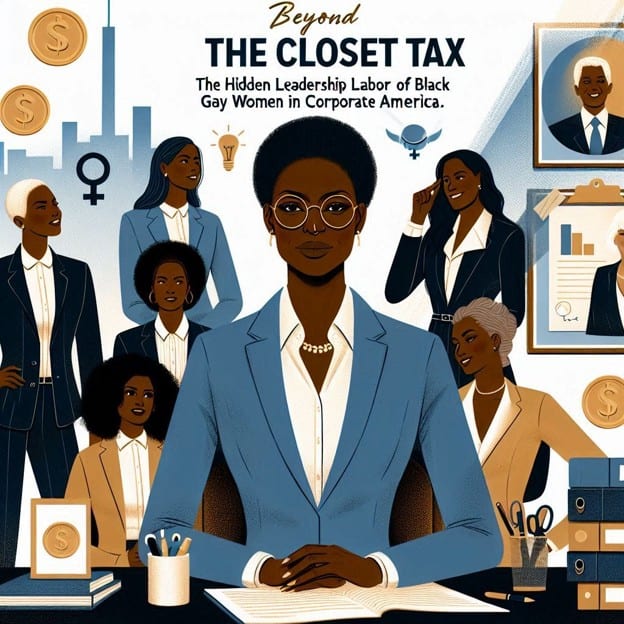
This is what I call the “Closet Tax”—the exhausting mental and emotional energy required to constantly navigate disclosure decisions in professional settings. It’s the cognitive burden of calculating whether mentioning your partner will derail your career trajectory. It’s the isolation of hearing heterosexual colleagues casually reference their families while you carefully edit your own life stories.
During Pride Month, as we celebrate progress in LGBTQ+ rights, it’s crucial to examine this hidden labor that Black gay women carry in corporate spaces. This burden isn’t just personal—it’s organizational inefficiency disguised as professional decorum.
The Double Standard of Authentic Sharing
In my book “High-Value Leadership: Transforming Organizations Through Purposeful Culture,” I discuss how authentic communication drives engagement and innovation. Yet for Black gay women, authenticity comes with unique professional risks that their heterosexual and white colleagues don’t face.
Consider this stark reality: when a white male executive mentions his wife and kids, it’s seen as personable leadership. When a Black gay woman mentions her partner, it becomes a “lifestyle choice” that some question in professional settings.
The Authenticity Penalty includes:
- Hyper-scrutiny of personal relationships
- Assumptions about “agenda” when advocating for inclusive policies
- Isolation from informal networks centered around heterosexual family activities
- Career consequences for the same authentic sharing praised in others
Dr. Kenji Yoshino’s research on “covering” reveals that 83% of LGBTQ+ individuals modify their behavior to fit heterosexual norms at work. For Black gay women, this covering carries additional layers of complexity as they navigate both racial and sexual orientation bias simultaneously.
The Emotional Labor Calculation
Every professional interaction requires Black gay women to perform what I call “The Disclosure Decision Matrix”—a split-second assessment of:
Environmental Safety: Is this person/situation safe for disclosure? Professional Impact: Will this information affect my career trajectory? Energy Conservation: Do I have the emotional bandwidth to handle potential reactions? Strategic Value: Does disclosure serve my professional goals?
This constant calculation is invisible labor that drains cognitive resources from actual leadership work. Research from the Williams Institute shows that workplace discrimination concerns cause LGBTQ+ employees to spend an average of 18 hours per week managing identity-related workplace stress.
Case Study: The Strategic Authenticity Journey
Consider the experience of Jasmine Rodriguez*, a Black lesbian woman who serves as Vice President of Operations at a Fortune 500 financial services company. When Jasmine joined the executive team three years ago, she carefully maintained what she calls “strategic ambiguity” about her personal life.
Phase 1: The Hiding Years For her first 18 months, Jasmine never mentioned her wife, Maria. She avoided company social events where partners were invited. She felt increasingly isolated as colleagues bonded over family stories she couldn’t share.
The cost was significant:
- Reduced authentic connections with team members
- Missed networking opportunities at family-inclusive events
- Increased stress from maintaining carefully constructed boundaries
- Decreased job satisfaction despite career advancement
Phase 2: The Awakening Everything changed when Jasmine attended a leadership development program where she learned about the business case for authentic leadership. She realized her carefully constructed boundaries were limiting her effectiveness.
Phase 3: Strategic Authenticity Implementation Working with an executive coach who understood intersectional challenges, Jasmine developed a strategic authenticity plan:
- Selective Disclosure: She began mentioning Maria in appropriate contexts, starting with trusted colleagues and employee resource group settings.
- Professional Integration: She leveraged her bilingual household (Maria speaks Spanish) to contribute insights about Latino market opportunities.
- Inclusive Leadership: She used her experience to create more inclusive team-building activities that didn’t assume heterosexual family structures.
- Ally Development: She identified and cultivated relationships with leaders who valued diverse perspectives.
The Results:
- Team engagement scores increased by 35%
- Her division captured $15M in new Latino market opportunities
- She was promoted to Senior VP within 12 months
- Employee satisfaction with inclusive leadership in her division reached company highs
*Name changed for privacy
The Business Cost of the Closet Tax
The Closet Tax isn’t just a personal burden—it’s organizational inefficiency with measurable costs:
Innovation Loss: When leaders can’t bring their whole selves to work, organizations lose valuable perspectives and market insights.
Engagement Deficit: Research shows that employees who can be authentic at work are 42% more likely to stay with their employer and 33% more productive.
Talent Retention: The stress of managing identity disclosure contributes to higher turnover rates among LGBTQ+ professionals, costing companies an average of $15,000-$50,000 per departure.
Market Blindness: Organizations that don’t leverage diverse leadership perspectives miss opportunities in increasingly diverse consumer markets.
Current Trends: The Shifting Landscape
Several trends are creating both opportunities and challenges for Black gay women in leadership:
Positive Developments:
- 94% of Fortune 500 companies now have LGBTQ+ inclusive policies
- Employee Resource Groups for LGBTQ+ professionals have grown 300% in five years
- Younger workforce expectations increasingly include authentic leadership
Persistent Challenges:
- Only 3% of senior executives are openly LGBTQ+
- Black LGBTQ+ women face compounded barriers in advancement
- Inclusion policies don’t always translate to inclusive cultures
Frameworks for Strategic Authenticity
Drawing from Audre Lorde’s wisdom that “the master’s tools will never dismantle the master’s house,” Black gay women must create new frameworks for authentic leadership. Here’s my strategic approach:
The BRIDGE Framework for Authentic Leadership
B – Build Your Foundation: Establish your leadership credibility before navigating disclosure decisions. Excellence becomes your shield.
R – Read the Environment: Develop sophisticated skills for assessing organizational culture, team dynamics, and individual receptiveness.
I – Identify Allies: Cultivate relationships with leaders who demonstrate inclusive values through actions, not just words.
D – Deploy Strategic Authenticity: Choose deliberate moments for authentic sharing that align with your professional goals and organizational impact.
G – Generate Systemic Change: Use your position to create more inclusive environments for others.
E – Evaluate and Evolve: Regularly assess the impact of your authenticity strategy and adjust as needed.
The Ally Assessment Tool
Not all allies are created equal. Use this framework to identify genuine advocates:
Surface Allies: Express support for LGBTQ+ rights but take no meaningful action Supportive Allies: Demonstrate inclusive behavior but may not actively advocate Strategic Allies: Use their privilege and position to create opportunities for LGBTQ+ advancement Transformational Allies: Work to change systems and challenge bias in organizational structures
Focus your energy on cultivating strategic and transformational allies who can provide both emotional support and professional advocacy.
Building Networks That Support, Not Tokenize
In “Rise & Thrive: A Black Woman’s Blueprint for Leadership Excellence,” I discuss the importance of building authentic professional networks. For Black gay women, this requires particular sophistication to avoid tokenization.
Authentic Network Building Strategies:
1. Intersectional Connections: Build relationships with others who understand multiple forms of marginalization, not just single-identity groups.
2. Cross-Identity Alliances: Cultivate relationships with leaders from different backgrounds who share values of inclusion and authentic leadership.
3. Professional Value Exchange: Ensure relationships are built on mutual professional benefit, not just diversity representation.
4. Strategic Visibility: Choose platforms and forums where your expertise, not your identity, takes center stage.
5. Mentorship Circles: Create and participate in mentoring relationships that address both professional development and identity navigation.
Expert Insights: The Psychology of Hidden Labor
Dr. Ilan Meyer’s groundbreaking research on minority stress theory explains why the Closet Tax creates such significant psychological burden. His studies show that the chronic stress of managing stigmatized identities can:
- Reduce cognitive capacity for complex problem-solving
- Decrease workplace satisfaction and engagement
- Increase turnover intentions
- Impact physical and mental health
For Black gay women, this stress is compounded by what Dr. Kimberlé Crenshaw calls “intersectional invisibility”—being overlooked because their experiences don’t fit single-identity frameworks.
Practical Strategies for Reducing the Closet Tax
For Individual Leaders:
1. Develop Your Authenticity Roadmap
- Assess your current level of authenticity at work
- Identify specific contexts where increased authenticity would serve your goals
- Create a timeline for strategic disclosure decisions
- Build support systems for each phase of your journey
2. Master the Art of Strategic Sharing
- Practice natural ways to reference your partner in professional contexts
- Develop comfort with boundary-setting when people ask intrusive questions
- Use your experiences to provide valuable business insights
- Connect your personal authenticity to professional effectiveness
3. Build Your Ally Network Systematically
- Identify potential allies through their actions, not just their words
- Cultivate relationships gradually, based on professional mutual benefit
- Educate allies about how they can support without tokenizing
- Create accountability structures within your network
4. Document Your Leadership Impact
- Track how authenticity affects your leadership effectiveness
- Gather evidence of business results from inclusive leadership
- Share your story strategically to create pathways for others
- Use your success to advocate for systemic changes
For Organizations:
1. Address Systemic Barriers
- Audit policies for heteronormative assumptions
- Create inclusive language in communications and benefits
- Ensure leadership development programs address intersectional experiences
- Measure and track inclusion beyond just representation numbers
2. Develop Inclusive Leadership Competencies
- Train leaders to recognize and interrupt bias
- Create psychological safety for authentic leadership expression
- Reward inclusive leadership behaviors in performance evaluations
- Provide coaching for leaders navigating authenticity challenges
Pride Month Action Plan: Moving Beyond Tolerance to Transformation
This Pride Month, commit to actions that reduce the Closet Tax for Black gay women in your organization:
Week 1: Assessment
- Evaluate your workplace culture for authentic inclusion
- Identify Black LGBTQ+ women leaders and understand their experiences
- Assess your own role in creating psychological safety
Week 2: Education
- Learn about intersectional experiences through education and listening
- Understand the difference between equality and equity in LGBTQ+ inclusion
- Research best practices from organizations leading in this area
Week 3: Action
- Implement at least one policy or practice change that increases inclusion
- Begin building authentic relationships with LGBTQ+ colleagues
- Use your influence to challenge bias when you see it
Week 4: Advocacy
- Become a vocal advocate for systemic changes in your organization
- Mentor or sponsor Black LGBTQ+ professionals
- Share your learning and commitment with your network
Creating Cultural Multiplier Effects
As I discuss in “Mastering a High-Value Company Culture,” authentic leaders create ripple effects that transform entire organizational cultures. When Black gay women can lead authentically, they:
- Model inclusive leadership for others
- Create psychological safety that benefits all employees
- Drive innovation through diverse perspectives
- Build market insights that improve business results
- Demonstrate that success doesn’t require conformity
Discussion Questions and Strategic Planning
As you consider how to address the Closet Tax in your leadership or organization, reflect on these questions:
- Personal Awareness: Where do you see the Closet Tax operating in your workplace? How might it be affecting leadership effectiveness?
- Organizational Culture: What systems, policies, or practices in your organization create additional burdens for Black LGBTQ+ women leaders?
- Ally Development: How can you move from being a supportive ally to a strategic or transformational ally?
- Business Impact: What opportunities might your organization be missing by not fully leveraging the perspectives of Black gay women leaders?
- Systemic Change: What specific actions could you take to reduce the hidden labor burden for intersectional leaders in your sphere of influence?
The Innovation Opportunity Hidden in Plain Sight
The Closet Tax represents more than just individual burden—it’s organizational waste of human potential. Black gay women who have navigated multiple forms of marginalization possess extraordinary skills in:
- Reading complex social dynamics
- Building bridges across differences
- Creating inclusive environments
- Identifying overlooked market opportunities
- Managing change and uncertainty
When organizations reduce the Closet Tax, they unlock these capabilities for business advantage.
Ready to Transform Your Leadership Culture?
Addressing the Closet Tax requires intentional strategy and systemic change. At Che’ Blackmon Consulting, we specialize in helping leaders and organizations create authentic inclusion that drives measurable results.
Our services include:
- Intersectional Leadership Development that addresses multiple identity navigation
- Inclusive Culture Transformation that goes beyond policies to practices
- Executive Coaching for leaders navigating authenticity challenges
- Organizational Assessment that identifies hidden barriers to authentic leadership
Whether you’re a leader seeking to navigate intersectional challenges or an organization committed to reducing the Closet Tax for all employees, we can help you create sustainable transformation.
Ready to move beyond tolerance to transformation? Contact us at admin@cheblackmon.com or call 888.369.7243. Let’s create the high-value culture where authentic leadership isn’t just accepted—it’s unleashed.
Remember Audre Lorde’s revolutionary insight: while the master’s tools may not dismantle the master’s house, we can create new tools that build houses where everyone can thrive. Your authentic leadership is one of those tools.
The time has come to move beyond the Closet Tax to authentic leadership advantage. The question isn’t whether you can afford to be authentic—it’s whether your organization can afford for you not to be.
Che’ Blackmon is a Human Resources strategist, author, and organizational culture transformation expert. Her books “Mastering a High-Value Company Culture,” “High-Value Leadership,” and “Rise & Thrive” provide frameworks for authentic leadership and inclusive organizational development. Learn more at cheblackmon.com.
#ClosetTax #IntersectionalLeadership #BlackLGBTQ+ #AuthenticLeadership #PrideMonth #InclusiveLeadership #HiddenLabor #DiversityAndInclusion #CorporateInclusion #LeadershipDevelopment #WorkplaceEquity #OrganizationalTransformation #BlackWomenInLeadership #ExecutivePresence #CulturalTransformation #StrategicAuthenticity #AllyDevelopment #BusinessCase

Leave a Reply