“The function of freedom is to free someone else.” – Toni Morrison
When Denise, a VP at a Fortune 500 company, advocated for a promising Black woman analyst to join a high-visibility project, she faced unexpected pushback. “Are you sure she’s ready?” came the coded questions. “Maybe we should wait.” Despite the analyst’s stellar performance record, Denise found herself defending not just her recommendation, but her own judgment. Sound familiar?
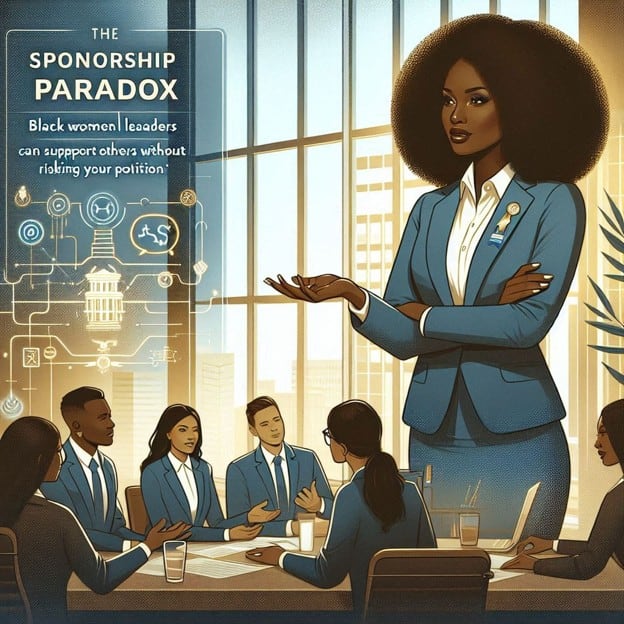
This scenario illustrates the sponsorship paradox many Black women leaders face: the profound responsibility to lift others while navigating the precarious reality that our own positions often hang in the balance. Unlike our white counterparts who can sponsor without scrutiny, we risk having our leadership questioned when we advocate for diverse talent.
Yet the data is clear. According to research by Catalyst, employees with sponsors are 23% more likely to move up, and sponsorship is particularly crucial for Black women who face both racial and gender barriers in advancement. The question isn’t whether we should sponsor—it’s how we can do it strategically while protecting our own influence.
Understanding the Unique Challenges
The Hypervisibility Factor
As Black women in leadership, we exist in a state of hypervisibility where our actions carry outsized consequences. When we sponsor someone who succeeds, we rarely get credit for our judgment. When they struggle, we’re seen as playing favorites or lacking business acumen. This creates what I call “advocacy anxiety”—the fear that supporting others might undermine our own credibility.
In my work with executives across industries, I’ve observed that Black women leaders often carry an invisible tax. We’re expected to be diversity champions while simultaneously proving we’re not just diversity hires ourselves. This double burden makes sponsorship feel like a high-stakes gamble rather than a natural leadership behavior.
The Scarcity Mindset Trap
Organizations often operate under the false assumption that there’s only room for one or two Black women at senior levels. This scarcity mindset creates artificial competition and can make sponsorship feel like giving away our spot. Yet research consistently shows that diverse leadership teams outperform homogeneous ones. When we sponsor others, we’re not diluting our influence—we’re amplifying it.
Strategic Sponsorship: A Framework for Success
Drawing from the principles in “High-Value Leadership: Transforming Organizations Through Purposeful Culture,” successful sponsorship requires both authenticity and strategy. Here’s how to navigate this complex terrain:
1. Build Your Sponsorship Strategy on Business Value
The most effective sponsors don’t lead with diversity arguments—they lead with business impact. Instead of saying, “We need more diversity,” try, “Based on her track record with our largest client and her innovative approach to market expansion, Sarah is positioned to drive significant revenue growth in the emerging markets division.”
Practical Example: Maria, a Black woman director at a tech company, successfully sponsored three junior colleagues by framing each recommendation around specific business needs. She documented their achievements, quantified their impact, and presented sponsorship as talent optimization rather than diversity initiative.
2. Create a “Sponsorship Portfolio”
Don’t put all your advocacy eggs in one basket. Sponsor multiple people across different backgrounds, levels, and functions. This approach demonstrates your commitment to organizational excellence rather than personal favoritism.
The 3-2-1 Rule:
- 3 people from underrepresented groups
- 2 people from majority groups
- 1 person in a completely different department
This diversified approach shields you from accusations of bias while maximizing your impact across the organization.
3. Document Everything
Keep detailed records of your sponsees’ achievements, challenges, and growth. This documentation serves multiple purposes:
- Provides objective evidence of their capabilities
- Demonstrates your thoughtful approach to development
- Creates a track record of your sponsorship success
The Evolution of Leadership and Sponsorship
Dave Ulrich’s recent update on the HR Business Partner model emphasizes the evolution toward “stakeholder value” rather than just “knowing the business.” This shift is particularly relevant for Black women leaders engaged in sponsorship. As Ulrich notes, “HR work should also be included in engagements with external stakeholders,” suggesting that our sponsorship efforts should be viewed as strategic stakeholder investments rather than internal favors.
The evolution from “human capital” to “human capability” that Ulrich describes aligns perfectly with strategic sponsorship—focusing on “marketplace value through talent + leadership + organization + HR function.” When we sponsor others, we’re building organizational capability that creates external value.
Case Study: The Multiplier Effect
Consider the case of Angela, a Black woman chief marketing officer who systematically sponsored eight professionals over five years. Rather than seeing this as risky, she positioned herself as a “talent architect” who could identify and develop high-potential employees. Her approach:
Year 1-2: Focused on building her own credibility and documenting her business impact Year 3: Began sponsoring one person while continuing to deliver exceptional results Year 4-5: Expanded to multiple sponsees, creating a “leadership pipeline”
The result? Angela’s reputation as a talent developer became a key differentiator in her promotion to executive vice president. Her sponsees went on to drive significant business outcomes, creating a multiplier effect that enhanced her own standing.
Risk Mitigation Strategies
1. The “Business Case” Approach
Always frame sponsorship in business terms:
- “This person’s unique perspective will help us capture the growing multicultural market”
- “Their background in X gives them insights our current team lacks”
- “Based on their performance metrics, they’re positioned to drive Y results”
2. The “Gradual Exposure” Method
Rather than immediately recommending someone for a high-profile role, create stepped opportunities:
- Cross-functional project participation
- Presentation opportunities in smaller settings
- Leadership of internal initiatives
- Gradual increase in visibility and responsibility
3. The “Coalition Building” Strategy
Partner with other leaders (including allies from majority groups) to co-sponsor individuals. This distributes risk while building broader organizational support.
Practical Implementation Framework
Phase 1: Foundation Building (Months 1-3)
- Assess your own organizational capital and influence
- Identify potential sponsees using objective criteria
- Document their current capabilities and potential
Phase 2: Strategic Positioning (Months 4-6)
- Begin creating opportunities for visibility
- Provide guidance on organizational navigation
- Build broader awareness of their capabilities
Phase 3: Active Advocacy (Months 7-12)
- Recommend for stretch assignments
- Advocate in promotion discussions
- Provide air cover during challenges
Phase 4: Multiplication (Year 2+)
- Develop multiple sponsees simultaneously
- Create systems for ongoing support
- Measure and communicate impact
Measuring Success
Track both individual and systemic outcomes:
Individual Metrics:
- Career advancement of sponsees
- Performance improvements
- Increased visibility and influence
Organizational Metrics:
- Leadership pipeline diversity
- Retention rates
- Innovation metrics
- Team performance
Personal Metrics:
- Your reputation as a talent developer
- Expansion of your network
- Enhancement of your leadership brand
Current Trends and Best Practices
The Rise of Reverse Mentoring
Smart organizations are recognizing that diverse junior talent brings valuable perspectives that can inform senior leadership decisions. Position your sponsorship as accessing this strategic insight.
Data-Driven Talent Decisions
Use analytics to support your sponsorship decisions. Present clear metrics on performance, potential, and projected impact. This approach aligns with the broader trend toward evidence-based talent management.
Inclusive Leadership as Competitive Advantage
Frame your sponsorship efforts within the larger context of inclusive leadership—a proven driver of innovation and market responsiveness.
The Compound Effect of Strategic Sponsorship
When done strategically, sponsorship creates a compound effect that strengthens rather than weakens your position. Each successful sponsee becomes a node in your network, an advocate for your leadership, and evidence of your talent development capabilities.
Remember, as I discussed in “Mastering a High-Value Company Culture,” culture is the lifeblood of any organization. When you sponsor others strategically, you’re not just advancing individual careers—you’re transforming organizational culture one leader at a time.
The sponsorship paradox is real, but it’s not insurmountable. By approaching sponsorship as a strategic business practice rather than a diversity obligation, we can lift others while elevating ourselves. This isn’t about choosing between our success and theirs—it’s about creating a multiplier effect that benefits everyone.
Discussion Questions and Next Steps
For Individual Reflection:
- What fears or concerns do you have about sponsoring others in your organization?
- How can you reframe sponsorship as a business strategy rather than a personal risk?
- Who in your network could you begin sponsoring using the framework outlined above?
For Team Discussion:
- How can your organization better support strategic sponsorship efforts?
- What systems could you implement to track the business impact of sponsorship?
- How might you create “sponsorship partnerships” with other leaders?
Next Steps:
- Identify 2-3 potential sponsees using objective business criteria
- Document their current capabilities and potential impact
- Create a 6-month sponsorship plan using the phased approach
- Build a coalition of other leaders who share your commitment to talent development
- Establish metrics to track both individual and organizational outcomes
Ready to transform your approach to sponsorship from risk to strategic advantage? The principles outlined here are just the beginning of what’s possible when you master the art of lifting while climbing.
📞 Ready to unlock your authentic leadership advantage? Contact: admin@cheblackmon.com | Call: 888.369.7243
Get the Complete Blueprint Master the frameworks from this week’s articles with “Rise & Thrive: A Black Woman’s Blueprint for Leadership Excellence” – your strategic guide to authentic leadership that drives results.
🔗 Get Your Copy: https://adept-solutions-llc-2.kit.com/products/rise-thrive-a-black-womans-bluepri
Join the Academy Want deeper transformation? Join the waitlist for Rise & Thrive Academy – the premier leadership development experience for Black women ready to leverage their authentic advantage.
🔗 Join the Waitlist: https://adept-solutions-llc-2.kit.com/6b1638bc22
#BlackWomenLeadership #Sponsorship #DiversityAndInclusion #LeadershipDevelopment #CareerAdvancement #WomenInLeadership #InclusiveLeadership #ProfessionalDevelopment #ExecutiveCoaching #TalentDevelopment #CorporateLeadership #LeadershipStrategy #AuthenticLeadership #WorkplaceDiversity #LeadershipExcellence

Leave a Reply