“Culture isn’t what you say—it’s what you do when nobody’s watching.”
Sarah, a newly promoted HR Director at a mid-sized healthcare company, sat across from me during our initial consultation. She’d read every leadership book on the market. She could recite organizational theories fluently. Yet her team was struggling with high turnover, low morale, and a culture that felt disconnected from the company’s stated values.
“I know what we should be doing,” she said, frustration evident in her voice. “But I can’t figure out how to make it actually happen day-to-day.”
Sarah’s challenge isn’t unique. In my twenty-plus years transforming organizational cultures, I’ve discovered that the gap between knowing and doing is where most culture initiatives fail. It’s one thing to understand high-value principles—it’s another entirely to embed them into the daily rhythms of work life.
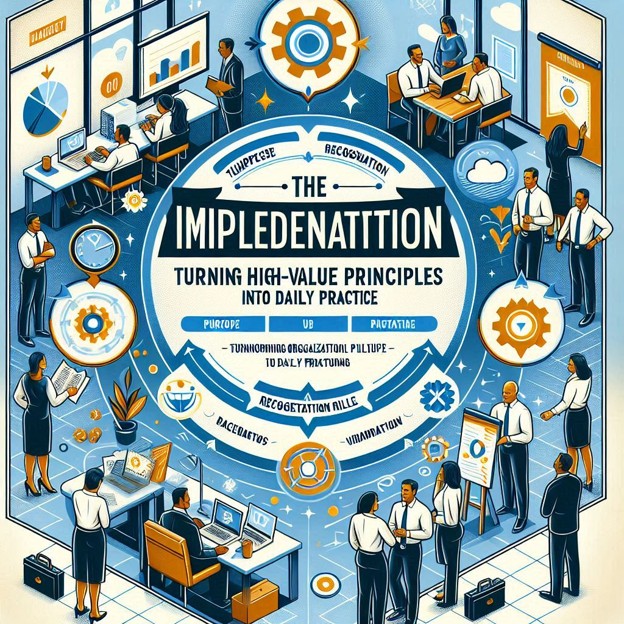
This implementation playbook bridges that gap. It transforms the concepts from “Mastering a High-Value Company Culture” and “High-Value Leadership” into actionable daily practices that create real, measurable change.
The Monday Morning Reality Check
Here’s the truth: Your culture isn’t defined by the motivational posters on your walls or the values statement on your website. It’s defined by what happens at 9:15 AM on a rainy Monday when deadlines are looming and tempers are short.
High-value culture lives in the micro-moments:
- How managers respond to mistakes
- Whether meetings start with genuine check-ins or dive straight into tasks
- If diverse voices are actively sought or merely tolerated
- When leaders choose transparency over convenience
- How conflicts are navigated versus avoided
As I detailed in “High-Value Leadership,” transformation happens through purposeful daily actions, not grand gestures. Let’s explore how to make this real.
The PRACTICE Framework: Your Daily Implementation Guide
After years of helping organizations operationalize their values, I’ve developed the PRACTICE framework—a systematic approach to embedding high-value principles into everyday work:
P – Purpose-Driven Morning Huddles
R – Recognition Rituals
A – Accountability Check-ins
C – Collaborative Decision-Making
T – Transparent Communication
I – Inclusive Practices
C – Continuous Learning Loops
E – Empowerment Actions
Let’s break down each element with real-world applications.
P – Purpose-Driven Morning Huddles
The Principle: Start each day connecting work to meaning.
The Practice: Begin team meetings with a 2-minute purpose moment. One team member shares how their work from the previous day connected to the organization’s larger mission.
Real Example: At a financial services firm I worked with, the customer service team started each shift by sharing one customer story that reminded them why their work mattered. Within three months, customer satisfaction scores increased by 18% and employee engagement rose by 22%.
Implementation Tip: Rotate who shares to ensure everyone connects their role to purpose. Keep it brief but meaningful.
R – Recognition Rituals
The Principle: What gets recognized gets repeated.
The Practice: Institute “Value Spotting Fridays” where team members publicly recognize colleagues who demonstrated core values in action.
The Double-Bind Advantage™: As I discuss in “Rise & Thrive,” Black women often face the challenge of being simultaneously hyper-visible and invisible. Strategic recognition rituals can help address this paradox by ensuring all contributions are seen and celebrated equitably.
Real Example: A technology startup implemented a digital “kudos board” where employees could post real-time recognition. They discovered that women, particularly women of color, were contributing innovative solutions that had previously gone unnoticed. Making recognition visible and systematic uncovered hidden talent and drove a 40% increase in innovation metrics.
A – Accountability Check-ins
The Principle: Accountability isn’t about blame—it’s about collective ownership.
The Practice: Weekly 15-minute team accountability circles where each person shares:
- One commitment from last week and its status
- One commitment for the coming week
- Any support needed
Implementation Tip: Frame accountability as support, not surveillance. Ask “What do you need to succeed?” not “Why didn’t you deliver?”
C – Collaborative Decision-Making
The Principle: Diverse perspectives drive better outcomes.
The Practice: Implement the “VOICES Protocol” for important decisions:
- Various perspectives sought actively
- Options explored without immediate judgment
- Impact on all stakeholders considered
- Consensus built through dialogue
- Execution plan co-created
- Success metrics defined together
Real Example: When a manufacturing company used this protocol for a major process change, they uncovered insights from line workers that saved $2.3 million and reduced implementation time by six months. The key? They included voices traditionally excluded from strategic decisions.
T – Transparent Communication
The Principle: Trust grows in transparency.
The Practice: Institute “Transparency Tuesdays” where leaders share:
- One organizational challenge currently being addressed
- Progress on key initiatives
- Upcoming changes and the reasoning behind them
The Leadership Evolution: Dave Ulrich’s recent update on the HR Business Partner model emphasizes that “HR issues are at the table as an integral part of any business discussion.” This transparency must extend beyond HR to all organizational communications. Leaders who share both struggles and successes build cultures of trust.
I – Inclusive Practices
The Principle: Inclusion is active, not passive.
The Practice: Implement meeting equity practices:
- Rotate meeting leadership
- Use anonymous digital polling for sensitive topics
- Institute “amplification” where team members repeat and credit good ideas from underrepresented voices
- Create space for introverts through written pre-meeting input options
Statistical Reality: Research shows that in typical meetings, men speak 75% of the time. Creating structured inclusive practices ensures all voices contribute to organizational success.
C – Continuous Learning Loops
The Principle: Failure is data, not defeat.
The Practice: End each project with a “Learning Harvest”:
- What worked well?
- What didn’t work as expected?
- What would we do differently?
- What knowledge can we share with other teams?
Real Example: A healthcare system implemented learning harvests after every patient safety incident. Instead of blame, they focused on system improvements. Result? 43% reduction in incidents and a culture where staff felt safe reporting near-misses.
E – Empowerment Actions
The Principle: Empowerment requires actual power transfer.
The Practice: Create “Decision Rights Maps” that clearly show:
- What decisions team members can make independently
- What requires consultation
- What needs approval
- Budget authority at each level
The Transformation: One retail chain gave store managers budget authority for local community partnerships. This empowerment led to a 30% increase in community engagement and a 15% boost in local sales, proving that distributed power drives results.
Case Study: From Theory to Transformation
Let me share how these principles transformed FlavorFast (name changed), a quick-service restaurant chain struggling with inconsistent culture across 200 locations.
The Challenge:
- High turnover (150% annually)
- Inconsistent customer experience
- Disconnect between corporate values and daily operations
- Low employee engagement scores
The Implementation Journey:
Month 1-2: Foundation Setting
- Trained all managers in the PRACTICE framework
- Started daily purpose huddles in every location
- Launched digital recognition platform
Month 3-4: Building Momentum
- Implemented weekly accountability circles
- Introduced collaborative decision-making for local marketing
- Started Transparency Tuesday video messages from CEO
Month 5-6: Deepening Practice
- Rolled out meeting equity practices
- Launched monthly learning harvests
- Created decision rights maps for each role
The Results (After 18 Months):
- Turnover reduced to 87% (industry average: 125%)
- Customer satisfaction increased 24%
- Employee engagement rose from 42% to 71%
- Same-store sales grew 12%
The secret? They didn’t just train on concepts—they embedded specific practices into daily operations.
Your 90-Day Quick Start Guide
Ready to implement? Here’s your roadmap:
Days 1-30: Foundation
- Week 1: Assess current state using the Culture Reality Audit (see tools section)
- Week 2: Select 2-3 PRACTICE elements to pilot
- Week 3: Train team leaders on selected practices
- Week 4: Launch pilot with one team
Days 31-60: Expansion
- Week 5-6: Gather feedback and refine approaches
- Week 7-8: Expand to additional teams
- Create “Culture Champions” in each department
Days 61-90: Embedding
- Week 9-10: Integrate practices into performance discussions
- Week 11-12: Celebrate early wins and share success stories
- Plan full rollout based on pilot learnings
The Technology Amplifier
Modern tools can accelerate culture implementation:
- Slack/Teams channels for real-time recognition
- Anonymous polling apps for inclusive input
- Video messages for leader transparency
- Digital dashboards for accountability tracking
- AI tools for meeting equity monitoring
As Ulrich notes, AI in HR is “only 20-30% up the S-curve,” meaning massive opportunity exists for technology to enable culture transformation.
Overcoming Common Implementation Obstacles
“We don’t have time for all these practices” Start with one. A two-minute purpose moment creates more productivity than it consumes. Time invested in culture pays compound returns.
“Our leaders won’t buy in” Begin with willing early adopters. Success stories create converts faster than mandates. Document ROI religiously.
“We’re too distributed/remote” Virtual teams need MORE intentional culture practices, not fewer. Every practice can be adapted for digital environments.
“This feels like just more meetings” These aren’t additional meetings—they’re improvements to existing interactions. Transform what you’re already doing rather than adding more.
Measuring What Matters
Track implementation through both leading and lagging indicators:
Leading Indicators (Weekly):
- Participation rates in practices
- Recognition frequency
- Number of diverse voices in decisions
- Learning harvests completed
Lagging Indicators (Quarterly):
- Employee engagement scores
- Turnover rates
- Customer satisfaction
- Innovation metrics
- Financial performance
The Compound Effect of Daily Practice
Here’s what I’ve learned after decades in this work: Culture transformation isn’t about perfection—it’s about direction. Small, consistent actions compound into remarkable change.
When you implement even three of these practices consistently for 90 days, you’ll see:
- Increased trust and psychological safety
- Higher engagement and retention
- Improved decision quality
- Accelerated innovation
- Better business results
Most importantly, you’ll create an environment where everyone—including traditionally overlooked talent—can thrive.
Discussion Questions for Your Leadership Team
- Which PRACTICE element would address our most pressing cultural challenge?
- What specific behaviors do we need to see more of, and how can these practices encourage them?
- How might these implementations need to be adapted for our unique context?
- What resistance might we encounter, and how can we address it proactively?
- Who are our potential Culture Champions, and how can we empower them?
- What would wild success look like 90 days from now?
- How can we ensure these practices are inclusive of all voices, particularly those traditionally marginalized?
Your Next Steps
- Download our free Culture Reality Audit tool to assess your starting point
- Choose 2-3 PRACTICE elements that address your biggest opportunities
- Schedule a team meeting to introduce your pilot plan
- Commit to 90 days of consistent implementation
- Document your journey and results
Ready to Accelerate Your Culture Transformation?
While this playbook provides a robust framework for implementation, every organization faces unique challenges. If Sarah’s story resonates with you—if you know what needs to happen but struggle with the how—you don’t have to navigate this journey alone.
Che’ Blackmon Consulting specializes in:
- Custom implementation roadmaps for your specific context
- Leader coaching on high-value practices
- Culture Champion development programs
- Implementation accountability partnerships
- ROI measurement and optimization
We’ve helped organizations reduce turnover by 50%, increase engagement by 60%, and drive significant improvements in business results—all through practical, daily culture practices.
Let’s explore how we can accelerate your culture transformation.
📧 Contact us at admin@cheblackmon.com
📱 Call 888.369.7243
🌐 Visit https://cheblackmon.com
Because culture transformation doesn’t happen in the boardroom—it happens in the break room, the Zoom room, and every room where your people show up to work.
Remember: You don’t need perfect conditions to start. You just need to start. Your consistent daily practices will create the high-value culture your organization deserves.
What practice will you implement first?
Che’ Blackmon is the founder of Che’ Blackmon Consulting and author of “Mastering a High-Value Company Culture,” “High-Value Leadership: Transforming Organizations Through Purposeful Culture,” and “Rise & Thrive: A Black Woman’s Blueprint for Leadership Excellence.” With over 20 years of experience transforming organizational cultures, she helps leaders turn high-value principles into daily practices that drive measurable results.
#HighValueLeadership #CompanyCulture #OrganizationalTransformation #LeadershipDevelopment #CultureChange #EmployeeEngagement #WorkplaceCulture #BusinessTransformation #HRStrategy #LeadershipCoaching #CultureTransformation #PurposefulLeadership #TeamEngagement #WorkplaceInnovation #InclusiveLeadership

Leave a Reply