By Che’ Blackmon
The executive stood in front of her leadership team and said the words that leaders are taught never to say: “I don’t know.”
She admitted that the strategy wasn’t working. That she’d made the wrong call on a major investment. That she needed their help to figure out the path forward.
The room went silent. Then something remarkable happened.
Her team leaned in. Ideas started flowing. People who’d been quietly disengaged for months suddenly became invested in solving the problem together. Trust deepened. Innovation accelerated. The vulnerability that conventional leadership wisdom says destroys credibility actually strengthened it.
Brené Brown has spent two decades researching vulnerability, courage, and leadership. Her core finding? Vulnerability isn’t weakness—it’s the most accurate measure of courage. Leaders who can be authentic about uncertainty, acknowledge mistakes, and show up as fully human don’t lose respect. They earn it. 💪🏾
But here’s where the conversation gets complicated: vulnerability in leadership isn’t equally safe or equally valued across all identities. When a white male CEO admits uncertainty, it’s often celebrated as authenticity and emotional intelligence. When a Black woman leader shows the same vulnerability, she risks confirming stereotypes about competence, being seen as unprepared, or having her authority undermined.
So yes, Brené Brown was right about leadership. Vulnerability is powerful. But we need to talk about how power, privilege, race, and gender shape who gets to be vulnerable—and at what cost.
What Vulnerability Actually Means in Leadership
Let’s start by clarifying what we’re talking about. Vulnerability in leadership doesn’t mean:
❌ Oversharing personal struggles inappropriately
❌ Using your team as your therapist
❌ Abdicating responsibility or decision-making authority
❌ Constant self-doubt or lack of confidence
❌ Emotional volatility or unpredictability
Vulnerability in leadership does mean:
✅ Acknowledging when you don’t have all the answers
✅ Admitting mistakes and taking responsibility
✅ Being honest about challenges the organization faces
✅ Asking for help and input from others
✅ Showing appropriate emotion and humanity
✅ Taking interpersonal risks to build genuine connection
✅ Being transparent about your values and what matters to you
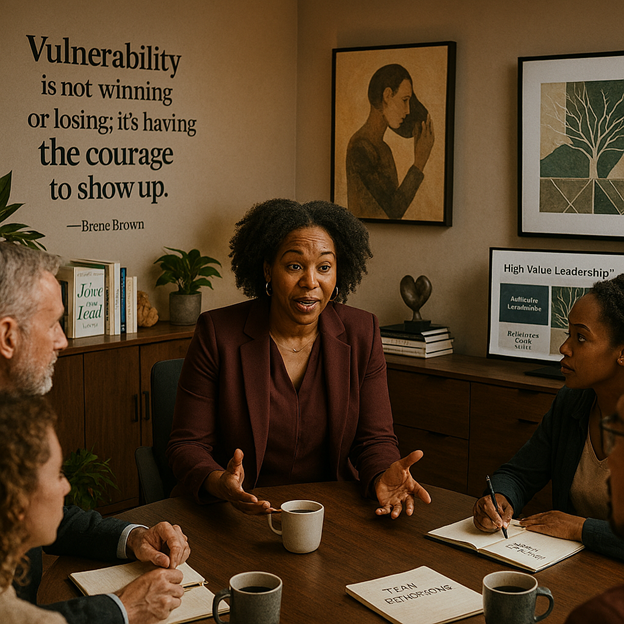
As Brown writes in Dare to Lead, “Vulnerability is not winning or losing; it’s having the courage to show up and be seen when we have no control over the outcome.” In leadership, that means making decisions without certainty, having difficult conversations without guaranteed outcomes, and leading through ambiguity without pretending you have it all figured out.
Research backs this up. A study published in the Journal of Applied Psychology found that leaders who demonstrated appropriate vulnerability—admitting mistakes, acknowledging limitations, asking for feedback—were rated as more effective by their teams and inspired higher levels of trust and psychological safety.
Google’s Project Aristotle, which studied hundreds of teams to identify what makes them successful, found that psychological safety—the belief that you can take risks without being punished or humiliated—was the single most important factor. And psychological safety starts with leaders modeling vulnerability.
The Business Case: Why Vulnerable Leadership Works 📊
Organizations benefit measurably when leaders practice authentic vulnerability:
Innovation Increases: When leaders admit they don’t have all the answers, teams feel empowered to experiment, take risks, and propose unconventional solutions. Research from Harvard Business School shows that psychological safety—created through leader vulnerability—directly correlates with innovation outcomes.
Trust Deepens: Employees trust leaders who are authentic more than leaders who project perfection. Edelman’s Trust Barometer consistently shows that authenticity is a key driver of trust in leadership.
Engagement Rises: Gallup research demonstrates that employees who feel their leaders care about them as people (not just as workers) are significantly more engaged. Vulnerability signals that you see employees as humans, not just resources.
Retention Improves: People don’t leave jobs—they leave managers. When leaders create psychologically safe environments through vulnerability, employees are more likely to stay, even during challenging times.
Decision-Making Improves: Leaders who can say “I don’t know” create space for diverse perspectives, which leads to better decisions. Research from Harvard Business Review shows that inclusive decision-making (which requires leader vulnerability) produces better business outcomes.
Organizational Resilience Strengthens: Companies led by vulnerable, authentic leaders navigate crises more effectively because employees trust leadership’s transparency and feel invested in solutions.
As I discuss in “High-Value Leadership: Transforming Organizations Through Purposeful Culture,” high-value organizations don’t demand perfection from leaders—they demand authenticity, accountability, and the courage to be human.
The Complication: Vulnerability and Identity 🎭
Here’s where Brown’s research, while groundbreaking, requires additional context for leaders from marginalized identities: vulnerability carries different risks depending on who you are.
The Gender Paradox
Women leaders are told to be authentic and vulnerable—right up until they actually are, at which point they’re often labeled as “too emotional,” “not executive material,” or “lacking confidence.”
Research from NYU’s Stern School of Business found that when women leaders show emotion, they’re judged more harshly than men showing identical emotions. Women’s tears are seen as unprofessional; men’s tears are seen as passionate commitment. Women’s admission of uncertainty is seen as incompetence; men’s is seen as thoughtful deliberation.
The Racial Dimension
For Black women leaders, the stakes of vulnerability are even higher. You’re already fighting stereotypes about competence, navigating the “angry Black woman” trope, and working twice as hard to establish credibility. Showing vulnerability can feel like confirming others’ doubts rather than demonstrating courage.
Dr. Ella F. Washington’s research on Black women’s leadership shows that Black women describe feeling they must project “twice the confidence” and “half the vulnerability” compared to white colleagues to be taken seriously. One participant in her study said: “I can’t afford to not know something. White men get promoted on potential. I get evaluated on perfection.”
As I write in “Rise & Thrive: A Black Woman’s Blueprint for Leadership Excellence,” Black women leaders navigate a painful double bind: be authentic and vulnerable (and risk confirming stereotypes), or project invulnerability (and be labeled as cold, unapproachable, or inauthentic). Neither path is safe.
The Authority Tax
There was a technology company where a white male executive and a Black woman executive made similar admissions in separate leadership meetings. The white man said, “I made a strategic error on this acquisition. Here’s what I learned.” His team rallied around him, seeing it as courageous accountability.
The Black woman said almost identical words about a different decision. Her team’s reaction was different. Some questioned whether she was the right person for the role. Others expressed concern about her judgment. Within weeks, her authority was being undermined in ways his never was.
Same vulnerability. Dramatically different outcomes.
This isn’t to say Black women shouldn’t be vulnerable—it’s to acknowledge that the cost-benefit analysis is different, and we need organizational cultures that make vulnerability safe for everyone, not just those already perceived as competent by default.
Strategic Vulnerability: A Framework for All Leaders 💎
Given these complexities, how do we practice vulnerability strategically—especially for leaders navigating marginalized identities?
1. Build Your Foundation First
Vulnerability works best when it’s built on a foundation of demonstrated competence and established credibility. This shouldn’t be necessary in a perfect world, but in the real world, it matters.
For Black women leaders, this often means:
- Documenting your expertise and accomplishments thoroughly
- Building a track record before taking major vulnerability risks
- Establishing your authority clearly before showing uncertainty
- Creating political capital before spending it on vulnerability
This isn’t about being inauthentic—it’s about being strategic. As I emphasize in “Mastering a High-Value Company Culture,” high-value leaders understand that context matters. The same behavior that builds trust in one context might undermine authority in another.
2. Choose Your Moments
Not every moment requires vulnerability, and not every audience is safe for it. Strategic vulnerability means discerning:
Safe spaces: Where can you be most vulnerable? (Trusted peers, executive coaches, close mentors, therapy, peer networks outside your organization)
Calculated risks: Where might vulnerability serve your goals? (Team meetings where you need input, moments when admitting uncertainty models the behavior you want from others)
Protected boundaries: Where should you maintain more professional distance? (Initial interactions with new stakeholders, contexts where your authority is already being questioned, situations with people who’ve demonstrated untrustworthiness)
There was a Black woman executive who kept two different “vulnerability budgets.” With her trusted leadership team, she was increasingly open about challenges and uncertainties. In broader organizational contexts where her credibility was still being established, she was more measured and strategic. This wasn’t dishonest—it was discerning.
3. Frame Vulnerability as Strength
How you present vulnerability matters as much as the vulnerability itself.
Weaker framing: “I don’t know what to do. I’m overwhelmed.”
Stronger framing: “This challenge is complex. I don’t have all the answers yet, which is why I’m bringing together the smartest people I know to solve it together.”
Weaker framing: “I made a terrible mistake.”
Stronger framing: “I made a decision that didn’t produce the results we needed. Here’s what I learned and how we’re adjusting course.”
Notice the difference? The second framings acknowledge reality while demonstrating leadership—taking ownership, showing strategic thinking, inviting collaboration.
4. Pair Vulnerability with Competence
Research suggests that leaders are most effective when they demonstrate both warmth (which includes vulnerability) and competence. Show both simultaneously:
“I don’t know the right answer here [vulnerability], and here’s my plan for how we’ll figure it out [competence].”
“I made an error in judgment on this project [vulnerability], and I’ve already implemented three changes to prevent similar issues going forward [competence].”
This combination prevents vulnerability from being misread as incompetence.
5. Create Psychological Safety for Others First 🤝
One of the most powerful forms of leader vulnerability is creating space for others to be vulnerable. You might say:
- “I want this to be a space where we can discuss what’s not working without fear of punishment.”
- “The best ideas often come from admitting what we don’t know. Who has questions or uncertainties we should discuss?”
- “I expect we’ll make mistakes as we navigate this. That’s part of innovation. Let’s be transparent when they happen.”
When you create psychological safety for your team, you demonstrate vulnerable leadership without necessarily exposing your own uncertainties prematurely.
6. Practice Selective Transparency
You don’t need to share everything. Selective transparency means being authentic about what matters most while maintaining appropriate boundaries.
You might share:
- Strategic challenges the organization faces and your thinking about them
- Your values and what drives your decision-making
- Mistakes you’ve made and lessons you’ve learned
- Areas where you’re learning and growing
You probably shouldn’t share:
- Confidential personnel or financial information
- Personal struggles that aren’t relevant to work
- Doubts about your fundamental capability to do your job
- Information that would undermine others’ privacy or dignity
7. Find Your Vulnerability Village 👥
Given that workplace vulnerability carries risks, especially for marginalized leaders, it’s essential to have spaces where you can be fully vulnerable without professional consequences.
This might include:
- Executive coaching or therapy
- Peer networks of other leaders at similar levels
- Trusted mentors outside your organization
- Affinity groups for leaders navigating similar identities
- Close friends or family who understand your work context
As I discuss in the article on leadership loneliness, sustainable leadership requires multiple layers of support. You can’t be vulnerable everywhere—but you must be vulnerable somewhere.
Organizational Responsibility: Making Vulnerability Safe 🏢
While individual strategies matter, organizations must create cultures where vulnerability is genuinely safe and valued for everyone.
Examine Your Leadership Prototypes
Who gets celebrated as “authentic” and “emotionally intelligent” in your organization? Who gets penalized for the same behaviors? If vulnerability is only safe for certain demographics, that’s not a vulnerability-friendly culture—that’s a privilege-protected culture.
Train Leaders on Psychological Safety
Teach leaders how to:
- Respond to vulnerability without punishing it
- Ask for input genuinely, not performatively
- Acknowledge their own limitations without undermining confidence
- Create space for dissent and uncertainty
- Distinguish between appropriate and inappropriate vulnerability
Evaluate Leaders on Relational Skills
If your leadership competencies focus exclusively on results, strategy, and decisiveness without valuing relationship-building, authenticity, and team development, you’re incentivizing invulnerability.
High-value organizations, as I discuss in “High-Value Leadership,” evaluate leaders on both task accomplishment and relational effectiveness—including their ability to create psychologically safe environments.
Address Stereotype Threat
Provide training on how stereotypes about different groups affect perceptions of vulnerability. When evaluators understand that they’re more likely to interpret Black women’s vulnerability as incompetence due to bias, they can consciously counter that tendency.
Model Vulnerability at the Top
Senior leaders set the tone. When C-suite executives authentically share challenges, admit mistakes, and ask for help, it gives permission for others to do the same. But ensure that this modeling is genuine, not performative—employees can tell the difference.
Create Structured Opportunities for Vulnerability
Some organizations build vulnerability into regular practices:
- After-action reviews where teams discuss what went wrong without blame
- Failure celebrations where teams share lessons learned from experiments that didn’t work
- Leadership development programs that include sharing personal leadership journeys
- Town halls where leaders answer unfiltered employee questions
- Team retrospectives focused on continuous improvement through honest reflection
Real-World Examples: Vulnerability in Action ✨
Satya Nadella, Microsoft CEO, transformed Microsoft’s culture in part by modeling vulnerability. He openly discussed his journey as the parent of a child with disabilities and how it shaped his leadership. He admitted Microsoft had fallen behind competitors and needed to learn. This vulnerability helped shift Microsoft from a “know-it-all” to a “learn-it-all” culture, contributing to its dramatic business turnaround.
Jacinda Ardern, former Prime Minister of New Zealand, led with remarkable vulnerability throughout her tenure—openly discussing the challenges of parenting while leading, showing emotion during national crises, and admitting when she didn’t have all the answers. Her approval ratings were among the highest globally, suggesting that vulnerability can strengthen rather than weaken political leadership.
Howard Schultz, former Starbucks CEO, shared his personal story growing up in poverty and watching his father struggle without health insurance. This vulnerability informed Starbucks’ decision to provide comprehensive benefits to part-time employees—a competitive advantage in attracting and retaining talent.
Mellody Hobson, co-CEO of Ariel Investments and prominent Black woman executive, has spoken openly about experiences of racism in corporate America and the challenges of being “the only” in many spaces. Her vulnerability on these topics has helped advance conversations about race and equity in business while strengthening rather than undermining her credibility.
These examples show that vulnerability can be powerful across different contexts—but it’s worth noting that most examples that get celebrated are from people who already held significant power and credibility. The challenge remains: how do we make vulnerability equally safe for emerging leaders and those from marginalized backgrounds?
When Vulnerability Backfires: Learning from Mistakes ⚠️
Vulnerability in leadership isn’t always successful. Understanding when and why it fails helps us practice it more effectively.
Oversharing: There was a leader who regularly shared detailed personal struggles—relationship problems, financial stress, health concerns—in team meetings. While vulnerability is valuable, this crossed into inappropriate oversharing that made the team uncomfortable and undermined confidence in the leader’s stability.
Lack of Follow-Through: A CEO publicly admitted the company had made strategic errors and promised transparency going forward. But when employees asked for specifics, leadership reverted to corporate speak and avoided accountability. The initial vulnerability seemed manipulative rather than authentic.
Vulnerability Without Competence: A new manager, trying to build connection, led with extensive vulnerability about feeling unprepared and uncertain. Without first establishing baseline competence, the team lost confidence before trust could develop.
Weaponized Vulnerability: Some leaders use vulnerability strategically to avoid accountability (“I’m working on it, I’m learning, give me grace”) without actually changing behavior or taking responsibility for impact.
Unreciprocated Vulnerability: Leaders who demand vulnerability from their teams while remaining invulnerable themselves create unhealthy power dynamics.
Practical Strategies: Developing Your Vulnerability Capacity 💪🏾
Start Small
You don’t need to transform overnight. Begin with low-stakes vulnerability:
- Admit when you don’t know something minor
- Ask for input on a decision you’re genuinely uncertain about
- Share a small mistake and what you learned
- Thank someone who corrected you or challenged your thinking
Practice Self-Compassion
Kristin Neff’s research on self-compassion shows that leaders who treat themselves with kindness when they fail are more resilient and effective. Before you can be vulnerable with others, practice being vulnerable with yourself—acknowledging imperfection without harsh self-judgment.
Develop Emotional Literacy
Vulnerability requires the ability to recognize and name emotions. If you grew up in contexts where emotions were suppressed or where showing feeling was dangerous, this may require intentional development. Therapy, coaching, or even emotion vocabulary resources can help.
Seek Feedback
Ask trusted colleagues: How do I come across? Do I seem approachable? Do people feel safe bringing problems to me? Their honest feedback can reveal where you might need more vulnerability—or where you might be oversharing.
Reflect on Your Leadership Legacy
What do you want to be remembered for? Leaders remembered most powerfully are often those who connected authentically—who were excellent and human simultaneously. Does your current leadership style reflect that aspiration?
For Black Women Leaders: Navigating the Tightrope 🎭
If you’re a Black woman leader wrestling with how to practice vulnerability given the higher risks:
Know that your caution is valid: You’re not being paranoid or inauthentic. The risks are real, and your strategic discernment about when and where to be vulnerable is sophisticated leadership judgment.
Build your evidence base first: Document your wins, establish your expertise, create a track record. Vulnerability works better when it’s not the first thing people know about you.
Find your safe spaces: Identify where you can be fully vulnerable without professional risk. You need those spaces to sustain yourself.
Frame vulnerability as strategic leadership: When you admit uncertainty, frame it as bringing together expertise to solve complex problems—which is what excellent leaders do.
Connect with other Black women leaders: Share strategies, support each other, and remember you’re not alone in navigating these dynamics.
Trust your instincts: If a situation doesn’t feel safe for vulnerability, it probably isn’t. Your pattern recognition about organizational dynamics is valuable data.
Advocate for cultural change: Use your voice to push for organizational cultures where vulnerability is safe for everyone, not just those already perceived as credible.
As I write in “Rise & Thrive,” your survival strategies—including strategic invulnerability—are sophisticated leadership skills developed in response to real organizational barriers. The goal isn’t to abandon them prematurely; it’s to create organizations where you don’t need them as much.
Discussion Questions 💭
- How does vulnerability show up (or not show up) in your organization’s leadership culture? Who seems to benefit from being vulnerable, and who pays a price?
- What makes vulnerability feel safe or unsafe for you personally? What would need to change for you to take more vulnerability risks?
- How do race, gender, and other identities shape who gets to be vulnerable in your organization without consequences?
- When have you witnessed vulnerability strengthen a leader’s effectiveness? When have you seen it backfire?
- What’s one area where showing more vulnerability might serve your leadership goals? What’s holding you back?
- How can your organization create cultures where vulnerability is genuinely safe for everyone, not just those who already hold power and credibility?
Next Steps: Practicing Vulnerability Today 🚀
For Individual Leaders:
- Identify one low-stakes situation this week where you can practice vulnerability (admitting you don’t know something, asking for help, acknowledging a small mistake)
- Reflect on where you currently fall on the spectrum from invulnerable to over-vulnerable—and whether that’s serving you
- Identify your “vulnerability village”—safe spaces where you can be fully authentic without professional risk
- Read or watch Brené Brown’s work on vulnerability, courage, and leadership
- Practice self-compassion when you make mistakes or fall short of your own expectations
For Organizational Leaders:
- Model appropriate vulnerability in your next leadership communication or team meeting
- Create structured opportunities for teams to practice vulnerability without punishment (retrospectives, after-action reviews, learning debriefs)
- Examine whether vulnerability is equally safe across demographics in your organization
- Include psychological safety and vulnerability in leadership competency models
- Train managers on how to create psychologically safe environments
For HR and Talent Development:
- Assess whether your performance management system punishes honesty about mistakes and challenges
- Include “creating psychological safety” as a leadership competency
- Provide training on responding effectively when employees are vulnerable
- Review evaluation data to see if different groups face different consequences for similar behaviors
- Design leadership development programs that include vulnerability skill-building
For Everyone:
- Notice when you witness vulnerability and respond with compassion rather than judgment
- Create space for others to be uncertain, make mistakes, or not know things
- Challenge cultures that demand perfection and punish humanity
- Practice being vulnerable in small ways to build your capacity
- Remember that vulnerability and accountability can coexist—admitting mistakes doesn’t mean avoiding consequences
Work With Che’ Blackmon Consulting
Is your organization ready to build a culture where vulnerability strengthens rather than undermines leadership?
Che’ Blackmon Consulting partners with leaders and organizations to create high-value cultures where authenticity, accountability, and excellence coexist. We understand that vulnerability in leadership isn’t one-size-fits-all—it must be practiced strategically and supported structurally.
Our services include:
- Executive coaching for leaders developing their vulnerability capacity
- Leadership development programs focused on authentic, courageous leadership
- Organizational culture transformation to build psychological safety
- Consulting on inclusive leadership practices that work for all identities
- Strategic guidance on navigating vulnerability as a leader from a marginalized background
We help leaders and organizations move beyond performative authenticity to genuine cultures of courage.
Ready to lead with both strength and vulnerability?
📧 admin@cheblackmon.com
📞 888.369.7243
🌐 cheblackmon.com
Brené Brown was right: vulnerability is courage, and courage is essential for leadership. But we must also acknowledge that the risks and rewards of vulnerability are not equally distributed. Until we create organizations where vulnerability is safe for everyone—not just those already perceived as competent and credible—we haven’t fully embraced its power. That’s the work ahead: building cultures where every leader can be both excellent and human.
#VulnerableLeadership #AuthenticLeadership #HighValueLeadership #BreneBrown #BlackWomenLeaders #PsychologicalSafety #LeadershipDevelopment #CourageousLeadership #EmotionalIntelligence #InclusiveLeadership #ExecutiveLeadership #DEI #OrganizationalCulture #LeadershipCourage #WorkplaceCulture #AuthenticityInLeadership #ExecutivePresence #LeadershipSkills #DareToLead #ProfessionalDevelopment

Leave a Reply