By Che’ Blackmon, Founder & CEO, Che’ Blackmon Consulting | DBA Candidate in Organizational Leadership
🥂 She Deserves Her Roses
Before we talk about 2026, let’s talk about her—the woman who got you through 2025.
She showed up when she was tired. She problem-solved when the solutions weren’t obvious. She navigated office politics that would have sidelined someone with less resilience. She mentored people who never thanked her, solved problems that were never acknowledged, and carried emotional labor that never appeared on anyone’s balance sheet.
She code-switched until her authentic voice felt like a second language. She managed microaggressions with a smile because showing frustration would confirm stereotypes. She worked twice as hard for half the recognition and still found the energy to lift others up behind her.
She survived budget cuts, reorganizations, toxic leadership, and systemic barriers that were never designed for her to succeed. She delivered excellence anyway. She built relationships. She stayed professional when people around her did not. She protected her team even when leadership didn’t protect her.
That woman—the one who got you through 2025—deserves celebration.
But celebration isn’t the same thing as replication.
You can honor who she was without committing to becoming her again in 2026. You can acknowledge her resilience without romanticizing the circumstances that required it. You can appreciate her strength without demanding she carry the same weight into another year.
Because here’s the sophisticated truth that doesn’t get said enough: The woman who survived 2025 and the woman who will thrive in 2026 might require different architecture.
Not a different person. A more strategic version of exactly who you are.
🏗️ The Architecture Question
Most leadership development programs ask you to “set goals” or “create a vision” for the new year. That’s not wrong, but it’s incomplete.
Goals are destinations. Architecture is infrastructure.
The architecture question isn’t “What do you want to accomplish in 2026?” It’s “What kind of woman needs to exist to accomplish that—and how do you intentionally build her?”
This isn’t about personality makeovers or becoming someone you’re not. It’s about strategic design. It’s about looking at the demands of 2026 and asking:
- What mindset does she need that I don’t currently have?
- What energy allocation does she require that I’m not currently practicing?
- What boundaries does she enforce that I’m currently violating?
- What visibility does she command that I’m currently avoiding?
- What influence infrastructure does she build that I haven’t prioritized?
For Black women leaders specifically, this question carries additional weight. We’ve spent decades adapting to environments that weren’t designed for us, code-switching to survive, and building resilience to compensate for systemic barriers. The woman we’ve had to be was shaped by necessity as much as choice.
The woman you’re architecting for 2026 gets to be shaped by strategy.
📊 What the Research Says About Intentional Leadership Design
Dr. Herminia Ibarra’s research on leadership transitions at INSEAD reveals a critical insight: Leaders who successfully navigate career advancement don’t just set new goals—they intentionally redesign how they operate.
Her work shows that effective leadership transitions require three shifts:
- Redefining your professional identity (how you see yourself and your role)
- Developing new networks and relationships (who has access to you and whose tables you’re at)
- Making sense of your experiences differently (the narratives you tell about challenges, setbacks, and successes)
Notice what’s missing from this list? Working harder.
The woman you’re becoming in 2026 doesn’t succeed by doing more of what the woman of 2025 did. She succeeds by operating differently—more strategically, more intentionally, more architecturally.
Research from the Center for Creative Leadership adds nuance for Black women specifically. Their study on executive women of color found that the leaders who break through to senior roles share a common practice: They actively redesign themselves at each career stage rather than assuming the competencies that got them to their current level will carry them to the next.
Translation: Upgrading yourself while running is not optional. It’s how you compete.
🎯 The GenX Reality: We Don’t Get to Step Back
Here’s what makes this conversation different for GenX women—and particularly for Black GenX women in corporate spaces:
We don’t have the luxury of taking a sabbatical to “find ourselves.” We don’t get gap years for self-discovery. We have to upgrade our leadership operating systems while simultaneously running them.
We’re in our peak earning years managing aging parents and supporting adult children still finding their footing. We’re carrying institutional knowledge in organizations experiencing massive generational turnover. We’re leading teams through AI transformation, economic uncertainty, and cultural shifts while figuring out our own relationship to these changes.
We can’t step back. We have to architect forward.
This isn’t a complaint—it’s context. GenX women became masters of “figure it out while doing it.” That skill is an asset. But it also means we’re prone to defaulting to survival patterns (figure it out, muscle through, make it work) when strategic redesign is what’s actually required.
The woman you’re architecting for 2026 isn’t just figuring it out. She’s designing it intentionally.
🏛️ Three Pillars of Intentional Leadership Architecture
Pillar 1: Leadership Presence—From Competence to Commanding
The Woman of 2025: She proved her competence repeatedly. She over-prepared for every meeting. She documented every decision. She made herself indispensable through technical expertise and reliability. She worked hard to earn respect.
The Woman You’re Architecting for 2026: She operates from an assumption of competence rather than constantly proving it. Her leadership presence communicates strategic value before she speaks. She’s moved from being respected for execution to being sought out for vision.
What This Requires:
Mindset Shift:
- From: “I need to prove I belong here”
- To: “My expertise is the reason I’m here—how do I leverage it strategically?”
Behavioral Change:
- Speak earlier in meetings (not after you’ve processed every angle)
- Offer strategic perspective, not just tactical solutions
- Stop over-explaining your recommendations
- Take up space without apologizing for it
For Black Women Specifically:
There was a financial services company where a Black woman VP consistently downplayed her expertise when presenting to senior leadership. She’d preface recommendations with “I might be wrong, but…” or “This is just my perspective…” Her ideas were excellent, but her delivery undermined her authority.
When she shifted to leading with conviction—”Based on my analysis, here’s what we need to do”—her influence quadrupled. Same expertise. Different presence.
The architecture work: Dismantling the protective pattern of minimizing yourself to make others comfortable, and building a presence that reflects your actual expertise level.
2026 Design Question: What would your leadership presence look like if you operated from the assumption that your competence is established, not questioned?
Pillar 2: Energy Architecture—From Reactive to Regenerative
The Woman of 2025: She said yes to everything because she feared the consequences of saying no. She absorbed everyone’s emotional labor. She managed crises as they emerged. Her calendar owned her. She collapsed into weekends trying to recover from weeks that depleted her.
The Woman You’re Architecting for 2026: She has an energy budget and protects it fiercely. She distinguishes between her responsibility and everyone else’s comfort. She prevents crises through strategic systems rather than managing them through heroic effort. Her calendar reflects her priorities, not everyone else’s emergencies.
What This Requires:
Energy Audit: Track your energy across one week. Not just time—energy.
- What activities energize you? (Even if they’re hard work)
- What depletes you disproportionately to the value created?
- Where are you spending energy managing what should be other people’s responsibilities?
- What boundaries would give you 20% more capacity?
Strategic Elimination:
According to research from the Energy Project, high-performing leaders don’t just manage time—they manage energy across four dimensions: physical, emotional, mental, and spiritual. The leaders who sustain performance without burnout practice strategic elimination, not just time management.
The Woman You’re Architecting:
- Eliminates one energy-draining commitment per quarter
- Builds 30-minute buffers between high-stakes meetings
- Protects morning hours for strategic thinking (no back-to-back meetings before 10am)
- Delegates emotional labor that isn’t hers to carry
- Says “I’ll get back to you” instead of immediately solving everyone’s problems
For Black Women Specifically:
We carry a particular kind of energy drain: the tax of navigating predominantly white spaces, managing others’ discomfort with our presence, and absorbing workplace dynamics that weren’t designed for our success.
Research from Dr. Ella F. Washington shows that Black women spend up to 15 hours per week on identity-related “emotional labor”—managing microaggressions, educating colleagues about diversity, proving competence repeatedly, and moderating authentic expression to fit workplace norms.
That’s nearly 40% of a standard work week spent on labor that doesn’t appear in your job description and doesn’t contribute to advancement.
The architecture work: Building boundaries around what energy you’ll spend on organizational dysfunction versus strategic priorities that actually advance your career.
2026 Design Question: If you had 15 more hours per week because you stopped absorbing what isn’t yours to carry, what would you build with that capacity?
Pillar 3: Influence Infrastructure—From Invisible to Indispensable
The Woman of 2025: She did excellent work and hoped someone noticed. She waited to be invited to important conversations. She built relationships when convenient. Her influence was limited to her direct team and immediate function.
The Woman You’re Architecting for 2026: She builds influence infrastructure intentionally. She cultivates relationships strategically across functions and levels. She positions her expertise where decision-makers can see it. Her influence extends beyond her role because she’s architected it that way.
What This Requires:
Relationship Mapping:
Create a visual map of your current influence infrastructure:
Inner Circle (High Trust, High Access):
- Who can you call at 5pm on Friday with a complex problem?
- Who advocates for you in rooms you’re not in?
- Who shares opportunities before they’re publicly posted?
Strategic Network (Moderate Trust, Targeted Engagement):
- Who do you engage with for mutual benefit but not deep relationship?
- Who has influence in areas you’re trying to grow into?
- Who knows your work but doesn’t know you personally?
Outer Ring (Low Trust, Minimal Engagement):
- Who should be in your network but currently isn’t?
- Who has power in spaces you’re trying to access?
- Who are the connectors who could bridge you to new opportunities?
The Architecture Question: Are you spending 80% of your relationship energy on your inner circle (maintenance) while spending only 20% on strategic network building (growth)?
The Woman You’re Architecting:
- Inverts that ratio: 30% maintenance, 70% strategic expansion
- Schedules “influence meetings” quarterly with 3-5 strategic relationships outside her immediate function
- Asks for introductions from existing connections
- Shares her expertise in forums where decision-makers participate
- Builds reciprocal value (solves problems for people she wants relationships with)
For Black Women Specifically:
Sylvia Ann Hewlett’s research on sponsorship shows that Black women are the least likely demographic to have sponsors (leaders who use their political capital to advocate for your advancement). We have mentors—people who give advice. We rarely have sponsors—people who fight for us in promotion conversations.
Why? Because sponsorship requires access to power networks that have historically excluded us. It requires relationships with decision-makers who often don’t look like us and don’t naturally gravitate toward us socially.
The architecture work: Intentionally building influence infrastructure that compensates for the networks you weren’t born into.
There was a healthcare organization where a Black woman Director realized she had strong relationships with other Black women leaders and mid-level managers—but zero relationships with the C-suite white men who made promotion decisions. Her competence was undeniable. Her influence infrastructure was non-existent where it mattered most for advancement.
She spent six months strategically building just three relationships with C-suite decision-makers. Not through manipulation—through solving problems they cared about. Within eighteen months, she was promoted to VP. Same competence. Different infrastructure.
2026 Design Question: Who needs to know about your expertise and value for your 2026 goals to be achievable—and do they currently know?
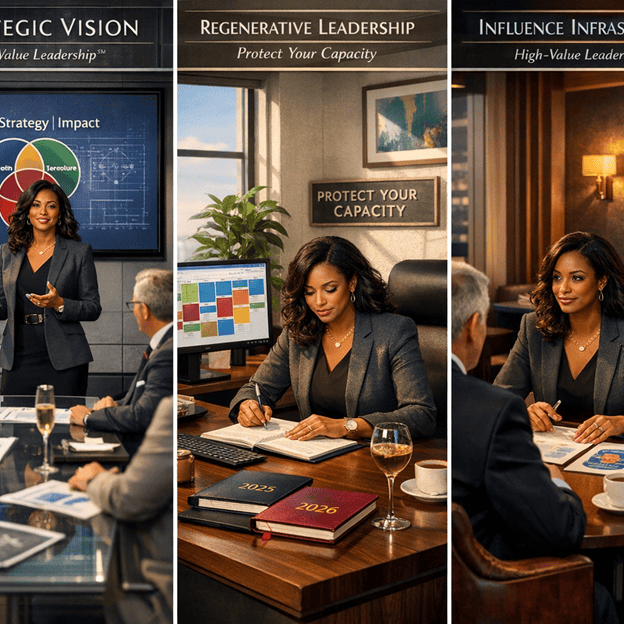
🔧 The Practical Architecture Process
Theory is useless without application. Here’s how to actually architect the woman you’re becoming in 2026:
Step 1: Honor the Woman of 2025 (December 30-31)
Complete this exercise in writing:
She got me through 2025 by:
- [List 5-7 specific strengths, patterns, or practices]
But in 2026, I need to:
- [List 3-5 different operational patterns required]
Example:
She got me through 2025 by:
- Saying yes to every opportunity to prove my value
- Working nights and weekends to deliver flawless results
- Managing everyone’s emotional comfort in meetings
- Building deep expertise in my functional area
But in 2026, I need to:
- Say yes strategically to opportunities aligned with VP-level priorities
- Protect weekend capacity for strategic thinking and personal renewal
- Stop managing others’ discomfort and focus on driving business outcomes
- Build cross-functional strategic visibility, not just functional expertise
The point: Name what worked and what needs to change. Honor both.
Step 2: Define Your 2026 Architecture Across Three Pillars (January 1-7)
For each pillar, answer:
Leadership Presence:
- What do I want to be known for in 2026? (Not what I do—who I am as a leader)
- What’s one behavior I need to stop? (Over-explaining, apologizing, deferring)
- What’s one behavior I need to start? (Speaking first, challenging assumptions, taking strategic risks)
Energy Architecture:
- What’s consuming energy without creating value?
- What boundary would give me 20% more capacity?
- What would regenerative energy management look like for me?
Influence Infrastructure:
- Who needs to know about my expertise for my 2026 goals to be possible?
- What three strategic relationships will I intentionally build?
- How will I create visibility in spaces where decisions about my future are made?
Step 3: Build Your First 90 Days (January-March 2026)
Don’t try to architect everything at once. Pick ONE shift per pillar for Q1:
Leadership Presence (One Behavioral Shift):
- Example: “I will speak in the first third of every senior leadership meeting, offering strategic perspective rather than waiting to respond to others.”
Energy Architecture (One Boundary):
- Example: “I will eliminate Sunday email checking and protect 9-11am Monday/Wednesday for strategic thinking with no meetings.”
Influence Infrastructure (One Relationship Investment):
- Example: “I will schedule monthly ‘learning conversations’ with the CFO, solving one problem she cares about each quarter.”
Track these for 90 days. Assess. Adjust. Expand.
Step 4: Create Accountability Architecture (Ongoing)
Architecture requires maintenance. Who will hold you accountable to becoming who you’re designing?
Options:
- Schedule monthly self-audits (calendar reminder: “Am I building the woman I designed?”)
- Partner with a peer for reciprocal accountability
- Hire a coach who specializes in leadership architecture
- Join a cohort-based program focused on strategic leadership design
The woman you’re architecting doesn’t just set intentions. She builds systems that ensure those intentions become reality.
💎 High-Value Leadership℠: Architecture as Strategic Competence
In High-Value Leadership: Transforming Organizations Through Purposeful Culture, I define high-value leadership as leadership that creates sustainable impact through intentional design, not reactive management.
The same principle applies to designing yourself as a leader.
Low-value leadership patterns:
- React to whatever emerges
- Default to last year’s operating system
- Hope circumstances change rather than intentionally changing how you engage circumstances
- Measure success by survival rather than strategic progress
High-Value Leadership℠ patterns:
- Anticipate what’s required and build infrastructure proactively
- Upgrade operating systems before they become obsolete
- Architect circumstances rather than just navigate them
- Measure success by intentional design, not accidental outcomes
The woman you’re becoming in 2026 isn’t an accidental outcome of circumstances. She’s a strategic design project.
In Mastering a High-Value Company Culture, I explore how transformational cultures are built through “conscious construction”—the intentional building of systems, norms, and practices that produce desired outcomes. You can’t build a high-value culture accidentally. It requires architecture.
The same is true for building the leader you’re becoming.
And for my Black women leaders specifically: Rise & Thrive: A Black Woman’s Blueprint for Leadership Excellence addresses the unique navigation required when you’re architecting yourself in spaces that weren’t designed for your success.
Rising is about visibility and positioning. Thriving is about sustainability and strategic design.
You can’t thrive by replicating the survival patterns that got you here. You have to architect a more strategic version of yourself—one that honors your resilience while refusing to romanticize the circumstances that required it.
🌟 She Got You Here. Now Design Who Takes You Forward.
December 31st is the perfect day for this work.
Not because there’s anything magical about the calendar flipping. Because you have permission—from yourself—to acknowledge that the woman who survived 2025 and the woman who will thrive in 2026 might operate differently.
She doesn’t need to be someone else. She needs to be a more strategic version of exactly who you are.
More boundaried. More visible. More intentional about energy. More deliberate about influence. More convicted in her presence. More protective of her capacity. More strategic about her relationships.
Same values. Different architecture.
So yes—cheers to the woman you were in 2025. She deserves every bit of celebration.
And now?
Let’s architect the woman you’re becoming.
Not through vague intentions or aspirational thinking. Through strategic design across three pillars: Leadership Presence, Energy Architecture, and Influence Infrastructure.
Because the woman who thrives in 2026 isn’t hoping circumstances change. She’s architecting herself to transform them.
💭 Reflection Questions
Work through these alone or with your leadership circle:
1. What did the woman of 2025 do brilliantly that you want to honor—and what did she do out of survival that you want to release?
2. If you operated from an assumption of established competence in 2026 instead of constantly proving yourself, how would your leadership presence shift?
3. For Black women specifically: What protective mechanism or survival pattern served you in hostile environments but is now limiting your effectiveness in your current context?
4. What’s consuming 20% or more of your energy without creating proportional value—and what boundary would protect that capacity?
5. Who needs to know about your expertise and leadership capability for your 2026 goals to be achievable—and do they currently know?
6. What’s one behavior you need to stop, one you need to start, and one boundary you need to enforce to become the woman you’re architecting for 2026?
🚀 Next Steps: From Reflection to Architecture
STEP 1: Complete the Honor & Release Exercise
Block 60 minutes on December 30th or 31st. Honor who got you through 2025. Name what needs to change for 2026.
STEP 2: Define Your Three-Pillar Architecture
Use the framework in this article to design:
- Your Leadership Presence shift
- Your Energy Architecture boundary
- Your Influence Infrastructure investment
STEP 3: Build Your Q1 Accountability System
Don’t just design the woman you’re becoming—create the systems that ensure you actually build her.
STEP 4: Get Strategic Support
Architecture is hard to do alone, especially when you’re upgrading while running.
🤝 Work with Che’ Blackmon Consulting
If you’ve realized that architecting the woman you’re becoming requires more than personal reflection—that you need strategic coaching, proven frameworks, and accountability from someone who understands both the business strategy AND the unique navigation Black women leaders face—we should talk.
Our services for individual leaders:
✅ Executive Coaching for Strategic Leadership Architecture
One-on-one coaching designed specifically for Black women leaders navigating the shift from competence to commanding presence, from reactive to regenerative energy management, and from invisible to indispensable influence.
✅ High-Value Leadership Intensive (Waitlist Now Open)
A cohort-based program that combines strategic leadership development with the architecture work of building sustainable, influential leadership presence. Specifically designed for GenX women leaders ready to upgrade their operating systems.
For organizations:
✅ Leadership Development Programs
Building high-value leadership cultures where architecture is taught as a strategic competence, not just goal-setting.
✅ Executive Coaching for Leadership Transitions
Supporting leaders through critical transitions with intentional redesign rather than hoping competence alone carries them forward.
✅ Culture Transformation for Equity
Creating organizational environments where Black women and other traditionally overlooked leaders don’t have to architect around systemic barriers—they can architect for strategic impact.
Ready to architect the woman you’re becoming with strategic support?
📧 admin@cheblackmon.com
📞 888.369.7243
🌐 cheblackmon.com
Additional Resources:
📚 Read: High-Value Leadership: Transforming Organizations Through Purposeful Culture
The strategic framework that applies to organizational transformation and personal leadership architecture
Get the book: https://books.by/blackmons-bookshelf
🎓 Join the Waitlist: High-Value Leadership Intensive
A transformative cohort-based program for leaders ready to architect their next-level leadership presence
Join: https://adept-solutions-llc-2.kit.com/147712ac25
📖 Read: Rise & Thrive: A Black Woman’s Blueprint for Leadership Excellence
The specific navigation guide for Black women architecting leadership excellence in corporate spaces
🎧 Listen: Unlock, Empower, Transform with Che’ Blackmon
Twice-weekly conversations on leadership architecture and strategic career design
📺 Watch: Rise & Thrive YouTube Series
Practical leadership architecture content for Black women in corporate leadership
Che’ Blackmon is the Founder & CEO of Che’ Blackmon Consulting, a Michigan-based fractional HR and culture transformation consultancy. As a DBA candidate in Organizational Leadership at National University with 24+ years of progressive HR leadership experience, she specializes in AI-enhanced culture transformation and executive coaching for high-value leadership development. She is the author of “High-Value Leadership: Transforming Organizations Through Purposeful Culture,” “Mastering a High-Value Company Culture,” and “Rise & Thrive: A Black Woman’s Blueprint for Leadership Excellence.”
She got you here. Now let’s architect who takes you forward. ✨
Not a different woman. A more strategic version of exactly who you are.
#Leadership #LeadershipDevelopment #WomenInLeadership #BlackWomenInBusiness #ExecutiveCoaching #CareerDevelopment #ProfessionalGrowth #HighValueLeadership #IntentionalLeadership #LeadershipPresence #EnergyManagement #ExecutivePresence #StrategicLeadership #NewYearNewYou #LeadershipTransformation

Leave a Reply