By Che’ Blackmon, DBA Candidate | Che’ Blackmon Consulting
Introduction: Rethinking What Resilience Really Means 💡
When we talk about resilient teams, most leaders think about bouncing back from adversity. They imagine employees who can weather the storm, recover from setbacks, and return to baseline performance. While this perspective has value, it fundamentally limits what your team can achieve. True resilience is not about returning to where you were before. It is about using challenges as springboards to reach new heights.
In my book Mastering a High-Value Company Culture, I explore how organizations can build cultures that do not merely survive disruption but thrive because of it. This concept of “bouncing forward” transforms adversity from a threat into an opportunity for growth, innovation, and sustainable competitive advantage.
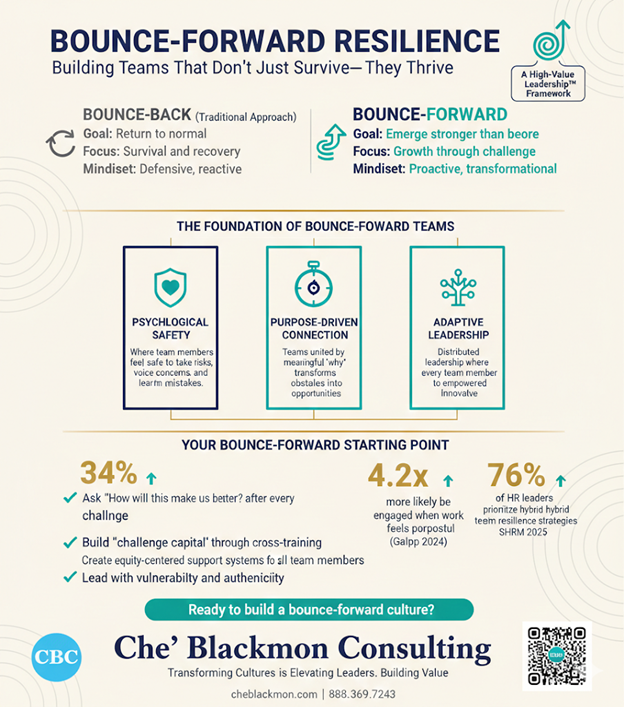
The difference between bounce-back and bounce-forward organizations is profound. Bounce-back teams aim to restore normalcy. Bounce-forward teams aim to emerge stronger, wiser, and more connected than before. Which type of team are you building?

Understanding the Shift: From Reactive to Proactive Resilience 🔄
Traditional resilience models focus on reaction. Something bad happens and the team responds. This approach, while necessary, keeps organizations perpetually in defense mode. They wait for crises, address them as they come, and hope for the best. This cycle is exhausting and unsustainable.
Research from the Harvard Business Review (2023) reveals that organizations practicing proactive resilience strategies outperform their reactive counterparts by 34% in employee engagement metrics and 28% in overall productivity. These findings underscore a critical truth: resilience is not just about surviving tough times. It is about building the capacity to anticipate, adapt, and advance.
As I discuss in High-Value Leadership: Transforming Organizations Through Purposeful Culture, purposeful leadership requires a shift in mindset. Leaders must move from asking “How do we recover?” to asking “How do we grow through this?” This single question reframes every challenge as a development opportunity.
The Foundation of Bounce-Forward Teams 🏗️
1. Psychological Safety as the Cornerstone
Amy Edmondson’s groundbreaking research on psychological safety has transformed how we understand high-performing teams. Teams where members feel safe to take risks, voice concerns, and admit mistakes consistently outperform those operating in fear-based environments. But psychological safety does not happen by accident. It requires intentional cultivation.
Consider a manufacturing company that experienced a significant quality control failure. In many organizations, the response would be to assign blame, implement punitive measures, and move on. Instead, this company chose a different path. Leadership gathered the team, acknowledged the failure openly, and asked a powerful question: “What can this teach us?” The result was not just a fix for the immediate problem but a complete overhaul of their quality assurance processes that reduced defects by 47% over the following year.
2. Purpose-Driven Connection
Teams that understand their “why” possess an internal compass that guides them through uncertainty. Purpose creates resilience because it provides meaning beyond the immediate task. When team members connect their daily work to a larger mission, setbacks become temporary obstacles rather than insurmountable barriers.
Gallup’s 2024 State of the Global Workplace report found that employees who strongly agree their organization’s purpose makes their job feel important are 4.2 times more likely to be engaged at work. Engagement, in turn, serves as a buffer against burnout and a catalyst for innovative problem-solving during difficult times.
3. Adaptive Leadership at Every Level
Bounce-forward resilience cannot be mandated from the top alone. It requires distributed leadership where every team member feels empowered to adapt, innovate, and lead within their sphere of influence. This democratization of leadership accelerates organizational response times and leverages the collective intelligence of the entire workforce.
The Unique Resilience Journey: Impact on Traditionally Overlooked Professionals ✊🏾
Any honest conversation about building resilient teams must address a fundamental truth: not all team members start from the same place. Traditionally overlooked professionals, particularly Black women in corporate spaces, often navigate additional layers of challenge that their counterparts do not face. Understanding this reality is not about creating division. It is about creating genuine equity in how we support our teams.
The Double Bind of Resilience Expectations
In my e-book Rise & Thrive: A Black Woman’s Blueprint for Leadership Excellence, I explore the complex dynamics Black women face in professional environments. Research from LeanIn.Org and McKinsey’s Women in the Workplace 2023 report confirms what many Black women already know: they are more likely to have their competence questioned, experience microaggressions, and feel they cannot bring their full selves to work.
This creates a double bind when it comes to resilience. Black women are often expected to be inherently strong and resilient (the “Strong Black Woman” trope) while simultaneously receiving less organizational support to build and maintain that resilience. They are asked to bounce back from challenges that their colleagues may never encounter, all while maintaining the same performance standards.
Moving from Survival to Thriving
True bounce-forward organizations recognize these disparities and take concrete action. They do not ask traditionally overlooked employees to simply “be resilient” in the face of systemic challenges. Instead, they address the systems themselves. This includes examining hiring practices, promotion pathways, mentorship opportunities, and everyday workplace interactions for bias and exclusion.
There was a professional services firm that noticed a troubling pattern: their Black female employees were leaving at higher rates than any other demographic group, despite strong performance reviews. Rather than attributing this to individual choices, leadership conducted listening sessions and anonymous surveys. What they discovered was a culture where Black women felt unseen, unsupported, and unable to advance. The company implemented targeted mentorship programs, revised their promotion criteria for objectivity, and created affinity groups. Within 18 months, retention among Black female employees improved by 62%, and overall employee engagement scores rose across the organization.
Creating Inclusive Resilience Frameworks
Building resilient teams requires recognizing that resilience itself must be inclusive. This means creating environments where all employees, regardless of their background, have equal access to the resources, relationships, and opportunities that foster growth. It means ensuring that when we discuss “bouncing forward,” we are not inadvertently placing additional burdens on those who already carry more.
Practical Strategies for Building Bounce-Forward Teams 🛠️
Strategy 1: Implement “After Action Learning” Sessions
Replace traditional post-mortems with forward-focused learning sessions. After any significant project, challenge, or change, gather your team to answer three questions: What happened? What did we learn? How will this make us better? The emphasis on the third question shifts the conversation from analysis to action.
Strategy 2: Build “Challenge Capital”
Just as organizations build financial reserves, bounce-forward teams intentionally build challenge capital. This includes cross-training team members so knowledge is distributed, maintaining documentation of processes and lessons learned, and cultivating relationships with external partners who can provide support during difficult times.
Strategy 3: Practice Micro-Resilience Daily
Resilience is not built only in major crises. It is developed through daily practices that strengthen the team’s adaptive capacity. Encourage team members to step outside their comfort zones regularly, celebrate small wins, and practice reframing negative situations. These micro-moments of resilience compound over time into substantial organizational capability.
Strategy 4: Create Equity-Centered Support Systems
Recognize that different team members may need different types of support to thrive. This is not about giving some employees advantages over others. It is about ensuring everyone has what they need to contribute their best. For traditionally overlooked professionals, this might include mentorship from leaders who understand their unique challenges, advocacy in rooms where decisions are made, and genuine opportunities for advancement.
Strategy 5: Lead with Vulnerability and Authenticity
Leaders set the tone for how teams handle adversity. When leaders model vulnerability by admitting their own challenges and sharing how they have grown through difficulties, they give permission for the entire team to do the same. This authenticity builds trust and creates space for honest conversations about what is and is not working.
Current Trends and Best Practices in Team Resilience 📊
The landscape of organizational resilience continues to evolve, shaped by technological advances, changing workforce expectations, and lessons learned from recent global disruptions. Several trends are particularly relevant for leaders committed to building bounce-forward teams.
AI-Enhanced Predictive Analytics
Forward-thinking organizations are using artificial intelligence to predict potential challenges before they become crises. This includes analyzing engagement data to identify early signs of burnout, tracking communication patterns to detect emerging team conflicts, and monitoring industry trends to anticipate market shifts. This proactive approach allows teams to address issues while they are still manageable.
Hybrid Work and Distributed Resilience
The shift to hybrid and remote work has fundamentally changed how teams build and maintain resilience. Organizations are discovering that resilience in distributed environments requires intentional effort to maintain connection, clear communication protocols, and new approaches to recognizing and supporting team members who may be struggling. The Society for Human Resource Management (SHRM) reports that 76% of HR professionals believe developing resilience strategies for hybrid teams is a top priority for 2025.
Mental Health Integration
The conversation around workplace mental health has shifted from stigmatized whispers to strategic priority. Best-in-class organizations are integrating mental health support into their resilience frameworks, recognizing that individual wellbeing and team performance are inseparable. This includes providing access to mental health resources, training managers to recognize signs of distress, and creating cultures where seeking help is viewed as strength rather than weakness.
Case Study: A Manufacturing Company’s Transformation 📈
There was a mid-sized manufacturing company in the Midwest that faced a perfect storm of challenges: supply chain disruptions, labor shortages, and increased competition from overseas. Traditional approaches would have focused on cost-cutting and survival. Instead, leadership chose to view this moment as an opportunity for transformation.
The company implemented a comprehensive bounce-forward strategy. First, they invested in cross-training programs so every team member could fill multiple roles. This not only addressed the labor shortage but also gave employees new skills and career pathways. Second, they created innovation teams charged with finding creative solutions to supply chain challenges. These teams were explicitly empowered to fail fast and learn faster. Third, they revised their leadership development program to emphasize adaptive leadership and inclusive practices.
Within two years, this company had not just survived the crisis but had emerged as a market leader. Employee engagement scores rose by 41%, voluntary turnover dropped by 33%, and productivity increased by 27%. Most importantly, the company had built a culture capable of facing future challenges with confidence rather than fear.
Measuring Team Resilience: Beyond Traditional Metrics 📐
What gets measured gets managed. To build bounce-forward teams, leaders need metrics that capture adaptive capacity, not just static performance. Consider tracking recovery time (how quickly your team returns to full productivity after a disruption), innovation rate (how many new ideas emerge during and after challenges), learning velocity (how quickly lessons are identified and implemented), and equity indicators (ensuring all team members are growing through challenges equally).
Regular pulse surveys can capture team sentiment and identify emerging issues before they become critical. Exit interviews and stay interviews provide qualitative data on what is working and what needs improvement. The key is to use these metrics not as report cards but as learning tools that inform continuous improvement.
Actionable Takeaways: Your Bounce-Forward Action Plan ✅
Building bounce-forward teams requires commitment and intentionality. Here are concrete steps you can implement immediately.
This week: Have a conversation with your team about the difference between bouncing back and bouncing forward. Ask them which mindset currently dominates your culture.
This month: Conduct an honest assessment of psychological safety on your team. Use anonymous surveys or bring in a neutral facilitator to get candid feedback.
This quarter: Implement “After Action Learning” sessions for all major projects or challenges. Document the insights and track how they influence future approaches.
This year: Develop comprehensive support systems that recognize and address the unique challenges faced by traditionally overlooked team members. Measure and track equity in access to resources and opportunities.
Ongoing: Model vulnerability as a leader. Share your own growth journey and create space for others to do the same.
Discussion Questions for Your Team 💬
Use these questions to spark meaningful conversations about resilience within your organization.
1. When our team faces a setback, do we focus primarily on recovering to where we were or on finding ways to grow beyond our previous capacity?
2. How safe do team members feel to admit mistakes, voice concerns, or propose unconventional ideas? What evidence supports this assessment?
3. Are there team members who consistently seem to carry heavier burdens or face greater challenges than others? What can we do to address these inequities?
4. What was the most significant challenge our team faced in the past year? Looking back, how did that challenge make us better?
5. If a new team member joined tomorrow, how would they describe our culture’s approach to handling adversity?
Next Steps: Your Journey to Bounce-Forward Excellence 🌟
Building bounce-forward resilience is not a one-time initiative. It is an ongoing commitment to growth, learning, and intentional culture development. The organizations that thrive in the coming years will be those that view every challenge as an opportunity to emerge stronger.
Start where you are. Use the strategies and questions in this article to assess your current state and identify areas for growth. Remember that progress, not perfection, is the goal. Every step toward a more resilient culture is a step toward sustainable success.
For those ready to take their resilience journey to the next level, professional guidance can accelerate your progress and help you avoid common pitfalls. A skilled culture transformation partner can provide objective assessment, proven frameworks, and accountability to ensure your initiatives translate into real results.
Ready to Build a Bounce-Forward Culture? 🤝
Che’ Blackmon Consulting specializes in helping organizations transform their cultures from reactive to proactive, from surviving to thriving. With over 24 years of progressive HR leadership experience and ongoing doctoral research focused on AI-enhanced culture transformation, we bring both practical expertise and cutting-edge insights to every engagement.
Let’s discuss how we can help you build the resilient, high-value culture your organization deserves.
📧 Email: admin@cheblackmon.com
📞 Phone: 888.369.7243
🌐 Website: cheblackmon.com
About the Author 👩🏾💼
Che’ Blackmon is the Founder and CEO of Che’ Blackmon Consulting, a Michigan based fractional HR and culture transformation consultancy. With over 24 years of progressive HR leadership experience across manufacturing, automotive, healthcare, and professional services sectors, Che’ brings deep expertise in building high-value organizational cultures. She is currently pursuing a Doctor of Business Administration (DBA) in Organizational Leadership, with dissertation research focused on AI-enhanced predictive analytics for culture transformation and employee turnover prevention.
Che’ is the author of three books on leadership and organizational culture: High-Value Leadership: Transforming Organizations Through Purposeful Culture, Mastering a High-Value Company Culture, and Rise & Thrive: A Black Woman’s Blueprint for Leadership Excellence. She hosts the twice-weekly podcast “Unlock, Empower, Transform with Che’ Blackmon” and creates content through her “Rise & Thrive” YouTube series.
#HighValueLeadership #TeamResilience #BounceForward #LeadershipDevelopment #CultureTransformation #HRLeadership #OrganizationalCulture #BlackWomenInLeadership #ExecutiveCoaching #WorkplaceWellbeing #TeamBuilding #FractionalHR #LeadershipTips #EmployeeEngagement #ThriveNotSurvive
© 2025 Che’ Blackmon Consulting. All rights reserved.

Leave a Reply