By Che’ Blackmon, DBA Candidate | Founder & CEO, Che’ Blackmon Consulting
Real organizational transformation is one of the most misunderstood and mismanaged challenges in business today. Most leaders know change is necessary. Many have the vision. Far fewer have the practical resources, the structured approach, and the cultural competency to make that change last.
Change is not a project with a start date and an end date. It is a sustained shift in the way an organization thinks, behaves, and measures success. And the person standing at the front of that shift, the one making the case, absorbing the resistance, and keeping the momentum alive when the excitement fades, is the Change Champion.
You may already be that person. Or you may be building toward it. Either way, this article is your toolkit.
Drawing from the frameworks I developed in High-Value Leadership: Transforming Organizations Through Purposeful Culture, Mastering a High-Value Company Culture, and Rise & Thrive: A Black Woman’s Blueprint for Leadership Excellence, this piece gives you the tangible, research-grounded, and practically tested resources you need to lead transformation that actually sticks. We will examine the tools, the mindsets, the data, and the human elements that separate performative change from transformative change.
Because in organizations where the culture is alive and people are seen, change does not have to be forced. It becomes the natural outcome of great leadership.

🌊 What Real Transformation Actually Requires
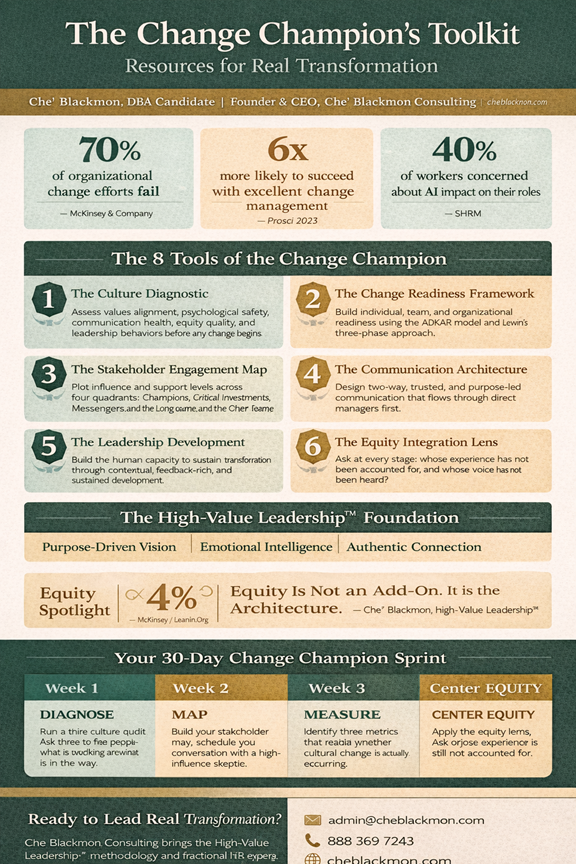
Before we talk about tools, we have to tell the truth about transformation. The research is sobering. McKinsey & Company reports that approximately 70 percent of organizational change efforts fail. Not because the strategy was wrong. Not because the budget was insufficient. Because leaders underestimated the human dimension of change.
Dr. John Kotter, whose eight-step model for leading change has guided organizations for decades, argues that the single greatest reason transformation initiatives collapse is a failure to create a strong enough guiding coalition early in the process. Change does not succeed because of announcements. It succeeds because of sustained, committed, culturally aligned leadership at every level of the organization.
In Mastering a High-Value Company Culture, the core premise is clear: culture is the lifeblood of any organization. And that premise becomes most urgent during times of change. When an organization is in transition, culture is either a tailwind accelerating the effort or a headwind pushing against everything the leadership team is trying to accomplish.
Real transformation requires three things that no technology, no consultant, and no training program can substitute for. It requires genuine leadership commitment, not just executive sponsorship on paper. It requires authentic employee involvement, not just communication cascades. And it requires a clear-eyed understanding of the cultural terrain the organization is navigating.
The tools in this article are designed to strengthen all three.
“Culture is either the wind at your back or the wall in your way. Real transformation begins with knowing which one you are dealing with.” — Che’ Blackmon
📊 Tool 1: The Culture Diagnostic
You cannot transform what you have not honestly assessed. A culture diagnostic is the starting point of every meaningful change effort, and it is also the step that most organizations rush past or skip entirely.
A culture diagnostic is not the same as an employee satisfaction survey, though surveys can be one input. A true diagnostic asks deeper questions. It examines the values that are espoused versus the values that are actually practiced. It looks at communication patterns, decision-making processes, how conflict is handled, who gets promoted, whose voices are amplified, and whose concerns are dismissed. It reveals the invisible architecture of the organization, the unwritten rules that govern behavior far more powerfully than any handbook or policy document.
🔍 What to Assess in a Culture Diagnostic
The most effective culture diagnostics examine the following dimensions. Each one reveals a different layer of the organizational culture and together they form a complete picture of what transformation is up against.
| 01 | Values Alignment Do employees know the organization’s stated values? More importantly, do they believe those values are actually practiced by leadership? A gap between stated and lived values is one of the most reliable predictors of disengagement and turnover. |
| 02 | Psychological Safety Can people speak truth without fear of consequences? Harvard professor Amy Edmondson’s research has shown that psychological safety is the bedrock of high-performing teams. If your culture punishes honest feedback, your transformation effort will be built on sand. |
| 03 | Communication Health How does information flow in your organization? From the top down only? Is frontline knowledge making its way back to decision-makers? Organizations where information travels in one direction are almost always underperforming their potential. |
| 04 | Equity and Inclusion Quality Are all employees experiencing the culture the same way? Invariably they are not. Disaggregating engagement data by race, gender, department, and tenure reveals the gaps that aggregate scores obscure. |
| 05 | Leadership Behaviors What behaviors does leadership model daily? Research consistently shows that employees watch leadership behavior far more closely than they listen to leadership messaging. Culture is what leaders do, not what they say. |
There was a professional services firm that had invested significantly in a new culture initiative built around their stated values of integrity, innovation, and inclusion. Engagement scores were flat. Turnover among high performers was rising. When leadership finally commissioned a real culture diagnostic rather than another engagement survey, the results were revelatory. Employees rated integrity highly in leadership communication but poorly in promotion decisions. Innovation was celebrated in town halls but penalized in day-to-day interactions when ideas challenged the status quo. And inclusion scores among employees of color were dramatically lower than among white employees, a gap the aggregate reporting had been masking for years.
The diagnostic did not solve those problems. But it gave leadership, for the first time, an honest map of the terrain. And that map made real transformation possible.
| 🛠️ Actionable Takeaway Commission or conduct a culture diagnostic before launching any major change initiative. Include both quantitative data (survey scores, turnover rates, promotion patterns) and qualitative data (focus groups, one-on-one listening sessions, open-ended questions). Disaggregate every data point by demographic. What you find in the gaps is where the work is. |
🧠 Tool 2: The Change Readiness Framework
Once you know what the culture is, the next question is whether the organization is ready to change it. Change readiness is not the same as change willingness. People may intellectually agree that change is necessary and emotionally resist it at the same time. That is not hypocrisy. It is human nature.
Kurt Lewin’s foundational change model identifies three phases of transformation: unfreezing the current state, moving to the desired state, and refreezing new behaviors into the culture. The unfreezing phase is the most underinvested and the most critical. It is where leaders must create the cognitive and emotional case for change before the structural and operational changes begin.
A change readiness framework helps leaders assess and build readiness at three levels: individual, team, and organizational. Each level requires different interventions, different communication strategies, and different timelines.
📋 The Three Levels of Change Readiness
Individual Readiness 🧑
Individual readiness centers on the ADKAR model, developed by Jeff Hiatt of Prosci, which identifies five building blocks of successful individual change. Awareness of the need for change. Desire to support the change. Knowledge of how to change. Ability to demonstrate new skills and behaviors. And Reinforcement to sustain the change. When individuals are missing any one of these building blocks, the change fails at the human level regardless of what the organizational chart says.
Team Readiness 🤝
Team readiness is assessed through examining team dynamics, trust levels, and the clarity of team roles within the change initiative. Teams that lack psychological safety will resist change not because they oppose the direction but because the environment does not feel safe enough to take the risks that change requires. High-value leaders invest in team readiness by building trust before asking for transformation.
Organizational Readiness 🏛️
Organizational readiness examines structure, capacity, and systems. Does the organization have the resources, the governance, and the management infrastructure to support the change? Are incentive systems aligned with the desired new behaviors or are they quietly rewarding the old ones? Organizations often announce values-based culture shifts while continuing to promote and reward leaders whose behaviors directly contradict those values. That misalignment kills transformation every time.
| 💡 Research Spotlight Prosci’s 2023 Benchmarking Report found that projects with excellent change management practices were six times more likely to meet or exceed objectives. The difference was not in the quality of the change plan. It was in how thoroughly leaders invested in preparing people for the change before it launched. |
🗣️ Tool 3: The Stakeholder Engagement Map
Every transformation effort has stakeholders. Not all of them are equal in their influence, and not all of them are visible in the organizational chart. A stakeholder engagement map is a strategic tool that gives Change Champions a clear picture of who holds formal and informal power in the organization, what each stakeholder’s current posture toward the change is, and what it will take to move them from resistance or neutrality to active support.
The most effective engagement maps plot stakeholders on two dimensions: their level of influence over the change and their current level of support for it. This creates four quadrants that require four different engagement strategies.
🗺️ The Four Quadrant Engagement Model
High Influence, High Support: Your Champions 🏆
These are the people you protect and leverage. They are already with you. Your job is to give them the platform, the resources, and the visibility to amplify the change on your behalf. One vocal champion in the right room is worth a hundred carefully crafted communications.
High Influence, Low Support: Your Critical Investment ⚠️
This is where your strategic energy belongs. These are the people who can stop the change or accelerate it. Understand their concerns. Meet with them directly and genuinely. Listen more than you talk. Often, resistance from high-influence stakeholders is not about the destination but about the process: they do not feel heard, consulted, or respected in how the change is being led.
Low Influence, High Support: Your Messengers 📣
These individuals may not have formal authority but they have credibility with their peers. They are often frontline employees, informal leaders, and trusted voices in the hallways and break rooms where real opinions are formed. Invest in these people. Equip them with information and involve them in the design of change. They will carry the message further and more authentically than any top-down communication campaign.
Low Influence, Low Support: Your Long Game ⏳
Do not ignore this quadrant, but do not overinvest here early. Focus on shifting the broader culture through the first three quadrants first. As the culture shifts and the change gains momentum, many in this quadrant will move on their own.
There was a manufacturing company that launched a workplace safety transformation after a series of near-miss incidents. Leadership developed a comprehensive program, communicated it extensively, and trained every employee. Six months in, safety incident rates had not improved. A stakeholder mapping exercise revealed the problem. Two of the most respected supervisors on the plant floor, people with enormous informal influence over the hourly workforce, were in the high influence and low support quadrant. They believed the initiative was management performance theater rather than genuine concern for worker safety. Once leadership engaged them directly, involved them in redesigning key elements of the program, and gave them formal roles in the rollout, the entire dynamic shifted. Within two quarters, safety metrics improved significantly.
The program did not change. The stakeholder engagement strategy did.
| 🛠️ Actionable Takeaway Before your next change initiative launches, build your stakeholder map. Identify every person with formal or informal influence. Assess their current support level honestly. Then create individualized engagement plans for your high-influence stakeholders before you launch broadly. The conversations you have in the planning stage will determine the outcomes in the execution stage. |
📚 Tool 4: The Communication Architecture
Poor communication is cited in virtually every study of failed organizational change as a primary contributing factor. And yet most change communication is not really communication at all. It is announcement. It is information transfer. It is leadership talking at people rather than talking with them.
A communication architecture is a deliberate system for designing and delivering change messages that create clarity, build trust, and invite participation. It is not a communication plan in the traditional sense, which typically maps messages to milestones. It is a framework for how communication happens throughout the entire transformation journey.
📡 The Five Principles of Transformative Communication
Principle 1: Lead with the Why 🎯
Simon Sinek’s research on the power of purpose is directly applicable to change communication. Before employees can commit to a new direction, they need to understand why it matters. Not why it matters to the organization’s strategic objectives, but why it matters to them, to their work, to their teams, and to the people they serve. The why is the engine of transformation. Every communication should return to it.
Principle 2: Make It Two-Way 🔄
Genuine communication includes listening. Town halls where executives present and employees politely sit are not communication. They are performance. The organizations that lead change effectively create real feedback loops: listening sessions, anonymous input channels, manager-facilitated team discussions, and skip-level conversations. They then demonstrate that they heard by adjusting based on what they learned. That responsiveness is what builds trust.
Principle 3: Communicate Through Trusted Voices 🧑🤝🧑
Employees believe their direct manager far more than they believe the CEO. Research from Edelman’s Trust Barometer consistently shows that an employee’s direct supervisor is among the most trusted sources of information in any organization. Change communication strategies that rely primarily on executive messaging and skip the middle layer are structurally flawed. Equip managers first. Make them believers and ambassadors before the organization-wide communication begins.
Principle 4: Communicate Early, Often, and Honestly 🕒
The vacuum created by insufficient communication is not neutral. It is filled immediately by rumor, speculation, and fear. Over-communicate during change. And when you do not have all the answers, communicate that honestly. Nothing builds trust during uncertainty like a leader who says clearly: here is what we know, here is what we are still working through, and here is when we will update you again.
Principle 5: Celebrate Progress Publicly 🎉
Change is exhausting. The people carrying it forward need to see that it is working. Celebrate early wins publicly and specifically. Name the people who contributed. Connect the milestone to the larger purpose. Recognition during change is not just motivational. It is evidence that the transformation is real and that leadership notices who is showing up for it.
💼 Tool 5: The Leadership Development Investment
You cannot transform an organization without transforming its leaders. This is the truth that organizational change theory acknowledges and organizational change practice consistently underinvests in.
In High-Value Leadership: Transforming Organizations Through Purposeful Culture, the case is made at length that leadership development is not a training event. It is an ongoing investment in the human capacity to create and sustain high-performing cultures. The five pillars of the High-Value Leadership™ methodology, purpose-driven vision, emotional intelligence, authentic connection, balanced accountability, and culture as strategy, are not competencies that can be checked off a list. They are developed over time through reflection, feedback, practice, and coaching.
Organizations that launch transformation initiatives without investing in the leadership capacity required to sustain them are setting themselves up for the 70 percent failure rate McKinsey documents. Leadership development is not a support activity for change. It is the change.
🌱 What Meaningful Leadership Development Looks Like
Meaningful leadership development during transformation has four components that distinguish it from traditional training programs.
| 01 | It is contextual Development is tied directly to the specific change the organization is navigating, not generic leadership competencies disconnected from the work at hand. Leaders are learning skills and frameworks they need to apply today, not in some abstract future scenario. |
| 02 | It includes honest feedback Leaders receive real, actionable feedback about how their current behaviors are supporting or undermining the transformation. This requires psychological safety within the leadership team itself, which is often the most important and most neglected investment an organization can make. |
| 03 | It is sustained over time A two-day leadership retreat does not develop leaders. It introduces concepts. Sustained development requires ongoing coaching, peer accountability, and structured opportunities to practice new behaviors and reflect on the results. |
| 04 | It models what the culture is trying to become If the transformation is aimed at building a more inclusive, psychologically safe, and purpose-driven culture, the leadership development experience must itself be inclusive, psychologically safe, and purpose-driven. You cannot develop leaders through experiences that contradict the values you are trying to build. |
💎 Tool 6: The Equity Integration Lens
No toolkit for organizational transformation is complete without a tool specifically designed to address what has historically been the most overlooked dimension of change: who benefits from the transformation and who gets left behind in it.
Research from McKinsey, Deloitte, and the Harvard Business Review consistently shows that change initiatives that do not explicitly account for equity in their design produce outcomes that widen existing gaps rather than close them. This is not because change champions intend to create inequitable outcomes. It is because systems that are not intentionally designed for equity default to replicating the inequities already built into the organization.
The equity integration lens is a practice of asking, at every stage of the change process, whose experience has not been accounted for, whose voice has not been heard, and whose barriers have not been addressed. It is not a checkbox. It is a discipline.
📌 The Specific Impact on Black Women in Corporate Spaces
In Rise & Thrive: A Black Woman’s Blueprint for Leadership Excellence, the experience of Black women navigating organizational change is examined with particular care. And the pattern that emerges is both consistent and consequential.
When organizations undergo transformation, Black women are disproportionately affected in several ways that standard change management frameworks do not address. They are more likely to have their ideas for change dismissed before they reach decision-makers. They are more likely to be assigned the implementation labor of change without being given the authority or the credit that should accompany it. They are more likely to experience the psychological burden of advocating for equity within a change process that does not explicitly center it. And they are less likely to be in the rooms where the key decisions about the change are being made.
| 📊 The Data Behind the Experience According to LeanIn.Org and McKinsey’s 2023 Women in the Workplace report, Black women are the most underrepresented group in corporate America’s management pipeline. They are also the group that reports the highest levels of interest in advancement, meaning the gap is not one of aspiration. It is one of access, structure, and organizational design. Any transformation that does not address this gap is, by definition, incomplete. |
There was a technology company that launched a high-profile culture transformation centered on the theme of bringing your whole self to work. The initiative received strong executive support and was broadly communicated as a commitment to inclusion. Twelve months later, exit interviews revealed that the initiative had not improved retention among Black women employees. In fact, it had declined slightly. When leadership examined the data more closely, they discovered that the bring your whole self messaging had not been accompanied by any structural change to how performance was evaluated, how promotions were decided, or how complaints about bias were handled. The invitation to be authentic had been extended without any of the structural protections that make authenticity safe.
The lesson is not that the initiative was wrong. The lesson is that cultural transformation requires both messaging and mechanism. The equity integration lens ensures that the mechanisms are built into the transformation design from the beginning, not added as an afterthought.
🔑 What Equity Integration Looks Like in Practice
Disaggregate Your Data 📊
Every engagement score, every retention rate, every promotion statistic should be broken down by race, gender, tenure, and department. Aggregate data hides the most important stories. When you see the gaps, you know exactly where to focus the transformation.
Include Equity in the Change Charter 📝
The documents that formally govern the transformation initiative should include explicit equity goals, measurable outcomes, and accountable owners. If equity does not appear in the change charter, it will not appear in the results.
Create Structural Sponsorship 🏆
Transformation creates visibility and opportunity. Ensure that Black women and other underrepresented professionals are actively sponsored into the roles, committees, and conversations that shape how the change unfolds. Sponsorship during change is not tokenism. It is organizational intelligence. You need the perspective of everyone the transformation will affect.
Audit the Process, Not Just the Outcomes 🔍
Equity audits should examine not just whether outcomes are equitable but whether the process of change itself is equitable. Who was consulted in the design phase? Whose needs shaped the implementation timeline? Who was given resources and whose resource requests were denied? Equitable outcomes require equitable processes.
“Transformation that does not ask who is being left out is not transformation at all. It is reorganization with better branding.” — Che’ Blackmon
📲 Tool 7: The Digital and AI Integration Strategy
We are living through one of the most significant technological transformations in the history of work. Artificial intelligence is reshaping workflows, eliminating roles, creating new ones, and generating both opportunity and anxiety at every level of organizations. For Change Champions, the integration of AI into organizational culture is not a future agenda item. It is a present and urgent challenge.
The Society for Human Resource Management reports that more than 40 percent of workers express concern about AI’s impact on their jobs. That anxiety, left unaddressed, becomes a cultural force that slows every other transformation effort the organization is attempting. When people are afraid, they do not innovate. They protect. They resist. They disengage.
The digital and AI integration strategy is a tool for giving leaders a structured approach to managing this dimension of change in a way that is transparent, human-centered, and equitable.
🤖 Three Principles for Human-Centered AI Integration
Involve Before You Deploy 🤝
Organizations that involve employees in the evaluation and design of AI tools before deployment consistently achieve better adoption rates and lower anxiety levels than those that simply announce new systems. This is not primarily about employee buy-in as a tactic. It is about organizational intelligence. The people doing the work know where AI will genuinely help and where it will create new problems. Their knowledge makes the implementation better.
Communicate the Why and the What Next 🎯
When AI eliminates or significantly changes a role, the organization has an obligation to communicate not just that the change is happening but what support will be provided for the people affected. Reskilling investments, internal mobility programs, and transition timelines are not optional in a human-centered AI strategy. They are the baseline.
Watch the Equity Implications Closely 👁️
Research from the Brookings Institution and the National Bureau of Economic Research shows that the roles most vulnerable to displacement by AI are disproportionately held by workers of color and women. Change Champions must apply the equity integration lens with particular intensity to AI transformation to ensure that the efficiency gains of technology adoption are not built on the disproportionate displacement of the organization’s most vulnerable employees.
| 💡 Current Trend Watch Gartner’s 2024 HR Technology research identifies AI-augmented HR analytics as one of the fastest-growing areas of investment in organizational development. Forward-thinking organizations are using predictive analytics not just to identify at-risk talent but to identify culture transformation opportunities before disengagement becomes turnover. This is the intersection of AI and culture strategy that Che’ Blackmon Consulting is actively building toward. |
📏 Tool 8: The Measurement and Momentum System
Transformation without measurement is aspiration. Change Champions need a measurement system that tracks not just whether the outputs of change are being delivered but whether the cultural shift the change is intended to produce is actually occurring.
Most organizational measurement systems are output-focused. They count the number of training sessions completed, the policies updated, the communications sent. These are process measures, and they are necessary. But they are not sufficient. The measure that matters most in cultural transformation is behavioral change: are people actually leading and working differently than they were before?
📊 Building a Transformation Scorecard
An effective transformation scorecard includes measures across four categories. Each category captures a different dimension of whether the change is producing the culture it was designed to create.
| 01 | Lagging Indicators These are outcome measures that tell you whether the transformation achieved its intended results: employee engagement scores, voluntary turnover rates, promotion equity ratios, customer satisfaction, and financial performance. These move slowly and reflect the cumulative effect of everything else. |
| 02 | Leading Indicators These are early-warning and early-confirmation measures that tell you whether the transformation is on track before the lagging indicators move: manager feedback quality scores, psychological safety assessments, frequency of cross-functional collaboration, and rate of idea generation and implementation. |
| 03 | Behavioral Indicators These are direct observations of whether leaders and employees are demonstrating the behaviors the transformation requires: participation rates in listening sessions, the degree to which decisions reflect the new values, how conflict is being handled, and whether previously silenced voices are now being heard. |
| 04 | Equity Indicators These are disaggregated measures that reveal whether the transformation is producing equitable outcomes across demographic groups: promotion rates by race and gender, pay equity progress, representation in high-visibility roles and projects, and differential engagement scores by employee group. |
The momentum system is the accountability structure that keeps the measurement alive and action-oriented. Regular transformation reviews at the leadership team level, where scorecard data is reviewed honestly and without defensiveness, create the rhythm of accountability that sustains change over time. Without this rhythm, transformation becomes a series of one-time events rather than a sustained cultural evolution.
| 🛠️ Actionable Takeaway Build your transformation scorecard before your change initiative launches. Identify at least two measures in each of the four categories. Assign ownership for each measure. Set up a 90-day cadence of leadership review. When the data shows the change is not landing as intended, treat that as intelligence rather than failure and adjust accordingly. |
🏆 A Case Study in Toolkit Application
There was a regional healthcare system facing simultaneous pressure from three directions: accelerating regulatory requirements, a wave of post-pandemic leadership departures, and deeply declining morale scores across nursing and administrative staff. The executive team recognized that the situation demanded more than operational fixes. It required genuine culture transformation.
They began with Tool 1: a comprehensive culture diagnostic that revealed three critical findings. First, frontline staff did not believe leadership was honest with them during difficult periods. Second, employees of color, particularly Black women in nursing leadership, reported significantly lower scores on belonging and advancement fairness than their white peers. Third, the middle management layer was both the most overwhelmed and the most under-supported group in the organization.
Using the Change Readiness Framework, leadership identified that the organization was high on organizational willingness to change but low on individual readiness, particularly among middle managers who were being asked to lead a transformation they had not been adequately prepared to lead.
The Stakeholder Engagement Map revealed two chief nursing officers whose informal influence across the system was enormous. Both were initially in the skeptical quadrant. Once they were brought into the design process as genuine partners rather than recipients of the plan, their posture shifted and their influence became one of the transformation’s greatest assets.
The Communication Architecture was redesigned to flow through direct managers first, with executive messaging following rather than leading. A monthly listening forum was established where any employee could raise concerns directly with the transformation steering committee.
Equity integration was written into the transformation charter with specific measurable commitments around representation in leadership development programs, promotion rate equity, and disaggregated engagement reporting.
Twelve months in, voluntary turnover in nursing had declined. Engagement scores improved most sharply among employees of color. And three of the Black women in nursing leadership had been promoted into expanded roles, two of whom had been explicitly identified and sponsored through the transformation’s equity initiative.
The transformation was not finished. It rarely is. But it was real. And it was measurable. And it was built on a toolkit rather than a hope.
“Transformation is not an event. It is a practice. And the organizations that sustain it are the ones that invest in the tools, not just the timeline.”
🤔 Discussion Questions
Use these questions individually or with your leadership team to deepen your engagement with the ideas in this article.
- If you commissioned an honest culture diagnostic in your organization today, what do you think it would reveal that your current data is not showing you? What would you be most afraid to find?
- Who are the high-influence, low-support stakeholders in your organization’s most important current change effort? What is the honest story of why they are not yet with you, and what would it take to genuinely engage them?
- How does your organization’s communication during change compare to the five principles described in this article? Where is the biggest gap?
- When your organization disaggregates engagement and advancement data by race and gender, what does it reveal? If you have not done this, what is preventing it?
- Which of the eight tools in this article is most urgently needed in your organization right now? What is the first concrete step you could take this week to begin applying it?
- How are Black women and other underrepresented professionals currently experiencing your organization’s culture transformation efforts? Do you know? And if not, what does it say that you do not?
📋 Next Steps for Change Champions
Knowing the tools is only the beginning. Application is where transformation happens. Here is a structured 30-day next step plan to move from reading to leading.
| Week 1 | Diagnose Select one area of your culture or one change initiative currently underway and conduct a mini culture audit. Ask three to five employees directly: what is working about how we are leading this change, and what is getting in the way? Listen without defending. |
| Week 2 | Map Build a stakeholder map for your current or upcoming change effort. Be honest about who is not yet with you and why. Schedule a one-on-one conversation with at least one high-influence, low-support stakeholder before the week is out. |
| Week 3 | Measure Identify the three metrics that would most honestly tell you whether your transformation is producing real cultural change rather than just activity. If your current measurement system does not include those metrics, propose adding them. |
| Week 4 | Center Equity Review your current change initiative through the equity integration lens. Ask explicitly: whose experience is not yet being accounted for? What structural change would need to happen for this transformation to produce genuinely equitable outcomes? Bring that question to your next leadership conversation. |
🌱 Ready to Lead Real Transformation?
Che’ Blackmon Consulting partners with organizations ready to move from aspirational change to measurable transformation. Through the High-Value Leadership™ methodology and fractional HR consulting services, we bring the tools, the expertise, and the cultural competency to help you build something that lasts.
Whether you are navigating a culture reset, a leadership development investment, or an equity-centered transformation initiative, the conversation starts with one question: what does your organization need to truly thrive?
Let’s answer that question together.
📧 admin@cheblackmon.com 📞 888.369.7243 🌐 cheblackmon.com
About the Author
Che’ Blackmon is the Founder and CEO of Che’ Blackmon Consulting (CBC), a Michigan-based culture transformation consultancy. She is a DBA Candidate in Organizational Leadership at National University, where her dissertation research focuses on AI-enhanced predictive analytics for culture transformation and employee turnover prevention. With more than 24 years of progressive HR leadership experience across manufacturing, automotive, healthcare, and professional services, Che’ is the published author of High-Value Leadership: Transforming Organizations Through Purposeful Culture, Mastering a High-Value Company Culture, and Rise & Thrive: A Black Woman’s Blueprint for Leadership Excellence. She hosts the podcast Unlock, Empower, Transform with Che’ Blackmon and the Rise & Thrive YouTube series. Learn more at cheblackmon.com.
#ChangeManagement, #HighValueLeadership, #CultureTransformation, #OrganizationalChange, #LeadershipDevelopment, #ChangeChampion, #WorkplaceCulture, #BlackWomenLead, #InclusiveLeadership, #HRLeadership, #PurposeDrivenLeadership, #EmployeeEngagement, #FractionalHR, #CheBlackmon, #UnlockEmpowerTransform

Leave a Reply