By Che’ Blackmon, DBA Candidate | Founder & CEO, Che’ Blackmon Consulting
“The illiterate of the 21st century will not be those who cannot read and write, but those who cannot learn, unlearn, and relearn.”
— Alvin Toffler
🔑 Introduction: Leadership Is a Verb, Not a Title
The world of work is changing faster than most organizations can keep up with. Artificial intelligence is reshaping job functions. Hybrid work models are redefining team dynamics. Employees are demanding more meaning, more inclusion, and more transparency from the people who lead them. In this environment, the leaders who will rise are not those with the most polished resumes or the loudest voices. They are the ones who never stop learning.
A growth mindset is the belief that abilities and intelligence can be developed through dedication, effort, and continuous learning. Coined by psychologist Dr. Carol Dweck in her groundbreaking research at Stanford University, the concept has moved far beyond academia. It is now one of the most important traits that separates transformative leaders from those who simply manage.
In Mastering a High‑Value Company Culture, I wrote that culture is the lifeblood of any organization. That remains true. But culture does not sustain itself. It requires leaders who are willing to evolve, to question their assumptions, and to model the kind of curiosity they want to see reflected throughout their teams. A high‑value culture cannot exist without leaders who are committed to growth.
This article explores why growth mindset matters more than ever for today’s leaders, how it disproportionately impacts those who have been traditionally overlooked in corporate spaces, and what practical steps you can take right now to become the kind of learning leader your organization needs.
🧠 What Is a Growth Mindset and Why Does It Matter for Leaders?
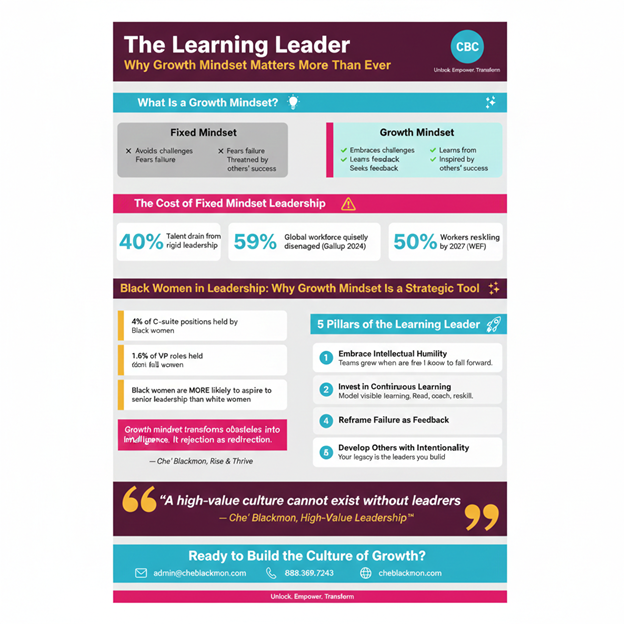
At its core, a growth mindset is a way of seeing the world. Leaders with a growth mindset believe they can improve, that failure is feedback, and that effort is the path to mastery. Their counterpart is what Dweck calls a fixed mindset: the belief that intelligence and talent are static traits you either have or you don’t.
Consider the difference in practice. A leader with a fixed mindset avoids challenges because failure threatens their identity. They may surround themselves with people who confirm what they already believe. They interpret criticism as a personal attack rather than an opportunity to recalibrate. By contrast, a growth mindset leader welcomes feedback, seeks out diverse perspectives, and treats setbacks as data points on the road to improvement.
Research from McKinsey & Company has shown that organizations with leaders who embrace growth mindset principles experience higher levels of employee engagement, stronger innovation pipelines, and better financial performance. A 2023 study published in the Harvard Business Review found that teams led by growth mindset leaders were 34% more likely to report feeling psychologically safe at work. Psychological safety, as we know from Google’s Project Aristotle research, is the single most important factor in building high‑performing teams.
In High‑Value Leadership: Transforming Organizations Through Purposeful Culture, I discussed how purpose‑driven direction, emotional intelligence, and authentic connection form the three pillars of high‑value leadership. A growth mindset is the thread that runs through all three. Without it, purpose becomes rigid ideology, emotional intelligence becomes manipulation, and connection becomes transactional.
💡 The Cost of a Fixed Mindset in Leadership
Fixed mindset leadership is expensive. Not in the way most executives think about cost, but in the slow erosion of trust, talent, and potential that accumulates when leaders stop growing.
Talent Drain
There was a mid‑sized manufacturing company in the Midwest that experienced a 40% turnover rate among its most experienced frontline supervisors over a two‑year period. Exit interviews consistently cited the same issue: leadership that refused to listen. Suggestions from the floor were ignored. Requests for cross‑training were denied. Promotions went to those who agreed with management rather than those who challenged the status quo. The cost? Millions in recruitment, lost institutional knowledge, and a workforce that stopped trying to innovate.
Innovation Stagnation
Fixed mindset leaders create cultures of compliance, not creativity. When employees learn that mistakes are punished and new ideas are dismissed, they stop offering either. The organization may look stable on the surface, but underneath, it is slowly falling behind competitors who are willing to experiment and learn.
Cultural Toxicity
Perhaps the most damaging consequence of fixed mindset leadership is the culture it breeds. When the person at the top operates from a place of defensiveness and rigidity, that attitude cascades throughout the organization. Managers stop developing their teams. Employees stop speaking up. The culture becomes one of self‑preservation rather than collective growth. As I detailed in Mastering a High‑Value Company Culture, a toxic culture does not happen overnight. It builds quietly when leaders stop paying attention to the environment they are creating.
✨ Growth Mindset and the Traditionally Overlooked: Why Representation Matters
While growth mindset is universally important, its impact on traditionally overlooked professionals, most specifically Black women in corporate spaces, deserves focused attention. The leadership landscape has never been a level playing field. For Black women, the journey to and through leadership roles involves navigating barriers that their peers often do not experience or even see.
📊 The Numbers Tell the Story
According to McKinsey’s Women in the Workplace 2024 report, Black women hold just 4% of C‑suite positions despite making up approximately 7.4% of the U.S. population. Only 1.6% of vice president roles and 1.4% of executive or senior‑level positions in Fortune 500 companies are held by Black women. This underrepresentation is not a pipeline problem. Black women are actually more likely than white women to report aspirations for senior leadership and to take proactive steps toward promotion.
What is happening? Systemic barriers. Limited access to sponsorship networks. The double bind of being expected to be assertive but not “aggressive,” confident but not “intimidating.” The invisible labor of code‑switching. The fatigue of being the “only one” in the room.
💪 Growth Mindset as a Strategic Tool
In Rise & Thrive: A Black Woman’s Blueprint for Leadership Excellence, I wrote about the concept of purposeful navigation: making strategic choices about when to challenge, when to listen, when to advocate for yourself, and when to build coalitions. Growth mindset is the engine that powers purposeful navigation. It transforms obstacles into intelligence. It reframes rejection as redirection. And most importantly, it resists the internalization of external limitations.
Black women who lead with a growth mindset do not wait for organizational cultures to “catch up.” They bring their whole selves to the table and leverage the very skills that navigating bias has sharpened: resilience, adaptability, pattern recognition, crisis management expertise, and community‑building capacities. These are not just personal qualities. They are leadership superpowers.
There was a healthcare organization that promoted its first Black woman to a VP role during a period of significant organizational crisis. She faced heightened scrutiny and skepticism from day one. Rather than shrinking to fit others’ expectations, she leaned into her growth mindset. She sought mentors both inside and outside the industry. She requested candid feedback from her direct reports and actually implemented what she heard. Within 18 months, her division had the highest employee satisfaction scores in the company and the lowest voluntary turnover. Her growth mindset did not just transform her career. It transformed the culture around her.
🌐 What Organizations Must Do
It is not enough for Black women and other overlooked professionals to cultivate growth mindsets in isolation. Organizations bear a responsibility to create environments where growth is possible for everyone. This means dismantling the systems that require certain employees to work twice as hard for half the recognition. It means rethinking how sponsorship, stretch assignments, and development opportunities are distributed. And it means leadership at every level modeling the humility and curiosity that a growth mindset demands.
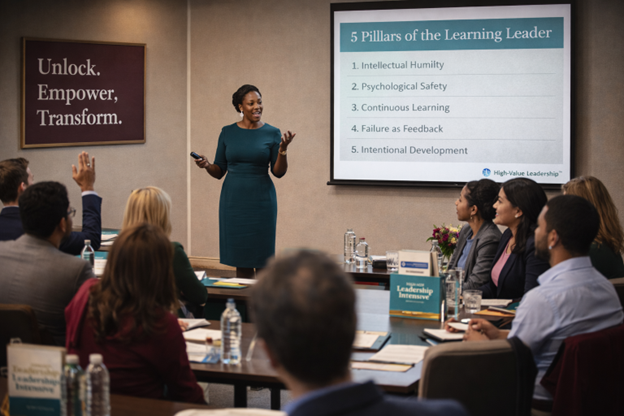
🚀 Five Pillars of the Learning Leader
Becoming a learning leader is not an event. It is a practice. Here are five pillars grounded in research and real‑world application that can guide your development.
1️⃣ Embrace Intellectual Humility
The strongest leaders are comfortable saying “I don’t know.” Intellectual humility is not weakness. It is the recognition that your current knowledge is incomplete and that other people, including those at every level of the organization, have insights you need. Dr. Adam Grant, organizational psychologist at Wharton, writes in Think Again that the ability to rethink and unlearn is as important as the ability to think and learn. High‑value leaders make this a daily practice.
2️⃣ Create Psychological Safety
Your team will never grow if they are afraid to fail. Dr. Amy Edmondson of Harvard Business School has demonstrated through decades of research that psychological safety is the foundation of learning organizations. This means creating environments where employees can take risks, make mistakes, voice concerns, and challenge the status quo without fear of punishment. As I discussed in High‑Value Leadership, trust‑based empowerment and personalized growth opportunities are essential components of the high‑value leader’s toolkit.
3️⃣ Invest in Continuous Learning
Growth mindset leaders do not just encourage learning in their teams. They model it visibly. They read. They attend workshops. They seek coaching. They pursue further education. The World Economic Forum’s Future of Jobs Report 2025 projects that 50% of all employees will need significant reskilling by 2027. Leaders who are not actively reskilling themselves are in no position to guide their teams through the changes ahead.
4️⃣ Reframe Failure as Feedback
Every setback carries a lesson. The question is whether your organizational culture allows people to find it. There was a technology firm that implemented what they called “learning reviews” instead of “post‑mortems” after every project. The language shift was intentional. It signaled that the purpose of examining what went wrong was not to assign blame but to harvest insight. Within one year, the company saw a measurable increase in teams volunteering for high‑risk, high‑reward projects because the stigma of failure had been replaced with the expectation of growth.
5️⃣ Develop Others with Intentionality
A learning leader’s legacy is measured not by their own achievements but by the leaders they develop. This requires intentionality. It means going beyond annual performance reviews and investing in regular coaching conversations, stretch assignments, and mentoring relationships. It also means examining who gets developed and who gets overlooked. If your leadership pipeline does not reflect the diversity of your workforce and your community, your development practices need to be audited for equity.
📋 Actionable Takeaways: Putting Growth Mindset into Practice
Knowing about growth mindset is not the same as living it. Here are concrete steps you can implement starting this week.
For Individual Leaders
- Conduct a personal leadership audit. Evaluate your response patterns. When was the last time you changed your mind about something important based on new information? If you cannot recall, that is your starting point.
- Schedule “learn time” on your calendar. Block 30 minutes each week exclusively for learning something new. It could be a podcast, a book chapter, a conversation with someone outside your industry, or a course module. Protect this time the way you protect your most important meetings.
- Seek feedback from unexpected sources. Ask a frontline employee, a cross‑functional peer, or a new hire what they see that leadership might be missing. Listen without defending.
- Rewrite your failure narrative. Choose one professional setback from your past and write down three lessons it taught you. This exercise retrains your brain to associate failure with learning rather than shame.
For Organizations
- Audit your development pipeline for equity. Who is getting access to stretch assignments, mentorship, and leadership development programs? If the demographics of your leadership pipeline do not match your workforce, the system is producing inequitable outcomes regardless of intent.
- Replace punitive language with learning language. Shift from “what went wrong” to “what did we learn.” This is not about removing accountability. It is about creating a culture where accountability and growth coexist.
- Invest in coaching for all levels of leadership. Executive coaching should not be reserved for the C‑suite. Emerging leaders, especially those from underrepresented backgrounds, benefit enormously from structured coaching that helps them navigate complex organizational dynamics.
- Make growth mindset a leadership competency. Include curiosity, adaptability, and learning agility in your leadership evaluation criteria. What gets measured gets managed.
📈 Current Trends: The Growth Mindset Imperative
The urgency around growth mindset in leadership has never been greater. Several trends are converging to make this the defining capability of the next decade.
AI and Automation are Redefining Competence. As artificial intelligence transforms industries, technical skills have a shorter shelf life than ever before. The World Economic Forum estimates that 44% of workers’ core skills will be disrupted in the next five years. Leaders who cling to “what has always worked” will find themselves and their teams obsolete. Growth mindset is no longer a nice‑to‑have. It is a business survival strategy.
Employees are Choosing Culture Over Compensation. Gallup’s State of the Global Workplace 2024 report found that 59% of the global workforce is quietly disengaged. The number one factor driving disengagement? A lack of development and growth opportunities. Employees, particularly younger workers, are leaving organizations that do not invest in their learning, even when the pay is competitive.
DEI is Evolving from Compliance to Culture. Organizations that treated diversity, equity, and inclusion as a checkbox exercise are finding that approach unsustainable. Authentic DEI requires leaders with growth mindsets: people willing to confront their own biases, learn from diverse perspectives, and continuously adapt their approach to inclusion. As I wrote in Rise & Thrive, the path to leadership excellence for Black women is not about fitting into existing structures. It is about transforming them. That transformation requires growth‑oriented leadership at every level.
🎓 Expert Insights: Voices on Growth and Leadership
Dr. Carol Dweck (Stanford University): “In a growth mindset, challenges are exciting rather than threatening. So rather than thinking, ‘Oh, I’m going to reveal my inadequacies,’ you say, ‘Wow, here’s a chance to grow.’” This reframe is essential for leaders navigating complex, ambiguous environments where certainty is a luxury no one can afford.
Brené Brown: In Dare to Lead, Brown writes that “the courage to be vulnerable is not about winning or losing. It’s about the courage to show up when you can’t predict or control the outcome.” Growth mindset requires this vulnerability. It asks leaders to admit what they do not know and to be seen in the process of learning.
Simon Sinek: Sinek’s concept of the “Circle of Safety” from Leaders Eat Last directly connects to growth mindset. When leaders create environments of trust and psychological safety, they give their people permission to experiment, fail, and grow. Without that circle, growth mindset becomes an individual effort fighting against a collective culture of fear.
Dave Ulrich: Ulrich’s work consistently emphasizes that culture is not just an internal feature but a competitive differentiator. Organizations that embed learning and growth into their cultural DNA attract better talent, drive more innovation, and outperform their peers financially. Growth mindset, at the organizational level, is the engine of competitive advantage.
🎯 Bringing It All Together: The High‑Value Learning Leader
The learning leader is not a new archetype. It is simply the natural evolution of what high‑value leadership has always demanded: purpose, emotional intelligence, authentic connection, and a relentless commitment to growth. What has changed is the pace of change itself. In a world where skills become obsolete faster than ever, where employees are hungry for development, and where the leaders at the top still do not reflect the diversity of the people they serve, growth mindset has moved from optional to essential.
In Mastering a High‑Value Company Culture, I wrote that employees are not resources. They are the lifeblood of the organization. The learning leader honors that truth by investing in their development, creating safe spaces for their growth, and modeling the kind of curiosity and humility that inspires everyone to bring their best selves to work.
In High‑Value Leadership, I explored how leaders must take extreme ownership of the cultures they create. A growth mindset is the foundation of that ownership because it keeps leaders accountable not just for results but for the environments that produce those results.
And in Rise & Thrive, I made this argument personal: your leadership value is not fixed. It grows as you embrace new challenges, build authentic connections, and refuse to let anyone else define the limits of your potential. That message is for everyone, but it carries particular power for those who have been told, explicitly or implicitly, that certain spaces were not designed for them.
Growth mindset is not just a leadership philosophy. It is a form of resistance against mediocrity, complacency, and the systems that benefit from keeping people small. Choose to grow. Choose to lead. Choose to build cultures where everyone can thrive.
❓ Discussion Questions
Use these questions for individual reflection, team meetings, or leadership development sessions.
- When was the last time you changed a firmly held opinion based on new evidence? What made you willing to shift?
- Think about your team’s response to failure. Is the default reaction to assign blame or to extract learning? What drives that pattern?
- Who in your organization gets access to development opportunities, and who does not? What criteria are being used, and are those criteria equitable?
- How does your organization’s culture affect the ability of Black women and other traditionally overlooked professionals to bring a growth mindset to their roles? Are the conditions in place for everyone to thrive?
- If you were to audit your own leadership for fixed mindset tendencies, what would you find? What is one area where you can commit to growth this month?
➡️ Next Steps: Your Growth Starts Here
Reading this article is a great first step. But growth mindset is not a concept you can absorb passively. It requires action.
- Share this article with a colleague or leadership team. Start a conversation about what growth mindset looks like in your organization today.
- Pick one actionable takeaway from the list above and implement it within the next seven days. Small, consistent steps compound into transformative change.
- Explore the resources mentioned in this article including Mastering a High‑Value Company Culture, High‑Value Leadership: Transforming Organizations Through Purposeful Culture, and Rise & Thrive: A Black Woman’s Blueprint for Leadership Excellence for deeper frameworks and strategies.
- Partner with Che’ Blackmon Consulting if your organization is ready for a deeper transformation. From fractional HR leadership and culture assessments to leadership development intensives and AI‑powered predictive analytics, we help companies build cultures where both people and performance thrive.
🙌 Ready to Build a Culture of Growth?
Let’s talk about how Che’ Blackmon Consulting can support your leadership journey.
📧 admin@cheblackmon.com
📞 888.369.7243
🌐 cheblackmon.com
© 2025 Che’ Blackmon Consulting. All Rights Reserved.
Unlock. Empower. Transform.
#GrowthMindset #Leadership #HighValueLeadership #CultureTransformation #LearningLeader #BlackWomenInLeadership #LeadershipDevelopment #FractionalHR #WomenInLeadership #OrganizationalCulture #EmployeeEngagement #WorkplaceCulture #LeadershipMatters #ExecutiveCoaching #CheBlackmonConsulting #DiversityEquityInclusion #HRStrategy #LeadWithPurpose #ProfessionalDevelopment #UnlockEmpowerTransform

Leave a Reply