By Che’ Blackmon, DBA Candidate | Founder & CEO, Che’ Blackmon Consulting
“The secret of change is to focus all of your energy not on fighting the old, but on building the new.”
— Socrates
🌿 Introduction: A Season Built for Intention
March is not just another month on the calendar. It is a turning point. The days are getting longer. The energy is shifting. And for leaders who pay attention, March carries an invitation that the rest of the year rarely offers: the chance to pause, recalibrate, and move forward with renewed clarity and conviction.
Think about it. The first quarter is nearly over. The goals you set in January have either gained traction or quietly stalled. The team dynamics you hoped would improve on their own have either strengthened or started showing cracks. March is the honest mirror that shows you exactly where you stand and, more importantly, where you need to go.
This month also holds a powerful cultural significance. March is Women’s History Month, a time dedicated to honoring the contributions, resilience, and leadership of women throughout history and in the present day. For Black women in corporate spaces, this month is a reminder that the fight for visibility, equity, and authentic representation is not a relic of the past. It is an ongoing, daily practice.
In Mastering a High‑Value Company Culture, I wrote that culture is the lifeblood of any organization. March is the perfect month to check the pulse of that lifeblood. Is your culture growing? Is it stagnant? Or has it quietly begun to decay under the surface while everyone focuses on hitting quarterly numbers? Spring does not ask permission to arrive. It simply shows up and transforms the landscape. The question for leaders is whether they are willing to do the same.
This article is your March playbook. It is designed to help you harness the energy of this pivotal month, honor the voices that have been historically silenced, and take practical steps to lead with the kind of purpose and power that transforms organizations from the inside out.

📆 The Q1 Reality Check: Where Do You Actually Stand?
Most organizations enter the new year with optimism. Goals are set. Budgets are approved. Strategies are unveiled at kickoff meetings with polished slide decks and motivational language. Then January fades into February, and the reality of execution sets in. By March, the gap between intention and action has become visible, whether leaders choose to acknowledge it or not.
A 2024 study by the Society for Human Resource Management (SHRM) found that nearly 60% of strategic initiatives launched at the beginning of the year show measurable drift from their original objectives by the end of the first quarter. The primary reasons? Lack of consistent follow through, competing priorities, and, most critically, a failure of leadership to adapt when early signals indicated the plan needed adjustment.
This is where purpose becomes essential. In High‑Value Leadership: Transforming Organizations Through Purposeful Culture, I discuss how purpose driven direction is one of the three foundational pillars of high‑value leadership. Purpose is not a statement you frame on the wall. It is the compass you consult when the terrain gets rough. Leaders who spring forward with power in March are those who return to their “why” and use it to realign their teams.
🔍 Three Questions for Your Q1 Audit
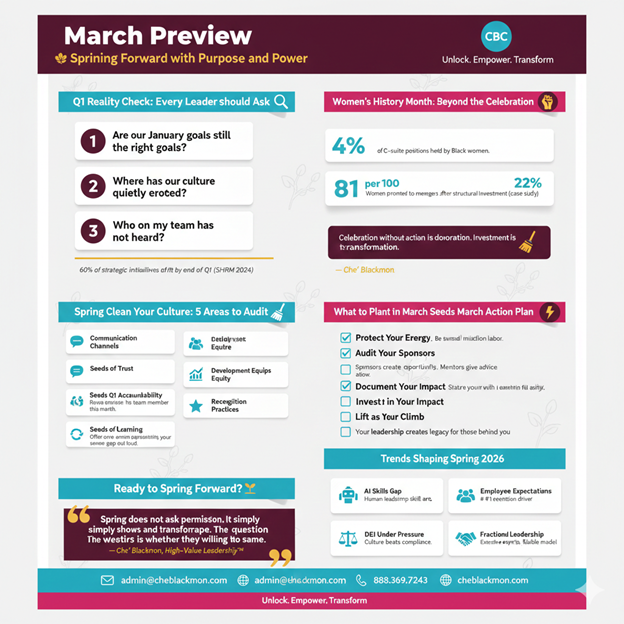
- Are the goals we set in January still the right goals? The business landscape shifts rapidly. A goal that made sense in December may need recalibration in March based on market conditions, team capacity, or new information. The best leaders are not rigid. They are responsive.
- Where has our culture quietly eroded? Culture erosion rarely announces itself. It shows up in small ways: a top performer who stopped volunteering for projects, a manager who has become more directive and less curious, a team that used to debate ideas openly but now defaults to silence. March is the month to look for these signals before they become crises.
- Who on my team has not been heard? Three months is long enough for patterns to form. If certain voices have been consistently absent from strategic conversations, that is not a coincidence. It is a leadership gap.
👑 Women’s History Month: Beyond the Celebration
Every March, organizations across the country acknowledge Women’s History Month. Social media fills with quotes from trailblazers. Company newsletters feature profiles of inspiring women in leadership. Internal communications teams create branded graphics. And then April arrives, and nothing changes.
This performative approach to honoring women’s contributions is not just insufficient. It is counterproductive. When employees see their organizations celebrate women one month and sideline them the other eleven, it deepens cynicism and erodes the trust that leaders claim to value.
📊 The State of Women in Leadership: 2025 and Beyond
According to McKinsey and LeanIn.Org’s Women in the Workplace report, women’s representation in the corporate pipeline has improved at the senior leadership level, but the progress is fragile. For every 100 men promoted from entry level to manager, only 81 women receive the same promotion. For women of color, that number drops even further.
For Black women specifically, the numbers remain sobering. Only 4% of C‑suite positions are held by Black women. Access to sponsorship, which research consistently shows is the most important accelerator for career advancement, remains disproportionately limited. And the phenomenon researchers call the “glass cliff,” where women and minorities are more likely to be promoted into leadership during times of organizational crisis when the risk of failure is highest, continues to shape the landscape.
✨ From Recognition to Real Investment
In Rise & Thrive: A Black Woman’s Blueprint for Leadership Excellence, I explore the concept of the hypervisibility and invisibility paradox that Black women navigate in corporate spaces. You are hyper visible when something goes wrong, when representation metrics need to be reported, or when the organization wants to showcase diversity in a public setting. But you become invisible when promotions are discussed, when high profile projects are assigned, or when executive mentoring relationships are formed behind closed doors.
Women’s History Month should be the catalyst for dismantling this paradox, not reinforcing it. Real investment looks like sponsorship programs that pair high potential women, especially women of color, with senior leaders who have the power and the willingness to advocate for their advancement in rooms where decisions are made. It looks like examining promotion criteria to ensure they are not built on models of success that were designed by and for a demographic that no longer represents the full talent pool. And it looks like funding, not just encouraging, leadership development for the women who have been doing extraordinary work without extraordinary support.
Case Study: From Celebration to Structural Change
There was a mid‑sized professional services firm that had celebrated Women’s History Month for five consecutive years with lunch and learn events, inspirational speaker series, and themed email campaigns. Employee engagement surveys showed that women, particularly women of color, rated the company’s commitment to equity lower each year despite these celebrations. The disconnect was clear: employees wanted structural investment, not symbolic gestures.
In the sixth year, the company changed its approach. Instead of a month of events, leadership committed to three structural changes: launching a formal sponsorship program pairing senior executives with high potential women of color, conducting a pay equity audit with results shared transparently, and restructuring promotion timelines to eliminate the informal “waiting period” that disproportionately affected women who had taken parental leave. Within 18 months, the representation of women in director level roles increased by 22%, and engagement scores among women of color rose for the first time in four years. The lesson was simple. Celebration without action is decoration. Investment is transformation.
🧹 Spring Cleaning Your Organizational Culture
Spring cleaning is not just for closets and garages. It is one of the most powerful metaphors available to leaders who are serious about maintaining a high‑value organizational culture. Just as physical spaces accumulate clutter over time, so do organizational cultures. Outdated policies that no longer serve the workforce. Communication habits that have become more performative than productive. Power dynamics that have calcified into gatekeeping structures. March is the ideal time to open the windows and let fresh air in.
🛠️ Five Areas to Audit This March
1️⃣ Communication Channels
How does information actually flow in your organization? Not how it is supposed to flow according to the org chart, but how it truly moves in practice. Are there teams that are consistently the last to know about changes? Are there employees who learn about strategic decisions from the rumor mill rather than from leadership? Communication gaps are culture gaps. Identify them and close them.
2️⃣ Meeting Culture
Meetings are one of the most revealing indicators of organizational health. Who speaks? Who is interrupted? Whose ideas are credited and whose are quietly absorbed by someone else? Research from Yale University found that women in professional settings are interrupted at significantly higher rates than their male counterparts, and that ideas initially proposed by women are more frequently attributed to the men who repeat them. If your meeting culture allows this pattern, your broader culture is sending a message about whose contributions are valued.
3️⃣ Development Equity
Pull the data on who has received leadership development opportunities, stretch assignments, and executive coaching in the last 12 months. If the demographics of that list do not reflect the demographics of your workforce, you have a development equity problem. As I wrote in Mastering a High‑Value Company Culture, investing in your people is not an overhead cost. It is the single most important investment you can make in your organization’s future.
4️⃣ Feedback Loops
Are employees giving honest feedback, or are they telling leadership what they think leadership wants to hear? A Harvard Business Review study found that 72% of employees believe their performance would improve if their managers provided corrective feedback more regularly. But feedback requires trust, and trust requires psychological safety. If your team has stopped being candid, the problem is not the team. The problem is the environment leadership has created.
5️⃣ Recognition Practices
Who gets recognized and for what? Recognition patterns often reveal unspoken cultural values more accurately than any mission statement. If your organization consistently celebrates individual heroics while overlooking collaborative excellence, you are incentivizing the wrong behaviors. If the employees being recognized month after month share the same demographic profile, you have a recognition equity problem that needs attention.
🚀 Leading with Purpose Driven Power
There is a difference between leading with authority and leading with purpose driven power. Authority comes from a title. Power, the kind that transforms organizations, comes from a deep alignment between who you are, what you believe, and how you show up every single day.
In High‑Value Leadership: Transforming Organizations Through Purposeful Culture, I describe how leaders who practice extreme ownership of their culture do not wait for someone else to fix what is broken. They take responsibility for the environments they create, and they model the values they want to see reflected in their teams. This is what it means to spring forward with power. It is not about force. It is about intentionality.
🌱 The Seasonal Leadership Framework
Nature offers a powerful model for leadership. Just as seasons cycle through periods of planting, growing, harvesting, and resting, effective leaders understand that their organizations move through similar rhythms. March sits at the intersection of rest and planting. The winter of planning is behind you. The growing season is ahead. What you plant now in your culture, in your relationships, in your leadership practices will determine what you harvest later in the year.
What to Plant in March
- Seeds of trust. Have one honest conversation this month with a team member you have not connected with deeply enough. Not a performance check in. A real conversation about what they need to thrive.
- Seeds of accountability. Revisit the commitments you made to your team at the beginning of the year. Which ones have you honored? Which ones have quietly been abandoned? Own the gap out loud. Your team already sees it. When you name it, you transform it from a trust deficit into a leadership moment.
- Seeds of equity. Identify one development opportunity this month and intentionally offer it to someone who has been overlooked. Not because it looks good on a diversity report, but because it is the right thing to do and because your organization cannot afford to leave talent underdeveloped.
- Seeds of learning. Commit to learning something new this month that stretches your perspective. Read a book by someone whose experience is radically different from yours. Attend a webinar outside your industry. Ask a junior employee to teach you something they are passionate about. Growth is contagious when leaders model it visibly.
💪🏾 Black Women in Leadership: Springing Forward on Your Own Terms
For Black women in corporate spaces, March carries a unique weight. Women’s History Month brings both visibility and the fatigue that comes with being asked, yet again, to represent, to educate, to inspire, often without the structural support that would make all of that emotional and intellectual labor sustainable.
In Rise & Thrive, I write about purposeful navigation: the strategic art of making choices about when to challenge, when to listen, when to advocate for yourself, and when to build coalitions. March is a month to practice all four of those skills with heightened intentionality.
🎯 A March Action Plan for Black Women Leaders
- Protect your energy. You will likely be asked to participate in Women’s History Month programming at your organization. Before saying yes to every panel, every interview request, and every mentoring coffee, ask yourself: is this an opportunity that advances my visibility and my career, or is this unpaid labor disguised as inclusion? It is okay to be selective. In fact, it is strategic.
- Audit your sponsors, not just your mentors. Mentors give advice. Sponsors use their influence to create opportunities for you when you are not in the room. Research from the Center for Talent Innovation shows that sponsorship is the most significant differentiator between professionals who advance and those who plateau. This month, identify who in your organization has the power and the track record to sponsor your next move. If you do not have a sponsor, building that relationship becomes your Q2 priority.
- Document your impact. Do not wait until performance review season to catalog your accomplishments. Start now. Create a running document of your contributions, the problems you have solved, the revenue or efficiency you have driven, and the people you have developed. This is not arrogance. It is evidence. As I discuss in Rise & Thrive, understanding your value proposition is the first step in commanding the recognition and advancement you have earned.
- Invest in your own development. If your organization is not investing in your growth, invest in yourself. Pursue certifications. Take a leadership course. Engage a coach. The World Economic Forum’s Future of Jobs Report 2025 identifies learning agility as one of the top five skills employers will prioritize through 2030. By investing in your own reskilling, you are not just advancing your career. You are future proofing it.
- Lift as you climb. One of the most powerful things a Black woman in leadership can do is create the conditions for other Black women to follow. That might mean recommending a colleague for a stretch assignment, sharing your knowledge through a mentoring relationship, or simply being visible so that someone earlier in her career can see what is possible. Your leadership creates a legacy that extends far beyond your own advancement.
📈 Current Trends Shaping March 2026 and Beyond
The leadership landscape is evolving at a pace that demands constant attention. Here are the trends that should be on every leader’s radar this March.
AI Is Accelerating the Leadership Skills Gap. As organizations integrate artificial intelligence into their operations, the demand for uniquely human leadership skills is intensifying. Emotional intelligence, cultural competence, ethical decision making, and the ability to lead through ambiguity are becoming the most valuable currencies in the leadership marketplace. Leaders who spend March sharpening these skills will be ahead of those who are still debating whether AI is relevant to their industry.
Employee Expectations Are Evolving Faster Than Policies. Gallup’s State of the Global Workplace 2024 report revealed that the number one factor driving employee disengagement globally is a lack of development and growth opportunities. Employees are no longer willing to wait years for their organizations to build leadership pipelines. They want investment now. Companies that delay will lose talent to competitors who act with urgency.
DEI Is Being Tested. Diversity, equity, and inclusion efforts are facing unprecedented scrutiny from multiple directions. Some organizations are scaling back their commitments under political and economic pressure. Others are doubling down by embedding equity into operational strategy rather than treating it as a standalone initiative. The organizations that will emerge strongest are those that understand what I have always believed: DEI is not a program. It is a culture. And culture, as I wrote in Mastering a High‑Value Company Culture, is the lifeblood of the organization.
The Fractional Leadership Model Is Growing. More companies, particularly those in the 20 to 200 employee range, are recognizing that they need executive level expertise without the full time executive price tag. Fractional HR leadership, fractional C‑suite roles, and project based consulting engagements are becoming standard practice. This model allows growing organizations to access strategic guidance that was previously only available to enterprise level companies. It is a trend that is democratizing leadership excellence.
🎓 Expert Insights: Voices on Purpose and Renewal
Simon Sinek: Sinek reminds us that leadership is not about being in charge. It is about taking care of those in your charge. In Leaders Eat Last, he describes the “Circle of Safety” that great leaders create. As you spring forward in March, ask yourself: is my circle expanding or contracting? Am I protecting my people’s ability to take risks, or am I unknowingly creating an environment where playing it safe is the only rational choice?
Brené Brown: Brown’s research on vulnerability in leadership has never been more relevant. “Clarity is kindness,” she writes in Dare to Lead. March is the month for clarity. Clear expectations. Clear feedback. Clear commitment to the values you espouse. Ambiguity breeds anxiety, and anxiety erodes culture.
Dave Ulrich: Ulrich’s work consistently emphasizes that HR and culture are not internal functions. They are strategic differentiators with external impact. The culture you build inside your organization directly shapes the experience your customers have, the talent you attract, and the reputation you carry in the market. A culture reset in March is not navel gazing. It is competitive strategy.
Dr. Carol Dweck: Dweck’s growth mindset research reminds us that the belief in our ability to develop is itself a leadership competency. March, with its themes of renewal and new beginnings, is a natural time to challenge the fixed mindset patterns that may have settled in during the winter months. Where have you stopped growing? That is where your attention belongs.
🎯 Bringing It All Together: Your March Manifesto
March is a month that rewards intentionality. The leaders who will end Q1 with momentum are not those who kept doing what they were doing in January. They are the ones who took stock, made adjustments, and chose to invest in the things that matter most: their people, their culture, and their own growth.
In Mastering a High‑Value Company Culture, I wrote that a high‑value culture does not happen by accident. It takes intentional design, consistent reinforcement, and continuous evolution. March is your design moment. Use it.
In High‑Value Leadership, I explored how the best leaders take extreme ownership of the environments they create. They do not blame external circumstances. They do not wait for permission. They act with the kind of purposeful conviction that inspires everyone around them to elevate. That is the energy March is offering you.
And in Rise & Thrive, I remind every woman, especially every Black woman in a leadership role, that your value is not determined by the structures around you. It is defined by the vision within you. Spring forward. Not because someone gave you permission. But because you were built for this season.
❓ Discussion Questions
Use these questions for personal reflection, team conversations, or leadership development sessions throughout March.
- What is one strategic goal from January that has lost momentum, and what specific action can you take this week to revive it?
- How is your organization honoring Women’s History Month? Is it celebration, or is it investment? What would structural commitment look like in your context?
- If you conducted a culture audit of your team today, what would you find in the areas of communication, meeting dynamics, development equity, and recognition? Where is the biggest gap?
- Think about the Black women and other traditionally overlooked professionals in your organization. Are they receiving sponsorship, stretch opportunities, and equitable access to development? If not, what is one concrete step you can take this month?
- What seed are you planting in March that your future self will thank you for? What are you willing to prune to make room for that growth?
➡️ Next Steps: Make March Count
Reading is a great start. But transformation requires movement. Here is how to turn this article into action.
- Share this article with your leadership team and use the discussion questions above to start a meaningful conversation before the month ends.
- Choose one area from the culture audit (communication, meetings, development equity, feedback, or recognition) and commit to one visible improvement by March 31st. Small, consistent changes compound into cultural transformation.
- Invest in your growth. Explore Mastering a High‑Value Company Culture, High‑Value Leadership: Transforming Organizations Through Purposeful Culture, and Rise & Thrive: A Black Woman’s Blueprint for Leadership Excellence for deeper frameworks, strategies, and practical tools you can apply immediately.
- Partner with Che’ Blackmon Consulting if your organization is ready for a deeper transformation this spring. From fractional HR leadership and culture assessments to leadership development intensives and AI powered predictive analytics, we help companies build cultures where both people and performance flourish.
🌸 Ready to Spring Forward?
Let’s talk about how Che’ Blackmon Consulting can help you lead with purpose and power this season.
📧 admin@cheblackmon.com
📞 888.369.7243
🌐 cheblackmon.com
© 2025 Che’ Blackmon Consulting. All Rights Reserved.
Unlock. Empower. Transform.
#SpringForward #Leadership #WomensHistoryMonth #CultureTransformation #HighValueLeadership #BlackWomenInLeadership #Q1Reset #OrganizationalCulture #FractionalHR #LeadershipDevelopment #WomenInLeadership #EmployeeEngagement #WorkplaceCulture #LeadershipMatters #CheBlackmonConsulting #DiversityEquityInclusion #HRStrategy #PurposeDrivenLeadership #ProfessionalDevelopment #UnlockEmpowerTransform

Leave a Reply