By Che’ Blackmon, DBA Candidate | Founder & CEO, Che’ Blackmon Consulting
📚 Book Tie‑In: High‑Value Leadership — Accountability and Ownership Frameworks
cheblackmon.com
🎯 Introduction: The Ownership Gap
There is a question that keeps surfacing in boardrooms, plant floors, and HR offices across every industry: Why does this team struggle to take ownership?
Leaders invest in training. They set goals. They implement performance management systems. And still, when something falls through the cracks, no one steps forward. The finger pointing starts. The excuses pile up. The same problems cycle through quarter after quarter. It is not a talent problem. It is an accountability architecture problem.
Accountability is one of the most discussed yet least understood concepts in organizational leadership. Most people think of it as something you enforce. Something you impose on others through consequences and corrective action. But that is only half the picture, and it is the less effective half. True accountability is not a policy. It is a culture. It is a shared commitment to owning results, learning from failure, and holding one another to a standard that everyone helped create.
In High‑Value Leadership: Transforming Organizations Through Purposeful Culture, I introduced the concept that leaders do not just manage performance. They architect the environments in which performance becomes a natural byproduct of shared purpose. Accountability is one of the most critical beams in that architecture. Without it, even the most talented teams will underperform. With it, even teams facing significant challenges can produce extraordinary results.
This article explores what accountability architecture actually looks like in practice, why traditional approaches to accountability fail (especially for traditionally overlooked populations), and how High‑Value Leaders™ build teams where ownership is not demanded but embedded in the culture itself.

⚠️ The Accountability Crisis: What the Data Tells Us
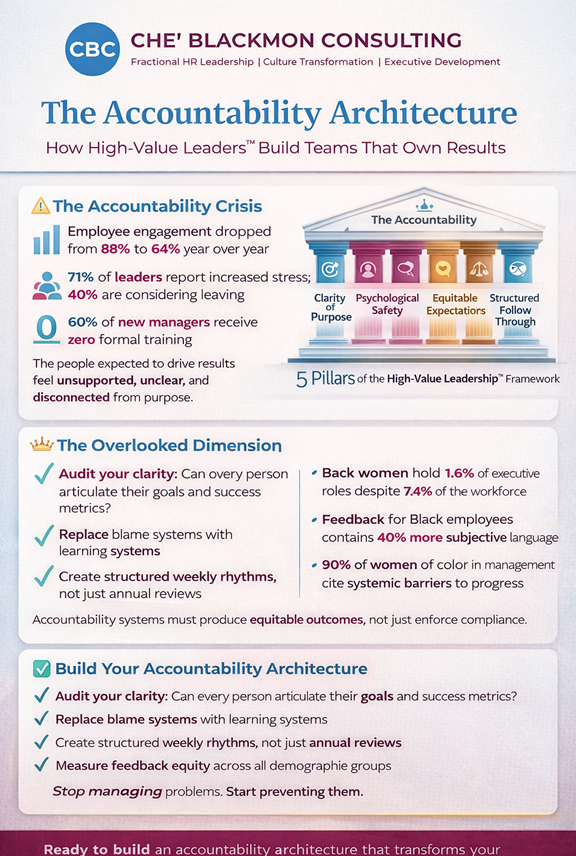
The numbers in 2026 paint a concerning picture. Employee engagement has dropped dramatically, falling from 88% to just 64% year over year according to recent workforce research. Gallup reported a notable decline in manager engagement in 2025, dropping from 30% to 27%, with younger managers under 35 declining five percentage points and female managers declining seven. Meanwhile, 71% of leaders report increased stress from their roles, and 40% of those stressed leaders are considering leaving.
At the same time, leadership development has risen to the number one organizational priority for 2026, followed by innovation and retention. Organizations are recognizing that controlling costs alone will not solve what ails them. The real issue is that the people expected to drive results feel unsupported, unclear about expectations, and disconnected from purpose.
This is the accountability crisis in plain terms. It is not that people do not want to be accountable. It is that organizations have failed to create the conditions where accountability can thrive. Too many leaders confuse surveillance with accountability, consequence with commitment, and compliance with ownership. The result is a workforce that does what it is told but refuses to go further, because going further feels risky in a culture that punishes mistakes more than it rewards initiative.
“Culture isn’t a nice‑to‑have. It’s your competitive advantage. We prove it with data.” When accountability is embedded in culture rather than enforced through policy, teams do not just meet expectations. They exceed them.
🛠️ The Accountability Architecture Framework
In Mastering a High‑Value Company Culture, I wrote that culture is the lifeblood of any organization and that employees are not resources but the lifeblood of that organization. The Accountability Architecture builds on that foundation. It is not a single practice or policy. It is a system of interconnected elements that, when aligned, create an environment where people naturally own their work, their outcomes, and their growth.
The framework rests on five structural pillars, each aligned with the High‑Value Leadership™ methodology:
🎯 Pillar 1: Clarity of Purpose (Purpose‑Driven Vision)
Accountability begins with clarity. People cannot own what they do not understand. Yet one of the most common failures in organizations is the assumption that because something was communicated, it was understood. Purpose‑Driven Vision means every team member can answer three fundamental questions: What are we trying to achieve? Why does it matter? What is my specific role in making it happen? When those questions go unanswered, accountability becomes impossible because people are trying to hit a target they cannot see.
There was a mid‑size manufacturing company that rolled out a new quality initiative and then spent the entire quarter frustrated that frontline teams were not meeting the new standards. An internal review revealed that the initiative had been communicated through a single email from the VP of Operations. Supervisors had never been briefed on the specifics. The frontline received no training. The target was set, but the architecture to support it was nonexistent. Once leadership rebuilt the communication cascade (briefing supervisors, training teams, posting visual standards on the floor, and establishing weekly check ins), compliance rose from 52% to 91% within 60 days.
🏠 Pillar 2: Psychological Safety (Stewardship of Culture)
Here is a truth many leaders resist: people will not take ownership in environments where they fear being punished for honest mistakes. Psychological safety is the invisible foundation of every accountable team. It does not mean lowering standards. It means creating space for people to try, fail, learn, and try again without the threat of humiliation or retaliation.
Research from the O.C. Tanner Institute confirms that when organizations prioritize transparency in accountability (leaders openly sharing challenges, admitting mistakes, and taking responsibility), odds of organizational success increase tenfold and trust in leaders increases eightfold. Teams become 13 times more likely to meet their goals and 15 times more likely to be engaged.
As Stewards of Culture, High‑Value Leaders™ model the behavior they expect. They own their mistakes publicly. They ask for feedback and act on it. They make it safe for others to raise concerns before those concerns become crises. This is what separates accountability cultures from blame cultures.
❤️ Pillar 3: Equitable Expectations (Emotional Intelligence)
Accountability only works when expectations are applied consistently and fairly. This is where many organizations fail, often without realizing it. When some team members receive clear, actionable performance feedback while others receive vague generalities, the accountability system is broken at its foundation.
Research from Catalyst reveals a pattern that should concern every HR leader: Black employees, particularly Black women, are significantly less likely to receive the kind of specific, developmental feedback that drives career advancement. They receive feedback that is less actionable, less connected to growth opportunities, and more focused on subjective assessments like “executive presence” or “cultural fit.” This is not an accountability system. It is a bias delivery mechanism disguised as one.
Emotional Intelligence in the Accountability Architecture means leaders audit their own feedback patterns. Are they giving the same quality of direction, correction, and praise to every team member? Are success metrics objective and transparent? Can every person on the team point to exactly what they need to do to advance? If the answer to any of those questions is no, the architecture needs repair.
⚖️ Pillar 4: Structured Follow Through (Balanced Responsibility)
Setting expectations without follow through is just wishful thinking. Balanced Responsibility means creating rhythms and structures that keep accountability alive without micromanaging. This includes regular check ins that focus on progress rather than surveillance, peer accountability partnerships that distribute ownership across the team, and milestone reviews that celebrate wins and course correct early.
The most effective accountability systems operate on what researchers call daily action systems rather than periodic measurement approaches. Instead of waiting for the quarterly review to discover that a project is off track, High‑Value Leaders™ create weekly touchpoints where teams assess their own progress, identify barriers, and request support. This shifts the dynamic from “my boss is checking on me” to “we are checking on our goals together.”
There was a professional services firm that replaced its traditional annual review cycle with a structured cadence of monthly goal alignment conversations, weekly team stand ups, and quarterly reflection sessions. Within one year, voluntary turnover dropped by 30%, internal promotion rates increased, and employee satisfaction scores rose across every demographic group. The key was not that they added more meetings. It was that every meeting had a clear purpose tied to shared outcomes.
🤝 Pillar 5: Reciprocal Accountability (Authentic Connection)
The final and most transformative pillar is reciprocal accountability. This is the principle that accountability flows in every direction, not just downward. Leaders are accountable to their teams just as teams are accountable to their leaders. When leaders ask “What do you need from me to succeed?” and then follow through on the answer, they create a fundamentally different kind of trust.
Authentic Connection means that accountability is not something done to people. It is something built with them. It means involving teams in setting their own goals, defining their own success metrics, and co‑creating the standards to which they will hold one another. When people have a hand in designing the system, they have a stake in making it work.
👑 The Overlooked Dimension: Accountability and Black Women in Corporate Spaces
Any honest conversation about accountability in the workplace must address a reality that too many organizations ignore: accountability systems are not experienced equally by everyone. For Black women in corporate spaces, the accountability architecture is often rigged from the start.
In Rise & Thrive: A Black Woman’s Blueprint for Leadership Excellence, I wrote extensively about how Black women navigate what scholars call “double jeopardy,” facing bias related to both race and gender simultaneously. This intersectional reality shapes how accountability is experienced in several critical ways.
🔍 The Double Standard of Scrutiny
Black women in leadership are disproportionately scrutinized while simultaneously being undersupported. Research consistently shows that Black women are held to higher standards than their peers while receiving less mentorship, less sponsorship, and less access to the senior leaders who control career trajectories. The U.S. Government Accountability Office found that despite making up 7.4% of the workforce, Black women hold only 1.6% of executive roles. This is not a pipeline problem. It is an accountability problem at the organizational level: who is being held accountable for ensuring that qualified Black women actually advance?
🔍 The Feedback Gap
Harvard Business Review research on Black women in the workplace reveals that self‑censorship, the need to code switch, and gendered expectations to prioritize the comfort of colleagues all hinder career progression. When performance feedback is vague, subjective, or filtered through unconscious bias, Black women are denied the clear accountability framework that everyone else receives. They are told to “be more strategic” without being told what that means. They are encouraged to “increase their visibility” while being penalized for being “too visible.” This is not accountability. It is a moving target designed (whether intentionally or not) to keep people running in place.
🔍 The Glass Cliff
Catalyst research highlights a troubling pattern: Black women are disproportionately promoted during periods of organizational crisis, a phenomenon known as the “glass cliff.” They are elevated into leadership roles during the most difficult moments, without the support, resources, or runway that their predecessors received. Then, when the turnaround proves as difficult as expected, the accountability falls squarely on their shoulders. Catalyst’s recommendation is clear: organizations must create accountability structures that include equitable succession planning, bias‑free evaluation processes, and genuine support systems for all leaders, not just those who fit the traditional prototype.
For Black women reading this, I want to name something directly. The accountability failures you have experienced are not your failures. They are systemic failures. And while navigating them requires the resilience, emotional intelligence, and strategic awareness I outlined in Rise & Thrive, the ultimate responsibility for fixing them belongs to the organizations that created them.
📋 Practical Case Studies: Accountability Architecture in Action
🟢 Case Study 1: From Blame Culture to Ownership Culture
A regional healthcare system with over 2,000 employees was experiencing dangerously high nursing turnover. Leadership attributed the problem to “a new generation that doesn’t want to work.” An internal culture assessment told a different story. Nurses reported that when patient care issues arose, they were immediately investigated for fault rather than supported in finding solutions. Experienced nurses stopped reporting near misses because the accountability system was actually a punishment system.
The organization redesigned its accountability architecture from the ground up. It replaced incident blame reports with learning reviews that focused on systemic root causes. It trained charge nurses and supervisors in psychological safety practices. It created peer accountability circles where nursing teams reviewed their own outcomes weekly and identified improvements collectively. Within 18 months, nursing turnover decreased by 35%, patient safety incident reporting actually increased (a positive indicator, meaning the team felt safe enough to be transparent), and employee engagement scores rose across every unit.
🟢 Case Study 2: Closing the Feedback Equity Gap
A technology company discovered through a third party audit that performance reviews for Black and Latino employees contained 40% more subjective language and 30% fewer specific developmental recommendations than reviews for white employees. Managers were not being intentionally biased. They were simply defaulting to vague language when they lacked cultural fluency or close working relationships with employees from different backgrounds.
The company implemented three changes. First, it standardized review criteria with measurable, role specific benchmarks that every employee could see. Second, it required managers to include at least three specific, actionable development recommendations in every review. Third, it created a calibration process where HR reviewed anonymized reviews across demographic groups quarterly to identify patterns. Within two review cycles, the feedback equity gap had narrowed by 68%, promotion rates for underrepresented employees increased, and managers reported feeling more confident (not less) in their evaluation skills.
🟢 Case Study 3: Building Reciprocal Accountability on the Plant Floor
An automotive parts manufacturer was struggling with chronic quality issues on its second shift. Management’s response had been to add more inspections, more write ups, and more supervisor oversight. Quality continued to decline. Morale cratered.
A new plant HR leader took a different approach. She convened a series of listening sessions with second shift operators and asked a question no one had asked before: “What do you need from us to produce quality parts consistently?” The answers were illuminating. Operators had been working with outdated work instructions, broken fixtures that maintenance never prioritized, and a supervisor who withheld information as a power tactic. The accountability failure was not on the floor. It was in the system above the floor.
Leadership replaced the supervisor, expedited maintenance requests, updated all work instructions with operator input, and established a weekly quality huddle run by the operators themselves. Within one quarter, scrap rates dropped by 44% and the second shift began outperforming the first shift for the first time in the plant’s history. The operators did not suddenly become more accountable. The organization became accountable to them.
✅ Actionable Takeaways: Building Your Accountability Architecture
💼 For Leaders and Organizations
- Audit your clarity. Can every person on your team articulate what they are responsible for, why it matters, and how success will be measured? If not, start there. Accountability without clarity is just confusion with consequences.
- Measure your feedback equity. Pull a random sample of performance reviews from the last cycle and compare them across demographic groups. Look for patterns in specificity, developmental recommendations, and subjective language. What you find may surprise you.
- Replace blame systems with learning systems. When something goes wrong, the first question should be “What in our system allowed this to happen?” not “Who is responsible for this failure?” This single shift transforms accountability from a weapon into a tool for improvement.
- Create structured rhythms. Accountability lives in the cadence of your operations, not in the annual review. Implement weekly team stand ups focused on progress and barriers, monthly one on ones focused on development, and quarterly reflections focused on alignment.
- Model reciprocal accountability. Ask your team regularly: “What do you need from me that you are not getting?” And then deliver on their answers. Nothing builds trust faster than a leader who holds themselves to the same standard they expect from others.
- Invest in manager development. Gallup’s research confirms that 70% of team engagement is directly attributable to the manager. Yet 60% of new managers receive no formal training upon entering their roles. Close that gap. Your accountability architecture is only as strong as the managers who maintain it.
🙋 For Black Women and the Traditionally Overlooked
- Demand clarity. If your goals, success metrics, or development path are vague, ask for specifics in writing. Document the conversation. You deserve the same level of clarity and direction that everyone else receives.
- Build your own accountability circle. Connect with peers (inside or outside your organization) who will hold you to your goals, celebrate your wins, and help you strategize through challenges. Isolation is the enemy of advancement.
- Track your contributions in real time. Do not wait for the annual review to articulate your impact. Maintain a running record of projects completed, outcomes delivered, problems solved, and skills developed. This becomes your evidence when the system is vague.
- Name the pattern when you see it. If you notice that feedback is consistently subjective, if you are being held to a different standard, or if you are being elevated into high risk roles without adequate support, say so. Use the language of accountability: “I want to be successful in this role. Here is what I need to make that happen.”
- Protect your well being. Accountability to your organization should never come at the cost of your health. The “strong Black woman” narrative is not a leadership strategy. It is a path to burnout. As I wrote in Rise & Thrive, sustainable leadership requires balancing self care with professional advancement.
🏢 For Culture Transformation
- Align accountability with values. If your organization says it values inclusion, then your accountability system must produce inclusive outcomes. Track promotion rates, retention rates, and engagement scores by demographic group and hold leaders accountable for equity in those metrics.
- Train for emotional intelligence. Managers cannot build equitable accountability systems if they lack the self awareness to recognize their own biases. Invest in emotional intelligence development as a core leadership competency, not an optional workshop.
- Make accountability visible. Publish team goals, progress updates, and outcomes transparently. When everyone can see the scoreboard, the game changes. Visibility drives ownership.
- Celebrate ownership publicly. When someone takes initiative, owns a mistake, or goes above and beyond, recognize it visibly. What gets celebrated gets repeated.
📊 Expert Insights and Current Research
The convergence of research in 2025 and 2026 paints a clear picture: accountability is the defining leadership challenge of this era. A January 2026 analysis of over 300 leading business reports found that executive teams are becoming hyper focused on accountability while simultaneously showing a decline in empathy. In fact, 59% of organizations now view empathy as a “nice to have” rather than an essential leadership capability. This is a dangerous combination. Accountability without empathy is authoritarianism. It produces compliance but destroys initiative.
The McLean & Company HR Trends Report for 2026 confirms that a widening gap exists between the pace of organizational transformation and the capacity of leaders to manage that transformation effectively. This creates what researchers call structural risk: the people responsible for accountability often lack the training, support, and emotional bandwidth to exercise it wisely.
McKinsey’s research demonstrates that organizations with strong cultures outperform their peers by three times in long term total shareholder return. And the O.C. Tanner Institute’s global research finds that when leaders practice transparency and recognition together, organizations are eight times more likely to be financially healthy. The data is unmistakable: accountability, when paired with transparency, psychological safety, and genuine recognition, is not just a people strategy. It is a business strategy with measurable returns.
💡 The High‑Value Leadership™ Perspective
Throughout High‑Value Leadership: Transforming Organizations Through Purposeful Culture, I make the case that leadership is not about controlling outcomes. It is about creating environments where the right outcomes emerge naturally because people are aligned, equipped, supported, and inspired. The Accountability Architecture is a direct extension of that philosophy.
Purpose‑Driven Vision provides the clarity that makes accountability possible. Stewardship of Culture creates the psychological safety that makes it sustainable. Emotional Intelligence ensures it is applied equitably. Balanced Responsibility gives it structure and rhythm. And Authentic Connection makes it reciprocal, transforming accountability from a top down mandate into a shared commitment.
This is what separates High‑Value Leaders™ from traditional managers. Traditional managers enforce accountability. High‑Value Leaders™ build it. They design it into the DNA of their teams. They model it in their own behavior. And they measure not just whether results were achieved, but whether the system itself is fair, transparent, and empowering for everyone.
As I wrote in Mastering a High‑Value Company Culture: “At the heart of every great company culture is its people.” The Accountability Architecture honors that truth. It treats people as the lifeblood of the organization, not as problems to be managed. And in doing so, it produces the kind of results that no amount of surveillance, corrective action, or top down pressure ever could.
❓ Discussion Questions
Use these questions for team meetings, leadership development sessions, or personal reflection:
- Can every member of your team clearly articulate their goals, why those goals matter, and how success will be measured? If not, where is the clarity gap?
- When something goes wrong on your team, is the first instinct to find the root cause or to find someone to blame? What does that instinct reveal about your culture?
- How would you rate the quality and consistency of feedback across all members of your team? Are there disparities based on tenure, gender, race, or relationship closeness?
- When was the last time you asked your team, “What do you need from me that you are not getting?” What would change if you asked that question consistently?
- Does your organization hold leaders accountable for equitable outcomes (promotion rates, retention rates, engagement scores) across all demographic groups? If not, what would it take to implement that?
- How does your personal accountability practice align with the five pillars of the High‑Value Leadership™ framework? Which pillar needs the most attention in your leadership right now?
🚀 Next Steps: From Framework to Action
Knowledge without action is just information. Here is how to move forward:
- Share this article with your leadership team and schedule a discussion using the questions above.
- Conduct a feedback equity audit on your most recent performance review cycle within the next 30 days.
- Select one pillar of the Accountability Architecture and implement a concrete change within 90 days.
- Ask your team the reciprocal accountability question (“What do you need from me?”) at your next one on one and follow through visibly.
- Invest in your own growth. Explore the resources below and consider how deepening your leadership practice can transform your team’s culture.
📬 Ready to Build an Accountability Architecture That Transforms Your Organization?
At Che’ Blackmon Consulting, we partner with organizations to design and implement the leadership and culture systems that drive real, measurable results. Whether you need fractional HR leadership, culture assessment, accountability system design, or leadership development, we bring 30+ years of experience and a proven framework to help your people and your organization thrive.
Explore our resources:
- 📖 Mastering a High‑Value Company Culture
- 📖 High‑Value Leadership: Transforming Organizations Through Purposeful Culture
- 📖 Rise & Thrive: A Black Woman’s Blueprint for Leadership Excellence
- 🎓 High‑Value Leadership Intensive (Waitlist): https://adept-solutions-llc-2.kit.com/147712ac25
- 🎧 Unlock, Empower, Transform Podcast
- 📰 The Blackmon Brief Newsletter
All books available at: https://books.by/blackmons‑bookshelf
📧 admin@cheblackmon.com | 📞 888.369.7243 | 🌐 cheblackmon.com
Fractional HR Leadership | Culture Transformation | Executive Development
Let’s build workplaces where both people and organizations flourish.
© 2026 Che’ Blackmon Consulting. All rights reserved. This article may be shared with proper attribution. #AccountabilityArchitecture #HighValueLeadership #HRLeadership #CultureTransformation #LeadershipDevelopment #FractionalCHRO #WorkplaceCulture #TeamAccountability #InclusiveLeadership #PeopleFirst #BlackWomenLead #EmployeeEngagement #HRStrategy #LeadershipTrends2026 #FractionalHR #ExecutiveDevelopment #PsychologicalSafety #FeedbackEquity #BlackWomenInBusiness #CheBlackmonConsulting

Leave a Reply