By Che’ Blackmon, DBA Candidate | Founder & CEO, Che’ Blackmon Consulting
Some organizations seem magnetic. People do not just work there. They stay, they grow, they refer their friends, and even after they leave, they speak of the culture with reverence. From the outside, it can look like luck. Great timing, a charismatic founder, or the right industry at the right moment. But here is what two and a half decades of human resources leadership across manufacturing, automotive, healthcare, professional services, and nonprofit environments has taught me: there is no such thing as an accidentally great culture. What looks like luck is almost always engineering.
In Mastering a High-Value Company Culture, I made the case that culture is the lifeblood of an organization. Not a tagline. Not a slide in the onboarding deck. The actual, living, breathing system through which every organizational outcome flows. And in High-Value Leadership: Transforming Organizations Through Purposeful Culture, I went further, arguing that culture does not build itself. It is built, or neglected, by the leaders who hold responsibility for it. This article takes those ideas into practical territory. Because understanding that great cultures are engineered is one thing. Understanding the specific systems that make them sticky is another entirely.

🏗️ The Architecture of a Culture That Retains
When an organization experiences low voluntary turnover, high engagement scores, and a reputation as an employer of choice, most senior leaders will credit their values, their people, or their mission. And they are not wrong. But what they often cannot explain is the mechanism. How do those values get operationalized? How does the mission translate into daily behavior? How do people actually feel the culture rather than just read it on the wall?
The answer lies in systems. Intentional, repeatable, measurable systems that translate leadership intent into lived employee experience. Culture that retains is not the result of good vibes. It is the result of deliberate architecture.
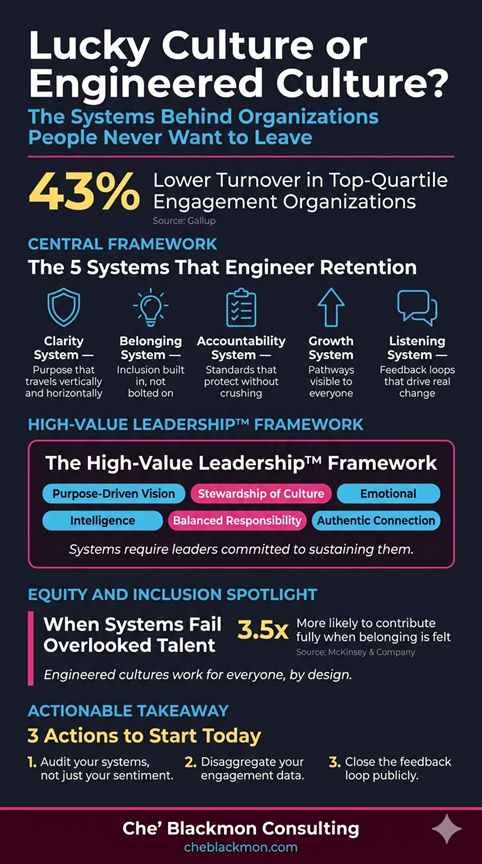
Research consistently confirms this. A landmark Gallup study on employee engagement found that organizations in the top quartile of engagement outperform bottom-quartile organizations by 23 percent in profitability and experience 43 percent lower turnover. What separates those quartiles is not industry or geography. It is the quality of systems that shape how people experience their work every single day.
“Culture is not what you say it is. Culture is what your systems consistently produce.” — Che’ Blackmon, High-Value Leadership™
🔍 The Five Systems That Make or Break Retention
📌 1. The Clarity System: Purpose That Travels Vertically and Horizontally
Purpose-driven vision is the first pillar of the High-Value Leadership™ framework, and it is foundational to retention for a reason. Human beings do not leave paycheck machines. They leave organizations where they cannot see themselves in the mission, where the stated values bear no resemblance to the daily decisions being made, or where their work feels disconnected from anything that matters.
Organizations that retain top talent have clarity systems in place. These are not annual town halls or framed mission statements. They are structured mechanisms that ensure every employee, at every level, can trace a line between their daily responsibilities and the organizational purpose. There was a company operating in the professional services sector that experienced a 19 percent voluntary turnover in a single fiscal year. When exit survey data was analyzed, the most common theme was not compensation. It was disconnection. Employees did not understand how their work contributed to the larger whole. A structured clarity initiative, including cascaded goal alignment, departmental purpose workshops, and a revised onboarding framework, reduced that turnover figure by more than a third within 18 months.
Clarity is not a one-time communication event. It is a repeating system.
🤝 2. The Belonging System: Inclusion That Is Built In, Not Bolted On
High retention cultures do not simply avoid exclusion. They actively architect belonging. And belonging, it turns out, is one of the most powerful drivers of commitment. A 2023 report from McKinsey & Company found that employees who feel a strong sense of belonging are 3.5 times more likely to contribute to their full potential and significantly less likely to leave. Yet most organizations treat inclusion as a program rather than a system.
The distinction matters enormously. A program is an event. It has a start date, an end date, and a budget line. A system is structural. It lives in how decisions are made, who is invited into the room, whose ideas get credited, how performance is evaluated, and who gets sponsored for advancement. There was a manufacturing organization that launched a diversity and inclusion initiative with great fanfare, complete with training sessions, a committee, and a new policy statement. Eighteen months later, their engagement scores for Black employees and other employees of color had not moved. When the data was disaggregated, the finding was clear: the program had not touched the systems. Promotions still went to the same profile. Stretch assignments were still distributed informally through networks that did not include everyone.
Engineered cultures build belonging into the systems themselves. Not just the programming.
✨ Real belonging is not a committee. It is the lived experience that results when systems are designed to see, hear, and advance every person equitably.
📋 3. The Accountability System: Standards That Protect Without Crushing
One of the most misunderstood elements of high-retention culture is the role of accountability. There is a pervasive belief, particularly in organizations that have experienced culture toxicity, that warmth and high standards are in tension. That if you hold people firmly accountable, you will damage psychological safety. And if you prioritize belonging and care, you will let performance erode. This is a false choice.
In High-Value Leadership, I describe the Balanced Responsibility pillar as the discipline of holding both simultaneously. The organizations that people never want to leave tend to be the ones where expectations are crystal clear, feedback is delivered with both candor and care, and accountability is applied consistently regardless of tenure, title, or proximity to leadership. That consistency is not punitive. It is, in fact, deeply reassuring. Employees in high-accountability cultures report higher levels of trust in leadership and higher perceptions of fairness than those in cultures where expectations shift based on who is watching.
There was a nonprofit organization that prided itself on being family-like. The problem was that the same family dynamic that created warmth also produced a culture where underperformance was tolerated, boundaries were fuzzy, and burnout among high performers was endemic. When leaders implemented structured accountability frameworks, including clear performance metrics, documented expectations, and consistent feedback cycles, the culture did not become colder. It became more equitable. High performers stayed. Disengaged employees either recommitted or self-selected out.
🌱 4. The Growth System: Pathways Visible to Everyone
Talent leaves organizations for many reasons, but one of the most consistently cited is the absence of a visible path forward. Growth systems in high-retention organizations are not limited to formal training programs or tuition reimbursement policies. They are the full infrastructure through which people can see, access, and pursue development, stretch opportunities, mentorship, sponsorship, and advancement.
The word “visible” is doing heavy lifting in that sentence. In many organizations, growth opportunities exist. They are just not equally visible or accessible. Informal networks, proximity to decision-makers, and social capital determine who knows about the opening before it is posted, who gets tapped for the high-visibility project, and who receives the developmental feedback that equips them for the next level. For employees who are not embedded in those informal networks, the opportunity gap is very real.
Engineered cultures systematize visibility. There was a healthcare organization that implemented a structured internal talent marketplace, pairing high-potential employees with formal sponsors and creating transparent criteria for stretch assignments. Within two years, internal promotion rates increased significantly and the pattern of informal favoritism that had previously characterized advancement became far less pronounced.
🗣️ 5. The Listening System: Feedback Loops That Drive Change
Organizations that retain their best people are organizations that demonstrably listen. Not performatively. Not in ways that collect data and file it away. But in ways where feedback from employees at every level visibly informs decisions, and where employees can trace the arc from what they said to what changed.
This is one of the most significant differentiators between organizations with high voluntary turnover and those without it. According to a 2022 Qualtrics study, employees who believe their feedback will be acted upon are 55 percent more likely to stay. Yet less than 30 percent of employees globally report that their organization actually closes the feedback loop by telling them what changed as a result of what they shared.
Listening systems include formal mechanisms like engagement surveys and stay interviews. They also include the informal practices that signal to employees whether speaking up is safe and whether it matters. In the organizations people never want to leave, feedback is not a performance. It is a practice.
👩🏿💼 The Compounding Cost of Getting This Wrong: A Lens on Traditionally Overlooked Talent
Every system described above carries a multiplied consequence for employees who have historically been marginalized or overlooked in organizational life. And no group navigates this dynamic more acutely, or with higher personal and professional stakes, than Black women in corporate environments.
In Rise & Thrive: A Black Woman’s Blueprint for Leadership Excellence, I wrote directly to this reality. Black women enter corporate spaces carrying expertise, credentials, and ambition, and they far too frequently encounter systems that were not designed with their advancement in mind. The result is not simply a talent pipeline problem for individuals. It is a systemic waste of organizational capacity that shows up in the data: Black women remain among the most underrepresented groups in senior leadership, and they experience higher rates of voluntary departure from corporate roles than many of their peers.
What does this have to do with culture engineering? Everything.
🚨 When Systems Fail Specific Populations
An organization can have strong clarity systems, well-designed accountability frameworks, and genuine listening mechanisms, and still produce a culture that pushes out its Black women if those systems carry embedded bias. Performance evaluation systems that reward informal relationship capital disproportionately disadvantage employees who are excluded from informal networks. Sponsorship systems that rely on personal affinity rather than structured nomination processes reproduce the same representation gaps cycle after cycle. Feedback cultures that penalize directness or code-switch expectations, often unfairly applied to Black women, undermine the psychological safety that retention requires.
There was a large-scale manufacturing organization that had strong engagement scores across most demographic groups, and then notably lower scores among Black women at the individual contributor and mid-management levels. When focus groups were conducted, the findings were consistent: the systems worked for most people. But for Black women specifically, the experience of being overlooked for high-visibility assignments, having their ideas credited to others, and receiving feedback that was vague enough to be unhelpful was common enough to represent a pattern rather than isolated incidents.
The solution was not a program. It was a systems audit followed by targeted redesign: structured sponsorship criteria, blind-step evaluation checkpoints in the promotion process, and a revised feedback framework that trained managers on specific, behavior-based language. Over three years, representation in leadership for Black women increased noticeably, and their engagement and retention scores moved toward parity with the broader workforce.
💡 The cultures people never want to leave are the cultures where everyone experiences the benefit of the systems, not just those who were already centered when the systems were designed.
📈 What the Research Tells Us About Engineered Retention
The business case for intentional culture engineering is not theoretical. It is among the most well-documented areas in organizational behavior research, and the financial implications are significant.
According to the Society for Human Resource Management, the cost of replacing a single employee ranges from one-half to two times that employee’s annual salary, when recruitment, onboarding, training, and lost productivity are fully accounted for. For organizations experiencing even moderate voluntary turnover, the cumulative cost is staggering. And that calculation does not include the institutional knowledge that walks out the door or the impact on the remaining team’s morale and capacity.
Deloitte’s research on organizational culture and performance found that companies with strong, deliberately designed cultures saw up to 30 percent greater innovation and 40 percent higher business growth over five-year periods compared to their culture-neglected counterparts. The Harvard Business Review has documented similar patterns, noting that leaders who invest in culture systematically, rather than episodically, are significantly more likely to achieve durable performance outcomes.
Culture engineering is not a soft investment. It is a strategic one.
🛠️ Actionable Takeaways: How to Begin Engineering Your Culture
The following takeaways are designed for HR leaders, executives, and culture practitioners who are ready to move from observation to action.
✅ Audit Your Systems, Not Just Your Sentiment
Engagement surveys tell you how people feel. Systems audits tell you why. Conduct a structured review of your promotion, feedback, recognition, and development systems. Ask specifically: who is benefiting from these systems, who is not, and what structural features explain the gap.
✅ Disaggregate Your Data
Overall engagement scores can mask significant disparities within the workforce. Break your data down by race, gender, level, and tenure at minimum. What you find may be the most important signal your culture is producing.
✅ Build Belonging Into Decisions, Not Just Programming
Review your last ten promotion decisions. Review your last ten assignments for high-visibility projects. Ask who is in the pattern and who is not. Inclusion that is structural changes outcomes. Inclusion that is only programmatic changes perception, temporarily.
✅ Close the Feedback Loop, Publicly
After every engagement survey cycle, communicate specifically what will change based on what employees said. Then report back on whether it changed. This single practice does more for trust than almost any other intervention available to leaders.
✅ Invest in Sponsorship, Not Just Mentorship
Mentors advise. Sponsors advocate. High-retention organizations are intentional about creating structured sponsorship opportunities for employees who are most likely to be invisible in informal networks, including Black women and others from underrepresented groups.
✅ Align Your Accountability Framework With Your Values
If your stated values include inclusion, collaboration, and psychological safety, then your performance management and accountability systems must reinforce those values. Leaders who undermine inclusion should face the same performance consequences as leaders who miss their financial targets. Until accountability is attached, values remain aspirational.
💡 The High-Value Leadership™ Connection
The High-Value Leadership™ framework, anchored in Purpose-Driven Vision, Stewardship of Culture, Emotional Intelligence, Balanced Responsibility, and Authentic Connection, exists because these five dimensions are the leadership-level expression of the systems described in this article. Systems do not sustain themselves. They require leaders who are committed to them, who model them, and who are willing to be held accountable to the same standards they set for others.
When leaders lead from those five pillars, they create the conditions under which great systems can actually do their work. When those pillars are absent, even well-designed systems erode. This is why culture transformation is both a systems project and a leadership development project. They are inseparable.
The organizations people never want to leave are not lucky. They are led by people who understand that culture is their most important product, and who invest in it with the same rigor, discipline, and intentionality that they invest in operations, finance, and strategy. They are organizations where the question is not whether culture matters, but how to build it better.
💬 Discussion Questions for Leaders and Teams
Use these questions to prompt meaningful conversation within your leadership team, HR function, or organizational development cohort.
- If a new employee joined your organization today, how would they experience your culture? What systems would they encounter that reflect your stated values?
- When you look at who advances in your organization, what pattern do you see? Is that pattern a reflection of your values or your blind spots?
- How does your organization close the feedback loop after listening efforts? What specifically has changed as a result of what employees shared?
- Who in your organization carries the heaviest invisible tax of navigating systems that were not designed for them? What one structural change could reduce that tax?
- What would a systems audit of your culture reveal that your engagement survey does not?
🚦 Next Steps: Moving From Insight to Action
Understanding that culture is engineered is important. Building the capacity to engineer it well is the work. Here is how you can begin.
- Conduct an honest assessment of your current culture systems using the five dimensions outlined in this article.
- Disaggregate your engagement and retention data to surface patterns that overall averages may conceal.
- Identify one system in your organization that is producing outcomes misaligned with your stated values and commit to redesigning it.
- Invest in leadership development that builds the High-Value Leadership™ capabilities required to sustain culture transformation.
- Read or revisit Mastering a High-Value Company Culture and High-Value Leadership: Transforming Organizations Through Purposeful Culture for a deeper framework on each of these dimensions.
🚀 Ready to Build a Culture People Never Want to Leave?
Che’ Blackmon Consulting partners with organizations and leaders who are serious about culture transformation. Whether you are diagnosing a retention crisis, redesigning your people systems, or developing the next generation of high-value leaders, we bring the frameworks, experience, and tools to move your organization forward.
📧 admin@cheblackmon.com 📞 888.369.7243 🌐 cheblackmon.com
About the Author
Che’ Blackmon is a doctoral candidate in Organizational Leadership (DBA), the Founder and CEO of Che’ Blackmon Consulting, and a recognized expert in culture transformation, fractional HR leadership, and high-value leadership development. With more than 24 years of progressive HR leadership experience spanning manufacturing, automotive, healthcare, nonprofit, and professional services industries, she has built a body of work dedicated to engineering cultures where every person can do their best work. She is the author of Mastering a High-Value Company Culture, High-Value Leadership: Transforming Organizations Through Purposeful Culture, and the e-book Rise & Thrive: A Black Woman’s Blueprint for Leadership Excellence. Che’ is the creator of the proprietary High-Value Leadership™ framework and the host of the Unlock, Empower, Transform podcast.
© 2025 Che’ Blackmon Consulting. All rights reserved. | High-Value Leadership™ is a trademark of Che’ Blackmon Consulting.
#HighValueLeadership #CompanyCulture #LeadershipDevelopment #OrganizationalCulture #HRLeadership #EmployeeRetention #WorkplaceCulture #BlackWomenLead #CultureTransformation #InclusiveLeadership #EngagedWorkplace #PurposeDrivenLeadership #HRStrategy #FractionalHR #CheBlackmonConsulting

Leave a Reply