By Che’ Blackmon, DBA Candidate | Founder & CEO, Che’ Blackmon Consulting
There is a running conversation in boardrooms and HR offices across every major industry that goes something like this: we did not see it coming. A top performer resigned without warning. An entire department’s engagement quietly collapsed before anyone noticed. A pattern of turnover that seemed random was, in retrospect, entirely predictable. The information was there. The signals were there. The data existed in performance management systems, engagement surveys, compensation records, and attendance logs. What was missing was not the data. What was missing was the willingness and the infrastructure to use it before the damage was done.
Predictive workforce analytics is the practice of using historical and real-time data to forecast future workforce outcomes, including turnover, engagement decline, skills gaps, and succession readiness, before those outcomes materialize as crises. It is one of the most powerful tools available to modern HR leaders and organizational executives, and it remains one of the most underutilized. The gap between organizations that use analytics reactively and those that use them predictively is measured in millions of dollars, in leadership pipeline depth, and in the competitive advantage that comes from never being surprised by your own people.
This article is about closing that gap. It is about what predictive workforce analytics actually is, what it makes possible, how it connects to the culture and leadership infrastructure that makes data meaningful, and why the organizations that get this right are positioned to outperform everyone who is still waiting for the exit interview to learn what they should have known six months earlier.
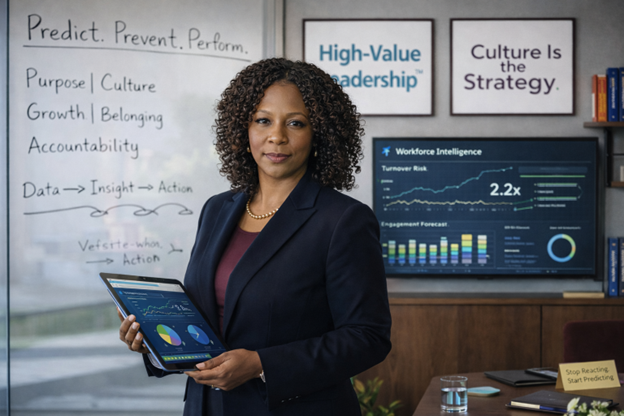
📈 From Rearview Mirror to Windshield: What Predictive Analytics Actually Does
Most workforce data is used descriptively. It tells you what happened. Turnover rate last quarter. Average time to fill open roles. Engagement scores from the last survey. Absenteeism trends by department. This is valuable information, but it is historical. By the time you are reading it, the story it tells has already been written and many of the decisions that would have changed the outcome are no longer available to you.
Predictive analytics shifts the orientation from the rearview mirror to the windshield. Instead of asking what happened, it asks what is likely to happen next and what we can do about it now. Machine learning models, statistical analysis, and integrated data systems are used to identify patterns across multiple data points simultaneously, patterns that no human manager can reliably detect by reviewing reports in isolation. When those patterns are identified early enough, leaders have a window of time in which intervention is both possible and effective.
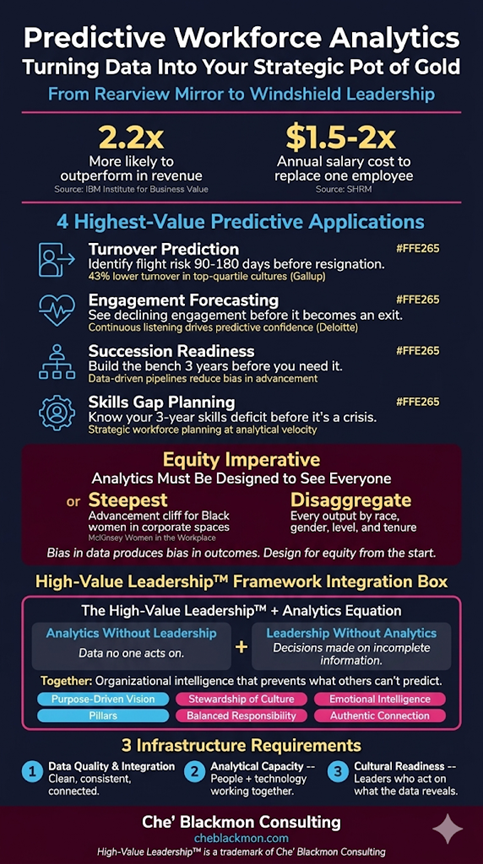
According to a 2023 IBM Institute for Business Value report, organizations that use predictive people analytics are 2.2 times more likely to outperform their peers in revenue growth and 1.5 times more likely to successfully retain high performers. These outcomes are not produced by the analytics alone. They are produced by the combination of good data and leaders who are committed to acting on what the data reveals. Analytics without cultural readiness to respond is just expensive reporting.
💡 Predictive analytics does not replace human judgment. It informs it with precision and timing that human intuition alone cannot match.
🔬 The Four Highest-Value Predictive Analytics Applications in Workforce Strategy
📌 1. Turnover Prediction
Voluntary turnover is the single most expensive and most preventable people problem in most organizations. The Society for Human Resource Management estimates the cost of replacing an employee ranges from one-half to two times their annual salary when recruitment, onboarding, and productivity loss are fully calculated. For organizations with chronic turnover, the cumulative annual cost is often in the millions, and the organizational energy required to perpetually backfill roles that should never have been vacated is a strategic tax on everything else the organization is trying to accomplish.
Predictive turnover models analyze dozens of variables simultaneously, including tenure, compensation relative to market, promotion recency, manager effectiveness scores, engagement survey responses, project assignment patterns, and even communication frequency in collaborative platforms. These variables, individually, are insufficient signals. In combination and over time, they produce a turnover risk score that can identify employees who are likely to leave 90 to 180 days before they submit a resignation letter. That window is everything. It is the difference between losing someone and retaining them.
There was a healthcare organization that implemented a turnover prediction model after experiencing a costly string of departures in a critical clinical department. The model identified a cluster of mid-level professionals who scored high on several simultaneous risk indicators, including stalled compensation growth, declining engagement scores, and a pattern of declining project participation. The organization intervened with targeted retention conversations, compensation adjustments, and development opportunities. The retention rate for that identified cohort exceeded 85 percent over the following year, and the cost avoidance from retained institutional knowledge was substantial.
📌 2. Engagement Forecasting
Engagement surveys measure the current state of employee sentiment at a single point in time. They are useful, but they are inherently delayed indicators. By the time disengagement shows up in an annual survey, it has typically been building for months, and the employees most affected may have already mentally resigned even if their physical departure has not yet followed. Predictive engagement modeling uses continuous data streams, including recognition frequency, performance review scores, absenteeism patterns, and internal mobility activity, to forecast engagement trajectories rather than simply measuring current states.
The practical application is transformative. Instead of discovering that a department’s engagement has dropped 12 points in the annual survey and then spending a quarter diagnosing the root cause, predictive engagement forecasting allows leaders to see the trajectory six months earlier, before it becomes a survey result, and intervene in ways that are proportionate to the early-stage signal rather than reactive to a full-blown engagement crisis.
Deloitte’s Global Human Capital Trends research has found that organizations using continuous listening strategies combined with predictive modeling report significantly higher confidence in their ability to prevent engagement decline before it becomes a retention event. The infrastructure required is not primarily technological. It is cultural. Organizations must build environments where employees are willing to provide authentic signal data, and that willingness is built through trust, not through surveillance.
📌 3. Succession Readiness and Leadership Pipeline Analytics
Succession planning in most organizations is an annual exercise. A list of names is generated for each critical role, assessed through a combination of performance reviews and manager nominations, and then filed until the next annual review cycle. This approach has two significant failures. First, it is static in a workforce that is dynamic. People develop, plateau, and sometimes exit between annual reviews in ways the succession plan does not capture. Second, it is deeply susceptible to the informal biases that determine whose name a manager thinks to put on a list.
Predictive succession analytics changes both of these dynamics. It creates a continuous, data-driven picture of pipeline depth by analyzing skill trajectories, learning and development engagement, performance trends over time, cross-functional experience, and leadership assessment data. It identifies not just who is ready for advancement but who is on a readiness trajectory, which is arguably more valuable because it gives the organization time to develop talent rather than simply select from a pool that already exists.
In High-Value Leadership: Transforming Organizations Through Purposeful Culture, the stewardship of culture is identified as a foundational leadership responsibility. Stewardship of a leadership pipeline requires the same intentional investment, and predictive analytics makes that stewardship precise in ways that informal succession conversations cannot. There was a manufacturing organization that used pipeline analytics to identify a significant gap in its next-generation leadership bench three years before the projected wave of senior retirements. That three-year runway allowed the organization to invest in accelerated development programs and internal mobility initiatives that would have been impossible to execute in a reactive timeframe.
📌 4. Skills Gap and Workforce Planning Analytics
The pace of technological change, industry disruption, and evolving market demands means that the skills your organization needs in three years are meaningfully different from the skills your workforce currently holds. Most organizations have no systematic visibility into this gap. They hire for current needs, develop for current capabilities, and then discover the skills deficit when it has already translated into a competitive disadvantage or a failed technology implementation.
Predictive skills gap analytics maps current workforce capabilities against projected future requirements and identifies the delta. It surfaces which roles are at highest risk of being underskilled for near-future needs, which employees are on development trajectories that position them well for emerging requirements, and where recruiting investment should be targeted to address gaps that internal development cannot close in time. This is workforce planning operating at strategic velocity rather than administrative pace.
✨ The Equity Imperative: Predictive Analytics and the Traditionally Overlooked
Predictive workforce analytics carries an enormous promise for equity and inclusion, and an equally significant risk of amplifying existing inequities if it is not designed and deployed with intentionality. This distinction matters profoundly, and it matters most for the professionals who have historically been most disadvantaged by the informal, relationship-driven, and often biased processes that analytics is designed to replace.
🚨 When Algorithms Inherit Bias
Data does not lie. But data can encode the decisions of systems that did. If an organization’s historical promotion data reflects years of bias against Black women and other underrepresented professionals, a predictive model trained on that data will encode those biases as predictive signals. The model will learn that the profile most likely to be promoted is the profile that has historically been promoted, regardless of whether that outcome reflects actual performance potential or simply pattern recognition of who was already advantaged.
This is not a theoretical risk. Amazon’s well-documented 2018 abandonment of an AI-based recruiting tool that systematically down-ranked resumes from women was a high-profile demonstration of exactly this dynamic. The model was trained on a decade of hiring decisions, and those decisions reflected the company’s historical pattern of male-dominated technical hiring. The algorithm learned to replicate that pattern as a success criterion.
The lesson is not that predictive analytics cannot serve equity. The lesson is that it will serve whatever the data encodes unless explicit corrective design choices are made. Bias audits of training data, diversity-adjusted weighting in model design, ongoing disparity monitoring in model outputs, and regular human review of algorithmic recommendations are all required elements of an equitable analytics infrastructure.
💡 The Case for Equity-Centered Analytics for Black Women
For Black women in corporate environments, the historic experience has been one of performing at a high level while advancement pathways remain narrow and informal sponsorship networks remain inaccessible. McKinsey and Company’s Women in the Workplace research has documented consistently that Black women face the most pronounced advancement gap of any demographic group, are the least likely to receive sponsorship, and are the most likely to have their contributions credited to others.
An analytics infrastructure designed with equity as a design principle changes this dynamic structurally. When advancement criteria are explicit and measurable rather than implicit and relational, the informal favoritism that has historically shaped who gets considered loses its power. When turnover risk models flag high-performing Black women as retention risks based on data rather than leaving the identification to managers who may have limited visibility into the drivers of their experience, organizations gain the ability to intervene before losing people they should have been actively developing.
In Rise and Thrive: A Black Woman’s Blueprint for Leadership Excellence, the argument is clear that structural change requires structural tools. Predictive analytics, when designed and deployed with equity as a non-negotiable design criterion, is one of the most powerful structural tools available for dismantling the informal systems that have kept Black women and other overlooked professionals from advancing at the rate their performance warrants.
📚 Rise & Thrive Connection: The data visibility that predictive analytics provides for organizations mirrors the strategic self-awareness that Rise and Thrive builds for individual professionals. Both are about seeing clearly, acting early, and refusing to be surprised by outcomes that were always preventable with the right information and the right systems.
There was a professional services organization that implemented an equity analytics layer on top of its existing workforce reporting. This layer disaggregated every key metric, including promotion rates, development program participation, stretch assignment allocation, and turnover risk scores, by race, gender, and career level simultaneously. The findings were not comfortable. Black women at the mid-manager level were significantly underrepresented in high-visibility project assignments, significantly underrepresented in the sponsorship program nominations, and significantly overrepresented in the high turnover risk cohort. None of these patterns had been visible in aggregate reporting. All of them were visible the moment the data was disaggregated. The organization redesigned its sponsorship nomination process, revised its project assignment criteria, and implemented structured check-in protocols for the identified high-risk cohort. Representation in senior leadership for Black women improved meaningfully over the following two years.
🏗️ Building the Infrastructure: What Predictive Analytics Requires
Predictive workforce analytics is not a software purchase. It is an organizational capability that requires infrastructure at three levels: data quality, analytical capacity, and cultural readiness to act on what the data reveals. All three are necessary. None is sufficient alone.
💻 Data Quality and Integration
Predictive models are only as good as the data they are trained on. Organizations with fragmented HRIS systems, inconsistent performance management practices, or gaps in data collection cannot produce reliable predictive outputs from poor inputs. Before investing in advanced analytics capability, organizations must honestly assess whether their data is clean, consistent, integrated, and comprehensive enough to support predictive modeling. This is often a multi-year infrastructure investment, but it is also the foundation on which every other analytics capability rests.
The specific data domains most critical for workforce prediction include performance management records over time, compensation history and market positioning, engagement survey data with longitudinal tracking, learning and development completion and application, organizational network analysis data, and manager effectiveness metrics. Organizations that have consistent, high-quality data in these domains have the raw material for powerful predictive capability. Those that do not need to build the foundation before expecting the insight.
🧠 Analytical Capacity: People and Technology
The technology landscape for predictive workforce analytics has matured significantly. Platforms including Visier, Workday People Analytics, SAP SuccessFactors Analytics, and IBM Watson Talent provide increasingly accessible predictive capability built on top of existing HR data infrastructure. Many of these platforms offer pre-built turnover prediction and engagement forecasting models that can be configured to an organization’s specific data environment without requiring a dedicated data science team.
The human capacity requirement is equally important. HR leaders who can translate analytical outputs into strategic conversations with business partners, who can communicate risk and opportunity in the language of revenue and competitive advantage rather than HR metrics, and who can advocate for data-driven interventions in organizations where intuition and relationships have historically driven people decisions are the irreplaceable human layer in any analytics capability. Technology surfaces the insight. HR leadership converts it into action.
🌱 Cultural Readiness: The Most Underestimated Requirement
The most sophisticated analytics infrastructure produces no value in an organization whose culture is not ready to act on what the data reveals. Cultural readiness for predictive analytics means leaders who are willing to be told that their department has a turnover risk cluster, who treat that information as an asset rather than an accusation, and who take proportionate action before the risk materializes rather than managing the aftermath of a departure that was predictable.
It also means an organizational commitment to using data as a tool for equity rather than efficiency alone. Mastering a High-Value Company Culture argues that cultures that endure are cultures built on transparency, accountability, and the genuine investment of leaders in the people they lead. Predictive analytics is a transparency tool. It makes visible what informal observation misses, and it creates accountability for acting on what is now impossible to claim was unseen.
💡 Data does not change culture. Leaders do. Predictive analytics gives leaders information early enough and precisely enough to lead differently. What they do with it is still a leadership choice.
📉 The High-Value Leadership™ Connection: Analytics in Service of Culture
The High-Value Leadership™ framework, anchored in Purpose-Driven Vision, Stewardship of Culture, Emotional Intelligence, Balanced Responsibility, and Authentic Connection, does not exist in tension with data-driven leadership. It is its philosophical foundation. Each pillar of the framework is both a cultural aspiration and a measurable domain that analytics can inform.
Purpose-Driven Vision requires that leaders understand whether employees experience a meaningful connection between their work and the organizational mission. Engagement analytics can measure that connection continuously and flag when it is eroding before it becomes disengagement. Stewardship of Culture requires that leaders actively monitor and respond to the health of the organizational culture. Turnover prediction and equity analytics are the instruments through which that stewardship becomes precise rather than impressionistic. Emotional Intelligence in leadership produces measurable outcomes in team safety, feedback quality, and collaborative effectiveness that analytics can surface. Balanced Responsibility is sustained when accountability systems are consistent and transparent, conditions that data visibility supports directly. Authentic Connection produces the trust that makes employees willing to provide the honest signal data that makes analytics useful in the first place.
The synergy is this: analytics without High-Value Leadership produces data that no one acts on. High-Value Leadership without analytics produces well-intentioned leadership that is still making decisions with incomplete information. Together, they produce the kind of organizational intelligence that allows leaders to steward their culture, protect their people, and build competitive advantage with a precision that neither achieves independently.
🛠️ Actionable Takeaways: Getting Started With Predictive Analytics
The following takeaways are designed for HR leaders, executives, and organizational stakeholders who are ready to move from descriptive to predictive workforce intelligence.
✅ For Organizational Leaders and HR Professionals
1. Assess Your Data Foundation First
Before investing in predictive analytics technology, audit the quality, consistency, and integration of your existing workforce data. Identify which critical data domains are well-captured and which have significant gaps. Build a data readiness roadmap as the first step in your analytics strategy rather than assuming technology can compensate for data quality deficits.
2. Start With Turnover Prediction
Turnover prediction is the highest immediate ROI application of predictive analytics for most organizations because the cost of preventable departure is large, the data required is widely available, and the intervention options are well-established. Implement a turnover risk model, integrate it into your manager toolkit, and establish a clear protocol for what action is taken at what risk threshold.
3. Disaggregate Every Output by Demographics
From the moment you begin producing predictive analytics outputs, establish the practice of disaggregating those outputs by race, gender, career level, and tenure simultaneously. What looks like a uniform pattern in aggregate data is often a significant disparity when examined by demographic segment. That disparity is both an equity signal and a strategic risk signal. Invisible inequity is expensive equityy and it is also just expensive.
4. Build Equity Audits Into Your Analytics Governance
Establish a regular review cycle in which your predictive models are audited for disparate impact. Examine whether model outputs, such as who is flagged as high turnover risk or high promotion potential, are distributed equitably across demographic groups. Where disparities are found, diagnose whether they reflect genuine differences in circumstance or whether they encode historical bias, and redesign accordingly.
5. Develop HR’s Analytical Fluency
The technology is increasingly accessible. The human capability to use it strategically is the limiting factor in most organizations. Invest in developing your HR team’s ability to work with data, translate analytics outputs into business language, and advocate for data-driven interventions at the executive level. This is a capability investment with compounding returns.
✨ For Individual Professionals Navigating Data-Driven Organizations
Understand How Decisions Are Being Made About You
In organizations with active analytics capabilities, workforce decisions are increasingly informed by algorithmic assessments. Understand what metrics are being tracked, what they are used for, and whether the organization has equity governance in place. Professionals who understand the data systems that influence their advancement are better positioned to advocate for themselves within those systems.
Build Your Own Evidence Base
Whether or not your organization has sophisticated analytics, you can build your own evidence base of documented contributions, quantified outcomes, and recorded feedback. This serves as your personal data infrastructure for advancement conversations and as a counterweight to any informal bias in how your performance is perceived relative to how it is documented.
💬 Discussion Questions for Leaders and Teams
Use these questions to drive strategic conversations within your organization, HR function, or leadership development cohort.
- If your organization implemented a turnover prediction model today and it identified your ten highest-risk employees, how confident are you that your leaders would act on that information? What cultural readiness barriers exist?
- When you look at your current succession pipeline analytics, how confident are you that the names on your succession plan reflect actual performance trajectories rather than informal relationship capital and proximity to decision-makers?
- Has your organization ever disaggregated its workforce data by race and gender simultaneously at the career-level? What do you think you would find? What would you do with it?
- If you are a Black woman or member of another underrepresented group: how transparent is the data that informs advancement decisions in your organization? And how are you building your own evidence infrastructure to ensure your contributions are visible and documented?
- What is one specific workforce outcome your organization experienced in the last two years that predictive analytics could have prevented? What would the organizational value of that prevention have been?
🚦 Next Steps: Building Your Predictive Analytics Capability
Turning workforce data into strategic gold requires commitment, infrastructure, and the cultural leadership to act on what the data reveals. Here is where to begin.
- Conduct a data readiness audit. Assess the quality, consistency, and integration of your current workforce data across the domains critical for predictive modeling.
- Identify your highest-priority predictive use case. For most organizations, turnover prediction offers the clearest immediate ROI and the most established model design.
- Establish demographic disaggregation as a standard practice in all workforce reporting, not as an add-on equity initiative but as core analytical hygiene.
- Invest in HR analytical fluency. Identify the capability gaps on your team and build a development plan that includes data literacy, analytics interpretation, and business case communication.
- Build equity governance into your analytics infrastructure from the beginning. Design bias audits, disparity monitoring, and human review protocols before you deploy models, not after disparities are discovered.
- Revisit the High-Value Leadership™ framework and its five pillars as the cultural foundation on which your analytics capability will either flourish or stall. Data in the hands of High-Value Leaders is a transformative organizational asset.
🚀 Ready to Turn Your Workforce Data Into Strategic Gold?
Che’ Blackmon Consulting partners with organizations and leaders who are serious about building the analytics infrastructure and the cultural leadership capacity to use workforce data as a genuine strategic asset. Whether you are building your first predictive capability, auditing existing analytics for equity, or developing the High-Value Leadership™ competencies that make data actionable, we bring the frameworks, experience, and tools to move your organization forward.
📧 admin@cheblackmon.com 📞 888.369.7243 🌐 cheblackmon.com
About the Author
Che’ Blackmon is a doctoral candidate in Organizational Leadership (DBA), the Founder and CEO of Che’ Blackmon Consulting, and a recognized expert in culture transformation, fractional HR leadership, and high-value leadership development. With more than 24 years of progressive HR leadership experience spanning manufacturing, automotive, healthcare, nonprofit, quick-service, and professional services industries, she brings a practitioner’s perspective to the intersection of workforce strategy, people analytics, and culture transformation. She is the author of Mastering a High-Value Company Culture, High-Value Leadership: Transforming Organizations Through Purposeful Culture, and the e-book Rise and Thrive: A Black Woman’s Blueprint for Leadership Excellence. Che’ is the creator of the proprietary High-Value Leadership™ framework and the host of the Unlock, Empower, Transform podcast.
© 2025 Che’ Blackmon Consulting. All rights reserved. | High-Value Leadership™ is a trademark of Che’ Blackmon Consulting.
#WorkforceAnalytics #PredictiveAnalytics #HRStrategy #PeopleAnalytics #HighValueLeadership #CompanyCulture #EmployeeRetention #HRLeadership #BlackWomenLead #WorkplaceBias #DataDrivenHR #OrganizationalCulture #CultureTransformation #FractionalHR #CheBlackmonConsulting

Leave a Reply