By Che’ Blackmon, DBA Candidate | Founder & CEO, Che’ Blackmon Consulting
When someone resigns, most leaders see a vacancy. They see a job posting that needs to go live, a team that needs to absorb extra work, and a calendar that suddenly feels tighter. What they rarely see is the full financial earthquake that one departure sets off beneath the surface of their organization. The real cost of turnover is not a single line item. It is a compounding crisis that touches recruiting, onboarding, productivity, morale, institutional knowledge, and customer relationships all at once.
And here is what makes it worse: the employees organizations can least afford to lose are often the ones who leave first.
In Mastering a High‑Value Company Culture, I wrote that culture is the lifeblood of any organization. When that lifeblood is healthy, people stay, grow, and contribute at levels that transform businesses. When it is toxic or neglected, talented people quietly update their resumes and walk out the door, taking years of knowledge, relationships, and momentum with them. Every exit is a cultural referendum. The question is whether leadership is paying attention to the verdict.

💰 The True Price Tag: What One Departure Really Costs
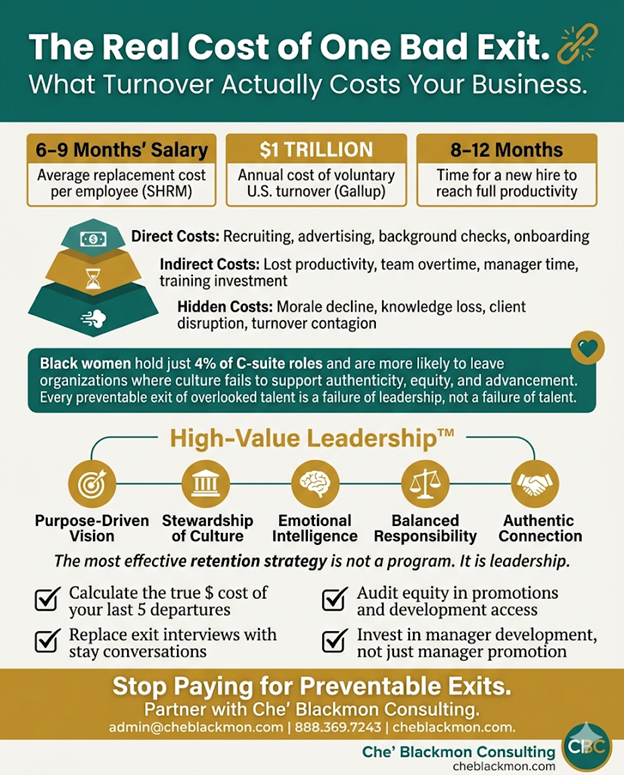
Most business leaders dramatically underestimate what it costs to replace an employee. According to the Society for Human Resource Management (SHRM), the average cost to replace a salaried employee ranges from six to nine months of that person’s salary. For senior or highly specialized roles, that figure can climb to 200% of annual compensation or more. Gallup’s research puts the annual cost of voluntary turnover in U.S. businesses at roughly one trillion dollars.
Let that number land for a moment. One trillion dollars. And that figure only accounts for the costs we can measure directly.
📋 Breaking Down the Cost Categories
Direct Costs include job advertising, recruiter fees, background checks, drug screenings, relocation packages, and signing bonuses. For a mid level manager earning $75,000 annually, these direct costs alone can exceed $15,000 before the new hire even completes orientation.
Indirect Costs are where the real damage hides. These include lost productivity during the vacancy period, the reduced output of the new hire during their learning curve (which research from the Brandon Hall Group suggests can last 8 to 12 months), overtime costs for team members absorbing extra responsibilities, and the time managers and HR professionals invest in interviewing, onboarding, and training.
Hidden Costs are the most dangerous because they compound silently. When a respected team member leaves, remaining employees begin questioning their own commitment. Institutional knowledge walks out the door. Client relationships fracture. Innovation slows because the team is focused on survival rather than growth. These ripple effects can persist for months or even years after a single departure.
🔍 The Turnover Domino Effect: When One Exit Becomes Five
Turnover is rarely an isolated event. Research published in the Academy of Management Journal has shown that when one employee leaves, the probability of additional departures in the same unit increases significantly. This phenomenon, sometimes called turnover contagion, occurs because departures signal to remaining employees that something may be fundamentally wrong with the team, the leadership, or the organization’s trajectory.
There was a company in the manufacturing sector that lost its most experienced shift supervisor. Within 60 days, three additional team leads submitted their resignations, citing the same concerns the supervisor had raised for over a year: inconsistent scheduling, a lack of recognition, and leadership that prioritized output numbers over people. The cost of replacing that one supervisor was estimated at $45,000. The total cost of the four departures combined, factoring in lost production, quality defects, and emergency overtime, exceeded $300,000.
In High‑Value Leadership: Transforming Organizations Through Purposeful Culture, I define Stewardship of Culture as one of the five pillars of the High‑Value Leadership™ framework. Leaders who steward culture do not wait for exit interviews to discover what is broken. They build systems of listening, accountability, and responsiveness that address concerns before they become resignations. When stewardship is absent, every exit becomes an invitation for the next one.
❤️ The Human Side: Impact on Traditionally Overlooked Talent
Not all turnover is created equal in terms of who bears the greatest burden. Traditionally overlooked employees, and most specifically Black women in corporate spaces, experience the costs of toxic culture and preventable turnover at a disproportionate rate.
According to a 2023 McKinsey and LeanIn.Org “Women in the Workplace” report, Black women are more likely than any other demographic group to report that they feel they cannot bring their authentic selves to work. They are more likely to experience microaggressions, to have their competence questioned, and to be passed over for promotion despite strong performance reviews. When organizations fail to address these dynamics, they lose talented professionals who could have been transformational leaders.
In Rise & Thrive: A Black Woman’s Blueprint for Leadership Excellence, I address what scholars call “double jeopardy,” the reality of facing bias and barriers related to both race and gender simultaneously. Black women hold just 4% of C‑suite positions and 1.4% of executive level roles in Fortune 500 companies, not because of a lack of ambition or qualification, but because of systemic barriers including hiring bias, limited access to influential networks, and workplace cultures that were not designed with their success in mind.
💡 The Retention Equity Gap
When a Black woman leaves an organization, the loss extends beyond her individual contribution. She often served as an informal mentor, a bridge builder across departments, and a voice for perspectives that would otherwise go unheard. Her departure frequently signals to other employees from underrepresented groups that the organization is not a safe place to invest their careers.
There was an organization in the healthcare industry that lost three of its five Black women in mid level leadership over an 18 month period. Each cited a variation of the same experience: being overlooked for stretch assignments, receiving feedback that felt coded (“too direct,” “needs to soften her approach”), and watching less qualified peers advance. The organization eventually spent over $500,000 on recruiting, onboarding, and lost productivity. The irony was that investing a fraction of that amount in equitable development programs, mentoring, and inclusive leadership training could have retained all three.
This is not just a diversity, equity, and inclusion conversation. It is a bottom line conversation. Organizations that fail to create environments where all talent can thrive are literally paying for that failure every single quarter.
📈 Current Trends: Why Turnover Is Accelerating in 2025 and 2026
The workforce landscape continues to shift in ways that make retention more complex than ever. Several converging trends are driving voluntary turnover to new heights.
- The Expectation Economy. Employees, particularly those in Gen Z and younger millennial demographics, expect more than a paycheck. They expect purpose, flexibility, growth pathways, and leaders who demonstrate emotional intelligence. Organizations that have not adapted to this shift are hemorrhaging talent.
- AI Anxiety and Change Fatigue. Rapid adoption of artificial intelligence and automation technologies has created uncertainty across industries. Employees who do not feel supported through technological transitions are more likely to disengage and seek stability elsewhere.
- The Manager Crisis. Gallup’s 2024 State of the Global Workplace report found that managers account for 70% of the variance in employee engagement. Yet many organizations continue to promote individuals into management roles based on technical competence rather than leadership capability, creating a pipeline of well meaning but ill equipped leaders who inadvertently drive turnover.
- Return to Office Tensions. Organizations that have mandated rigid return to office policies without addressing the underlying trust deficit are seeing spikes in voluntary departures, particularly among high performers who have demonstrated their ability to deliver results remotely.
🛠️ A Practical Framework: Calculating Your Organization’s True Turnover Cost
Understanding the problem is the first step. Quantifying it is what creates urgency for action. Below is a simplified framework for calculating the true cost of a single departure. Use this as a starting point and adjust based on your industry and role complexity.
🧮 The Turnover Cost Calculator
- Separation Costs: Exit interview time, administrative processing, severance (if applicable), unemployment insurance increases, and legal review. Estimated range: $1,000 to $5,000.
- Vacancy Costs: Lost productivity per day multiplied by the average number of days the position remains open. For a $75,000 role, daily productivity value is approximately $375. The average time to fill in 2025 is 44 days (SHRM benchmark), resulting in an estimated $16,500 in vacancy costs alone.
- Replacement Costs: Job advertising, recruiter fees, interviewing time (multiply hours spent by hourly rate of each interviewer), background and reference checks, onboarding materials, and technology setup. Estimated range: $5,000 to $25,000 depending on role level.
- Ramp Up Costs: New hires typically operate at 25% productivity in month one, 50% in month two, and 75% in month three. Full productivity may not be reached for 8 to 12 months. Calculate the difference between full productivity value and actual output during this period.
- Cultural and Morale Costs: While harder to quantify, estimate this by tracking engagement survey score changes, additional voluntary departures within 90 days, and customer satisfaction shifts following a key departure.
For a mid level manager earning $75,000, the conservative total cost of a single departure often falls between $50,000 and $100,000. For senior leaders and specialized roles, that number can easily exceed $200,000.
✨ High‑Value Leadership™ as a Retention Strategy
The most effective retention strategy is not a program. It is not a perk. It is leadership. Specifically, it is the kind of leadership that intentionally builds cultures where people feel seen, heard, valued, and positioned to grow.
The High‑Value Leadership™ framework I developed through High‑Value Leadership: Transforming Organizations Through Purposeful Culture rests on five pillars, each of which directly addresses the root causes of preventable turnover.
- Purpose‑Driven Vision. Employees who understand the “why” behind their work are significantly more engaged. When leaders articulate a compelling purpose and connect daily tasks to that larger mission, people stop viewing their role as a job and start viewing it as a contribution.
- Stewardship of Culture. Culture does not maintain itself. It requires active, ongoing stewardship. Leaders must listen before they direct, measure what matters, and respond to cultural warning signs before they become cultural crises.
- Emotional Intelligence. Daniel Goleman’s research has consistently shown that emotional intelligence is the single strongest predictor of leadership effectiveness. Leaders who can manage their own emotions and respond empathetically to others create psychologically safe environments where people are willing to stay, even during difficult seasons.
- Balanced Responsibility. High performing cultures hold people accountable while also investing in their development. When accountability exists without support, it breeds fear. When support exists without accountability, it breeds complacency. The balance between these two forces is where retention thrives.
- Authentic Connection. People do not leave companies. They leave leaders who fail to connect with them. Authentic connection means knowing your people beyond their performance metrics, understanding their aspirations, and creating space for them to bring their whole selves to work.
✅ Actionable Takeaways: 7 Steps to Reduce Costly Turnover
- Conduct a Turnover Cost Audit. Use the framework above to calculate the true cost of your last five departures. Present these numbers to senior leadership. Nothing creates urgency faster than a dollar sign.
- Invest in Manager Development, Not Just Manager Promotion. Equip every people leader with emotional intelligence training, coaching skills, and cultural stewardship tools. The return on this investment far exceeds the cost of the turnover it prevents.
- Build Stay Interview Practices. Stop relying solely on exit interviews to learn what is wrong. Implement quarterly stay conversations that ask high performers what keeps them engaged and what might cause them to leave.
- Audit Your Equity Practices. Examine promotion rates, pay equity, and access to stretch assignments across demographic groups. If Black women and other traditionally overlooked employees are advancing at lower rates than their peers, your retention strategy has a critical gap that no amount of perks will fill.
- Create Psychological Safety Metrics. Add questions to your engagement surveys that specifically measure whether employees feel safe speaking up, challenging ideas, and making mistakes without punishment. Track these scores over time and tie them to manager performance evaluations.
- Establish a 90 Day Early Warning System. The first 90 days after a departure are the highest risk period for additional turnover. During this window, increase check in frequency with remaining team members, address workload redistribution transparently, and accelerate backfill timelines.
- Align Retention with Business Strategy. Retention should not live exclusively in HR’s portfolio. It should be a standing agenda item in every leadership team meeting, with the same rigor and visibility as revenue, quality, and customer satisfaction metrics.
🗣️ Expert Insight: What the Research Tells Us
Dr. John Sullivan, a widely recognized HR thought leader, has argued that most organizations measure turnover rate but fail to measure turnover quality, meaning they do not distinguish between the departure of an average performer and the departure of someone who was a top contributor. He recommends that organizations calculate “regrettable turnover” separately and treat each instance as a critical incident requiring root cause analysis.
Dave Ulrich, whose work I reference extensively in Mastering a High‑Value Company Culture, has emphasized that talent is the primary driver of value in knowledge economies. Organizations that treat people as interchangeable parts will consistently underperform those that invest in creating environments where talent can be developed, engaged, and retained.
Brené Brown’s research on vulnerability and trust, which I draw upon in High‑Value Leadership, reinforces that employees are more likely to stay in environments where they feel they can be honest about challenges without fear of retaliation. When leaders model vulnerability and create space for authentic dialogue, they build the kind of trust that no compensation package can replicate.
🎯 From My Experience: Over Two Decades on the Front Lines of Retention
With more than 24 years of progressive HR leadership across manufacturing, automotive, healthcare, nonprofit, quick service, and professional services industries, I have watched the turnover conversation evolve significantly. Early in my career, turnover was treated as an unavoidable cost of doing business. Leaders would shrug and say, “People leave. That’s just how it works.”
That mindset is outdated and expensive. What I have witnessed consistently is that the organizations willing to invest intentionally in culture, in leadership development, and in creating equitable pathways for all employees (not just those who look like, sound like, or think like the existing leadership team) are the ones that retain their best people and outperform their competitors.
There was a company in the automotive sector that was experiencing 40% annual turnover on its production floor. After conducting a thorough culture assessment, the root causes became clear: frontline supervisors had received no leadership training, recognition was nonexistent, and scheduling practices were eroding trust. Within 12 months of implementing targeted leadership development, structured recognition programs, and transparent scheduling communication, turnover dropped to 18%. The estimated annual savings exceeded $1.2 million.
That is not magic. That is what happens when organizations stop treating people as replaceable and start treating culture as a strategic priority.
💬 Discussion Questions for Your Leadership Team
Use these questions to spark a meaningful conversation with your leadership team about turnover’s true impact on your organization:
- Do we currently calculate the full cost of turnover, or are we only tracking the turnover rate? What would change if we attached a dollar amount to every departure?
- When was the last time we lost a high performer? Did we conduct a root cause analysis, or did we simply post the job and move on?
- Are Black women and other traditionally overlooked employees advancing at the same rate as their peers in our organization? If not, what systemic barriers might be contributing to that gap?
- How would our frontline supervisors and mid level managers rate their own preparedness to lead people effectively? Have we invested in their development?
- Do our stay interview practices give us actionable insight, or are we waiting for exit interviews to learn what went wrong?
- Which of the five High‑Value Leadership™ pillars (Purpose‑Driven Vision, Stewardship of Culture, Emotional Intelligence, Balanced Responsibility, Authentic Connection) represents our organization’s greatest strength? Which represents our greatest opportunity for growth?
- If we could retain just five additional employees this year who would otherwise have left, what would that save us financially? What would it preserve culturally?
🚀 Next Steps: Stop Paying for Preventable Exits
Every organization has the power to reduce turnover, but it requires a shift in mindset. It requires leaders who are willing to examine their culture honestly, invest in people strategically, and hold themselves accountable for the environments they create. The cost of doing nothing is measurable, and it is growing every quarter.
If you are ready to move from reactive recruiting to proactive retention, Che’ Blackmon Consulting can help. Through fractional HR leadership, culture transformation consulting, and leadership development rooted in the High‑Value Leadership™ framework, we partner with organizations to build cultures that attract, develop, and retain the talent they cannot afford to lose.
Because the real question is not whether you can afford to invest in your culture. The real question is whether you can afford not to.
🌟 Ready to Transform Your Organization’s Culture?
Work with Che’ Blackmon Consulting
📧 admin@cheblackmon.com
📞 888.369.7243
🌐 cheblackmon.com
📚 Explore More from Che’ Blackmon
Mastering a High‑Value Company Culture – Available on Amazon
High‑Value Leadership: Transforming Organizations Through Purposeful Culture – Available on Amazon
Rise & Thrive: A Black Woman’s Blueprint for Leadership Excellence – E‑Book Available at cheblackmon.com
🎥 Rise & Thrive YouTube Series | 🎙️ Unlock, Empower, Transform Podcast
© 2026 Che’ Blackmon Consulting. All rights reserved.
High‑Value Leadership™ is a proprietary framework of Che’ Blackmon Consulting.
#HighValueLeadership #TurnoverCost #EmployeeRetention #HRLeadership #CultureTransformation #WorkplaceCulture #BlackWomenInLeadership #LeadershipDevelopment #TalentRetention #FractionalHR #PeopleFirst #CheBlackmonConsulting #RetentionStrategy #EmployeeEngagement #DEI #OrganizationalCulture #LeadershipMatters #HRStrategy #HighValueCulture #RiseAndThrive

Leave a Reply