By Che’ Blackmon, DBA Candidate | Founder & CEO, Che’ Blackmon Consulting
There is an old saying in human resources that people do not leave companies; they leave managers. It has been repeated so often that it almost sounds like a cliché. But the reason it endures is because the data behind it is overwhelming, and most organizations still have not done anything meaningful about it.
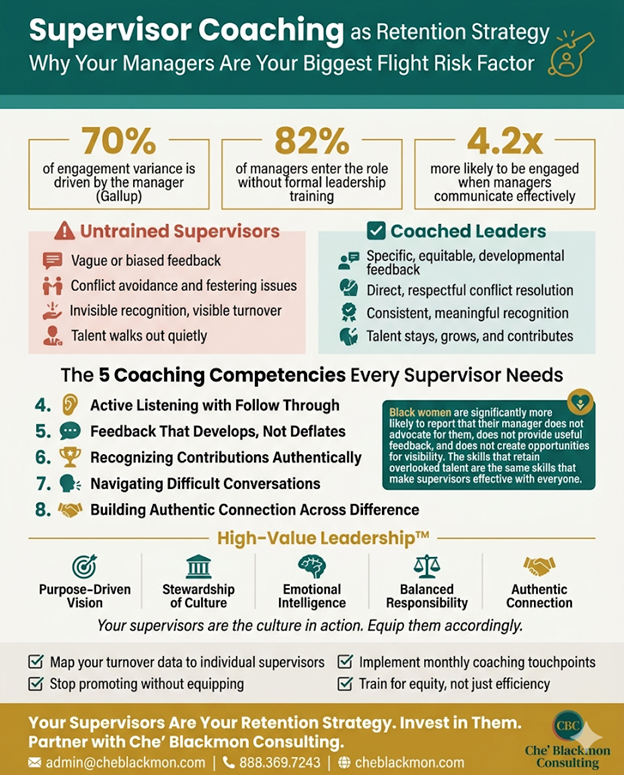
Gallup’s research has confirmed this reality for over two decades. Managers account for at least 70% of the variance in employee engagement scores. That is not a typo. Seventy percent. Which means your supervisors, your shift leads, your department heads, and your frontline managers are not just influencing retention. They are your retention strategy, whether they know it or not. And whether they are equipped for that role or not.
In Mastering a High‑Value Company Culture, I wrote that culture is the lifeblood of any organization. But culture does not flow from mission statements framed in the lobby. It flows from the daily interactions between employees and the leaders closest to them. Your frontline supervisor who dismisses a concern without listening. Your department manager who plays favorites and calls it performance management. Your team lead who takes credit for someone else’s work without blinking. These are the moments where culture is built or destroyed, one conversation at a time. And these are the moments that determine whether your best people stay or go.

🚨 The Manager Gap: Promoted for Performance, Failing at People
One of the most consistent patterns across every industry I have worked in over more than 24 years of HR leadership, from automotive and manufacturing to healthcare, nonprofit, quick service, and professional services, is this: organizations routinely promote their best individual contributors into management roles and then provide little to no development for the leadership skills that role actually requires.
The best welder becomes the welding supervisor. The top performing nurse becomes the charge nurse. The highest billing associate becomes the team lead. The assumption is that because someone excels at doing the work, they will naturally excel at leading the people who do the work. That assumption is expensive and wrong.
A 2024 survey conducted by the Chartered Management Institute found that 82% of managers in the United Kingdom entered management roles without any formal training in leadership. While the study focused on the UK workforce, similar patterns have been well documented in the United States. The result is what researchers have termed “accidental managers,” individuals who hold authority over others without ever being taught how to lead, communicate, coach, or resolve conflict effectively.
In High‑Value Leadership: Transforming Organizations Through Purposeful Culture, I outline the concept of Balanced Responsibility as one of the five pillars of the High‑Value Leadership™ framework. Balanced Responsibility means holding people accountable while simultaneously investing in their development. When organizations promote people into supervisory roles without equipping them to lead, they violate this principle in both directions. They hold the new manager accountable for outcomes without providing the support to achieve them. And they hold the team accountable for engagement while placing them under someone who was never taught how to engage.
📉 What the Research Tells Us: Managers Are the Multiplier
The connection between manager quality and employee retention is not speculation. It is one of the most well documented relationships in organizational science.
Gallup’s 2024 State of the Global Workplace report found that employees who strongly agree their manager communicates effectively are 4.2 times more likely to be engaged at work. Meanwhile, employees who rate their immediate supervisor poorly are four times more likely to be actively looking for a new job. The report further noted that improving manager effectiveness is the single most impactful action an organization can take to improve overall workplace engagement and retention.
A separate study by the Work Institute’s 2023 Retention Report found that the top three reasons employees voluntarily leave organizations are career development opportunities, work life balance, and manager behavior. Of those three, manager behavior is the factor most within the organization’s immediate control because it can be improved through targeted coaching, development, and accountability.
Dr. John Gottman, the renowned relationship researcher, has identified that it takes a ratio of five positive interactions to one negative interaction to maintain a healthy relationship. While his work focuses on personal relationships, organizational psychologists have applied this principle to the workplace with striking results. Managers who maintain high ratios of positive to corrective interactions retain more people, receive higher trust scores, and produce stronger team outcomes. Managers who default to criticism, micromanagement, or indifference create environments where people emotionally disengage long before they formally resign.
🎯 The Five Coaching Competencies Every Supervisor Needs
Supervisor coaching is not about turning every manager into a therapist or a motivational speaker. It is about building a consistent, practical set of leadership competencies that directly influence whether employees feel valued, heard, and motivated to stay. Based on the High‑Value Leadership™ framework and more than two decades of applied experience, the following five competencies are the ones that matter most for retention.
🔑 1. Active Listening with Follow Through
Most employees do not expect their manager to solve every problem. What they expect is to be heard and to see evidence that their input was taken seriously. Active listening is not nodding during a conversation and then doing nothing. It is reflecting what was said, asking clarifying questions, and then following up with visible action or a transparent explanation of why action was not taken. When managers master this competency, trust builds quickly. When they fail at it, resentment builds faster.
🔑 2. Delivering Feedback That Develops, Not Deflates
Feedback is a tool. In the hands of a skilled leader, it sharpens performance. In the hands of an untrained supervisor, it creates fear, defensiveness, and disengagement. Effective supervisor coaching teaches managers how to deliver feedback that is specific, timely, behavior focused, and forward looking. It teaches them to replace statements like “you need to do better” with observations like “in yesterday’s team meeting, I noticed you had some strong ideas that you did not share until the end. I would love to see you bring those contributions in earlier next time because the team benefits from your perspective.” That shift in approach changes the entire dynamic.
🔑 3. Recognizing Contributions Authentically
Recognition is one of the most powerful and most underutilized retention tools available to any manager. And it costs nothing. A 2023 Workhuman and Gallup joint study found that employees who receive meaningful recognition are five times more likely to feel connected to their company’s culture and four times more likely to be engaged. Yet the same study found that only 23% of employees strongly agree they receive the right amount of recognition for the work they do. Supervisor coaching should include structured guidance on how to recognize contributions in ways that are specific, personal, and consistent. Generic praise like “good job” is forgettable. Recognition that names the specific contribution, explains its impact, and connects it to the team’s purpose is transformational.
🔑 4. Navigating Difficult Conversations Without Avoidance
Many supervisors avoid conflict because they were never taught how to handle it. They let performance issues fester until they become crises. They avoid addressing interpersonal tensions until the team fractures. They dodge conversations about compensation, career progression, or workload because they do not know what to say. This avoidance does not protect anyone. It signals to employees that their concerns are not important enough to address, which accelerates disengagement and turnover. Coaching supervisors in conflict navigation, using frameworks grounded in Emotional Intelligence (the third pillar of High‑Value Leadership™), equips them to have direct, respectful conversations that resolve issues rather than burying them.
🔑 5. Building Authentic Connection Across Difference
The fifth pillar of the High‑Value Leadership™ framework is Authentic Connection, and it is perhaps the most important competency for supervisors leading increasingly diverse teams. Authentic connection means knowing your people beyond their job titles. It means understanding what motivates them, what frustrates them, what their career aspirations are, and what makes them feel valued. It also means developing the cultural competence to connect effectively across differences of race, gender, generation, and background. Supervisors who build authentic connections with their teams create bonds that are far more durable than any compensation package or benefits plan.
❤️ The Overlooked Impact: When Manager Gaps Hit Black Women Hardest
The consequences of poorly equipped supervisors are not distributed equally across the workforce. Traditionally overlooked employees, and most specifically Black women in corporate spaces, experience the effects of unskilled management at a disproportionate rate.
In Rise & Thrive: A Black Woman’s Blueprint for Leadership Excellence, I address the reality that Black women face what scholars call “double jeopardy” in the workplace, navigating bias related to both race and gender simultaneously. This reality becomes especially acute when the person with the most direct power over your daily work experience, your immediate supervisor, lacks the emotional intelligence, cultural competence, or coaching skill to lead you equitably.
McKinsey’s 2023 “Women in the Workplace” research, conducted in partnership with LeanIn.Org, found that Black women are significantly more likely than white women to report that their manager does not advocate for them, does not provide useful feedback, and does not create opportunities for visibility. They are also more likely to report receiving feedback that is coded with racial and gender bias, such as being told they are “too assertive,” “intimidating,” or that they “need to soften their approach.”
These dynamics are not just uncomfortable. They are retention killers. When a Black woman’s manager does not have the competence to provide equitable coaching, fair recognition, and unbiased feedback, she experiences the workplace as a place that does not value her contributions. She begins to disengage. She stops volunteering for stretch assignments because the risk feels too high and the reward too unlikely. She updates her resume quietly. And when she leaves, the organization often has no idea that the root cause was not compensation, not location, not the role itself, but the person in the chair directly above hers.
💡 Case in Point
There was a company in the professional services sector that conducted an analysis of its voluntary turnover data over a three year period. When the data was segmented by demographic, the results were stark: Black women were leaving at nearly twice the rate of their white counterparts. Exit interviews pointed to a common theme. The departing employees did not feel supported by their direct supervisors. They described managers who overlooked them for project leadership, gave them vague feedback while providing detailed developmental guidance to peers, and excluded them from informal networking opportunities where real career decisions were made.
The company’s response was to implement a mandatory supervisor coaching program that included training on bias awareness, equitable feedback practices, and inclusive sponsorship. Within 18 months, voluntary turnover among Black women in the organization decreased by 34%. The program did not just improve diversity metrics. It improved overall team performance and engagement scores across every demographic, because the skills that make a supervisor effective with overlooked talent are the same skills that make them effective with everyone.
📈 Current Trends: The Coaching Revolution in 2025 and 2026
Several converging trends are pushing supervisor coaching from a “nice to have” to a strategic imperative for forward thinking organizations.
- The Manager Burnout Epidemic. Managers themselves are burning out at record rates. A 2024 report from Microsoft’s Work Trend Index found that 53% of managers say they feel burned out at work, making them less effective leaders and more likely to leave themselves. Coaching is not just about making managers better for their teams. It is about sustaining the managers who hold the organization together.
- The Shift from Performance Reviews to Ongoing Coaching. Leading organizations are abandoning the annual performance review in favor of continuous coaching conversations. Companies like Adobe, Microsoft, and Deloitte have restructured their performance management systems around regular one on one coaching interactions. This shift demands that supervisors develop real coaching skills, not just the ability to fill out a rating form once a year.
- Gen Z’s Non Negotiable Demand for Feedback. The newest generation in the workforce is vocal about wanting frequent, constructive, and personalized feedback from their managers. Research from Deloitte’s Gen Z and Millennial Survey consistently shows that young employees prioritize manager quality and development support above nearly every other factor when evaluating whether to stay with an employer.
- AI as a Coach Amplifier, Not a Replacement. Organizations are beginning to deploy AI tools that support managers with real time coaching prompts, sentiment analysis from team surveys, and personalized development recommendations. These tools are promising, but they amplify the effectiveness of already skilled coaches. They cannot compensate for a manager who fundamentally lacks the ability to connect with, listen to, and develop people.
- Psychological Safety as a Business Metric. Google’s Project Aristotle research established that psychological safety is the most important factor in high performing teams. That research has now been widely adopted, and progressive organizations are measuring psychological safety as a leading indicator of both engagement and retention. Since supervisors are the primary architects of psychological safety within their teams, coaching them in this area has become a direct investment in business performance.
🛠️ Building a Supervisor Coaching Program That Actually Works
Many organizations have attempted manager training programs that produced no lasting change. The workshops were attended, the evaluations were completed, and within 30 days the old behaviors returned. The difference between training that fades and coaching that transforms is structural. Effective supervisor coaching programs share several critical design elements.
✨ Element 1: Anchor Coaching in Organizational Purpose
The first pillar of the High‑Value Leadership™ framework is Purpose‑Driven Vision. Supervisor coaching should not be positioned as remedial or punitive. It should be framed as a strategic investment in the organization’s mission. When managers understand that their coaching development is connected to the company’s larger purpose and that the organization views them as essential to its success, buy in increases dramatically.
✨ Element 2: Replace One Time Workshops with Sustained Practice
A two hour workshop on “effective feedback” will not change behavior. What changes behavior is repeated practice with real time observation and feedback. Effective programs incorporate monthly coaching circles where supervisors practice skills with peers, shadow coaching sessions where a coach observes the supervisor in their natural work environment, and structured reflection exercises that connect daily interactions to leadership competency development.
✨ Element 3: Measure Impact Through Retention Data, Not Just Satisfaction Scores
Most training programs measure success by participant satisfaction (“Did you enjoy the workshop?”). Effective coaching programs measure success by business outcomes. Track voluntary turnover rates by team before and after coaching implementation. Monitor engagement survey scores at the supervisor level. Analyze regrettable turnover data to determine whether coaching is reducing the loss of high performers. These metrics create accountability and demonstrate ROI to senior leadership.
✨ Element 4: Include Equity and Inclusion as Core Competencies
Supervisor coaching programs that do not address bias, cultural competence, and equitable treatment are incomplete. As discussed in the equity section above, the skills that retain overlooked talent are not optional add ons. They are foundational. Every coaching curriculum should include modules on recognizing and interrupting bias in feedback, ensuring equitable access to development opportunities, and building trust across cultural differences.
✨ Element 5: Support the Coaches
Supervisors cannot pour from an empty cup. Effective coaching programs also include support for the supervisors themselves: access to their own coaching relationships, clear boundaries around their span of control, workload assessments to prevent burnout, and recognition for the invisible labor of people leadership. This aligns directly with the Stewardship of Culture pillar, which teaches that culture must be nurtured at every level, including at the level of those entrusted with stewarding it.
🌟 From My Experience: What 24+ Years in the Trenches Has Taught Me
Across every industry I have served in my career, from the plant floor to the executive suite, the pattern is unmistakable. When supervisors are coached, engagement rises, grievances decline, safety improves, quality improves, and turnover slows. When supervisors are neglected, every metric that matters to the business suffers.
There was a company in the automotive manufacturing sector that was struggling with chronic first year turnover on its production floor. The HR team analyzed the data and discovered that 60% of new hires who left within their first year were assigned to the same three supervisors. These were not bad people. They were technically proficient, experienced operators who had been promoted based on their production knowledge. But they had never been taught how to onboard new team members, deliver constructive feedback, or create an environment where people felt welcome and supported during their most vulnerable first weeks on the job.
The company implemented a targeted coaching program for those three supervisors and eventually expanded it to the entire supervisory team. The coaching focused on the fundamentals: listening, welcoming, setting clear expectations, checking in during the first 90 days, and recognizing small wins. Within two quarters, first year turnover in those teams dropped by more than 40%. The supervisors themselves reported feeling more confident and less stressed. One of them told the HR team, “Nobody ever taught me how to do the people part of my job. I was just figuring it out and getting it wrong.”
That single quote captures the entire problem. And the entire opportunity.
✅ Actionable Takeaways: 7 Steps to Turn Your Supervisors into Retention Anchors
- Map Turnover to Managers. Analyze your voluntary turnover data by supervisor. Identify patterns. If certain teams consistently lose people at higher rates, the common denominator is likely the leader, not the work itself.
- Stop Promoting Without Equipping. Every new supervisor should receive a structured onboarding experience that includes leadership fundamentals, not just operational procedures. If you would not hand someone a machine without training them to operate it safely, do not hand them a team without training them to lead it effectively.
- Implement Monthly Coaching Touchpoints. Move beyond annual training events. Create monthly coaching circles, peer learning pods, or one on one check ins with an internal or external coach that keep development ongoing and skill application consistent.
- Train for Equity, Not Just Efficiency. Ensure every coaching curriculum includes bias awareness, equitable feedback practices, and inclusive leadership behaviors. These are not separate from good management. They are the standard of good management.
- Measure What Matters. Track engagement scores, retention rates, and regrettable turnover at the individual manager level. Make this data visible to leadership and tie it to manager performance evaluations.
- Create Feedback Loops from Employees to Leadership. Implement upward feedback mechanisms (such as skip level meetings, anonymous pulse surveys, or 360 degree assessments) that give senior leadership visibility into how supervisors are actually experienced by their teams, not just how they report their own effectiveness.
- Invest in Your Supervisors’ Wellbeing. Managers who are burned out, overwhelmed, or unsupported cannot coach others effectively. Ensure your coaching program includes resources for supervisor resilience, workload balance, and access to their own professional development and support.
💬 Discussion Questions for Your Leadership Team
Use these questions to open a candid dialogue about the role your supervisors play in retention:
- If we segmented our voluntary turnover data by supervisor, what patterns would emerge? Do we have the courage to look at that data honestly?
- How many of our current supervisors received formal leadership development before or immediately after being promoted? What did that development include?
- Do Black women and other traditionally overlooked employees in our organization rate their supervisory relationships as positively as their peers? If we do not know the answer, what does that tell us?
- Are our supervisors equipped to deliver equitable feedback, inclusive recognition, and culturally competent coaching? Or are we assuming these skills will develop on their own?
- When was the last time we asked our supervisors what they need to be more effective? Are we supporting them the way we expect them to support their teams?
- Which of the five High‑Value Leadership™ pillars (Purpose‑Driven Vision, Stewardship of Culture, Emotional Intelligence, Balanced Responsibility, Authentic Connection) is most underdeveloped in our supervisory population? What would it look like to address that gap intentionally?
- If we invested in a structured supervisor coaching program today, what measurable outcomes would we expect to see in 6 months? In 12 months?
🚀 Next Steps: Your Supervisors Are Waiting
Your organization’s retention strategy is only as strong as the people who implement it every day, and those people are your supervisors. They are the ones who conduct the morning huddles, approve the time off requests, deliver the feedback, respond to the complaints, and set the tone for how it feels to work on their team. They are the culture in action. And right now, most of them are doing their best with very little support.
That is a gap you can close. And the return on closing it, measured in retention, engagement, performance, and equity, is extraordinary.
If you are ready to transform your supervisors from your biggest flight risk factor into your most powerful retention asset, Che’ Blackmon Consulting can help. Through fractional HR leadership, culture transformation consulting, and supervisor coaching programs rooted in the High‑Value Leadership™ framework, we equip your managers with the skills, competencies, and support they need to lead people well, retain top talent, and build cultures where everyone thrives.
Because the most expensive leadership decision you can make is not investing in a bad hire. It is failing to develop the supervisor who drives that hire out the door.
🌟 Ready to Transform Your Organization’s Culture?
Work with Che’ Blackmon Consulting
📧 admin@cheblackmon.com
📞 888.369.7243
🌐 cheblackmon.com
📚 Explore More from Che’ Blackmon
Mastering a High‑Value Company Culture – Available on Amazon
High‑Value Leadership: Transforming Organizations Through Purposeful Culture – Available on Amazon
Rise & Thrive: A Black Woman’s Blueprint for Leadership Excellence – E‑Book Available at cheblackmon.com
🎥 Rise & Thrive YouTube Series | 🎙️ Unlock, Empower, Transform Podcast
© 2026 Che’ Blackmon Consulting. All rights reserved.
High‑Value Leadership™ is a proprietary framework of Che’ Blackmon Consulting.
#SupervisorCoaching #RetentionStrategy #HighValueLeadership #ManagerDevelopment #EmployeeRetention #LeadershipCoaching #WorkplaceCulture #CultureTransformation #BlackWomenInLeadership #FrontlineLeaders #PeopleFirst #CheBlackmonConsulting #EmployeeEngagement #CoachingCulture #TalentRetention #DEI #HRLeadership #FractionalHR #LeadershipMatters #RiseAndThrive

Leave a Reply