📖 Book Tie‑In: Mastering a High‑Value Company Culture — Engagement and Psychological Safety
By Che’ Blackmon, DBA Candidate | Founder & CEO, Che’ Blackmon Consulting
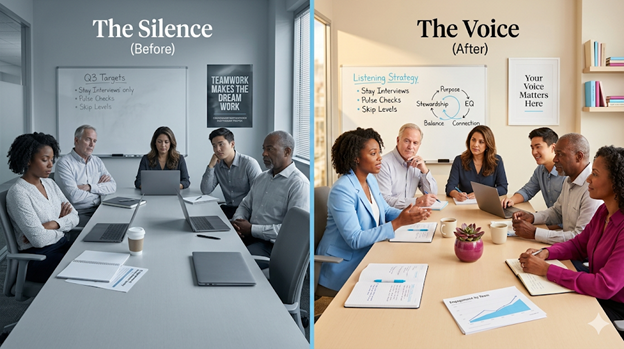
Your employees are talking. They are talking to their partners over dinner. They are talking to their friends on the weekend. They are talking to recruiters in their LinkedIn inboxes. The one place they are not talking? To you.
This is the engagement gap, and it is one of the most expensive, pervasive, and misunderstood problems in modern organizations. It is the distance between what employees actually think about their work, their leaders, and their future at the company, and what they are willing to say out loud. That gap is not empty. It is filled with frustration, unspoken ideas, eroding trust, and quiet plans to leave.
In Mastering a High‑Value Company Culture, I wrote that culture is the lifeblood of any organization. But culture does not reveal itself through what people say in town hall meetings when the CEO is watching. It reveals itself in what people say when they feel safe enough to be honest, and more importantly, in what they choose not to say when they do not feel safe at all. The engagement gap is the space where culture is actually lived. And for most organizations, that space is a warning they have not yet learned to read.
📊 The State of Silence: What the Data Reveals
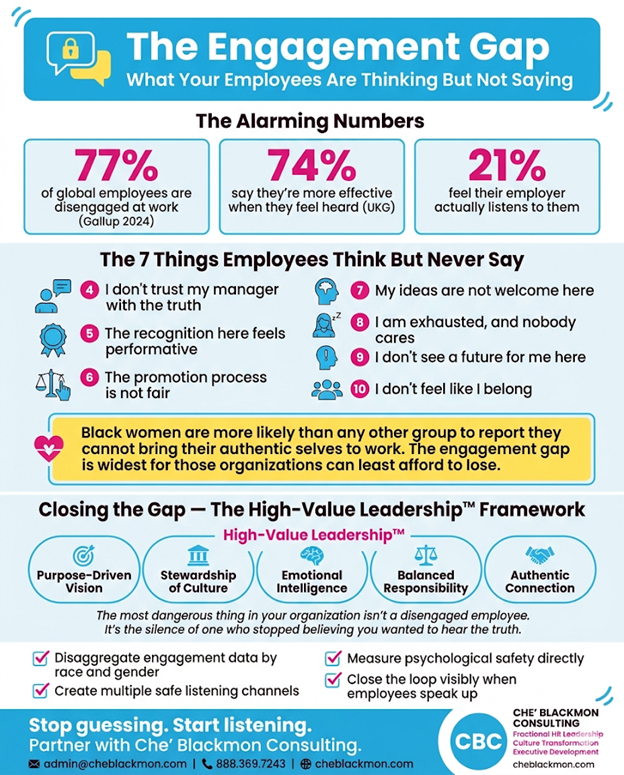
The numbers on employee engagement have been alarming for years, and they are not improving fast enough. Gallup’s 2024 State of the Global Workplace report found that only 23% of employees worldwide are engaged at work. That means 77% of the global workforce is either not engaged or actively disengaged. In the United States, the number is slightly better at 33%, but that still means two out of every three American workers are showing up without being fully invested in the work they do or the organizations they serve.
But here is the part that rarely makes the headlines. Disengagement does not always look like poor performance. Some of the most disengaged employees in your organization are hitting their numbers, meeting their deadlines, and attending every meeting. They are doing just enough to stay employed while investing their creativity, passion, and discretionary effort somewhere else. Gallup calls this “quiet quitting,” but that term obscures the real issue. These employees have not quit their work ethic. They have quit their belief that the organization deserves their best.
The engagement gap lives in the silence between what leaders ask and what employees reveal. A 2023 study by the Workforce Institute at UKG found that 74% of employees believe they are more effective when they feel heard, yet only 21% feel strongly that their employer genuinely listens to them. That 53 percentage point chasm is not a communication issue. It is a trust issue. And trust is the foundation upon which every other element of engagement is built.
🧠 The Psychology of Silence: Why Employees Stop Talking
Understanding why employees go silent requires understanding the concept of psychological safety, a term popularized by Harvard Business School professor Amy Edmondson. Psychological safety is the shared belief that a team is safe for interpersonal risk taking. It means employees feel they can speak up, ask questions, admit mistakes, and challenge ideas without fear of humiliation, punishment, or career consequences.
Google’s landmark Project Aristotle research confirmed that psychological safety is the single most important factor in high performing teams. Teams with high psychological safety outperformed their peers on every meaningful metric, not because they had smarter people, but because their people felt safe enough to contribute fully.
When psychological safety is absent, employees perform a constant internal calculation before every interaction. “If I raise this concern, will my manager retaliate?” “If I admit I do not understand, will I be seen as incompetent?” “If I challenge this decision, will I be labeled as difficult?” “If I share this idea, will someone else take credit for it?” These calculations happen in seconds, and they happen dozens of times a day. Over time, the cost of speaking up begins to consistently outweigh the perceived benefit, and silence becomes the rational choice.
In Mastering a High‑Value Company Culture, I describe the contrast between two operations managers I observed over the course of my career. One leader, whom I called Mark, created an environment where people felt safe to communicate openly and take ownership of their work. The other, Larry, fostered a climate of passive aggressive retaliation where employees learned quickly that honesty was punished. Both managers worked in the same company, under the same mission statement, governed by the same values poster on the wall. The difference in the cultures they created was entirely a function of whether their people felt psychologically safe enough to engage authentically.
🔇 The Seven Things Employees Think But Never Say
Based on more than 24 years of HR leadership across manufacturing, automotive, healthcare, nonprofit, quick service, and professional services industries, and informed by countless exit interviews, engagement surveys, skip level conversations, and confidential coaching sessions, the following represent the most common unspoken truths employees carry with them every day.
1. “I do not trust my manager with the truth.” 🤐
This is the foundational silence. When employees do not trust that their direct supervisor will handle honest feedback with maturity and without retaliation, they learn to tell leadership what it wants to hear. They smile in one on one meetings. They check “satisfied” on the survey. And they apply for other jobs in the parking lot.
2. “The recognition here feels performative.” 🏆
Employees can tell the difference between genuine recognition and scripted appreciation. When leaders praise publicly but criticize privately, when recognition goes to the same people regardless of contribution, or when “Employee of the Month” is chosen by rotation rather than merit, people disengage from the entire system. They stop seeking recognition and start seeking employers who notice real contributions.
3. “The promotion process is not fair.” 🚧
Few things erode engagement faster than watching someone less qualified advance while you are told to “be patient” or “keep doing great work.” When employees perceive that advancement is based on relationships rather than results, or that certain demographics consistently advance while others are passed over, the message is clear even if it is never spoken aloud: your ceiling is predetermined.
4. “My ideas are not welcome here.” 💡
Innovation does not die because employees lack creativity. It dies because employees stop offering their ideas after being dismissed, ignored, or worse, watching their ideas get implemented after someone else presents them. The engagement gap widens every time an employee sits in a meeting with a solution they will never share because the last time they spoke up, nothing happened.
5. “I am exhausted, and nobody cares.” 😩
Burnout has become normalized in many workplaces. Employees describe working through illness, skipping vacations, and taking on additional responsibilities after colleagues leave without any adjustment to workload or compensation. When they raise concerns, they are met with some version of “we all have to do more with less.” That response does not build resilience. It builds resentment.
6. “I do not see a future for me here.” 🔮
This may be the most dangerous unspoken truth because it represents the moment an employee transitions from disengaged to departing. When people cannot envision their next role, their next opportunity for growth, or their next milestone within the organization, they begin envisioning it somewhere else. The engagement gap becomes a retention crisis the moment an employee stops seeing themselves in the company’s future.
7. “I do not feel like I belong.” 💔
Belonging is not the same as inclusion, and it runs deeper than diversity metrics. An employee can be included in every meeting and still feel like they do not belong. Belonging means feeling that your authentic self is valued, that your perspective matters, and that your presence is not merely tolerated but genuinely wanted. When belonging is absent, engagement is impossible.
❤️ The Amplified Gap: How Silence Disproportionately Impacts Black Women
Every one of the seven unspoken truths listed above is experienced more acutely by traditionally overlooked employees, and most specifically by Black women in corporate spaces.
In Rise & Thrive: A Black Woman’s Blueprint for Leadership Excellence, I address what scholars call “double jeopardy,” the compounding reality of navigating bias related to both race and gender simultaneously. Black women face contradictory expectations in the workplace: be assertive but not aggressive, be visible but not too visible, be confident but not intimidating. The cognitive and emotional labor required to navigate these contradictions every day is exhausting and largely invisible to leadership.
McKinsey’s 2023 “Women in the Workplace” report, conducted with LeanIn.Org, found that Black women are more likely than any other demographic group to report that they cannot bring their authentic selves to work. They are more likely to experience microaggressions, to have their judgment questioned, to be mistaken for someone in a more junior role, and to feel that they need to outperform their peers just to be perceived as equally competent.
For Black women, the engagement gap is not simply about whether the organization listens. It is about whether the organization has created conditions where it is safe for them to speak at all. When a Black woman raises a concern and is labeled “angry,” she learns to stay silent. When she shares an idea and watches a peer present the same idea two weeks later to applause, she learns to keep her insights to herself. When she asks about her career trajectory and receives vague non answers while watching others with less experience advance, she learns that this organization’s version of meritocracy does not include her.
These are not isolated incidents. They are systemic patterns, and they create an engagement gap that is significantly wider and deeper for Black women than for their counterparts.
💡 Case in Point
There was a company in the healthcare industry that prided itself on strong engagement scores. The overall score hovered around 78%, well above the industry average. But when the HR team disaggregated the data by race and gender for the first time, a different picture emerged. Engagement among Black women in the organization was 52%, a full 26 points below the company average. The gap had been invisible for years because no one had thought to look at it.
When focus groups were convened, the themes were consistent. Black women described feeling invisible in team meetings, receiving feedback that felt racially coded, watching peers with less tenure receive developmental opportunities they had requested and been denied, and sensing that raising concerns would be career limiting. The organization’s culture was not universally broken. It was selectively broken, and the employees experiencing the worst of it were the least likely to report it through traditional engagement channels.
The company responded by implementing confidential listening sessions, disaggregated engagement tracking, bias awareness training for all people leaders, and an equitable sponsorship program. Within 12 months, engagement among Black women rose to 71%, closing the gap by 19 points. The company also saw improvements in overall engagement, innovation metrics, and retention across every demographic because the systemic issues affecting Black women had been dragging the broader culture down as well.
📈 Current Trends: The Evolving Engagement Landscape in 2025 and 2026
Several converging trends are reshaping how organizations must think about engagement and the silence that surrounds it.
- Survey Fatigue and Declining Participation. Employees are increasingly skeptical of engagement surveys, particularly when previous surveys produced no visible changes. Response rates have declined across industries, and organizations that rely solely on annual surveys are getting an increasingly incomplete and unreliable picture of their culture.
- The Rise of Passive Listening. Progressive organizations are supplementing surveys with passive listening tools that analyze communication patterns, meeting participation, collaboration networks, and sentiment from internal platforms to identify engagement signals without relying on employees to self report. These tools raise important ethical questions about privacy, but they represent a fundamental shift in how organizations measure the gap between what employees say and what they actually experience.
- The Trust Recession. Edelman’s 2024 Trust Barometer found that trust in employers has declined for the second consecutive year. Employees increasingly question whether leadership decisions are made in their interest, particularly around return to office mandates, layoff strategies, and the deployment of AI technologies that may affect their roles. This broader trust recession makes the engagement gap harder to close because employees are starting from a lower baseline of belief in organizational sincerity.
- Gen Z’s Vocal Disillusionment. Unlike previous generations who tended to disengage silently, Gen Z employees are more likely to voice their dissatisfaction publicly, on social media, in Glassdoor reviews, and in team Slack channels. While this transparency can be uncomfortable for leadership, it also provides organizations with more visible signals of the engagement gap than they have ever had before. The question is whether leaders are listening or dismissing these signals as generational entitlement.
- Belonging as the New Engagement Frontier. Research from BetterUp has shown that workplace belonging is correlated with a 56% increase in job performance, a 50% reduction in turnover risk, and a 75% decrease in sick days. Organizations that focus exclusively on engagement metrics without measuring belonging are addressing the symptom while ignoring the cause.
✨ Closing the Gap: The High‑Value Leadership™ Approach
Closing the engagement gap requires more than better surveys and bigger budgets for pizza parties. It requires a fundamental shift in how leaders think about the relationship between culture, trust, and the daily experience of every employee. The High‑Value Leadership™ framework I developed through High‑Value Leadership: Transforming Organizations Through Purposeful Culture provides a structured approach to this shift, grounded in five interconnected pillars.
🎯 Purpose‑Driven Vision: Answering the “Why” Before the “What”
Employees disengage when they cannot connect their daily work to a meaningful purpose. Leaders who articulate a compelling “why” and consistently connect individual contributions to that larger mission create environments where people feel their work matters. When work matters, silence gives way to investment.
🏛️ Stewardship of Culture: Listening Before Directing
Culture does not maintain itself. It requires active stewardship, which begins with genuine listening. Stewardship means creating multiple, safe channels for employees to share their truth: not just annual surveys, but regular pulse checks, skip level meetings, stay interviews, anonymous feedback mechanisms, and walking the floor conversations that happen outside of formal settings. Stewardship also means acting visibly on what you hear, because listening without action is worse than not asking at all.
🧠 Emotional Intelligence: Reading What Is Not Said
Emotionally intelligent leaders do not wait for employees to raise their hands. They read body language, notice changes in participation, pay attention to who has stopped contributing in meetings, and follow up when something feels off. Daniel Goleman’s research has consistently demonstrated that emotional intelligence is the strongest predictor of leadership effectiveness. In the context of the engagement gap, it is the skill that allows leaders to hear what employees are thinking even when they are not saying it.
⚖️ Balanced Responsibility: Accountability with Humanity
High performing cultures balance accountability with genuine care for the people being held accountable. When accountability is imposed without empathy, it creates fear. When empathy is extended without accountability, it creates complacency. The balance between these forces is where psychological safety lives, and psychological safety is the single most important condition for closing the engagement gap.
🤝 Authentic Connection: Making It Safe to Be Honest
Authentic connection means building relationships where honesty is not just permitted but rewarded. It means leaders who share their own challenges, who admit when they do not have answers, who demonstrate vulnerability as a strength rather than a liability. When leaders model authenticity, they give employees permission to do the same. And when employees feel that permission, the engagement gap begins to close.
🌟 From My Experience: Lessons from 24+ Years on the Front Lines of Engagement
Across every industry I have served, the engagement gap has been a constant companion. I have seen it manifest differently depending on the environment. In manufacturing and automotive settings, it shows up as high absenteeism, safety incidents, and grievance filings. In healthcare, it appears as compassion fatigue, short staffing spirals, and patient care errors. In professional services, it looks like presenteeism, performative busyness, and the quiet exodus of top talent to competitors who promised what the current employer could not deliver.
There was an automotive manufacturing company that was experiencing a steady decline in its employee engagement survey scores over three consecutive years. Leadership attributed the decline to “post pandemic fatigue” and assumed it would resolve on its own. It did not. The HR team conducted confidential listening sessions with employees at every level and discovered a pattern: frontline workers felt that leadership made decisions that affected their daily lives without ever consulting them. Shift schedules were changed without input. Safety protocols were adjusted without explanation. Overtime was mandated without acknowledgment of the personal cost.
The employees had not stopped caring about their work. They had stopped believing that their input mattered. When the company implemented a structured feedback loop that included shift level advisory councils, transparent communication about scheduling decisions, and a recognition program designed with employee input, engagement scores reversed course within two quarters. The gap had not been about engagement programs. It had been about voice.
✅ Actionable Takeaways: 8 Steps to Close the Engagement Gap
- Disaggregate Your Engagement Data. Stop looking at your engagement scores as a single number. Break them down by department, team, tenure, and most critically, by race and gender. The gaps you discover will tell you where your culture is actually broken.
- Create Multiple Listening Channels. Annual surveys are not enough. Implement pulse surveys, skip level meetings, confidential listening sessions, stay interviews, and leader rounding. Different employees feel safe in different formats. Give them options.
- Close the Loop Visibly. When employees share feedback, they need to see evidence that it was received and considered. Communicate what you heard, what you are doing about it, and what you cannot change (and why). The fastest way to widen the engagement gap is to ask for feedback and then do nothing with it.
- Measure Psychological Safety Directly. Add specific questions to your engagement surveys that measure whether employees feel safe speaking up, challenging ideas, admitting mistakes, and being honest with their managers. Track these scores over time and by team.
- Train Leaders in Emotional Intelligence. Equip your managers with the ability to read nonverbal cues, ask open ended questions, create space for honest dialogue, and respond to vulnerability with support rather than judgment. These skills are trainable and their impact on engagement is measurable.
- Audit Your Belonging Practices. Go beyond inclusion metrics. Ask whether employees, especially Black women and other traditionally overlooked talent, feel they genuinely belong. Do they see themselves reflected in leadership? Are their cultural identities respected? Do they feel their perspectives are sought and valued?
- Redesign Recognition to Be Equitable and Specific. Examine who gets recognized, for what, and by whom. Ensure recognition is distributed equitably across demographics and that it is specific enough to feel meaningful. “Great job” is forgettable. “Your analysis in the Q3 review changed how we approach that entire product line” is transformational.
- Make Engagement a Leadership Accountability, Not an HR Program. Engagement should be a standing item on every leadership team agenda, reviewed with the same rigor as financial performance, quality metrics, and customer satisfaction. When engagement is treated as HR’s problem, it remains HR’s problem. When it becomes a leadership accountability, it becomes a business advantage.
💬 Discussion Questions for Your Leadership Team
Use these questions to open an honest conversation about the engagement gap in your organization:
- When was the last time an employee told us something we did not want to hear? How did we respond? And what does that response signal to everyone watching?
- If we disaggregated our engagement data by race and gender today, what would we find? Do we have the courage to look?
- Do our employees trust their direct supervisors enough to be honest? How do we know, and what evidence do we have beyond our own assumptions?
- Which of the seven unspoken truths in this article resonates most with what we suspect our employees are experiencing? What would we do differently if we treated that suspicion as fact?
- Are Black women and other traditionally overlooked employees in our organization experiencing a different culture than what our overall engagement scores suggest? What would it take to find out?
- Which of the five High‑Value Leadership™ pillars (Purpose‑Driven Vision, Stewardship of Culture, Emotional Intelligence, Balanced Responsibility, Authentic Connection) represents our organization’s biggest opportunity to close the engagement gap?
- If our employees could say one thing to leadership with complete safety and no consequences, what do we think they would say? And what are we doing to create the conditions where they actually can?
🚀 Next Steps: Start Hearing What Has Always Been There
The engagement gap is not new. It has always existed. What is new is our understanding of how much it costs, who it impacts most, and what it takes to close it. The employees in your organization are not withholding their truth to be difficult. They are withholding it because the environment has taught them that honesty is risky. Changing that equation is not a program. It is a leadership commitment.
If you are ready to move beyond surface level engagement scores and begin understanding the culture your employees actually experience, Che’ Blackmon Consulting can help. Through fractional HR leadership, culture assessments, engagement strategy development, and leadership coaching rooted in the High‑Value Leadership™ framework, we partner with organizations to create environments where employees do not just show up. They speak up, lean in, and stay.
Because the most dangerous thing in your organization is not a disengaged employee. It is the silence of an employee who stopped believing you wanted to hear the truth.
🌟 Ready to Transform Your Organization’s Culture?
Work with Che’ Blackmon Consulting
📧 admin@cheblackmon.com
📞 888.369.7243
🌐 cheblackmon.com
📚 Explore More from Che’ Blackmon
Mastering a High‑Value Company Culture – Available on Amazon
High‑Value Leadership: Transforming Organizations Through Purposeful Culture – Available on Amazon
Rise & Thrive: A Black Woman’s Blueprint for Leadership Excellence – E‑Book Available at cheblackmon.com
🎥 Rise & Thrive YouTube Series | 🎙️ Unlock, Empower, Transform Podcast
© 2026 Che’ Blackmon Consulting. All rights reserved.
High‑Value Leadership™ is a proprietary framework of Che’ Blackmon Consulting.
#EngagementGap #EmployeeEngagement #HighValueLeadership #PsychologicalSafety #WorkplaceCulture #CultureTransformation #BlackWomenInLeadership #EmployeeVoice #RetentionStrategy #HRLeadership #LeadershipDevelopment #TalentRetention #CheBlackmonConsulting #FractionalHR #InclusiveLeadership #BelongingAtWork #PeopleFirst #QuietQuitting #EmployeeExperience #RiseAndThrive

Leave a Reply