By Che’ Blackmon, DBA Candidate | Founder & CEO, Che’ Blackmon Consulting
Most organizations spend the majority of their retention energy on the wrong conversation. They invest in exit interviews, asking people who have already decided to leave why they are going. By the time that conversation happens, the decision is final, the institutional knowledge is walking out the door, and the feedback arrives too late to change anything for the person giving it. Exit interviews do not prevent turnover. They document it.
Stay interviews flip the equation entirely. Instead of asking departing employees why they left, stay interviews ask current employees why they stay, what might cause them to leave, and what the organization could do differently to keep them engaged and committed. It is a simple concept with extraordinary power. And now, with the integration of artificial intelligence, the stay interview is evolving from an occasional HR initiative into a continuous, data driven retention strategy that can identify flight risk, surface hidden frustrations, and reveal engagement patterns that traditional surveys miss entirely.
In Mastering a High‑Value Company Culture, I wrote that culture is the lifeblood of any organization. But understanding the health of that lifeblood requires more than annual check ups. It requires ongoing, intelligent listening. AI powered stay interviews represent the next evolution of that listening, and organizations that embrace this tool will retain the talent their competitors are still trying to figure out how to attract.
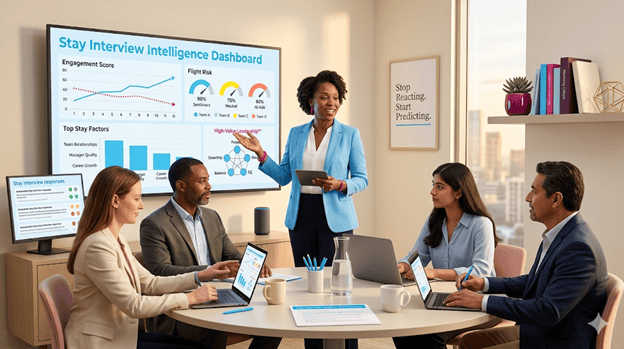
🔄 From Exit to Stay: Why the Conversation Must Shift
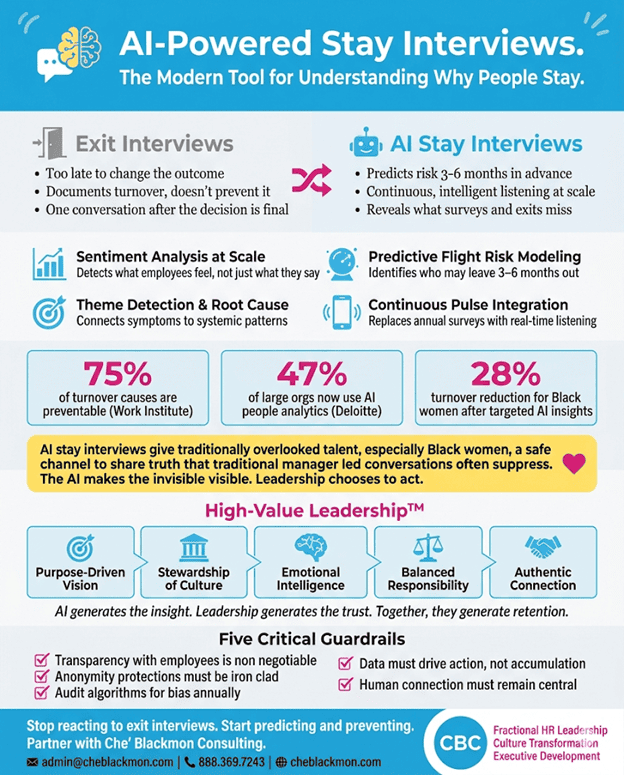
The exit interview has been a staple of HR practice for decades. And for decades, it has produced the same frustrating outcome: a folder full of honest feedback from people who are no longer around to benefit from the changes that feedback might inspire. According to the Work Institute’s 2023 Retention Report, more than 75% of the root causes of voluntary turnover are preventable. The problem is not that organizations lack the information to prevent departures. The problem is that they gather that information at the wrong time.
Stay interviews address this timing gap directly. Popularized by workplace strategist Beverly Kaye and first introduced in her work on employee engagement, the stay interview is a structured, proactive conversation between a manager and a current employee designed to understand what keeps the employee engaged and what could push them toward the door. The questions are straightforward: What do you look forward to when you come to work? What are you learning here? What would make your job better? If you could change something about your role or the team, what would it be? What might tempt you to leave?
These are not complicated questions. But they are rarely asked. And when they are asked, the answers are often captured in a notebook, shared informally, and never analyzed at scale. This is where artificial intelligence changes everything.
🤖 What AI Brings to the Stay Interview
Artificial intelligence does not replace the human connection at the heart of a stay interview. What it does is amplify the organization’s ability to listen at scale, identify patterns that no individual manager could detect, and transform qualitative conversations into quantitative, actionable intelligence.
📊 Sentiment Analysis at Scale
AI powered natural language processing (NLP) tools can analyze the text and tone of stay interview responses across hundreds or thousands of employees simultaneously. These tools detect emotional sentiment, recurring themes, shifts in language over time, and even the difference between what employees say and how they say it. For example, an employee who responds “everything is fine” with language patterns that suggest resignation rather than satisfaction will be flagged differently than one who says the same words with genuine enthusiasm. This level of analysis is impossible for a human reviewer to perform consistently at scale.
🔮 Predictive Flight Risk Modeling
When stay interview data is combined with other organizational data points such as tenure, promotion history, manager tenure, performance ratings, PTO usage patterns, and engagement survey scores, AI can build predictive models that identify which employees are at elevated risk of leaving within the next three to six months. This moves retention from a reactive practice (waiting for the resignation letter) to a predictive strategy (intervening before the decision is made). In my brand voice document for Che’ Blackmon Consulting, I describe this as “predictive analytics for people, not just products.” It is the principle that the same data science rigor organizations apply to forecasting supply chain disruptions and customer churn can and should be applied to understanding and preventing talent loss.
🎯 Theme Detection and Root Cause Analysis
Traditional stay interviews produce valuable but often siloed insights. Manager A learns that their employee wants more development opportunities. Manager B learns that their employee is frustrated by scheduling practices. Manager C learns that their employee feels overlooked for recognition. In isolation, these feel like individual concerns. AI powered analysis aggregates these inputs and identifies systemic themes: perhaps development, scheduling, and recognition are not three separate problems but three symptoms of a single root cause, such as supervisor capacity or an inequitable resource allocation model. This kind of pattern recognition transforms stay interview data from anecdotal feedback into strategic intelligence.
📱 Continuous Pulse Integration
AI enables organizations to move stay interviews from an annual or quarterly event to a continuous listening rhythm. Chatbot based micro stay interviews can be deployed through existing communication platforms, asking employees two to three targeted questions at regular intervals. The AI compiles and analyzes responses over time, building a longitudinal picture of each employee’s engagement trajectory. This approach reduces survey fatigue (because each interaction is brief) while dramatically increasing the richness and timeliness of the data.
❤️ The Equity Imperative: Why AI Stay Interviews Matter Most for Overlooked Talent
Traditional stay interviews, when conducted exclusively by direct managers, carry an inherent limitation: they rely on the employee feeling psychologically safe enough to be honest with the person who holds the most direct power over their daily experience. For many employees, especially those from traditionally overlooked backgrounds, that safety does not exist.
In Rise & Thrive: A Black Woman’s Blueprint for Leadership Excellence, I address the reality that Black women in corporate spaces face a compounding set of barriers that make honest upward communication especially risky. They navigate what scholars call “double jeopardy,” facing bias related to both race and gender. They are more likely to receive coded feedback, to be overlooked for stretch assignments, and to feel that raising concerns will be career limiting. In a traditional stay interview setting, a Black woman may tell her manager “everything is fine” not because it is, but because her lived experience has taught her that honesty with authority figures can be weaponized.
AI powered stay interviews offer a critical alternative pathway. When employees can respond to stay interview questions through an anonymous or semi anonymous digital interface, the psychological barriers to honesty are significantly reduced. The employee is not looking into the eyes of the person who controls their performance review. They are sharing their truth with a system that aggregates it alongside hundreds of other voices, protecting individual identity while surfacing collective patterns.
Furthermore, AI analysis can be designed to disaggregate data by demographic group, revealing whether the stay interview themes for Black women differ from those of their peers. If Black women are consistently reporting concerns about advancement equity, feedback quality, or belonging at higher rates than the general population, the AI flags that disparity as a systemic issue requiring targeted intervention rather than burying it inside an aggregated average that makes everything look acceptable.
💡 Case in Point
There was a company in the manufacturing sector that implemented an AI powered stay interview platform across its three largest plants. The overall results were positive: 71% of employees reported feeling engaged, and the most common “stay factor” was team relationships. But when the AI disaggregated the data by race and gender, a starkly different picture emerged for Black women in mid level roles. Their top reported concern was not compensation or workload. It was “I do not feel my manager advocates for me.” This insight had never surfaced in the company’s traditional engagement survey because it was averaged into the broader population’s more positive responses.
Armed with this insight, the company implemented a targeted sponsorship program for Black women in mid level positions and added advocacy training to its supervisor coaching curriculum. Within 12 months, voluntary turnover among Black women in the organization dropped by 28%, and their engagement scores improved by 15 points. The AI did not solve the problem. It made the problem visible. Leadership solved it by choosing to act.
📈 Current Trends: The AI Stay Interview Landscape in 2025 and 2026
- Conversational AI Platforms Are Maturing. Tools like Culture Amp, Qualtrics, Peakon (now part of Workday), and Lattice have integrated AI driven sentiment analysis into their employee listening suites. Newer entrants are building purpose built stay interview chatbots that feel conversational rather than transactional, reducing the friction that makes traditional surveys feel like homework.
- Predictive People Analytics Is No Longer Experimental. Organizations that once viewed predictive turnover modeling as futuristic are now deploying it operationally. A 2024 report from Deloitte found that 47% of large organizations are actively using or piloting AI powered people analytics tools, up from 29% in 2022. The tools are becoming more accessible, more affordable, and more accurate.
- Ethical AI and Algorithmic Fairness Are Front and Center. As AI tools become more prevalent in HR, concerns about algorithmic bias, data privacy, and the ethical use of employee data are intensifying. Responsible organizations are establishing AI governance frameworks that ensure their tools do not replicate or amplify existing biases. This is especially critical when analyzing data for traditionally overlooked populations, where biased algorithms could produce recommendations that worsen rather than improve equity outcomes.
- Manager Enablement Is the Missing Piece. The most sophisticated AI platform in the world is useless if the managers who receive its insights do not know what to do with them. Progressive organizations are pairing AI stay interview tools with manager coaching programs that teach supervisors how to interpret the data, have follow up conversations, and implement changes based on what the AI reveals. The technology generates the insight. The manager generates the trust.
- Integration with Employee Experience Ecosystems. AI stay interview data is increasingly being integrated with broader employee experience platforms that connect onboarding, learning, performance, and career mobility into a single ecosystem. This integration allows organizations to respond to a stay interview insight (“I want more development”) with a concrete action (“Here are three learning pathways aligned with your stated career goal”) in near real time.
✨ The High‑Value Leadership™ Framework and AI Stay Interviews
Technology alone does not transform culture. Technology amplifies the culture that already exists. If the culture is one of genuine listening and responsive leadership, AI stay interviews will accelerate that culture’s impact. If the culture is one of lip service and performative engagement, AI will simply produce more data that leadership ignores. The difference is the quality of the leadership operating the tool.
The High‑Value Leadership™ framework I developed through High‑Value Leadership: Transforming Organizations Through Purposeful Culture provides the leadership foundation that makes AI stay interviews effective. Each of the five pillars directly supports the conditions required for AI powered listening to produce real results.
- Purpose‑Driven Vision ensures that stay interview data is used in service of a compelling organizational mission, not as a surveillance tool. When employees understand that the organization’s purpose includes their growth and wellbeing, they are more willing to share honest feedback through any channel.
- Stewardship of Culture means that leaders actively use the insights generated by AI stay interviews to nurture the culture rather than filing them away. Stewardship requires closing the loop: telling employees what was heard, what is being done, and what cannot change (and why).
- Emotional Intelligence equips managers to respond to AI generated insights with empathy and skill. The data might reveal that an employee is at risk. The emotionally intelligent manager translates that data point into a human conversation that makes the employee feel seen, not surveilled.
- Balanced Responsibility ensures that the accountability for acting on stay interview insights does not fall solely on HR. Retention is a leadership responsibility, and AI stay interview data should be integrated into every people leader’s performance expectations.
- Authentic Connection reminds us that no amount of data replaces the power of a leader who knows their people. AI stay interviews provide the map. Authentic connection provides the relationship that makes the map worth following.
🌟 From My Experience: 24+ Years of Listening on the Front Lines
Long before AI tools existed, the stay interview was one of the most powerful practices in my retention toolkit. Across manufacturing, automotive, healthcare, nonprofit, quick service, and professional services industries, I consistently found that the most valuable retention intelligence came not from surveys or exit interviews but from the simple act of asking people who were still present: “What keeps you here? And what could push you away?”
There was a company in the automotive sector that was losing experienced skilled trades workers at an unsustainable rate. The exit interview data pointed to compensation as the primary driver. The company raised wages. The turnover continued. When the HR team implemented stay interviews with the remaining skilled trades employees, a completely different picture emerged. The employees who were staying were not staying for the pay. They were staying for the relationships on their teams and the respect they received from their immediate supervisors. The employees who were leaving were not leaving because of pay. They were leaving because they felt invisible to leadership, passed over for input on decisions that affected their work, and disrespected by a scheduling process that prioritized production flexibility over personal commitments.
The exit interviews had pointed to a symptom. The stay interviews revealed the disease. If that company had access to AI powered tools that could aggregate, analyze, and disaggregate those stay interview insights across every plant, every shift, and every demographic group, the intervention would have been faster, more precise, and more impactful. That is the promise of AI in this space. Not to replace the listening. To sharpen it.
⚠️ Critical Guardrails: Using AI Responsibly in Employee Listening
The power of AI stay interviews comes with real responsibilities that organizations must take seriously.
- Transparency Is Non Negotiable. Employees must know that AI tools are being used, what data is being collected, how it will be analyzed, and who will have access to the results. Trust cannot be built through hidden surveillance. Organizations that deploy AI listening tools without transparency will deepen the engagement gap rather than closing it.
- Anonymity Protections Must Be Real. If the AI platform promises anonymity, that promise must be iron clad. Employees who discover that their “anonymous” feedback was traceable back to them will never trust the system again, and they will warn their colleagues not to either.
- Algorithmic Bias Must Be Audited. AI tools trained on historical data can inherit and amplify the biases embedded in that data. Organizations must audit their AI stay interview tools for bias, particularly in how they interpret sentiment across different cultural communication styles. A response pattern that an algorithm flags as “disengaged” might actually reflect a culturally specific communication norm that differs from the majority population’s style.
- Data Must Drive Action, Not Accumulation. The fastest way to undermine an AI stay interview program is to collect insights and do nothing with them. Every cycle of data collection must be followed by visible, communicated action. When employees see that their input led to a change, they invest more trust in the process. When they see that their input disappeared into a dashboard, they stop participating.
- Human Connection Must Remain Central. AI is the amplifier. The manager is the instrument. No algorithm can replace the moment when a leader looks an employee in the eye and says, “I heard you. Here is what we are doing about it.” That moment is where trust is built, and trust is the only foundation on which retention can stand.
✅ Actionable Takeaways: 7 Steps to Implement AI Powered Stay Interviews
- Start with the Human Foundation. Before deploying any AI tool, ensure your managers are trained in the fundamentals of stay interviews: how to ask the right questions, how to listen without defensiveness, and how to follow through on what they hear. Technology amplifies leadership quality. It does not create it.
- Select Tools That Disaggregate Data by Demographics. Any AI stay interview platform you adopt should have the capability to segment results by race, gender, tenure, role level, and location. If the tool cannot show you how the experience of Black women differs from the experience of the general population, it is not sophisticated enough for equitable culture work.
- Pilot Before Scaling. Implement AI powered stay interviews in one department or facility first. Learn what works, what employees respond to, and where the technology’s recommendations need human context before rolling the program across the enterprise.
- Communicate Transparently with Employees. Before launch, explain the purpose of the AI stay interview program, how the data will be used, what protections are in place for anonymity, and most importantly, the organization’s commitment to acting on what it learns. Transparency at the outset builds trust that sustains the program over time.
- Build Closed Loop Action Cycles. For every round of AI stay interview data collected, establish a clear timeline for analysis, leadership review, action planning, and communication back to employees. The cycle should be: listen, analyze, act, communicate. Repeat.
- Audit for Algorithmic Bias Annually. Engage an external partner or internal data science team to audit your AI tools for bias at least once per year. Pay special attention to how sentiment analysis algorithms interpret responses from employees of different racial, cultural, and linguistic backgrounds.
- Integrate Stay Interview Insights with Manager Coaching. The AI generates the data. The manager generates the relationship. Ensure your supervisor coaching program includes training on how to interpret AI stay interview insights and translate them into meaningful, personalized conversations with team members.
💬 Discussion Questions for Your Leadership Team
Use these questions to explore how AI powered stay interviews could transform your organization’s approach to retention:
- Are we currently conducting stay interviews in any form? If so, how are we analyzing and acting on the data? If not, what has prevented us from starting?
- How confident are we that our employees, especially Black women and other traditionally overlooked talent, feel safe enough to give honest feedback through existing channels? What evidence do we have?
- If we disaggregated our retention and engagement data by race and gender tomorrow, what would we expect to find? What would we be afraid to find?
- Are our managers equipped to act on the insights an AI stay interview platform would generate? Or would we need to invest in coaching and development before deploying the technology?
- What ethical guardrails do we have in place for using AI in our people practices? How would we ensure transparency, anonymity, and algorithmic fairness?
- Which of the five High‑Value Leadership™ pillars (Purpose‑Driven Vision, Stewardship of Culture, Emotional Intelligence, Balanced Responsibility, Authentic Connection) represents our organization’s greatest strength in listening to employees? Which represents our biggest gap?
- If we could predict which employees are at risk of leaving six months from now, what would we do differently today? Are we prepared to act on that knowledge?
🚀 Next Steps: Stop Reacting. Start Predicting.
The organizations that will win the talent war in the next decade will not be the ones that offer the highest salaries or the best perks. They will be the ones that understand their people so well that they can predict and prevent the conditions that cause good people to leave. AI powered stay interviews are not a futuristic fantasy. They are available today, and they are already transforming retention outcomes for organizations that have the leadership courage to listen, disaggregate, and act.
If you are ready to evolve your retention strategy from exit interviews and annual surveys to continuous, intelligent, equitable listening, Che’ Blackmon Consulting can help. Through fractional HR leadership, culture transformation consulting, and AI powered retention strategy development rooted in the High‑Value Leadership™ framework, we partner with organizations to build cultures that do not just attract talent but understand it, invest in it, and keep it.
Because the best retention strategy is not reacting to exit interviews. It is creating an environment where your best people never want to leave. And the first step is asking them why they stay.
🌟 Ready to Transform Your Organization’s Culture?
Work with Che’ Blackmon Consulting
📧 admin@cheblackmon.com
📞 888.369.7243
🌐 cheblackmon.com
📚 Explore More from Che’ Blackmon
Mastering a High‑Value Company Culture – Available on Amazon
High‑Value Leadership: Transforming Organizations Through Purposeful Culture – Available on Amazon
Rise & Thrive: A Black Woman’s Blueprint for Leadership Excellence – E‑Book Available at cheblackmon.com
🎥 Rise & Thrive YouTube Series | 🎙️ Unlock, Empower, Transform Podcast
© 2026 Che’ Blackmon Consulting. All rights reserved.
High‑Value Leadership™ is a proprietary framework of Che’ Blackmon Consulting.
#AIinHR #StayInterviews #PredictiveAnalytics #HighValueLeadership #EmployeeRetention #PeopleAnalytics #WorkplaceCulture #CultureTransformation #BlackWomenInLeadership #TalentRetention #HRTechnology #CheBlackmonConsulting #FractionalHR #RetentionStrategy #EmployeeListening #PsychologicalSafety #FutureOfWork #HRInnovation #LeadershipDevelopment #RiseAndThrive

Leave a Reply