By Che’ Blackmon, DBA Candidate | Founder & CEO, Che’ Blackmon Consulting
🌈 Inclusive Culture Architecture | Pride Month
Walk into almost any company today and you will find the word everywhere. It lives on the careers page. It shows up in the values painted on the lobby wall. It gets repeated in onboarding decks and quarterly town halls. You belong here. The phrase is meant to feel warm, and for many people it does. Yet for some of the very people it claims to welcome, belonging has started to feel like a promise the building was never designed to keep.

🏗️ When the Welcome Mat Hides a Locked Door
Belonging became the headline of inclusion work for a good reason. It captures something representation alone cannot. You can hire a more diverse team and still leave people feeling like guests in someone else’s house. So leaders reached for belonging as the next frontier, and that instinct was right. The problem is where many stopped.
Here is the quiet flaw in the way belonging often gets used. It asks the individual to adjust to a culture that was built without them in mind. Fit in. Find your people. Bring your whole self, as long as your whole self matches the unwritten rules already in place. Belonging, framed this way, becomes one more thing the overlooked have to earn. The pressure to assimilate gets rebranded as inclusion.
This matters most for the people who have always been asked to do the adjusting. Across manufacturing, automotive, healthcare, non-profit, quick-service, and professional services settings, Black women in corporate spaces have learned to read a room, soften an idea, and carry the emotional cost of being the only one at the table. A culture can tell them they belong while every system around them quietly says prove it again.
📊 The Business Case Is Stronger Than the Slogans
The financial argument for inclusion is not soft, and it is not new. In its 2023 analysis of more than a thousand companies across two dozen countries, McKinsey & Company found that organizations in the top quartile for gender and for ethnic diversity in leadership were roughly 39 percent more likely to outperform their peers on profitability than companies in the bottom quartile (McKinsey & Company, 2023). That figure has climbed steadily across a decade of study. The relationship is an association rather than a guarantee, yet the pattern is consistent enough that ignoring it has become its own kind of risk.
The cost of getting it wrong shows up just as clearly. A 2023 peer reviewed study of workplace ostracism found that when people are subtly pushed to the margins, their basic need to belong is thwarted, and the fallout is measurable: lower job satisfaction, a stronger intention to quit, weaker loyalty, and even higher reported depression (Brison & Caesens, 2023). Exclusion, in other words, is not only unkind. It is expensive, and the invoice arrives through turnover, disengagement, and lost institutional knowledge.
🪜 The Broken Rung Black Women Keep Hitting
If belonging programs alone solved the problem, the promotion data would show it. It does not. The 2024 Women in the Workplace report, the tenth edition of the study by McKinsey & Company and LeanIn.Org, describes a broken rung at the very first step into management. For every 100 men promoted to manager, only 81 women advance. For Black women, that number falls to 54 (McKinsey & Company & LeanIn.Org, 2024). Women of color hold only about 7 percent of senior leadership seats, a number that has barely moved in years.
The daily experience tells the same story. Women who absorb three or more microaggressions are far more likely to burn out and to seriously consider leaving, with the data pointing to several times the risk of their peers (McKinsey & Company & LeanIn.Org, 2024). Black women in corporate spaces often carry an extra weight that rarely appears in an engagement survey: being mistaken for someone else of the same race, having their competence quietly questioned, or feeling judged for how they speak.
Put the pieces together and the limit of belonging language becomes obvious. You cannot affirm your way out of a structural problem. Telling a Black woman she belongs while the promotion machinery routes opportunity around her is asking her to feel at home in a house whose stairs keep collapsing under her feet. The warmth is real. The architecture is broken.
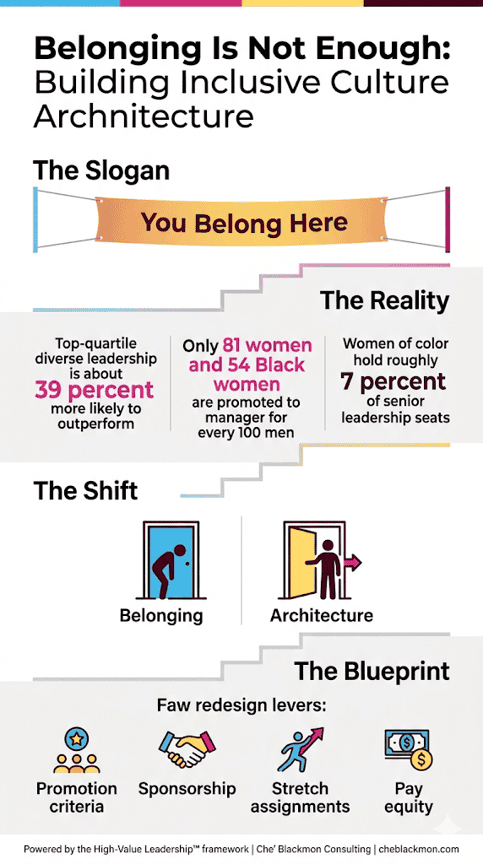
🧱 From Belonging to Architecture
Belonging is a feeling. Architecture is a structure. That single distinction reframes the entire conversation. Feelings can be nurtured with intention and care, and they should be. Structures, though, have to be designed, inspected, and rebuilt when they fail. Inclusive culture architecture asks a harder and more useful question than do people feel welcome. It asks how is opportunity actually distributed here, and who built the rules.
That means looking at the load bearing walls of an organization. How are promotion criteria written and applied. Who gets the high visibility projects that lead to advancement. Who has a sponsor with real influence, not just a mentor with kind words. How are pay, feedback, and meeting norms designed, and who gets interrupted while someone else gets credit. These are not vibes. They are decisions, and decisions can be redesigned.
This is where the High-Value Leadership™ framework earns its place. Its Stewardship of Culture pillar treats culture as something a leader designs and maintains on purpose, the way a steward tends a property rather than hoping the weather cooperates. Paired with the Authentic Connection pillar, it pushes leaders past the comfortable slogan toward the uncomfortable audit. Belonging asks people to fit the building. Architecture asks the building to fit the people.
🏢 Case Study: The Company That Redesigned the Room
Consider an organization in the professional services space that had spent two years investing heavily in belonging. There were affinity groups, listening sessions, and a values statement that named inclusion in bold letters. Engagement scores looked respectable. Leaders felt proud. Yet a closer look at the exit data told a different story, because women of color were leaving at nearly twice the rate of their colleagues, and the talent pipeline into management had quietly narrowed to almost no one who looked like the clients they served.
Rather than launch another awareness campaign, the leadership team stopped asking people to fit and started auditing the structure itself. They examined who received stretch assignments and found the choices ran on familiarity rather than merit. They rewrote vague promotion criteria into clear and observable standards. They built a sponsorship program that paired emerging Black women leaders with senior leaders who held real budget and real decision power, and they tracked the outcomes the same way they tracked revenue.
The results showed up in the numbers that matter. Within eighteen months, voluntary turnover among women of color fell by roughly a third, internal promotion rates for the group rose, and the management pipeline began to reflect the workforce and the market. The belonging programs had not been wrong. They had simply been asked to carry weight that only architecture could hold. The shift, anchored in deliberate Stewardship of Culture, turned good intentions into a measurable result.
✅ What You Can Do This Week
- Audit one process, not your whole culture.Pull the last two years of promotions and ask a hard question. Did opportunity flow evenly, or did it follow familiarity? One honest data pull beats a dozen value statements.
- Separate mentors from sponsors.A mentor gives advice. A sponsor spends political capital on your behalf. Identify which Black women on your team have real sponsors, and close the gap on purpose.
- Make your promotion criteria observable.Replace words like leadership presence with specific, written, and measurable standards so the rules stop living in people’s heads.
- Track stretch assignments like you track budget.Visibility work leads to advancement. Watch who gets it for the next quarter and notice the pattern.
- Ask a quieter question in your next survey.Move past do you feel you belong and ask whether people believe the path to advancement is fair. The gap between those two answers is your real work.
💬 Discussion Questions
- Where in your organization does belonging language outpace structural change?
- If you mapped how your last five promotions actually happened, what would the map reveal?
- Who are the Black women on your team, and do they have sponsors with real influence or only mentors with kind words?
- What is one load bearing process you could redesign this quarter instead of asking people to adapt to it?
👣 Next Steps for Readers
Start with a single audit rather than a sweeping initiative. Choose promotions, sponsorship, or stretch assignments, and look at the real data for the past two years. Bring the findings to your leadership team and frame the conversation around architecture rather than blame. Then pick one structure to redesign, set a measurable goal, and revisit it in ninety days. Inclusive culture is not built in a town hall. It is built in the quiet decisions you are willing to change.
🤝 Work With Che’ Blackmon Consulting
If you are ready to move from belonging slogans to inclusive culture architecture that produces measurable results, Che’ Blackmon Consulting partners with leaders to design cultures worth staying for. Let us build the structure together.
📧 admin@cheblackmon.com 📞 888.369.7243 🌐
📚 References
Brison, N., & Caesens, G. (2023). The relationship between workplace ostracism and organizational dehumanization: The role of need to belong and its outcomes. Psychologica Belgica, 63(1). https://doi.org/10.5334/pb.1215
McKinsey & Company. (2023). Diversity matters even more: The case for holistic impact. https://www.mckinsey.com/featured-insights/diversity-and-inclusion/diversity-matters-even-more
McKinsey & Company, & LeanIn.Org. (2024). Women in the workplace 2024: The 10th-anniversary report. https://www.mckinsey.com/featured-insights/diversity-and-inclusion/women-in-the-workplace-2024
#InclusiveLeadership #CultureArchitecture #BlackWomenInLeadership #BelongingAtWork #HighValueLeadership #DEI #PrideMonth #FractionalHR #OrganizationalCulture #LeadershipDevelopment

Leave a Reply