By Che’ Blackmon, DBA Candidate | Founder & CEO, Che’ Blackmon Consulting
Tomorrow, millions of people will sit down at a table that someone else prepared.
Somebody planned the menu. Somebody shopped, chopped, cleaned, and remembered who cannot eat what. Most guests will never see the hours behind the meal. They will only see the table.
Leadership works the same way. By the time your organization reaches the end of the year, the results are on the table: the numbers, the launches, the clients kept. What is harder to see is who set that table, what it cost them, and whether anyone noticed.
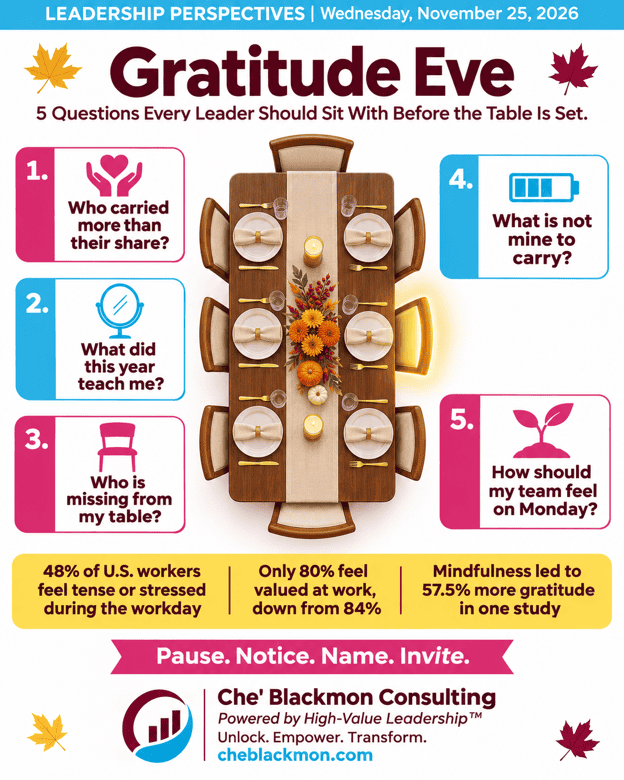
So before the table is set, take one quiet hour tonight. Not to plan. Not to answer one more email. To sit with five questions that every leader should ask before the year closes.
🍂 Why the Night Before Matters
Thanksgiving Eve is one of the few nights of the year when the calendar gives leaders permission to slow down. The office is quieter. Inboxes are lighter. The pressure of December has not arrived yet.
That pause is not a luxury. It is a leadership tool.
Research published in the Journal of Applied Psychology found that when employees practiced a short mindfulness exercise (simply slowing down and paying attention to the present), they became noticeably more grateful. In one experiment, people who listened to a 16 minute mindfulness recording listed 57.5 percent more things they were thankful for than a comparison group (Sawyer et al., 2022). Across a multisource diary study and a 10 day experience sampling study, the pattern held at work: being present raised gratitude, and gratitude increased helping behavior toward coworkers by strengthening the desire to make a difference for others.
Read that from a leader’s chair. Gratitude did not appear because people were told to feel it. It appeared because they stopped long enough to notice. And once they noticed, they helped more.
That is the case for Gratitude Eve. A pause creates the noticing. The noticing creates the gratitude. The gratitude shapes how you lead when everyone returns on Monday.

📊 What the Research Says About This Year
The pause matters more this year than most.
The American Psychological Association’s 2026 Work in America survey of 2,009 employed adults found that 80 percent of workers feel valued at work, down from 84 percent a year earlier. Nearly half (48 percent) say they typically feel tense or stressed during the workday, and 37 percent say their work environment hurts their mental health, up from 32 percent in 2025. At the same time, 95 percent say it is important to work for an organization that values their emotional and psychological wellbeing (American Psychological Association [APA], 2026).
There is also good news in the same study. Workers with high psychological capital (a mix of hope, confidence, resilience, and optimism) were far more likely to describe their workplace as healthy, and only 19 percent of them planned to look for a new job, compared with 51 percent of workers with low psychological capital (APA, 2026). Hope and resilience are not only personal traits. Leaders build them, or drain them, every single day.
For women, the weight is heavier. Deloitte’s Women @ Work 2025 survey of 7,500 women across 15 countries found that only 51 percent rate their mental health as good, 36 percent say their stress is higher than a year ago, and 22 percent describe their mental load as too high. Just 33 percent feel comfortable talking about mental health at work (Deloitte, 2025).
Put those findings together and a clear picture forms. Many of the people who set your organization’s table this year are tired, stretched, and unsure whether anyone saw them. Gratitude, practiced well, is one of the few leadership moves that costs almost nothing and reaches all of them.
🦃 The 5 Questions to Sit With Before the Table Is Set
🙏 1. Who carried more than their share this year, and do they know I saw it?
Every organization has people who quietly held things together: the manager who covered an open role for six months, the analyst who fixed the report before anyone knew it was broken, the coordinator who kept a frustrated client from walking away.
Seeing their effort is not enough. They need to know you saw it.
In practice: Write down three names tonight. Next to each, write one specific thing they did and the difference it made. Send at least one of those notes before Monday.
🪞 2. What did this year teach me that I would have missed without slowing down?
Leaders are trained to look forward. The next quarter. The next target. The next hire. But some of the most valuable lessons only show up in the rearview mirror.
Maybe a project that failed taught you more about your team than one that succeeded. Maybe a hard conversation you avoided cost more than the conversation would have.
In practice: Finish this sentence in a journal or a note on your phone: “This year taught me that I lead best when…” Keep it. It belongs in your 2027 planning.
🍽️ 3. Who is missing from my table?
Every table has an empty chair. Sometimes it belongs to someone who left. Sometimes it belongs to someone who is still in the building but never gets invited to the conversations that shape decisions.
In many organizations, that chair belongs to the traditionally overlooked. Black women in corporate spaces often carry heavy loads (mentoring, problem solving, smoothing tension) while being left out of sponsorship and stretch opportunities. Their contributions get used without being named.
In practice: Look at the five most important meetings on your calendar in December. Ask yourself whose voice is consistently missing, and invite one person who has earned a seat but has never been asked to sit.
🔋 4. What am I carrying into this holiday that is not mine to carry?
Many leaders arrive at Thanksgiving running on empty. They took on tasks they should have delegated. They absorbed stress that belonged to systems, not people. They said yes when the honest answer was “not now.”
High-Value Leadership™ starts with the leader’s own capacity. You cannot pour into a culture from an empty cup.
In practice: List three things you are mentally carrying right now. For each one, decide: keep it, delegate it, or drop it. Choose at least one to hand off or let go before December 1.
🌱 5. What do I want my people to feel when they come back on Monday?
The week after Thanksgiving sets the tone for December. Teams can return to a frantic sprint, or they can return to a leader who is clear, steady, and grateful.
Your answer to this question shapes your first email, your first meeting, and your first conversation of the season.
In practice: Choose one word for how you want your team to feel on Monday (valued, focused, steady, hopeful). Then plan one action that creates that feeling in your first hour back.
👩🏾💼 Why These Questions Matter Most for Black Women Who Lead
For many Black women in leadership, the holiday season does not mean rest. It often means a second shift: hosting, organizing, caring for family, and still answering the late email because they know their margin for error at work feels smaller.
Deloitte’s finding that only one in three women feels comfortable discussing mental health at work (Deloitte, 2025) lands differently when you already feel watched more closely than your peers. Many women simply keep going.
These five questions are for them, too. The leader who asks “What am I carrying that is not mine?” is giving herself permission to set something down. The leader who asks “Who is missing from my table?” may realize she has been the person nobody thought to thank.
And for leaders who manage Black women: this is the week to say thank you with specifics. Name the problem she solved. Name the result. Then follow it with an invitation (a seat at a meeting, a stretch project, an introduction) so the gratitude becomes opportunity.
📈 Case in Point: A Leadership Team That Paused Before the Holiday
The following is a composite scenario built from common patterns in organizational practice. It is framed generally and does not describe a specific client.
🏢 The Challenge
Consider a professional services firm of about 300 employees. After a demanding year of growth, a December pulse survey showed that only 61 percent of employees agreed with the statement “My contributions are recognized.” Exit interviews kept repeating the same phrase: “I never knew if anyone noticed.” Two high performing women of color managers had left in the fall, both citing burnout.
🔧 The Intervention
- A Gratitude Eve hour. The night before the Thanksgiving break, each of the firm’s 14 senior leaders blocked one hour, alone and offline, to work through the five questions above.
- Three specific notes per leader. Each leader sent three handwritten or personal notes naming a specific contribution and its impact. That was 42 notes in one week.
- One empty chair filled. Every leader identified one overlooked contributor and invited that person into a December planning meeting they had never attended before.
- One thing set down. Each leader handed off or dropped one task before December, and shared what it was with their team, which modeled healthy limits.
📊 The Results
By the next quarterly pulse survey, agreement with “My contributions are recognized” rose from 61 percent to 76 percent. Annualized voluntary turnover in the first quarter of the new year fell from 14 percent to 10 percent, and seven of the 14 people invited into planning meetings were later assigned stretch roles. Leaders also reported something no survey captured: the first Monday back felt calmer.
The lesson is simple. The firm did not launch a new program or buy new software. Leaders paused, noticed, named, and invited. The result was a culture where people felt seen.
🧠 Current Trends and Best Practices
- Specific beats general. “Thanks, team” is polite. “Your follow up kept that client” is memorable. Name the action and the impact.
- Private and public both matter. Some people want a handwritten note. Others want their work recognized in front of peers. Ask, then honor their preference.
- Gratitude needs a path to opportunity. For traditionally overlooked employees, thanks without access can feel hollow. Pair recognition with visibility, sponsorship, or a seat at the table.
- Rest is part of performance. With stress rising across the workforce (APA, 2026), protecting real time off over the holiday is a strategic choice, not a soft one.
- Reflection belongs on the calendar. The leaders who reflect well do not wait for inspiration. They schedule it, the same way they schedule a budget review.
✅ Actionable Takeaways You Can Use This Week
- Block one hour tonight. Put “Gratitude Eve” on your calendar, close the laptop, and work through the five questions.
- Send three specific thank you notes. Name the person, the action, and the impact.
- Fill one empty chair. Invite an overlooked contributor into a December meeting where decisions are made.
- Set one thing down. Delegate or drop one task before December 1.
- Choose your Monday word. Decide how you want your team to feel when they return, and plan one action that creates it.
- Protect the holiday. Tell your team you will not send messages over the break, and keep that promise.
💬 Discussion Questions
- Who in your organization carried more than their share this year, and how would they know you noticed?
- What lesson from this year would you have missed if you had never slowed down?
- Whose voice is consistently missing from the conversations that shape your decisions?
- How does your organization make sure gratitude for Black women and other overlooked leaders turns into real opportunity?
- What would change in your culture if every leader paused for one hour before every major holiday?
🚀 Next Steps for Readers
- Save this article and return to it tonight, before the table is set.
- Share it with one leader who poured into everyone else this year.
- Bring your answers to question 2 and question 5 into your 2027 planning.
- Explore High-Value Leadership: Transforming Organizations Through Purposeful Culture for a deeper framework on building a culture where people feel seen and valued.
- Join the High-Value Leadership Intensive waitlist to turn reflection into a culture strategy for the new year.
📚 References
American Psychological Association. (2026). Workers weather stress, uncertainty, and AI with psychological capital: 2026 Work in America survey. https://www.apa.org/pubs/reports/work-in-america/2026
Deloitte. (2025). Women @ Work 2025: A global outlook. Deloitte Global. https://www.deloitte.com/content/dam/assets-shared/docs/collections/2025/deloitte-women-at-work-2025-a-global-outlook.pdf
Sawyer, K. B., Thoroughgood, C. N., Stillwell, E. E., Duffy, M. K., Scott, K. L., & Adair, E. A. (2022). Being present and thankful: A multi-study investigation of mindfulness, gratitude, and employee helping behavior. Journal of Applied Psychology, 107(2), 240–262. https://doi.org/10.1037/apl0000903
🤝 Let’s Build a Culture Where People Feel Seen
If this Gratitude Eve made you think about the culture you want to lead in 2027, let’s talk. Che’ Blackmon Consulting partners with executives and organizations to build High-Value Leadership™ cultures where people are seen, valued, and ready to thrive.
Unlock. Empower. Transform.
📧 admin@cheblackmon.com | 📞 888.369.7243 | 🌐 cheblackmon.com
#GratefulLeadership #Thanksgiving #LeadershipReflection #Gratitude #EmployeeRecognition #WorkplaceWellbeing #HighValueLeadership #BlackWomenInLeadership #WomenInLeadership #LeadershipDevelopment #WorkplaceCulture #CheBlackmonConsulting

Leave a Reply