Beyond Diversity Metrics: Building Truly Inclusive Leadership Culture

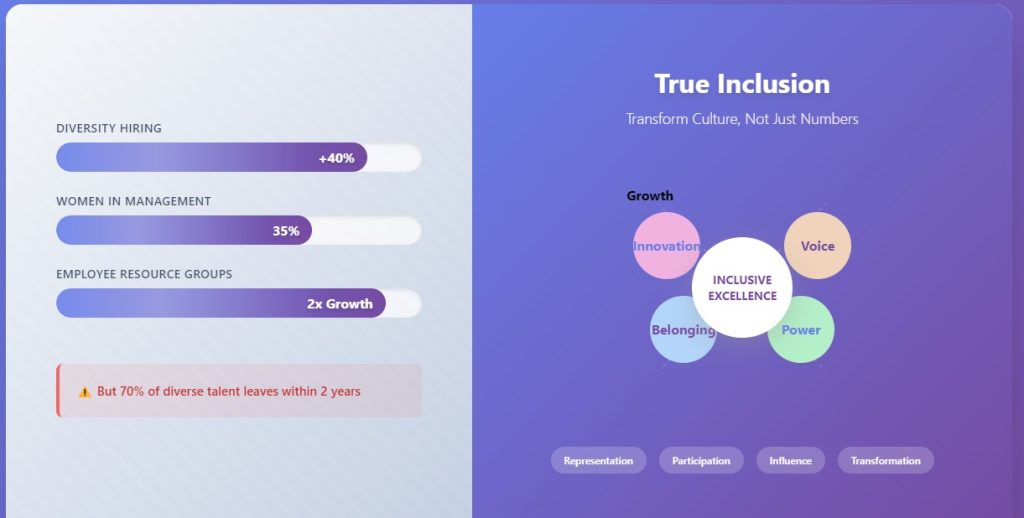
The numbers look impressive on paper. “We’ve increased diverse hiring by 40%!” “Women now represent 35% of our management!” “Our employee resource groups have doubled in size!”

Yet something’s wrong.

Despite hitting diversity targets, your organization still hemorrhages Black women within 18 months. Meetings remain dominated by the same voices. Innovation feels stagnant. And that carefully crafted diversity report can’t explain why your “diverse” leadership team still thinks, acts, and decides remarkably alike.

Here’s the uncomfortable truth: you can have diversity without inclusion, but you cannot have excellence without both.

The Metrics Trap: When Numbers Lie

Most organizations approach diversity like a math problem. Hit the percentages. Check the boxes. Publish the report. But as I’ve observed throughout my twenty-plus years transforming organizational cultures, diversity metrics without inclusive culture is like planting seeds in concrete—nothing grows.

Consider the tech company that proudly achieved 30% female representation in engineering. Within two years, 70% of those women had left. The problem wasn’t the hiring; it was what happened after. The culture remained unchanged—same communication styles rewarded, same after-work bonding rituals, same unwritten rules about who gets heard.

In “Mastering a High-Value Company Culture,” I emphasized that culture is the lifeblood of any organization. When that culture excludes—even unintentionally—diversity becomes a revolving door rather than a competitive advantage.

The Real Cost of Fake Inclusion

McKinsey’s 2023 research reveals the gap:

  • Companies in the top quartile for gender diversity are 25% more likely to have above-average profitability
  • BUT only when coupled with inclusive practices
  • Without inclusion, diverse teams actually perform 15% worse than homogeneous ones due to unmanaged conflict

For Black women specifically, the statistics are sobering:

  • 75% report having to prove themselves more than peers
  • 54% experience being mistaken for someone more junior
  • Only 1 in 4 feel they can bring their authentic selves to work

Understanding True Inclusion: Beyond the Surface

True inclusion isn’t about tolerance—it’s about transformation. It requires fundamentally reshaping how your organization operates, decides, and values contribution.

The Inclusion Framework That Works

Level 1: Representation (Diversity) Bodies in seats. Different faces in spaces. Important but insufficient.

Level 2: Participation (Voice) Everyone speaks, but are they heard? Many organizations stall here.

Level 3: Influence (Power) Diverse perspectives actually shape decisions and direction.

Level 4: Transformation (Evolution) The organization itself changes, becoming stronger through inclusion.

Most organizations celebrate reaching Level 1, struggle at Level 2, and never attempt Levels 3 or 4. This is why their diversity initiatives fail.

The Black Woman’s Experience: A Litmus Test for Inclusion

Want to know if your organization has achieved true inclusion? Look at the experience of Black women. As I discuss in “Rise & Thrive,” Black women navigate the intersection of race and gender, making them the canaries in the coal mine of organizational culture.

When Black women thrive in your organization—genuinely thrive, not just survive—you’ve created something special. When they leave, they’re telling you something your metrics won’t: your inclusion is performative, not transformative.

Case Study: Microsoft’s Evolution

Microsoft’s transformation under Satya Nadella provides a masterclass in moving beyond metrics to meaning. They didn’t just hire more diverse talent; they fundamentally changed their culture:

Before (Diversity Without Inclusion):

  • Competitive ranking system that rewarded individual achievement
  • “Know-it-all” culture that silenced different perspectives
  • High diverse talent turnover despite recruitment success

After (True Inclusive Leadership):

  • Collaborative evaluation emphasizing team success
  • “Learn-it-all” culture that values diverse thinking
  • Black women in leadership roles increased 3x with retention above 90%

The key? They changed systems, not just statistics.

Building Inclusive Leadership Culture: The Blueprint

1. Audit Your Invisible Architecture

Every organization has invisible architecture—unwritten rules that determine who succeeds. Map yours:

Communication Patterns:

  • Who gets interrupted most? (Research shows Black women are interrupted 2.8x more often)
  • Whose ideas need “validation” from others to be accepted?
  • Which communication styles are labeled “professional”?

Decision-Making Processes:

  • Where do real decisions happen? (Formal meetings or golf courses?)
  • Who has access to decision-makers?
  • How are different viewpoints weighted?

Advancement Pathways:

  • What experiences are deemed “essential” for promotion?
  • Who gets stretch assignments?
  • How is “potential” defined and identified?

2. Redesign for Inclusion

Once you see the invisible, you can redesign it:

Inclusive Meeting Practices:

  • Rotate meeting leadership
  • Implement “no interruption” rules with enforcement
  • Use written input before verbal discussion
  • Credit ideas explicitly to their originators

Equitable Decision Systems:

  • Require diverse decision-making teams
  • Document decision criteria transparently
  • Create multiple input channels
  • Measure decision quality, not just speed

Advancement Equity:

  • Define objective promotion criteria
  • Track stretch assignment distribution by demographics
  • Create sponsorship programs (not just mentorship)
  • Eliminate “culture fit” in favor of “culture add”

3. Measure What Matters

Move beyond headcount to meaningful metrics:

Inclusion Indicators:

  • Speaking time distribution in meetings
  • Idea attribution accuracy
  • Promotion velocity by demographic
  • Stay interview insights (not just exit data)

Cultural Health Metrics:

  • Psychological safety scores by demographic
  • Belonging index variations
  • Code-switching frequency reports
  • Energy expenditure on cultural navigation

Innovation Outcomes:

  • Ideas generated by diverse vs. homogeneous teams
  • Implementation rate of diverse perspectives
  • Market insights from diverse viewpoints
  • Customer satisfaction across demographics
The Leadership Imperative: Personal Transformation

In “High-Value Leadership,” I emphasize that transformation begins with leaders. You cannot create what you don’t embody.

The Inclusive Leader’s Journey

Stage 1: Awareness Recognizing your own biases and blind spots. This is uncomfortable but essential.

Stage 2: Education Learning about different experiences and perspectives. Reading, listening, engaging.

Stage 3: Action Making visible changes to your leadership practice. Sponsoring differently. Listening differently. Deciding differently.

Stage 4: Advocacy Using your power to change systems. Challenging exclusionary practices. Creating new norms.

Stage 5: Accountability Measuring your impact. Accepting feedback. Continuous improvement.

Personal Inclusion Practices

Daily Actions:

  • Amplify underrepresented voices in every meeting
  • Question “how we’ve always done it”
  • Seek input from those least like you
  • Notice who’s missing from discussions

Weekly Practices:

  • Review speaking time in your meetings
  • Connect with someone outside your usual circle
  • Sponsor someone who doesn’t look like you
  • Challenge one exclusionary norm

Monthly Commitments:

  • Assess your team’s inclusion metrics
  • Seek feedback on your inclusive leadership
  • Learn about a different cultural perspective
  • Celebrate inclusive behaviors publicly

Transforming Systems, Not Just Statistics

True inclusion requires systemic change. Here’s how to architect it:

Hiring for Addition, Not Fit

Traditional: “They need to fit our culture” Inclusive: “What can they add to make us stronger?”

Example: Instead of asking “Would I want to have a beer with this person?” ask “What perspective or experience would they bring that we currently lack?”

Performance Through Inclusion Lens

Traditional: Individual achievement metrics Inclusive: Collaborative success indicators

  • How well does this person elevate others?
  • What diverse perspectives do they integrate?
  • How do they bridge differences?
  • What inclusive practices do they model?

Promotion with Purpose

Traditional: Subjective potential assessments Inclusive: Transparent capability frameworks

Create clear rubrics that value:

  • Cross-cultural communication
  • Inclusive team building
  • Diverse network cultivation
  • Systemic thinking

The Business Case That Matters

Yes, inclusion drives profit—Boston Consulting Group found that companies with above-average diversity scores have 19% higher innovation revenues. But the real case goes deeper:

Innovation Acceleration: Inclusive teams solve problems faster because they consider more options.

Risk Mitigation: Diverse perspectives identify blind spots before they become crises.

Market Intelligence: Inclusive organizations understand diverse markets authentically.

Talent Magnetism: True inclusion becomes self-reinforcing, attracting top talent.

Resilience Building: Inclusive cultures adapt better to change because they’re already flexible.

Red Flags: Signs Your Inclusion Is Performative

  • Diverse hires cluster at lower levels
  • “Culture fit” remains a hiring criterion
  • Same voices dominate discussions
  • Diversity fatigue among majority groups
  • Black women and other minorities report exhaustion
  • Innovation feels forced rather than flowing
  • Employee resource groups lack budget or influence
  • Leaders can’t name specific inclusive actions they’ve taken

Green Flags: Signs of True Inclusion

  • Diverse talent seeks you out
  • Meetings sound different—more voices, richer dialogue
  • “Bad ideas” lead to breakthrough innovations
  • Conflict becomes productive rather than destructive
  • Retention equalizes across demographics
  • Customer insights surprise you
  • Energy increases rather than depletes
  • Stories of belonging outnumber stories of bias

Your 30-Day Inclusion Acceleration Plan

Week 1: Assess Reality

  • Conduct meeting audits for participation patterns
  • Survey psychological safety by demographic
  • Map your organization’s invisible architecture
  • Identify three specific exclusionary practices

Week 2: Design Changes

  • Create inclusive meeting protocols
  • Develop transparent decision criteria
  • Design equitable advancement pathways
  • Build measurement systems

Week 3: Implement Pilots

  • Test new meeting formats
  • Practice inclusive decision-making
  • Launch sponsorship initiatives
  • Begin collecting inclusion data

Week 4: Scale and Sustain

  • Share early wins
  • Address resistance directly
  • Expand successful practices
  • Commit to long-term change

The Role of Black Women in Transformation

Organizations serious about inclusion should center Black women’s experiences—not as charity, but as strategy. When you design for those navigating the most complex challenges, you create solutions that benefit everyone.

This means:

  • Seeking their input (and paying for it)
  • Protecting their energy (stop making them fix your culture for free)
  • Amplifying their innovations
  • Following their leadership

Discussion Questions for Leadership Teams

  1. What’s the difference between our diversity metrics and our inclusion reality?
  2. How would our organization change if Black women held 30% of senior leadership positions and thrived there?
  3. What invisible rules in our organization would shock an outsider?
  4. Which of our “best practices” actually exclude diverse talent?
  5. How do we currently measure inclusion beyond headcount?
  6. What would need to change for diverse talent to stop code-switching?
  7. If we’re honest, does our organization want true inclusion or just better metrics?

Your Next Steps

Today:

  • Observe one meeting through an inclusion lens
  • Notice who speaks most and least
  • Identify one exclusionary practice you can change

This Week:

  • Conduct a team inclusion assessment
  • Have three conversations with people unlike you
  • Challenge one “way we’ve always done it”

This Month:

  • Implement one systemic change
  • Measure its impact
  • Share learnings broadly
  • Commit to the next change

The Transformation Imperative

Diversity without inclusion is not just ineffective—it’s exhausting for those carrying the weight of being “diverse.” True inclusion transforms organizations from the inside out, creating environments where excellence emerges from every corner, not just familiar ones.

The choice is clear: continue performing diversity theater with impressive metrics and disappointing results, or commit to the harder work of building truly inclusive leadership culture.


Ready to Move Beyond Metrics to Meaning?

At Che’ Blackmon Consulting, we help organizations transform diversity initiatives into inclusive excellence. We don’t just help you count different people—we help you create cultures where different people count.

Our approach includes:

  • Comprehensive inclusion audits beyond traditional metrics
  • Invisible architecture mapping and redesign
  • Inclusive leadership development programs
  • Systemic transformation strategies
  • Measurement frameworks for true inclusion

Stop exhausting your diverse talent with performative inclusion. Start building cultures where everyone—especially traditionally overlooked talent—can thrive.

📧 Email: admin@cheblackmon.com
📞 Call: 888.369.7243
🌐 Visit: www.cheblackmon.com

Special Offer: Schedule an Inclusion Reality Check—a frank assessment of where your organization truly stands beyond the metrics. First 10 organizations this quarter receive a customized inclusion roadmap.

Remember: You can hit every diversity target and still fail at inclusion. True excellence requires both.

#DiversityAndInclusion #InclusiveLeadership #DEI #WorkplaceCulture #BlackWomenInLeadership #OrganizationalCulture #TalentRetention #InclusionMatters #LeadershipDevelopment #DiversityMetrics #CultureTransformation #EquityInBusiness #PsychologicalSafety #BelongingAtWork #SystemicChange

The Detroit Lions Principle: How GRIT Culture Transforms Organizations

The Detroit Lions were professional football’s punchline for decades. A culture of losing had become so embedded in their DNA that failure seemed inevitable. Then something remarkable happened. Under Dan Campbell’s leadership, they didn’t just improve—they transformed entirely, becoming playoff contenders through a complete cultural revolution built on one word: GRIT.

This transformation offers profound lessons for every organization, particularly those seeking to create environments where traditionally overlooked talent can thrive.

Understanding the GRIT Framework

When Campbell took over in 2021, he didn’t start with new plays or roster changes. He started with culture. GRIT became more than a slogan—it became an operating system that filtered every decision, from draft picks to daily practices.

The GRIT framework encompasses:

  • Guts: Courage to take calculated risks
  • Resilience: Bouncing forward from setbacks
  • Initiative: Taking ownership without being asked
  • Toughness: Mental and emotional fortitude

But here’s what makes this remarkable: Campbell’s GRIT wasn’t about toxic masculinity or “tough it out” mentality. It was about creating psychological safety while maintaining high standards—a balance that many organizations struggle to achieve.

The Pre-Campbell Era: A Culture Case Study in Failure

Before Campbell’s arrival, the Lions exemplified how toxic culture becomes self-perpetuating:

  • Learned Helplessness: Players expected to lose
  • Blame Culture: Finger-pointing replaced accountability
  • Individual Survival: Players focused on personal stats over team success
  • Leadership Vacuum: No clear vision or values
  • External Focus: Blaming refs, luck, or circumstances

The parallels to struggling organizations are striking. How many companies operate with these same cultural deficits, wondering why performance never improves despite changing strategies, systems, or personnel?

The Transformation Playbook

Campbell’s approach to cultural transformation provides a blueprint that any organization can follow:

1. Authentic Leadership from Day One

Campbell cried at his introductory press conference. In a sport that often punishes vulnerability, he showed emotion openly. This wasn’t weakness—it was revolutionary authenticity that signaled a new era.

For Black women in corporate spaces, this authenticity principle is crucial. As I discuss in “Rise & Thrive,” the pressure to code-switch and hide authentic selves creates exhaustion and limits potential. Campbell proved that leaders can be both authentic and effective.

2. Clear, Memorable Values

GRIT wasn’t corporate jargon. It was simple, memorable, and actionable. Every player, coach, and staff member could explain what it meant and how to live it.

Compare this to most corporate value statements—lengthy, generic, forgotten. High-value cultures need values that stick.

3. Aligned Systems and Processes

The Lions didn’t just talk GRIT—they operationalized it:

  • Draft picks were evaluated for grit alongside talent
  • Practice intensity increased to build mental toughness
  • Play-calling became more aggressive, reflecting courage
  • Player development focused on resilience-building

This alignment is what I emphasize in “High-Value Leadership.” Culture without systems is just wishful thinking.

4. Psychological Safety with Accountability

Campbell created an environment where:

  • Players could fail without being destroyed
  • Mistakes became learning opportunities
  • Accountability was about growth, not punishment
  • Success was collective, not individual

This balance is especially important for traditionally overlooked talent. Research shows that Black women often face harsher judgment for mistakes while receiving less credit for successes. GRIT culture levels this playing field by making resilience and learning the focus, not perfection.

The Sheila Ford Hamp Factor: Aligned Leadership

The transformation wasn’t just about Campbell. Owner Sheila Ford Hamp provided something crucial: patience and alignment. When the team started 0-10-1 in Campbell’s first season, she didn’t panic. She understood that cultural transformation takes time.

This owner-coach alignment created what I call in “Mastering a High-Value Company Culture” the “permission structure” for real change. Too often, organizations sabotage cultural transformation through impatience or mixed messages from leadership.

Brad Holmes, the General Manager, completed this alignment trinity. His draft philosophy perfectly matched Campbell’s culture, prioritizing character alongside talent. This meant passing on more talented players who didn’t fit the culture—a controversial decision that paid massive dividends.

The Leadership Trinity: When Alignment Creates Magic 🏆

The Lions’ transformation wasn’t just about Dan Campbell’s cultural revolution—it was a masterclass in aligned leadership between three key figures: Owner Sheila Ford Hamp, General Manager Brad Holmes, and Head Coach Dan Campbell. This trinity created what most organizations lack: complete philosophical and operational alignment from ownership through execution.

Sheila Ford Hamp: The Patient Visionary

When Hamp took over as principal owner in 2020, she made a crucial decision that would define the franchise’s future. She didn’t just want to win—she wanted to build something sustainable that Detroit could be proud of. Her “noble cause” wasn’t about quick fixes but about cultural transformation.

Most remarkably, when the team went 0-10-1 to start Campbell’s first season, she didn’t waver. “A rebuild is hard,” she acknowledged publicly, providing cover for her leadership team when critics called for heads to roll. This patience—rare in professional sports and even rarer in corporate America—gave Holmes and Campbell the runway needed for real transformation.

Brad Holmes: The Talent Architect

If Campbell rebuilt the culture, Brad Holmes architected the talent foundation that made it possible. His genius lies not just in identifying talent, but in recognizing the intersection of ability and character that creates championship teams.

Holmes revolutionized the Lions’ approach to talent acquisition through what he calls his “critical factors”:

  • Smarts: Not just football IQ, but emotional and situational intelligence
  • Toughness: Mental resilience over physical bravado
  • Will: Internal drive that doesn’t require external motivation
  • Relentlessness: Sustained effort through adversity
  • Passion: Genuine love for the craft and team
  • High Football Character: Reliability, work ethic, and team-first mentality

His 2021 draft—his first with the Lions—became the cornerstone of transformation:

  • Penei Sewell: Elite talent with exceptional character
  • Amon-Ra St. Brown: Overlooked by others but embodied every GRIT principle
  • Alim McNeill: High character, high motor player others undervalued

Holmes’ approach mirrors what I discuss in “Mastering a High-Value Company Culture”—he doesn’t just fill positions; he builds culture through strategic talent selection. His ability to identify players who were overlooked by other teams because they didn’t fit traditional molds became the Lions’ competitive advantage.

The Three-Touch Welcome: Culture from Day One

Perhaps most tellingly, when the Lions draft a player, that player immediately hears from all three leaders—Hamp, Holmes, and Campbell. This isn’t corporate ceremony; it’s cultural immersion. The message is clear: you’re not just joining a team; you’re joining a aligned organization where ownership, management, and coaching share the same vision.

This three-pronged approach ensures:

  • Consistent Messaging: No mixed signals about expectations or values
  • Visible Unity: Players see leadership alignment immediately
  • Cultural Priority: Character and culture matter from the top down
  • Sustained Support: Players know the entire organization backs the vision

Brad Holmes and the Overlooked Talent Revolution

Holmes’ genius extends beyond traditional scouting—he’s revolutionized how the Lions identify and develop traditionally overlooked talent. His approach offers profound lessons for corporate talent acquisition:

Beyond the Obvious Metrics Holmes doesn’t just look at 40-yard dash times or bench press reps. He evaluates:

  • How players respond to adversity
  • Their growth trajectory versus current ability
  • Leadership in losing situations
  • Work ethic when no one’s watching
  • Ability to elevate teammates

This mirrors what traditionally overlooked talent, especially Black women, bring to organizations—excellence that doesn’t always show up in traditional metrics.

The Amon-Ra St. Brown Principle St. Brown fell to the 4th round despite exceptional college production. Why? He didn’t fit the prototype—not the fastest, not the biggest. But Holmes saw what others missed: relentless work ethic, exceptional intelligence, and an internal drive that couldn’t be taught.

By year two, St. Brown was setting NFL records. This exemplifies Holmes’ ability to see potential where others see limitations—a crucial skill when identifying overlooked talent in any organization.

Cultural Fit Without Conformity Holmes’ interpretation of “cultural fit” differs from the corporate world’s often exclusionary definition. He seeks players who embody GRIT values while bringing diverse backgrounds, styles, and perspectives. The Lions’ locker room includes:

  • Players from Power 5 schools and small colleges
  • Different personality types united by shared values
  • Various leadership styles all contributing to team success
  • International players bringing global perspectives

The Multiplication Effect

When ownership, management, and coaching align, the impact multiplies:

Year 1 (2021): Foundation Building

  • Hamp provides patience and resources
  • Holmes drafts culture-carriers despite “reaching” for character
  • Campbell installs GRIT culture
  • Result: 3-13-1 record but foundational pieces in place

Year 2 (2022): Momentum Building

  • Hamp maintains course despite criticism
  • Holmes adds complementary talent (Jameson Williams, Aidan Hutchinson)
  • Campbell’s culture takes root
  • Result: 9-8 record, cultural transformation visible

Year 3 (2023): Breakthrough

  • Hamp’s patience pays dividends
  • Holmes’ draft picks become stars
  • Campbell’s culture fully embedded
  • Result: Division champions, playoff contenders

This progression shows what happens when leadership alignment allows cultural transformation to fully develop—something most organizations abandon too quickly.

Corporate Applications of the Trinity Model

For organizations seeking similar transformation:

The Owner/Board Role (Hamp Model)

  • Provide patient capital for transformation
  • Shield leadership from short-term pressures
  • Communicate unwavering support publicly
  • Define the “noble cause” beyond profits

The Talent Leader Role (Holmes Model)

  • Redefine talent identification criteria
  • Value character alongside competence
  • Find overlooked talent through non-traditional metrics
  • Build culture through every hire

The Cultural Leader Role (Campbell Model)

  • Live the values authentically
  • Create psychological safety with accountability
  • Develop people beyond their roles
  • Celebrate collective success

The Integration Requirement All three must:

  • Share unified vision
  • Communicate constantly
  • Support each other publicly
  • Measure success similarly
  • Maintain patience through valleys

GRIT Principles for Your Organization

Principle 1: Define Your Own GRIT

What’s your organization’s equivalent? Not a copy of the Lions’ GRIT, but your authentic cultural cornerstone. It should be:

  • Simple enough to remember
  • Specific enough to guide decisions
  • Inspiring enough to motivate
  • Inclusive enough for diverse talent

Principle 2: Make Vulnerability a Strength

Campbell’s tears weren’t weakness—they were connection. In organizations, this translates to:

  • Leaders admitting mistakes openly
  • Sharing struggles alongside successes
  • Creating space for authentic expression
  • Recognizing that strength includes emotional intelligence

For Black women, who often face the “strong Black woman” stereotype that denies them vulnerability, this cultural shift is transformative.

Principle 3: Build Through the Draft (Hiring)

The Lions’ success came from drafting players who embodied GRIT, not just talent. Your hiring should similarly prioritize cultural alignment—but be careful. “Culture fit” often becomes code for “like us,” excluding diverse talent.

Instead, focus on “culture add”—people who share your values while bringing new perspectives. As I discuss extensively in my books, diversity strengthens culture when values align.

Principle 4: Patience with Persistence

The Lions went 3-13-1 in Campbell’s first year. Many wanted him fired. But the culture was building beneath the surface. By year two, they won 9 games. By year three, they were in the playoffs.

Organizations must resist the quarterly earnings pressure that kills cultural transformation. Real change takes 18-36 months minimum.

The Business Case for GRIT Culture

The Lions’ transformation isn’t just feel-good storytelling. The results are measurable:

On-Field Performance:

  • From 3 wins to playoff contention in 3 years
  • Top 5 offensive production
  • Dramatically improved player development

Off-Field Success:

  • Sellout crowds after years of empty seats
  • National media attention and respect
  • Increased merchandise sales
  • Enhanced city pride and connection

Translated to Business:

  • Higher employee engagement (player commitment)
  • Improved innovation (creative play-calling)
  • Better customer loyalty (fan dedication)
  • Enhanced brand value (national recognition)
  • Stronger talent attraction (free agent interest)

GRIT Culture and Traditionally Overlooked Talent

GRIT culture, properly implemented, creates unique opportunities for traditionally overlooked talent:

Meritocracy Through Resilience

When resilience becomes a core value, the playing field levels. Black women, who’ve often had to overcome more obstacles to reach the same position, suddenly find their resilience recognized as an asset rather than invisible labor.

Initiative Over Politics

GRIT culture rewards taking initiative rather than playing politics. This benefits those who’ve been excluded from informal networks where political capital traditionally accumulates.

Collective Success

The Lions’ emphasis on team over individual success challenges the “lone wolf” mentality that often excludes collaborative leaders. Black women’s emphasis on community and lifting while climbing suddenly becomes strategic advantage.

Authentic Toughness

GRIT redefines toughness beyond traditional masculine stereotypes. Mental resilience, emotional intelligence, and sustained persistence matter more than bravado.

Building Your GRIT Culture: A 90-Day Sprint

Days 1-30: Foundation Setting

Week 1-2: Cultural Audit

  • Survey employees about current culture
  • Identify your version of “losing culture” symptoms
  • Document gaps between stated and lived values
  • Analyze turnover and engagement by demographics

Week 3-4: Vision Development

  • Define your GRIT equivalent
  • Create simple, memorable messaging
  • Align leadership team completely
  • Design communication strategy

Days 31-60: System Alignment

Week 5-6: Process Audit

  • Review hiring practices for cultural alignment
  • Examine promotion criteria
  • Assess performance management systems
  • Identify misaligned policies

Week 7-8: Initial Adjustments

  • Update job descriptions to include cultural values
  • Revise interview questions
  • Modify onboarding to emphasize culture
  • Create recognition programs for value demonstration

Days 61-90: Implementation Launch

Week 9-10: Leadership Modeling

  • Leaders demonstrate vulnerability appropriately
  • Share stories of resilience and learning
  • Publicly recognize GRIT behaviors
  • Address cultural violations consistently

Week 11-12: Broader Rollout

  • Team-level culture discussions
  • Peer recognition programs
  • Celebrate early wins
  • Document success stories

Measuring GRIT Culture Success

Key metrics to track:

Engagement Indicators:

  • Employee satisfaction scores by demographic
  • Voluntary turnover rates
  • Internal promotion rates
  • Initiative-taking frequency

Performance Metrics:

  • Team collaboration scores
  • Innovation metrics
  • Customer satisfaction
  • Productivity trends

Resilience Measures:

  • Recovery time from setbacks
  • Learning from failure rates
  • Stress-related absence changes
  • Problem-solving improvement

Inclusion Indicators:

  • Advancement rates for traditionally overlooked talent
  • Psychological safety scores
  • Belonging metrics
  • Voice and contribution measures

Common Pitfalls to Avoid

1. Toxic Toughness

GRIT isn’t about suffering or “toughing it out.” It’s about resilience with support. Don’t let GRIT become an excuse for poor working conditions or lack of resources.

2. Cultural Uniformity

GRIT should allow diverse expressions. A Black woman’s resilience might look different from others’—recognize and value these differences.

3. Impatience

The Lions didn’t transform overnight. Expecting immediate results will kill your cultural transformation.

4. Leader Exemption

If leaders don’t model GRIT, it becomes empty rhetoric. Campbell lived it—your leaders must too.

5. System Misalignment

Culture without supporting systems fails. Every policy, process, and practice must reinforce GRIT principles.

Your GRIT Implementation Toolkit

Essential Elements:

  1. Leadership alignment charter
  2. Values translation guide
  3. Behavioral interview questions
  4. Recognition program framework
  5. Culture measurement dashboard
  6. Story collection system
  7. Onboarding culture modules
  8. Manager culture coaching guides

Quick Wins to Build Momentum:

  • Weekly GRIT story sharing
  • Peer nomination recognition
  • Failure celebration forums
  • Cross-functional GRIT teams
  • Culture champion network
  • Executive vulnerability sessions

Discussion Questions for Leadership Teams

  1. What aspects of “losing culture” exist in our organization?
  2. How would our organization change if resilience was valued as highly as results?
  3. What would our version of GRIT look like?
  4. How might emphasizing resilience benefit traditionally overlooked talent?
  5. What systems currently work against the culture we want to create?
  6. Are we willing to maintain patience through the transformation valley?
  7. How can we measure cultural progress before financial results appear?
  8. What would authentic leadership look like in our context?

Your Next Steps

This Week:

  • Assess your organization’s current cultural state
  • Identify your biggest cultural liability
  • Define what your GRIT could be
  • Get leadership alignment on culture priority

This Month:

  • Conduct culture audit with inclusion lens
  • Create your cultural transformation vision
  • Identify system misalignments
  • Build coalition of culture champions

This Quarter:

  • Launch pilot culture initiatives
  • Begin measuring cultural indicators
  • Share early success stories
  • Maintain patience through resistance

The Championship Mindset

The Detroit Lions proved that any organization, no matter how steeped in failure, can transform through intentional culture change. But transformation requires more than wanting it—it requires systematic, patient, courageous leadership.

For traditionally overlooked talent, especially Black women, GRIT culture offers something revolutionary: a framework where their existing strengths—resilience, initiative, authentic toughness—become recognized assets rather than invisible labor.

The question isn’t whether you need cultural transformation. The question is whether you have the GRIT to see it through.


Ready to Build Your GRIT Culture?

At Che’ Blackmon Consulting, we help organizations develop their own version of GRIT culture—one that transforms performance while creating environments where traditionally overlooked talent thrives.

Our proven approach includes:

  • Cultural assessment with inclusion analytics
  • Custom GRIT framework development
  • Leadership alignment and development
  • System and process optimization
  • Measurement and sustainability planning

Don’t wait for another losing season. Start your transformation today.

📧 Email: admin@cheblackmon.com
📞 Call: 888.369.7243
🌐 Visit: www.cheblackmon.com

Special Opportunity: Schedule a GRIT Culture Assessment and discover your organization’s readiness for transformation. First 10 organizations this month receive complementary culture baseline metrics.

Remember: Every championship team was once a losing team that decided to change. Your transformation starts with that decision.

#OrganizationalCulture #LeadershipAlignment #TalentAcquisition #CultureTransformation #DetroitLions #GRITCulture #InclusiveLeadership #BlackWomenInLeadership #TeamBuilding #ResilienceAtWork #TalentManagement #CorporateCulture #LeadershipDevelopment #OrganizationalChange #HighValueCulture

Competing on Culture: How High-Value Organizations Win the Talent War

The war for talent has a new battlefield. It’s not salary. It’s not perks. It’s culture.

While companies scramble to outbid each other with signing bonuses and stock options, the real winners are quietly building something money can’t buy: high-value cultures where people actually want to work. These organizations understand a fundamental truth that others miss—in today’s economy, culture isn’t just a competitive advantage. It’s THE competitive advantage.

The New Rules of Talent Competition

The numbers paint a clear picture of this shift. According to Glassdoor’s 2023 Mission & Culture Survey, 77% of workers consider a company’s culture before applying for a job, and 56% rank culture as more important than salary. For millennials and Gen Z, these numbers jump even higher. But here’s where it gets interesting: for Black women and traditionally overlooked talent, culture isn’t just a preference—it’s a survival factor.

When I wrote “Mastering a High-Value Company Culture,” I emphasized that culture is an organization’s lifeblood. Now, it’s also become its calling card. Top talent, especially diverse talent, is actively screening out organizations with toxic or exclusionary cultures before they even apply.

The Real Cost of Cultural Mediocrity

Consider these statistics:

  • Companies with poor cultures experience 48% higher turnover (SHRM, 2023)
  • The cost of replacing an employee ranges from 50-200% of their annual salary
  • Organizations with toxic cultures see 30-35% higher healthcare costs due to stress-related issues
  • Poor culture leads to 65% higher error rates and 48% more safety incidents

Meanwhile, companies with strong cultures report:

  • 4x higher revenue growth (MIT/Deloitte, 2023)
  • 21% higher profitability (Gallup, 2023)
  • 40% higher retention rates
  • 89% greater customer satisfaction

The math is simple: culture drives retention, retention drives performance, and performance drives profit.

Why Traditional Approaches Fail 📉

Most organizations approach culture like interior decorating—add some values posters, install a ping-pong table, declare “we’re a family,” and call it done. This surface-level approach not only fails to attract top talent; it actively repels it.

Traditional culture-building fails because it:

1. Ignores Systemic Barriers Many organizations proudly declare “we’re a meritocracy” while maintaining systems that systematically disadvantage certain groups. For Black women, navigating these “meritocracies” often means working twice as hard for half the recognition.

2. Confuses Perks with Purpose Free snacks and casual Fridays don’t create culture. Purpose, values alignment, and genuine inclusion do. As I discuss in “High-Value Leadership,” transformative cultures are built on meaning, not amenities.

3. Mistakes Homogeneity for Harmony Too many leaders believe cultural cohesion means everyone thinking, acting, and looking the same. This artificial harmony stifles innovation and excludes diverse talent who could drive breakthrough performance.

The High-Value Culture Advantage 🚀

High-value organizations compete differently. They understand that winning the talent war isn’t about outbidding competitors—it’s about becoming the kind of organization where talented people can do their best work.

Case Study: How Patagonia Wins Without the Highest Salaries

Patagonia doesn’t offer Silicon Valley salaries or Wall Street bonuses. Yet they have one of the lowest turnover rates in retail (4% versus an industry average of 65%) and receive 9,000 applications for every open position. How?

They built a culture that aligns with their employees’ values:

  • Environmental activism isn’t just allowed; it’s encouraged
  • Work-life balance is genuine, not just rhetoric
  • Purpose permeates every decision
  • Employees feel they’re part of something bigger than profit

The result? Patagonia saves millions in recruitment and training costs while building a workforce so committed that competitors can’t poach them regardless of salary offers.

The Microsoft Transformation: From Toxic to Magnetic

When Satya Nadella became CEO in 2014, Microsoft had a notorious culture problem. The stack-ranking system pitted employees against each other, innovation had stalled, and top talent was fleeing to competitors.

Nadella’s cultural transformation focused on:

  • Shifting from “know-it-all” to “learn-it-all” mindset
  • Replacing competition with collaboration
  • Emphasizing empathy and inclusion
  • Creating psychological safety for risk-taking

The results speak volumes:

  • Stock price increased 400%+
  • Employee satisfaction soared from 40% to 93%
  • Microsoft became a top destination for diverse talent
  • Innovation metrics improved 112%

Creating Magnetic Cultures for Overlooked Talent 💫

For traditionally overlooked talent, especially Black women, culture determines not just job satisfaction but psychological safety, career trajectory, and even physical health. High-value organizations recognize this and intentionally create cultures where diverse talent doesn’t just survive—they thrive.

The Four Pillars of Inclusive Excellence

1. Authentic Representation It’s not enough to hire diverse talent; they need to see themselves reflected in leadership. When Black women see other Black women in executive positions, it signals that advancement is possible. Organizations like Best Buy, with 44% of corporate positions held by women and 33% by people of color, consistently outperform industry averages in both talent acquisition and business results.

2. Equitable Advancement Systems High-value cultures replace subjective “potential” assessments with transparent, objective advancement criteria. They recognize that Black women often excel in performance but get overlooked for promotion due to bias in “leadership potential” evaluations.

3. Psychological Safety Plus Beyond basic psychological safety, these organizations actively address microaggressions, provide bias interruption training, and create multiple channels for reporting concerns. They understand that for Black women, psychological safety includes protection from daily indignities that accumulate into “death by a thousand cuts.”

4. Value for Values These organizations don’t just tolerate different perspectives; they actively seek and reward them. They understand that Black women’s emphasis on community, collaboration, and holistic success can transform organizational performance.

The Talent Acquisition Revolution 🎯

High-value organizations are revolutionizing how they attract talent:

Beyond the Job Posting

Traditional Approach: Generic job posting emphasizing requirements

High-Value Approach: Story-based recruitment showing real employees thriving

Example: Salesforce creates video narratives featuring Black women leaders discussing their actual experiences, challenges they’ve overcome, and support they’ve received. These authentic stories attract candidates who might otherwise assume the company wouldn’t welcome them.

Strategic Partnership Building

Instead of just posting on job boards, high-value organizations build relationships with:

  • Historically Black Colleges and Universities (HBCUs)
  • Professional associations for Black women
  • Community organizations
  • Employee resource groups that become recruitment ambassadors

The Interview Revolution

Traditional interviews often disadvantage Black women through:

  • Emphasis on self-promotion over demonstrated achievement
  • Cultural bias in communication style preferences
  • Informal “fit” assessments that favor homogeneity

High-value organizations redesign their interview process:

  • Structured interviews with standardized questions
  • Diverse interview panels
  • Work sample assessments over hypotheticals
  • Clear rubrics that value different styles of excellence

Retention Through Cultural Excellence 🌟

Attracting talent is just the beginning. Retention happens when culture delivers on its promises.

The First 90 Days: Setting the Cultural Foundation

High-value organizations understand that cultural integration begins on day one:

Week 1: Cultural Immersion

  • Not just orientation but genuine cultural onboarding
  • Connection with employee resource groups
  • Assignment of cultural navigators (not just work mentors)
  • Clear communication of advancement pathways

Month 1: Building Bridges

  • Facilitated connections across departments
  • Inclusion in important meetings (even as observers)
  • Opportunities to contribute ideas
  • Regular check-ins focused on cultural fit (both ways)

Quarter 1: Establishing Value

  • Meaningful project assignments
  • Public recognition of early contributions
  • Feedback that’s specific and actionable
  • Clear development planning

Long-term Retention Strategies

Create Growth Pathways, Not Glass Ceilings

For Black women, seeing a clear path to advancement is crucial. High-value organizations:

  • Map specific routes from entry to executive
  • Provide transparent promotion criteria
  • Offer stretch assignments that build executive presence
  • Create sponsorship programs (not just mentorship)

Address the Whole Person

These organizations recognize that retention requires supporting employees holistically:

  • Flexible work arrangements that acknowledge caregiving responsibilities
  • Mental health support that understands cultural context
  • Employee resource groups with real influence and budget
  • Celebration of cultural heritage and differences

Building Your High-Value Culture Playbook 📋

Ready to compete on culture? Here’s your strategic framework:

Phase 1: Cultural Audit (Month 1-2)

Assess Current State:

  • Employee satisfaction by demographic
  • Turnover rates and exit interview themes
  • Advancement patterns by race and gender
  • Culture survey with inclusion metrics

Identify Gaps:

  • Where do traditionally overlooked employees struggle?
  • What systemic barriers exist?
  • Which policies create inequitable outcomes?
  • How do informal networks exclude certain groups?

Phase 2: Vision Development (Month 3)

Define Your High-Value Culture:

  • What makes your organization unique?
  • How will you differentiate from competitors?
  • What values will guide decisions?
  • How will you measure success?

Create Inclusive Excellence Standards:

  • Leadership competencies that value diverse styles
  • Performance metrics that recognize collaboration
  • Advancement criteria that eliminate bias
  • Communication norms that include all voices

Phase 3: Strategic Implementation (Months 4-9)

Build Infrastructure:

  • Redesign recruitment processes
  • Revamp onboarding programs
  • Create feedback systems
  • Establish accountability measures

Develop Leaders:

  • Train on inclusive leadership
  • Build cultural intelligence
  • Address unconscious bias
  • Create sponsorship capabilities

Phase 4: Measure and Refine (Ongoing)

Track Progress:

  • Monthly pulse surveys
  • Quarterly culture assessments
  • Annual inclusion audits
  • Continuous feedback loops

Celebrate Wins:

  • Share success stories
  • Recognize culture champions
  • Publicize improvements
  • Build momentum

Success Stories: Organizations Winning Through Culture

Costco’s Countercultural Approach

While retailers typically see 75% annual turnover, Costco maintains just 8% among employees with 1+ years tenure. Their secret? A culture that values employees as assets, not expenses:

  • Starting wages 50% above minimum wage
  • Internal promotion as standard practice
  • Benefits that extend to part-time workers
  • Leadership that started on the warehouse floor

Result: Higher profits per employee than any major competitor and customer loyalty that’s legendary.

HubSpot’s Culture Code Success

HubSpot published their Culture Code publicly, making their values and practices transparent to potential employees. This radical transparency:

  • Attracts candidates who align with their values
  • Repels those who wouldn’t thrive
  • Saves millions in bad hire costs
  • Creates accountability for living their values

Their culture-first approach helped them grow from startup to $2 billion in revenue with employee satisfaction scores consistently above 90%.

The ROI of High-Value Culture 💰

For skeptics who think culture is “soft,” here are the hard numbers:

Direct Financial Impact:

  • Companies with engaged cultures see 23% higher profit (Gallup)
  • Strong cultures reduce turnover costs by up to 50%
  • Inclusive companies are 1.7x more likely to be innovation leaders
  • Diverse companies are 35% more likely to outperform competitors

Indirect Value Creation:

  • Reduced recruitment costs through employee referrals
  • Lower training expenses due to higher retention
  • Decreased legal costs from discrimination claims
  • Enhanced brand value through positive employer reputation

For Black Women Specifically: When organizations create cultures where Black women thrive:

  • Innovation increases (diverse teams are 45% more likely to report market growth)
  • Customer insights improve (diverse teams better understand diverse markets)
  • Risk management strengthens (diverse perspectives identify blind spots)
  • Employer brand enhances (authenticity attracts all top talent)

Your Action Plan: Next 30 Days

Week 1: Assess

  • Survey your current employees about cultural experience
  • Analyze turnover data by demographic
  • Review Glassdoor and other employer reviews
  • Identify your top 3 cultural gaps

Week 2: Envision

  • Define what high-value culture means for your organization
  • Identify 3 cultural differentiators you could develop
  • Create a vision statement for your ideal culture
  • Set measurable culture goals

Week 3: Plan

  • Develop a 90-day culture improvement plan
  • Identify quick wins you can implement immediately
  • Build a coalition of culture champions
  • Create accountability measures

Week 4: Act

  • Launch one meaningful culture initiative
  • Communicate your culture vision organization-wide
  • Begin measuring baseline culture metrics
  • Celebrate early adopters and wins

Discussion Questions for Leadership Teams 💭

  1. What aspects of our current culture might be causing us to lose the talent war?
  2. How would our organization change if we became the employer of choice for Black women and overlooked talent?
  3. What cultural elements could become our unique competitive advantage?
  4. Which of our current practices accidentally exclude diverse talent?
  5. How might investing in culture transformation impact our bottom line?
  6. What would it take to make our organization a place where everyone genuinely wants to work?
  7. How can we measure whether our culture attracts or repels top talent?

Your Competitive Edge Awaits

The talent war has evolved. Organizations still competing on salary alone are fighting yesterday’s battle. Today’s winners compete on culture—creating environments where talented people, especially those traditionally overlooked, can do their best work.

The choice is yours: continue struggling to attract and retain talent with outdated approaches, or build a high-value culture that becomes your ultimate competitive advantage.


Ready to Win the Talent War Through Culture?

At Che’ Blackmon Consulting, we help organizations build magnetic cultures that attract, retain, and elevate traditionally overlooked talent—especially Black women who bring invaluable perspectives and capabilities.

Our proven approach helps you:

  • Conduct comprehensive culture audits with inclusion focus
  • Design high-value cultures that differentiate you from competitors
  • Implement sustainable transformation strategies
  • Measure and maintain cultural excellence
  • Build leadership capabilities for inclusive excellence

Don’t just compete for talent—become the organization talent chooses.

📧 Email: admin@cheblackmon.com 📞 Call: 888.369.7243

🌐 Visit: https://cheblackmon.com

Special Opportunity: Schedule a Culture Competition Assessment and receive a customized report on how your culture stacks up against competitors in attracting diverse talent.

Remember: In the war for talent, culture isn’t just another weapon—it’s the battlefield itself. Those who shape the battlefield win the war.

#TalentAcquisition #CompanyCulture #DiversityAndInclusion #TalentRetention #WorkplaceCulture #EmployeeEngagement #OrganizationalDevelopment #HRStrategy #InclusiveLeadership #TalentManagement #CultureTransformation #BlackWomenInLeadership #EmployerBranding #FutureOfWork #HighValueCulture

The Culture Code: Why Your Organization’s DNA Determines Its Destiny

Every organization has DNA—an invisible code that determines how decisions get made, who gets heard, and ultimately, who succeeds. This cultural genetic material shapes everything from your Monday morning meetings to your most critical strategic decisions. And just like biological DNA, once established, it becomes remarkably resistant to change.

But here’s what most leaders miss: this organizational DNA wasn’t designed with everyone in mind. In fact, for Black women and other traditionally overlooked talent, navigating corporate culture often means adapting to a code that was written without their input, experience, or success in mind.

The Hidden Architecture of Organizational Success

Think of your organization’s culture as an operating system. It runs in the background, influencing every interaction, decision, and outcome. When I wrote “Mastering a High-Value Company Culture,” I emphasized that culture is the lifeblood of any organization. But it’s more than that—it’s the very blueprint that determines whether your organization will thrive or merely survive.

Research from MIT Sloan found that companies with strong, adaptive cultures saw 4x higher revenue growth and created 12x more shareholder value over a decade compared to those with weak cultures. Yet despite these compelling numbers, most organizations treat culture as a nice-to-have rather than a strategic imperative.

The Detroit Lions Transformation: A Case Study in Cultural DNA

Consider the Detroit Lions’ remarkable transformation under Dan Campbell’s leadership. For decades, the Lions were synonymous with failure—a culture of losing had become embedded in their organizational DNA. But Campbell didn’t just change tactics; he rewrote the team’s genetic code.

He introduced “GRIT” as the foundation—not just a slogan, but a complete cultural operating system. Every decision, from draft picks to daily practices, was filtered through this new cultural lens. The result? A team that went from perennial losers to playoff contenders, proving that when you change the DNA, you change the destiny.

When Culture Codes Exclude: The Reality for Black Women

For Black women in corporate spaces, the culture code often operates as a series of locked doors. Consider Sarah, a senior marketing director at a Fortune 500 company. Despite consistently exceeding targets, she found herself repeatedly passed over for VP roles. The feedback? “Not quite the right fit for our executive culture.”

This vague assessment reveals how cultural DNA can become a weapon of exclusion. When organizations say “culture fit,” they often mean “similar to what we’ve always had.” This creates what I call in “Rise & Thrive” the hypervisibility/invisibility paradox—Black women are hypervisible when they don’t conform to cultural expectations, yet invisible when they achieve excellence.

The Numbers Tell the Story

  • Black women hold just 1.6% of VP roles in Fortune 500 companies
  • 62% report having to code-switch daily to navigate corporate culture
  • Companies with inclusive cultures see 2.3x higher cash flow per employee
  • Yet only 3.2% of senior leadership positions are held by Black women

These statistics aren’t just numbers—they’re evidence of cultural codes that systematically exclude exceptional talent.

Decoding Your Organization’s Cultural DNA 🧬

Understanding your organization’s culture code requires looking beyond mission statements and values posters. Here’s what actually shapes your cultural DNA:

1. Decision-Making Patterns

Who’s in the room when real decisions get made? If your strategic discussions consistently lack diverse perspectives, your culture code is signaling who truly belongs at the top.

2. Communication Norms

Does your culture reward those who “speak up” in meetings while penalizing those who prefer written communication or need processing time? These seemingly neutral preferences can systematically disadvantage certain groups.

3. Success Metrics

What gets celebrated? If your organization only recognizes individual achievement while ignoring collaborative success, you’re encoding competition over cooperation into your DNA.

4. Informal Networks

Where do career-making conversations happen? Golf courses? Happy hours? These informal spaces often become the real venues for advancement—and they’re frequently the least inclusive.

The High-Value Culture Revolution 🚀

In “High-Value Leadership,” I discuss how transformative leaders don’t just work within existing cultures—they actively reshape them. Here’s how to begin rewriting your organization’s cultural code:

Create Inclusive Excellence Standards

Traditional Approach: “We hire for culture fit” High-Value Approach: “We hire for culture add—what perspectives and experiences will make us stronger?”

Example: Microsoft’s transformation under Satya Nadella shifted from a “know-it-all” to a “learn-it-all” culture, specifically creating space for diverse thinking styles and backgrounds.

Establish Equitable Advancement Pathways

Stop relying solely on self-promotion for advancement. Create transparent, structured pathways that recognize different styles of excellence. Research shows Black women are less likely to self-promote but more likely to exceed performance standards—your advancement system should account for this.

Redefine Leadership Presence

Challenge narrow definitions of executive presence. Does confidence have to look like dominance? Does leadership require fitting into a predetermined mold? Organizations that expand their definition of leadership see 45% better talent retention among diverse employees.

Building Bridges While Transforming Structures 🌉

For Black women navigating current corporate cultures while working to transform them, strategic navigation is essential. Here’s your blueprint:

1. Document Everything

Keep detailed records of your contributions, innovations, and impact. When culture codes work against you, evidence becomes your armor.

2. Build Strategic Alliances

Identify culture champions—those with influence who recognize the need for change. These allies can amplify your voice when you’re not in the room.

3. Create Micro-Cultures

You don’t have to wait for organization-wide change. Start with your team. Model inclusive practices, celebrate diverse contributions, and demonstrate what’s possible.

4. Leverage External Visibility

When internal culture limits your growth, external visibility creates options. Speak at conferences, publish thought leadership, build your professional brand beyond your organization’s walls.

The Culture Transformation Playbook 📚

Ready to transform your organization’s DNA? Here’s your action plan:

Phase 1: Diagnose (Months 1-3)

  • Conduct a cultural audit focusing on inclusion metrics
  • Map informal networks and decision-making patterns
  • Identify gaps between stated values and lived experience
  • Document microaggressions and systemic barriers

Phase 2: Design (Months 4-6)

  • Create inclusive leadership standards
  • Develop equitable advancement frameworks
  • Design bias interruption processes
  • Build measurement systems for cultural health

Phase 3: Implement (Months 7-12)

  • Launch pilot programs with willing teams
  • Train leaders in inclusive practices
  • Create feedback loops for continuous adjustment
  • Celebrate early wins to build momentum

Phase 4: Embed (Ongoing)

  • Integrate changes into performance systems
  • Update policies to reflect new cultural norms
  • Share success stories widely
  • Continue evolving based on results

Success Stories: Organizations Cracking the Code

Salesforce’s Equality Journey

Salesforce conducted a comprehensive pay audit and invested $16 million to address unexplained pay gaps. They’ve also tied executive compensation to diversity metrics, literally encoding inclusion into their cultural DNA.

Best Buy’s Inclusive Transformation

Under Corie Barry’s leadership, Best Buy redesigned their talent systems to reduce bias, resulting in 44% of corporate positions being held by women and 33% by people of color—far exceeding industry averages.

Your Culture, Your Choice

The culture code of your organization isn’t fixed—it’s a living system that can be rewritten. But change requires more than good intentions. It demands strategic action, sustained commitment, and the courage to challenge deeply embedded patterns.

For traditionally overlooked talent, especially Black women, the choice is clear: we can either continue adapting to cultures that weren’t designed for us, or we can become architects of transformation, creating cultures where everyone can thrive.

Discussion Questions for Your Leadership Team 💭

  1. What aspects of our current culture might be creating invisible barriers for Black women and other underrepresented talent?
  2. How do our informal networks and unwritten rules affect who advances in our organization?
  3. What would need to change for our organization to become a place where diverse talent doesn’t just survive but genuinely thrives?
  4. How might expanding our definition of leadership excellence unlock new value for our organization?
  5. What’s one cultural norm we could change this quarter that would signal meaningful transformation?

Your Next Steps

This Week:

  • Observe three meetings and note who speaks most, whose ideas gain traction, and who gets interrupted
  • Document one cultural norm that might be creating barriers
  • Identify one ally who could partner in cultural transformation

This Month:

  • Conduct a team culture audit using the framework provided
  • Share this article with your leadership team and schedule a discussion
  • Identify three specific changes to pilot with your team

This Quarter:

  • Develop a culture transformation proposal
  • Build a coalition of culture champions
  • Launch one meaningful culture change initiative

Ready to Transform Your Organization’s DNA?

Culture transformation isn’t a solo journey. At Che’ Blackmon Consulting, we partner with organizations ready to build high-value cultures where traditionally overlooked talent—especially Black women—can genuinely thrive.

Our approach combines strategic consulting with practical implementation, helping you:

  • Decode your current cultural DNA
  • Design inclusive excellence standards
  • Implement sustainable transformation
  • Measure and maintain cultural health

Book a Culture Transformation Strategy Session and discover how to create an organization where everyone’s brilliance can shine. Because when you change the culture code, you change everything.

📧 Email: admin@cheblackmon.com 📞 Call: 888.369.7243

🌐 Visit: www.cheblackmon.com

Remember: Your organization’s destiny isn’t determined by market conditions or competitive pressures—it’s determined by the culture you choose to create. Choose wisely. Choose inclusively. Choose transformation.

#OrganizationalCulture #DiversityAndInclusion #LeadershipDevelopment #CultureTransformation #InclusiveLeadership #WorkplaceCulture #DEI #BlackWomenInBusiness #CorporateCulture #HighValueLeadership #TalentManagement #OrganizationalDNA #CultureChange #ExecutiveLeadership #BusinessTransformation

Boundaries Without Burnout: Sustainable Leadership Practices for the Long Haul 🛡️

The text came at 11:47 PM on a Sunday: “Quick question about tomorrow’s presentation…”

For the third weekend in a row, Marcus, a senior director at a tech firm, found himself working until 2 AM. His family had stopped planning weekend activities. His health metrics were trending in dangerous directions. His team’s turnover had hit 40%. Yet he wore his exhaustion like a badge of honor, believing that sacrificing everything for work was what “real leaders” did.

Six months later, Marcus collapsed during a board meeting. The diagnosis: severe burnout requiring extended medical leave. His absence created chaos, proving that unsustainable leadership practices don’t just harm leaders—they destabilize entire organizations.

The Sustainability Crisis in Leadership

Leadership burnout has reached epidemic proportions. Deloitte’s 2024 Workplace Burnout Survey reveals that 77% of leaders have experienced burnout in their current role, with 91% saying it impacts the quality of their work. The consequences ripple throughout organizations:

  • Burned-out leaders make 23% more errors in judgment
  • Teams with exhausted leaders show 37% lower engagement
  • Organizations with high leader burnout see 32% higher turnover
  • Customer satisfaction drops 28% under burned-out leadership

As I explored in “High-Value Leadership: Transforming Organizations Through Purposeful Culture,” sustainable leadership isn’t about doing less—it’s about creating systems that enable consistent high performance without sacrificing wellbeing.

The Compounded Challenge for Black Women Leaders 💪

For Black women in leadership, the sustainability challenge intensifies dramatically. Research from the National Bureau of Economic Research shows:

  • Black women leaders work 11% more hours than white peers in similar roles
  • They receive 36% more “office housework” assignments
  • Experience 2.5x more pressure to be “always on”
  • Face 43% more scrutiny of their time management

In “Rise & Thrive: A Black Woman’s Blueprint for Leadership Excellence,” I discussed the “prove-them-wrong tax”—the exhausting pressure Black women face to work twice as hard to be considered half as good. This creates a vicious cycle where setting boundaries feels like career suicide.

Case Study: Dr. Robinson’s Breaking Point

Dr. Aisha Robinson, Chief Medical Officer at a major hospital system, maintained what she called “fortress mode” for five years—first to arrive, last to leave, never saying no. She mentored every Black medical student, served on every diversity committee, and still managed a full patient load.

“I felt like I was representing every Black woman who might come after me,” she explained. “One mistake, one boundary, one ‘no’ could confirm stereotypes.”

The cost? A stress-induced autoimmune condition that forced her to take medical leave. Her absence created a leadership vacuum that took months to stabilize, proving that unsustainable practices serve no one.

Understanding the Anatomy of Sustainable Leadership 🔬

The Myth of Endless Capacity

Traditional leadership models treat human capacity like an infinite resource. This industrial-era thinking fails to account for:

  • Cognitive load limits
  • Emotional labor costs
  • Physical health requirements
  • Relationship maintenance needs
  • Creative restoration demands

Research from Stanford shows that productivity sharply declines after 50 hours per week, and working 70 hours produces no more output than 55 hours. Yet leadership culture often rewards presence over productivity, activity over achievement.

The Four Pillars of Sustainable Leadership

1. Energy Management (Not Just Time Management) Your energy is finite. Sustainable leaders recognize four types:

  • Physical energy (health, sleep, nutrition)
  • Emotional energy (mood, relationships)
  • Mental energy (focus, creativity)
  • Spiritual energy (purpose, meaning)

2. Strategic No’s Enable Strategic Yes’s Every yes to one thing is a no to something else. Sustainable leaders:

  • Evaluate opportunities against core priorities
  • Delegate strategically
  • Eliminate low-value activities
  • Protect high-impact time

3. Recovery as Performance Strategy Athletes don’t train 24/7—neither should leaders. Structured recovery:

  • Prevents decision fatigue
  • Maintains innovation capacity
  • Sustains relationship quality
  • Ensures long-term effectiveness

4. Systems Over Heroics Sustainable leadership builds systems that work without constant heroic effort:

  • Clear processes reduce crisis management
  • Developed teams share leadership load
  • Documented knowledge prevents bottlenecks
  • Automated tasks free strategic thinking time

The SUSTAIN Framework for Long-Term Leadership Success 🌱

S – Set Non-Negotiable Boundaries

Professional Boundaries:

  • Work hours (with rare exceptions)
  • Response time expectations
  • Meeting availability windows
  • Project capacity limits

Personal Boundaries:

  • Protected family time
  • Health appointments
  • Rest periods
  • Personal development time

Example Implementation: “I maintain deep work hours from 9-11 AM daily. Unless there’s a true emergency, I’m unavailable during this time. This allows me to tackle strategic priorities when my energy is highest.”

U – Understand Your Peak Performance Patterns

Track your energy patterns for two weeks:

  • When do you do your best strategic thinking?
  • When are you most creative?
  • When do you communicate most effectively?
  • When do you need recovery?

Align your schedule with these patterns rather than fighting against them.

S – Structure Your Support Systems

Professional Support:

  • Executive assistant or administrative support
  • Strong second-in-command
  • Developed team leaders
  • External coaches or mentors

Personal Support:

  • Family/friend network
  • Health team (doctor, therapist, etc.)
  • Household help if possible
  • Community connections

T – Take Recovery Seriously

Micro-Recovery (Daily):

  • 5-minute breathing breaks
  • Walking meetings
  • Lunch away from desk
  • Evening shutdown ritual

Macro-Recovery (Weekly/Monthly):

  • Full weekend days off
  • Regular vacations
  • Quarterly planning retreats
  • Annual extended breaks

A – Automate and Delegate Ruthlessly

Automation Opportunities:

  • Recurring meetings scheduling
  • Standard email responses
  • Report generation
  • Routine approvals

Delegation Framework:

  • Tasks only you can do (keep)
  • Tasks others can do with training (delegate)
  • Tasks that shouldn’t be done (eliminate)
  • Tasks that can be systematized (automate)

I – Invest in Capacity Building

Personal Capacity:

  • Leadership development
  • Skill enhancement
  • Health optimization
  • Relationship nurturing

Team Capacity:

  • Succession planning
  • Cross-training
  • Leadership development
  • System documentation

N – Navigate Transitions Thoughtfully

Career transitions, role changes, and life events require boundary adjustments:

  • Acknowledge increased demands
  • Set temporary boundaries
  • Communicate clearly
  • Plan for re-stabilization

Real-World Success Stories 📈

Microsoft’s Cultural Transformation

Under Satya Nadella’s leadership, Microsoft transformed from a burnout culture to a sustainable one:

Changes Implemented:

  • Eliminated stack ranking that created internal competition
  • Introduced “Daily Active Questions” about wellbeing
  • Created meeting-free Fridays
  • Implemented minimum time between meetings
  • Encouraged “clarity over urgency” principle

Results:

  • Employee satisfaction increased 10 points
  • Innovation metrics improved 40%
  • Stock price increased 450% over 8 years
  • Turnover decreased 25%

Arianna Huffington’s Wake-Up Call

After collapsing from exhaustion and breaking her cheekbone, Huffington Post founder Arianna Huffington transformed her approach:

Personal Changes:

  • 8 hours sleep non-negotiable
  • No devices in bedroom
  • Morning meditation practice
  • Regular digital detoxes

Organizational Impact:

  • Founded Thrive Global
  • Influenced corporate wellness globally
  • Demonstrated that success doesn’t require burnout

Creating Boundaries for Traditionally Overlooked Leaders 🌟

The Additional Challenges

Black women and other traditionally overlooked leaders face unique boundary challenges:

1. Representation Tax

  • Expected to attend every diversity event
  • Pressured to mentor all diverse talent
  • Asked to educate others constantly
  • Required to be the “diverse voice”

2. Perfectionism Pressure

  • No room for visible mistakes
  • Must outperform to be equal
  • Constantly proving belonging
  • Carrying group representation burden

3. Cultural Expectations

  • “Strong Black woman” stereotype
  • Community obligations
  • Extended family responsibilities
  • Religious/cultural commitments

Strategic Boundary Setting for Black Women Leaders

1. Selective Visibility Choose when and how to be visible:

  • Quality over quantity in commitments
  • Strategic presence at key events
  • Documented contributions
  • Purposeful networking

2. Collective Support Systems Build networks that understand your unique challenges:

  • Black women leadership groups
  • Peer mentorship circles
  • Sponsor relationships
  • Professional associations

3. Unapologetic Self-Care Reframe self-care as resistance and leadership:

  • Health as non-negotiable
  • Rest as revolutionary
  • Joy as resistance
  • Boundaries as leadership modeling

4. Strategic No’s Develop scripts for common requests:

  • “I’m honored you thought of me, but my current commitments prevent me from giving this the attention it deserves.”
  • “I can recommend [colleague name] who would be excellent for this.”
  • “Let me check my capacity and get back to you by [specific date].”

Current Trends in Sustainable Leadership 🔮

2024-2025 Emerging Practices:

1. Results-Only Work Environments (ROWE) Focus on outcomes, not hours logged

2. Sabbatical Programs Extended breaks for restoration and learning

3. Energy Management Training Teaching leaders to manage energy like athletes

4. Boundary Coaching Professional support for setting and maintaining boundaries

5. Collective Leadership Models Shared leadership reducing individual burden

Your Sustainable Leadership Action Plan 🎯

Week 1: Assessment

Energy Audit:

  • Track energy levels hourly for one week
  • Note energy drains and boosters
  • Identify patterns
  • Document insights

Boundary Inventory:

  • List current boundaries (or lack thereof)
  • Note where boundaries are violated
  • Identify consequences of poor boundaries
  • Prioritize areas needing attention

Month 1: Foundation Setting

Week 2: Communication

  • Communicate one new boundary
  • Set out-of-office messages
  • Update calendar availability
  • Share response time expectations

Week 3: Systems Building

  • Identify three tasks to delegate
  • Automate one recurring task
  • Create one standard process
  • Document one key procedure

Week 4: Support Activation

  • Schedule health appointments
  • Connect with support network
  • Join professional community
  • Engage coach or mentor

Quarter 1: Implementation and Integration

Month 2: Refinement

  • Adjust boundaries based on feedback
  • Expand delegation
  • Deepen recovery practices
  • Build team capacity

Month 3: Sustainability

  • Evaluate progress
  • Celebrate successes
  • Address challenges
  • Plan next evolution

Measuring Sustainable Leadership Success 📊

Personal Metrics:

  • Energy levels (1-10 daily rating)
  • Sleep quality and quantity
  • Health indicators
  • Relationship satisfaction
  • Work satisfaction scores

Professional Metrics:

  • Team engagement scores
  • Turnover rates
  • Innovation metrics
  • Goal achievement
  • 360 feedback scores

Organizational Metrics:

  • Department performance
  • Cultural health scores
  • Succession readiness
  • Customer satisfaction
  • Financial results

Discussion Questions for Reflection 💭

  1. What story about leadership and sacrifice have you internalized that might be harming your sustainability?
  2. What would become possible if you modeled sustainable leadership for your team?
  3. Which boundaries feel most difficult to set, and what makes them challenging?
  4. How might better boundaries actually improve your leadership effectiveness?
  5. What support would you need to maintain boundaries consistently?

Your Next Steps: From Burnout to Breakthrough 🚀

Sustainable leadership isn’t about doing less—it’s about doing what matters most, consistently and excellently, for the long haul. When leaders model sustainability, entire organizations transform.

The choice isn’t between success and wellbeing. The most successful leaders understand that wellbeing IS success—sustained, impactful, and transformative.

Ready to build sustainable leadership practices that last?

Che’ Blackmon Consulting specializes in helping leaders, particularly traditionally overlooked talent, create sustainable success without sacrifice.

We offer:

Sustainable Leadership Assessment – Evaluate your current practices and identify sustainability gaps

Boundary Setting Intensive – Develop and implement professional boundaries that stick

Energy Management Optimization – Create systems that sustain rather than drain

Team Capacity Building – Develop your team to share leadership load effectively

Executive Wellbeing Coaching – Personalized support for sustainable high performance

Don’t wait for burnout to force change. Build sustainable practices now.

📞 Schedule your consultation: 888.369.7243
📧 Email: admin@cheblackmon.com
🌐 Learn more: www.cheblackmon.com

Because true leadership excellence means being able to lead powerfully today, tomorrow, and for years to come.


Che’ Blackmon, SPHR, is the founder of Che’ Blackmon Consulting and author of “Mastering a High-Value Company Culture” and “High-Value Leadership: Transforming Organizations Through Purposeful Culture.” With over 20 years of experience in organizational transformation, she specializes in helping leaders create sustainable success that honors both professional excellence and personal wellbeing.

#SustainableLeadership #LeadershipWellbeing #BurnoutPrevention #BlackWomenInLeadership #ExecutiveWellness #WorkLifeBalance #BoundariesAtWork #LeadershipDevelopment #HighValueLeadership #WomenInLeadership #CorporateWellness #LeadershipSustainability #MentalHealthAtWork #ExecutiveCoaching #OrganizationalCulture

The AI Readiness Assessment: Is Your Organization Future-Ready? 🤖

The meeting room fell silent. The CEO had just announced that their biggest competitor—a company half their size—had reduced operational costs by 30% and increased customer satisfaction by 45% using AI-powered systems. Meanwhile, their own organization was still debating whether AI was “just a fad.”

This scene plays out daily across corporate America. The AI revolution isn’t coming—it’s here. And organizations that aren’t ready risk becoming obsolete.

The Current State of AI Adoption: Beyond the Hype 📊

According to McKinsey’s 2024 Global AI Survey, 72% of organizations have adopted AI in at least one business function, up from just 20% in 2017. Yet only 8% have achieved AI at scale. This gap between adoption and true readiness represents both massive risk and unprecedented opportunity.

The reality is stark:

  • Companies using AI report average revenue increases of 20%
  • AI-ready organizations show 3x higher profit margins than peers
  • 85% of executives believe AI will transform their industry within 3 years
  • Yet 67% admit their organizations lack the capabilities to implement AI effectively

As I explored in “High-Value Leadership: Transforming Organizations Through Purposeful Culture,” true transformation requires more than technology—it demands cultural readiness, leadership alignment, and inclusive implementation strategies.

The Hidden Digital Divide: AI’s Impact on Traditionally Overlooked Talent 💡

Here’s what most AI readiness assessments miss: the technology gap disproportionately affects traditionally overlooked employees, particularly Black women and other underrepresented groups.

Consider these disparities:

  • Only 22% of AI professionals are women; less than 4% are Black women
  • Black employees are 35% less likely to receive AI training opportunities
  • 78% of AI decision-making roles are held by white men
  • Organizations with diverse AI teams show 35% better performance metrics

In “Rise & Thrive: A Black Woman’s Blueprint for Leadership Excellence,” I discussed how Black women often must work twice as hard for half the recognition. With AI, this dynamic intensifies—those without access to AI tools and training face exponential disadvantage.

Case Study: The Tale of Two Analysts

Sarah, a white analyst at a Fortune 500 firm, received early access to AI tools, training, and mentorship. Within six months, she was automating reports that previously took days, earning recognition and promotion.

Keisha, a Black analyst at the same company, wasn’t included in the pilot program despite superior performance reviews. She continued manual processes while watching peers advance using AI assistance. When she finally received training, she had to catch up while managing her full workload, without the support system Sarah enjoyed.

This isn’t just unfair—it’s bad business. Organizations that exclude diverse talent from AI initiatives miss critical perspectives that could prevent bias, improve adoption, and drive innovation.

The Five Pillars of AI Readiness Assessment 🏗️

Pillar 1: Leadership Alignment and Vision

Assessment Questions:

  • Does leadership understand AI’s strategic importance?
  • Is there a clear AI vision aligned with business objectives?
  • Are resources allocated for AI transformation?
  • Do leaders model AI adoption?

Red Flags:

  • AI viewed as “IT’s responsibility”
  • No C-suite champion for AI
  • Budget treats AI as expense vs. investment
  • Leadership skepticism about AI value

Green Lights:

  • CEO actively champions AI initiatives
  • Board discussions include AI strategy
  • Cross-functional AI steering committee exists
  • Investment in AI matches strategic priority

Pillar 2: Cultural Readiness for Change

In “Mastering a High-Value Company Culture,” I emphasized that culture eats strategy for breakfast. This is especially true with AI adoption.

Assessment Areas:

  • Innovation appetite
  • Risk tolerance
  • Learning orientation
  • Change adaptability
  • Trust in technology

Cultural Barriers to AI:

  • Fear-based resistance (“AI will take our jobs”)
  • Perfectionism paralysis (“We need 100% accuracy”)
  • Siloed thinking (“That’s not my department”)
  • Status quo bias (“We’ve always done it this way”)

Cultural Enablers:

  • Growth mindset (“AI helps us do more”)
  • Experimental approach (“Let’s pilot and learn”)
  • Collaborative spirit (“AI benefits everyone”)
  • Future focus (“We must evolve to thrive”)

Pillar 3: Technical Infrastructure and Capabilities

Core Technical Requirements:

  • Data quality and accessibility
  • Cloud computing capacity
  • Integration capabilities
  • Security frameworks
  • Scalability potential

Assessment Matrix:

ComponentBasicDevelopingAdvancedLeading
Data QualitySiloed, inconsistentPartially integratedMostly unifiedSingle source of truth
Cloud AdoptionOn-premise onlyHybrid modelCloud-firstMulti-cloud optimized
API IntegrationManual processesSome automationWidespread APIsFully integrated
SecurityBasic protocolsEnhanced securityAdvanced protectionAI-powered security

Pillar 4: Talent and Skills Development

Critical Skill Gaps:

  • Only 37% of workers feel prepared for AI
  • 62% of managers can’t evaluate AI output
  • 89% of organizations report AI talent shortage
  • Average time to fill AI role: 6 months

Inclusive Talent Strategy:

  1. Assess Current State
    • Map existing skills
    • Identify high-potential employees
    • Note representation gaps
    • Document learning preferences
  2. Design Inclusive Training
    • Multiple learning formats
    • Culturally relevant examples
    • Peer support groups
    • Flexible scheduling options
  3. Create Advancement Paths
    • Clear progression routes
    • Mentorship programs
    • Stretch assignments
    • Recognition systems

Pillar 5: Ethical AI and Governance

Key Governance Areas:

  • Bias detection and mitigation
  • Privacy protection
  • Transparency requirements
  • Accountability frameworks
  • Compliance standards

The Equity Imperative: AI systems trained on biased data perpetuate discrimination. Without diverse teams building and auditing AI, we risk automating inequality at scale.

Examples of AI bias:

  • Facial recognition failing for darker skin tones
  • Resume screening favoring male candidates
  • Loan algorithms discriminating against zip codes
  • Healthcare AI missing symptoms in women

Real-World AI Readiness: Success and Failure Stories 📈

Success Story: JPMorgan Chase’s Inclusive AI Journey

JPMorgan Chase’s AI transformation succeeded through deliberate inclusivity:

Strategy:

  • Created diverse AI Center of Excellence
  • Mandated bias testing for all algorithms
  • Provided AI training to 50,000 employees
  • Established ethics review board with diverse members

Results:

  • 2.5 million hours saved annually through automation
  • 90% reduction in loan processing time
  • 25% improvement in fraud detection
  • 40% increase in employee satisfaction
  • Industry recognition for ethical AI practices

Cautionary Tale: Amazon’s Biased Recruiting AI

Amazon’s AI recruiting tool showed preference for male candidates because it was trained on 10 years of resumes—predominantly from men.

Lessons Learned:

  • Historical data embeds historical bias
  • Diverse teams catch problems earlier
  • Ethics must be built-in, not bolted-on
  • Regular audits are essential
  • Transparency builds trust

The Traditionally Overlooked Advantage in AI 🌟

Organizations serious about AI readiness should prioritize traditionally overlooked talent, particularly Black women, for strategic reasons:

Unique Strengths:

  1. Pattern Recognition – Experience navigating bias develops keen pattern detection
  2. Risk Assessment – Understanding of unintended consequences
  3. Innovation Perspective – Different experiences drive creative solutions
  4. Trust Building – Experience with exclusion informs inclusive design
  5. Ethical Sensitivity – Lived experience with algorithmic bias

Strategic Implementation:

  • Create AI fellowship programs targeting HBCUs
  • Partner with organizations like Black Girls Code
  • Establish mentorship with Black women in tech
  • Provide protected time for AI skill development
  • Recognize and reward inclusive AI innovations

Your AI Readiness Assessment Tool 📝

Section A: Leadership and Strategy (25 points)

Rate each statement 1-5 (1=Strongly Disagree, 5=Strongly Agree):

  1. Our CEO actively champions AI initiatives □
  2. We have a clear, documented AI strategy □
  3. AI investments align with business priorities □
  4. Leaders use AI tools themselves □
  5. Board meetings include AI discussions □

Subtotal: ___/25

Section B: Culture and Change (25 points)

  1. Employees embrace new technologies □
  2. Failure is viewed as learning □
  3. Cross-functional collaboration is common □
  4. Continuous learning is valued □
  5. Innovation is rewarded and recognized □

Subtotal: ___/25

Section C: Technical Readiness (25 points)

  1. Our data is clean and accessible □
  2. We have cloud infrastructure □
  3. Systems integrate well □
  4. Security protocols are robust □
  5. We can scale technology quickly □

Subtotal: ___/25

Section D: Talent and Inclusion (25 points)

  1. AI training is available to all employees □
  2. We have diverse AI teams □
  3. Employees feel prepared for AI □
  4. Career paths include AI skills □
  5. Traditionally overlooked groups are included □

Subtotal: ___/25

Total Score: ___/100

Interpreting Your Score:

80-100: AI Leaders You’re ahead of the curve but must maintain momentum and address any gaps.

60-79: AI Ready Strong foundation with specific areas needing attention before scaling.

40-59: AI Developing Significant preparation needed; focus on foundational elements first.

Below 40: AI Emerging Urgent action required to avoid competitive disadvantage.

Current AI Trends Shaping Organizational Readiness 🔮

2024-2025 Key Trends:

1. Generative AI Democratization

  • Tools like ChatGPT making AI accessible
  • No-code AI platforms emerging
  • Natural language interfaces standard
  • AI assistants for every role

2. Ethical AI Mandate

  • Regulatory requirements increasing
  • Consumer demand for transparency
  • Investor focus on responsible AI
  • Reputation risks for AI misuse

3. Hybrid Intelligence Models

  • Human-AI collaboration vs. replacement
  • Augmented decision-making
  • AI as colleague, not tool
  • Emphasis on human judgment

4. Industry-Specific AI

  • Vertical AI solutions emerging
  • Specialized models for sectors
  • Regulatory compliance built-in
  • Domain expertise crucial

Your 90-Day AI Readiness Action Plan 🎯

Days 1-30: Assessment and Awareness

Week 1: Current State Analysis

  • Complete readiness assessment
  • Map existing AI initiatives
  • Identify skill gaps
  • Document concerns and resistance

Week 2: Stakeholder Engagement

  • Interview leadership
  • Survey employees
  • Engage overlooked voices
  • Gather customer perspectives

Week 3: Competitive Analysis

  • Research industry AI adoption
  • Identify best practices
  • Note competitor advantages
  • Find partnership opportunities

Week 4: Gap Analysis

  • Compare current to desired state
  • Prioritize gaps by impact
  • Identify quick wins
  • Estimate resource needs

Days 31-60: Strategy and Planning

Month 2 Focus Areas:

  • Develop AI vision and strategy
  • Create inclusive governance structure
  • Design pilot programs
  • Build diverse AI team
  • Establish success metrics
  • Create communication plan

Days 61-90: Implementation Launch

Month 3 Priorities:

  • Launch pilot program
  • Begin training initiatives
  • Implement governance frameworks
  • Establish feedback loops
  • Celebrate early wins
  • Adjust based on learning

Building an Inclusive AI Future 🌈

For Organizations:

Immediate Actions:

  1. Audit current AI initiatives for diversity
  2. Create inclusive AI training programs
  3. Establish diverse AI governance boards
  4. Partner with diverse educational institutions
  5. Set representation targets and track progress

Long-term Strategies:

  1. Build AI apprenticeship programs
  2. Create returnship opportunities
  3. Establish AI ethics committees
  4. Develop bias detection systems
  5. Share success stories broadly

For Traditionally Overlooked Professionals:

Skill Building:

  1. Take free AI courses (Coursera, edX)
  2. Join AI communities and networks
  3. Experiment with AI tools
  4. Document AI projects
  5. Share learning publicly

Career Advancement:

  1. Volunteer for AI initiatives
  2. Build AI into current role
  3. Network with AI professionals
  4. Seek AI mentorship
  5. Position yourself as AI bridge-builder

Discussion Questions for Organizational Reflection 💭

  1. What would happen to your organization if competitors achieved AI advantage while you didn’t?
  2. Which traditionally overlooked voices in your organization could provide unique insights for AI implementation?
  3. How might AI amplify existing inequities in your workplace, and how can you prevent this?
  4. What cultural shifts are needed for your organization to embrace AI fully?
  5. How can you ensure AI enhances rather than replaces human value in your organization?

Your Next Steps: From Assessment to AI Advantage 🚀

AI readiness isn’t just about technology—it’s about creating inclusive, adaptive cultures that leverage both human and artificial intelligence for competitive advantage.

The organizations that will thrive aren’t necessarily those with the biggest AI budgets, but those that build inclusive AI strategies leveraging all available talent and perspectives.

Ready to accelerate your AI transformation journey?

Che’ Blackmon Consulting specializes in helping organizations build inclusive AI readiness, with particular expertise in ensuring traditionally overlooked talent is central to your AI strategy.

We offer:

Comprehensive AI Readiness Assessment – Deep evaluation of your organization’s AI maturity across all dimensions

Inclusive AI Strategy Development – Create AI roadmaps that leverage diverse talent and perspectives

Cultural Transformation for AI – Build cultures that embrace innovation while maintaining human value

AI Leadership Development – Prepare leaders to guide organizations through AI transformation

Bias Prevention and Ethical AI – Implement frameworks ensuring AI serves all stakeholders fairly

Don’t let the AI revolution leave your organization—or your talent—behind.

📞 Schedule your consultation: 888.369.7243
📧 Email: admin@cheblackmon.com
🌐 Learn more: www.cheblackmon.com

Because true AI readiness means ensuring no talent is left behind in the transformation.


Che’ Blackmon, SPHR, is the founder of Che’ Blackmon Consulting and author of “Mastering a High-Value Company Culture” and “High-Value Leadership: Transforming Organizations Through Purposeful Culture.” With over 20 years of experience transforming organizational cultures, she specializes in helping organizations build inclusive excellence in the age of AI, ensuring traditionally overlooked talent is central to digital transformation strategies.

#AIReadiness #ArtificialIntelligence #DigitalTransformation #InclusiveAI #FutureOfWork #AIStrategy #DiversityInTech #BlackWomenInTech #OrganizationalChange #TechLeadership #AIEthics #WorkplaceInnovation #DigitalInclusion #LeadershipDevelopment #AITransformation