Blog

Gratitude Eve: 5 Questions Every Leader Should Sit With Before the Table Is Set

By Che’ Blackmon, DBA Candidate | Founder & CEO, Che’ Blackmon Consulting

Tomorrow, millions of people will sit down at a table that someone else prepared.

Somebody planned the menu. Somebody shopped, chopped, cleaned, and remembered who cannot eat what. Most guests will never see the hours behind the meal. They will only see the table.

Leadership works the same way. By the time your organization reaches the end of the year, the results are on the table: the numbers, the launches, the clients kept. What is harder to see is who set that table, what it cost them, and whether anyone noticed.

So before the table is set, take one quiet hour tonight. Not to plan. Not to answer one more email. To sit with five questions that every leader should ask before the year closes.

πŸ‚ Why the Night Before Matters

Thanksgiving Eve is one of the few nights of the year when the calendar gives leaders permission to slow down. The office is quieter. Inboxes are lighter. The pressure of December has not arrived yet.

That pause is not a luxury. It is a leadership tool.

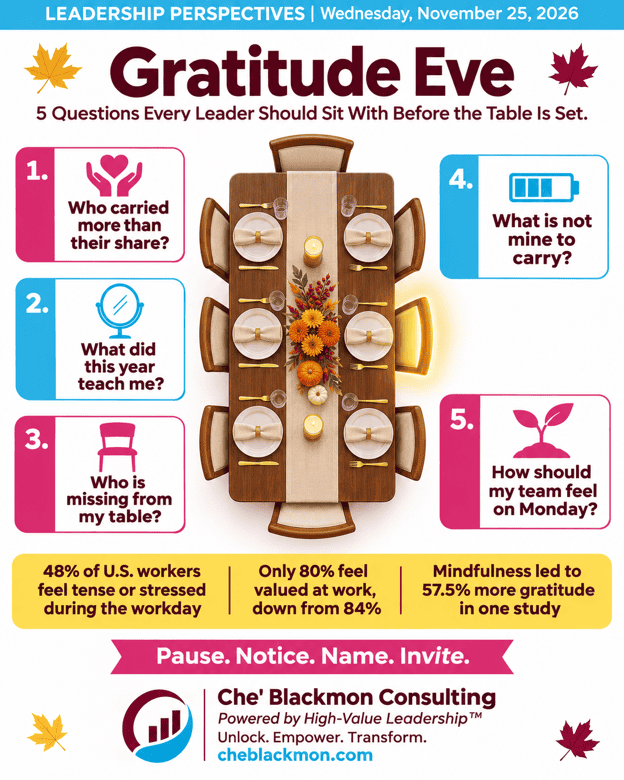
Research published in the Journal of Applied Psychology found that when employees practiced a short mindfulness exercise (simply slowing down and paying attention to the present), they became noticeably more grateful. In one experiment, people who listened to a 16 minute mindfulness recording listed 57.5 percent more things they were thankful for than a comparison group (Sawyer et al., 2022). Across a multisource diary study and a 10 day experience sampling study, the pattern held at work: being present raised gratitude, and gratitude increased helping behavior toward coworkers by strengthening the desire to make a difference for others.

Read that from a leader’s chair. Gratitude did not appear because people were told to feel it. It appeared because they stopped long enough to notice. And once they noticed, they helped more.

That is the case for Gratitude Eve. A pause creates the noticing. The noticing creates the gratitude. The gratitude shapes how you lead when everyone returns on Monday.

πŸ“Š What the Research Says About This Year

The pause matters more this year than most.

The American Psychological Association’s 2026 Work in America survey of 2,009 employed adults found that 80 percent of workers feel valued at work, down from 84 percent a year earlier. Nearly half (48 percent) say they typically feel tense or stressed during the workday, and 37 percent say their work environment hurts their mental health, up from 32 percent in 2025. At the same time, 95 percent say it is important to work for an organization that values their emotional and psychological wellbeing (American Psychological Association [APA], 2026).

There is also good news in the same study. Workers with high psychological capital (a mix of hope, confidence, resilience, and optimism) were far more likely to describe their workplace as healthy, and only 19 percent of them planned to look for a new job, compared with 51 percent of workers with low psychological capital (APA, 2026). Hope and resilience are not only personal traits. Leaders build them, or drain them, every single day.

For women, the weight is heavier. Deloitte’s Women @ Work 2025 survey of 7,500 women across 15 countries found that only 51 percent rate their mental health as good, 36 percent say their stress is higher than a year ago, and 22 percent describe their mental load as too high. Just 33 percent feel comfortable talking about mental health at work (Deloitte, 2025).

Put those findings together and a clear picture forms. Many of the people who set your organization’s table this year are tired, stretched, and unsure whether anyone saw them. Gratitude, practiced well, is one of the few leadership moves that costs almost nothing and reaches all of them.

πŸ¦ƒ The 5 Questions to Sit With Before the Table Is Set

πŸ™ 1. Who carried more than their share this year, and do they know I saw it?

Every organization has people who quietly held things together: the manager who covered an open role for six months, the analyst who fixed the report before anyone knew it was broken, the coordinator who kept a frustrated client from walking away.

Seeing their effort is not enough. They need to know you saw it.

In practice: Write down three names tonight. Next to each, write one specific thing they did and the difference it made. Send at least one of those notes before Monday.

πŸͺž 2. What did this year teach me that I would have missed without slowing down?

Leaders are trained to look forward. The next quarter. The next target. The next hire. But some of the most valuable lessons only show up in the rearview mirror.

Maybe a project that failed taught you more about your team than one that succeeded. Maybe a hard conversation you avoided cost more than the conversation would have.

In practice: Finish this sentence in a journal or a note on your phone: “This year taught me that I lead best when…” Keep it. It belongs in your 2027 planning.

🍽️ 3. Who is missing from my table?

Every table has an empty chair. Sometimes it belongs to someone who left. Sometimes it belongs to someone who is still in the building but never gets invited to the conversations that shape decisions.

In many organizations, that chair belongs to the traditionally overlooked. Black women in corporate spaces often carry heavy loads (mentoring, problem solving, smoothing tension) while being left out of sponsorship and stretch opportunities. Their contributions get used without being named.

In practice: Look at the five most important meetings on your calendar in December. Ask yourself whose voice is consistently missing, and invite one person who has earned a seat but has never been asked to sit.

πŸ”‹ 4. What am I carrying into this holiday that is not mine to carry?

Many leaders arrive at Thanksgiving running on empty. They took on tasks they should have delegated. They absorbed stress that belonged to systems, not people. They said yes when the honest answer was “not now.”

High-Value Leadershipβ„’ starts with the leader’s own capacity. You cannot pour into a culture from an empty cup.

In practice: List three things you are mentally carrying right now. For each one, decide: keep it, delegate it, or drop it. Choose at least one to hand off or let go before December 1.

🌱 5. What do I want my people to feel when they come back on Monday?

The week after Thanksgiving sets the tone for December. Teams can return to a frantic sprint, or they can return to a leader who is clear, steady, and grateful.

Your answer to this question shapes your first email, your first meeting, and your first conversation of the season.

In practice: Choose one word for how you want your team to feel on Monday (valued, focused, steady, hopeful). Then plan one action that creates that feeling in your first hour back.
πŸ‘©πŸΎβ€πŸ’Ό Why These Questions Matter Most for Black Women Who Lead

For many Black women in leadership, the holiday season does not mean rest. It often means a second shift: hosting, organizing, caring for family, and still answering the late email because they know their margin for error at work feels smaller.

Deloitte’s finding that only one in three women feels comfortable discussing mental health at work (Deloitte, 2025) lands differently when you already feel watched more closely than your peers. Many women simply keep going.

These five questions are for them, too. The leader who asks “What am I carrying that is not mine?” is giving herself permission to set something down. The leader who asks “Who is missing from my table?” may realize she has been the person nobody thought to thank.

And for leaders who manage Black women: this is the week to say thank you with specifics. Name the problem she solved. Name the result. Then follow it with an invitation (a seat at a meeting, a stretch project, an introduction) so the gratitude becomes opportunity.

πŸ“ˆ Case in Point: A Leadership Team That Paused Before the Holiday

The following is a composite scenario built from common patterns in organizational practice. It is framed generally and does not describe a specific client.

🏒 The Challenge

Consider a professional services firm of about 300 employees. After a demanding year of growth, a December pulse survey showed that only 61 percent of employees agreed with the statement “My contributions are recognized.” Exit interviews kept repeating the same phrase: “I never knew if anyone noticed.” Two high performing women of color managers had left in the fall, both citing burnout.

πŸ”§ The Intervention

  1. A Gratitude Eve hour. The night before the Thanksgiving break, each of the firm’s 14 senior leaders blocked one hour, alone and offline, to work through the five questions above.
  2. Three specific notes per leader. Each leader sent three handwritten or personal notes naming a specific contribution and its impact. That was 42 notes in one week.
  3. One empty chair filled. Every leader identified one overlooked contributor and invited that person into a December planning meeting they had never attended before.
  4. One thing set down. Each leader handed off or dropped one task before December, and shared what it was with their team, which modeled healthy limits.

πŸ“Š The Results

By the next quarterly pulse survey, agreement with “My contributions are recognized” rose from 61 percent to 76 percent. Annualized voluntary turnover in the first quarter of the new year fell from 14 percent to 10 percent, and seven of the 14 people invited into planning meetings were later assigned stretch roles. Leaders also reported something no survey captured: the first Monday back felt calmer.

The lesson is simple. The firm did not launch a new program or buy new software. Leaders paused, noticed, named, and invited. The result was a culture where people felt seen.

🧠 Current Trends and Best Practices

  • Specific beats general. “Thanks, team” is polite. “Your follow up kept that client” is memorable. Name the action and the impact.
  • Private and public both matter. Some people want a handwritten note. Others want their work recognized in front of peers. Ask, then honor their preference.
  • Gratitude needs a path to opportunity. For traditionally overlooked employees, thanks without access can feel hollow. Pair recognition with visibility, sponsorship, or a seat at the table.
  • Rest is part of performance. With stress rising across the workforce (APA, 2026), protecting real time off over the holiday is a strategic choice, not a soft one.
  • Reflection belongs on the calendar. The leaders who reflect well do not wait for inspiration. They schedule it, the same way they schedule a budget review.

βœ… Actionable Takeaways You Can Use This Week

  1. Block one hour tonight. Put “Gratitude Eve” on your calendar, close the laptop, and work through the five questions.
  2. Send three specific thank you notes. Name the person, the action, and the impact.
  3. Fill one empty chair. Invite an overlooked contributor into a December meeting where decisions are made.
  4. Set one thing down. Delegate or drop one task before December 1.
  5. Choose your Monday word. Decide how you want your team to feel when they return, and plan one action that creates it.
  6. Protect the holiday. Tell your team you will not send messages over the break, and keep that promise.

πŸ’¬ Discussion Questions

  1. Who in your organization carried more than their share this year, and how would they know you noticed?
  2. What lesson from this year would you have missed if you had never slowed down?
  3. Whose voice is consistently missing from the conversations that shape your decisions?
  4. How does your organization make sure gratitude for Black women and other overlooked leaders turns into real opportunity?
  5. What would change in your culture if every leader paused for one hour before every major holiday?

πŸš€ Next Steps for Readers

  • Save this article and return to it tonight, before the table is set.
  • Share it with one leader who poured into everyone else this year.
  • Bring your answers to question 2 and question 5 into your 2027 planning.
  • Explore High-Value Leadership: Transforming Organizations Through Purposeful Culture for a deeper framework on building a culture where people feel seen and valued.
  • Join the High-Value Leadership Intensive waitlist to turn reflection into a culture strategy for the new year.

πŸ“š References

American Psychological Association. (2026). Workers weather stress, uncertainty, and AI with psychological capital: 2026 Work in America survey. https://www.apa.org/pubs/reports/work-in-america/2026

Deloitte. (2025). Women @ Work 2025: A global outlook. Deloitte Global. https://www.deloitte.com/content/dam/assets-shared/docs/collections/2025/deloitte-women-at-work-2025-a-global-outlook.pdf

Sawyer, K. B., Thoroughgood, C. N., Stillwell, E. E., Duffy, M. K., Scott, K. L., & Adair, E. A. (2022). Being present and thankful: A multi-study investigation of mindfulness, gratitude, and employee helping behavior. Journal of Applied Psychology, 107(2), 240–262. https://doi.org/10.1037/apl0000903

🀝 Let’s Build a Culture Where People Feel Seen

If this Gratitude Eve made you think about the culture you want to lead in 2027, let’s talk. Che’ Blackmon Consulting partners with executives and organizations to build High-Value Leadershipβ„’ cultures where people are seen, valued, and ready to thrive.

Unlock. Empower. Transform.

πŸ“§ admin@cheblackmon.com  |  πŸ“ž 888.369.7243  |  🌐 cheblackmon.com

#GratefulLeadership #Thanksgiving #LeadershipReflection #Gratitude #EmployeeRecognition #WorkplaceWellbeing #HighValueLeadership #BlackWomenInLeadership #WomenInLeadership #LeadershipDevelopment #WorkplaceCulture #CheBlackmonConsulting

The Gratitude Advantage: A Thanksgiving Note to the Leaders Who Poured All Year

You held everyone up this year. Here is your thank you, and the research behind it.

By Che’ Blackmon, DBA Candidate | Founder & CEO, Che’ Blackmon Consulting

πŸ’Œ A Note From Che’

It is Thanksgiving week, and I want to begin with two words: thank you. If you led people through restructures, new tools, tight budgets, and hard conversations this year, I see you. In my doctoral research and across years in healthcare, manufacturing, and professional services, I have learned that gratitude is not a soft extra. It is a leadership practice with measurable results. So this week’s Brief is shorter and warmer than usual, because you deserve a breath before the table is set.

πŸ‚ The Leader Nobody Thanked

She was the first one online on Monday and the last one to log off on Friday. She covered two open roles, steadied a nervous team through a reorganization, and still remembered every birthday.

In December, someone asked her for next year’s plan. Nobody asked how she was doing.

If that sounds familiar, you are not alone. Many of the leaders who poured the most this year are the ones running closest to empty.

πŸ“‰ The Cost of Pouring Without Being Poured Into

πŸ§‘β€πŸ’Ό Managers Are Carrying the Weight

Gallup’s latest State of the Global Workplace research found that global employee engagement fell from 23 percent to 21 percent in 2024, a drop Gallup estimates cost the world economy $438 billion in lost productivity. The steepest decline was among managers, whose engagement fell from 30 percent to 27 percent. Engagement among female managers dropped seven points (Harter & Pendell, 2025).

Read that again. The people responsible for engaging everyone else are losing their own spark, and women leaders are feeling it most.

For Black women in leadership, the strain often carries an extra layer. We are frequently the ones who mentor informally, translate culture, and hold the team together, and that work rarely shows up on a performance review. Being seen matters. The most recent Women in the Workplace study found that women with sponsors are promoted at 1.7 times the rate of women without them, while women of color hold just 7 percent of executive suite roles (Krivkovich et al., 2025). Being named, credited, and championed is not a small courtesy. It shapes careers.

πŸ™Œ Recognition Is a Retention Strategy

Here is the good news. Gratitude works, and the data is clear. Gallup and Workhuman followed nearly 3,500 employees from 2022 to 2024 and found that well recognized employees were 45 percent less likely to have left their organization two years later. Yet only 22 percent of employees say they get the right amount of recognition for their work, a number that has not moved since 2022 (Yi, 2024).

That gap is the Gratitude Advantage. Most organizations are leaving it on the table.

πŸ¦ƒ Three Ways to Practice the Gratitude Advantage This Week

Keep it simple. Gratitude does not need a budget, a program, or a committee. It needs intention.

✍️ 1. Make It Specific

“Thanks for everything” fades by Friday. “Thank you for staying calm when the system went down on Tuesday, because the whole team followed your lead” stays with someone for a year. Name the behavior, then name the impact.

πŸ“£ 2. Say It Where It Counts

Private thanks warms the heart. Public credit opens doors. Say a colleague’s name, and what she did, in a room where decisions get made. For the woman whose work is often invisible, this is where gratitude becomes advocacy.

πŸ«– 3. Receive It, Then Rest

When someone thanks you, let it land. Do not deflect or downplay it. Then take real rest this week: close the laptop, silence the notifications, and be present at your own table. Rest is not a reward for finishing. It is part of how leaders last. This is High-Value Leadershipβ„’ at its core: a culture where people feel seen, valued, and whole, starting with the leader.

πŸ₯ What This Looks Like in Practice

Consider a healthcare organization heading into its busiest season with tired unit leaders and rising turnover. Instead of launching a new initiative, the chief nursing officer opened each leadership huddle with one specific thank you: a name, an action, and the difference it made. Within weeks, unit managers began doing the same with their own teams. It cost nothing. Over the following months, leaders said people felt noticed again, and the quiet exits began to slow.

βœ… Your Gratitude Moves This Week

  • Send three specific thank yous before Wednesday. Name the behavior and the impact.
  • Credit one person publicly in a meeting where it matters.
  • Ask one leader on your team how they are really doing, and wait for the real answer.
  • Accept one thank you without deflecting it.
  • Schedule your rest and protect it like a client meeting.

For organizations: ask whether your recognition reaches everyone or only the most visible few. Look at who gets named in company meetings, and who does the work that makes those moments possible.

πŸ”¬ Research Corner

In longitudinal research from Gallup and Workhuman, employees whose recognition met at least four of Gallup’s five pillars of strategic recognition were 65 percent less likely to be actively looking or watching for another job than employees who received lower quality recognition (Yi, 2024). The takeaway for leaders: how you say thank you matters as much as whether you say it.

πŸ“… This Week at CBC

  • Tuesday (LinkedIn): Grateful Leadership: The Competitive Advantage Nobody Talks About, and How to Build It Into Your Culture
  • Wednesday (Article): Gratitude Eve: 5 Questions Every Leader Should Sit With Before the Table Is Set
  • Wednesday (Rise & Thrive on YouTube): Pouring From a Full Cup: Gratitude and Rest for the Woman Who Leads Everyone Else
  • Friday (Article): Black Friday Leadership: The Strategic Rest That Prepares You for December’s Final Push
  • Thursday (Unlock. Empower. Transform. on YouTube): Thanksgiving: Leading From Abundance: A Holiday Message for the Leader Who Poured All Year

πŸ’­ Reflect and Reply

Who poured into you this year, and have you told them? Hit reply and tell me who you are thanking this week. I read every response.

πŸ“š References

Harter, J., & Pendell, R. (2025, April 22). Global engagement falls for the second time since 2009. Gallup. https://www.gallup.com/workplace/659279/global-engagement-falls-second-time-2009.aspx

Krivkovich, A., Goldstein, D., & McConnell, M. (2025, December 9). Women in the workplace 2025. McKinsey & Company; LeanIn.Org. https://www.mckinsey.com/featured-insights/diversity-and-inclusion/women-in-the-workplace

Yi, R. (2024, September 18). Employee retention depends on getting recognition right. Gallup. https://www.gallup.com/workplace/650174/employee-retention-depends-getting-recognition-right.aspx

🀝 With Gratitude

Thank you for reading, sharing, and leading with heart this year. When you are ready to build a culture where every leader feels seen, let’s talk.

πŸ“§ admin@cheblackmon.com | πŸ“ž 888.369.7243 | 🌐 cheblackmon.com

Unlock. Empower. Transform.

#GratefulLeadership #Gratitude #Thanksgiving #EmployeeRecognition #EmployeeRetention #HighValueLeadership #BlackWomenInLeadership #WomenInLeadership #ManagerBurnout #WorkplaceCulture #TheBlackmonBrief #CheBlackmonConsulting

Strategic Speaking: How to Turn One Keynote Into Three Client Conversations

By Che’ Blackmon, DBA Candidate | Founder & CEO, Che’ Blackmon Consulting

The applause was real. So was the silence that followed.

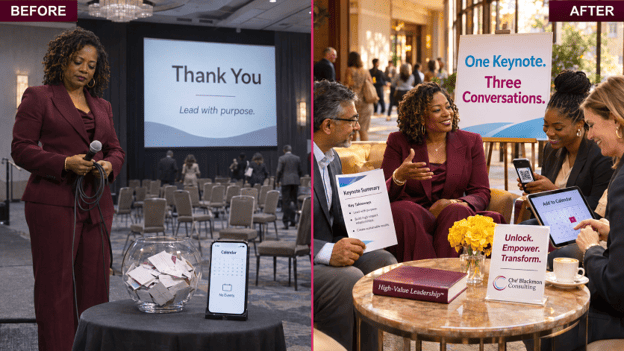
She had just delivered the best talk of her career. People stood. Three attendees lined up afterward to say it was exactly what their organizations needed. Someone took a photo of her final slide. She went home with a stack of business cards, a glowing note from the organizer, and a feeling that everything was about to change.

Six weeks later, not one of those conversations had turned into a meeting.

If that story feels familiar, you are not alone. Many leaders, consultants, and subject matter experts treat a keynote as the finish line. It is not. The talk is the opening move. The real work, and the real return, lives in the conversations you design before you ever step on the stage.

🎀 The Applause Trap: Why Great Talks Die at the Door

Applause feels like progress. It is not a pipeline.

The applause trap happens when a speaker measures success by how the room felt instead of what the room did next. A talk can be inspiring, well researched, and beautifully delivered, and still produce nothing, because nobody was given a clear, easy, and specific next step.

Three habits keep speakers stuck in the trap:

  • Ending on inspiration instead of invitation. The final minute is the most remembered part of a talk. Many speakers spend it on a quote. Few spend it on a next step.
  • Leaving follow up to chance. A fishbowl of business cards is not a strategy. Neither is “Feel free to reach out.”
  • Speaking to the room, but not through it. The person who books you is rarely the only decision maker. The most important buyer is often someone who was never in the audience.

Strategic speaking flips the order. You decide what conversations you want first, and then you build the talk that earns them.

πŸ“‰ Why the Stage Matters More Than Ever

Here is the shift every leader who sells expertise needs to understand: buyers are doing more of the decision on their own, and they are doing it before they ever talk to you.

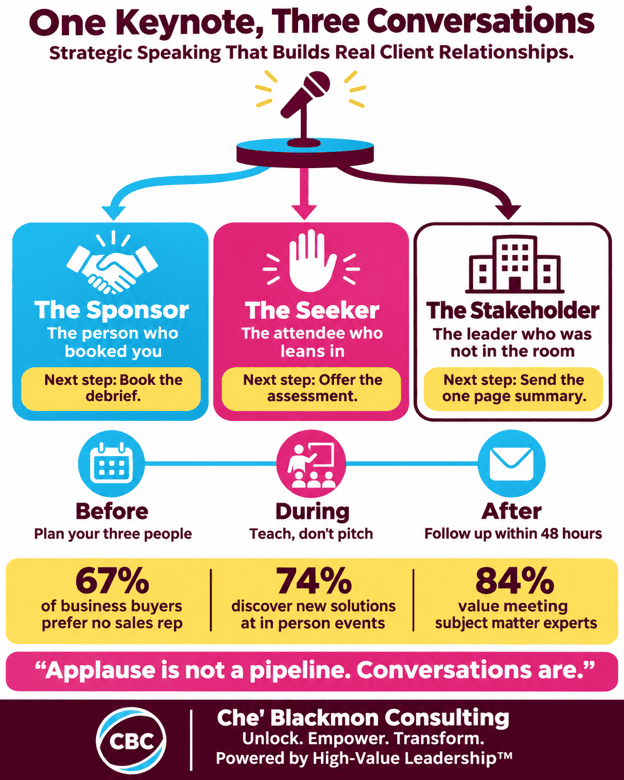
A recent Gartner survey of 646 business buyers found that 67 percent now prefer a buying experience without a sales representative, and 45 percent reported using AI during a recent purchase (Gartner, 2026). Read that again. Two out of three buyers would rather not be sold to at all. Cold outreach and polished brochures are losing ground, because buyers are researching, comparing, and shortlisting quietly.

So where does trust still get built? In the room. Freeman’s 2025 study of 1,022 trade show and conference attendees found that 74 percent name in person events as a place where they discover new products and services, ahead of company websites (56 percent) and online events (40 percent). Even more telling, 84 percent said connecting with subject matter experts at events is very or extremely important (Freeman, 2025).

Put those two findings side by side and the message is clear. Buyers want less selling and more expertise. A keynote is one of the few moments where a decision maker voluntarily gives you thirty to sixty minutes of undivided attention to show how you think. That is not a performance. It is the most valuable sales meeting you will never have to ask for.

βš–οΈ Who Gets the Big Stage, and Who Gets the Panel

Not everyone is invited to the same stage.

A 2025 study published in BioScience reviewed 1,692 distinguished speakers at North American professional conferences from 2000 to 2023. Women’s representation improved over time, but the pattern by stage size was striking: women made up 50 percent of moderators and panelists, 43 percent of keynote speakers, and only 36 percent of plenary speakers. Late career speakers were 44 percent less likely to be women than early and mid career speakers (Bombaci et al., 2025). The data comes from one field, but the pattern will look familiar to anyone who has watched conference lineups in business. The bigger and more senior the stage, the fewer women on it.

For Black women in corporate and consulting spaces, the gap is often wider. We are invited to moderate. We are asked to sit on the diversity panel. We are thanked for “sharing our story.” Far less often, we are booked as the expert whose framework anchors the main stage.

That is exactly why strategic speaking matters. When you are given fewer stages, each one has to work harder. The goal is not to be grateful for the invitation. The goal is to leave every room with relationships that move your work, your influence, and your income forward.

🧭 The One Keynote, Three Conversations Method

Every talk you give can open three distinct conversations. Each one has a different person, a different purpose, and a different next step. Plan all three before you write a single slide.

🀝 Conversation 1: The Sponsor

The Sponsor is the person who booked you: the event organizer, the association director, or the executive who invited you to speak to their team. They already trust you enough to put you in front of their people. That makes them your warmest relationship in the building.

Most speakers send a thank you note and move on. Strategic speakers schedule a debrief before the event even happens. Ask the Sponsor for twenty minutes the week after the talk to review what the audience said, what questions came up, and what challenges surfaced. That debrief often reveals a need inside the Sponsor’s own organization, and it is the most natural path to a workshop, a leadership retreat, or a longer engagement.

Try this: When you confirm the booking, write, “I’d love to schedule a short debrief after the event so I can share what I heard from your audience. Does the following Tuesday work?”

πŸ™‹πŸΎβ€β™€οΈ Conversation 2: The Seeker

The Seeker is the attendee who leans in. They took notes, asked a question, or waited after the session. They are feeling the exact problem you just described, and they want to know what to do next.

Do not leave the Seeker to find you. Give them a reason to raise their hand on purpose. Offer a short diagnostic, a one page assessment, or a framework worksheet that ties directly to your talk, and make it available through a QR code on your final slide. When someone requests it, you now know who they are, what organization they represent, and what they care about. That is a warm, relevant follow up, not a cold pitch.

Try this: End your talk with one clear invitation, such as, “Scan this code to get the five question culture check we used today, and I’ll send you your results personally.”

πŸ›οΈ Conversation 3: The Stakeholder Who Was Not in the Room

This is the conversation most speakers miss. The person with the budget and the final decision is often not in the audience. It is the chief executive, the chief operating officer, or the board member who will hear about your talk secondhand.

Make it easy for your audience to carry your message upstairs. Create a one page executive summary of your talk, with three insights, one key statistic, and one recommended action. Offer it to the Sponsor and to every Seeker, and say plainly, “This is written so you can forward it to your leadership team.” When that summary lands in the right inbox, you have earned a conversation with someone you never met.

Try this: Title your summary for the reader, not for you. “Three Culture Risks Your Leadership Team Should Discuss This Quarter” gets forwarded. “Recap of My Keynote” does not.

πŸ› οΈ Build the Bridge: Before, During, and After the Talk

The three conversations do not happen by accident. They are designed across the full life of the talk.

Before the talk

  • Ask the Sponsor who will be in the room, what keeps them up at night, and which decision makers might hear about the session later.
  • Build your content around one framework the audience can name and remember. In High-Value Leadershipβ„’, the framework is the bridge between insight and action, because people buy the way you think before they buy what you offer.
  • Prepare your Seeker offer and your Stakeholder summary in advance, so you are not scrambling afterward.

During the talk

  • Teach, do not pitch. The most persuasive thing you can do on stage is solve a real problem in front of the people who have it.
  • Tell one story framed generally, such as “Consider an organization that,” with a measurable result. Numbers make your expertise concrete.
  • Give one call to action, not five. Confusion kills follow up.

After the talk

  • Follow up with every Seeker within 48 hours, while the talk is still fresh.
  • Hold the Sponsor debrief within one week.
  • Send the Stakeholder summary to the Sponsor with a short note about who might find it useful.
  • Track every conversation by talk, so you know which stages actually build your business.

πŸ“Š Case in Point: A Culture Strategist Who Stopped Collecting Applause

The following is a composite scenario drawn from patterns common across professional services, manufacturing, and healthcare environments. The figures are illustrative.

🏭 The Challenge

Consider a culture strategist, a Black woman who spent two decades leading people strategy in manufacturing and healthcare before launching her own practice. She was an excellent speaker. In one year, she delivered twelve talks at industry associations, leadership summits, and regional conferences. Her evaluations were outstanding.

Her results were not. Across all twelve talks, she averaged fewer than one follow up meeting per event, and only one talk turned into a paid engagement. When she reviewed her process, the problem was obvious: every talk ended with a quote and a thank you. Follow up depended entirely on attendees reaching out on their own.

πŸ”§ The Intervention

She rebuilt her speaking strategy around the three conversations and anchored every talk in a single, teachable High-Value Leadershipβ„’ framework on purposeful culture.

  1. Sponsor debriefs. Every booking confirmation included a request for a post event debrief, scheduled before the talk took place.
  2. A Seeker offer. Each talk ended with a QR code linked to a short culture assessment. She personally reviewed every response and sent a short, tailored note.
  3. A Stakeholder summary. She created a one page executive brief for each talk, written to be forwarded to senior leaders who were not in the room.
  4. Simple tracking. She logged every conversation by talk, by conversation type, and by outcome.

πŸ“ˆ The Results

Over the next twelve months, she delivered ten talks, two fewer than the year before. Those ten talks produced 31 follow up conversations, an average of just over three per talk. Nine became proposals, and six became signed engagements. Two of those engagements came directly from Sponsor debriefs, and three came from executives who received a forwarded summary and never attended a single session. The average time from talk to signed agreement dropped from about five months to seven weeks.

The lesson is simple. She did not need more stages. She needed a system that turned each stage into relationships. That is High-Value Leadershipβ„’ in practice: purpose first, value delivered generously, and a clear path for people to keep working with you.

🧠 Current Trends and Best Practices

  • Buyers decide before they call. With most business buyers preferring to avoid sales conversations, speaking has become one of the strongest ways to be shortlisted before the first meeting.
  • Smaller rooms, deeper conversations. Executive roundtables, private leadership dinners, and invite only workshops are growing because decision makers want access to expertise, not a crowd.
  • The talk lives longer than the event. Clips, recap articles, and executive summaries let one keynote keep working for months. Plan your repurposing before you speak.
  • AI is changing research, not trust. Buyers use AI tools to compare options, but they still want to hear directly from a credible human expert before they commit.
  • Internal stages count too. For HR and culture leaders inside organizations, a presentation to the executive team works the same way. The Sponsor, the Seeker, and the Stakeholder all exist inside your company.

βœ… Actionable Takeaways You Can Use This Week

  1. Audit your last three talks. For each one, count how many conversations it produced. Write the number down. That is your baseline.
  2. Name your three people. For your next talk, write the name or role of your likely Sponsor, Seeker, and Stakeholder.
  3. Book the debrief now. Email the organizer of your next talk today and schedule a debrief for the week after.
  4. Build one Seeker offer. Create a simple, one page assessment or worksheet that connects directly to your core message.
  5. Draft your executive summary. Write three insights, one statistic, and one recommended action in a format a senior leader would forward.
  6. Rewrite your last minute. Replace your closing quote with one clear invitation and one clear next step.

πŸ’¬ Discussion Questions

  1. When you speak, how do you currently measure success, and what would change if you measured conversations instead of applause?
  2. Who is the most important decision maker who never hears your talks directly, and how could your message reach them?
  3. In your industry, who gets the main stage, and who is more often invited to moderate or sit on the panel?
  4. What would it take for the Black women experts in your organization or network to be booked as the keynote instead of the panel?

πŸš€ Next Steps for Readers

  • Share this article with a leader, consultant, or HR executive who speaks often and deserves more return from every stage.
  • Read High-Value Leadership: Transforming Organizations Through Purposeful Culture to build the framework you will teach with confidence from any stage.
  • Join the High-Value Leadership Intensive waitlist to develop your authority, influence, and executive presence alongside other purpose driven leaders.
  • Subscribe to The Blackmon Brief on Substack for weekly culture and leadership insights every Monday.

πŸ“š References

Bombaci, S., Farr, C., Pejchar, L., Wilkins, K. D., & Wittman, T. (2025). Forward steps, lingering gaps: Gender representation among distinguished speakers at professional conferences. BioScience, 75(9), 737–746. https://doi.org/10.1093/biosci/biaf063

Freeman. (2025). Unpacking XLNC: The future of commerce for trade shows and conferences [Trends report]. https://www.freeman.com/wp-content/uploads/2025/04/Freeman-Commerce-Report-2025.pdf

Gartner. (2026, March 9). Gartner sales survey finds 67% of B2B buyers prefer a rep-free experience [Press release]. https://www.gartner.com/en/newsroom/press-releases/2026-03-09-gartner-sales-survey-finds-67-percent-of-b2b-buyers-prefer-a-rep-free-experience

🀝 Let’s Turn Your Next Stage Into Real Influence

Your expertise deserves more than applause. Whether you are an executive preparing for a board presentation, a consultant building authority in your industry, or a culture leader ready to claim the main stage, Che’ Blackmon Consulting helps you build the message, the framework, and the follow through that turn every talk into lasting relationships and measurable results. Let’s talk about your next stage.

πŸ“§ admin@cheblackmon.com  |  πŸ“ž 888.369.7243  |  🌐 cheblackmon.com

Unlock. Empower. Transform.

#StrategicSpeaking #KeynoteSpeaker #ThoughtLeadership #ExecutivePresence #HighValueLeadership #BusinessDevelopment #ClientRelationships #PublicSpeaking #BlackWomenInLeadership #WomenWhoSpeak #ConsultingLife #CheBlackmonConsulting

Your Book as a Business Card: Why Published Leaders Close More Clients and Better Conversations

By Che’ Blackmon, DBA Candidate | Founder & CEO, Che’ Blackmon Consulting

Most business cards end up in a drawer. Some end up in the trash before the parking lot.

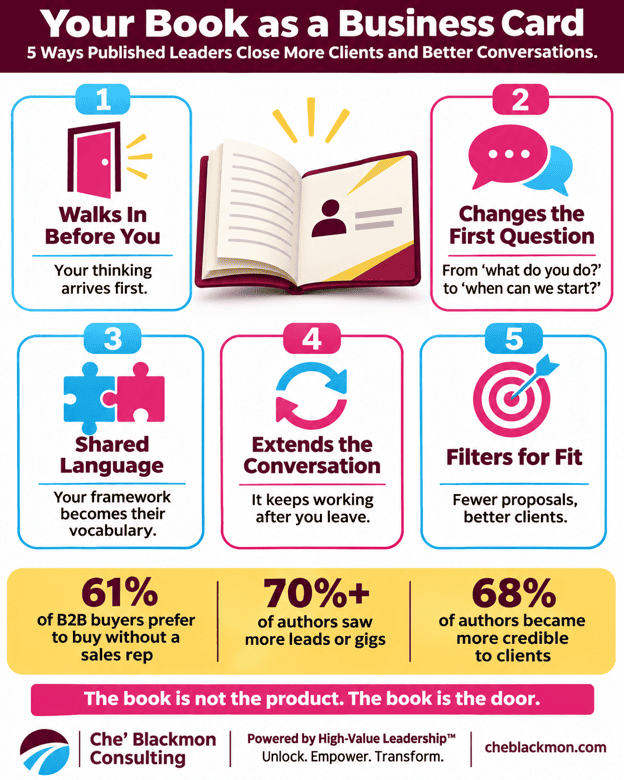
A book ends up on a desk. It gets passed down the hall, quoted in a meeting you never attended, and pulled off a shelf six months later when a budget finally opens. It is the only business card a prospect will pay for, keep, and hand to their boss.

That is not a reason to write a book for vanity. It is a reason to understand what a book actually does for a leader’s authority, and why the leaders who use their books well are having very different conversations than the leaders who do not.

πŸ“‡ The Business Card Problem Every Expert Faces

Here is the hard truth about how buyers decide today: most of the decision happens before you are invited into the room.

A 2024 survey of 632 business buyers found that 61 percent prefer a buying experience with no sales representative involved at all, and 73 percent actively avoid suppliers whose outreach feels irrelevant (Gartner, 2025). Buyers are researching quietly, comparing options on their own, and forming opinions about your expertise long before your first call.

That changes the job of a credential. A title tells people where you sit. A bio tells people where you have been. Neither one lets a buyer test how you think. A book does. It lets a prospect spend three hours inside your thinking, on their own time, with no pitch and no pressure. By the time they reach out, they are not asking whether you know what you are doing. They are asking when you can start.

πŸ“š What the Research Says About Published Leaders

For years, the case for writing a business book was mostly anecdotal. That is changing. A 2024 study of 301 published nonfiction authors, led by author and analyst Josh Bernoff with a team of publishing industry sponsors, offers one of the most detailed looks yet at what books actually return (Bernoff, 2024).

The findings challenge the idea that a book is about book sales:

  • More than 70 percent of authors reported an increase in leads or paid opportunities after publishing.
  • 68 percent said they became more credible to prospects and clients.
  • 61 percent said their personal brand became more valuable.
  • About one in three saw increases in speaking fees and consulting work.
  • Among authors who earned consulting revenue connected to their book, the median was $50,000, with workshops ($40,000) and speeches ($30,000) close behind.

Read that from a business owner’s chair. For most authors, the book was not the product. The book was the door. The revenue came from the conversations the book made possible.

There is an important caution in the same study. Fewer than half of authors reached the success they expected in changing opinions or selling copies. A book does not build authority on its own. It builds authority when the leader puts it to work.

πŸ”‘ Five Ways a Book Works as a Business Card That Never Gets Thrown Away

πŸšͺ 1. It Walks Into the Room Before You Do

A book travels where you cannot. It sits on the desk of an executive who has never met you and speaks for you in a leadership team meeting you will never attend. When the invitation finally comes, the room already has a sense of your voice.

In practice: Send a signed copy before a first meeting, not after it. Mark one chapter that speaks to the problem the prospect named.

🧭 2. It Changes the First Question

Without a book, first conversations often start with “So, tell me what you do.” With a book, they start with “I read your chapter on accountability. Can we talk about what that would look like here?” That is a different conversation. It is shorter, deeper, and closer to a decision.

In practice: Ask every new contact, “Did anything in the book land for you?” Their answer tells you where the real need lives.

🧱 3. It Turns Your Method Into a Shared Language

Frameworks are hard to buy when they live only in your head. In a book, they become vocabulary a whole team can use. When a client’s leaders start using your terms in their own meetings, your method has moved from your slides into their culture. That is the moment a consultant becomes a partner.

In practice: Name your core framework clearly and repeat it the same way across your book, your talks, and your proposals.

πŸ” 4. It Extends the Conversation After You Leave

A great meeting fades by Friday. A book keeps working. It answers the questions people were too busy to ask, and it gives the person who championed you something to hand the skeptics.

In practice: After a discovery call, send a short note pointing to two pages that answer the concern raised. You are giving your internal champion ammunition.

🎯 5. It Filters for Fit

Not every prospect is your client, and a book helps both sides figure that out early. Leaders who read your work and disagree with your values will self select out. Leaders who read it and feel seen will arrive ready to work. Fewer proposals, better clients.

In practice: Track how many new clients mention the book in their first conversation. That number is your real return.

πŸ‘©πŸΎβ€πŸ’Ό Why a Book Carries Even More Weight for Black Women Leaders

For many Black women in corporate spaces, credibility is not granted once. It is requested again in every new room. Women of color hold only 7 percent of executive suite roles in corporate America (McKinsey & Company & LeanIn.Org, 2024), and the same research has documented for years that Black women are more likely to have their competence and authority questioned.

When your expertise is doubted out loud, a book offers something powerful: third party proof that you did not have to argue for in the moment. It is permanent, public, and reviewable. It shifts the conversation from “Can she do this?” to “How did she build this?”

This is a theme I return to throughout Rise & Thrive: A Black Woman’s Blueprint for Leadership Excellence. Visibility is not vanity. For leaders who have been overlooked, documented expertise is a strategy for being seen accurately. A book is one of the clearest ways to claim your expertise out loud and in writing, at the same time.

That matters for organizations too. If your company wants a stronger pipeline of Black women leaders, encourage and fund their thought leadership. Sponsor the article, the white paper, the conference talk, and yes, the book. You are investing in their visibility and in your culture’s credibility at once.

πŸ“Š Case in Point: A Consultancy That Stopped Chasing Clients

The following is a composite scenario drawn from patterns common across professional services and healthcare consulting. The figures are illustrative.

🏒 The Challenge

Consider a small culture and leadership consultancy led by a Black woman principal with two decades of experience across healthcare and professional services. Her results were strong, yet her pipeline was exhausting. She was writing long proposals for nearly every inquiry, winning about 22 percent of them, and waiting an average of 94 days from first call to signed agreement.

Most first meetings were spent proving she was qualified. Prospects who did hire her often said the same thing afterward: “We had no idea how deep your approach went until we started working together.”

πŸ”§ The Intervention

She published a practical book built around her signature framework for purposeful culture and made it the center of her business development, not a side project.

  1. Book first, proposal second. Every qualified inquiry received a signed copy with a short note and one marked chapter before the discovery call.
  2. One framework, one language. Her book, keynote, website, and proposals all used the same named method, so prospects heard a consistent story everywhere they met her.
  3. Champion kits. After each discovery call, her internal champion received a one page summary of the framework and two chapter references to share with the executive team.
  4. Teaching, not pitching. She hosted a quarterly roundtable where leaders discussed one chapter, which kept past prospects in conversation without a sales message.

πŸ“ˆ The Results

Within twelve months, her proposal win rate rose from 22 percent to 41 percent. The average time from first call to signed agreement dropped from 94 days to 58. Her average engagement size grew by about 30 percent, because clients arrived wanting the full method instead of a single workshop. And for the first time, more than half of new inquiries came through referrals from people who had read the book.

The lesson is simple. The book did not replace her expertise. It made her expertise visible before the first handshake. This is a core idea within High-Value Leadershipβ„’: authority is built through consistent, purposeful value that people can experience for themselves.

πŸ“– Three Books, Three Different Doors

A body of work does more than a single title, because each book opens a different conversation. Here is how that plays out across the CBC library.

  • Mastering a High-Value Company Culture opens the operational conversation. It speaks to the leader asking, “Where do we even start?”
  • High-Value Leadership: Transforming Organizations Through Purposeful Culture opens the executive conversation. It speaks to the leader asking, “How do we lead culture as a strategy, not a program?”
  • Rise & Thrive: A Black Woman’s Blueprint for Leadership Excellence opens the personal conversation. It speaks to the leader asking, “How do I rise without shrinking who I am?”

When you have more than one piece of published work, think of them as a set of keys. Hand the one that fits the door in front of you.

🧠 Current Trends and Best Practices

  • Buyers are educating themselves first. With most business buyers preferring to research without a salesperson, your published thinking is now your first meeting.
  • The book is the hub, not the whole wheel. The strongest authors turn each chapter into articles, talks, workshops, and short videos so the ideas meet buyers wherever they are.
  • Depth beats volume. A focused, practical book on one problem builds more authority than a broad book on everything.
  • Proof is shifting from claims to evidence. Readers trust books that include research, real frameworks, and measurable outcomes over books built on personal opinion alone.
  • Authority must be activated. The research is clear that a book left on a shelf does little. A book placed in the right hands at the right moment does a great deal.

βœ… Actionable Takeaways You Can Use This Week

  1. Audit your first five minutes. Think about your last three first meetings. How much time did you spend proving you were qualified? That is the time a book can give back.
  2. Name your framework. Write your core method in one sentence and give it a name you will use everywhere.
  3. Pick your “business card chapter.” If you are already published, choose the chapter that best answers your ideal client’s most common problem, and lead with it.
  4. Send before you meet. For your next important first meeting, send your book or a short written piece of your thinking ahead of time.
  5. Track the mentions. Start a simple list of every client or prospect who references your writing. That list is your authority return.
  6. Sponsor someone’s voice. If you lead a team, ask one overlooked leader, especially a Black woman on your team, what she would write about if she had the time and support. Then help her find both.

πŸ’¬ Discussion Questions

  1. What do your prospects or stakeholders need to believe about your expertise before they say yes, and where are they learning it today?
  2. If someone read only your published work, what would they conclude about how you lead?
  3. Which idea in your work deserves to become a named framework that others can use?
  4. How might documented expertise change the way Black women leaders in your organization are seen, sponsored, and promoted?
  5. What is one conversation you keep having that a single chapter could have for you?

πŸš€ Next Steps for Readers

  • Share this article with a colleague who has a book inside them and keeps putting it off.
  • Read High-Value Leadership: Transforming Organizations Through Purposeful Culture to see how purposeful authority and culture strategy work together.
  • Join the High-Value Leadership Intensive waitlist to build your leadership platform alongside other leaders committed to purposeful culture.
  • Subscribe to The Blackmon Brief on Substack for weekly culture insights every Monday.

πŸ“š References

Bernoff, J. (2024). A comprehensive study of business book ROI. Gotham Ghostwriters, Amplify Publishing Group, Smith Publicity, & Thought Leadership Leverage. https://gothamghostwriters.com/a-comprehensive-study-of-business-book-roi/

Gartner. (2025, June 25). Gartner sales survey finds 61% of B2B buyers prefer a rep-free buying experience [Press release]. https://www.gartner.com/en/newsroom/press-releases/2025-06-25-gartner-sales-survey-finds-61-percent-of-b2b-buyers-prefer-a-rep-free-buying-experience

McKinsey & Company & LeanIn.Org. (2024). Women in the workplace 2024: The 10th-anniversary report. https://www.mckinsey.com/featured-insights/diversity-and-inclusion/women-in-the-workplace

🀝 Let’s Put Your Expertise to Work

Your expertise deserves to be seen before you ever say a word. Whether you are building your own authority platform or building a culture where every leader’s voice is visible, Che’ Blackmon Consulting can help you get there with purpose. Let’s talk about what that looks like for you and your team.

πŸ“§ admin@cheblackmon.com  |  πŸ“ž 888.369.7243  |  🌐 cheblackmon.com

Unlock. Empower. Transform.

#ThoughtLeadership #BusinessBooks #AuthorityBuilding #ExecutivePresence #PersonalBrand #ConsultingBusiness #HighValueLeadership #BlackWomenInLeadership #LeadershipDevelopment #ClientAcquisition #PublishedAuthor #CheBlackmonConsulting