Blog

The Thought Leader’s Playbook: Building Your Authority Platform 🚀

She had 25 years of transformational HR experience. She’d increased engagement by double digits, saved millions through retention strategies, and revolutionized cultures at three different organizations. Yet when industry publications sought expert commentary, they called consultants with half her experience but twice her visibility. The difference? They had built authority platforms. She had built results.

This gap between expertise and recognition disproportionately affects traditionally overlooked professionals, particularly Black women who deliver exceptional outcomes while remaining invisible in thought leadership spaces. It’s time to change that narrative.

The Authority Gap: Why Visibility Matters More Than Ever

Thought leadership isn’t vanity—it’s strategy. According to LinkedIn’s 2024 research, 58% of decision-makers cite thought leadership as directly influencing their purchasing decisions. For consultants and senior professionals, an authority platform can mean the difference between competing on price and commanding premium rates based on recognized expertise.

Yet the thought leadership landscape remains strikingly homogeneous. A recent study by the PR firm Weber Shandwick found that only 11% of recognized thought leaders in business are Black women, despite representing a growing percentage of senior leadership and entrepreneurship. This isn’t just an individual loss—it’s an intellectual capital crisis for industries desperate for diverse perspectives on complex challenges.

The cost of invisibility compounds over time. While others shape industry narratives, traditionally overlooked experts watch their innovations get credited to louder voices. Their methodologies get repackaged without attribution. Their insights get filtered through others’ perspectives.

Understanding the Modern Authority Platform 💡

Today’s authority platform isn’t built on a single channel—it’s an ecosystem of strategic touchpoints that reinforce your expertise across multiple dimensions. Think of it as cultural architecture for your professional brand, where each element supports and amplifies the others.

The Five Pillars of Authority

1. Core Expertise Definition Your authority platform begins with crystal clarity about your unique value proposition. This isn’t about being everything to everyone. It’s about owning a specific intersection of knowledge where you have undeniable credibility.

2. Content Architecture Strategic content creation that demonstrates thought leadership through multiple formats: articles, videos, podcasts, research, and speaking engagements. Each piece builds on your core narrative while addressing current industry challenges.

3. Platform Distribution Multi-channel presence that meets your audience where they are: LinkedIn for professional networking, industry publications for credibility, podcasts for intimate connection, and your owned platforms for deeper engagement.

4. Community Building Authority isn’t broadcast—it’s cultivated through relationships. This includes engaging with other thought leaders, nurturing your audience, and creating spaces for meaningful dialogue around your expertise.

5. Results Amplification Documented impact that proves your ideas work in practice. Case studies, testimonials, and quantifiable outcomes that transform theory into proven methodology.

The Unique Challenges and Opportunities for Black Women 🌟

Building an authority platform as a Black woman requires navigating additional complexities while leveraging unique strengths. The challenges are real:

  • Credibility tax: Having to prove expertise repeatedly while others enjoy assumed competence
  • Tone policing: Balancing authentic expression with palatability expectations
  • Cultural translation: Code-switching between communities without losing authentic voice
  • Representation burden: Being expected to speak for all Black women rather than from your individual expertise

But these challenges have forged extraordinary capabilities:

  • Perspective advantage: Seeing patterns others miss due to lived experience
  • Bridge-building expertise: Connecting disparate communities through shared values
  • Resilience modeling: Demonstrating success strategies for overcoming systemic barriers
  • Cultural fluency: Speaking to diverse audiences with authentic understanding

A technology executive built her authority platform by specifically addressing the intersection of AI ethics and diversity—a critical blindspot for the industry. Within 18 months, she became the go-to expert for Fortune 500 companies grappling with algorithmic bias. Her unique perspective, informed by personal experience with systemic bias, provided insights traditional thought leaders couldn’t access.

The Content Strategy That Commands Attention 📝

Start With Your Intellectual Property

Before creating new content, audit your existing intellectual capital. What frameworks have you developed? What methodologies consistently deliver results? What insights do you share that make people say, “I never thought of it that way”?

The High-Value Leadership methodology, for example, emerged from recognizing that traditional leadership models failed to unlock the potential of overlooked talent. By documenting and systematizing this approach, it becomes teachable, scalable, and recognizable as a distinct thought leadership contribution.

The 70-20-10 Content Framework

70% Educational Content: Provide genuine value without asking for anything in return. Share frameworks, insights, and strategies that demonstrate your expertise while helping your audience solve real problems.

20% Curated Perspectives: Comment on industry trends, research, and others’ content through your unique lens. This positions you within larger conversations while demonstrating thought leadership beyond self-promotion.

10% Authority Building: Share your wins, testimonials, media features, and speaking engagements. This isn’t bragging—it’s necessary social proof that reinforces your expertise.

Content Formats That Resonate

Different formats serve different purposes in your authority platform:

Long-form Articles (like this one): Demonstrate depth of thinking and comprehensive expertise. Ideal for complex topics requiring nuance.

Video Content: Builds personal connection and demonstrates communication skills. Particularly powerful for traditionally overlooked professionals whose expertise might be questioned in text alone.

Podcast Appearances: Allows for conversational expertise demonstration and reaches audiences during commute/workout time.

Research and White Papers: Establishes academic credibility and provides quotable statistics for media coverage.

Social Media Micro-Content: Maintains visibility and engagement between major content pieces.

Platform Selection: Where to Build Your Authority 🎯

LinkedIn: The Professional Foundation

LinkedIn remains the cornerstone platform for B2B thought leadership. With over 1 billion users, it’s where decision-makers seek expertise. Key strategies include:

  • Publishing weekly articles that demonstrate expertise
  • Sharing daily insights that maintain visibility
  • Engaging meaningfully with others’ content
  • Using native video for higher engagement
  • Leveraging LinkedIn newsletters for subscriber building

Industry Publications: The Credibility Builders

Contributing to recognized industry publications provides third-party validation. Start with trade publications in your niche before targeting broader business media. Many publications actively seek diverse voices—leverage this opportunity.

Your Owned Platform: The Authority Hub

Whether it’s a blog, podcast, or YouTube channel, owned media gives you complete control over your narrative. This becomes your intellectual property repository where deeper engagement happens.

Speaking Platforms: The Multiplier Effect

Speaking engagements—virtual and in-person—accelerate authority building. Each presentation becomes content you can repurpose across platforms. Start with podcasts and virtual panels, building toward keynote opportunities.

The Networking Strategy That Amplifies Authority 🤝

Thought leadership isn’t a solo sport. Strategic relationships accelerate authority building exponentially.

The Circle of Influence Model

Inner Circle: 5-7 thought leaders at or above your level who become collaboration partners, providing mutual support and amplification.

Middle Circle: 20-30 rising professionals who benefit from your expertise while expanding your reach into new networks.

Outer Circle: Your broader audience who consume content and occasionally engage, providing social proof of influence.

Strategic Collaboration Over Competition

Rather than viewing other thought leaders as competition, seek collaboration opportunities:

  • Co-authored articles that combine expertise
  • Panel discussions that showcase complementary perspectives
  • Podcast swaps that cross-pollinate audiences
  • Research partnerships that create original insights

A group of Black women consultants created a thought leadership collective, amplifying each other’s content and creating speaking opportunities through their combined networks. Within one year, all members saw 40%+ increases in speaking engagements and premium client acquisition.
Overcoming Imposter Syndrome and Visibility Fears 💫

“Who am I to claim thought leadership?” This question particularly plagues traditionally overlooked professionals who’ve been conditioned to minimize their expertise. Consider these reframes:

From Expertise to Service: Your visibility isn’t about ego—it’s about serving those who need your insights. Staying invisible serves no one.

From Perfect to Progressive: You don’t need all the answers. Share what you know now, learn publicly, and evolve your thinking transparently.

From Individual to Collective: Your thought leadership creates pathways for others with similar backgrounds. Visibility becomes community service.

From Comparison to Contribution: Stop comparing your beginning to others’ middle. Focus on your unique contribution to important conversations.

The Monetization Framework 💰

Authority platforms should generate returns beyond recognition. Here’s how thought leadership translates to revenue:

Direct Monetization

  • Premium Consulting: Command higher rates based on recognized expertise
  • Speaking Fees: Paid keynotes and workshop facilitation
  • Course Creation: Package expertise into scalable learning experiences
  • Book Deals: Publishers seek recognized thought leaders
  • Board Appointments: Authority leads to governance opportunities

Indirect Monetization

  • Client Acquisition: Thought leadership becomes your sales funnel
  • Partnership Opportunities: Strategic alliances with complementary experts
  • Media Opportunities: Paid commentary and expert positioning
  • Investment Attraction: Authority platforms attract funding for ventures

The Authority Premium

Research from Hinge Marketing shows that visible experts command rates 13x higher than their invisible counterparts. For traditionally overlooked professionals, this premium can overcome systemic pay gaps through market positioning.

Case Study: From Invisible Expert to Industry Authority 🌟

A healthcare administrator with 20 years of experience struggled to differentiate her consulting practice despite exceptional results. She’d improved patient satisfaction scores by 30% consistently but couldn’t command premium rates.

Her authority platform journey:

Month 1-3: Defined her niche—patient experience through cultural competency. Began publishing weekly LinkedIn articles sharing frameworks.

Month 4-6: Launched a podcast interviewing healthcare leaders about diversity challenges. Each episode became multiple content pieces.

Month 7-9: Speaking opportunities emerged from podcast visibility. Industry publications requested contributed articles.

Month 10-12: Keynote invitations arrived. Consulting inquiries shifted from price-sensitive to value-focused. Rates doubled.

Year 2: Published research on cultural competency’s ROI. Became quoted expert in major healthcare publications. Launched premium mastermind program.

The transformation wasn’t just financial. She shifted from implementing others’ strategies to having her methodologies taught in healthcare MBA programs.

Current Trends Shaping Thought Leadership

The Authenticity Imperative

Audiences increasingly reject polished perfection for raw authenticity. Vulnerability, when strategic, builds deeper connection than flawless presentation. This trend particularly benefits traditionally overlooked voices whose authenticity provides refreshing perspective.

Video-First Evolution

Video content receives 48% more engagement than text. However, this doesn’t mean abandoning writing—it means repurposing written content into video formats. The Rise & Thrive framework translates powerfully to video series exploring each principle.

Micro-Influence Over Mass Reach

Depth beats breadth. Having 1,000 engaged executives following your content delivers more value than 10,000 passive followers. Focus on quality engagement over vanity metrics.

AI-Augmented Creation

AI tools accelerate content creation without replacing authentic voice. Use AI for research, outline generation, and editing while maintaining your unique perspective and expertise.

The Action Plan: Your First 90 Days 📋

Days 1-30: Foundation Building

Week 1: Complete expertise audit and define your unique value proposition

  • List your top 10 professional achievements
  • Identify patterns in your success stories
  • Define the intersection where your expertise is unique

Week 2: Develop your core message architecture

  • Create your thought leadership thesis statement
  • Outline 3-5 key frameworks or methodologies
  • Write your authority bio (150, 300, and 500-word versions)

Week 3: Establish platform presence

  • Optimize LinkedIn profile for thought leadership
  • Set up owned platform (blog, newsletter, or podcast)
  • Create content calendar for next quarter

Week 4: Begin content creation

  • Publish first long-form piece establishing expertise
  • Create 10 social media posts from that content
  • Engage meaningfully with 5 other thought leaders’ content

Days 31-60: Momentum Building

Week 5-6: Expand content formats

  • Record video version of written content
  • Seek first podcast guest opportunity
  • Submit article to industry publication

Week 7-8: Network strategically

  • Identify 20 thought leaders in your space
  • Engage consistently with their content
  • Propose collaboration to 3 peers

Days 61-90: Acceleration

Week 9-10: Amplify reach

  • Launch email newsletter to capture audience
  • Create lead magnet showcasing expertise
  • Pitch speaking opportunity for virtual event

Week 11-12: Measure and iterate

  • Analyze content performance metrics
  • Survey audience for topic interests
  • Refine strategy based on data

Week 13: Scale what works

  • Double down on highest-performing content format
  • Systematize content creation process
  • Begin developing premium offering

Integration with High-Value Leadership Principles 🎯

Building an authority platform embodies High-Value Leadership principles:

Cultural Architecture: Your thought leadership shapes industry culture by introducing new paradigms and challenging outdated thinking.

Purposeful Influence: Every piece of content serves your larger mission of transforming how organizations recognize and develop talent.

Inclusive Excellence: Your platform amplifies traditionally overlooked perspectives while maintaining exceptional standards.

Sustainable Impact: Thought leadership creates lasting change beyond individual transactions, influencing how entire industries operate.

Discussion Questions for Reflection 🤔

  1. What expertise do you possess that could transform your industry if more people knew about it?
  2. What fears have kept you from building your authority platform, and what would be possible if you overcame them?
  3. How might your unique perspective as a traditionally overlooked professional become your greatest thought leadership advantage?
  4. What would change in your industry if your methodology became standard practice?
  5. Who are three thought leaders you could collaborate with to amplify collective impact?
  6. What content format feels most authentic to your communication style?
  7. How could your thought leadership create pathways for others with similar backgrounds?

Your Next Steps

Building an authority platform isn’t optional for traditionally overlooked professionals—it’s essential for ensuring our expertise shapes important conversations. You’ve spent years developing unique insights and proven methodologies. Now it’s time to ensure they reach those who need them most.

The thought leadership gap won’t close itself. Every day you remain invisible, industries miss critical perspectives that could transform outcomes. Your expertise isn’t just valuable—it’s necessary.

Ready to build your authority platform?

Che’ Blackmon Consulting specializes in helping traditionally overlooked professionals, particularly Black women, build powerful thought leadership platforms that command attention and premium rates. Through our comprehensive approach, we help you:

  • Define and articulate your unique expertise
  • Develop compelling content strategies
  • Build strategic visibility across platforms
  • Create monetization frameworks for your thought leadership
  • Overcome visibility fears with proven confidence-building techniques

Our High-Value Leadership methodology ensures your authority platform doesn’t just elevate you—it creates pathways for others while transforming industry standards.

Transform your expertise into recognized authority:

📧 Email: admin@cheblackmon.com
📞 Phone: 888.369.7243
🌐 Website: cheblackmon.com

Because your voice isn’t just valuable—it’s vital to transforming how business gets done. 🌟


Che’ Blackmon is the founder of Che’ Blackmon Consulting, author of “High-Value Leadership: Transforming Organizations Through Purposeful Culture,” “Mastering a High-Value Company Culture,” and “Rise & Thrive: A Black Woman’s Blueprint for Leadership Excellence.” With 24+ years of progressive HR leadership experience and doctoral studies in Organizational Leadership, she helps traditionally overlooked professionals build authority platforms that transform industries through AI-enhanced strategies and proven thought leadership frameworks.

#ThoughtLeadership, #BlackWomenInBusiness, #AuthorityBuilding, #PersonalBranding, #WomenInLeadership, #ExecutiveBranding, #ContentStrategy, #LinkedInStrategy, #HighValueLeadership, #ConsultingSuccess, #BusinessStrategy, #LeadershipDevelopment, #BrandAuthority, #ProfessionalGrowth, #ExpertPositioning, #DigitalAuthority, #WomenEntrepreneurs, #CorporateLeadership, #InfluencerMarketing, #BusinessTransformation

Executive Presence After 45: Commanding Respect Without Playing Games 💎

The boardroom fell silent when she walked in. Not because of her title or her perfectly tailored suit, but because of something deeper—an authentic command of space that couldn’t be taught in any MBA program. At 52, this senior executive had learned what many never discover: true executive presence after 45 isn’t about performing power; it’s about embodying it.

The Evolution of Executive Presence in Midlife

Executive presence transforms dramatically as we mature. The performative confidence of our thirties gives way to something more substantial—a grounded authority built on decades of experience, wisdom, and self-knowledge. This evolution is particularly powerful for professionals who’ve spent years navigating corporate environments where their contributions were minimized or overlooked.

Research from the Center for Talent Innovation reveals that executive presence accounts for 26% of what it takes to get promoted. Yet traditional definitions often exclude the unique strengths that emerge with age and experience, especially for Black women and other traditionally marginalized professionals who’ve developed exceptional resilience and strategic thinking through necessity.

Breaking Free from Outdated Playbooks 🎯

The old rules of executive presence—aggressive posturing, emotional suppression, and conformity to narrow standards—were never designed for our success. They were designed to maintain existing power structures. After 45, we have the wisdom to recognize these games for what they are: exhausting performances that diminish our authentic power.

Consider the technology company that lost three senior Black female executives in one year. Exit interviews revealed a common thread: they were exhausted from code-switching, moderating their voices, and navigating the unwritten rules of “fitting in.” The company’s definition of executive presence was so narrow it excluded the very perspectives that could have driven innovation.

The high-value leadership approach recognizes that authentic presence comes from alignment between personal values and professional expression. When we stop playing games designed for someone else’s success, we create space for genuine influence.

The Authenticity Advantage

Authenticity after 45 isn’t just liberating—it’s strategic. Years of experience have taught us that sustainable success comes from consistency between who we are and how we lead. This authenticity advantage manifests in several ways:

Deep Credibility: You’ve earned your expertise through real experience. Your insights carry weight because they’re battle-tested. You don’t need to inflate your accomplishments or adopt aggressive tactics to be heard.

Emotional Intelligence: Decades of navigating complex relationships have honed your ability to read rooms, build coalitions, and influence without manipulation. You understand that respect is commanded through consistency, not demanded through authority.

Strategic Patience: You’ve learned that not every battle needs to be fought today. This strategic patience allows you to choose your moments, conserve energy, and focus on transformational rather than transactional wins.

Cultural Intelligence as Executive Currency 💡

For Black women and other traditionally overlooked professionals, executive presence after 45 includes a sophisticated form of cultural intelligence that organizations desperately need but rarely recognize. This includes:

  • Code-switching mastery: The ability to navigate multiple cultural contexts while maintaining authenticity
  • Pattern recognition: Identifying systemic issues others miss because you’ve experienced their impact firsthand
  • Bridge-building expertise: Connecting diverse stakeholders through shared values rather than surface similarities
  • Resilience modeling: Demonstrating how to thrive despite barriers, inspiring others facing similar challenges

A Fortune 500 company recently discovered that their most successful transformation initiative was led by a 48-year-old Black woman who’d been passed over for promotion three times. Her success came from understanding cultural dynamics others couldn’t see and building trust across traditionally siloed departments. Her executive presence wasn’t loud or performative—it was precise, inclusive, and devastatingly effective.

Navigating the Double Standards 🎭

Let’s address the elephant in the room. Executive presence standards remain riddled with bias. Research from Harvard Business Review shows that Black women executives face unique challenges:

  • Being perceived as “too aggressive” when displaying the same assertiveness praised in others
  • Having expertise questioned more frequently despite equal or superior qualifications
  • Needing to prove competence repeatedly while peers enjoy assumed credibility
  • Balancing warmth and authority in ways not required of other demographics

The solution isn’t to work harder at meeting impossible standards. It’s to redefine the game entirely. High-value leadership means establishing your own metrics for success while delivering undeniable results.

Practical Strategies for Commanding Respect

1. Own Your Narrative 📖

Stop letting others define your story. Create a clear, consistent narrative about your value and expertise. Use specific examples of impact, not just activities. Frame your experience as strategic assets, not just years served.

2. Build Strategic Visibility

Executive presence requires being seen in the right contexts. This means:

  • Contributing to high-visibility projects that align with organizational priorities
  • Speaking up in meetings with prepared, strategic insights
  • Publishing thought leadership that positions you as an industry expert
  • Building relationships with decision-makers across the organization

3. Master the Art of Presence ✨

Physical presence matters, but not in the way traditional advice suggests. Instead of power poses and aggressive body language:

  • Take up appropriate space without apology
  • Speak at a measured pace that commands attention
  • Make deliberate eye contact that conveys confidence
  • Use strategic silence to create impact

4. Leverage Your Experience Network

After 45, your network should be a strategic asset. Cultivate relationships that provide:

  • Access to opportunities and information
  • Advocacy and sponsorship for advancement
  • Diverse perspectives that enhance decision-making
  • Support systems for navigating challenges

5. Practice Strategic Non-Compliance 🚀

Sometimes commanding respect means refusing to participate in dynamics that diminish you. This might look like:

  • Declining to take notes in meetings where you’re the senior person present
  • Redirecting conversations that focus on appearance rather than performance
  • Refusing to moderate your expertise to make others comfortable
  • Setting boundaries around access to your time and energy

The Neuroscience of Mature Confidence

Recent neuroscience research reveals that our brains actually improve in crucial leadership areas as we age. The anterior cingulate cortex, responsible for conflict resolution and empathy, becomes more developed. The prefrontal cortex, governing strategic thinking and emotional regulation, reaches peak integration.

This biological evolution supports what many of us feel intuitively: we’re better leaders after 45 than we were before. We process complex information more effectively, make more nuanced decisions, and maintain emotional equilibrium under pressure.

Case Study: The Transformation Effect 🌟

A healthcare organization struggled with employee engagement scores hovering around 42%. They brought in a 51-year-old Black woman as Chief Culture Officer—a role created specifically for her after she’d been passed over for COO.

Within 18 months, she:

  • Increased engagement to 71% by implementing inclusive leadership practices
  • Reduced turnover by 34% through mentorship programs targeting overlooked talent
  • Improved patient satisfaction scores by 28% by aligning culture with care delivery
  • Saved $2.3 million through retention and productivity improvements

Her executive presence wasn’t traditional. She led through stories, built consensus through listening circles, and commanded respect through consistent delivery of results. She didn’t play the games—she changed them.

Integration with High-Value Leadership Principles

The principles outlined in “High-Value Leadership: Transforming Organizations Through Purposeful Culture” directly support authentic executive presence after 45:

Purpose-Driven Authority: Your presence is grounded in clear purpose, not positional power. This creates sustainable influence that transcends titles.

Cultural Architecture: You understand that presence isn’t individual—it’s systemic. By modeling high-value behaviors, you create cultural permission for others to do the same.

Inclusive Excellence: Your executive presence includes rather than excludes, creating psychological safety while maintaining high standards.

The Rise & Thrive Framework in Action 💫

For Black women specifically, the “Rise & Thrive” blueprint offers additional strategies:

  1. Recognize Your Worth: Document your contributions and impact regularly. Create a “value portfolio” that makes your executive presence undeniable.
  2. Invest in Your Growth: Continue developing skills that differentiate you. After 45, this might include board readiness, succession planning, or industry thought leadership.
  3. Seek Strategic Sponsors: Move beyond mentors to sponsors who will actively advocate for your advancement and create opportunities for your presence to be recognized.
  4. Establish Your Legacy: Define what you want to be known for and align your executive presence with that legacy vision.

Current Trends Shaping Executive Presence

The Authenticity Revolution 🌈

Organizations are finally recognizing that authentic leadership drives better results. McKinsey research shows companies with authentic leadership cultures outperform peers by 25% in profitability.

The Inclusion Imperative

Diverse leadership teams make better decisions 87% of the time, according to recent studies. Executive presence that includes rather than excludes is becoming a competitive advantage.

The Wisdom Premium

As organizations face unprecedented complexity, the pattern recognition and strategic thinking that come with experience are increasingly valued. The “wisdom premium” is real and measurable.

Actionable Takeaways

This Week:

  • Conduct an executive presence audit. Where are you playing games versus showing up authentically?
  • Identify three specific ways your unique perspective adds value
  • Practice one strategic non-compliance behavior that preserves your energy

This Month:

  • Document five significant impacts you’ve made using your value portfolio format
  • Schedule coffee with two strategic connections who can advocate for your advancement
  • Deliver one high-visibility presentation that showcases your expertise

This Quarter:

  • Develop thought leadership content that positions you as an industry expert
  • Seek feedback on your executive presence from trusted advisors
  • Align your presence with your legacy vision

Discussion Questions for Reflection 🤔

  1. What “games” have you been playing that no longer serve your authentic leadership?
  2. How has your understanding of executive presence evolved throughout your career?
  3. What unique strengths do you bring to leadership after 45 that younger colleagues might not possess?
  4. Where do you see opportunities to redefine executive presence standards in your organization?
  5. What would change if you stopped moderating your expertise to make others comfortable?

Your Next Steps

Executive presence after 45 isn’t about fitting into outdated molds—it’s about breaking them and creating new paradigms for leadership success. You’ve earned the right to show up authentically, command respect without compromise, and lead from your unique strengths.

If you’re ready to develop executive presence that honors your experience, amplifies your influence, and creates lasting impact without playing exhausting games, it’s time to explore how high-value leadership principles can transform your professional trajectory.

Ready to command respect on your own terms?

Che’ Blackmon Consulting specializes in helping experienced professionals, particularly Black women and traditionally overlooked talent, develop authentic executive presence that drives results. Through our culture transformation framework and leadership development programs, we help you:

  • Define and articulate your unique value proposition
  • Navigate organizational dynamics with strategic intelligence
  • Build influence without compromising authenticity
  • Create sustainable success aligned with your values

Connect with us to explore your leadership transformation:

📧 Email: admin@cheblackmon.com
📞 Phone: 888.369.7243
🌐 Website: cheblackmon.com

Because after 45, you’re not here to play games—you’re here to change them. 💎


Che’ Blackmon is the founder of Che’ Blackmon Consulting, author of “High-Value Leadership: Transforming Organizations Through Purposeful Culture,” “Mastering a High-Value Company Culture,” and “Rise & Thrive: A Black Woman’s Blueprint for Leadership Excellence.” With 24+ years of progressive HR leadership experience and doctoral studies in Organizational Leadership, she helps organizations unlock the potential of traditionally overlooked talent through AI-enhanced culture transformation.

#ExecutivePresence, #WomenInLeadership, #BlackWomenLead, #Leadership45Plus, #AuthenticLeadership, #CorporateCulture, #HighValueLeadership, #LeadershipDevelopment, #DiversityAndInclusion, #WomenOver45, #ExecutiveCoaching, #CareerGrowth, #ThoughtLeadership, #CultureTransformation, #InclusiveLeadership, #BlackExcellence, #LeadershipMatters, #WisdomAtWork, #ProfessionalDevelopment, #TransformationalLeadership

The Great Reconnection: Rebuilding Team Cohesion Post-Pandemic 🔗

When Zoom Fatigue Meets the Hunger for Real Connection

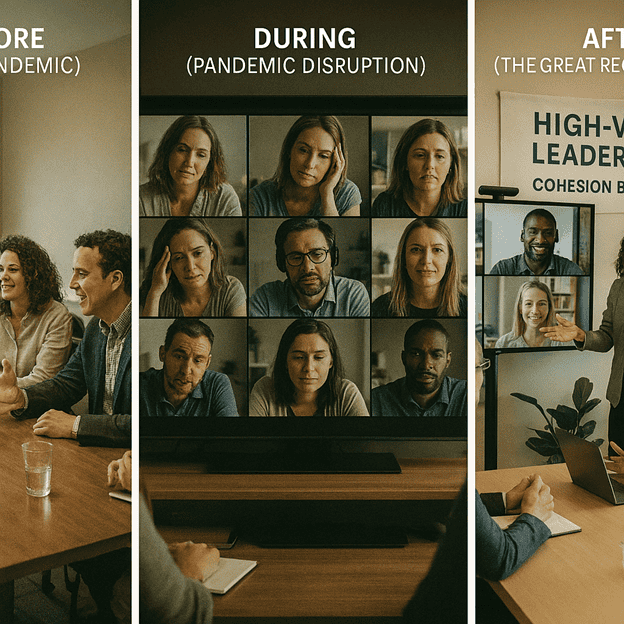
Remember March 2020? One week you were grabbing coffee with colleagues, collaborating at whiteboards, and having impromptu hallway conversations that solved problems in five minutes. The next week, everyone was home, staring at gallery view, trying to figure out how to unmute.

We thought it was temporary.

Now, years later, we’re in a different reality. Some teams are fully remote. Others are hybrid. Some have returned to offices. But here’s what’s universal: the connections that held teams together before the pandemic—those aren’t coming back automatically.

The casual trust-building that happened over lunch? Gone. The cultural osmosis that new employees absorbed by being physically present? Missing. The relationships that made difficult conversations easier and innovation faster? Frayed or broken.

And for Black women and other traditionally overlooked employees who were already navigating workplace isolation, exclusion from informal networks, and the emotional labor of being “the only”—the pandemic’s disconnection compounded challenges that existed long before COVID-19. 💔

Leaders are asking: How do we rebuild what was lost? How do we create cohesion when people aren’t in the same place? How do we build culture when the old culture-building methods no longer apply?

The answer isn’t “return to office” mandates or forced fun Zoom happy hours. It’s something deeper, more intentional, and frankly, more necessary: The Great Reconnection.

This is about rebuilding team cohesion deliberately, equitably, and sustainably for the world we’re actually working in—not the one we left behind.

Let’s explore how to reconnect teams in ways that honor what we’ve learned, address what we’ve lost, and build something better than what existed before.

What We Actually Lost (And What We Didn’t) 📉

Before we rebuild, let’s be honest about what broke.

What the Pandemic Disrupted:

Informal Relationship Building
The coffee chats, lunch conversations, and post-meeting hallway debriefs where relationships deepened and trust built—these evaporated overnight. For new employees who started remotely, they never experienced these connections at all.

Cultural Transmission
New hires used to learn organizational culture by observation—how people interact, what’s really valued, how decisions get made. In remote environments, this cultural knowledge transfer became invisible or nonexistent.

Spontaneous Collaboration
The “hey, can I ask you something?” moments that led to quick problem-solving, knowledge sharing, and serendipitous innovation—these required more effort remotely and often just didn’t happen.

Social Capital for Those Without Access
Even before the pandemic, Black women and other marginalized employees often lacked access to informal networks where real decisions happened. Remote work made these invisible networks even more invisible—and even more powerful.

Boundaries Between Work and Life
For many, particularly women and caretakers, the pandemic erased boundaries. Work invaded homes. “Always on” became the expectation. The mental health impact continues.

But Here’s What the Pandemic Revealed:

Flexibility is Possible
Organizations that claimed remote work was impossible proved it wasn’t. This opened possibilities for people with disabilities, caretakers, and those who thrive outside traditional office environments.

Productivity Doesn’t Require Presenteeism
Results matter more than where or when work happens. This was always true; the pandemic just made it undeniable.

Commutes and Office Politics Were Costly
Particularly for Black women who spend emotional energy code-switching, navigating microaggressions, and managing office dynamics—remote work reduced some of that exhausting labor.

Meetings Could Have Been Emails
We learned to be more intentional about what requires synchronous time and what doesn’t. That’s valuable.

What We Learned Can’t Be Unlearned
Employees experienced autonomy, flexibility, and work-life integration. Many won’t—and shouldn’t have to—give that up to rebuild connection.

The question isn’t whether to rebuild cohesion. It’s how to rebuild it in ways that honor what we’ve learned while addressing what we’ve lost.

Why Traditional Team-Building Won’t Work Anymore 🚫

Let’s address the elephant in the Zoom room: most traditional team-building approaches are failing in post-pandemic environments.

The Mandatory Return-to-Office Approach
“We need people back in the office to rebuild culture.” This ignores that:

  • Flexibility is now a retention issue, not a perk
  • Forced proximity doesn’t create genuine connection
  • The people most harmed by inflexible mandates are often caretakers, people with disabilities, and those who face discrimination in office environments
  • Culture is what you build, not where you build it

Research from Gartner shows that proximity bias—favoring employees who are physically present—increases in hybrid environments. Black women and other remote workers get disadvantaged in visibility, opportunities, and advancement.

The Forced Fun Approach
Virtual happy hours, mandatory team games, synchronized coffee breaks. These rarely build genuine connection and often create resentment, especially among employees juggling caregiving or managing Zoom fatigue.

The “Just Like Before” Approach
Trying to recreate 2019’s team dynamics in 2025 ignores that people, priorities, and possibilities have changed. Nostalgia isn’t a strategy.

The One-Size-Fits-All Approach
What builds connection for extroverts might exhaust introverts. What works for local employees might exclude distributed team members. What feels inclusive to some might feel performative to others.

The Technology-Will-Save-Us Approach
Collaboration tools, virtual reality meetings, team apps—technology enables connection but doesn’t create it. Connection is human; technology is infrastructure.

So if these approaches don’t work, what does?

The High-Value Framework for Post-Pandemic Cohesion 🎯

High-Value Leadership: Transforming Organizations Through Purposeful Culture teaches that cohesion isn’t about proximity—it’s about psychological safety, shared purpose, and genuine belonging.

Post-pandemic team cohesion requires four foundational elements:

1. Intentional Connection Architecture

Pre-pandemic, connection happened organically through physical proximity. Post-pandemic, connection must be architecturally designed into how teams work.

This means:

  • Structured Relationship-Building: Regular one-on-ones, team rituals, and dedicated connection time that’s protected, not optional
  • Purposeful Meeting Design: Clear intentions for when synchronous time is needed and what should be asynchronous
  • Connection Metrics: Tracking relationship health, trust levels, and belonging as rigorously as tracking productivity
  • Distributed-First Design: Designing for remote participants first, then adapting for in-person, rather than the reverse

A technology company redesigned their team structure post-pandemic around “connection pods”—small, stable groups of 4-6 people who met weekly for 30 minutes with no agenda other than connection. Not to discuss work. Not to problem-solve. Just to see each other as humans. These pods cut across departments and levels, deliberately mixing people who wouldn’t normally interact.

Result? Employee engagement scores rose 40%, retention improved significantly, and cross-functional collaboration increased because people had relationships beyond their immediate teams.

Implementation Tip: Design connection into your calendar as deliberately as you design project time. Make it non-negotiable, not optional when there’s “extra time.”

2. Equity in Access and Visibility

Pre-pandemic informal networks already excluded many. Post-pandemic remote and hybrid work either amplifies that exclusion or creates opportunity to democratize access—depending on how it’s designed.

Black women in corporate spaces face a specific challenge post-pandemic: we’re often remote (by choice or necessity), which can reduce some microaggression exposure but also reduces visibility to leadership, access to mentors and sponsors, and inclusion in informal networks where decisions happen.

There was a financial services firm that noticed their promotion rates shifted dramatically post-pandemic. Remote employees—disproportionately women and people of color—were promoted at lower rates than in-office employees, despite equal or better performance metrics. The issue? Proximity bias. Leaders were unconsciously favoring people they saw in person.

They addressed it by:

  • Making all-hands and leadership meetings hybrid with equal engagement for remote and in-person participants
  • Implementing “remote-first” communication norms where everything was documented digitally, not just discussed in hallways
  • Requiring leaders to track their one-on-one time with remote vs. in-office employees and address imbalances
  • Creating explicit criteria for promotions that didn’t include “office presence”

Implementation Tip: Audit who has access to informal conversations, mentorship, visibility opportunities, and face time with leadership. If patterns emerge showing certain groups are excluded, redesign access intentionally.

3. Psychological Safety Across Distance

Psychological safety—the belief that you can speak up, take risks, disagree, and be yourself without fear of punishment—is harder to build and easier to lose when teams aren’t physically together.

Why? Because trust is built through micro-interactions over time. A smile. A supportive comment after a mistake. Body language that says “I’ve got your back.” These are harder to read through screens or in asynchronous communication.

For Black women, psychological safety requires even more intentionality. Research from Catalyst shows Black women are the least likely demographic to feel they belong at work, the least likely to have sponsors, and the most likely to experience isolation. Remote work can either amplify that isolation or—if designed well—reduce it by minimizing some in-person bias.

A consulting firm rebuilt psychological safety post-pandemic through:

  • Vulnerability Modeling: Leaders shared personal challenges, admitted mistakes, and discussed their own pandemic struggles in team meetings
  • Structured Check-Ins: Every meeting started with a genuine “how are you?” round with permission to be honest, not performative
  • Brave Spaces: Monthly forums where team members could discuss difficult topics—bias, burnout, caregiving challenges—with facilitator support
  • Rapid Response to Harm: When someone experienced bias or exclusion, leadership addressed it immediately and transparently

Implementation Tip: Don’t assume psychological safety exists. Measure it through anonymous surveys, listen to what marginalized employees say about their experience, and intervene when safety is compromised.

4. Purpose-Driven Cohesion

The strongest teams aren’t bonded by forced fun—they’re bonded by shared purpose, mutual respect, and collective impact.

Mastering a High-Value Company Culture emphasizes that culture is what you’re building together, not just how you interact while building it. Post-pandemic cohesion must be anchored in meaningful work, not manufactured closeness.

This means:

  • Clarifying team mission and how each person contributes
  • Celebrating wins collectively and publicly
  • Making impact visible so people see how their work matters
  • Creating opportunities for collaboration on meaningful projects
  • Building communities of practice around shared interests and expertise

A healthcare organization rebuilt cohesion by creating “impact circles”—voluntary groups focused on solving real organizational challenges. A circle focused on patient experience. Another on operational efficiency. Another on health equity. Employees joined based on interest, worked on real problems, and presented solutions to leadership.

Result? People built relationships through meaningful collaboration. The work mattered beyond the relationships, and the relationships deepened because the work mattered.

Implementation Tip: Don’t just build connection for connection’s sake. Build it through purposeful work that creates collective meaning.

The Rise & Thrive Strategy: Reconnection as Empowerment 💪🏾

Rise & Thrive: A Black Woman’s Blueprint for Leadership Excellence addresses something particularly relevant here: for Black women, “team cohesion” has always been complex.

We’ve experienced team cohesion that includes us performatively but excludes us meaningfully. We’ve been on teams where we’re expected to bring “diversity” but our expertise is questioned. We’ve built relationships with colleagues who are friendly in private but silent when we face bias publicly.

So when we talk about “The Great Reconnection,” Black women are asking: Reconnection to what? To cultures that never fully included us? To dynamics that exhausted us?

The answer must be: No. We’re not rebuilding what was. We’re building what should have been.

Post-pandemic reconnection is an opportunity to:

Design Inclusion Intentionally
Remote and hybrid work removes some physical barriers. Use this opportunity to ensure Black women have equal access to leadership, equal visibility for contributions, equal opportunity for advancement.

Redistribute Emotional Labor
Black women have historically carried disproportionate emotional labor—supporting others, managing office dynamics, code-switching. Reconnection should redistribute that labor equitably, not assume we’ll resume carrying it.

Center Well-Being
Reconnection shouldn’t mean returning to unsustainable hustle culture. It should mean building sustainable ways of working that honor our full humanity—our caregiving responsibilities, our mental health needs, our boundaries.

Create Authentic Belonging
Not “cultural fit” (which often means “similarity to those already here”) but genuine belonging where we can bring our full selves, our unique perspectives, and our authentic leadership.

Build Sponsorship, Not Just Mentorship
Cohesion that benefits Black women includes leaders who actively sponsor us for opportunities, advocate for our advancement, and open doors that have historically been closed.

The Great Reconnection, done right, isn’t about returning to pre-pandemic norms. It’s about creating post-pandemic cultures where everyone—especially those previously excluded—can genuinely belong and thrive.

Best Practices From Organizations Getting It Right 📊

Current research from Gallup, Microsoft’s Work Trend Index, and McKinsey reveals patterns among organizations successfully rebuilding cohesion:

They Embrace Flexible Work as Permanent

The highest-performing post-pandemic organizations don’t treat flexibility as temporary. They’ve redesigned work around outcomes, autonomy, and trust—not location and hours.

Practice: Offer flexibility by default. Require justification for inflexibility, not the reverse. Design roles for remote success first, then adapt for hybrid/in-person as needed.

They Over-Communicate and Over-Clarify

In distributed environments, communication that feels like “too much” is actually sufficient. Assumptions and unspoken expectations destroy cohesion.

Practice: Repeat important information through multiple channels. Document decisions transparently. Create space for questions. Assume nothing is obvious.

They Invest in Technology That Enables Connection

Not just Zoom. But asynchronous collaboration tools, virtual whiteboarding, team recognition platforms, and digital spaces for informal connection.

Practice: Evaluate tools based on whether they create equity between remote and in-person team members. If remote employees have degraded experiences, the tool isn’t working.

They Design Hybrid for Equity

When some team members are in-person and others are remote, the risk of two-tiered systems is high. Equitable hybrid design ensures remote participants aren’t second-class.

Practice: “Remote-first” meeting norms even in hybrid settings—everyone on their own screen during video calls (even if in the same office), digital collaboration boards everyone can access, documentation of hallway conversations.

They Measure Connection, Not Just Output

High-performing organizations track relationship health, belonging scores, psychological safety metrics, and connection quality—not just productivity and deliverables.

Practice: Regular pulse surveys asking: “Do you feel connected to your team?” “Do you feel your contributions are valued?” “Do you have relationships at work where you can be authentic?” Use data to improve.

They Create Intentional In-Person Moments

When teams do gather physically, it’s purposeful—focused on activities that benefit from being together (relationship building, strategic planning, creative collaboration) rather than routine work that can happen remotely.

Practice: Design in-person time for maximum relational value. Don’t waste precious face-to-face time on information sharing that could be asynchronous. Use it for connection, collaboration, and culture-building.

They Prioritize Manager Development

Middle managers are the frontline of reconnection. They need training, support, and resources to build cohesion in hybrid/remote environments.

Practice: Invest heavily in manager development focused on: leading distributed teams, building psychological safety remotely, inclusive facilitation, recognizing and addressing bias, supporting well-being.

They Address Proximity Bias Explicitly

Organizations that acknowledge proximity bias exists are better positioned to mitigate it. Those that pretend it doesn’t struggle.

Practice: Name proximity bias openly. Track promotion and opportunity distribution by work location. Train leaders to recognize and interrupt bias. Hold leaders accountable for equitable treatment of remote and in-person employees.

Practical Strategies for Rebuilding Cohesion 🛠️

Ready to reconnect your team? Here are actionable approaches:

Strategy 1: Rituals That Create Rhythm

Consistent, meaningful rituals create predictability and connection even when people aren’t physically together.

Examples:

  • Weekly team check-ins starting with personal shares (not just work updates)
  • Monthly “learning lunches” where someone teaches the team something they’re passionate about
  • Quarterly in-person gatherings (if geographically feasible) focused on relationship building
  • Daily asynchronous “wins” channel where team members share successes
  • “First Friday” virtual coffees in small randomized groups

Implementation: Start small. One ritual, done consistently, builds more cohesion than multiple sporadic efforts. Get team input on what feels meaningful, not mandated.

Strategy 2: Connection Roles and Responsibilities

Designate specific team members (on rotation) to facilitate connection—not just the leader’s job.

Examples:

  • “Connection Captain” who plans monthly team activities
  • “Recognition Champion” who highlights team member contributions weekly
  • “Onboarding Buddy” for each new hire, responsible for cultural integration
  • “Wellness Advocate” who checks in on team well-being and flags concerns

Implementation: Rotate these roles so everyone contributes to culture-building. Provide resources and support. Recognize this work as valuable, not “extra.”

Strategy 3: Structured Vulnerability

Psychological safety grows when leaders model vulnerability and create structured opportunities for authenticity.

Examples:

  • “Failure Fridays” where team members share something that didn’t work and what they learned
  • Leadership sharing their own challenges, mistakes, and growth areas publicly
  • “Whole Person” check-ins where people share what’s happening in their lives, not just work
  • Team retrospectives that include “what’s working for me” and “what’s hard for me” reflections

Implementation: Start with leadership modeling. Make vulnerability voluntary but encouraged. Create clear agreements about confidentiality and respect.

Strategy 4: Cross-Functional Connection

Cohesion within teams matters, but cross-organizational relationships prevent silos and build broader connection.

Examples:

  • “Coffee Roulette” programs matching random employees across departments for virtual coffee
  • Cross-functional project teams working on real organizational challenges
  • Internal mentorship programs connecting people from different areas
  • “Shadowing days” where employees experience other departments’ work
  • Communities of practice around shared interests (ERGs, hobbies, professional development)

Implementation: Make these programs opt-in but highly encouraged. Provide work time for participation. Celebrate connections that form and collaborate that emerges.

Strategy 5: Recognition and Celebration

Shared celebration builds collective identity and reinforces what matters.

Examples:

  • Public recognition in team meetings for specific contributions (not generic praise)
  • Peer-to-peer recognition platforms where employees appreciate each other
  • Milestone celebrations (work anniversaries, project completions, personal achievements)
  • “Impact stories” where employees share how their work made a difference
  • Team wins celebrated collectively, not just individual achievements

Implementation: Make recognition specific, frequent, and equitable. Ensure recognition reaches all team members, not just the most visible. Celebrate learning and effort, not just results.

Strategy 6: Equity Audits and Adjustments

Regularly assess whether reconnection efforts are working for everyone, especially those historically excluded.

Examples:

  • Quarterly surveys asking marginalized employees specifically about belonging and connection
  • Analysis of who participates in connection activities and who doesn’t—investigate barriers
  • Tracking who gets face time with leadership, mentorship, and visibility opportunities
  • Exit interviews asking specifically about connection and belonging
  • Inclusion council reviewing cohesion strategies through equity lens

Implementation: Don’t just collect data—act on it. When disparities emerge, address them immediately and transparently. Make equity in connection a measurable goal.

When Physical Return Makes Sense (And When It Doesn’t) 🏢

Let’s address the contentious question: Should teams return to physical offices?

The answer: It depends—and it should be determined by purpose, not nostalgia.

Physical presence may support cohesion when:

  • The work genuinely requires in-person collaboration (physical prototyping, hands-on training, etc.)
  • Teams are co-located and commutes are reasonable
  • Office environments are inclusive, accessible, and psychologically safe for all employees
  • In-person time is designed for maximum relational value, not routine tasks
  • Flexibility is maintained for those with caregiving, disabilities, or other needs
  • The organization invests in making offices worth commuting to

Physical presence may harm cohesion when:

  • It’s mandated without clear purpose, breeding resentment
  • Remote employees are excluded or disadvantaged
  • Offices aren’t inclusive spaces (accessibility barriers, code-switching pressure, microaggressions)
  • Commute costs disproportionately burden lower-paid employees
  • Presenteeism gets rewarded over actual performance
  • Flexibility disappears, driving away talent who thrived remotely

For Black women specifically, the return-to-office question is layered:

  • Does in-person presence reduce some isolation, or does it increase emotional labor?
  • Will I have more or less access to leadership and opportunities in-office?
  • Is the office environment psychologically safe, or is remote work a buffer from daily microaggressions?
  • Will my flexibility needs be accommodated, or will I be penalized for them?

There’s no universal answer. The right approach is flexibility by default, intentionality always, and equity non-negotiable.

Common Pitfalls to Avoid ⚠️

As you rebuild cohesion, watch for these mistakes:

Pitfall #1: Assuming Connection Happens Automatically
Pre-pandemic, proximity created some organic connection. Post-pandemic, connection must be designed, facilitated, and protected.

Solution: Make connection-building explicit work with dedicated time, resources, and accountability.

Pitfall #2: Prioritizing Extroverts’ Needs
Loud, visible, social connection feels like “team cohesion” but exhausts introverts and neurodiverse team members.

Solution: Offer multiple ways to connect—some social, some work-focused, some large group, some one-on-one, some synchronous, some asynchronous.

Pitfall #3: Ignoring Proximity Bias
Hybrid teams without intentional equity design advantage in-office employees and disadvantage remote employees.

Solution: Explicitly name and address proximity bias. Design for remote-first. Track and correct disparities in opportunities and advancement.

Pitfall #4: Underestimating Pandemic Trauma
People experienced loss, isolation, stress, and change. Reconnection must honor that, not dismiss it.

Solution: Create space for people to process what they’ve been through. Don’t rush to “normal.” Build in healing alongside connection.

Pitfall #5: One-Size-Fits-All Approaches
What builds connection for one person or team may not work for another.

Solution: Offer options. Get team input. Iterate based on what actually works, not what leadership thinks should work.

Pitfall #6: Forgetting About New Employees
People who joined during/after the pandemic never experienced pre-pandemic culture. They need intentional integration.

Solution: Create robust onboarding focused on relationships, not just logistics. Assign mentors/buddies. Over-communicate culture explicitly rather than assuming they’ll “pick it up.”

Pitfall #7: Neglecting Manager Support
Managers are expected to rebuild cohesion without training, resources, or their own support systems.

Solution: Invest heavily in manager development, peer support for managers, and reducing manager burnout. They can’t build team cohesion if they’re drowning.

Discussion Questions for Leadership Teams 💬

Use these to facilitate meaningful conversations:

  1. On a scale of 1-10, how connected do we think our teams feel right now? What evidence do we have for that assessment?
  2. What worked about our pre-pandemic culture, and what do we absolutely not want to rebuild? Be specific.
  3. Who on our teams might be experiencing isolation or exclusion that we’re not seeing? How do we find out and address it?
  4. What assumptions are we making about what people need to feel connected? Have we actually asked them?
  5. How are we measuring team cohesion and belonging? Are we tracking it as rigorously as productivity?
  6. If our Black women employees, remote workers, or other marginalized team members were asked whether they feel genuinely included in our reconnection efforts—what would they say?
  7. What would have to change for cohesion to exist regardless of where or when people work?

Next Steps: Your Reconnection Roadmap 🗺️

This Week:

  • Survey your team on how connected they currently feel and what would increase connection
  • Identify 1-2 current practices that might be excluding some team members
  • Have individual conversations with team members about their connection needs

This Month:

  • Implement one consistent team ritual focused on connection
  • Audit proximity bias—who’s getting opport