Blog

The Agile Leader: Flexibility Without Chaos 🌟

Navigating Change with Clarity, Not Confusion

Leadership today demands something previous generations never faced at this pace: constant adaptation. Markets shift overnight. Teams go remote, then hybrid, then back again. Priorities change mid-quarter. Yet amid all this movement, your people need stability. They need direction. They need to know you’ve got this.

This is the agile leader’s paradox. How do you stay flexible without creating chaos? How do you pivot without whiplash? How do you embrace change while maintaining the cultural foundation that makes your organization strong?

The answer isn’t in doing more. It’s in leading differently.

Why Traditional Leadership Falls Short in Modern Times

The old playbook taught us to plan, execute, and control. Set your five-year strategy. Lock in your processes. Manage by the numbers. Don’t deviate from the plan.

That worked when the world moved slower.

Today, that rigid approach doesn’t just fail—it damages. Companies that can’t adapt lose talent to competitors who can. Leaders who resist change create cultures of fear and stagnation. Teams that follow outdated playbooks watch opportunities pass them by.

But here’s what most leadership advice gets wrong: flexibility without structure isn’t freedom—it’s chaos.

Random pivots confuse your team. Constant changes without explanation erode trust. “Being agile” becomes code for “we don’t know what we’re doing.” And the people who suffer most? Those who were already fighting for stability in unstable environments.

The Hidden Cost of Chaos for the Traditionally Overlooked

Let’s be direct about something leadership literature often dances around: chaos doesn’t affect everyone equally.

When a leader keeps changing direction without clear communication, team members with established relationships and access can stop by their office for clarification. They grab coffee with the boss and get the real story. They’re in the informal networks where actual decisions get explained.

Black women in corporate spaces? We often don’t have that access. 📊

Research from Catalyst shows that Black women are significantly less likely to have sponsors in leadership and less likely to receive mentorship that translates into career advancement. When leadership becomes unpredictable, this gap widens. We’re expected to perform without the informal knowledge networks that make ambiguity manageable.

There was a company who prided themselves on “moving fast and breaking things.” Their leadership team pivoted strategies quarterly, sometimes monthly. They saw it as innovation. But their Black women employees—particularly those in mid-level roles—reported something different: exhaustion, confusion, and the constant feeling of being behind. Why? Because the real strategy was being discussed in spaces they weren’t invited to. The “agility” was actually favoritism dressed up as flexibility.

This is why agile leadership must be intentional. It’s not enough to be flexible. You must be strategically flexible with transparent structure.

The Framework: Flexibility With Foundation 🏗️

True agile leadership rests on three pillars:

1. Clarity of Core

Your values, mission, and cultural non-negotiables should be rock solid. These don’t flex. They’re your foundation.

In High-Value Leadership: Transforming Organizations Through Purposeful Culture, I emphasize that culture isn’t what you say in a town hall—it’s what you protect when pressure mounts. Your core values are your decision-making filter when everything else is uncertain.

Ask yourself: When we pivot, what stays the same? What principles guide us regardless of market conditions? What promise to our people remains unbreakable?

A technology company navigating massive industry disruption did something powerful: they created a one-page document titled “What Never Changes.” It included commitments like “We develop our people,” “We communicate transparently,” and “We measure success by impact, not just revenue.” When they had to shift their product strategy three times in eighteen months, employees didn’t panic. The core remained steady.

Practical Application: Document your organizational non-negotiables. Not corporate speak—real commitments. Share them. Reference them in every major decision. Make them visible.

2. Transparent Communication

Agility requires trust. Trust requires transparency. It’s that simple.

When you need to change direction, your team needs three things:

  • What is changing
  • Why it’s changing
  • How it affects them specifically

Notice what’s missing? Spin. Sugar-coating. Corporate jargon about “exciting new directions.”

Your people are smart. They can handle the truth. What they can’t handle is guessing, filling in blanks with worst-case scenarios, or discovering later they were kept in the dark.

For Black women navigating corporate spaces—who often face the double bind of being judged more harshly for mistakes while having less access to information—transparent communication isn’t nice to have. It’s survival. When you clearly explain the rationale for changes, you level the playing field. Everyone operates from the same information.

Practical Application: Before announcing any significant change, answer these questions in writing:

  1. What specific problem are we solving?
  2. What alternatives did we consider?
  3. What will success look like?
  4. What support will people receive during this transition?
  5. What questions do I anticipate, and what are the honest answers?

3. Structured Flexibility

Here’s the secret: the best agile leaders don’t wing it. They create structures that allow for adaptation.

Think of jazz music. 🎵 There’s a structure—key, rhythm, chord progressions. Within that structure, musicians improvise brilliantly. Remove the structure? It’s just noise.

Your organization needs the same approach. Clear decision-making frameworks. Defined authorities. Established communication rhythms. Known escalation paths. Within those structures, teams can move quickly and adapt without constantly checking if they’re going rogue.

A manufacturing company shifting to meet supply chain disruptions implemented “flex zones”—areas where teams had pre-authorized authority to make changes without approval, and “core zones” where consistency was critical. Teams knew exactly where they could adapt and where they needed alignment. The result? Faster adaptation without the chaos of everyone improvising everything.

Practical Application: Identify where flexibility serves you and where consistency is critical. Create clear boundaries. Empower teams within those boundaries.

The Rise & Thrive Principle: Leadership Through Disruption 💪🏾

In Rise & Thrive: A Black Woman’s Blueprint for Leadership Excellence, I discuss the unique strengths Black women bring to leadership—forged through navigating systems not designed for us. We understand how to:

  • Read rooms and adapt quickly
  • Build trust in uncertain environments
  • Lead with authenticity when conformity is rewarded
  • Create pathways where none existed

These aren’t just survival skills. They’re organizational superpowers in times of disruption.

Agile leadership, done right, harnesses these strengths—not just from Black women leaders, but from everyone who has learned to thrive in ambiguity. It creates cultures where adaptation is collaborative, not top-down. Where flexibility serves the mission, not executive convenience.

The question isn’t whether your Black women employees can handle change. They’ve been handling it. The question is whether your leadership style allows their adaptive expertise to shape your organization’s response—or whether you’re leaving that insight untapped.

Best Practices from High-Performing Agile Organizations 📈

Current research from McKinsey, BCG, and Deloitte reveals patterns among organizations that successfully balance flexibility with stability:

They over-communicate during transitions. Leaders think they’ve explained the change enough. Then they explain it again. And again. Through multiple channels. With space for questions. Repetition isn’t annoying—it’s necessary.

They involve diverse voices in decision-making. The organizations that pivot most successfully are those that source input from multiple levels and perspectives before deciding. Diverse teams spot problems and opportunities that homogeneous leadership misses.

They measure culture, not just outcomes. Agile organizations track trust scores, psychological safety metrics, and inclusion indicators alongside financial results. Why? Because culture is what allows fast adaptation. Damage your culture, and you’ve destroyed your agility.

They invest in middle management. The managers between executive decisions and frontline execution are your agility engine. When they’re equipped to lead through change, your organization flows. When they’re bypassed or under-resourced, you get chaos.

They create learning systems, not blame cultures. When a pivot doesn’t work, the question is “What did we learn?” not “Who screwed up?” This dramatically increases the speed at which organizations can try, adjust, and improve.

Mastering High-Value Culture in Agile Times 🎯

Mastering a High-Value Company Culture centers on a fundamental truth: your culture is your competitive advantage. Not your product. Not your funding. Not even your people—because great people leave bad cultures.

High-value cultures in agile organizations share specific characteristics:

Psychological Safety is Protected, Not Presumed. People need to know they can voice concerns about changes, admit when they don’t understand new directions, and flag potential problems without career risk. This is especially critical for traditionally overlooked employees who have learned that speaking up can backfire.

Equity is Embedded in Change Management. Every significant change should include an impact assessment: How does this affect different employee groups? Who might face barriers in this new approach? Where might we accidentally create disadvantages? This isn’t bureaucracy—it’s smart leadership.

Development is Continuous, Not Episodic. Agile organizations don’t wait for annual training. They build learning into the workflow. They create peer learning systems. They expect leaders at all levels to develop their teams constantly.

Recognition Celebrates Adaptation. What you celebrate is what you multiply. If you only recognize results, you discourage the experimentation that drives agility. Celebrate smart pivots, productive failures, and the people who help others navigate change.

Real Talk: When Agility Becomes an Excuse ⚠️

Let’s address something uncomfortable: sometimes leaders hide behind “agility” to avoid accountability.

“We’re being agile” becomes the explanation for:

  • Poor planning that should have been better
  • Avoiding difficult conversations about what isn’t working
  • Keeping people perpetually off-balance so they don’t question leadership
  • Changing direction because leadership lacks conviction, not because circumstances changed

True agility is responsive. False agility is reactive.

True agility serves the mission and the people. False agility serves leadership’s discomfort with commitment.

If your team describes your leadership as “all over the place” rather than “responsive,” you might have crossed the line. If you’re changing direction more than you’re building on existing direction, pause. If your people are exhausted rather than energized, something’s wrong.

Your Agile Leadership Checklist ✅

Ready to assess your own agility? Use these questions:

Clarity Questions:

  • Can every person on my team articulate our core mission and values?
  • When we change strategies, do our values remain the decision-making filter?
  • Is there a document or clear statement of “what never changes” here?

Communication Questions:

  • Do I explain the “why” behind changes, or just announce the “what”?
  • Have I created multiple channels for questions and concerns?
  • Am I accessible to people who don’t have traditional access to leadership?
  • Do I follow up after major announcements to check understanding?

Structure Questions:

  • Do teams know where they have authority to adapt and where they need alignment?
  • Have we defined decision-making frameworks, or do people guess?
  • Is our flexibility strategic, or are we just making it up as we go?

Equity Questions:

  • Who has access to informal information networks, and who doesn’t?
  • How do changes affect different groups in our organization?
  • Are the same people always disadvantaged by our “flexibility”?
  • What systems ensure everyone can succeed in our agile environment?

Moving Forward: From Chaos to Confident Adaptation 🚀

The goal isn’t perfect leadership. It’s purposeful leadership. Leadership that adapts without abandoning. Leadership that moves with intention, not just motion.

You can be the leader who:

  • Responds to market changes without destabilizing your team
  • Pivots when necessary without creating organizational whiplash
  • Maintains culture while evolving strategy
  • Creates space for all voices, especially those traditionally silenced
  • Builds trust through transparency
  • Demonstrates that flexibility and stability aren’t opposites—they’re partners

This is the leadership our moment demands. This is what separates organizations that thrive from those that merely survive.

Discussion Questions for Your Leadership Team 💬

Use these to spark meaningful conversation:

  1. On a scale of 1-10, how would our team rate our leadership’s clarity during change? What specific evidence would they point to?
  2. Think of our last major pivot or change. Who had early access to information about it, and who learned last? What does that pattern reveal?
  3. What are the 3-5 non-negotiable values or principles that should guide every decision here, regardless of market conditions or strategic pivots?
  4. How do we currently measure whether our agility is serving our people or exhausting them? What early warning signs should we watch for?
  5. Who in our organization has demonstrated exceptional adaptability in difficult circumstances? What have they learned that could improve our organizational agility?
  6. If we asked our Black women employees (or other traditionally overlooked groups) to honestly assess our change management and communication, what would they say? How do we create the safety for those honest conversations?

Next Steps: Building Your Agile Leadership Capacity 📋

This Week:

  • Document your organizational non-negotiables (the things that don’t flex)
  • Review your last major communication about change—did it include what, why, and how?
  • Identify one area where you can create structured flexibility for your team

This Month:

  • Conduct listening sessions with employees at different levels about how they experience change here
  • Assess your decision-making frameworks—are they clear and accessible to all?
  • Review recent changes through an equity lens—who was advantaged and who was disadvantaged?

This Quarter:

  • Develop or refine your change management communication templates
  • Invest in middle management development focused on leading through ambiguity
  • Establish metrics for organizational trust and cultural health alongside business outcomes

Work With Che’ Blackmon Consulting 🤝

Leading with agility while maintaining culture isn’t something you figure out alone. It requires intentional strategy, honest assessment, and often, an outside perspective that can see what you’re too close to notice.

Che’ Blackmon Consulting partners with leaders and organizations committed to building high-value cultures that can adapt without losing their soul. Whether you’re navigating major transitions, developing your leadership team, or creating more inclusive and agile systems, we bring expertise grounded in real-world application and deep understanding of how culture drives performance.

Let’s talk about:

  • Executive coaching for leaders managing complex change
  • Organizational culture assessments and transformation strategies
  • Leadership development focused on inclusive agility
  • Strategic planning that centers both performance and people
  • Customized workshops and keynotes for your team or event

The strongest leaders don’t navigate change alone. They partner with people who’ve guided others through it successfully.

Ready to move from chaos to confident adaptation?

📧 admin@cheblackmon.com
📞 888.369.7243
🌐 cheblackmon.com


Your organization’s next chapter doesn’t have to be written in chaos. With the right approach, flexibility becomes your strength—not your weakness. Let’s build that together. ✨

#AgileLeadership #HighValueLeadership #LeadershipDevelopment #OrganizationalCulture #DiversityAndInclusion #BlackWomenInLeadership #ExecutiveCoaching #ChangeManagement #CultureTransformation #InclusiveLeadership #WomenInBusiness #BlackExcellence #LeadershipMatters #CorporateCulture #EmotionalIntelligence
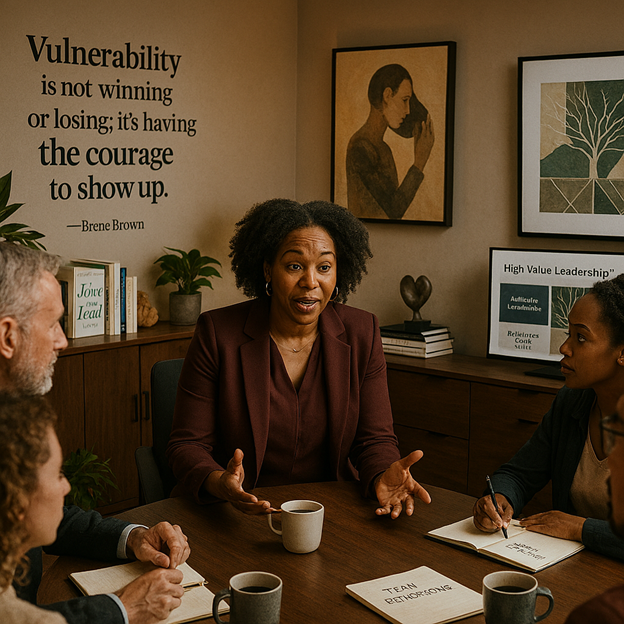

The Power of Vulnerability: Brené Brown Was Right About Leadership

By Che’ Blackmon


The executive stood in front of her leadership team and said the words that leaders are taught never to say: “I don’t know.”

She admitted that the strategy wasn’t working. That she’d made the wrong call on a major investment. That she needed their help to figure out the path forward.

The room went silent. Then something remarkable happened.

Her team leaned in. Ideas started flowing. People who’d been quietly disengaged for months suddenly became invested in solving the problem together. Trust deepened. Innovation accelerated. The vulnerability that conventional leadership wisdom says destroys credibility actually strengthened it.

Brené Brown has spent two decades researching vulnerability, courage, and leadership. Her core finding? Vulnerability isn’t weakness—it’s the most accurate measure of courage. Leaders who can be authentic about uncertainty, acknowledge mistakes, and show up as fully human don’t lose respect. They earn it. 💪🏾

But here’s where the conversation gets complicated: vulnerability in leadership isn’t equally safe or equally valued across all identities. When a white male CEO admits uncertainty, it’s often celebrated as authenticity and emotional intelligence. When a Black woman leader shows the same vulnerability, she risks confirming stereotypes about competence, being seen as unprepared, or having her authority undermined.

So yes, Brené Brown was right about leadership. Vulnerability is powerful. But we need to talk about how power, privilege, race, and gender shape who gets to be vulnerable—and at what cost.

What Vulnerability Actually Means in Leadership

Let’s start by clarifying what we’re talking about. Vulnerability in leadership doesn’t mean:

❌ Oversharing personal struggles inappropriately
❌ Using your team as your therapist
❌ Abdicating responsibility or decision-making authority
❌ Constant self-doubt or lack of confidence
❌ Emotional volatility or unpredictability

Vulnerability in leadership does mean:

✅ Acknowledging when you don’t have all the answers
✅ Admitting mistakes and taking responsibility
✅ Being honest about challenges the organization faces
✅ Asking for help and input from others
✅ Showing appropriate emotion and humanity
✅ Taking interpersonal risks to build genuine connection
✅ Being transparent about your values and what matters to you

As Brown writes in Dare to Lead, “Vulnerability is not winning or losing; it’s having the courage to show up and be seen when we have no control over the outcome.” In leadership, that means making decisions without certainty, having difficult conversations without guaranteed outcomes, and leading through ambiguity without pretending you have it all figured out.

Research backs this up. A study published in the Journal of Applied Psychology found that leaders who demonstrated appropriate vulnerability—admitting mistakes, acknowledging limitations, asking for feedback—were rated as more effective by their teams and inspired higher levels of trust and psychological safety.

Google’s Project Aristotle, which studied hundreds of teams to identify what makes them successful, found that psychological safety—the belief that you can take risks without being punished or humiliated—was the single most important factor. And psychological safety starts with leaders modeling vulnerability.

The Business Case: Why Vulnerable Leadership Works 📊

Organizations benefit measurably when leaders practice authentic vulnerability:

Innovation Increases: When leaders admit they don’t have all the answers, teams feel empowered to experiment, take risks, and propose unconventional solutions. Research from Harvard Business School shows that psychological safety—created through leader vulnerability—directly correlates with innovation outcomes.

Trust Deepens: Employees trust leaders who are authentic more than leaders who project perfection. Edelman’s Trust Barometer consistently shows that authenticity is a key driver of trust in leadership.

Engagement Rises: Gallup research demonstrates that employees who feel their leaders care about them as people (not just as workers) are significantly more engaged. Vulnerability signals that you see employees as humans, not just resources.

Retention Improves: People don’t leave jobs—they leave managers. When leaders create psychologically safe environments through vulnerability, employees are more likely to stay, even during challenging times.

Decision-Making Improves: Leaders who can say “I don’t know” create space for diverse perspectives, which leads to better decisions. Research from Harvard Business Review shows that inclusive decision-making (which requires leader vulnerability) produces better business outcomes.

Organizational Resilience Strengthens: Companies led by vulnerable, authentic leaders navigate crises more effectively because employees trust leadership’s transparency and feel invested in solutions.

As I discuss in “High-Value Leadership: Transforming Organizations Through Purposeful Culture,” high-value organizations don’t demand perfection from leaders—they demand authenticity, accountability, and the courage to be human.

The Complication: Vulnerability and Identity 🎭

Here’s where Brown’s research, while groundbreaking, requires additional context for leaders from marginalized identities: vulnerability carries different risks depending on who you are.

The Gender Paradox

Women leaders are told to be authentic and vulnerable—right up until they actually are, at which point they’re often labeled as “too emotional,” “not executive material,” or “lacking confidence.”

Research from NYU’s Stern School of Business found that when women leaders show emotion, they’re judged more harshly than men showing identical emotions. Women’s tears are seen as unprofessional; men’s tears are seen as passionate commitment. Women’s admission of uncertainty is seen as incompetence; men’s is seen as thoughtful deliberation.

The Racial Dimension

For Black women leaders, the stakes of vulnerability are even higher. You’re already fighting stereotypes about competence, navigating the “angry Black woman” trope, and working twice as hard to establish credibility. Showing vulnerability can feel like confirming others’ doubts rather than demonstrating courage.

Dr. Ella F. Washington’s research on Black women’s leadership shows that Black women describe feeling they must project “twice the confidence” and “half the vulnerability” compared to white colleagues to be taken seriously. One participant in her study said: “I can’t afford to not know something. White men get promoted on potential. I get evaluated on perfection.”

As I write in “Rise & Thrive: A Black Woman’s Blueprint for Leadership Excellence,” Black women leaders navigate a painful double bind: be authentic and vulnerable (and risk confirming stereotypes), or project invulnerability (and be labeled as cold, unapproachable, or inauthentic). Neither path is safe.

The Authority Tax

There was a technology company where a white male executive and a Black woman executive made similar admissions in separate leadership meetings. The white man said, “I made a strategic error on this acquisition. Here’s what I learned.” His team rallied around him, seeing it as courageous accountability.

The Black woman said almost identical words about a different decision. Her team’s reaction was different. Some questioned whether she was the right person for the role. Others expressed concern about her judgment. Within weeks, her authority was being undermined in ways his never was.

Same vulnerability. Dramatically different outcomes.

This isn’t to say Black women shouldn’t be vulnerable—it’s to acknowledge that the cost-benefit analysis is different, and we need organizational cultures that make vulnerability safe for everyone, not just those already perceived as competent by default.

Strategic Vulnerability: A Framework for All Leaders 💎

Given these complexities, how do we practice vulnerability strategically—especially for leaders navigating marginalized identities?

1. Build Your Foundation First

Vulnerability works best when it’s built on a foundation of demonstrated competence and established credibility. This shouldn’t be necessary in a perfect world, but in the real world, it matters.

For Black women leaders, this often means:

  • Documenting your expertise and accomplishments thoroughly
  • Building a track record before taking major vulnerability risks
  • Establishing your authority clearly before showing uncertainty
  • Creating political capital before spending it on vulnerability

This isn’t about being inauthentic—it’s about being strategic. As I emphasize in “Mastering a High-Value Company Culture,” high-value leaders understand that context matters. The same behavior that builds trust in one context might undermine authority in another.

2. Choose Your Moments

Not every moment requires vulnerability, and not every audience is safe for it. Strategic vulnerability means discerning:

Safe spaces: Where can you be most vulnerable? (Trusted peers, executive coaches, close mentors, therapy, peer networks outside your organization)

Calculated risks: Where might vulnerability serve your goals? (Team meetings where you need input, moments when admitting uncertainty models the behavior you want from others)

Protected boundaries: Where should you maintain more professional distance? (Initial interactions with new stakeholders, contexts where your authority is already being questioned, situations with people who’ve demonstrated untrustworthiness)

There was a Black woman executive who kept two different “vulnerability budgets.” With her trusted leadership team, she was increasingly open about challenges and uncertainties. In broader organizational contexts where her credibility was still being established, she was more measured and strategic. This wasn’t dishonest—it was discerning.

3. Frame Vulnerability as Strength

How you present vulnerability matters as much as the vulnerability itself.

Weaker framing: “I don’t know what to do. I’m overwhelmed.”
Stronger framing: “This challenge is complex. I don’t have all the answers yet, which is why I’m bringing together the smartest people I know to solve it together.”

Weaker framing: “I made a terrible mistake.”
Stronger framing: “I made a decision that didn’t produce the results we needed. Here’s what I learned and how we’re adjusting course.”

Notice the difference? The second framings acknowledge reality while demonstrating leadership—taking ownership, showing strategic thinking, inviting collaboration.

4. Pair Vulnerability with Competence

Research suggests that leaders are most effective when they demonstrate both warmth (which includes vulnerability) and competence. Show both simultaneously:

“I don’t know the right answer here [vulnerability], and here’s my plan for how we’ll figure it out [competence].”

“I made an error in judgment on this project [vulnerability], and I’ve already implemented three changes to prevent similar issues going forward [competence].”

This combination prevents vulnerability from being misread as incompetence.

5. Create Psychological Safety for Others First 🤝

One of the most powerful forms of leader vulnerability is creating space for others to be vulnerable. You might say:

  • “I want this to be a space where we can discuss what’s not working without fear of punishment.”
  • “The best ideas often come from admitting what we don’t know. Who has questions or uncertainties we should discuss?”
  • “I expect we’ll make mistakes as we navigate this. That’s part of innovation. Let’s be transparent when they happen.”

When you create psychological safety for your team, you demonstrate vulnerable leadership without necessarily exposing your own uncertainties prematurely.

6. Practice Selective Transparency

You don’t need to share everything. Selective transparency means being authentic about what matters most while maintaining appropriate boundaries.

You might share:

  • Strategic challenges the organization faces and your thinking about them
  • Your values and what drives your decision-making
  • Mistakes you’ve made and lessons you’ve learned
  • Areas where you’re learning and growing

You probably shouldn’t share:

  • Confidential personnel or financial information
  • Personal struggles that aren’t relevant to work
  • Doubts about your fundamental capability to do your job
  • Information that would undermine others’ privacy or dignity

7. Find Your Vulnerability Village 👥

Given that workplace vulnerability carries risks, especially for marginalized leaders, it’s essential to have spaces where you can be fully vulnerable without professional consequences.

This might include:

  • Executive coaching or therapy
  • Peer networks of other leaders at similar levels
  • Trusted mentors outside your organization
  • Affinity groups for leaders navigating similar identities
  • Close friends or family who understand your work context

As I discuss in the article on leadership loneliness, sustainable leadership requires multiple layers of support. You can’t be vulnerable everywhere—but you must be vulnerable somewhere.

Organizational Responsibility: Making Vulnerability Safe 🏢

While individual strategies matter, organizations must create cultures where vulnerability is genuinely safe and valued for everyone.

Examine Your Leadership Prototypes

Who gets celebrated as “authentic” and “emotionally intelligent” in your organization? Who gets penalized for the same behaviors? If vulnerability is only safe for certain demographics, that’s not a vulnerability-friendly culture—that’s a privilege-protected culture.

Train Leaders on Psychological Safety

Teach leaders how to:

  • Respond to vulnerability without punishing it
  • Ask for input genuinely, not performatively
  • Acknowledge their own limitations without undermining confidence
  • Create space for dissent and uncertainty
  • Distinguish between appropriate and inappropriate vulnerability

Evaluate Leaders on Relational Skills

If your leadership competencies focus exclusively on results, strategy, and decisiveness without valuing relationship-building, authenticity, and team development, you’re incentivizing invulnerability.

High-value organizations, as I discuss in “High-Value Leadership,” evaluate leaders on both task accomplishment and relational effectiveness—including their ability to create psychologically safe environments.

Address Stereotype Threat

Provide training on how stereotypes about different groups affect perceptions of vulnerability. When evaluators understand that they’re more likely to interpret Black women’s vulnerability as incompetence due to bias, they can consciously counter that tendency.

Model Vulnerability at the Top

Senior leaders set the tone. When C-suite executives authentically share challenges, admit mistakes, and ask for help, it gives permission for others to do the same. But ensure that this modeling is genuine, not performative—employees can tell the difference.

Create Structured Opportunities for Vulnerability

Some organizations build vulnerability into regular practices:

  • After-action reviews where teams discuss what went wrong without blame
  • Failure celebrations where teams share lessons learned from experiments that didn’t work
  • Leadership development programs that include sharing personal leadership journeys
  • Town halls where leaders answer unfiltered employee questions
  • Team retrospectives focused on continuous improvement through honest reflection

Real-World Examples: Vulnerability in Action ✨

Satya Nadella, Microsoft CEO, transformed Microsoft’s culture in part by modeling vulnerability. He openly discussed his journey as the parent of a child with disabilities and how it shaped his leadership. He admitted Microsoft had fallen behind competitors and needed to learn. This vulnerability helped shift Microsoft from a “know-it-all” to a “learn-it-all” culture, contributing to its dramatic business turnaround.

Jacinda Ardern, former Prime Minister of New Zealand, led with remarkable vulnerability throughout her tenure—openly discussing the challenges of parenting while leading, showing emotion during national crises, and admitting when she didn’t have all the answers. Her approval ratings were among the highest globally, suggesting that vulnerability can strengthen rather than weaken political leadership.

Howard Schultz, former Starbucks CEO, shared his personal story growing up in poverty and watching his father struggle without health insurance. This vulnerability informed Starbucks’ decision to provide comprehensive benefits to part-time employees—a competitive advantage in attracting and retaining talent.

Mellody Hobson, co-CEO of Ariel Investments and prominent Black woman executive, has spoken openly about experiences of racism in corporate America and the challenges of being “the only” in many spaces. Her vulnerability on these topics has helped advance conversations about race and equity in business while strengthening rather than undermining her credibility.

These examples show that vulnerability can be powerful across different contexts—but it’s worth noting that most examples that get celebrated are from people who already held significant power and credibility. The challenge remains: how do we make vulnerability equally safe for emerging leaders and those from marginalized backgrounds?

When Vulnerability Backfires: Learning from Mistakes ⚠️

Vulnerability in leadership isn’t always successful. Understanding when and why it fails helps us practice it more effectively.

Oversharing: There was a leader who regularly shared detailed personal struggles—relationship problems, financial stress, health concerns—in team meetings. While vulnerability is valuable, this crossed into inappropriate oversharing that made the team uncomfortable and undermined confidence in the leader’s stability.

Lack of Follow-Through: A CEO publicly admitted the company had made strategic errors and promised transparency going forward. But when employees asked for specifics, leadership reverted to corporate speak and avoided accountability. The initial vulnerability seemed manipulative rather than authentic.

Vulnerability Without Competence: A new manager, trying to build connection, led with extensive vulnerability about feeling unprepared and uncertain. Without first establishing baseline competence, the team lost confidence before trust could develop.

Weaponized Vulnerability: Some leaders use vulnerability strategically to avoid accountability (“I’m working on it, I’m learning, give me grace”) without actually changing behavior or taking responsibility for impact.

Unreciprocated Vulnerability: Leaders who demand vulnerability from their teams while remaining invulnerable themselves create unhealthy power dynamics.

Practical Strategies: Developing Your Vulnerability Capacity 💪🏾

Start Small

You don’t need to transform overnight. Begin with low-stakes vulnerability:

  • Admit when you don’t know something minor
  • Ask for input on a decision you’re genuinely uncertain about
  • Share a small mistake and what you learned
  • Thank someone who corrected you or challenged your thinking

Practice Self-Compassion

Kristin Neff’s research on self-compassion shows that leaders who treat themselves with kindness when they fail are more resilient and effective. Before you can be vulnerable with others, practice being vulnerable with yourself—acknowledging imperfection without harsh self-judgment.

Develop Emotional Literacy

Vulnerability requires the ability to recognize and name emotions. If you grew up in contexts where emotions were suppressed or where showing feeling was dangerous, this may require intentional development. Therapy, coaching, or even emotion vocabulary resources can help.

Seek Feedback

Ask trusted colleagues: How do I come across? Do I seem approachable? Do people feel safe bringing problems to me? Their honest feedback can reveal where you might need more vulnerability—or where you might be oversharing.

Reflect on Your Leadership Legacy

What do you want to be remembered for? Leaders remembered most powerfully are often those who connected authentically—who were excellent and human simultaneously. Does your current leadership style reflect that aspiration?

For Black Women Leaders: Navigating the Tightrope 🎭

If you’re a Black woman leader wrestling with how to practice vulnerability given the higher risks:

Know that your caution is valid: You’re not being paranoid or inauthentic. The risks are real, and your strategic discernment about when and where to be vulnerable is sophisticated leadership judgment.

Build your evidence base first: Document your wins, establish your expertise, create a track record. Vulnerability works better when it’s not the first thing people know about you.

Find your safe spaces: Identify where you can be fully vulnerable without professional risk. You need those spaces to sustain yourself.

Frame vulnerability as strategic leadership: When you admit uncertainty, frame it as bringing together expertise to solve complex problems—which is what excellent leaders do.

Connect with other Black women leaders: Share strategies, support each other, and remember you’re not alone in navigating these dynamics.

Trust your instincts: If a situation doesn’t feel safe for vulnerability, it probably isn’t. Your pattern recognition about organizational dynamics is valuable data.

Advocate for cultural change: Use your voice to push for organizational cultures where vulnerability is safe for everyone, not just those already perceived as credible.

As I write in “Rise & Thrive,” your survival strategies—including strategic invulnerability—are sophisticated leadership skills developed in response to real organizational barriers. The goal isn’t to abandon them prematurely; it’s to create organizations where you don’t need them as much.

Discussion Questions 💭

  1. How does vulnerability show up (or not show up) in your organization’s leadership culture? Who seems to benefit from being vulnerable, and who pays a price?
  2. What makes vulnerability feel safe or unsafe for you personally? What would need to change for you to take more vulnerability risks?
  3. How do race, gender, and other identities shape who gets to be vulnerable in your organization without consequences?
  4. When have you witnessed vulnerability strengthen a leader’s effectiveness? When have you seen it backfire?
  5. What’s one area where showing more vulnerability might serve your leadership goals? What’s holding you back?
  6. How can your organization create cultures where vulnerability is genuinely safe for everyone, not just those who already hold power and credibility?

Next Steps: Practicing Vulnerability Today 🚀

For Individual Leaders:

  • Identify one low-stakes situation this week where you can practice vulnerability (admitting you don’t know something, asking for help, acknowledging a small mistake)
  • Reflect on where you currently fall on the spectrum from invulnerable to over-vulnerable—and whether that’s serving you
  • Identify your “vulnerability village”—safe spaces where you can be fully authentic without professional risk
  • Read or watch Brené Brown’s work on vulnerability, courage, and leadership
  • Practice self-compassion when you make mistakes or fall short of your own expectations

For Organizational Leaders:

  • Model appropriate vulnerability in your next leadership communication or team meeting
  • Create structured opportunities for teams to practice vulnerability without punishment (retrospectives, after-action reviews, learning debriefs)
  • Examine whether vulnerability is equally safe across demographics in your organization
  • Include psychological safety and vulnerability in leadership competency models
  • Train managers on how to create psychologically safe environments

For HR and Talent Development:

  • Assess whether your performance management system punishes honesty about mistakes and challenges
  • Include “creating psychological safety” as a leadership competency
  • Provide training on responding effectively when employees are vulnerable
  • Review evaluation data to see if different groups face different consequences for similar behaviors
  • Design leadership development programs that include vulnerability skill-building

For Everyone:

  • Notice when you witness vulnerability and respond with compassion rather than judgment
  • Create space for others to be uncertain, make mistakes, or not know things
  • Challenge cultures that demand perfection and punish humanity
  • Practice being vulnerable in small ways to build your capacity
  • Remember that vulnerability and accountability can coexist—admitting mistakes doesn’t mean avoiding consequences

Work With Che’ Blackmon Consulting

Is your organization ready to build a culture where vulnerability strengthens rather than undermines leadership?

Che’ Blackmon Consulting partners with leaders and organizations to create high-value cultures where authenticity, accountability, and excellence coexist. We understand that vulnerability in leadership isn’t one-size-fits-all—it must be practiced strategically and supported structurally.

Our services include:

  • Executive coaching for leaders developing their vulnerability capacity
  • Leadership development programs focused on authentic, courageous leadership
  • Organizational culture transformation to build psychological safety
  • Consulting on inclusive leadership practices that work for all identities
  • Strategic guidance on navigating vulnerability as a leader from a marginalized background

We help leaders and organizations move beyond performative authenticity to genuine cultures of courage.

Ready to lead with both strength and vulnerability?

📧 admin@cheblackmon.com
📞 888.369.7243
🌐 cheblackmon.com


Brené Brown was right: vulnerability is courage, and courage is essential for leadership. But we must also acknowledge that the risks and rewards of vulnerability are not equally distributed. Until we create organizations where vulnerability is safe for everyone—not just those already perceived as competent and credible—we haven’t fully embraced its power. That’s the work ahead: building cultures where every leader can be both excellent and human.

#VulnerableLeadership #AuthenticLeadership #HighValueLeadership #BreneBrown #BlackWomenLeaders #PsychologicalSafety #LeadershipDevelopment #CourageousLeadership #EmotionalIntelligence #InclusiveLeadership #ExecutiveLeadership #DEI #OrganizationalCulture #LeadershipCourage #WorkplaceCulture #AuthenticityInLeadership #ExecutivePresence #LeadershipSkills #DareToLead #ProfessionalDevelopment

Cultural Intelligence: Leading Across Differences

By Che’ Blackmon


The meeting was scheduled for 9 AM sharp. The American team arrived at 8:55, laptops open, ready to dive in. Their colleagues from Brazil arrived at 9:20, greeting everyone warmly, asking about families before discussing business. The Americans interpreted this as unprofessional. The Brazilians saw the Americans as cold and transactional.

Neither group was wrong. They were operating from different cultural frameworks—and neither had the cultural intelligence to bridge the gap.

Now scale that scenario across your organization. Different communication styles. Different approaches to authority and hierarchy. Different definitions of professionalism, directness, and respect. Different experiences of race, gender, and power that shape how people show up in workplace spaces.

In today’s globalized, diverse, and increasingly complex business environment, technical expertise alone won’t make you an effective leader. You need cultural intelligence—the capability to function effectively across national, ethnic, organizational, and social cultures. 🌍

For Black women leaders navigating predominantly white corporate spaces, cultural intelligence isn’t optional—it’s survival. You’ve likely been developing it your entire career, code-switching across contexts, translating between cultures, reading unspoken rules that were never explicitly taught. That expertise is valuable. The question is: how do we cultivate it systematically across entire organizations so that the burden doesn’t fall solely on those navigating from the margins?

What Is Cultural Intelligence (CQ)?

Cultural intelligence, or CQ, is a framework developed by researchers Christopher Earley and Soon Ang. It’s defined as the capability to relate and work effectively in culturally diverse situations. Unlike IQ (cognitive intelligence) or EQ (emotional intelligence), CQ specifically addresses our ability to function across cultural differences.

CQ consists of four capabilities:

CQ Drive (Motivation): Your interest, confidence, and drive to adapt to multicultural situations. Do you genuinely want to learn about and engage with different cultures, or do you see difference as a problem to manage?

CQ Knowledge (Cognition): Your understanding of how cultures are similar and different. This includes knowledge about cultural values, norms, economic systems, and how culture shapes behavior.

CQ Strategy (Metacognition): Your awareness and ability to plan for multicultural interactions. Can you check your assumptions? Do you adjust your mental models when cultural differences emerge?

CQ Action (Behavior): Your ability to adapt verbal and nonverbal behavior appropriately in cross-cultural situations. Can you modify your communication style, decision-making approach, or leadership behavior when needed?

Research shows that leaders with high CQ:

  • Build stronger, more innovative teams
  • Navigate global business contexts more effectively
  • Create more inclusive workplace cultures
  • Make better decisions by considering diverse perspectives
  • Experience less conflict and misunderstanding across differences

For organizations, CQ translates directly to business outcomes: higher employee engagement, better talent retention, increased innovation, and stronger financial performance in diverse markets.

Why Cultural Intelligence Matters More Than Ever 📈

The business case for cultural intelligence has never been stronger:

Demographic Shifts: The U.S. workforce is increasingly diverse. By 2030, people of color will comprise the majority of the working-age population. Global teams are standard, not exceptional. Leaders who can’t navigate across differences will struggle to lead effectively.

Remote and Hybrid Work: Virtual work eliminates some cultural barriers (like geographical distance) while intensifying others. Without in-person context clues, cultural misunderstandings multiply. Leaders need heightened CQ to lead distributed, diverse teams effectively.

Social Justice Movements: Events like the 2020 racial reckoning following George Floyd’s murder forced organizations to confront how culture, power, and identity shape workplace experiences. Employees—especially younger workers—increasingly expect leaders to demonstrate cultural competence, not just cultural awareness.

Globalized Markets: Even small organizations operate in global contexts—supply chains, customer bases, competitors. Understanding cultural differences isn’t just about being respectful; it’s about being competitive.

Innovation Imperative: Research from Boston Consulting Group shows that companies with above-average diversity in leadership teams report innovation revenue that is 19% higher than companies with below-average diversity. But diversity only drives innovation when leaders can effectively leverage different perspectives—which requires cultural intelligence.

The Hidden Curriculum: Black Women’s Cultural Intelligence 💎

Here’s what often goes unacknowledged: Black women in corporate America have been developing sophisticated cultural intelligence our entire careers. We’ve had to.

As I write in “Rise & Thrive: A Black Woman’s Blueprint for Leadership Excellence,” Black women become expert code-switchers, translating between home culture and corporate culture, adjusting tone and language depending on audience, reading subtle social cues about when to speak up and when to stay quiet, managing perceptions while staying authentic.

This is cultural intelligence in action—though it’s rarely named or valued as such.

Dr. Ella F. Washington, in her research on Black women’s leadership, notes that Black women develop what she calls “bicultural competence”—the ability to navigate both Black cultural contexts and predominantly white corporate environments. This competence is a form of expertise, yet it’s typically framed as a personal necessity rather than an organizational asset.

Consider this: A Black woman leader enters a meeting where she’s the only Black person and one of few women. She immediately assesses:

  • How formal or casual should her language be?
  • How assertive can she be without triggering “angry Black woman” stereotypes?
  • How much can she challenge without being seen as difficult?
  • How warm should she be without being dismissed as less competent?
  • How do the power dynamics in the room shape what’s safe to say?

She’s conducting a complex cultural analysis in real-time, every single day. That’s high-level CQ. But instead of being recognized as a strategic skill, it’s often invisible labor that goes uncompensated and unacknowledged.

Meanwhile, leaders who’ve never had to code-switch—who’ve only operated in environments designed for them—may have never developed these capabilities at all.

The Four Dimensions: Building Your Cultural Intelligence

Let’s break down how to develop each component of CQ, with particular attention to how this shows up in diverse workplace contexts.

1. CQ Drive: Cultivating Genuine Curiosity 🌱

CQ Drive starts with motivation—not just tolerance of difference, but genuine interest in learning from people whose experiences and perspectives differ from your own.

What undermines CQ Drive:

  • Treating diversity as a compliance requirement rather than a strategic advantage
  • Assuming your cultural norms are universal or “just professional”
  • Believing that good intentions eliminate the need for cultural learning
  • Viewing difference as a problem to manage rather than a resource to leverage

What builds CQ Drive:

  • Developing meaningful relationships across difference
  • Reflecting on how your own cultural identity shapes your worldview
  • Seeking out experiences that challenge your assumptions
  • Recognizing the business and human benefits of cultural diversity

There was a tech company that required all senior leaders to participate in a “reverse mentoring” program, where executives were paired with employees from underrepresented backgrounds. The explicit goal wasn’t for the senior leader to mentor the junior employee, but the reverse—junior employees shared their experiences navigating the organization as people of color, women, LGBTQ+ individuals, or people with disabilities. This built CQ Drive by creating personal investment in understanding different experiences.

2. CQ Knowledge: Understanding Cultural Frameworks 📚

CQ Knowledge involves understanding how cultures differ across key dimensions and recognizing patterns without stereotyping individuals.

Social psychologist Geert Hofstede identified six dimensions along which cultures vary:

  • Power Distance: The extent to which less powerful members accept unequal power distribution. In high power distance cultures, hierarchy is respected and rarely questioned. In low power distance cultures, leaders are expected to be accessible and employees feel comfortable challenging authority.
  • Individualism vs. Collectivism: Whether cultures prioritize individual achievement or group harmony.
  • Uncertainty Avoidance: How comfortable cultures are with ambiguity and unstructured situations.
  • Masculinity vs. Femininity: The distribution of emotional roles and values between genders.
  • Long-term vs. Short-term Orientation: Focus on future rewards vs. immediate results.
  • Indulgence vs. Restraint: The extent to which societies allow gratification of desires.

Understanding these dimensions helps leaders recognize why colleagues from different backgrounds might approach work differently—not because they’re difficult or unprofessional, but because they’re operating from different cultural logic.

Critical caveat: CQ Knowledge should never become stereotyping. Not all members of a culture embody cultural norms equally, and individuals are shaped by multiple, intersecting cultural identities. A Black woman from Atlanta who grew up middle-class and attended an HBCU has different cultural reference points than a Black woman from rural Mississippi who was first-generation college. Both are Black women, but treating “Black women” as a monolithic cultural category erases complexity.

As I emphasize in “High-Value Leadership: Transforming Organizations Through Purposeful Culture,” high-value leaders hold both pattern recognition (understanding general cultural tendencies) and individual recognition (seeing people as unique) simultaneously.

3. CQ Strategy: Planning and Awareness 🧠

CQ Strategy is metacognitive—it’s your ability to think about your own thinking and adjust your mental models when engaging across difference.

Key practices:

Before cross-cultural interactions:

  • What cultural differences might influence this interaction?
  • What assumptions am I making?
  • What do I need to learn or clarify?
  • How might my own cultural background influence my interpretations?

During cross-cultural interactions:

  • Am I checking my assumptions or jumping to conclusions?
  • What’s being communicated beyond the words?
  • Are there cultural differences influencing this dynamic?
  • What’s working? What needs adjustment?

After cross-cultural interactions:

  • What went well? What didn’t?
  • What did I learn about this cultural context?
  • What will I do differently next time?
  • How did my own cultural lens influence my interpretation?

There was a multinational organization that implemented a practice they called “cultural debriefs” after major cross-cultural initiatives or challenging interactions. Teams would gather to discuss: What cultural factors influenced outcomes? What assumptions proved accurate or inaccurate? What would we do differently? This built CQ Strategy by making cultural reflection a regular practice, not an afterthought.

For Black women leaders, CQ Strategy often means consciously analyzing: “Was that feedback about my actual performance, or was it filtered through racial or gender bias? Is this a universal workplace norm, or a culturally specific expectation being presented as universal?” This strategic analysis is exhausting but necessary—and it’s a form of CQ that should be recognized as leadership expertise.

4. CQ Action: Adapting Your Behavior 🎭

CQ Action is where cultural intelligence becomes visible—it’s your ability to adjust communication style, decision-making processes, and leadership behaviors based on cultural context.

This is NOT about losing authenticity or becoming a chameleon. It’s about having behavioral flexibility—the capability to adjust your approach while staying grounded in your values and core identity.

Communication Adjustments:

Some cultures value direct, explicit communication (“Tell me exactly what you think”). Others prefer indirect, high-context communication (“Read between the lines and preserve harmony”). Effective cross-cultural leaders can flex between styles.

For example, in giving feedback:

  • A low-context approach: “Your report missed three key data points and needs revision.”
  • A high-context approach: “This is a strong start. As we refine it, let’s ensure we’re capturing X, Y, and Z.”

Neither is inherently better—they’re culturally different. Leaders with high CQ can use both.

Decision-Making Adjustments:

Some cultures expect leaders to make decisions autonomously and decisively. Others expect extensive consultation and consensus-building. A leader who only knows one approach will struggle in contexts that require another.

There was a U.S.-based company that acquired a Japanese firm. The American CEO made quick, top-down decisions—which was valued in U.S. corporate culture as decisive leadership. But in the Japanese subsidiary, this approach was perceived as disrespectful and undermined trust. The CEO had to learn to slow down, incorporate more consultation, and build consensus before decisions—not because his original approach was wrong, but because it was culturally mismatched to the context.

Authority and Hierarchy:

Black women leaders often navigate complex territory here. In many corporate cultures, challenging authority or “speaking truth to power” is theoretically valued. But when Black women do it, they’re more likely to face negative consequences—labeled as aggressive, insubordinate, or having “attitude problems.”

This requires sophisticated CQ Action: reading the room, assessing who holds power and how they respond to challenge, calibrating your approach based on context. It’s exhausting. And it’s an advanced leadership skill that should be recognized as such.

Organizational Cultural Intelligence: Beyond Individual Skills 🏢

While individual CQ matters, sustainable cultural intelligence requires organizational commitment. As I discuss in “Mastering a High-Value Company Culture,” high-value organizations don’t ask diverse employees to adapt to static, monocultural environments. They build cultures that value and leverage cultural differences.

Assess Your Organizational CQ

How culturally intelligent is your organization? Ask:

  • Do your “professional norms” reflect one dominant culture, or do they genuinely accommodate diverse cultural approaches?
  • Are cultural differences treated as deficits to be fixed or assets to be leveraged?
  • Who does the adapting? Do people from dominant groups ever adjust to accommodate others, or is adaptation always required from marginalized groups?
  • Are communication norms flexible, or is there one “right” way to communicate?
  • Do your promotion and performance criteria favor one cultural style over others?

Build Structurally Inclusive Practices

Flexible Communication Norms: Instead of mandating one communication style, create space for multiple approaches. Some people process verbally in meetings; others need written prep to contribute best thinking. Neither is wrong.

Diversify Leadership Definitions: If “leadership” is defined narrowly (assertive, individually competitive, hierarchical), you’ll miss leaders whose cultural backgrounds emphasize collaborative, collectivist, or consensus-driven approaches.

Cultural Humility Training: Move beyond one-time diversity training to ongoing cultural humility development—the recognition that cultural learning is never complete and requires continuous curiosity and self-reflection.

Employee Resource Groups (ERGs): Support ERGs not just as social networks but as strategic partners who provide cultural insight that strengthens business decisions.

Inclusive Decision-Making: When significant decisions are made, ask: Who’s not in the room? Whose perspectives are we missing? What cultural blind spots might we have?

Address Power and Privilege ⚖️

Cultural intelligence without attention to power dynamics is incomplete. It’s not enough to “celebrate differences” if some cultural expressions are valued while others are penalized.

Research from sociologist Arlie Hochschild shows that emotional labor—managing one’s emotions and expressions to meet organizational norms—is disproportionately required from women and people of color. Black women are expected to be warm but not “too much,” confident but not threatening, authentic but palatable to white colleagues.

That’s not cultural intelligence—that’s requiring cultural assimilation while calling it professionalism.

True organizational CQ means examining:

  • Whose cultural norms are treated as default “professional standards”?
  • Who gets labeled “unprofessional” or “not a culture fit” and why?
  • Who has to code-switch constantly, and who never does?
  • How does your organization value the cultural intelligence that marginalized groups have developed?

The Global Context: Cultural Intelligence Across Borders 🌏

While we’ve focused primarily on cultural differences within U.S. workplaces, CQ is equally critical for global business contexts.

Time Orientation: In some cultures, punctuality means arriving exactly on time. In others, approximate timing is normal and relationships matter more than schedules. Neither is unprofessional—they’re culturally different approaches to time.

Negotiation Styles: Some cu