Blog

📚 AI‑Powered Stay Interviews: The Modern Tool for Understanding Why People Stay

By Che’ Blackmon, DBA Candidate | Founder & CEO, Che’ Blackmon Consulting

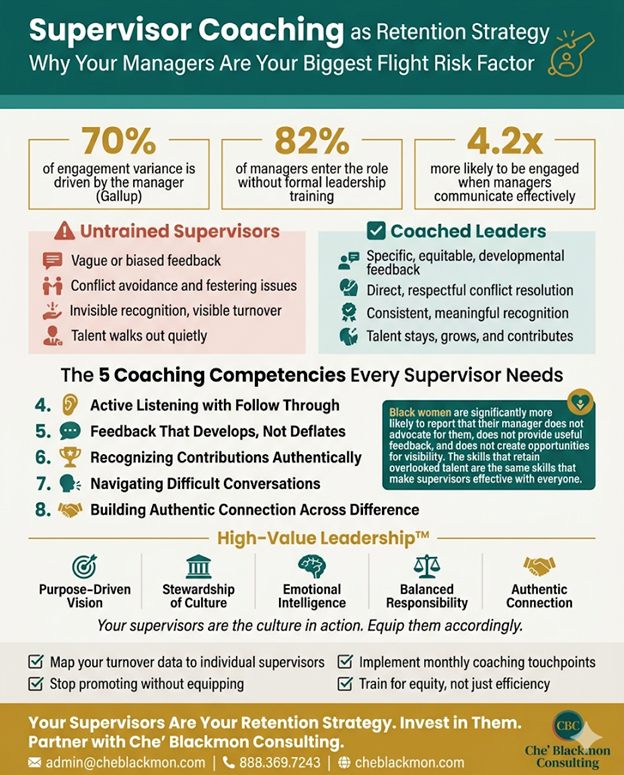
Most organizations spend the majority of their retention energy on the wrong conversation. They invest in exit interviews, asking people who have already decided to leave why they are going. By the time that conversation happens, the decision is final, the institutional knowledge is walking out the door, and the feedback arrives too late to change anything for the person giving it. Exit interviews do not prevent turnover. They document it.

Stay interviews flip the equation entirely. Instead of asking departing employees why they left, stay interviews ask current employees why they stay, what might cause them to leave, and what the organization could do differently to keep them engaged and committed. It is a simple concept with extraordinary power. And now, with the integration of artificial intelligence, the stay interview is evolving from an occasional HR initiative into a continuous, data driven retention strategy that can identify flight risk, surface hidden frustrations, and reveal engagement patterns that traditional surveys miss entirely.

In Mastering a High‑Value Company Culture, I wrote that culture is the lifeblood of any organization. But understanding the health of that lifeblood requires more than annual check ups. It requires ongoing, intelligent listening. AI powered stay interviews represent the next evolution of that listening, and organizations that embrace this tool will retain the talent their competitors are still trying to figure out how to attract.

🔄 From Exit to Stay: Why the Conversation Must Shift

The exit interview has been a staple of HR practice for decades. And for decades, it has produced the same frustrating outcome: a folder full of honest feedback from people who are no longer around to benefit from the changes that feedback might inspire. According to the Work Institute’s 2023 Retention Report, more than 75% of the root causes of voluntary turnover are preventable. The problem is not that organizations lack the information to prevent departures. The problem is that they gather that information at the wrong time.

Stay interviews address this timing gap directly. Popularized by workplace strategist Beverly Kaye and first introduced in her work on employee engagement, the stay interview is a structured, proactive conversation between a manager and a current employee designed to understand what keeps the employee engaged and what could push them toward the door. The questions are straightforward: What do you look forward to when you come to work? What are you learning here? What would make your job better? If you could change something about your role or the team, what would it be? What might tempt you to leave?

These are not complicated questions. But they are rarely asked. And when they are asked, the answers are often captured in a notebook, shared informally, and never analyzed at scale. This is where artificial intelligence changes everything.

🤖 What AI Brings to the Stay Interview

Artificial intelligence does not replace the human connection at the heart of a stay interview. What it does is amplify the organization’s ability to listen at scale, identify patterns that no individual manager could detect, and transform qualitative conversations into quantitative, actionable intelligence.

📊 Sentiment Analysis at Scale

AI powered natural language processing (NLP) tools can analyze the text and tone of stay interview responses across hundreds or thousands of employees simultaneously. These tools detect emotional sentiment, recurring themes, shifts in language over time, and even the difference between what employees say and how they say it. For example, an employee who responds “everything is fine” with language patterns that suggest resignation rather than satisfaction will be flagged differently than one who says the same words with genuine enthusiasm. This level of analysis is impossible for a human reviewer to perform consistently at scale.

🔮 Predictive Flight Risk Modeling

When stay interview data is combined with other organizational data points such as tenure, promotion history, manager tenure, performance ratings, PTO usage patterns, and engagement survey scores, AI can build predictive models that identify which employees are at elevated risk of leaving within the next three to six months. This moves retention from a reactive practice (waiting for the resignation letter) to a predictive strategy (intervening before the decision is made). In my brand voice document for Che’ Blackmon Consulting, I describe this as “predictive analytics for people, not just products.” It is the principle that the same data science rigor organizations apply to forecasting supply chain disruptions and customer churn can and should be applied to understanding and preventing talent loss.

🎯 Theme Detection and Root Cause Analysis

Traditional stay interviews produce valuable but often siloed insights. Manager A learns that their employee wants more development opportunities. Manager B learns that their employee is frustrated by scheduling practices. Manager C learns that their employee feels overlooked for recognition. In isolation, these feel like individual concerns. AI powered analysis aggregates these inputs and identifies systemic themes: perhaps development, scheduling, and recognition are not three separate problems but three symptoms of a single root cause, such as supervisor capacity or an inequitable resource allocation model. This kind of pattern recognition transforms stay interview data from anecdotal feedback into strategic intelligence.

📱 Continuous Pulse Integration

AI enables organizations to move stay interviews from an annual or quarterly event to a continuous listening rhythm. Chatbot based micro stay interviews can be deployed through existing communication platforms, asking employees two to three targeted questions at regular intervals. The AI compiles and analyzes responses over time, building a longitudinal picture of each employee’s engagement trajectory. This approach reduces survey fatigue (because each interaction is brief) while dramatically increasing the richness and timeliness of the data.

❤️ The Equity Imperative: Why AI Stay Interviews Matter Most for Overlooked Talent

Traditional stay interviews, when conducted exclusively by direct managers, carry an inherent limitation: they rely on the employee feeling psychologically safe enough to be honest with the person who holds the most direct power over their daily experience. For many employees, especially those from traditionally overlooked backgrounds, that safety does not exist.

In Rise & Thrive: A Black Woman’s Blueprint for Leadership Excellence, I address the reality that Black women in corporate spaces face a compounding set of barriers that make honest upward communication especially risky. They navigate what scholars call “double jeopardy,” facing bias related to both race and gender. They are more likely to receive coded feedback, to be overlooked for stretch assignments, and to feel that raising concerns will be career limiting. In a traditional stay interview setting, a Black woman may tell her manager “everything is fine” not because it is, but because her lived experience has taught her that honesty with authority figures can be weaponized.

AI powered stay interviews offer a critical alternative pathway. When employees can respond to stay interview questions through an anonymous or semi anonymous digital interface, the psychological barriers to honesty are significantly reduced. The employee is not looking into the eyes of the person who controls their performance review. They are sharing their truth with a system that aggregates it alongside hundreds of other voices, protecting individual identity while surfacing collective patterns.

Furthermore, AI analysis can be designed to disaggregate data by demographic group, revealing whether the stay interview themes for Black women differ from those of their peers. If Black women are consistently reporting concerns about advancement equity, feedback quality, or belonging at higher rates than the general population, the AI flags that disparity as a systemic issue requiring targeted intervention rather than burying it inside an aggregated average that makes everything look acceptable.

💡 Case in Point

There was a company in the manufacturing sector that implemented an AI powered stay interview platform across its three largest plants. The overall results were positive: 71% of employees reported feeling engaged, and the most common “stay factor” was team relationships. But when the AI disaggregated the data by race and gender, a starkly different picture emerged for Black women in mid level roles. Their top reported concern was not compensation or workload. It was “I do not feel my manager advocates for me.” This insight had never surfaced in the company’s traditional engagement survey because it was averaged into the broader population’s more positive responses.

Armed with this insight, the company implemented a targeted sponsorship program for Black women in mid level positions and added advocacy training to its supervisor coaching curriculum. Within 12 months, voluntary turnover among Black women in the organization dropped by 28%, and their engagement scores improved by 15 points. The AI did not solve the problem. It made the problem visible. Leadership solved it by choosing to act.

📈 Current Trends: The AI Stay Interview Landscape in 2025 and 2026

  • Conversational AI Platforms Are Maturing. Tools like Culture Amp, Qualtrics, Peakon (now part of Workday), and Lattice have integrated AI driven sentiment analysis into their employee listening suites. Newer entrants are building purpose built stay interview chatbots that feel conversational rather than transactional, reducing the friction that makes traditional surveys feel like homework.
  • Predictive People Analytics Is No Longer Experimental. Organizations that once viewed predictive turnover modeling as futuristic are now deploying it operationally. A 2024 report from Deloitte found that 47% of large organizations are actively using or piloting AI powered people analytics tools, up from 29% in 2022. The tools are becoming more accessible, more affordable, and more accurate.
  • Ethical AI and Algorithmic Fairness Are Front and Center. As AI tools become more prevalent in HR, concerns about algorithmic bias, data privacy, and the ethical use of employee data are intensifying. Responsible organizations are establishing AI governance frameworks that ensure their tools do not replicate or amplify existing biases. This is especially critical when analyzing data for traditionally overlooked populations, where biased algorithms could produce recommendations that worsen rather than improve equity outcomes.
  • Manager Enablement Is the Missing Piece. The most sophisticated AI platform in the world is useless if the managers who receive its insights do not know what to do with them. Progressive organizations are pairing AI stay interview tools with manager coaching programs that teach supervisors how to interpret the data, have follow up conversations, and implement changes based on what the AI reveals. The technology generates the insight. The manager generates the trust.
  • Integration with Employee Experience Ecosystems. AI stay interview data is increasingly being integrated with broader employee experience platforms that connect onboarding, learning, performance, and career mobility into a single ecosystem. This integration allows organizations to respond to a stay interview insight (“I want more development”) with a concrete action (“Here are three learning pathways aligned with your stated career goal”) in near real time.

✨ The High‑Value Leadership™ Framework and AI Stay Interviews

Technology alone does not transform culture. Technology amplifies the culture that already exists. If the culture is one of genuine listening and responsive leadership, AI stay interviews will accelerate that culture’s impact. If the culture is one of lip service and performative engagement, AI will simply produce more data that leadership ignores. The difference is the quality of the leadership operating the tool.

The High‑Value Leadership™ framework I developed through High‑Value Leadership: Transforming Organizations Through Purposeful Culture provides the leadership foundation that makes AI stay interviews effective. Each of the five pillars directly supports the conditions required for AI powered listening to produce real results.

  1. Purpose‑Driven Vision ensures that stay interview data is used in service of a compelling organizational mission, not as a surveillance tool. When employees understand that the organization’s purpose includes their growth and wellbeing, they are more willing to share honest feedback through any channel.
  2. Stewardship of Culture means that leaders actively use the insights generated by AI stay interviews to nurture the culture rather than filing them away. Stewardship requires closing the loop: telling employees what was heard, what is being done, and what cannot change (and why).
  3. Emotional Intelligence equips managers to respond to AI generated insights with empathy and skill. The data might reveal that an employee is at risk. The emotionally intelligent manager translates that data point into a human conversation that makes the employee feel seen, not surveilled.
  4. Balanced Responsibility ensures that the accountability for acting on stay interview insights does not fall solely on HR. Retention is a leadership responsibility, and AI stay interview data should be integrated into every people leader’s performance expectations.
  5. Authentic Connection reminds us that no amount of data replaces the power of a leader who knows their people. AI stay interviews provide the map. Authentic connection provides the relationship that makes the map worth following.
🌟 From My Experience: 24+ Years of Listening on the Front Lines

Long before AI tools existed, the stay interview was one of the most powerful practices in my retention toolkit. Across manufacturing, automotive, healthcare, nonprofit, quick service, and professional services industries, I consistently found that the most valuable retention intelligence came not from surveys or exit interviews but from the simple act of asking people who were still present: “What keeps you here? And what could push you away?”

There was a company in the automotive sector that was losing experienced skilled trades workers at an unsustainable rate. The exit interview data pointed to compensation as the primary driver. The company raised wages. The turnover continued. When the HR team implemented stay interviews with the remaining skilled trades employees, a completely different picture emerged. The employees who were staying were not staying for the pay. They were staying for the relationships on their teams and the respect they received from their immediate supervisors. The employees who were leaving were not leaving because of pay. They were leaving because they felt invisible to leadership, passed over for input on decisions that affected their work, and disrespected by a scheduling process that prioritized production flexibility over personal commitments.

The exit interviews had pointed to a symptom. The stay interviews revealed the disease. If that company had access to AI powered tools that could aggregate, analyze, and disaggregate those stay interview insights across every plant, every shift, and every demographic group, the intervention would have been faster, more precise, and more impactful. That is the promise of AI in this space. Not to replace the listening. To sharpen it.

⚠️ Critical Guardrails: Using AI Responsibly in Employee Listening

The power of AI stay interviews comes with real responsibilities that organizations must take seriously.

  • Transparency Is Non Negotiable. Employees must know that AI tools are being used, what data is being collected, how it will be analyzed, and who will have access to the results. Trust cannot be built through hidden surveillance. Organizations that deploy AI listening tools without transparency will deepen the engagement gap rather than closing it.
  • Anonymity Protections Must Be Real. If the AI platform promises anonymity, that promise must be iron clad. Employees who discover that their “anonymous” feedback was traceable back to them will never trust the system again, and they will warn their colleagues not to either.
  • Algorithmic Bias Must Be Audited. AI tools trained on historical data can inherit and amplify the biases embedded in that data. Organizations must audit their AI stay interview tools for bias, particularly in how they interpret sentiment across different cultural communication styles. A response pattern that an algorithm flags as “disengaged” might actually reflect a culturally specific communication norm that differs from the majority population’s style.
  • Data Must Drive Action, Not Accumulation. The fastest way to undermine an AI stay interview program is to collect insights and do nothing with them. Every cycle of data collection must be followed by visible, communicated action. When employees see that their input led to a change, they invest more trust in the process. When they see that their input disappeared into a dashboard, they stop participating.
  • Human Connection Must Remain Central. AI is the amplifier. The manager is the instrument. No algorithm can replace the moment when a leader looks an employee in the eye and says, “I heard you. Here is what we are doing about it.” That moment is where trust is built, and trust is the only foundation on which retention can stand.

✅ Actionable Takeaways: 7 Steps to Implement AI Powered Stay Interviews

  1. Start with the Human Foundation. Before deploying any AI tool, ensure your managers are trained in the fundamentals of stay interviews: how to ask the right questions, how to listen without defensiveness, and how to follow through on what they hear. Technology amplifies leadership quality. It does not create it.
  2. Select Tools That Disaggregate Data by Demographics. Any AI stay interview platform you adopt should have the capability to segment results by race, gender, tenure, role level, and location. If the tool cannot show you how the experience of Black women differs from the experience of the general population, it is not sophisticated enough for equitable culture work.
  3. Pilot Before Scaling. Implement AI powered stay interviews in one department or facility first. Learn what works, what employees respond to, and where the technology’s recommendations need human context before rolling the program across the enterprise.
  4. Communicate Transparently with Employees. Before launch, explain the purpose of the AI stay interview program, how the data will be used, what protections are in place for anonymity, and most importantly, the organization’s commitment to acting on what it learns. Transparency at the outset builds trust that sustains the program over time.
  5. Build Closed Loop Action Cycles. For every round of AI stay interview data collected, establish a clear timeline for analysis, leadership review, action planning, and communication back to employees. The cycle should be: listen, analyze, act, communicate. Repeat.
  6. Audit for Algorithmic Bias Annually. Engage an external partner or internal data science team to audit your AI tools for bias at least once per year. Pay special attention to how sentiment analysis algorithms interpret responses from employees of different racial, cultural, and linguistic backgrounds.
  7. Integrate Stay Interview Insights with Manager Coaching. The AI generates the data. The manager generates the relationship. Ensure your supervisor coaching program includes training on how to interpret AI stay interview insights and translate them into meaningful, personalized conversations with team members.

💬 Discussion Questions for Your Leadership Team

Use these questions to explore how AI powered stay interviews could transform your organization’s approach to retention:

  1. Are we currently conducting stay interviews in any form? If so, how are we analyzing and acting on the data? If not, what has prevented us from starting?
  2. How confident are we that our employees, especially Black women and other traditionally overlooked talent, feel safe enough to give honest feedback through existing channels? What evidence do we have?
  3. If we disaggregated our retention and engagement data by race and gender tomorrow, what would we expect to find? What would we be afraid to find?
  4. Are our managers equipped to act on the insights an AI stay interview platform would generate? Or would we need to invest in coaching and development before deploying the technology?
  5. What ethical guardrails do we have in place for using AI in our people practices? How would we ensure transparency, anonymity, and algorithmic fairness?
  6. Which of the five High‑Value Leadership™ pillars (Purpose‑Driven Vision, Stewardship of Culture, Emotional Intelligence, Balanced Responsibility, Authentic Connection) represents our organization’s greatest strength in listening to employees? Which represents our biggest gap?
  7. If we could predict which employees are at risk of leaving six months from now, what would we do differently today? Are we prepared to act on that knowledge?

🚀 Next Steps: Stop Reacting. Start Predicting.

The organizations that will win the talent war in the next decade will not be the ones that offer the highest salaries or the best perks. They will be the ones that understand their people so well that they can predict and prevent the conditions that cause good people to leave. AI powered stay interviews are not a futuristic fantasy. They are available today, and they are already transforming retention outcomes for organizations that have the leadership courage to listen, disaggregate, and act.

If you are ready to evolve your retention strategy from exit interviews and annual surveys to continuous, intelligent, equitable listening, Che’ Blackmon Consulting can help. Through fractional HR leadership, culture transformation consulting, and AI powered retention strategy development rooted in the High‑Value Leadership™ framework, we partner with organizations to build cultures that do not just attract talent but understand it, invest in it, and keep it.

Because the best retention strategy is not reacting to exit interviews. It is creating an environment where your best people never want to leave. And the first step is asking them why they stay.

🌟 Ready to Transform Your Organization’s Culture?

Work with Che’ Blackmon Consulting

📧  admin@cheblackmon.com

📞  888.369.7243

🌐  cheblackmon.com

📚 Explore More from Che’ Blackmon

Mastering a High‑Value Company Culture – Available on Amazon

High‑Value Leadership: Transforming Organizations Through Purposeful Culture – Available on Amazon

Rise & Thrive: A Black Woman’s Blueprint for Leadership Excellence – E‑Book Available at cheblackmon.com

🎥 Rise & Thrive YouTube Series | 🎙️ Unlock, Empower, Transform Podcast

© 2026 Che’ Blackmon Consulting. All rights reserved.

High‑Value Leadership™ is a proprietary framework of Che’ Blackmon Consulting.

#AIinHR #StayInterviews #PredictiveAnalytics #HighValueLeadership #EmployeeRetention #PeopleAnalytics #WorkplaceCulture #CultureTransformation #BlackWomenInLeadership #TalentRetention #HRTechnology #CheBlackmonConsulting #FractionalHR #RetentionStrategy #EmployeeListening #PsychologicalSafety #FutureOfWork #HRInnovation #LeadershipDevelopment #RiseAndThrive
📚 The Engagement Gap: What Your Employees Are Thinking But Not Saying

📖 Book Tie‑In: Mastering a High‑Value Company Culture — Engagement and Psychological Safety

By Che’ Blackmon, DBA Candidate | Founder & CEO, Che’ Blackmon Consulting

Your employees are talking. They are talking to their partners over dinner. They are talking to their friends on the weekend. They are talking to recruiters in their LinkedIn inboxes. The one place they are not talking? To you.

This is the engagement gap, and it is one of the most expensive, pervasive, and misunderstood problems in modern organizations. It is the distance between what employees actually think about their work, their leaders, and their future at the company, and what they are willing to say out loud. That gap is not empty. It is filled with frustration, unspoken ideas, eroding trust, and quiet plans to leave.

In Mastering a High‑Value Company Culture, I wrote that culture is the lifeblood of any organization. But culture does not reveal itself through what people say in town hall meetings when the CEO is watching. It reveals itself in what people say when they feel safe enough to be honest, and more importantly, in what they choose not to say when they do not feel safe at all. The engagement gap is the space where culture is actually lived. And for most organizations, that space is a warning they have not yet learned to read.

📊 The State of Silence: What the Data Reveals

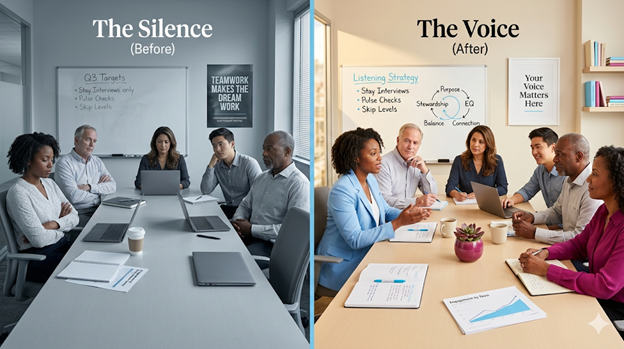
The numbers on employee engagement have been alarming for years, and they are not improving fast enough. Gallup’s 2024 State of the Global Workplace report found that only 23% of employees worldwide are engaged at work. That means 77% of the global workforce is either not engaged or actively disengaged. In the United States, the number is slightly better at 33%, but that still means two out of every three American workers are showing up without being fully invested in the work they do or the organizations they serve.

But here is the part that rarely makes the headlines. Disengagement does not always look like poor performance. Some of the most disengaged employees in your organization are hitting their numbers, meeting their deadlines, and attending every meeting. They are doing just enough to stay employed while investing their creativity, passion, and discretionary effort somewhere else. Gallup calls this “quiet quitting,” but that term obscures the real issue. These employees have not quit their work ethic. They have quit their belief that the organization deserves their best.

The engagement gap lives in the silence between what leaders ask and what employees reveal. A 2023 study by the Workforce Institute at UKG found that 74% of employees believe they are more effective when they feel heard, yet only 21% feel strongly that their employer genuinely listens to them. That 53 percentage point chasm is not a communication issue. It is a trust issue. And trust is the foundation upon which every other element of engagement is built.

🧠 The Psychology of Silence: Why Employees Stop Talking

Understanding why employees go silent requires understanding the concept of psychological safety, a term popularized by Harvard Business School professor Amy Edmondson. Psychological safety is the shared belief that a team is safe for interpersonal risk taking. It means employees feel they can speak up, ask questions, admit mistakes, and challenge ideas without fear of humiliation, punishment, or career consequences.

Google’s landmark Project Aristotle research confirmed that psychological safety is the single most important factor in high performing teams. Teams with high psychological safety outperformed their peers on every meaningful metric, not because they had smarter people, but because their people felt safe enough to contribute fully.

When psychological safety is absent, employees perform a constant internal calculation before every interaction. “If I raise this concern, will my manager retaliate?” “If I admit I do not understand, will I be seen as incompetent?” “If I challenge this decision, will I be labeled as difficult?” “If I share this idea, will someone else take credit for it?” These calculations happen in seconds, and they happen dozens of times a day. Over time, the cost of speaking up begins to consistently outweigh the perceived benefit, and silence becomes the rational choice.

In Mastering a High‑Value Company Culture, I describe the contrast between two operations managers I observed over the course of my career. One leader, whom I called Mark, created an environment where people felt safe to communicate openly and take ownership of their work. The other, Larry, fostered a climate of passive aggressive retaliation where employees learned quickly that honesty was punished. Both managers worked in the same company, under the same mission statement, governed by the same values poster on the wall. The difference in the cultures they created was entirely a function of whether their people felt psychologically safe enough to engage authentically.

🔇 The Seven Things Employees Think But Never Say

Based on more than 24 years of HR leadership across manufacturing, automotive, healthcare, nonprofit, quick service, and professional services industries, and informed by countless exit interviews, engagement surveys, skip level conversations, and confidential coaching sessions, the following represent the most common unspoken truths employees carry with them every day.

1. “I do not trust my manager with the truth.” 🤐

This is the foundational silence. When employees do not trust that their direct supervisor will handle honest feedback with maturity and without retaliation, they learn to tell leadership what it wants to hear. They smile in one on one meetings. They check “satisfied” on the survey. And they apply for other jobs in the parking lot.

2. “The recognition here feels performative.” 🏆

Employees can tell the difference between genuine recognition and scripted appreciation. When leaders praise publicly but criticize privately, when recognition goes to the same people regardless of contribution, or when “Employee of the Month” is chosen by rotation rather than merit, people disengage from the entire system. They stop seeking recognition and start seeking employers who notice real contributions.

3. “The promotion process is not fair.” 🚧

Few things erode engagement faster than watching someone less qualified advance while you are told to “be patient” or “keep doing great work.” When employees perceive that advancement is based on relationships rather than results, or that certain demographics consistently advance while others are passed over, the message is clear even if it is never spoken aloud: your ceiling is predetermined.

4. “My ideas are not welcome here.” 💡

Innovation does not die because employees lack creativity. It dies because employees stop offering their ideas after being dismissed, ignored, or worse, watching their ideas get implemented after someone else presents them. The engagement gap widens every time an employee sits in a meeting with a solution they will never share because the last time they spoke up, nothing happened.

5. “I am exhausted, and nobody cares.” 😩

Burnout has become normalized in many workplaces. Employees describe working through illness, skipping vacations, and taking on additional responsibilities after colleagues leave without any adjustment to workload or compensation. When they raise concerns, they are met with some version of “we all have to do more with less.” That response does not build resilience. It builds resentment.

6. “I do not see a future for me here.” 🔮

This may be the most dangerous unspoken truth because it represents the moment an employee transitions from disengaged to departing. When people cannot envision their next role, their next opportunity for growth, or their next milestone within the organization, they begin envisioning it somewhere else. The engagement gap becomes a retention crisis the moment an employee stops seeing themselves in the company’s future.

7. “I do not feel like I belong.” 💔

Belonging is not the same as inclusion, and it runs deeper than diversity metrics. An employee can be included in every meeting and still feel like they do not belong. Belonging means feeling that your authentic self is valued, that your perspective matters, and that your presence is not merely tolerated but genuinely wanted. When belonging is absent, engagement is impossible.

❤️ The Amplified Gap: How Silence Disproportionately Impacts Black Women

Every one of the seven unspoken truths listed above is experienced more acutely by traditionally overlooked employees, and most specifically by Black women in corporate spaces.

In Rise & Thrive: A Black Woman’s Blueprint for Leadership Excellence, I address what scholars call “double jeopardy,” the compounding reality of navigating bias related to both race and gender simultaneously. Black women face contradictory expectations in the workplace: be assertive but not aggressive, be visible but not too visible, be confident but not intimidating. The cognitive and emotional labor required to navigate these contradictions every day is exhausting and largely invisible to leadership.

McKinsey’s 2023 “Women in the Workplace” report, conducted with LeanIn.Org, found that Black women are more likely than any other demographic group to report that they cannot bring their authentic selves to work. They are more likely to experience microaggressions, to have their judgment questioned, to be mistaken for someone in a more junior role, and to feel that they need to outperform their peers just to be perceived as equally competent.

For Black women, the engagement gap is not simply about whether the organization listens. It is about whether the organization has created conditions where it is safe for them to speak at all. When a Black woman raises a concern and is labeled “angry,” she learns to stay silent. When she shares an idea and watches a peer present the same idea two weeks later to applause, she learns to keep her insights to herself. When she asks about her career trajectory and receives vague non answers while watching others with less experience advance, she learns that this organization’s version of meritocracy does not include her.

These are not isolated incidents. They are systemic patterns, and they create an engagement gap that is significantly wider and deeper for Black women than for their counterparts.

💡 Case in Point

There was a company in the healthcare industry that prided itself on strong engagement scores. The overall score hovered around 78%, well above the industry average. But when the HR team disaggregated the data by race and gender for the first time, a different picture emerged. Engagement among Black women in the organization was 52%, a full 26 points below the company average. The gap had been invisible for years because no one had thought to look at it.

When focus groups were convened, the themes were consistent. Black women described feeling invisible in team meetings, receiving feedback that felt racially coded, watching peers with less tenure receive developmental opportunities they had requested and been denied, and sensing that raising concerns would be career limiting. The organization’s culture was not universally broken. It was selectively broken, and the employees experiencing the worst of it were the least likely to report it through traditional engagement channels.

The company responded by implementing confidential listening sessions, disaggregated engagement tracking, bias awareness training for all people leaders, and an equitable sponsorship program. Within 12 months, engagement among Black women rose to 71%, closing the gap by 19 points. The company also saw improvements in overall engagement, innovation metrics, and retention across every demographic because the systemic issues affecting Black women had been dragging the broader culture down as well.

📈 Current Trends: The Evolving Engagement Landscape in 2025 and 2026

Several converging trends are reshaping how organizations must think about engagement and the silence that surrounds it.

  • Survey Fatigue and Declining Participation. Employees are increasingly skeptical of engagement surveys, particularly when previous surveys produced no visible changes. Response rates have declined across industries, and organizations that rely solely on annual surveys are getting an increasingly incomplete and unreliable picture of their culture.
  • The Rise of Passive Listening. Progressive organizations are supplementing surveys with passive listening tools that analyze communication patterns, meeting participation, collaboration networks, and sentiment from internal platforms to identify engagement signals without relying on employees to self report. These tools raise important ethical questions about privacy, but they represent a fundamental shift in how organizations measure the gap between what employees say and what they actually experience.
  • The Trust Recession. Edelman’s 2024 Trust Barometer found that trust in employers has declined for the second consecutive year. Employees increasingly question whether leadership decisions are made in their interest, particularly around return to office mandates, layoff strategies, and the deployment of AI technologies that may affect their roles. This broader trust recession makes the engagement gap harder to close because employees are starting from a lower baseline of belief in organizational sincerity.
  • Gen Z’s Vocal Disillusionment. Unlike previous generations who tended to disengage silently, Gen Z employees are more likely to voice their dissatisfaction publicly, on social media, in Glassdoor reviews, and in team Slack channels. While this transparency can be uncomfortable for leadership, it also provides organizations with more visible signals of the engagement gap than they have ever had before. The question is whether leaders are listening or dismissing these signals as generational entitlement.
  • Belonging as the New Engagement Frontier. Research from BetterUp has shown that workplace belonging is correlated with a 56% increase in job performance, a 50% reduction in turnover risk, and a 75% decrease in sick days. Organizations that focus exclusively on engagement metrics without measuring belonging are addressing the symptom while ignoring the cause.

✨ Closing the Gap: The High‑Value Leadership™ Approach

Closing the engagement gap requires more than better surveys and bigger budgets for pizza parties. It requires a fundamental shift in how leaders think about the relationship between culture, trust, and the daily experience of every employee. The High‑Value Leadership™ framework I developed through High‑Value Leadership: Transforming Organizations Through Purposeful Culture provides a structured approach to this shift, grounded in five interconnected pillars.

🎯 Purpose‑Driven Vision: Answering the “Why” Before the “What”

Employees disengage when they cannot connect their daily work to a meaningful purpose. Leaders who articulate a compelling “why” and consistently connect individual contributions to that larger mission create environments where people feel their work matters. When work matters, silence gives way to investment.

🏛️ Stewardship of Culture: Listening Before Directing

Culture does not maintain itself. It requires active stewardship, which begins with genuine listening. Stewardship means creating multiple, safe channels for employees to share their truth: not just annual surveys, but regular pulse checks, skip level meetings, stay interviews, anonymous feedback mechanisms, and walking the floor conversations that happen outside of formal settings. Stewardship also means acting visibly on what you hear, because listening without action is worse than not asking at all.

🧠 Emotional Intelligence: Reading What Is Not Said

Emotionally intelligent leaders do not wait for employees to raise their hands. They read body language, notice changes in participation, pay attention to who has stopped contributing in meetings, and follow up when something feels off. Daniel Goleman’s research has consistently demonstrated that emotional intelligence is the strongest predictor of leadership effectiveness. In the context of the engagement gap, it is the skill that allows leaders to hear what employees are thinking even when they are not saying it.

⚖️ Balanced Responsibility: Accountability with Humanity

High performing cultures balance accountability with genuine care for the people being held accountable. When accountability is imposed without empathy, it creates fear. When empathy is extended without accountability, it creates complacency. The balance between these forces is where psychological safety lives, and psychological safety is the single most important condition for closing the engagement gap.

🤝 Authentic Connection: Making It Safe to Be Honest

Authentic connection means building relationships where honesty is not just permitted but rewarded. It means leaders who share their own challenges, who admit when they do not have answers, who demonstrate vulnerability as a strength rather than a liability. When leaders model authenticity, they give employees permission to do the same. And when employees feel that permission, the engagement gap begins to close.

🌟 From My Experience: Lessons from 24+ Years on the Front Lines of Engagement

Across every industry I have served, the engagement gap has been a constant companion. I have seen it manifest differently depending on the environment. In manufacturing and automotive settings, it shows up as high absenteeism, safety incidents, and grievance filings. In healthcare, it appears as compassion fatigue, short staffing spirals, and patient care errors. In professional services, it looks like presenteeism, performative busyness, and the quiet exodus of top talent to competitors who promised what the current employer could not deliver.

There was an automotive manufacturing company that was experiencing a steady decline in its employee engagement survey scores over three consecutive years. Leadership attributed the decline to “post pandemic fatigue” and assumed it would resolve on its own. It did not. The HR team conducted confidential listening sessions with employees at every level and discovered a pattern: frontline workers felt that leadership made decisions that affected their daily lives without ever consulting them. Shift schedules were changed without input. Safety protocols were adjusted without explanation. Overtime was mandated without acknowledgment of the personal cost.

The employees had not stopped caring about their work. They had stopped believing that their input mattered. When the company implemented a structured feedback loop that included shift level advisory councils, transparent communication about scheduling decisions, and a recognition program designed with employee input, engagement scores reversed course within two quarters. The gap had not been about engagement programs. It had been about voice.

✅ Actionable Takeaways: 8 Steps to Close the Engagement Gap

  1. Disaggregate Your Engagement Data. Stop looking at your engagement scores as a single number. Break them down by department, team, tenure, and most critically, by race and gender. The gaps you discover will tell you where your culture is actually broken.
  2. Create Multiple Listening Channels. Annual surveys are not enough. Implement pulse surveys, skip level meetings, confidential listening sessions, stay interviews, and leader rounding. Different employees feel safe in different formats. Give them options.
  3. Close the Loop Visibly. When employees share feedback, they need to see evidence that it was received and considered. Communicate what you heard, what you are doing about it, and what you cannot change (and why). The fastest way to widen the engagement gap is to ask for feedback and then do nothing with it.
  4. Measure Psychological Safety Directly. Add specific questions to your engagement surveys that measure whether employees feel safe speaking up, challenging ideas, admitting mistakes, and being honest with their managers. Track these scores over time and by team.
  5. Train Leaders in Emotional Intelligence. Equip your managers with the ability to read nonverbal cues, ask open ended questions, create space for honest dialogue, and respond to vulnerability with support rather than judgment. These skills are trainable and their impact on engagement is measurable.
  6. Audit Your Belonging Practices. Go beyond inclusion metrics. Ask whether employees, especially Black women and other traditionally overlooked talent, feel they genuinely belong. Do they see themselves reflected in leadership? Are their cultural identities respected? Do they feel their perspectives are sought and valued?
  7. Redesign Recognition to Be Equitable and Specific. Examine who gets recognized, for what, and by whom. Ensure recognition is distributed equitably across demographics and that it is specific enough to feel meaningful. “Great job” is forgettable. “Your analysis in the Q3 review changed how we approach that entire product line” is transformational.
  8. Make Engagement a Leadership Accountability, Not an HR Program. Engagement should be a standing item on every leadership team agenda, reviewed with the same rigor as financial performance, quality metrics, and customer satisfaction. When engagement is treated as HR’s problem, it remains HR’s problem. When it becomes a leadership accountability, it becomes a business advantage.

💬 Discussion Questions for Your Leadership Team

Use these questions to open an honest conversation about the engagement gap in your organization:

  1. When was the last time an employee told us something we did not want to hear? How did we respond? And what does that response signal to everyone watching?
  2. If we disaggregated our engagement data by race and gender today, what would we find? Do we have the courage to look?
  3. Do our employees trust their direct supervisors enough to be honest? How do we know, and what evidence do we have beyond our own assumptions?
  4. Which of the seven unspoken truths in this article resonates most with what we suspect our employees are experiencing? What would we do differently if we treated that suspicion as fact?
  5. Are Black women and other traditionally overlooked employees in our organization experiencing a different culture than what our overall engagement scores suggest? What would it take to find out?
  6. Which of the five High‑Value Leadership™ pillars (Purpose‑Driven Vision, Stewardship of Culture, Emotional Intelligence, Balanced Responsibility, Authentic Connection) represents our organization’s biggest opportunity to close the engagement gap?
  7. If our employees could say one thing to leadership with complete safety and no consequences, what do we think they would say? And what are we doing to create the conditions where they actually can?

🚀 Next Steps: Start Hearing What Has Always Been There

The engagement gap is not new. It has always existed. What is new is our understanding of how much it costs, who it impacts most, and what it takes to close it. The employees in your organization are not withholding their truth to be difficult. They are withholding it because the environment has taught them that honesty is risky. Changing that equation is not a program. It is a leadership commitment.

If you are ready to move beyond surface level engagement scores and begin understanding the culture your employees actually experience, Che’ Blackmon Consulting can help. Through fractional HR leadership, culture assessments, engagement strategy development, and leadership coaching rooted in the High‑Value Leadership™ framework, we partner with organizations to create environments where employees do not just show up. They speak up, lean in, and stay.

Because the most dangerous thing in your organization is not a disengaged employee. It is the silence of an employee who stopped believing you wanted to hear the truth.

🌟 Ready to Transform Your Organization’s Culture?

Work with Che’ Blackmon Consulting

📧  admin@cheblackmon.com

📞  888.369.7243

🌐  cheblackmon.com

📚 Explore More from Che’ Blackmon

Mastering a High‑Value Company Culture – Available on Amazon

High‑Value Leadership: Transforming Organizations Through Purposeful Culture – Available on Amazon

Rise & Thrive: A Black Woman’s Blueprint for Leadership Excellence – E‑Book Available at cheblackmon.com

🎥 Rise & Thrive YouTube Series | 🎙️ Unlock, Empower, Transform Podcast

© 2026 Che’ Blackmon Consulting. All rights reserved.

High‑Value Leadership™ is a proprietary framework of Che’ Blackmon Consulting.

#EngagementGap #EmployeeEngagement #HighValueLeadership #PsychologicalSafety #WorkplaceCulture #CultureTransformation #BlackWomenInLeadership #EmployeeVoice #RetentionStrategy #HRLeadership #LeadershipDevelopment #TalentRetention #CheBlackmonConsulting #FractionalHR #InclusiveLeadership #BelongingAtWork #PeopleFirst #QuietQuitting #EmployeeExperience #RiseAndThrive

📚 Supervisor Coaching as Retention Strategy: Why Your Managers Are Your Biggest Flight Risk Factor

By Che’ Blackmon, DBA Candidate | Founder & CEO, Che’ Blackmon Consulting

There is an old saying in human resources that people do not leave companies; they leave managers. It has been repeated so often that it almost sounds like a cliché. But the reason it endures is because the data behind it is overwhelming, and most organizations still have not done anything meaningful about it.

Gallup’s research has confirmed this reality for over two decades. Managers account for at least 70% of the variance in employee engagement scores. That is not a typo. Seventy percent. Which means your supervisors, your shift leads, your department heads, and your frontline managers are not just influencing retention. They are your retention strategy, whether they know it or not. And whether they are equipped for that role or not.

In Mastering a High‑Value Company Culture, I wrote that culture is the lifeblood of any organization. But culture does not flow from mission statements framed in the lobby. It flows from the daily interactions between employees and the leaders closest to them. Your frontline supervisor who dismisses a concern without listening. Your department manager who plays favorites and calls it performance management. Your team lead who takes credit for someone else’s work without blinking. These are the moments where culture is built or destroyed, one conversation at a time. And these are the moments that determine whether your best people stay or go.

🚨 The Manager Gap: Promoted for Performance, Failing at People

One of the most consistent patterns across every industry I have worked in over more than 24 years of HR leadership, from automotive and manufacturing to healthcare, nonprofit, quick service, and professional services, is this: organizations routinely promote their best individual contributors into management roles and then provide little to no development for the leadership skills that role actually requires.

The best welder becomes the welding supervisor. The top performing nurse becomes the charge nurse. The highest billing associate becomes the team lead. The assumption is that because someone excels at doing the work, they will naturally excel at leading the people who do the work. That assumption is expensive and wrong.

A 2024 survey conducted by the Chartered Management Institute found that 82% of managers in the United Kingdom entered management roles without any formal training in leadership. While the study focused on the UK workforce, similar patterns have been well documented in the United States. The result is what researchers have termed “accidental managers,” individuals who hold authority over others without ever being taught how to lead, communicate, coach, or resolve conflict effectively.

In High‑Value Leadership: Transforming Organizations Through Purposeful Culture, I outline the concept of Balanced Responsibility as one of the five pillars of the High‑Value Leadership™ framework. Balanced Responsibility means holding people accountable while simultaneously investing in their development. When organizations promote people into supervisory roles without equipping them to lead, they violate this principle in both directions. They hold the new manager accountable for outcomes without providing the support to achieve them. And they hold the team accountable for engagement while placing them under someone who was never taught how to engage.

📉 What the Research Tells Us: Managers Are the Multiplier

The connection between manager quality and employee retention is not speculation. It is one of the most well documented relationships in organizational science.

Gallup’s 2024 State of the Global Workplace report found that employees who strongly agree their manager communicates effectively are 4.2 times more likely to be engaged at work. Meanwhile, employees who rate their immediate supervisor poorly are four times more likely to be actively looking for a new job. The report further noted that improving manager effectiveness is the single most impactful action an organization can take to improve overall workplace engagement and retention.

A separate study by the Work Institute’s 2023 Retention Report found that the top three reasons employees voluntarily leave organizations are career development opportunities, work life balance, and manager behavior. Of those three, manager behavior is the factor most within the organization’s immediate control because it can be improved through targeted coaching, development, and accountability.

Dr. John Gottman, the renowned relationship researcher, has identified that it takes a ratio of five positive interactions to one negative interaction to maintain a healthy relationship. While his work focuses on personal relationships, organizational psychologists have applied this principle to the workplace with striking results. Managers who maintain high ratios of positive to corrective interactions retain more people, receive higher trust scores, and produce stronger team outcomes. Managers who default to criticism, micromanagement, or indifference create environments where people emotionally disengage long before they formally resign.

🎯 The Five Coaching Competencies Every Supervisor Needs

Supervisor coaching is not about turning every manager into a therapist or a motivational speaker. It is about building a consistent, practical set of leadership competencies that directly influence whether employees feel valued, heard, and motivated to stay. Based on the High‑Value Leadership™ framework and more than two decades of applied experience, the following five competencies are the ones that matter most for retention.

🔑 1. Active Listening with Follow Through

Most employees do not expect their manager to solve every problem. What they expect is to be heard and to see evidence that their input was taken seriously. Active listening is not nodding during a conversation and then doing nothing. It is reflecting what was said, asking clarifying questions, and then following up with visible action or a transparent explanation of why action was not taken. When managers master this competency, trust builds quickly. When they fail at it, resentment builds faster.

🔑 2. Delivering Feedback That Develops, Not Deflates

Feedback is a tool. In the hands of a skilled leader, it sharpens performance. In the hands of an untrained supervisor, it creates fear, defensiveness, and disengagement. Effective supervisor coaching teaches managers how to deliver feedback that is specific, timely, behavior focused, and forward looking. It teaches them to replace statements like “you need to do better” with observations like “in yesterday’s team meeting, I noticed you had some strong ideas that you did not share until the end. I would love to see you bring those contributions in earlier next time because the team benefits from your perspective.” That shift in approach changes the entire dynamic.

🔑 3. Recognizing Contributions Authentically

Recognition is one of the most powerful and most underutilized retention tools available to any manager. And it costs nothing. A 2023 Workhuman and Gallup joint study found that employees who receive meaningful recognition are five times more likely to feel connected to their company’s culture and four times more likely to be engaged. Yet the same study found that only 23% of employees strongly agree they receive the right amount of recognition for the work they do. Supervisor coaching should include structured guidance on how to recognize contributions in ways that are specific, personal, and consistent. Generic praise like “good job” is forgettable. Recognition that names the specific contribution, explains its impact, and connects it to the team’s purpose is transformational.

🔑 4. Navigating Difficult Conversations Without Avoidance

Many supervisors avoid conflict because they were never taught how to handle it. They let performance issues fester until they become crises. They avoid addressing interpersonal tensions until the team fractures. They dodge conversations about compensation, career progression, or workload because they do not know what to say. This avoidance does not protect anyone. It signals to employees that their concerns are not important enough to address, which accelerates disengagement and turnover. Coaching supervisors in conflict navigation, using frameworks grounded in Emotional Intelligence (the third pillar of High‑Value Leadership™), equips them to have direct, respectful conversations that resolve issues rather than burying them.

🔑 5. Building Authentic Connection Across Difference

The fifth pillar of the High‑Value Leadership™ framework is Authentic Connection, and it is perhaps the most important competency for supervisors leading increasingly diverse teams. Authentic connection means knowing your people beyond their job titles. It means understanding what motivates them, what frustrates them, what their career aspirations are, and what makes them feel valued. It also means developing the cultural competence to connect effectively across differences of race, gender, generation, and background. Supervisors who build authentic connections with their teams create bonds that are far more durable than any compensation package or benefits plan.

❤️ The Overlooked Impact: When Manager Gaps Hit Black Women Hardest

The consequences of poorly equipped supervisors are not distributed equally across the workforce. Traditionally overlooked employees, and most specifically Black women in corporate spaces, experience the effects of unskilled management at a disproportionate rate.

In Rise & Thrive: A Black Woman’s Blueprint for Leadership Excellence, I address the reality that Black women face what scholars call “double jeopardy” in the workplace, navigating bias related to both race and gender simultaneously. This reality becomes especially acute when the person with the most direct power over your daily work experience, your immediate supervisor, lacks the emotional intelligence, cultural competence, or coaching skill to lead you equitably.

McKinsey’s 2023 “Women in the Workplace” research, conducted in partnership with LeanIn.Org, found that Black women are significantly more likely than white women to report that their manager does not advocate for them, does not provide useful feedback, and does not create opportunities for visibility. They are also more likely to report receiving feedback that is coded with racial and gender bias, such as being told they are “too assertive,” “intimidating,” or that they “need to soften their approach.”

These dynamics are not just uncomfortable. They are retention killers. When a Black woman’s manager does not have the competence to provide equitable coaching, fair recognition, and unbiased feedback, she experiences the workplace as a place that does not value her contributions. She begins to disengage. She stops volunteering for stretch assignments because the risk feels too high and the reward too unlikely. She updates her resume quietly. And when she leaves, the organization often has no idea that the root cause was not compensation, not location, not the role itself, but the person in the chair directly above hers.

💡 Case in Point

There was a company in the professional services sector that conducted an analysis of its voluntary turnover data over a three year period. When the data was segmented by demographic, the results were stark: Black women were leaving at nearly twice the rate of their white counterparts. Exit interviews pointed to a common theme. The departing employees did not feel supported by their direct supervisors. They described managers who overlooked them for project leadership, gave them vague feedback while providing detailed developmental guidance to peers, and excluded them from informal networking opportunities where real career decisions were made.

The company’s response was to implement a mandatory supervisor coaching program that included training on bias awareness, equitable feedback practices, and inclusive sponsorship. Within 18 months, voluntary turnover among Black women in the organization decreased by 34%. The program did not just improve diversity metrics. It improved overall team performance and engagement scores across every demographic, because the skills that make a supervisor effective with overlooked talent are the same skills that make them effective with everyone.

📈 Current Trends: The Coaching Revolution in 2025 and 2026

Several converging trends are pushing supervisor coaching from a “nice to have” to a strategic imperative for forward thinking organizations.

  • The Manager Burnout Epidemic. Managers themselves are burning out at record rates. A 2024 report from Microsoft’s Work Trend Index found that 53% of managers say they feel burned out at work, making them less effective leaders and more likely to leave themselves. Coaching is not just about making managers better for their teams. It is about sustaining the managers who hold the organization together.
  • The Shift from Performance Reviews to Ongoing Coaching. Leading organizations are abandoning the annual performance review in favor of continuous coaching conversations. Companies like Adobe, Microsoft, and Deloitte have restructured their performance management systems around regular one on one coaching interactions. This shift demands that supervisors develop real coaching skills, not just the ability to fill out a rating form once a year.
  • Gen Z’s Non Negotiable Demand for Feedback. The newest generation in the workforce is vocal about wanting frequent, constructive, and personalized feedback from their managers. Research from Deloitte’s Gen Z and Millennial Survey consistently shows that young employees prioritize manager quality and development support above nearly every other factor when evaluating whether to stay with an employer.
  • AI as a Coach Amplifier, Not a Replacement. Organizations are beginning to deploy AI tools that support managers with real time coaching prompts, sentiment analysis from team surveys, and personalized development recommendations. These tools are promising, but they amplify the effectiveness of already skilled coaches. They cannot compensate for a manager who fundamentally lacks the ability to connect with, listen to, and develop people.
  • Psychological Safety as a Business Metric. Google’s Project Aristotle research established that psychological safety is the most important factor in high performing teams. That research has now been widely adopted, and progressive organizations are measuring psychological safety as a leading indicator of both engagement and retention. Since supervisors are the primary architects of psychological safety within their teams, coaching them in this area has become a direct investment in business performance.

🛠️ Building a Supervisor Coaching Program That Actually Works

Many organizations have attempted manager training programs that produced no lasting change. The workshops were attended, the evaluations were completed, and within 30 days the old behaviors returned. The difference between training that fades and coaching that transforms is structural. Effective supervisor coaching programs share several critical design elements.

✨ Element 1: Anchor Coaching in Organizational Purpose

The first pillar of the High‑Value Leadership™ framework is Purpose‑Driven Vision. Supervisor coaching should not be positioned as remedial or punitive. It should be framed as a strategic investment in the organization’s mission. When managers understand that their coaching deve