Blog

Predictive Workforce Analytics: Turning Data Into Your Strategic Pot of Gold

By Che’ Blackmon, DBA Candidate | Founder & CEO, Che’ Blackmon Consulting

There is a running conversation in boardrooms and HR offices across every major industry that goes something like this: we did not see it coming. A top performer resigned without warning. An entire department’s engagement quietly collapsed before anyone noticed. A pattern of turnover that seemed random was, in retrospect, entirely predictable. The information was there. The signals were there. The data existed in performance management systems, engagement surveys, compensation records, and attendance logs. What was missing was not the data. What was missing was the willingness and the infrastructure to use it before the damage was done.

Predictive workforce analytics is the practice of using historical and real-time data to forecast future workforce outcomes, including turnover, engagement decline, skills gaps, and succession readiness, before those outcomes materialize as crises. It is one of the most powerful tools available to modern HR leaders and organizational executives, and it remains one of the most underutilized. The gap between organizations that use analytics reactively and those that use them predictively is measured in millions of dollars, in leadership pipeline depth, and in the competitive advantage that comes from never being surprised by your own people.

This article is about closing that gap. It is about what predictive workforce analytics actually is, what it makes possible, how it connects to the culture and leadership infrastructure that makes data meaningful, and why the organizations that get this right are positioned to outperform everyone who is still waiting for the exit interview to learn what they should have known six months earlier.
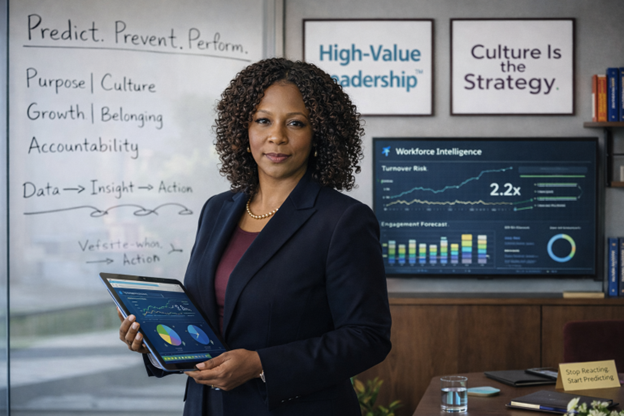
📈 From Rearview Mirror to Windshield: What Predictive Analytics Actually Does

Most workforce data is used descriptively. It tells you what happened. Turnover rate last quarter. Average time to fill open roles. Engagement scores from the last survey. Absenteeism trends by department. This is valuable information, but it is historical. By the time you are reading it, the story it tells has already been written and many of the decisions that would have changed the outcome are no longer available to you.

Predictive analytics shifts the orientation from the rearview mirror to the windshield. Instead of asking what happened, it asks what is likely to happen next and what we can do about it now. Machine learning models, statistical analysis, and integrated data systems are used to identify patterns across multiple data points simultaneously, patterns that no human manager can reliably detect by reviewing reports in isolation. When those patterns are identified early enough, leaders have a window of time in which intervention is both possible and effective.

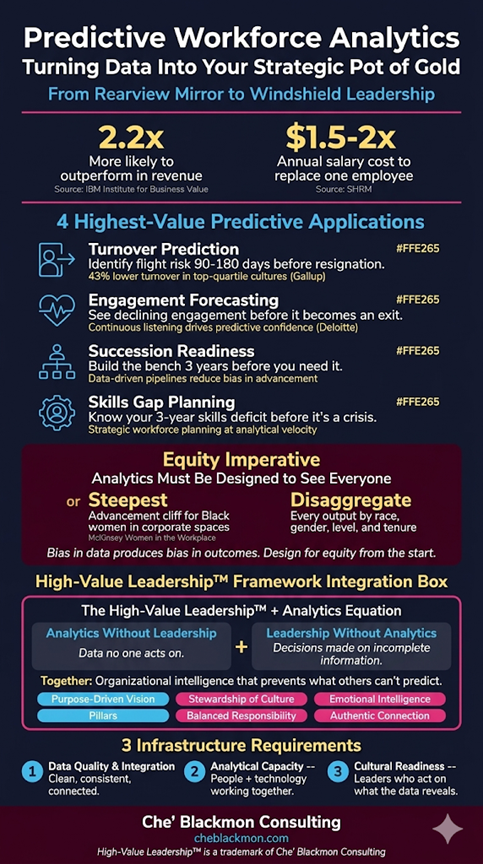
According to a 2023 IBM Institute for Business Value report, organizations that use predictive people analytics are 2.2 times more likely to outperform their peers in revenue growth and 1.5 times more likely to successfully retain high performers. These outcomes are not produced by the analytics alone. They are produced by the combination of good data and leaders who are committed to acting on what the data reveals. Analytics without cultural readiness to respond is just expensive reporting.

💡 Predictive analytics does not replace human judgment. It informs it with precision and timing that human intuition alone cannot match.

🔬 The Four Highest-Value Predictive Analytics Applications in Workforce Strategy

📌 1. Turnover Prediction

Voluntary turnover is the single most expensive and most preventable people problem in most organizations. The Society for Human Resource Management estimates the cost of replacing an employee ranges from one-half to two times their annual salary when recruitment, onboarding, and productivity loss are fully calculated. For organizations with chronic turnover, the cumulative annual cost is often in the millions, and the organizational energy required to perpetually backfill roles that should never have been vacated is a strategic tax on everything else the organization is trying to accomplish.

Predictive turnover models analyze dozens of variables simultaneously, including tenure, compensation relative to market, promotion recency, manager effectiveness scores, engagement survey responses, project assignment patterns, and even communication frequency in collaborative platforms. These variables, individually, are insufficient signals. In combination and over time, they produce a turnover risk score that can identify employees who are likely to leave 90 to 180 days before they submit a resignation letter. That window is everything. It is the difference between losing someone and retaining them.

There was a healthcare organization that implemented a turnover prediction model after experiencing a costly string of departures in a critical clinical department. The model identified a cluster of mid-level professionals who scored high on several simultaneous risk indicators, including stalled compensation growth, declining engagement scores, and a pattern of declining project participation. The organization intervened with targeted retention conversations, compensation adjustments, and development opportunities. The retention rate for that identified cohort exceeded 85 percent over the following year, and the cost avoidance from retained institutional knowledge was substantial.

📌 2. Engagement Forecasting

Engagement surveys measure the current state of employee sentiment at a single point in time. They are useful, but they are inherently delayed indicators. By the time disengagement shows up in an annual survey, it has typically been building for months, and the employees most affected may have already mentally resigned even if their physical departure has not yet followed. Predictive engagement modeling uses continuous data streams, including recognition frequency, performance review scores, absenteeism patterns, and internal mobility activity, to forecast engagement trajectories rather than simply measuring current states.

The practical application is transformative. Instead of discovering that a department’s engagement has dropped 12 points in the annual survey and then spending a quarter diagnosing the root cause, predictive engagement forecasting allows leaders to see the trajectory six months earlier, before it becomes a survey result, and intervene in ways that are proportionate to the early-stage signal rather than reactive to a full-blown engagement crisis.

Deloitte’s Global Human Capital Trends research has found that organizations using continuous listening strategies combined with predictive modeling report significantly higher confidence in their ability to prevent engagement decline before it becomes a retention event. The infrastructure required is not primarily technological. It is cultural. Organizations must build environments where employees are willing to provide authentic signal data, and that willingness is built through trust, not through surveillance.

📌 3. Succession Readiness and Leadership Pipeline Analytics

Succession planning in most organizations is an annual exercise. A list of names is generated for each critical role, assessed through a combination of performance reviews and manager nominations, and then filed until the next annual review cycle. This approach has two significant failures. First, it is static in a workforce that is dynamic. People develop, plateau, and sometimes exit between annual reviews in ways the succession plan does not capture. Second, it is deeply susceptible to the informal biases that determine whose name a manager thinks to put on a list.

Predictive succession analytics changes both of these dynamics. It creates a continuous, data-driven picture of pipeline depth by analyzing skill trajectories, learning and development engagement, performance trends over time, cross-functional experience, and leadership assessment data. It identifies not just who is ready for advancement but who is on a readiness trajectory, which is arguably more valuable because it gives the organization time to develop talent rather than simply select from a pool that already exists.

In High-Value Leadership: Transforming Organizations Through Purposeful Culture, the stewardship of culture is identified as a foundational leadership responsibility. Stewardship of a leadership pipeline requires the same intentional investment, and predictive analytics makes that stewardship precise in ways that informal succession conversations cannot. There was a manufacturing organization that used pipeline analytics to identify a significant gap in its next-generation leadership bench three years before the projected wave of senior retirements. That three-year runway allowed the organization to invest in accelerated development programs and internal mobility initiatives that would have been impossible to execute in a reactive timeframe.

📌 4. Skills Gap and Workforce Planning Analytics

The pace of technological change, industry disruption, and evolving market demands means that the skills your organization needs in three years are meaningfully different from the skills your workforce currently holds. Most organizations have no systematic visibility into this gap. They hire for current needs, develop for current capabilities, and then discover the skills deficit when it has already translated into a competitive disadvantage or a failed technology implementation.

Predictive skills gap analytics maps current workforce capabilities against projected future requirements and identifies the delta. It surfaces which roles are at highest risk of being underskilled for near-future needs, which employees are on development trajectories that position them well for emerging requirements, and where recruiting investment should be targeted to address gaps that internal development cannot close in time. This is workforce planning operating at strategic velocity rather than administrative pace.

✨ The Equity Imperative: Predictive Analytics and the Traditionally Overlooked

Predictive workforce analytics carries an enormous promise for equity and inclusion, and an equally significant risk of amplifying existing inequities if it is not designed and deployed with intentionality. This distinction matters profoundly, and it matters most for the professionals who have historically been most disadvantaged by the informal, relationship-driven, and often biased processes that analytics is designed to replace.

🚨 When Algorithms Inherit Bias

Data does not lie. But data can encode the decisions of systems that did. If an organization’s historical promotion data reflects years of bias against Black women and other underrepresented professionals, a predictive model trained on that data will encode those biases as predictive signals. The model will learn that the profile most likely to be promoted is the profile that has historically been promoted, regardless of whether that outcome reflects actual performance potential or simply pattern recognition of who was already advantaged.

This is not a theoretical risk. Amazon’s well-documented 2018 abandonment of an AI-based recruiting tool that systematically down-ranked resumes from women was a high-profile demonstration of exactly this dynamic. The model was trained on a decade of hiring decisions, and those decisions reflected the company’s historical pattern of male-dominated technical hiring. The algorithm learned to replicate that pattern as a success criterion.

The lesson is not that predictive analytics cannot serve equity. The lesson is that it will serve whatever the data encodes unless explicit corrective design choices are made. Bias audits of training data, diversity-adjusted weighting in model design, ongoing disparity monitoring in model outputs, and regular human review of algorithmic recommendations are all required elements of an equitable analytics infrastructure.

💡 The Case for Equity-Centered Analytics for Black Women

For Black women in corporate environments, the historic experience has been one of performing at a high level while advancement pathways remain narrow and informal sponsorship networks remain inaccessible. McKinsey and Company’s Women in the Workplace research has documented consistently that Black women face the most pronounced advancement gap of any demographic group, are the least likely to receive sponsorship, and are the most likely to have their contributions credited to others.

An analytics infrastructure designed with equity as a design principle changes this dynamic structurally. When advancement criteria are explicit and measurable rather than implicit and relational, the informal favoritism that has historically shaped who gets considered loses its power. When turnover risk models flag high-performing Black women as retention risks based on data rather than leaving the identification to managers who may have limited visibility into the drivers of their experience, organizations gain the ability to intervene before losing people they should have been actively developing.

In Rise and Thrive: A Black Woman’s Blueprint for Leadership Excellence, the argument is clear that structural change requires structural tools. Predictive analytics, when designed and deployed with equity as a non-negotiable design criterion, is one of the most powerful structural tools available for dismantling the informal systems that have kept Black women and other overlooked professionals from advancing at the rate their performance warrants.

📚  Rise & Thrive Connection: The data visibility that predictive analytics provides for organizations mirrors the strategic self-awareness that Rise and Thrive builds for individual professionals. Both are about seeing clearly, acting early, and refusing to be surprised by outcomes that were always preventable with the right information and the right systems.

There was a professional services organization that implemented an equity analytics layer on top of its existing workforce reporting. This layer disaggregated every key metric, including promotion rates, development program participation, stretch assignment allocation, and turnover risk scores, by race, gender, and career level simultaneously. The findings were not comfortable. Black women at the mid-manager level were significantly underrepresented in high-visibility project assignments, significantly underrepresented in the sponsorship program nominations, and significantly overrepresented in the high turnover risk cohort. None of these patterns had been visible in aggregate reporting. All of them were visible the moment the data was disaggregated. The organization redesigned its sponsorship nomination process, revised its project assignment criteria, and implemented structured check-in protocols for the identified high-risk cohort. Representation in senior leadership for Black women improved meaningfully over the following two years.
🏗️ Building the Infrastructure: What Predictive Analytics Requires

Predictive workforce analytics is not a software purchase. It is an organizational capability that requires infrastructure at three levels: data quality, analytical capacity, and cultural readiness to act on what the data reveals. All three are necessary. None is sufficient alone.

💻 Data Quality and Integration

Predictive models are only as good as the data they are trained on. Organizations with fragmented HRIS systems, inconsistent performance management practices, or gaps in data collection cannot produce reliable predictive outputs from poor inputs. Before investing in advanced analytics capability, organizations must honestly assess whether their data is clean, consistent, integrated, and comprehensive enough to support predictive modeling. This is often a multi-year infrastructure investment, but it is also the foundation on which every other analytics capability rests.

The specific data domains most critical for workforce prediction include performance management records over time, compensation history and market positioning, engagement survey data with longitudinal tracking, learning and development completion and application, organizational network analysis data, and manager effectiveness metrics. Organizations that have consistent, high-quality data in these domains have the raw material for powerful predictive capability. Those that do not need to build the foundation before expecting the insight.

🧠 Analytical Capacity: People and Technology

The technology landscape for predictive workforce analytics has matured significantly. Platforms including Visier, Workday People Analytics, SAP SuccessFactors Analytics, and IBM Watson Talent provide increasingly accessible predictive capability built on top of existing HR data infrastructure. Many of these platforms offer pre-built turnover prediction and engagement forecasting models that can be configured to an organization’s specific data environment without requiring a dedicated data science team.

The human capacity requirement is equally important. HR leaders who can translate analytical outputs into strategic conversations with business partners, who can communicate risk and opportunity in the language of revenue and competitive advantage rather than HR metrics, and who can advocate for data-driven interventions in organizations where intuition and relationships have historically driven people decisions are the irreplaceable human layer in any analytics capability. Technology surfaces the insight. HR leadership converts it into action.

🌱 Cultural Readiness: The Most Underestimated Requirement

The most sophisticated analytics infrastructure produces no value in an organization whose culture is not ready to act on what the data reveals. Cultural readiness for predictive analytics means leaders who are willing to be told that their department has a turnover risk cluster, who treat that information as an asset rather than an accusation, and who take proportionate action before the risk materializes rather than managing the aftermath of a departure that was predictable.

It also means an organizational commitment to using data as a tool for equity rather than efficiency alone. Mastering a High-Value Company Culture argues that cultures that endure are cultures built on transparency, accountability, and the genuine investment of leaders in the people they lead. Predictive analytics is a transparency tool. It makes visible what informal observation misses, and it creates accountability for acting on what is now impossible to claim was unseen.

💡 Data does not change culture. Leaders do. Predictive analytics gives leaders information early enough and precisely enough to lead differently. What they do with it is still a leadership choice.

📉 The High-Value Leadership™ Connection: Analytics in Service of Culture

The High-Value Leadership™ framework, anchored in Purpose-Driven Vision, Stewardship of Culture, Emotional Intelligence, Balanced Responsibility, and Authentic Connection, does not exist in tension with data-driven leadership. It is its philosophical foundation. Each pillar of the framework is both a cultural aspiration and a measurable domain that analytics can inform.

Purpose-Driven Vision requires that leaders understand whether employees experience a meaningful connection between their work and the organizational mission. Engagement analytics can measure that connection continuously and flag when it is eroding before it becomes disengagement. Stewardship of Culture requires that leaders actively monitor and respond to the health of the organizational culture. Turnover prediction and equity analytics are the instruments through which that stewardship becomes precise rather than impressionistic. Emotional Intelligence in leadership produces measurable outcomes in team safety, feedback quality, and collaborative effectiveness that analytics can surface. Balanced Responsibility is sustained when accountability systems are consistent and transparent, conditions that data visibility supports directly. Authentic Connection produces the trust that makes employees willing to provide the honest signal data that makes analytics useful in the first place.

The synergy is this: analytics without High-Value Leadership produces data that no one acts on. High-Value Leadership without analytics produces well-intentioned leadership that is still making decisions with incomplete information. Together, they produce the kind of organizational intelligence that allows leaders to steward their culture, protect their people, and build competitive advantage with a precision that neither achieves independently.

🛠️ Actionable Takeaways: Getting Started With Predictive Analytics

The following takeaways are designed for HR leaders, executives, and organizational stakeholders who are ready to move from descriptive to predictive workforce intelligence.

✅ For Organizational Leaders and HR Professionals

1. Assess Your Data Foundation First

Before investing in predictive analytics technology, audit the quality, consistency, and integration of your existing workforce data. Identify which critical data domains are well-captured and which have significant gaps. Build a data readiness roadmap as the first step in your analytics strategy rather than assuming technology can compensate for data quality deficits.

2. Start With Turnover Prediction

Turnover prediction is the highest immediate ROI application of predictive analytics for most organizations because the cost of preventable departure is large, the data required is widely available, and the intervention options are well-established. Implement a turnover risk model, integrate it into your manager toolkit, and establish a clear protocol for what action is taken at what risk threshold.

3. Disaggregate Every Output by Demographics

From the moment you begin producing predictive analytics outputs, establish the practice of disaggregating those outputs by race, gender, career level, and tenure simultaneously. What looks like a uniform pattern in aggregate data is often a significant disparity when examined by demographic segment. That disparity is both an equity signal and a strategic risk signal. Invisible inequity is expensive equityy and it is also just expensive.

4. Build Equity Audits Into Your Analytics Governance

Establish a regular review cycle in which your predictive models are audited for disparate impact. Examine whether model outputs, such as who is flagged as high turnover risk or high promotion potential, are distributed equitably across demographic groups. Where disparities are found, diagnose whether they reflect genuine differences in circumstance or whether they encode historical bias, and redesign accordingly.

5. Develop HR’s Analytical Fluency

The technology is increasingly accessible. The human capability to use it strategically is the limiting factor in most organizations. Invest in developing your HR team’s ability to work with data, translate analytics outputs into business language, and advocate for data-driven interventions at the executive level. This is a capability investment with compounding returns.

✨ For Individual Professionals Navigating Data-Driven Organizations

Understand How Decisions Are Being Made About You

In organizations with active analytics capabilities, workforce decisions are increasingly informed by algorithmic assessments. Understand what metrics are being tracked, what they are used for, and whether the organization has equity governance in place. Professionals who understand the data systems that influence their advancement are better positioned to advocate for themselves within those systems.

Build Your Own Evidence Base

Whether or not your organization has sophisticated analytics, you can build your own evidence base of documented contributions, quantified outcomes, and recorded feedback. This serves as your personal data infrastructure for advancement conversations and as a counterweight to any informal bias in how your performance is perceived relative to how it is documented.

💬 Discussion Questions for Leaders and Teams

Use these questions to drive strategic conversations within your organization, HR function, or leadership development cohort.

  • If your organization implemented a turnover prediction model today and it identified your ten highest-risk employees, how confident are you that your leaders would act on that information? What cultural readiness barriers exist?
  • When you look at your current succession pipeline analytics, how confident are you that the names on your succession plan reflect actual performance trajectories rather than informal relationship capital and proximity to decision-makers?
  • Has your organization ever disaggregated its workforce data by race and gender simultaneously at the career-level? What do you think you would find? What would you do with it?
  • If you are a Black woman or member of another underrepresented group: how transparent is the data that informs advancement decisions in your organization? And how are you building your own evidence infrastructure to ensure your contributions are visible and documented?
  • What is one specific workforce outcome your organization experienced in the last two years that predictive analytics could have prevented? What would the organizational value of that prevention have been?

🚦 Next Steps: Building Your Predictive Analytics Capability

Turning workforce data into strategic gold requires commitment, infrastructure, and the cultural leadership to act on what the data reveals. Here is where to begin.

  1. Conduct a data readiness audit. Assess the quality, consistency, and integration of your current workforce data across the domains critical for predictive modeling.
  2. Identify your highest-priority predictive use case. For most organizations, turnover prediction offers the clearest immediate ROI and the most established model design.
  3. Establish demographic disaggregation as a standard practice in all workforce reporting, not as an add-on equity initiative but as core analytical hygiene.
  4. Invest in HR analytical fluency. Identify the capability gaps on your team and build a development plan that includes data literacy, analytics interpretation, and business case communication.
  5. Build equity governance into your analytics infrastructure from the beginning. Design bias audits, disparity monitoring, and human review protocols before you deploy models, not after disparities are discovered.
  6. Revisit the High-Value Leadership™ framework and its five pillars as the cultural foundation on which your analytics capability will either flourish or stall. Data in the hands of High-Value Leaders is a transformative organizational asset.

🚀 Ready to Turn Your Workforce Data Into Strategic Gold?

Che’ Blackmon Consulting partners with organizations and leaders who are serious about building the analytics infrastructure and the cultural leadership capacity to use workforce data as a genuine strategic asset. Whether you are building your first predictive capability, auditing existing analytics for equity, or developing the High-Value Leadership™ competencies that make data actionable, we bring the frameworks, experience, and tools to move your organization forward.

📧 admin@cheblackmon.com     📞 888.369.7243     🌐 cheblackmon.com

About the Author

Che’ Blackmon is a doctoral candidate in Organizational Leadership (DBA), the Founder and CEO of Che’ Blackmon Consulting, and a recognized expert in culture transformation, fractional HR leadership, and high-value leadership development. With more than 24 years of progressive HR leadership experience spanning manufacturing, automotive, healthcare, nonprofit, quick-service, and professional services industries, she brings a practitioner’s perspective to the intersection of workforce strategy, people analytics, and culture transformation. She is the author of Mastering a High-Value Company Culture, High-Value Leadership: Transforming Organizations Through Purposeful Culture, and the e-book Rise and Thrive: A Black Woman’s Blueprint for Leadership Excellence. Che’ is the creator of the proprietary High-Value Leadership™ framework and the host of the Unlock, Empower, Transform podcast.

© 2025 Che’ Blackmon Consulting. All rights reserved. | High-Value Leadership™ is a trademark of Che’ Blackmon Consulting.

#WorkforceAnalytics #PredictiveAnalytics #HRStrategy #PeopleAnalytics #HighValueLeadership #CompanyCulture #EmployeeRetention #HRLeadership #BlackWomenLead #WorkplaceBias #DataDrivenHR #OrganizationalCulture #CultureTransformation #FractionalHR #CheBlackmonConsulting
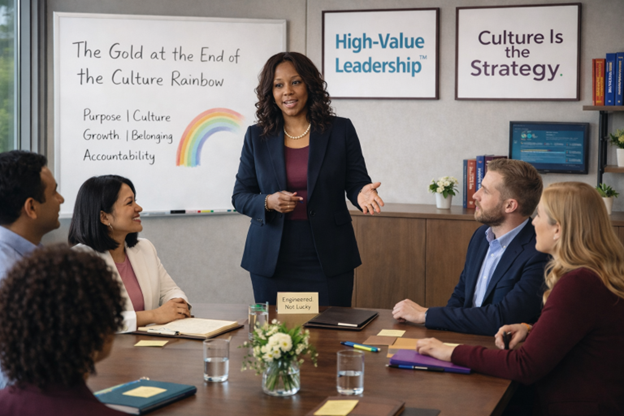
St. Patrick’s Day: The Gold at the End of the Culture Rainbow — What High-Value Organizations Actually Find

By Che’ Blackmon, DBA Candidate | Founder & CEO, Che’ Blackmon Consulting

Every St. Patrick’s Day, the legend gets told again. Somewhere at the end of a rainbow, there is a pot of gold. The leprechaun guards it. Most people never reach it. And even in the stories where someone does find it, the gold has a way of disappearing before it can be held onto for long. It is a charming myth. But for the leaders and organizations chasing culture transformation, it is also a surprisingly accurate metaphor for what happens when culture is treated as something to be discovered rather than something to be built.

The truth is this: high-value culture is not found at the end of a rainbow. It does not appear because the timing is finally right, because the budget loosened up, or because a new HR initiative declared the organization a great place to work. It is engineered. It is earned. It is sustained through intention, investment, and the kind of leadership that refuses to let values be decorative. And the organizations that actually reach that gold? They find something far more valuable than luck.

This St. Patrick’s Day, let us look at what high-value organizations actually find at the end of a culture well built, why so many organizations never make it there, and what it takes to follow the rainbow all the way through.

🌈 The Rainbow Is Real. The Luck Is Not.

In Irish folklore, the rainbow is beautiful but elusive. You can see where it is going, but every time you try to follow it, the end keeps moving. That is exactly how most organizations experience culture. They can see what a great culture looks like. They attend the conferences, read the case studies, and draft the values statements. But every time they try to close the gap between aspiration and reality, the destination seems to shift. The culture they are chasing never quite arrives.

The reason is almost always the same. They are following the rainbow instead of building the path. Culture is not a destination you find. It is an infrastructure you construct, one system, one decision, and one leadership behavior at a time. The organizations that treat it as something to be discovered are always in pursuit. The organizations that treat it as something to be engineered are the ones that eventually stand next to the pot of gold and say: we built this.

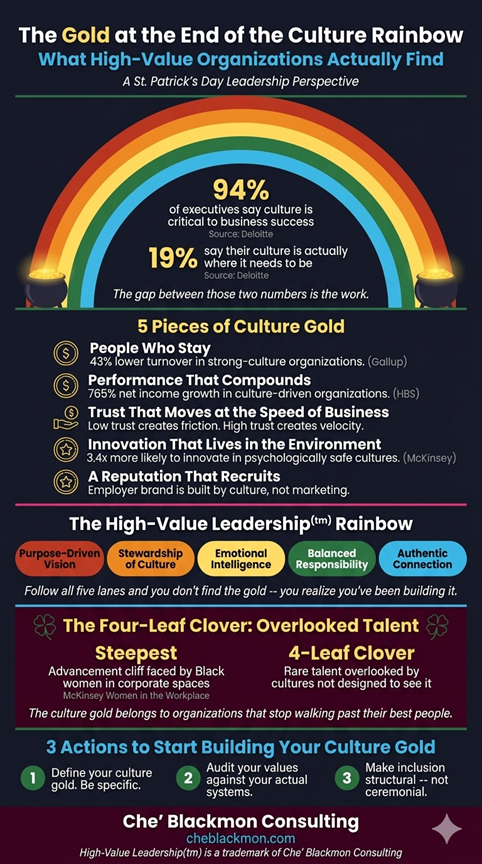
Research from Deloitte found that 94 percent of executives and 88 percent of employees believe a distinct workplace culture is important to business success. But only 19 percent of organizations feel their culture is where it needs to be. That gap is not a mystery. It is the distance between knowing culture matters and actually doing the disciplined work of creating it.

🍀 The rainbow is real. The culture gold is attainable. But it requires a map, not a wish.

🪨 The Pot of Gold: What High-Value Organizations Actually Find

When organizations do the work, the rewards are not abstract. They are measurable, durable, and transformative in ways that show up on both the balance sheet and the daily experience of every person who walks through the door. Here is what high-value organizations actually find at the end of a culture well built.

🥇 Gold Piece 1: People Who Stay

Voluntary turnover is one of the most costly and least discussed failures in organizational life. According to the Society for Human Resource Management, replacing a single employee costs between one half and two times that employee’s annual salary. For a workforce of any size, chronic turnover is not a staffing inconvenience. It is a financial hemorrhage. And the most common cause is not compensation. It is culture.

Gallup’s research consistently finds that employees in organizations with strong cultures are 43 percent less likely to leave voluntarily. They stay not because they cannot find something better elsewhere. They stay because what they have built here, the relationships, the purpose, the sense that their contribution matters, is genuinely difficult to replicate. That loyalty is not manufactured by a retention bonus or a perks program. It is the natural result of a culture that made them feel seen, valued, and invested in over time.

There was a manufacturing organization that had experienced significant voluntary turnover at the senior individual contributor level for three consecutive years. Every exit interview cited the same themes: unclear expectations, leadership that did not listen, and a sense that longevity was penalized rather than rewarded. When the organization committed to a structured culture realignment, including redesigned feedback systems, visible leadership accountability, and a formal internal mobility program, voluntary turnover dropped measurably within 18 months. The gold was not a new benefit. It was a culture that finally said: you belong here and your future is here.

🥇 Gold Piece 2: Performance That Compounds

Culture and performance are not separate conversations. They are the same conversation. Organizations with strong, intentional cultures outperform their peers not occasionally but consistently and significantly. A comprehensive study from Harvard Business School found that organizations with performance-enhancing cultures saw net income growth of 765 percent over an 11-year period, compared to 1 percent growth in organizations without strong cultures. These are not marginal differences. They are civilizational.

The mechanism is not magic. It is engagement. When people work in cultures where they understand the purpose, trust the leadership, feel psychologically safe to contribute, and see a clear connection between their effort and the organizational outcome, they work differently. Not harder in the frantic, depleting sense. Better. More creatively. More collaboratively. More sustainably. That quality of contribution compounds over time in ways that no individual talent acquisition strategy can replicate.

In High-Value Leadership: Transforming Organizations Through Purposeful Culture, the argument is that culture is not a byproduct of good strategy. It is the precondition for good strategy working at all. The same strategic plan produces wildly different outcomes depending on the culture in which it is executed. High-value culture multiplies every other organizational investment.

🥇 Gold Piece 3: Trust That Moves at the Speed of Business

In low-trust organizations, everything slows down. Decisions require more layers of approval. Information moves through gatekeepers instead of channels. Collaboration requires negotiation instead of assumption. Conflict generates defensiveness instead of resolution. The friction of low trust is invisible on an org chart but absolutely visible in the pace and quality of organizational output.

Patrick Lencioni, in The Five Dysfunctions of a Team, identified absence of trust as the foundational dysfunction from which every other organizational failure flows. High-value cultures build trust systemically, through consistent leadership behavior, transparent communication, psychological safety, and accountability that applies equally to everyone regardless of title or tenure. When that trust is present, organizations move faster, decide better, and recover from setbacks more completely.

There was a professional services organization that had struggled with a culture of internal competition that made information sharing a liability rather than a norm. Leaders hoarded insights. Teams duplicated work rather than collaborating. Client outcomes suffered. When leadership committed to a culture of transparent communication, shared accountability metrics, and visible recognition of collaborative behavior, the pace of client delivery improved significantly and internal satisfaction scores rose within two quarters. Trust, it turns out, is not soft. It is infrastructure.

🥇 Gold Piece 4: Innovation That Lives in the Environment

The most innovative organizations in the world are not innovative because they hired creative people. They are innovative because they built cultures in which creative thinking is safe, encouraged, and acted upon. Innovation does not live in a person. It lives in the conditions the culture creates for that person to bring their full thinking to work.

A 2023 McKinsey report found that organizations with psychologically safe cultures were 3.4 times more likely to report above-average innovation performance. Psychological safety, the belief that one can speak up, offer ideas, challenge assumptions, and admit mistakes without fear of punishment, is not a personality trait. It is a cultural output. It is produced by leaders who model intellectual humility, by systems that reward the raising of problems as well as the delivery of solutions, and by norms that treat disagreement as a gift rather than a threat.

Mastering a High-Value Company Culture makes the case that innovation is not a strategy. It is a symptom of a culture that has already done the foundational work of building safety, clarity, and genuine investment in its people. You cannot bolt on innovation. You have to grow the conditions from which it naturally emerges.

🥇 Gold Piece 5: A Reputation That Recruits

Employer brand is not built by marketing. It is built by culture. The organizations that consistently attract top talent without extraordinary compensation packages are the organizations whose reputation precedes them. People talk about where they work. They talk about how they were treated, whether their contributions were recognized, whether leadership lived the values stated on the website, and whether they would send a friend to apply. That word-of-mouth infrastructure, built entirely from genuine employee experience, is among the most powerful recruiting tools available and it costs nothing to create except the commitment to building a culture worth talking about.

✨ The Clover in the Crowd: Seeing Overlooked Talent as Organizational Gold

There is a particular element of the St. Patrick’s Day mythology that deserves a longer look in this context. The four-leaf clover is rare precisely because most people walk past thousands of three-leaf clovers without stopping to look carefully. The four-leaf version is not fundamentally different. It is simply overlooked by those who are not paying attention.

This is a perfect metaphor for what happens with overlooked talent in most organizations. The talent is there. It has always been there. It is simply not being seen by cultures and systems designed to recognize only the most obvious markers of potential and contribution.

🚨 The Compounded Invisibility of Black Women in Corporate Spaces

No group in the American corporate workforce has been more consistently undervalued, more systematically overlooked, and more persistently bypassed in advancement conversations than Black women. This is not a subjective observation. McKinsey and Company’s Women in the Workplace research has documented for years that Black women face the steepest advancement cliff of any demographic group, are the least likely to receive sponsorship from senior leaders, and are the most likely to have their ideas credited to others in collaborative settings.

In Rise and Thrive: A Black Woman’s Blueprint for Leadership Excellence, this reality is addressed without softening. Black women enter corporate organizations with credentials, competence, and the particular resilience that comes from navigating systems not designed for their success. They contribute, they lead, and they deliver results, often while managing the invisible tax of code-switching, navigating bias, and working harder for recognition that colleagues with less experience receive more readily. When organizations fail to retain and advance Black women, they are not losing a demographic. They are losing the four-leaf clover they walked right past.

The organizations that find the gold at the end of the culture rainbow are, without exception, the ones that have built systems to see and advance every form of talent equitably. Not through performative inclusion initiatives but through structural redesign of the processes that determine whose ideas get credited, whose names appear on succession plans, and whose contributions are measured with the same rigor as their colleagues.

📚  Rise & Thrive Connection: If you are a Black woman in a corporate environment where your contributions are consistently visible but your advancement is consistently stalled, Rise and Thrive: A Black Woman’s Blueprint for Leadership Excellence was written specifically for this season of your professional journey. The SHIELD Resilience Framework within that work is a strategic and personal toolkit designed to help you navigate exactly this terrain with clarity, confidence, and purpose.

The culture gold belongs to organizations that stop walking past their most valuable talent and start building the systems to recognize, develop, and advance them. Equitably. Structurally. Permanently.

🍀 The High-Value Leadership™ Rainbow: Following the Right Path

The High-Value Leadership™ framework is the map for organizations serious about reaching the cultural gold. Its five pillars are not a checklist. They are a system. Each one is a lane in the rainbow, and together they lead somewhere worth going.

1️⃣  Purpose-Driven Vision: The Red Lane

Purpose is not a tagline. It is the organizational north star that gives every employee a reason to come to work that transcends their job description. Organizations with a clear, authentic, and cascaded sense of purpose see higher engagement, lower turnover, and stronger alignment between individual effort and organizational outcome. The red lane of the rainbow is where culture begins. Without it, every other investment in culture is noise without direction.

2️⃣  Stewardship of Culture: The Orange Lane

Culture does not maintain itself. It requires active, intentional stewardship from leaders who model the values they want to permeate the organization, who hold themselves and others accountable to those values, and who understand that the daily decisions they make are cultural signals whether or not they intend them to be. Stewardship of culture is the orange lane: the warmth and energy that keeps the culture alive between the major initiatives and the annual engagement surveys.

3️⃣  Emotional Intelligence: The Yellow Lane

Daniel Goleman’s research has demonstrated that emotional intelligence accounts for 67 percent of the competencies most essential for strong leadership performance. Leaders who understand their own emotional landscape and who can read and respond to the emotional climate of their teams build cultures of safety, connection, and resilience. The yellow lane is where human beings actually experience each other, and it is where culture is either built or eroded in the ordinary moments of every workday.

4️⃣  Balanced Responsibility: The Green Lane

This is the St. Patrick’s Day lane. And it is fitting that the green lane of the High-Value Leadership™ framework is where growth lives. Balanced Responsibility is the discipline of holding high standards in a psychologically safe environment. It is the refusal to choose between care and accountability. It is the recognition that people grow fastest in environments where expectations are clear, feedback is honest and kind, and the standard applies to everyone. The green lane is where ordinary teams become exceptional ones.

5️⃣  Authentic Connection: The Blue Lane

The organizations people never want to leave are the organizations where the relationships are real. Authentic connection is not team building at an offsite. It is the daily practice of leaders who know their people as people, who communicate with transparency, who express genuine interest in the development of every person on their team, and who build the kind of relational trust that survives disagreement, setback, and change. The blue lane is where loyalty is built, and it cannot be purchased. It can only be earned.

🌈 Follow all five lanes, and you do not find the gold at the end. You realize you have been building it the entire way.

🏆 What Lucky Companies Are Actually Doing Differently

Here is a secret about the organizations that everyone calls lucky. They are not lucky. They are disciplined. They made commitments that most organizations resist making because those commitments require sustained investment, visible accountability, and the willingness to examine uncomfortable truths about where the culture currently is versus where it claims to be.

There was a healthcare organization that was widely regarded in its market as one of the best places to work. When asked what their secret was, senior leaders consistently said the same thing: they had committed years earlier to making every major people decision, including hiring, promotion, recognition, and development, consistent with their stated values. Not aspirationally consistent. Actually consistent. They audited their systems. They trained their managers. They measured the gaps and held themselves publicly accountable to closing them. They were not lucky. They were relentlessly intentional.

There was a quick-service organization that had historically struggled with front-line retention. After investing in a structured onboarding redesign, a manager development program built on the principles of psychological safety and clear expectations, and a recognition system that celebrated tenure and contribution equally, their 90-day voluntary turnover rate dropped by more than 30 percent within a year. They did not get lucky. They got deliberate.

And there was a nonprofit organization that had the kind of mission-driven culture that everyone admired from the outside but that was eroding internally because leaders had confused passion for purpose with the disciplined practices that sustain culture over time. When they introduced structured accountability systems, transparent communication norms, and a formal investment in leadership development, the internal culture began to match the external reputation. They did not find the gold. They built it.

🛠️ Actionable Takeaways: How to Follow Your Own Rainbow

The following takeaways are practical, immediate, and designed for leaders at every level who are ready to stop chasing culture and start building it.

✅ For Organizational Leaders and HR Professionals

Name What Your Culture Gold Actually Is

Most organizations have a vague aspiration toward great culture but no specific definition of what great looks like in their context. Define it. What does a high-value culture mean for your industry, your workforce, and your strategic goals? What are the three to five measurable outcomes that tell you the culture is working? You cannot build toward something you have not defined.

Audit Your Systems Against Your Values

Your values are only as real as the systems that reinforce them. Take one value your organization claims to hold and trace it through your actual people processes: hiring, onboarding, performance management, recognition, and promotion. Does the value show up at every touchpoint? Where it does not, you have found your work.

Make Inclusion Structural, Not Ceremonial

If your inclusion strategy consists of events, statements, and training sessions but has not touched the processes that determine whose ideas get credited, whose names appear on succession plans, and whose feedback shapes strategy, it is ceremonial. Structural inclusion means redesigning the systems. Start with one.

Invest in Leader Development as a Culture Strategy

Your culture is only as healthy as the leaders delivering it daily. Every manager in your organization is a culture carrier. The question is whether they are carrying it in the direction you intend. Invest in developing the High-Value Leadership™ competencies across your entire leadership pipeline.

✨ For Individual Professionals Building Their Own Culture Path

Identify Where You Are on the Rainbow

Before you can follow the path forward, you need an honest assessment of where you currently stand. Are you in an organization whose culture is aligned with your values? Are you in a role where your contributions are genuinely visible and equitably rewarded? Your answers determine your next strategic move.

Protect Your Energy Like It Is Gold

Because it is. The professional energy required to navigate a culture that is not designed for your success is finite and non-renewable. In Rise and Thrive, the point is made clearly: strategic resilience is not the ability to endure indefinitely. It is the wisdom to know when to invest more, when to advocate for change, and when to find a culture that actually deserves what you bring.

Build Your Own Five-Lane Rainbow

Regardless of the organizational culture around you, you can embody the High-Value Leadership™ principles in your own professional practice. Lead with purpose. Steward the culture of your team. Bring emotional intelligence to every interaction. Hold yourself and others to high standards with care. Build authentic connections everywhere you go. You become the culture you wish existed.

💬 Discussion Questions for Leaders and Teams

Use these questions to spark meaningful conversation within your organization, leadership team, or professional network.

  • If you had to identify the one piece of “culture gold” your organization most needs right now, what would it be? Retention? Trust? Innovation? Inclusion? And what is one system you could redesign to begin building it?
  • Where in your organization’s rainbow does the path get unclear or disappear? What is the specific gap between your stated values and the lived experience of your employees?
  • Are there four-leaf clovers in your organization, talented professionals whose contributions are consistently undervalued or overlooked? What structural change could make them visible?
  • Which of the five High-Value Leadership™ pillars is most present in your organizational culture right now, and which one is most absent? What would it look like to invest in the missing lane?
  • For individual professionals: are you in a culture that is building toward gold? If not, what is your strategic response, and what resources do you need to navigate the path forward?

🚦 Next Steps: Start Following Your Rainbow Today

The pot of gold at the end of the culture rainbow is not a myth. It is a reality that disciplined, intentional, High-Value Leadership™ organizations reach every day. Here is how to begin following the path.

  1. Define your culture gold. Be specific about what a high-value culture looks and feels like in your organizational context.
  2. Conduct a values-to-systems audit. Identify the gap between what your culture claims and what your systems actually produce.
  3. Identify and address one area of structural invisibility where overlooked talent, including Black women and other underrepresented professionals, is not advancing at the rate their performance warrants.
  4. Invest in the High-Value Leadership™ competencies across your leadership pipeline through coaching, development programming, and accountability structures.
  5. If you are an individual professional navigating a culture misaligned with your values and potential, pick up Rise and Thrive: A Black Woman’s Blueprint for Leadership Excellence for a strategic framework designed for exactly this season.
  6. Revisit Mastering a High-Value Company Culture and High-Value Leadership: Transforming Organizations Through Purposeful Culture for the comprehensive frameworks behind every principle in this article.

🍀 This St. Patrick’s Day, may your organization be blessed not with luck, but with the discipline, the courage, and the leadership to build the culture gold that lasts. The rainbow is yours to follow. The gold is yours to build.

🚀 Ready to Build Your Culture Gold?

Che’ Blackmon Consulting partners with organizations and leaders who are serious about following the culture rainbow all the way through. Whether you are diagnosing a retention challenge, redesigning your people systems, or investing in the leadership development that makes every organizational strategy work better, we bring the frameworks, experience, and tools to help you find what you are building toward.

📧 admin@cheblackmon.com     📞 888.369.7243     🌐 cheblackmon.com

About the Author

Che’ Blackmon is a doctoral candidate in Organizational Leadership (DBA), the Founder and CEO of Che’ Blackmon Consulting, and a recognized expert in culture transformation, fractional HR leadership, and high-value leadership development. With more than 24 years of progressive HR leadership experience across manufacturing, automotive, healthcare, nonprofit, quick-service, and professional services industries, she has built a body of work dedicated to engineering cultures where every person can thrive at every career stage. She is the author of Mastering a High-Value Company Culture, High-Value Leadership: Transforming Organizations Through Purposeful Culture, and the e-book Rise and Thrive: A Black Woman’s Blueprint for Leadership Excellence. Che’ is the creator of the proprietary High-Value Leadership™ framework and the host of the Unlock, Empower, Transform podcast.

© 2025 Che’ Blackmon Consulting. All rights reserved. | High-Value Leadership™ is a trademark of Che’ Blackmon Consulting.

#StPatricksDay #CultureIsStrategy #HighValueLeadership #CompanyCulture #LeadershipDevelopment #OrganizationalCulture #BlackWomenLead #WorkplaceCulture #HRLeadership #CultureTransformation #EmployeeRetention #InclusiveLeadership #PurposeDrivenLeadership #FractionalHR #CheBlackmonConsulting
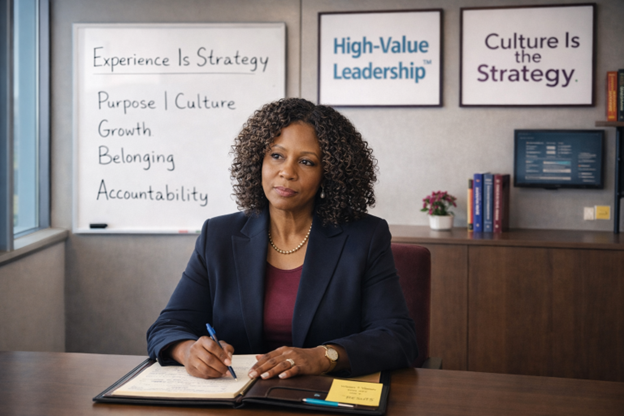
The Ageism Audacity: How Companies Overlook Their Most Experienced Leaders (And Pay for It)

By Che’ Blackmon, DBA Candidate | Founder & CEO, Che’ Blackmon Consulting

📚  Book Tie-In: Rise & Thrive — A Black Woman’s Blueprint for Leadership Excellence | Navigating Workplace Bias

There is a particular kind of professional insult that rarely gets called out in the open. It does not announce itself in a policy memo. It does not show up in a disciplinary report. It lives in the subtle signals: the way a seasoned leader gets passed over for the high-visibility project, the way her ideas are summarized by someone twenty years younger and then credited as fresh thinking, or the way a job posting specifies five to seven years of experience for a senior role that clearly needs twenty. This is ageism. And in corporate America, it is not only alive. It is thriving.

Ageism is one of the most normalized and least confronted forms of workplace bias. The Age Discrimination in Employment Act has been federal law since 1967, protecting workers aged 40 and older from discriminatory employment practices. Yet according to the AARP, more than three in five workers over age 45 have experienced or witnessed age discrimination in the workplace. The problem is not shrinking. It is growing more sophisticated, more embedded in organizational culture, and more costly than most leaders are willing to admit.

This article is about that cost. It is also about the specific experience of Black women who navigate ageism as one layer of a compounding bias that the corporate world has yet to honestly reckon with. And it is about what leaders and organizations can do, right now, to stop losing some of their most valuable people to a prejudice that serves no one.

📈 What Ageism Actually Costs Organizations

Most organizations do not track the financial cost of ageism because most organizations do not acknowledge that ageism is happening. That is the first problem. When a seasoned leader is eased out of a role, dismissed from a succession conversation, or simply never considered for advancement despite a record of results, the organization loses more than a person. It loses institutional knowledge, strategic perspective, relationship capital, and the kind of pattern recognition that only comes from decades of navigating real complexity.

The financial numbers are significant. A 2020 study published in the journal Innovation in Aging estimated that ageism in the United States costs the economy approximately 850 billion dollars annually when healthcare and employment costs are combined. Research from AARP found that if workers aged 50 and older participated in the workforce at the same rate as younger workers, the U.S. gross domestic product would increase by 7.6 percent. These are not marginal figures. They represent the measurable result of organizations systematically devaluing experience.

At the organizational level, the cost is equally concrete. When experienced leaders leave prematurely, organizations face the expense of recruiting and onboarding replacements who require significant time to reach equivalent effectiveness. According to the Society for Human Resource Management, the average time to full productivity for a new hire in a senior role can extend well beyond a year. Every month of that learning curve represents organizational capacity that a retained experienced leader would have delivered immediately.

“The institutional knowledge that leaves when an experienced leader walks out the door is almost never fully documented and is almost never fully replaced.” — Che’ Blackmon, High-Value Leadership™

Beyond the financial calculation, there is a culture cost. When employees across generations watch their most experienced colleagues be sidelined, they draw conclusions about what the organization actually values. They learn that longevity is not rewarded. They learn that wisdom is less prized than novelty. They learn that the culture is transactional rather than generative. And they make their own career decisions accordingly.

🔍 The Many Faces of Workplace Ageism

Ageism in the workplace rarely presents as overt discrimination. It has evolved into something more subtle and, in many ways, more damaging precisely because it is harder to name and challenge. Understanding what it looks like in practice is the first step toward addressing it.

📋 Ageism in Hiring and Promotion

There was a professional services firm that updated its job description language across the board to require “digital nativity” and “fresh perspectives” without defining what either term meant in operational terms. The effect was predictable. The finalist pools for senior roles skewed dramatically younger, and experienced candidates who had spent decades developing precisely the strategic skills the roles required were filtered out before their qualifications were ever reviewed. No one in the organization called it age discrimination. But the EEOC would have had a different view.

In promotion decisions, ageism shows up as a quiet assumption that experienced professionals are “too set in their ways” to learn new approaches, that they will be resistant to change initiatives, or that they represent higher flight risks because they are closer to retirement. These assumptions are rarely tested against evidence. They are applied as default filters that determine who gets considered and who does not.

🗣️ Ageism in Day-to-Day Work Life

The daily experience of ageism is relentless and cumulative. It looks like being excluded from team communications because they happen on platforms the organization assumes older professionals do not use. It looks like being assigned to wind-down projects rather than growth initiatives. It looks like having one’s ideas met with polite disinterest in meetings and then enthusiastically endorsed when a younger colleague reintroduces them a week later. It looks like performance reviews that reference “adaptability” as a concern without specifying what the expected adaptation actually is.

There was a healthcare organization where a senior HR leader with more than two decades of experience was systematically excluded from the working groups developing the organization’s new people strategy. The rationale offered was that the initiative needed “new energy.” The actual result was a strategy that duplicated programs the organization had already tried and abandoned years earlier, at significant cost, because no one with long institutional memory was in the room.

💻 Ageism in Technology and Training Access

One of the most quietly damaging forms of ageism in modern organizations is the assumption that experienced professionals are less capable of learning new technologies. This assumption is both empirically unsupported and organizationally destructive. Research from the MIT AgeLab has consistently found that older workers demonstrate high capacity for learning new skills and technology when provided adequate training and time. The gap is not ability. It is access.

Organizations that assume their experienced employees will not engage with new tools often simply do not invest in training them. The resulting performance gap then becomes evidence for the original assumption, creating a self-fulfilling cycle of exclusion that the organization never examines critically.

✨ The Compounded Reality: Black Women at the Intersection of Age and Race

For Black women in corporate environments, ageism does not operate in isolation. It operates in combination with racial bias, gender discrimination, and the particular professional penalties that accumulate across a career spent navigating systems that were never designed for their advancement. The result is a form of compounded bias that is uniquely isolating and uniquely costly.

In Rise and Thrive: A Black Woman’s Blueprint for Leadership Excellence, this reality is addressed directly. Black women who have spent two or three decades building expertise, earning credentials, and delivering results often find themselves in a paradox at senior career stages: they are simultaneously seen as too experienced to be approachable for mentorship by younger colleagues and too overlooked to be positioned for the advancement their records clearly justify. The skills and wisdom they have accumulated become invisible to organizations that are not designed to see them.

🚨 The Double Standard of “Ovequalified”

The word “overqualified” carries a particular weight when applied to Black women in senior roles. What organizations describe as overqualification is often, in practice, a discomfort with a Black woman whose experience, authority, and credibility exceed what the organizational culture is prepared to accommodate. The professional record that should open doors becomes the reason doors are presented as closed.

There was a manufacturing organization that passed over a highly experienced Black woman HR leader for a VP-level role three times over a four-year period, each time citing concerns about “cultural fit” with the new executive team. The leaders hired into that role instead had significantly less experience, required extensive onboarding, and the organization’s HR function struggled measurably during each transition. The experienced leader eventually left the industry entirely. The organization lost institutional memory, strategic capacity, and a leader who understood the workforce at a depth that no succession plan replaced.

This is not an anomaly. McKinsey and Company’s Women in the Workplace research has consistently found that Black women face a steeper advancement cliff than any other demographic group. They are promoted at lower rates than their peers, receive less sponsorship from senior leaders, and are more likely to see their career momentum stall at middle management despite performance records that exceed expectations.

📚  Rise & Thrive Connection: In Rise & Thrive, Che’ Blackmon writes directly to the Black woman who has been told, in words or in practice, that her experience is a liability rather than an asset. The SHIELD Resilience Framework in that work offers a strategic and personal blueprint for navigating exactly this kind of compounded bias with dignity, strategy, and clarity of purpose. If you are living this reality, that book was written for you.

💡 The Erasure of Legacy and Mentorship Potential

When experienced Black women are pushed out of organizations prematurely, the loss extends far beyond the individual and the organization. It disrupts the mentorship and sponsorship pipeline for younger Black women who are navigating the early stages of careers in the same environments. The absence of senior Black women who have survived, thrived, and built sustained leadership records is felt by every junior colleague who looks up and cannot find a reflection of their own possibility at the table.

This is why the cost of ageism in this specific context is not only a business cost. It is a cultural and generational one. Every experienced Black woman leader who exits corporate life earlier than she should have represents a broken link in a chain of possibility that takes years or decades to rebuild.

🏗️ What High-Value Leadership™ Says About Experience

The High-Value Leadership™ framework, built on five pillars of Purpose-Driven Vision, Stewardship of Culture, Emotional Intelligence, Balanced Responsibility, and Authentic Connection, is explicitly designed to recognize and leverage the full depth of what experienced leaders bring. Experience is not a liability in this framework. It is a strategic advantage that, when honored and deployed intentionally, elevates the entire organization.

In Mastering a High-Value Company Culture, the argument is clear: cultures that endure are cultures that draw from the full range of human experience within the organization. They do not treat institutional memory as irrelevant. They treat it as foundational. The most resilient and high-performing cultures are multigenerational by design, not by accident. They recognize that the perspective of someone who has navigated three recessions, two technological revolutions, and a global pandemic is not redundant. It is rare.

High-Value Leadership: Transforming Organizations Through Purposeful Culture goes further, arguing that stewardship of culture requires leaders who understand where the organization has been in order to responsibly guide where it is going. You cannot steward something you do not understand historically. Experienced leaders carry that historical understanding. Sidelining them in favor of perpetual novelty is not innovation. It is amnesia.

💡 Organizations that treat experience as obsolescence are not evolving. They are forgetting. And forgetting is expensive.

🔬 What the Research Tells Us

The business case for retaining and advancing experienced leaders is well documented, and the evidence is not subtle.

A landmark study published by Harvard Business School found that companies led by experienced CEOs significantly outperformed those led by executives earlier in their careers on long-term profitability and organizational stability metrics. The research attributed this advantage specifically to the pattern recognition and risk calibration skills that develop only through sustained experience over time.

McKinsey and Company research on organizational resilience found that companies with age-diverse leadership teams demonstrated higher adaptability during disruption. The combination of long-term i