Blog

📚 AI Ethics in HR: Using Technology to Empower People, Not Replace Them

By Che’ Blackmon, DBA Candidate | Founder & CEO, Che’ Blackmon Consulting

cheblackmon.com

🎯 Introduction: The Promise and the Peril

Artificial intelligence is no longer a futuristic concept reserved for tech companies and science fiction. It is here, embedded in the tools HR professionals use every single day. From screening resumes to predicting employee turnover, AI is reshaping how organizations find, develop, and retain talent. The question is no longer whether AI will transform human resources. The question is whether we will allow it to transform human resources ethically.

That distinction matters more than most leaders realize. When implemented thoughtfully, AI can reduce administrative burdens, surface hidden talent, and create more equitable workplaces. When deployed carelessly, it can amplify the very biases it was supposed to eliminate, silently filtering out qualified candidates and reinforcing systemic inequities that have plagued corporate spaces for decades.

In my book Mastering a High‑Value Company Culture, I wrote that culture is the lifeblood of any organization. Technology does not replace that lifeblood. It either strengthens it or it poisons it. There is no neutral ground. Every algorithm, every automated workflow, and every AI powered decision reflects the values of the people and systems that created it. As HR leaders, we must ensure those values align with the high‑value cultures we are working so hard to build.

This article explores the ethical dimensions of AI in HR, examines how these technologies disproportionately affect traditionally overlooked populations (most specifically Black women in corporate spaces), and provides actionable strategies for leveraging AI as a tool for empowerment rather than exclusion.

🤖 The Current Landscape: AI in HR by the Numbers

The adoption of AI in human resources has accelerated dramatically. Over half of U.S. companies now invest in AI based recruiting tools, and AI powered hiring platforms processed over 30 million applications in 2024 alone. These systems handle resume screening, candidate scoring, interview scheduling, employee engagement analytics, and even performance prediction.

The regulatory landscape is shifting just as quickly. New York City’s Local Law 144 requires annual independent bias audits for automated employment decision tools. California’s Civil Rights Council regulations, effective since October 2025, make it unlawful to use automated decision systems that discriminate based on protected characteristics. The Colorado AI Act, taking effect in June 2026, mandates rigorous impact assessments for high risk AI systems. Illinois House Bill 3773, effective January 2026, requires employers to notify candidates whenever AI is used in employment decisions.

The message from legislators is clear: the era of unregulated AI in employment is over. And for those of us in HR leadership, this is not a threat. It is a call to lead.

⚠️ The Hidden Danger: When Algorithms Inherit Our Biases

Here is a truth that many technology vendors would rather not discuss openly. AI systems are only as fair as the data they are trained on. When that training data reflects decades of discriminatory hiring patterns, the resulting algorithms do not eliminate bias. They automate it. They scale it. And they give it a veneer of objectivity that makes it even harder to challenge.

Consider the widely cited case of a major technology company that developed an AI recruiting tool only to discover it systematically penalized resumes containing the word “women’s” (as in “women’s basketball team” or “women’s leadership council”). The tool had been trained on ten years of hiring data that reflected a predominantly male workforce, and it learned to replicate that pattern with ruthless efficiency.

Research published in PNAS Nexus in 2025 brought even more troubling findings to light. A large scale experiment evaluating five leading AI models found that these systems systematically disadvantaged Black male applicants even when qualifications were identical to other candidates. Separate Stanford research discovered that AI resume screening tools gave older male candidates higher ratings than both female and younger candidates when all resumes were generated from the same underlying data.

A 2025 Brookings Institution study revealed something equally concerning: when human recruiters collaborated with racially biased AI models, they could not adequately identify or mitigate the bias that had seeped into their own decision making. In scenarios where the AI reinforced stereotypes favoring white candidates for high status roles, respondents selected majority white candidates over 90% of the time. The AI did not just make biased decisions on its own. It contaminated the judgment of the humans working alongside it.

“A faster biased decision is still a biased decision.” This reality demands that HR leaders approach AI adoption with both enthusiasm and vigilance.

👑 The Overlooked Impact: Black Women in the Algorithm’s Blind Spot

The conversation about AI bias in HR cannot be complete without addressing how these systems uniquely affect those who have been historically marginalized. Black women in corporate spaces experience what scholars call “double jeopardy,” navigating bias related to both race and gender simultaneously. When AI systems enter the equation, that jeopardy can multiply.

In Rise & Thrive: A Black Woman’s Blueprint for Leadership Excellence, I wrote extensively about how Black women hold just 4% of C‑suite positions, 1.6% of VP roles, and 1.4% of executive or senior level positions in Fortune 500 companies despite making up approximately 7.4% of the U.S. population. These numbers are not the result of insufficient ambition or inadequate qualifications. They are the product of systemic barriers including hiring bias, limited access to influential networks, and workplace cultures that were never designed with Black women in mind.

Now imagine layering AI on top of these existing disparities. When an algorithm is trained on historical hiring data from an organization that has rarely promoted Black women into senior roles, what pattern does it learn? It learns to replicate that exclusion. It learns that the “ideal candidate” looks, sounds, and presents like the people who have historically held those roles. It penalizes difference rather than recognizing it as the leadership asset it truly is.

There was a company that implemented an AI driven performance evaluation system intended to create more objectivity in its promotion process. On the surface, the system appeared race and gender neutral. But the metrics it prioritized (executive visibility scores, cross functional project leadership, and senior sponsor endorsements) were all areas where Black women consistently had less access due to existing structural inequities. The algorithm did not create new bias. It codified the old bias into a system that now appeared scientifically validated.

As I emphasized in High‑Value Leadership: Transforming Organizations Through Purposeful Culture, authentic leadership means bringing your whole self to your role. When AI systems implicitly reward conformity to a narrow professional prototype, they penalize the very authenticity that makes diverse leadership transformative. Code switching excellence, pattern recognition born from navigating bias, crisis management expertise developed through lived experience: these are leadership superpowers that no algorithm currently knows how to measure or value.

✅ Empowerment Over Replacement: The High‑Value Approach to AI

So how do we get this right? The answer lies in a principle I have built my entire consulting practice around: people first, always. In Mastering a High‑Value Company Culture, I wrote that employees are not resources; they form the lifeblood of your organization. That truth does not change because a new technology has arrived. If anything, it becomes more important.

A High‑Value approach to AI in HR rests on five pillars that mirror the High‑Value Leadership™ framework:

🎯 1. Purpose Driven Vision: Define Your “Why” Before Your “How”

Before selecting any AI tool, organizations must articulate why they are adopting it and whose interests it serves. Is the goal to process applications faster, or is it to ensure every qualified candidate receives fair consideration? These are fundamentally different objectives that lead to fundamentally different outcomes. Purpose driven AI adoption starts with asking what kind of culture you are trying to build, not what kind of efficiency you are trying to gain.

🏠 2. Stewardship of Culture: Guard the Gate Intentionally

HR leaders are the stewards of organizational culture. That stewardship now extends to the digital tools that shape employee experiences. Every AI system should be evaluated through a cultural lens: Does this tool align with our stated values? Does it support the inclusive environment we are building? Does it treat every candidate and employee with the dignity they deserve? Stewardship means refusing to implement technology simply because it is available and instead demanding that it meets the standard of the culture you are cultivating.

❤️ 3. Emotional Intelligence: Keep Humans at the Center

AI excels at processing data. It does not understand context, nuance, or the human stories behind the numbers. A resume gap might represent a caregiving responsibility, a health challenge, or a period of entrepreneurial pursuit. An unconventional career path might reflect extraordinary adaptability. Emotional intelligence in AI governance means ensuring that human judgment remains the final authority on decisions that shape people’s lives and livelihoods.

⚖️ 4. Balanced Responsibility: Audit, Adjust, and Account

Balanced responsibility requires organizations to take ownership of the outcomes their AI systems produce. This means conducting regular bias audits across demographic groups, maintaining transparency about when and how AI is used, and creating accessible channels for candidates and employees to challenge automated decisions. Leading organizations are establishing cross functional AI ethics committees that include HR, legal, technology, and employee representatives to provide ongoing oversight.

🤝 5. Authentic Connection: Technology Should Open Doors, Not Close Them

The ultimate measure of any AI system in HR is whether it expands opportunity or narrows it. Authentic connection means using technology to reach candidates who might otherwise be overlooked, to surface talent from non traditional backgrounds, and to create pathways that have not existed before. When AI is deployed in service of authentic connection, it becomes a tool for building the diverse, dynamic, purpose driven organizations that our workplaces so desperately need.

📋 Practical Case Studies: Lessons from the Field

🟢 Case Study 1: The Resume Screen That Screened Out Talent

A midsize manufacturing company implemented an AI resume screening tool to handle a surge in applications. Within six months, the hiring team noticed a troubling trend: the diversity of their candidate slates had decreased significantly despite receiving applications from a more diverse pool than ever before. An internal audit revealed that the AI was deprioritizing candidates who attended Historically Black Colleges and Universities (HBCUs), had gaps in employment (disproportionately affecting women and caregivers), or used language patterns more common among bilingual applicants. The company paused the tool, retrained it with a more representative dataset, and implemented mandatory human review for all candidates flagged for rejection. Within one quarter, their candidate diversity returned to and exceeded previous levels.

🟢 Case Study 2: AI as an Equity Accelerator

A regional healthcare system took a different approach entirely. Before deploying any AI tools, leadership convened a cross functional team that included frontline employees, union representatives, and members of their employee resource groups. Together, they established clear equity benchmarks that any AI tool would need to meet. They selected a platform specifically because it included built in bias detection and allowed real time monitoring of outcomes by demographic group. The result was a 34% improvement in diverse candidate slates while maintaining quality of hire standards. More importantly, candidate satisfaction scores increased by 28% once transparency features were fully implemented. Candidates reported feeling more respected by a process that was upfront about how technology was being used.

🟢 Case Study 3: Correcting AI Driven Performance Reviews

A professional services firm discovered that its AI enhanced performance evaluation system was consistently rating employees from underrepresented backgrounds lower than their peers, even when objective output metrics were comparable. Investigation revealed that the system weighted “executive presence” as a key competency, and this subjective metric was being scored by managers who held unconscious biases about what executive presence looked like. The firm revised its competency model, replaced subjective metrics with measurable outcomes, retrained managers on equitable evaluation practices, and recalibrated its AI system. The following review cycle showed a measurable reduction in rating disparities across all demographic groups.
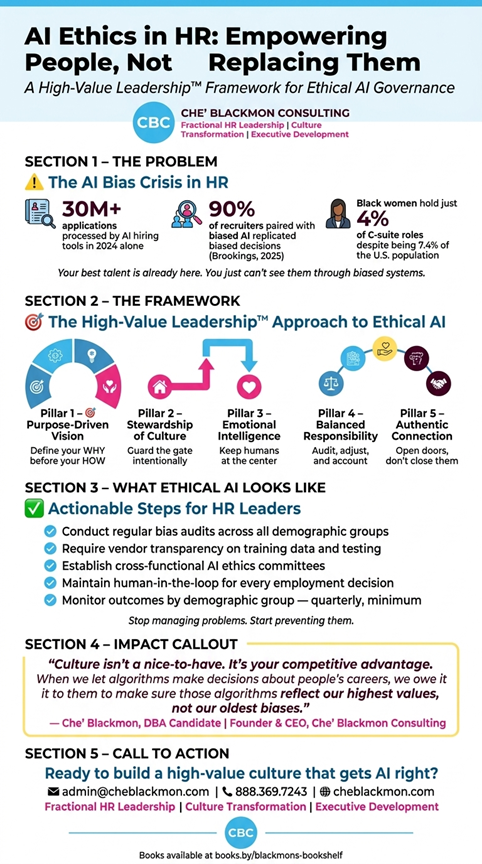
🛠️ Actionable Takeaways: What HR Leaders Can Do Right Now

The following strategies represent best practices that every HR leader can begin implementing today, regardless of organization size or industry:

🔍 For Your Organization

  • Conduct a comprehensive AI inventory. Document every tool in your HR technology stack that uses artificial intelligence, machine learning, or automated decision making. Many organizations are surprised to discover how many AI powered features are embedded in tools they already use.
  • Require vendor transparency. Before purchasing or renewing any AI powered HR tool, demand documentation of training data composition, bias testing results, and ongoing audit protocols. If a vendor cannot or will not provide this information, that is a significant red flag.
  • Establish an AI ethics committee. Create a cross functional oversight body that includes representatives from HR, legal, IT, and your employee resource groups. This committee should review all AI tools before implementation and conduct quarterly reviews of outcomes.
  • Implement human in the loop protocols. Ensure that no employment decision (hiring, promotion, termination, or performance rating) is made solely by an automated system. Define clear protocols for when human judgment must override algorithmic recommendations.
  • Monitor outcomes by demographic group. Track the impact of AI tools on different populations. If your AI resume screener is advancing 60% of white candidates to the interview stage but only 35% of Black candidates, you have a problem that needs immediate attention.

🙋 For the Traditionally Overlooked: Especially Black Women Navigating AI Driven Processes

  • Know your rights. Several jurisdictions now require employers to disclose when AI is being used in employment decisions. In New York City, employers must provide notice and share bias audit results. Understanding these protections empowers you to advocate for yourself.
  • Request transparency. You have the right to ask whether AI was used in evaluating your application or performance. If an employer cannot explain how a decision was made, that opacity itself may be worth questioning.
  • Document your qualifications comprehensively. AI systems often rely on keyword matching and pattern recognition. Ensure your resume and professional profiles include industry standard terminology, measurable achievements, and clearly articulated competencies.
  • Build and leverage your network. AI can screen you out, but relationships can bring you in. The power of authentic connection, sponsors who advocate for you in rooms you have not yet entered, remains one of the most effective tools for career advancement.
  • Remember your value. As I wrote in Rise & Thrive, your lived experiences have cultivated extraordinary resilience, adaptability, and social intelligence. These are leadership superpowers. No algorithm diminishes your worth.

🏢 For Organizational Culture

  • Align AI adoption with your stated values. If your organization claims to value diversity, equity, and inclusion, your AI tools must demonstrably support those values. There is no room for cognitive dissonance between what we say and what our systems do.
  • Train managers on AI literacy. Managers who use AI powered tools need to understand how those tools work, what their limitations are, and when to exercise independent judgment. AI literacy is no longer optional for people leaders.
  • Create feedback loops. Give candidates and employees accessible channels to report concerns about AI driven decisions. Use that feedback to continuously improve your systems and processes.
  • Lead publicly. Share your organization’s AI ethics commitments externally. Transparency builds trust with candidates, employees, customers, and communities.

📊 Expert Insights and Current Research

The research is both sobering and instructive. A 2025 study published in PNAS Nexus examined five leading large language models used in hiring contexts and found that all five exhibited measurable bias based on the gender and racial signals embedded in candidate names, even when qualifications were identical. The study’s authors emphasized that intersectionality, rigorous testing, and human oversight are essential to reducing algorithmic harm.

The Brookings Institution’s 2025 research demonstrated that AI does not just make biased decisions in isolation. It actively influences the humans who work alongside it, making them more likely to replicate biased patterns even after the AI is removed from the process. This finding challenges the common assumption that “human in the loop” safeguards are sufficient on their own.

A 2026 HRD America report captured the emerging consensus among industry leaders: HR is uniquely positioned to lead the effort to reduce algorithmic bias and to define the checkpoints where human judgment and empathy must override an algorithm’s output. The report emphasized that HR professionals must evolve from being consumers of AI technology to being the primary stewards of its ethical implementation.

The regulatory trajectory is unmistakable. The EU AI Act classifies employment related AI as high risk, requiring strict data governance, accuracy testing, and human oversight. The EEOC has already settled its first AI hiring discrimination lawsuit. Organizations that treat ethical AI as a compliance checkbox rather than a strategic priority will find themselves at a growing competitive and legal disadvantage.

💡 The High‑Value Leadership™ Perspective

Throughout High‑Value Leadership: Transforming Organizations Through Purposeful Culture, I explore how authentic, values driven leadership transforms organizations from the inside out. AI ethics in HR is not a separate conversation from culture transformation. It is the same conversation, amplified by technology.

When we talk about Purpose Driven Vision, we are talking about leaders who refuse to adopt technology without first asking who it serves and who it might harm. When we talk about Stewardship of Culture, we are talking about HR professionals who evaluate every tool through the lens of the inclusive environment they are building. When we talk about Emotional Intelligence, we are insisting that empathy and human judgment remain central to decisions that affect people’s careers. When we talk about Balanced Responsibility, we are demanding accountability, transparency, and the courage to pause when something is not right. And when we talk about Authentic Connection, we are affirming that technology’s highest purpose is to open doors that have been closed for too long.

This is what it means to use AI ethically. Not to fear it. Not to adopt it blindly. But to govern it with the same intentionality, courage, and commitment to people that defines High‑Value Leadership at its best.

❓ Discussion Questions

Use these questions for team meetings, leadership development sessions, or personal reflection:

  1. Does your organization currently use AI in any aspect of the employee lifecycle? If so, do you know how those tools make their decisions?
  2. Have you ever audited your AI tools for disparate impact across different demographic groups? What did you find, or what do you expect you might find?
  3. How does your organization balance the efficiency AI provides with the need for human judgment in employment decisions?
  4. In what ways might AI be reinforcing existing structural barriers for traditionally overlooked populations in your workplace?
  5. What would it look like to apply the five pillars of the High‑Value Leadership™ framework to your organization’s AI governance strategy?
  6. How can you personally advocate for more transparent and equitable use of AI in your workplace, regardless of your title or position?

🚀 Next Steps: From Awareness to Action

Knowledge without action is just information. Here are your next steps:

  1. Share this article with your HR team, your leadership, and anyone involved in technology decisions at your organization.
  2. Request an AI audit of your organization’s HR technology stack within the next 90 days.
  3. Identify one AI tool in your current workflow and evaluate it against the five pillars of the High‑Value Leadership™ framework.
  4. Start the conversation. Whether it is a lunch and learn, a team meeting, or a one on one with your CHRO, begin advocating for ethical AI governance in your organization.
  5. Invest in your own development. Explore the resources below and consider how you can deepen your understanding of AI ethics in HR.

📬 Ready to Build a High‑Value Culture That Gets AI Right?

At Che’ Blackmon Consulting, we partner with organizations to transform their cultures from the inside out. Whether you need fractional HR leadership, culture assessment, AI ethics strategy, or leadership development, we bring 30+ years of experience and a proven framework to help your people and your organization thrive.

Explore our resources:

  • 📖  Mastering a High‑Value Company Culture
  • 📖  High‑Value Leadership: Transforming Organizations Through Purposeful Culture
  • 📖  Rise & Thrive: A Black Woman’s Blueprint for Leadership Excellence
  • 🎓  High‑Value Leadership Intensive (Waitlist): https://adept-solutions-llc-2.kit.com/147712ac25
  • 🎧  Unlock, Empower, Transform Podcast
  • 📰  The Blackmon Brief Newsletter

All books available at: https://books.by/blackmons‑bookshelf

📧  admin@cheblackmon.com   |   📞  888.369.7243   |   🌐  cheblackmon.com

Let’s build workplaces where both people and organizations flourish.

© 2026 Che’ Blackmon Consulting. All rights reserved. This article may be shared with proper attribution.

#AIinHR #EthicalAI #HighValueLeadership #HRLeadership #CultureTransformation #AIBias #DiversityEquityInclusion #BlackWomenLead #FractionalCHRO #HRTech #PeopleFirst #TalentManagement #LeadershipDevelopment #WorkplaceCulture #FutureOfWork #InclusiveLeadership #AICompliance #HRStrategy #BlackWomenInBusiness #CheBlackmonConsulting

5 Culture Red Flags That Signal a Flight Risk Crisis (Before Anyone Resigns)

By Che’ Blackmon, DBA Candidate | Founder & CEO, Che’ Blackmon Consulting

📚 Book Tie-In: Mastering a High-Value Company Culture | High-Value Leadership™ | Rise & Thrive

“By the time someone submits their resignation, the decision was made weeks, months, or sometimes years ago. The warning signs were always there. The question is whether anyone was paying attention.”

People do not leave organizations without warning. They leave after a long series of unaddressed signals that the organization either did not notice or chose not to act on. A resignation letter is never the beginning of the story. It is the final paragraph of a narrative that started long before the exit interview.

This is the truth that most organizations are not yet equipped to confront. They treat turnover as a talent acquisition problem when it is almost always a culture problem. They launch engagement surveys after people disengage. They invest in employer branding after their best people have already started quietly exploring other options. And they are consistently surprised by departures that, in retrospect, were entirely predictable.

The research supports this clearly. According to Gallup, 52 percent of voluntarily exiting employees say their manager or organization could have done something to prevent their departure. That is not a small number. That is more than half of all voluntary turnover representing lost revenue, disrupted teams, and cultural erosion that was, in the majority of cases, preventable.

This article is about what to watch for before the resignation arrives. It is about the five culture red flags that most organizations are either misreading or missing entirely. And it is about what High-Value Leaders™ do differently to catch those signals early, address the root causes, and build organizations where the best people choose to stay.

📊 The Real Cost of a Flight Risk Crisis

Before diving into the red flags, it is worth grounding this conversation in the financial reality that makes early detection so urgent. Organizations frequently treat turnover as an unfortunate but manageable cost of doing business. The numbers tell a very different story.

The Society for Human Resource Management estimates that replacing an employee costs between 50 percent and 200 percent of that employee’s annual salary, depending on role complexity, seniority, and industry. For a senior professional earning $120,000 annually, that replacement cost ranges from $60,000 to $240,000. Multiply that across even a modest turnover rate in a mid-size organization and the financial impact becomes staggering.

But the financial cost is only part of the picture. The hidden costs of flight risk crises include the institutional knowledge that walks out the door, the morale damage to the employees who remain and watch their colleagues leave, the productivity disruption during recruitment and onboarding cycles, and the reputational harm to employer brand when turnover patterns become visible to the external talent market. These costs do not appear on a standard P&L report. But they compound over time in ways that are genuinely devastating to organizational performance.

“A culture that is hemorrhaging talent is not just an HR problem. It is a balance sheet problem. And it is a leadership problem.”

There is also the question of who leaves first. High-value talent is almost always the first to go in a flight risk crisis. High performers have options. They know their market value. They are not waiting for conditions to improve because they have other doors open to them. When your organization is experiencing a flight risk crisis, the people who leave are disproportionately the people you can least afford to lose.

Early detection is not a nice-to-have organizational capability. It is a strategic imperative.

🚩 Red Flag 1: The Silence That Replaced the Voice

⚠️  Warning Signal: Your most engaged employees have stopped speaking up.

There is a specific kind of organizational silence that should alarm every leader. It is not the silence of a team that has nothing to say. It is the silence of a team that tried to say something and experienced consequences subtle or overt for doing so. It is the silence that follows disappointment. And it is one of the earliest and most reliable predictors of impending departure.

Organizational behavior research consistently identifies psychological safety as one of the most critical components of team performance and retention. When employees feel safe to speak up, share ideas, surface concerns, and disagree with leadership, they are significantly more likely to remain engaged and invested in organizational outcomes. When that safety disappears, disengagement follows almost immediately. And disengagement, if unaddressed, becomes departure.

The pattern is recognizable once you know to look for it. An employee who was once vocal in meetings suddenly offers minimal input. A team member who previously raised concerns through appropriate channels goes quiet. A high performer stops volunteering for initiatives they would have enthusiastically pursued six months earlier. These are not coincidences. They are communications.

🔍 What Organizations Miss

The mistake most organizations make is interpreting this silence as satisfaction. If no one is complaining, the assumption becomes that everything must be fine. This is precisely backwards. Silence in a previously vocal employee is a warning. It often means they have decided the organization is not worth the effort of engaging. It can also mean they have already made the decision to leave and are simply serving out a notice period in their own minds.

There was a technology company that experienced a surprise wave of departures among its mid-level engineering team. Exit interviews revealed a consistent pattern: employees had attempted to raise concerns about workload distribution and decision-making transparency in the prior year and had been either dismissed or had their concerns go unaddressed. They stopped raising issues. And within six to eight months of going quiet, they left. The organization had interpreted the silence as resolution. It was actually resignation in the making.

🛠️ What High-Value Leaders™ Do

  • Conduct quarterly stay interviews, not just exit interviews, specifically asking high-value team members what is working, what is not, and what would cause them to consider leaving.
  • Audit meeting participation patterns. If previously engaged voices have gone quiet, investigate with curiosity rather than assumption.
  • Create structured channels for candid input that do not require individual bravery to access. Anonymous pulse surveys, skip-level conversations, and team retrospectives all serve this function.
  • When an employee raises a concern, close the loop explicitly. Tell them what you heard, what you considered, and what the outcome was. Silence after speaking up is what trains people to stop speaking.

🚩 Red Flag 2: Equity Gaps in Recognition, Advancement, and Opportunity

⚠️  Warning Signal: The same people keep getting overlooked. And they are noticing.

One of the most reliable predictors of flight risk is the perception, often an accurate one, that the organization does not distribute recognition, advancement opportunities, or high-visibility projects equitably. When employees consistently observe that certain colleagues receive praise, promotions, and stretch assignments while others with comparable or superior performance do not, they draw conclusions about their own future in the organization. And those conclusions frequently end with a job search.

This red flag is particularly acute for women of color and specifically for Black women in corporate environments. As explored in Rise & Thrive: A Black Woman’s Blueprint for Leadership Excellence, Black women navigate what researchers describe as a double jeopardy dynamic, facing compounding bias related to both race and gender simultaneously. They are frequently overlooked for advancement despite demonstrating exceptional performance. They are passed over for sponsorship. Their ideas are minimized until credited to someone else. And they watch this pattern repeat across their peer group until the organizational message becomes unmistakably clear: this is not a place built for their success.

“When the same people are consistently overlooked, they are not just losing opportunities. They are receiving a message about their value. And they will eventually act on that message.”

The research on this is unambiguous. McKinsey and LeanIn.org’s Women in the Workplace report consistently finds that women of color are the most likely demographic to leave their organizations, and that their departures are most commonly driven by perceptions of limited advancement opportunity, insufficient recognition, and cultures that fail to value their contributions equitably.

🔍 What Organizations Miss

Most organizations do not experience equity gaps as a single dramatic act of discrimination. They experience it as a thousand small patterns that each seem individually explainable but collectively paint an unmistakable picture. The same candidate always gets the developmental stretch assignment. The same voices always get amplified in leadership discussions. The same profiles always appear in succession planning documentation. When employees see these patterns clearly, and they always do, their assessment of their own future potential in the organization adjusts accordingly.

There was a financial services company that consistently lost its highest-rated Black women professionals at the director level. Internal analysis of promotion data revealed that these employees were rated as high performers at significantly higher rates than their white male counterparts but were promoted at significantly lower rates. The gap was not a matter of performance. It was a matter of sponsorship, visibility, and structural bias in promotion decision-making. The organization had been attributing the departures to external market forces. The actual cause was an internal equity gap that had been operating, invisibly to leadership, for years.

🛠️ What High-Value Leaders™ Do

  • Disaggregate all talent data by race, gender, and intersecting identity. Do not allow average scores to hide demographic disparities. The gaps in disaggregated data will tell you what aggregate data conceals.
  • Audit your last 12 months of promotion decisions, high-visibility project assignments, and formal recognition events. Who consistently appears in those categories? Who consistently does not?
  • Distinguish between mentorship and sponsorship. Mentors offer advice. Sponsors use their organizational capital to open doors. High-value talent from underrepresented backgrounds needs sponsors, not just mentors.
  • Create structured equity checkpoints in promotion and project assignment processes. Unstructured decisions default to bias. Structure creates accountability.

🚩 Red Flag 3: Manager Behavior That Is Quietly Driving People Out

⚠️  Warning Signal: People are not leaving the organization. They are leaving their manager.

Gallup’s research is unambiguous on this point: managers account for at least 70 percent of the variance in employee engagement scores. This means that the single most powerful variable in whether an employee chooses to stay or go is not the organization’s benefits package, its mission statement, or its office amenities. It is the direct relationship between that employee and their immediate manager. And most organizations are dramatically underprepared to identify and address problematic manager behavior before it costs them their best talent.

The challenge is that toxic or ineffective manager behavior rarely presents as overt misconduct that triggers a formal complaint. More commonly, it operates in the gray zones: the manager who consistently takes credit for their team’s work, the leader who gives feedback to everyone except the people who most need it, the supervisor who plays favorites in ways that are visible to everyone on the team, the director who manages up brilliantly while managing down poorly. These behaviors drive talent out of organizations quietly and continuously, and they rarely get addressed until the departure data becomes impossible to ignore.

In High-Value Leadership: Transforming Organizations Through Purposeful Culture, the pillar of Balanced Responsibility is defined as the capacity to hold high standards within an environment that is genuinely psychologically safe. This is precisely what ineffective managers fail to do. They either abandon accountability in the name of harmony or weaponize accountability in ways that damage trust and erode the psychological safety that high performance requires.

🔍 What Organizations Miss

The most common organizational failure here is the promotion of high individual contributors into management roles without any meaningful assessment of their people leadership capabilities. Technical excellence is not a predictor of people leadership effectiveness. And yet, in most organizations, the path to management runs directly through demonstrated individual performance, which means that many managers arrive in their roles entirely unprepared for the relational complexity of leading people.

There was a healthcare organization that consistently struggled with turnover in one particular division. Exit interview data was reviewed by department. The turnover rate in the identified division was three times higher than the organizational average. When stay interview data was collected and analyzed by manager, a single manager accounted for the departure of five high performers over an 18-month period. That manager had never received direct feedback about their impact on team retention because no one had connected the individual departure data to the management relationship. The pattern was invisible until someone looked for it.

🛠️ What High-Value Leaders™ Do

  • Map your turnover data by manager, not just by department or division. Individual manager retention impact is the most important flight risk metric most organizations are not measuring.
  • Assess manager performance against people leadership criteria as rigorously as operational performance criteria. The manager who delivers results while destroying morale is a flight risk accelerant.
  • Create upward feedback mechanisms that allow direct reports to provide candid input on their manager’s effectiveness in a structured, psychologically safe format.
  • Develop managers before you deploy them. Leadership development for people managers is not an optional investment. It is a retention infrastructure investment.

🚩 Red Flag 4: Values Drift — When What You Say and What You Do Diverge

⚠️  Warning Signal: Employees no longer believe the values on the wall.

Values drift is one of the most insidious and damaging forms of organizational culture deterioration because it operates gradually, almost imperceptibly, until the gap between stated values and lived reality becomes too wide to bridge. It begins with small compromises. A leader makes a decision that technically conflicts with a stated organizational value but is justified with enough contextual reasoning that no one raises a formal objection. Then it happens again. And again. And over time, employees begin to understand that the values are aspirational rather than operational. They are what the organization wishes it were, not what it actually is.

This matters enormously for retention because values alignment is one of the primary reasons high-performing employees choose and stay with an organization. Research from Deloitte consistently finds that employees who perceive strong alignment between their personal values and their organization’s demonstrated values are significantly more engaged, more loyal, and more likely to advocate for their employer in the talent market. Conversely, when values drift is perceived, the disillusionment that follows is one of the strongest predictors of voluntary departure, particularly among purpose-driven professionals.

In Mastering a High-Value Company Culture, this is addressed directly: a high-value culture does not happen by accident. It requires intentional design, consistent reinforcement, and continuous evolution. Values that are not regularly tested against real decisions and real behaviors are not values. They are decorations.

🔍 What Organizations Miss

Organizations frequently address values drift by reinforcing the values communication rather than the values behavior. They add more posters to the lobby, more references in the all-hands presentation, more values language in the annual report. None of this addresses the actual problem, which is a behavioral gap at the leadership level that employees can see clearly. The communication strategy does not close a behavioral gap. It actually widens the credibility gap.

There was a consumer goods company that had built a significant portion of its employer brand around a stated commitment to work-life integration. Recruitment materials, onboarding programs, and internal communications all prominently featured this value. Over a three-year period, however, leadership decisions consistently created expectation of availability during evenings and weekends, publicly celebrated employees who worked through vacations, and promoted individuals who were seen as being always available. The stated value was work-life integration. The lived reality was total work availability. Engagement data showed that this single value gap was the most commonly cited source of disillusionment among departing employees, particularly among parents and caregivers.

🛠️ What High-Value Leaders™ Do

  • Conduct a regular values audit: review the last 20 significant organizational decisions against your stated values. What patterns emerge? Where do the gaps live?
  • Ask employees directly: where do you see our values most clearly in action? Where do you see the biggest gap between what we say and what we do? Act on what you hear.
  • Hold leadership accountable to values alignment explicitly. Include values-consistent behavior as a component of leadership performance evaluation.
  • When a values violation occurs at the leadership level, address it transparently. How an organization handles a visible values gap is itself a values statement.

🚩 Red Flag 5: The Invisible Ceiling — When Growth Stops

⚠️  Warning Signal: High performers can no longer see a future for themselves here.

Ambitious people stay where they can grow. The moment a high performer concludes that their growth potential in an organization has plateaued, the countdown to departure begins. This is not complicated human behavior. It is entirely rational. People who are capable of more will seek environments that offer more. And the organizations that fail to create visible, credible, and accessible growth pathways for their best talent will consistently see that talent exit to organizations that do.

The invisible ceiling is particularly well-documented for Black women in corporate environments. Research from Catalyst found that Black women are more ambitious than their white female counterparts at every level of the corporate hierarchy. They want to advance. They are actively pursuing advancement. And they are running directly into organizational structures that consistently fail to provide it. When a Black woman has demonstrated over a period of years that she is capable of more than the role she holds, has been told she is high potential, has been placed in leadership development programs, and still does not advance while her less accomplished peers do, she does not stay and wait indefinitely. She finds an organization that will give her what this one would not.

This specific dynamic produces a pattern that organizations frequently describe as mysterious or inexplicable: the departure of their most talented, most prepared, most ready-to-advance employees. There is nothing mysterious about it. It is the entirely predictable result of building development pipelines that develop without advancing.

🔍 What Organizations Miss

The most common organizational failure in this area is confusing the development investment with the advancement outcome. Organizations invest in training, coaching, and leadership programs for high-potential employees, and they interpret that investment as evidence of their commitment to those employees’ growth. But the development investment and the advancement decision are two separate organizational behaviors. An employee who has been developed but not advanced has not been given what they were promised. They have been given preparation for an opportunity that was never actually extended.

There was a retail company that had a well-regarded internal leadership development program. Analysis of program participants over a five-year period revealed that graduation from the program did not correlate meaningfully with promotion rates for Black women participants, even though it did for white male participants at a statistically significant level. The program was developing these employees. The promotion process was not advancing them. The two systems were not connected, and the gap between them was driving departures among precisely the employees the program was designed to retain.

🛠️ What High-Value Leaders™ Do

  • Map your leadership development program graduates against your promotion data, disaggregated by race and gender. Is development translating into advancement equally across demographic groups? If not, the program is not the problem. The promotion process is.
  • Create explicit, transparent advancement criteria that are communicated to employees and applied consistently. Ambiguous criteria default to bias.
  • Ensure that every high-potential employee has a sponsor, not just a mentor, who is actively advocating for their advancement in rooms where decisions are made.
  • Conduct individual career conversations annually with every high performer. Ask directly: where do you see yourself in two years? What does this organization need to do to make that possible here rather than somewhere else?

✊🏽 The Compounding Effect: How All Five Red Flags Land Differently for Black Women

Any honest examination of flight risk culture dynamics must include a direct conversation about the compounding effect these five red flags produce for Black women in corporate environments. Because each of the red flags described in this article operates with additional weight and consequence for Black women, given the structural inequities and identity-based barriers that shape their organizational experience.

When Black women go silent in meetings, it is frequently not because they have nothing to say. It is because they have learned, through experience, that their voices are received differently than their colleagues’ voices. Their ideas get minimized, their concerns get pathologized as difficult or emotional, and their advocacy for systemic change gets interpreted as personal grievance. The organizational silence of a Black woman is often a grief response to accumulated dismissal. It is one of the clearest possible flight risk signals, and it is consistently misread.

When Black women experience equity gaps in advancement, they are not just experiencing a delayed promotion. They are experiencing confirmation of a pattern they have been warned about, have observed in their peer group, and have been navigating since entering the workforce. Each instance of inequitable treatment is not an isolated event. It is evidence added to an existing case file that the organization is not safe for their ambitions.

“For Black women, a flight risk is not just about leaving a job. It is about the accumulated cost of showing up fully in spaces that have never fully made room for them.”

The research is consistent and sobering. The McKinsey and LeanIn.org Women in the Workplace report found that for every 100 men promoted to manager, only 54 Black women are promoted to the same level. This gap does not reflect a difference in performance, aspiration, or capability. It reflects structural inequity in how talent is identified, developed, and advanced. And it produces organizations where Black women who have the talent to lead at every level are leaving at disproportionate rates, taking with them not just individual capability but the cultural intelligence, resilience-forged leadership, and organizational wisdom they have spent careers developing.

The organizations that will lead the next decade are the ones that understand this reality and build systems specifically designed to address it. Not as a diversity program. As a talent strategy. As a culture imperative. As a business decision grounded in the understanding that equity and excellence are not competing values. They are the same value.

🔬 Research Corner: What the Data Says About Flight Risk

  • Gallup’s State of the Global Workplace report found that 52 percent of voluntarily exiting employees say their manager or organization could have done something to prevent their departure. The majority of voluntary turnover is preventable with earlier intervention.
  • The Work Institute’s Retention Report found that the top drivers of voluntary turnover include career development (cited most frequently), work-life balance, manager behavior, compensation, and culture fit. Four of the five top drivers are culture-related and therefore within organizational control.
  • McKinsey and LeanIn.org’s Women in the Workplace report found that for every 100 men promoted to manager, only 54 Black women are promoted to the same level, creating a structural pipeline gap that drives disproportionate departure rates among Black women at every subsequent career stage.
  • Deloitte’s Global Human Capital Trends research found that organizations with strong recognition cultures experience 31 percent lower voluntary turnover than those without. Recognition is not a soft culture practice. It is a retention strategy with measurable financial impact.
  • Harvard Business Review research found that employees who experience psychological safety in their teams are 27 percent more likely to report that their organization retains talent effectively, connecting cultural safety directly to retention outcomes.
  • SHRM estimates the total cost of losing an employee ranges from 50 to 200 percent of annual salary when factoring recruitment, onboarding, lost productivity, and knowledge transfer costs. A proactive culture investment that prevents even five departures per year produces a significant and measurable return.

✅ Actionable Takeaways: A Flight Risk Early Warning System

Detection is only valuable when it leads to action. Here is a practical framework for building an early warning system before the next resignation arrives.

📋 Build a Flight Risk Dashboard

Identify the five to seven leading indicators most relevant to your organization and track them consistently. These might include: voluntary participation rates in meetings and initiatives, promotion rates disaggregated by demographic, manager retention scores from upward feedback, time-in-role data for high-potential employees who have not advanced, and pulse survey scores on belonging and psychological safety. Review this dashboard quarterly with the same rigor you apply to financial reporting.

🤝 Implement Stay Interviews Immediately

Exit interviews are a post-mortem. Stay interviews are the intervention. A 30-minute stay interview with every high-value team member, conducted quarterly or biannually, asking what is keeping them, what concerns them, and what would cause them to explore other options, provides more actionable flight risk intelligence than any engagement survey. The conversation itself is also a retention act. It communicates that the organization values the person enough to ask.

📈 Audit Your Equity Data Right Now

Pull your last 12 months of promotion decisions, recognition events, high-visibility project assignments, and compensation adjustments. Disaggregate the data by race and gender. Look at the patterns honestly. If you see gaps, do not explain them away. Investigate them. The gaps in that disaggregated data are your most urgent flight risk intelligence.

📊 Connect Development to Advancement

Review your leadership pipeline and development programs against actual promotion outcomes, disaggregated by demographic group. If your development investment is not producing equitable advancement outcomes, the development program is not the solution. The promotion process needs to be redesigned.

🎯 Address Manager Impact as a Strategic Priority

Map your turnover data by manager. Identify the managers whose teams experience the highest departure rates. Investigate whether those departures cluster around specific behavioral patterns. Provide direct feedback and development to the managers identified. If behavior does not change, make the leadership decision that the culture requires. A high-performing manager who is quietly driving your best talent out is a net liability regardless of their individual output.

💬 Discussion Questions for Leaders and Teams

Use these questions to begin the conversations your organization needs to have before the next resignation letter arrives.

  • When did someone in your organization last go quiet after previously being vocal? What happened, and what did your organization do with that signal?
  • If you disaggregated your last year of promotion and recognition data by race and gender, what patterns would emerge? Have you looked?
  • What percentage of your voluntary turnover in the last two years could be traced back to a specific manager or management pattern? Do you know?
  • Where is the biggest gap between what your organization says it values and what your employees actually experience? Who in your organization is most affected by that gap?
  • How many of your high-potential employees can see a clear and credible path to advancement from where they currently sit? When did you last ask them?
  • What is your organization doing specifically to retain Black women in the leadership pipeline? Is that effort connected to your promotion and advancement data, or is it operating separately from the systems that actually determine who advances?

🚀 Next Steps for Readers

The best time to address a flight risk culture was before it started. The second-best time is right now.

  • This week, schedule one stay interview with a high-value team member. Ask what is working, what concerns them, and what would cause them to explore other options. Listen without defensiveness.
  • Pull your voluntary turnover data from the last 18 months. Disaggregate it by manager, by demographic group, and by tenure at departure. Look for patterns. Act on what you find.
  • Share this article with at least one leader in your organization and commit to a candid conversation about which of the five red flags you see operating in your current culture.
  • Order your copies of Mastering a High-Value Company Culture and High-Value Leadership: Transforming Organizations Through Purposeful Culture for the complete frameworks, tools, and evidence-based strategies behind everything covered in this article.
  • If you are a Black woman navigating flight risk dynamics from the inside of a corporate organization, Rise & Thrive: A Black Woman’s Blueprint for Leadership Excellence was written for your specific experience and is available now.
  • If your organization is experiencing turnover patterns you cannot fully explain, that gap in explanation is itself a signal. Do not wait for the next resignation letter. Start the culture work now.

🤝 Is Your Organization Showing Flight Risk Red Flags?

Che’ Blackmon Consulting partners with organizations ready to move from reactive turnover management to proactive culture leadership. Through culture diagnostics, fractional HR strategy, leadership development, and the High-Value Leadership™ System, CBC delivers the clarity, tools, and implementation support to identify and address flight risk culture dynamics before they become a crisis. 📧  admin@cheblackmon.com 📞  888.369.7243 🌐  cheblackmon.com

© Che’ Blackmon Consulting | High-Value Leadership™ | All Rights Reserved

#CultureTransformation #HRLeadership #WorkplaceCulture #EmployeeEngagement #RetentionStrategy #LeadershipDevelopment #BlackWomenLead #InclusiveLeadership #PsychologicalSafety #TalentManagement #CheBlackmon #FractionalHR #PurposeDrivenLeadership #WorkplaceEquity #OrganizationalCulture #HighValueCulture

The GenX Superpower: How a Generation of Resilient Leaders Built Cultures That Last

By Che’ Blackmon, DBA Candidate | Founder & CEO, Che’ Blackmon Consulting

📚 Book Tie-In: Mastering a High-Value Company Culture | High-Value Leadership™ | Rise & Thrive

“Generation X did not have helicopter parents, participation trophies, or onboarding programs that held their hands. They had responsibility. Ambiguity. And the uncommon ability to figure it out anyway. That is not a liability. That is a superpower.”

There is a generation quietly holding corporate America together right now. They are not trending on social media. They do not have an entire marketing ecosystem built around their preferences. They are not the subject of the latest workplace study on how to attract and retain them. But they are absolutely essential. They are Generation X, born roughly between 1965 and 1980, and the organizational cultures that have lasted through recessions, technology revolutions, global disruptions, and generational upheaval were very often built on their watch.

This is not a think piece about generational conflict. It is not a comparison exercise designed to elevate one generation at the expense of another. It is a recognition, long overdue, of what the GenX leadership experience actually produced: a cohort of deeply resilient, operationally grounded, emotionally intelligent, and culturally fluent leaders who built organizations designed to endure. It is time to study that superpower, name it explicitly, and learn from it before it walks out the door.

🗺️ Who Is Generation X, Really?

Generation X grew up between two massive cultural forces. On one side were the Baby Boomers, a generation shaped by post-war optimism and institutional loyalty, who built their careers on the expectation that hard work and company allegiance would be rewarded with stability and upward mobility. On the other side came the Millennials, a generation raised with affirmation, technological fluency from birth, and organizational expectations centered around purpose and flexibility.

Gen X landed in the middle. And that middle position produced something remarkable. They came of age during a period of significant social and economic disruption. Divorce rates were climbing. Both parents were increasingly in the workforce. The term “latchkey kid” was coined largely to describe their experience of coming home to an empty house, managing their own time, and making their own decisions long before adulthood officially arrived. They watched institutions fail. Corporate downsizing in the late 1980s and early 1990s taught them early that company loyalty was not always reciprocal. They adapted. They became self-sufficient. They learned to lead without a roadmap.

“Gen X did not wait for someone to create the path. They made one. And in doing so, they built organizational cultures designed to survive uncertainty.”

By the time Gen X entered the workforce in meaningful numbers, they had already developed a set of leadership capabilities that took others decades to build. They were adaptable because change had been their constant. They were pragmatic because idealism had been tested in their formative years. They were skeptical of authority not out of disrespect but out of experience with institutions that had not always earned the trust placed in them. And they were intensely results-focused because they learned early that outcomes mattered more than appearances.

Today, many Gen X professionals are in or approaching the peak of their organizational influence. They hold senior leadership, executive, and C-suite roles across industries. They are the generation bridging retiring Boomer leaders and emerging Millennial and Gen Z talent. Their institutional knowledge, cultural intelligence, and hard-earned resilience make them uniquely positioned to shape what organizational culture looks like for the next generation. But only if organizations recognize and leverage what they bring to the table.

💪 The Resilience Framework: What Gen X Actually Built

Resilience is a word that gets used a lot in leadership circles. It gets applied broadly, defined loosely, and celebrated without much examination of where it actually comes from. For Gen X leaders, resilience was not a workshop they attended. It was a lived curriculum. And the organizational cultures they built reflect that curriculum in deeply practical ways.

In Mastering a High-Value Company Culture, the foundation is clear: culture is not an accident. It is built through intentional design, consistent reinforcement, and continuous evolution. Gen X leaders understood this intuitively because they lived the consequences of cultures that were left unmanaged. They watched organizations collapse under poor leadership. They navigated environments where values were stated but never practiced. And when they were finally in positions to build something themselves, they built differently.

🔧 The Five Cultural Contributions of GenX Leadership

1. 🎯 Values Rooted in Reality, Not Aspiration Alone

Gen X leaders tend to build cultures where values are tested under pressure rather than simply declared in a strategic planning session. There was a company that went through a significant financial contraction and watched its entire executive team hold firm to its stated commitment to transparency, communicating openly with employees about what was happening and why, and making decisions that reflected the company’s stated people-first value even when the financial pressure to do otherwise was immense. That leadership team was almost entirely composed of Gen X leaders who had personally experienced what it felt like to be on the receiving end of corporate dishonesty during workforce restructurings in their early careers. They built the culture they had wished existed.

This is a defining characteristic of Gen X culture architecture: the values they instill are informed by what they experienced when values failed. The result is organizational cultures where accountability is not performative and where stated values are actually tested against real decisions.

2. 🧠 Emotional Intelligence Earned Through Adversity

Before emotional intelligence became a leadership competency that appeared on every 360-degree feedback form, Gen X leaders were developing it the old-fashioned way. Growing up in environments that often required them to read rooms, manage conflict independently, and navigate complicated family and social dynamics gave them an emotional vocabulary that showed up powerfully in their professional lives.

Research by Daniel Golema