Predictive Workforce Analytics: Turning Data Into Your Strategic Pot of Gold

By Che’ Blackmon, DBA Candidate | Founder & CEO, Che’ Blackmon Consulting

There is a running conversation in boardrooms and HR offices across every major industry that goes something like this: we did not see it coming. A top performer resigned without warning. An entire department’s engagement quietly collapsed before anyone noticed. A pattern of turnover that seemed random was, in retrospect, entirely predictable. The information was there. The signals were there. The data existed in performance management systems, engagement surveys, compensation records, and attendance logs. What was missing was not the data. What was missing was the willingness and the infrastructure to use it before the damage was done.

Predictive workforce analytics is the practice of using historical and real-time data to forecast future workforce outcomes, including turnover, engagement decline, skills gaps, and succession readiness, before those outcomes materialize as crises. It is one of the most powerful tools available to modern HR leaders and organizational executives, and it remains one of the most underutilized. The gap between organizations that use analytics reactively and those that use them predictively is measured in millions of dollars, in leadership pipeline depth, and in the competitive advantage that comes from never being surprised by your own people.

This article is about closing that gap. It is about what predictive workforce analytics actually is, what it makes possible, how it connects to the culture and leadership infrastructure that makes data meaningful, and why the organizations that get this right are positioned to outperform everyone who is still waiting for the exit interview to learn what they should have known six months earlier.

📈 From Rearview Mirror to Windshield: What Predictive Analytics Actually Does

Most workforce data is used descriptively. It tells you what happened. Turnover rate last quarter. Average time to fill open roles. Engagement scores from the last survey. Absenteeism trends by department. This is valuable information, but it is historical. By the time you are reading it, the story it tells has already been written and many of the decisions that would have changed the outcome are no longer available to you.

Predictive analytics shifts the orientation from the rearview mirror to the windshield. Instead of asking what happened, it asks what is likely to happen next and what we can do about it now. Machine learning models, statistical analysis, and integrated data systems are used to identify patterns across multiple data points simultaneously, patterns that no human manager can reliably detect by reviewing reports in isolation. When those patterns are identified early enough, leaders have a window of time in which intervention is both possible and effective.

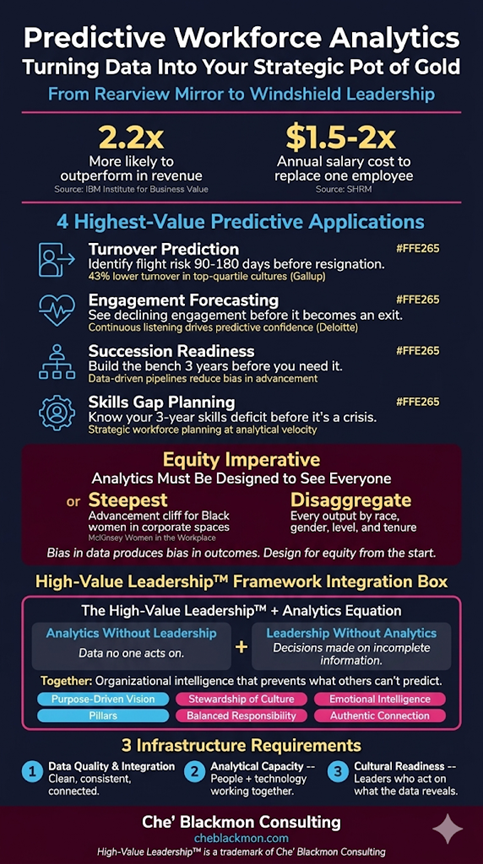
According to a 2023 IBM Institute for Business Value report, organizations that use predictive people analytics are 2.2 times more likely to outperform their peers in revenue growth and 1.5 times more likely to successfully retain high performers. These outcomes are not produced by the analytics alone. They are produced by the combination of good data and leaders who are committed to acting on what the data reveals. Analytics without cultural readiness to respond is just expensive reporting.

💡 Predictive analytics does not replace human judgment. It informs it with precision and timing that human intuition alone cannot match.

🔬 The Four Highest-Value Predictive Analytics Applications in Workforce Strategy

📌 1. Turnover Prediction

Voluntary turnover is the single most expensive and most preventable people problem in most organizations. The Society for Human Resource Management estimates the cost of replacing an employee ranges from one-half to two times their annual salary when recruitment, onboarding, and productivity loss are fully calculated. For organizations with chronic turnover, the cumulative annual cost is often in the millions, and the organizational energy required to perpetually backfill roles that should never have been vacated is a strategic tax on everything else the organization is trying to accomplish.

Predictive turnover models analyze dozens of variables simultaneously, including tenure, compensation relative to market, promotion recency, manager effectiveness scores, engagement survey responses, project assignment patterns, and even communication frequency in collaborative platforms. These variables, individually, are insufficient signals. In combination and over time, they produce a turnover risk score that can identify employees who are likely to leave 90 to 180 days before they submit a resignation letter. That window is everything. It is the difference between losing someone and retaining them.

There was a healthcare organization that implemented a turnover prediction model after experiencing a costly string of departures in a critical clinical department. The model identified a cluster of mid-level professionals who scored high on several simultaneous risk indicators, including stalled compensation growth, declining engagement scores, and a pattern of declining project participation. The organization intervened with targeted retention conversations, compensation adjustments, and development opportunities. The retention rate for that identified cohort exceeded 85 percent over the following year, and the cost avoidance from retained institutional knowledge was substantial.

📌 2. Engagement Forecasting

Engagement surveys measure the current state of employee sentiment at a single point in time. They are useful, but they are inherently delayed indicators. By the time disengagement shows up in an annual survey, it has typically been building for months, and the employees most affected may have already mentally resigned even if their physical departure has not yet followed. Predictive engagement modeling uses continuous data streams, including recognition frequency, performance review scores, absenteeism patterns, and internal mobility activity, to forecast engagement trajectories rather than simply measuring current states.

The practical application is transformative. Instead of discovering that a department’s engagement has dropped 12 points in the annual survey and then spending a quarter diagnosing the root cause, predictive engagement forecasting allows leaders to see the trajectory six months earlier, before it becomes a survey result, and intervene in ways that are proportionate to the early-stage signal rather than reactive to a full-blown engagement crisis.

Deloitte’s Global Human Capital Trends research has found that organizations using continuous listening strategies combined with predictive modeling report significantly higher confidence in their ability to prevent engagement decline before it becomes a retention event. The infrastructure required is not primarily technological. It is cultural. Organizations must build environments where employees are willing to provide authentic signal data, and that willingness is built through trust, not through surveillance.

📌 3. Succession Readiness and Leadership Pipeline Analytics

Succession planning in most organizations is an annual exercise. A list of names is generated for each critical role, assessed through a combination of performance reviews and manager nominations, and then filed until the next annual review cycle. This approach has two significant failures. First, it is static in a workforce that is dynamic. People develop, plateau, and sometimes exit between annual reviews in ways the succession plan does not capture. Second, it is deeply susceptible to the informal biases that determine whose name a manager thinks to put on a list.

Predictive succession analytics changes both of these dynamics. It creates a continuous, data-driven picture of pipeline depth by analyzing skill trajectories, learning and development engagement, performance trends over time, cross-functional experience, and leadership assessment data. It identifies not just who is ready for advancement but who is on a readiness trajectory, which is arguably more valuable because it gives the organization time to develop talent rather than simply select from a pool that already exists.

In High-Value Leadership: Transforming Organizations Through Purposeful Culture, the stewardship of culture is identified as a foundational leadership responsibility. Stewardship of a leadership pipeline requires the same intentional investment, and predictive analytics makes that stewardship precise in ways that informal succession conversations cannot. There was a manufacturing organization that used pipeline analytics to identify a significant gap in its next-generation leadership bench three years before the projected wave of senior retirements. That three-year runway allowed the organization to invest in accelerated development programs and internal mobility initiatives that would have been impossible to execute in a reactive timeframe.

📌 4. Skills Gap and Workforce Planning Analytics

The pace of technological change, industry disruption, and evolving market demands means that the skills your organization needs in three years are meaningfully different from the skills your workforce currently holds. Most organizations have no systematic visibility into this gap. They hire for current needs, develop for current capabilities, and then discover the skills deficit when it has already translated into a competitive disadvantage or a failed technology implementation.

Predictive skills gap analytics maps current workforce capabilities against projected future requirements and identifies the delta. It surfaces which roles are at highest risk of being underskilled for near-future needs, which employees are on development trajectories that position them well for emerging requirements, and where recruiting investment should be targeted to address gaps that internal development cannot close in time. This is workforce planning operating at strategic velocity rather than administrative pace.

✨ The Equity Imperative: Predictive Analytics and the Traditionally Overlooked

Predictive workforce analytics carries an enormous promise for equity and inclusion, and an equally significant risk of amplifying existing inequities if it is not designed and deployed with intentionality. This distinction matters profoundly, and it matters most for the professionals who have historically been most disadvantaged by the informal, relationship-driven, and often biased processes that analytics is designed to replace.

🚨 When Algorithms Inherit Bias

Data does not lie. But data can encode the decisions of systems that did. If an organization’s historical promotion data reflects years of bias against Black women and other underrepresented professionals, a predictive model trained on that data will encode those biases as predictive signals. The model will learn that the profile most likely to be promoted is the profile that has historically been promoted, regardless of whether that outcome reflects actual performance potential or simply pattern recognition of who was already advantaged.

This is not a theoretical risk. Amazon’s well-documented 2018 abandonment of an AI-based recruiting tool that systematically down-ranked resumes from women was a high-profile demonstration of exactly this dynamic. The model was trained on a decade of hiring decisions, and those decisions reflected the company’s historical pattern of male-dominated technical hiring. The algorithm learned to replicate that pattern as a success criterion.

The lesson is not that predictive analytics cannot serve equity. The lesson is that it will serve whatever the data encodes unless explicit corrective design choices are made. Bias audits of training data, diversity-adjusted weighting in model design, ongoing disparity monitoring in model outputs, and regular human review of algorithmic recommendations are all required elements of an equitable analytics infrastructure.

💡 The Case for Equity-Centered Analytics for Black Women

For Black women in corporate environments, the historic experience has been one of performing at a high level while advancement pathways remain narrow and informal sponsorship networks remain inaccessible. McKinsey and Company’s Women in the Workplace research has documented consistently that Black women face the most pronounced advancement gap of any demographic group, are the least likely to receive sponsorship, and are the most likely to have their contributions credited to others.

An analytics infrastructure designed with equity as a design principle changes this dynamic structurally. When advancement criteria are explicit and measurable rather than implicit and relational, the informal favoritism that has historically shaped who gets considered loses its power. When turnover risk models flag high-performing Black women as retention risks based on data rather than leaving the identification to managers who may have limited visibility into the drivers of their experience, organizations gain the ability to intervene before losing people they should have been actively developing.

In Rise and Thrive: A Black Woman’s Blueprint for Leadership Excellence, the argument is clear that structural change requires structural tools. Predictive analytics, when designed and deployed with equity as a non-negotiable design criterion, is one of the most powerful structural tools available for dismantling the informal systems that have kept Black women and other overlooked professionals from advancing at the rate their performance warrants.

📚  Rise & Thrive Connection: The data visibility that predictive analytics provides for organizations mirrors the strategic self-awareness that Rise and Thrive builds for individual professionals. Both are about seeing clearly, acting early, and refusing to be surprised by outcomes that were always preventable with the right information and the right systems.

There was a professional services organization that implemented an equity analytics layer on top of its existing workforce reporting. This layer disaggregated every key metric, including promotion rates, development program participation, stretch assignment allocation, and turnover risk scores, by race, gender, and career level simultaneously. The findings were not comfortable. Black women at the mid-manager level were significantly underrepresented in high-visibility project assignments, significantly underrepresented in the sponsorship program nominations, and significantly overrepresented in the high turnover risk cohort. None of these patterns had been visible in aggregate reporting. All of them were visible the moment the data was disaggregated. The organization redesigned its sponsorship nomination process, revised its project assignment criteria, and implemented structured check-in protocols for the identified high-risk cohort. Representation in senior leadership for Black women improved meaningfully over the following two years.
🏗️ Building the Infrastructure: What Predictive Analytics Requires

Predictive workforce analytics is not a software purchase. It is an organizational capability that requires infrastructure at three levels: data quality, analytical capacity, and cultural readiness to act on what the data reveals. All three are necessary. None is sufficient alone.

💻 Data Quality and Integration

Predictive models are only as good as the data they are trained on. Organizations with fragmented HRIS systems, inconsistent performance management practices, or gaps in data collection cannot produce reliable predictive outputs from poor inputs. Before investing in advanced analytics capability, organizations must honestly assess whether their data is clean, consistent, integrated, and comprehensive enough to support predictive modeling. This is often a multi-year infrastructure investment, but it is also the foundation on which every other analytics capability rests.

The specific data domains most critical for workforce prediction include performance management records over time, compensation history and market positioning, engagement survey data with longitudinal tracking, learning and development completion and application, organizational network analysis data, and manager effectiveness metrics. Organizations that have consistent, high-quality data in these domains have the raw material for powerful predictive capability. Those that do not need to build the foundation before expecting the insight.

🧠 Analytical Capacity: People and Technology

The technology landscape for predictive workforce analytics has matured significantly. Platforms including Visier, Workday People Analytics, SAP SuccessFactors Analytics, and IBM Watson Talent provide increasingly accessible predictive capability built on top of existing HR data infrastructure. Many of these platforms offer pre-built turnover prediction and engagement forecasting models that can be configured to an organization’s specific data environment without requiring a dedicated data science team.

The human capacity requirement is equally important. HR leaders who can translate analytical outputs into strategic conversations with business partners, who can communicate risk and opportunity in the language of revenue and competitive advantage rather than HR metrics, and who can advocate for data-driven interventions in organizations where intuition and relationships have historically driven people decisions are the irreplaceable human layer in any analytics capability. Technology surfaces the insight. HR leadership converts it into action.

🌱 Cultural Readiness: The Most Underestimated Requirement

The most sophisticated analytics infrastructure produces no value in an organization whose culture is not ready to act on what the data reveals. Cultural readiness for predictive analytics means leaders who are willing to be told that their department has a turnover risk cluster, who treat that information as an asset rather than an accusation, and who take proportionate action before the risk materializes rather than managing the aftermath of a departure that was predictable.

It also means an organizational commitment to using data as a tool for equity rather than efficiency alone. Mastering a High-Value Company Culture argues that cultures that endure are cultures built on transparency, accountability, and the genuine investment of leaders in the people they lead. Predictive analytics is a transparency tool. It makes visible what informal observation misses, and it creates accountability for acting on what is now impossible to claim was unseen.

💡 Data does not change culture. Leaders do. Predictive analytics gives leaders information early enough and precisely enough to lead differently. What they do with it is still a leadership choice.

📉 The High-Value Leadership™ Connection: Analytics in Service of Culture

The High-Value Leadership™ framework, anchored in Purpose-Driven Vision, Stewardship of Culture, Emotional Intelligence, Balanced Responsibility, and Authentic Connection, does not exist in tension with data-driven leadership. It is its philosophical foundation. Each pillar of the framework is both a cultural aspiration and a measurable domain that analytics can inform.

Purpose-Driven Vision requires that leaders understand whether employees experience a meaningful connection between their work and the organizational mission. Engagement analytics can measure that connection continuously and flag when it is eroding before it becomes disengagement. Stewardship of Culture requires that leaders actively monitor and respond to the health of the organizational culture. Turnover prediction and equity analytics are the instruments through which that stewardship becomes precise rather than impressionistic. Emotional Intelligence in leadership produces measurable outcomes in team safety, feedback quality, and collaborative effectiveness that analytics can surface. Balanced Responsibility is sustained when accountability systems are consistent and transparent, conditions that data visibility supports directly. Authentic Connection produces the trust that makes employees willing to provide the honest signal data that makes analytics useful in the first place.

The synergy is this: analytics without High-Value Leadership produces data that no one acts on. High-Value Leadership without analytics produces well-intentioned leadership that is still making decisions with incomplete information. Together, they produce the kind of organizational intelligence that allows leaders to steward their culture, protect their people, and build competitive advantage with a precision that neither achieves independently.

🛠️ Actionable Takeaways: Getting Started With Predictive Analytics

The following takeaways are designed for HR leaders, executives, and organizational stakeholders who are ready to move from descriptive to predictive workforce intelligence.

✅ For Organizational Leaders and HR Professionals

1. Assess Your Data Foundation First

Before investing in predictive analytics technology, audit the quality, consistency, and integration of your existing workforce data. Identify which critical data domains are well-captured and which have significant gaps. Build a data readiness roadmap as the first step in your analytics strategy rather than assuming technology can compensate for data quality deficits.

2. Start With Turnover Prediction

Turnover prediction is the highest immediate ROI application of predictive analytics for most organizations because the cost of preventable departure is large, the data required is widely available, and the intervention options are well-established. Implement a turnover risk model, integrate it into your manager toolkit, and establish a clear protocol for what action is taken at what risk threshold.

3. Disaggregate Every Output by Demographics

From the moment you begin producing predictive analytics outputs, establish the practice of disaggregating those outputs by race, gender, career level, and tenure simultaneously. What looks like a uniform pattern in aggregate data is often a significant disparity when examined by demographic segment. That disparity is both an equity signal and a strategic risk signal. Invisible inequity is expensive equityy and it is also just expensive.

4. Build Equity Audits Into Your Analytics Governance

Establish a regular review cycle in which your predictive models are audited for disparate impact. Examine whether model outputs, such as who is flagged as high turnover risk or high promotion potential, are distributed equitably across demographic groups. Where disparities are found, diagnose whether they reflect genuine differences in circumstance or whether they encode historical bias, and redesign accordingly.

5. Develop HR’s Analytical Fluency

The technology is increasingly accessible. The human capability to use it strategically is the limiting factor in most organizations. Invest in developing your HR team’s ability to work with data, translate analytics outputs into business language, and advocate for data-driven interventions at the executive level. This is a capability investment with compounding returns.

✨ For Individual Professionals Navigating Data-Driven Organizations

Understand How Decisions Are Being Made About You

In organizations with active analytics capabilities, workforce decisions are increasingly informed by algorithmic assessments. Understand what metrics are being tracked, what they are used for, and whether the organization has equity governance in place. Professionals who understand the data systems that influence their advancement are better positioned to advocate for themselves within those systems.

Build Your Own Evidence Base

Whether or not your organization has sophisticated analytics, you can build your own evidence base of documented contributions, quantified outcomes, and recorded feedback. This serves as your personal data infrastructure for advancement conversations and as a counterweight to any informal bias in how your performance is perceived relative to how it is documented.

💬 Discussion Questions for Leaders and Teams

Use these questions to drive strategic conversations within your organization, HR function, or leadership development cohort.

  • If your organization implemented a turnover prediction model today and it identified your ten highest-risk employees, how confident are you that your leaders would act on that information? What cultural readiness barriers exist?
  • When you look at your current succession pipeline analytics, how confident are you that the names on your succession plan reflect actual performance trajectories rather than informal relationship capital and proximity to decision-makers?
  • Has your organization ever disaggregated its workforce data by race and gender simultaneously at the career-level? What do you think you would find? What would you do with it?
  • If you are a Black woman or member of another underrepresented group: how transparent is the data that informs advancement decisions in your organization? And how are you building your own evidence infrastructure to ensure your contributions are visible and documented?
  • What is one specific workforce outcome your organization experienced in the last two years that predictive analytics could have prevented? What would the organizational value of that prevention have been?

🚦 Next Steps: Building Your Predictive Analytics Capability

Turning workforce data into strategic gold requires commitment, infrastructure, and the cultural leadership to act on what the data reveals. Here is where to begin.

  1. Conduct a data readiness audit. Assess the quality, consistency, and integration of your current workforce data across the domains critical for predictive modeling.
  2. Identify your highest-priority predictive use case. For most organizations, turnover prediction offers the clearest immediate ROI and the most established model design.
  3. Establish demographic disaggregation as a standard practice in all workforce reporting, not as an add-on equity initiative but as core analytical hygiene.
  4. Invest in HR analytical fluency. Identify the capability gaps on your team and build a development plan that includes data literacy, analytics interpretation, and business case communication.
  5. Build equity governance into your analytics infrastructure from the beginning. Design bias audits, disparity monitoring, and human review protocols before you deploy models, not after disparities are discovered.
  6. Revisit the High-Value Leadership™ framework and its five pillars as the cultural foundation on which your analytics capability will either flourish or stall. Data in the hands of High-Value Leaders is a transformative organizational asset.

🚀 Ready to Turn Your Workforce Data Into Strategic Gold?

Che’ Blackmon Consulting partners with organizations and leaders who are serious about building the analytics infrastructure and the cultural leadership capacity to use workforce data as a genuine strategic asset. Whether you are building your first predictive capability, auditing existing analytics for equity, or developing the High-Value Leadership™ competencies that make data actionable, we bring the frameworks, experience, and tools to move your organization forward.

📧 admin@cheblackmon.com     📞 888.369.7243     🌐 cheblackmon.com

About the Author

Che’ Blackmon is a doctoral candidate in Organizational Leadership (DBA), the Founder and CEO of Che’ Blackmon Consulting, and a recognized expert in culture transformation, fractional HR leadership, and high-value leadership development. With more than 24 years of progressive HR leadership experience spanning manufacturing, automotive, healthcare, nonprofit, quick-service, and professional services industries, she brings a practitioner’s perspective to the intersection of workforce strategy, people analytics, and culture transformation. She is the author of Mastering a High-Value Company Culture, High-Value Leadership: Transforming Organizations Through Purposeful Culture, and the e-book Rise and Thrive: A Black Woman’s Blueprint for Leadership Excellence. Che’ is the creator of the proprietary High-Value Leadership™ framework and the host of the Unlock, Empower, Transform podcast.

© 2025 Che’ Blackmon Consulting. All rights reserved. | High-Value Leadership™ is a trademark of Che’ Blackmon Consulting.

#WorkforceAnalytics #PredictiveAnalytics #HRStrategy #PeopleAnalytics #HighValueLeadership #CompanyCulture #EmployeeRetention #HRLeadership #BlackWomenLead #WorkplaceBias #DataDrivenHR #OrganizationalCulture #CultureTransformation #FractionalHR #CheBlackmonConsulting

St. Patrick’s Day: The Gold at the End of the Culture Rainbow — What High-Value Organizations Actually Find

By Che’ Blackmon, DBA Candidate | Founder & CEO, Che’ Blackmon Consulting

Every St. Patrick’s Day, the legend gets told again. Somewhere at the end of a rainbow, there is a pot of gold. The leprechaun guards it. Most people never reach it. And even in the stories where someone does find it, the gold has a way of disappearing before it can be held onto for long. It is a charming myth. But for the leaders and organizations chasing culture transformation, it is also a surprisingly accurate metaphor for what happens when culture is treated as something to be discovered rather than something to be built.

The truth is this: high-value culture is not found at the end of a rainbow. It does not appear because the timing is finally right, because the budget loosened up, or because a new HR initiative declared the organization a great place to work. It is engineered. It is earned. It is sustained through intention, investment, and the kind of leadership that refuses to let values be decorative. And the organizations that actually reach that gold? They find something far more valuable than luck.

This St. Patrick’s Day, let us look at what high-value organizations actually find at the end of a culture well built, why so many organizations never make it there, and what it takes to follow the rainbow all the way through.

🌈 The Rainbow Is Real. The Luck Is Not.

In Irish folklore, the rainbow is beautiful but elusive. You can see where it is going, but every time you try to follow it, the end keeps moving. That is exactly how most organizations experience culture. They can see what a great culture looks like. They attend the conferences, read the case studies, and draft the values statements. But every time they try to close the gap between aspiration and reality, the destination seems to shift. The culture they are chasing never quite arrives.

The reason is almost always the same. They are following the rainbow instead of building the path. Culture is not a destination you find. It is an infrastructure you construct, one system, one decision, and one leadership behavior at a time. The organizations that treat it as something to be discovered are always in pursuit. The organizations that treat it as something to be engineered are the ones that eventually stand next to the pot of gold and say: we built this.

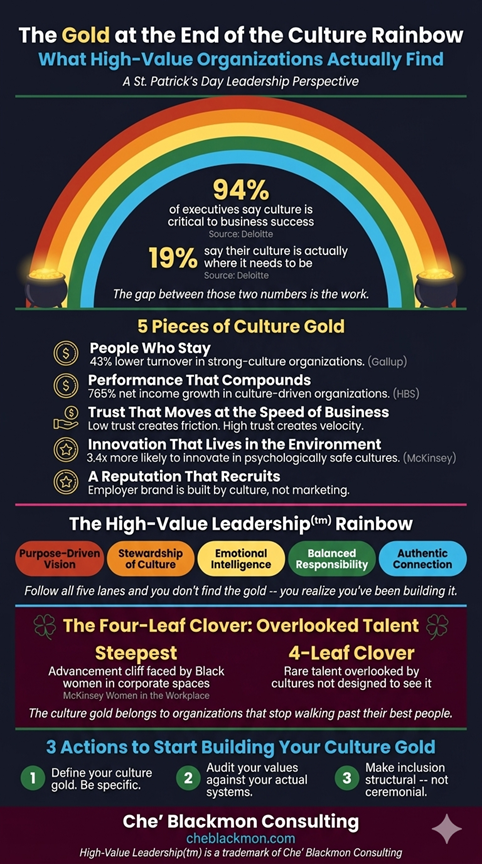
Research from Deloitte found that 94 percent of executives and 88 percent of employees believe a distinct workplace culture is important to business success. But only 19 percent of organizations feel their culture is where it needs to be. That gap is not a mystery. It is the distance between knowing culture matters and actually doing the disciplined work of creating it.

🍀 The rainbow is real. The culture gold is attainable. But it requires a map, not a wish.

🪨 The Pot of Gold: What High-Value Organizations Actually Find

When organizations do the work, the rewards are not abstract. They are measurable, durable, and transformative in ways that show up on both the balance sheet and the daily experience of every person who walks through the door. Here is what high-value organizations actually find at the end of a culture well built.

🥇 Gold Piece 1: People Who Stay

Voluntary turnover is one of the most costly and least discussed failures in organizational life. According to the Society for Human Resource Management, replacing a single employee costs between one half and two times that employee’s annual salary. For a workforce of any size, chronic turnover is not a staffing inconvenience. It is a financial hemorrhage. And the most common cause is not compensation. It is culture.

Gallup’s research consistently finds that employees in organizations with strong cultures are 43 percent less likely to leave voluntarily. They stay not because they cannot find something better elsewhere. They stay because what they have built here, the relationships, the purpose, the sense that their contribution matters, is genuinely difficult to replicate. That loyalty is not manufactured by a retention bonus or a perks program. It is the natural result of a culture that made them feel seen, valued, and invested in over time.

There was a manufacturing organization that had experienced significant voluntary turnover at the senior individual contributor level for three consecutive years. Every exit interview cited the same themes: unclear expectations, leadership that did not listen, and a sense that longevity was penalized rather than rewarded. When the organization committed to a structured culture realignment, including redesigned feedback systems, visible leadership accountability, and a formal internal mobility program, voluntary turnover dropped measurably within 18 months. The gold was not a new benefit. It was a culture that finally said: you belong here and your future is here.

🥇 Gold Piece 2: Performance That Compounds

Culture and performance are not separate conversations. They are the same conversation. Organizations with strong, intentional cultures outperform their peers not occasionally but consistently and significantly. A comprehensive study from Harvard Business School found that organizations with performance-enhancing cultures saw net income growth of 765 percent over an 11-year period, compared to 1 percent growth in organizations without strong cultures. These are not marginal differences. They are civilizational.

The mechanism is not magic. It is engagement. When people work in cultures where they understand the purpose, trust the leadership, feel psychologically safe to contribute, and see a clear connection between their effort and the organizational outcome, they work differently. Not harder in the frantic, depleting sense. Better. More creatively. More collaboratively. More sustainably. That quality of contribution compounds over time in ways that no individual talent acquisition strategy can replicate.

In High-Value Leadership: Transforming Organizations Through Purposeful Culture, the argument is that culture is not a byproduct of good strategy. It is the precondition for good strategy working at all. The same strategic plan produces wildly different outcomes depending on the culture in which it is executed. High-value culture multiplies every other organizational investment.

🥇 Gold Piece 3: Trust That Moves at the Speed of Business

In low-trust organizations, everything slows down. Decisions require more layers of approval. Information moves through gatekeepers instead of channels. Collaboration requires negotiation instead of assumption. Conflict generates defensiveness instead of resolution. The friction of low trust is invisible on an org chart but absolutely visible in the pace and quality of organizational output.

Patrick Lencioni, in The Five Dysfunctions of a Team, identified absence of trust as the foundational dysfunction from which every other organizational failure flows. High-value cultures build trust systemically, through consistent leadership behavior, transparent communication, psychological safety, and accountability that applies equally to everyone regardless of title or tenure. When that trust is present, organizations move faster, decide better, and recover from setbacks more completely.

There was a professional services organization that had struggled with a culture of internal competition that made information sharing a liability rather than a norm. Leaders hoarded insights. Teams duplicated work rather than collaborating. Client outcomes suffered. When leadership committed to a culture of transparent communication, shared accountability metrics, and visible recognition of collaborative behavior, the pace of client delivery improved significantly and internal satisfaction scores rose within two quarters. Trust, it turns out, is not soft. It is infrastructure.

🥇 Gold Piece 4: Innovation That Lives in the Environment

The most innovative organizations in the world are not innovative because they hired creative people. They are innovative because they built cultures in which creative thinking is safe, encouraged, and acted upon. Innovation does not live in a person. It lives in the conditions the culture creates for that person to bring their full thinking to work.

A 2023 McKinsey report found that organizations with psychologically safe cultures were 3.4 times more likely to report above-average innovation performance. Psychological safety, the belief that one can speak up, offer ideas, challenge assumptions, and admit mistakes without fear of punishment, is not a personality trait. It is a cultural output. It is produced by leaders who model intellectual humility, by systems that reward the raising of problems as well as the delivery of solutions, and by norms that treat disagreement as a gift rather than a threat.

Mastering a High-Value Company Culture makes the case that innovation is not a strategy. It is a symptom of a culture that has already done the foundational work of building safety, clarity, and genuine investment in its people. You cannot bolt on innovation. You have to grow the conditions from which it naturally emerges.

🥇 Gold Piece 5: A Reputation That Recruits

Employer brand is not built by marketing. It is built by culture. The organizations that consistently attract top talent without extraordinary compensation packages are the organizations whose reputation precedes them. People talk about where they work. They talk about how they were treated, whether their contributions were recognized, whether leadership lived the values stated on the website, and whether they would send a friend to apply. That word-of-mouth infrastructure, built entirely from genuine employee experience, is among the most powerful recruiting tools available and it costs nothing to create except the commitment to building a culture worth talking about.

✨ The Clover in the Crowd: Seeing Overlooked Talent as Organizational Gold

There is a particular element of the St. Patrick’s Day mythology that deserves a longer look in this context. The four-leaf clover is rare precisely because most people walk past thousands of three-leaf clovers without stopping to look carefully. The four-leaf version is not fundamentally different. It is simply overlooked by those who are not paying attention.

This is a perfect metaphor for what happens with overlooked talent in most organizations. The talent is there. It has always been there. It is simply not being seen by cultures and systems designed to recognize only the most obvious markers of potential and contribution.

🚨 The Compounded Invisibility of Black Women in Corporate Spaces

No group in the American corporate workforce has been more consistently undervalued, more systematically overlooked, and more persistently bypassed in advancement conversations than Black women. This is not a subjective observation. McKinsey and Company’s Women in the Workplace research has documented for years that Black women face the steepest advancement cliff of any demographic group, are the least likely to receive sponsorship from senior leaders, and are the most likely to have their ideas credited to others in collaborative settings.

In Rise and Thrive: A Black Woman’s Blueprint for Leadership Excellence, this reality is addressed without softening. Black women enter corporate organizations with credentials, competence, and the particular resilience that comes from navigating systems not designed for their success. They contribute, they lead, and they deliver results, often while managing the invisible tax of code-switching, navigating bias, and working harder for recognition that colleagues with less experience receive more readily. When organizations fail to retain and advance Black women, they are not losing a demographic. They are losing the four-leaf clover they walked right past.

The organizations that find the gold at the end of the culture rainbow are, without exception, the ones that have built systems to see and advance every form of talent equitably. Not through performative inclusion initiatives but through structural redesign of the processes that determine whose ideas get credited, whose names appear on succession plans, and whose contributions are measured with the same rigor as their colleagues.

📚  Rise & Thrive Connection: If you are a Black woman in a corporate environment where your contributions are consistently visible but your advancement is consistently stalled, Rise and Thrive: A Black Woman’s Blueprint for Leadership Excellence was written specifically for this season of your professional journey. The SHIELD Resilience Framework within that work is a strategic and personal toolkit designed to help you navigate exactly this terrain with clarity, confidence, and purpose.

The culture gold belongs to organizations that stop walking past their most valuable talent and start building the systems to recognize, develop, and advance them. Equitably. Structurally. Permanently.

🍀 The High-Value Leadership™ Rainbow: Following the Right Path

The High-Value Leadership™ framework is the map for organizations serious about reaching the cultural gold. Its five pillars are not a checklist. They are a system. Each one is a lane in the rainbow, and together they lead somewhere worth going.

1️⃣  Purpose-Driven Vision: The Red Lane

Purpose is not a tagline. It is the organizational north star that gives every employee a reason to come to work that transcends their job description. Organizations with a clear, authentic, and cascaded sense of purpose see higher engagement, lower turnover, and stronger alignment between individual effort and organizational outcome. The red lane of the rainbow is where culture begins. Without it, every other investment in culture is noise without direction.

2️⃣  Stewardship of Culture: The Orange Lane

Culture does not maintain itself. It requires active, intentional stewardship from leaders who model the values they want to permeate the organization, who hold themselves and others accountable to those values, and who understand that the daily decisions they make are cultural signals whether or not they intend them to be. Stewardship of culture is the orange lane: the warmth and energy that keeps the culture alive between the major initiatives and the annual engagement surveys.

3️⃣  Emotional Intelligence: The Yellow Lane

Daniel Goleman’s research has demonstrated that emotional intelligence accounts for 67 percent of the competencies most essential for strong leadership performance. Leaders who understand their own emotional landscape and who can read and respond to the emotional climate of their teams build cultures of safety, connection, and resilience. The yellow lane is where human beings actually experience each other, and it is where culture is either built or eroded in the ordinary moments of every workday.

4️⃣  Balanced Responsibility: The Green Lane

This is the St. Patrick’s Day lane. And it is fitting that the green lane of the High-Value Leadership™ framework is where growth lives. Balanced Responsibility is the discipline of holding high standards in a psychologically safe environment. It is the refusal to choose between care and accountability. It is the recognition that people grow fastest in environments where expectations are clear, feedback is honest and kind, and the standard applies to everyone. The green lane is where ordinary teams become exceptional ones.

5️⃣  Authentic Connection: The Blue Lane

The organizations people never want to leave are the organizations where the relationships are real. Authentic connection is not team building at an offsite. It is the daily practice of leaders who know their people as people, who communicate with transparency, who express genuine interest in the development of every person on their team, and who build the kind of relational trust that survives disagreement, setback, and change. The blue lane is where loyalty is built, and it cannot be purchased. It can only be earned.

🌈 Follow all five lanes, and you do not find the gold at the end. You realize you have been building it the entire way.

🏆 What Lucky Companies Are Actually Doing Differently

Here is a secret about the organizations that everyone calls lucky. They are not lucky. They are disciplined. They made commitments that most organizations resist making because those commitments require sustained investment, visible accountability, and the willingness to examine uncomfortable truths about where the culture currently is versus where it claims to be.

There was a healthcare organization that was widely regarded in its market as one of the best places to work. When asked what their secret was, senior leaders consistently said the same thing: they had committed years earlier to making every major people decision, including hiring, promotion, recognition, and development, consistent with their stated values. Not aspirationally consistent. Actually consistent. They audited their systems. They trained their managers. They measured the gaps and held themselves publicly accountable to closing them. They were not lucky. They were relentlessly intentional.

There was a quick-service organization that had historically struggled with front-line retention. After investing in a structured onboarding redesign, a manager development program built on the principles of psychological safety and clear expectations, and a recognition system that celebrated tenure and contribution equally, their 90-day voluntary turnover rate dropped by more than 30 percent within a year. They did not get lucky. They got deliberate.

And there was a nonprofit organization that had the kind of mission-driven culture that everyone admired from the outside but that was eroding internally because leaders had confused passion for purpose with the disciplined practices that sustain culture over time. When they introduced structured accountability systems, transparent communication norms, and a formal investment in leadership development, the internal culture began to match the external reputation. They did not find the gold. They built it.

🛠️ Actionable Takeaways: How to Follow Your Own Rainbow

The following takeaways are practical, immediate, and designed for leaders at every level who are ready to stop chasing culture and start building it.

✅ For Organizational Leaders and HR Professionals

Name What Your Culture Gold Actually Is

Most organizations have a vague aspiration toward great culture but no specific definition of what great looks like in their context. Define it. What does a high-value culture mean for your industry, your workforce, and your strategic goals? What are the three to five measurable outcomes that tell you the culture is working? You cannot build toward something you have not defined.

Audit Your Systems Against Your Values

Your values are only as real as the systems that reinforce them. Take one value your organization claims to hold and trace it through your actual people processes: hiring, onboarding, performance management, recognition, and promotion. Does the value show up at every touchpoint? Where it does not, you have found your work.

Make Inclusion Structural, Not Ceremonial

If your inclusion strategy consists of events, statements, and training sessions but has not touched the processes that determine whose ideas get credited, whose names appear on succession plans, and whose feedback shapes strategy, it is ceremonial. Structural inclusion means redesigning the systems. Start with one.

Invest in Leader Development as a Culture Strategy

Your culture is only as healthy as the leaders delivering it daily. Every manager in your organization is a culture carrier. The question is whether they are carrying it in the direction you intend. Invest in developing the High-Value Leadership™ competencies across your entire leadership pipeline.

✨ For Individual Professionals Building Their Own Culture Path

Identify Where You Are on the Rainbow

Before you can follow the path forward, you need an honest assessment of where you currently stand. Are you in an organization whose culture is aligned with your values? Are you in a role where your contributions are genuinely visible and equitably rewarded? Your answers determine your next strategic move.

Protect Your Energy Like It Is Gold

Because it is. The professional energy required to navigate a culture that is not designed for your success is finite and non-renewable. In Rise and Thrive, the point is made clearly: strategic resilience is not the ability to endure indefinitely. It is the wisdom to know when to invest more, when to advocate for change, and when to find a culture that actually deserves what you bring.

Build Your Own Five-Lane Rainbow

Regardless of the organizational culture around you, you can embody the High-Value Leadership™ principles in your own professional practice. Lead with purpose. Steward the culture of your team. Bring emotional intelligence to every interaction. Hold yourself and others to high standards with care. Build authentic connections everywhere you go. You become the culture you wish existed.

💬 Discussion Questions for Leaders and Teams

Use these questions to spark meaningful conversation within your organization, leadership team, or professional network.

  • If you had to identify the one piece of “culture gold” your organization most needs right now, what would it be? Retention? Trust? Innovation? Inclusion? And what is one system you could redesign to begin building it?
  • Where in your organization’s rainbow does the path get unclear or disappear? What is the specific gap between your stated values and the lived experience of your employees?
  • Are there four-leaf clovers in your organization, talented professionals whose contributions are consistently undervalued or overlooked? What structural change could make them visible?
  • Which of the five High-Value Leadership™ pillars is most present in your organizational culture right now, and which one is most absent? What would it look like to invest in the missing lane?
  • For individual professionals: are you in a culture that is building toward gold? If not, what is your strategic response, and what resources do you need to navigate the path forward?

🚦 Next Steps: Start Following Your Rainbow Today

The pot of gold at the end of the culture rainbow is not a myth. It is a reality that disciplined, intentional, High-Value Leadership™ organizations reach every day. Here is how to begin following the path.

  1. Define your culture gold. Be specific about what a high-value culture looks and feels like in your organizational context.
  2. Conduct a values-to-systems audit. Identify the gap between what your culture claims and what your systems actually produce.
  3. Identify and address one area of structural invisibility where overlooked talent, including Black women and other underrepresented professionals, is not advancing at the rate their performance warrants.
  4. Invest in the High-Value Leadership™ competencies across your leadership pipeline through coaching, development programming, and accountability structures.
  5. If you are an individual professional navigating a culture misaligned with your values and potential, pick up Rise and Thrive: A Black Woman’s Blueprint for Leadership Excellence for a strategic framework designed for exactly this season.
  6. Revisit Mastering a High-Value Company Culture and High-Value Leadership: Transforming Organizations Through Purposeful Culture for the comprehensive frameworks behind every principle in this article.

🍀 This St. Patrick’s Day, may your organization be blessed not with luck, but with the discipline, the courage, and the leadership to build the culture gold that lasts. The rainbow is yours to follow. The gold is yours to build.

🚀 Ready to Build Your Culture Gold?

Che’ Blackmon Consulting partners with organizations and leaders who are serious about following the culture rainbow all the way through. Whether you are diagnosing a retention challenge, redesigning your people systems, or investing in the leadership development that makes every organizational strategy work better, we bring the frameworks, experience, and tools to help you find what you are building toward.

📧 admin@cheblackmon.com     📞 888.369.7243     🌐 cheblackmon.com

About the Author

Che’ Blackmon is a doctoral candidate in Organizational Leadership (DBA), the Founder and CEO of Che’ Blackmon Consulting, and a recognized expert in culture transformation, fractional HR leadership, and high-value leadership development. With more than 24 years of progressive HR leadership experience across manufacturing, automotive, healthcare, nonprofit, quick-service, and professional services industries, she has built a body of work dedicated to engineering cultures where every person can thrive at every career stage. She is the author of Mastering a High-Value Company Culture, High-Value Leadership: Transforming Organizations Through Purposeful Culture, and the e-book Rise and Thrive: A Black Woman’s Blueprint for Leadership Excellence. Che’ is the creator of the proprietary High-Value Leadership™ framework and the host of the Unlock, Empower, Transform podcast.

© 2025 Che’ Blackmon Consulting. All rights reserved. | High-Value Leadership™ is a trademark of Che’ Blackmon Consulting.

#StPatricksDay #CultureIsStrategy #HighValueLeadership #CompanyCulture #LeadershipDevelopment #OrganizationalCulture #BlackWomenLead #WorkplaceCulture #HRLeadership #CultureTransformation #EmployeeRetention #InclusiveLeadership #PurposeDrivenLeadership #FractionalHR #CheBlackmonConsulting
The Ageism Audacity: How Companies Overlook Their Most Experienced Leaders (And Pay for It)

By Che’ Blackmon, DBA Candidate | Founder & CEO, Che’ Blackmon Consulting

📚  Book Tie-In: Rise & Thrive — A Black Woman’s Blueprint for Leadership Excellence | Navigating Workplace Bias

There is a particular kind of professional insult that rarely gets called out in the open. It does not announce itself in a policy memo. It does not show up in a disciplinary report. It lives in the subtle signals: the way a seasoned leader gets passed over for the high-visibility project, the way her ideas are summarized by someone twenty years younger and then credited as fresh thinking, or the way a job posting specifies five to seven years of experience for a senior role that clearly needs twenty. This is ageism. And in corporate America, it is not only alive. It is thriving.

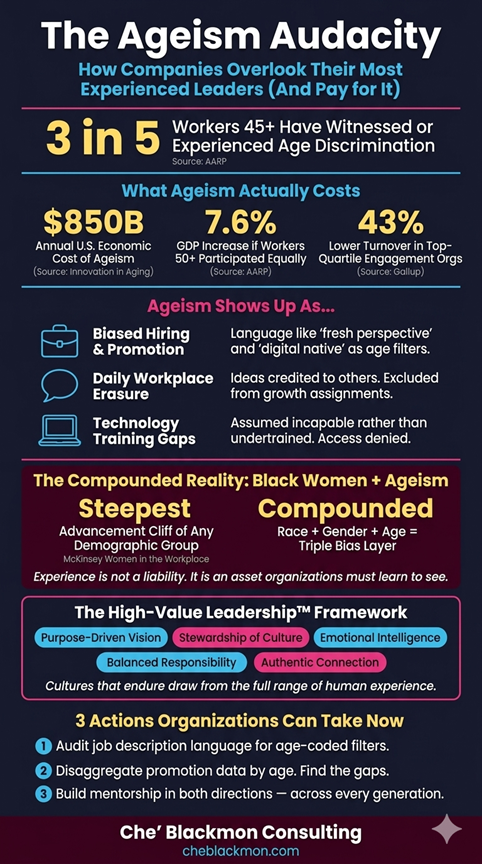
Ageism is one of the most normalized and least confronted forms of workplace bias. The Age Discrimination in Employment Act has been federal law since 1967, protecting workers aged 40 and older from discriminatory employment practices. Yet according to the AARP, more than three in five workers over age 45 have experienced or witnessed age discrimination in the workplace. The problem is not shrinking. It is growing more sophisticated, more embedded in organizational culture, and more costly than most leaders are willing to admit.

This article is about that cost. It is also about the specific experience of Black women who navigate ageism as one layer of a compounding bias that the corporate world has yet to honestly reckon with. And it is about what leaders and organizations can do, right now, to stop losing some of their most valuable people to a prejudice that serves no one.

📈 What Ageism Actually Costs Organizations

Most organizations do not track the financial cost of ageism because most organizations do not acknowledge that ageism is happening. That is the first problem. When a seasoned leader is eased out of a role, dismissed from a succession conversation, or simply never considered for advancement despite a record of results, the organization loses more than a person. It loses institutional knowledge, strategic perspective, relationship capital, and the kind of pattern recognition that only comes from decades of navigating real complexity.

The financial numbers are significant. A 2020 study published in the journal Innovation in Aging estimated that ageism in the United States costs the economy approximately 850 billion dollars annually when healthcare and employment costs are combined. Research from AARP found that if workers aged 50 and older participated in the workforce at the same rate as younger workers, the U.S. gross domestic product would increase by 7.6 percent. These are not marginal figures. They represent the measurable result of organizations systematically devaluing experience.

At the organizational level, the cost is equally concrete. When experienced leaders leave prematurely, organizations face the expense of recruiting and onboarding replacements who require significant time to reach equivalent effectiveness. According to the Society for Human Resource Management, the average time to full productivity for a new hire in a senior role can extend well beyond a year. Every month of that learning curve represents organizational capacity that a retained experienced leader would have delivered immediately.

“The institutional knowledge that leaves when an experienced leader walks out the door is almost never fully documented and is almost never fully replaced.” — Che’ Blackmon, High-Value Leadership™

Beyond the financial calculation, there is a culture cost. When employees across generations watch their most experienced colleagues be sidelined, they draw conclusions about what the organization actually values. They learn that longevity is not rewarded. They learn that wisdom is less prized than novelty. They learn that the culture is transactional rather than generative. And they make their own career decisions accordingly.

🔍 The Many Faces of Workplace Ageism

Ageism in the workplace rarely presents as overt discrimination. It has evolved into something more subtle and, in many ways, more damaging precisely because it is harder to name and challenge. Understanding what it looks like in practice is the first step toward addressing it.

📋 Ageism in Hiring and Promotion

There was a professional services firm that updated its job description language across the board to require “digital nativity” and “fresh perspectives” without defining what either term meant in operational terms. The effect was predictable. The finalist pools for senior roles skewed dramatically younger, and experienced candidates who had spent decades developing precisely the strategic skills the roles required were filtered out before their qualifications were ever reviewed. No one in the organization called it age discrimination. But the EEOC would have had a different view.

In promotion decisions, ageism shows up as a quiet assumption that experienced professionals are “too set in their ways” to learn new approaches, that they will be resistant to change initiatives, or that they represent higher flight risks because they are closer to retirement. These assumptions are rarely tested against evidence. They are applied as default filters that determine who gets considered and who does not.

🗣️ Ageism in Day-to-Day Work Life

The daily experience of ageism is relentless and cumulative. It looks like being excluded from team communications because they happen on platforms the organization assumes older professionals do not use. It looks like being assigned to wind-down projects rather than growth initiatives. It looks like having one’s ideas met with polite disinterest in meetings and then enthusiastically endorsed when a younger colleague reintroduces them a week later. It looks like performance reviews that reference “adaptability” as a concern without specifying what the expected adaptation actually is.

There was a healthcare organization where a senior HR leader with more than two decades of experience was systematically excluded from the working groups developing the organization’s new people strategy. The rationale offered was that the initiative needed “new energy.” The actual result was a strategy that duplicated programs the organization had already tried and abandoned years earlier, at significant cost, because no one with long institutional memory was in the room.

💻 Ageism in Technology and Training Access

One of the most quietly damaging forms of ageism in modern organizations is the assumption that experienced professionals are less capable of learning new technologies. This assumption is both empirically unsupported and organizationally destructive. Research from the MIT AgeLab has consistently found that older workers demonstrate high capacity for learning new skills and technology when provided adequate training and time. The gap is not ability. It is access.

Organizations that assume their experienced employees will not engage with new tools often simply do not invest in training them. The resulting performance gap then becomes evidence for the original assumption, creating a self-fulfilling cycle of exclusion that the organization never examines critically.

✨ The Compounded Reality: Black Women at the Intersection of Age and Race

For Black women in corporate environments, ageism does not operate in isolation. It operates in combination with racial bias, gender discrimination, and the particular professional penalties that accumulate across a career spent navigating systems that were never designed for their advancement. The result is a form of compounded bias that is uniquely isolating and uniquely costly.

In Rise and Thrive: A Black Woman’s Blueprint for Leadership Excellence, this reality is addressed directly. Black women who have spent two or three decades building expertise, earning credentials, and delivering results often find themselves in a paradox at senior career stages: they are simultaneously seen as too experienced to be approachable for mentorship by younger colleagues and too overlooked to be positioned for the advancement their records clearly justify. The skills and wisdom they have accumulated become invisible to organizations that are not designed to see them.

🚨 The Double Standard of “Ovequalified”

The word “overqualified” carries a particular weight when applied to Black women in senior roles. What organizations describe as overqualification is often, in practice, a discomfort with a Black woman whose experience, authority, and credibility exceed what the organizational culture is prepared to accommodate. The professional record that should open doors becomes the reason doors are presented as closed.

There was a manufacturing organization that passed over a highly experienced Black woman HR leader for a VP-level role three times over a four-year period, each time citing concerns about “cultural fit” with the new executive team. The leaders hired into that role instead had significantly less experience, required extensive onboarding, and the organization’s HR function struggled measurably during each transition. The experienced leader eventually left the industry entirely. The organization lost institutional memory, strategic capacity, and a leader who understood the workforce at a depth that no succession plan replaced.

This is not an anomaly. McKinsey and Company’s Women in the Workplace research has consistently found that Black women face a steeper advancement cliff than any other demographic group. They are promoted at lower rates than their peers, receive less sponsorship from senior leaders, and are more likely to see their career momentum stall at middle management despite performance records that exceed expectations.

📚  Rise & Thrive Connection: In Rise & Thrive, Che’ Blackmon writes directly to the Black woman who has been told, in words or in practice, that her experience is a liability rather than an asset. The SHIELD Resilience Framework in that work offers a strategic and personal blueprint for navigating exactly this kind of compounded bias with dignity, strategy, and clarity of purpose. If you are living this reality, that book was written for you.

💡 The Erasure of Legacy and Mentorship Potential

When experienced Black women are pushed out of organizations prematurely, the loss extends far beyond the individual and the organization. It disrupts the mentorship and sponsorship pipeline for younger Black women who are navigating the early stages of careers in the same environments. The absence of senior Black women who have survived, thrived, and built sustained leadership records is felt by every junior colleague who looks up and cannot find a reflection of their own possibility at the table.

This is why the cost of ageism in this specific context is not only a business cost. It is a cultural and generational one. Every experienced Black woman leader who exits corporate life earlier than she should have represents a broken link in a chain of possibility that takes years or decades to rebuild.

🏗️ What High-Value Leadership™ Says About Experience

The High-Value Leadership™ framework, built on five pillars of Purpose-Driven Vision, Stewardship of Culture, Emotional Intelligence, Balanced Responsibility, and Authentic Connection, is explicitly designed to recognize and leverage the full depth of what experienced leaders bring. Experience is not a liability in this framework. It is a strategic advantage that, when honored and deployed intentionally, elevates the entire organization.

In Mastering a High-Value Company Culture, the argument is clear: cultures that endure are cultures that draw from the full range of human experience within the organization. They do not treat institutional memory as irrelevant. They treat it as foundational. The most resilient and high-performing cultures are multigenerational by design, not by accident. They recognize that the perspective of someone who has navigated three recessions, two technological revolutions, and a global pandemic is not redundant. It is rare.

High-Value Leadership: Transforming Organizations Through Purposeful Culture goes further, arguing that stewardship of culture requires leaders who understand where the organization has been in order to responsibly guide where it is going. You cannot steward something you do not understand historically. Experienced leaders carry that historical understanding. Sidelining them in favor of perpetual novelty is not innovation. It is amnesia.

💡 Organizations that treat experience as obsolescence are not evolving. They are forgetting. And forgetting is expensive.

🔬 What the Research Tells Us

The business case for retaining and advancing experienced leaders is well documented, and the evidence is not subtle.

A landmark study published by Harvard Business School found that companies led by experienced CEOs significantly outperformed those led by executives earlier in their careers on long-term profitability and organizational stability metrics. The research attributed this advantage specifically to the pattern recognition and risk calibration skills that develop only through sustained experience over time.

McKinsey and Company research on organizational resilience found that companies with age-diverse leadership teams demonstrated higher adaptability during disruption. The combination of long-term institutional knowledge from experienced leaders with the technological fluency of younger professionals produced outcomes neither group achieved in isolation. Age diversity at the leadership level is not merely a matter of equity. It is a driver of competitive performance.

AARP Public Policy Institute research found that workers over 50 are more likely to stay in roles when they feel valued, and that their retention rates in organizations with strong cultures of inclusion across age groups are significantly higher than industry averages. In other words, the organizations that treat experience with respect keep their experienced people. The organizations that signal disregard lose them. And when they lose them, they pay.

Deloitte’s Global Human Capital Trends report has identified multigenerational workforce management as one of the defining organizational challenges of this decade. Despite widespread acknowledgment of the demographic reality, only a fraction of organizations have formal strategies for retaining and advancing experienced workers. The gap between recognition and action remains wide, and the cost of that gap accumulates every year.

🛠️ Actionable Takeaways: What Organizations and Leaders Can Do Right Now

Addressing ageism requires both structural change and cultural commitment. The following takeaways are designed for HR leaders, executives, and individual professionals navigating this bias from any direction.

✅ For Organizations and HR Leaders

1. Audit Your Job Description Language

Review every active job posting for language that functions as an age filter without stated operational necessity. Terms like “digital native,” “fresh perspective,” and “energetic” are legally risky and strategically counterproductive. Replace them with specific competency descriptions that welcome candidates from any career stage.

2. Disaggregate Promotion and Succession Data by Age

If your succession pipeline skews significantly young without a documented, competency-based rationale, your organization has an ageism problem whether or not it recognizes it. Break the data down. Ask who is being developed, who is being considered, and who is being left out. Then ask why.

3. Build Intentional Mentorship in Both Directions

Reverse mentoring programs, where younger employees share technology and cultural insights with senior leaders, are valuable. But they must be paired with traditional mentorship where experienced leaders formally invest in the development of rising talent. Neither direction should be optional. Both should be structured, recognized, and rewarded.

4. Redesign Training Access

Stop assuming that experienced employees are less interested in or less capable of learning. Ensure that all employees, regardless of age or tenure, have equal access to skill development programs, technology training, and leadership development opportunities. Measure participation by age cohort and close the gaps you find.

5. Address Ageism in Your Culture Explicitly

Ageism will not resolve itself through silence. Name it in your inclusion strategy. Address it in your manager training. Create psychological safety for employees who experience it to report it without fear of being labeled as difficult. Culture that does not name a bias cannot dismantle it.

✨ For Experienced Professionals Navigating Ageism

Document and Narrate Your Value

Do not assume your track record speaks for itself in a culture that is not listening. Build a current portfolio of your accomplishments, your strategic contributions, and your specific impact on organizational outcomes. Frame your experience as competitive advantage, not historical context. Translate what you know into the language of what the organization needs now.

Expand Your Visible Presence

Ageism thrives on invisibility. Stay present and visible in professional networks, industry conversations, and internal leadership forums. Speak up in meetings. Offer to lead initiatives. Let your current engagement be as visible as your historical record.

Build Bridges Across Generations

One of the most powerful ways to counter the narrative that experience equals irrelevance is to demonstrate your investment in the success of people at earlier career stages. Mentor actively. Sponsor intentionally. The leaders who are seen as invested in the future are rarely dismissed as artifacts of the past.

Know Your Legal Rights

The Age Discrimination in Employment Act is federal law. If you are 40 or older and experiencing employment decisions that appear to be age-based, document everything and consult with an employment attorney. Ageism that rises to illegal discrimination has legal remedies, and knowing that is part of navigating the professional landscape with full information.

💬 Discussion Questions for Leaders and Teams

Use these questions to open meaningful conversations within your organization, leadership development cohort, or professional network.

  • When you look at your organization’s succession pipeline, what is the age distribution of candidates being actively developed for senior roles? What does that distribution tell you about whose experience your culture values?
  • Has your organization ever lost an experienced leader to early departure or retirement and later discovered that the institutional knowledge they carried could not be replaced? What would a proactive strategy to prevent that loss have looked like?
  • If you are an experienced professional, how are you narrating your value in your current organization? Are you letting your track record speak for itself, or are you actively translating your experience into the language of current organizational need?
  • For leaders who are committed to multigenerational inclusion, what is one structural change, not a program, not an event, but a system change, that your organization could make in the next 90 days to better retain and advance experienced professionals?
  • How does the experience of ageism differ for Black women and other professionals who also carry the weight of racial and gender bias? What does your organization’s inclusion strategy say explicitly about that intersection?

🚦 Next Steps: Moving from Recognition to Action

Understanding that ageism is costing your organization is one thing. Building the will and the systems to address it is the work. Here is where to begin.

  1. Conduct an age-inclusive audit of your hiring, promotion, and succession processes. Do not rely on self-assessment alone. Use data.
  2. Add age as an explicit category in your diversity, equity, and inclusion strategy and measurement framework.
  3. Implement structured mentorship programs that move in both directions across generational lines, and hold leaders accountable for participation.
  4. Review your organization’s performance management language for age-coded assumptions about adaptability, energy, and fit.
  5. If you are an experienced professional navigating ageism, pick up Rise and Thrive: A Black Woman’s Blueprint for Leadership Excellence for a framework designed to help you navigate compounded bias with strategy and self-possession.
  6. Invest in leadership development that builds the High-Value Leadership™ competencies required to steward an age-diverse culture with intention, equity, and results.

🚀 Ready to Build a Culture That Values Every Generation?

Che’ Blackmon Consulting partners with organizations and leaders who are ready to do the real work of culture transformation. Whether you are diagnosing a retention crisis rooted in ageism, redesigning your inclusion strategy to honor the full range of your workforce, or developing the next generation of high-value leaders across all career stages, we bring the frameworks, experience, and tools to move your organization forward.

📧 admin@cheblackmon.com     📞 888.369.7243     🌐 cheblackmon.com

About the Author

Che’ Blackmon is a doctoral candidate in Organizational Leadership (DBA), the Founder and CEO of Che’ Blackmon Consulting, and a recognized expert in culture transformation, fractional HR leadership, and high-value leadership development. With more than 24 years of progressive HR leadership experience spanning manufacturing, automotive, healthcare, nonprofit, and professional services industries, she has built a body of work dedicated to engineering cultures where every person, at every career stage, can do their best work. She is the author of Mastering a High-Value Company Culture, High-Value Leadership: Transforming Organizations Through Purposeful Culture, and the e-book Rise and Thrive: A Black Woman’s Blueprint for Leadership Excellence. Che’ is the creator of the proprietary High-Value Leadership™ framework and the host of the Unlock, Empower, Transform podcast.

© 2025 Che’ Blackmon Consulting. All rights reserved. | High-Value Leadership™ is a trademark of Che’ Blackmon Consulting.

#AgeismInTheWorkplace #WorkplaceBias #ExperiencedLeaders #HighValueLeadership #CompanyCulture #BlackWomenLead #LeadershipDevelopment #OrganizationalCulture #HRLeadership #InclusiveLeadership #AgeDiversity #CultureTransformation #WorkplaceEquity #FractionalHR #CheBlackmonConsulting
📚 Lucky Culture or Engineered Culture? The Systems Behind Organizations People Never Want to Leave

By Che’ Blackmon, DBA Candidate | Founder & CEO, Che’ Blackmon Consulting

Some organizations seem magnetic. People do not just work there. They stay, they grow, they refer their friends, and even after they leave, they speak of the culture with reverence. From the outside, it can look like luck. Great timing, a charismatic founder, or the right industry at the right moment. But here is what two and a half decades of human resources leadership across manufacturing, automotive, healthcare, professional services, and nonprofit environments has taught me: there is no such thing as an accidentally great culture. What looks like luck is almost always engineering.

In Mastering a High-Value Company Culture, I made the case that culture is the lifeblood of an organization. Not a tagline. Not a slide in the onboarding deck. The actual, living, breathing system through which every organizational outcome flows. And in High-Value Leadership: Transforming Organizations Through Purposeful Culture, I went further, arguing that culture does not build itself. It is built, or neglected, by the leaders who hold responsibility for it. This article takes those ideas into practical territory. Because understanding that great cultures are engineered is one thing. Understanding the specific systems that make them sticky is another entirely.

🏗️  The Architecture of a Culture That Retains

When an organization experiences low voluntary turnover, high engagement scores, and a reputation as an employer of choice, most senior leaders will credit their values, their people, or their mission. And they are not wrong. But what they often cannot explain is the mechanism. How do those values get operationalized? How does the mission translate into daily behavior? How do people actually feel the culture rather than just read it on the wall?

The answer lies in systems. Intentional, repeatable, measurable systems that translate leadership intent into lived employee experience. Culture that retains is not the result of good vibes. It is the result of deliberate architecture.

Research consistently confirms this. A landmark Gallup study on employee engagement found that organizations in the top quartile of engagement outperform bottom-quartile organizations by 23 percent in profitability and experience 43 percent lower turnover. What separates those quartiles is not industry or geography. It is the quality of systems that shape how people experience their work every single day.

“Culture is not what you say it is. Culture is what your systems consistently produce.” — Che’ Blackmon, High-Value Leadership™

🔍  The Five Systems That Make or Break Retention

📌 1. The Clarity System: Purpose That Travels Vertically and Horizontally

Purpose-driven vision is the first pillar of the High-Value Leadership™ framework, and it is foundational to retention for a reason. Human beings do not leave paycheck machines. They leave organizations where they cannot see themselves in the mission, where the stated values bear no resemblance to the daily decisions being made, or where their work feels disconnected from anything that matters.

Organizations that retain top talent have clarity systems in place. These are not annual town halls or framed mission statements. They are structured mechanisms that ensure every employee, at every level, can trace a line between their daily responsibilities and the organizational purpose. There was a company operating in the professional services sector that experienced a 19 percent voluntary turnover in a single fiscal year. When exit survey data was analyzed, the most common theme was not compensation. It was disconnection. Employees did not understand how their work contributed to the larger whole. A structured clarity initiative, including cascaded goal alignment, departmental purpose workshops, and a revised onboarding framework, reduced that turnover figure by more than a third within 18 months.

Clarity is not a one-time communication event. It is a repeating system.

🤝 2. The Belonging System: Inclusion That Is Built In, Not Bolted On

High retention cultures do not simply avoid exclusion. They actively architect belonging. And belonging, it turns out, is one of the most powerful drivers of commitment. A 2023 report from McKinsey & Company found that employees who feel a strong sense of belonging are 3.5 times more likely to contribute to their full potential and significantly less likely to leave. Yet most organizations treat inclusion as a program rather than a system.

The distinction matters enormously. A program is an event. It has a start date, an end date, and a budget line. A system is structural. It lives in how decisions are made, who is invited into the room, whose ideas get credited, how performance is evaluated, and who gets sponsored for advancement. There was a manufacturing organization that launched a diversity and inclusion initiative with great fanfare, complete with training sessions, a committee, and a new policy statement. Eighteen months later, their engagement scores for Black employees and other employees of color had not moved. When the data was disaggregated, the finding was clear: the program had not touched the systems. Promotions still went to the same profile. Stretch assignments were still distributed informally through networks that did not include everyone.

Engineered cultures build belonging into the systems themselves. Not just the programming.

✨ Real belonging is not a committee. It is the lived experience that results when systems are designed to see, hear, and advance every person equitably.

📋 3. The Accountability System: Standards That Protect Without Crushing

One of the most misunderstood elements of high-retention culture is the role of accountability. There is a pervasive belief, particularly in organizations that have experienced culture toxicity, that warmth and high standards are in tension. That if you hold people firmly accountable, you will damage psychological safety. And if you prioritize belonging and care, you will let performance erode. This is a false choice.

In High-Value Leadership, I describe the Balanced Responsibility pillar as the discipline of holding both simultaneously. The organizations that people never want to leave tend to be the ones where expectations are crystal clear, feedback is delivered with both candor and care, and accountability is applied consistently regardless of tenure, title, or proximity to leadership. That consistency is not punitive. It is, in fact, deeply reassuring. Employees in high-accountability cultures report higher levels of trust in leadership and higher perceptions of fairness than those in cultures where expectations shift based on who is watching.

There was a nonprofit organization that prided itself on being family-like. The problem was that the same family dynamic that created warmth also produced a culture where underperformance was tolerated, boundaries were fuzzy, and burnout among high performers was endemic. When leaders implemented structured accountability frameworks, including clear performance metrics, documented expectations, and consistent feedback cycles, the culture did not become colder. It became more equitable. High performers stayed. Disengaged employees either recommitted or self-selected out.

🌱 4. The Growth System: Pathways Visible to Everyone

Talent leaves organizations for many reasons, but one of the most consistently cited is the absence of a visible path forward. Growth systems in high-retention organizations are not limited to formal training programs or tuition reimbursement policies. They are the full infrastructure through which people can see, access, and pursue development, stretch opportunities, mentorship, sponsorship, and advancement.

The word “visible” is doing heavy lifting in that sentence. In many organizations, growth opportunities exist. They are just not equally visible or accessible. Informal networks, proximity to decision-makers, and social capital determine who knows about the opening before it is posted, who gets tapped for the high-visibility project, and who receives the developmental feedback that equips them for the next level. For employees who are not embedded in those informal networks, the opportunity gap is very real.

Engineered cultures systematize visibility. There was a healthcare organization that implemented a structured internal talent marketplace, pairing high-potential employees with formal sponsors and creating transparent criteria for stretch assignments. Within two years, internal promotion rates increased significantly and the pattern of informal favoritism that had previously characterized advancement became far less pronounced.

🗣️ 5. The Listening System: Feedback Loops That Drive Change

Organizations that retain their best people are organizations that demonstrably listen. Not performatively. Not in ways that collect data and file it away. But in ways where feedback from employees at every level visibly informs decisions, and where employees can trace the arc from what they said to what changed.

This is one of the most significant differentiators between organizations with high voluntary turnover and those without it. According to a 2022 Qualtrics study, employees who believe their feedback will be acted upon are 55 percent more likely to stay. Yet less than 30 percent of employees globally report that their organization actually closes the feedback loop by telling them what changed as a result of what they shared.

Listening systems include formal mechanisms like engagement surveys and stay interviews. They also include the informal practices that signal to employees whether speaking up is safe and whether it matters. In the organizations people never want to leave, feedback is not a performance. It is a practice.

👩🏿‍💼  The Compounding Cost of Getting This Wrong: A Lens on Traditionally Overlooked Talent

Every system described above carries a multiplied consequence for employees who have historically been marginalized or overlooked in organizational life. And no group navigates this dynamic more acutely, or with higher personal and professional stakes, than Black women in corporate environments.

In Rise & Thrive: A Black Woman’s Blueprint for Leadership Excellence, I wrote directly to this reality. Black women enter corporate spaces carrying expertise, credentials, and ambition, and they far too frequently encounter systems that were not designed with their advancement in mind. The result is not simply a talent pipeline problem for individuals. It is a systemic waste of organizational capacity that shows up in the data: Black women remain among the most underrepresented groups in senior leadership, and they experience higher rates of voluntary departure from corporate roles than many of their peers.

What does this have to do with culture engineering? Everything.

🚨  When Systems Fail Specific Populations

An organization can have strong clarity systems, well-designed accountability frameworks, and genuine listening mechanisms, and still produce a culture that pushes out its Black women if those systems carry embedded bias. Performance evaluation systems that reward informal relationship capital disproportionately disadvantage employees who are excluded from informal networks. Sponsorship systems that rely on personal affinity rather than structured nomination processes reproduce the same representation gaps cycle after cycle. Feedback cultures that penalize directness or code-switch expectations, often unfairly applied to Black women, undermine the psychological safety that retention requires.

There was a large-scale manufacturing organization that had strong engagement scores across most demographic groups, and then notably lower scores among Black women at the individual contributor and mid-management levels. When focus groups were conducted, the findings were consistent: the systems worked for most people. But for Black women specifically, the experience of being overlooked for high-visibility assignments, having their ideas credited to others, and receiving feedback that was vague enough to be unhelpful was common enough to represent a pattern rather than isolated incidents.

The solution was not a program. It was a systems audit followed by targeted redesign: structured sponsorship criteria, blind-step evaluation checkpoints in the promotion process, and a revised feedback framework that trained managers on specific, behavior-based language. Over three years, representation in leadership for Black women increased noticeably, and their engagement and retention scores moved toward parity with the broader workforce.

💡 The cultures people never want to leave are the cultures where everyone experiences the benefit of the systems, not just those who were already centered when the systems were designed.

📈  What the Research Tells Us About Engineered Retention

The business case for intentional culture engineering is not theoretical. It is among the most well-documented areas in organizational behavior research, and the financial implications are significant.

According to the Society for Human Resource Management, the cost of replacing a single employee ranges from one-half to two times that employee’s annual salary, when recruitment, onboarding, training, and lost productivity are fully accounted for. For organizations experiencing even moderate voluntary turnover, the cumulative cost is staggering. And that calculation does not include the institutional knowledge that walks out the door or the impact on the remaining team’s morale and capacity.

Deloitte’s research on organizational culture and performance found that companies with strong, deliberately designed cultures saw up to 30 percent greater innovation and 40 percent higher business growth over five-year periods compared to their culture-neglected counterparts. The Harvard Business Review has documented similar patterns, noting that leaders who invest in culture systematically, rather than episodically, are significantly more likely to achieve durable performance outcomes.

Culture engineering is not a soft investment. It is a strategic one.

🛠️  Actionable Takeaways: How to Begin Engineering Your Culture

The following takeaways are designed for HR leaders, executives, and culture practitioners who are ready to move from observation to action.

✅ Audit Your Systems, Not Just Your Sentiment

Engagement surveys tell you how people feel. Systems audits tell you why. Conduct a structured review of your promotion, feedback, recognition, and development systems. Ask specifically: who is benefiting from these systems, who is not, and what structural features explain the gap.

✅ Disaggregate Your Data

Overall engagement scores can mask significant disparities within the workforce. Break your data down by race, gender, level, and tenure at minimum. What you find may be the most important signal your culture is producing.

✅ Build Belonging Into Decisions, Not Just Programming

Review your last ten promotion decisions. Review your last ten assignments for high-visibility projects. Ask who is in the pattern and who is not. Inclusion that is structural changes outcomes. Inclusion that is only programmatic changes perception, temporarily.

✅ Close the Feedback Loop, Publicly

After every engagement survey cycle, communicate specifically what will change based on what employees said. Then report back on whether it changed. This single practice does more for trust than almost any other intervention available to leaders.

✅ Invest in Sponsorship, Not Just Mentorship

Mentors advise. Sponsors advocate. High-retention organizations are intentional about creating structured sponsorship opportunities for employees who are most likely to be invisible in informal networks, including Black women and others from underrepresented groups.

✅ Align Your Accountability Framework With Your Values

If your stated values include inclusion, collaboration, and psychological safety, then your performance management and accountability systems must reinforce those values. Leaders who undermine inclusion should face the same performance consequences as leaders who miss their financial targets. Until accountability is attached, values remain aspirational.

💡  The High-Value Leadership™ Connection

The High-Value Leadership™ framework, anchored in Purpose-Driven Vision, Stewardship of Culture, Emotional Intelligence, Balanced Responsibility, and Authentic Connection, exists because these five dimensions are the leadership-level expression of the systems described in this article. Systems do not sustain themselves. They require leaders who are committed to them, who model them, and who are willing to be held accountable to the same standards they set for others.

When leaders lead from those five pillars, they create the conditions under which great systems can actually do their work. When those pillars are absent, even well-designed systems erode. This is why culture transformation is both a systems project and a leadership development project. They are inseparable.

The organizations people never want to leave are not lucky. They are led by people who understand that culture is their most important product, and who invest in it with the same rigor, discipline, and intentionality that they invest in operations, finance, and strategy. They are organizations where the question is not whether culture matters, but how to build it better.

💬  Discussion Questions for Leaders and Teams

Use these questions to prompt meaningful conversation within your leadership team, HR function, or organizational development cohort.

  • If a new employee joined your organization today, how would they experience your culture? What systems would they encounter that reflect your stated values?
  • When you look at who advances in your organization, what pattern do you see? Is that pattern a reflection of your values or your blind spots?
  • How does your organization close the feedback loop after listening efforts? What specifically has changed as a result of what employees shared?
  • Who in your organization carries the heaviest invisible tax of navigating systems that were not designed for them? What one structural change could reduce that tax?
  • What would a systems audit of your culture reveal that your engagement survey does not?

🚦  Next Steps: Moving From Insight to Action

Understanding that culture is engineered is important. Building the capacity to engineer it well is the work. Here is how you can begin.

  1. Conduct an honest assessment of your current culture systems using the five dimensions outlined in this article.
  2. Disaggregate your engagement and retention data to surface patterns that overall averages may conceal.
  3. Identify one system in your organization that is producing outcomes misaligned with your stated values and commit to redesigning it.
  4. Invest in leadership development that builds the High-Value Leadership™ capabilities required to sustain culture transformation.
  5. Read or revisit Mastering a High-Value Company Culture and High-Value Leadership: Transforming Organizations Through Purposeful Culture for a deeper framework on each of these dimensions.

🚀  Ready to Build a Culture People Never Want to Leave?

Che’ Blackmon Consulting partners with organizations and leaders who are serious about culture transformation. Whether you are diagnosing a retention crisis, redesigning your people systems, or developing the next generation of high-value leaders, we bring the frameworks, experience, and tools to move your organization forward.

📧 admin@cheblackmon.com     📞 888.369.7243     🌐 cheblackmon.com

About the Author

Che’ Blackmon is a doctoral candidate in Organizational Leadership (DBA), the Founder and CEO of Che’ Blackmon Consulting, and a recognized expert in culture transformation, fractional HR leadership, and high-value leadership development. With more than 24 years of progressive HR leadership experience spanning manufacturing, automotive, healthcare, nonprofit, and professional services industries, she has built a body of work dedicated to engineering cultures where every person can do their best work. She is the author of Mastering a High-Value Company Culture, High-Value Leadership: Transforming Organizations Through Purposeful Culture, and the e-book Rise & Thrive: A Black Woman’s Blueprint for Leadership Excellence. Che’ is the creator of the proprietary High-Value Leadership™ framework and the host of the Unlock, Empower, Transform podcast.

© 2025 Che’ Blackmon Consulting. All rights reserved. | High-Value Leadership™ is a trademark of Che’ Blackmon Consulting.

#HighValueLeadership #CompanyCulture #LeadershipDevelopment #OrganizationalCulture #HRLeadership #EmployeeRetention #WorkplaceCulture #BlackWomenLead #CultureTransformation #InclusiveLeadership #EngagedWorkplace #PurposeDrivenLeadership #HRStrategy #FractionalHR #CheBlackmonConsulting

📚 The Accountability Architecture: How High‑Value Leaders Build Teams That Own Results

By Che’ Blackmon, DBA Candidate | Founder & CEO, Che’ Blackmon Consulting

📚 Book Tie‑In: High‑Value Leadership — Accountability and Ownership Frameworks

cheblackmon.com

🎯 Introduction: The Ownership Gap

There is a question that keeps surfacing in boardrooms, plant floors, and HR offices across every industry: Why does this team struggle to take ownership?

Leaders invest in training. They set goals. They implement performance management systems. And still, when something falls through the cracks, no one steps forward. The finger pointing starts. The excuses pile up. The same problems cycle through quarter after quarter. It is not a talent problem. It is an accountability architecture problem.

Accountability is one of the most discussed yet least understood concepts in organizational leadership. Most people think of it as something you enforce. Something you impose on others through consequences and corrective action. But that is only half the picture, and it is the less effective half. True accountability is not a policy. It is a culture. It is a shared commitment to owning results, learning from failure, and holding one another to a standard that everyone helped create.

In High‑Value Leadership: Transforming Organizations Through Purposeful Culture, I introduced the concept that leaders do not just manage performance. They architect the environments in which performance becomes a natural byproduct of shared purpose. Accountability is one of the most critical beams in that architecture. Without it, even the most talented teams will underperform. With it, even teams facing significant challenges can produce extraordinary results.

This article explores what accountability architecture actually looks like in practice, why traditional approaches to accountability fail (especially for traditionally overlooked populations), and how High‑Value Leaders™ build teams where ownership is not demanded but embedded in the culture itself.

⚠️ The Accountability Crisis: What the Data Tells Us

The numbers in 2026 paint a concerning picture. Employee engagement has dropped dramatically, falling from 88% to just 64% year over year according to recent workforce research. Gallup reported a notable decline in manager engagement in 2025, dropping from 30% to 27%, with younger managers under 35 declining five percentage points and female managers declining seven. Meanwhile, 71% of leaders report increased stress from their roles, and 40% of those stressed leaders are considering leaving.

At the same time, leadership development has risen to the number one organizational priority for 2026, followed by innovation and retention. Organizations are recognizing that controlling costs alone will not solve what ails them. The real issue is that the people expected to drive results feel unsupported, unclear about expectations, and disconnected from purpose.

This is the accountability crisis in plain terms. It is not that people do not want to be accountable. It is that organizations have failed to create the conditions where accountability can thrive. Too many leaders confuse surveillance with accountability, consequence with commitment, and compliance with ownership. The result is a workforce that does what it is told but refuses to go further, because going further feels risky in a culture that punishes mistakes more than it rewards initiative.

“Culture isn’t a nice‑to‑have. It’s your competitive advantage. We prove it with data.” When accountability is embedded in culture rather than enforced through policy, teams do not just meet expectations. They exceed them.

🛠️ The Accountability Architecture Framework

In Mastering a High‑Value Company Culture, I wrote that culture is the lifeblood of any organization and that employees are not resources but the lifeblood of that organization. The Accountability Architecture builds on that foundation. It is not a single practice or policy. It is a system of interconnected elements that, when aligned, create an environment where people naturally own their work, their outcomes, and their growth.

The framework rests on five structural pillars, each aligned with the High‑Value Leadership™ methodology:

🎯 Pillar 1: Clarity of Purpose (Purpose‑Driven Vision)

Accountability begins with clarity. People cannot own what they do not understand. Yet one of the most common failures in organizations is the assumption that because something was communicated, it was understood. Purpose‑Driven Vision means every team member can answer three fundamental questions: What are we trying to achieve? Why does it matter? What is my specific role in making it happen? When those questions go unanswered, accountability becomes impossible because people are trying to hit a target they cannot see.

There was a mid‑size manufacturing company that rolled out a new quality initiative and then spent the entire quarter frustrated that frontline teams were not meeting the new standards. An internal review revealed that the initiative had been communicated through a single email from the VP of Operations. Supervisors had never been briefed on the specifics. The frontline received no training. The target was set, but the architecture to support it was nonexistent. Once leadership rebuilt the communication cascade (briefing supervisors, training teams, posting visual standards on the floor, and establishing weekly check ins), compliance rose from 52% to 91% within 60 days.

🏠 Pillar 2: Psychological Safety (Stewardship of Culture)

Here is a truth many leaders resist: people will not take ownership in environments where they fear being punished for honest mistakes. Psychological safety is the invisible foundation of every accountable team. It does not mean lowering standards. It means creating space for people to try, fail, learn, and try again without the threat of humiliation or retaliation.

Research from the O.C. Tanner Institute confirms that when organizations prioritize transparency in accountability (leaders openly sharing challenges, admitting mistakes, and taking responsibility), odds of organizational success increase tenfold and trust in leaders increases eightfold. Teams become 13 times more likely to meet their goals and 15 times more likely to be engaged.

As Stewards of Culture, High‑Value Leaders™ model the behavior they expect. They own their mistakes publicly. They ask for feedback and act on it. They make it safe for others to raise concerns before those concerns become crises. This is what separates accountability cultures from blame cultures.

❤️ Pillar 3: Equitable Expectations (Emotional Intelligence)

Accountability only works when expectations are applied consistently and fairly. This is where many organizations fail, often without realizing it. When some team members receive clear, actionable performance feedback while others receive vague generalities, the accountability system is broken at its foundation.

Research from Catalyst reveals a pattern that should concern every HR leader: Black employees, particularly Black women, are significantly less likely to receive the kind of specific, developmental feedback that drives career advancement. They receive feedback that is less actionable, less connected to growth opportunities, and more focused on subjective assessments like “executive presence” or “cultural fit.” This is not an accountability system. It is a bias delivery mechanism disguised as one.

Emotional Intelligence in the Accountability Architecture means leaders audit their own feedback patterns. Are they giving the same quality of direction, correction, and praise to every team member? Are success metrics objective and transparent? Can every person on the team point to exactly what they need to do to advance? If the answer to any of those questions is no, the architecture needs repair.

⚖️ Pillar 4: Structured Follow Through (Balanced Responsibility)

Setting expectations without follow through is just wishful thinking. Balanced Responsibility means creating rhythms and structures that keep accountability alive without micromanaging. This includes regular check ins that focus on progress rather than surveillance, peer accountability partnerships that distribute ownership across the team, and milestone reviews that celebrate wins and course correct early.

The most effective accountability systems operate on what researchers call daily action systems rather than periodic measurement approaches. Instead of waiting for the quarterly review to discover that a project is off track, High‑Value Leaders™ create weekly touchpoints where teams assess their own progress, identify barriers, and request support. This shifts the dynamic from “my boss is checking on me” to “we are checking on our goals together.”

There was a professional services firm that replaced its traditional annual review cycle with a structured cadence of monthly goal alignment conversations, weekly team stand ups, and quarterly reflection sessions. Within one year, voluntary turnover dropped by 30%, internal promotion rates increased, and employee satisfaction scores rose across every demographic group. The key was not that they added more meetings. It was that every meeting had a clear purpose tied to shared outcomes.

🤝 Pillar 5: Reciprocal Accountability (Authentic Connection)

The final and most transformative pillar is reciprocal accountability. This is the principle that accountability flows in every direction, not just downward. Leaders are accountable to their teams just as teams are accountable to their leaders. When leaders ask “What do you need from me to succeed?” and then follow through on the answer, they create a fundamentally different kind of trust.

Authentic Connection means that accountability is not something done to people. It is something built with them. It means involving teams in setting their own goals, defining their own success metrics, and co‑creating the standards to which they will hold one another. When people have a hand in designing the system, they have a stake in making it work.

👑 The Overlooked Dimension: Accountability and Black Women in Corporate Spaces

Any honest conversation about accountability in the workplace must address a reality that too many organizations ignore: accountability systems are not experienced equally by everyone. For Black women in corporate spaces, the accountability architecture is often rigged from the start.

In Rise & Thrive: A Black Woman’s Blueprint for Leadership Excellence, I wrote extensively about how Black women navigate what scholars call “double jeopardy,” facing bias related to both race and gender simultaneously. This intersectional reality shapes how accountability is experienced in several critical ways.

🔍 The Double Standard of Scrutiny

Black women in leadership are disproportionately scrutinized while simultaneously being undersupported. Research consistently shows that Black women are held to higher standards than their peers while receiving less mentorship, less sponsorship, and less access to the senior leaders who control career trajectories. The U.S. Government Accountability Office found that despite making up 7.4% of the workforce, Black women hold only 1.6% of executive roles. This is not a pipeline problem. It is an accountability problem at the organizational level: who is being held accountable for ensuring that qualified Black women actually advance?

🔍 The Feedback Gap

Harvard Business Review research on Black women in the workplace reveals that self‑censorship, the need to code switch, and gendered expectations to prioritize the comfort of colleagues all hinder career progression. When performance feedback is vague, subjective, or filtered through unconscious bias, Black women are denied the clear accountability framework that everyone else receives. They are told to “be more strategic” without being told what that means. They are encouraged to “increase their visibility” while being penalized for being “too visible.” This is not accountability. It is a moving target designed (whether intentionally or not) to keep people running in place.

🔍 The Glass Cliff

Catalyst research highlights a troubling pattern: Black women are disproportionately promoted during periods of organizational crisis, a phenomenon known as the “glass cliff.” They are elevated into leadership roles during the most difficult moments, without the support, resources, or runway that their predecessors received. Then, when the turnaround proves as difficult as expected, the accountability falls squarely on their shoulders. Catalyst’s recommendation is clear: organizations must create accountability structures that include equitable succession planning, bias‑free evaluation processes, and genuine support systems for all leaders, not just those who fit the traditional prototype.

For Black women reading this, I want to name something directly. The accountability failures you have experienced are not your failures. They are systemic failures. And while navigating them requires the resilience, emotional intelligence, and strategic awareness I outlined in Rise & Thrive, the ultimate responsibility for fixing them belongs to the organizations that created them.

📋 Practical Case Studies: Accountability Architecture in Action

🟢 Case Study 1: From Blame Culture to Ownership Culture

A regional healthcare system with over 2,000 employees was experiencing dangerously high nursing turnover. Leadership attributed the problem to “a new generation that doesn’t want to work.” An internal culture assessment told a different story. Nurses reported that when patient care issues arose, they were immediately investigated for fault rather than supported in finding solutions. Experienced nurses stopped reporting near misses because the accountability system was actually a punishment system.

The organization redesigned its accountability architecture from the ground up. It replaced incident blame reports with learning reviews that focused on systemic root causes. It trained charge nurses and supervisors in psychological safety practices. It created peer accountability circles where nursing teams reviewed their own outcomes weekly and identified improvements collectively. Within 18 months, nursing turnover decreased by 35%, patient safety incident reporting actually increased (a positive indicator, meaning the team felt safe enough to be transparent), and employee engagement scores rose across every unit.

🟢 Case Study 2: Closing the Feedback Equity Gap

A technology company discovered through a third party audit that performance reviews for Black and Latino employees contained 40% more subjective language and 30% fewer specific developmental recommendations than reviews for white employees. Managers were not being intentionally biased. They were simply defaulting to vague language when they lacked cultural fluency or close working relationships with employees from different backgrounds.

The company implemented three changes. First, it standardized review criteria with measurable, role specific benchmarks that every employee could see. Second, it required managers to include at least three specific, actionable development recommendations in every review. Third, it created a calibration process where HR reviewed anonymized reviews across demographic groups quarterly to identify patterns. Within two review cycles, the feedback equity gap had narrowed by 68%, promotion rates for underrepresented employees increased, and managers reported feeling more confident (not less) in their evaluation skills.

🟢 Case Study 3: Building Reciprocal Accountability on the Plant Floor

An automotive parts manufacturer was struggling with chronic quality issues on its second shift. Management’s response had been to add more inspections, more write ups, and more supervisor oversight. Quality continued to decline. Morale cratered.

A new plant HR leader took a different approach. She convened a series of listening sessions with second shift operators and asked a question no one had asked before: “What do you need from us to produce quality parts consistently?” The answers were illuminating. Operators had been working with outdated work instructions, broken fixtures that maintenance never prioritized, and a supervisor who withheld information as a power tactic. The accountability failure was not on the floor. It was in the system above the floor.

Leadership replaced the supervisor, expedited maintenance requests, updated all work instructions with operator input, and established a weekly quality huddle run by the operators themselves. Within one quarter, scrap rates dropped by 44% and the second shift began outperforming the first shift for the first time in the plant’s history. The operators did not suddenly become more accountable. The organization became accountable to them.

✅ Actionable Takeaways: Building Your Accountability Architecture

💼 For Leaders and Organizations

  • Audit your clarity. Can every person on your team articulate what they are responsible for, why it matters, and how success will be measured? If not, start there. Accountability without clarity is just confusion with consequences.
  • Measure your feedback equity. Pull a random sample of performance reviews from the last cycle and compare them across demographic groups. Look for patterns in specificity, developmental recommendations, and subjective language. What you find may surprise you.
  • Replace blame systems with learning systems. When something goes wrong, the first question should be “What in our system allowed this to happen?” not “Who is responsible for this failure?” This single shift transforms accountability from a weapon into a tool for improvement.
  • Create structured rhythms. Accountability lives in the cadence of your operations, not in the annual review. Implement weekly team stand ups focused on progress and barriers, monthly one on ones focused on development, and quarterly reflections focused on alignment.
  • Model reciprocal accountability. Ask your team regularly: “What do you need from me that you are not getting?” And then deliver on their answers. Nothing builds trust faster than a leader who holds themselves to the same standard they expect from others.
  • Invest in manager development. Gallup’s research confirms that 70% of team engagement is directly attributable to the manager. Yet 60% of new managers receive no formal training upon entering their roles. Close that gap. Your accountability architecture is only as strong as the managers who maintain it.

🙋 For Black Women and the Traditionally Overlooked

  • Demand clarity. If your goals, success metrics, or development path are vague, ask for specifics in writing. Document the conversation. You deserve the same level of clarity and direction that everyone else receives.
  • Build your own accountability circle. Connect with peers (inside or outside your organization) who will hold you to your goals, celebrate your wins, and help you strategize through challenges. Isolation is the enemy of advancement.
  • Track your contributions in real time. Do not wait for the annual review to articulate your impact. Maintain a running record of projects completed, outcomes delivered, problems solved, and skills developed. This becomes your evidence when the system is vague.
  • Name the pattern when you see it. If you notice that feedback is consistently subjective, if you are being held to a different standard, or if you are being elevated into high risk roles without adequate support, say so. Use the language of accountability: “I want to be successful in this role. Here is what I need to make that happen.”
  • Protect your well being. Accountability to your organization should never come at the cost of your health. The “strong Black woman” narrative is not a leadership strategy. It is a path to burnout. As I wrote in Rise & Thrive, sustainable leadership requires balancing self care with professional advancement.

🏢 For Culture Transformation

  • Align accountability with values. If your organization says it values inclusion, then your accountability system must produce inclusive outcomes. Track promotion rates, retention rates, and engagement scores by demographic group and hold leaders accountable for equity in those metrics.
  • Train for emotional intelligence. Managers cannot build equitable accountability systems if they lack the self awareness to recognize their own biases. Invest in emotional intelligence development as a core leadership competency, not an optional workshop.
  • Make accountability visible. Publish team goals, progress updates, and outcomes transparently. When everyone can see the scoreboard, the game changes. Visibility drives ownership.
  • Celebrate ownership publicly. When someone takes initiative, owns a mistake, or goes above and beyond, recognize it visibly. What gets celebrated gets repeated.

📊 Expert Insights and Current Research

The convergence of research in 2025 and 2026 paints a clear picture: accountability is the defining leadership challenge of this era. A January 2026 analysis of over 300 leading business reports found that executive teams are becoming hyper focused on accountability while simultaneously showing a decline in empathy. In fact, 59% of organizations now view empathy as a “nice to have” rather than an essential leadership capability. This is a dangerous combination. Accountability without empathy is authoritarianism. It produces compliance but destroys initiative.

The McLean & Company HR Trends Report for 2026 confirms that a widening gap exists between the pace of organizational transformation and the capacity of leaders to manage that transformation effectively. This creates what researchers call structural risk: the people responsible for accountability often lack the training, support, and emotional bandwidth to exercise it wisely.

McKinsey’s research demonstrates that organizations with strong cultures outperform their peers by three times in long term total shareholder return. And the O.C. Tanner Institute’s global research finds that when leaders practice transparency and recognition together, organizations are eight times more likely to be financially healthy. The data is unmistakable: accountability, when paired with transparency, psychological safety, and genuine recognition, is not just a people strategy. It is a business strategy with measurable returns.

💡 The High‑Value Leadership™ Perspective

Throughout High‑Value Leadership: Transforming Organizations Through Purposeful Culture, I make the case that leadership is not about controlling outcomes. It is about creating environments where the right outcomes emerge naturally because people are aligned, equipped, supported, and inspired. The Accountability Architecture is a direct extension of that philosophy.

Purpose‑Driven Vision provides the clarity that makes accountability possible. Stewardship of Culture creates the psychological safety that makes it sustainable. Emotional Intelligence ensures it is applied equitably. Balanced Responsibility gives it structure and rhythm. And Authentic Connection makes it reciprocal, transforming accountability from a top down mandate into a shared commitment.

This is what separates High‑Value Leaders™ from traditional managers. Traditional managers enforce accountability. High‑Value Leaders™ build it. They design it into the DNA of their teams. They model it in their own behavior. And they measure not just whether results were achieved, but whether the system itself is fair, transparent, and empowering for everyone.

As I wrote in Mastering a High‑Value Company Culture: “At the heart of every great company culture is its people.” The Accountability Architecture honors that truth. It treats people as the lifeblood of the organization, not as problems to be managed. And in doing so, it produces the kind of results that no amount of surveillance, corrective action, or top down pressure ever could.

❓ Discussion Questions

Use these questions for team meetings, leadership development sessions, or personal reflection:

  1. Can every member of your team clearly articulate their goals, why those goals matter, and how success will be measured? If not, where is the clarity gap?
  2. When something goes wrong on your team, is the first instinct to find the root cause or to find someone to blame? What does that instinct reveal about your culture?
  3. How would you rate the quality and consistency of feedback across all members of your team? Are there disparities based on tenure, gender, race, or relationship closeness?
  4. When was the last time you asked your team, “What do you need from me that you are not getting?” What would change if you asked that question consistently?
  5. Does your organization hold leaders accountable for equitable outcomes (promotion rates, retention rates, engagement scores) across all demographic groups? If not, what would it take to implement that?
  6. How does your personal accountability practice align with the five pillars of the High‑Value Leadership™ framework? Which pillar needs the most attention in your leadership right now?

🚀 Next Steps: From Framework to Action

Knowledge without action is just information. Here is how to move forward:

  1. Share this article with your leadership team and schedule a discussion using the questions above.
  2. Conduct a feedback equity audit on your most recent performance review cycle within the next 30 days.
  3. Select one pillar of the Accountability Architecture and implement a concrete change within 90 days.
  4. Ask your team the reciprocal accountability question (“What do you need from me?”) at your next one on one and follow through visibly.
  5. Invest in your own growth. Explore the resources below and consider how deepening your leadership practice can transform your team’s culture.

📬 Ready to Build an Accountability Architecture That Transforms Your Organization?

At Che’ Blackmon Consulting, we partner with organizations to design and implement the leadership and culture systems that drive real, measurable results. Whether you need fractional HR leadership, culture assessment, accountability system design, or leadership development, we bring 30+ years of experience and a proven framework to help your people and your organization thrive.

Explore our resources:

  • 📖  Mastering a High‑Value Company Culture
  • 📖  High‑Value Leadership: Transforming Organizations Through Purposeful Culture
  • 📖  Rise & Thrive: A Black Woman’s Blueprint for Leadership Excellence
  • 🎓  High‑Value Leadership Intensive (Waitlist): https://adept-solutions-llc-2.kit.com/147712ac25
  • 🎧  Unlock, Empower, Transform Podcast
  • 📰  The Blackmon Brief Newsletter

All books available at: https://books.by/blackmons‑bookshelf

📧  admin@cheblackmon.com   |   📞  888.369.7243   |   🌐  cheblackmon.com

Fractional HR Leadership  |  Culture Transformation  |  Executive Development

Let’s build workplaces where both people and organizations flourish.

© 2026 Che’ Blackmon Consulting. All rights reserved. This article may be shared with proper attribution. #AccountabilityArchitecture #HighValueLeadership #HRLeadership #CultureTransformation #LeadershipDevelopment #FractionalCHRO #WorkplaceCulture #TeamAccountability #InclusiveLeadership #PeopleFirst #BlackWomenLead #EmployeeEngagement #HRStrategy #LeadershipTrends2026 #FractionalHR #ExecutiveDevelopment #PsychologicalSafety #FeedbackEquity #BlackWomenInBusiness #CheBlackmonConsulting

📚 AI Ethics in HR: Using Technology to Empower People, Not Replace Them

By Che’ Blackmon, DBA Candidate | Founder & CEO, Che’ Blackmon Consulting

cheblackmon.com

🎯 Introduction: The Promise and the Peril

Artificial intelligence is no longer a futuristic concept reserved for tech companies and science fiction. It is here, embedded in the tools HR professionals use every single day. From screening resumes to predicting employee turnover, AI is reshaping how organizations find, develop, and retain talent. The question is no longer whether AI will transform human resources. The question is whether we will allow it to transform human resources ethically.

That distinction matters more than most leaders realize. When implemented thoughtfully, AI can reduce administrative burdens, surface hidden talent, and create more equitable workplaces. When deployed carelessly, it can amplify the very biases it was supposed to eliminate, silently filtering out qualified candidates and reinforcing systemic inequities that have plagued corporate spaces for decades.

In my book Mastering a High‑Value Company Culture, I wrote that culture is the lifeblood of any organization. Technology does not replace that lifeblood. It either strengthens it or it poisons it. There is no neutral ground. Every algorithm, every automated workflow, and every AI powered decision reflects the values of the people and systems that created it. As HR leaders, we must ensure those values align with the high‑value cultures we are working so hard to build.

This article explores the ethical dimensions of AI in HR, examines how these technologies disproportionately affect traditionally overlooked populations (most specifically Black women in corporate spaces), and provides actionable strategies for leveraging AI as a tool for empowerment rather than exclusion.

🤖 The Current Landscape: AI in HR by the Numbers

The adoption of AI in human resources has accelerated dramatically. Over half of U.S. companies now invest in AI based recruiting tools, and AI powered hiring platforms processed over 30 million applications in 2024 alone. These systems handle resume screening, candidate scoring, interview scheduling, employee engagement analytics, and even performance prediction.

The regulatory landscape is shifting just as quickly. New York City’s Local Law 144 requires annual independent bias audits for automated employment decision tools. California’s Civil Rights Council regulations, effective since October 2025, make it unlawful to use automated decision systems that discriminate based on protected characteristics. The Colorado AI Act, taking effect in June 2026, mandates rigorous impact assessments for high risk AI systems. Illinois House Bill 3773, effective January 2026, requires employers to notify candidates whenever AI is used in employment decisions.

The message from legislators is clear: the era of unregulated AI in employment is over. And for those of us in HR leadership, this is not a threat. It is a call to lead.

⚠️ The Hidden Danger: When Algorithms Inherit Our Biases

Here is a truth that many technology vendors would rather not discuss openly. AI systems are only as fair as the data they are trained on. When that training data reflects decades of discriminatory hiring patterns, the resulting algorithms do not eliminate bias. They automate it. They scale it. And they give it a veneer of objectivity that makes it even harder to challenge.

Consider the widely cited case of a major technology company that developed an AI recruiting tool only to discover it systematically penalized resumes containing the word “women’s” (as in “women’s basketball team” or “women’s leadership council”). The tool had been trained on ten years of hiring data that reflected a predominantly male workforce, and it learned to replicate that pattern with ruthless efficiency.

Research published in PNAS Nexus in 2025 brought even more troubling findings to light. A large scale experiment evaluating five leading AI models found that these systems systematically disadvantaged Black male applicants even when qualifications were identical to other candidates. Separate Stanford research discovered that AI resume screening tools gave older male candidates higher ratings than both female and younger candidates when all resumes were generated from the same underlying data.

A 2025 Brookings Institution study revealed something equally concerning: when human recruiters collaborated with racially biased AI models, they could not adequately identify or mitigate the bias that had seeped into their own decision making. In scenarios where the AI reinforced stereotypes favoring white candidates for high status roles, respondents selected majority white candidates over 90% of the time. The AI did not just make biased decisions on its own. It contaminated the judgment of the humans working alongside it.

“A faster biased decision is still a biased decision.” This reality demands that HR leaders approach AI adoption with both enthusiasm and vigilance.

👑 The Overlooked Impact: Black Women in the Algorithm’s Blind Spot

The conversation about AI bias in HR cannot be complete without addressing how these systems uniquely affect those who have been historically marginalized. Black women in corporate spaces experience what scholars call “double jeopardy,” navigating bias related to both race and gender simultaneously. When AI systems enter the equation, that jeopardy can multiply.

In Rise & Thrive: A Black Woman’s Blueprint for Leadership Excellence, I wrote extensively about how Black women hold just 4% of C‑suite positions, 1.6% of VP roles, and 1.4% of executive or senior level positions in Fortune 500 companies despite making up approximately 7.4% of the U.S. population. These numbers are not the result of insufficient ambition or inadequate qualifications. They are the product of systemic barriers including hiring bias, limited access to influential networks, and workplace cultures that were never designed with Black women in mind.

Now imagine layering AI on top of these existing disparities. When an algorithm is trained on historical hiring data from an organization that has rarely promoted Black women into senior roles, what pattern does it learn? It learns to replicate that exclusion. It learns that the “ideal candidate” looks, sounds, and presents like the people who have historically held those roles. It penalizes difference rather than recognizing it as the leadership asset it truly is.

There was a company that implemented an AI driven performance evaluation system intended to create more objectivity in its promotion process. On the surface, the system appeared race and gender neutral. But the metrics it prioritized (executive visibility scores, cross functional project leadership, and senior sponsor endorsements) were all areas where Black women consistently had less access due to existing structural inequities. The algorithm did not create new bias. It codified the old bias into a system that now appeared scientifically validated.

As I emphasized in High‑Value Leadership: Transforming Organizations Through Purposeful Culture, authentic leadership means bringing your whole self to your role. When AI systems implicitly reward conformity to a narrow professional prototype, they penalize the very authenticity that makes diverse leadership transformative. Code switching excellence, pattern recognition born from navigating bias, crisis management expertise developed through lived experience: these are leadership superpowers that no algorithm currently knows how to measure or value.

✅ Empowerment Over Replacement: The High‑Value Approach to AI

So how do we get this right? The answer lies in a principle I have built my entire consulting practice around: people first, always. In Mastering a High‑Value Company Culture, I wrote that employees are not resources; they form the lifeblood of your organization. That truth does not change because a new technology has arrived. If anything, it becomes more important.

A High‑Value approach to AI in HR rests on five pillars that mirror the High‑Value Leadership™ framework:

🎯 1. Purpose Driven Vision: Define Your “Why” Before Your “How”

Before selecting any AI tool, organizations must articulate why they are adopting it and whose interests it serves. Is the goal to process applications faster, or is it to ensure every qualified candidate receives fair consideration? These are fundamentally different objectives that lead to fundamentally different outcomes. Purpose driven AI adoption starts with asking what kind of culture you are trying to build, not what kind of efficiency you are trying to gain.

🏠 2. Stewardship of Culture: Guard the Gate Intentionally

HR leaders are the stewards of organizational culture. That stewardship now extends to the digital tools that shape employee experiences. Every AI system should be evaluated through a cultural lens: Does this tool align with our stated values? Does it support the inclusive environment we are building? Does it treat every candidate and employee with the dignity they deserve? Stewardship means refusing to implement technology simply because it is available and instead demanding that it meets the standard of the culture you are cultivating.

❤️ 3. Emotional Intelligence: Keep Humans at the Center

AI excels at processing data. It does not understand context, nuance, or the human stories behind the numbers. A resume gap might represent a caregiving responsibility, a health challenge, or a period of entrepreneurial pursuit. An unconventional career path might reflect extraordinary adaptability. Emotional intelligence in AI governance means ensuring that human judgment remains the final authority on decisions that shape people’s lives and livelihoods.

⚖️ 4. Balanced Responsibility: Audit, Adjust, and Account

Balanced responsibility requires organizations to take ownership of the outcomes their AI systems produce. This means conducting regular bias audits across demographic groups, maintaining transparency about when and how AI is used, and creating accessible channels for candidates and employees to challenge automated decisions. Leading organizations are establishing cross functional AI ethics committees that include HR, legal, technology, and employee representatives to provide ongoing oversight.

🤝 5. Authentic Connection: Technology Should Open Doors, Not Close Them

The ultimate measure of any AI system in HR is whether it expands opportunity or narrows it. Authentic connection means using technology to reach candidates who might otherwise be overlooked, to surface talent from non traditional backgrounds, and to create pathways that have not existed before. When AI is deployed in service of authentic connection, it becomes a tool for building the diverse, dynamic, purpose driven organizations that our workplaces so desperately need.

📋 Practical Case Studies: Lessons from the Field

🟢 Case Study 1: The Resume Screen That Screened Out Talent

A midsize manufacturing company implemented an AI resume screening tool to handle a surge in applications. Within six months, the hiring team noticed a troubling trend: the diversity of their candidate slates had decreased significantly despite receiving applications from a more diverse pool than ever before. An internal audit revealed that the AI was deprioritizing candidates who attended Historically Black Colleges and Universities (HBCUs), had gaps in employment (disproportionately affecting women and caregivers), or used language patterns more common among bilingual applicants. The company paused the tool, retrained it with a more representative dataset, and implemented mandatory human review for all candidates flagged for rejection. Within one quarter, their candidate diversity returned to and exceeded previous levels.

🟢 Case Study 2: AI as an Equity Accelerator

A regional healthcare system took a different approach entirely. Before deploying any AI tools, leadership convened a cross functional team that included frontline employees, union representatives, and members of their employee resource groups. Together, they established clear equity benchmarks that any AI tool would need to meet. They selected a platform specifically because it included built in bias detection and allowed real time monitoring of outcomes by demographic group. The result was a 34% improvement in diverse candidate slates while maintaining quality of hire standards. More importantly, candidate satisfaction scores increased by 28% once transparency features were fully implemented. Candidates reported feeling more respected by a process that was upfront about how technology was being used.

🟢 Case Study 3: Correcting AI Driven Performance Reviews

A professional services firm discovered that its AI enhanced performance evaluation system was consistently rating employees from underrepresented backgrounds lower than their peers, even when objective output metrics were comparable. Investigation revealed that the system weighted “executive presence” as a key competency, and this subjective metric was being scored by managers who held unconscious biases about what executive presence looked like. The firm revised its competency model, replaced subjective metrics with measurable outcomes, retrained managers on equitable evaluation practices, and recalibrated its AI system. The following review cycle showed a measurable reduction in rating disparities across all demographic groups.

🛠️ Actionable Takeaways: What HR Leaders Can Do Right Now

The following strategies represent best practices that every HR leader can begin implementing today, regardless of organization size or industry:

🔍 For Your Organization

  • Conduct a comprehensive AI inventory. Document every tool in your HR technology stack that uses artificial intelligence, machine learning, or automated decision making. Many organizations are surprised to discover how many AI powered features are embedded in tools they already use.
  • Require vendor transparency. Before purchasing or renewing any AI powered HR tool, demand documentation of training data composition, bias testing results, and ongoing audit protocols. If a vendor cannot or will not provide this information, that is a significant red flag.
  • Establish an AI ethics committee. Create a cross functional oversight body that includes representatives from HR, legal, IT, and your employee resource groups. This committee should review all AI tools before implementation and conduct quarterly reviews of outcomes.
  • Implement human in the loop protocols. Ensure that no employment decision (hiring, promotion, termination, or performance rating) is made solely by an automated system. Define clear protocols for when human judgment must override algorithmic recommendations.
  • Monitor outcomes by demographic group. Track the impact of AI tools on different populations. If your AI resume screener is advancing 60% of white candidates to the interview stage but only 35% of Black candidates, you have a problem that needs immediate attention.

🙋 For the Traditionally Overlooked: Especially Black Women Navigating AI Driven Processes

  • Know your rights. Several jurisdictions now require employers to disclose when AI is being used in employment decisions. In New York City, employers must provide notice and share bias audit results. Understanding these protections empowers you to advocate for yourself.
  • Request transparency. You have the right to ask whether AI was used in evaluating your application or performance. If an employer cannot explain how a decision was made, that opacity itself may be worth questioning.
  • Document your qualifications comprehensively. AI systems often rely on keyword matching and pattern recognition. Ensure your resume and professional profiles include industry standard terminology, measurable achievements, and clearly articulated competencies.
  • Build and leverage your network. AI can screen you out, but relationships can bring you in. The power of authentic connection, sponsors who advocate for you in rooms you have not yet entered, remains one of the most effective tools for career advancement.
  • Remember your value. As I wrote in Rise & Thrive, your lived experiences have cultivated extraordinary resilience, adaptability, and social intelligence. These are leadership superpowers. No algorithm diminishes your worth.

🏢 For Organizational Culture

  • Align AI adoption with your stated values. If your organization claims to value diversity, equity, and inclusion, your AI tools must demonstrably support those values. There is no room for cognitive dissonance between what we say and what our systems do.
  • Train managers on AI literacy. Managers who use AI powered tools need to understand how those tools work, what their limitations are, and when to exercise independent judgment. AI literacy is no longer optional for people leaders.
  • Create feedback loops. Give candidates and employees accessible channels to report concerns about AI driven decisions. Use that feedback to continuously improve your systems and processes.
  • Lead publicly. Share your organization’s AI ethics commitments externally. Transparency builds trust with candidates, employees, customers, and communities.

📊 Expert Insights and Current Research

The research is both sobering and instructive. A 2025 study published in PNAS Nexus examined five leading large language models used in hiring contexts and found that all five exhibited measurable bias based on the gender and racial signals embedded in candidate names, even when qualifications were identical. The study’s authors emphasized that intersectionality, rigorous testing, and human oversight are essential to reducing algorithmic harm.

The Brookings Institution’s 2025 research demonstrated that AI does not just make biased decisions in isolation. It actively influences the humans who work alongside it, making them more likely to replicate biased patterns even after the AI is removed from the process. This finding challenges the common assumption that “human in the loop” safeguards are sufficient on their own.

A 2026 HRD America report captured the emerging consensus among industry leaders: HR is uniquely positioned to lead the effort to reduce algorithmic bias and to define the checkpoints where human judgment and empathy must override an algorithm’s output. The report emphasized that HR professionals must evolve from being consumers of AI technology to being the primary stewards of its ethical implementation.

The regulatory trajectory is unmistakable. The EU AI Act classifies employment related AI as high risk, requiring strict data governance, accuracy testing, and human oversight. The EEOC has already settled its first AI hiring discrimination lawsuit. Organizations that treat ethical AI as a compliance checkbox rather than a strategic priority will find themselves at a growing competitive and legal disadvantage.

💡 The High‑Value Leadership™ Perspective

Throughout High‑Value Leadership: Transforming Organizations Through Purposeful Culture, I explore how authentic, values driven leadership transforms organizations from the inside out. AI ethics in HR is not a separate conversation from culture transformation. It is the same conversation, amplified by technology.

When we talk about Purpose Driven Vision, we are talking about leaders who refuse to adopt technology without first asking who it serves and who it might harm. When we talk about Stewardship of Culture, we are talking about HR professionals who evaluate every tool through the lens of the inclusive environment they are building. When we talk about Emotional Intelligence, we are insisting that empathy and human judgment remain central to decisions that affect people’s careers. When we talk about Balanced Responsibility, we are demanding accountability, transparency, and the courage to pause when something is not right. And when we talk about Authentic Connection, we are affirming that technology’s highest purpose is to open doors that have been closed for too long.

This is what it means to use AI ethically. Not to fear it. Not to adopt it blindly. But to govern it with the same intentionality, courage, and commitment to people that defines High‑Value Leadership at its best.

❓ Discussion Questions

Use these questions for team meetings, leadership development sessions, or personal reflection:

  1. Does your organization currently use AI in any aspect of the employee lifecycle? If so, do you know how those tools make their decisions?
  2. Have you ever audited your AI tools for disparate impact across different demographic groups? What did you find, or what do you expect you might find?
  3. How does your organization balance the efficiency AI provides with the need for human judgment in employment decisions?
  4. In what ways might AI be reinforcing existing structural barriers for traditionally overlooked populations in your workplace?
  5. What would it look like to apply the five pillars of the High‑Value Leadership™ framework to your organization’s AI governance strategy?
  6. How can you personally advocate for more transparent and equitable use of AI in your workplace, regardless of your title or position?

🚀 Next Steps: From Awareness to Action

Knowledge without action is just information. Here are your next steps:

  1. Share this article with your HR team, your leadership, and anyone involved in technology decisions at your organization.
  2. Request an AI audit of your organization’s HR technology stack within the next 90 days.
  3. Identify one AI tool in your current workflow and evaluate it against the five pillars of the High‑Value Leadership™ framework.
  4. Start the conversation. Whether it is a lunch and learn, a team meeting, or a one on one with your CHRO, begin advocating for ethical AI governance in your organization.
  5. Invest in your own development. Explore the resources below and consider how you can deepen your understanding of AI ethics in HR.

📬 Ready to Build a High‑Value Culture That Gets AI Right?

At Che’ Blackmon Consulting, we partner with organizations to transform their cultures from the inside out. Whether you need fractional HR leadership, culture assessment, AI ethics strategy, or leadership development, we bring 30+ years of experience and a proven framework to help your people and your organization thrive.

Explore our resources:

  • 📖  Mastering a High‑Value Company Culture
  • 📖  High‑Value Leadership: Transforming Organizations Through Purposeful Culture
  • 📖  Rise & Thrive: A Black Woman’s Blueprint for Leadership Excellence
  • 🎓  High‑Value Leadership Intensive (Waitlist): https://adept-solutions-llc-2.kit.com/147712ac25
  • 🎧  Unlock, Empower, Transform Podcast
  • 📰  The Blackmon Brief Newsletter

All books available at: https://books.by/blackmons‑bookshelf

📧  admin@cheblackmon.com   |   📞  888.369.7243   |   🌐  cheblackmon.com

Let’s build workplaces where both people and organizations flourish.

© 2026 Che’ Blackmon Consulting. All rights reserved. This article may be shared with proper attribution.

#AIinHR #EthicalAI #HighValueLeadership #HRLeadership #CultureTransformation #AIBias #DiversityEquityInclusion #BlackWomenLead #FractionalCHRO #HRTech #PeopleFirst #TalentManagement #LeadershipDevelopment #WorkplaceCulture #FutureOfWork #InclusiveLeadership #AICompliance #HRStrategy #BlackWomenInBusiness #CheBlackmonConsulting