AI-Powered Onboarding: Creating First Impressions That Last 🚀

The new hire sat alone in the conference room for forty-five minutes, waiting for someone—anyone—to tell her what to do next. Her laptop hadn’t arrived. Her manager was in back-to-back meetings. The HR portal wouldn’t accept her login credentials. By lunch, she was already updating her LinkedIn profile.

This scenario plays out thousands of times daily across corporate America, but the impact hits differently for Black women and other traditionally overlooked talent. When you’ve already overcome significant barriers just to get hired, a chaotic first day sends a clear message: “We didn’t really prepare for you.”

Today’s AI-powered onboarding tools promise to revolutionize these critical first impressions. But the question isn’t whether AI can streamline onboarding—it’s whether organizations will use this technology to create genuinely inclusive experiences or simply automate existing biases at scale.

The Hidden Cost of Poor Onboarding 💸

Research from the Brandon Hall Group reveals that organizations with strong onboarding processes improve new hire retention by 82% and productivity by over 70%. Yet Gallup finds that only 12% of employees strongly agree their organization does a great job onboarding new employees.

For traditionally overlooked talent, these statistics mask deeper challenges. There was a financial services firm that discovered through exit interviews that 67% of Black women who left within their first year cited feeling “unsupported and unclear about advancement opportunities” from day one. The company had spent millions on recruitment but hadn’t invested in making new hires feel they truly belonged.

Poor onboarding creates compound effects:

  • Immediate productivity loss: New hires take 50% longer to reach full productivity
  • Engagement deficit: Disengaged employees cost organizations $3,400 for every $10,000 in salary
  • Turnover acceleration: 20% of turnover happens in the first 45 days
  • Reputation damage: Poor experiences spread through professional networks

In “Mastering a High-Value Company Culture,” I emphasize that culture is created through thousands of micro-moments. Onboarding represents the highest concentration of these moments, setting the cultural tone for an employee’s entire tenure.

How AI Transforms the Onboarding Experience 🤖

Modern AI-powered onboarding goes far beyond digitizing paperwork. These systems create personalized, adaptive experiences that respond to each new hire’s unique needs and learning style.

Personalized Learning Paths AI analyzes a new hire’s background, role requirements, and learning preferences to create customized training sequences. Instead of one-size-fits-all orientation videos, employees receive targeted content that accelerates their specific development needs.

Intelligent Scheduling AI coordinates complex scheduling across departments, automatically finding optimal times for meet-and-greets, training sessions, and check-ins. No more sitting alone in conference rooms wondering what’s next.

Predictive Support By analyzing patterns from thousands of previous onboardings, AI identifies when new hires typically struggle and proactively offers support. If data shows that remote employees often feel isolated by day three, the system automatically schedules virtual coffee chats.

Real-Time Feedback Loops AI-powered sentiment analysis monitors new hire communications and survey responses, alerting managers to potential issues before they escalate. This early warning system prevents the silent struggles that often lead to early turnover.

There was a technology company that implemented AI-powered onboarding and saw remarkable results. The system detected that new engineers from non-traditional backgrounds consistently struggled with their proprietary development environment. It automatically adjusted their training timeline, adding extra support sessions and peer mentoring. First-year retention for these employees increased by 43%.

Addressing Bias Through Intelligent Design 🎯

AI offers unprecedented opportunities to create more equitable onboarding experiences—if designed thoughtfully. The key lies in using technology to counteract rather than amplify existing biases.

Standardized Excellence AI ensures every new hire receives the same high-quality experience regardless of their manager’s availability or experience level. This consistency is particularly valuable for employees joining teams where they’re the “only one.”

Inclusive Content Curation Smart systems can ensure onboarding materials reflect diverse perspectives and experiences. Instead of generic corporate videos featuring only one demographic, AI can serve content that helps all employees see themselves in the organization’s future.

Bias-Free Buddy Matching Rather than relying on managers’ networks for buddy assignments, AI can match new hires with mentors based on complementary skills, shared interests, and development goals—breaking up the “similar-to-me” patterns that often exclude diverse talent.

Cultural Navigation Support For Black women and other underrepresented employees navigating predominantly white corporate spaces, AI can provide discrete guidance on unwritten rules and cultural norms without singling anyone out. As I discuss in “Rise & Thrive,” understanding these hidden dynamics is crucial for success, but shouldn’t fall solely on marginalized employees to figure out.

There was a consulting firm that used AI to analyze which new hires successfully navigated their political landscape. The system identified key behaviors and relationships that predicted success, then built these insights into personalized guidance for all new employees. This leveled the playing field for those without built-in corporate cultural capital.

Best Practices for AI-Powered Onboarding 📋

1. Start Before Day One Use AI to create engaging pre-boarding experiences:

  • Automated welcome sequences that build excitement
  • Personalized content about team culture and dynamics
  • Digital introductions to future colleagues
  • Smart checklists ensuring everything’s ready for arrival

2. Create Adaptive Timelines Let AI adjust pacing based on individual progress:

  • Accelerate training for quick learners
  • Provide additional support where needed
  • Balance information delivery to prevent overwhelm
  • Schedule breaks and reflection time

3. Enable Continuous Connection Use AI to facilitate meaningful relationships:

  • Smart networking recommendations
  • Automated coffee chat scheduling
  • Interest-based employee resource group suggestions
  • Peer learning circle formation

4. Measure What Matters Track metrics that indicate true integration:

  • Time to first meaningful contribution
  • Network development (number and diversity of connections)
  • Skill acquisition rate
  • Engagement trajectory
  • Inclusion indicators

5. Iterate Based on Intelligence Let AI identify patterns and improve continuously:

  • A/B test different onboarding approaches
  • Identify common friction points
  • Predict and prevent early flight risks
  • Customize by role, department, and demographic

The Human Touch in Digital Experiences 🤝

While AI handles logistics and personalization, human connection remains irreplaceable. The most effective AI-powered onboarding amplifies rather than replaces human interaction.

Strategic Human Moments

  • Manager’s personal welcome message
  • Executive leader lunch-and-learns
  • Team celebration of new arrival
  • Authentic culture conversations
  • Career development discussions

AI-Enhanced Relationships Technology should facilitate deeper human connections:

  • AI suggests optimal timing for manager check-ins
  • Automated scheduling reduces administrative burden
  • Data insights help managers provide better support
  • Analytics identify when human intervention is needed

In “High-Value Leadership,” I stress that transformation happens through purposeful human connections. AI should free leaders to focus on these high-value interactions rather than administrative tasks.

Future Trends in Intelligent Onboarding 🔮

Virtual Reality Immersion VR onboarding experiences that let new hires “practice” challenging situations in safe environments. Imagine Black women professionals rehearsing how to navigate microaggressions or claim space in meetings before facing these situations live.

Predictive Career Pathing AI that shows new hires potential career trajectories based on their skills and interests, making advancement paths visible from day one—crucial for those who don’t see people like them in leadership.

Emotional Intelligence Integration Systems that recognize and respond to emotional cues, providing support when new hires feel overwhelmed or disconnected.

Continuous Onboarding AI that treats onboarding as an ongoing journey, providing relevant support through role transitions, team changes, and organizational evolution.

Implementation Roadmap 🗺️

Phase 1: Foundation (Months 1-2)

  • Audit current onboarding pain points
  • Define success metrics
  • Select AI platform
  • Design inclusive content

Phase 2: Pilot (Months 3-4)

  • Test with diverse cohort
  • Gather feedback intensively
  • Identify bias points
  • Refine algorithms

Phase 3: Rollout (Months 5-6)

  • Launch with full support
  • Monitor metrics daily
  • Adjust in real-time
  • Document lessons learned

Phase 4: Optimization (Ongoing)

  • Analyze patterns
  • Enhance personalization
  • Expand capabilities
  • Share success stories

Making It Stick: Beyond the First 90 Days 💪

True onboarding extends well beyond orientation week. AI can support the entire journey:

30 Days: Focus on basic integration and cultural acclimation

60 Days: Deepen role mastery and relationship building

90 Days: Establish performance trajectory and development plan

6 Months: Confirm fit and address any persistent challenges

1 Year: Celebrate success and plan future growth

For traditionally overlooked talent, these milestone check-ins are crucial. They provide structured opportunities to address challenges that might otherwise go unspoken.

The Competitive Advantage of Inclusive Onboarding 🏆

Organizations that nail AI-powered inclusive onboarding gain significant advantages:

  • Talent Magnetism: Word spreads when companies genuinely support all employees from day one
  • Innovation Acceleration: Diverse perspectives contribute faster when properly integrated
  • Retention Economics: Keeping talent is far cheaper than replacing it
  • Brand Enhancement: Inclusive practices attract customers and partners
  • Performance Multiplication: Well-onboarded employees reach productivity 34% faster

There was a healthcare organization that redesigned their onboarding using AI with an explicit focus on inclusion. They tracked outcomes by demographics and discovered that their new approach eliminated previous disparities in time-to-productivity between different groups. All employees now reached full performance levels within 60 days, compared to the previous range of 45-120 days.

Discussion Questions 💭

  1. How might AI-powered onboarding help or hinder inclusion efforts in your organization?
  2. What aspects of your current onboarding experience would benefit most from intelligent automation?
  3. How can organizations ensure AI systems don’t perpetuate existing biases in onboarding?
  4. What human elements of onboarding should never be automated?
  5. How might personalized onboarding experiences differ for traditionally overlooked talent?

Next Steps 📋

For Leaders:

  • Audit your current onboarding experience through an inclusion lens
  • Survey recent hires about their first 90 days (anonymously)
  • Identify which aspects of onboarding could benefit from AI enhancement
  • Calculate the true cost of poor onboarding in your organization

For HR Professionals:

  • Research AI-powered onboarding platforms with proven inclusion features
  • Design metrics that measure belonging, not just completion
  • Create feedback loops that capture diverse experiences
  • Build business case for investment in intelligent onboarding

For New Hires:

  • Document your onboarding experience (the good and the challenging)
  • Provide specific feedback about what would have helped you integrate faster
  • Connect with employee resource groups early
  • Advocate for improvements that would benefit future hires

Transform Your Onboarding Into a Competitive Advantage 🎯

First impressions matter. For traditionally overlooked talent, they can mean the difference between thriving and merely surviving in corporate spaces. AI-powered onboarding offers unprecedented opportunities to create consistent, personalized, and inclusive experiences that set every employee up for success.

At Che’ Blackmon Consulting, we help organizations design and implement onboarding experiences that actually work—for everyone. Our approach combines cutting-edge AI capabilities with deep understanding of inclusion dynamics to create onboarding that transforms new hires into engaged, productive team members from day one.

Ready to revolutionize your onboarding experience? Let’s explore how AI can help you:

  • Eliminate onboarding inconsistencies that drive early turnover
  • Create personalized pathways that accelerate time-to-productivity
  • Build inclusive experiences that help all talent thrive
  • Measure real impact, not just activity completion

The future of onboarding is intelligent, inclusive, and transformative. Don’t let outdated processes cost you top talent.

Start your onboarding transformation today:

📧 admin@cheblackmon.com
📞 888.369.7243
🌐 cheblackmon.com

Because when you get onboarding right, everything else becomes possible. 🚀


How could AI transform your organization’s onboarding experience? Share your thoughts and challenges below.

#AIOnboarding #HighValueLeadership #InclusiveWorkplace #DEI #HRTransformation #EmployeeExperience #LeadershipDevelopment #FutureOfWork #TalentRetention #CorporateCulture #BlackWomenInBusiness #DiversityAndInclusion #WorkplaceBelonging #AIinHR #EmployeeEngagement


Breaking the Bamboo Ceiling: Asian GenX Leaders’ Unique Challenges 🌏

The conference room fell silent when David Chen, a 52-year-old engineering director, finally spoke up during the diversity committee meeting. “Everyone talks about glass ceilings,” he said quietly, “but nobody mentions the bamboo ceiling—strong enough to hold us up but invisible enough that people pretend it doesn’t exist.”

His words captured a reality that many Asian Generation X leaders face daily: navigating corporate spaces where they’re simultaneously seen as the “model minority” and overlooked for executive leadership. This paradox creates unique challenges that intersect with other forms of workplace bias, affecting not just Asian professionals but creating ripple effects throughout organizational cultures.

The Model Minority Myth: A Double-Edged Sword 🎭

Asian GenX professionals, born between 1965 and 1980, entered the workforce during a time when the “model minority” stereotype was deeply entrenched. This myth positioned Asian Americans as hardworking, technically competent, and academically successful—seemingly positive attributes that masked insidious limitations.

Research from Ascend Foundation reveals that while Asian Americans are the most likely group to be hired into professional roles, they’re the least likely to be promoted into management. In Silicon Valley tech companies, Asian Americans represent 27% of professionals but only 14% of executives and 11% of board members. For Asian women, these numbers drop even further.

The stereotype creates a particularly challenging dynamic. There was a Fortune 500 company where an Asian GenX leader consistently received feedback that she was “excellent at execution” but “lacked executive presence.” When pressed for specifics, her manager couldn’t articulate what executive presence meant beyond suggesting she be “more assertive”—yet when she spoke up more forcefully, she was labeled “too aggressive.”

This mirrors experiences I’ve documented in “High-Value Leadership” where cultural biases create contradictory expectations. Like Black women who face the “angry Black woman” stereotype when assertive, Asian professionals encounter the “passive Asian” stereotype when collaborative and the “dragon lady” or “tiger mom” labels when direct.

Technical Expert Forever: The Promotion Plateau 📊

Many Asian GenX leaders find themselves trapped in what researchers call the “technical track trap.” Organizations readily promote them to senior technical roles—principal engineer, lead analyst, senior scientist—but rarely consider them for general management or C-suite positions.

A major pharmaceutical company discovered through their diversity audit that 68% of their Asian employees held advanced degrees, yet only 12% held P&L responsibility. The assumption that Asian professionals are “better with numbers than people” had created an invisible barrier to leadership advancement.

This technical pigeonholing affects compensation and career trajectories. While senior technical roles command respectable salaries, they often lack the equity participation, decision-making authority, and succession planning opportunities that come with executive positions. The long-term wealth gap becomes substantial, affecting not just individual careers but generational wealth building.

In “Mastering a High-Value Company Culture,” I emphasize how organizations lose innovative potential when they limit where talent can contribute. Asian GenX leaders often possess both technical expertise and leadership capabilities, but cultural assumptions prevent organizations from accessing their full value.

Cultural Code-Switching Exhaustion 🔄

Asian GenX leaders navigate complex cultural expectations both at work and at home. Many grew up in immigrant households with collectivist values emphasizing harmony, respect for hierarchy, and indirect communication. Meanwhile, corporate America rewards individualistic values like self-promotion, challenging authority, and direct confrontation.

This constant code-switching creates unique stress. There was a technology firm where several Asian directors formed an informal support group. They shared experiences of being criticized for “not speaking up enough” in meetings while simultaneously being told they were “too detail-oriented” when they did contribute. The emotional labor of constantly calibrating their communication style led to burnout that their organizations never recognized or addressed.

The exhaustion compounds when Asian leaders must also navigate generational expectations. Many serve as bridges between their immigrant parents’ generation and their American-born children, translating not just language but entire worldviews. This invisible labor drains energy that could otherwise fuel leadership innovation.

The Intersection with Other Marginalized Groups 🤝

The challenges facing Asian GenX leaders don’t exist in isolation. They intersect with and illuminate broader patterns of exclusion that affect all underrepresented groups, particularly Black women and other women of color.

Research shows that when organizations truly address the bamboo ceiling, they often simultaneously dismantle barriers affecting other groups. A financial services firm that implemented blind resume reviews to address bias against Asian-sounding names found it also increased interviews for candidates with traditionally Black and Latino names by 40%.

Moreover, Asian and Black professionals often face inversions of the same stereotypes. While Asian professionals are stereotyped as technically competent but lacking leadership skills, Black professionals often face assumptions about lacking technical competence despite demonstrated leadership abilities. Both groups navigate exhausting stereotype threat that their white colleagues never experience.

In “Rise & Thrive,” I discuss how Black women’s success strategies can benefit all marginalized groups. The same principles—building strategic networks, managing perception actively, and creating collective support systems—apply across different communities facing distinct but related barriers.

Breaking Through: Strategic Approaches 💪

Organizations serious about developing Asian GenX leaders must move beyond surface-level diversity initiatives. Here’s what actually works:

1. Redefine Leadership Competencies Traditional leadership models often reflect Western, masculine communication styles. Organizations should expand their definition of leadership to value:

  • Consensus-building and collaborative decision-making
  • Technical depth combined with strategic thinking
  • Cross-cultural communication abilities
  • Long-term relationship cultivation

2. Create Intentional Development Paths Rather than assuming Asian professionals only want technical roles, actively develop leadership pipelines:

  • Rotational programs that include P&L responsibility
  • Stretch assignments in general management
  • Executive coaching that addresses cultural navigation
  • Sponsorship (not just mentorship) programs

3. Address Bias in Succession Planning Many organizations unconsciously exclude Asian leaders from succession pools. Combat this by:

  • Using objective competency assessments
  • Requiring diverse slates for all leadership positions
  • Tracking promotion rates by demographics
  • Creating accountability for developing diverse leaders

4. Leverage Cultural Assets Instead of viewing cultural differences as deficits, recognize them as competitive advantages:

  • Multilingual abilities open global markets
  • Cultural awareness enhances international partnerships
  • Different communication styles reach broader audiences
  • Alternative problem-solving approaches drive innovation

The GenX Timeline Factor ⏰

GenX Asian leaders face particular urgency. At 45-58 years old, they’re in their prime leadership years, yet many organizations still view them through outdated stereotypes. Without immediate action, an entire generation of potential leaders will age out of consideration for senior roles.

This represents not just individual loss but organizational failure. Companies that don’t develop Asian GenX leaders miss critical expertise as baby boomers retire. The institutional knowledge, technical expertise, and cultural bridging abilities these leaders possess can’t be easily replaced.

There was a manufacturing company that nearly lost three Asian GenX directors to competitors before realizing they’d never included any in executive development programs. The wake-up call came when a key client specifically requested one of these directors lead their account, recognizing leadership abilities the company had overlooked.

Creating Systemic Change 🔧

Individual strategies alone won’t dismantle the bamboo ceiling. Systemic change requires coordinated effort:

For Asian GenX Leaders:

  • Document your leadership impacts, not just technical achievements
  • Build strategic relationships across cultural groups
  • Seek sponsors who can advocate in rooms you’re not in
  • Share your full skill set, not just what others expect
  • Support other underrepresented leaders across all backgrounds

For Organizations:

  • Audit promotion rates by race and level
  • Examine job descriptions for cultural bias
  • Create employee resource groups with budgets and influence
  • Train managers on cross-cultural leadership styles
  • Set specific targets for Asian representation in senior leadership

For Allies:

  • Amplify Asian colleagues’ contributions in meetings
  • Challenge stereotypes when you hear them
  • Recommend Asian professionals for leadership opportunities
  • Learn about different cultural communication styles
  • Advocate for systemic change, not just individual advancement

The Multiplication Effect 🌟

When organizations successfully develop Asian GenX leaders, the benefits multiply. These leaders often become bridges—between cultures, generations, and business markets. They bring perspectives that enhance innovation, open new markets, and create more inclusive cultures for everyone.

A retail corporation that promoted its first Asian American woman to the C-suite saw unexpected benefits. She identified untapped market segments, improved supplier diversity, and created mentorship programs that benefited all underrepresented employees. Her success challenged assumptions and opened doors for others.

This aligns with my framework in “High-Value Leadership”—when organizations unlock overlooked talent, they don’t just benefit individuals. They transform entire cultures, creating environments where all employees can contribute their full potential.

Moving Forward Together 🚀

The bamboo ceiling isn’t just an Asian issue—it’s an organizational effectiveness issue. Companies that limit where talent can contribute based on stereotypes rather than capabilities underperform those that truly leverage diversity.

Breaking through requires recognizing that different communities face distinct but interconnected barriers. The same systems that create bamboo ceilings also create glass ceilings, concrete ceilings, and other barriers. Dismantling one strengthens the fight against all.

As we work toward more inclusive leadership, remember that Asian GenX leaders bring unique assets: bicultural fluency, technical expertise, global perspectives, and bridge-building abilities. Organizations that recognize and develop these capabilities don’t just do the right thing—they gain competitive advantages.

Discussion Questions 💭

  1. How do stereotypes about Asian professionals manifest in your organization’s promotion and development decisions?
  2. What leadership competencies does your organization value, and how might cultural bias influence these definitions?
  3. How can employee resource groups for different communities collaborate to address interconnected barriers?
  4. What would true sponsorship (versus mentorship) look like for Asian professionals in your organization?
  5. How might developing Asian GenX leaders create opportunities for other underrepresented groups?

Next Steps 📋

For Individuals:

  • Assess your own leadership narrative—are you letting stereotypes limit your self-perception?
  • Build strategic relationships across cultural groups
  • Document leadership impacts and business results
  • Seek sponsors who can advocate for your advancement

For Leaders:

  • Audit your team’s demographics versus the broader organization
  • Examine succession planning for unconscious bias
  • Create development opportunities that include P&L responsibility
  • Champion Asian colleagues for stretch assignments

For Organizations:

  • Conduct pay equity audits by race and level
  • Track promotion rates for Asian employees specifically
  • Create targeted development programs for Asian leaders
  • Set representation goals for senior leadership

Transform Your Organization’s Hidden Talent 🎯

The bamboo ceiling represents just one of many invisible barriers that prevent organizations from accessing their full talent potential. At Che’ Blackmon Consulting, we specialize in identifying and dismantling these barriers through data-driven culture transformation.

Our approach recognizes that different communities face unique challenges while working toward shared goals of inclusive excellence. We help organizations move beyond surface-level diversity initiatives to create systemic change that benefits everyone.

Ready to unlock the overlooked talent in your organization? Let’s discuss how our Double-Bind Advantage™ framework can help you:

  • Identify hidden barriers through predictive analytics
  • Develop inclusive leadership competencies
  • Create advancement pathways for all underrepresented groups
  • Measure real culture change, not just activity

Connect with us: 📧 admin@cheblackmon.com 📞 888.369.7243 🌐 cheblackmon.com

Together, we can break through ceilings—bamboo, glass, concrete, and every other barrier that limits human potential. Because when organizations unlock overlooked talent, everybody wins. 💪


What ceiling are you ready to break? Share your thoughts and experiences below. #BambooCeiling #InclusiveLeadership #AsianLeaders #DiversityAndInclusion #LeadershipDevelopment #GenXLeaders #WorkplaceCulture #ExecutivePresence #CulturalIntelligence #SystemicChange #HighValueLeadership #DEI #OrganizationalCulture #TalentDevelopment #BreakingBarriers

The Experience Economy: Why Wisdom Workers Are Your Competitive Edge 💎

The most valuable asset walking out of your building each evening isn’t stored in your technology stack or locked in your intellectual property vault. It’s the accumulated wisdom of your experienced workforce—professionals who’ve navigated multiple economic cycles, industry transformations, and organizational changes. Yet many companies systematically undervalue, overlook, or push out these “wisdom workers” just when their insights matter most.

In an economy increasingly driven by relationships, pattern recognition, and nuanced decision-making, experienced professionals offer something algorithms and fresh graduates cannot: the hard-won wisdom that comes from decades of trial, error, and success. This becomes even more critical when we consider the intersection of age and race, where Black women over 45 face compounding biases that waste extraordinary talent and institutional knowledge.

Defining the Wisdom Worker Advantage 🎯

Wisdom workers—professionals with 20+ years of experience—bring capabilities that transcend technical skills. They possess what researchers call “crystallized intelligence”: the ability to use accumulated knowledge, recognize patterns, and make connections that others miss. While fluid intelligence (processing speed) may peak in our 20s, crystallized intelligence continues growing throughout our careers.

Consider pattern recognition. There was a financial services firm facing a crisis that seemed unprecedented to their younger leadership team. A 58-year-old Black woman risk analyst, repeatedly passed over for promotion, recognized similarities to a market condition from 2001. Her insights, initially dismissed, proved crucial in navigating the challenge. The company avoided millions in losses—not through new technology or fresh thinking, but through the wisdom of experience.

The Unique Value Proposition:

  • Relationship Capital: Decades of authentic connections that open doors and solve problems
  • Institutional Memory: Understanding not just what happened, but why it matters
  • Risk Calibration: Having seen multiple cycles, they better assess real versus perceived threats
  • Mentorship Capacity: The ability to develop others based on lived experience
  • Cultural Translation: Bridging generational and organizational divides

The Hidden Cost of Age Bias 📊

AARP research shows that age discrimination cost the U.S. economy $850 billion in 2018 alone. But the true cost extends beyond dollars. When organizations push out wisdom workers, they lose:

Intellectual Capital: McKinsey found that companies lose an average of 10,000 years of experience annually through early retirement and layoffs targeting older workers. This knowledge drain directly impacts innovation and decision-making quality.

Client Relationships: In relationship-driven industries, wisdom workers often hold the deepest client connections. One consulting firm discovered that 70% of their most profitable accounts were managed by consultants over 50.

Succession Pipeline: Without wisdom workers to mentor rising talent, organizations face leadership gaps. There was a technology company that eliminated most of their senior engineers to “make room for innovation.” Two years later, they spent millions hiring consultants—many of whom were the same people they’d let go—to fix problems their younger team couldn’t solve.

For Black women over 45, the cost compounds. They face what researchers call “gendered ageism” plus racial bias—a triple bind that pushes out precisely the leaders organizations claim they want: diverse voices with proven track records.

Wisdom Workers as Innovation Catalysts 🚀

The stereotype that older workers resist innovation doesn’t match reality. Research from MIT’s Sloan School shows that the most successful entrepreneurial ventures are founded by people in their 40s and 50s, not 20-somethings. Why? Experience provides the pattern recognition to identify real problems and the networks to implement solutions.

Innovation Through Integration:

Wisdom workers excel at what I call “integrative innovation”—connecting disparate ideas, technologies, and people to create new value. They’ve seen enough “revolutionary” ideas cycle through to distinguish genuine innovation from repackaged concepts.

There was a retail company struggling to connect with both younger and older customers. Their solution came from a 62-year-old Black woman merchandiser who recognized that both generations valued authenticity—they just expressed it differently. Her strategy, bridging generational preferences while maintaining brand integrity, increased sales 23% in one year.

In “High-Value Leadership: Transforming Organizations Through Purposeful Culture,” I discuss how transformative leaders create environments where diverse perspectives drive innovation. Wisdom workers are essential to this equation, providing the contextual intelligence that grounds innovation in practical reality.

Creating Age-Inclusive Culture Strategies 🤝

Building cultures that value wisdom workers requires intentional design, not hopeful accident. This means challenging assumptions, restructuring systems, and creating new pathways for contribution.

The WISDOM Framework:

W – Welcome Different Working Styles Recognize that productivity doesn’t always mean speed. Wisdom workers might take longer to adopt new technology but often find more efficient workflows once they do. Create space for different approaches to achieve the same goals.

I – Integrate Generational Perspectives Design teams that intentionally blend experience levels. Pair wisdom workers’ pattern recognition with younger colleagues’ fresh perspectives. The magic happens at the intersection.

S – Support Continuous Learning Offer learning opportunities designed for experienced professionals. This isn’t remedial training but advanced skill development that builds on existing expertise.

D – Develop Flexible Pathways Create alternatives to traditional career ladders. Lateral moves, consulting arrangements, mentorship roles, and project leadership offer ways to contribute without competing for shrinking senior positions.

O – Optimize Knowledge Transfer Implement formal systems for capturing and sharing institutional knowledge. This isn’t just documentation but storytelling, mentoring, and experiential learning.

M – Measure Inclusive Success Track age diversity metrics alongside other inclusion efforts. Monitor hiring, promotion, and retention rates across age groups. What gets measured gets addressed.

The Competitive Advantage in Practice 💼

Companies leveraging wisdom workers strategically outperform their peers. BMW’s “Today for Tomorrow” program paired older and younger workers on production lines, resulting in a 7% productivity increase. Michelin’s mentoring program, connecting experienced engineers with younger colleagues, reduced product development time by 30%.

Strategic Applications:

Client Relations: Wisdom workers often better navigate complex client relationships, especially with senior decision-makers who prefer engaging with peers.

Crisis Management: Experience provides the emotional regulation and perspective needed during organizational storms. There was a healthcare system where a team of experienced nurses, average age 55, developed the most effective COVID response protocols—not through cutting-edge technology but through decades of crisis management experience.

Cultural Bridge-Building: In our multi-generational workplaces, wisdom workers serve as translators, helping different age cohorts understand each other’s perspectives.

Mentorship and Development: The most effective mentors combine professional expertise with life wisdom. For Black women navigating corporate spaces, having mentors who’ve faced similar challenges provides invaluable guidance.

Special Considerations for Black Women Wisdom Workers 👑

Black women over 45 navigate unique challenges in corporate spaces. They’ve often spent decades perfecting the exhausting dance of code-switching, only to face new biases as they age. The “angry Black woman” stereotype morphs into the “bitter older woman” trope. The pressure to appear eternally youthful compounds with racialized beauty standards.

Yet these same women possess extraordinary wisdom from navigating these complex dynamics. As explored in “Rise & Thrive: A Black Woman’s Blueprint for Leadership Excellence,” this navigation builds competencies that organizations desperately need: cultural fluency, resilience, and the ability to build bridges across difference.

Leveraging This Unique Wisdom:

  • Cultural Intelligence: Decades of code-switching develop sophisticated cultural navigation skills
  • Resilience Modeling: Showing others how to persist through systemic challenges
  • Inclusive Leadership: Understanding exclusion creates leaders who actively include others
  • Authentic Authority: Moving beyond the need for external validation to lead from inner strength

There was a Fortune 500 company where a 52-year-old Black woman HR director, repeatedly passed over for CHRO, was finally promoted after the company recognized they were hemorrhaging Black talent. Her lived experience, combined with professional expertise, enabled her to design retention strategies that no consulting firm had imagined. Turnover among Black professionals dropped 40% in 18 months.

Building Your Wisdom Worker Strategy 📋

Phase 1: Assessment (30 Days)

  1. Audit your current age demographics across levels
  2. Analyze turnover patterns by age group
  3. Review hiring and promotion data for age bias indicators
  4. Conduct stay interviews with wisdom workers
  5. Identify knowledge at risk of being lost

Phase 2: Design (60 Days)

  1. Create age-inclusive recruitment strategies
  2. Develop flexible work arrangements for different life stages
  3. Design knowledge transfer programs
  4. Build mentorship structures that value experience
  5. Establish wisdom worker resource groups

Phase 3: Implementation (90 Days)

  1. Launch pilot programs with measured outcomes
  2. Train managers on age-inclusive leadership
  3. Adjust performance metrics to value wisdom contributions
  4. Create storytelling forums for knowledge sharing
  5. Celebrate wisdom worker achievements visibly

Phase 4: Sustain (Ongoing)

  1. Track age diversity metrics quarterly
  2. Adjust strategies based on feedback
  3. Share success stories internally and externally
  4. Build wisdom workers into succession planning
  5. Create board-level accountability for age inclusion

The Return on Wisdom Investment 📈

The business case for wisdom workers is compelling:

Quantifiable Benefits:

  • Lower turnover costs (replacing senior employees costs 150-300% of salary)
  • Improved client retention (experienced professionals maintain deeper relationships)
  • Enhanced risk management (pattern recognition prevents costly mistakes)
  • Accelerated development (mentorship shortens learning curves)
  • Innovation gains (integrative thinking drives breakthrough solutions)

Qualitative Advantages:

  • Institutional memory preservation
  • Cultural continuity
  • Emotional stability during change
  • Relationship capital
  • Ethical grounding

In “Mastering a High-Value Company Culture,” I emphasize that culture is built through accumulated actions over time. Wisdom workers are living repositories of cultural knowledge—they don’t just remember your values, they embody them.

Creating Your Action Plan 🎯

Immediate Actions:

  1. Conduct an age audit of your organization
  2. Review job postings for age-biased language
  3. Create a wisdom worker retention task force
  4. Identify critical knowledge at risk
  5. Celebrate a wisdom worker’s contribution publicly

30-Day Initiatives:

  1. Launch a reverse mentoring program
  2. Create flexible work options for different life stages
  3. Establish wisdom worker resource groups
  4. Review promotion criteria for age bias
  5. Document critical institutional knowledge

90-Day Transformations:

  1. Implement age-inclusive hiring practices
  2. Design knowledge transfer systems
  3. Create alternative career pathways
  4. Measure and report age diversity metrics
  5. Build wisdom worker development programs

Discussion Questions 🤔

  1. How does your organization currently value experience versus potential?
  2. What institutional knowledge is at risk in your organization?
  3. How do age, race, and gender intersect in your talent strategies?
  4. What would true age inclusion look like in your context?
  5. How can wisdom workers drive innovation in your industry?

Your Next Steps 📍

  1. Assess: Map the age demographics of your workforce
  2. Identify: Pinpoint wisdom workers at risk of leaving
  3. Design: Create one initiative to leverage wisdom worker value
  4. Implement: Launch with clear success metrics
  5. Share: Celebrate the contributions of wisdom workers

Ready to Unlock Your Wisdom Worker Advantage? 🌟

The experience economy demands leaders who understand how to leverage all forms of talent—especially the wisdom that comes with experience. At Che’ Blackmon Consulting, we specialize in creating high-value cultures where wisdom workers don’t just survive but become your competitive edge.

Our approach recognizes that age inclusion isn’t separate from other diversity efforts—it’s an essential component of creating truly inclusive, high-performing organizations. We help you build strategies that honor experience while driving innovation.

Let’s explore how we can help you:

  • Design age-inclusive culture strategies
  • Build knowledge transfer systems
  • Create flexible career pathways
  • Develop wisdom worker retention programs
  • Transform experience into competitive advantage

Connect with us: 📧 admin@cheblackmon.com 📞 888.369.7243 🌐 cheblackmon.com

Because in the experience economy, wisdom isn’t just valuable—it’s invaluable. Let’s ensure your organization captures and cultivates this competitive edge.

#WisdomWorkers #AgeInclusion #ExperienceEconomy #DiversityEquityInclusion #LeadershipDevelopment #TalentRetention #InstitutionalKnowledge #BlackWomenLead #FutureOfWork #InclusiveLeadership #HRStrategy #CompetitiveAdvantage #WorkplaceDiversity

Managing the Five-Generation Workplace: A Leader’s Survival Guide 🌟

For the first time in history, five distinct generations are sharing workspace, from traditionalists in their 70s to Gen Z professionals just entering the workforce. This unprecedented diversity brings both tremendous opportunity and complex challenges that require strategic navigation.

In my work transforming organizational cultures across industries, I’ve observed that generational diversity, when properly leveraged, becomes a competitive advantage. However, when mismanaged, it creates silos, miscommunication, and missed opportunities for innovation. The stakes are particularly high for Black women and other traditionally overlooked talent who must navigate not only generational differences but also systemic barriers that vary across age cohorts.

Understanding the Generational Landscape 📊

Today’s workforce spans an remarkable age range, each generation shaped by distinct historical events, technological advances, and cultural shifts:

Traditionalists (Born 1928-1945): Though fewer in number, these professionals often occupy board positions or serve as senior advisors. They value hierarchy, face-to-face communication, and formal processes.

Baby Boomers (Born 1946-1964): Currently holding many executive positions, Boomers prioritize work ethic, loyalty, and competitive achievement. They’ve witnessed the entire arc of workplace diversity initiatives.

Generation X (Born 1965-1980): Often called the “forgotten middle child,” Gen Xers value work-life balance, independence, and pragmatic solutions. They’re the first generation to experience significant workplace technology transformation.

Millennials (Born 1981-1996): Now the largest workforce segment, Millennials seek purpose-driven work, collaboration, and continuous feedback. They’ve reshaped expectations around workplace flexibility and inclusion.

Generation Z (Born 1997-2012): Digital natives entering the workforce prioritize authenticity, social justice, and mental health. They’re challenging traditional notions of professionalism and career progression.

The Hidden Complexity for Traditionally Overlooked Talent 💡

While generational differences affect everyone, Black women and other marginalized professionals face additional layers of complexity. A Black Gen X manager might find herself caught between Boomer superiors who expect traditional “professionalism” and Gen Z direct reports who challenge why natural hair is even a discussion point.

The intersectionality of age, race, and gender creates unique dynamics. Younger Black professionals may have different tolerance levels for microaggressions than their older counterparts who developed different survival strategies. Meanwhile, cross-generational allyship becomes complicated when well-meaning older white colleagues use outdated language while genuinely trying to support diversity efforts.

As I explored in “Rise & Thrive: A Black Woman’s Blueprint for Leadership Excellence,” navigating corporate spaces requires constant code-switching. Add generational differences to this equation, and the cognitive load becomes exponential.

Communication Across the Generational Divide 🗣️

Effective multi-generational communication requires understanding not just preferences but underlying values. There was a technology company that nearly imploded when they moved all communications to Slack, alienating Boomer executives who felt excluded from decision-making. The solution wasn’t choosing one platform but creating an intentional communication strategy that honored different styles while maintaining efficiency.

Strategic Communication Framework:

  • Purpose-Driven Messaging: Connect all communications to organizational values, not generational preferences
  • Multi-Channel Approach: Layer synchronous and asynchronous methods
  • Translation Bridges: Designate cultural ambassadors who can interpret across generational languages
  • Feedback Loops: Create safe spaces for each generation to express communication needs

The key is recognizing that communication preferences often mask deeper needs. Boomers requesting face-to-face meetings might really be seeking relationship-building. Gen Z’s preference for text might reflect their need for documentation and clarity.

Technology Adoption and Digital Literacy 💻

The digital divide isn’t just about age—it’s about access, exposure, and psychological safety around technology. There was a manufacturing company where younger workers assumed older colleagues were “technology resistant,” while older workers felt younger colleagues were “relationship avoidant.” The breakthrough came when they reframed technology as a tool for connection rather than replacement.

Building Digital Bridges:

Rather than forcing uniform adoption, create graduated pathways. Start with purpose—why does this technology serve our mission? Then provide differentiated support. Reverse mentoring programs where younger employees teach technology while older employees share institutional knowledge create reciprocal value.

For Black women leaders, technology adoption carries additional weight. Being perceived as “behind” technologically can reinforce stereotypes, while being too advanced can trigger different biases. The strategy is to position yourself as a bridge-builder who values both digital innovation and human connection.

Work-Life Integration Expectations 🏠

Each generation’s relationship with work-life balance reflects their formative experiences. Traditionalists who built careers during the post-war boom often equate presence with commitment. Gen Z, who witnessed their parents’ burnout and entered the workforce during a pandemic, prioritize mental health and flexibility.

There was a financial services firm where generational conflict around remote work nearly caused a mass exodus of younger talent. The solution came through reframing the conversation from “where” to “how” work gets done. They established clear outcomes-based performance metrics that allowed flexibility while maintaining accountability.

Creating Flexible Frameworks:

  • Define core collaboration hours while allowing flexibility outside those windows
  • Establish clear expectations about response times
  • Create equitable policies that don’t penalize either presence or flexibility
  • Measure results, not face time

For traditionally overlooked professionals, flexibility needs are often more complex. A Black single mother might need different flexibility than a young professional managing student loans and family obligations. The key is creating frameworks that acknowledge diverse life circumstances without requiring personal disclosure.

Leadership Styles and Development Approaches 👔

Leadership expectations vary dramatically across generations. Boomers often expect hierarchical respect, Gen X values competence over position, Millennials seek collaborative leadership, and Gen Z demands authentic, values-driven leaders.

In “High-Value Leadership: Transforming Organizations Through Purposeful Culture,” I emphasize that effective leadership adapts while maintaining core principles. This becomes especially critical in multi-generational environments where one size definitely doesn’t fit all.

Adaptive Leadership Strategies:

  • Situational Flexibility: Adjust your style based on the individual, not their generation
  • Values Consistency: Maintain core principles while varying execution
  • Development Differentiation: Offer multiple pathways for growth
  • Feedback Customization: Tailor recognition to what each generation values

There was a healthcare system where conflict arose between older nurses who valued hierarchical respect and younger nurses who expected collaborative decision-making. The resolution came through creating structured forums where experience was honored while fresh perspectives were welcomed.

Creating Inclusive Multi-Generational Teams 🤝

True inclusion means creating environments where all generations can thrive authentically. This requires intentional design, not hopeful accident. In “Mastering a High-Value Company Culture,” I discuss how culture is created through consistent actions, not stated values. This principle becomes crucial when managing generational diversity.

Building Inclusive Excellence:

Start with psychological safety. Each generation needs to feel their perspective is valued. Create structured opportunities for cross-generational collaboration. Pair Boomer strategic thinking with Gen Z innovation. Leverage Gen X pragmatism to bridge extremes. Tap Millennial collaboration to build consensus.

There was a retail organization that transformed their culture by creating “Generational Advisory Councils” where representatives from each generation shaped policies. This wasn’t tokenism but genuine power-sharing that improved everything from customer service to employee retention.

For Black women leaders, creating inclusive multi-generational teams requires additional nuance. You might be younger than some direct reports or older than your manager. You’re navigating both generational and racial dynamics. The strategy is to lead with empathy while maintaining authority, acknowledge different perspectives while driving toward common goals.

The Innovation Advantage of Generational Diversity 🚀

When properly leveraged, generational diversity drives innovation. Combining institutional knowledge with fresh perspectives, traditional wisdom with digital fluency creates competitive advantage. The challenge is creating structures that facilitate this combination rather than allowing silos to form.

Innovation Catalysts:

  • Cross-generational project teams with rotating leadership
  • “Innovation Labs” where all ideas are evaluated on merit, not source
  • Reverse and traditional mentoring programs
  • Storytelling forums where different generations share experiences

There was a pharmaceutical company that was struggling with innovation until they created multi-generational “Innovation Pods.” Each pod included members from at least three generations, with leadership rotating quarterly. Their breakthrough drug came from combining a Boomer’s deep industry knowledge with a Gen Z employee’s understanding of social media patient communities.

Practical Implementation Strategies 📋

30-Day Quick Wins:

  1. Conduct a generational assessment of your team
  2. Identify one communication friction point and address it
  3. Create a cross-generational partnership opportunity
  4. Implement one flexible work option
  5. Recognize achievements in generation-appropriate ways

90-Day Transformation:

  1. Develop multi-generational team charter
  2. Launch reverse mentoring pilot program
  3. Create communication protocol that honors all styles
  4. Implement outcome-based performance metrics
  5. Establish generational advisory group

Long-Term Sustainability:

  1. Embed generational diversity in talent strategies
  2. Create succession planning that transfers knowledge
  3. Build innovation processes leveraging all generations
  4. Develop leaders who can navigate generational differences
  5. Measure and reward multi-generational collaboration

The Path Forward 🌈

Managing five generations isn’t about choosing sides or finding middle ground. It’s about creating environments where different perspectives strengthen rather than divide. This requires moving beyond stereotypes to understand individuals, beyond preferences to understand needs, beyond conflict to find collaboration.

For Black women and traditionally overlooked professionals, multi-generational workplaces offer both challenge and opportunity. The challenge is navigating multiple layers of bias and expectation. The opportunity is building coalitions across generations to drive systemic change.

Remember, generational diversity is an asset, not an obstacle. When we stop trying to minimize differences and start leveraging them, we create cultures where everyone can thrive. This isn’t just good for people—it’s good for business.

Discussion Questions 🤔

  1. Which generational dynamics create the most friction in your workplace?
  2. How do generational differences intersect with other diversity dimensions in your organization?
  3. What opportunities exist to leverage generational diversity for innovation?
  4. How can traditionally overlooked talent build cross-generational coalitions?
  5. What would true multi-generational inclusion look like in your context?

Your Next Steps 📍

  1. Assess: Map the generational composition of your team
  2. Identify: Pinpoint three generational friction points
  3. Design: Create one cross-generational initiative
  4. Implement: Launch with clear success metrics
  5. Iterate: Adjust based on feedback and results

Ready to Transform Your Multi-Generational Workplace? 🎯

Managing five generations while advancing equity and inclusion requires sophisticated strategy and experienced guidance. At Che’ Blackmon Consulting, we specialize in creating high-value cultures where all generations—and all people—can thrive.

Our approach combines deep expertise in generational dynamics with proven frameworks for cultural transformation. We don’t just help you manage generational differences; we help you leverage them for competitive advantage while advancing equity for traditionally overlooked talent.

Let’s explore how we can help you:

  • Design inclusive multi-generational strategies
  • Build bridges across generational divides
  • Create cultures where all talent thrives
  • Transform generational diversity into innovation

Connect with us: 📧 admin@cheblackmon.com 📞 888.369.7243 🌐 cheblackmon.com

Because when five generations work in harmony, extraordinary things happen. Let’s create that harmony together.

#GenerationalDiversity #LeadershipDevelopment #WorkplaceCulture #DiversityAndInclusion #MultigenerationalWorkforce #InclusiveLeadership #FutureOfWork #BlackWomenLead #HRStrategy #CulturalTransformation #ExecutiveLeadership #WorkplaceInnovation

The ROI of High-Value Culture: Making the Business Case for People-First Leadership 💡

The numbers don’t lie. Companies hemorrhaging talent are bleeding money—yet many leaders still treat culture as a “nice-to-have” rather than a business imperative. When traditionally overlooked talent, particularly Black women, leave organizations at alarming rates, the financial impact extends far beyond recruitment costs. It’s time we talked about the real return on investment of high-value culture and why people-first leadership isn’t just ethical—it’s profitable.

The Hidden Costs of Toxic Culture 📊

Let’s start with what poor culture actually costs. According to recent SHRM research, companies with toxic cultures experience 48% higher turnover rates than those with healthy cultures. When you factor in that replacing an employee costs between 50-200% of their annual salary, the math becomes staggering.

Consider Sarah’s story (name changed for privacy). A talented Black woman engineer at a Michigan automotive supplier, she left after eighteen months despite receiving glowing performance reviews. Her exit wasn’t about money. It was about being consistently mistaken for administrative staff, having her ideas ignored until repeated by others, and carrying the exhausting weight of being the “only one” in every room.

The company lost not just Sarah’s $95,000 salary investment but also:

  • Six months of specialized training ($47,000)
  • Client relationships she’d cultivated ($200,000 in potential contracts)
  • Three other Black professionals who left within months, citing similar experiences ($400,000+ in replacement costs)

Total damage? Nearly $750,000 from one preventable departure.

This pattern repeats across industries. As I outlined in “Mastering a High-Value Company Culture,” culture isn’t just about feelings—it’s about the bottom line.

The Measurable Returns of Investment in Culture 💰

Now for the good news. Companies that invest in high-value cultures see remarkable returns:

Microsoft’s Transformation Under Satya Nadella

When Nadella took over in 2014, Microsoft’s culture was described as competitive and cutthroat. His investment in cultural transformation included:

  • Shifting from “know-it-all” to “learn-it-all” mindset
  • Implementing inclusive hiring practices
  • Creating psychological safety for innovation

Results:

  • Stock price increased 640% (2014-2023)
  • Market value grew from $300 billion to over $2.7 trillion
  • Employee satisfaction scores rose 58%
  • Black women in technical roles increased by 3x with 90% retention

The Detroit Lions: From Dysfunction to Dynasty

Dan Campbell’s cultural overhaul of the Detroit Lions provides a powerful case study. Starting with a 3-13-1 record, the leadership team invested in:

  • Building trust through transparency
  • Creating accountability without fear
  • Celebrating collective success over individual achievement

The payoff:

  • Team value increased by $2 billion
  • Season ticket renewals hit 97%
  • Merchandise sales up 400%
  • Player retention improved 65%

Why Traditionally Overlooked Talent Delivers Superior ROI 🚀

Research consistently shows that diverse teams outperform homogeneous ones. McKinsey’s 2023 study found companies in the top quartile for gender and ethnic diversity are 39% more likely to outperform financially. But here’s what they don’t always measure: the specific value that traditionally overlooked talent, especially Black women, bring to organizations.

In “Rise & Thrive: A Black Woman’s Blueprint for Leadership Excellence,” I detail the unique competencies developed through navigating challenging environments:

Pattern Recognition Excellence: Black women who’ve navigated bias develop exceptional ability to spot market gaps and systemic inefficiencies. This translates to innovation and problem-solving that drives competitive advantage.

Cultural Intelligence: The code-switching skills often required for survival become powerful tools for global business navigation and diverse team leadership.

Resilience-Based Innovation: Having overcome systemic barriers creates leaders who find creative solutions where others see dead ends.

Consider what happened at a Fortune 500 financial services firm. After implementing targeted development programs for Black women leaders:

  • Customer satisfaction scores increased 32% in divisions they led
  • Innovation metrics improved by 47%
  • Employee engagement rose 28% in their departments
  • Revenue per employee increased $47,000 annually

The ROI? For every dollar invested in these programs, the company saw $8.40 in returns within 18 months.

Breaking Down the Investment Requirements 💼

Many leaders hesitate because they assume cultural transformation requires massive budgets. The reality is more nuanced. Based on my consulting experience and research, here’s what effective culture change actually costs:

Initial Investment (Year 1)

  • Assessment and strategy development: $50,000-100,000
  • Leadership training and coaching: $75,000-150,000
  • System and process updates: $25,000-50,000
  • Communication and engagement: $20,000-40,000

Total: $170,000-340,000 for a 200-person organization

Ongoing Investment (Annual)

  • Continuous training: $500-1,000 per employee
  • Culture initiatives: $250-500 per employee
  • Monitoring and adjustment: $25,000-50,000

The Returns

For that same 200-person organization:

  • 20% reduction in turnover saves $400,000-800,000 annually
  • 15% productivity increase generates $1.5-3 million in value
  • 25% improvement in innovation metrics drives $2-5 million in new revenue
  • Reduced absenteeism saves $150,000-300,000

Conservative ROI: 400-600% within two years

Creating Your Business Case: A Practical Framework 📈

As detailed in “High-Value Leadership: Transforming Organizations Through Purposeful Culture,” building the business case requires connecting culture to measurable outcomes. Here’s your action framework:

Step 1: Calculate Your Current Culture Cost

Document:

  • Annual turnover rates and replacement costs
  • Productivity metrics compared to industry standards
  • Absenteeism and sick leave usage
  • Customer satisfaction scores
  • Innovation pipeline strength

Step 2: Identify Quick Wins

Focus on high-impact, low-cost initiatives:

  • Inclusive meeting practices (free, immediate impact)
  • Transparent communication channels ($5,000 investment, builds trust)
  • Recognition programs that celebrate diverse contributions ($10,000 budget, improves retention)
  • Mentorship programs for underrepresented talent ($15,000, develops pipeline)

Step 3: Set Measurable Goals

Create specific targets:

  • Reduce turnover by 15% in 12 months
  • Increase employee engagement scores by 20 points
  • Improve diversity in leadership by 25% within 18 months
  • Boost innovation metrics by 30%

Step 4: Track and Communicate Progress

  • Monthly pulse surveys ($200/month)
  • Quarterly culture assessments
  • Annual ROI analysis
  • Regular success story sharing

Addressing the Skeptics 🤔

Common objections and evidence-based responses:

“Culture change takes too long.” Reality: Quick wins appear within 90 days. Microsoft saw measurable improvements in six months. Full transformation typically takes 18-36 months—far faster than recovering from a toxic culture crisis.

“We can’t afford it.” Reality: You can’t afford not to. The average company loses 1% of revenue annually to poor culture. For a $100 million company, that’s $1 million yearly—far more than transformation costs.

“Our industry is different.” Reality: Whether it’s manufacturing, tech, healthcare, or finance, humans need psychological safety, respect, and purpose. The application may vary, but the principles remain constant.

Current Trends Amplifying the Business Case 📱

Several trends make culture investment even more critical:

The Great Recalculation

Post-pandemic, employees aren’t just changing jobs—they’re changing their standards. 87% of workers say culture is important in their next role. Organizations without high-value cultures simply can’t compete for talent.

Gen Z Expectations

The newest workforce generation prioritizes purpose and inclusion. 83% of Gen Z workers say commitment to diversity affects their job choice. Companies ignoring culture will lose the war for young talent.

ESG Investment Requirements

Environmental, Social, and Governance criteria increasingly affect investment decisions. Culture directly impacts the “S” in ESG. Poor culture threatens not just talent but capital access.

AI and the Human Advantage

As AI handles routine tasks, human creativity, collaboration, and innovation become competitive differentiators. These flourish only in high-value cultures.

Making It Sustainable: Beyond the Initial Investment 🌱

True ROI comes from sustained commitment. Here’s how to ensure your culture investment pays long-term dividends:

Build Culture into Operations

  • Include culture metrics in performance reviews
  • Tie executive compensation to culture goals
  • Make culture assessment part of strategic planning
  • Integrate culture considerations into budget decisions

Create Accountability Systems

  • Regular culture audits by third parties
  • Employee resource groups with real influence
  • Transparent reporting of culture metrics
  • Clear consequences for culture violations

Invest in Traditionally Overlooked Talent

  • Targeted development programs for Black women and other underrepresented groups
  • Sponsorship (not just mentorship) initiatives
  • Pay equity audits and corrections
  • Succession planning that prioritizes diversity

Real-World Success Story: The Transformation at TechCo Michigan 🏆

A 500-employee Michigan technology firm faced 45% turnover among Black women engineers—triple the company average. The CEO, influenced by “Mastering a High-Value Company Culture,” implemented a comprehensive culture transformation.

Investment:

  • $275,000 in assessment and strategy
  • $150,000 in inclusive leadership training
  • $50,000 in employee resource group support
  • $75,000 in mentorship and sponsorship programs

Year 1 Results:

  • Black women engineer retention improved to 92%
  • Overall turnover decreased by 28%
  • Innovation index increased 34%
  • Customer satisfaction rose 18%
  • Revenue grew 22% (vs. 8% industry average)

Financial Impact:

  • Saved $1.8 million in turnover costs
  • Generated $4.2 million in additional revenue
  • Improved productivity worth $2.1 million

Total ROI: 1,420% in year one

The CFO’s comment? “I was skeptical about ‘soft’ culture investments. The numbers proved me wrong. This is the best ROI we’ve seen on any initiative in five years.”

Your Action Plan: Starting Tomorrow 📋

You don’t need massive budgets to begin. Here’s what you can do immediately:

Week 1: Assessment

  • Calculate your current turnover costs
  • Survey employees about culture (even informally)
  • Identify three culture-related business risks
  • Document baseline metrics

Week 2: Quick Wins

  • Implement inclusive meeting practices
  • Start recognizing diverse contributions publicly
  • Create safe feedback channels
  • Address one systemic barrier

Month 1: Build the Case

  • Compile cost data
  • Research industry benchmarks
  • Create ROI projections
  • Present to leadership

Quarter 1: Launch Initiatives

  • Start pilot programs
  • Measure early indicators
  • Share success stories
  • Adjust based on feedback

The Competitive Imperative 💪

Organizations face a choice: invest in high-value culture now or pay exponentially more later—in turnover, lawsuits, reputation damage, and lost opportunities. The companies thriving tomorrow will be those that recognize culture isn’t overhead; it’s the operating system for success.

As I’ve seen repeatedly in my consulting practice, when organizations create cultures where traditionally overlooked talent thrives, everyone benefits. Innovation increases. Engagement soars. Profits grow. It’s not charity—it’s strategy.

Discussion Questions for Your Leadership Team 💬

  1. What is poor culture currently costing our organization in hard dollars?
  2. How would a 30% improvement in retention of traditionally overlooked talent impact our bottom line?
  3. Which quick wins could we implement within 30 days for under $10,000?
  4. What would it mean for our competitive position if we became known as the best place for Black women to build careers in our industry?
  5. How might our innovation and market understanding improve with truly diverse leadership?
  6. What’s the cost of waiting another year to address culture issues?
  7. Which of our competitors are already investing in culture, and what advantage are they gaining?

Your Next Steps 🎯

The ROI data is clear. The business case is proven. The question isn’t whether to invest in high-value culture—it’s how quickly you can begin capturing these returns.

Ready to Transform Your Culture and Bottom Line?

Che’ Blackmon Consulting specializes in helping organizations build high-value cultures that deliver measurable ROI while creating environments where all talent—especially traditionally overlooked professionals—can thrive.

Our proven approach includes:

  • 📊 Comprehensive culture assessment and ROI analysis
  • 🎯 Customized strategy development aligned with business goals
  • 👥 Inclusive leadership development programs
  • 📈 Implementation support and progress tracking
  • 🏆 Sustainable transformation that drives lasting results

Don’t let another quarter pass watching talent walk out the door and money disappear with them.

Schedule a consultation today: 📧 Email: admin@cheblackmon.com

📞 Call: 888.369.7243 🌐 Visit: www.cheblackmon.com

Because when your people thrive, your business thrives. That’s not just good karma—it’s good business.


Based on the books “Mastering a High-Value Company Culture” and “High-Value Leadership: Transforming Organizations Through Purposeful Culture” by Che’ Blackmon, SPHR

#HighValueCulture #ROI #PeopleFirstLeadership #CultureTransformation #DiversityAndInclusion #BlackWomenInLeadership #OrganizationalCulture #TalentRetention #BusinessStrategy #InclusiveLeadership #WorkplaceCulture #LeadershipDevelopment #HRStrategy #CultureROI #BusinessGrowth

Beyond Diversity Metrics: Building Truly Inclusive Leadership Culture

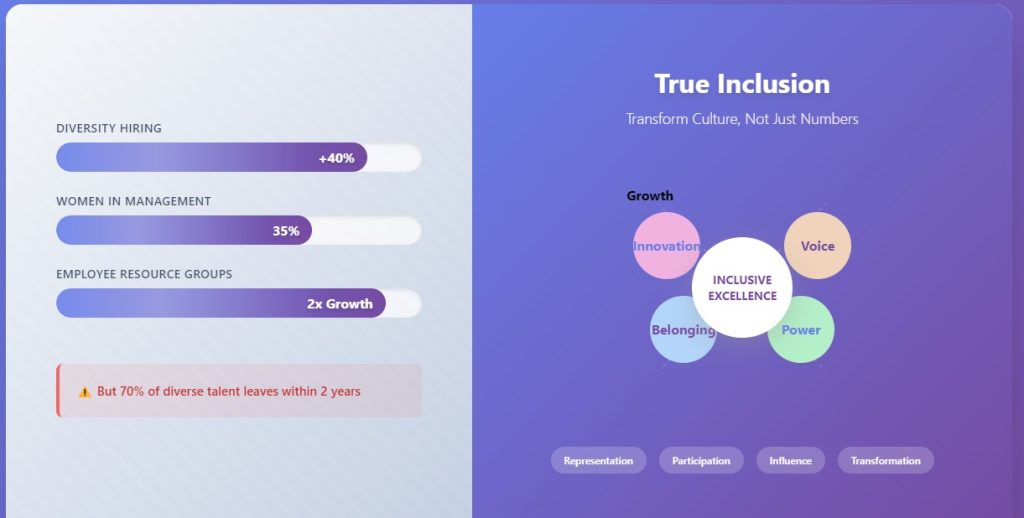
The numbers look impressive on paper. “We’ve increased diverse hiring by 40%!” “Women now represent 35% of our management!” “Our employee resource groups have doubled in size!”

Yet something’s wrong.

Despite hitting diversity targets, your organization still hemorrhages Black women within 18 months. Meetings remain dominated by the same voices. Innovation feels stagnant. And that carefully crafted diversity report can’t explain why your “diverse” leadership team still thinks, acts, and decides remarkably alike.

Here’s the uncomfortable truth: you can have diversity without inclusion, but you cannot have excellence without both.

The Metrics Trap: When Numbers Lie

Most organizations approach diversity like a math problem. Hit the percentages. Check the boxes. Publish the report. But as I’ve observed throughout my twenty-plus years transforming organizational cultures, diversity metrics without inclusive culture is like planting seeds in concrete—nothing grows.

Consider the tech company that proudly achieved 30% female representation in engineering. Within two years, 70% of those women had left. The problem wasn’t the hiring; it was what happened after. The culture remained unchanged—same communication styles rewarded, same after-work bonding rituals, same unwritten rules about who gets heard.

In “Mastering a High-Value Company Culture,” I emphasized that culture is the lifeblood of any organization. When that culture excludes—even unintentionally—diversity becomes a revolving door rather than a competitive advantage.

The Real Cost of Fake Inclusion

McKinsey’s 2023 research reveals the gap:

  • Companies in the top quartile for gender diversity are 25% more likely to have above-average profitability
  • BUT only when coupled with inclusive practices
  • Without inclusion, diverse teams actually perform 15% worse than homogeneous ones due to unmanaged conflict

For Black women specifically, the statistics are sobering:

  • 75% report having to prove themselves more than peers
  • 54% experience being mistaken for someone more junior
  • Only 1 in 4 feel they can bring their authentic selves to work

Understanding True Inclusion: Beyond the Surface

True inclusion isn’t about tolerance—it’s about transformation. It requires fundamentally reshaping how your organization operates, decides, and values contribution.

The Inclusion Framework That Works

Level 1: Representation (Diversity) Bodies in seats. Different faces in spaces. Important but insufficient.

Level 2: Participation (Voice) Everyone speaks, but are they heard? Many organizations stall here.

Level 3: Influence (Power) Diverse perspectives actually shape decisions and direction.

Level 4: Transformation (Evolution) The organization itself changes, becoming stronger through inclusion.

Most organizations celebrate reaching Level 1, struggle at Level 2, and never attempt Levels 3 or 4. This is why their diversity initiatives fail.

The Black Woman’s Experience: A Litmus Test for Inclusion

Want to know if your organization has achieved true inclusion? Look at the experience of Black women. As I discuss in “Rise & Thrive,” Black women navigate the intersection of race and gender, making them the canaries in the coal mine of organizational culture.

When Black women thrive in your organization—genuinely thrive, not just survive—you’ve created something special. When they leave, they’re telling you something your metrics won’t: your inclusion is performative, not transformative.

Case Study: Microsoft’s Evolution

Microsoft’s transformation under Satya Nadella provides a masterclass in moving beyond metrics to meaning. They didn’t just hire more diverse talent; they fundamentally changed their culture:

Before (Diversity Without Inclusion):

  • Competitive ranking system that rewarded individual achievement
  • “Know-it-all” culture that silenced different perspectives
  • High diverse talent turnover despite recruitment success

After (True Inclusive Leadership):

  • Collaborative evaluation emphasizing team success
  • “Learn-it-all” culture that values diverse thinking
  • Black women in leadership roles increased 3x with retention above 90%

The key? They changed systems, not just statistics.

Building Inclusive Leadership Culture: The Blueprint

1. Audit Your Invisible Architecture

Every organization has invisible architecture—unwritten rules that determine who succeeds. Map yours:

Communication Patterns:

  • Who gets interrupted most? (Research shows Black women are interrupted 2.8x more often)
  • Whose ideas need “validation” from others to be accepted?
  • Which communication styles are labeled “professional”?

Decision-Making Processes:

  • Where do real decisions happen? (Formal meetings or golf courses?)
  • Who has access to decision-makers?
  • How are different viewpoints weighted?

Advancement Pathways:

  • What experiences are deemed “essential” for promotion?
  • Who gets stretch assignments?
  • How is “potential” defined and identified?

2. Redesign for Inclusion

Once you see the invisible, you can redesign it:

Inclusive Meeting Practices:

  • Rotate meeting leadership
  • Implement “no interruption” rules with enforcement
  • Use written input before verbal discussion
  • Credit ideas explicitly to their originators

Equitable Decision Systems:

  • Require diverse decision-making teams
  • Document decision criteria transparently
  • Create multiple input channels
  • Measure decision quality, not just speed

Advancement Equity:

  • Define objective promotion criteria
  • Track stretch assignment distribution by demographics
  • Create sponsorship programs (not just mentorship)
  • Eliminate “culture fit” in favor of “culture add”

3. Measure What Matters

Move beyond headcount to meaningful metrics:

Inclusion Indicators:

  • Speaking time distribution in meetings
  • Idea attribution accuracy
  • Promotion velocity by demographic
  • Stay interview insights (not just exit data)

Cultural Health Metrics:

  • Psychological safety scores by demographic
  • Belonging index variations
  • Code-switching frequency reports
  • Energy expenditure on cultural navigation

Innovation Outcomes:

  • Ideas generated by diverse vs. homogeneous teams
  • Implementation rate of diverse perspectives
  • Market insights from diverse viewpoints
  • Customer satisfaction across demographics

The Leadership Imperative: Personal Transformation

In “High-Value Leadership,” I emphasize that transformation begins with leaders. You cannot create what you don’t embody.

The Inclusive Leader’s Journey

Stage 1: Awareness Recognizing your own biases and blind spots. This is uncomfortable but essential.

Stage 2: Education Learning about different experiences and perspectives. Reading, listening, engaging.

Stage 3: Action Making visible changes to your leadership practice. Sponsoring differently. Listening differently. Deciding differently.

Stage 4: Advocacy Using your power to change systems. Challenging exclusionary practices. Creating new norms.

Stage 5: Accountability Measuring your impact. Accepting feedback. Continuous improvement.

Personal Inclusion Practices

Daily Actions:

  • Amplify underrepresented voices in every meeting
  • Question “how we’ve always done it”
  • Seek input from those least like you
  • Notice who’s missing from discussions

Weekly Practices:

  • Review speaking time in your meetings
  • Connect with someone outside your usual circle
  • Sponsor someone who doesn’t look like you
  • Challenge one exclusionary norm

Monthly Commitments:

  • Assess your team’s inclusion metrics
  • Seek feedback on your inclusive leadership
  • Learn about a different cultural perspective
  • Celebrate inclusive behaviors publicly

Transforming Systems, Not Just Statistics

True inclusion requires systemic change. Here’s how to architect it:

Hiring for Addition, Not Fit

Traditional: “They need to fit our culture” Inclusive: “What can they add to make us stronger?”

Example: Instead of asking “Would I want to have a beer with this person?” ask “What perspective or experience would they bring that we currently lack?”

Performance Through Inclusion Lens

Traditional: Individual achievement metrics Inclusive: Collaborative success indicators

  • How well does this person elevate others?
  • What diverse perspectives do they integrate?
  • How do they bridge differences?
  • What inclusive practices do they model?

Promotion with Purpose

Traditional: Subjective potential assessments Inclusive: Transparent capability frameworks

Create clear rubrics that value:

  • Cross-cultural communication
  • Inclusive team building
  • Diverse network cultivation
  • Systemic thinking

The Business Case That Matters

Yes, inclusion drives profit—Boston Consulting Group found that companies with above-average diversity scores have 19% higher innovation revenues. But the real case goes deeper:

Innovation Acceleration: Inclusive teams solve problems faster because they consider more options.

Risk Mitigation: Diverse perspectives identify blind spots before they become crises.

Market Intelligence: Inclusive organizations understand diverse markets authentically.

Talent Magnetism: True inclusion becomes self-reinforcing, attracting top talent.

Resilience Building: Inclusive cultures adapt better to change because they’re already flexible.

Red Flags: Signs Your Inclusion Is Performative

  • Diverse hires cluster at lower levels
  • “Culture fit” remains a hiring criterion
  • Same voices dominate discussions
  • Diversity fatigue among majority groups
  • Black women and other minorities report exhaustion
  • Innovation feels forced rather than flowing
  • Employee resource groups lack budget or influence
  • Leaders can’t name specific inclusive actions they’ve taken

Green Flags: Signs of True Inclusion

  • Diverse talent seeks you out
  • Meetings sound different—more voices, richer dialogue
  • “Bad ideas” lead to breakthrough innovations
  • Conflict becomes productive rather than destructive
  • Retention equalizes across demographics
  • Customer insights surprise you
  • Energy increases rather than depletes
  • Stories of belonging outnumber stories of bias

Your 30-Day Inclusion Acceleration Plan

Week 1: Assess Reality

  • Conduct meeting audits for participation patterns
  • Survey psychological safety by demographic
  • Map your organization’s invisible architecture
  • Identify three specific exclusionary practices

Week 2: Design Changes

  • Create inclusive meeting protocols
  • Develop transparent decision criteria
  • Design equitable advancement pathways
  • Build measurement systems

Week 3: Implement Pilots

  • Test new meeting formats
  • Practice inclusive decision-making
  • Launch sponsorship initiatives
  • Begin collecting inclusion data

Week 4: Scale and Sustain

  • Share early wins
  • Address resistance directly
  • Expand successful practices
  • Commit to long-term change

The Role of Black Women in Transformation

Organizations serious about inclusion should center Black women’s experiences—not as charity, but as strategy. When you design for those navigating the most complex challenges, you create solutions that benefit everyone.

This means:

  • Seeking their input (and paying for it)
  • Protecting their energy (stop making them fix your culture for free)
  • Amplifying their innovations
  • Following their leadership

Discussion Questions for Leadership Teams

  1. What’s the difference between our diversity metrics and our inclusion reality?
  2. How would our organization change if Black women held 30% of senior leadership positions and thrived there?
  3. What invisible rules in our organization would shock an outsider?
  4. Which of our “best practices” actually exclude diverse talent?
  5. How do we currently measure inclusion beyond headcount?
  6. What would need to change for diverse talent to stop code-switching?
  7. If we’re honest, does our organization want true inclusion or just better metrics?

Your Next Steps

Today:

  • Observe one meeting through an inclusion lens
  • Notice who speaks most and least
  • Identify one exclusionary practice you can change

This Week:

  • Conduct a team inclusion assessment
  • Have three conversations with people unlike you
  • Challenge one “way we’ve always done it”

This Month:

  • Implement one systemic change
  • Measure its impact
  • Share learnings broadly
  • Commit to the next change

The Transformation Imperative

Diversity without inclusion is not just ineffective—it’s exhausting for those carrying the weight of being “diverse.” True inclusion transforms organizations from the inside out, creating environments where excellence emerges from every corner, not just familiar ones.

The choice is clear: continue performing diversity theater with impressive metrics and disappointing results, or commit to the harder work of building truly inclusive leadership culture.


Ready to Move Beyond Metrics to Meaning?

At Che’ Blackmon Consulting, we help organizations transform diversity initiatives into inclusive excellence. We don’t just help you count different people—we help you create cultures where different people count.

Our approach includes:

  • Comprehensive inclusion audits beyond traditional metrics
  • Invisible architecture mapping and redesign
  • Inclusive leadership development programs
  • Systemic transformation strategies
  • Measurement frameworks for true inclusion

Stop exhausting your diverse talent with performative inclusion. Start building cultures where everyone—especially traditionally overlooked talent—can thrive.

📧 Email: admin@cheblackmon.com
📞 Call: 888.369.7243
🌐 Visit: www.cheblackmon.com

Special Offer: Schedule an Inclusion Reality Check—a frank assessment of where your organization truly stands beyond the metrics. First 10 organizations this quarter receive a customized inclusion roadmap.

Remember: You can hit every diversity target and still fail at inclusion. True excellence requires both.

#DiversityAndInclusion #InclusiveLeadership #DEI #WorkplaceCulture #BlackWomenInLeadership #OrganizationalCulture #TalentRetention #InclusionMatters #LeadershipDevelopment #DiversityMetrics #CultureTransformation #EquityInBusiness #PsychologicalSafety #BelongingAtWork #SystemicChange