The Trust Rebuild: Restoring Faith After Organizational Failure

“Trust takes years to build, seconds to break, and forever to repair.” – Unknown

The email hit my inbox at 3:47 PM on a Tuesday. A Fortune 500 company—one that had just made headlines for a massive ethical breach—wanted help. Their ask was simple yet monumental: “Can you help us rebuild trust?”

As I sat with their leadership team weeks later, the damage was palpable. Employee engagement had plummeted 67%. Their stock price had dropped 40%. But the most telling statistic? Of the Black women in their leadership pipeline, 82% were actively interviewing elsewhere.

When organizations fail, trust doesn’t just crack—it shatters. And the shards cut deepest for those who already navigate workplace relationships with heightened vigilance.

The Anatomy of Broken Trust: Why Some Wounds Run Deeper

In “Mastering a High-Value Company Culture,” I emphasized that culture is built on trust. When that foundation crumbles, the entire structure becomes unstable. But here’s what most recovery plans miss: trust breaks differently for different people.

The Disproportionate Impact on Traditionally Overlooked Talent

When organizational trust fails, Black women and other traditionally overlooked employees experience what I call “trust bankruptcy”—a complete depletion of the already limited trust reserves they’ve carefully rationed throughout their careers.

Consider these compounding factors:

  1. Historical Context: We enter organizations with inherited mistrust from generations of broken promises
  2. Higher Stakes: One breach confirms what we’ve been warned about but hoped wasn’t true
  3. Limited Safety Nets: Fewer sponsors and allies mean less protection during turbulent times
  4. Representation Burden: We face pressure to stay and fix what we didn’t break
  5. Career Risk: Leaving looks like “not being a team player,” staying looks like complicity

Case Study: After a major pharmaceutical company’s discrimination lawsuit became public, their Black women employees reported feeling “vindicated but violated.” The breach confirmed their experiences while destroying their hope for change. Within six months, they lost 73% of their Black female talent—taking with them critical institutional knowledge and innovation capacity.

The Trust Equation: Understanding What’s Really Broken

Drawing from research by Stephen M.R. Covey and validated through my consulting work, organizational trust operates on four dimensions:

Trust = (Credibility + Reliability + Intimacy) / Self-Orientation

When organizations fail, they typically damage all four:

  • Credibility: “Do they know what they’re doing?”
  • Reliability: “Can I count on them?”
  • Intimacy: “Do they care about me?”
  • Self-Orientation: “Are they only looking out for themselves?”

For Black women, each dimension carries additional weight:

  • Credibility includes: “Will they acknowledge systemic issues?”
  • Reliability means: “Will they follow through on DEI commitments?”
  • Intimacy asks: “Do they see me as fully human?”
  • Self-Orientation questions: “Am I just a diversity metric?”

The RESTORE Framework: A Path Back to Trust

Through guiding dozens of organizations through trust rebuilding, I’ve developed a framework that addresses both universal and unique trust restoration needs:

R – Recognize with Radical Honesty

Acknowledgment must be specific, not sanitized.

Effective Recognition Includes:

  • Name what happened without euphemisms
  • Acknowledge who was harmed and how
  • Accept responsibility without deflection
  • Validate the experiences of those most impacted

The Overlooked Perspective: Black women need recognition that goes beyond the immediate failure to acknowledge systemic patterns. “This incident” is rarely isolated—it’s usually part of a continuum.

Example: When a tech company faced backlash for pay discrimination, their CEO didn’t just address the wage gaps. She acknowledged: “This reflects a pattern of undervaluing Black women’s contributions that goes back to our founding. The recent audit simply quantified what many of you have experienced for years.”

E – Engage in Deep Listening

Trust rebuilding requires hearing truths you’d rather avoid.

Deep Listening Strategies:

  • Create multiple feedback channels (anonymous and attributed)
  • Host listening sessions by affinity groups
  • Bring in external facilitators for psychological safety
  • Document what you hear without editing
  • Share back what you learned transparently

As I detailed in “Rise & Thrive,” Black women are often the truth-tellers organizations need but don’t want to hear. In trust rebuilding, their voices are your early warning system.

S – Strategize with Stakeholder Input

Solutions imposed from above fail. Co-created solutions succeed.

Inclusive Strategy Development:

  • Include traditionally overlooked voices in solution design
  • Compensate people for emotional labor
  • Create decision-making transparency
  • Build in accountability mechanisms
  • Set measurable milestones

Critical Insight: Black women should be strategy partners, not just feedback providers. Their dual consciousness—seeing organizations from both inside and outside—provides invaluable perspective.

T – Take Swift, Visible Action

Trust rebuilds through consistent action, not grand gestures.

Action Priorities:

  1. Immediate: Stop the bleeding (policy changes, personnel decisions)
  2. Short-term: Demonstrate commitment (resource allocation, structural changes)
  3. Long-term: Embed new practices (system redesign, culture shift)

Real-World Impact: A financial services firm facing trust crisis made their first visible action promoting a Black woman to Chief Ethics Officer—not as tokenism, but recognizing her track record of speaking truth to power. She was given real authority, budget, and a direct line to the board.

O – Operationalize New Standards

Prevent future failures by changing systems, not just behaviors.

Systemic Changes Required:

  • Embed trust metrics in performance reviews
  • Create psychological safety protocols
  • Build early warning systems
  • Reward truth-telling, not just harmony
  • Make trust everyone’s responsibility

From “High-Value Leadership”: Systems drive behaviors. If you want trustworthy behavior, build trustworthy systems.

R – Repair Relationships Individually

Organizational trust rebuilds one relationship at a time.

Relationship Repair Strategies:

  • Leaders personally apologize to those harmed
  • Managers have one-on-one trust conversations
  • Teams create new working agreements
  • Individuals commit to new behaviors
  • Everyone takes ownership of trust building

The Extra Mile for Overlooked Talent: Recognize that Black women often need to see sustained change before re-engaging. Don’t mistake professional courtesy for restored trust.

E – Evaluate and Evolve Continuously

Trust rebuilding never ends—it evolves.

Ongoing Evaluation Includes:

  • Regular trust assessments
  • Continuous feedback loops
  • Adjustment based on results
  • Celebration of progress
  • Acknowledgment of setbacks
  • Commitment to permanent vigilance

Current Trends in Trust Restoration

Based on recent research and Dave Ulrich’s work on stakeholder value, modern trust rebuilding involves:

1. From Internal to Ecosystem Trust

Organizations now rebuild trust across entire stakeholder networks—employees, customers, communities, investors—recognizing interconnected impact.

2. From Words to Measurable Actions

Trust rebuilding includes specific metrics:

  • Employee trust scores by demographic
  • Customer confidence indicators
  • Community partnership health
  • Investor relations stability

3. From Crisis Response to Proactive Trust Building

Leading organizations build trust reserves before they need them through:

  • Regular trust audits
  • Preemptive issue addressing
  • Transparent communication norms
  • Failure acknowledgment cultures

4. From Homogeneous to Inclusive Trust Strategies

Recognition that different groups need different trust rebuilding approaches based on their historical and current experiences with the organization.

The Trust Rebuild Playbook: Your 180-Day Roadmap

Days 1-30: Truth and Reconciliation

Week 1-2: Leadership Reckoning

  • Leadership team acknowledges failure privately
  • Prepare for public acknowledgment
  • Begin internal listening tour
  • Halt any ongoing harmful practices

Week 3-4: Organization-Wide Truth Telling

  • Public acknowledgment of failure
  • Open forums for employee input
  • External investigation if needed
  • Document all feedback received

Days 31-90: Strategy and Structure

Month 2: Co-Create Solutions

  • Form diverse trust rebuild task force
  • Design new policies and practices
  • Allocate resources for change
  • Create accountability mechanisms

Month 3: Begin Implementation

  • Launch quick wins
  • Communicate progress transparently
  • Address resistance directly
  • Celebrate early adopters

Days 91-180: Embed and Evolve

Month 4-5: Systemic Changes

  • Implement structural reforms
  • Train all leaders in trust building
  • Create ongoing feedback systems
  • Measure progress consistently

Month 6: Evaluate and Adjust

  • Conduct trust assessment
  • Adjust strategies based on data
  • Plan for continuous improvement
  • Commit to long-term vigilance

Special Considerations for Black Women Leaders

If you’re a Black woman leading or participating in trust rebuilding:

  1. Your skepticism is wisdom—don’t let others gaslight your valid concerns
  2. Your emotional labor has value—negotiate compensation for extra work
  3. Your truth-telling is service—even when it’s uncomfortable for others
  4. Your boundaries are necessary—you can’t heal what you didn’t break
  5. Your leadership is essential—but not at the cost of your wellbeing

As I shared in “Rise & Thrive,” we must be strategic about when and how we invest our trust. Organizational failure often validates our caution while simultaneously demanding our leadership in healing.

Measuring Trust Restoration Success

Traditional metrics miss trust’s complexity. Comprehensive measurement includes:

Quantitative Metrics:

  • Employee trust scores (segmented by demographics)
  • Retention rates of traditionally overlooked talent
  • Speak-up culture indicators
  • Psychological safety assessments
  • Ethics hotline usage patterns

Qualitative Indicators:

  • Story changes in organization narrative
  • Shift in water cooler conversations
  • Energy in meetings
  • Innovation levels
  • Cross-functional collaboration quality

The Black Women’s Trust Index™: I’ve developed a specific metric focusing on Black women’s trust levels as a leading indicator of organizational health. When Black women trust your organization, you’ve likely created an environment where everyone can thrive.

The Compound Effect of Trust Rebuilding

When done right, trust rebuilding creates unexpected benefits:

  • Stronger Culture: Phoenix cultures often surpass pre-crisis levels
  • Innovation Boost: Psychological safety drives creative risk-taking
  • Talent Magnet: Authentic recovery attracts purpose-driven talent
  • Market Advantage: Trusted organizations outperform competitors
  • Social Impact: Healing creates ripples beyond organization walls

Most importantly, successfully rebuilding trust after failure demonstrates that transformation is possible—a powerful message for all stakeholders.

Discussion Questions for Trust Rebuilding

  1. Where has your organization broken trust, and who was most impacted?
  2. How might traditionally overlooked employees’ perspectives transform your trust rebuilding approach?
  3. What systems need to change to prevent future trust breaches?
  4. How can you measure trust restoration beyond traditional engagement surveys?
  5. What would it take for you personally to trust again after organizational failure?

Your Next Steps to Trust Restoration

  1. Assess your organization’s current trust levels using the trust equation
  2. Identify which stakeholder groups have the lowest trust and why
  3. Engage traditionally overlooked voices in solution design
  4. Design one concrete action to demonstrate commitment this week
  5. Commit to the long journey of trust rebuilding

Ready to Rebuild Trust That Lasts?

Trust rebuilding after organizational failure isn’t just about damage control—it’s about emerging stronger, more inclusive, and more resilient than before. But it requires expertise, commitment, and a willingness to face uncomfortable truths.

Che’ Blackmon Consulting specializes in guiding organizations through the delicate process of trust restoration, with particular expertise in addressing the unique needs of traditionally overlooked talent.

Our Trust Rebuilding Services Include:

  • Organizational Trust Audit and Assessment
  • Inclusive Trust Strategy Development
  • Leadership Team Trust Coaching
  • Stakeholder Engagement Facilitation
  • Trust Metrics Design and Implementation

Specialized Programs:

  • The Trust Rebuild Intensive: 180-day organizational transformation
  • Truth and Reconciliation Facilitation: Creating safe spaces for healing
  • The Black Women’s Trust Index™: Measuring what matters most
  • Leadership After Failure: Executive coaching for trust restoration

Schedule a consultation to explore how we can help you rebuild trust that not only recovers what was lost but creates something stronger and more inclusive.

Remember: The Chinese character for crisis combines “danger” and “opportunity.” Your organizational failure can become the catalyst for building trust that’s deeper, wider, and more resilient than what existed before.


Che’ Blackmon is the CEO of Che’ Blackmon Consulting and author of “Mastering a High-Value Company Culture,” “High-Value Leadership: Transforming Organizations Through Purposeful Culture,” and “Rise & Thrive: A Black Woman’s Blueprint for Leadership Excellence.” With over 20 years of experience guiding organizations through transformation, she specializes in helping leaders rebuild trust after failure while creating more inclusive, resilient cultures.

#TrustInLeadership #OrganizationalCulture #BlackWomenInBusiness #CrisisManagement #LeadershipDevelopment #CorporateTrust #DiversityEquityInclusion #WorkplaceCulture #EthicalLeadership #TrustBuilding #InclusiveLeadership #OrganizationalChange #CultureTransformation #ExecutiveLeadership #BusinessEthics

Crisis as Opportunity: Transforming Setbacks into Strategic Advantages

“I have been bent and broken, but—I hope—into a better shape.” – Charles Dickens

When I was passed over for a promotion early in my career—watching a less qualified colleague advance while I was told to “be patient”—I faced a choice. I could let bitterness consume me, or I could transform that setback into fuel for something greater. That rejection became the catalyst for developing my expertise in organizational culture transformation, eventually leading to my consulting practice and three published books.

Every crisis contains the seeds of opportunity. The question is: Will you plant them?

The Alchemy of Adversity: Why Some Thrive While Others Merely Survive

In “High-Value Leadership,” I introduced the concept of transformative durability—the ability to convert challenges into competitive advantages. This isn’t toxic positivity or empty rhetoric. It’s a strategic framework for leveraging disruption as a catalyst for innovation and growth.

Research from the Center for Creative Leadership shows that 70% of senior executives cite “hardship experiences” as critical to their leadership development. But here’s what they don’t tell you: the ability to transform crisis into opportunity isn’t equally distributed.

The Hidden Mathematics of Crisis Response

When organizations face setbacks, traditionally overlooked talent—particularly Black women—often experience what I call “compound crisis.” We’re managing:

  1. The immediate business challenge
  2. Heightened scrutiny as “diversity hires”
  3. Increased pressure to represent our entire demographic
  4. Limited access to support networks
  5. The emotional labor of maintaining composure while navigating bias

Yet paradoxically, this compound pressure creates what researchers call “stress inoculation”—building extraordinary resilience and strategic thinking capabilities.

Case Study: When a major retail corporation faced bankruptcy in 2019, their Black women executives comprised only 3% of leadership but generated 40% of the turnaround strategies that saved the company. Why? They’d been innovating with limited resources throughout their careers. Crisis management was already their normal operating procedure.

The TRANSFORM Framework: Converting Crisis into Catalyst

Through two decades of navigating organizational upheavals, I’ve developed a systematic approach to converting setbacks into strategic advantages:

T – Take Strategic Stock

Crisis creates clarity. Use it.

Immediate Actions:

  • Conduct a brutal reality assessment
  • Identify what’s actually at risk vs. what feels at risk
  • Map available resources (including hidden ones)
  • Document lessons in real-time

The Overlooked Advantage: Black women excel at resource mapping because we’ve often had to create opportunities from minimal resources. Use this skill strategically.

R – Reframe the Narrative

How you story your crisis determines your trajectory.

From Victim to Victor Narratives:

  • “We’re struggling” → “We’re transforming”
  • “We lost resources” → “We’re innovating with constraints”
  • “We failed” → “We gathered critical data”
  • “We’re behind” → “We’re positioned for a breakthrough”

As I detailed in “Rise & Thrive,” controlling your narrative is especially crucial for Black women who often have their stories told for them rather than by them.

A – Activate Hidden Networks

Crisis reveals who your real allies are. More importantly, it activates dormant connections.

Network Activation Strategy:

  • Map your “crisis cabinet” before you need it
  • Include diverse perspectives (not just the usual suspects)
  • Activate weak ties—they often provide breakthrough insights
  • Create reciprocal support systems

N – Navigate with Agility

Rigid plans break in crisis. Agile strategies bend and adapt.

Agility Principles:

  • Set direction, not destination
  • Create 30-60-90 day sprints
  • Build in pivot points
  • Measure progress, not perfection

S – Seek Innovation Opportunities

Constraints breed creativity. Crisis forces innovation.

Innovation Through Crisis:

  • What assumptions can we challenge?
  • What sacred cows can we sacrifice?
  • What new combinations become possible?
  • What previously impossible ideas now make sense?

F – Find the Advantage

Every crisis creates competitive advantages for those who look.

Advantage Identification:

  • What are competitors neglecting while distracted?
  • What capabilities are we building through this challenge?
  • What relationships are strengthening under pressure?
  • What innovations are emerging from necessity?

O – Operationalize Learning

Don’t waste your crisis. Embed the lessons.

Learning Integration:

  • Document what worked and why
  • Create playbooks for future challenges
  • Build crisis capabilities into normal operations
  • Share knowledge across the organization

R – Rebuild Stronger

Use momentum from crisis resolution to leapfrog past previous limitations.

Strategic Rebuilding:

  • Don’t return to old normal—create better normal
  • Institutionalize crisis innovations
  • Strengthen areas exposed as vulnerable
  • Position for next-level growth

M – Maintain Momentum

Crisis energy dissipates quickly. Capture it.

Momentum Strategies:

  • Celebrate crisis wins publicly
  • Reward innovation and agility
  • Tell transformation stories
  • Build on newfound capabilities

The Double-Bind Advantage™ in Crisis Leadership

In “Mastering a High-Value Company Culture,” I discussed how great cultures emerge from crucibles. For Black women in leadership, every day can feel like a crucible. This creates what I call the Double-Bind Advantage™—unique crisis leadership capabilities:

  1. Emotional Regulation Mastery: We’ve learned to maintain composure under extreme scrutiny
  2. Code-Switching Agility: We fluidly adapt communication styles to different audiences
  3. Pattern Recognition: We spot systemic issues others miss
  4. Coalition Building: We create unlikely alliances for survival and success
  5. Innovation Through Constraint: We maximize minimal resources

Real-World Example: During the 2020 pandemic, companies with Black women in C-suite positions were 35% more likely to successfully pivot their business models (McKinsey, 2021). These leaders didn’t just manage crisis—they transformed it into competitive advantage.

Current Trends: The Evolution of Crisis Leadership

Dave Ulrich’s latest research on human capability highlights a shift from reactive crisis management to proactive crisis leverage. Modern crisis leadership involves:

1. Pre-Crisis Capability Building

Organizations are developing “crisis muscles” during stable times through:

  • Scenario planning exercises
  • Controlled failure experiments
  • Cross-training for flexibility
  • Stress testing systems

2. Inclusive Crisis Response Teams

Recognizing that homogeneous teams create blind spots, leading organizations build diverse crisis response capabilities:

  • Multiple perspective integration
  • Cognitive diversity prioritization
  • Traditionally overlooked voices elevated
  • Decision-making democratization

3. Crisis as Innovation Lab

Forward-thinking companies treat crisis as R&D opportunities:

  • Rapid prototyping
  • Fail-fast mentalities
  • Customer co-creation
  • Competitive intelligence gathering

4. Stakeholder Value Expansion

Crisis response now considers all stakeholders:

  • Employee wellbeing
  • Community impact
  • Supplier relationships
  • Long-term sustainability

The Playbook: Your 90-Day Crisis Transformation Plan

Days 1-30: Stabilize and Assess

Week 1-2: Immediate Stabilization

  • Secure critical operations
  • Communicate with key stakeholders
  • Assess actual vs. perceived damage
  • Activate crisis response team

Week 3-4: Strategic Assessment

  • Conduct SWOT analysis
  • Map resource availability
  • Identify quick wins
  • Begin narrative reframing

Days 31-60: Innovate and Activate

Week 5-6: Innovation Sprint

  • Challenge existing assumptions
  • Prototype new approaches
  • Test minimum viable solutions
  • Gather rapid feedback

Week 7-8: Network Activation

  • Engage dormant connections
  • Seek diverse perspectives
  • Build coalition support
  • Leverage collective intelligence

Days 61-90: Transform and Transcend

Week 9-10: Implementation

  • Launch transformation initiatives
  • Communicate wins broadly
  • Embed new practices
  • Measure early impact

Week 11-12: Momentum Building

  • Celebrate progress
  • Document lessons learned
  • Plan next phase growth
  • Position for advantage

Crisis Leadership for Black Women: A Special Note

If you’re a Black woman navigating organizational crisis, remember:

  1. Your hypervigilance is a superpower—you see risks others miss
  2. Your resilience isn’t required—demand organizational support
  3. Your innovation matters—don’t let others claim your ideas
  4. Your voice is essential—crisis requires diverse perspectives
  5. Your growth through crisis is valuable—monetize your expertise

As I shared in “Rise & Thrive,” we must transform the additional burdens we carry into strategic advantages. Crisis leadership is one arena where our unique experiences become invaluable assets.

Measuring Crisis Transformation Success

Traditional crisis metrics focus on recovery. Transformational metrics focus on advancement:

Instead of: Time to return to baseline Measure: New capabilities developed

Instead of: Revenue recovery rate Measure: Market position improvement

Instead of: Employee retention through crisis Measure: Employee engagement and innovation

Instead of: Cost of crisis management Measure: ROI of crisis innovations

Building Your Crisis Advantage Portfolio

Document your crisis transformation journey:

  1. Crisis Faced: What was the challenge?
  2. Actions Taken: What strategies did you employ?
  3. Innovations Created: What new approaches emerged?
  4. Capabilities Built: What strengths developed?
  5. Advantages Gained: How are you stronger?
  6. Lessons Learned: What would you repeat/change?
  7. Future Applications: How will you leverage this?

The Compound Effect of Crisis Leadership

When you transform crisis into opportunity, the benefits multiply:

  • Individual Level: Enhanced leadership capabilities
  • Team Level: Increased resilience and innovation
  • Organizational Level: Competitive advantages
  • Industry Level: New best practices
  • Societal Level: Systemic transformation

Most importantly, when traditionally overlooked leaders excel in crisis, it challenges fundamental assumptions about leadership itself.

Discussion Questions for Strategic Reflection

  1. What crisis in your past could have been transformed into greater opportunity with the TRANSFORM framework?
  2. How might traditionally overlooked employees in your organization hold keys to crisis innovation?
  3. What competitive advantages could emerge from your current challenges?
  4. Where are you playing it safe when crisis demands bold innovation?
  5. How can you build crisis leadership capabilities before the next challenge arrives?

Your Next Steps to Crisis Transformation

  1. Audit your current crisis or recent setback using the TRANSFORM framework
  2. Identify three hidden opportunities within your challenge
  3. Activate one dormant network connection who could provide fresh perspective
  4. Design one innovative response to your crisis
  5. Document lessons learned for future advantage

Ready to Transform Your Crisis into Competitive Advantage?

Crisis is inevitable. Suffering through it isn’t. Whether you’re facing organizational upheaval, market disruption, or leadership challenges, you can transform setbacks into strategic advantages.

Che’ Blackmon Consulting specializes in helping leaders and organizations convert crisis into catalyst. We bring particular expertise in unlocking the overlooked talent that often holds the keys to breakthrough innovation during challenging times.

Our Crisis Transformation Services Include:

  • Crisis Leadership Assessment and Development
  • Organizational Resilience Building
  • Innovation Through Constraint Workshops
  • Strategic Narrative Reframing
  • Post-Crisis Advantage Positioning

Special Programs:

  • Crisis Leadership Intensive: 90-day transformation program
  • The Double-Bind Advantage™ Workshop: For traditionally overlooked leaders
  • Building Anti-Fragile Cultures: Organizational resilience training
  • From Setback to Setup: Individual leader coaching

Schedule a consultation to explore how we can help you transform your current crisis into your greatest competitive advantage.

Remember: Every setback contains the setup for your next breakthrough. The question isn’t whether you’ll face crisis—it’s whether you’ll waste it.


Che’ Blackmon is the CEO of Che’ Blackmon Consulting and author of “Mastering a High-Value Company Culture,” “High-Value Leadership: Transforming Organizations Through Purposeful Culture,” and “Rise & Thrive: A Black Woman’s Blueprint for Leadership Excellence.” With over 20 years of experience guiding organizations through transformation, she specializes in helping leaders convert crisis into competitive advantage while unlocking the full potential of traditionally overlooked talent.

#CrisisLeadership #TransformationalLeadership #BlackWomenLeaders #OrganizationalResilience #LeadershipDevelopment #CrisisManagement #StrategicAdvantage #DiversityInLeadership #BusinessTransformation #InnovationThroughCrisis #WomenInBusiness #ExecutiveLeadership #ChangeManagement #LeadershipStrategy #ResilienceInBusiness

The Anatomy of Organizational Resilience: Building Anti-Fragile Cultures

“You may encounter many defeats, but you must not be defeated. In fact, it may be necessary to encounter the defeats, so you can know who you are, what you can rise from, how you can still come out of it.” – Maya Angelou

In 2020, the world watched as organizations crumbled under unprecedented pressure. Yet some didn’t just survive—they thrived. What separated the casualties from the champions wasn’t size, resources, or industry. It was something deeper: organizational resilience rooted in anti-fragile culture.

As I’ve witnessed throughout my 20+ years transforming organizations, resilience isn’t about bouncing back to normal. It’s about bouncing forward to better.

Beyond Resilience: The Anti-Fragile Advantage

Nassim Taleb introduced the concept of “anti-fragility”—systems that actually get stronger under stress. While fragile things break under pressure and resilient things resist it, anti-fragile systems improve because of it. This principle, when applied to organizational culture, creates what I call “transformative durability.”

In “High-Value Leadership,” I emphasized that culture is your competitive advantage. An anti-fragile culture takes this further—it turns every crisis into a catalyst for evolution.

The difference is profound:

  • Fragile cultures break under pressure
  • Resilient cultures withstand pressure
  • Anti-fragile cultures grow stronger through pressure

The Hidden Cost of Fragile Cultures on Overlooked Talent

Here’s what most leadership books won’t tell you: organizational fragility disproportionately impacts those already navigating systemic barriers. When cultures crack under pressure, the fault lines often appear first around traditionally overlooked talent—especially Black women in corporate spaces.

Consider these realities:

  • During the 2020 crisis, Black women left the workforce at higher rates than any other group
  • In “fragile” organizations, Black women are often the first to experience the breakdown of psychological safety
  • When support systems fail, those with the least institutional power suffer most

As I detailed in “Rise & Thrive,” Black women often serve as early warning systems for organizational health. When we struggle, it signals deeper cultural fractures that will eventually impact everyone.

Case Study: A Fortune 500 tech company noticed that despite diversity initiatives, Black women in leadership roles had a 60% higher turnover rate during organizational restructuring. Upon investigation, they discovered these leaders were absorbing disproportionate emotional labor—managing both business challenges and serving as unofficial diversity advocates without support. By addressing this systemic fragility, they not only retained talent but strengthened their entire leadership pipeline.

The Five Pillars of Anti-Fragile Culture

Through my work transforming organizational cultures, I’ve identified five essential pillars that create anti-fragility:

1. Distributed Leadership Networks

Traditional hierarchies create single points of failure. Anti-fragile cultures build what I call “leadership webs”—interconnected networks where leadership capacity exists at every level.

In Practice:

  • Cross-functional decision-making teams
  • Rotating leadership opportunities
  • Peer mentorship programs
  • Shadow boards including diverse voices

This especially benefits traditionally overlooked talent by creating multiple pathways to influence and advancement.

2. Psychological Safety with Accountability

Amy Edmondson’s psychological safety meets Brené Brown’s vulnerability. But here’s the twist: anti-fragile cultures add what I call “generative accountability”—the expectation that everyone contributes to making the environment safer for others.

The Framework:

  • Safety to fail (learning is expected)
  • Safety to challenge (dissent is valued)
  • Safety to be authentic (whole selves welcome)
  • Accountability to grow (comfort isn’t the goal)

For Black women navigating corporate spaces, this combination provides both protection and empowerment—safety to bring their full selves while being challenged to reach their full potential.

3. Cultural Memory Systems

Anti-fragile cultures learn from every experience. They build what Dave Ulrich might call “organizational wisdom”—systematic ways to capture, share, and apply lessons from both failures and successes.

Building Cultural Memory:

  • After-action reviews for all major initiatives
  • Story repositories celebrating resilience
  • Failure museums showcasing lessons learned
  • Knowledge transfer protocols
  • Cross-generational mentoring

4. Adaptive Capacity Infrastructure

Rather than rigid processes, anti-fragile cultures build adaptive capacity—the ability to shift quickly without losing core identity.

Drawing from “Mastering a High-Value Company Culture,” this includes:

  • Flexible work arrangements that became permanent
  • Decision-making protocols that can scale up or down
  • Communication systems that work across all scenarios
  • Resource allocation methods that can pivot quickly

5. Purpose-Driven Coherence

In chaos, purpose becomes your North Star. Anti-fragile cultures maintain what I call “purposeful coherence”—alignment around why you exist that transcends how you operate.

Purpose in Practice:

  • Every decision links back to core purpose
  • Trade-offs are made through a purpose lens
  • Individual roles connect to collective mission
  • Success metrics include purpose fulfillment

The SHIELD+ Framework: Building Personal and Organizational Anti-Fragility

Expanding on the SHIELD framework from “Rise & Thrive,” here’s how to build anti-fragility at both individual and organizational levels:

S – Sensing Systems

  • Individual: Develop early warning awareness
  • Organizational: Create feedback loops that capture weak signals

H – Healing Mechanisms

  • Individual: Build recovery practices before you need them
  • Organizational: Establish support systems that activate automatically

I – Innovation Engines

  • Individual: Cultivate creative problem-solving skills
  • Organizational: Create safe spaces for experimentation

E – Elastic Networks

  • Individual: Build diverse, supportive relationships
  • Organizational: Foster cross-functional collaboration

L – Learning Loops

  • Individual: Extract wisdom from every experience
  • Organizational: Systematize knowledge capture and sharing

D – Distributed Power

  • Individual: Develop multiple sources of influence
  • Organizational: Decentralize decision-making authority

+ Purposeful Evolution

  • Individual: Align growth with deeper purpose
  • Organizational: Let purpose guide transformation

Current Trends: The Future of Organizational Resilience

Based on recent research and Dave Ulrich’s evolving HR models, several trends are shaping anti-fragile cultures:

1. From Crisis Response to Crisis Anticipation

Organizations are building “futures thinking” capabilities, using scenario planning and weak signal detection to prepare for multiple possibilities.

2. From Individual Resilience to Collective Resilience

The focus shifts from helping individuals cope to building systems that support collective thriving.

3. From Diversity to Inclusive Intelligence

Beyond representation, organizations recognize that cognitive diversity drives anti-fragility by providing multiple perspectives on challenges.

4. From Work-Life Balance to Work-Life Integration

Anti-fragile cultures recognize that resilience comes from whole-person support, not artificial separation.

The Overlooked Advantage: Why Black Women Are Essential to Anti-Fragile Cultures

Here’s what organizations are beginning to understand: those who’ve navigated systemic challenges possess unique anti-fragility capabilities. Black women, having developed what I call “systemic navigation intelligence,” bring essential skills:

  • Pattern recognition: Spotting system weaknesses others miss
  • Adaptive expertise: Thriving despite—not because of—organizational support
  • Bridge building: Connecting across differences
  • Crisis leadership: Maintaining composure under extreme pressure
  • Innovation through constraint: Creating solutions with limited resources

Real-World Example: During COVID-19, a healthcare system found that units led by Black women had 40% better staff retention and patient satisfaction scores. Why? These leaders had already developed distributed support systems, flexible communication styles, and crisis management skills through their career journeys.

Building Your Anti-Fragile Culture: A 90-Day Roadmap

Days 1-30: Foundation Assessment

  • Conduct a fragility audit: Where does your culture break under pressure?
  • Identify early warning voices: Who sees problems first?
  • Map your single points of failure
  • Assess psychological safety levels across different groups

Days 31-60: Infrastructure Building

  • Launch pilot distributed leadership initiatives
  • Create learning capture systems
  • Establish support networks
  • Begin adaptive capacity training

Days 61-90: Evolution Activation

  • Test systems with controlled challenges
  • Celebrate learning from failures
  • Amplify traditionally overlooked voices
  • Measure anti-fragility indicators

Measuring Anti-Fragility: New Metrics for New Realities

Traditional resilience metrics miss the mark. Anti-fragile cultures need evolved measurements:

Instead of: Time to recover from crisis Measure: Capabilities gained through crisis

Instead of: Employee stress levels Measure: Collective support system activation

Instead of: Retention during stability Measure: Retention through transformation

Instead of: Individual performance Measure: Network performance enhancement

The Leadership Imperative: Your Role in Building Anti-Fragility

Whether you’re a CEO, HR leader, or individual contributor, you have a role in building anti-fragile culture:

For Senior Leaders:

  • Model vulnerability and learning
  • Distribute power intentionally
  • Invest in overlooked talent
  • Measure what matters for anti-fragility

For HR Professionals:

  • Design systems that strengthen under stress
  • Build inclusive support networks
  • Create learning capture mechanisms
  • Champion traditionally overlooked voices

For Individual Contributors:

  • Develop your anti-fragility skills
  • Build diverse networks
  • Share your lessons learned
  • Support others’ growth

For Black Women and Traditionally Overlooked Talent:

  • Recognize your anti-fragility advantages
  • Document your navigation strategies
  • Build collective support systems
  • Lead from where you are

The Compound Effect of Anti-Fragile Culture

When you build anti-fragile culture, the benefits compound:

  • Short-term: Better crisis navigation
  • Medium-term: Stronger competitive advantage
  • Long-term: Sustainable excellence
  • Generational: Legacy of resilience

Most importantly, anti-fragile cultures create environments where everyone—especially traditionally overlooked talent—can thrive through challenges rather than despite them.

Discussion Questions for Transformation

  1. Where is your organization most fragile, and who experiences this fragility first?
  2. How might traditionally overlooked employees actually hold keys to organizational anti-fragility?
  3. What systems could you build that get stronger under pressure?
  4. How does your current culture handle failure, and what needs to change?
  5. Who in your organization demonstrates anti-fragility, and how can you amplify their influence?

Your Next Steps to Anti-Fragility

  1. Assess your organization’s current resilience level using the Five Pillars framework
  2. Identify traditionally overlooked voices that could strengthen your culture
  3. Design one system that could improve through challenge
  4. Test your anti-fragility with a small, controlled challenge
  5. Connect with others building anti-fragile cultures

Ready to Build Your Anti-Fragile Culture?

Organizational resilience isn’t optional anymore—it’s essential. But resilience alone isn’t enough. You need anti-fragility: the ability to transform every challenge into greater capability.

Che’ Blackmon Consulting specializes in helping organizations build anti-fragile cultures that don’t just survive disruption—they evolve through it. We bring particular expertise in unlocking the overlooked talent that often holds the keys to organizational resilience.

Our Anti-Fragility Services Include:

  • Organizational Resilience Assessment
  • Anti-Fragile Culture Design
  • Distributed Leadership Development
  • Inclusive Intelligence Systems
  • Crisis-to-Catalyst Transformation Programs

Special Focus Areas:

  • Leveraging overlooked talent for organizational strength
  • Building support systems that strengthen under pressure
  • Creating psychological safety with accountability
  • Developing adaptive capacity infrastructure

Schedule a consultation to explore how we can help you build a culture that doesn’t just bounce back—it bounces forward.

Remember: In a world of constant change, the strongest organizations aren’t the ones that resist pressure—they’re the ones that grow stronger because of it.


Che’ Blackmon is the CEO of Che’ Blackmon Consulting and author of “Mastering a High-Value Company Culture,” “High-Value Leadership: Transforming Organizations Through Purposeful Culture,” and “Rise & Thrive: A Black Woman’s Blueprint for Leadership Excellence.” With over 20 years of experience transforming organizations across industries, she specializes in building anti-fragile cultures that unlock the full potential of all talent—especially those traditionally overlooked.

#OrganizationalResilience #AntifragileLeadership #CultureTransformation #BlackWomenInLeadership #HighValueCulture #LeadershipDevelopment #CrisisLeadership #InclusiveLeadership #OrganizationalCulture #FutureOfWork #DiversityAndInclusion #ResilienceBuilding #SystemicChange #LeadershipStrategy #WorkplaceCulture

Leading When Resources Are Limited: The Nonprofit Leadership Playbook

“My first post-collegiate job was for a nonprofit human service organization for which I worked for two fabulous managers, Lillian and Joan. Their leadership style modeled exactly how to generate high value, and they showed it could be done on a shoestring.” – Che’ Blackmon, Rise & Thrive

In the nonprofit sector, the phrase “doing more with less” isn’t just a catchphrase—it’s a daily reality. Limited budgets. Lean teams. Overwhelming community needs. Yet within these constraints lies an opportunity to demonstrate what I call “high-value leadership”—the ability to create extraordinary impact through purposeful culture and strategic resource management.

The Nonprofit Leadership Challenge: A Different Kind of Pressure

Leading a nonprofit organization presents unique challenges that for-profit leaders rarely face. You’re managing multiple bottom lines: financial sustainability, mission impact, and stakeholder trust. Your team members often work for less than market rate because they believe in the cause. Your board expects miracles on a shoestring budget.

As I shared in “Mastering a High-Value Company Culture,” culture is the lifeblood of any organization. This truth becomes even more critical in nonprofits where culture often substitutes for the perks and compensation packages that attract talent elsewhere.

Consider Sarah, the executive director of a youth development nonprofit in Detroit. With an annual budget of just $500,000, she manages programs serving over 1,000 young people. Her secret? Building a culture where every dollar stretches because every team member feels personally invested in the mission.

The Double-Bind Advantage™: Turning Constraints into Catalysts

In “Rise & Thrive,” I introduced the concept of the Double-Bind Advantage™—how Black women transform systemic barriers into leadership strengths. This same principle applies to nonprofit leadership. Your resource constraints, while challenging, can become catalysts for innovation, collaboration, and sustainable impact.

Here’s how constraints can work in your favor:

  1. Forced Innovation: Limited resources spark creative problem-solving
  2. Mission Clarity: Scarcity demands laser focus on what truly matters
  3. Team Cohesion: Shared challenges build stronger bonds
  4. Community Partnership: Need drives authentic collaboration
  5. Sustainable Practices: Efficiency becomes embedded in culture

Building a High-Value Culture on a Nonprofit Budget

1. Lead with Purpose, Not Perks

In my early nonprofit experience with Lillian and Joan, I learned that purpose can be more powerful than paychecks. They created a culture where:

  • Every team member understood how their work changed lives
  • Small celebrations recognized big impacts
  • Professional growth substituted for financial rewards
  • Shared meals (especially Lillian’s Polish dishes!) built family-like bonds

Action Step: Create a “Mission Moments” ritual where team members share weekly stories of impact. This costs nothing but builds invaluable connection to purpose.

2. Leverage the Five Languages of Appreciation

Drawing from “High-Value Leadership,” recognition doesn’t require a budget. Use the five languages of appreciation strategically:

  • Words of Affirmation: Public recognition in team meetings
  • Quality Time: One-on-one development conversations
  • Acts of Service: Leaders helping with hands-on work
  • Tangible Gifts: Handwritten notes or donated items
  • Appropriate Touch: High-fives and team huddles

Case Study: A small environmental nonprofit increased retention by 40% simply by implementing weekly appreciation practices tailored to each team member’s preference.

3. Transform Scarcity Mindset into Abundance Thinking

Limited resources often create a scarcity mindset that becomes self-fulfilling. Instead, cultivate abundance thinking:

From Scarcity: “We can’t afford professional development.” To Abundance: “Let’s create peer learning circles and access free resources.”

From Scarcity: “We don’t have enough staff.” To Abundance: “How can we engage volunteers meaningfully?”

The UNITE Framework for Nonprofit Team Building

Adapted from “High-Value Leadership,” this framework helps you build high-performing teams without high-cost investments:

U – Understand Individual Strengths

  • Use free assessments to identify team talents
  • Match roles to natural abilities
  • Create complementary partnerships

N – Nurture Psychological Safety

  • Address the unique pressures nonprofit workers face
  • Create space for burnout prevention
  • Normalize sustainable pace

I – Inspire Collective Purpose

  • Connect daily tasks to mission impact
  • Share beneficiary stories regularly
  • Celebrate collective wins

T – Transfer Knowledge Systematically

  • Document processes for sustainability
  • Create mentorship programs
  • Build learning into daily work

E – Establish Excellence Standards

  • Define success beyond financial metrics
  • Measure mission impact rigorously
  • Maintain high standards despite constraints

Strategic Resource Management: The Nonprofit Leadership Toolkit

1. The Triple Bottom Line Budget

Move beyond traditional budgeting to consider:

  • Financial Resources: Money, grants, donations
  • Human Resources: Staff time, volunteer hours, board expertise
  • Social Resources: Community partnerships, reputation, trust

2. The Partnership Multiplication Strategy

Every resource limitation is an opportunity for partnership:

  • Space constraints? Partner with schools, churches, or businesses
  • Staff limitations? Collaborate with universities for interns
  • Technology needs? Seek pro bono support from tech companies
  • Marketing gaps? Engage volunteer professionals

Real-World Example: A literacy nonprofit tripled its reach by partnering with the public library system, gaining free space, volunteer tutors, and built-in marketing.

3. The Innovation Through Constraints Model

Borrowing from design thinking, use constraints as creative catalysts:

  1. Define the constraint clearly
  2. Brainstorm solutions that work within limits
  3. Pilot low-cost experiments
  4. Scale what works
  5. Share learnings with other nonprofits

Navigating Nonprofit Politics with Strategic Intelligence

Nonprofit leadership involves managing complex stakeholder relationships. Apply these strategies from “Rise & Thrive”:

Board Management

  • Educate board members on operational realities
  • Create clear role definitions
  • Use data to support resource requests
  • Build individual relationships with key members

Donor Relations

  • Demonstrate impact, not just need
  • Create meaningful engagement beyond asking
  • Build long-term partnerships, not transactions
  • Show fiscal responsibility alongside mission passion

Community Partnerships

  • Approach with mutual benefit mindset
  • Clearly define roles and expectations
  • Celebrate partner contributions publicly
  • Build trust through consistent delivery

The Evolution of Nonprofit Leadership: Current Trends

Drawing from Dave Ulrich’s updated HR Business Partner model, nonprofit leadership is evolving:

From Service Delivery to Systems Change

Modern nonprofit leaders think beyond direct service to address root causes and systemic barriers.

From Isolation to Ecosystem Leadership

Success comes through collective impact and strategic partnerships rather than organizational silos.

From Scarcity to Sustainability

Focus shifts from survival to building sustainable models that ensure long-term impact.

From Intuition to Data-Informed Decisions

While maintaining heart-centered leadership, incorporate data and evidence into strategy.

Preventing Burnout While Building Impact

Nonprofit leaders face unique burnout risks. Build resilience using the SHIELD strategy from “Rise & Thrive”:

S – Self-Awareness: Monitor your energy and effectiveness

H – Healthy Coping: Develop practices that sustain you

I – Internal Resources: Strengthen your sense of purpose

E – External Support: Build peer networks with other nonprofit leaders

L – Learning Orientation: View challenges as growth opportunities

D – Daily Practices: Maintain routines that replenish you

Creating Your 90-Day Nonprofit Leadership Action Plan

Days 1-30: Assessment and Foundation

  • Conduct culture audit using High-Value principles
  • Identify top 3 resource constraints to address
  • Map existing partnerships and potential collaborations
  • Establish team appreciation practices

Days 31-60: Strategy and Systems

  • Implement one new partnership
  • Launch peer learning initiatives
  • Create mission moment rituals
  • Develop resource multiplication strategies

Days 61-90: Sustainability and Scale

  • Document successful innovations
  • Share learnings with team and board
  • Plan for sustainable growth
  • Celebrate progress and impact

The Ripple Effect of High-Value Nonprofit Leadership

When you lead a nonprofit with high-value principles, the impact extends far beyond your organization:

  • Staff members develop skills that serve them throughout their careers
  • Volunteers become ambassadors for your cause
  • Beneficiaries receive not just services but dignity and empowerment
  • The community gains a model for what’s possible with purposeful leadership
  • Other nonprofits learn from your innovations

As I learned from Lillian and Joan, building high-value culture isn’t about having abundant resources—it’s about resourceful abundance in how you value people, leverage partnerships, and maintain unwavering focus on purpose.

Discussion Questions for Reflection

  1. What resource constraints in your nonprofit could become catalysts for innovation?
  2. How might you apply the Five Languages of Appreciation with zero budget?
  3. Which partnerships could multiply your impact without increasing costs?
  4. What scarcity mindsets need to shift to abundance thinking in your organization?
  5. How can you better care for yourself while caring for your mission?

Your Next Steps

  1. Assess your current nonprofit culture using the principles from this article
  2. Identify one resource constraint to transform into an opportunity this month
  3. Connect with other nonprofit leaders to share strategies and support
  4. Implement one new appreciation practice with your team this week
  5. Document your innovations to share with the nonprofit community

Ready to Transform Your Nonprofit Leadership?

Leading with limited resources doesn’t mean limiting your impact. If you’re ready to build a high-value culture that transforms constraints into catalysts for success, let’s connect.

Che’ Blackmon Consulting specializes in helping nonprofit leaders create sustainable, high-impact organizations through strategic culture transformation and leadership development. Our fractional CHRO services provide executive-level expertise at nonprofit-friendly investments.

We offer:

  • Nonprofit Leadership Intensive (90-day transformation program)
  • Culture Assessment and Strategic Planning
  • Board Development and Engagement Strategies
  • Team Building and Appreciation Systems
  • Burnout Prevention and Leader Resilience Programs

Schedule a consultation to explore how we can help you lead with purpose, multiply resources through partnership, and create lasting impact in your community.

Remember: Your resource constraints don’t define your impact—your leadership does.


Che’ Blackmon is the CEO of Che’ Blackmon Consulting and author of “Mastering a High-Value Company Culture,” “High-Value Leadership: Transforming Organizations Through Purposeful Culture,” and “Rise & Thrive: A Black Woman’s Blueprint for Leadership Excellence.” With over 20 years of experience transforming organizations across sectors, she specializes in helping leaders create high-value cultures that deliver breakthrough results, regardless of resource constraints.

#NonprofitLeadership #HighValueCulture #LeadershipDevelopment #NonprofitManagement #OrganizationalCulture #SocialImpact #ResourcefulLeadership #NonprofitExcellence #CultureTransformation #LeadershipStrategy #MissionDriven #NonprofitInnovation #TeamBuilding #ExecutiveLeadership #CHROInsights

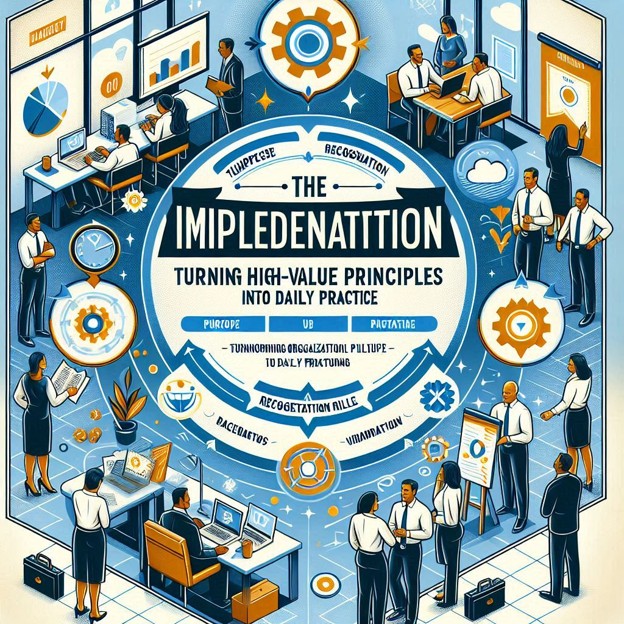
The Implementation Playbook: Turning High-Value Principles into Daily Practice

“Culture isn’t what you say—it’s what you do when nobody’s watching.”

Sarah, a newly promoted HR Director at a mid-sized healthcare company, sat across from me during our initial consultation. She’d read every leadership book on the market. She could recite organizational theories fluently. Yet her team was struggling with high turnover, low morale, and a culture that felt disconnected from the company’s stated values.

“I know what we should be doing,” she said, frustration evident in her voice. “But I can’t figure out how to make it actually happen day-to-day.”

Sarah’s challenge isn’t unique. In my twenty-plus years transforming organizational cultures, I’ve discovered that the gap between knowing and doing is where most culture initiatives fail. It’s one thing to understand high-value principles—it’s another entirely to embed them into the daily rhythms of work life.

This implementation playbook bridges that gap. It transforms the concepts from “Mastering a High-Value Company Culture” and “High-Value Leadership” into actionable daily practices that create real, measurable change.

The Monday Morning Reality Check

Here’s the truth: Your culture isn’t defined by the motivational posters on your walls or the values statement on your website. It’s defined by what happens at 9:15 AM on a rainy Monday when deadlines are looming and tempers are short.

High-value culture lives in the micro-moments:

  • How managers respond to mistakes
  • Whether meetings start with genuine check-ins or dive straight into tasks
  • If diverse voices are actively sought or merely tolerated
  • When leaders choose transparency over convenience
  • How conflicts are navigated versus avoided

As I detailed in “High-Value Leadership,” transformation happens through purposeful daily actions, not grand gestures. Let’s explore how to make this real.

The PRACTICE Framework: Your Daily Implementation Guide

After years of helping organizations operationalize their values, I’ve developed the PRACTICE framework—a systematic approach to embedding high-value principles into everyday work:

PPurpose-Driven Morning Huddles

RRecognition Rituals

AAccountability Check-ins

CCollaborative Decision-Making

TTransparent Communication

IInclusive Practices

CContinuous Learning Loops

EEmpowerment Actions

Let’s break down each element with real-world applications.

P – Purpose-Driven Morning Huddles

The Principle: Start each day connecting work to meaning.

The Practice: Begin team meetings with a 2-minute purpose moment. One team member shares how their work from the previous day connected to the organization’s larger mission.

Real Example: At a financial services firm I worked with, the customer service team started each shift by sharing one customer story that reminded them why their work mattered. Within three months, customer satisfaction scores increased by 18% and employee engagement rose by 22%.

Implementation Tip: Rotate who shares to ensure everyone connects their role to purpose. Keep it brief but meaningful.

R – Recognition Rituals

The Principle: What gets recognized gets repeated.

The Practice: Institute “Value Spotting Fridays” where team members publicly recognize colleagues who demonstrated core values in action.

The Double-Bind Advantage™: As I discuss in “Rise & Thrive,” Black women often face the challenge of being simultaneously hyper-visible and invisible. Strategic recognition rituals can help address this paradox by ensuring all contributions are seen and celebrated equitably.

Real Example: A technology startup implemented a digital “kudos board” where employees could post real-time recognition. They discovered that women, particularly women of color, were contributing innovative solutions that had previously gone unnoticed. Making recognition visible and systematic uncovered hidden talent and drove a 40% increase in innovation metrics.

A – Accountability Check-ins

The Principle: Accountability isn’t about blame—it’s about collective ownership.

The Practice: Weekly 15-minute team accountability circles where each person shares:

  • One commitment from last week and its status
  • One commitment for the coming week
  • Any support needed

Implementation Tip: Frame accountability as support, not surveillance. Ask “What do you need to succeed?” not “Why didn’t you deliver?”

C – Collaborative Decision-Making

The Principle: Diverse perspectives drive better outcomes.

The Practice: Implement the “VOICES Protocol” for important decisions:

  • Various perspectives sought actively
  • Options explored without immediate judgment
  • Impact on all stakeholders considered
  • Consensus built through dialogue
  • Execution plan co-created
  • Success metrics defined together

Real Example: When a manufacturing company used this protocol for a major process change, they uncovered insights from line workers that saved $2.3 million and reduced implementation time by six months. The key? They included voices traditionally excluded from strategic decisions.

T – Transparent Communication

The Principle: Trust grows in transparency.

The Practice: Institute “Transparency Tuesdays” where leaders share:

  • One organizational challenge currently being addressed
  • Progress on key initiatives
  • Upcoming changes and the reasoning behind them

The Leadership Evolution: Dave Ulrich’s recent update on the HR Business Partner model emphasizes that “HR issues are at the table as an integral part of any business discussion.” This transparency must extend beyond HR to all organizational communications. Leaders who share both struggles and successes build cultures of trust.

I – Inclusive Practices

The Principle: Inclusion is active, not passive.

The Practice: Implement meeting equity practices:

  • Rotate meeting leadership
  • Use anonymous digital polling for sensitive topics
  • Institute “amplification” where team members repeat and credit good ideas from underrepresented voices
  • Create space for introverts through written pre-meeting input options

Statistical Reality: Research shows that in typical meetings, men speak 75% of the time. Creating structured inclusive practices ensures all voices contribute to organizational success.

C – Continuous Learning Loops

The Principle: Failure is data, not defeat.

The Practice: End each project with a “Learning Harvest”:

  • What worked well?
  • What didn’t work as expected?
  • What would we do differently?
  • What knowledge can we share with other teams?

Real Example: A healthcare system implemented learning harvests after every patient safety incident. Instead of blame, they focused on system improvements. Result? 43% reduction in incidents and a culture where staff felt safe reporting near-misses.

E – Empowerment Actions

The Principle: Empowerment requires actual power transfer.

The Practice: Create “Decision Rights Maps” that clearly show:

  • What decisions team members can make independently
  • What requires consultation
  • What needs approval
  • Budget authority at each level

The Transformation: One retail chain gave store managers budget authority for local community partnerships. This empowerment led to a 30% increase in community engagement and a 15% boost in local sales, proving that distributed power drives results.

Case Study: From Theory to Transformation

Let me share how these principles transformed FlavorFast (name changed), a quick-service restaurant chain struggling with inconsistent culture across 200 locations.

The Challenge:

  • High turnover (150% annually)
  • Inconsistent customer experience
  • Disconnect between corporate values and daily operations
  • Low employee engagement scores

The Implementation Journey:

Month 1-2: Foundation Setting

  • Trained all managers in the PRACTICE framework
  • Started daily purpose huddles in every location
  • Launched digital recognition platform

Month 3-4: Building Momentum

  • Implemented weekly accountability circles
  • Introduced collaborative decision-making for local marketing
  • Started Transparency Tuesday video messages from CEO

Month 5-6: Deepening Practice

  • Rolled out meeting equity practices
  • Launched monthly learning harvests
  • Created decision rights maps for each role

The Results (After 18 Months):

  • Turnover reduced to 87% (industry average: 125%)
  • Customer satisfaction increased 24%
  • Employee engagement rose from 42% to 71%
  • Same-store sales grew 12%

The secret? They didn’t just train on concepts—they embedded specific practices into daily operations.

Your 90-Day Quick Start Guide

Ready to implement? Here’s your roadmap:

Days 1-30: Foundation

  1. Week 1: Assess current state using the Culture Reality Audit (see tools section)
  2. Week 2: Select 2-3 PRACTICE elements to pilot
  3. Week 3: Train team leaders on selected practices
  4. Week 4: Launch pilot with one team

Days 31-60: Expansion

  1. Week 5-6: Gather feedback and refine approaches
  2. Week 7-8: Expand to additional teams
  3. Create “Culture Champions” in each department

Days 61-90: Embedding

  1. Week 9-10: Integrate practices into performance discussions
  2. Week 11-12: Celebrate early wins and share success stories
  3. Plan full rollout based on pilot learnings

The Technology Amplifier

Modern tools can accelerate culture implementation:

  • Slack/Teams channels for real-time recognition
  • Anonymous polling apps for inclusive input
  • Video messages for leader transparency
  • Digital dashboards for accountability tracking
  • AI tools for meeting equity monitoring

As Ulrich notes, AI in HR is “only 20-30% up the S-curve,” meaning massive opportunity exists for technology to enable culture transformation.

Overcoming Common Implementation Obstacles

“We don’t have time for all these practices” Start with one. A two-minute purpose moment creates more productivity than it consumes. Time invested in culture pays compound returns.

“Our leaders won’t buy in” Begin with willing early adopters. Success stories create converts faster than mandates. Document ROI religiously.

“We’re too distributed/remote” Virtual teams need MORE intentional culture practices, not fewer. Every practice can be adapted for digital environments.

“This feels like just more meetings” These aren’t additional meetings—they’re improvements to existing interactions. Transform what you’re already doing rather than adding more.

Measuring What Matters

Track implementation through both leading and lagging indicators:

Leading Indicators (Weekly):

  • Participation rates in practices
  • Recognition frequency
  • Number of diverse voices in decisions
  • Learning harvests completed

Lagging Indicators (Quarterly):

  • Employee engagement scores
  • Turnover rates
  • Customer satisfaction
  • Innovation metrics
  • Financial performance

The Compound Effect of Daily Practice

Here’s what I’ve learned after decades in this work: Culture transformation isn’t about perfection—it’s about direction. Small, consistent actions compound into remarkable change.

When you implement even three of these practices consistently for 90 days, you’ll see:

  • Increased trust and psychological safety
  • Higher engagement and retention
  • Improved decision quality
  • Accelerated innovation
  • Better business results

Most importantly, you’ll create an environment where everyone—including traditionally overlooked talent—can thrive.

Discussion Questions for Your Leadership Team

  1. Which PRACTICE element would address our most pressing cultural challenge?
  2. What specific behaviors do we need to see more of, and how can these practices encourage them?
  3. How might these implementations need to be adapted for our unique context?
  4. What resistance might we encounter, and how can we address it proactively?
  5. Who are our potential Culture Champions, and how can we empower them?
  6. What would wild success look like 90 days from now?
  7. How can we ensure these practices are inclusive of all voices, particularly those traditionally marginalized?

Your Next Steps

  1. Download our free Culture Reality Audit tool to assess your starting point
  2. Choose 2-3 PRACTICE elements that address your biggest opportunities
  3. Schedule a team meeting to introduce your pilot plan
  4. Commit to 90 days of consistent implementation
  5. Document your journey and results

Ready to Accelerate Your Culture Transformation?

While this playbook provides a robust framework for implementation, every organization faces unique challenges. If Sarah’s story resonates with you—if you know what needs to happen but struggle with the how—you don’t have to navigate this journey alone.

Che’ Blackmon Consulting specializes in:

  • Custom implementation roadmaps for your specific context
  • Leader coaching on high-value practices
  • Culture Champion development programs
  • Implementation accountability partnerships
  • ROI measurement and optimization

We’ve helped organizations reduce turnover by 50%, increase engagement by 60%, and drive significant improvements in business results—all through practical, daily culture practices.

Let’s explore how we can accelerate your culture transformation.

📧 Contact us at admin@cheblackmon.com
📱 Call 888.369.7243
🌐 Visit https://cheblackmon.com

Because culture transformation doesn’t happen in the boardroom—it happens in the break room, the Zoom room, and every room where your people show up to work.

Remember: You don’t need perfect conditions to start. You just need to start. Your consistent daily practices will create the high-value culture your organization deserves.

What practice will you implement first?


Che’ Blackmon is the founder of Che’ Blackmon Consulting and author of “Mastering a High-Value Company Culture,” “High-Value Leadership: Transforming Organizations Through Purposeful Culture,” and “Rise & Thrive: A Black Woman’s Blueprint for Leadership Excellence.” With over 20 years of experience transforming organizational cultures, she helps leaders turn high-value principles into daily practices that drive measurable results.

#HighValueLeadership #CompanyCulture #OrganizationalTransformation #LeadershipDevelopment #CultureChange #EmployeeEngagement #WorkplaceCulture #BusinessTransformation #HRStrategy #LeadershipCoaching #CultureTransformation #PurposefulLeadership #TeamEngagement #WorkplaceInnovation #InclusiveLeadership

The Cultural Fit Paradox: Hiring for Values Without Sacrificing Diversity

How to Build Strong Cultures That Welcome Different Perspectives—and Why “Fit” Shouldn’t Mean “Same”

“They’re just not a cultural fit.”

These five words have derailed more diverse candidates than any other phrase in corporate hiring. After twenty years of transforming organizational cultures, I’ve heard this excuse countless times. And here’s what it usually means: “They don’t look, sound, or act like us.”

But here’s the paradox that keeps leaders up at night: How do you maintain a strong, cohesive culture while building the diverse teams that drive innovation? How do you hire for shared values without creating an echo chamber of sameness?

In “Mastering a High-Value Company Culture,” I argued that culture is your competitive advantage. But if your culture only fits one type of person, it’s not an advantage—it’s a liability. Today, I’ll show you how to resolve the cultural fit paradox once and for all.

The Hidden Cost of Misusing “Cultural Fit”

Let’s be brutally honest about how “cultural fit” gets weaponized:

The Homogeneity Trap

When teams hire for “fit,” they often hire for comfort. Research from Harvard Business School shows that hiring managers consistently choose candidates who remind them of themselves—a phenomenon called “affinity bias.” The result? Teams that look alike, think alike, and ultimately fail alike.

The Innovation Killer

McKinsey’s research proves what we intuitively know: diverse teams outperform homogeneous ones by 35%. When you hire only people who “fit” your current culture, you’re literally leaving money on the table.

The Exclusion Engine

For Black women and other underrepresented groups, “cultural fit” often becomes code for “you make us uncomfortable.” As I explored in “Rise & Thrive,” we’re often excluded not because we can’t do the job, but because we do it differently.

Reframing the Conversation: From Cultural Fit to Values Alignment

The solution isn’t abandoning culture in hiring—it’s getting crystal clear about what actually matters. Here’s the critical distinction:

Cultural Fit asks: “Will this person blend in seamlessly?” Values Alignment asks: “Does this person share our core principles?”

Cultural Fit wonders: “Will they join us for happy hour?” Values Alignment wonders: “Will they uphold our commitment to excellence?”

Cultural Fit focuses on: Personality, background, communication style Values Alignment focuses on: Integrity, work ethic, shared mission

This shift changes everything.

The VALUES Framework for Inclusive Hiring

I’ve developed this framework to help organizations hire for values while building diverse teams:

V – Verify Core Values (Not Surface Preferences)

First, distinguish between actual values and cultural preferences:

Core Values (Keep These):

  • Integrity in all dealings
  • Commitment to customer success
  • Innovation and continuous improvement
  • Respect for all individuals
  • Excellence in execution

Cultural Preferences (Question These):

  • “Work hard, play hard” mentality
  • After-hours socializing expectations
  • Specific communication styles
  • Traditional career paths
  • Ivy League credentials

A – Assess Through Multiple Lenses

Use diverse hiring teams and structured interviews to evaluate values:

  • Behavioral questions that reveal values in action
  • Case studies that show problem-solving approaches
  • Reference checks that confirm value alignment
  • Work samples that demonstrate excellence

L – Look for Culture Add, Not Culture Fit

Ask: “What perspectives and experiences will this person bring that we’re missing?”

  • Different industry backgrounds
  • Varied educational paths
  • Diverse life experiences
  • Alternative problem-solving approaches
  • Fresh perspectives on old challenges

U – Uncover Unconscious Bias

Build bias interruption into your process:

  • Structured interview questions asked consistently
  • Diverse interview panels required
  • “Culture fit” discussions banned
  • Objective evaluation criteria defined
  • Blind resume reviews when possible

E – Expand Your Definition of Excellence

Excellence comes in many forms:

  • Different communication styles can all be effective
  • Leadership doesn’t always look like extroversion
  • Innovation often comes from unexpected sources
  • Quiet contribution can be as valuable as visible performance

S – Sustain Through Onboarding

Don’t abandon new hires after they start:

  • Clear values communication from day one
  • Multiple cultural interpreters assigned
  • Regular check-ins on cultural integration
  • Adjustment support for both individual and organization
  • Success metrics beyond “fitting in”

Real-World Success: How Microsoft Transformed Their Approach

Microsoft’s cultural transformation under Satya Nadella provides a masterclass in hiring for values while increasing diversity. Here’s what they did:

The Shift

From: Competitive, “know-it-all” culture To: Collaborative, “learn-it-all” culture

The Hiring Changes

  • Stopped prioritizing aggressive competitors
  • Started valuing growth mindset
  • Looked for collaborators, not just stars
  • Valued empathy as a leadership trait
  • Expanded recruiting beyond traditional sources

The Results

  • Increased representation of women in technical roles by 64%
  • Improved racial diversity in leadership by 45%
  • Stock price increased 500%+
  • Employee satisfaction soared
  • Innovation metrics exploded

The key? They maintained strong values (growth, innovation, customer focus) while abandoning narrow cultural preferences (aggression, competition, traditional backgrounds).

Special Considerations for Underrepresented Candidates

As someone who’s navigated corporate spaces as a Black woman, I know the “cultural fit” conversation carries extra weight for us. Here’s what progressive organizations are doing:

The Double-Bind Recognition

Smart companies recognize that underrepresented candidates often face a double-bind:

  • Show up authentically and be deemed “not a fit”
  • Code-switch to fit in and be seen as “inauthentic”

The solution? Value authenticity as culture add, not culture threat.

The Onboarding Investment

Don’t expect diverse hires to navigate your culture alone:

  • Assign cultural navigators who share similar backgrounds
  • Create employee resource groups for support
  • Provide clear documentation of unwritten rules
  • Allow time for mutual cultural adaptation

The Retention Focus

Hiring diverse talent without retention is just expensive turnover:

  • Regular stay interviews to surface concerns
  • Advancement pathways clearly defined
  • Sponsorship programs for underrepresented talent
  • Zero tolerance for microaggressions

The New Playbook: Practical Implementation Strategies

Revamp Your Job Descriptions

Remove: “Must thrive in fast-paced, work-hard-play-hard environment” Add: “Must be committed to delivering excellent results for our customers”

Remove: “Looking for someone who fits our dynamic team culture” Add: “Seeking someone who shares our values of integrity, innovation, and inclusion”

Transform Your Interview Process

Instead of: “Would I want to grab a beer with this person?” Ask: “How would this person’s perspective strengthen our team?”

Instead of: “Do they communicate like us?” Ask: “Can they communicate effectively with diverse stakeholders?”

Redefine Success Metrics

Track hiring outcomes by:

  • Values alignment scores (through structured assessment)
  • Diversity of backgrounds and perspectives
  • Innovation contributed by new hires
  • Retention rates across demographic groups
  • Team performance improvements

Navigating Common Objections

“But we need people who gel with our team!” Teams “gel” through shared purpose and mutual respect, not sameness. Diverse teams that share values outperform homogeneous teams that share backgrounds.

“Our culture is what makes us special!” Your values make you special. Your culture should be flexible enough to express those values through different styles and approaches.

“We tried hiring for diversity, but they didn’t work out!” Did you set them up for success? Did you adapt your culture to include their perspectives? Did you protect them from bias? The failure might be in your system, not their fit.

“How do we maintain culture with remote/hybrid work?” This actually makes values-based hiring MORE important. When you can’t rely on office proximity to build culture, shared values become your North Star.

The Technology Factor: AI in Values-Based Hiring

Dave Ulrich’s 2024 research on HR transformation highlights how AI can help separate values alignment from cultural bias:

AI Tools for Values Assessment

  • Natural language processing to identify values in responses
  • Behavioral prediction based on past actions, not demographics
  • Bias detection in interviewer evaluations
  • Pattern recognition for successful values alignment

The Human Element Remains Critical

Technology can help identify values alignment, but humans must:

  • Define what values actually mean in practice
  • Assess cultural contribution potential
  • Make nuanced decisions about fit versus add
  • Create inclusive environments post-hire

Your 30-Day Culture-Add Transformation Plan

Week 1: Values Clarification

  • Distinguish between core values and preferences
  • Get leadership alignment on true values
  • Identify where “fit” has excluded diverse talent
  • Define what each value looks like in practice

Week 2: Process Audit

  • Review job descriptions for exclusionary language
  • Analyze current hiring data by demographics
  • Interview recent hires about their experience
  • Identify bias points in current process

Week 3: Redesign and Training

  • Rewrite job descriptions focusing on values
  • Create structured interview guides
  • Train hiring managers on inclusive practices
  • Develop “culture add” assessment tools

Week 4: Pilot and Refine

  • Test new approach with next openings
  • Gather feedback from all parties
  • Adjust based on learnings
  • Plan broader implementation

Building Lillian and Joan’s Legacy

In “Mastering a High-Value Company Culture,” I shared the story of Lillian and Joan, two very different leaders who built an incredible culture at a nonprofit. Lillian was a wise Polish American woman; Joan was her complete opposite in style. Yet they shared core values: compassion, service, and excellence.

Their success proved that different leadership styles, backgrounds, and approaches can create powerful cultures when united by shared values. They hired for heart and competence, not for sameness. The result? A diverse team that delivered extraordinary results on a shoestring budget.

This is your opportunity to build that kind of legacy.

Discussion Questions for Your Leadership Team

  1. What aspects of our “cultural fit” discussions are really about comfort versus values?
  2. How might our organization benefit from perspectives we’re currently excluding?
  3. Which of our cultural norms are essential, and which are just “how we’ve always done it”?
  4. What would change if we asked “What will they add?” instead of “Will they fit?”
  5. How can we measure values alignment without measuring sameness?
  6. What support systems do we need for culture-add hires to thrive?
  7. How might reframing from fit to add become our competitive advantage?

The Path Forward: Building Cultures That Include and Excel

The future belongs to organizations that can build strong cultures while welcoming diverse perspectives. This isn’t about weakening culture—it’s about strengthening it through inclusion.

When you hire for values alignment instead of cultural fit, you:

  • Build teams that innovate through diversity
  • Create cultures that adapt and evolve
  • Attract top talent from all backgrounds
  • Drive better business results
  • Model the future of work

The cultural fit paradox isn’t really a paradox at all. It’s a false choice between strong culture and diversity. The truth? The strongest cultures are built on shared values expressed through beautifully different perspectives.

Ready to Transform Your Hiring for High-Value Culture?

At Che’ Blackmon Consulting, we specialize in helping organizations build strong cultures that welcome diverse talent. We understand the difference between values alignment and cultural fit—and we know how to hire for one without sacrificing the other.

Our Culture-Add Hiring Transformation includes:

  • Values clarification and definition workshops
  • Hiring process audit and bias analysis
  • Inclusive job description development
  • Interview guide creation and training
  • Culture-add assessment tool design
  • 6-month implementation support with measurable outcomes

Program Benefits:

  • Increase diverse hiring by 40-60%
  • Improve new hire retention by 35%
  • Enhance team innovation metrics
  • Strengthen actual culture while expanding who can participate
  • Build competitive advantage through inclusion

Don’t let “cultural fit” be the excuse that keeps you from building the diverse, innovative teams your organization needs to thrive.

Contact Che’ Blackmon Consulting today to schedule your complimentary Culture-Add Hiring Assessment. Together, we’ll design a hiring approach that strengthens your values while welcoming the perspectives that will transform your future.

Because the best cultures aren’t built on sameness—they’re built on shared values expressed through beautiful diversity.


Che’ Blackmon is the founder of Che’ Blackmon Consulting and author of “Mastering a High-Value Company Culture,” “High-Value Leadership,” and “Rise & Thrive: A Black Woman’s Blueprint for Leadership Excellence.” With over 20 years of experience transforming organizational cultures, she helps companies build hiring practices that strengthen culture while embracing diversity.

#CulturalFit #DiversityAndInclusion #InclusiveHiring #ValuesBasedLeadership #CultureAdd #HiringForDiversity #WorkplaceCulture #DEI #LeadershipDevelopment #HighValueLeadership #HRTransformation #TalentAcquisition #InclusiveLeadership #OrganizationalCulture #DiversityMatters