📚 The Real Cost of One Bad Exit: Calculating What Turnover Actually Costs Your Business

By Che’ Blackmon, DBA Candidate | Founder & CEO, Che’ Blackmon Consulting

When someone resigns, most leaders see a vacancy. They see a job posting that needs to go live, a team that needs to absorb extra work, and a calendar that suddenly feels tighter. What they rarely see is the full financial earthquake that one departure sets off beneath the surface of their organization. The real cost of turnover is not a single line item. It is a compounding crisis that touches recruiting, onboarding, productivity, morale, institutional knowledge, and customer relationships all at once.

And here is what makes it worse: the employees organizations can least afford to lose are often the ones who leave first.

In Mastering a High‑Value Company Culture, I wrote that culture is the lifeblood of any organization. When that lifeblood is healthy, people stay, grow, and contribute at levels that transform businesses. When it is toxic or neglected, talented people quietly update their resumes and walk out the door, taking years of knowledge, relationships, and momentum with them. Every exit is a cultural referendum. The question is whether leadership is paying attention to the verdict.

💰 The True Price Tag: What One Departure Really Costs

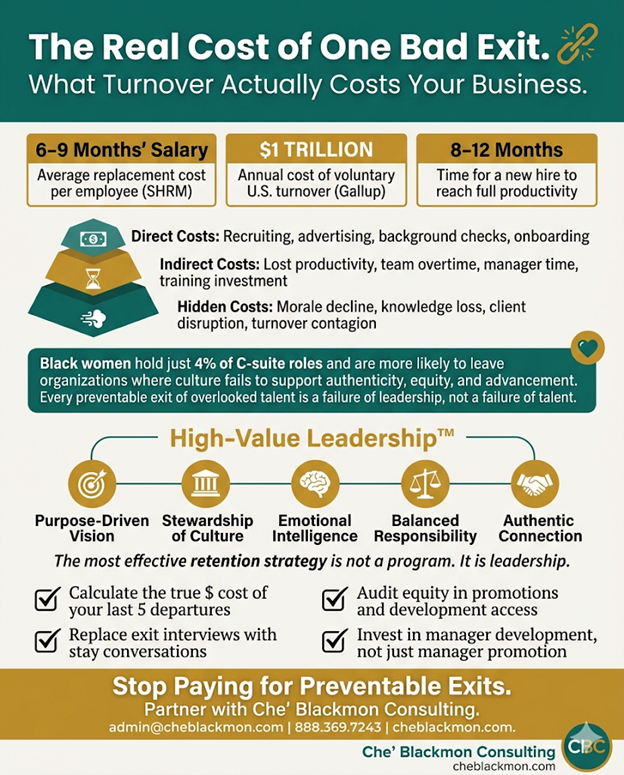
Most business leaders dramatically underestimate what it costs to replace an employee. According to the Society for Human Resource Management (SHRM), the average cost to replace a salaried employee ranges from six to nine months of that person’s salary. For senior or highly specialized roles, that figure can climb to 200% of annual compensation or more. Gallup’s research puts the annual cost of voluntary turnover in U.S. businesses at roughly one trillion dollars.

Let that number land for a moment. One trillion dollars. And that figure only accounts for the costs we can measure directly.

📋 Breaking Down the Cost Categories

Direct Costs include job advertising, recruiter fees, background checks, drug screenings, relocation packages, and signing bonuses. For a mid level manager earning $75,000 annually, these direct costs alone can exceed $15,000 before the new hire even completes orientation.

Indirect Costs are where the real damage hides. These include lost productivity during the vacancy period, the reduced output of the new hire during their learning curve (which research from the Brandon Hall Group suggests can last 8 to 12 months), overtime costs for team members absorbing extra responsibilities, and the time managers and HR professionals invest in interviewing, onboarding, and training.

Hidden Costs are the most dangerous because they compound silently. When a respected team member leaves, remaining employees begin questioning their own commitment. Institutional knowledge walks out the door. Client relationships fracture. Innovation slows because the team is focused on survival rather than growth. These ripple effects can persist for months or even years after a single departure.

🔍 The Turnover Domino Effect: When One Exit Becomes Five

Turnover is rarely an isolated event. Research published in the Academy of Management Journal has shown that when one employee leaves, the probability of additional departures in the same unit increases significantly. This phenomenon, sometimes called turnover contagion, occurs because departures signal to remaining employees that something may be fundamentally wrong with the team, the leadership, or the organization’s trajectory.

There was a company in the manufacturing sector that lost its most experienced shift supervisor. Within 60 days, three additional team leads submitted their resignations, citing the same concerns the supervisor had raised for over a year: inconsistent scheduling, a lack of recognition, and leadership that prioritized output numbers over people. The cost of replacing that one supervisor was estimated at $45,000. The total cost of the four departures combined, factoring in lost production, quality defects, and emergency overtime, exceeded $300,000.

In High‑Value Leadership: Transforming Organizations Through Purposeful Culture, I define Stewardship of Culture as one of the five pillars of the High‑Value Leadership™ framework. Leaders who steward culture do not wait for exit interviews to discover what is broken. They build systems of listening, accountability, and responsiveness that address concerns before they become resignations. When stewardship is absent, every exit becomes an invitation for the next one.

❤️ The Human Side: Impact on Traditionally Overlooked Talent

Not all turnover is created equal in terms of who bears the greatest burden. Traditionally overlooked employees, and most specifically Black women in corporate spaces, experience the costs of toxic culture and preventable turnover at a disproportionate rate.

According to a 2023 McKinsey and LeanIn.Org “Women in the Workplace” report, Black women are more likely than any other demographic group to report that they feel they cannot bring their authentic selves to work. They are more likely to experience microaggressions, to have their competence questioned, and to be passed over for promotion despite strong performance reviews. When organizations fail to address these dynamics, they lose talented professionals who could have been transformational leaders.

In Rise & Thrive: A Black Woman’s Blueprint for Leadership Excellence, I address what scholars call “double jeopardy,” the reality of facing bias and barriers related to both race and gender simultaneously. Black women hold just 4% of C‑suite positions and 1.4% of executive level roles in Fortune 500 companies, not because of a lack of ambition or qualification, but because of systemic barriers including hiring bias, limited access to influential networks, and workplace cultures that were not designed with their success in mind.

💡 The Retention Equity Gap

When a Black woman leaves an organization, the loss extends beyond her individual contribution. She often served as an informal mentor, a bridge builder across departments, and a voice for perspectives that would otherwise go unheard. Her departure frequently signals to other employees from underrepresented groups that the organization is not a safe place to invest their careers.

There was an organization in the healthcare industry that lost three of its five Black women in mid level leadership over an 18 month period. Each cited a variation of the same experience: being overlooked for stretch assignments, receiving feedback that felt coded (“too direct,” “needs to soften her approach”), and watching less qualified peers advance. The organization eventually spent over $500,000 on recruiting, onboarding, and lost productivity. The irony was that investing a fraction of that amount in equitable development programs, mentoring, and inclusive leadership training could have retained all three.

This is not just a diversity, equity, and inclusion conversation. It is a bottom line conversation. Organizations that fail to create environments where all talent can thrive are literally paying for that failure every single quarter.

📈 Current Trends: Why Turnover Is Accelerating in 2025 and 2026

The workforce landscape continues to shift in ways that make retention more complex than ever. Several converging trends are driving voluntary turnover to new heights.

  • The Expectation Economy. Employees, particularly those in Gen Z and younger millennial demographics, expect more than a paycheck. They expect purpose, flexibility, growth pathways, and leaders who demonstrate emotional intelligence. Organizations that have not adapted to this shift are hemorrhaging talent.
  • AI Anxiety and Change Fatigue. Rapid adoption of artificial intelligence and automation technologies has created uncertainty across industries. Employees who do not feel supported through technological transitions are more likely to disengage and seek stability elsewhere.
  • The Manager Crisis. Gallup’s 2024 State of the Global Workplace report found that managers account for 70% of the variance in employee engagement. Yet many organizations continue to promote individuals into management roles based on technical competence rather than leadership capability, creating a pipeline of well meaning but ill equipped leaders who inadvertently drive turnover.
  • Return to Office Tensions. Organizations that have mandated rigid return to office policies without addressing the underlying trust deficit are seeing spikes in voluntary departures, particularly among high performers who have demonstrated their ability to deliver results remotely.
🛠️ A Practical Framework: Calculating Your Organization’s True Turnover Cost

Understanding the problem is the first step. Quantifying it is what creates urgency for action. Below is a simplified framework for calculating the true cost of a single departure. Use this as a starting point and adjust based on your industry and role complexity.

🧮 The Turnover Cost Calculator

  1. Separation Costs: Exit interview time, administrative processing, severance (if applicable), unemployment insurance increases, and legal review. Estimated range: $1,000 to $5,000.
  2. Vacancy Costs: Lost productivity per day multiplied by the average number of days the position remains open. For a $75,000 role, daily productivity value is approximately $375. The average time to fill in 2025 is 44 days (SHRM benchmark), resulting in an estimated $16,500 in vacancy costs alone.
  3. Replacement Costs: Job advertising, recruiter fees, interviewing time (multiply hours spent by hourly rate of each interviewer), background and reference checks, onboarding materials, and technology setup. Estimated range: $5,000 to $25,000 depending on role level.
  4. Ramp Up Costs: New hires typically operate at 25% productivity in month one, 50% in month two, and 75% in month three. Full productivity may not be reached for 8 to 12 months. Calculate the difference between full productivity value and actual output during this period.
  5. Cultural and Morale Costs: While harder to quantify, estimate this by tracking engagement survey score changes, additional voluntary departures within 90 days, and customer satisfaction shifts following a key departure.

For a mid level manager earning $75,000, the conservative total cost of a single departure often falls between $50,000 and $100,000. For senior leaders and specialized roles, that number can easily exceed $200,000.

✨ High‑Value Leadership™ as a Retention Strategy

The most effective retention strategy is not a program. It is not a perk. It is leadership. Specifically, it is the kind of leadership that intentionally builds cultures where people feel seen, heard, valued, and positioned to grow.

The High‑Value Leadership™ framework I developed through High‑Value Leadership: Transforming Organizations Through Purposeful Culture rests on five pillars, each of which directly addresses the root causes of preventable turnover.

  • Purpose‑Driven Vision. Employees who understand the “why” behind their work are significantly more engaged. When leaders articulate a compelling purpose and connect daily tasks to that larger mission, people stop viewing their role as a job and start viewing it as a contribution.
  • Stewardship of Culture. Culture does not maintain itself. It requires active, ongoing stewardship. Leaders must listen before they direct, measure what matters, and respond to cultural warning signs before they become cultural crises.
  • Emotional Intelligence. Daniel Goleman’s research has consistently shown that emotional intelligence is the single strongest predictor of leadership effectiveness. Leaders who can manage their own emotions and respond empathetically to others create psychologically safe environments where people are willing to stay, even during difficult seasons.
  • Balanced Responsibility. High performing cultures hold people accountable while also investing in their development. When accountability exists without support, it breeds fear. When support exists without accountability, it breeds complacency. The balance between these two forces is where retention thrives.
  • Authentic Connection. People do not leave companies. They leave leaders who fail to connect with them. Authentic connection means knowing your people beyond their performance metrics, understanding their aspirations, and creating space for them to bring their whole selves to work.

✅ Actionable Takeaways: 7 Steps to Reduce Costly Turnover

  1. Conduct a Turnover Cost Audit. Use the framework above to calculate the true cost of your last five departures. Present these numbers to senior leadership. Nothing creates urgency faster than a dollar sign.
  2. Invest in Manager Development, Not Just Manager Promotion. Equip every people leader with emotional intelligence training, coaching skills, and cultural stewardship tools. The return on this investment far exceeds the cost of the turnover it prevents.
  3. Build Stay Interview Practices. Stop relying solely on exit interviews to learn what is wrong. Implement quarterly stay conversations that ask high performers what keeps them engaged and what might cause them to leave.
  4. Audit Your Equity Practices. Examine promotion rates, pay equity, and access to stretch assignments across demographic groups. If Black women and other traditionally overlooked employees are advancing at lower rates than their peers, your retention strategy has a critical gap that no amount of perks will fill.
  5. Create Psychological Safety Metrics. Add questions to your engagement surveys that specifically measure whether employees feel safe speaking up, challenging ideas, and making mistakes without punishment. Track these scores over time and tie them to manager performance evaluations.
  6. Establish a 90 Day Early Warning System. The first 90 days after a departure are the highest risk period for additional turnover. During this window, increase check in frequency with remaining team members, address workload redistribution transparently, and accelerate backfill timelines.
  7. Align Retention with Business Strategy. Retention should not live exclusively in HR’s portfolio. It should be a standing agenda item in every leadership team meeting, with the same rigor and visibility as revenue, quality, and customer satisfaction metrics.

🗣️ Expert Insight: What the Research Tells Us

Dr. John Sullivan, a widely recognized HR thought leader, has argued that most organizations measure turnover rate but fail to measure turnover quality, meaning they do not distinguish between the departure of an average performer and the departure of someone who was a top contributor. He recommends that organizations calculate “regrettable turnover” separately and treat each instance as a critical incident requiring root cause analysis.

Dave Ulrich, whose work I reference extensively in Mastering a High‑Value Company Culture, has emphasized that talent is the primary driver of value in knowledge economies. Organizations that treat people as interchangeable parts will consistently underperform those that invest in creating environments where talent can be developed, engaged, and retained.

Brené Brown’s research on vulnerability and trust, which I draw upon in High‑Value Leadership, reinforces that employees are more likely to stay in environments where they feel they can be honest about challenges without fear of retaliation. When leaders model vulnerability and create space for authentic dialogue, they build the kind of trust that no compensation package can replicate.

🎯 From My Experience: Over Two Decades on the Front Lines of Retention

With more than 24 years of progressive HR leadership across manufacturing, automotive, healthcare, nonprofit, quick service, and professional services industries, I have watched the turnover conversation evolve significantly. Early in my career, turnover was treated as an unavoidable cost of doing business. Leaders would shrug and say, “People leave. That’s just how it works.”

That mindset is outdated and expensive. What I have witnessed consistently is that the organizations willing to invest intentionally in culture, in leadership development, and in creating equitable pathways for all employees (not just those who look like, sound like, or think like the existing leadership team) are the ones that retain their best people and outperform their competitors.

There was a company in the automotive sector that was experiencing 40% annual turnover on its production floor. After conducting a thorough culture assessment, the root causes became clear: frontline supervisors had received no leadership training, recognition was nonexistent, and scheduling practices were eroding trust. Within 12 months of implementing targeted leadership development, structured recognition programs, and transparent scheduling communication, turnover dropped to 18%. The estimated annual savings exceeded $1.2 million.

That is not magic. That is what happens when organizations stop treating people as replaceable and start treating culture as a strategic priority.

💬 Discussion Questions for Your Leadership Team

Use these questions to spark a meaningful conversation with your leadership team about turnover’s true impact on your organization:

  1. Do we currently calculate the full cost of turnover, or are we only tracking the turnover rate? What would change if we attached a dollar amount to every departure?
  2. When was the last time we lost a high performer? Did we conduct a root cause analysis, or did we simply post the job and move on?
  3. Are Black women and other traditionally overlooked employees advancing at the same rate as their peers in our organization? If not, what systemic barriers might be contributing to that gap?
  4. How would our frontline supervisors and mid level managers rate their own preparedness to lead people effectively? Have we invested in their development?
  5. Do our stay interview practices give us actionable insight, or are we waiting for exit interviews to learn what went wrong?
  6. Which of the five High‑Value Leadership™ pillars (Purpose‑Driven Vision, Stewardship of Culture, Emotional Intelligence, Balanced Responsibility, Authentic Connection) represents our organization’s greatest strength? Which represents our greatest opportunity for growth?
  7. If we could retain just five additional employees this year who would otherwise have left, what would that save us financially? What would it preserve culturally?

🚀 Next Steps: Stop Paying for Preventable Exits

Every organization has the power to reduce turnover, but it requires a shift in mindset. It requires leaders who are willing to examine their culture honestly, invest in people strategically, and hold themselves accountable for the environments they create. The cost of doing nothing is measurable, and it is growing every quarter.

If you are ready to move from reactive recruiting to proactive retention, Che’ Blackmon Consulting can help. Through fractional HR leadership, culture transformation consulting, and leadership development rooted in the High‑Value Leadership™ framework, we partner with organizations to build cultures that attract, develop, and retain the talent they cannot afford to lose.

Because the real question is not whether you can afford to invest in your culture. The real question is whether you can afford not to.

🌟 Ready to Transform Your Organization’s Culture?

Work with Che’ Blackmon Consulting

📧  admin@cheblackmon.com

📞  888.369.7243

🌐  cheblackmon.com

📚 Explore More from Che’ Blackmon

Mastering a High‑Value Company Culture – Available on Amazon

High‑Value Leadership: Transforming Organizations Through Purposeful Culture – Available on Amazon

Rise & Thrive: A Black Woman’s Blueprint for Leadership Excellence – E‑Book Available at cheblackmon.com

🎥 Rise & Thrive YouTube Series | 🎙️ Unlock, Empower, Transform Podcast

© 2026 Che’ Blackmon Consulting. All rights reserved.

High‑Value Leadership™ is a proprietary framework of Che’ Blackmon Consulting.

#HighValueLeadership #TurnoverCost #EmployeeRetention #HRLeadership #CultureTransformation #WorkplaceCulture #BlackWomenInLeadership #LeadershipDevelopment #TalentRetention #FractionalHR #PeopleFirst #CheBlackmonConsulting #RetentionStrategy #EmployeeEngagement #DEI #OrganizationalCulture #LeadershipMatters #HRStrategy #HighValueCulture #RiseAndThrive

The Diversity Dividend: How Inclusive Leadership Drives Measurable Business Performance

By Che’ Blackmon, DBA Candidate | Founder & CEO, Che’ Blackmon Consulting

For years, the business case for diversity, equity, and inclusion was framed as a moral argument. Organizations were told it was the right thing to do. They were asked to look at representation gaps, acknowledge historical inequities, and commit to change because fairness demanded it. That case remains true. But it is also incomplete. Because the data has now accumulated to the point where the business case for inclusive leadership is not just ethical. It is empirical, financial, and strategic.

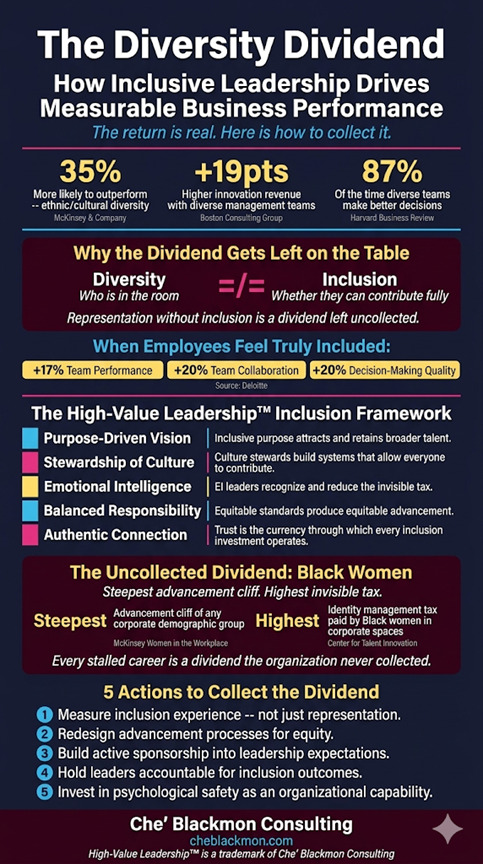
The diversity dividend is real. It shows up in revenue performance, in innovation rates, in decision quality, in talent retention, and in the resilience of organizations that can draw on the full range of human perspective rather than the narrow band of experience that homogeneous leadership teams represent. Companies in the top quartile for gender diversity are 15 to 25 percent more likely to achieve above-average financial returns, according to McKinsey and Company. Companies in the top quartile for ethnic and cultural diversity are 35 percent more likely to outperform their peers. These are not soft metrics. They are business results.

This article makes the case that inclusive leadership is not a program to be launched or a goal to be checked off. It is a strategic discipline that requires the same rigor, accountability, and investment that organizations apply to any other driver of performance. It is also deeply connected to the culture and leadership infrastructure that determines whether the diversity dividend can be collected at all, or whether it evaporates because the organization built representation without building the conditions for that representation to thrive.

📈 Defining the Diversity Dividend: What the Research Actually Shows

The phrase diversity dividend is not rhetorical. It describes a measurable premium in organizational performance that results from the strategic inclusion of diverse perspectives, backgrounds, and experiences at every level of decision-making. It is different from diversity as representation, which measures who is in the room. The dividend is produced when those people are genuinely included in the conversation, when their perspectives actually shape the decisions, and when the culture has been built to make that kind of authentic contribution possible.

The research base for this claim is extensive and spans more than two decades of organizational study. McKinsey and Company’s Diversity Wins report found that organizations with more than 30 percent women in executive roles were significantly more likely to outperform those with fewer women in leadership. The Boston Consulting Group found that companies with above-average diversity on their management teams reported innovation revenue 19 percentage points higher than companies with below-average diversity. Harvard Business Review research found that diverse teams make better decisions 87 percent of the time compared to individual decision-makers, and that cognitively diverse teams solve complex problems faster than homogeneous ones.

Deloitte’s research on inclusive leadership found that when employees feel included in their organization, team performance improves by 17 percent, team collaboration improves by 20 percent, and decision-making quality improves by 20 percent. These gains are not abstract. They translate directly into the metrics that determine organizational success: speed to market, product quality, client retention, and financial performance.

💡 Diversity without inclusion is representation without return. The dividend is paid only when people can fully bring their expertise, perspective, and voice to the work.

The mechanism behind these outcomes is well-established in organizational behavior research. Diverse teams bring a broader range of information, challenge assumptions that homogeneous teams accept uncritically, generate more options before converging on solutions, and are less susceptible to the groupthink dynamics that produce catastrophic organizational failures. When those diverse perspectives are genuinely included, the quality of organizational reasoning improves at every level.

🔍 The Gap Between Diversity and Inclusion: Why the Dividend Gets Left on the Table

Most organizations that have invested in diversity initiatives have discovered a frustrating reality: representation does not automatically produce inclusion, and inclusion does not automatically produce the performance outcomes the research promises. The gap between having diverse people and deriving value from their diversity is where most inclusion strategies fail, and understanding that gap is essential to closing it.

🚨 The Presence Trap

There was a manufacturing organization that invested significantly in recruiting a diverse workforce and achieved meaningful representation improvements at the individual contributor and mid-management levels. Its survey data, however, told a different story. Black employees and employees from other underrepresented groups consistently reported feeling that their ideas were less likely to be taken seriously, that they were excluded from informal decision-making conversations, and that advancement criteria were applied inconsistently across demographic lines. The organization had hired for diversity and then failed to build the conditions that allow diversity to contribute. The dividend was available. The infrastructure to collect it was absent.

This pattern is extraordinarily common. Organizations mistake the presence of diverse talent for the inclusion of diverse talent. They celebrate demographic milestones while ignoring the experience data that would tell them whether those milestones are translating into genuine participation, authentic contribution, and equitable advancement. Representation is a necessary condition for the diversity dividend. It is not a sufficient one.

📋 The Inclusion Infrastructure Deficit

Genuine inclusion requires structural conditions that most organizations have not built. It requires psychological safety, the belief that speaking up, disagreeing, and contributing authentically will not result in professional consequences. It requires consistent accountability, the assurance that the same standards apply to everyone regardless of who they know or what they look like. It requires transparent processes for advancement and recognition, so that the informal favoritism and proximity bias that have historically shaped organizational outcomes are replaced by visible, equitable criteria.

In High-Value Leadership: Transforming Organizations Through Purposeful Culture, the argument is made that authentic connection and stewardship of culture are leadership responsibilities that directly produce or undermine the psychological safety required for inclusion to function. Leaders who model intellectual humility, who actively solicit dissenting views, who credit contributions equitably, and who make their decision-making criteria transparent are the human infrastructure through which the diversity dividend becomes collectible.

There was a professional services organization that had a stated commitment to inclusion but whose actual culture rewarded conformity. Employees who challenged dominant perspectives in strategy meetings were labeled as difficult rather than engaged. Managers who had built informal networks of similar-background colleagues routinely bypassed formal nomination processes for high-visibility assignments. The organization’s diversity metrics looked adequate. Its inclusion experience data told the truth. When leadership invested in a culture realignment that addressed psychological safety, equitable processes, and manager accountability, engagement scores for underrepresented employees improved significantly within 18 months.

✨ The Compounded Reality: Black Women and the Uncollected Dividend

No group in the American corporate workforce carries the weight of the inclusion gap more acutely than Black women. They enter organizations with credentials, competence, and the strategic resilience that comes from navigating systems not designed for their advancement. They contribute, lead, and deliver results at rates that consistently exceed the recognition and advancement they receive. And the organizations that fail to include them fully are not just making an equity error. They are making a business error, leaving a measurable dividend uncollected.

🚨 The Advancement Cliff

McKinsey and Company’s Women in the Workplace research has documented for consecutive years that Black women face the steepest advancement cliff of any demographic group in corporate America. They are the least likely to receive sponsorship from senior leaders who can advocate for their advancement in rooms they are not in. They are the most likely to have their ideas credited to others. They are the most likely to be assessed as strong performers but not leadership material, a distinction that reflects the gap between performance evaluation systems that measure output and advancement criteria that measure cultural fit with leadership teams that do not reflect their identity.

The organizational cost of this pattern is not abstract. Every Black woman whose career progression is artificially stalled represents a loss of strategic leadership capacity at a career stage when her institutional knowledge, relationship equity, and functional expertise are at their most valuable. Every departure that results from that stalled trajectory represents a recruitment and development investment that produces no return. Every organization that perpetuates this pattern is systematically excluding some of its most experienced contributors from the rooms where its most consequential decisions are made.

💡 The Invisible Tax

Beyond the structural barriers, Black women in corporate environments pay what researchers have described as an invisible tax: the additional cognitive and emotional labor required to navigate workplaces that were not designed for their presence. This includes code-switching, the perpetual management of how one is perceived across racial and gender lines simultaneously. It includes the hypervisibility that makes Black women simultaneously more scrutinized and less sponsored. It includes the experience of having their competence questioned at levels their peers do not encounter, requiring a constant standard of proof that depletes the professional energy that should be directed toward contribution and development.

This invisible tax has measurable outcomes. Research from the Center for Talent Innovation found that Black women are significantly more likely than their peers to report exhaustion from managing their identity at work, and significantly more likely to consider leaving their current employer as a result. The organizations that address this tax structurally, through psychological safety investments, equitable recognition systems, and active sponsorship programs, are the organizations that retain the Black women whose full contribution is available to produce the diversity dividend.

📚  Rise & Thrive Connection: In Rise & Thrive: A Black Woman’s Blueprint for Leadership Excellence, the strategies for navigating these structural realities are addressed with both candor and practical depth. The SHIELD Resilience Framework offers Black women a personal and professional toolkit for thriving in environments that require resilience alongside excellence. If you are navigating this reality, that work was written for this season of your career.

🏗️ How High-Value Leadership™ Collects the Dividend

The High-Value Leadership™ framework, built on Purpose-Driven Vision, Stewardship of Culture, Emotional Intelligence, Balanced Responsibility, and Authentic Connection, is the leadership architecture through which the diversity dividend moves from research finding to organizational reality. Each pillar creates specific conditions that either enable or inhibit the full contribution of diverse talent.

Purpose-Driven Vision and the Inclusive Why 🎯

Organizations whose purpose is genuinely inclusive, whose stated mission reflects a commitment to the full human experience rather than a narrow demographic slice of it, attract and retain a broader range of talent. More importantly, they create a shared framework of meaning that makes diversity coherent rather than cosmetic. Purpose-Driven Vision in a High-Value Leadership™ context is not a tagline that happens to include inclusive language. It is a North Star that actually guides decision-making, resource allocation, and leadership behavior across the entire organization.

Stewardship of Culture and the Inclusion Infrastructure 🌱

Culture stewardship is where the diversity dividend is either built or lost. The leader who actively monitors the health of their team’s inclusion experience, who intervenes when exclusion patterns emerge, who redesigns processes when they produce inequitable outcomes, and who holds themselves and others accountable to inclusion standards is the leader who creates the conditions that allow diverse talent to contribute fully. Mastering a High-Value Company Culture makes the case that culture is not built by programs. It is built by the daily decisions of leaders who understand that every choice they make is a cultural signal.

Emotional Intelligence and the Empathy Infrastructure 🧠

Daniel Goleman’s research established that emotional intelligence accounts for the majority of leadership effectiveness. In the context of inclusive leadership, EI is the capacity to understand and navigate the emotional landscape of a diverse team, to recognize when a team member is experiencing the invisible tax described above, to respond to that experience with empathy rather than dismissal, and to create interactions that feel safe for authentic expression across difference. Leaders with high EI are the leaders whose diverse team members stay, grow, and contribute at their full capacity.

Balanced Responsibility and the Equity Standard ⚖️

The diversity dividend is only collectible when the standards of excellence and accountability apply equally to everyone, and when the rewards for meeting those standards, recognition, advancement, and opportunity, are distributed equitably. Balanced Responsibility in the High-Value Leadership™ framework means holding high performance standards in a psychologically safe environment where everyone has an equal opportunity to meet them. It means that underperformance is addressed regardless of who is underperforming, and that excellence is recognized regardless of who is excelling.

Authentic Connection and the Trust Foundation 🤝

Trust is the currency through which every other inclusion investment operates. Diverse team members who do not trust that their organization is genuinely committed to their equitable advancement will not provide the full contribution that the diversity dividend requires. They will perform at a level sufficient to protect their employment while reserving their highest value for environments that actually deserve it. Authentic connection, the fifth pillar of High-Value Leadership™, is built through consistent, transparent, and genuinely reciprocal leadership relationships. It is the foundation on which everything else rests.

🌈 The diversity dividend is not a bonus paid for doing inclusion right. It is the natural return on an organizational investment in building a culture where every person can bring their full contribution to the work.

📉 What Inclusive Organizations Are Actually Doing Differently

The organizations that consistently collect the diversity dividend are not the ones with the most sophisticated DEI programs. They are the ones where inclusion is embedded in how decisions are made, how people are developed, and how leadership accountability is measured. Here is what that looks like in practice.

There was a healthcare organization that redesigned its promotion process after recognizing that its informal nomination system consistently produced a finalist pool that did not reflect the diversity of its workforce. It replaced subjective manager nominations with structured competency assessments, added sponsorship requirements for all high-potential program participants, and implemented demographic reporting for every stage of the promotion pipeline. Within two years, representation in senior clinical leadership improved significantly and engagement scores for underrepresented employees rose toward parity with the broader workforce.

There was a nonprofit organization that integrated inclusion metrics into its leadership performance evaluation system for the first time, making manager accountability for team inclusion experience a factor in annual performance reviews. Leaders who had previously treated DEI as a compliance obligation began treating it as a leadership competency, because it was now measured and consequential. Team engagement scores for Black employees and other employees of color improved in those managers’ units, and voluntary turnover in those groups declined.

There was an automotive organization that implemented a structured reverse mentoring program pairing senior leaders with junior professionals from underrepresented groups, not as a nicety but as a development requirement. Senior leaders reported that the perspective shift produced by those relationships changed how they made decisions about team composition, project assignments, and advancement nominations. The organization’s internal diversity advancement metrics improved noticeably over the program’s first two years.

The common thread across all three is structural change to the systems that determine who advances, who contributes, and who is held accountable for inclusion outcomes. Programs create awareness. Systems create change.

🛠️ Actionable Takeaways: Collecting Your Organization’s Diversity Dividend

✅ For Organizational Leaders and HR Professionals

1. Measure Inclusion Experience Separately From Representation

Representation metrics tell you who is in the organization. Inclusion experience metrics tell you whether they can contribute fully. Disaggregate your engagement survey data by race, gender, and career level. Ask specific questions about psychological safety, recognition equity, and advancement fairness. The gaps you find are where the dividend is being left uncollected.

2. Redesign Advancement Processes for Equity

Audit every stage of your promotion and advancement process for informal bias. Who nominates candidates? What criteria are applied? How are nominations reviewed? Where are the demographic disparities in each stage? Redesigning for equity does not mean lowering standards. It means ensuring the same standards apply to everyone and that advancement pathways are visible to everyone.

3. Build Active Sponsorship Into Your Culture

Mentorship advises. Sponsorship advocates. Ensure that your highest-potential professionals from underrepresented groups have sponsors who actively advocate for their advancement in rooms they are not in. Make sponsorship a leadership expectation, not an optional gesture.

4. Hold Leaders Accountable for Inclusion Outcomes

What gets measured gets managed. Add inclusion metrics to your leadership performance evaluation system. Hold managers accountable for the engagement and advancement of underrepresented team members, not just for the output metrics that capture only part of their leadership impact.

5. Invest in Psychological Safety as an Organizational Capability

Psychological safety does not emerge from good intentions. It is built through consistent leadership behavior over time. Train your managers in the specific practices that build safety: soliciting dissent, crediting contributions accurately, responding to disagreement without defensiveness, and modeling intellectual humility. Measure it. Improve it.

✨ For Individual Professionals Navigating Inclusive Leadership Environments

Document Your Contributions and Quantify Your Impact

The diversity dividend depends on organizations being able to see and value your contribution. Do not assume visibility will come automatically, particularly in environments where Black women and other underrepresented professionals are systematically underseen. Build your evidence base, document your outcomes, and make your impact visible and specific.

Seek Sponsors, Not Just Mentors

The research is clear that sponsorship drives advancement in ways that mentorship alone cannot. Identify leaders in your organization who have both the authority and the willingness to advocate for your advancement. Invest in those relationships with the same intentionality you bring to every other strategic priority.

💬 Discussion Questions for Leaders and Teams

Use these questions to generate meaningful conversations within your organization, leadership team, or professional development community.

  • When you look at your organization’s representation data alongside your inclusion experience data for the same demographic groups, what gaps do you see? What do those gaps tell you about where the diversity dividend is being left uncollected?
  • Is your organization’s advancement process designed primarily for equity or primarily for efficiency? What would it look like to redesign it so that both criteria were equally weighted?
  • What specific actions are your senior leaders taking to sponsor rather than simply mentor high-potential professionals from underrepresented groups? How is that sponsorship measured and recognized?
  • For Black women and other professionals navigating the invisible tax of identity management at work: what one structural change in your organization would most meaningfully reduce that tax? And who has the authority to make it?
  • If your organization’s diversity dividend is currently uncollected, what is the estimated annual cost of that uncollected return in turnover, disengagement, missed innovation, and foregone talent?

🚦 Next Steps: From Diversity Initiative to Inclusive Performance Strategy

The diversity dividend is available to every organization willing to build the conditions required to collect it. Here is a practical path forward.

  1. Conduct a disaggregated analysis of your engagement, advancement, and retention data by race, gender, and career level simultaneously. Find the gap between your representation metrics and your inclusion experience metrics.
  2. Audit your advancement and promotion processes for informal bias. Identify the stages where disparities emerge and commit to structural redesign of those stages.
  3. Build active sponsorship into your leadership expectations and measure it. Track how many high-potential professionals from underrepresented groups have sponsors who are actively advocating for their advancement.
  4. Add inclusion outcomes to your leadership performance evaluation framework. Make manager accountability for inclusion experience a measured and consequential leadership competency.
  5. Invest in psychological safety as an organizational capability. Train your managers, measure safety by team and manager, and hold leaders accountable for the culture their behavior produces.
  6. If you are a Black woman or member of another underrepresented group navigating these dynamics: Rise and Thrive: A Black Woman’s Blueprint for Leadership Excellence was written for exactly this professional journey. The SHIELD Resilience Framework within that work provides both the personal tools and the strategic clarity to navigate these environments with purpose and power.

🚀 Ready to Collect Your Organization’s Diversity Dividend?

Che’ Blackmon Consulting partners with organizations and leaders who are ready to move from diversity as representation to inclusion as a performance strategy. Whether you are diagnosing the gap between your representation data and your inclusion experience, redesigning your advancement processes for equity, or developing the High-Value Leadership™ competencies that make the diversity dividend collectible, we bring the frameworks, experience, and tools to help your organization perform at its full potential.

📧 admin@cheblackmon.com     📞 888.369.7243     🌐 cheblackmon.com

About the Author

Che’ Blackmon is a doctoral candidate in Organizational Leadership (DBA), the Founder and CEO of Che’ Blackmon Consulting, and a recognized expert in culture transformation, fractional HR leadership, and high-value leadership development. With more than 24 years of progressive HR leadership experience spanning manufacturing, automotive, healthcare, nonprofit, quick-service, and professional services industries, she has built a body of work dedicated to engineering cultures where every person, at every career stage and across every identity, can contribute fully and advance equitably. She is the author of Mastering a High-Value Company Culture, High-Value Leadership: Transforming Organizations Through Purposeful Culture, and the e-book Rise and Thrive: A Black Woman’s Blueprint for Leadership Excellence. Che’ is the creator of the proprietary High-Value Leadership™ framework and the host of the Unlock, Empower, Transform podcast.

© 2025 Che’ Blackmon Consulting. All rights reserved. | High-Value Leadership™ is a trademark of Che’ Blackmon Consulting.

#DiversityDividend #InclusiveLeadership #DEI #HighValueLeadership #CompanyCulture #BlackWomenLead #WorkplaceBias #OrganizationalPerformance #HRLeadership #CultureTransformation #EmployeeEngagement #WorkplaceInclusion #LeadershipDevelopment #FractionalHR #CheBlackmonConsulting

Predictive Workforce Analytics: Turning Data Into Your Strategic Pot of Gold

By Che’ Blackmon, DBA Candidate | Founder & CEO, Che’ Blackmon Consulting

There is a running conversation in boardrooms and HR offices across every major industry that goes something like this: we did not see it coming. A top performer resigned without warning. An entire department’s engagement quietly collapsed before anyone noticed. A pattern of turnover that seemed random was, in retrospect, entirely predictable. The information was there. The signals were there. The data existed in performance management systems, engagement surveys, compensation records, and attendance logs. What was missing was not the data. What was missing was the willingness and the infrastructure to use it before the damage was done.

Predictive workforce analytics is the practice of using historical and real-time data to forecast future workforce outcomes, including turnover, engagement decline, skills gaps, and succession readiness, before those outcomes materialize as crises. It is one of the most powerful tools available to modern HR leaders and organizational executives, and it remains one of the most underutilized. The gap between organizations that use analytics reactively and those that use them predictively is measured in millions of dollars, in leadership pipeline depth, and in the competitive advantage that comes from never being surprised by your own people.

This article is about closing that gap. It is about what predictive workforce analytics actually is, what it makes possible, how it connects to the culture and leadership infrastructure that makes data meaningful, and why the organizations that get this right are positioned to outperform everyone who is still waiting for the exit interview to learn what they should have known six months earlier.

📈 From Rearview Mirror to Windshield: What Predictive Analytics Actually Does

Most workforce data is used descriptively. It tells you what happened. Turnover rate last quarter. Average time to fill open roles. Engagement scores from the last survey. Absenteeism trends by department. This is valuable information, but it is historical. By the time you are reading it, the story it tells has already been written and many of the decisions that would have changed the outcome are no longer available to you.

Predictive analytics shifts the orientation from the rearview mirror to the windshield. Instead of asking what happened, it asks what is likely to happen next and what we can do about it now. Machine learning models, statistical analysis, and integrated data systems are used to identify patterns across multiple data points simultaneously, patterns that no human manager can reliably detect by reviewing reports in isolation. When those patterns are identified early enough, leaders have a window of time in which intervention is both possible and effective.

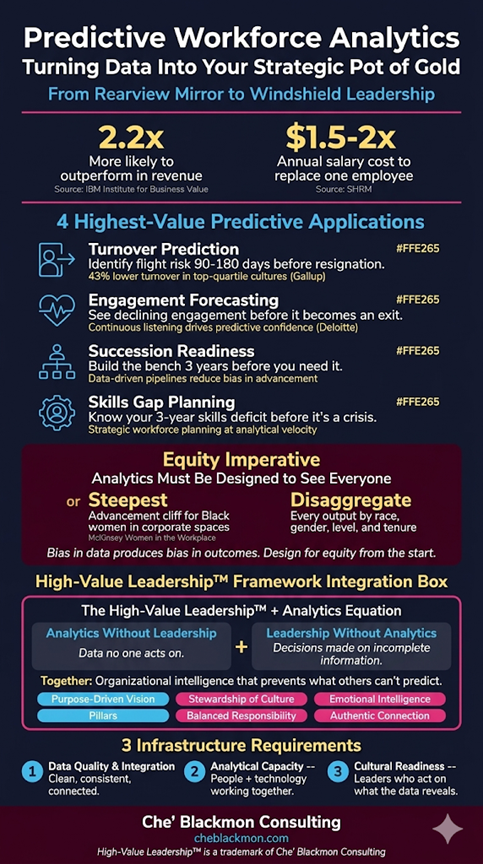
According to a 2023 IBM Institute for Business Value report, organizations that use predictive people analytics are 2.2 times more likely to outperform their peers in revenue growth and 1.5 times more likely to successfully retain high performers. These outcomes are not produced by the analytics alone. They are produced by the combination of good data and leaders who are committed to acting on what the data reveals. Analytics without cultural readiness to respond is just expensive reporting.

💡 Predictive analytics does not replace human judgment. It informs it with precision and timing that human intuition alone cannot match.

🔬 The Four Highest-Value Predictive Analytics Applications in Workforce Strategy

📌 1. Turnover Prediction

Voluntary turnover is the single most expensive and most preventable people problem in most organizations. The Society for Human Resource Management estimates the cost of replacing an employee ranges from one-half to two times their annual salary when recruitment, onboarding, and productivity loss are fully calculated. For organizations with chronic turnover, the cumulative annual cost is often in the millions, and the organizational energy required to perpetually backfill roles that should never have been vacated is a strategic tax on everything else the organization is trying to accomplish.

Predictive turnover models analyze dozens of variables simultaneously, including tenure, compensation relative to market, promotion recency, manager effectiveness scores, engagement survey responses, project assignment patterns, and even communication frequency in collaborative platforms. These variables, individually, are insufficient signals. In combination and over time, they produce a turnover risk score that can identify employees who are likely to leave 90 to 180 days before they submit a resignation letter. That window is everything. It is the difference between losing someone and retaining them.

There was a healthcare organization that implemented a turnover prediction model after experiencing a costly string of departures in a critical clinical department. The model identified a cluster of mid-level professionals who scored high on several simultaneous risk indicators, including stalled compensation growth, declining engagement scores, and a pattern of declining project participation. The organization intervened with targeted retention conversations, compensation adjustments, and development opportunities. The retention rate for that identified cohort exceeded 85 percent over the following year, and the cost avoidance from retained institutional knowledge was substantial.

📌 2. Engagement Forecasting

Engagement surveys measure the current state of employee sentiment at a single point in time. They are useful, but they are inherently delayed indicators. By the time disengagement shows up in an annual survey, it has typically been building for months, and the employees most affected may have already mentally resigned even if their physical departure has not yet followed. Predictive engagement modeling uses continuous data streams, including recognition frequency, performance review scores, absenteeism patterns, and internal mobility activity, to forecast engagement trajectories rather than simply measuring current states.

The practical application is transformative. Instead of discovering that a department’s engagement has dropped 12 points in the annual survey and then spending a quarter diagnosing the root cause, predictive engagement forecasting allows leaders to see the trajectory six months earlier, before it becomes a survey result, and intervene in ways that are proportionate to the early-stage signal rather than reactive to a full-blown engagement crisis.

Deloitte’s Global Human Capital Trends research has found that organizations using continuous listening strategies combined with predictive modeling report significantly higher confidence in their ability to prevent engagement decline before it becomes a retention event. The infrastructure required is not primarily technological. It is cultural. Organizations must build environments where employees are willing to provide authentic signal data, and that willingness is built through trust, not through surveillance.

📌 3. Succession Readiness and Leadership Pipeline Analytics

Succession planning in most organizations is an annual exercise. A list of names is generated for each critical role, assessed through a combination of performance reviews and manager nominations, and then filed until the next annual review cycle. This approach has two significant failures. First, it is static in a workforce that is dynamic. People develop, plateau, and sometimes exit between annual reviews in ways the succession plan does not capture. Second, it is deeply susceptible to the informal biases that determine whose name a manager thinks to put on a list.

Predictive succession analytics changes both of these dynamics. It creates a continuous, data-driven picture of pipeline depth by analyzing skill trajectories, learning and development engagement, performance trends over time, cross-functional experience, and leadership assessment data. It identifies not just who is ready for advancement but who is on a readiness trajectory, which is arguably more valuable because it gives the organization time to develop talent rather than simply select from a pool that already exists.

In High-Value Leadership: Transforming Organizations Through Purposeful Culture, the stewardship of culture is identified as a foundational leadership responsibility. Stewardship of a leadership pipeline requires the same intentional investment, and predictive analytics makes that stewardship precise in ways that informal succession conversations cannot. There was a manufacturing organization that used pipeline analytics to identify a significant gap in its next-generation leadership bench three years before the projected wave of senior retirements. That three-year runway allowed the organization to invest in accelerated development programs and internal mobility initiatives that would have been impossible to execute in a reactive timeframe.

📌 4. Skills Gap and Workforce Planning Analytics

The pace of technological change, industry disruption, and evolving market demands means that the skills your organization needs in three years are meaningfully different from the skills your workforce currently holds. Most organizations have no systematic visibility into this gap. They hire for current needs, develop for current capabilities, and then discover the skills deficit when it has already translated into a competitive disadvantage or a failed technology implementation.

Predictive skills gap analytics maps current workforce capabilities against projected future requirements and identifies the delta. It surfaces which roles are at highest risk of being underskilled for near-future needs, which employees are on development trajectories that position them well for emerging requirements, and where recruiting investment should be targeted to address gaps that internal development cannot close in time. This is workforce planning operating at strategic velocity rather than administrative pace.

✨ The Equity Imperative: Predictive Analytics and the Traditionally Overlooked

Predictive workforce analytics carries an enormous promise for equity and inclusion, and an equally significant risk of amplifying existing inequities if it is not designed and deployed with intentionality. This distinction matters profoundly, and it matters most for the professionals who have historically been most disadvantaged by the informal, relationship-driven, and often biased processes that analytics is designed to replace.

🚨 When Algorithms Inherit Bias

Data does not lie. But data can encode the decisions of systems that did. If an organization’s historical promotion data reflects years of bias against Black women and other underrepresented professionals, a predictive model trained on that data will encode those biases as predictive signals. The model will learn that the profile most likely to be promoted is the profile that has historically been promoted, regardless of whether that outcome reflects actual performance potential or simply pattern recognition of who was already advantaged.

This is not a theoretical risk. Amazon’s well-documented 2018 abandonment of an AI-based recruiting tool that systematically down-ranked resumes from women was a high-profile demonstration of exactly this dynamic. The model was trained on a decade of hiring decisions, and those decisions reflected the company’s historical pattern of male-dominated technical hiring. The algorithm learned to replicate that pattern as a success criterion.

The lesson is not that predictive analytics cannot serve equity. The lesson is that it will serve whatever the data encodes unless explicit corrective design choices are made. Bias audits of training data, diversity-adjusted weighting in model design, ongoing disparity monitoring in model outputs, and regular human review of algorithmic recommendations are all required elements of an equitable analytics infrastructure.

💡 The Case for Equity-Centered Analytics for Black Women

For Black women in corporate environments, the historic experience has been one of performing at a high level while advancement pathways remain narrow and informal sponsorship networks remain inaccessible. McKinsey and Company’s Women in the Workplace research has documented consistently that Black women face the most pronounced advancement gap of any demographic group, are the least likely to receive sponsorship, and are the most likely to have their contributions credited to others.

An analytics infrastructure designed with equity as a design principle changes this dynamic structurally. When advancement criteria are explicit and measurable rather than implicit and relational, the informal favoritism that has historically shaped who gets considered loses its power. When turnover risk models flag high-performing Black women as retention risks based on data rather than leaving the identification to managers who may have limited visibility into the drivers of their experience, organizations gain the ability to intervene before losing people they should have been actively developing.

In Rise and Thrive: A Black Woman’s Blueprint for Leadership Excellence, the argument is clear that structural change requires structural tools. Predictive analytics, when designed and deployed with equity as a non-negotiable design criterion, is one of the most powerful structural tools available for dismantling the informal systems that have kept Black women and other overlooked professionals from advancing at the rate their performance warrants.

📚  Rise & Thrive Connection: The data visibility that predictive analytics provides for organizations mirrors the strategic self-awareness that Rise and Thrive builds for individual professionals. Both are about seeing clearly, acting early, and refusing to be surprised by outcomes that were always preventable with the right information and the right systems.

There was a professional services organization that implemented an equity analytics layer on top of its existing workforce reporting. This layer disaggregated every key metric, including promotion rates, development program participation, stretch assignment allocation, and turnover risk scores, by race, gender, and career level simultaneously. The findings were not comfortable. Black women at the mid-manager level were significantly underrepresented in high-visibility project assignments, significantly underrepresented in the sponsorship program nominations, and significantly overrepresented in the high turnover risk cohort. None of these patterns had been visible in aggregate reporting. All of them were visible the moment the data was disaggregated. The organization redesigned its sponsorship nomination process, revised its project assignment criteria, and implemented structured check-in protocols for the identified high-risk cohort. Representation in senior leadership for Black women improved meaningfully over the following two years.

🏗️ Building the Infrastructure: What Predictive Analytics Requires

Predictive workforce analytics is not a software purchase. It is an organizational capability that requires infrastructure at three levels: data quality, analytical capacity, and cultural readiness to act on what the data reveals. All three are necessary. None is sufficient alone.

💻 Data Quality and Integration

Predictive models are only as good as the data they are trained on. Organizations with fragmented HRIS systems, inconsistent performance management practices, or gaps in data collection cannot produce reliable predictive outputs from poor inputs. Before investing in advanced analytics capability, organizations must honestly assess whether their data is clean, consistent, integrated, and comprehensive enough to support predictive modeling. This is often a multi-year infrastructure investment, but it is also the foundation on which every other analytics capability rests.

The specific data domains most critical for workforce prediction include performance management records over time, compensation history and market pos