🌱 Spring Training for Leaders: Preparing for Your Best Quarter Yet

By Che’ Blackmon, DBA Candidate | Founder & CEO, Che’ Blackmon Consulting

Every spring, professional athletes gather for one purpose: to sharpen skills, realign with team goals, rebuild chemistry, and eliminate the habits that held them back the season before. Spring training is not glamorous. It is deliberate, repetitive, and often uncomfortable. Yet it is the foundation of every championship run.

Leaders need spring training too.

As we move into a new quarter, organizations everywhere are assessing where they stand. Q2 presents a pivotal window. The early optimism of January has worn off. The energy of a new year has either taken root or faded. And for many companies, the gap between where they intended to be and where they actually are is becoming uncomfortably clear.

This is your moment to step into the training room.

In my work as a culture transformation consultant and through the frameworks I have developed in High-Value Leadership: Transforming Organizations Through Purposeful Culture, Mastering a High-Value Company Culture, and Rise & Thrive: A Black Woman’s Blueprint for Leadership Excellence, one truth has emerged with consistent clarity: organizations do not transform on their own. Leaders do. And the best leaders treat every quarter as an opportunity to re-examine, retool, and recommit.

This article is your playbook for doing exactly that.

⚾ Why Q2 Is Your Most Strategic Quarter

Most strategic plans are written in the fourth quarter and launched with fanfare in January. By Q2, the adrenaline has settled. Budgets have been tested. Teams have shown their real dynamics. And the data does not lie.

According to research from McKinsey & Company, fewer than one-third of organizational transformations succeed. The most common culprits are not poor strategy but poor execution, misaligned teams, and leaders who fail to sustain momentum. Q2 is the quarter where that momentum is either lost or locked in.

Think of it this way: in baseball, spring training is not the season but it absolutely determines the season. The teams that use preseason to drill fundamentals, repair weak spots, and build genuine cohesion are the ones raising trophies in October. Leaders who treat Q2 as a sprint rather than preparation for the championship run will almost always fall short.

This quarter matters. Prepare accordingly.

📊 The State of the Workforce: What the Data Is Telling Us

Before leaders can train effectively, they need an honest assessment of the playing field. The current workforce landscape demands attention to several converging trends.

🔍 Trend 1: Employee Engagement Remains a Critical Challenge

Gallup’s State of the Global Workplace report consistently shows that only about 23% of employees worldwide are engaged at work. This means that the overwhelming majority of people in any given organization are either quietly disengaged or actively working against organizational goals. That is not a human resources problem. It is a leadership problem.

High-value leaders, as I outline in High-Value Leadership: Transforming Organizations Through Purposeful Culture, do not simply manage tasks. They build cultures where people feel seen, valued, and connected to purpose. Engagement is not a benefit or a perk. It is the direct outcome of how leaders show up every single day.

🤖 Trend 2: AI Integration Is Accelerating, and People Are Scared

Artificial intelligence is no longer a future concern. It is reshaping workflows, eliminating redundancies, and creating entirely new roles in real time. The Society for Human Resource Management reports that more than 40% of workers are worried about AI affecting their jobs. Leaders who ignore that fear are creating a culture of anxiety rather than innovation.

Your spring training must include conversations about AI. Not to pacify employees but to involve them in the transition. The organizations that are thriving in this environment are the ones where leaders have demystified the technology and positioned their teams as partners in the process, not casualties of it.

💬 Trend 3: Psychological Safety Is the New Competitive Advantage

Harvard Business School professor Amy Edmondson has spent decades researching what separates high-performing teams from average ones. Her conclusion is consistent: psychological safety, the belief that one will not be punished for speaking up, is the single most important factor in team performance.

And yet most organizations have a long way to go. A 2023 survey by the Center for Creative Leadership found that nearly half of employees do not feel comfortable raising concerns to their managers. If your team cannot tell you the truth, you are leading with a blindfold on.

Spring training for leaders means creating the conditions where honest dialogue becomes the norm, not the exception.

🎯 The High-Value Leadership Framework: Your Training Playbook

Spring training without a framework is just exercise. Purposeful preparation requires a structure. The High-Value Leadership™ methodology I have developed centers on five core pillars. Each one is a station in your leadership training camp.

Pillar 1 🏆 Purpose-Driven Vision

Great leaders do not just communicate what needs to get done. They articulate why it matters. Simon Sinek’s foundational research shows that teams who understand the purpose behind their work consistently outperform those who do not. In Mastering a High-Value Company Culture, I describe culture as the lifeblood of any organization. Purpose is the heartbeat that keeps it alive.

There was a manufacturing company that was facing high turnover and low morale despite competitive pay. After working through a leadership assessment, it became clear that frontline employees had almost no visibility into how their work connected to the company’s mission. Once leadership made purpose visible through regular town halls, transparent communication, and meaningful recognition, the culture began to shift. Turnover dropped. Productivity climbed. And it started not with a new HR policy but with a leader willing to tell the real story of why the work mattered.

“Culture is the lifeblood of any organization. Purpose is the heartbeat that keeps it alive.” — Che’ Blackmon

Pillar 2 🧐 Emotional Intelligence in Action

Daniel Goleman’s research established that emotional intelligence accounts for nearly 90% of what distinguishes top performers from their peers with similar technical skills. Self-awareness, self-regulation, empathy, motivation, and social skill are not soft skills. They are power skills, and they are the difference between leaders who build loyalty and those who burn through talent.

Q2 is the perfect time to take your EQ temperature. Are you regulating your stress well? Are you genuinely listening before responding? Are you curious about your team’s experience or just reporting out results? These are not comfortable questions. They are necessary ones.

Pillar 3 🤝 Authentic Connection at Every Level

John Maxwell has long taught that leadership is influence, nothing more and nothing less. And influence is built on relationships. High-value leaders do not manage from a distance. They are present, intentional, and genuinely interested in the humans they lead.

This does not require hours of one-on-one time with every direct report. It requires consistency. A brief, genuine check-in. Remembering details. Following through on commitments. Being present in a meeting rather than half-present behind a screen. Small, repeated actions compound over time into trust.

Pillar 4 ⚖️ Balanced Accountability

High standards and psychological safety are not opposites. They coexist in high-performing cultures. The best leaders hold their teams to rigorous expectations while simultaneously creating an environment where mistakes are learning opportunities rather than career-ending events.

Netflix’s Patty McCord described this dynamic in her book Powerful: organizations that treat employees as capable adults and hold them accountable accordingly attract and retain top talent. The key is that accountability must be paired with clarity. People cannot meet a standard they do not fully understand.

Pillar 5 🌍 Culture as a Strategic Asset

Culture is not the result of a few perks and a nicely worded mission statement. It is built through thousands of daily decisions: who gets promoted, whose ideas get heard, how conflict is handled, what behaviors are rewarded, and what behaviors are quietly tolerated. In Mastering a High-Value Company Culture, I make the case that intentional culture is not a nice-to-have. It is a strategic imperative.

Your spring training must include a culture audit. Not a survey that gets filed away but a real reckoning with what your culture is producing right now and whether it is aligned with where you want to go.

💎 Centering the Traditionally Overlooked: The Business Case for Inclusion

No conversation about leadership development is complete without addressing who has historically been excluded from it. For too long, the image of a leader has been narrow, and the pipeline of leadership training, sponsorship, and opportunity has reflected that narrowness.

The data on Black women in corporate America is sobering. According to LeanIn.Org, Black women are significantly underrepresented at every level of corporate leadership, from manager to the C-suite. They are more likely to have their ideas dismissed, less likely to have sponsors who advocate for them, and more likely to face the compounded burden of both racial and gender bias in performance evaluations.

In Rise & Thrive: A Black Woman’s Blueprint for Leadership Excellence, I speak directly to the experience of navigating a workplace that was not designed with you in mind. What researchers describe as “double jeopardy” refers to the unique intersection of race and gender bias that Black women experience simultaneously. It is not theoretical. It is the daily reality of being the only one in the room, of having your competence questioned before it is demonstrated, and of carrying an invisible tax on your time and energy that your peers do not pay.

📊 The Numbers Do Not Lie Black women hold approximately 4% of C-suite positions, 1.6% of VP roles, and 1.4% of executive-level positions in Fortune 500 companies — despite making up 7.4% of the U.S. population. This is a leadership development gap, not a talent gap. Source: McKinsey & Company, LeanIn.Org

Spring training for leaders must be explicitly designed to close these gaps. Here is what that looks like in practice.

1. Examine Your Promotion Process with an Equity Lens 🔍

There was an organization where HR data revealed that women of color were advancing at a significantly slower rate than white peers with comparable performance ratings. The issue was not in the formal criteria. It was in the informal conversations that happened before promotion committees convened. The leaders who spoke up for candidates were speaking up for people they knew well, and they knew well the people who looked like them, socialized with them, and reminded them of themselves.

Audit your talent pipeline. Look at who is being developed, who is being sponsored, and who is being overlooked. Then ask why.

2. Create Sponsorship, Not Just Mentorship 🏆

Mentorship tells someone what to do. Sponsorship opens the door and says your name when you are not in the room. Research from the Center for Talent Innovation shows that Black women are twice as likely to have a mentor and half as likely to have a sponsor compared to white male peers. That gap is consequential. Sponsors accelerate careers in ways that mentors cannot.

If you are in a position of influence, use it. Use it deliberately and consistently for the people who have historically been passed over.

3. Normalize Feedback for Everyone 🗣️

One of the most insidious forms of workplace inequity is the withholding of honest feedback from employees of color. Research from Lean In and McKinsey shows that Black women are less likely to receive the kind of direct, actionable feedback that leads to growth. Often, well-intentioned managers soften feedback out of discomfort, leaving Black women without the information they need to advance.

Feedback is not punitive. It is a form of investment. Every employee deserves the honest, developmental feedback that leads to real growth.
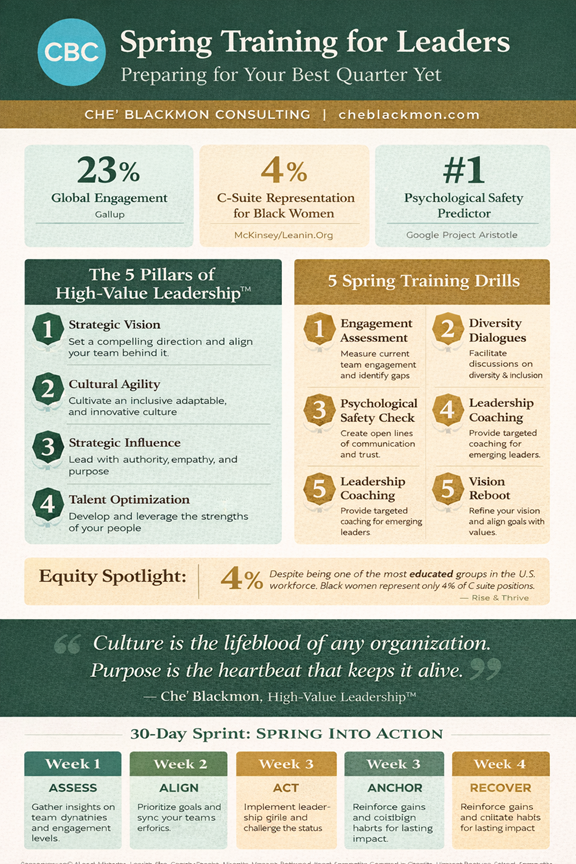
📋 Spring Training Drills: Actionable Takeaways for Leaders

The following are your core training drills for Q2. These are not aspirational ideals. They are concrete, executable actions that you can begin this week.

Drill 1: Conduct a Mid-Cycle Culture Audit 🤔

Do not wait for your annual engagement survey. Conduct a quick, focused listening session with your team. Ask three simple questions:

  1. What is working well right now that we should protect?
  2. What is holding us back that we should address?
  3. What do you need from me as your leader that you are not currently getting?

Then listen. Do not defend. Do not explain. Just listen. What you hear will be more valuable than any survey data.

Drill 2: Realign on Goals Together 🎯

Pull out your Q1 commitments and review them openly with your team. Celebrate what was accomplished. Acknowledge what missed the mark without assigning blame. Then collaboratively adjust the Q2 plan based on what the data and the team’s experience are telling you.

Shared ownership of the plan produces shared accountability for the outcome. Leaders who hand down targets from above without consultation are operating a command-and-control model that today’s workforce will not sustain.

Drill 3: Invest in One Person’s Development This Quarter 🌱

Identify one emerging leader on your team, particularly someone who is often overlooked, and make a deliberate investment in their development. Connect them to a stretch assignment. Introduce them to your network. Advocate for them in a meeting where they are not present.

One intentional act of sponsorship per quarter adds up over time. It builds loyalty. It builds bench strength. And it builds the kind of inclusive culture that attracts top talent.

Drill 4: Block Time for Your Own Growth 📚

Leaders who are not growing are slowly falling behind. This quarter, commit to a learning goal. Read one book that challenges your current thinking. Attend a leadership workshop. Engage a coach or consultant who will tell you the truth about your blind spots.

Continuous growth is not optional for high-value leaders. It is foundational.

Drill 5: Build in Reflection Time 🧘

The best athletes do not train without reviewing game film. The best leaders do not lead without reflection. Carve out fifteen to thirty minutes weekly, not monthly, to assess your leadership. What went well? What would you do differently? Where did you operate from your values and where did you compromise them?

Reflection without action is daydreaming. Action without reflection is chaos. The combination is mastery.

💡 Expert Insights: What the Research Is Telling Leaders Right Now

The convergence of research from organizational psychology, leadership science, and workforce analytics is pointing in a clear direction. Leaders who will thrive in the next decade share a common set of characteristics that look very different from the command-and-control models of the past.

Brené Brown’s research on vulnerability in leadership reveals that the most trusted leaders are not the ones who project infallibility. They are the ones who are willing to say, “I do not have all the answers, and I need your help.” That kind of courage is not weakness. It is the foundation of genuine team trust.

Research from Google’s Project Aristotle, which studied hundreds of internal teams over several years, found that psychological safety was the number one predictor of team effectiveness. Not individual brilliance. Not technical expertise. Psychological safety. The willingness to take interpersonal risks, to ask questions, to admit mistakes, and to offer new ideas without fear of ridicule or punishment.

And Gallup’s decades of research on the manager-employee relationship confirm what any honest employee will tell you: people do not leave companies. They leave managers. The investment organizations make in manager development is the highest-return investment they can make.

“People don’t leave companies. They leave managers. Investing in leader development is the highest-return investment an organization can make.”

🏆 A Case Study in Culture Transformation

There was a regional healthcare organization grappling with high nurse turnover, declining patient satisfaction scores, and a middle management team that was burned out and disengaged. The executive team had tried every structural fix: new scheduling software, updated benefits packages, revised onboarding protocols. Nothing moved the needle.

What was missing was not a better system. It was better leadership.

When the organization committed to a comprehensive leadership development initiative rooted in the High-Value Leadership™ framework, the results were notable. Middle managers were trained in emotional intelligence and feedback delivery. Town halls became two-way conversations rather than executive monologues. A formal sponsorship program was created to develop underrepresented employees, including Black women who had been in the organization for years without a clear path forward.

Within twelve months, voluntary turnover in the nursing staff declined meaningfully. Employee engagement scores improved. And several of the employees in the sponsorship program had been promoted into roles that expanded their scope of influence.

The culture did not change because the environment changed. It changed because the leaders changed.

📝 The Rise and Thrive Principle: Leading While Fully Yourself

For Black women in leadership, spring training carries an additional dimension. It includes the intentional work of deciding, again and again, to show up fully as yourself in spaces that have not always welcomed your wholeness.

In Rise & Thrive: A Black Woman’s Blueprint for Leadership Excellence, I write about the tax that code-switching, over-explaining, and shrinking to fit an uninclusive culture places on Black women professionals. That tax is real. It drains energy, creativity, and resilience. And it costs organizations the full benefit of the talent they claim to have hired.

Spring training for Black women leaders means something specific. It means reassessing which rooms deserve your energy and which do not. It means building a personal board of advisors who reflect where you want to go, not just where you have been. It means protecting your peace as a professional strategy, not a luxury.

And for organizations, it means creating the conditions that make it possible for Black women to lead without the constant overhead of proving their right to be there. That starts at the top. It starts with leaders who are willing to examine their own biases and do the work of creating genuinely inclusive cultures, not just diverse headcounts.

🤔 Discussion Questions for Leaders

Use these questions individually or with your leadership team as part of your Q2 spring training conversations:

  • When did you last have a genuinely honest conversation with your team about what is and is not working? What made that conversation possible, or what has made it difficult?
  • Who on your team is thriving, and who is struggling? What do you actually know about why, and what have you done in response?
  • If you audited your organization’s promotion and development decisions over the last two years, would the outcomes reflect your stated commitment to equity? What would the data show?
  • What is one leadership habit you know is holding your team back? What would it take for you to change it this quarter?
  • Who are you actively sponsoring right now? If the answer is no one, who could you start sponsoring this week?
  • What does your team’s culture actually reward, meaning what behaviors get recognized, celebrated, or repeated? Is that aligned with your stated values?

📋 Next Steps for Your Q2 Preparation

Spring training does not happen on its own. Here is a structured thirty-day plan to launch your best quarter yet.

  1. Week 1 – Assess: Conduct a listening session with your team. Review Q1 results honestly. Identify one cultural gap and one leadership habit you want to address.
  2. Week 2 – Align: Reconnect the team around purpose. Revisit goals and co-create the Q2 plan. Identify the emerging leader you will sponsor this quarter.
  3. Week 3 – Act: Launch your development investment. Begin your weekly reflection practice. Have one feedback conversation you have been putting off.
  4. Week 4 – Anchor: Build the structures that will sustain the momentum. Schedule regular check-ins. Create accountability mechanisms that the team owns, not just you.

Then do it again next quarter. High-value leadership is not a one-time effort. It is a sustained practice.

🌱 Ready to Build Your High-Value Culture?

Che’ Blackmon Consulting partners with organizations ready to move from intentions to transformation. Whether you are a mid-market company navigating growth, a leadership team in need of a culture reset, or a Black woman leader ready to rise without shrinking, we have a solution designed for you.

Our signature High-Value Leadership™ consulting services and the High-Value Leadership Intensive course are built from over 24 years of real-world experience transforming culture across manufacturing, healthcare, automotive, and professional services sectors.

Your best quarter starts with one conversation.

📧 admin@cheblackmon.com     📞 888.369.7243     🌐 cheblackmon.com

About the Author

Che’ Blackmon is the Founder and CEO of Che’ Blackmon Consulting (CBC), a Michigan-based culture transformation consultancy. She is a DBA candidate in Organizational Leadership at National University, where her dissertation research focuses on AI-enhanced predictive analytics for culture transformation and employee turnover prevention. With more than 24 years of progressive HR leadership experience across manufacturing, automotive, healthcare, and professional services, Che’ is the author of three published works: High-Value Leadership: Transforming Organizations Through Purposeful Culture, Mastering a High-Value Company Culture, and Rise & Thrive: A Black Woman’s Blueprint for Leadership Excellence. She hosts the podcast Unlock, Empower, Transform with Che’ Blackmon and the Rise & Thrive YouTube series. Learn more at cheblackmon.com.

#LeadershipDevelopment, #HighValueLeadership, #CultureTransformation, #SpringTraining, #Q2Goals, #EmployeeEngagement, #BlackWomenLead, #InclusiveLeadership, #HRLeadership, #WorkplaceCulture, #PurposeDrivenLeadership, #OrganizationalDevelopment, #FractionalHR, #CheBlackmon, #UnlockEmpowerTransform

The Self-Care Strategy: It’s Not Selfish, It’s Strategic 🌟

By Che’ Blackmon, DBA Candidate | Founder & CEO, Che’ Blackmon Consulting

Introduction: Redefining Self-Care for High Performers 💪

Let’s address the elephant in the room. When you hear “self-care,” what comes to mind? Bubble baths? Spa days? Perhaps a guilty feeling that you should be doing something more productive? For too long, self-care has been marketed as indulgence, something we squeeze in between meetings when we have a spare moment. This framing is not only incomplete. It is dangerously wrong.

The truth is that self-care is not a luxury. It is infrastructure. Just as a building requires a solid foundation to stand, leaders require sustainable practices to perform at their highest level. Without intentional self-care, burnout is not a possibility. It is an inevitability.

In my book High-Value Leadership: Transforming Organizations Through Purposeful Culture, I explore how the most effective leaders understand that their capacity to serve others depends on their commitment to sustaining themselves. This is not selfish thinking. This is strategic thinking. And for those of us who have been conditioned to put everyone else first, it might just be the most revolutionary act of leadership we ever embrace.

The Business Case for Self-Care 📊

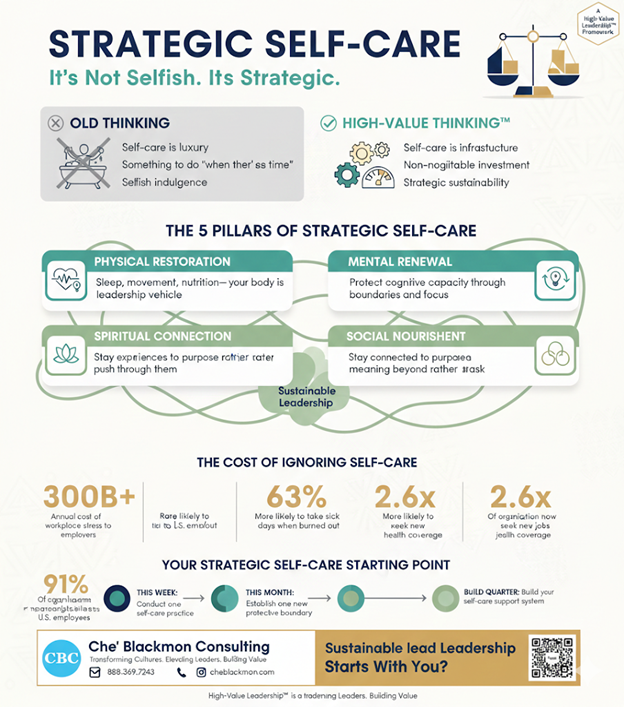
If you need permission to prioritize your wellbeing, let the data provide it. The World Health Organization has classified burnout as an occupational phenomenon, and research consistently demonstrates its devastating impact on both individuals and organizations. According to Gallup’s 2024 workplace research, burned out employees are 63% more likely to take a sick day, 2.6 times more likely to actively seek a new job, and 23% more likely to visit the emergency room.

The cost to organizations is staggering. The American Institute of Stress estimates that workplace stress costs U.S. employers over $300 billion annually in absenteeism, turnover, diminished productivity, and medical costs. But here is what those numbers do not capture: the loss of innovation, creativity, and human potential that occurs when talented professionals are running on empty.

There was a healthcare organization that noticed a troubling pattern among their leadership team. High performers were leaving at alarming rates, citing exhaustion and lack of work-life balance. Exit interviews revealed a culture where leaders felt they could not take time for themselves without appearing uncommitted. The organization implemented a comprehensive wellness initiative that included protected personal time, mental health resources, and leadership modeling of healthy boundaries. Within 18 months, leadership turnover decreased by 41% and employee engagement scores increased by 27%.

The lesson is clear. When leaders take care of themselves, organizations thrive. When they do not, everyone suffers.

The Unique Burden: Self-Care for Black Women in Leadership ✊🏾

Any honest conversation about self-care must acknowledge that the need for it, and the barriers to practicing it, are not distributed equally. For Black women in corporate spaces, the conversation around self-care carries additional weight and complexity.

The “Strong Black Woman” Trap

In my e-book Rise & Thrive: A Black Woman’s Blueprint for Leadership Excellence, I address the cultural conditioning that makes self-care particularly challenging for Black women. The “Strong Black Woman” archetype, while born from genuine resilience and survival, has evolved into an expectation that we must be superhuman, never tired, never struggling, always capable of taking on more.

Research from the National Institutes of Health confirms what many Black women already know: the pressure to appear strong and invulnerable contributes to higher rates of stress-related health conditions, including hypertension, cardiovascular disease, and depression. A 2023 study in the Journal of Black Psychology found that Black women who endorsed the Strong Black Woman schema reported significantly higher levels of emotional suppression and lower levels of self-care engagement.

The Double Shift of Emotional Labor

Black women in corporate environments often perform a “double shift” of emotional labor. The first shift involves the standard demands of leadership: making decisions, managing teams, navigating organizational politics. The second shift involves managing the perceptions and comfort of others, code-switching, responding to microaggressions, serving as the unofficial diversity educator, and constantly proving competence in spaces that may question it by default.

This additional labor is exhausting and largely invisible. It is not captured in job descriptions or performance reviews, yet it consumes significant energy and bandwidth. McKinsey’s Women in the Workplace 2023 report found that Black women are more likely than any other group to report feeling “on guard” at work and less likely to feel they can bring their whole selves to their professional environment.

Reclaiming Rest as Resistance

For Black women, self-care is not just personal wellness. It is an act of resistance against systems that have historically demanded our labor without regard for our wellbeing. Tricia Hersey, founder of The Nap Ministry, frames rest as a form of reparations and resistance. While this may sound provocative, the underlying message is profound: choosing to care for ourselves in a world that often devalues us is a radical and necessary act.

This does not mean that self-care should fall solely on individual shoulders. Organizations have a responsibility to create environments where all employees, particularly those who carry additional burdens, can thrive without sacrificing their health. But while we work toward systemic change, individual self-care practices remain essential for survival and success.

The Strategic Self-Care Framework 🛠️

Moving from concept to practice requires a framework. Strategic self-care is intentional, proactive, and aligned with your values and goals. It is not reactive pampering when you are already depleted. It is consistent investment in your capacity to lead, create, and serve.

Pillar 1: Physical Restoration 🏃‍♀️

Your body is the vehicle through which you do everything else. Physical self-care includes adequate sleep (the research is clear that seven to nine hours is non-negotiable for cognitive function), regular movement, proper nutrition, and preventive healthcare. For leaders, this also means paying attention to ergonomics, taking breaks during the workday, and not treating your body as an afterthought to your ambitions.

Practical application: Block “non-negotiable” time in your calendar for physical activity, just as you would block time for an important meeting. Treat medical appointments as mandatory, not optional. Create environmental cues that support healthy choices, such as keeping water at your desk and healthy snacks accessible.

Pillar 2: Emotional Processing 💭

Leadership is emotionally demanding. You absorb the stress of your team, navigate conflict, make difficult decisions, and often cannot fully express your own struggles to those you lead. Emotional self-care involves creating space to process these experiences rather than simply pushing through them.

This might include journaling, therapy or coaching, conversations with trusted peers, or simply allowing yourself to feel rather than immediately problem-solve. For Black women and other traditionally overlooked professionals, finding spaces where you can be fully yourself without code-switching or managing others’ perceptions is particularly important.

Practical application: Identify your “processing practices,” the specific activities that help you metabolize emotional experiences. Schedule regular check-ins with a therapist, coach, or trusted confidant. Build relationships with peers who share similar experiences and can provide genuine understanding.

Pillar 3: Mental Renewal 🧠

Cognitive fatigue is real. Decision fatigue is real. The constant demands on your attention in the modern workplace deplete mental resources that must be replenished. Mental self-care involves protecting your cognitive capacity through boundaries, focus time, and activities that restore rather than deplete mental energy.

Practical application: Implement “focus blocks” where you work without interruption on cognitively demanding tasks. Practice single-tasking rather than multitasking. Create technology boundaries, such as no email after certain hours or device-free weekends. Engage in activities that provide mental rest, whether that is reading for pleasure, creative hobbies, or time in nature.

Pillar 4: Spiritual Connection 🙏

Spiritual self-care does not necessarily mean religion, though for many it does. It refers to practices that connect you to something larger than yourself and provide meaning and purpose. This might include meditation, prayer, time in nature, creative expression, or community involvement.

In Mastering a High-Value Company Culture, I discuss how purpose-driven cultures outperform those focused solely on metrics. The same principle applies to individuals. Leaders who maintain connection to their deeper “why” are more resilient, more motivated, and more effective than those operating on willpower alone.

Practical application: Clarify your personal purpose and values. Build regular practices that connect you to this purpose. Surround yourself with community that shares and reinforces your values. Make time for activities that fill your soul, not just your schedule.

Pillar 5: Social Nourishment 🤝

Humans are social beings, and meaningful connection is essential for wellbeing. Yet leadership can be isolating. The higher you rise, the fewer peers you have, and the more carefully you must manage relationships with those who report to you. Social self-care involves intentionally cultivating relationships that nourish rather than drain you.

Practical application: Audit your relationships. Identify those that energize you and those that deplete you. Invest more in the former and set boundaries with the latter. Seek out communities of like-minded leaders who understand your challenges. Prioritize quality time with loved ones who know you beyond your professional role.

Current Trends: How Leading Organizations Support Self-Care 📈

The most forward-thinking organizations recognize that employee wellbeing is not separate from business success. It is foundational to it. Here are some current best practices being implemented by industry leaders.

Mental Health as a Core Benefit

According to the Society for Human Resource Management, 91% of organizations now offer some form of mental health coverage, up from 76% five years ago. Leading companies are going beyond basic EAP programs to provide comprehensive mental health support, including therapy coverage, meditation apps, mental health days, and manager training on supporting employee wellbeing.

Flexible Work as Wellness

The shift to hybrid and remote work has opened new possibilities for work-life integration. Organizations are recognizing that flexibility itself is a form of self-care support, allowing employees to manage their energy, attend to personal responsibilities, and work during their most productive hours. The key is implementing flexibility equitably so that all employees, including those in traditionally overlooked groups, feel empowered to use it.

Leadership Modeling

Perhaps the most powerful trend is senior leaders openly modeling self-care practices. When executives take vacation, set boundaries on after-hours communication, and speak openly about their own wellbeing practices, it creates permission for everyone else to do the same. There was a technology company whose CEO began ending team meetings by sharing his own self-care practice for the week. This simple act normalized the conversation and resulted in measurable increases in employee use of wellness benefits.

Case Study: Transformation Through Strategic Self-Care 📖

There was a manufacturing company in the Midwest facing a crisis of leadership burnout. Three senior leaders had resigned within six months, all citing exhaustion and unsustainable workloads. The remaining leadership team was stretched thin, and the culture had become one of constant firefighting rather than strategic growth.

Rather than simply hiring replacements and continuing the same pattern, the company took a different approach. They conducted a thorough assessment of workloads, decision-making processes, and cultural expectations. What they found was a system that inadvertently punished self-care: leaders who took time off returned to overwhelming backlogs, those who set boundaries were perceived as less committed, and there were no structural supports for sustainable work practices.

The company implemented comprehensive changes. They redistributed responsibilities to eliminate single points of failure. They established coverage systems so that leaders could truly disconnect during time off. They trained all managers on recognizing and preventing burnout. They created accountability for sustainable work practices, including incorporating wellbeing metrics into performance evaluations.

The results were transformative. Within two years, leadership turnover dropped by 58%, employee engagement scores rose by 34%, and the company saw a 23% improvement in productivity metrics. Most importantly, leaders reported feeling capable of performing at their best because they finally had the support to sustain themselves.

Overcoming Internal Resistance to Self-Care 🚧

Understanding the importance of self-care is one thing. Actually practicing it is another. Most high-achieving professionals have internalized beliefs that make self-care feel uncomfortable or even wrong. Recognizing these internal barriers is the first step to overcoming them.

“I Don’t Have Time”

This is the most common objection, and it is usually a prioritization issue rather than a time issue. We make time for what we value. If self-care consistently falls off your schedule, it is worth examining whether you truly believe in its importance or whether you are still treating it as optional. Consider this: you will make time for self-care now, or you will make time for illness later. The choice is yours.

“Others Need Me”

Yes, others need you. But they need the best version of you, not a depleted, resentful, burned-out version. As flight attendants remind us, you must secure your own oxygen mask before assisting others. Your capacity to help anyone depends on your capacity to sustain yourself. Taking care of yourself is not abandoning others. It is ensuring you can show up for them fully.

“It Feels Selfish”

Self-care is not selfish. It is strategic stewardship of your most valuable resource: yourself. Would you call it selfish for a surgeon to rest before a complex operation? Would you call it selfish for an athlete to recover between competitions? Your leadership requires the same respect for human limits and the same commitment to sustainable performance.

“I’ll Rest When I Reach My Goal”

This is a dangerous myth. There will always be another goal, another milestone, another demand. If you condition yourself to postpone self-care until some future achievement, you will never practice it. Sustainable success requires sustainable practices now, not someday.

Actionable Takeaways: Your Self-Care Strategy ✅

Strategic self-care requires planning and commitment. Here are concrete steps you can implement immediately.

Today: Identify one self-care practice you have been neglecting and schedule it in your calendar for this week. Treat it as non-negotiable.

This week: Conduct a personal energy audit. Track when you feel energized versus depleted throughout your days. Look for patterns and identify changes you can make.

This month: Establish one new boundary that protects your wellbeing. This might be no email after 7 PM, a weekly lunch break away from your desk, or saying no to one commitment that does not align with your priorities.

This quarter: Build a self-care support system. Identify a therapist, coach, or accountability partner who can help you maintain your practices. Find a community of peers who understand your challenges.

Ongoing: Review and adjust your self-care practices regularly. As your life and responsibilities evolve, your self-care needs will evolve too. Build reflection into your routine.

Discussion Questions for Reflection 💬

Use these questions to deepen your thinking about self-care and its role in your leadership.

1. What messages about self-care did you receive growing up? How do those messages influence your current practices?

2. When you are at your best as a leader, what self-care practices are usually in place? What is typically missing when you are struggling?

3. What internal beliefs or external pressures make self-care difficult for you? What would it take to challenge those barriers?

4. How does your organization’s culture support or undermine employee wellbeing? What changes would make the biggest difference?

5. If you fully embraced self-care as strategic rather than selfish, what would change about how you lead?

Next Steps: Committing to Your Wellbeing 🌱

Reading about self-care is not the same as practicing it. The ideas in this article will only create change if you take action. Start small, but start today. Choose one practice, one boundary, one commitment to yourself, and honor it. Build from there.

Remember that self-care is not a destination. It is a practice. Some weeks will be better than others. The goal is not perfection but consistency over time. When you fall off track, simply begin again without judgment. Every moment is a new opportunity to choose yourself.

For leaders and organizations committed to building cultures where self-care is valued and supported, professional guidance can accelerate progress and ensure sustainability. Culture change is complex work, and having an experienced partner can make the difference between good intentions and lasting transformation.

Ready to Build a Culture That Values Wellbeing? 🤝

Che’ Blackmon Consulting partners with organizations to create high-value cultures where leaders and teams can thrive sustainably. With over 24 years of progressive HR leadership experience and ongoing doctoral research focused on culture transformation, we bring both practical expertise and evidence-based insights to every engagement.

Let’s explore how we can support your journey to strategic self-care and sustainable leadership.

📧 Email: admin@cheblackmon.com

📞 Phone: 888.369.7243

🌐 Website: cheblackmon.com

About the Author 👩🏾‍💼

Che’ Blackmon is the Founder and CEO of Che’ Blackmon Consulting, a Michigan based fractional HR and culture transformation consultancy. With over 24 years of progressive HR leadership experience across manufacturing, automotive, healthcare, and professional services sectors, Che’ brings deep expertise in building high-value organizational cultures where both people and performance thrive.

She is currently pursuing a Doctor of Business Administration (DBA) in Organizational Leadership, with dissertation research focused on AI-enhanced predictive analytics for culture transformation and employee turnover prevention.

Che’ is the author of three books on leadership and organizational culture: High-Value Leadership: Transforming Organizations Through Purposeful Culture, Mastering a High-Value Company Culture, and Rise & Thrive: A Black Woman’s Blueprint for Leadership Excellence. She hosts the twice-weekly podcast “Unlock, Empower, Transform with Che’ Blackmon” and creates content through her “Rise & Thrive” YouTube series.

© 2025 Che’ Blackmon Consulting. All rights reserved.

#SelfCareStrategy #StrategicSelfCare #LeadershipWellness #BurnoutPrevention #HighValueLeadership #SustainableSuccess #BlackWomenInLeadership #ExecutiveWellbeing #WorkLifeIntegration #BoundariesAreLeadership #RestIsProductive #MentalHealthAtWork #LeadershipDevelopment #ThriveNotSurvive #WellnessAtWork

Building Resilient Teams: Beyond Bounce-Back to Bounce-Forward 🚀

By Che’ Blackmon, DBA Candidate | Che’ Blackmon Consulting

Introduction: Rethinking What Resilience Really Means 💡

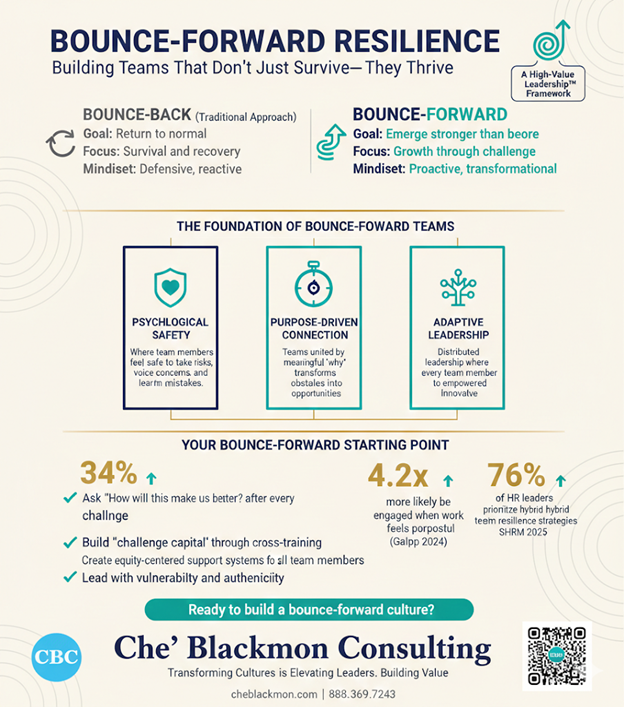
When we talk about resilient teams, most leaders think about bouncing back from adversity. They imagine employees who can weather the storm, recover from setbacks, and return to baseline performance. While this perspective has value, it fundamentally limits what your team can achieve. True resilience is not about returning to where you were before. It is about using challenges as springboards to reach new heights.

In my book Mastering a High-Value Company Culture, I explore how organizations can build cultures that do not merely survive disruption but thrive because of it. This concept of “bouncing forward” transforms adversity from a threat into an opportunity for growth, innovation, and sustainable competitive advantage.

The difference between bounce-back and bounce-forward organizations is profound. Bounce-back teams aim to restore normalcy. Bounce-forward teams aim to emerge stronger, wiser, and more connected than before. Which type of team are you building?

Understanding the Shift: From Reactive to Proactive Resilience 🔄

Traditional resilience models focus on reaction. Something bad happens and the team responds. This approach, while necessary, keeps organizations perpetually in defense mode. They wait for crises, address them as they come, and hope for the best. This cycle is exhausting and unsustainable.

Research from the Harvard Business Review (2023) reveals that organizations practicing proactive resilience strategies outperform their reactive counterparts by 34% in employee engagement metrics and 28% in overall productivity. These findings underscore a critical truth: resilience is not just about surviving tough times. It is about building the capacity to anticipate, adapt, and advance.

As I discuss in High-Value Leadership: Transforming Organizations Through Purposeful Culture, purposeful leadership requires a shift in mindset. Leaders must move from asking “How do we recover?” to asking “How do we grow through this?” This single question reframes every challenge as a development opportunity.

The Foundation of Bounce-Forward Teams 🏗️

1. Psychological Safety as the Cornerstone

Amy Edmondson’s groundbreaking research on psychological safety has transformed how we understand high-performing teams. Teams where members feel safe to take risks, voice concerns, and admit mistakes consistently outperform those operating in fear-based environments. But psychological safety does not happen by accident. It requires intentional cultivation.

Consider a manufacturing company that experienced a significant quality control failure. In many organizations, the response would be to assign blame, implement punitive measures, and move on. Instead, this company chose a different path. Leadership gathered the team, acknowledged the failure openly, and asked a powerful question: “What can this teach us?” The result was not just a fix for the immediate problem but a complete overhaul of their quality assurance processes that reduced defects by 47% over the following year.

2. Purpose-Driven Connection

Teams that understand their “why” possess an internal compass that guides them through uncertainty. Purpose creates resilience because it provides meaning beyond the immediate task. When team members connect their daily work to a larger mission, setbacks become temporary obstacles rather than insurmountable barriers.

Gallup’s 2024 State of the Global Workplace report found that employees who strongly agree their organization’s purpose makes their job feel important are 4.2 times more likely to be engaged at work. Engagement, in turn, serves as a buffer against burnout and a catalyst for innovative problem-solving during difficult times.

3. Adaptive Leadership at Every Level

Bounce-forward resilience cannot be mandated from the top alone. It requires distributed leadership where every team member feels empowered to adapt, innovate, and lead within their sphere of influence. This democratization of leadership accelerates organizational response times and leverages the collective intelligence of the entire workforce.

The Unique Resilience Journey: Impact on Traditionally Overlooked Professionals ✊🏾

Any honest conversation about building resilient teams must address a fundamental truth: not all team members start from the same place. Traditionally overlooked professionals, particularly Black women in corporate spaces, often navigate additional layers of challenge that their counterparts do not face. Understanding this reality is not about creating division. It is about creating genuine equity in how we support our teams.

The Double Bind of Resilience Expectations

In my e-book Rise & Thrive: A Black Woman’s Blueprint for Leadership Excellence, I explore the complex dynamics Black women face in professional environments. Research from LeanIn.Org and McKinsey’s Women in the Workplace 2023 report confirms what many Black women already know: they are more likely to have their competence questioned, experience microaggressions, and feel they cannot bring their full selves to work.

This creates a double bind when it comes to resilience. Black women are often expected to be inherently strong and resilient (the “Strong Black Woman” trope) while simultaneously receiving less organizational support to build and maintain that resilience. They are asked to bounce back from challenges that their colleagues may never encounter, all while maintaining the same performance standards.

Moving from Survival to Thriving

True bounce-forward organizations recognize these disparities and take concrete action. They do not ask traditionally overlooked employees to simply “be resilient” in the face of systemic challenges. Instead, they address the systems themselves. This includes examining hiring practices, promotion pathways, mentorship opportunities, and everyday workplace interactions for bias and exclusion.

There was a professional services firm that noticed a troubling pattern: their Black female employees were leaving at higher rates than any other demographic group, despite strong performance reviews. Rather than attributing this to individual choices, leadership conducted listening sessions and anonymous surveys. What they discovered was a culture where Black women felt unseen, unsupported, and unable to advance. The company implemented targeted mentorship programs, revised their promotion criteria for objectivity, and created affinity groups. Within 18 months, retention among Black female employees improved by 62%, and overall employee engagement scores rose across the organization.

Creating Inclusive Resilience Frameworks

Building resilient teams requires recognizing that resilience itself must be inclusive. This means creating environments where all employees, regardless of their background, have equal access to the resources, relationships, and opportunities that foster growth. It means ensuring that when we discuss “bouncing forward,” we are not inadvertently placing additional burdens on those who already carry more.

Practical Strategies for Building Bounce-Forward Teams 🛠️

Strategy 1: Implement “After Action Learning” Sessions

Replace traditional post-mortems with forward-focused learning sessions. After any significant project, challenge, or change, gather your team to answer three questions: What happened? What did we learn? How will this make us better? The emphasis on the third question shifts the conversation from analysis to action.

Strategy 2: Build “Challenge Capital”

Just as organizations build financial reserves, bounce-forward teams intentionally build challenge capital. This includes cross-training team members so knowledge is distributed, maintaining documentation of processes and lessons learned, and cultivating relationships with external partners who can provide support during difficult times.

Strategy 3: Practice Micro-Resilience Daily

Resilience is not built only in major crises. It is developed through daily practices that strengthen the team’s adaptive capacity. Encourage team members to step outside their comfort zones regularly, celebrate small wins, and practice reframing negative situations. These micro-moments of resilience compound over time into substantial organizational capability.

Strategy 4: Create Equity-Centered Support Systems

Recognize that different team members may need different types of support to thrive. This is not about giving some employees advantages over others. It is about ensuring everyone has what they need to contribute their best. For traditionally overlooked professionals, this might include mentorship from leaders who understand their unique challenges, advocacy in rooms where decisions are made, and genuine opportunities for advancement.

Strategy 5: Lead with Vulnerability and Authenticity

Leaders set the tone for how teams handle adversity. When leaders model vulnerability by admitting their own challenges and sharing how they have grown through difficulties, they give permission for the entire team to do the same. This authenticity builds trust and creates space for honest conversations about what is and is not working.

Current Trends and Best Practices in Team Resilience 📊

The landscape of organizational resilience continues to evolve, shaped by technological advances, changing workforce expectations, and lessons learned from recent global disruptions. Several trends are particularly relevant for leaders committed to building bounce-forward teams.

AI-Enhanced Predictive Analytics

Forward-thinking organizations are using artificial intelligence to predict potential challenges before they become crises. This includes analyzing engagement data to identify early signs of burnout, tracking communication patterns to detect emerging team conflicts, and monitoring industry trends to anticipate market shifts. This proactive approach allows teams to address issues while they are still manageable.

Hybrid Work and Distributed Resilience

The shift to hybrid and remote work has fundamentally changed how teams build and maintain resilience. Organizations are discovering that resilience in distributed environments requires intentional effort to maintain connection, clear communication protocols, and new approaches to recognizing and supporting team members who may be struggling. The Society for Human Resource Management (SHRM) reports that 76% of HR professionals believe developing resilience strategies for hybrid teams is a top priority for 2025.

Mental Health Integration

The conversation around workplace mental health has shifted from stigmatized whispers to strategic priority. Best-in-class organizations are integrating mental health support into their resilience frameworks, recognizing that individual wellbeing and team performance are inseparable. This includes providing access to mental health resources, training managers to recognize signs of distress, and creating cultures where seeking help is viewed as strength rather than weakness.

Case Study: A Manufacturing Company’s Transformation 📈

There was a mid-sized manufacturing company in the Midwest that faced a perfect storm of challenges: supply chain disruptions, labor shortages, and increased competition from overseas. Traditional approaches would have focused on cost-cutting and survival. Instead, leadership chose to view this moment as an opportunity for transformation.

The company implemented a comprehensive bounce-forward strategy. First, they invested in cross-training programs so every team member could fill multiple roles. This not only addressed the labor shortage but also gave employees new skills and career pathways. Second, they created innovation teams charged with finding creative solutions to supply chain challenges. These teams were explicitly empowered to fail fast and learn faster. Third, they revised their leadership development program to emphasize adaptive leadership and inclusive practices.

Within two years, this company had not just survived the crisis but had emerged as a market leader. Employee engagement scores rose by 41%, voluntary turnover dropped by 33%, and productivity increased by 27%. Most importantly, the company had built a culture capable of facing future challenges with confidence rather than fear.

Measuring Team Resilience: Beyond Traditional Metrics 📐

What gets measured gets managed. To build bounce-forward teams, leaders need metrics that capture adaptive capacity, not just static performance. Consider tracking recovery time (how quickly your team returns to full productivity after a disruption), innovation rate (how many new ideas emerge during and after challenges), learning velocity (how quickly lessons are identified and implemented), and equity indicators (ensuring all team members are growing through challenges equally).

Regular pulse surveys can capture team sentiment and identify emerging issues before they become critical. Exit interviews and stay interviews provide qualitative data on what is working and what needs improvement. The key is to use these metrics not as report cards but as learning tools that inform continuous improvement.

Actionable Takeaways: Your Bounce-Forward Action Plan ✅

Building bounce-forward teams requires commitment and intentionality. Here are concrete steps you can implement immediately.

This week: Have a conversation with your team about the difference between bouncing back and bouncing forward. Ask them which mindset currently dominates your culture.

This month: Conduct an honest assessment of psychological safety on your team. Use anonymous surveys or bring in a neutral facilitator to get candid feedback.

This quarter: Implement “After Action Learning” sessions for all major projects or challenges. Document the insights and track how they influence future approaches.

This year: Develop comprehensive support systems that recognize and address the unique challenges faced by traditionally overlooked team members. Measure and track equity in access to resources and opportunities.

Ongoing: Model vulnerability as a leader. Share your own growth journey and create space for others to do the same.

Discussion Questions for Your Team 💬

Use these questions to spark meaningful conversations about resilience within your organization.

1. When our team faces a setback, do we focus primarily on recovering to where we were or on finding ways to grow beyond our previous capacity?

2. How safe do team members feel to admit mistakes, voice concerns, or propose unconventional ideas? What evidence supports this assessment?

3. Are there team members who consistently seem to carry heavier burdens or face greater challenges than others? What can we do to address these inequities?

4. What was the most significant challenge our team faced in the past year? Looking back, how did that challenge make us better?

5. If a new team member joined tomorrow, how would they describe our culture’s approach to handling adversity?

Next Steps: Your Journey to Bounce-Forward Excellence 🌟

Building bounce-forward resilience is not a one-time initiative. It is an ongoing commitment to growth, learning, and intentional culture development. The organizations that thrive in the coming years will be those that view every challenge as an opportunity to emerge stronger.

Start where you are. Use the strategies and questions in this article to assess your current state and identify areas for growth. Remember that progress, not perfection, is the goal. Every step toward a more resilient culture is a step toward sustainable success.

For those ready to take their resilience journey to the next level, professional guidance can accelerate your progress and help you avoid common pitfalls. A skilled culture transformation partner can provide objective assessment, proven frameworks, and accountability to ensure your initiatives translate into real results.

Ready to Build a Bounce-Forward Culture? 🤝

Che’ Blackmon Consulting specializes in helping organizations transform their cultures from reactive to proactive, from surviving to thriving. With over 24 years of progressive HR leadership experience and ongoing doctoral research focused on AI-enhanced culture transformation, we bring both practical expertise and cutting-edge insights to every engagement.

Let’s discuss how we can help you build the resilient, high-value culture your organization deserves.

📧 Email: admin@cheblackmon.com

📞 Phone: 888.369.7243

🌐 Website: cheblackmon.com

About the Author 👩🏾‍💼

Che’ Blackmon is the Founder and CEO of Che’ Blackmon Consulting, a Michigan based fractional HR and culture transformation consultancy. With over 24 years of progressive HR leadership experience across manufacturing, automotive, healthcare, and professional services sectors, Che’ brings deep expertise in building high-value organizational cultures. She is currently pursuing a Doctor of Business Administration (DBA) in Organizational Leadership, with dissertation research focused on AI-enhanced predictive analytics for culture transformation and employee turnover prevention.

Che’ is the author of three books on leadership and organizational culture: High-Value Leadership: Transforming Organizations Through Purposeful Culture, Mastering a High-Value Company Culture, and Rise & Thrive: A Black Woman’s Blueprint for Leadership Excellence. She hosts the twice-weekly podcast “Unlock, Empower, Transform with Che’ Blackmon” and creates content through her “Rise & Thrive” YouTube series.

#HighValueLeadership #TeamResilience #BounceForward #LeadershipDevelopment #CultureTransformation #HRLeadership #OrganizationalCulture #BlackWomenInLeadership #ExecutiveCoaching #WorkplaceWellbeing #TeamBuilding #FractionalHR #LeadershipTips #EmployeeEngagement #ThriveNotSurvive

© 2025 Che’ Blackmon Consulting. All rights reserved.

⚡ The Energy Audit: Where Leaders Lose (and Find) Their Spark ⚡

A High-Value Leadership Perspective on Sustainable Performance

Leadership is exhausting.

There, I said it. Not the motivational poster version you see plastered across LinkedIn feeds. The real, bone tired, Sunday evening dread kind of exhausting that creeps in when you’ve been running on empty for so long that you can’t remember what full feels like. If you’re reading this and nodding along, you’re not alone. Energy depletion among leaders has reached epidemic proportions, and it’s affecting not just performance metrics, but the very fabric of organizational culture and the personal wellbeing of those who lead.

The question isn’t whether leaders are losing energy. The question is: where is it going, and how do we get it back? 💡

🔍 The Hidden Energy Drains: What the Research Reveals

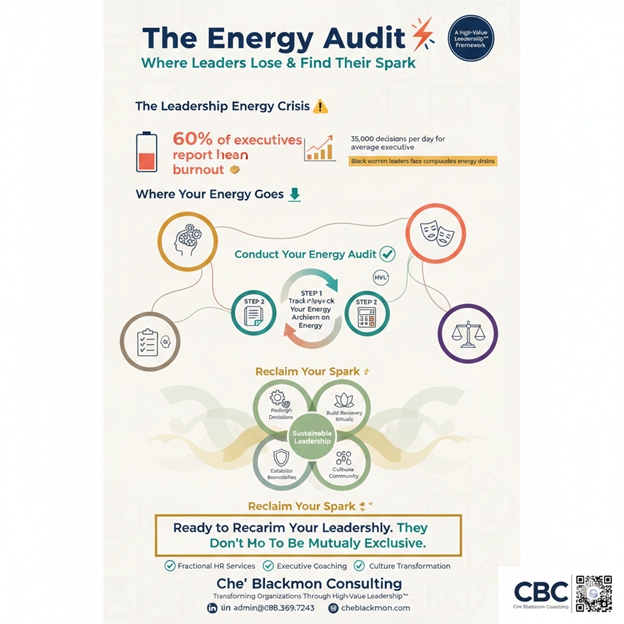
Recent studies from the Harvard Business Review paint a sobering picture. Over 60% of executives report feeling burned out, and the numbers are even more staggering for leaders who navigate the additional weight of being traditionally overlooked in corporate spaces. For Black women in leadership, the energy tax is compounded by what researchers call “emotional labor,” the invisible work of managing perceptions, code switching, and proving competence in environments that weren’t built with them in mind.

Energy depletion doesn’t happen in a vacuum. It accumulates through a series of micro moments that, individually, seem manageable. Collectively, they create a deficit that no amount of weekend rest can repair. Consider these common energy drains that leaders face daily:

Decision Fatigue and Cognitive Overload

The average executive makes over 35,000 decisions per day. Each decision, no matter how small, depletes a finite cognitive resource. When you’re already operating in spaces where every move is scrutinized more heavily, that number multiplies. You’re not just deciding on strategy or budget allocations; you’re constantly calculating the perception of each choice.

Misaligned Values and Cultural Dissonance

There’s an energy leak that happens when your personal values clash with organizational culture. When you have to suppress your authentic self to fit into corporate norms, when you’re the only voice advocating for equity in rooms full of people who view it as a checkbox rather than a commitment, you’re burning fuel that should be powering innovation and growth. This is particularly acute for Black women leaders who often find themselves as the “only” or one of few, navigating cultures that were not designed with their leadership styles, communication preferences, or lived experiences in mind.

Invisible Labor and Unrecognized Contributions

The work that doesn’t show up in job descriptions but somehow always lands on your desk. Mentoring junior colleagues. Smoothing over team conflicts. Being voluntold for diversity initiatives while your peers focus solely on revenue generating work. This invisible labor drains energy while rarely adding to your advancement or recognition.

Constant Performance Pressure and Imposter Syndrome

When you’re operating in spaces where people like you have historically been excluded, there’s an unspoken pressure to be exceptional at all times. Mistakes that would be learning opportunities for others become proof that you don’t belong. This hypervigilance is exhausting. It creates a perpetual state of stress that depletes energy reserves faster than any strategic initiative or operational challenge.

💸 The Cost of Running on Empty

Energy depletion isn’t just a personal problem. It’s an organizational crisis that manifests in tangible, measurable ways. When leaders run on empty, the ripple effects touch every corner of the enterprise.

There was a company in the manufacturing sector that lost a brilliant VP of Operations within 18 months of her appointment. On paper, she had everything: impressive credentials, strategic vision, and the operational expertise to transform their supply chain. What the exit interview revealed was more nuanced. She was exhausted. Not from the work itself, but from the constant need to prove her worth in ways her male counterparts never had to. She left not because she couldn’t do the job, but because the energy required to do it while managing bias, microaggressions, and isolation was unsustainable.

The company didn’t just lose a talented executive. They lost institutional knowledge, strategic relationships, and a pipeline of diverse talent who saw in her departure a signal about their own futures. The cost of replacing her ran into seven figures when you factor in recruitment, onboarding, lost productivity, and the projects that stalled in her absence. More significantly, they lost credibility in their diversity and inclusion commitments.

The organizational costs of leadership energy depletion include decreased decision quality, reduced innovation and creative problem solving, higher turnover among high performers, cultural erosion and disengagement, missed strategic opportunities, and damaged employer brand and recruitment challenges. These aren’t abstract concepts. They show up in quarterly earnings, employee engagement scores, and talent retention metrics.

📊 Conducting Your Energy Audit: A Framework for Leaders

An energy audit for leaders mirrors the process organizations use to identify inefficiencies in their operations. Instead of examining electrical systems and HVAC units, you’re examining how you allocate your most precious resource: your energy. This isn’t about working harder or finding more hours in the day. It’s about working smarter and being intentional about where your energy goes.

Step One: Track Your Energy Expenditures

For one week, keep a simple energy journal. Not a detailed log of every minute, but a general accounting of what gives you energy and what depletes it. At the end of each day, ask yourself three questions. What activities today left me energized? What activities left me drained? What surprised me about my energy patterns?

Pay particular attention to the activities that drain you but that you feel obligated to continue. These are your prime candidates for elimination, delegation, or redesign. For Black women leaders, this often includes activities related to being the diversity representative, informal mentorship that isn’t valued or compensated, and managing others’ comfort with your presence in leadership spaces.

Step Two: Identify Your Energy Architecture

Everyone has a unique energy architecture, the patterns and rhythms that govern when you’re at your best. Some leaders are morning people who tackle complex decisions before noon. Others hit their stride in the afternoon. Understanding your architecture allows you to structure your day for maximum effectiveness.

Examine your calendar through an energy lens. Are you scheduling high stakes meetings during your lowest energy periods? Are you filling your peak hours with administrative tasks that could be batched or delegated? Are you building in recovery time between energy intensive activities, or are you scheduling back to back meetings that leave no room for processing or renewal?

Step Three: Calculate Your Return on Energy

Just as organizations calculate ROI for financial investments, leaders need to calculate return on energy for their activities. Not everything that feels productive is actually moving you or your organization forward. Some activities are energy vampires disguised as important work.

Create three categories for your activities: high energy investment, high return activities; necessary but energy draining activities; and low return energy drains. The goal isn’t to eliminate all energy draining activities. Some are unavoidable parts of leadership. The goal is to be conscious about which drains are necessary and which are habits or obligations that no longer serve you or your organization.

⚙️ Strategic Energy Management: From Audit to Action

Understanding where your energy goes is only half the battle. The real transformation happens when you redesign how you work, lead, and show up in ways that honor your energy architecture while meeting organizational demands.

Redesign Your Decision Making Process

Decision fatigue is real and cumulative. Combat it by creating decision frameworks that reduce the cognitive load of routine choices. Establish clear criteria for common decisions so you’re not reinventing the wheel each time. Delegate decisions that don’t require your specific expertise or authority. Batch similar decisions together rather than switching contexts throughout the day.

A technology executive shared her strategy of implementing “decision free Fridays” where she avoids making any major decisions, using the day instead for strategic thinking and planning. This single change improved not only her decision quality on other days, but also her overall wellbeing.

Build Energy Recovery Into Your Rhythm

You can’t sprint a marathon. Leadership is a long game that requires intentional recovery. This isn’t about bubble baths and self care platitudes. It’s about building recovery mechanisms into your regular rhythm that allow you to sustain high performance over time.

Recovery looks different for different people, but research points to several effective strategies. Physical movement breaks between meetings. Dedicated think time that isn’t interrupted by pings and notifications. Clear boundaries between work and personal time, even when working remotely. Micro breaks throughout the day, not just at lunch. Regular check ins with trusted advisors or coaches who can provide perspective. Time in community with people who share your lived experience and understand the unique challenges you face.

Create Boundaries That Honor Your Energy

For leaders who are used to being accessible, available, and always on, boundary setting can feel uncomfortable. For Black women leaders, it can feel particularly risky given the stereotypes about being difficult or not being team players. Yet boundaries aren’t walls that keep people out. They’re guidelines that protect your ability to show up fully and effectively.

Start by identifying your non negotiables. These are the boundaries that protect your core energy reserves. They might include no meetings before 9am or after 5pm, no work emails on weekends, dedicated time for strategic thinking that can’t be interrupted, or limits on travel commitments. Communicate these boundaries clearly and consistently. Model them for your team to create a culture where sustainable performance is valued over performative busyness.

🌟 The Unique Energy Dynamics for Black Women in Leadership

Let’s address what often goes unsaid in mainstream leadership development. The energy equation looks different when you’re navigating leadership while Black and female. The tax on your energy isn’t just about the work itself but about the context in which you’re doing it.

Research from the Center for Talent Innovation found that Black professionals are more likely than their white counterparts to report feeling stalled in their careers, being on guard to protect against bias, and needing to work harder than their peers to achieve the same level of recognition. Each of these experiences represents a significant energy drain that compounds over time.

The Code Switching Tax

Code switching, the practice of adjusting your language, behavior, and appearance to fit into predominantly white professional spaces, is exhausting. It requires constant vigilance and self monitoring. You’re not just thinking about what to say; you’re calculating how it will be received, whether it reinforces or contradicts stereotypes, and what the political ramifications might be.

A senior director at a Fortune 500 company described it as “wearing a mask that you can never quite take off, even when you get home.” The energy required to maintain that mask, day after day, year after year, is staggering. And unlike other forms of professional stress, there’s no relief valve because the triggers aren’t isolated incidents but the ambient conditions of the environment itself.

The Credibility Gap

Studies consistently show that Black women in leadership positions face a credibility gap that their white male counterparts don’t encounter. Your expertise is questioned more frequently. Your decisions are second guessed more openly. Your authority is challenged more readily. Each incident might seem small, but the cumulative effect is significant energy depletion.

This credibility gap means you often need to work twice as hard to get half the credit. You come over prepared to meetings. You document everything meticulously. You build coalitions more carefully. You navigate politics more strategically. All of this is energy intensive work that should be going into innovation, strategy, and growth.

The Isolation Factor

Being the only one or one of few creates a unique form of isolation that drains energy in ways that are hard to articulate to people who haven’t experienced it. You don’t have the natural allies and informal networks that form organically among majority group members. You can’t assume anyone understands the nuances of your experience without extensive explanation. You bear the burden of representation, knowing that your actions will be generalized to your entire demographic.

This isolation affects everything from strategic decision making to simple workplace interactions. When you don’t have trusted peers who share your perspective, you’re processing challenges in isolation. When you don’t see yourself reflected in senior leadership, you’re charting a path with no map. This solo navigation is exhausting in ways that compound over time.

🛠️ Building a Sustainable Leadership Practice

Sustainable leadership isn’t about finding a magic formula that eliminates stress or makes challenges disappear. It’s about developing practices and support systems that allow you to navigate the demands of leadership without depleting yourself in the process.

Cultivate Your Kitchen Cabinet

Every leader needs a kitchen cabinet, a small group of trusted advisors who can provide honest feedback, strategic perspective, and emotional support. This isn’t your official board of directors or your executive team. This is your personal advisory group, the people who have your back and your best interests at heart.

For Black women leaders, this cabinet ideally includes other Black women who understand the unique dynamics you face. People who can validate your experiences, share strategies that worked for them, and remind you that you’re not alone or crazy when you encounter situations that others might dismiss. These relationships are not just nice to have; they’re essential for sustainable performance.

Develop Your Energy Rituals

High performing athletes have pre game rituals that prepare them mentally and physically for competition. Leaders need similar rituals that signal to their bodies and minds when it’s time to perform and when it’s time to recover. These rituals create structure and predictability in otherwise chaotic schedules.

Your energy rituals might include a morning routine that sets your intention for the day, transition rituals between work and home that create psychological separation, weekly planning sessions that align your calendar with your energy architecture, monthly reviews where you assess what’s working and what needs adjustment, or quarterly retreats for deep reflection and strategic thinking.

Invest in Professional Development That Energizes

Not all professional development is created equal when it comes to energy. Generic leadership programs that don’t acknowledge or address the unique challenges faced by Black women leaders can actually be depleting. You spend energy translating their content to your context, managing the microaggressions that inevitably arise, and explaining your perspective to people who may not be ready to hear it.

Seek out development opportunities that energize rather than drain you. Programs designed for and by people who share your lived experience. Executive coaching with someone who understands the intersection of race and gender in leadership. Communities and networks where you can show up authentically without having to code switch or self censor.

🏢 The Organizational Imperative: Creating Cultures That Sustain Leaders

While individual energy management is crucial, we can’t ignore the organizational conditions that either support or undermine leader sustainability. Organizations that want to retain their best leaders, particularly those from traditionally underrepresented groups, must create cultures that recognize and address the unique energy drains these leaders face.

This isn’t about special treatment. It’s about equitable treatment that accounts for the different challenges different leaders face. When organizations fail to do this, they lose talented leaders not because those leaders can’t handle the work, but because the energy required to navigate bias, isolation, and constant credibility questioning is unsustainable.

Audit Your Culture for Energy Equity

Organizations need to conduct their own energy audits, examining where systemic issues create unnecessary drains on leaders from underrepresented groups. This includes examining meeting cultures that require everyone to be on all the time, recognition systems that overlook invisible labor, advancement criteria that privilege certain styles and backgrounds, informal networks that exclude diverse leaders, and workload distribution that disproportionately assigns diversity and inclusion work to people of color.

Provide Real Support, Not Performative Programs

Many organizations have diversity and inclusion initiatives that look good on paper but provide little real support for leaders navigating challenging environments. Real support includes executive sponsorship from senior leaders who use their political capital to advocate for diverse leaders, affinity groups with budget and influence, not just permission to meet, flexible work arrangements that account for different needs and circumstances, professional development that addresses the specific challenges diverse leaders face, and clear pathways for advancement that don’t require assimilation.

Measure What Matters

If leader sustainability and energy aren’t measured, they won’t be managed. Organizations should track retention rates disaggregated by race and gender, time to promotion for diverse leaders compared to their peers, participation in high visibility projects and opportunities, engagement scores among different demographic groups, and exit interview themes related to culture and belonging.

These metrics reveal whether your organization is creating conditions that support all leaders or whether some leaders are having to work significantly harder than others to achieve the same outcomes.

🚀 Moving Forward: From Depletion to Renewal

Finding your spark again isn’t about a single intervention or magic solution. It’s about making intentional, strategic choices about how you lead, where you invest your energy, and what you’re willing to stop doing. It’s about recognizing that sustainable leadership isn’t weakness; it’s wisdom.

For Black women leaders especially, reclaiming your energy is an act of resistance against systems that expect you to work twice as hard for half the recognition. It’s a commitment to showing up powerfully without burning out completely. It’s honoring your brilliance by protecting the energy that fuels it.

The energy audit is your starting point. It’s the moment you stop accepting exhaustion as the price of leadership and start designing a leadership practice that honors both your ambition and your humanity. You deserve to lead powerfully and live fully. The two don’t have to be mutually exclusive.

✅ Actionable Takeaways

Conduct a week long energy audit tracking what energizes and depletes you daily. Identify your peak performance times and restructure your calendar accordingly. Calculate return on energy for your current commitments and eliminate low value drains. Establish three non negotiable boundaries that protect your core energy reserves. Build a kitchen cabinet of trusted advisors who understand your unique challenges. Create daily transition rituals between high energy work and recovery time. Invest in professional development designed for leaders who share your lived experience. Audit your organization’s culture for energy equity and advocate for systemic changes.

💭 Discussion Questions

What activities in your current role give you energy versus drain your energy? How might your energy equation differ from colleagues who don’t share your identity or background? What boundaries would you need to establish to protect your peak performance capacity? In what ways does your organization’s culture support or undermine sustainable leadership? What would change if you prioritized energy sustainability as much as productivity? How can you build community with other leaders who understand your unique challenges? What invisible labor are you carrying that should be recognized, compensated, or redistributed? What would it look like to lead powerfully while also protecting your wellbeing?

🎯 Next Steps: Partner with Che’ Blackmon Consulting

If you’re ready to reclaim your leadership energy and build a sustainable high value practice, Che’ Blackmon Consulting can help. As a Doctoral Candidate in Organizational Leadership with over two decades of progressive HR leadership experience, Che’ Blackmon specializes in culture transformation and leadership development that honors the unique experiences of traditionally overlooked leaders.

Through fractional HR services, executive coaching, and organizational culture audits, CBC helps leaders and organizations create the conditions for sustainable high performance. Our approach combines strategic HR expertise with deep understanding of the intersectional challenges that Black women and other underrepresented leaders face in corporate spaces.

Whether you need individual coaching to conduct your energy audit and redesign your leadership practice, team development to build more inclusive and energizing cultures, or organizational consulting to address systemic energy drains, we’re here to support your journey from depletion to renewal.

Let’s Talk About Your Leadership Energy 💫

📧 admin@cheblackmon.com

📞 888.369.7243

🌐 cheblackmon.com

Your energy is your leadership currency. Invest it wisely. Protect it fiercely. Renew it regularly.

#Leadership #ExecutiveLeadership #LeadershipDevelopment #BlackWomenLeaders #WomenInLeadership #ExecutiveBurnout #LeadershipEnergy #SustainableLeadership #HighValueLeadership #CultureTransformation #DiversityAndInclusion #ExecutiveCoaching #WorkplaceCulture #LeadershipCoaching #BlackExcellence #ProfessionalDevelopment #HRLeadership #OrganizationalCulture #LeadershipStrategy #ExecutivePresence

Preventing Burnout Before It Starts: Early Warning Signs ⚠️🔥

By Che’ Blackmon, DBA Candidate | Founder & CEO, Che’ Blackmon Consulting

Burnout doesn’t happen overnight. It builds quietly over weeks and months, hiding behind professional commitment and high performance until the moment it becomes impossible to ignore. By then, the damage is done. Talented leaders walk away from careers they spent years building. Organizations lose institutional knowledge and cultural momentum. Teams fracture under the weight of covering for depleted colleagues.

The good news? Burnout is predictable. And what’s predictable is preventable. The warning signs appear long before the crisis hits, offering organizations and individuals precious time to intervene, recalibrate, and protect both human wellbeing and business outcomes.

This matters even more for Black women and other traditionally overlooked leaders who navigate additional stressors including microaggressions, cultural taxation, and the exhausting labor of being underestimated while simultaneously having to prove competence at every turn. For these leaders, burnout risk compounds exponentially, yet their warning signs are often dismissed or misinterpreted.

Understanding the early warning signs of burnout and taking decisive action transforms a reactive crisis management approach into proactive culture building. It’s the difference between losing talented leaders and retaining them. Between costly turnover and sustainable growth. Between organizational chaos and thriving teams.

Understanding Burnout: More Than Just Stress 🧠💔

Before we can prevent burnout, we need to understand what it actually is. Burnout isn’t simply being tired or stressed. Those are temporary states that rest and recovery can address. Burnout represents a chronic condition of emotional, physical, and mental exhaustion caused by prolonged exposure to demanding workplace conditions.

The World Health Organization officially recognized burnout in 2019 as an occupational phenomenon characterized by three dimensions. Energy depletion or exhaustion that rest doesn’t resolve. Increased mental distance from one’s job, or feelings of negativism or cynicism related to work. And reduced professional efficacy, a sense that nothing you do makes a difference anymore.

Research from Gallup reveals that 76% of employees experience burnout on the job at least sometimes, and 28% say they feel burned out “very often” or “always.” The financial costs are staggering. Burnout accounts for an estimated $125 billion to $190 billion annually in healthcare spending in the United States alone. Factor in turnover costs, lost productivity, absenteeism, and diminished innovation capacity, and the true price tag climbs into the hundreds of billions.

But burnout’s most devastating impact isn’t captured in financial metrics. It’s the brilliant strategist who stops contributing in meetings. The innovative leader who becomes cynical about change. The rising star who quietly updates their resume and slips out the door. The collective loss of human potential and organizational wisdom that never shows up on a balance sheet but fundamentally undermines competitive advantage.

The Unique Burnout Risk for Traditionally Overlooked Leaders 🎯⚖️

Black women in corporate leadership navigate a landscape where standard burnout risk factors are amplified and additional stressors layer on top. Understanding these unique dynamics is essential for any organization serious about preventing burnout and retaining diverse talent.

Research from the Institute for Women’s Policy Research shows that Black women face a higher likelihood of experiencing chronic workplace stress than their white counterparts. They experience microaggressions at rates significantly higher than other groups. They’re subjected to more scrutiny of their work and more frequent questioning of their competence. They carry the invisible burden of representing an entire demographic while simultaneously working to be seen as individuals.

This phenomenon, known as “covering,” requires Black women to downplay aspects of their identity to fit into predominantly white corporate cultures. The constant code switching, the careful calibration of tone and presentation, the monitoring of natural hair choices or style of dress, all of this represents additional cognitive and emotional labor that depletes energy reserves before the actual work even begins.

Then there’s cultural taxation, the expectation that Black women will serve as diversity representatives, informal mentors to all employees of color, and volunteer committee members for every inclusion initiative, usually without additional compensation or recognition toward advancement. This work, while valuable to organizations, often goes unrewarded while simultaneously pulling these leaders away from the strategic contributions that would position them for promotion.

Consider the healthcare executive who spent twelve years advancing through her organization, consistently exceeding performance targets. She was asked to lead the diversity and inclusion task force, mentor five early-career employees of color, participate in recruiting initiatives at HBCUs, and serve as the public face of the organization’s equity commitments. All while maintaining her demanding operational responsibilities. Within eighteen months, she developed anxiety, insomnia, and eventually left for a competitor who offered not just better compensation but genuine support structures.

When organizations ignore these additional stressors or worse, assume all employees face identical challenges, they create conditions where burnout among Black women becomes not just likely but inevitable. The warning signs appear earlier and compound faster, yet they’re frequently dismissed as individual performance issues rather than systemic failures that demand organizational response.

Individual Warning Signs: Recognizing the Red Flags 🚩👤

Burnout progresses through stages, and catching it early makes all the difference. Here are the warning signs that appear before full burnout sets in, organized by the dimension they most clearly represent.

Physical Warning Signs 💪⚡

The body speaks first. Physical symptoms often emerge before we consciously recognize emotional or mental exhaustion. Chronic fatigue that doesn’t improve with rest or sleep signals that something deeper than ordinary tiredness is occurring. You sleep eight hours but wake feeling depleted. Weekends no longer restore energy. Vacation provides temporary relief that evaporates within days of returning to work.

Sleep disruption manifests in multiple ways. Difficulty falling asleep despite exhaustion. Waking repeatedly throughout the night. Racing thoughts that prevent rest. Some people sleep too much, using sleep as escape from overwhelming demands, yet never feel truly rested.

Physical symptoms accumulate. Frequent headaches or migraines. Muscle tension, particularly in neck and shoulders. Digestive issues. Increased susceptibility to colds and infections as stress suppresses immune function. Changes in appetite, either eating far more or far less than normal. These aren’t random health issues. They’re your body’s alarm system signaling that current demands exceed your capacity to sustain them.

Emotional Warning Signs 😔❤️

Emotional changes often manifest as shifts in how you experience work and relationships. Growing cynicism about your job, colleagues, or organization represents a significant warning sign. The work that once energized you now feels pointless. Meetings that previously sparked engagement now trigger eye rolls. Colleagues you respected become sources of irritation.

Detachment and numbness signal advanced warning stages. You stop caring about outcomes that previously mattered. Team conflicts that would have concerned you now barely register. You go through motions mechanically, disconnected from the purpose that once drove your performance.

Emotional volatility increases. Small frustrations trigger disproportionate reactions. You snap at colleagues over minor issues. Feedback that you’d normally process constructively now feels like personal attack. The emotional regulation that characterized your professional demeanor becomes harder to maintain.

For Black women leaders, emotional exhaustion often includes what researchers call “racial battle fatigue,” the cumulative psychological and emotional toll of navigating racial microaggressions and systemic bias. This manifests as heightened frustration, sadness, or anger related to workplace dynamics, combined with the exhaustion of managing those emotions in professional settings where expressing them might be perceived as “unprofessional” or “aggressive.”

Mental and Cognitive Warning Signs 🧠💭

Cognitive function deteriorates under chronic stress. Concentration becomes difficult. You read emails three times without absorbing content. Meetings require intense effort to track conversations. Tasks that previously came easily now demand exhausting mental energy.

Memory issues emerge. Forgetting commitments, missing deadlines, or losing track of important details that you’d normally manage effortlessly. Your capacity for strategic thinking diminishes. Big picture vision gets lost in daily firefighting. Innovation and creative problem solving feel impossible when survival mode dominates.

Decision-making becomes paralyzing. Simple choices feel overwhelming. Analysis paralysis sets in even for routine matters. You second-guess yourself constantly, losing confidence in judgment that previously guided effective leadership.

Racing thoughts and rumination increase. Work concerns invade every moment. You can’t turn off mentally even during supposed downtime. Thoughts loop obsessively without productive resolution, creating mental exhaustion that compounds physical fatigue.

Behavioral Warning Signs 🚶‍♀️📉

Behavior changes provide observable indicators that others might notice before you fully recognize them yourself. Withdrawal from colleagues and relationships often signals advancing burnout. You skip social gatherings you’d normally attend. Stop participating in informal conversations. Decline lunch invitations. Retreat from connections that previously sustained you.

Productivity paradoxes emerge. Some people work longer hours while accomplishing less, spinning wheels without traction. Others disengage entirely, doing minimum necessary to get by while their performance slides. Procrastination increases as motivation wanes. Deadlines get missed or barely met when previously you delivered early.

Increased reliance on coping mechanisms becomes apparent. More caffeine to force energy. Alcohol to decompress. Comfort eating or restriction. These aren’t character flaws. They’re attempts to manage overwhelming stress through whatever tools feel accessible in the moment.

Absenteeism rises. More sick days. Arriving late. Leaving early. These absences represent attempts to catch breath, grab moments of recovery, or avoid environments that have become intolerable. They’re symptoms, not solutions, but they signal distress that demands attention.

Organizational Warning Signs: When Teams Are at Risk 🏢📊

Burnout isn’t just an individual problem. It’s a team and organizational phenomenon. Smart leaders watch for patterns that indicate their teams are sliding toward collective exhaustion.

Team Dynamics Shifts 👥⚠️

Team engagement metrics tell important stories. When survey scores drop consistently across quarters, particularly on questions about feeling valued, having manageable workload, or seeing purpose in work, burnout is building. Exit interview themes cluster around exhaustion, unsustainable demands, and lack of support. These aren’t isolated incidents. They’re patterns demanding systemic response.

Communication changes within teams. Meetings become tense or silent. Collaboration decreases. People work in silos rather than leveraging collective intelligence. Conflict increases as exhausted people have less emotional bandwidth for navigating differences constructively. Trust erodes when everyone operates in survival mode.

Innovation stalls. When people are burned out, they lack energy for creative thinking. Risk aversion increases. Safe, familiar approaches dominate even when circumstances demand new strategies. The team that previously generated breakthrough ideas now struggles to execute basic requirements.

Performance and Productivity Indicators 📈❌

Quality issues emerge across deliverables. Errors increase. Rework becomes necessary. Standards slip. These aren’t signs of incompetence. They’re evidence of teams stretched beyond sustainable capacity, lacking the mental clarity and energy necessary for excellence.

Project timelines consistently slip. What used to get done in reasonable timeframes now requires extensions. Not because people aren’t working hard, often they’re working harder than ever, but because depleted humans simply cannot sustain previous productivity levels indefinitely.

There was a technology company where sprint velocity dropped 40% over six months while hours worked increased 25%. The team wasn’t lazy or incompetent. They were burning out. More hours created diminishing returns as exhaustion undermined both speed and quality. Leadership initially pushed harder, demanding greater output. This accelerated the problem until three senior engineers quit within a month, forcing organizational reckoning with unsustainable practices.

Retention and Turnover Patterns 🚪💼

Voluntary turnover rates climb, particularly among high performers. When your best people start leaving, burnout is often the underlying cause. They have options. They’ll use them rather than sacrifice their wellbeing for organizations that don’t protect it.

Pay particular attention when traditionally overlooked talent exits at higher rates. If Black women, LGBTQ+ professionals, or other marginalized groups leave disproportionately, this signals that unique stressors aren’t being addressed. It’s not just about burnout from workload. It’s about the additional burden of navigating hostile or unwelcoming environments while managing demanding work.

Recruitment and onboarding become difficult. Word spreads about organizational culture. Talented candidates decline offers after talking to current employees or reading Glassdoor reviews that mention burnout, overwork, or lack of support. The organization’s employer brand suffers, making it progressively harder to attract quality talent.

Root Causes: Why Burnout Happens 🌳🔍

Understanding warning signs matters, but preventing burnout requires addressing root causes. Organizational conditions create environments where burnout either thrives or struggles to take hold.

Unsustainable Workload and Expectations 📚⏰

Chronic overwork represents the most direct path to burnout. When organizations consistently demand more than humans can sustainably deliver, exhaustion becomes inevitable. This manifests in multiple ways. Unrealistic deadlines that require extreme hours. Staffing levels insufficient for workload demands. Refusal to prioritize, treating everything as urgent and important simultaneously.

The “do more with less” mentality, while sometimes necessary during genuine crises, becomes toxic when it represents permanent operating philosophy. Teams absorb work from eliminated positions without corresponding reduction in expectations. People cover for vacant roles for months while organizations delay hiring. Individual capacity limits get ignored in pursuit of quarterly targets.

Technology exacerbates this by erasing boundaries between work and personal time. Email at all hours. Slack messages on weekends. The expectation of constant availability means people never fully disconnect. Recovery becomes impossible when the next demand arrives before the last one’s stress has dissipated.

Lack of Control and Autonomy 🎮🚫

Research consistently shows that lack of control over work significantly predicts burnout. When people have no say in how, when, or where they work, no influence over priorities or resource allocation, no voice in decisions affecting their roles, they experience powerlessness that breeds exhaustion and cynicism.

Micromanagement destroys autonomy and accelerates burnout. Talented professionals hired for expertise find themselves subjected to excessive oversight, questioned on routine decisions, and required to justify every action. This signals distrust that undermines engagement while creating additional work of documenting and explaining choices that should be delegated.

Lack of flexibility compounds control issues. Rigid policies that ignore individual needs and circumstances. Presenteeism cultures that value face time over results. Inability to adjust schedules for personal obligations without penalty. These restrictions feel particularly burdensome for working parents, caregivers, and anyone balancing significant responsibilities outside work.

Values Misalignment and Purpose Deficit 🎯💔

Burnout accelerates when people’s values conflict with organizational practices or when work feels meaningless. This shows up when organizations espouse values they don’t live. Claim to prioritize people while treating employees as disposable resources. Talk about innovation while punishing intelligent risk-taking. Champion diversity publicly while maintaining homogeneous leadership and inequitable practices privately.

Purpose matters profoundly for sustained engagement. When people can’t connect their daily work to meaningful impact, cynicism takes root. Tasks feel like pointless box checking. Energy drains away without the renewal that comes from knowing your contribution makes a difference.

For Black women and other traditionally overlooked leaders, values misalignment often centers on equity and inclusion. Working for organizations that claim commitment to diversity while experiencing or witnessing discriminatory practices creates profound dissonance. The emotional labor of navigating that contradiction while maintaining professional composure accelerates burnout.

Insufficient Recognition and Reward ⭐💰

Humans need acknowledgment for their contributions. When effort goes unrecognized, when achievements pass without celebration, when compensation fails to reflect value delivered, resentment builds and motivation withers.

This isn’t about constant praise or inflated egos. It’s about fundamental fairness. People working at high levels deserve compensation that reflects their contributions. Performance that exceeds expectations warrants recognition. Excellence should create pathways to advancement, not just more work without increased rewards.

Recognition gaps affect traditionally overlooked talent disproportionately. Research shows Black women receive less credit for collaborative work, less visibility for achievements, and fewer advancement opportunities despite equivalent or superior performance. This pattern of having contributions undervalued while simultaneously being expected to do more creates the perfect conditions for burnout.

Toxic Workplace Dynamics 🚩🤝

Workplace relationships and culture dramatically influence burnout risk. Toxic environments accelerate exhaustion through multiple pathways. Interpersonal conflict that goes unaddressed. Bullying or harassment. Lack of psychological safety where people fear speaking up. Blame cultures that punish mistakes rather than using them as learning opportunities.

Exclusionary cultures where certain groups never fully belong take tremendous toll. When Black women walk into meetings and realize they’re the only one who looks like them, again. When their ideas get credited to male colleagues. When they’re interrupted or spoken over repeatedly. When their natural hair or style of dress generates commentary. Each incident seems small in isolation, but cumulatively they create chronic stress that depletes energy and erodes engagement.

Leadership quality matters immensely. Bad managers create burnout through poor communication, unclear expectations, inconsistent decision making, favoritism, and failure to support their teams. People don’t leave jobs; they leave bad bosses. And often they leave because those bad bosses created conditions that made burnout inevitable.

Prevention Strategies: Individual Actions 🛡️💪

While organizations bear primary responsibility for creating conditions that prevent burnout, individuals can take proactive steps to protect their wellbeing and build resilience.

Develop Self-Awareness and Regular Check-Ins 🪞✅

You cannot address what you don’t recognize. Building awareness of your own warning signs enables early intervention before burnout becomes severe. Create regular practices for checking in with yourself. Weekly reviews of energy levels, emotional state, and work satisfaction. Monthly assessments of whether current pace feels sustainable. Quarterly big picture reflection on alignment between your values and work reality.

Track patterns. When do you feel most energized versus depleted? Which activities drain you disproportionately? What early physical or emotional signals appear when stress escalates? Understanding your unique burnout signature helps you intervene before symptoms become severe.

Journal, if that works for you. The act of writing about experiences helps process them and often reveals patterns that weren’t obvious in the moment. You might notice that every Sunday night brings dread about the coming week, or that certain types of meetings consistently leave you feeling dismissed or undervalued. These insights inform where you need to set boundaries or seek support.

Set and Maintain Boundaries ⚖️🚧

Boundaries protect sustainable performance. They’re not signs of weakness or lack of commitment. They’re requirements for long term effectiveness. This means establishing clear work hours and communicating them. Turning off notifications during personal time. Taking actual lunch breaks rather than eating at your desk. Using vacation time without checking email constantly.

Learning to say no strategically becomes essential. You cannot do everything. Attempting to do so guarantees you’ll do nothing particularly well while destroying your wellbeing in the process. Evaluate requests against priorities. Decline commitments that don’t align with core responsibilities or development goals. Suggest alternatives when you must say no to maintain relationships while protecting your capacity.

For Black women leaders, boundary setting often feels risky. Saying no might confirm stereotypes about not being team players. Setting limits might be interpreted as lack of ambition. These fears aren’t irrational given how Black women’s behavior gets scrutinized differently. But the alternative, accepting every request and sacrificing your wellbeing to prove your worth, guarantees burnout. Your boundaries might need to be communicated more carefully, framed more strategically, but they’re no less necessary.

Prioritize Recovery and Restoration 🌙🔋

Recovery isn’t optional. It’s required for sustainable high performance. Build intentional recovery practices into your routine. Daily practices might include short meditation breaks, brief walks outside, or simply closing your eyes and breathing for five minutes between meetings. Weekly recovery could involve exercise you genuinely enjoy, time in nature, engaging in hobbies unrelated to work, or spending quality time with people you love.

Sleep deserves priority. Most adults need seven to nine hours of quality sleep nightly. Chronic sleep deprivation undermines every aspect of functioning and accelerates burnout. Protect your sleep by establishing consistent bedtimes, creating restful environments, and avoiding screens before bed.

Take your vacation time. All of it. Research shows that people who take regular time off are more productive, creative, and engaged than those who don’t. Vacation isn’t reward for good performance. It’s maintenance required for continued performance. Disconnect fully during time off. The organization will survive without you for a week, and you’ll return significantly more capable than if you’d worked through supposed rest periods.

Build and Leverage Support Systems 🤝💬

Isolation amplifies burnout. Connection provides protection. Cultivate relationships with people who understand your experience and can offer support, perspective, and accountability. This might include mentors who’ve navigated similar challenges. Peers facing comparable demands. Friends outside your industry who remind you of your identity beyond your job title. Professional support like therapists or coaches who provide structured space for processing stress.

For Black women leaders, finding community with others who share your experience proves invaluable. Affinity groups, professional organizations for Black women, informal networks with other women of color in leadership, these spaces offer validation and wisdom that well-meaning colleagues from different backgrounds simply cannot provide. You shouldn’t have to explain why certain comments sting or why code switching exhausts you. Having people who just get it creates breathing room that sustains you through challenges.

Don’t hesitate to seek professional help. Therapy isn’t admission of failure or weakness. It’s strategic investment in your mental health and leadership capacity. A skilled therapist helps you process stress, develop coping strategies, identify patterns, and build resilience. The return on investment, both personally and professionally, far exceeds the cost.

Prevention Strategies: Organizational Responsibility 🏢🌟

Individual strategies matter, but preventing burnout requires organizational commitment. Leaders must create conditions where people can thrive sustainably rather than placing sole responsibility on individuals to cope with toxic or demanding environments.

Design Sustainable Workload and Staffing 📊👥

Right-size expectations to match human capacity. This requires honest assessment of what people can reasonably accomplish in standard work weeks without chronic overtime or weekend work. Conduct regular workload audits. Are people consistently working sixty-hour weeks? That’s a design flaw, not evidence of dedication.

Staff appropriately for actual workload. When positions go unfilled, work doesn’t disappear. It lands on remaining team members, often without corresponding reduction in their original responsibilities. This creates chronic overwork that accelerates burnout. Either hire to fill gaps or explicitly reduce deliverables to match available capacity.

Prioritize ruthlessly. Everything cannot be the top priority. When leaders treat all initiatives as equally urgent and important, they force teams to work unsustainably attempting impossible feat of doing everything at once. Clear prioritization enables teams to focus energy effectively rather than fragmenting attention across too many competing demands.

There was a professional services firm that instituted quarterly workload reviews where teams assessed their capacity against current and projected commitments. When workload exceeded sustainable thresholds, leadership made hard choices about what to postpone, eliminate, or resource differently. This practice reduced burnout rates by 43% over eighteen months and improved both retention and client satisfaction as teams delivered higher quality work on realistic timelines.

Foster Autonomy and Control 🎯✨

Trust your people. Hire talented professionals and then let them use their expertise. Micromanagement signals distrust and creates additional work while undermining engagement. Set clear outcomes and guardrails, then empower people to determine how to achieve those outcomes within established parameters.

Provide flexibility in how, when, and where work gets done. Different people have different peak productivity times, different life circumstances requiring accommodation, and different working styles that yield their best contributions. Rigid policies that demand uniformity sacrifice performance for the illusion of control.

Involve teams in decisions affecting their work. People support what they help create and resist what gets imposed. When changes are necessary, include those who’ll implement them in planning conversations. Their insights improve decisions while their involvement builds ownership and reduces resistance.

Build Psychologically Safe, Inclusive Cultures 🛡️🌈

Psychological safety, the belief that you can speak up, take risks, and make mistakes without fear of humiliation or punishment, protects against burnout. People in psychologically safe environments can raise concerns before they become crises, ask for help when they need it, and engage fully without exhausting emotional armor.

Leaders create psychological safety through their responses to vulnerability, mistakes, and dissent. When someone admits they’re struggling, do you respond with support or judgment? When an initiative fails, do you seek learning or assign blame? When someone questions a decision, do you engage curiosity or defensiveness? Your responses teach people whether it’s safe to be human.

Building inclusive cultures where all employees genuinely belong reduces burnout among traditionally overlooked talent. This requires more than diversity statements. It demands examining and changing practices that exclude. Calling out microaggressions. Ensuring equitable access to opportunities and resources. Creating pathways for diverse talent to advance without having to conform to narrow cultural expectations.

Address cultural taxation directly. If Black women or other marginalized groups carry disproportionate diversity and inclusion work, compensate them appropriately and count that work toward advancement. Better yet, distribute that work more equitably or hire dedicated staff rather than expecting volunteers to shoulder organizational responsibilities.

Recognize and Reward Contributions Fairly ⭐🏆

Acknowledge people’s work regularly and genuinely. This doesn’t require elaborate programs or expensive rewards. Often simple, specific recognition of contributions means more than generic praise. Tell people what they did well and why it mattered. Celebrate achievements publicly. Express appreciation privately.

Ensure compensation reflects value delivered. Conduct regular equity audits to identify and correct pay disparities. Research consistently shows Black women earn less than white men and women for equivalent work. If your organization replicates that pattern, you’re contributing to burnout through fundamental inequity.

Create clear advancement pathways and ensure they’re accessible to all talent. When people see no future beyond their current role, engagement deteriorates. When advancement requires sacrificing wellbeing or conforming to narrow cultural expectations, talented diverse leaders opt out. Promotion processes should reward performance and potential, not who fits traditional molds or who’s willing to work themselves into exhaustion.

Model and Support Sustainable Practices 🌱👔

Leaders set the tone. If you send emails at midnight, your team feels pressure to do the same. If you never take vacation, they won’t either. If you glorify overwork and celebrate people who sacrifice wellbeing for results, you create cultures where burnout becomes badge of honor rather than warning sign.

Model healthy boundaries. Take your vacation and disconnect during it. Leave the office at reasonable hours. Talk openly about prioritizing wellness and work-life integration. These behaviors give permission for others to do the same.

Provide resources that support wellbeing. Employee assistance programs with quality mental health coverage. Wellness stipends people can use for gym memberships, therapy, or whatever supports their health. Flexible work arrangements that accommodate diverse life circumstances. Professional development focused on stress management, resilience building, and sustainable performance.

Train managers to recognize warning signs and respond supportively. Many managers want to support their teams but lack skills to identify burnout risk or have difficult conversations about wellbeing. Invest in developing these capabilities. The return on investment shows up in retention, engagement, and performance.

Early Intervention: What to Do When Warning Signs Appear 🚨🤝

Recognizing warning signs means nothing without action. Here’s what to do when burnout signals appear.

For Individuals Experiencing Warning Signs

First, acknowledge what’s happening without judgment. You’re not weak or failing. Burnout signals that current conditions exceed sustainable capacity. That’s information, not indictment.

Assess your situation honestly. Review the warning signs. Which ones are you experiencing? How long have they been present? Are they getting worse? This assessment helps you determine urgency and appropriate interventions.

Take immediate action on what you control. Adjust your schedule to include more recovery time. Decline new commitments. Use available vacation days. Reconnect with support systems. These steps won’t solve systemic problems, but they provide breathing room while you address larger issues.

Have the conversation with your manager. This feels risky, particularly for Black women and other traditionally overlooked leaders who fear being perceived as not handling the work. But suffering in silence guarantees deterioration. Frame the conversation around sustainability and performance. “I’m noticing these signs that suggest my current workload isn’t sustainable long term. I want to discuss how we can adjust priorities or resources to maintain the quality and consistency you need from me.”

Seek professional support. Talk to your doctor if physical symptoms persist. Work with a therapist to develop coping strategies and process stress. Engage a coach to navigate career decisions or improve boundaries. These aren’t signs of failure. They’re strategic investments in your most important asset: you.

If organizational response is inadequate or the environment proves unchangeable, consider your options. Sometimes the healthiest choice is leaving. Your wellbeing matters more than any job. Organizations that create burnout conditions and refuse to address them don’t deserve your continued sacrifice.

For Leaders Observing Warning Signs in Team Members

Approach with care and compassion. Burnout often carries stigma. People fear being perceived as weak or inadequate. Create safe space for honest conversation. “I’ve noticed some changes and wanted to check in. How are you really doing?” Sometimes simply asking with genuine interest opens important dialogue.

Listen without judgment. Your role isn’t to fix everything immediately. It’s to understand the situation and demonstrate that you care about their wellbeing as much as their productivity. Validate their experience. Burnout isn’t personal failing. It’s often organizational failure that individuals experience.

Take action on what you can control. Redistribute workload. Adjust deadlines. Provide resources. Remove barriers. Connect them with support services. Small interventions can make significant difference when they signal genuine organizational commitment to employee wellbeing.

Escalate systemic issues. If your team member’s burnout results from organizational problems beyond your authority to fix, advocate upward. Bring concerns to senior leadership. Push for changes in policies, staffing, or expectations. Your credibility and position give you voice that individual contributors often lack.

Follow up consistently. One conversation won’t solve burnout. Check in regularly. Monitor progress. Adjust support as needed. Your sustained attention demonstrates that their wellbeing matters beyond immediate productivity concerns.

Building Burnout-Resistant Cultures 🏗️💪

Preventing burnout requires more than addressing individual warning signs. It demands building organizational cultures where sustainable high performance becomes the norm rather than the exception.

This starts with leadership commitment. When executives genuinely prioritize employee wellbeing, not just in statements but in budgets, policies, and daily decisions, cultures shift. When managers get evaluated and rewarded based on team sustainability as much as team productivity, behaviors change. When organizations invest in prevention rather than waiting to manage crisis, they protect both human dignity and business performance.

It requires particular attention to equity. Organizations cannot claim commitment to diversity while ignoring how burnout risk compounds for Black women and other traditionally overlooked talent. Preventing burnout in diverse workforces means acknowledging unique stressors, addressing systemic inequities, and creating conditions where all employees can thrive without sacrificing their identities or their health.

The warning signs are clear. The prevention strategies are known. What’s required now is courage to implement them even when doing so challenges deeply embedded cultural norms about work, worth, and what it means to be committed professional. Because the alternative, continuing to burn through talented people in pursuit of quarterly targets, creates losses that no organization can afford long term.

Burnout is preventable. Let’s act like it.

Reflection Questions for Your Team 💭🗣️

  • Which burnout warning signs are most prevalent in our organization currently? What patterns do we notice across teams or departments?
  • How do we currently respond when team members show signs of burnout? Are those responses effective or do they inadvertently worsen the situation?
  • What organizational practices or cultural norms contribute to burnout risk in our workplace? Which of these are we willing to change?
  • Do traditionally overlooked employees in our organization experience burnout at different rates or for different reasons than majority group members? If so, what does that reveal about our culture?
  • How sustainable are our current workload expectations? If we’re honest, could our team maintain this pace for another year without significant burnout?
  • What preventive measures could we implement immediately to reduce burnout risk? What longer-term systemic changes would have greatest impact?
  • How do our leaders model sustainable work practices? What behaviors do we inadvertently reward that contribute to burnout?

Next Steps: Taking Action to Prevent Burnout 🎯

For Individuals:

  • Complete a personal burnout assessment this week. Review the warning signs and honestly evaluate which ones you’re experiencing. Score yourself on each dimension.
  • Identify three specific boundaries you need to establish or reinforce to protect your wellbeing. Write them down and communicate them clearly this month.
  • Schedule recovery time for the next three months. Block your calendar. Commit to protecting this time as zealously as you protect important meetings.
  • Reach out to your support network. Schedule coffee with a mentor, call a trusted friend, or book that first therapy appointment you’ve been considering.
  • If you’re experiencing significant warning signs, have the conversation with your manager within two weeks. Prepare talking points focused on sustainability and solutions.

For Managers and Team Leaders:

  • Conduct a team burnout risk assessment. Review warning signs with your leadership team and identify which team members might be at risk.
  • Schedule one-on-one check-ins focused specifically on wellbeing, not just project status. Ask how people are really doing and create space for honest answers.
  • Audit current workload expectations. Can your team sustainably deliver what you’re asking? If not, what needs to change?
  • Examine your own practices. What are you modeling about work hours, boundaries, and sustainable performance? Make one visible change to model healthier patterns.
  • Create a team agreement about communication expectations, work hours, and response time requirements. Get buy-in and model adherence.

For Organizations:

  • Conduct an organizational burnout audit. Assess prevalence of warning signs across the organization, paying particular attention to patterns among different demographic groups.
  • Establish burnout prevention as a strategic priority with specific goals, accountability, and resources allocated.
  • Review policies, practices, and cultural norms that contribute to burnout. Create action plans to address the top three contributors.
  • Train all managers on recognizing burnout warning signs and having supportive conversations about wellbeing.
  • Specifically examine how burnout risk differs for Black women and other traditionally overlooked talent. Implement targeted interventions addressing unique stressors.
  • Build burnout prevention metrics into leadership evaluation and organizational scorecards. Track trends and hold leaders accountable for creating sustainable conditions.

Partner with Che’ Blackmon Consulting 🤝✨

Preventing burnout requires more than awareness. It demands strategic intervention, cultural transformation, and sustained commitment. At Che’ Blackmon Consulting, we help organizations build burnout-resistant cultures through our High-Value Leadership methodology.

Our services include:

  • Organizational burnout assessments and prevention planning
  • Leadership development programs focused on sustainable high performance
  • Culture transformation initiatives that prioritize employee wellbeing alongside business results
  • Executive coaching for leaders navigating burnout personally or within their teams
  • Specialized support for organizations committed to retaining diverse talent by addressing unique burnout risk factors
  • AI-powered predictive analytics for identifying burnout risk 3-6 months in advance

We combine evidence-based approaches with deep understanding of how burnout manifests differently across diverse employee populations, ensuring interventions that actually work for all your talent.

Ready to Prevent Burnout Before It Starts? 🌟

Let’s build sustainable, high-performing teams together.

📧 admin@cheblackmon.com

📞 888.369.7243

🌐 cheblackmon.com

Che’ Blackmon, DBA Candidate, is the Founder & CEO of Che’ Blackmon Consulting, a fractional HR and culture transformation consultancy. With over 24 years of progressive HR leadership experience, she specializes in helping organizations build sustainable, high-performing cultures where all talent thrives. She is the author of “High-Value Leadership: Transforming Organizations Through Purposeful Culture,” “Mastering a High-Value Company Culture,” and “Rise & Thrive: A Black Woman’s Blueprint for Leadership Excellence.”

#BurnoutPrevention #EarlyWarningSigns #LeadershipWellness #WorkplaceBurnout #EmployeeWellbeing #HighValueLeadership #OrganizationalCulture #MentalHealthAtWork #BlackWomenLeaders #SustainableLeadership #HRLeadership #ExecutiveWellness #PreventBurnout #WorkplaceWellness #LeadershipDevelopment #EmployeeRetention #CultureTransformation #InclusiveLeadership #WorkLifeIntegration #LeadershipMatters

The Wellness ROI: Why Healthy Leaders Build Healthy Companies 💪🌱

By Che’ Blackmon, DBA Candidate | Founder & CEO, Che’ Blackmon Consulting

What if the best investment you could make in your organization’s success was investing in your own wellness? Not the wellness programs with free fruit baskets or yoga mats gathering dust in the break room. I’m talking about the real, transformative kind of wellness that starts at the top. The kind that ripples through every level of your company and shows up in your bottom line.

Here’s a truth many executives resist: your personal wellness directly impacts organizational performance. When leaders are depleted, disengaged, or running on fumes, their teams feel it. When leaders thrive, organizations flourish. The data is clear. Companies with healthy, engaged leaders see 21% higher profitability and 17% higher productivity than those led by burned out, chronically stressed executives.

Yet leadership wellness remains one of the most overlooked drivers of organizational success. This oversight is even more pronounced for traditionally overlooked leaders, particularly Black women executives who navigate unique stressors including cultural taxation, microaggressions, and the exhausting labor of being “the only one” in the room. The cost of ignoring leadership wellness? Billions in lost productivity, failed culture transformation initiatives, and talented leaders walking out the door.

The Hidden Cost of Unhealthy Leadership 📉💸

Leadership wellness isn’t a luxury. It’s a business imperative. When executives neglect their physical, mental, and emotional health, the consequences cascade throughout the organization in measurable ways.

Consider the manufacturing company where the executive team prided themselves on being “available 24/7” and working through weekends. On the surface, this looked like dedication. In reality, they were modeling unsustainable behaviors that employees replicated throughout the organization. Within eighteen months, the company faced turnover rates exceeding 45%, safety incidents increased by 32%, and employee engagement scores plummeted to the bottom quartile. The direct costs? Over $8.4 million in recruitment, training, workers’ compensation claims, and lost productivity.

The research backs this up. Studies show that stressed leaders make poorer decisions, struggle with emotional regulation, and create environments where psychological safety diminishes. Their teams experience higher rates of burnout, increased conflict, and decreased innovation. The irony? Leaders often believe they’re demonstrating commitment through self-sacrifice when they’re actually undermining the very outcomes they’re trying to achieve.

The Unique Burden for Traditionally Overlooked Leaders 🎯

For Black women in leadership, the wellness equation includes additional variables that many organizations fail to acknowledge. Research from the American Psychological Association reveals that Black women executives experience chronic stress at rates significantly higher than their white counterparts, driven by persistent workplace discrimination, lack of mentorship and sponsorship, and the pressure to represent an entire demographic while navigating predominantly white, male corporate spaces.

These leaders face what researchers call “John Henryism,” a pattern of high effort coping with chronic stressors that leads to accelerated wear and tear on the body and mind. They work twice as hard to receive half the recognition. They carry the invisible weight of being scrutinized more intensely, having their competence questioned more frequently, and managing the emotional labor of making others comfortable with their presence in leadership.

The cost is staggering. Not just to these talented leaders who deserve better, but to organizations losing brilliant minds, innovative thinking, and leadership capacity they desperately need. When companies ignore these realities, they lose not only individual leaders but entire communities of potential talent who see the burnout patterns and opt out before even entering the pipeline.

Understanding True Leadership Wellness 🧠❤️

Leadership wellness goes far beyond the absence of illness or the presence of a gym membership. It encompasses the complete integration of physical vitality, mental clarity, emotional resilience, and spiritual grounding that enables leaders to show up as their best selves consistently.

In my work developing High-Value Leadership frameworks, I’ve identified four critical dimensions that healthy leaders actively cultivate:

  • Physical Wellness: Not just exercise, but sustainable energy management, quality sleep, proper nutrition, and the ability to recognize and respond to your body’s signals before they become crises.
  • Mental Wellness: Cognitive capacity for strategic thinking, decision-making under pressure, creative problem-solving, and the mental spaciousness to see beyond immediate firefighting.
  • Emotional Wellness: Self-awareness, emotional regulation, empathy, the ability to navigate difficult conversations, and resilience in the face of setbacks without bypassing genuine processing of challenges.
  • Spiritual Wellness: Connection to purpose, alignment with values, meaning-making in work, and the capacity to maintain perspective during turbulent times.

These dimensions don’t exist in isolation. They interact and reinforce each other. A leader who consistently sleeps four hours a night will struggle with emotional regulation. An executive disconnected from their deeper purpose will find it difficult to inspire others authentically. Leaders who ignore their mental health needs will eventually hit walls that impact every aspect of their leadership effectiveness.

The Measurable ROI of Leader Wellness 📊✨

Let’s talk numbers because that’s the language that gets attention in boardrooms. Organizations that prioritize leadership wellness see returns that go straight to the bottom line.

Research from the Harvard Business Review demonstrates that companies with wellness-focused leadership development programs experience 28% higher stock performance over time compared to industry peers. Deloitte’s research shows organizations with strong wellness cultures report 11% higher revenue growth and are 2.5 times more likely to be high-performing organizations.

But the returns extend beyond financial metrics. There was a healthcare organization struggling with physician burnout rates exceeding 60%, threatening both patient care quality and accreditation status. When they implemented a comprehensive leadership wellness initiative starting with their C-suite and cascading through medical directors, the transformation was remarkable. Within two years, physician burnout dropped to 28%, patient satisfaction scores increased by 17 points, and medical error rates decreased by 41%. The financial impact? A positive ROI of $4.50 for every dollar invested in the wellness program.

The Ripple Effect on Organizational Culture 🌊

Healthy leaders create healthy cultures. When executives model sustainable work practices, prioritize recovery and renewal, and demonstrate vulnerability around their own wellness journeys, they give permission for everyone else to do the same.

Consider the technology company where the CEO openly shared their commitment to therapy, regular exercise, and unplugging on weekends. This transparency shifted the entire organizational narrative around wellness from weakness to wisdom. Middle managers felt empowered to set boundaries. Individual contributors stopped glorifying overwork. The company saw voluntary turnover drop by 34%, engagement scores rise to the 87th percentile, and innovation metrics improve significantly as people had the mental and emotional capacity to think creatively rather than simply react to constant urgency.

The data is unequivocal. Organizations with healthy leaders experience lower healthcare costs, reduced absenteeism, higher retention rates, stronger employer brands, and more resilient teams capable of navigating uncertainty without fracturing. These outcomes don’t happen by accident. They result from intentional choices that leaders make about how they steward their own wellness and model those practices throughout the organization.

Practical Strategies for Leadership Wellness 🔧💡

Understanding the importance of leadership wellness matters little without practical application. Here are evidence-based strategies that high-performing leaders use to maintain their wellness while driving organizational results.

Build Non-Negotiable Wellness Routines ⏰

Healthy leaders treat wellness activities with the same commitment they give to board meetings or strategic planning sessions. These aren’t items that get bumped when calendars fill up. They’re foundational practices that enable everything else.

Start with sleep. Research consistently shows that leaders who prioritize seven to eight hours of quality sleep demonstrate better judgment, improved emotional regulation, and enhanced creative problem-solving. Block your sleep schedule like you block meeting time. Protect it fiercely.

Movement matters. This doesn’t require marathon training or extreme fitness regimens. It means regular physical activity that gets your heart rate up, reduces stress hormones, and clears mental fog. Whether it’s walking, swimming, dancing, or strength training, find what you enjoy and do it consistently. Schedule it. Show up for it. Model it for your team.

Mindfulness and meditation practices offer another powerful tool. Even ten minutes daily of focused breathing, meditation, or mindful reflection can significantly reduce stress, improve focus, and enhance decision-making capacity. Leaders who maintain these practices report greater clarity, better emotional regulation, and improved ability to stay present during challenging conversations.

Create Boundaries That Serve You and Your Organization 🛡️

Boundaries aren’t barriers to productivity. They’re enablers of sustainable high performance. Leaders who establish and maintain clear boundaries around their time, energy, and availability create space for recovery, reflection, and renewal.

This means learning to say no strategically. Not every meeting requires your presence. Not every decision needs your input. Not every crisis demands your personal intervention. Trust your team. Delegate meaningfully. Create space in your calendar for deep work, strategic thinking, and restoration.

Technology boundaries matter too. The expectation of constant availability destroys wellness and models unsustainable practices for your entire organization. Establish clear communication protocols. Define true emergencies versus things that can wait. Turn off notifications during focused work time and personal time. Your team will adapt, and they’ll appreciate the permission to do the same.

Invest in Professional Support 🤝

High-performing athletes have coaches, trainers, nutritionists, and sports psychologists supporting their performance. Why should high-performing leaders be any different? Professional support isn’t admission of weakness. It’s strategic investment in your most important asset: yourself.

Therapy and counseling provide invaluable support for processing stress, developing emotional intelligence, and maintaining mental health. Executive coaching offers outside perspective, accountability, and strategic guidance for both professional development and personal wellness. Peer support groups connect you with other leaders navigating similar challenges, reducing isolation and providing community.

For Black women leaders especially, finding culturally competent support makes a significant difference. Therapists, coaches, and mentors who understand the unique challenges of navigating corporate spaces as a Black woman can provide validation, strategies, and support that generic programs miss entirely. Don’t settle for support that doesn’t truly see and understand your experience.

Cultivate Authentic Connection and Community 👥💖

Leadership can be lonely, particularly at senior levels. Isolation erodes wellness, increases stress, and limits perspective. Intentionally building and maintaining authentic connections becomes essential for sustained leadership effectiveness.

This includes personal relationships outside of work that remind you of your identity beyond your title. Friendships that have nothing to do with business deals or networking. Family time that’s truly present and engaged. Community involvement that connects you to purpose larger than quarterly earnings.

It also means fostering genuine connection within your professional sphere. Building relationships with peers based on mutual support rather than competition. Creating space for vulnerable conversations about the real challenges of leadership. Finding or creating communities where you can be fully yourself without performance or pretense.

Building Organizational Systems That Support Leader Wellness 🏢🌟

Individual leader wellness practices matter, but they’re not enough. Organizations must create systems and structures that support rather than undermine leadership wellness.

Redesign How Leadership Work Gets Done 🔄

Many organizations structure leadership roles in ways that guarantee burnout. Unrealistic spans of control, constant context switching, back-to-back meetings with no processing time, expectation of immediate responses to all communications. These aren’t signs of importance. They’re design flaws.

Organizations serious about leader wellness audit how leadership work actually happens. They examine meeting cultures and eliminate wasteful gatherings. They create focused time blocks for strategic thinking. They establish communication protocols that respect recovery time. They distribute decision-making authority so everything doesn’t bottleneck at the top.

One professional services firm reduced executive meetings by 40% through rigorous evaluation of whether gatherings actually required executive presence or could be handled differently. They implemented “focus Fridays” where no meetings were scheduled, giving leaders uninterrupted time for deep work. Within six months, leader satisfaction scores increased by 31%, and strategic initiative completion rates improved by 27%.

Make Wellness Part of Leadership Development 📚

Leadership development programs typically focus on strategy, finance, operations, and people management. Rarely do they address the personal sustainability required to lead effectively over time. This gap sets leaders up for failure.

Progressive organizations integrate wellness into leadership development from the start. They teach new leaders about energy management, stress physiology, and the neuroscience of decision-making. They provide training on emotional intelligence, self-awareness, and resilience building. They normalize conversations about mental health, work-life integration, and sustainable performance.

This proves particularly critical for developing diverse leadership pipelines. When organizations equip Black women and other traditionally overlooked leaders with not just technical skills but also tools for managing the unique stressors they face, retention and advancement improve dramatically. Development programs that acknowledge and address these realities, rather than pretending everyone faces identical challenges, create pathways for diverse talent to not just survive but thrive in leadership roles.

Measure and Reward Sustainable Leadership 📈

What gets measured gets managed. What gets rewarded gets repeated. If organizations want healthy leadership, they must measure wellness indicators and build them into performance evaluation and compensation systems.

This includes tracking leader burnout indicators, team engagement scores, voluntary turnover rates in leader’s organizations, and sustainability metrics like vacation usage and reasonable working hours. It means evaluating leaders not just on what results they achieve but how they achieve them. Leaders who drive results through unsustainable practices that burn out their teams should not be rewarded the same as leaders who deliver outcomes while building healthy, engaged, resilient teams.

Recognition and advancement criteria should explicitly include modeling healthy leadership practices. Taking vacation time should be celebrated, not stigmatized. Setting boundaries should be seen as mature leadership, not lack of commitment. Leaders who invest in their wellness and create cultures where others can do the same deserve promotion over those who achieve short-term gains through long-term destructive practices.

The Future of Leadership Wellness 🚀🔮

The pandemic fundamentally shifted conversations about work, wellness, and sustainability. Leaders who emerged from that crucible understand that the old playbook of sacrificing health for results no longer works, if it ever truly did. The future belongs to organizations that integrate wellness into their leadership DNA.

We’re seeing emergence of predictive analytics that identify burnout risk before it becomes crisis. AI-powered tools that help leaders optimize their schedules for energy and effectiveness rather than simply cramming in maximum commitments. Virtual reality applications for stress management and mindfulness practice. Wearable technology that provides real-time biofeedback on stress physiology.

But technology alone won’t solve this. The real shift requires cultural transformation that values human sustainability as much as quarterly performance. It demands courage from leaders to model different ways of working. It necessitates organizations making hard choices to support leader wellness even when it conflicts with short-term convenience or traditional expectations.

For organizations committed to diversity, equity, and inclusion, leader wellness must be a central component of those efforts. You cannot build truly inclusive cultures while ignoring the disproportionate wellness burdens placed on Black women and other marginalized leaders. Real DEI work addresses not just representation but also the conditions that enable diverse leaders to sustain their careers and thrive long-term.

The Investment That Pays Dividends 💰🌈

Leadership wellness isn’t self-indulgence. It’s strategic imperative. The leaders who will navigate the complexity and uncertainty ahead are those who have cultivated the physical vitality, mental clarity, emotional resilience, and spiritual grounding to sustain themselves and their teams through whatever comes.

Organizations that invest in leadership wellness see measurable returns in every metric that matters: financial performance, employee engagement, innovation capacity, retention rates, and competitive positioning. They build cultures where people want to work, not just because of what they do but because of how they do it.

The question isn’t whether your organization can afford to prioritize leadership wellness. The question is whether you can afford not to. Because the leaders you’re burning out today are the ones you’ll desperately need tomorrow. The culture you’re creating through unsustainable leadership practices today will determine whether you can attract and retain the talent you need to compete in the future.

Healthy leaders build healthy companies. It’s time we started acting like we believe it.

Reflection Questions for Your Leadership Team 💭🗣️

  • What leadership wellness practices are we currently modeling, and what message do those practices send to our organization?
  • How do our organizational systems and structures support or undermine leadership sustainability?
  • What wellness burdens do our traditionally overlooked leaders carry that we haven’t acknowledged or addressed?
  • If we measured the ROI of our current leadership wellness investments, what would the numbers reveal?
  • What would need to change in our culture for sustainable leadership practices to become the norm rather than the exception?
  • How are we integrating wellness into our leadership development programs and succession planning?
  • What specific commitments are we willing to make as a leadership team to prioritize our own wellness and model healthy practices?

Next Steps: Building Your Wellness-Centered Leadership Culture 🎯

For Individual Leaders:

  • Conduct a personal wellness audit across all four dimensions: physical, mental, emotional, and spiritual. Identify your biggest gaps and commit to one actionable change in each area.
  • Schedule non-negotiable wellness activities in your calendar for the next month and protect them as fiercely as you protect board meetings.
  • Identify one boundary you need to establish or reinforce to protect your wellness and communicate it clearly to your team this week.
  • Research and reach out to at least three professional support resources (therapist, coach, peer group) that could support your wellness journey.

For Organizations:

  • Assess your current leadership wellness initiatives. Are they cosmetic (fruit baskets) or substantive (systemic support)? Identify gaps and develop a comprehensive strategy.
  • Audit how leadership work actually gets done in your organization. Where are the design flaws that guarantee burnout? Create an action plan to address the top three.
  • Review your leadership development programs and performance evaluation criteria. Are you teaching and rewarding sustainable leadership or inadvertently promoting destructive practices?
  • Establish baseline wellness metrics for your leadership team and set targets for improvement. Include these in your organizational scorecard alongside traditional performance measures.
  • Specifically examine the wellness burdens placed on your traditionally overlooked leaders. Develop targeted support systems that address their unique challenges rather than pretending one size fits all.

Partner with Che’ Blackmon Consulting 🤝✨

Building a wellness-centered leadership culture requires more than good intentions. It demands strategic expertise, proven frameworks, and ongoing support. At Che’ Blackmon Consulting, we specialize in helping organizations transform their leadership cultures through our proprietary High-Value Leadership methodology.

Our fractional HR and culture transformation services include:

  • Leadership wellness assessments and strategic planning
  • Culture transformation initiatives that prioritize sustainable leadership
  • AI-powered predictive analytics for identifying wellness risks before they become crises
  • Executive coaching for sustainable high performance
  • Leadership development programs that integrate wellness from the ground up
  • Specialized support for organizations committed to creating environments where traditionally overlooked leaders thrive

Whether you’re a small business looking to build a healthy leadership culture from the start or an established organization ready to transform unsustainable practices, we have solutions tailored to your needs.

Ready to Build Healthier Leadership? 🌟

Let’s talk about creating a leadership wellness strategy that drives real results.

📧 admin@cheblackmon.com

📞 888.369.7243

🌐 cheblackmon.com

Che’ Blackmon, DBA Candidate, is the Founder & CEO of Che’ Blackmon Consulting, a fractional HR and culture transformation consultancy serving organizations across Michigan and beyond. With over 24 years of progressive HR leadership experience, she specializes in helping companies build High-Value Cultures where leaders and teams thrive sustainably. She is the author of “High-Value Leadership: Transforming Organizations Through Purposeful Culture,” “Mastering a High-Value Company Culture,” and “Rise & Thrive: A Black Woman’s Blueprint for Leadership Excellence.”

#LeadershipWellness #ExecutiveHealth #HighValueLeadership #OrganizationalCulture #LeadershipDevelopment #WellnessROI #SustainableLeadership #BlackWomenLeaders #DiversityAndInclusion #CultureTransformation #ExecutiveCoaching #LeadershipExcellence #WorkplaceWellbeing #HealthyLeadership #CorporateWellness #InclusiveLeadership #LeadershipMindset #OrganizationalWellness #ProfessionalDevelopment #LeadershipMatters