By Che’ Blackmon, DBA Candidate | Founder & CEO, Che’ Blackmon Consulting
There is a tension at the center of every leader’s daily reality. The phone is ringing about this quarter’s numbers. The team is waiting on a decision. A key employee just resigned. And somewhere in the back of a leader’s mind, underneath all of it, lives the question that does not have a deadline but carries the highest stakes: where are we actually going?
This is the fundamental challenge of future-focused leadership. Not the challenge of having a vision. Most leaders have a vision. The real challenge is building organizations that can execute on the present without sacrificing the future, that can solve today’s problems without creating tomorrow’s crises, and that can develop people for roles that do not yet exist while honoring the people doing the work that exists right now.
It is a balancing act. And it is one of the most consequential skills in modern leadership.
This article draws on the principles in High-Value Leadership: Transforming Organizations Through Purposeful Culture, Mastering a High-Value Company Culture, and Rise & Thrive: A Black Woman’s Blueprint for Leadership Excellence to give leaders a practical, grounded, and research-backed framework for leading with one eye on today and both eyes on what comes next.
Because organizations that only manage the present will always be surprised by the future. And organizations led by high-value leaders will be the ones who designed it.

🏗️ The Architecture of Future-Focused Leadership
Future-focused leadership is not a personality type. It is not reserved for visionaries with bold ten-year plans or founders disrupting entire industries. It is a set of deliberate practices available to every leader who chooses to cultivate them, from the frontline supervisor managing a team of six to the chief executive leading an organization of thousands.
At its core, future-focused leadership is the discipline of operating with dual awareness: full presence in the challenges of today and genuine investment in building the capabilities, culture, and clarity the organization will need tomorrow. Neither dimension can be sacrificed for the other. A leader who is entirely present-focused builds a responsive team that runs out of road. A leader who is entirely future-focused builds an inspiring vision that never gets off the ground.
Research from the Harvard Business Review confirms that the most effective leaders operate in what researchers call the “ambi-temporal” zone, demonstrating the ability to simultaneously manage current operational demands while developing future organizational capacity. This is not multitasking. It is a structured approach to organizational leadership that requires both intentionality and infrastructure.
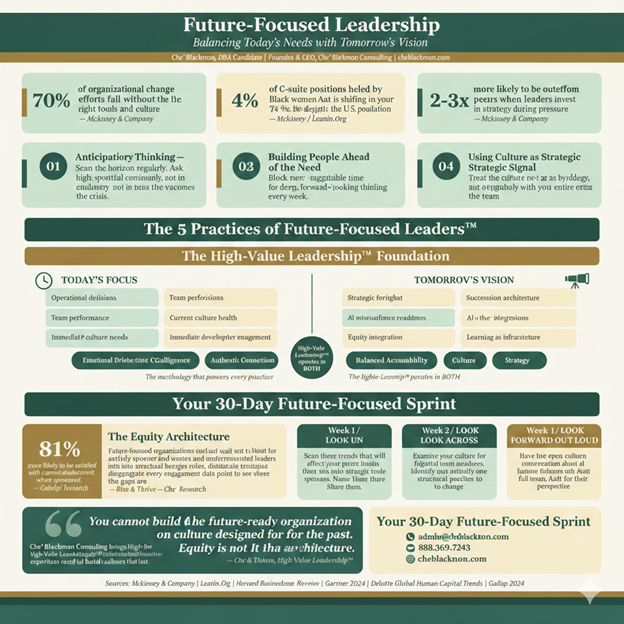
In High-Value Leadership: Transforming Organizations Through Purposeful Culture, the five pillars of the High-Value Leadership™ methodology provide the foundation for this dual awareness. Purpose-Driven Vision gives the leader the north star. Emotional Intelligence gives the leader the capacity to lead people through ambiguity. Authentic Connection builds the trust that sustains an organization through uncertainty. Balanced Accountability ensures that standards are maintained even when the path forward is not yet clear. And Culture as Strategy ensures that every decision, near-term and long-term, is made in service of the organization’s highest values.
Together these five pillars do not just define great leadership. They define future-ready leadership.
| “ “Organizations that only manage the present will always be surprised by the future. High-value leaders design what comes next.” — Che’ Blackmon, High-Value Leadership™ |
📈 Why the Present and Future Are Not Competing Priorities
One of the most persistent and damaging myths in organizational leadership is the idea that leaders must choose between managing today and building for tomorrow. This framing produces leaders who feel perpetually behind because they believe that tending to operational demands means they are neglecting strategic development, and vice versa.
The reality is more nuanced and far more hopeful. The present and the future are not competing priorities. They are expressions of the same organizational purpose operating at different time horizons. When a leader makes a hiring decision today, that decision shapes what the organization is capable of in three years. When a leader invests in psychological safety today, that investment produces the innovation the organization will depend on next year. When a leader develops a high-potential employee today, that investment creates the next generation of organizational leadership.
Deloitte’s Global Human Capital Trends research consistently identifies organizational agility as one of the top requirements for business survival in the current economic environment. Agility, however, is not the ability to react quickly to the present. It is the capacity to have built, in advance, the people, the culture, and the processes needed to respond intelligently to whatever comes next. Agility is future-focused leadership made operational.
🔄 The Integration Imperative
The leaders who navigate this balance most effectively are those who have learned to see every present-day decision as a future-building opportunity. This does not require ignoring urgency. It requires reframing how urgency is understood.
There was a nonprofit organization navigating a leadership transition at the same time it was facing a funding shortfall. The new executive director could have spent all of her energy on the immediate crisis. Instead, she used the transition period to do something that felt counterintuitive in the moment: she slowed down to get honest about the organization’s culture, its values, and the kind of leadership it needed to thrive not just through the crisis but beyond it. She restructured meetings to include a standing agenda item called “What are we building toward?” even when the immediate pressure was “How do we make payroll?” That practice became the discipline that eventually carried the organization into its strongest fundraising year on record.
The present crisis did not disappear. It was resolved precisely because leadership never stopped building for the future while managing it.
| 💡 Research Spotlight McKinsey & Company’s research on organizational resilience found that companies that continued strategic investment during periods of economic pressure outperformed their peers by 2 to 3 times over the following economic cycle. Resilience is not the ability to survive a crisis. It is the discipline of building during one. |
🚀 The Five Practices of Future-Focused Leaders
Future-focused leadership is not an abstract philosophy. It is a set of specific, learnable practices that leaders can develop and embed into their daily leadership rhythms. The five practices below represent the intersection of research on strategic leadership, the High-Value Leadership™ methodology, and the practical realities of leading organizations through complexity.
| 01 | Practicing Anticipatory Thinking Anticipatory thinking is the disciplined habit of scanning the horizon before the horizon becomes the crisis. It means regularly asking: what is shifting in our industry, our workforce, and our competitive environment that we are not yet paying attention to? Leaders who practice this habit use tools like environmental scanning, trend analysis, scenario planning, and structured futures conversations to move from reactive to proactive. The goal is not to predict the future with certainty. It is to be surprised less often. |
| 02 | Building People Ahead of the Need The most common version of this mistake is waiting until a leadership gap is visible before investing in the people who could fill it. Future-focused leaders develop talent continuously, not in response to vacancies. They identify high-potential team members, invest in their growth, create visibility for their capabilities, and sponsor them into stretch roles before those roles become critical. This practice transforms talent development from a reactive HR function into a strategic organizational asset. |
| 03 | Protecting Strategic Thinking Time This practice sounds simple and is among the hardest to maintain. Future-focused leaders deliberately protect blocks of time for deep, forward-looking thinking that are not available for meetings, operational problem-solving, or email. Research from Microsoft’s Work Trend Index found that leaders who blocked protected time for strategic thinking reported significantly higher confidence in their organization’s direction and significantly lower decision fatigue. The future does not get built during back-to-back meetings. It gets built in the quiet spaces leaders choose to protect. |
| 04 | Using Culture as a Strategic Signal Culture is the single most powerful signal an organization sends about its future priorities. When leaders invest in culture, they are not just making the present more pleasant. They are building the organizational architecture that will determine what the organization is capable of achieving. As Mastering a High-Value Company Culture establishes, culture is the lifeblood of any organization. Future-focused leaders treat culture not as a byproduct of strategy but as strategy itself. |
| 05 | Leading Through Transparent Communication Nothing erodes future orientation faster than a communication vacuum. When leaders fail to articulate where the organization is headed and why, people fill the silence with speculation, anxiety, and self-protective behavior. Future-focused leaders communicate about the future regularly, honestly, and in the language of shared purpose. They acknowledge uncertainty without retreating from vision. They tell people not just what is happening but what it means and where it leads. |
🌎 Current Trends Reshaping the Future of Leadership
Future-focused leadership does not happen in a vacuum. It happens in the context of powerful forces reshaping what organizations are, what they require, and what leadership must become to meet those requirements. Three trends in particular are redefining the leadership mandate right now.
🤖 Artificial Intelligence and the Augmented Organization
Artificial intelligence is not a future development in organizational life. It is a present reality changing how work is done, who does it, and what human leaders need to focus on. Gartner’s 2024 research found that 76 percent of HR leaders reported that their managers were overwhelmed by the scope of expanding responsibilities, and AI integration is a primary driver of that expansion.
Future-focused leaders are distinguishing themselves not by their technical expertise in AI but by their clarity about what AI cannot replace: judgment, empathy, contextual understanding, and the human capacity to build trust. The leaders who are winning in this environment are those who are investing in the skills that AI augments rather than replicates, and building organizational cultures where humans and technology are genuinely complementary rather than competing.
The equity dimension of AI adoption also demands leadership attention. Research from the Brookings Institution has identified that the workers most vulnerable to AI-related job displacement are disproportionately workers of color and women. Future-focused leaders who are also equity-conscious leaders are asking now, not later, how their AI adoption strategy will affect the most vulnerable members of their workforce and what investment they are making to ensure the benefits of AI are broadly shared.
👥 The Multi-Generational Workforce
For the first time in history, many organizations are managing workforces that span five distinct generations, from Baby Boomers in senior roles to Generation Z entering the workforce with fundamentally different expectations about work, leadership, and organizational purpose. This is not primarily a management challenge. It is a culture challenge.
Gallup’s 2024 State of the Global Workplace report found that employees’ expectations for meaningful work, manager quality, and organizational values alignment have reached an all-time high across every generation. The generational gap is not primarily about technology or communication style. It is about what people need to find their work meaningful and their leadership trustworthy.
Future-focused leaders are building cultures sophisticated enough to honor those shared needs while remaining flexible enough to meet them in different ways. They are asking not just “How do we manage this generation?” but “What are all of our people trying to tell us about what leadership needs to become?
🌍 The Equity Imperative in Strategic Planning
Organizational equity is no longer a values statement. It is a business strategy and a competitive advantage. Research from McKinsey consistently shows that organizations in the top quartile for gender and racial diversity are significantly more likely to outperform their peers financially. The pipeline of diverse talent is there. The leadership investment in creating pathways for that talent has, in most organizations, not kept pace.
Future-focused leaders understand that building an organization capable of thriving in an increasingly diverse market and workforce requires building an internal culture that reflects, develops, and advances diverse talent. This is not altruism. It is organizational intelligence.
| “ “You cannot build a future-ready organization on a culture designed for the past. Equity is not the destination. It is the architecture.” — Aligned with High-Value Leadership™ — Culture as Strategy` |
💎 The Unique Position of Black Women in Future-Focused Leadership
Any honest conversation about the future of leadership must include an honest conversation about who has historically been excluded from that future. And among the groups most consequentially excluded from strategic leadership in corporate America, Black women occupy a category that demands specific attention.
The data from LeanIn.Org and McKinsey’s 2023 Women in the Workplace report is stark and familiar. Black women hold 4 percent of C-suite positions despite making up approximately 7.4 percent of the U.S. population. Their representation decreases at every level of advancement from entry-level management through executive leadership. And research from Catalyst documents that Black women are more likely than any other demographic group to report that their leadership potential is underestimated, that their ideas are credited to others, and that their advancement is blocked by structural barriers rather than individual performance.
This is not a future problem. It is a present one with future consequences. Organizations that continue to exclude Black women from strategic leadership are building the future with a fraction of their available intelligence, perspective, and capability.
🔑 The Strategic Value of What Has Been Excluded
In Rise & Thrive: A Black Woman’s Blueprint for Leadership Excellence, the argument is made with both data and conviction: Black women do not just deserve seats at the table. They bring a perspective, a resilience, and a relational intelligence that has been refined by navigating environments not designed for their success. That navigation is not incidental experience. It is leadership development of the most demanding kind.
Research from the Center for Talent Innovation found that Black women are among the most ambitious employees in the American workforce. They are more likely than their white counterparts to want to advance to senior leadership. They are more likely to pursue graduate education and professional development. And they are more likely to leave organizations that fail to recognize and invest in their ambition, at significant cost to those organizations.
Future-focused organizations are recognizing this equation before talent walks out the door. They are building sponsorship programs specifically designed to accelerate Black women through the leadership pipeline. They are examining the structural barriers in their promotion processes. They are disaggregating engagement and advancement data to see where the gaps are and taking genuine accountability for closing them.
🏆 What Future-Focused Leadership Looks Like for Black Women Themselves
For Black women currently navigating corporate environments while also building leadership capability and managing the additional cognitive load that comes with being among the “only ones” in the room, future-focused leadership has a personal dimension that generic leadership development frameworks rarely address.
It means claiming the strategic value of the perspective you have earned. The ability to read a room, to build trust across difference, to persist with integrity under pressure: these are not soft skills. They are advanced leadership capabilities that most executive development programs take years to produce in leaders who never had to develop them in survival conditions.
It means building strategic visibility deliberately, not waiting to be noticed but architecting the conditions under which your contributions are seen, credited, and advanced. As Rise & Thrive frames it: the goal is not just to have a seat at the table. The goal is to understand the architecture of the table well enough to rebuild it.
And it means finding and building the community of sponsors, mentors, peers, and advocates who make the long game survivable. Research consistently shows that the single highest-impact career accelerator for Black women in corporate environments is sponsorship, not mentorship. A mentor advises. A sponsor opens doors. Future-focused Black women leaders are actively identifying and cultivating sponsors who will use their influence on their behalf.
| 📊 The Data That Demands Action Catalyst research found that Black women who had a sponsor were 81% more likely to be satisfied with their career advancement than those without one. Sponsorship during the formative stages of a career can close the structural gaps that performance alone cannot bridge. If your organization does not have a formal sponsorship program, it is building its future without half of its available leadership talent. |
🧭 Building a Future-Focused Culture: The Organization’s Role
Individual future-focused leadership is necessary. It is not sufficient. The most capable, vision-driven, equity-committed leader in an organization will be limited by an organizational culture that does not support future orientation at the structural level. Building a future-focused organization requires embedding future orientation into the culture itself.
Mastering a High-Value Company Culture makes the case that culture is not the product of good intentions or leadership speeches. It is the product of consistent behaviors, aligned systems, and structural reinforcement over time. A future-focused culture is built through the same deliberate mechanisms.
🏛️ Structural Practices of Future-Focused Organizations
Strategic Foresight as a Standing Practice 🔭
Future-focused organizations do not just conduct strategic planning annually. They build foresight into their regular operating cadence. Quarterly environmental scans, standing agenda items for emerging trends, scenario planning exercises, and structured conversations about organizational futures are embedded into the leadership rhythm. The future is not a once-a-year conversation. It is a continuous one.
Succession Architecture Built Before the Need 🏗️
Organizations that invest in succession planning before they have a crisis to manage are building the most important form of organizational resilience: leadership continuity. This means identifying the critical roles across the organization, assessing who is being developed to fill them, creating active development plans for high-potential candidates, and tracking progress with the same rigor as financial metrics. It also means examining who is absent from those succession pools and why.
Learning as a Strategic Investment 📚
The LinkedIn Workplace Learning Report consistently identifies continuous learning culture as one of the top predictors of organizational resilience. Organizations that invest in learning are not just keeping their people current. They are building the adaptive capacity that makes organizational evolution possible. Future-focused organizations budget for learning the way they budget for infrastructure because it is infrastructure.
Feedback Loops That Actually Inform the Future 🔄
Future-focused organizations have mechanisms for bringing frontline intelligence into strategic decision-making. They recognize that the people closest to the work often see the future most clearly: what customers are asking for, what processes are breaking down, what capabilities are missing. Creating genuine feedback loops, not performance reviews or engagement surveys that get filed away, but real mechanisms for organizational intelligence to flow upward, is one of the highest-leverage investments a future-focused culture can make.
🏆 A Case Study in Future-Focused Leadership
There was a regional financial services firm that had operated successfully for several decades with a leadership team that was almost entirely homogeneous, senior, and deeply embedded in the practices that had produced past success. The firm was profitable. It was also falling behind. Younger clients were choosing competitors with more digitally agile service models. The pipeline of mid-level talent was leaking. And the leadership team, for all its experience, had almost no representation from the communities that made up the growing majority of its client base.
A new chief people officer arrived with a mandate that was simultaneously operational and strategic: stabilize talent retention and build a leadership pipeline for the next decade. Her approach was precisely future-focused in the way this article defines it.
She began not by reorganizing or restructuring but by diagnosing. She commissioned a culture assessment that revealed a fundamental misalignment: the firm’s stated values emphasized innovation and client-centricity, but its actual practices rewarded tenure and conformity. The future it said it wanted and the present it was actually building were not the same organization.
From that diagnosis she built a three-year talent strategy that did two things simultaneously. It addressed the present by redesigning onboarding and early career development programs that had a 40 percent dropout rate in the first eighteen months. And it invested in the future by creating a formal sponsorship program specifically targeting high-potential employees from underrepresented backgrounds, including several Black women in analytical and client service roles who had strong performance records and no organizational visibility.
Three years later, the firm had reduced early-career attrition by more than half. Two of the women from the sponsorship cohort had moved into director-level roles. And the leadership team had its first two members from communities of color in the firm’s history, both of whom were credited with leading the digital transformation of the firm’s client engagement model.
The present and the future had been built at the same time. Neither was sacrificed for the other. And the firm’s most important competitive assets going forward were the people they had almost let walk out the door.
| “ “Future-focused leadership is not about predicting what comes next. It is about building organizations worthy of the people who will lead them there.” — Che’ Blackmon |
📋 Actionable Takeaways for Leaders at Every Level
Future-focused leadership is not a transformation that happens overnight. It is a direction that is chosen and then reinforced through practice. The following takeaways are designed to be applicable regardless of your current role, your organization’s size, or the urgency of the present demands you are navigating.
| 01 | Audit Your Calendar Your calendar is the most honest map of your actual priorities. How much time do you spend reacting versus building? Block one hour per week as non-negotiable strategic thinking time. Protect it. Name it. Treat it with the same seriousness as your most important client meeting. That one hour, maintained consistently over a year, will produce more organizational value than the vast majority of meetings it replaces. |
| 02 | Name Your Horizon Clarity about the future begins with being specific about what future you are building toward. Not a tagline. An actual, honest articulation of what this organization is trying to become in three to five years and why that matters. If you cannot articulate it clearly, you cannot lead toward it. If your team cannot articulate it, they are not building toward it either. |
| 03 | Identify the Three People You Are Building Look at your team right now. Who are the three people with the highest potential for the next level of leadership? Are you actively investing in their development? Do they have sponsors who are advocating for them in rooms they are not yet in? If you cannot name them immediately, that gap is one of the most important future-focused investments you can make right now. |
| 04 | Ask the Equity Question Every Time Every decision about talent, about culture, and about organizational direction should be accompanied by the equity question: who benefits from this decision and who is disadvantaged by it? Not because equity is a constraint on strategy. Because organizations that build equity into their strategic architecture have access to the full breadth of human capability. Those that do not are building the future with one hand tied behind their back. |
| 05 | Tell the Future Story Now Do not wait until the strategy is perfect to communicate it. People cannot orient themselves toward a destination that has not been named. Talk about the future of your organization openly, honestly, and regularly. Include your team in shaping it. The act of naming the future together is itself a future-building practice. It creates shared ownership of a direction rather than employee compliance with a plan. |
🤔 Discussion Questions
Use these questions individually or with your leadership team to deepen your practice of future-focused leadership.
- What is the ratio of time your leadership team currently spends on operational management versus strategic development? Is that ratio intentional, and if not, what would you change it to?
- Who are the people in your organization with the highest future leadership potential? What structured investment is being made in their development, and who is sponsoring their advancement?
- What signals from your external environment, your workforce, and your industry are you currently paying insufficient attention to? What would it take to make anticipatory thinking a regular practice in your leadership?
- When you disaggregate your succession planning data by race and gender, what does it reveal? If your future leadership pipeline does not reflect the diversity of your workforce and the communities you serve, what is the first structural change you need to make?
- How clearly can you articulate your organization’s future direction in language your entire team would recognize and believe? What is the gap between the future you say you are building and the present you are actually constructing?
- For Black women and other underrepresented leaders reading this article: what does your organization’s future currently offer you? And what would you need to see, structurally, to believe it is being built with you rather than around you?
📋 Next Steps: Your 30-Day Future-Focused Leadership Sprint
The distance between reading and leading is action. Here is a four-week plan to begin practicing future-focused leadership immediately, regardless of where you are starting from.
| Week 1 | Look Up Dedicate one hour to an honest environmental scan of your industry. What are three trends that will materially affect your organization in the next three years? Write them down. Share them with your leadership team. Begin the conversation about what they require. |
| Week 2 | Look In Conduct a talent audit focused on the future. Who are the three highest-potential people on your team? Who is sponsoring them? What development investment is currently in place? Identify the single most important gap and commit to a concrete action to begin closing it. |
| Week 3 | Look Across Examine your culture for future-readiness. Review how decisions are currently made, how feedback flows, how learning is resourced, and how succession is planned. Identify the one cultural practice that most limits your organization’s future orientation and propose one structural change. |
| Week 4 | Look Forward Out Loud Communicate about the future with your full team. Not a polished presentation. An honest, open conversation about where you are going, what you are building, and what their role is in shaping it. Ask for their perspective. Listen without defensiveness. The future belongs to everyone who helps build it. |
🌱 Ready to Lead Into the Future?
Che’ Blackmon Consulting partners with organizations and leaders committed to building cultures that are not just strong today but genuinely ready for tomorrow. Through the High-Value Leadership™ methodology, fractional HR leadership, and culture transformation consulting, we bring the frameworks, the expertise, and the equity-centered perspective to help you build organizations that last.
The future of your organization is being built right now. The question is whether you are building it on purpose.
📧 admin@cheblackmon.com 📞 888.369.7243 🌐 cheblackmon.com
About the Author
Che’ Blackmon is the Founder and CEO of Che’ Blackmon Consulting (CBC), a Michigan-based culture transformation consultancy. She is a DBA Candidate in Organizational Leadership at National University, with dissertation research focused on AI-enhanced predictive analytics for culture transformation and employee turnover prevention. With more than 24 years of progressive HR leadership experience across manufacturing, automotive, healthcare, and professional services, Che’ is the published author of High-Value Leadership: Transforming Organizations Through Purposeful Culture, Mastering a High-Value Company Culture, and Rise & Thrive: A Black Woman’s Blueprint for Leadership Excellence. She hosts the podcast Unlock, Empower, Transform with Che’ Blackmon and the Rise & Thrive YouTube series. Learn more at cheblackmon.com.
#FutureFocusedLeadership, #HighValueLeadership, #LeadershipDevelopment, #CultureTransformation, #StrategicLeadership, #OrganizationalChange, #WorkplaceCulture, #BlackWomenLead, #InclusiveLeadership, #HRLeadership, #SuccessionPlanning, #EmployeeEngagement, #FractionalHR, #CheBlackmon, #UnlockEmpowerTransform