The Trust Equation: Building Relationships That Deliver Results

By Che’ Blackmon Founder & CEO, Che’ Blackmon Consulting DBA Candidate in Organizational Leadership

In organizational leadership, trust is not a soft skill relegated to team building exercises and annual retreats. It is the fundamental currency of high performance. Without trust, even the most brilliant strategies collapse under the weight of organizational dysfunction, political maneuvering, and cultural toxicity. Yet trust remains one of the most misunderstood and poorly cultivated elements of corporate success.

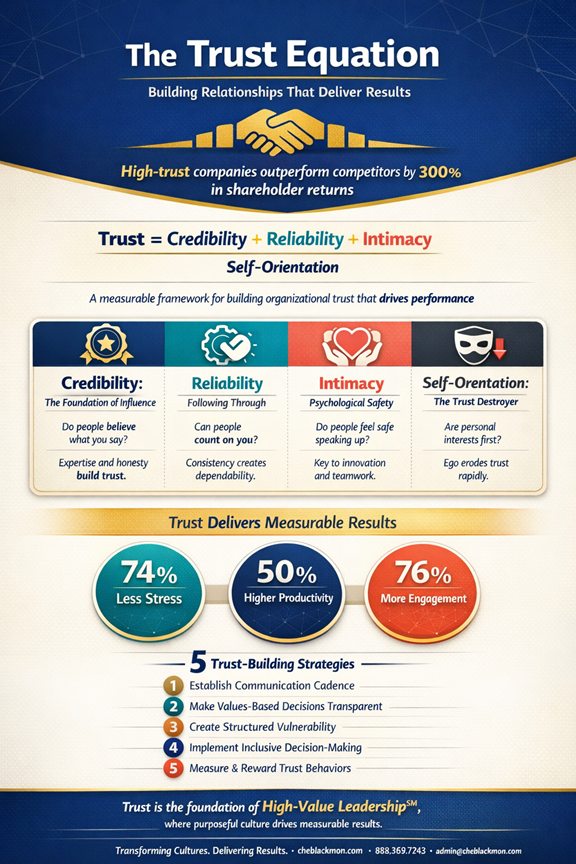
Consider this: According to research from the Harvard Business Review, employees at high-trust companies report 74% less stress, 50% higher productivity, and 76% more engagement than those at low-trust organizations. The financial implications are equally compelling. Companies with high-trust cultures outperform their competitors by nearly 300% in total shareholder returns. Trust is not abstract. It translates directly to your bottom line, your retention metrics, and your ability to attract and develop exceptional talent.

This article explores the trust equation as both a leadership framework and a strategic imperative for organizational transformation, drawing from research in organizational behavior, decades of HR leadership experience across manufacturing and automotive sectors, and practical insights from building high-value company cultures that deliver measurable results.
๐Ÿ’Ž Understanding the Trust Equation

The trust equation, originally developed by David Maister, Charles Green, and Robert Galford, provides a mathematical framework for understanding what builds and erodes trust in professional relationships:

Trust = (Credibility + Reliability + Intimacy) รท Self-Orientation

Let’s examine each component and its implications for organizational leadership.

๐ŸŽฏ Credibility: The Foundation of Influence

Credibility answers the question: Do people believe what you say? In organizational contexts, credibility emerges from demonstrated expertise, consistent communication of accurate information, and the willingness to admit when you don’t have all the answers. Leaders with credibility don’t pretend to be infallible. They acknowledge complexity, cite sources, and make decisions based on data rather than ego.

There was a manufacturing company facing chronic quality issues that threatened a major automotive contract. The CEO could have deflected blame or manufactured optimistic projections. Instead, she brought the entire leadership team together, presented unvarnished production data, acknowledged the severity of the situation, and outlined a realistic 90-day improvement plan with weekly transparency reports to all stakeholders. Her credibility soared not because she had easy answers but because she refused to insult their intelligence with corporate spin.

For traditionally overlooked employees, particularly Black women navigating predominantly white corporate spaces, credibility faces additional barriers. Research from the Center for Talent Innovation reveals that Black women must often work harder to establish credibility, facing what scholars call the credibility tax. They are more likely to have their expertise questioned, their accomplishments attributed to external factors like affirmative action, and their leadership capabilities doubted. Building credibility in these environments requires not just competence but strategic visibility, calculated risk-taking, and the cultivation of sponsors who can amplify your expertise.

โš™๏ธ Reliability: Following Through on Commitments

Reliability asks: Can people count on you to do what you said you would do? This seems straightforward until you recognize how frequently leaders make commitments they cannot keep. Every cancelled one-on-one meeting, every delayed decision, every forgotten promise erodes the reliability component of trust. Reliability compounds over time. Leaders who consistently deliver on small commitments build reserves of trust that sustain them through inevitable failures on larger initiatives.

Consider the experience of a technology startup that promised its engineering team flexible work arrangements, then abruptly mandated full-time office attendance when venture capital funding arrived. The policy reversal destroyed reliability overnight. Engineers who had structured their lives around flexibility felt betrayed. Within six months, the company lost 40% of its technical talent, delaying product launches and damaging its reputation in the competitive talent market.

The lesson is clear: leaders must underpromise and overdeliver rather than making grandiose commitments they lack the authority or resources to fulfill. Reliability requires realistic assessment of capacity, transparent communication about constraints, and the courage to say no when you cannot responsibly commit.

For Black women and other marginalized groups, unreliable leadership has particularly devastating effects. When leaders promise diversity initiatives, mentorship programs, or pathways to advancement but fail to follow through, it confirms suspicions that inclusion efforts are performative rather than genuine. This erosion of trust creates what organizational psychologists call minority stress, the additional cognitive and emotional burden of navigating predominantly white institutions while managing constant microaggressions and broken promises.

๐Ÿค Intimacy: Creating Psychological Safety

Intimacy in the trust equation does not refer to personal closeness but to the safety people feel when they share concerns, admit mistakes, or voice dissenting opinions. Organizations with high intimacy are characterized by psychological safety, the belief that you won’t be punished or humiliated for speaking up. Research by Dr. Amy Edmondson at Harvard Business School demonstrates that psychological safety is the strongest predictor of team effectiveness, innovation, and learning velocity.

Leaders create intimacy through vulnerability. When a senior executive admits uncertainty, acknowledges a failed initiative, or asks for help, it signals that imperfection is acceptable. This permission to be human cascades through the organization. Teams become willing to surface problems early rather than hiding them until they metastasize into crises.

There was a healthcare organization whose culture punished dissent so aggressively that nurses stopped reporting medication errors, fearing retaliation. Patient safety incidents increased by 300% over two years before the board intervened, replacing the executive team with leaders trained in high-reliability organizations. The new leadership implemented anonymous reporting systems, held monthly listening sessions, and publicly celebrated employees who identified process failures. Within 18 months, reported incidents increased (a positive indicator of transparency) while actual patient harm decreased by 60%.

For Black women in corporate environments, psychological safety is often absent. Research published in the Journal of Vocational Behavior found that Black women report the lowest levels of psychological safety among all demographic groups, navigating what scholars describe as a concrete ceiling rather than a glass one. They face penalty for displaying too much emotion or too little, for being too assertive or insufficiently confident. This impossible calculus makes authentic participation exhausting. Leaders building trust with diverse teams must recognize that intimacy requires dismantling the informal penalties that punish difference.

๐ŸŽญ Self-Orientation: The Trust Destroyer

Self-orientation is the denominator in the trust equation, which means it has multiplicative destructive power. High self-orientation appears when leaders prioritize their own interests, ego, or advancement over the needs of their teams and organizations. It manifests in credit-stealing, blame-shifting, political maneuvering, and decisions that optimize personal visibility rather than organizational outcomes.

The mathematics are unforgiving. A leader might score highly on credibility, reliability, and intimacy, but if self-orientation is high, trust collapses. Employees can forgive occasional incompetence. They rarely forgive self-serving behavior masquerading as leadership.

Consider the executive who championed a major operational improvement project, celebrated publicly when it succeeded, but privately blamed the implementation team when components failed. His credibility, initially high due to technical expertise, evaporated as employees recognized his pattern of claiming credit while deflecting accountability. Within a year, his department experienced the highest turnover rate in the company.

Reducing self-orientation requires uncomfortable self-awareness. It means asking: Am I making this decision because it’s right for the organization or because it makes me look good? Am I promoting this person because they’re the best candidate or because they’re loyal to me? Am I pushing this initiative because it solves a real problem or because I want to be associated with innovation? These questions are difficult precisely because self-interest is often unconscious, rationalized through elaborate justifications that disguise ego as strategy.

For traditionally overlooked employees, high self-orientation among leaders translates to tokenism, performative diversity, and the perpetuation of exclusive networks that maintain power for existing elites. When leaders prioritize their own comfort over systemic change, diversity initiatives become box-checking exercises rather than genuine transformation.

๐Ÿ—๏ธ Building Trust in Organizational Transformation

The trust equation provides a diagnostic framework, but organizational transformation requires systematic application of trust-building principles. In my work developing AI-enhanced predictive analytics for culture transformation, one pattern emerges consistently: companies that successfully transform their cultures prioritize trust metrics as early indicators of systemic health.

Traditional engagement surveys measure satisfaction after the fact. Advanced predictive models identify trust erosion 3 to 6 months before it manifests in turnover, absenteeism, or productivity declines. These systems track communication patterns, response times to employee concerns, consistency between stated values and resource allocation, and the distribution of opportunities across demographic groups.

There was a professional services firm that implemented trust metrics alongside traditional performance indicators. They discovered that teams with the highest billable hours had the lowest trust scores, indicating that short-term revenue optimization was destroying long-term sustainability. The firm restructured incentives to reward trust-building behaviors like mentorship, knowledge sharing, and collaborative problem-solving. Within 18 months, both trust scores and revenue increased, disproving the false dichotomy between relationship investment and financial performance.

๐ŸŒŸ Trust as the Foundation of High-Value Culture

A high-value company culture, as articulated in my books “Mastering a High-Value Company Culture” and “High-Value Leadership: Transforming Organizations Through Purposeful Culture,” is fundamentally built on trust. You cannot have accountability without trust. You cannot have innovation without trust. You cannot have diversity and inclusion without trust. Every positive organizational attribute depends on this foundation.

High-value cultures are characterized by several trust-dependent attributes. First, they exhibit high challenge and high support, creating environments where people are pushed to excellence while knowing they will be supported through inevitable struggles. Second, they demonstrate transparency in decision-making, helping employees understand the logic behind strategic choices even when those choices are difficult. Third, they maintain consistency between espoused values and actual practices, ensuring that mission statements reflect reality rather than aspirational fiction.

The automotive sector provides powerful examples of trust-based transformation. When the Detroit Lions underwent cultural transformation under their current leadership, they didn’t just change personnel. They fundamentally altered the trust dynamics of the organization. Leaders established credibility through transparent communication about the rebuilding process. They demonstrated reliability by following through on development commitments to players. They created intimacy by acknowledging past failures and vulnerability. They reduced self-orientation by making decisions based on long-term team success rather than short-term wins that would boost individual reputations.

The results speak for themselves. From chronic underperformance to championship contention, the Lions transformed not through individual talent alone but through building a trust-based culture that maximized collective capability. This same blueprint applies across industries. Trust is not sector-specific. It is the universal foundation of organizational excellence.

๐Ÿš€ Practical Strategies for Building Trust

Understanding the trust equation intellectually is necessary but insufficient. Leaders must translate framework into action through deliberate practices that build trust systematically. The following strategies have proven effective across organizations ranging from 20 to 2,000 employees.

1๏ธโƒฃ Establish Communication Cadence and Consistency

Trust requires predictability. Establish regular communication rhythms and maintain them religiously. Weekly team meetings at the same time. Monthly all-hands presentations. Quarterly strategic updates. The specific frequency matters less than consistency. When leaders cancel repeatedly or reschedule based on their convenience rather than team needs, reliability erodes.

Beyond meetings, establish response time norms. If you commit to responding to employee questions within 24 hours, honor that commitment even when the response is “I’m still working on this and will have an update by Friday.” Silence breeds anxiety and speculation. Predictable communication, even when the message is difficult, builds trust.

2๏ธโƒฃ Make Values-Based Decisions Transparent

When you make difficult decisions, explain the values-based reasoning behind them. Don’t just announce the decision. Walk people through the trade-offs you considered, the criteria you used, and how your choice aligns with organizational values. This transparency builds credibility and helps employees develop better judgment for their own decisions.

There was a company that needed to reduce headcount during an economic downturn. The CEO could have issued a terse announcement and moved on. Instead, she held a company-wide meeting where she explained the financial realities, the alternatives she had considered (reduced hours, executive pay cuts, delayed expansion), the decision-making framework she used (preserving technical talent critical to future growth), and the severance packages she had negotiated. She took questions for two hours. While the decision was painful, trust actually increased because employees understood the logic and saw that the choice, while difficult, was made with integrity.

3๏ธโƒฃ Create Structured Vulnerability

Psychological safety requires leaders to model vulnerability first. Create structured opportunities to share challenges, admit mistakes, and ask for help. In leadership team meetings, start with a round where each person shares one area where they’re struggling. In all-hands meetings, acknowledge recent failures and what you learned from them. In one-on-one conversations, ask for feedback on your leadership and demonstrate you value the input by acting on it.

Vulnerability must be genuine rather than performative. Employees recognize the difference between authentic admission of difficulty and calculated humility designed to seem relatable. The test is whether you’re willing to be vulnerable about things that might genuinely affect how people perceive your competence, not just safe admissions that everyone already knows.

4๏ธโƒฃ Implement Inclusive Decision-Making Processes

Trust erodes when decisions consistently favor the same people or perspectives. Implement processes that ensure diverse voices influence outcomes. This might mean rotating who leads strategic initiatives, deliberately seeking input from junior employees before senior ones speak (to avoid groupthink), or using anonymous feedback mechanisms when hierarchy might suppress honest communication.

For Black women and other traditionally overlooked employees, inclusive processes are not optional nice-to-haves. They are essential to building trust that the organization genuinely values their perspectives rather than tokenizing their presence. As I outline in “Rise & Thrive: A Black Woman’s Blueprint for Leadership Excellence,” Black women must often navigate the additional burden of representing their entire demographic while fighting assumptions about their capabilities. Leaders who build trust create systems that distribute voice and influence based on merit and insight rather than proximity to power.

5๏ธโƒฃ Measure and Reward Trust-Building Behaviors

Organizations get what they measure and reward. If you measure only individual performance, you incentivize self-orientation. If you measure team outcomes, collaboration, mentorship, and knowledge sharing, you incentivize trust-building behaviors. Incorporate trust metrics into performance evaluations. Recognize and promote leaders who develop others, not just those who deliver short-term results.

Advanced analytics can track these behaviors systematically. Communication pattern analysis can identify leaders who hoard information versus those who share generously. Network analysis can reveal who serves as connectors across organizational silos. Turnover analysis can identify which leaders retain and develop talent versus which ones churn through people in pursuit of results.

โš ๏ธ Trust Barriers for Traditionally Overlooked Populations

While the trust equation applies universally, its application is not neutral. Traditionally overlooked populations, particularly Black women, face systemic barriers that complicate trust-building in corporate environments. Understanding these barriers is essential for leaders committed to genuine inclusion rather than performative diversity.

๐Ÿšง The Double Bind of Assertiveness

Black women face what researchers call the double bind: behaviors that build trust when exhibited by white men are interpreted as threatening or inappropriate when exhibited by Black women. Assertiveness becomes aggression. Confidence becomes arrogance. Direct communication becomes unprofessional. This impossible calculus means Black women must expend enormous cognitive energy calculating how to communicate in ways that build rather than erode trust, often requiring them to soften language, add qualifiers, and perform deference that undermines their own credibility.

Leaders who want to build trust with Black women must recognize this dynamic and actively work against it. This means intervening when you observe differential reactions to similar behaviors across demographic groups. It means examining your own reactions when a Black woman communicates directly. It means creating explicit permission for assertiveness rather than forcing women of color to navigate an invisible maze of racial and gender expectations.

๐Ÿšง The Sponsorship Gap

Trust-building in organizations happens partly through formal channels but significantly through informal networks and sponsorship relationships. Research from the Center for Talent Innovation shows that Black women are significantly less likely to have sponsors who advocate for them in promotion discussions, connect them to high-visibility projects, and provide air cover when they take risks.

This sponsorship gap compounds over time. Without sponsors, Black women have fewer opportunities to demonstrate competence on high-stakes projects, which means they build less credibility, which means they’re less likely to attract sponsors. The cycle perpetuates itself. Leaders who want to build trust must deliberately sponsor talented Black women, using their own credibility to amplify theirs.

๐Ÿšง The Authenticity Penalty

Psychological safety, the intimacy component of trust, requires authenticity. Yet Black women in predominantly white corporate spaces often feel pressure to code-switch, downplay cultural identity, and perform whiteness to fit in. Research published in the Journal of Applied Psychology found that this pressure to suppress authentic identity creates chronic stress, reduces job satisfaction, and increases turnover intentions.

Leaders who want to build trust must create environments where cultural authenticity is not just tolerated but celebrated. This means examining dress codes that penalize natural hair. It means recognizing that effective communication takes many forms beyond the white, middle-class norms that dominate corporate America. It means understanding that inclusivity is not requiring everyone to assimilate but rather expanding organizational norms to accommodate diverse ways of being professional.

๐Ÿ”ฎ The Future of Trust: AI-Enhanced Culture Transformation

As organizations become more complex and distributed, maintaining trust at scale requires technological augmentation. My doctoral research focuses on AI-enhanced predictive analytics for culture transformation, specifically identifying trust erosion before it manifests in turnover. These systems represent the next frontier in proactive organizational development.

Advanced analytics can track communication patterns that indicate declining trust. When response times to employee questions increase, when meeting attendance drops, when collaboration decreases, when informal social connections weaken, these patterns predict turnover 3 to 6 months in advance. This early warning system allows leaders to intervene before valuable employees disengage completely.

More importantly, predictive analytics can identify disparities in how trust-building behaviors are distributed across demographic groups. If Black women receive fewer mentorship opportunities, less access to high-visibility projects, or slower responses to their ideas, data surfaces these patterns in ways that anecdotal evidence cannot. This creates accountability for inclusive practices.

The goal is not to replace human judgment but to augment it. Leaders need data to identify patterns they might miss, early warning signals that prevent crises, and objective measures of progress toward cultural goals. AI becomes a tool for building more trustworthy organizations, not replacing the fundamentally human work of relationship-building.

๐Ÿ’ก Key Takeaways

The trust equation provides a powerful framework for understanding and building the most critical element of organizational success. Trust is not a soft skill. It is the hard infrastructure that enables everything else: innovation, accountability, collaboration, retention, and financial performance.

For leaders committed to transformation, the path forward is clear. Build credibility through competence and honesty. Demonstrate reliability by following through on commitments. Create intimacy through psychological safety and vulnerability. Reduce self-orientation by prioritizing organizational success over personal advancement. These are not abstract principles. They are daily practices that compound into cultural transformation.

For traditionally overlooked populations, particularly Black women navigating corporate spaces, building and experiencing trust requires confronting systemic barriers that complicate every element of the equation. Leaders who want to create genuinely inclusive cultures must recognize these barriers and actively work to dismantle them through policy, practice, and personal intervention.

The future belongs to organizations that make trust a strategic priority, measuring it, rewarding it, and building it systematically. In an era of increasing organizational complexity, distributed work, and demographic diversity, trust is not optional. It is the competitive advantage that separates high-performing cultures from those that merely survive.

๐Ÿ’ฌ Discussion Questions for Your Leadership Team

Use these questions to spark meaningful conversations about trust in your organization:

1. Where does our organization score highest in the trust equation: credibility, reliability, or intimacy? Where do we score lowest? What specific behaviors contribute to each score?

2. How do we know if self-orientation is influencing our leadership decisions? What systems do we have in place to surface when leaders prioritize personal success over organizational outcomes?

3. Do all employees experience the same levels of trust in our organization, or do traditionally overlooked populations face additional barriers? How would we know?

4. What would it look like to measure trust as rigorously as we measure financial performance? What metrics would we track? How would we use that data?

5. If we implemented one trust-building practice consistently for the next 90 days, which would have the greatest impact on our culture? What prevents us from starting today?

6. How does our promotion and reward system incentivize trust-building behaviors versus individual achievement? What would need to change to better align incentives with our cultural values?

7. When was the last time someone on our leadership team admitted a mistake publicly? What does that tell us about psychological safety at the top of our organization?

๐ŸŽฏ Next Steps: From Insight to Action

Reading about trust is useful. Building it requires action. Here are concrete steps you can take this week:

Conduct a trust audit. Survey your team anonymously using the trust equation framework. Ask employees to rate leadership on credibility, reliability, intimacy, and self-orientation. Compare results across demographic groups to identify disparities.

Establish communication norms. Define and commit to specific communication rhythms: response times, meeting cadences, transparency expectations. Share these norms publicly and hold yourself accountable.

Create structured vulnerability. In your next leadership team meeting, start with a round where each person shares one area where they’re currently struggling. Model the behavior you want to see cascade through the organization.

Review recent decisions through a trust lens. Examine the last three significant decisions your leadership team made. For each, evaluate: Did we communicate the values-based reasoning? Did we follow through on related commitments? Did we involve diverse perspectives? Did we prioritize organizational success over individual advancement?

Identify and address barriers for marginalized employees. Conduct listening sessions with Black women and other traditionally overlooked groups in your organization. Ask specifically about trust barriers they face. Commit to addressing at least one systemic barrier within 90 days.

Measure what matters. Add trust metrics to your organizational dashboard. Track them as rigorously as revenue, productivity, and customer satisfaction. Make trust a standing agenda item in leadership meetings.

๐Ÿค Work with Che’ Blackmon Consulting

Building trust at scale requires expertise, systems, and accountability. Che’ Blackmon Consulting helps organizations transform their cultures through:

โœจ AI-Enhanced Culture Transformation: Predictive analytics that identify trust erosion 3 to 6 months before it manifests in turnover, giving you time to intervene proactively.

โœจ Fractional HR Leadership: Strategic HR guidance for companies with 20 to 200 employees who need senior-level expertise without full-time overhead.

โœจ Executive Coaching for Black Women Leaders: Specialized support for navigating the unique challenges of building credibility, trust, and influence in predominantly white corporate spaces.

โœจ Culture Transformation Consulting: Systematic approaches to building high-value cultures that deliver measurable results in engagement, retention, and performance.

โœจ Leadership Development: Training and workshops based on proven frameworks from “High-Value Leadership,” “Mastering a High-Value Company Culture,” and “Rise & Thrive.”

Ready to build a trust-based culture that drives results?

๐Ÿ“ง Email: admin@cheblackmon.com

๐Ÿ“ž Phone: 888.369.7243

๐ŸŒ Website: cheblackmon.com

Let’s transform your organization together. Because trust is not a luxury. It is the foundation of everything you want to achieve.

About the Author

Che’ Blackmon is the Founder and CEO of Che’ Blackmon Consulting, a Michigan-based culture transformation consultancy. She is a DBA candidate in Organizational Leadership at National University, where her dissertation research focuses on AI-enhanced predictive analytics for culture transformation and employee turnover prevention. With 24+ years of progressive HR leadership experience across manufacturing, automotive, healthcare, and professional services, Che’ has delivered measurable results including 9% increases in employee engagement, 60% improvements in safety metrics, and 96% ratification rates in workplace organization negotiations.

She is the author of three books on leadership and organizational culture: “High-Value Leadership: Transforming Organizations Through Purposeful Culture,” “Mastering a High-Value Company Culture,” and “Rise & Thrive: A Black Woman’s Blueprint for Leadership Excellence.” She hosts the twice-weekly podcast “Unlock, Empower, Transform with Che’ Blackmon” and produces the weekly YouTube series “Rise & Thrive.”

#Leadership #TrustEquation #OrganizationalCulture #HighValueLeadership #CultureTransformation #HR #PeopleAndCulture #ExecutiveLeadership #ChangeManagement #EmployeeEngagement #TrustInLeadership #DiversityAndInclusion #PsychologicalSafety #LeadershipDevelopment #OrganizationalDevelopment #HRLeadership #CorporateCulture #WorkplaceCulture #BusinessLeadership #LeadershipStrategy


๐Ÿ’ Building Beloved Brands: Culture as Your Greatest Marketing Tool ๐Ÿ’

By Che’ Blackmon, DBA Candidate | Founder & CEO, Che’ Blackmon Consulting

Every year, companies spend billions on advertising, influencer partnerships, and marketing campaigns designed to make customers love them. They craft perfect taglines, produce stunning visuals, and purchase premium placements. Yet despite all this investment, many brands remain forgettable. Consumers scroll past their ads, ignore their emails, and feel nothing when they see their logos.

Meanwhile, other organizations spend far less on traditional marketing yet inspire fierce loyalty. Customers become advocates. Employees become ambassadors. Communities form around these brands, defending them during crises and celebrating their wins as personal victories. These are beloved brands.

What separates the beloved from the forgettable? It is not a bigger marketing budget or a cleverer campaign. It is culture. The most beloved brands in the world are built from the inside out, with organizational cultures so strong and authentic that they radiate outward, attracting customers, talent, and partners who share their values.

Culture is not just an HR initiative. It is your greatest marketing tool.

๐Ÿ” The Inside Out Revolution

Traditional marketing operates outside in. It identifies what customers want to hear, then crafts messages designed to appeal to those desires. The product or service may or may not match the promise. The internal culture may or may not reflect the external image. The gap between what is advertised and what is experienced creates cynicism, and modern consumers have developed finely tuned detectors for inauthenticity.

Beloved brands flip this model. They build cultures around genuine values, treat employees in ways that reflect those values, create products and services that embody those values, and then let that authenticity speak for itself. The marketing is not separate from the culture. The culture IS the marketing.

As I explore in High-Value Leadership: Transforming Organizations Through Purposeful Culture, organizations with purposeful cultures do not need to convince anyone of their values. They demonstrate them daily through thousands of interactions, decisions, and moments of truth. This consistency creates trust, and trust creates love.

๐Ÿ“Š The Data Behind Beloved Brands

The business case for culture-driven branding is overwhelming. Research from Deloitte found that mission-driven companies have 30% higher levels of innovation and 40% higher levels of retention compared to their competitors. Glassdoor studies show that companies with strong cultures outperform the S&P 500 by 122%.

Edelman’s Trust Barometer consistently reveals that consumers make purchasing decisions based on trust in an organization’s values, with 81% saying they must be able to trust the brand to do what is right. This trust cannot be manufactured through advertising. It must be earned through consistent, values-aligned behavior.

Perhaps most compelling, research from Harvard Business School found that customers who are emotionally connected to a brand have a 306% higher lifetime value than satisfied customers. They stay longer, spend more, and actively recruit others to the brand. This emotional connection is not created by clever marketing. It is created by genuine experiences that reflect genuine culture.

๐Ÿข Anatomy of a Beloved Brand

What does a culture-driven beloved brand actually look like in practice? Several elements consistently appear:

Clear, Lived Values ๐ŸŽฏ

Beloved brands have values that are more than wall decorations. These values guide real decisions, including difficult ones. When there is tension between values and short-term profit, values win. Employees can articulate the values without checking a poster because they see them in action daily.

Employee Experience Mirrors Customer Experience โœจ

Organizations cannot sustainably treat customers better than they treat employees. Eventually, the internal reality leaks into external interactions. Beloved brands ensure that the care, respect, and value they want customers to feel is first experienced by the people who serve those customers.

Stories Over Slogans ๐Ÿ“–

Beloved brands are rich in authentic stories: the employee who went above and beyond, the customer whose life was changed, the decision that sacrificed profit for principle. These stories circulate organically because they are true and because they resonate with shared values. No advertising agency can create stories as powerful as genuine cultural moments.

Transparency in Imperfection ๐Ÿ’Ž

Beloved brands do not pretend to be perfect. They acknowledge mistakes, share challenges openly, and invite stakeholders into their journey of improvement. This vulnerability creates deeper connection than any polished facade could achieve. Customers and employees alike prefer authentic imperfection to manufactured perfection.

Community Cultivation ๐ŸŒฑ

Beloved brands see themselves as hosts of communities rather than vendors of products. They create spaces, whether physical or virtual, where people with shared values can connect. They facilitate relationships between customers, not just between company and customer. This community becomes self-sustaining, generating word of mouth that no marketing spend could purchase.

๐Ÿ’ซ Culture, Brand, and the Overlooked Leader

For Black women and other traditionally overlooked leaders in corporate spaces, the relationship between culture and brand carries particular significance.

Authenticity, which is the cornerstone of beloved brands, has often been dangerous territory for Black women at work. The pressure to code switch, to present a version of oneself deemed acceptable to majority culture, creates an internal tension between authentic expression and professional survival. When organizations demand inauthenticity from their people, that inauthenticity inevitably seeps into the brand.

Conversely, organizations that create cultures where all employees can show up authentically unlock tremendous brand potential. The unique perspectives, communication styles, and cultural competencies that diverse leaders bring become sources of differentiation and connection with increasingly diverse customer bases.

In Rise & Thrive: A Black Woman’s Blueprint for Leadership Excellence, I explore how Black women leaders can advocate for cultures that allow authentic contribution while strategically positioning themselves as culture shapers. When Black women are empowered to lead authentically, they often create the very cultures that build beloved brands, bringing community orientation, relational intelligence, and values-driven leadership that resonates with modern consumers.

Research from McKinsey consistently shows that companies with diverse leadership teams are more likely to outperform their peers. Part of this advantage comes from the cultural richness that diverse leaders create, cultures that feel welcoming to diverse customers and that generate innovation through varied perspectives.

๐Ÿ“ฑ Culture in the Age of Radical Transparency

Several trends have made culture-driven branding more important than ever:

Social Media Amplification ๐Ÿ“ฃ

Every employee is now a potential brand ambassador or brand critic with a platform. A single viral post about workplace culture, positive or negative, can reach millions. Organizations can no longer hide internal realities behind external marketing. The gap between advertised values and lived values is exposed within hours.

Review Culture ๐ŸŒŸ

Platforms like Glassdoor, Indeed, and Google Reviews mean that internal culture is visible to anyone with a smartphone. Job candidates research employer brands before applying. Customers read employee reviews before purchasing. Culture is no longer private. It is part of the public brand whether organizations like it or not.

Values-Driven Consumers ๐Ÿ’š

Younger generations in particular make purchasing decisions based on perceived company values around sustainability, diversity, equity, community involvement, and ethical practices. They research before buying and share their findings widely. Companies with genuine values-aligned cultures have stories to tell. Companies with manufactured values have only marketing copy.

The Great Resignation’s Legacy ๐Ÿšช

The workforce disruptions of recent years laid bare the importance of culture for retention and recruitment. Organizations known for toxic cultures struggled to hire even at premium wages, while those with positive cultures maintained stability. The competition for talent has made culture a visible differentiator that directly affects operational capacity.

๐Ÿ› ๏ธ Building Your Beloved Brand from the Inside Out

1. Audit Your Culture-Brand Gap ๐Ÿ”Ž

Start by honestly assessing the distance between how your organization presents itself externally and how it operates internally. Survey employees about whether marketing messages reflect their experience. Review customer complaints for patterns that suggest systemic cultural issues. Read your Glassdoor reviews as if you were a prospective customer.

Action Step: Gather your leadership team and compare your external brand promises to internal employee experience data. Identify three specific gaps where the external message does not match internal reality.

2. Define Values That Matter ๐Ÿ’Ž

Generic values like “integrity” and “excellence” mean nothing because they differentiate no one. Beloved brands have specific, sometimes even provocative values that reflect genuine beliefs. These values should help you say no to opportunities that do not align, even profitable ones. In Mastering a High-Value Company Culture, I outline processes for identifying values that are authentic, distinctive, and actionable.

Action Step: Test your values by identifying three decisions in the past year that were made specifically because of values, even when other options might have been more profitable or convenient. If you cannot identify such decisions, your values may not be operational.

3. Align Employee Experience First ๐Ÿ‘ฅ

Before investing in external brand campaigns, ensure employees experience what you want customers to experience. If you want customers to feel valued, employees must feel valued first. If you want customers to trust you, employees must trust leadership first. The internal experience inevitably becomes the external experience.

There was a hospitality company struggling with customer satisfaction despite heavy marketing investment. Analysis revealed that frontline employees felt unsupported and disrespected. They could not create welcoming experiences for guests because they themselves did not feel welcomed. By redirecting resources from marketing to employee experience improvements, including better scheduling, manager training, and recognition programs, the company saw customer satisfaction rise naturally as employees became genuine ambassadors.

Action Step: For each promise you make to customers, assess whether employees experience that same promise internally. Create a plan to close any gaps.

4. Collect and Amplify Authentic Stories ๐Ÿ“š

Every organization has stories that reveal its true culture. The question is whether anyone is capturing and sharing them. Create systems for collecting stories from employees, customers, and community members. Look for moments when values were demonstrated in action. These authentic stories become your most powerful marketing content.

Action Step: Implement a monthly ritual where teams share stories of values in action. Celebrate these stories publicly and save them for future use in recruitment, marketing, and culture reinforcement.

5. Turn Employees into Brand Ambassadors ๐ŸŒŸ

Employees who genuinely love where they work become powerful, credible advocates for the brand. This cannot be forced or manufactured. It happens naturally when employees feel valued, aligned with organizational purpose, and proud of how the organization operates. The goal is not to train employees to say nice things but to create conditions where nice things are genuinely true.

Action Step: Survey employees about their willingness to recommend the organization to friends and family, both as an employer and as a provider of products or services. Use the results as a leading indicator of brand health.

6. Build Community, Not Just Customer Base ๐Ÿค

Beloved brands create opportunities for customers to connect with each other around shared values and interests. This might be through events, online forums, user groups, or collaborative initiatives. When customers form relationships through your brand, their loyalty becomes about community belonging, not just product satisfaction.

Action Step: Identify one initiative that could bring customers together around shared values rather than just shared product use. Pilot this community-building effort and measure engagement beyond traditional marketing metrics.

๐Ÿ“ˆ Measuring Culture-Driven Brand Success

Traditional marketing metrics do not fully capture the value of culture-driven branding. Consider adding these measurements:

Employee Net Promoter Score (eNPS): How likely are employees to recommend your organization as a place to work? This predicts future brand advocacy.

Culture-Brand Alignment Index: Survey both employees and customers about organizational values. Measure the consistency between internal and external perceptions.

Organic Advocacy Rate: Track unprompted positive mentions on social media, review sites, and in customer feedback. This indicates genuine brand love versus manufactured buzz.

Referral Source Analysis: Monitor how many new customers and employees come through referrals versus paid acquisition. High referral rates suggest culture is creating advocacy.

๐Ÿ† The Sustainable Advantage

In a world where products can be copied, prices can be undercut, and advertising can be outspent, culture remains the one sustainable competitive advantage. It cannot be purchased, replicated overnight, or faked for long. A genuine culture that creates a beloved brand is built over years through consistent, values-aligned decisions and authentic human connection.

This is both the challenge and the opportunity. Organizations willing to do the hard, slow work of culture building create advantages that compound over time. Every positive employee experience strengthens the culture. Every authentic customer interaction reinforces the brand. Every values-aligned decision adds to the reservoir of trust.

The organizations that will thrive in the coming decades are those that understand this fundamental truth: the best marketing does not happen in the marketing department. It happens everywhere, every day, in every interaction between your people and your stakeholders. Culture is your greatest marketing tool. Is yours working for you or against you?

๐Ÿ’ฌ Discussion Questions

1. How large is the gap between your organization’s external brand message and internal cultural reality? What evidence supports your assessment?

2. Can you identify three authentic stories from your organization that reveal its true values in action? How are these stories currently being shared or not shared?

3. For traditionally overlooked leaders: How does your organization’s culture support or hinder your ability to contribute authentically? How might greater authenticity strengthen the brand?

4. If every employee at your organization posted honestly about their work experience on social media, how would it affect your brand? What does this tell you about culture-brand alignment?

5. What would need to change in your organization for employees to become genuine, enthusiastic brand ambassadors without being asked?

๐Ÿš€ Your Next Steps

Building a beloved brand is not a project with a finish line. It is an ongoing commitment to culture that radiates outward. Start where you are with what you have. Choose one strategy from this article and implement it this month. Measure both cultural indicators and brand indicators to track progress.

Engage your team in the conversation. Share this article and discuss which elements resonate with your current reality and aspirations. Culture change happens through many small conversations and decisions, not through mandates from above.

Remember that culture-driven branding requires patience. The results compound over time as trust builds, stories accumulate, and reputation solidifies. The organizations that stay committed to this approach create advantages that become increasingly difficult for competitors to overcome.

โœจ Ready to Build a Beloved Brand from the Inside Out?

If you are ready to transform your organizational culture into your most powerful marketing asset, Che’ Blackmon Consulting is here to guide the journey. We specialize in culture transformation, leadership development, and helping organizations discover that their greatest competitive advantage lies in how they treat their people.

๐Ÿ“ง Email: admin@cheblackmon.com

๐Ÿ“ž Phone: 888.369.7243

๐ŸŒ Website: cheblackmon.com

Let’s unlock your potential, empower your leadership, and transform your impact together.

๐Ÿ“– About the Author

Che’ Blackmon is the Founder and CEO of Che’ Blackmon Consulting, a Michigan-based fractional HR and culture transformation consultancy. With over 24 years of progressive HR leadership experience across manufacturing, automotive, healthcare, and other sectors, Che’ brings deep expertise in building organizational cultures that become competitive advantages. She is currently pursuing her Doctor of Business Administration (DBA) in Organizational Leadership with research focused on AI-enhanced organizational transformation. Che’ is the author of High-Value Leadership: Transforming Organizations Through Purposeful Culture, Mastering a High-Value Company Culture, and Rise & Thrive: A Black Woman’s Blueprint for Leadership Excellence. She hosts the “Unlock, Empower, Transform” podcast and the “Rise & Thrive” YouTube series.

#Leadership #BrandBuilding #CompanyCulture #HighValueLeadership #EmployerBranding #WorkplaceCulture #BrandStrategy #CultureTransformation #EmployeeExperience #CustomerExperience #MarketingStrategy #BelovedBrands #OrganizationalCulture #LeadershipDevelopment #BrandLoyalty

๐Ÿ’œ The Empathy Advantage: Why Caring Is a Competitive Edge ๐Ÿ’œ

By Che’ Blackmon, DBA Candidate | Founder & CEO, Che’ Blackmon Consulting

For decades, empathy was treated as a liability in business. Caring too much was seen as weakness. Understanding others’ feelings was considered a distraction from the real work of hitting targets, cutting costs, and maximizing shareholder value. Leaders were taught to check their emotions at the door and make decisions with cold, calculated rationality.

That era is over. The organizations winning in today’s economy have discovered what should have been obvious all along: empathy is not a liability. It is a competitive advantage. A strategic asset. A leadership superpower that separates thriving organizations from those merely surviving.

This is not wishful thinking or soft management philosophy. It is backed by rigorous research, documented in bottom-line results, and increasingly recognized as essential for navigating the complexities of modern work. The empathy advantage is real. And leaders who fail to develop it do so at their own peril.

๐Ÿ”ฌ The Science of Empathy in Leadership

Before exploring empathy’s business impact, it helps to understand what empathy actually is. Researchers distinguish between three types of empathy: cognitive empathy, which is the ability to understand another person’s perspective; emotional empathy, which is the capacity to feel what another person feels; and compassionate empathy, which combines understanding and feeling with the motivation to help.

Effective leaders develop all three. They work to understand how their employees see situations. They connect emotionally with their teams’ experiences. And they channel that understanding and connection into meaningful action that improves people’s lives and work.

Neuroscience has revealed that empathy is not just a personality trait but a skill that can be developed. Brain imaging studies show that empathic responses involve specific neural networks that can be strengthened through intentional practice. This means empathy is not something you either have or do not have. It is something you can choose to cultivate.

As I discuss in High-Value Leadership: Transforming Organizations Through Purposeful Culture, the most impactful leaders are those who continuously expand their capacity for understanding others. They treat empathy as a core competency worthy of the same investment they give to strategic thinking or financial acumen.

๐Ÿ“Š The Business Case for Caring

The data on empathic leadership has reached a point where it can no longer be dismissed as feel-good theory. Consider these findings:

Catalyst research found that employees with highly empathic senior leaders report being more innovative, with 61% saying they are often or always innovative at work compared to only 13% of those with less empathic leaders. The same study found that 76% of people with empathic leaders report being engaged, compared to just 32% with less empathic leadership.

The Center for Creative Leadership studied data from 6,731 managers across 38 countries and found that empathy is positively related to job performance. Managers who show more empathy toward their direct reports are viewed as better performers by their own bosses.

Businessolver’s State of Workplace Empathy study revealed that 93% of employees say they are more likely to stay with an empathetic employer. In an era of fierce competition for talent, this statistic alone should make empathy a strategic priority.

There was a retail organization facing severe turnover in their customer service division. Exit interviews consistently cited feeling unheard and undervalued. Rather than raising wages, which budget constraints made difficult, leadership invested in empathy training for managers. They taught supervisors to conduct genuine check-ins, acknowledge the emotional difficulty of customer-facing work, and respond to concerns with curiosity rather than dismissal. Within one year, turnover dropped by 40% and customer satisfaction scores increased alongside employee engagement.

๐Ÿ’ซ Empathy and the Overlooked Leader

For Black women and other traditionally overlooked leaders in corporate spaces, the conversation about empathy carries layers of complexity that mainstream leadership discourse often ignores.

On one hand, Black women have often been the unrecognized empathy engines of their organizations. They mentor informally. They translate across cultures. They notice when colleagues are struggling and offer support. They carry emotional labor that keeps teams and organizations functioning, often without acknowledgment or compensation.

On the other hand, Black women frequently receive less empathy than they extend. Research from the Yale Child Study Center found that Black girls are perceived as needing less nurturing and protection than white peers. This bias extends into workplaces where Black women’s struggles are minimized, their concerns dismissed, and their emotional expressions judged more harshly than those of colleagues from majority groups.

In Rise & Thrive: A Black Woman’s Blueprint for Leadership Excellence, I explore how Black women can navigate this empathy gap. The answer is not to withdraw empathy but to be strategic about its deployment, to seek and cultivate relationships with those who reciprocate care, and to advocate for organizational systems that recognize and reward empathic labor regardless of who performs it.

The emerging recognition of empathy as a business advantage creates an opportunity. As organizations actively seek empathic leaders, Black women who have developed these skills through necessity can position themselves as exactly what the market demands. The challenge is ensuring this value is recognized rather than extracted without acknowledgment.

๐ŸŒ Empathy in the Modern Workplace

Several trends have elevated empathy from nice to have to essential.

Remote and Hybrid Work ๐Ÿ 

When teams are distributed, the casual interactions that once built relationships disappear. Leaders must be more intentional about understanding what their people are experiencing. The colleague struggling with childcare while working from home, the team member feeling isolated in a new city, the employee caring for aging parents while meeting deadlines: these realities require empathic attention that was easier to overlook when everyone gathered in the same building.

Mental Health Awareness ๐Ÿง 

The stigma around mental health has decreased significantly, particularly among younger workers. Employees expect leaders who can engage thoughtfully with topics like anxiety, depression, and burnout. This does not mean leaders need to become therapists. But they must develop the empathic capacity to recognize struggle, respond with compassion, and connect people with appropriate resources.

Generational Shifts ๐Ÿ”„

Millennials and Gen Z workers, who now comprise the majority of the workforce, have different expectations of leadership than previous generations. They want to be seen as whole people, not just producers of output. They seek meaning, connection, and leaders who genuinely care about their development. Organizations that fail to meet these expectations struggle to attract and retain top talent from these generations.

Social Justice Awareness โœŠ

Events of recent years have heightened awareness of systemic inequities. Employees from marginalized groups expect leaders who can empathize with their experiences, even when those experiences differ from the leader’s own. This requires not just good intentions but developed empathic skills that bridge differences in background, identity, and perspective.

๐Ÿ› ๏ธ Building Your Empathy Capacity

Empathy can be developed through intentional practice. Here are strategies that research and experience have shown to be effective:

1. Practice Curious Listening ๐Ÿ‘‚

Most people listen with the goal of responding, forming their reply while the other person is still speaking. Empathic listening means setting aside your agenda to truly understand another’s experience. It means asking follow up questions driven by genuine curiosity. It means sitting with discomfort when what you hear challenges your assumptions.

Action Step: In your next three conversations, commit to asking at least two follow up questions before sharing your own perspective. Notice what you learn that you would have missed otherwise.

2. Expand Your Experience ๐ŸŒ

Empathy grows when we encounter perspectives different from our own. This might mean reading literature by authors from different backgrounds, attending cultural events outside your usual circles, or simply having lunch with colleagues from different departments or levels of the organization. Each new perspective expands your capacity to understand experiences unlike your own.

Action Step: Identify one source of perspectives you rarely encounter, whether a podcast, publication, or community group. Engage with it regularly for the next month and notice how it affects your understanding.

3. Name Emotions Accurately ๐ŸŽฏ

Research shows that expanding your emotional vocabulary increases your ability to recognize and respond to emotions in others. Moving beyond basic labels like “good” or “bad” to more precise descriptions like “apprehensive,” “overwhelmed,” “hopeful,” or “validated” sharpens your empathic perception. This skill, called emotional granularity, can be developed through practice.

Action Step: Keep a brief emotion journal for one week. Three times daily, pause to identify exactly what you are feeling, using the most precise language you can. This practice improves recognition of emotions in yourself and others.

4. Validate Before Problem Solving ๐Ÿ’

Many leaders jump immediately to solutions when employees share struggles. While well-intentioned, this often leaves people feeling unheard. Empathic leaders learn to validate emotions first, acknowledging the difficulty of a situation before moving to address it. Often, the validation itself is what people need most.

Action Step: When someone shares a problem, practice saying “That sounds really challenging” or “I can understand why that would be frustrating” before offering any solutions. Notice how this changes the interaction.

5. Assume Positive Intent ๐ŸŒŸ

When people behave in ways that frustrate or confuse us, our default is often to assume negative motivations. Empathic leaders practice assuming positive intent, imagining what circumstances might lead a reasonable person to behave this way. This does not mean ignoring problematic behavior but approaching it with curiosity rather than condemnation.

Action Step: The next time someone’s behavior frustrates you, pause and generate three possible explanations that assume they had good intentions. Let these possibilities inform how you respond.

6. Create Structural Empathy ๐Ÿ—๏ธ

Individual empathy must be supported by organizational systems. This means building regular check-ins into team rhythms, creating feedback mechanisms that surface employee concerns, designing policies that account for diverse life circumstances, and ensuring workloads allow space for human connection. In Mastering a High-Value Company Culture, I detail how to embed empathy into organizational infrastructure so it becomes sustainable rather than dependent on individual heroics.

Action Step: Audit one team process, whether a meeting, workflow, or policy. Ask yourself: Does this structure create space for empathy or crowd it out? Identify one small change that could make empathic interaction easier.

โš ๏ธ Empathy’s Boundaries

While empathy is essential, it must be balanced with other leadership capacities. Healthy empathy has boundaries.

Empathy should not mean absorption. Taking on others’ emotions to the point of personal depletion serves no one. Leaders must care deeply while maintaining the emotional regulation needed to remain effective. This is particularly important for Black women and others who may already carry disproportionate emotional labor.

Empathy should not prevent accountability. Understanding why someone behaves a certain way does not mean accepting harmful behavior. Empathic leaders can hold people accountable while treating them with dignity. In fact, genuine empathy often requires having difficult conversations that less caring leaders avoid.

Empathy should not enable dependency. The goal is empowering people to develop their own resilience, not creating reliance on your emotional support. Sustainable empathic leadership helps people build capacity rather than simply receiving comfort.

๐Ÿ“ˆ Measuring the Empathy Advantage

Organizations serious about empathy as a competitive advantage should measure it. This can include:

Employee engagement surveys that specifically assess perceived empathy from leadership. Questions like “My manager genuinely cares about my wellbeing” and “I feel understood by leadership” provide trackable metrics.

Exit interview analysis examining whether departing employees cite feeling unheard or uncared for. These qualitative insights often reveal empathy gaps that quantitative measures miss.

360-degree feedback that includes empathy-related competencies. When empathy is explicitly evaluated, it signals organizational priority and provides developmental guidance.

Correlation analysis between empathy metrics and business outcomes. Tracking relationships between empathy scores and retention, productivity, innovation, and customer satisfaction builds the business case for continued investment.