The Meeting Revolution: Transforming Time Wasters into Value Creators

By Che’ Blackmon, Founder & CEO, Che’ Blackmon Consulting
DBA Candidate in Organizational Leadership | Author | Culture Transformation Expert

⏰ The $37 Billion Problem Nobody Talks About

Every week, millions of professionals walk into conference rooms, join Zoom calls, and sit through meetings that accomplish absolutely nothing. They nod politely, check emails under the table, and count the minutes until they can return to actual work. This isn’t just frustrating. It’s expensive.

Research from Harvard Business School reveals that executives spend an average of 23 hours per week in meetings, up from less than 10 hours in the 1960s. Bain & Company estimates that a single weekly executive meeting at a large company costs approximately $15 million annually in participant time. Across the U.S. economy, unnecessary meetings drain an estimated $37 billion in salary costs each year. That’s billion, with a B.

But the real cost isn’t measured in dollars alone. It’s measured in lost innovation, delayed decisions, employee disengagement, and the slow erosion of organizational culture. When meetings become time wasters rather than value creators, they signal that the organization doesn’t respect its most precious resource: people’s time and talent.

This problem hits some employees harder than others. Black women and other traditionally overlooked professionals often face a double burden in meeting culture. They’re expected to attend more meetings to provide “diverse perspectives,” yet their contributions are frequently interrupted, dismissed, or attributed to others. They spend emotional energy managing microaggressions and code-switching while simultaneously trying to add substantive value. The result? Meeting overload with minimal influence, a particularly insidious form of organizational waste.

The meeting revolution isn’t about having fewer meetings. It’s about fundamentally reimagining what meetings are for, who should attend them, and how they create value. It’s about transforming the most dreaded item on your calendar into your most powerful leadership tool.

πŸ” Diagnosing Your Meeting Problem

Before you can revolutionize your meetings, you need to understand what’s actually broken. Most organizations suffer from one or more of these meeting pathologies:

Meeting Bloat
Too many people attend meetings where they have nothing to contribute and nothing to gain. A manufacturing company discovered that their weekly production meetings averaged 17 attendees, but only 6 people spoke during any given session. The other 11 people sat silently for an hour, reading emails and wondering why they were there. When leadership analyzed actual participation patterns and contribution requirements, they realized they’d been wasting 11 hours of labor per week on unnecessary meeting attendance. Multiply that across 52 weeks, and a single meeting was consuming 572 hours annually from people who added no value and received none.

Purpose Deficit
Many meetings happen simply because they’ve always happened. “Weekly team check-in” appears on calendars indefinitely with no clear objective beyond “touching base” or “staying aligned.” When a technology company challenged teams to articulate the specific purpose and expected outcome of each recurring meeting, 40% of meetings couldn’t produce a coherent answer. These purposeless gatherings continued consuming time simply through organizational inertia.

Pre-Work Vacuum
Participants arrive unprepared, forcing the meeting to become a reading session rather than a decision-making forum. A healthcare organization tracked this pattern and found that 68% of their leadership meetings began with a 20-minute recap of information that had been distributed days earlier. Participants hadn’t read the materials, so valuable decision-making time was consumed with basic information transfer that could have happened asynchronously.

Discussion Domination
A small number of voices consume the airtime while others remain silent. Research from organizational psychologists consistently shows that in the average meeting, three people do 70% of the talking. This pattern intensifies for women of color, who report being interrupted more frequently, having their ideas attributed to others, and facing subtle or overt dismissal when they contribute. One professional services firm analyzed their meeting recordings and discovered that while Black women comprised 12% of meeting attendees, they received only 4% of total speaking time and were interrupted at twice the rate of white male colleagues.

Decision Paralysis
Meetings end without clear decisions, action items, or accountability. Participants leave unsure what was decided, who’s responsible for next steps, or when follow-up will occur. A financial services company found that 55% of their meetings concluded with ambiguous outcomes that led to confusion, duplicated effort, or complete inaction.

Meeting Recursion
Meetings are scheduled to discuss what happened in other meetings, or to prepare for upcoming meetings. One organization calculated that 30% of their leadership team’s meeting time was spent in “pre-meetings” to align before the actual meeting, and “post-meetings” to debrief and determine what actually got decided. They were having meetings about meetings, creating a recursive loop that consumed vast amounts of time while producing minimal forward progress.

πŸ’Ž The High-Value Leadershipβ„’ Approach to Meetings

The High-Value Leadership methodology views meetings as cultural artifacts that reveal organizational values and priorities. Show me your meeting culture, and I’ll show you your real culture, not the one in your mission statement.

In high-value organizations, meetings serve three core purposes and nothing else:

1. Decision-making: Bringing together the right people with the right information to make consequential choices that require collective judgment.

2. Problem-solving: Collaboratively working through complex challenges that benefit from diverse perspectives and real-time interaction.

3. Alignment-building: Creating shared understanding, reinforcing purpose, and strengthening relationships in ways that asynchronous communication cannot achieve.

Every meeting should clearly serve at least one of these purposes. If it doesn’t, it shouldn’t happen. This clarity transforms meetings from obligatory calendar events into intentional value-creation opportunities.

The High-Value framework also recognizes that meeting effectiveness isn’t just about productivity metrics. It’s about equity, inclusion, and whether all participants can show up authentically and contribute their best thinking. A meeting that produces quick decisions but silences important voices hasn’t created value. It’s stored up future problems while burning present time.

πŸš€ Seven Principles for Meeting Transformation

Revolutionizing meeting culture requires more than new rules or better facilitation techniques. It demands fundamental shifts in how leaders think about collective time and collaborative work. These seven principles provide the foundation:

Principle 1: Default to Asynchronous

The best meeting is often no meeting at all. Before scheduling any gathering, ask whether the objective can be accomplished through written communication, collaborative documents, or recorded updates. Research from MIT’s Human Dynamics Laboratory shows that 60% of meeting objectives can be achieved more efficiently through asynchronous methods.

A software development company implemented a “async first” policy requiring meeting organizers to document why asynchronous approaches wouldn’t work before sending calendar invites. This simple friction reduced meeting volume by 35% within three months while actually improving information sharing and decision quality. Employees reported feeling more respected and productive, with particularly strong positive responses from working parents and employees managing different time zones or cognitive preferences.

Asynchronous communication also creates more equitable participation. It gives people time to process information and formulate responses without the pressure of real-time performance. This particularly benefits employees who process verbally versus those who think better in writing, those who speak English as a second language, and those who face bias in speaking opportunities during live meetings.

Principle 2: Ruthlessly Respect Time

Every minute of meeting time represents an investment of human capital. Treat it accordingly. This means starting precisely on time, ending early when possible, and never holding people hostage to demonstrate dedication or seniority.

One executive team adopted a practice of calculating and displaying the real-time cost of their meetings based on hourly compensation rates. When participants saw “$8,400 and counting” displayed on screen during their 90-minute leadership meeting, behavior changed dramatically. Pre-work completion rates jumped from 40% to 95%. Tangential discussions decreased by 60%. Meeting duration dropped by an average of 22 minutes as participants became acutely aware of the investment they were consuming.

Time respect also means being strategic about when meetings occur. A global professional services firm analyzed productivity patterns and discovered that scheduling meetings during employees’ peak cognitive hours reduced their most valuable work time. They implemented “core focus time” blocks from 9 to 11:30 AM daily when no meetings could be scheduled, protecting prime thinking hours for deep work. Meeting quality improved because participants were less fatigued, and individual productivity increased as people could count on uninterrupted time for complex work.

Principle 3: Right People, Right Roles

Invite only people who genuinely need to be there, and make their role explicit. Are they decision-makers, subject matter experts, implementers who need context, or stakeholders who should be informed but not necessarily present?

A healthcare system revolutionized their meeting culture by creating four participation categories: Decision-Maker (has authority and will vote), Input-Provider (has expertise needed for decision), Context-Receiver (needs to understand decisions but doesn’t influence them), and Informed-After (should know outcomes but doesn’t need to attend). Meeting organizers had to explicitly categorize each potential attendee and invite accordingly.

This clarity reduced average meeting attendance by 40% while improving decision quality. More importantly, it addressed a pattern where junior employees, particularly women and people of color, were included in meetings for “exposure” or “development” but given no real role or voice. The new system required meeting organizers to articulate the specific value each person would add and receive, making tokenistic invitations obvious and indefensible.

Principle 4: Prepare or Postpone

Establish a non-negotiable standard: if participants haven’t done required pre-work, the meeting doesn’t happen. This policy seems harsh until you realize that unprepared meetings waste everyone’s time, not just the unprepared individual’s.

A technology company implemented this rule strictly. If more than 20% of required attendees hadn’t completed pre-work 24 hours before a scheduled meeting, the meeting automatically canceled and rescheduled. The first month saw 15 canceled meetings and significant grumbling. The second month saw 4 cancellations. By month three, pre-work completion rates exceeded 95% and stayed there.

The policy created cultural accountability. Participants who had done the work weren’t penalized by sitting through recap sessions for those who hadn’t. Leaders who failed to distribute materials with adequate lead time faced immediate consequences. The organization’s meeting culture shifted from “wing it and figure it out live” to “come prepared to add value.”

Principle 5: Facilitate for Equity

The meeting facilitator’s job isn’t just to manage time and agenda. It’s to ensure all voices are heard, contributions are valued, and participation patterns don’t replicate existing power dynamics.

This requires active facilitation techniques: calling on people who haven’t spoken, interrupting interrupters, explicitly attributing ideas to their originators, and creating space for different communication styles. Research from Stanford’s Clayman Institute shows that without active facilitation, women speak 25% less than men in mixed-gender meetings and are interrupted twice as often. For women of color, these disparities intensify.

A financial services company trained all meeting facilitators in equity practices including round-robin sharing, anonymous idea contribution through digital tools, and structured reflection time before discussion. They also implemented a policy where facilitators explicitly named interruption and attribution issues when they occurred: “John, you just interrupted Sarah. Sarah, please continue.” Or “That’s the idea Maria proposed five minutes ago. Maria, do you want to build on it?”

The impact was measurable. Within six months, contribution rates across demographic groups equalized. Employee engagement scores for women and employees of color increased by an average of 18 points. Innovation metrics improved as diverse perspectives that had previously been silenced began influencing decisions. Perhaps most telling, several white male leaders reported that the meetings were now more valuable because they heard insights they’d been missing.

Principle 6: Decide and Document

Every decision-making meeting must end with crystal clear answers to three questions: What did we decide? Who is responsible for what? When will it happen? These answers must be documented and distributed within 24 hours.

The lack of decision clarity wastes enormous amounts of organizational time. People leave meetings with different understandings of what was decided, leading to misaligned action, duplicated effort, and future meetings to “clarify” what should have been clear initially.

One manufacturing organization implemented a “decision register” visible to all employees. Every decision made in leadership meetings was logged with the decision statement, rationale, responsible parties, and timeline. This transparency had multiple benefits. It reduced confusion and second-guessing. It created accountability as leaders knew their decisions were public. It also revealed patterns, like how certain types of decisions repeatedly got revisited, signaling unclear decision rights or inadequate initial information.

The documentation practice also protected against a common pattern where decisions made in meetings somehow transformed or disappeared in the retelling. When a cross-functional team could point to documented decisions, it was harder for senior leaders to later claim “we never agreed to that” or for competing factions to offer conflicting interpretations of what had been decided.

Principle 7: Measure and Improve

What gets measured gets managed. If you’re serious about meeting transformation, establish metrics and track them consistently. Meeting effectiveness scores, time-to-decision metrics, participation equity measures, and post-meeting surveys all provide data to drive improvement.

A professional services firm implemented a simple two-question survey after every meeting: “Was this meeting a good use of your time? (Yes/No)” and “What would have made it more valuable? (Open response).” They published results monthly by meeting type and meeting organizer.

The transparency created healthy pressure for improvement. Meeting organizers whose sessions consistently scored below 70% “good use of time” received coaching and support. Patterns emerged from the qualitative feedback, like how certain meetings always ran long or how particular agenda items consistently generated frustration. Leadership used this data to make systematic improvements: canceling low-value recurring meetings, restructuring agendas, changing facilitation approaches, and redistributing decision rights.

Within a year, average meeting effectiveness scores increased from 64% to 87%. More importantly, the culture shifted. Meetings became something people valued rather than endured, and meeting quality became a legitimate topic of professional feedback and development.

✊ Special Considerations: Meetings and Marginalized Voices

The meeting revolution must explicitly address how traditional meeting culture disproportionately burdens and silences Black women and other marginalized professionals. This isn’t a side issue. It’s central to whether your meeting transformation actually creates value or simply makes existing dysfunction more efficient.

Research from the Center for Talent Innovation documents patterns that Black women navigate in every meeting:

The Only One Burden
Being the sole or one of very few Black women in the room creates pressure to represent an entire demographic while simultaneously trying to contribute as an individual professional. This dual burden consumes cognitive energy and emotional labor that others don’t expend, making meetings more exhausting and less productive for those carrying it.

Contribution Invisibility
Ideas proposed by Black women are frequently overlooked until a white colleague or male colleague restates them, at which point they’re suddenly brilliant. This pattern, documented extensively in organizational research, means that Black women do the intellectual work without receiving credit, recognition, or career advancement benefits.

Tone Policing and Professionalism Bias
Black women face narrower ranges of acceptable communication styles. Passion reads as anger. Directness reads as aggression. Confidence reads as arrogance. This constant navigation of perception management drains energy and often leads to self-silencing.

Meeting Overload Without Influence
Being invited to meetings for “diversity” or “perspective” but having minimal actual influence on decisions. The time investment is the same as powerful attendees, but the impact is vastly different.

Addressing these patterns requires deliberate intervention:

First, track participation and contribution patterns by demographic group. If you’re not measuring, you’re not serious about equity. Video or audio analysis tools can reveal interruption rates, speaking time distribution, and whose ideas get developed versus dismissed. Make this data visible to meeting participants so patterns can’t be denied or dismissed.

Second, establish and enforce ground rules that protect equitable participation. This includes no interrupting, explicit attribution of ideas, and facilitator intervention when patterns emerge. Some organizations use a “progressive stack” approach where facilitators prioritize calling on people from underrepresented groups who haven’t yet spoken.

Third, separate idea generation from idea evaluation. Using techniques like silent brainstorming, anonymous digital contribution, or round-robin sharing ensures that ideas get heard based on merit rather than the identity or status of who proposes them.

Fourth, create feedback channels where people can safely name problematic dynamics without career risk. Anonymous post-meeting surveys, third-party facilitators for important sessions, or trained employee resource group representatives who can raise patterns they observe all create safer spaces for truth-telling.

Fifth, hold leaders accountable for inclusive meeting practices. Make facilitation skills, including equity facilitation, part of leadership development and performance evaluation. When senior leaders model interruption, idea theft, or dismissive behavior toward certain participants, they set cultural norms. When they model equity, protection of voices, and explicit value for diverse contributions, they create different norms.

πŸ› οΈ Practical Tools for Immediate Implementation

Theory is worthless without execution. Here are concrete tools you can implement immediately to begin your meeting revolution:

The Meeting Audit

Spend one week tracking every meeting you attend or organize. For each, document: stated purpose, actual value created, who spoke and for how long, whether pre-work was completed, whether clear decisions emerged, and your honest assessment of whether it was necessary. At week’s end, categorize meetings as Keep (valuable as is), Improve (valuable but needs changes), Replace (objective better achieved differently), or Eliminate (serves no clear purpose).

This audit creates undeniable evidence of where time goes and where value lives. Most leaders who complete this exercise discover that 30 to 50% of their meeting time produces minimal value and could be reclaimed for higher-impact work.

The Purpose Statement Template

Before scheduling any meeting, complete this template: “The purpose of this meeting is to [achieve specific outcome] by [specific end time]. Success looks like [concrete deliverable or decision]. Participants need to [pre-work requirements] before attending. We need [specific people/roles] because [their unique contribution].”

If you can’t complete this template clearly and specifically, you’re not ready to hold the meeting. This simple discipline eliminates vast amounts of meeting waste by forcing clarity before calendars get cluttered.

The 40-20-40 Agenda Structure

For decision-making meetings, structure agendas as 40% pre-work completion, 20% live meeting discussion, and 40% post-meeting execution. This rhythm ensures that meeting time is spent on high-value collaborative work rather than information transfer or coordination that can happen asynchronously.

The pre-work phase includes distributing materials, clarifying decision criteria, gathering input from stakeholders who won’t attend, and identifying areas of agreement versus contention. The live meeting focuses on discussing contentious issues, making decisions that require real-time interaction, and aligning on next steps. The post-meeting phase includes documentation, communication to broader stakeholders, and execution tracking.

This structure transformed operations at a logistics company where meetings had become information dumps. By moving information sharing to pre-work and using live time for actual decision-making, they reduced meeting time by 45% while improving decision quality and speed.

The Equity Checkpoint

Implement a mid-meeting pause to assess participation equity. About halfway through, the facilitator asks: “Let’s check our participation. Who haven’t we heard from yet? What perspectives might we be missing?” This simple intervention creates space for voices that might otherwise remain silent and signals that equitable participation is a priority, not an afterthought.

Some organizations formalize this with a “pass the mic” practice where after any substantive comment, the speaker nominates the next speaker, with the explicit goal of hearing from people who haven’t contributed yet. This disrupts patterns where the same voices dominate and creates intentional space for broader participation.

The Meeting Contract

Establish a shared agreement that all participants commit to before important meetings. This might include: arrive prepared having completed pre-work, start and end on time, put devices away unless needed for meeting work, contribute actively, listen respectfully, avoid interrupting, acknowledge others’ ideas explicitly, and stay engaged rather than multitasking.

A healthcare leadership team created their meeting contract collaboratively and displayed it at the start of every meeting. When violations occurred, anyone could point to the contract as a neutral authority. This made addressing disruptive behaviors less personal and more about shared standards everyone had agreed to uphold.

The Decision Rights Matrix

Create a clear framework defining who has authority to make which types of decisions. This eliminates meetings held simply because decision rights are unclear. When everyone knows that budget decisions under $10,000 rest with department heads, capital expenditures between $10,000 and $100,000 require VP approval, and anything above $100,000 goes to the executive team, fewer meetings get scheduled to “discuss” decisions that should have single points of accountability.

A professional services firm implemented this and reduced their leadership team meetings from twice weekly to once weekly because decision authority was no longer ambiguous. Decisions that could be made by designated individuals were made, freeing leadership meeting time for strategic issues requiring collective judgment.

πŸ“Š Case Study: Complete Meeting Transformation

A mid-sized technology company with 450 employees faced a meeting crisis. Employees reported spending an average of 18 hours weekly in meetings, with engagement scores plummeting and voluntary turnover reaching 28% annually. Exit interviews revealed that meeting culture was a primary driver of departures, with phrases like “death by meeting” and “no time for actual work” appearing repeatedly.

The CEO committed to a comprehensive meeting revolution using High-Value Leadership principles:

Phase 1: Audit and Analysis (Month 1)
Every employee tracked their meeting time, participation, and perceived value for two weeks. The data was sobering. The average employee attended 23 meetings weekly. Only 35% of these meetings had clear stated purposes. Pre-work completion averaged 22%. Participation analysis revealed that in leadership meetings, three executives dominated 80% of airtime, while employees from underrepresented groups contributed less than 10% despite representing 25% of attendees.

Phase 2: Radical Reset (Month 2)
The company canceled every recurring meeting for one month. Every single one. If a meeting was truly necessary, the organizer had to re-justify it using the purpose statement template and invite only essential participants. This reset eliminated 60% of recurring meetings permanently. Those that returned had clear purposes, streamlined attendance, and committed participants.

Phase 3: Infrastructure Building (Months 3-6)
Leadership implemented the seven principles systematically. They adopted async-first communication, established meeting contracts, created decision rights matrices, trained facilitators in equity practices, and implemented effectiveness measurement. They also created “meeting-free Fridays” where no internal meetings could be scheduled, protecting uninterrupted focus time.

Phase 4: Culture Embedding (Months 7-12)
The practices became cultural norms rather than imposed rules. Meeting effectiveness became a regular topic in one-on-ones and team retrospectives. Leaders who demonstrated excellent meeting facilitation were recognized and asked to mentor others. Meeting practices were incorporated into onboarding for new employees and leadership development for managers.

Results After 12 Months:

  • Average weekly meeting time decreased from 18 hours to 8 hours per employee
  • Meeting effectiveness scores increased from 48% to 89%
  • Employee engagement scores rose 23 points
  • Voluntary turnover dropped from 28% to 12%
  • Time-to-decision on major initiatives decreased by 40%
  • Participation equity improved dramatically, with contribution rates equalizing across demographic groups
  • Innovation metrics increased as diverse voices that had been silenced began influencing product and process decisions
  • Employees reported having time for deep work again, with 72% saying they felt more productive and less overwhelmed

The CEO reflected: “We thought we had a meeting problem. We actually had a respect problem. Our meeting culture communicated that we didn’t respect people’s time, contributions, or dignity. Transforming meetings transformed our culture because it forced us to clarify what we actually value and act accordingly.”

⚠️ Anticipating and Overcoming Resistance

Meeting transformation will face pushback. Understanding common resistance patterns helps you address them proactively:

“But we need to stay connected!”
This objection conflates frequency with effectiveness. You can stay connected through brief daily standups, async updates, or monthly deep-dive sessions. The question isn’t whether to connect but how to connect in ways that create value rather than obligation.

“My meetings are different.”
They’re usually not. The executive who insists their leadership team meetings are uniquely complex and therefore exempt from transformation principles is often protecting dysfunctional patterns they’ve normalized. Good meeting practices apply regardless of seniority or domain.

“We tried this before and it didn’t work.”
Previous failures often resulted from half-hearted implementation or lack of leadership commitment. Meeting transformation requires sustained effort, not a single mandate. Ask what was different about the prior attempt and what would need to change for success this time.

“This will slow down decision-making.”
Poor meetings slow down decisions far more than good ones. When meetings lack clarity, preparation, or decision authority, they create the illusion of progress while actually delaying action. Well-structured meetings accelerate decisions by bringing the right people together with the right information at the right time.

“People will feel excluded if we reduce attendance.”
Sitting in meetings where you can’t contribute doesn’t create inclusion. It creates frustration and disengagement. True inclusion means inviting people to contexts where they can genuinely participate and influence outcomes, not tokenistic attendance at every possible gathering.

Overcoming resistance requires visible, sustained leadership commitment. When senior leaders cancel unnecessary meetings, arrive prepared to necessary ones, facilitate equitably, and make meeting effectiveness a priority, the organization follows. When they continue meeting dysfunction while demanding that others change, cynicism spreads and transformation stalls.

One particularly effective practice is having senior leaders publicly share their own meeting audits and transformation plans. When the CEO acknowledges spending too much time in low-value meetings and commits to specific changes, it creates permission and expectation for everyone else to do the same.

🌟 Your Meeting Revolution Journey

Transforming meeting culture doesn’t happen overnight. It’s a journey that unfolds in stages, each building on the previous:

Weeks 1-2: Awareness
Conduct your personal meeting audit. Track time, value, and patterns. Share findings with your team. Create collective awareness of the current state and its costs.

Weeks 3-4: Experimentation
Choose one or two high-impact practices to try. Maybe it’s the purpose statement template or the equity checkpoint. Implement them consistently in meetings you control and gather feedback on what works.

Months 2-3: Expansion
Scale successful practices to your broader team or department. Train others in facilitation techniques. Establish shared norms and agreements. Cancel or restructure clearly broken meetings.

Months 4-6: Systematization
Build infrastructure around successful practices. Create templates, measurement systems, and feedback loops. Make meeting effectiveness a regular discussion topic in team retrospectives and one-on-ones.

Months 7-12: Culture Shift
Meeting transformation moves from imposed practice to cultural norm. New employees are onboarded into the transformed culture. Meeting excellence becomes an expected leadership competency. The organization develops a reputation for respecting time and creating collaborative value.

Year 2+: Continuous Evolution
Practices continue evolving based on data and feedback. The organization remains vigilant against meeting bloat creeping back. Meeting culture becomes a competitive advantage in attracting and retaining talent who value their time and contributions.

πŸ’¬ Reflection Questions

Consider your current meeting reality and transformation potential:

  1. 1. What percentage of your weekly meetings would pass the “good use of time” test if you answered honestly?
  2. 2. Which meetings on your calendar exist primarily through inertia rather than clear purpose?
  3. 3. When you think about meetings where you’ve contributed meaningfully and felt valued, what made those different from typical meetings?
  4. 4. How does your current meeting culture impact employees from traditionally marginalized groups? Are their contributions heard and valued equitably?
  5. 5. If you could reclaim 10 hours per week from meeting reduction, what high-value work could you accomplish?
  6. 6. What’s the first meeting you’ll audit, restructure, or cancel after reading this article?
  7. 7. Who in your organization is ready to champion meeting transformation with you, and how will you enlist their partnership?

πŸ“ˆ Your Next Steps: From Insight to Action

Reading about meeting transformation is easy. Actually doing it requires commitment and strategy. Here’s your action plan:

This Week: Personal Audit

Track every meeting you attend for the next five days. Use a simple spreadsheet with columns for meeting name, duration, stated purpose, your role, whether pre-work was completed, value created, and honest rating of necessity. At week’s end, calculate total meeting hours and percentage you’d rate as truly valuable.

This personal data becomes your baseline and your motivation. When you see in black and white that you spent 16 hours in meetings and only 5 were genuinely valuable, the urgency for change becomes undeniable.

This Month: Team Conversation

Share your audit findings with your team and invite them to conduct their own. Facilitate a conversation about current meeting culture: what’s working, what’s broken, what people wish were different. Use this discussion to identify 2 to 3 high-impact changes you can implement together immediately.

Focus on meetings you directly control rather than trying to fix the entire organization at once. Your team can become a proof point that different meeting culture is possible, creating momentum for broader transformation.

This Quarter: Systematic Implementation

Choose three principles from this article to implement consistently: maybe ruthless time respect, preparation standards, and equity facilitation. Train your team in these practices. Build them into meeting templates and facilitation guides. Measure and share results monthly.

Create feedback mechanisms so you know whether changes are working. The simple two-question survey (“Was this a good use of your time?” and “What would improve it?”) provides data to guide continuous refinement.

Also, identify one broken meeting to fix completely. Apply the full transformation framework: clarify purpose, right-size attendance, establish preparation requirements, implement equity practices, ensure decision clarity, and measure effectiveness. Make this meeting your showcase for what’s possible.

This Year: Culture Transformation

Scale successful practices beyond your immediate team. Share your results with peer leaders and offer to coach them in implementation. Work with senior leadership to address organizational policies or practices that enable meeting dysfunction, like back-to-back calendar defaults or unclear decision rights.

Build meeting excellence into leadership development, performance expectations, and onboarding. Make it a regular conversation topic, not a one-time initiative. Celebrate leaders who demonstrate exceptional meeting facilitation and create value for participants.

Track metrics like total organizational meeting hours, meeting effectiveness scores, participation equity measures, and time-to-decision on key initiatives. Use this data to demonstrate ROI and maintain momentum even when attention shifts to other priorities.

🎯 The Revolution Starts With You

Every meeting you organize, attend, or facilitate is an opportunity to model a different way. You don’t need organizational permission to prepare thoroughly, participate equitably, respect others’ time, and demand clear purpose and outcomes. You don’t need executive sponsorship to interrupt interrupters, explicitly attribute ideas, or create space for silenced voices.

The meeting revolution begins with individual leaders choosing differently. It spreads as those choices create better experiences that others want to replicate. It becomes cultural transformation when enough individuals commit that the old dysfunction becomes socially unacceptable and the new excellence becomes expected standard.

Your meetings reveal your values. They demonstrate whether you truly respect people’s time and contributions or just claim to. They show whether you’re serious about equity and inclusion or satisfied with performative gestures. They prove whether you’re building a high-value culture or tolerating mediocrity.

The question isn’t whether your organization’s meeting culture needs transformation. It almost certainly does. The question is whether you’ll be a leader who makes it happen or a bystander who tolerates the waste.

Choose revolution. Your calendar, your culture, and your people’s potential are waiting.

🀝 Partner with Che’ Blackmon Consulting

Transforming meeting culture is one component of comprehensive organizational culture transformation. Che’ Blackmon Consulting specializes in helping Michigan organizations build high-value cultures where people thrive, innovation flourishes, and results compound.

Whether you need strategic guidance on meeting transformation, comprehensive culture assessment and redesign, or leadership development that builds sustainable change capability, we offer customized solutions including:

  • Meeting culture audits and transformation planning
  • Leadership team facilitation training with equity focus
  • Culture assessment using AI-powered predictive analytics
  • Fractional HR leadership for organizations scaling intentionally
  • Executive coaching for leaders navigating culture transformation
  • Workshop facilitation on High-Value Leadership principles
  • Equity and inclusion strategy development and implementation

Our High-Value Leadershipβ„’ methodology transforms organizations from the inside out, addressing the systems, practices, and mindsets that drive sustainable performance. We don’t offer quick fixes or surface-level interventions. We partner with leaders ready to do the deep work of culture transformation.

Ready to revolutionize your meeting culture and transform your organization?

πŸ“§ admin@cheblackmon.com
πŸ“ž 888.369.7243
🌐 cheblackmon.com

Let’s transform your meetings. Let’s transform your culture. Let’s transform your results.

Β© 2025 Che’ Blackmon Consulting. All rights reserved.

#Leadership #MeetingCulture #OrganizationalEfficiency #HighValueLeadership #TimeManagement #CultureTransformation #ExecutiveLeadership #ProductivityHacks #BlackWomenInBusiness #InclusiveLeadership #WorkplaceEquity #LeadershipDevelopment #OrganizationalDevelopment #ChangeManagement #BusinessEfficiency

Quick Wins That Last: The Science of Sustainable Change

By Che’ Blackmon, Founder & CEO, Che’ Blackmon Consulting
DBA Candidate in Organizational Leadership | Author | Culture Transformation Expert

🎯 The Quick Win Paradox

Every leader loves a quick win. The immediate boost to morale, the visible progress, the celebratory team email announcing success. Yet six months later, that win has often evaporated like morning dew. The new initiative fizzled. The productivity gains reversed. The cultural shift never quite took root.

Here’s the uncomfortable truth: most organizational change efforts fail not because leaders choose the wrong strategies, but because they mistake temporary improvements for lasting transformation. According to research from McKinsey & Company, approximately 70% of organizational change initiatives fail to achieve their intended goals. The culprit? Leaders chase the dopamine hit of immediate results without building the infrastructure for sustainability.

This pattern particularly impacts those already navigating workplace dynamics from positions of vulnerability. When organizations implement surface-level diversity initiatives or quick-fix engagement programs without addressing systemic issues, Black women and other traditionally overlooked employees bear the brunt of the disappointment. They invest emotional energy into change that never materializes, eroding trust and deepening disengagement.

The science of sustainable change offers a better path. One where quick wins serve as launching points rather than finish lines. Where immediate improvements create momentum for deeper transformation. Where leaders build change that lasts not months but years.

🧬 Understanding the Neuroscience of Lasting Change

Sustainable change isn’t magic. It’s biology.

Our brains are wired for efficiency, constantly seeking to automate behaviors into habits that require minimal conscious effort. This neurological efficiency creates what researchers call “neural pathways,” the well-worn routes our thoughts and behaviors travel. Changing these pathways requires more than willpower or good intentions. It demands consistent repetition, environmental restructuring, and strategic reinforcement.

Dr. Phillippa Lally’s research at University College London found that it takes an average of 66 days for a new behavior to become automatic. Not 21 days, as popular mythology suggests. Sixty-six days of consistent practice before the brain rewires itself enough to make the new behavior feel natural rather than forced.

This science has profound implications for organizational change. When a manufacturing company rolls out a new safety protocol or a healthcare organization implements a revised patient communication system, leaders often expect immediate adoption. They announce the change, provide initial training, then move on to the next priority. Three months later, they’re frustrated that employees have reverted to old patterns.

The neuroscience tells us why. The brain hasn’t had sufficient repetition and reinforcement to rewire. The new behavior still feels effortful, unnatural, foreign. Under stress or time pressure, employees automatically revert to established neural pathways because those routes require less cognitive energy.

Sustainable change requires leaders to design with neuroscience in mind. This means building in extended reinforcement periods, creating environmental cues that trigger desired behaviors, and establishing systems that make the new way easier than the old way.

πŸ’‘ The High-Value Framework for Sustainable Quick Wins

The High-Value Leadership methodology recognizes that quick wins and lasting change aren’t opposing forces. They’re complementary elements of effective transformation when structured properly.

Here’s how the framework transforms temporary improvements into enduring results:

Start with Strategic Clarity

Before pursuing any quick win, high-value leaders ask: Does this align with our core purpose and values? Will success here build capability for larger transformations? Can we measure both immediate impact and long-term sustainability?

A Michigan automotive supplier was hemorrhaging talent, with turnover exceeding 40% annually. Leadership wanted quick wins to stem the bleeding. Rather than implementing generic retention bonuses or surface-level engagement activities, they started with clarity. Employee exit interviews revealed that lack of career development and feeling undervalued were primary drivers, particularly among women and employees of color who saw limited advancement pathways.

The quick win became creating transparent career ladders with clear competency requirements and monthly skill-building workshops. Results appeared within 60 days as employees reported feeling more valued and seeing clearer futures. But sustainability came from embedding these practices into performance management systems, succession planning, and compensation structures. Three years later, turnover had dropped to 18%, with particularly strong retention improvements among previously overlooked demographics.

Build Infrastructure Simultaneously

Quick wins become sustainable when leaders build supporting infrastructure from day one. This means establishing measurement systems, communication rhythms, accountability structures, and feedback loops before the initial win fades.

Consider a healthcare organization that wanted to improve patient satisfaction scores. Leadership could have focused solely on scripting better patient interactions, a common quick-win approach that often produces temporary score bumps. Instead, they built infrastructure: weekly team huddles to review patient feedback, recognition systems for employees demonstrating excellent patient care, and revised hiring practices to select for empathy and communication skills.

The scripting produced quick improvements, with satisfaction scores rising 12% within the first quarter. But the infrastructure sustained and amplified those gains. Two years later, scores had increased 34% and remained stable even as staff turned over, because the systems embedded patient-centered care into organizational DNA.

Engage the Full System

Sustainable change requires engaging all stakeholders, particularly those whose voices often go unheard. When Black women, frontline employees, and other traditionally marginalized groups are excluded from change design, initiatives frequently fail because they don’t address actual barriers or leverage existing informal solutions.

There was a financial services company that wanted to improve internal collaboration across siloed departments. Initial quick-win attempts included new collaboration software and cross-functional meetings. Adoption was minimal.

When leaders finally engaged frontline employees in the design process, they discovered the real barriers: unclear decision rights, fear of stepping on toes in hierarchical culture, and lack of psychological safety to share ideas across departments. They also learned that several informal collaboration networks already existed, created and maintained primarily by administrative staff and junior employees, many of whom were women of color.

The redesigned approach leveraged these existing networks, formalized decision-making authorities, and created safe spaces for cross-functional innovation. Quick wins appeared as several stalled projects moved forward within weeks. Sustainability came from fundamentally shifting power dynamics and decision structures, with collaboration increasing 67% over the following 18 months.

Create Visible Progress Markers

The brain responds powerfully to visible progress. When people can see change happening, they’re more likely to maintain effort and resist reverting to old patterns. High-value leaders create visual management systems, progress dashboards, and celebration rituals that keep momentum alive during the difficult middle phase of transformation.

A manufacturing facility implemented a visual management system to improve operational efficiency. Rather than simply tracking metrics in spreadsheets, they created floor displays showing real-time performance, improvement trends, and team contributions. They celebrated weekly wins in team huddles and monthly milestones in all-staff meetings.

The visible progress sustained engagement through the challenging adaptation period. When efficiency improvements plateaued around week 8, a pattern common in change initiatives, teams could see the progress already made and remained committed to pushing through. Eighteen months later, efficiency had improved 23%, and the visual management system had become embedded in daily operations.

🌍 The Equity Dimension: Making Change Work for Everyone

Sustainable change must address how transformation efforts impact different groups differently. Too often, change initiatives designed without equity awareness create additional burdens for those already navigating workplace challenges.

Black women in corporate environments frequently experience what researchers call “invisible labor,” the emotional work of code-switching, managing microaggressions, serving as the sole diversity voice, and mentoring other employees of color without recognition or compensation. When organizations implement change initiatives without acknowledging this reality, they often inadvertently increase invisible labor while celebrating company-wide wins.

For example, a technology company launched an ambitious culture transformation focused on psychological safety and authentic communication. Leadership celebrated quick wins as employees began speaking more openly in meetings and challenging ideas more directly. However, Black women in the organization experienced the change differently. While their white colleagues felt empowered to be more direct, these employees faced backlash when demonstrating the same behaviors, labeled as aggressive or difficult rather than authentic and engaged.

Sustainable change requires leaders to anticipate and address these disparate impacts. This means:

Disaggregating Data

Measure outcomes by demographic groups to identify whether quick wins benefit everyone equally. When a Midwest manufacturing company tracked their engagement improvement initiatives by race and gender, they discovered that while overall engagement increased 15%, engagement among Black women actually decreased 8%. This data revealed that the new “open communication” culture was creating additional stress for employees already managing identity-based workplace challenges.

Armed with this insight, leaders implemented targeted supports including facilitated conversations on communication norms across different cultures, bias training focused on tone policing and professionalism standards, and mentorship programs connecting Black women with senior leaders. These adjustments transformed the initiative from one that worked for most into one that worked for all.

Creating Equitable Access to Quick Wins

Ensure that opportunities to contribute to and benefit from quick wins are distributed equitably. A pharmaceutical company’s innovation challenge generated impressive quick wins, with several employee ideas rapidly implemented to improve processes. However, analysis revealed that 89% of submitted ideas came from employees with advanced degrees, and zero came from manufacturing floor workers, where Black women were disproportionately represented.

Leaders restructured the innovation process to include idea generation sessions during shift meetings, provided support for translating ideas into formal proposals, and created a review committee with diverse representation. The next innovation cycle generated three times more ideas with much broader participation and several breakthrough improvements from previously unheard voices.

Addressing Systemic Barriers

Quick wins become sustainable only when they address root causes rather than symptoms. For traditionally overlooked employees, this often means confronting promotion practices, sponsorship access, compensation equity, and psychological safety issues.

A professional services firm celebrated quick wins in diversity recruiting, increasing Black women hires by 35%. However, retention remained abysmal, with most leaving within two years. Sustainable change required addressing the systemic barriers these employees faced: lack of sponsors for advancement, exclusion from informal networking, and minimal representation in leadership limiting perceptions of career possibilities.

The firm implemented structured sponsorship programs, created employee resource groups with executive sponsors, and committed to representation goals at every leadership level. Five years later, they had not only sustained diverse hiring but had achieved industry-leading retention and advancement rates for Black women.

πŸ”¬ Evidence-Based Strategies for Sustainability

Research across organizational psychology, neuroscience, and change management offers clear strategies for making quick wins last:

Strategy 1: The 30-60-90 Reinforcement Cycle

Dr. John Kotter’s change management research emphasizes the importance of short-term wins followed by sustained reinforcement. Structure initiatives in 30-60-90 day cycles with distinct goals and checkpoints.

During the first 30 days, focus on creating visible progress and early wins that build confidence and momentum. Days 30 through 60 represent the danger zone where enthusiasm typically wanes. This is when intensive reinforcement through coaching, feedback, and adjustment is critical. By day 90, behaviors should be becoming more automatic, but continued measurement and celebration remain essential.

A healthcare system used this cycle to transform patient handoff procedures. The first 30 days produced quick wins as errors decreased 28%. Days 30-60 saw backsliding as staff reverted to old patterns under pressure. Leaders responded with additional coaching, process simplification, and peer mentoring. By day 90, the new procedures had become standard practice, and error rates had decreased 41% with improvements sustained over the following two years.

Strategy 2: Leverage Existing Strengths

Sustainable change builds on what already works rather than trying to overhaul everything simultaneously. The Appreciative Inquiry approach, developed by David Cooperrider, demonstrates that organizations change more effectively when they identify and amplify existing strengths.

A food manufacturing company wanted to improve quality control. Rather than implementing an entirely new system, leaders first identified teams with the strongest quality records and studied what they did differently. These teams had developed informal peer review processes and shift handoff rituals that caught errors early. Leadership amplified these existing strengths, spreading practices across all teams while refining and formalizing what already worked. Quality improvements appeared within weeks and strengthened over the following year because the changes felt like enhancements rather than disruptions.

Strategy 3: Design for Automaticity

Make desired behaviors the path of least resistance. This principle from behavioral economics recognizes that people default to whatever requires minimal effort. Sustainable change requires redesigning environments, systems, and processes so that doing the right thing is easier than doing the old thing.

A technology company wanted to improve cross-functional collaboration. Rather than simply encouraging more meetings or communication, they redesigned physical spaces to increase informal interactions, restructured project teams to require cross-functional participation, and modified the performance review system to reward collaborative behaviors. These structural changes made collaboration the automatic choice rather than an additional effort, sustaining improvements long after initial enthusiasm faded.

Strategy 4: Build Change Capability

Organizations that excel at sustainable change don’t just implement individual initiatives effectively. They build organizational capability for ongoing adaptation and improvement. This means developing change leadership skills at all levels, creating learning systems that capture and spread innovations, and fostering cultures that embrace continuous evolution.

A logistics company invested in training frontline supervisors in change leadership, teaching them how to introduce improvements, engage teams in problem-solving, and sustain new practices. Over three years, the number of successful improvement initiatives increased 340%, and the organization’s ability to adapt to market changes accelerated significantly. Building change capability transformed quick wins from occasional victories into a repeatable organizational competence.

🎯 Practical Application: Your Sustainable Change Roadmap

Transform your next quick win into lasting change with these actionable steps:

Phase 1: Strategic Foundation (Week 1)

Begin by clarifying why this change matters and how it connects to broader organizational purpose. Engage diverse stakeholders, particularly those most impacted by current challenges, in defining success. Establish baseline metrics and commit to disaggregating data to ensure equitable impact.

Ask yourself: What systemic barriers might this change address or inadvertently reinforce? Whose voices need to be included in design? How will we know if this change works for everyone, not just most people?

Phase 2: Quick Win Launch (Weeks 2-4)

Implement the initial change with clear communication, necessary training, and visible leadership support. Create early opportunities for success and celebrate them publicly. Establish feedback mechanisms to identify barriers and resistance quickly.

During this phase, pay particular attention to whether traditionally overlooked employees are experiencing the change as intended. Are Black women and other marginalized groups able to participate fully? Are there unintended consequences creating additional burdens for some while benefiting others?

Phase 3: Reinforcement and Adjustment (Weeks 5-12)

This is where most change initiatives fail. Anticipate the enthusiasm dip and plan intensive support during this period. Provide coaching, address emerging barriers, simplify processes if needed, and maintain frequent communication about progress and purpose.

Use this phase to build infrastructure that will outlast initial momentum. Establish regular review rhythms, accountability structures, and recognition systems. Identify and develop internal champions who can sustain the change when leadership attention shifts to other priorities.

Phase 4: Embedding and Scaling (Months 4-6)

Integrate new practices into formal systems including performance management, training programs, hiring processes, and resource allocation. Ensure that sustaining the change is someone’s explicit responsibility, not an “everyone’s job” that becomes no one’s priority.

By this phase, the change should feel increasingly normal rather than new. Behaviors should be becoming automatic, supported by systems rather than dependent on individual willpower. Progress should be measured not just by initial metrics but by indicators of sustainability such as resilience under pressure and successful knowledge transfer to new employees.

Phase 5: Continuous Evolution (Month 7+)

Sustainable change isn’t static. It evolves as conditions change and learning accumulates. Establish processes for ongoing refinement based on data, feedback, and emerging best practices. Celebrate not just the original win but the organization’s growing capability to adapt and improve.

This phase is where quick wins truly become lasting transformation. The specific practice may have evolved from its original form, but the underlying capability for change, the systems supporting improvement, and the cultural commitment to evolution remain strong.

✨ Special Considerations for Black Women Leaders

As a Black woman leading change, you navigate unique dynamics that white leaders and male leaders of any race rarely face. Your change initiatives may face greater scrutiny, your authority may be questioned more readily, and your successes may be attributed to luck or external factors rather than skill.

Sustainable change leadership in this context requires additional strategies:

Document Everything
Keep detailed records of your change initiatives, including baseline data, progress metrics, and outcomes. When your contributions are overlooked or minimized, documentation provides objective evidence of your impact.

Build Coalitions Strategically
Identify allies across race and gender who will advocate for your initiatives and amplify your voice. This isn’t about lacking confidence in your own leadership but recognizing that coalition power often achieves what individual effort cannot.

Frame Change in Business Terms
While you may be deeply motivated by equity and justice, framing change initiatives in terms of business outcomes often garners broader support. Improved retention, enhanced innovation, increased productivity, these metrics speak languages that resistant stakeholders understand.

Protect Your Energy
Leading sustainable change requires marathon endurance, not sprint intensity. Set boundaries around your emotional labor, delegate when possible, and build support systems that sustain you through the challenging middle phases of transformation. Your wellbeing isn’t separate from your effectiveness. It’s foundational to it.

Celebrate Yourself
In environments where your contributions may be underrecognized, become your own best champion. Acknowledge your wins, share your successes strategically, and refuse to shrink from owning your impact. Sustainable change includes your own sustainable leadership, which requires recognition and renewal.

πŸš€ When Quick Wins Become Organizational DNA

The ultimate measure of sustainable change isn’t whether an initiative succeeds for one year or two. It’s whether the change becomes so embedded in organizational DNA that it persists through leadership transitions, market disruptions, and workforce evolution.

This level of sustainability requires several key elements:

Shared Mental Models
Everyone understands not just what to do but why it matters and how it connects to organizational purpose. A distribution center achieved this with their safety transformation. Five years after the initial initiative, new employees learned safety practices not through formal training alone but through cultural osmosis. Long-tenured employees naturally mentored newcomers, and safety consciousness permeated daily conversations and decisions because it had become “how we do things here.”

Distributed Leadership
Change isn’t dependent on specific individuals but is led by people throughout the organization. When the champion of a successful initiative leaves, the work continues because ownership is collective rather than concentrated. A professional services firm embedded this principle by ensuring every major initiative had leadership teams spanning levels and functions rather than single champions.

Adaptive Systems
Structures and processes evolve with changing conditions while maintaining core principles. The specific practice may shift, but the underlying commitment remains constant. A technology company’s innovation system illustrates this well. Over a decade, the specific mechanisms for generating and implementing ideas changed multiple times, but the cultural commitment to continuous improvement and employee voice strengthened year over year.

Measurement Integration
Success metrics become permanent parts of dashboards and reviews rather than temporary project indicators. This ensures ongoing attention and accountability even as initial urgency fades. When a healthcare system made patient satisfaction a standing agenda item in every leadership meeting, it signaled that this wasn’t a temporary initiative but a permanent priority.

πŸ’¬ Reflection Questions

As you consider your own change leadership, reflect on these questions:

  1. 1. What “quick wins” in your organization have failed to sustain? What infrastructure was missing that might have supported longer-term success?
  2. 2. How do your current change initiatives impact different demographic groups? Are you measuring outcomes in ways that reveal disparate impacts?
  3. 3. What existing strengths in your organization could be amplified rather than building change from scratch?
  4. 4. Who in your organization has valuable perspectives on needed changes but rarely gets heard? How could you engage these voices in designing and implementing initiatives?
  5. 5. What will you do differently in the next 30 days to transform a current initiative from a quick win into sustainable transformation?
  6. 6. How are you personally modeling sustainable change rather than just advocating for it?

πŸ“ˆ Your Next Steps

Sustainable change doesn’t happen accidentally. It requires intentional design, persistent effort, and strategic leadership. Here’s how to begin:

Immediate Actions (This Week)

Choose one current initiative and assess its sustainability infrastructure. Does it have measurement systems, accountability structures, and reinforcement mechanisms that will outlast initial enthusiasm? If not, what one element could you add immediately?

Identify whose voices are missing from your change efforts. Schedule conversations with employees who are typically overlooked, particularly Black women and other employees of color, to understand their experience of recent changes and gather input on needed improvements.

Short-Term Commitments (This Month)

Design your next quick win with sustainability built in from the start. Use the five-phase roadmap above to plan not just for immediate results but for lasting impact.

Establish a review rhythm for your major initiatives that extends beyond typical 30 or 60-day checkpoints. Schedule 90-day, 6-month, and 12-month reviews to monitor sustainability and make necessary adjustments.

Long-Term Development (This Quarter)

Invest in building change leadership capability across your organization. This might include training, coaching, or creating communities of practice where leaders share insights and support each other through transformation efforts.

Audit your systems for equity. Examine how performance management, recognition, career development, and other key processes impact different groups. Commit to addressing identified disparities as part of your sustainability strategy.

🀝 Partner with Che’ Blackmon Consulting

Building sustainable organizational change requires expertise, experience, and strategic guidance. Che’ Blackmon Consulting specializes in helping Michigan organizations transform quick wins into lasting cultural transformation through our AI-powered culture transformation platform and fractional HR leadership services.

Whether you’re struggling to sustain improvement initiatives, seeking to build more equitable change processes, or ready to develop comprehensive culture transformation strategies, we offer customized solutions including:

  • Culture assessment and transformation planning
  • Fractional HR leadership for growing organizations
  • Change management strategy and implementation support
  • Leadership development focused on sustainable transformation
  • Equity audits and inclusive culture building
  • Executive coaching for Black women leaders navigating organizational change

Our High-Value Leadership methodology combines proven organizational psychology principles with cutting-edge AI analytics to predict challenges before they derail your initiatives and create sustainable competitive advantage through purposeful culture.

Ready to transform your quick wins into lasting legacy?

πŸ“§ admin@cheblackmon.com
πŸ“ž 888.369.7243
🌐 cheblackmon.com

Let’s build change that lasts.

Β© 2025 Che’ Blackmon Consulting. All rights reserved.

#Leadership #OrganizationalChange #CultureTransformation #HighValueLeadership #ChangeManagement #SustainableChange #BlackWomenInBusiness #ExecutiveLeadership #HRStrategy #WorkplaceCulture #DiversityAndInclusion #EquityInLeadership #BusinessTransformation #LeadershipDevelopment #OrganizationalDevelopment

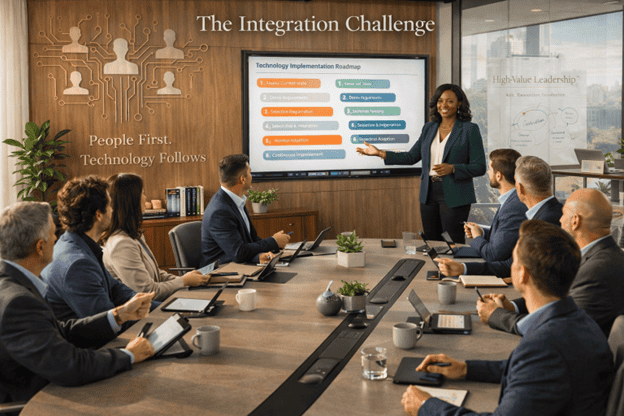
The Integration Challenge: Making New Technology Work for Your Culture πŸ’»

By Che’ Blackmon, DBA Candidate | Founder & CEO, Che’ Blackmon Consulting

Every year, organizations invest billions of dollars in new technology. And every year, a staggering number of those investments fail to deliver their promised value. The problem is rarely the technology itself. The problem is culture.

We have all seen it happen. A company announces an exciting new platform, system, or tool. Training sessions are scheduled. Rollout dates are set. And then reality hits. Adoption lags. Workarounds multiply. The old ways persist alongside the new, creating confusion rather than efficiency. Within months, the shiny new technology becomes expensive shelfware, and employees grow even more cynical about the next change initiative.

The truth is that technology implementation is fundamentally a human challenge. In High-Value Leadership: Transforming Organizations Through Purposeful Culture, I explore how the most successful leaders understand that tools are only as effective as the cultures that embrace them. Getting technology integration right requires attending to people first and platforms second.

This challenge carries particular implications for those who have been traditionally overlooked in technology decisions. When new systems are designed and implemented without diverse input, they often perpetuate existing inequities or create new barriers. Making technology work for your culture means making it work for everyone in your culture.

Why Technology Implementations Fail 🚫

The statistics are sobering. Research from McKinsey indicates that 70% of digital transformation initiatives fail to reach their stated goals. Gartner reports that through 2025, 80% of organizations attempting to scale digital business will fail because they do not take a modern approach to data and analytics governance. These are not failures of technology. They are failures of integration, adoption, and cultural alignment.

Several common patterns emerge in failed technology implementations. First, organizations often focus exclusively on technical requirements while ignoring human requirements. They ask “What can this system do?” without asking “What do our people need?” or “How does this fit with how we actually work?”

Second, change management is frequently an afterthought rather than a core component of the implementation strategy. Leaders assume that if the technology is good enough, people will naturally adopt it. This assumption ignores everything we know about human behavior, habit formation, and resistance to change.

Third, implementation teams often lack diversity, leading to blind spots about how different users will experience the new system. When the people designing and rolling out technology do not reflect the full range of people who will use it, critical needs get overlooked. This is not just about demographic diversity but also about including perspectives from different roles, levels, and functions within the organization.

Fourth, organizations underestimate the time and resources required for true adoption. They budget for licenses and training but not for the ongoing support, reinforcement, and iteration that successful integration demands.

The Equity Dimension of Technology Change βš–οΈ

Technology is never neutral. Every system encodes assumptions about who will use it, how they will use it, and what they need. When those assumptions are shaped by homogeneous perspectives, the resulting technology can create or reinforce barriers for those already marginalized in the workplace.

Consider artificial intelligence and algorithmic decision making tools, which are increasingly common in hiring, performance evaluation, and workforce management. Research has repeatedly demonstrated that these systems can perpetuate and even amplify existing biases. Amazon famously scrapped an AI recruiting tool after discovering it systematically downgraded resumes from women. Other studies have shown racial bias in facial recognition systems, credit scoring algorithms, and predictive analytics tools used in HR.

In Rise & Thrive: A Black Woman’s Blueprint for Leadership Excellence, I discuss how Black women in corporate spaces must navigate technology systems that were often not designed with them in mind. From collaboration platforms that favor certain communication styles to performance management systems that encode biased assumptions about what “leadership” looks like, technology can become another obstacle to overcome rather than a tool for advancement.

This reality demands that leaders approach technology integration with an equity lens. Who was consulted in selecting this system? Whose needs were centered in the design? Who might be disadvantaged by how this technology works? These questions must be part of every technology decision, not afterthoughts when problems emerge.

Culture First, Technology Second 🎯

The most successful technology implementations begin not with selecting a platform but with understanding the culture into which that platform will be introduced. In Mastering a High-Value Company Culture, I outline how organizational culture shapes every aspect of how work gets done, including how new tools and systems are received.

Before any technology decision, leaders should conduct an honest cultural assessment. How does your organization typically respond to change? What past technology implementations have succeeded or failed, and why? Where are the pockets of resistance likely to emerge? Who are the informal influencers whose adoption will signal to others that the change is worth embracing?

Understanding your culture also means understanding its fault lines. Are there trust issues between leadership and frontline employees? Are certain teams or demographics already feeling unheard or undervalued? Technology implementation can either exacerbate these tensions or, if handled thoughtfully, begin to heal them.

There was a manufacturing company that learned this lesson through experience. Leadership decided to implement a new enterprise resource planning system without adequately consulting the production floor workers who would use it daily. The system was technically superior to what it replaced, but it did not account for the practical realities of how work actually flowed in the plant. Workers felt disrespected that their expertise had been ignored. Adoption was resistant and resentful. It took nearly two years of remediation, including finally listening to frontline input, before the system delivered its promised value.

πŸ“Š Case Study: Technology That Brought People Together

A regional healthcare network with approximately 180 employees needed to implement a new patient records system to comply with updated regulations. Previous technology rollouts had been rocky, marked by low adoption and persistent workarounds that created data integrity issues.

This time, leadership took a different approach. Before selecting a vendor, they formed an implementation team that deliberately included voices from every level and function: physicians, nurses, administrative staff, IT professionals, and billing specialists. The team included significant representation from employees of color, who had previously reported feeling excluded from technology decisions that affected their daily work.

This diverse team did not just evaluate technical specifications. They mapped actual workflows, identified pain points with the current system, and articulated what success would look like from their various perspectives. When vendors presented their solutions, every member of the implementation team had a voice in the evaluation.

The selected system was not the cheapest option or the one with the most features. It was the one that best fit how the organization actually worked and that addressed the specific needs identified by the diverse implementation team. Rollout included peer champions from each department who had been part of the selection process and could speak authentically about why this system was chosen.

Adoption exceeded expectations. More importantly, employees reported feeling respected and included in a way they had not experienced with previous technology changes. The implementation became a model for how the organization approached subsequent changes, building a culture of inclusive decision making that extended far beyond technology.

Current Trends Reshaping Technology Integration 🌐

The technology landscape continues to evolve rapidly, and several trends are reshaping how organizations approach integration challenges.

Artificial intelligence is transforming virtually every business function, from customer service to human resources to operations. Organizations are grappling with how to integrate AI tools in ways that augment human capability rather than replace human judgment. This requires careful attention to where AI excels and where human insight remains essential, as well as ongoing monitoring for algorithmic bias.

Remote and hybrid work have accelerated the adoption of collaboration technologies, but many organizations are still struggling to use these tools effectively. The challenge is not just technical but cultural: how do you maintain connection, build trust, and preserve organizational culture when people are working from different locations? Technology can enable remote collaboration, but it cannot substitute for the intentional culture building that makes distributed teams successful.

Employee experience platforms are emerging as a way to integrate multiple technology touchpoints into a more coherent whole. Rather than forcing employees to navigate dozens of disconnected systems, these platforms create unified interfaces that simplify the technology landscape. The most effective implementations center the employee experience rather than administrative convenience.

Data analytics and predictive tools are becoming increasingly sophisticated, offering organizations unprecedented insight into workforce trends, engagement patterns, and potential challenges. Used ethically and transparently, these tools can help leaders make better decisions. Used poorly, they can erode trust and create surveillance cultures that undermine the very engagement they are meant to improve.

The Human Side of Digital Transformation πŸ‘₯

Successful technology integration requires attending to the emotional and psychological dimensions of change, not just the technical ones. People resist new technology for many reasons, and understanding those reasons is essential for overcoming resistance.

Fear of obsolescence is a powerful driver of technology resistance. When people worry that new systems might eliminate their jobs or devalue their expertise, they have strong incentives to resist adoption. Leaders must address these fears directly, being honest about how roles may change while providing pathways for people to develop new skills and remain valuable contributors.

Loss of competence is another common concern. People who are experts in the old way of doing things may feel like beginners when a new system is introduced. This can be particularly challenging for experienced professionals whose identities are tied to their expertise. Creating safe spaces to learn, make mistakes, and develop new competencies is essential.

Past negative experiences shape how people approach new technology initiatives. If previous implementations were poorly handled, broken promises and frustration leave lasting scars. Leaders must acknowledge this history rather than pretending it does not exist, and demonstrate through action that this time will be different.

For employees from traditionally marginalized groups, technology change can carry additional weight. Will this new system make it easier or harder to do my job? Will it expose me to new forms of surveillance or bias? Will my concerns be taken seriously if I encounter problems? Leaders must proactively address these concerns rather than waiting for them to surface as resistance.

πŸ’­ Expert Perspective

John Kotter, the renowned change management expert from Harvard Business School, emphasizes that successful transformation requires both management and leadership. Management ensures that new systems are implemented correctly, that training is delivered, and that processes are documented. Leadership creates the vision, builds the coalition, and addresses the human dimensions of change. Technology implementations that focus exclusively on management while neglecting leadership are destined to underperform, no matter how good the underlying technology may be.

Building an Inclusive Implementation Strategy πŸ› οΈ

Creating technology implementations that work for everyone requires intentional effort at every stage of the process. Here are key strategies for building inclusion into your approach.

Diversify your implementation team. Include people from different levels, functions, demographics, and tenure in the organization. Seek out those who have been critical of past technology initiatives, as their concerns often point to real issues that others may overlook. Ensure that traditionally marginalized voices have genuine influence, not just token representation.

Conduct equity impact assessments. Before implementing any new technology, systematically consider how it might affect different groups within your organization. Who benefits most from this change? Who might be disadvantaged? Are there accessibility concerns? Does the technology encode assumptions that could perpetuate bias?

Create multiple channels for feedback. Not everyone is comfortable raising concerns in the same ways. Provide anonymous feedback mechanisms alongside open forums. Actively seek input from those who tend to be quieter in group settings. Make it clear that concerns will be taken seriously and addressed.

Invest in equitable training. Training should be accessible to everyone, accounting for different learning styles, schedules, and starting points. Avoid assumptions about baseline technical knowledge. Provide ongoing support rather than one time training events.

Monitor adoption patterns. Track who is successfully adopting the new technology and who is struggling. Look for patterns that might indicate systemic barriers. If certain groups are consistently lagging in adoption, investigate why rather than assuming the problem is with those individuals.

Iterate based on real user experience. Implementation is not complete when the technology goes live. Continuously gather feedback and make adjustments based on how the system is actually being used. Be willing to change course if the technology is not serving its intended purpose.

Leading Through Technology Change 🌟

The role of leadership in technology implementation cannot be overstated. How leaders show up during technology change sends powerful signals about priorities, values, and what kind of culture the organization is building.

Model the behavior you expect. If leaders do not use the new technology, no one else will take it seriously. This means genuinely adopting new systems, not having assistants manage them on your behalf. It also means being transparent about your own learning curve and challenges.

Communicate constantly. People need to understand not just what is changing but why. Connect technology changes to organizational values and strategic goals. Acknowledge the challenges while maintaining confidence in the path forward. Be honest about what you do not yet know.

Celebrate progress. Recognize and reward adoption, especially from those who are helping others succeed. Share stories of how the new technology is making work better. Build momentum through visible wins.

Stay the course. Technology implementation takes longer than most leaders expect. Resist the temptation to move on to the next initiative before the current one has truly taken root. Sustained attention signals that this change matters.

The ROI of Getting It Right πŸ“ˆ

Organizations that successfully integrate technology with culture see returns that extend far beyond the specific tools they implement. They build change capability that makes future transformations easier. They strengthen trust between leadership and employees. They create cultures where innovation can flourish because people feel safe learning new things.

Research from Deloitte indicates that organizations with inclusive cultures are six times more likely to be innovative and twice as likely to meet or exceed financial targets. Technology that is implemented inclusively contributes to building these cultures, while technology that is implemented poorly erodes them.

The cost of failed technology implementation is not just the wasted investment in the technology itself. It is the damage to employee engagement, the reinforcement of cynicism about change, and the lost opportunity to build a more adaptive organization. Getting technology integration right is an investment in culture as much as in capability.

Technology in Service of People ✨

The integration challenge is ultimately not about technology at all. It is about people. It is about creating organizations where change is possible, where diverse perspectives shape decisions, and where tools serve human purposes rather than the other way around.

For leaders committed to building high value cultures, technology implementation is an opportunity to demonstrate values in action. How you approach change reveals what you truly believe about your people. Are they obstacles to be managed or partners to be engaged? Are their concerns valid or inconvenient? Does everyone deserve a voice or only those who already have power?

For those who have been traditionally overlooked, technology change can be either a new barrier or a new opportunity. The difference lies in leadership. Leaders who center equity in their technology decisions, who actively seek out marginalized voices, and who hold themselves accountable for inclusive outcomes can use technology as a force for positive cultural transformation.

The organizations that will thrive in our technology rich future are not those with the most sophisticated systems. They are those that have built cultures capable of embracing change while remaining grounded in human values. Technology should serve culture, not the other way around. When leaders understand this truth and act on it, the integration challenge becomes an integration opportunity.

Discussion Questions for Your Team πŸ—£οΈ

1. Think about a technology implementation you experienced that went well. What made it successful? Now think about one that struggled. What was different?

2. Who is typically included in technology decisions in your organization? Whose perspectives might be missing?

3. How does your organization respond when employees raise concerns about new technology? Do people feel safe expressing resistance or skepticism?

4. Have you ever experienced a technology system that seemed to work against you or make your job harder? What would have made it better?

5. What technology changes are on the horizon for your organization? How can you apply the principles discussed here to increase the likelihood of successful integration?

Your Next Steps πŸ‘£

This week, identify one technology tool or system that your team uses but has not fully adopted. Have a candid conversation about why adoption has been incomplete. Listen for concerns about usability, equity, or fit with how work actually gets done. Use what you learn to inform how you approach the next technology change.

If you are currently planning or in the midst of a technology implementation, conduct an informal equity assessment. Ask yourself who has been involved in decisions, whose perspectives have been centered, and who might be affected in ways that have not yet been considered. Make adjustments based on what you discover.

Finally, reflect on your own relationship with technology change. How do you typically respond to new systems and tools? What would help you embrace technology more readily? Your answers may offer insight into what others in your organization need as well.

Ready to Make Technology Work for Your Culture? 🌟

At Che’ Blackmon Consulting, we help organizations navigate the human side of technology change. Through our fractional HR services and culture transformation expertise, we partner with companies of 20 to 200 employees to build cultures where technology serves people and change initiatives succeed.

Whether you need support developing inclusive implementation strategies, building change capability in your leadership team, or creating cultures where innovation and technology adoption flourish, we bring both strategic insight and practical experience to help your organization thrive.

Let’s Build Something Together

πŸ“§  admin@cheblackmon.com

πŸ“ž  888.369.7243

🌐  cheblackmon.com

Che’ Blackmon, DBA Candidate

Founder & CEO, Che’ Blackmon Consulting

Author of Mastering a High-Value Company Culture, High-Value Leadership, and Rise & Thrive

Host of “Unlock, Empower, Transform with Che’ Blackmon” Podcast

Unlock. Empower. Transform.

#DigitalTransformation #TechnologyIntegration #HighValueLeadership #ChangeManagement #WorkplaceCulture #HRStrategy #DiversityEquityInclusion #BlackWomenInTech #OrganizationalCulture #EmployeeExperience #FractionalHR #CultureTransformation #LeadershipDevelopment #FutureOfWork #InclusiveLeadership

When Leaders Learn: The Competitive Advantage of Curiosity 🧠

By Che’ Blackmon, DBA Candidate | Founder & CEO, Che’ Blackmon Consulting

The most dangerous words in leadership are “I already know.”

In a world that shifts beneath our feet daily, the leaders who thrive are not the ones with all the answers. They are the ones still asking questions. They are the curious ones. The learners. The leaders humble enough to admit what they do not know and brave enough to go find out.

Curiosity is not a soft skill. It is a strategic advantage. Organizations led by curious leaders innovate faster, adapt more readily, and build cultures where people feel valued for their ideas rather than just their output. In High-Value Leadership: Transforming Organizations Through Purposeful Culture, I explore how the most effective leaders never stop learning, and how that commitment to growth cascades throughout their entire organization.

But here is what often goes unspoken: curiosity has not always been welcomed equally from all leaders. For those who have been traditionally overlooked, particularly Black women in corporate spaces, expressing curiosity has sometimes been met with suspicion rather than support. Changing that reality is part of the work we must do together.

The Science Behind Curious Leadership πŸ”¬

Curiosity is more than a personality trait. It is a neurological state that fundamentally changes how we process information, solve problems, and connect with others. When we are genuinely curious, our brains release dopamine, the same neurotransmitter associated with reward and motivation. This creates a positive feedback loop where learning itself becomes intrinsically rewarding.

Research from Harvard Business School demonstrates that curious people make better decisions because they are more likely to seek out diverse perspectives and challenge their own assumptions. They are less susceptible to confirmation bias, that tendency we all have to seek information that supports what we already believe. In leadership, this translates to better strategy, more inclusive decision making, and fewer blind spots.

Dr. Francesca Gino, a behavioral scientist at Harvard, has studied curiosity extensively in organizational settings. Her research reveals that when leaders model curiosity, it creates psychological safety for others to ask questions, admit uncertainty, and propose unconventional ideas. Curiosity, it turns out, is contagious. And it builds the kind of culture where innovation becomes possible.

Yet despite this compelling evidence, many organizations still reward certainty over inquiry. Leaders feel pressure to have immediate answers, to project unwavering confidence, and to never appear uncertain. This pressure is especially acute for leaders from underrepresented groups, who often feel they cannot afford to show any perceived weakness.

The Curiosity Gap: Who Gets to Ask Questions? πŸ€”

Not everyone experiences the freedom to be curious equally in professional settings. This is a truth that must be named clearly. Research consistently shows that when Black professionals, and particularly Black women, ask probing questions or challenge existing approaches, they are more likely to be perceived as aggressive, difficult, or not a “team player.” The same behavior from white colleagues is often celebrated as intellectual curiosity or strategic thinking.

In Rise & Thrive: A Black Woman’s Blueprint for Leadership Excellence, I address this double bind directly. Black women in corporate America often learn to suppress their natural curiosity as a survival mechanism. Asking too many questions can be coded as not knowing enough. Challenging assumptions can be perceived as being combative. The cost of curiosity, when you are already navigating bias, can feel too high.

This creates a tremendous loss for organizations. When talented leaders feel they cannot bring their full intellectual curiosity to work, companies miss out on the insights, innovations, and perspectives that drive competitive advantage. The curiosity gap is not just an equity issue. It is a business issue.

A study from the Center for Talent Innovation found that Black women are more likely than any other group to aspire to positions of power yet face the steepest barriers to advancement. Part of dismantling those barriers means creating environments where their questions, challenges, and intellectual contributions are welcomed rather than penalized.

Curiosity as Culture: Building Learning Organizations πŸ—οΈ

Individual curiosity matters, but the real transformation happens when curiosity becomes embedded in organizational culture. In Mastering a High-Value Company Culture, I examine how the healthiest organizations are those that treat learning as a core value rather than an afterthought.

Learning organizations share several distinguishing characteristics. They reward questions as much as answers. They treat failures as data rather than disasters. They create time and space for reflection, not just action. And critically, they ensure that learning opportunities are distributed equitably across all levels and demographics of the workforce.

There was an automotive supplier in the Midwest that exemplified this transformation. For years, the company operated with a command and control leadership style where executives made decisions and everyone else executed. Questions were seen as challenges to authority. Mistakes were hidden rather than examined. Predictably, the company struggled to adapt to market changes and lost ground to more agile competitors.

The turning point came when new leadership committed to building a culture of curiosity. They implemented regular “learning reviews” where teams examined not just what went wrong but what could be understood differently. They created cross functional innovation teams where diverse perspectives were explicitly sought. Perhaps most importantly, they trained managers to respond to questions with interest rather than defensiveness.

Within two years, the company had developed three new product lines that emerged directly from employee suggestions. Engagement scores rose significantly. And the leadership pipeline became notably more diverse as people from all backgrounds felt empowered to contribute ideas and demonstrate capability.

πŸ“Š Case Study: The Question That Changed Everything

A healthcare system with multiple facilities was struggling with patient satisfaction scores that remained stubbornly flat despite numerous improvement initiatives. Leadership had brought in consultants, implemented new protocols, and invested in training. Nothing seemed to move the needle.

Then a frontline nurse, a Black woman who had been with the organization for fifteen years, asked a simple question in a town hall meeting: “Have we ever asked patients what would actually make them feel more cared for?” The room went quiet. Despite all the initiatives, no one had systematically gathered patient perspectives on what mattered most to them.

Leadership could have dismissed the question. They could have felt defensive about the implicit critique. Instead, they chose curiosity. They implemented patient listening sessions across all facilities. What they learned transformed their approach. Patients did not want more technology or faster service. They wanted to feel seen and heard by their caregivers. They wanted their names pronounced correctly. They wanted someone to sit down, make eye contact, and really listen.

The changes that followed were not expensive or complicated, but they required the humility to learn from those being served. Patient satisfaction improved dramatically. And the nurse who asked the question? She was promoted to lead a new patient experience initiative, her curiosity finally recognized as the asset it always was.

The Current Landscape: Why Curiosity Matters More Than Ever 🌍

We are living through a period of unprecedented change. Artificial intelligence is reshaping industries overnight. Remote and hybrid work has fundamentally altered how teams collaborate. Demographic shifts are transforming both workforces and customer bases. Economic volatility makes long term planning feel nearly impossible.

In this environment, the leaders who will succeed are not those who cling to what worked before. They are the ones curious enough to explore what might work next. A 2024 LinkedIn Workplace Learning Report found that the most in demand leadership competency is adaptability, and adaptability is fundamentally rooted in curiosity. You cannot adapt to what you refuse to learn about.

The rise of artificial intelligence makes this particularly urgent. AI can process information and execute tasks faster than any human. What it cannot do, at least not yet, is ask the kinds of creative, contextual, deeply human questions that drive true innovation. Leaders who develop and model curiosity are developing the exact capabilities that cannot be automated away.

Organizations are increasingly recognizing this reality. Companies like Microsoft, Google, and Pixar have explicitly built curiosity into their cultural values. They hire for it, develop it, and reward it. Smaller organizations can do the same, often with more agility than their larger counterparts.

Developing Your Curiosity Muscle πŸ’ͺ

The good news is that curiosity can be developed. It is not a fixed trait that you either have or lack. Like any capability, it can be strengthened through intentional practice. Here are research backed strategies for building your curiosity muscle.

Practice asking “What am I missing?” Before finalizing any significant decision, deliberately seek out perspectives you have not yet considered. Who has not been consulted? What assumptions have not been tested? What would someone with a completely different background see that you might be blind to?

Cultivate intellectual humility. This means holding your own knowledge and opinions with appropriate tentativeness. The most curious leaders are comfortable saying “I do not know” and “I might be wrong.” They see gaps in their knowledge as opportunities rather than threats to their credibility.

Diversify your information diet. Read outside your industry. Have conversations with people whose experiences differ from yours. Travel, whether physically or through books and media, to contexts unfamiliar to you. Curiosity is fed by exposure to novelty.

Ask more questions than you give answers. In meetings, challenge yourself to ask at least two questions for every statement you make. Notice how this shifts the dynamic and what you learn as a result.

Create space for wonder. Our always connected, always productive culture leaves little room for the kind of open ended contemplation that sparks curiosity. Protect time for thinking without an agenda. Walk without podcasts. Sit without scrolling. Let your mind wander and notice where it goes.

Creating Curiosity Safe Environments πŸ›‘οΈ

For leaders responsible for teams and organizations, developing personal curiosity is only part of the equation. Equally important is creating environments where others feel safe being curious too. This is especially critical for ensuring that traditionally marginalized voices can fully participate.

Respond to questions with gratitude. When someone asks a question, especially one that challenges current thinking, thank them explicitly. Say “That is a great question” and mean it. Your response to questions signals to everyone watching whether curiosity is truly welcome.

Model not knowing. When you do not have an answer, say so openly. Then demonstrate what productive uncertainty looks like by describing how you will find out. This gives permission to others to acknowledge their own knowledge gaps.

Examine who gets to be curious. Pay attention to whose questions are taken seriously and whose are dismissed. Notice if certain groups are penalized for the same inquisitive behavior that is rewarded in others. This requires honest self examination and willingness to interrupt inequitable patterns.

Celebrate learning from failure. When initiatives do not succeed, lead the conversation toward what was learned rather than who is to blame. Share your own failures and what they taught you. Make it clear that trying, learning, and adjusting is more valued than always getting it right the first time.

Invest in development equitably. Learning opportunities, stretch assignments, and mentorship should be distributed based on potential, not just past access. Organizations that concentrate development resources in those who already have advantages perpetuate inequity and miss the talent hiding in plain sight.

πŸ’­ Expert Perspective

Carol Dweck, the Stanford psychologist whose research on mindset has transformed how we understand learning and achievement, distinguishes between fixed and growth mindsets. Leaders with fixed mindsets see abilities as static. They avoid challenges that might reveal limitations and feel threatened by the success of others. Leaders with growth mindsets see abilities as developable through effort and learning. They embrace challenges, persist through obstacles, and find inspiration in others’ success. Curiosity is the engine of the growth mindset, the force that transforms setbacks into opportunities and uncertainty into exploration.

The Competitive Edge of Curious Organizations πŸ“ˆ

Organizations that embed curiosity into their culture do not just feel better to work in. They perform better by virtually every measure that matters.

Innovation increases because people feel safe proposing unproven ideas. A study by Spencer Harrison and colleagues found that curious teams generate more creative solutions because they are willing to explore unconventional approaches rather than defaulting to what has always been done.

Engagement improves because people feel their intellectual contributions matter. When employees are encouraged to ask questions and explore possibilities, they feel valued as whole people rather than just task completers. This translates directly to retention and discretionary effort.

Adaptability accelerates because organizations develop the muscle of continuous learning. When curiosity is normal, pivoting in response to new information feels natural rather than traumatic. These organizations do not just survive disruption. They leverage it.

Diversity and inclusion strengthen because curiosity requires valuing different perspectives. When leaders are genuinely curious about experiences different from their own, they create space for voices that have historically been marginalized. This is not just good ethics. It is good strategy.

The Leader as Learner ✨

The most profound shift a leader can make is from expert to learner. This does not mean abandoning expertise or pretending not to know things you genuinely know. It means approaching every situation, every person, and every challenge with genuine openness to being surprised, to having your assumptions challenged, to discovering something you did not expect.

For Black women and others who have been traditionally overlooked in corporate spaces, reclaiming curiosity is an act of resistance. It is refusing to shrink your intellect to make others comfortable. It is insisting that your questions matter and your perspective adds value. It is modeling for those coming behind you that their full intellectual selves are welcome in spaces of power.

For organizations, cultivating curiosity is not optional in today’s environment. It is essential for survival and success. The companies that will thrive in the coming decades are those building cultures where every person feels empowered to ask, explore, challenge, and learn.

The competitive advantage of curiosity is available to any leader and any organization willing to embrace it. The question is not whether you can afford to become more curious. The question is whether you can afford not to.

Discussion Questions for Your Team πŸ—£οΈ

1. When was the last time you asked a question at work that felt risky? What happened, and what did you learn from the experience?

2. Does everyone on your team have equal permission to be curious and ask challenging questions? If not, what creates those differences?

3. How does your organization respond to failures? Are they treated as learning opportunities or as problems to be hidden?

4. What is something you believed strongly about your work or industry that you have reconsidered based on new information?

5. If you had unlimited time and resources to learn about any aspect of your field, what would you explore? What is stopping you from starting now?

Your Next Steps πŸ‘£

This week, identify one assumption you hold about your work, your team, or your industry. Then actively seek information that might challenge that assumption. Talk to someone with a different perspective. Read an article that argues the opposite position. Notice what happens to your thinking when you deliberately expose it to challenge.

In your next meeting, commit to asking more than you tell. Come prepared with questions rather than just answers. Pay attention to how this shifts the conversation and what you learn that you might have otherwise missed.

Finally, reflect on whether curiosity is truly welcomed equally on your team. Have a candid conversation with someone whose experience in your organization differs from yours. Ask what would make them feel more empowered to bring their full intellectual curiosity to work.

Ready to Build a Culture of Curious Leadership? 🌟

At Che’ Blackmon Consulting, we help organizations transform from cultures of certainty to cultures of curiosity. Through our fractional HR services and culture transformation expertise, we partner with companies of 20 to 200 employees to build environments where every voice matters, every question is welcomed, and continuous learning drives competitive advantage.

Whether you need support developing curious leaders, creating psychologically safe team environments, or building comprehensive learning cultures, we bring both strategic insight and practical implementation to help your organization thrive.

Let’s Explore What’s Possible

πŸ“§  admin@cheblackmon.com

πŸ“ž  888.369.7243

🌐  cheblackmon.com

Che’ Blackmon, DBA Candidate

Founder & CEO, Che’ Blackmon Consulting

Author of Mastering a High-Value Company Culture, High-Value Leadership, and Rise & Thrive

Host of “Unlock, Empower, Transform with Che’ Blackmon” Podcast

Unlock. Empower. Transform.

#CuriousLeadership #LeadershipDevelopment #HighValueLeadership #GrowthMindset #ContinuousLearning #WorkplaceCulture #LeaderAsLearner #DiversityEquityInclusion #BlackWomenInLeadership #OrganizationalCulture #PsychologicalSafety #FractionalHR #CultureTransformation #LeadershipTips #LearningOrganization

The Feedback Revolution: Creating Cultures of Continuous Improvement πŸ”„

By Che’ Blackmon, DBA Candidate | Founder & CEO, Che’ Blackmon Consulting

Something remarkable is happening in organizations that choose to embrace honest, consistent feedback as a cornerstone of their culture. They are not just improving performance metrics. They are transforming the very fabric of how people show up, contribute, and grow together.

Yet here is the uncomfortable truth: most organizations still treat feedback like a dreaded annual ritual rather than the powerful catalyst for continuous improvement it can be. The result? Disengaged employees, stagnant growth, and cultures where people learn to stay silent rather than speak up.

As I explore in High-Value Leadership: Transforming Organizations Through Purposeful Culture, the organizations that truly thrive are those that embed feedback into their daily rhythm. This is not about creating more forms to fill out or scheduling more uncomfortable conversations. This is about fundamentally reimagining how we develop, support, and elevate one another.

Why Traditional Feedback Systems Fail πŸ“‰

Let us be honest about what is not working. The traditional annual performance review is broken. Research from Gallup consistently shows that only about 14% of employees strongly agree that performance reviews inspire them to improve. Think about that for a moment. We have built entire systems around a practice that fails the vast majority of the people it is supposed to serve.

The problems run deep. Annual reviews create anxiety rather than motivation. They rely on recency bias, meaning managers remember the last few weeks rather than the full year of contributions. They often feel punitive rather than developmental. And perhaps most critically, they come far too late to actually change behavior or outcomes.

There was a manufacturing company in the Midwest that discovered this reality through painful experience. For years, they conducted annual reviews like clockwork, checking boxes and completing forms. Yet employee engagement remained stubbornly low, turnover was climbing, and their safety incident rate was concerning. The reviews were happening, but growth was not. It was not until leadership committed to replacing this antiquated approach with continuous feedback loops that the culture began to shift.

The Overlooked Voices in Feedback Culture πŸ’‘

Here is where we must speak candidly about an issue that too many organizations avoid. Feedback systems, even well intentioned ones, often perpetuate existing inequities. The traditionally overlooked, those who have historically been marginalized in corporate spaces, frequently experience feedback differently than their majority counterparts.

Research published in the Harvard Business Review reveals that Black professionals and women often receive feedback that is more vague, less actionable, and more focused on personality rather than performance. They are told to be “less aggressive” when advocating for ideas, while colleagues exhibiting the same behaviors are praised for being “assertive” or “showing leadership.” This is not feedback designed for growth. This is bias dressed in developmental language.

In Rise & Thrive: A Black Woman’s Blueprint for Leadership Excellence, I address this reality head on. Black women in corporate America navigate a unique intersection of race and gender that shapes how feedback is given to them, received by them, and acted upon. The feedback revolution must include dismantling these disparities, or it will simply reinforce them.

Consider these statistics: A McKinsey study found that Black women are significantly more likely than white women to have their judgment questioned in their area of expertise. They are also more likely to need to provide more evidence of their competence. When feedback systems fail to account for these dynamics, they become tools of exclusion rather than development.

Building Feedback as a Daily Practice πŸ› οΈ

Creating a culture of continuous improvement requires moving feedback from an event to a practice. In Mastering a High-Value Company Culture, I outline the framework for making this shift sustainable and impactful. It begins with leadership but must extend to every level of the organization.

The most effective feedback cultures share several characteristics. First, feedback flows in multiple directions. It moves from managers to team members, from team members to managers, from peers to peers, and from the organization to its stakeholders. When feedback only travels downward, you do not have a culture of improvement. You have a culture of compliance.

Second, effective feedback is specific, timely, and tied to observable behaviors. “Great job” means nothing. “The way you facilitated that difficult conversation by asking clarifying questions helped the team reach consensus” tells the person exactly what worked and why. They can replicate that behavior because they understand it.

Third, feedback must be psychologically safe. People will not share honest perspectives if they fear retaliation or judgment. This is especially critical for those who have historically faced negative consequences for speaking truth to power. Leaders must actively demonstrate that all feedback, even feedback that challenges leadership decisions, is welcomed and valued.

πŸ“Š Case Study: From Annual Reviews to Continuous Growth

A healthcare organization with approximately 150 employees was struggling with high turnover among their nursing staff. Exit interviews revealed a consistent theme: employees felt unsupported and unseen. The annual review process felt disconnected from their daily challenges and provided no meaningful pathway for growth.

The organization implemented a comprehensive feedback transformation. Weekly fifteen minute check ins replaced quarterly formal reviews. Peer recognition programs were established. Most importantly, leadership committed to acting visibly on feedback received, closing the loop so employees knew their voices mattered.

Within eighteen months, nursing turnover decreased by 35%. Engagement scores rose significantly. Patient satisfaction metrics improved. The shift was not about doing more. It was about doing feedback differently and consistently.

Current Trends Reshaping Feedback πŸš€

The landscape of workplace feedback is evolving rapidly, driven by both technology and changing workforce expectations. Organizations that want to lead must understand and adapt to these shifts.

Artificial intelligence and predictive analytics are transforming how organizations understand culture and engagement patterns. Rather than waiting for problems to manifest in turnover or disengagement, forward thinking companies are using data to identify cultural challenges before they become crises. This proactive approach to feedback, gathering signals from multiple touchpoints and using predictive models to understand trends, represents the future of continuous improvement.

The rise of remote and hybrid work has also fundamentally changed feedback dynamics. When teams are not physically together, intentional feedback practices become even more critical. The casual conversations that once happened naturally must now be designed into the workday. Organizations that fail to adapt their feedback approaches to distributed work environments risk losing connection with their people entirely.

Generation Z and younger millennials are entering the workforce with different expectations around feedback. They want regular input, not annual summaries. They expect development to be ongoing, not a once yearly conversation. Organizations that cling to outdated feedback models will struggle to attract and retain this emerging talent.

Creating Equity in Feedback Practices βš–οΈ

Building truly equitable feedback systems requires intentional effort and ongoing vigilance. Here are research backed strategies that make a measurable difference.

Standardize feedback criteria while individualizing delivery. Everyone should be evaluated against the same competencies and expectations, but how feedback is delivered should account for individual context and communication preferences. This prevents the kind of subjective assessment that allows bias to flourish.

Train feedback givers to recognize and interrupt bias. Studies show that without training, even well meaning managers give different types of feedback to different demographic groups. Ongoing education about bias in feedback, combined with structured feedback templates, helps ensure everyone receives the same quality of developmental input.

Create multiple channels for feedback. Not everyone is comfortable speaking up in the same ways. Some prefer written feedback. Others value face to face conversation. Some need time to process before responding. By offering various mechanisms for sharing and receiving feedback, organizations can ensure more voices are included in the continuous improvement process.

Audit feedback patterns regularly. Who is receiving developmental feedback versus punitive feedback? Who is being positioned for advancement? Are there disparities based on demographic factors? Without measuring, organizations cannot manage these critical equity indicators.

Actionable Steps for Leaders 🎯

Transformation begins with action. Here are concrete steps every leader can take to spark the feedback revolution in their organization.

Start with yourself. Model the feedback behavior you want to see. Ask for feedback on your leadership regularly and publicly act on what you learn. When people see that leaders are open to critique and willing to grow, they feel safer participating in feedback culture themselves.

Establish feedback rhythms. Weekly check ins, monthly retrospectives, and quarterly development conversations create predictable moments for feedback exchange. When feedback has a regular cadence, it becomes normalized rather than feared.

Celebrate improvement publicly. When someone grows based on feedback, recognize it. This reinforces that feedback is about development, not punishment. It also demonstrates the tangible benefits of a continuous improvement mindset.

Invest in training. Giving and receiving feedback are skills that can be developed. Provide your people with the tools and techniques they need to participate effectively in feedback culture. This is especially important for those who have not had positive experiences with feedback in the past.

Close the loop. Nothing kills feedback culture faster than gathering input and then doing nothing with it. When you ask for feedback, share what you learned, what you are going to do about it, and follow through. This builds trust that makes future feedback more likely and more honest.

πŸ’­ Expert Perspective

Dr. Amy Edmondson of Harvard Business School, whose research on psychological safety has shaped how we understand high performing teams, emphasizes that feedback cultures thrive only when people feel safe to speak candidly. Without psychological safety, feedback systems become performative exercises that change nothing. Leaders must actively work to create environments where candor is not just accepted but expected and rewarded.

The Business Case for Feedback Culture πŸ“ˆ

For organizations that need the numbers, the evidence is compelling. Companies with strong feedback cultures consistently outperform their peers on key metrics.

Research from Deloitte found that organizations moving to continuous feedback saw an increase in employee engagement of nearly 15%. Engagement drives productivity, customer satisfaction, and profitability. The connection between feedback culture and business results is not theoretical. It is measurable and significant.

Turnover costs are another compelling factor. Replacing an employee costs anywhere from 50% to 200% of their annual salary, depending on the role. Organizations with robust feedback cultures experience lower turnover because employees feel seen, supported, and developed. They do not need to leave to find growth opportunities because growth is embedded in their current experience.

Innovation also flourishes in feedback rich environments. When people feel safe sharing ideas, challenging assumptions, and learning from failures, organizations become more adaptive and creative. In rapidly changing markets, this adaptability is not just nice to have. It is essential for survival.

The Revolution Starts Now ✨

Creating a culture of continuous improvement through feedback is not a project with a finish line. It is an ongoing commitment to growth, equity, and excellence. It requires courage from leaders and trust from teams. It demands that we examine our assumptions about how feedback works and who it serves.

Most importantly, it requires acknowledging that the traditional approaches have not served everyone equally. The feedback revolution must be an equity revolution, ensuring that every voice matters and every person has access to the developmental support they need to thrive.

The organizations that embrace this revolution will attract the best talent, retain their high performers, and build cultures where innovation and excellence become natural outcomes. Those that cling to outdated practices will wonder why their people disengage, why their results plateau, and why their best employees keep walking out the door.

The choice is clear. The time is now. The feedback revolution is calling.

Discussion Questions for Your Team πŸ—£οΈ

1. When was the last time you received feedback that genuinely helped you grow? What made it effective?

2. How does feedback currently flow in your organization? Is it primarily top down, or does it move in multiple directions?

3. Are there voices in your organization that may not feel safe participating in feedback conversations? How could you change that?

4. What would need to change for feedback to feel less like an event and more like a daily practice in your workplace?

5. How do you personally respond when you receive challenging feedback? What helps you receive it constructively?

Your Next Steps πŸ‘£

This week, choose one feedback conversation you have been avoiding and have it. Use the principles discussed here: be specific, be timely, and focus on behaviors rather than personality. Notice what happens when you approach feedback as an act of investment in another person’s growth.

If you lead a team, ask each person what kind of feedback is most helpful to them and how they prefer to receive it. This simple act of asking demonstrates that you value their development and want to support them effectively.

Finally, examine your organization’s feedback systems with fresh eyes. Are they serving everyone equitably? Are they creating the continuous improvement you need? If not, it may be time for a revolution.

Ready to Transform Your Feedback Culture? 🌟

At Che’ Blackmon Consulting, we partner with organizations ready to move beyond outdated feedback practices and build cultures where continuous improvement is the norm. Through our fractional HR services and culture transformation expertise, we help companies with 20 to 200 employees create feedback systems that drive engagement, retain top talent, and deliver measurable business results.

Whether you need support redesigning your performance management approach, training leaders to give effective feedback, or building comprehensive culture transformation strategies, we are here to help you lead the feedback revolution in your organization.

Let’s Start the Conversation

πŸ“§  admin@cheblackmon.com

πŸ“ž  888.369.7243

🌐  cheblackmon.com

Che’ Blackmon, DBA Candidate

Founder & CEO, Che’ Blackmon Consulting

Author of Mastering a High-Value Company Culture, High-Value Leadership, and Rise & Thrive

Host of “Unlock, Empower, Transform with Che’ Blackmon” Podcast

Unlock. Empower. Transform.

#FeedbackCulture #LeadershipDevelopment #HighValueLeadership #ContinuousImprovement #WorkplaceCulture #HRStrategy #EmployeeEngagement #DiversityEquityInclusion #BlackWomenInLeadership #OrganizationalCulture #TalentRetention #FractionalHR #CultureTransformation #LeadershipTips #PeopleFirst

πŸ–₯️ Virtual Leadership Mastery: Beyond Zoom Fatigue to Real Connection 🀝

By Che’ Blackmon, DBA Candidate | Founder & CEO, Che’ Blackmon Consulting

The calendar notification pops up. Another video call. You take a deep breath, adjust your camera angle, and paste on that professional smile you have perfected over countless virtual meetings. Sound familiar? If you are leading teams in today’s digital landscape, you know this routine all too well. But here is the truth that many leaders are discovering: the exhaustion you feel is not really about the technology. It is about the absence of genuine human connection.

Virtual leadership has become the new frontier of organizational culture. And like any frontier, it demands pioneers willing to forge new paths rather than simply transplant old habits into new environments. In my work helping organizations build high value cultures, I have witnessed a profound shift. The leaders who thrive virtually are not those who have the fastest internet or the most sophisticated software. They are the ones who understand that technology is merely the bridge. Connection is the destination. πŸ’‘

The Real Cost of Surface Level Virtual Leadership

Research from Microsoft’s Work Trend Index reveals that 54% of employees feel overworked and 39% feel exhausted. But dig deeper into these numbers, and a more nuanced picture emerges. The exhaustion is not simply about screen time. It is about the cognitive load of performing connection rather than experiencing it.

For traditionally overlooked employees, particularly Black women navigating corporate spaces, this burden multiplies exponentially. The virtual environment can amplify existing challenges around visibility, credibility, and belonging. When your camera turns on, you are not just showing up to work. You are managing perceptions, code switching, and often working twice as hard to be seen as equally competent. This is the hidden tax that drains energy before any actual work begins.

As I explore in Rise & Thrive: A Black Woman’s Blueprint for Leadership Excellence, authentic leadership requires environments where we can bring our full selves without the exhausting performance of acceptability. Virtual spaces can either perpetuate this burden or, when led intentionally, become equalizers that allow talent and contribution to shine regardless of proximity to power.

What High Value Virtual Leadership Actually Looks Like 🌟

In High-Value Leadership: Transforming Organizations Through Purposeful Culture, I outline principles that become even more critical in virtual environments. High value leaders understand that every interaction either deposits into or withdraws from the cultural bank account. In virtual settings, where casual hallway conversations and spontaneous connections are absent, every scheduled interaction carries increased weight.

Consider this scenario. A manufacturing company with facilities across three states struggled to maintain cohesion as their leadership team went remote. Engagement scores dropped. Turnover increased among their most diverse talent. The easy diagnosis was “Zoom fatigue.” The actual problem ran much deeper.

Their virtual meetings had become information dumps. Leaders talked at their teams rather than with them. The informal moments that once built trust, the pre-meeting small talk, the walk to the parking lot conversations, had vanished without replacement. For employees already feeling marginalized, this created an environment where they became increasingly invisible. Their contributions went unacknowledged. Their perspectives went unsolicited. Their presence became optional.

The transformation began when leadership recognized that virtual environments require deliberate architecture. Connection does not happen by accident when everyone is working from different locations. It must be designed, protected, and prioritized.

Five Strategies for Building Authentic Virtual Connection

1. Redesign Meeting Architecture πŸ“‹

Stop replicating in person meetings on video. Virtual gatherings demand their own structure. Begin every meeting with a genuine check in that goes beyond “How’s everyone doing?” Ask specific questions that invite real responses. “What is one thing bringing you energy this week?” or “What challenge are you navigating that we might help with?” These questions signal that people matter, not just their productivity.

A healthcare organization restructured their weekly leadership calls. They reduced standing agenda items by 40% to create space for what they called “connection before content.” Within three months, participation in discussions increased dramatically, with the most significant engagement coming from team members who had previously remained silent. The quality of decisions improved because more voices shaped them.

2. Create Intentional Visibility for Overlooked Talent πŸ‘οΈ

Virtual environments can flatten hierarchies, but only if leaders actively work against proximity bias. In remote settings, the employees who get noticed are often those who speak up most frequently or who had pre-existing relationships with leadership. This systematically disadvantages those who were already on the margins.

High value virtual leaders implement rotating spotlight moments where different team members lead portions of meetings. They actively seek input from those who have not spoken rather than calling only on raised hands. They schedule one-on-one virtual coffee chats specifically with team members they do not naturally interact with, creating the serendipitous connections that remote work otherwise eliminates.

For Black women and other traditionally overlooked professionals, these intentional practices can be transformative. When a leader deliberately amplifies your voice in a meeting, it signals to the entire team that your perspective has value. When you are given opportunities to lead and shine, it disrupts unconscious assumptions about who belongs in leadership.

3. Master the Art of Virtual Presence 🎯

As outlined in Mastering a High-Value Company Culture, culture is created through consistent patterns of behavior. In virtual environments, your presence on camera becomes one of the most powerful culture building tools you possess.

This does not mean being “on” all the time. Authentic virtual presence means showing up fully when you show up, and being honest about when you need to step back. It means looking directly at your camera when speaking to create eye contact, not at the gallery of faces. It means using your physical reactions, nodding, smiling, leaning in, to communicate engagement that might otherwise be lost through screens.

Great virtual leaders also normalize cameras off when appropriate. They recognize that the pressure to perform on camera can be particularly draining for those already navigating identity management in corporate spaces. Building a culture where team members can participate fully without visual performance when needed is itself an act of inclusion.

4. Build Psychological Safety Across Digital Distances πŸ›‘οΈ

Google’s Project Aristotle famously identified psychological safety as the most critical factor in team effectiveness. In virtual environments, building this safety requires deliberate effort. People cannot read the room when there is no physical room to read.

Leaders must verbally create the safety that physical presence once conveyed. This means explicitly welcoming dissenting opinions. It means responding to mistakes with curiosity rather than criticism, and doing so visibly so the entire team witnesses the response. It means checking in privately with team members after difficult discussions to ensure they feel heard and valued.

For employees from marginalized backgrounds, psychological safety in virtual spaces often hinges on seeing leaders respond well when they bring their authentic perspectives. One dismissive comment in a team meeting can undo months of trust building. Conversely, one moment of genuine appreciation for a unique viewpoint can signal that different perspectives are genuinely valued.

5. Leverage Asynchronous Connection πŸ“±

Not all virtual leadership happens in real time. Some of the most meaningful connections can be built asynchronously through thoughtful messages, personalized video notes, and genuine engagement with team members’ work and ideas.

A senior leader began sending brief personalized video messages to team members acknowledging specific contributions. These 60 second recordings, sent asynchronously, created more felt connection than hours of group video calls. Team members reported feeling seen and valued in ways that transcended physical proximity. The practice was particularly impactful for remote employees who had never worked in the same physical location as leadership.

This approach also levels the playing field. Asynchronous communication gives introverts, those processing in second languages, and those who need more time to formulate thoughts an equal opportunity to contribute meaningfully.

What the Research Tells Us πŸ“Š

Studies from Stanford University’s Virtual Human Interaction Lab have identified four primary causes of video call fatigue: excessive close up eye contact, cognitive load from seeing yourself, reduced mobility, and the increased effort required to send and receive nonverbal cues. Understanding these factors allows leaders to design countermeasures.

Meanwhile, research from McKinsey & Company indicates that organizations with inclusive cultures are 35% more likely to outperform their competitors. Virtual leadership that intentionally creates belonging is not just the right thing to do. It is a competitive advantage.

For companies with diverse workforces, the stakes are even higher. Gallup research shows that employees who feel their voices are heard at work are 4.6 times more likely to feel empowered to perform their best work. In virtual environments where voices can easily be lost, leaders must work harder to ensure every team member feels heard.

From Zoom Rooms to Thriving Teams: A Culture Transformation Approach πŸš€

Virtual leadership mastery is not about perfecting your lighting or upgrading your microphone, though those things can help. It is fundamentally about understanding that every virtual interaction is an opportunity to build or erode culture.

The organizations succeeding in this new landscape share common characteristics. They treat virtual culture as intentionally as they once treated physical office culture. They measure engagement and belonging, not just productivity. They create multiple pathways for connection, recognizing that one size does not fit all. Most importantly, they hold leaders accountable for the human experience of their teams, not just the output.

For traditionally overlooked employees, these intentional cultures can represent something even more profound. They can be spaces where talent and contribution finally receive the recognition that physical proximity bias once blocked. They can be environments where diverse perspectives are actively sought rather than merely tolerated. They can be the workplaces where rising and thriving becomes possible for everyone.

Actionable Takeaways for Virtual Leadership Mastery βœ…

Start your next meeting with a meaningful check in question. Move beyond “How is everyone?” to questions that invite genuine sharing and demonstrate that you value people beyond their productivity.

Audit your meeting participation patterns. Track who speaks, who is called on, and whose ideas get implemented. Look for patterns that might indicate some voices are being systematically overlooked.

Schedule intentional one on ones with team members outside your natural circle. Remote work eliminates serendipitous connections. Leaders must deliberately create them.

Implement “cameras optional” norms for appropriate meetings. Reduce performance pressure while maintaining connection through other means.

Send personalized asynchronous appreciation. A brief video message acknowledging specific contributions can create more felt connection than hours of group calls.

Create multiple channels for input and feedback. Not everyone thrives speaking up in real time video calls. Offer alternatives that allow all communication styles to contribute.

Model vulnerability and authenticity. When leaders share their own challenges and humanity, it creates permission for others to do the same.

Questions for Reflection and Discussion πŸ’­

1. When you consider your current virtual leadership practices, where do you see opportunities to move from information transfer to genuine connection?

2. Who on your team might be experiencing the “invisible tax” of managing perceptions and identity in virtual spaces? How might you intentionally reduce this burden?

3. What meeting structures or norms in your organization might be inadvertently silencing certain voices? What could you change starting this week?

4. How do you currently measure the health of your virtual culture? What additional indicators might give you better insight?

5. If psychological safety in your virtual environment could be strengthened in one area, what would have the greatest impact?

Your Next Steps Toward Virtual Leadership Excellence 🎯

The journey from Zoom fatigue to real connection is not about adding more to your already full plate. It is about transforming what is already there. It is about bringing intentionality to interactions that have become routine. It is about remembering that behind every screen is a human being seeking to contribute, belong, and thrive.

This week, choose one practice from this article to implement. Start small. Pay attention to how your team responds. Adjust. Iterate. Culture transformation, whether virtual or physical, happens through consistent small actions over time.

For those seeking deeper transformation, Che’ Blackmon Consulting partners with organizations ready to build high value cultures where every team member can rise and thrive. Whether your teams are virtual, hybrid, or navigating the complexities of modern work, purposeful leadership and intentional culture design can unlock performance and engagement you may not have thought possible.

The screens between us do not have to be barriers. With intentional leadership, they can become windows into workplaces where connection is real, contribution is recognized, and every team member has the opportunity to lead and succeed. 🌟

═══════════════════════════════════════════

Ready to Transform Your Organization’s Culture? πŸš€

Connect with Che’ Blackmon Consulting to discover how AI powered culture analytics and high value leadership strategies can help your teams thrive, wherever they work.

πŸ“§ admin@cheblackmon.com

πŸ“ž 888.369.7243

🌐 cheblackmon.com

About the Author

Che’ Blackmon is a DBA Candidate, Founder and CEO of Che’ Blackmon Consulting, and author of High-Value Leadership, Mastering a High-Value Company Culture, and Rise & Thrive: A Black Woman’s Blueprint for Leadership Excellence. With over two decades of HR leadership experience across manufacturing, automotive, and healthcare sectors, she helps organizations build cultures where every team member can contribute their best work.

#VirtualLeadership #RemoteWork #LeadershipDevelopment #OrganizationalCulture #HighValueLeadership #BlackWomenInBusiness #WorkplaceCulture #EmployeeEngagement #DEI #HRLeadership #TeamBuilding #FutureOfWork #AuthenticLeadership #CultureTransformation #WomenInLeadership