The Return: 3 Moves Successful Leaders Make Before Stepping Back Into the Game

By Che’ Blackmon, Founder & CEO, Che’ Blackmon Consulting | DBA Candidate in Organizational Leadership


🎯 How You Return Matters as Much as What You Return To

January 2nd is deceptive.

Everyone’s back at their desks. Inboxes are overflowing. Slack channels are buzzing. Conference rooms are filling up with “New Year Strategy” meetings. The machine is humming again, and the pressure to jump right back in is immediate and intense.

Most leaders walk back into the office the same way they left it in December. Same energy. Same patterns. Same operational mode. They hit the ground running, responding to whatever’s urgent, clearing the backlog, catching up.

And that’s exactly why they get the same results they got last year.

Here’s what successful leaders know that average leaders miss: The return is a strategic inflection point. How you step back into the game in the first 48 hours sets the tone, establishes the narrative, and determines whether you’re leading 2026 or just surviving it.

For Black women leaders specifically, this moment carries additional weight. We’re returning to environments where we’re often the only one in the room who looks like us, where our leadership is questioned more readily, where our mistakes are magnified and our successes are minimized. We don’t have the luxury of a sloppy re-entry. The narrative about our competence, our commitment, and our leadership capability is being written in these first interactions.

So while everyone else is frantically trying to catch up, smart leaders are three moves ahead.

They’re not just returning. They’re strategically re-entering with intention, narrative control, and clear signals about what 2026 is going to be different from 2025.


📊 The Research on Strategic Re-Entry

Dr. Sabine Sonnentag, organizational psychologist at the University of Mannheim, has spent two decades studying recovery and performance cycles in leadership. Her research reveals a critical insight: How leaders re-engage after a break predicts their performance trajectory for the entire quarter.

Leaders who return reactively (responding to whatever’s most urgent, operating in catch-up mode, reverting immediately to pre-break patterns) show performance patterns identical to their pre-break baseline. Translation: The break didn’t actually create any sustainable change in how they operate.

Leaders who return strategically (with clear priorities, intentional energy management, and deliberate narrative framing) show measurably different performance patterns characterized by better decision-making, higher team engagement, and sustained energy throughout Q1.

The difference isn’t how much rest they got. It’s how strategically they re-entered.

Research from Harvard Business School’s Leadership Initiative adds another dimension. Their study of C-suite leaders returning from extended breaks (sabbaticals, parental leave, major vacations) found that the leaders who successfully leveraged their break for performance improvement did three things immediately upon return:

  1. Controlled the narrative about their time away and how it prepared them for what’s next
  2. Audited their energy and made immediate adjustments to how they were allocating attention
  3. Made a strategic first move that signaled their priorities for the coming quarter

The leaders who didn’t do these three things returned to the same patterns that necessitated the break in the first place.

Your return strategy matters more than your vacation destination.


🎬 Move 1: The Narrative Reset

The Re-Entry Risk: If you don’t control the story about your holiday break, someone else will write it for you. And it probably won’t be the story you want told.

What most leaders do: They walk back in and immediately apologize for being away. “Sorry I was out, I know I’m behind.” They signal that time off was an absence that created deficit rather than a strategic pause that created capacity.

For Black women especially, this default apology is dangerous. We’re already fighting narratives about commitment and dedication. We’re already under scrutiny about whether we’re “really committed” to advancement. Walking back in apologetically reinforces exactly the wrong narrative.

What strategic leaders do: They frame their time away in terms that align with their leadership brand and 2026 priorities.

Three Narrative Frames to Choose From:

The Sustainability Narrative: “I took time to fully disconnect and recharge, which is how I maintain the energy and strategic thinking my team needs from me in Q1.”

What this signals: You understand that sustainable high performance requires recovery. You’re not grinding yourself into burnout. You’re managing your capacity strategically so you can lead effectively long-term.

When to use this: When your leadership brand is about building sustainable, high-performing teams and cultures. When you’re known for marathon leadership, not sprint heroics.

The Vision Narrative: “I spent time thinking strategically about Q1 priorities and how we position ourselves for the opportunities I’m seeing in the market.”

What this signals: You didn’t check out. You used the space to think at a higher altitude than daily operations allow. You’re returning with strategic clarity, not just rested.

When to use this: When your leadership brand is about strategic vision and market positioning. When you’re positioning for executive-level advancement that requires demonstrable strategic thinking.

The Commitment Narrative: “I invested time in [meaningful project, skill development, thought leadership] that’s going to make me more effective in [specific area] this quarter.”

What this signals: Your downtime wasn’t wasted. You’re continuously developing. You’re committed to bringing your best to the work.

When to use this: When you’re navigating environments where your commitment is questioned. When you’re building credibility in a new role or new organization. When you’re a Black woman who knows your dedication will be scrutinized more than others’.

How to Deploy Your Narrative:

First Day Back:

In your first three interactions (with your manager, your team, your peers), weave your chosen narrative naturally into the conversation.

Wrong approach:
“How was your break?”
“Good! Busy with family stuff. How was yours?”

Strategic approach:
“How was your break?”
“Restorative. I made it a priority to fully disconnect so I could come back with the energy and strategic focus we need for Q1. I’m really clear on our three priorities and ready to drive them. How was yours?”

Notice what just happened:

✅ You controlled the narrative (it was restorative and strategic, not just time off)
✅ You signaled energy and readiness (not apology or deficit)
✅ You connected your break to business value (strategic focus for Q1)
✅ You transitioned to them (showing genuine interest without dwelling on your time away)

In Your First Team Meeting:

Don’t just dive into the work. Take 90 seconds to set the tone.

“Welcome back, everyone. I hope you all had restorative time with whatever matters most to you. I want to be transparent: I spent some of my break thinking about how we set ourselves up for exceptional Q1 performance, and I’m excited about the three strategic priorities I want to share with you today.”

What this does:

✅ Acknowledges the break without apology
✅ Models that time away can be both restorative AND strategic
✅ Frames the return with clear priorities, not catch-up chaos
✅ Demonstrates that you’re leading, not reacting

For Black Women Specifically:

There was a technology company where a Black woman Director returned from two weeks of vacation and immediately went into apology mode: “I know I’m behind, I’ll get caught up this week, sorry for any delays.”

Meanwhile, her white male peer returned the same day and opened his first meeting with: “Great to be back. I spent some downtime thinking about our Q1 strategy, and I’ve got some ideas I want to run by the team.”

Same vacation length. Different narrative. Different perception of leadership readiness.

You don’t owe anyone an apology for taking time you’re entitled to. You do owe yourself a strategic narrative that positions you as a leader who uses time intentionally.


🔋 Move 2: The Energy Audit

The Re-Entry Risk:
You return to the same energy-depleting patterns that necessitated the break in the first place, burning through whatever recovery you achieved within 72 hours.

What most leaders do: They return and immediately revert to pre-break patterns. Same packed calendar. Same reactive availability. Same energy-draining commitments. By January 5th, any benefit of the break is gone.

What strategic leaders do: They audit their energy before they re-engage fully and make immediate adjustments based on what they learned during the break.

The 48-Hour Energy Audit:

Before you fully re-engage, answer these questions:

1. Energy Inventory:

How am I showing up on January 2nd?

  • ☐ Energized, clear, ready to lead strategically
  • ☐ Rested but anxious about workload
  • ☐ Already depleted from inbox and catch-up mode
  • ☐ Dragging, dreading, running on fumes

If you’re not in the first category, something needs to change immediately. Your team reads your energy. Your leadership effectiveness is directly tied to it.

2. Energy Source Identification:

During the break, what energized me?

  • Unstructured time?
  • Meaningful project work without interruption?
  • Strategic thinking space?
  • Physical activity?
  • Social connection?
  • Complete disconnection from work?

What drained me even during time off?

  • Checking email sporadically?
  • Thinking about unresolved work issues?
  • Anxiety about returning?
  • Lack of structure?

3. Energy Pattern Recognition:

Looking at my calendar for the next two weeks:

What percentage of my time is allocated to:

  • ☐ Energy-creating activities (strategic thinking, meaningful work, development)
  • ☐ Energy-neutral activities (necessary operations, routine management)
  • ☐ Energy-depleting activities (back-to-back meetings, reactivity, others’ urgencies)

If more than 60% of your calendar is energy-depleting, you’ll be burned out by January 20th. Make adjustments now, not when you’re already running on empty.

Immediate Energy Adjustments:

Based on your audit, make three immediate changes to your first two weeks back:

Adjustment 1: Calendar Protection

Block strategic thinking time in your calendar BEFORE meetings fill every gap.

Example: Every Monday and Wednesday, 9:00 to 10:30 AM is protected for strategic work. No meetings. No exceptions. Email and Slack are closed.

Why this matters: Research from Cal Newport shows that leaders who protect deep work time in the first week back maintain energy and effectiveness 3X longer than leaders who immediately fill their calendars with meetings.

Adjustment 2: Selective Availability

You don’t need to be immediately available to everyone about everything.

Create tiered response times:

  • Strategic priorities: Same day response
  • Operational issues: 24-hour response
  • Non-urgent requests: 48-hour response
  • Others’ lack of planning: Not your emergency

Communicate this clearly: “I’m prioritizing deep focus time this quarter to drive our strategic initiatives. I’m checking email/Slack twice daily. If something is genuinely urgent, text me.”

Adjustment 3: Energy Investment vs. Energy Drain Triage

Audit every recurring meeting on your calendar:

  • Does this energize me or create value? → Keep
  • Is this necessary but neutral? → Delegate or shorten
  • Does this drain me without proportional value? → Decline or renegotiate

For Black women specifically:

We carry disproportionate “diversity tax” commitments: ERG leadership, mentoring, DEI committees. These are important but often uncompensated and energy-intensive.

Energy audit question: Are these advancing my strategic priorities or consuming capacity I need for advancement-focused work?

You don’t have to abandon these commitments, but you get to intentionally decide which ones you’re keeping and protect your capacity by declining or delegating others.


🎯 Move 3: The Strategic First Move

The Re-Entry Risk:
Your first actions back signal your actual priorities, regardless of what you say your priorities are. If your first move is reactive catch-up, that’s the signal everyone reads.

What most leaders do: They spend January 2nd through 6th clearing backlogs. Email. Voicemail. Catching up on what they missed. Responding to everyone else’s urgencies.

What this signals: You’re in reactive mode. You’re not driving priorities; you’re responding to them.

What strategic leaders do: They make a deliberate first move that signals their 2026 priorities before they touch the backlog.

The Strategic First Move Framework:

Principle: Your first significant action upon return should demonstrate your top Q1 priority.

Not your first 30 minutes. You’re allowed to get coffee, check critical messages, orient yourself. But your first substantive leadership action should signal what matters most.

Examples of Strategic First Moves:

If your 2026 priority is building a high-performing team:

Strategic first move: Schedule individual check-ins with each of your direct reports before you clear your inbox. Ask them about their Q1 priorities, what support they need, and what they’re most excited about.

What this signals: People are your priority. You lead humans, not just projects. You’re interested in their success, not just task completion.

If your 2026 priority is strategic visibility:

Strategic first move: Send a strategic memo to senior leadership outlining your Q1 vision and how it connects to enterprise priorities.

What this signals: You’re thinking strategically. You’re connecting your work to organizational outcomes. You’re positioning yourself as a strategic thinker, not just an executor.

If your 2026 priority is innovation:

Strategic first move: Block your calendar for a strategy session where you and your team brainstorm Q1 innovation opportunities before diving into operational execution.

What this signals: Innovation isn’t what you do “if you have time.” It’s how you’re leading. You’re creating space for strategic thinking before operational demands consume all capacity.

If your 2026 priority is cross-functional influence:

Strategic first move: Schedule strategic conversations with three leaders outside your function to understand their Q1 priorities and explore collaboration opportunities.

What this signals: You’re building influence infrastructure. You’re thinking beyond your silo. You’re positioning yourself for broader organizational impact.

For Black Women Leaders Specifically:

If your 2026 priority is advancement:

Strategic first move: Request a 30-minute conversation with your skip-level leader to share your Q1 vision and ask for their perspective on how you can increase your strategic impact.

What this signals: You’re proactive about your development. You’re building relationships with decision-makers. You’re positioning yourself for visibility where advancement decisions happen.

Why this matters for Black women:

Research from Catalyst shows that Black women are significantly less likely than any other demographic to have regular access to senior leaders. We’re not naturally included in informal networks where relationships develop. We have to be intentional about creating those touchpoints.

Your strategic first move creates that touchpoint while also demonstrating strategic thinking and initiative.

The Implementation:

January 2nd, before 11:00 AM:

Make your strategic first move. Block the calendar time. Send the email. Schedule the meetings. Whatever action signals your priority, do it before you get sucked into the backlog.

Why before 11:00 AM?

Because by afternoon, the urgencies will find you. By January 3rd, you’ll be in reactive mode. Your window to signal strategic leadership instead of reactive management is narrow. Use it.


💼 What This Looks Like in Practice

Let’s bring all three moves together with a practical example:

Scenario: You’re a Director of Operations returning on January 2nd. Your 2026 priority is positioning yourself for VP-level advancement, which requires demonstrating strategic thinking and building executive relationships.

Move 1: Narrative Reset

First interaction (your manager asks how your break was):

“It was exactly what I needed. I made it a priority to fully disconnect, and I also spent some time thinking strategically about how we position Operations as a strategic driver for the enterprise in Q1. I’m really clear on three initiatives that I think will have significant impact. I’d love to get your input when you have 20 minutes this week.”

What you just did:

✅ Framed your break as both restorative and strategic
✅ Signaled that you’re thinking at VP level (enterprise impact, not just functional execution)
✅ Created an opportunity to have a strategic conversation with your manager
✅ Positioned yourself as proactive and visionary

Move 2: Energy Audit

Before you dive into email:

You recognize that last quarter you were constantly drained by back-to-back operational meetings that could have been handled by your senior managers. You made three immediate adjustments:

  1. Protected 9:00 to 11:00 AM Monday/Wednesday for strategic work (blocked on calendar, communicated to team)
  2. Delegated three recurring operational meetings to senior managers with clear decision-making authority
  3. Declined two DEI committee meetings that weren’t advancing your strategic priorities (redirected to a colleague who’s passionate about that work)

What you just did:

✅ Protected capacity for strategic thinking (what VPs do)
✅ Demonstrated trust in your team through delegation (leadership competence)
✅ Made strategic choices about where to invest energy (boundary setting)

Move 3: Strategic First Move

January 2nd, 10:00 AM:

Before touching your inbox, you:

  1. Sent a strategic memo to the COO outlining three Q1 initiatives that connect Operations to enterprise revenue goals
  2. Scheduled 1:1 strategic conversations with the CFO and CMO to understand their Q1 priorities and explore cross-functional collaboration
  3. Blocked your calendar for a January 8th strategy session with your team to co-create the Q1 operational roadmap

What you just did:

✅ Demonstrated strategic thinking at executive level (memo to COO)
✅ Built relationships with decision-makers (CFO, CMO conversations)
✅ Modeled strategic leadership with your team (co-creation, not just execution)

The result:

By 11:00 AM on January 2nd, you’ve signaled that you’re operating at a different level than you were in December. You’re not just managing operations; you’re driving strategic value. You’re not just responding to priorities; you’re setting them. You’re not just surviving Q1; you’re leading it.

And you haven’t even opened your inbox yet.


🚧 The Barriers to Strategic Re-Entry (And How to Navigate Them)

Barrier 1: “But I’m already behind! I can’t afford strategic moves; I need to catch up.”

The truth: You’re never caught up. Ever. There will always be more email, more requests, more urgencies. If you wait until you’re “caught up” to make strategic moves, you’ll never make them.

The reframe: Strategic moves create efficiency. Clarity about priorities means you stop wasting time on non-priorities. Delegation creates capacity. Relationship-building creates resources.

You can’t afford NOT to make strategic moves.

Barrier 2: “People need me. I can’t block my calendar or delay responses.”

The truth: People need your leadership, not your reactivity. A leader who’s constantly available for everyone else’s urgencies isn’t leading. They’re fire-fighting.

The reframe: By protecting strategic thinking time and setting boundaries around availability, you’re modeling sustainable leadership. You’re demonstrating what high-performing teams look like: clear priorities, delegated authority, strategic focus.

Your team needs you to lead, not to be constantly interruptible.

Barrier 3: “I don’t have the political capital to make bold first moves.”

The truth for Black women especially: You’re right that you’re under more scrutiny. Your mistakes are magnified. Your boldness is questioned.

But here’s the other truth: Playing small doesn’t protect you. Being invisible doesn’t advance you. Waiting for permission guarantees you’ll be overlooked.

The reframe: Strategic first moves aren’t risky when they’re well-executed and aligned with business priorities. Sending a strategic memo that connects your work to enterprise goals isn’t bold; it’s leadership. Building relationships with decision-makers isn’t political; it’s strategic.

You’re not being risky. You’re being strategic. There’s a difference.


💎 High-Value Leadership℠: Strategic Re-Entry as Competitive Advantage

In High-Value Leadership: Transforming Organizations Through Purposeful Culture, I define high-value leadership as leadership that creates disproportionate impact through strategic intention, not just hard work.

Low-value re-entry: React to whatever’s urgent. Apologize for being away. Immediately revert to pre-break patterns. Burn through recovery within 72 hours.

High-Value Leadership℠ re-entry: Control your narrative. Audit your energy. Make strategic first moves that signal your priorities. Create conditions for sustained high performance throughout Q1.

The difference isn’t effort. It’s strategy.

In Mastering a High-Value Company Culture, I outline how transformational leaders build cultures through intentional first moves that signal values and priorities. Your team is watching how you return. They’re reading your energy. They’re noticing what you prioritize.

Your re-entry sets the tone for how your team will operate in Q1.

If you return frantically catching up, they’ll learn that reactivity is valued. If you return strategically focused, they’ll learn that clarity and priorities matter. If you return with protected thinking time, they’ll learn that deep work is valued over constant availability.

You’re not just returning for yourself. You’re modeling leadership for your team.

And for my Black women leaders: Rise & Thrive: A Black Woman’s Blueprint for Leadership Excellence addresses how to navigate the additional scrutiny we face when we return to spaces that question our commitment and our capability.

Rising means controlling the narrative about your leadership. Thriving means protecting your energy so you can sustain excellence. Excellence means making strategic moves that position you for advancement, not just survival.

Your return is an opportunity to signal that you’re operating at a different level. Don’t waste it on catch-up mode.


📋 The Leader’s Return Checklist

Use this checklist before and during your first 48 hours back:

Before January 2nd:

  • ☐ Choose your narrative frame (Sustainability, Vision, or Commitment)
  • ☐ Identify your top Q1 priority
  • ☐ Plan your strategic first move that signals that priority
  • ☐ Block strategic thinking time on your calendar for the first two weeks
  • ☐ Review your recurring meetings and identify candidates for delegation or elimination

January 2nd, Morning:

  • ☐ Deploy your narrative in first three interactions
  • ☐ Make your strategic first move before 11:00 AM
  • ☐ Communicate your availability boundaries to your team
  • ☐ Check critical messages only (don’t dive into full inbox clearing)

January 2nd, Afternoon:

  • ☐ Complete energy audit using the framework in this article
  • ☐ Make three immediate calendar adjustments based on audit
  • ☐ Have first team interaction that sets tone for Q1

First Week Back:

  • ☐ Monitor energy levels daily (are your adjustments working?)
  • ☐ Protect strategic thinking blocks (no exceptions)
  • ☐ Follow through on strategic first move actions
  • ☐ Assess: Is your narrative landing? Is your energy sustainable? Are your priorities clear to your team?

By End of Week 1:

  • ☐ You’ve demonstrated strategic leadership, not just catch-up reactivity
  • ☐ Your team understands Q1 priorities
  • ☐ You’ve built or reinforced key strategic relationships
  • ☐ Your energy is sustainable (not depleted)
  • ☐ You’ve created conditions for high-performing Q1, not just surviving January

🎯 Why January 2nd Matters More Than You Think

Most leaders treat January 2nd as just another day. Get back to work. Clear the backlog. Catch up.

Strategic leaders know: January 2nd is a strategic inflection point.

How you return determines:

✅ The narrative about your leadership for Q1
✅ The energy you’ll have available for strategic work
✅ The priorities your team understands matter most
✅ The positioning for opportunities that emerge in Q1
✅ The pattern you’re establishing for sustainable performance

You get one chance to return strategically. Everyone else is catching up. You’re three moves ahead.

So make the narrative reset. Audit your energy and protect it fiercely. Make a strategic first move that signals what 2026 is actually about.

Don’t just return to work. Return to lead.


💭 Discussion Questions

Reflect on these or discuss with your leadership team:

1. How have you typically returned from breaks in the past? What narrative did you consciously or unconsciously signal about your time away?

2. Which narrative frame aligns best with your leadership brand and 2026 priorities: Sustainability, Vision, or Commitment? How will you deploy it in your first interactions?

3. When you audit your energy honestly, what percentage of your typical calendar is energy-depleting versus energy-creating? What immediate adjustment would have the biggest impact?

4. What would a strategic first move look like for your top 2026 priority? What’s preventing you from making it on January 2nd instead of waiting until you’re “caught up”?

5. For Black women specifically: How does the additional scrutiny you face impact how you think about strategic re-entry? What narrative or first move would position you most powerfully while navigating that reality?

6. If your team is watching how you return and learning what you value, what do you want them to learn? Is your planned re-entry aligned with that message?


🚀 Next Steps: Your Strategic Return Plan

STEP 1: Choose Your Narrative (Before January 2nd)

Decide which frame aligns with your leadership brand and practice deploying it naturally.

STEP 2: Complete Your Energy Audit (December 31 or January 1)

Use the framework in this article to identify what energizes versus depletes you, then make three immediate calendar adjustments.

STEP 3: Plan Your Strategic First Move (Before January 2nd)

What action will you take before 11:00 AM on January 2nd that signals your top priority?

STEP 4: Download The Leader’s Return Checklist

Get the full implementation checklist and track your strategic re-entry.

[Download the checklist at cheblackmon.com]

STEP 5: Build Ongoing Strategic Leadership Competence

Your return is one strategic inflection point. Building sustained high-value leadership requires ongoing development.


🤝 Work with Che’ Blackmon Consulting

If you’ve realized that your leadership effectiveness requires more than good intentions and hard work, that strategic re-entry and sustained high performance require frameworks and accountability you can’t build alone, we should talk.

Che’ Blackmon Consulting specializes in building High-Value Leadership℠ competence through executive coaching, cohort-based development programs, and organizational culture transformation.

For Individual Leaders:

✅ Executive Coaching for Strategic Leadership
One-on-one coaching specifically designed for leaders ready to move from reactive management to strategic leadership, from survival mode to sustainable high performance.

✅ High-Value Leadership Intensive (Waitlist Now Open)
A transformative cohort-based program that builds the strategic thinking, energy management, and positioning competence that separates good leaders from exceptional ones.

For Organizations:

✅ Leadership Development Programs
Building organizational capability in strategic thinking, energy management, and high-value leadership practices.

✅ Culture Transformation
Creating environments where strategic leadership is developed, recognized, and rewarded systematically.

✅ AI-Enhanced Predictive Analytics
Identifying leadership capacity and energy patterns before they become performance issues.

Ready to develop strategic leadership competence?

📧 admin@cheblackmon.com
📞 888.369.7243
🌐 cheblackmon.com


Additional Resources:

📚 Read: High-Value Leadership: Transforming Organizations Through Purposeful Culture
The comprehensive framework for building leadership that creates disproportionate impact
Get the book: https://books.by/blackmons-bookshelf

🎓 Join the Waitlist: High-Value Leadership Intensive
Cohort-based development for leaders ready to operate strategically, not just reactively
Join: https://adept-solutions-llc-2.kit.com/147712ac25

📖 Read: Rise & Thrive: A Black Woman’s Blueprint for Leadership Excellence
Specific navigation strategies for Black women building strategic leadership presence

🎧 Listen: Unlock, Empower, Transform with Che’ Blackmon
Twice-weekly podcast on strategic leadership, culture transformation, and high-value practices
[Subscribe at cheblackmon.com/podcast]

📺 Watch: Rise & Thrive YouTube Series
Practical leadership content for Black women navigating corporate spaces strategically


Che’ Blackmon is the Founder & CEO of Che’ Blackmon Consulting, a Michigan-based fractional HR and culture transformation consultancy. As a DBA candidate in Organizational Leadership at National University with 24+ years of progressive HR leadership experience, she specializes in AI-enhanced culture transformation and High-Value Leadership℠ development. She is the author of “High-Value Leadership: Transforming Organizations Through Purposeful Culture,” “Mastering a High-Value Company Culture,” and “Rise & Thrive: A Black Woman’s Blueprint for Leadership Excellence.”


Everyone else is catching up. You’re three moves ahead. ✨

Control your narrative. Audit your energy. Make your strategic first move.

Don’t just return to work. Return to lead.

#Leadership #StrategicLeadership #LeadershipDevelopment #ExecutiveLeadership #BackToWork #NewYearLeadership #HighValueLeadership #ProfessionalGrowth #LeadershipStrategy #ExecutivePresence #CareerDevelopment #WorkplaceLeadership #LeadershipTips #Q1Strategy #EnergyManagement

New Year. Same Damn Problems. Here’s Why That’s Actually Good News. 💡

By Che’ Blackmon, Founder & CEO, Che’ Blackmon Consulting | DBA Candidate in Organizational Leadership


Let me tell you something nobody wants to hear on January 1st: that champagne you drank at midnight didn’t wash away your 2025 problems.

Your toxic team member is still toxic. Your turnover crisis is still a crisis. That executive who undermines you in meetings? Still undermining you. The systems that failed you in October are going to fail you in February unless something fundamentally changes.

And here’s the part that might surprise you: this is actually the best news you’ll hear all year.

The New Year’s Lie We Keep Telling Ourselves 🎭

We’ve been conditioned to believe that January 1st is magic. A clean slate. A fresh start. A chance to be better, do better, achieve more. We make resolutions. We buy planners. We tell ourselves “this year will be different.”

But here’s what actually happens: We take the same leadership habits, the same broken organizational systems, the same unresolved conflicts, and we drag them across an arbitrary date on the calendar. Then we wonder why March feels exactly like November.

There was a company that spent $50,000 on a New Year’s leadership retreat. Vision boards. Team building exercises. Motivational speakers. By April, their turnover rate was higher than it had been the previous year. Why? Because they treated culture transformation like a resolution instead of a structural renovation.

The calendar changed. The company culture didn’t.

The Truth About January 1st (And Why It Still Matters) 📅

Now, before you think I’m about to tell you that New Year’s is meaningless, let me be clear: I’m not.

January 1st absolutely has power. But not because the universe resets. Not because your problems dissolve at midnight. The power of January 1st is purely psychological, and that psychology is incredibly valuable if you know how to use it strategically.

Research in behavioral psychology shows that temporal landmarks create what scientists call “the fresh start effect.” People are more likely to pursue goals after meaningful calendar dates. Our brains love milestones. We’re wired to see beginnings as opportunities for change.

But here’s the critical distinction: Psychology creates the opening. Strategy determines whether anything actually changes.

For Black women in leadership, this distinction isn’t academic. It’s survival. We don’t have the luxury of hoping things will magically improve. We’ve spent our entire careers navigating spaces that weren’t designed for us, excelling despite systems built to exclude us, and carrying the weight of being “the only” or “the first.”

We know that willpower doesn’t dismantle structural barriers. We know that positive thinking doesn’t change toxic workplace cultures. We know that working twice as hard to get half as far isn’t a sustainable strategy.

What we need isn’t motivation. We need methodology.

Why Your 2025 Problems Are Coming With You Into 2026 🎒

Let’s get specific about what actually follows you into the new year:

Unresolved conflict doesn’t expire. That tension between your marketing and sales teams? Still there. The communication breakdown between leadership and frontline employees? Still broken. The resentment from that poorly handled reorganization? Still festering.

Structural dysfunction doesn’t self-correct. If your hiring process was biased in 2025, it’s still biased now. If your promotion criteria were unclear and subjective, they still are. If your retention strategy was “hope people don’t leave,” congratulations on your continued hope-based approach.

Toxic culture doesn’t heal itself. Organizations don’t wake up on January 2nd suddenly valuing psychological safety. They don’t spontaneously start recognizing contributions from traditionally overlooked employees. They don’t magically begin addressing microaggressions or creating equitable opportunities.

There was a healthcare organization that celebrated making it through 2024 with “only” 23% turnover. They threw a party. They gave bonuses. They congratulated themselves on improvement. What they didn’t do was ask why nearly a quarter of their workforce left, what patterns existed in who was leaving, or what systemic issues were driving the exodus. Twelve months later, they were at 31% turnover and completely blindsided.

The new year didn’t fix their turnover problem. It amplified it.

The Part Where This Becomes Good News 🌟

So if January 1st doesn’t magically solve anything, and your problems are definitely coming with you, why is this good news?

Because clarity is power.

When you stop waiting for magical transformations and start acknowledging what’s actually broken, you can finally do something about it. When you recognize that the calendar change is just a psychological trigger rather than an actual solution, you can use that trigger strategically instead of being disappointed by it repeatedly.

Here’s what I mean: Everyone else in your organization is in reset mode right now. They’re setting goals. They’re making plans. They’re talking about fresh starts. This is your window.

While they’re focused on individual resolutions and departmental objectives, you can be the leader who says, “Before we talk about what we want to achieve this year, let’s talk about what prevented us from achieving it last year.”

While they’re creating vision statements, you can create accountability structures. While they’re doing icebreakers, you can be identifying the actual ice that needs breaking. While they’re hoping for change, you can be engineering it.

The GenX Reframe: Using the Reset Without Believing the Hype 🎯

If you’re a Black Gen X woman leader, you already know that waiting for conditions to be perfect is a losing strategy. We came up in corporate America during a time when diversity was a checkbox, mentorship was scarce, and “leaning in” meant leaning into spaces that actively pushed back.

We learned not to wait for permission. We learned not to trust that fairness would find us. We learned to create our own opportunities, build our own tables, and be strategic about every single move we made.

That same strategic mindset applies here.

The New Year reset is happening whether you participate or not. Your employees are thinking about it. Your leadership team is planning around it. Your competitors are leveraging it. The question isn’t whether to engage with the cultural moment of January. The question is whether you’re going to let that moment use you, or whether you’re going to use it.

In my work developing the High-Value Leadership methodology, I’ve identified a critical pattern: Organizations that treat January as a planning month succeed at about the same rate as organizations that don’t plan at all. But organizations that treat January as a diagnostic month followed by strategic intervention? They transform.

What Actually Needs to Change (Not What You Wish Would Change) 🔧

Let’s get tactical. If you had these problems in 2025, you’ll have them in 2026 unless you address the root causes:

High turnover among high performers. This isn’t a compensation issue most of the time. It’s a culture issue. Your best people are leaving because they’re tired of carrying underperformers, navigating unclear expectations, or watching less qualified colleagues get promoted. You can wish they’d stay. Or you can fix the systems that make staying intolerable.

Consistently overlooked contributions from certain demographics. If the same groups of people keep getting passed over for advancement, keep having their ideas attributed to others, or keep being excluded from high-visibility projects, you have a pattern. Patterns don’t break themselves. They require intentional intervention.

Leadership team dysfunction masquerading as “healthy debate.” There’s a difference between productive conflict and toxic competition. If your executive team spends more time protecting turf than serving the mission, no amount of trust falls will fix it. You need structural changes to accountability, decision-making processes, and consequence management.

Reactive crisis management instead of proactive problem-solving. If you spent 2025 putting out fires, you’ll spend 2026 the same way unless you create systems for identifying sparks before they become flames. This requires investment in predictive analytics, employee feedback mechanisms, and leadership courage to address small problems before they metastasize.

Diversity initiatives without inclusion infrastructure. Hiring diverse talent is the easy part. Creating an environment where that talent can thrive, advance, and lead? That requires transforming how decisions get made, how success gets defined, and how power gets distributed. If you celebrated diversity numbers while maintaining exclusionary cultures, 2026 is when that comes due.

The Strategic Reset: 7 Things Leaders Need to Fix (Not Wish For) ✅

Here’s your 2026 Strategic Reset Checklist. Not resolutions. Not wishes. Structural interventions.

1. Conduct an honest turnover autopsy. Don’t just track who left. Track who left, when they left, what roles they held, what demographics they represented, and what their exit interviews revealed. Look for patterns. Patterns tell you where your system is broken.

2. Audit your promotion and recognition processes for bias. Who got promoted in 2025? Who got high-visibility assignments? Who got mentored by senior leaders? If the answers consistently favor the same demographic groups, you don’t have a meritocracy. You have a bias delivery system.

3. Create psychological safety metrics and track them. If you’re not measuring whether people feel safe speaking up, challenging ideas, or raising concerns, you have no idea whether your culture is healthy. What gets measured gets managed. What gets managed can be transformed.

4. Establish consequence accountability for toxic behavior. That high performer who treats people terribly? The executive who creates hostile environments? The manager who drives away talent? They need to face actual consequences or your culture will continue to rot from the inside out.

5. Build predictive systems for culture challenges. Don’t wait until exit interviews to learn about problems. Implement regular pulse surveys, create safe feedback channels, and develop early warning indicators for engagement decline. Problems you can predict, you can prevent.

6. Invest in middle management development specifically focused on equity. Your frontline managers make or break your culture every single day. If they don’t have skills, tools, and accountability for creating equitable team environments, your executive-level commitments are meaningless.

7. Stop treating culture work as an HR responsibility and start treating it as a leadership imperative. Culture transformation doesn’t happen in HR. It happens in every interaction, every decision, every meeting, every evaluation. If your executives aren’t actively engaged in culture work, you’re not actually doing culture work.

For Black Women Leaders: The Strategic Advantage of Starting Clear 💪

Let me speak directly to my sisters navigating corporate leadership: We already know that organizational New Year’s resolutions rarely benefit us.

We know that diversity commitments often evaporate by February. We know that inclusion initiatives frequently exclude us from design and implementation. We know that culture transformation work gets delegated to us without resources, authority, or genuine support.

But here’s what we also know: We’re exceptionally skilled at creating change in hostile environments.

We’ve been doing it our entire careers. We’ve been translating between cultures, navigating coded language, building coalitions across difference, and finding ways to succeed despite structural barriers designed to prevent exactly that.

The New Year reset moment gives us permission to be bold about naming problems that we’re usually expected to quietly tolerate. It gives us cover to propose structural changes that might otherwise be dismissed as “too much” or “not the right time.” It gives us the psychological opening to push for the transformations we’ve been strategizing about all year.

In “Rise & Thrive: A Black Woman’s Blueprint for Leadership Excellence,” I talk about the concept of strategic visibility. Sometimes the most powerful leadership move is being visible about what’s not working. January is the perfect time for that visibility.

The Data Behind Why This Matters Now 📊

Organizations that conduct strategic diagnostics in Q1 and implement changes by Q2 see measurably different outcomes than organizations that skip straight to goal-setting.

Research shows that companies with strong feedback cultures have 14.9% lower turnover rates than companies without them. Organizations that address bias in promotion processes see 30% increases in retention among diverse talent. Companies that establish clear psychological safety metrics report 27% higher innovation rates.

But here’s the part that matters most: None of these improvements happen accidentally. They happen because leaders made conscious decisions to prioritize structural change over cosmetic motivation.

There was a manufacturing company facing catastrophic turnover in their engineering department. Every January, they did the same thing: new vision statement, updated values poster, team building retreat. Every April, they had the same result: another exodus of talent. Year five, they tried something different. They spent January interviewing every engineer about systemic barriers to success. They spent February designing solutions to those barriers. They spent March implementing changes to workload distribution, recognition systems, and advancement criteria. By December, they had their lowest turnover rate in eight years.

The calendar didn’t change their outcome. Strategy did.

Making the Psychology Work for You Instead of Against You 🧠

Here’s how to leverage the fresh start effect without falling for the fresh start fantasy:

Use January as your diagnostic month. While everyone else is making resolutions, you’re gathering data. While they’re setting goals, you’re identifying obstacles. While they’re hoping for change, you’re mapping the intervention points where change actually happens.

Create visible accountability structures. Don’t just commit to transformation. Build the systems that make transformation inevitable. Public dashboards. Regular progress reports. Clear metrics. Defined timelines. Named ownership.

Engage your people in the diagnosis. The folks closest to the problems have the clearest view of solutions. But they rarely get asked. January is your opportunity to authentically involve employees in identifying what needs to change and designing how to change it.

Communicate ruthlessly honestly. Don’t sugarcoat the challenges. Don’t oversell the timeline. Don’t promise what you can’t deliver. Be transparent about what’s broken, what you’re committing to fix, what resources you’re allocating, and what success will look like.

Celebrate diagnostic clarity, not just outcomes. Getting clear about what’s actually wrong is an achievement. Naming toxic patterns is brave leadership. Acknowledging systemic failures is the first step toward systemic solutions. Honor that work.

The Traditionally Overlooked: Why This Matters Differently for Some 🎓

Every organizational problem impacts different people differently. That’s not opinion. That’s pattern recognition backed by decades of data.

When turnover is high, women of color often leave first. Not because they’re less committed. Because they face additional barriers, receive less support, and carry extra burdens that their counterparts don’t experience.

When toxic behavior goes unaddressed, it disproportionately harms people with less organizational power. That’s not coincidence. That’s how power protects itself.

When promotion processes lack transparency, bias fills the gaps. And bias consistently favors people who already have privilege.

If you’re creating your 2026 strategy without explicitly considering differential impact, you’re not actually fixing your problems. You’re just rearranging who suffers from them.

There was a technology company that celebrated reducing overall turnover from 18% to 12%. Significant achievement, right? Except when you disaggregated the data, turnover among Black women actually increased from 22% to 29%. The company’s interventions helped some people. They actively harmed others. Without disaggregated analysis, they never would have known.

What you don’t measure by demographic, you can’t fix equitably.

From Diagnosis to Action: What Happens After January 🚀

Clarity without action is just well-informed stagnation. Here’s how to move from diagnostic to transformation:

Month 1 (January): Honest Assessment. Interview departing employees. Survey current employees. Analyze demographic patterns in advancement, recognition, and retention. Identify the top three systemic issues preventing your culture from being what you claim it is.

Month 2 (February): Strategic Design. Based on your assessment, design specific interventions. Not vague commitments. Actual changes to actual systems. Who will do what by when with what resources and what measures of success.

Month 3 (March): Implementation. Launch your interventions. Communicate clearly about what’s changing and why. Create feedback loops so you know whether changes are working. Adjust based on real-time data.

Month 4-12: Iteration and Refinement. Culture transformation isn’t a one-time event. It’s continuous improvement based on continuous learning. What’s working? What’s not? What needs to change? What needs to stay?

What Makes This Different From Every Other January Article You’ll Read 💯

I’m not selling you hope. I’m offering you methodology.

I’m not telling you that 2026 will be better because you want it to be. I’m telling you that 2026 can be different if you’re willing to do structurally different things.

I’m not pretending that positive thinking transforms toxic cultures. I’m giving you the tools to actually transform them.

And I’m not asking you to wait for organizational commitment before you start leading differently. I’m inviting you to use this psychological moment to create the structural changes that everyone agrees are needed but nobody wants to prioritize.

That’s what High-Value Leadership is fundamentally about. It’s not about hoping for high-value cultures. It’s about building the systems, structures, and strategies that make high-value cultures inevitable.

Your Next Steps: Making 2026 Structurally Different 🎯

Here’s what I want you to do right now:

Step 1: Write down the three biggest culture challenges your organization faced in 2025. Not symptoms. Root causes.

Step 2: For each challenge, identify one structural change that would address the root cause. Not a training. Not a poster. An actual system modification.

Step 3: Determine what resources, authority, and support you need to implement those changes. Be specific.

Step 4: Decide who needs to be involved in both diagnosis and solution design. Hint: It’s probably not just leadership.

Step 5: Create a timeline. When will you complete assessment? When will you design interventions? When will you launch? When will you evaluate?

Discussion Questions for Your Leadership Team 💬

Use these to facilitate honest conversation about what actually needs to change:

  1. What problems did we hope would resolve themselves in 2025 that are still with us today?
  2. Where do we see the biggest gaps between our stated values and our actual practices?
  3. Who in our organization carries disproportionate burdens, and what systems create those disparities?
  4. What would need to change structurally for our best people to want to stay for the next five years?
  5. If we’re truly honest, what are we hoping will magically improve without us having to do uncomfortable work to change it?
  6. How do we currently respond when people raise concerns about bias, inequity, or toxic behavior? What does that response pattern tell us about our culture?
  7. What metrics would tell us whether our culture is actually improving versus just maintaining the status quo?

The Bottom Line ⚡

New Year. Same damn problems.

But now you have clarity about what they actually are, why they persist, and what needs to change structurally to address them.

That clarity is your competitive advantage. That honesty is your strategic foundation. That willingness to name what’s broken instead of pretending it will fix itself? That’s leadership.

2026 won’t be different because the calendar changed. It will be different because you’re willing to make structurally different choices about how you lead, what you prioritize, and what you refuse to tolerate.

The question isn’t whether your problems are coming with you into the new year. They absolutely are.

The question is what you’re going to do about them.


Ready to Turn Clarity Into Transformation? 🌟

If you’re done with hope-based strategies and ready for structural change, let’s talk. Che’ Blackmon Consulting specializes in AI-enhanced culture transformation that doesn’t just identify problems but predicts them 3-6 months in advance, giving you the strategic advantage to intervene before crises happen.

Whether you need a comprehensive culture diagnostic, strategic intervention design, or ongoing transformation support, we’re here to partner with you in creating the high-value culture your organization claims to want and your people deserve to experience.

Let’s make 2026 structurally different together.

📧 admin@cheblackmon.com
📞 888.369.7243
🌐 cheblackmon.com

Che’ Blackmon is a DBA candidate in Organizational Leadership, published author of three leadership books, and Founder & CEO of Che’ Blackmon Consulting. She brings 24+ years of progressive HR leadership experience and a commitment to transforming organizational cultures through honest assessment, strategic intervention, and relentless accountability.

#HighValueLeadership #CultureTransformation #OrganizationalCulture #LeadershipDevelopment #BlackWomenInLeadership #TurnoverPrevention #EmployeeRetention #ToxicWorkplace #PsychologicalSafety #StrategicLeadership #DEI #InclusiveLeadership #GenXLeadership #HRStrategy #WorkplaceCulture #ChangeManagement #ExecutiveLeadership #BlackWomenLeaders #CorporateCulture #LeadershipStrategy

Cheers to the Woman You Were—Now Let’s Architect the Woman You’re Becoming

By Che’ Blackmon, Founder & CEO, Che’ Blackmon Consulting | DBA Candidate in Organizational Leadership


🥂 She Deserves Her Roses

Before we talk about 2026, let’s talk about her—the woman who got you through 2025.

She showed up when she was tired. She problem-solved when the solutions weren’t obvious. She navigated office politics that would have sidelined someone with less resilience. She mentored people who never thanked her, solved problems that were never acknowledged, and carried emotional labor that never appeared on anyone’s balance sheet.

She code-switched until her authentic voice felt like a second language. She managed microaggressions with a smile because showing frustration would confirm stereotypes. She worked twice as hard for half the recognition and still found the energy to lift others up behind her.

She survived budget cuts, reorganizations, toxic leadership, and systemic barriers that were never designed for her to succeed. She delivered excellence anyway. She built relationships. She stayed professional when people around her did not. She protected her team even when leadership didn’t protect her.

That woman—the one who got you through 2025—deserves celebration.

But celebration isn’t the same thing as replication.

You can honor who she was without committing to becoming her again in 2026. You can acknowledge her resilience without romanticizing the circumstances that required it. You can appreciate her strength without demanding she carry the same weight into another year.

Because here’s the sophisticated truth that doesn’t get said enough: The woman who survived 2025 and the woman who will thrive in 2026 might require different architecture.

Not a different person. A more strategic version of exactly who you are.


🏗️ The Architecture Question

Most leadership development programs ask you to “set goals” or “create a vision” for the new year. That’s not wrong, but it’s incomplete.

Goals are destinations. Architecture is infrastructure.

The architecture question isn’t “What do you want to accomplish in 2026?” It’s “What kind of woman needs to exist to accomplish that—and how do you intentionally build her?”

This isn’t about personality makeovers or becoming someone you’re not. It’s about strategic design. It’s about looking at the demands of 2026 and asking:

  • What mindset does she need that I don’t currently have?
  • What energy allocation does she require that I’m not currently practicing?
  • What boundaries does she enforce that I’m currently violating?
  • What visibility does she command that I’m currently avoiding?
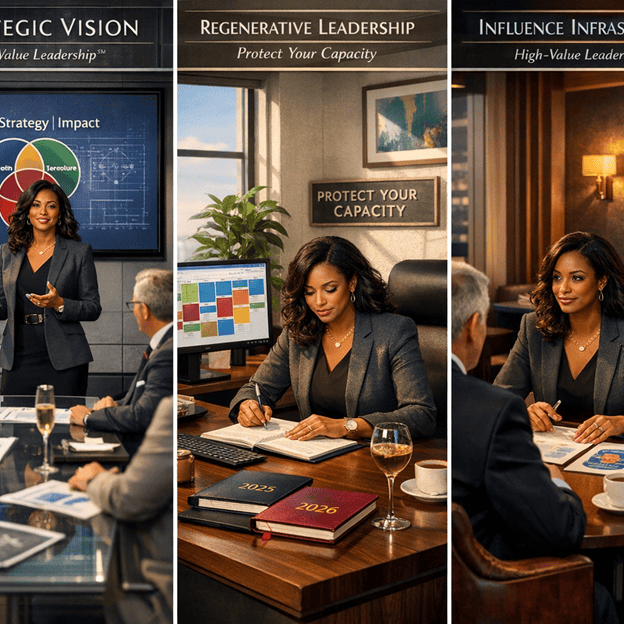
  • What influence infrastructure does she build that I haven’t prioritized?

For Black women leaders specifically, this question carries additional weight. We’ve spent decades adapting to environments that weren’t designed for us, code-switching to survive, and building resilience to compensate for systemic barriers. The woman we’ve had to be was shaped by necessity as much as choice.

The woman you’re architecting for 2026 gets to be shaped by strategy.


📊 What the Research Says About Intentional Leadership Design

Dr. Herminia Ibarra’s research on leadership transitions at INSEAD reveals a critical insight: Leaders who successfully navigate career advancement don’t just set new goals—they intentionally redesign how they operate.

Her work shows that effective leadership transitions require three shifts:

  1. Redefining your professional identity (how you see yourself and your role)
  2. Developing new networks and relationships (who has access to you and whose tables you’re at)
  3. Making sense of your experiences differently (the narratives you tell about challenges, setbacks, and successes)

Notice what’s missing from this list? Working harder.

The woman you’re becoming in 2026 doesn’t succeed by doing more of what the woman of 2025 did. She succeeds by operating differently—more strategically, more intentionally, more architecturally.

Research from the Center for Creative Leadership adds nuance for Black women specifically. Their study on executive women of color found that the leaders who break through to senior roles share a common practice: They actively redesign themselves at each career stage rather than assuming the competencies that got them to their current level will carry them to the next.

Translation: Upgrading yourself while running is not optional. It’s how you compete.


🎯 The GenX Reality: We Don’t Get to Step Back

Here’s what makes this conversation different for GenX women—and particularly for Black GenX women in corporate spaces:

We don’t have the luxury of taking a sabbatical to “find ourselves.” We don’t get gap years for self-discovery. We have to upgrade our leadership operating systems while simultaneously running them.

We’re in our peak earning years managing aging parents and supporting adult children still finding their footing. We’re carrying institutional knowledge in organizations experiencing massive generational turnover. We’re leading teams through AI transformation, economic uncertainty, and cultural shifts while figuring out our own relationship to these changes.

We can’t step back. We have to architect forward.

This isn’t a complaint—it’s context. GenX women became masters of “figure it out while doing it.” That skill is an asset. But it also means we’re prone to defaulting to survival patterns (figure it out, muscle through, make it work) when strategic redesign is what’s actually required.

The woman you’re architecting for 2026 isn’t just figuring it out. She’s designing it intentionally.


🏛️ Three Pillars of Intentional Leadership Architecture

Pillar 1: Leadership Presence—From Competence to Commanding

The Woman of 2025: She proved her competence repeatedly. She over-prepared for every meeting. She documented every decision. She made herself indispensable through technical expertise and reliability. She worked hard to earn respect.

The Woman You’re Architecting for 2026: She operates from an assumption of competence rather than constantly proving it. Her leadership presence communicates strategic value before she speaks. She’s moved from being respected for execution to being sought out for vision.

What This Requires:

Mindset Shift:

  • From: “I need to prove I belong here”
  • To: “My expertise is the reason I’m here—how do I leverage it strategically?”

Behavioral Change:

  • Speak earlier in meetings (not after you’ve processed every angle)
  • Offer strategic perspective, not just tactical solutions
  • Stop over-explaining your recommendations
  • Take up space without apologizing for it

For Black Women Specifically:

There was a financial services company where a Black woman VP consistently downplayed her expertise when presenting to senior leadership. She’d preface recommendations with “I might be wrong, but…” or “This is just my perspective…” Her ideas were excellent, but her delivery undermined her authority.

When she shifted to leading with conviction—”Based on my analysis, here’s what we need to do”—her influence quadrupled. Same expertise. Different presence.

The architecture work: Dismantling the protective pattern of minimizing yourself to make others comfortable, and building a presence that reflects your actual expertise level.

2026 Design Question: What would your leadership presence look like if you operated from the assumption that your competence is established, not questioned?


Pillar 2: Energy Architecture—From Reactive to Regenerative

The Woman of 2025: She said yes to everything because she feared the consequences of saying no. She absorbed everyone’s emotional labor. She managed crises as they emerged. Her calendar owned her. She collapsed into weekends trying to recover from weeks that depleted her.

The Woman You’re Architecting for 2026: She has an energy budget and protects it fiercely. She distinguishes between her responsibility and everyone else’s comfort. She prevents crises through strategic systems rather than managing them through heroic effort. Her calendar reflects her priorities, not everyone else’s emergencies.

What This Requires:

Energy Audit: Track your energy across one week. Not just time—energy.

  • What activities energize you? (Even if they’re hard work)
  • What depletes you disproportionately to the value created?
  • Where are you spending energy managing what should be other people’s responsibilities?
  • What boundaries would give you 20% more capacity?

Strategic Elimination:

According to research from the Energy Project, high-performing leaders don’t just manage time—they manage energy across four dimensions: physical, emotional, mental, and spiritual. The leaders who sustain performance without burnout practice strategic elimination, not just time management.

The Woman You’re Architecting:

  • Eliminates one energy-draining commitment per quarter
  • Builds 30-minute buffers between high-stakes meetings
  • Protects morning hours for strategic thinking (no back-to-back meetings before 10am)
  • Delegates emotional labor that isn’t hers to carry
  • Says “I’ll get back to you” instead of immediately solving everyone’s problems

For Black Women Specifically:

We carry a particular kind of energy drain: the tax of navigating predominantly white spaces, managing others’ discomfort with our presence, and absorbing workplace dynamics that weren’t designed for our success.

Research from Dr. Ella F. Washington shows that Black women spend up to 15 hours per week on identity-related “emotional labor”—managing microaggressions, educating colleagues about diversity, proving competence repeatedly, and moderating authentic expression to fit workplace norms.

That’s nearly 40% of a standard work week spent on labor that doesn’t appear in your job description and doesn’t contribute to advancement.

The architecture work: Building boundaries around what energy you’ll spend on organizational dysfunction versus strategic priorities that actually advance your career.

2026 Design Question: If you had 15 more hours per week because you stopped absorbing what isn’t yours to carry, what would you build with that capacity?


Pillar 3: Influence Infrastructure—From Invisible to Indispensable

The Woman of 2025: She did excellent work and hoped someone noticed. She waited to be invited to important conversations. She built relationships when convenient. Her influence was limited to her direct team and immediate function.

The Woman You’re Architecting for 2026: She builds influence infrastructure intentionally. She cultivates relationships strategically across functions and levels. She positions her expertise where decision-makers can see it. Her influence extends beyond her role because she’s architected it that way.

What This Requires:

Relationship Mapping:

Create a visual map of your current influence infrastructure:

Inner Circle (High Trust, High Access):

  • Who can you call at 5pm on Friday with a complex problem?
  • Who advocates for you in rooms you’re not in?
  • Who shares opportunities before they’re publicly posted?

Strategic Network (Moderate Trust, Targeted Engagement):

  • Who do you engage with for mutual benefit but not deep relationship?
  • Who has influence in areas you’re trying to grow into?
  • Who knows your work but doesn’t know you personally?

Outer Ring (Low Trust, Minimal Engagement):

  • Who should be in your network but currently isn’t?
  • Who has power in spaces you’re trying to access?
  • Who are the connectors who could bridge you to new opportunities?

The Architecture Question: Are you spending 80% of your relationship energy on your inner circle (maintenance) while spending only 20% on strategic network building (growth)?

The Woman You’re Architecting:

  • Inverts that ratio: 30% maintenance, 70% strategic expansion
  • Schedules “influence meetings” quarterly with 3-5 strategic relationships outside her immediate function
  • Asks for introductions from existing connections
  • Shares her expertise in forums where decision-makers participate
  • Builds reciprocal value (solves problems for people she wants relationships with)

For Black Women Specifically:

Sylvia Ann Hewlett’s research on sponsorship shows that Black women are the least likely demographic to have sponsors (leaders who use their political capital to advocate for your advancement). We have mentors—people who give advice. We rarely have sponsors—people who fight for us in promotion conversations.

Why? Because sponsorship requires access to power networks that have historically excluded us. It requires relationships with decision-makers who often don’t look like us and don’t naturally gravitate toward us socially.

The architecture work: Intentionally building influence infrastructure that compensates for the networks you weren’t born into.

There was a healthcare organization where a Black woman Director realized she had strong relationships with other Black women leaders and mid-level managers—but zero relationships with the C-suite white men who made promotion decisions. Her competence was undeniable. Her influence infrastructure was non-existent where it mattered most for advancement.

She spent six months strategically building just three relationships with C-suite decision-makers. Not through manipulation—through solving problems they cared about. Within eighteen months, she was promoted to VP. Same competence. Different infrastructure.

2026 Design Question: Who needs to know about your expertise and value for your 2026 goals to be achievable—and do they currently know?


🔧 The Practical Architecture Process

Theory is useless without application. Here’s how to actually architect the woman you’re becoming in 2026:

Step 1: Honor the Woman of 2025 (December 30-31)

Complete this exercise in writing:

She got me through 2025 by:

  • [List 5-7 specific strengths, patterns, or practices]

But in 2026, I need to:

  • [List 3-5 different operational patterns required]

Example:

She got me through 2025 by:

  • Saying yes to every opportunity to prove my value
  • Working nights and weekends to deliver flawless results
  • Managing everyone’s emotional comfort in meetings
  • Building deep expertise in my functional area

But in 2026, I need to:

  • Say yes strategically to opportunities aligned with VP-level priorities
  • Protect weekend capacity for strategic thinking and personal renewal
  • Stop managing others’ discomfort and focus on driving business outcomes
  • Build cross-functional strategic visibility, not just functional expertise

The point: Name what worked and what needs to change. Honor both.


Step 2: Define Your 2026 Architecture Across Three Pillars (January 1-7)

For each pillar, answer:

Leadership Presence:

  • What do I want to be known for in 2026? (Not what I do—who I am as a leader)
  • What’s one behavior I need to stop? (Over-explaining, apologizing, deferring)
  • What’s one behavior I need to start? (Speaking first, challenging assumptions, taking strategic risks)

Energy Architecture:

  • What’s consuming energy without creating value?
  • What boundary would give me 20% more capacity?
  • What would regenerative energy management look like for me?

Influence Infrastructure:

  • Who needs to know about my expertise for my 2026 goals to be possible?
  • What three strategic relationships will I intentionally build?
  • How will I create visibility in spaces where decisions about my future are made?

Step 3: Build Your First 90 Days (January-March 2026)

Don’t try to architect everything at once. Pick ONE shift per pillar for Q1:

Leadership Presence (One Behavioral Shift):

  • Example: “I will speak in the first third of every senior leadership meeting, offering strategic perspective rather than waiting to respond to others.”

Energy Architecture (One Boundary):

  • Example: “I will eliminate Sunday email checking and protect 9-11am Monday/Wednesday for strategic thinking with no meetings.”

Influence Infrastructure (One Relationship Investment):

  • Example: “I will schedule monthly ‘learning conversations’ with the CFO, solving one problem she cares about each quarter.”

Track these for 90 days. Assess. Adjust. Expand.


Step 4: Create Accountability Architecture (Ongoing)

Architecture requires maintenance. Who will hold you accountable to becoming who you’re designing?

Options:

  • Schedule monthly self-audits (calendar reminder: “Am I building the woman I designed?”)
  • Partner with a peer for reciprocal accountability
  • Hire a coach who specializes in leadership architecture
  • Join a cohort-based program focused on strategic leadership design

The woman you’re architecting doesn’t just set intentions. She builds systems that ensure those intentions become reality.


💎 High-Value Leadership℠: Architecture as Strategic Competence

In High-Value Leadership: Transforming Organizations Through Purposeful Culture, I define high-value leadership as leadership that creates sustainable impact through intentional design, not reactive management.

The same principle applies to designing yourself as a leader.

Low-value leadership patterns:

  • React to whatever emerges
  • Default to last year’s operating system
  • Hope circumstances change rather than intentionally changing how you engage circumstances
  • Measure success by survival rather than strategic progress

High-Value Leadership℠ patterns:

  • Anticipate what’s required and build infrastructure proactively
  • Upgrade operating systems before they become obsolete
  • Architect circumstances rather than just navigate them
  • Measure success by intentional design, not accidental outcomes

The woman you’re becoming in 2026 isn’t an accidental outcome of circumstances. She’s a strategic design project.

In Mastering a High-Value Company Culture, I explore how transformational cultures are built through “conscious construction”—the intentional building of systems, norms, and practices that produce desired outcomes. You can’t build a high-value culture accidentally. It requires architecture.

The same is true for building the leader you’re becoming.

And for my Black women leaders specifically: Rise & Thrive: A Black Woman’s Blueprint for Leadership Excellence addresses the unique navigation required when you’re architecting yourself in spaces that weren’t designed for your success.

Rising is about visibility and positioning. Thriving is about sustainability and strategic design.

You can’t thrive by replicating the survival patterns that got you here. You have to architect a more strategic version of yourself—one that honors your resilience while refusing to romanticize the circumstances that required it.


🌟 She Got You Here. Now Design Who Takes You Forward.

December 31st is the perfect day for this work.

Not because there’s anything magical about the calendar flipping. Because you have permission—from yourself—to acknowledge that the woman who survived 2025 and the woman who will thrive in 2026 might operate differently.

She doesn’t need to be someone else. She needs to be a more strategic version of exactly who you are.

More boundaried. More visible. More intentional about energy. More deliberate about influence. More convicted in her presence. More protective of her capacity. More strategic about her relationships.

Same values. Different architecture.

So yes—cheers to the woman you were in 2025. She deserves every bit of celebration.

And now?

Let’s architect the woman you’re becoming.

Not through vague intentions or aspirational thinking. Through strategic design across three pillars: Leadership Presence, Energy Architecture, and Influence Infrastructure.

Because the woman who thrives in 2026 isn’t hoping circumstances change. She’s architecting herself to transform them.


💭 Reflection Questions

Work through these alone or with your leadership circle:

1. What did the woman of 2025 do brilliantly that you want to honor—and what did she do out of survival that you want to release?

2. If you operated from an assumption of established competence in 2026 instead of constantly proving yourself, how would your leadership presence shift?

3. For Black women specifically: What protective mechanism or survival pattern served you in hostile environments but is now limiting your effectiveness in your current context?

4. What’s consuming 20% or more of your energy without creating proportional value—and what boundary would protect that capacity?

5. Who needs to know about your expertise and leadership capability for your 2026 goals to be achievable—and do they currently know?

6. What’s one behavior you need to stop, one you need to start, and one boundary you need to enforce to become the woman you’re architecting for 2026?


🚀 Next Steps: From Reflection to Architecture

STEP 1: Complete the Honor & Release Exercise

Block 60 minutes on December 30th or 31st. Honor who got you through 2025. Name what needs to change for 2026.

STEP 2: Define Your Three-Pillar Architecture

Use the framework in this article to design:

  • Your Leadership Presence shift
  • Your Energy Architecture boundary
  • Your Influence Infrastructure investment

STEP 3: Build Your Q1 Accountability System

Don’t just design the woman you’re becoming—create the systems that ensure you actually build her.

STEP 4: Get Strategic Support

Architecture is hard to do alone, especially when you’re upgrading while running.


🤝 Work with Che’ Blackmon Consulting

If you’ve realized that architecting the woman you’re becoming requires more than personal reflection—that you need strategic coaching, proven frameworks, and accountability from someone who understands both the business strategy AND the unique navigation Black women leaders face—we should talk.

Our services for individual leaders:

✅ Executive Coaching for Strategic Leadership Architecture
One-on-one coaching designed specifically for Black women leaders navigating the shift from competence to commanding presence, from reactive to regenerative energy management, and from invisible to indispensable influence.

✅ High-Value Leadership Intensive (Waitlist Now Open)
A cohort-based program that combines strategic leadership development with the architecture work of building sustainable, influential leadership presence. Specifically designed for GenX women leaders ready to upgrade their operating systems.

For organizations:

✅ Leadership Development Programs
Building high-value leadership cultures where architecture is taught as a strategic competence, not just goal-setting.

✅ Executive Coaching for Leadership Transitions
Supporting leaders through critical transitions with intentional redesign rather than hoping competence alone carries them forward.

✅ Culture Transformation for Equity
Creating organizational environments where Black women and other traditionally overlooked leaders don’t have to architect around systemic barriers—they can architect for strategic impact.

Ready to architect the woman you’re becoming with strategic support?

📧 admin@cheblackmon.com
📞 888.369.7243
🌐 cheblackmon.com


Additional Resources:

📚 Read: High-Value Leadership: Transforming Organizations Through Purposeful Culture
The strategic framework that applies to organizational transformation and personal leadership architecture
Get the book: https://books.by/blackmons-bookshelf

🎓 Join the Waitlist: High-Value Leadership Intensive
A transformative cohort-based program for leaders ready to architect their next-level leadership presence
Join: https://adept-solutions-llc-2.kit.com/147712ac25

📖 Read: Rise & Thrive: A Black Woman’s Blueprint for Leadership Excellence
The specific navigation guide for Black women architecting leadership excellence in corporate spaces

🎧 Listen: Unlock, Empower, Transform with Che’ Blackmon
Twice-weekly conversations on leadership architecture and strategic career design

📺 Watch: Rise & Thrive YouTube Series
Practical leadership architecture content for Black women in corporate leadership


Che’ Blackmon is the Founder & CEO of Che’ Blackmon Consulting, a Michigan-based fractional HR and culture transformation consultancy. As a DBA candidate in Organizational Leadership at National University with 24+ years of progressive HR leadership experience, she specializes in AI-enhanced culture transformation and executive coaching for high-value leadership development. She is the author of “High-Value Leadership: Transforming Organizations Through Purposeful Culture,” “Mastering a High-Value Company Culture,” and “Rise & Thrive: A Black Woman’s Blueprint for Leadership Excellence.”


She got you here. Now let’s architect who takes you forward. ✨

Not a different woman. A more strategic version of exactly who you are.

#Leadership #LeadershipDevelopment #WomenInLeadership #BlackWomenInBusiness #ExecutiveCoaching #CareerDevelopment #ProfessionalGrowth #HighValueLeadership #IntentionalLeadership #LeadershipPresence #EnergyManagement #ExecutivePresence #StrategicLeadership #NewYearNewYou #LeadershipTransformation

The Competence Paradox: Why Your 2025 Wins Don’t Guarantee Your 2026 Relevance

By Che’ Blackmon, Founder & CEO, Che’ Blackmon Consulting | DBA Candidate in Organizational Leadership


🎯 The Lie We’ve Been Sold

You crushed 2025.

You delivered that critical project three weeks ahead of schedule. You resolved the interdepartmental conflict that had been festering for eighteen months. You mentored six emerging leaders, negotiated a complex vendor agreement that saved the company $400K, and your team’s engagement scores increased by 14 points. Your performance review was glowing. Your contributions were undeniable.

And yet.

When the VP role opened in January 2026, they hired someone from outside the organization. Someone with half your tenure and a third of your institutional knowledge. Someone who “brings fresh perspective” and “fits the leadership vision going forward.”

Here’s the uncomfortable truth that nobody talks about in those sanitized leadership development workshops: Competence got you in the room, but competence alone won’t elevate you to the leadership table.

For Black women professionals—especially those of us in GenX who came up being told that excellence was the only credential we needed—this is a particularly painful realization. We were raised on the promise that if we worked twice as hard, prepared three times as thoroughly, and delivered flawless results, we’d be recognized. We’d advance. We’d be valued.

We did all of that. And we’re still the most competent people in rooms where we’re also the most invisible.

Welcome to the Competence Paradox.


💡 What Is the Competence Paradox?

The Competence Paradox is the gap between proving you’re capable and being positioned for advancement. It’s the space where excellent work goes unrecognized, where critical contributions get attributed to “the team,” and where your November wins are completely forgotten by February.

It’s the phenomenon where you can be objectively high-value—delivering measurable impact, solving complex problems, driving organizational results—and still not be positioned as high-value in the eyes of decision-makers.

Research from the Center for Talent Innovation reveals that 65% of Black professionals report their ideas are not acknowledged or adopted at the same rate as their white colleagues’ ideas, even when the ideas are identical. McKinsey’s 2024 Women in the Workplace study shows that Black women are significantly underrepresented in senior leadership despite often being the most educated and credentialed employees in their organizations.

The data is clear: Competence is necessary but insufficient.


🔍 The Three Dimensions of the Paradox

Dimension 1: The Invisibility of Excellence

There was a financial services company where a Black woman Director of Risk Management had successfully predicted and prevented three major compliance violations over eighteen months. Her analysis was thorough, her recommendations were implemented, and the company avoided millions in potential penalties. Her work was excellent.

But when the C-suite discussed “strategic thinkers” for succession planning, her name never came up. Why? Because preventing disasters is invisible work. Nobody sees what didn’t happen. Her competence was undeniable, but it wasn’t visible in ways that translated to leadership perception.

Meanwhile, a peer who led a flashy digital transformation initiative (that ultimately came in over budget and under-delivered) was being groomed for VP. His work was visible. His “innovation” was discussed. His positioning was strategic.

The lesson: Excellence that’s invisible doesn’t translate to influence.

Dimension 2: The Attribution Gap

Catalyst research shows that when women—particularly Black women—deliver strong results, those results are more likely to be attributed to external factors (team effort, market conditions, luck) rather than individual competence and leadership. When men deliver comparable results, they’re attributed to skill, vision, and leadership capability.

You delivered a complex project successfully? “The team really came through.”
He delivered a comparable project? “His leadership was instrumental.”

Same outcome. Different narrative. Different career trajectory.

The lesson: If you’re not controlling the narrative around your wins, someone else is—or worse, no one is.

Dimension 3: The Positioning Premium

According to research from Stanford’s VMware Women’s Leadership Lab, leaders who advance share a common trait that has nothing to do with competence: strategic self-positioning. They actively manage how their work is perceived, discussed, and remembered. They cultivate sponsors who amplify their contributions. They connect their wins to organizational priorities in ways that make them indispensable.

Meanwhile, many high-performing Black women operate under the belief that “good work speaks for itself.” It doesn’t. Not in environments where unconscious bias shapes whose contributions get amplified and whose get overlooked.

The lesson: Being competent and being positioned as leadership material are two different skill sets.


📊 The Data: What Actually Separates Promoted Leaders from Equally Capable Peers?

A comprehensive study by the Executive Leadership Council and the Center for Creative Leadership examined what differentiates executives who advance to the C-suite from equally qualified peers who plateau. The findings are illuminating—and frustrating:

Factors That DON’T Significantly Predict Advancement:

  • ❌ Years of experience (competence baseline)
  • ❌ Educational credentials (competence baseline)
  • ❌ Performance ratings (competence validation)
  • ❌ Technical expertise (competence demonstration)

Factors That DO Significantly Predict Advancement:

  • ✅ Executive sponsorship (someone with power advocating for you)
  • ✅ Strategic visibility (your work being known beyond your immediate function)
  • ✅ Narrative control (how your contributions are framed and remembered)
  • ✅ Perceived leadership potential (not just performance, but future capability)
  • ✅ Cultural capital (being seen as “fitting” the leadership culture)

Notice anything? None of these advancement factors are about doing better work. They’re about positioning, perception, and power dynamics.

For Black women, the implications are sobering. We often excel at the competence factors while being systematically excluded from the positioning factors. We’re told to focus on performance while watching less qualified peers leverage relationships, visibility, and strategic positioning to leapfrog us.


🚧 Why GenX Women Fall Into This Trap More Than Others

GenX women—particularly Black GenX women—were socialized into a specific professional mythology:

The Mythology:

  • “Keep your head down and do excellent work.”
  • “Let your results speak for themselves.”
  • “Don’t be too visible or you’ll be seen as self-promotional.”
  • “Prove yourself through performance, not politics.”
  • “If you’re good enough, they’ll notice.”

The Reality:

  • Invisible excellence doesn’t translate to advancement
  • Results need advocates to speak for them
  • Strategic visibility is leadership competence, not vanity
  • Organizations ARE political—pretending they’re not is career sabotage
  • “Good enough” gets overlooked while “strategically positioned” gets promoted

We entered the workforce in the 80s and 90s when this mythology was gospel—especially for Black women who were told that any visibility that wasn’t tied to flawless performance would confirm stereotypes. We learned to be exceptional AND invisible. Competent AND non-threatening. Valuable AND uncomplaining.

Now we’re in mid-to-senior career stages watching younger colleagues—who didn’t internalize these limiting beliefs—advocate for themselves, leverage sponsors, and advance past us. Not because they’re more competent. Because they understand the positioning game we were told not to play.


💰 The Real Cost of the Competence Paradox

Let’s quantify what this costs:

Financial Impact

Research from PayScale and the American Association of University Women shows:

  • Black women earn 38% less than white men for comparable work
  • The wage gap for Black women widens with seniority (competence increases but positioning gaps compound)
  • Black women with advanced degrees earn less than white men with bachelor’s degrees

Translation: Your 2025 competence didn’t close the gap. Your 2026 positioning strategy might.

Career Velocity Impact

A study by LeanIn.Org and McKinsey found:

  • For every 100 men promoted to manager, only 60 Black women are promoted
  • Black women are less likely than any other group to be promoted from manager to senior manager
  • This gap isn’t explained by performance differences—it’s explained by sponsorship and visibility gaps

Translation: Competence gets you to manager. Positioning gets you to senior leader.

Influence & Impact Ceiling

When you’re highly competent but poorly positioned:

  • Your ideas get implemented without credit
  • Your expertise is utilized without compensation
  • Your leadership capability is questioned despite proven results
  • Your contributions are valued but not rewarded with advancement

This isn’t just unfair—it’s a strategic waste of your capacity and a limitation on your impact.


🎯 The Four Pillars of Strategic Positioning

If competence alone isn’t enough (and the data shows it isn’t), what does strategic positioning actually look like?

Pillar 1: Visibility Architecture

What it is: Intentionally designing how, when, and where your expertise becomes known.

What it’s NOT: Self-promotion for ego or attention.

What it IS: Strategic communication that connects your work to organizational priorities in ways decision-makers can see, understand, and value.

Practical Application:

There was a healthcare organization where a Black woman VP of Operations consistently delivered on complex regulatory compliance projects. Excellent work. Zero visibility outside her immediate division. When asked why she didn’t present her wins at leadership meetings, she said, “That feels like bragging.”

Meanwhile, a peer was presenting quarterly “innovation updates” that were 30% substance and 70% positioning. Guess who got tapped for the COO role?

The VP’s competence was never in question. Her positioning was non-existent.

How to Build Visibility Architecture:

  • Connect your wins to C-suite priorities in writing (memos, reports, updates)
  • Request presentation time at leadership forums (frame it as “sharing learnings” not self-promotion)
  • Publish thought leadership externally (LinkedIn articles, industry publications)
  • Speak at conferences and internal events
  • Build a “brag file” and share quarterly highlights with your leader AND their leader

Pillar 2: Sponsorship Cultivation

What it is: Identifying and cultivating relationships with leaders who have power and will advocate for you in rooms you’re not in.

The difference between mentorship and sponsorship:

  • Mentors give advice and support
  • Sponsors use their capital to advocate for your advancement

Research by Sylvia Ann Hewlett shows that 85% of promotions happen because of sponsorship, not performance alone. Yet Black women are significantly less likely to have sponsors than any other demographic group.

How to Cultivate Sponsors:

  • Identify leaders whose priorities align with your expertise
  • Make their lives easier by solving problems they care about
  • Ask explicitly for sponsorship (not just mentorship)
  • Give them “ammunition”—regular updates on your wins that they can use to advocate for you
  • Understand that sponsorship is reciprocal: what value do you bring to their objectives?

Pillar 3: Narrative Control

What it is: Actively shaping the story that gets told about your work, your contributions, and your leadership capability.

If you’re not controlling your narrative, one of three things happens:

  1. Your contributions get attributed to “the team” or external factors
  2. Your work gets remembered incorrectly or incompletely
  3. No story gets told at all—your wins simply disappear from organizational memory

Your November wins won’t be remembered in February unless you’ve strategically positioned them in the organizational narrative.

How to Control Your Narrative:

  • Frame your wins strategically: Don’t just report what you did—connect it to strategic outcomes
    • ❌ “Completed the vendor negotiation project”
    • ✅ “Restructured vendor agreements resulting in $400K annual savings and 15% efficiency improvement, directly supporting the CFO’s cost optimization initiative”
  • Document in real-time: Don’t wait for annual reviews to capture your impact
  • Use the “FYI” strategy: Send brief, strategic updates to key stakeholders positioning your work in the context of organizational priorities
  • Teach others to advocate for you: Give your manager, sponsors, and allies the language to describe your impact accurately

Pillar 4: Future-Readiness Signaling

What it is: Demonstrating not just current competence but future capability.

Decision-makers promote based on perceived potential, not just proven performance. They’re asking: “Can I see this person at the next level?”

For Black women, this is where bias does the most damage. Research shows that evaluators are more likely to question Black women’s “leadership presence,” “executive gravitas,” and “strategic thinking” even when objective performance is identical to peers.

How to Signal Future-Readiness:

  • Speak the language of strategy, not just execution: Connect your work to enterprise goals, market dynamics, competitive positioning
  • Demonstrate cross-functional thinking: Show you understand the business beyond your functional silo
  • Participate visibly in strategic initiatives: Volunteer for transformation projects, strategic planning, high-visibility task forces
  • Build external credibility: Industry recognition, speaking engagements, board seats signal you’re leadership-ready
  • Articulate a leadership POV: Have a clear perspective on industry trends, organizational challenges, future opportunities

🔥 Real Talk: What Black Women Specifically Need to Navigate This Paradox

Let’s address what the “mainstream” leadership advice won’t say directly:

1. The “Twice as Good” Trap Is Real—And It’s Not Enough

We were told if we worked twice as hard and delivered twice the results, we’d get the same opportunities. That was always a lie. The standard isn’t “twice as good”—it’s “twice as good AND strategically positioned.”

You can’t out-competence systemic bias. You have to out-strategize it.

2. Visibility Isn’t “Bragging”—It’s Strategic Communication

Black women are socialized to avoid visibility that isn’t tied to flawless performance. We’re told:

  • Don’t be too confident (aggressive)
  • Don’t talk about your wins (self-promotional)
  • Don’t make yourself too visible (threatening)

Meanwhile, mediocre white men are building personal brands and leveraging every minor win into maximum visibility.

Reframe: Strategic visibility is a professional competence, not a character flaw. If you can’t advocate for yourself, you can’t advocate for your team, your priorities, or the people you’re trying to lift up.

3. You Need Sponsors Who Actually Have Power

Well-meaning mentorship from other Black women or junior leaders won’t compensate for lack of sponsorship from C-suite decision-makers. This isn’t about abandoning your community—it’s about being strategic about who has the actual power to advance your career.

4. “Fitting In” Isn’t the Goal—Strategic Differentiation Is

We’re often told to “fit” the leadership culture. But for Black women, “fitting” often means shrinking, code-switching, or performing a version of leadership that isn’t authentic.

Reframe: High-value leadership isn’t about conformity—it’s about strategic differentiation. Position your unique perspective, experience, and approach as a competitive advantage, not something to minimize.

5. Protecting Your Capacity Is Strategic Positioning

Black women carry disproportionate emotional labor, invisible work, and “diversity responsibilities” that consume capacity but don’t translate to advancement. Every hour you spend on unpaid DEI work or managing others’ discomfort is an hour you’re not spending on strategic positioning.

It’s not selfish to protect your capacity for work that actually advances your career. It’s strategic.


📋 The 5-Minute Visibility Audit

Before you can position yourself strategically, you need to understand your current visibility baseline. Answer these questions honestly:

Strategic Visibility Check

1. Who knows about your most significant 2025 accomplishments?

  • ☐ Just me
  • ☐ My immediate manager
  • ☐ My skip-level leader
  • ☐ C-suite decision-makers
  • ☐ People outside my function/division

2. When was the last time you presented your work to senior leadership?

  • ☐ Never
  • ☐ Over a year ago
  • ☐ Within the past year
  • ☐ Within the past quarter
  • ☐ Regularly (monthly/quarterly)

3. How many senior leaders outside your direct reporting line could articulate your value proposition?

  • ☐ Zero
  • ☐ 1-2
  • ☐ 3-5
  • ☐ 5+

4. Do you have documentation of your wins connected to business outcomes?

  • ☐ No formal tracking
  • ☐ Performance review notes only
  • ☐ Personal “brag file” I maintain
  • ☐ Regular updates shared with leadership
  • ☐ Published thought leadership demonstrating expertise

5. When your name comes up in succession planning conversations, what are you known for?

  • ☐ I honestly don’t know
  • ☐ Executing tasks well
  • ☐ Being reliable/a team player
  • ☐ Subject matter expertise in my function
  • ☐ Strategic thinking and leadership potential

Sponsorship & Advocacy Check

6. Do you have a sponsor (not mentor) actively advocating for you?

  • ☐ No
  • ☐ I have mentors but not sponsors
  • ☐ I think so, but I’m not sure
  • ☐ Yes, and I actively maintain that relationship

7. How often do you give your manager/sponsor “ammunition” to advocate for you?

  • ☐ Never/rarely
  • ☐ During performance reviews only
  • ☐ When specifically asked
  • ☐ Proactively on a regular basis

8. Who in your organization would fight for you to get promoted if you weren’t in the room?

  • ☐ No one I can identify
  • ☐ Maybe my direct manager
  • ☐ My manager and 1-2 others
  • ☐ Multiple leaders with decision-making power

Future-Readiness Signaling Check

9. When you communicate about your work, do you focus on:

  • ☐ Tasks completed (execution)
  • ☐ Projects delivered (management)
  • ☐ Problems solved (expertise)
  • ☐ Strategic outcomes achieved (leadership)
  • ☐ Future capability and vision (executive presence)

10. In the past 6 months, have you:

  • ☐ Participated in cross-functional strategic initiatives
  • ☐ Presented on industry trends or organizational strategy
  • ☐ Published thought leadership externally
  • ☐ Built relationships with decision-makers outside your division
  • ☐ Articulated a clear POV on where the organization should be headed

Scoring Your Visibility

0-3 checks: Your competence is invisible. Urgent positioning work needed.

4-6 checks: You have baseline visibility but significant positioning gaps.

7-9 checks: You’re positioning strategically in some areas but missing opportunities.

10+ checks: You understand that positioning is as important as performance.


🛠️ Your 2026 Positioning Strategy: Four Quarters, Four Pillars

Stop trying to boil the ocean. Here’s a practical quarterly plan to build strategic positioning throughout 2026:

Q1 2026: Build Your Visibility Architecture

Goal: Make your expertise visible to decision-makers

Actions:

  • Document your 2025 wins connected to business outcomes
  • Request 15 minutes at a leadership meeting to share key learnings from a major project
  • Start a quarterly “FYI” update to your skip-level leader
  • Publish one thought leadership piece (LinkedIn article, internal blog, industry publication)
  • Create a tracking system for capturing wins in real-time

Milestone: By March 31, at least 3 senior leaders outside your direct chain can articulate your value.

Q2 2026: Cultivate Strategic Sponsorship

Goal: Identify and activate sponsors who will advocate for you

Actions:

  • Identify 2-3 potential sponsors (leaders with power whose priorities align with your expertise)
  • Set up informal “learning conversations” with each
  • Solve a problem they care about (make their lives easier)
  • Explicitly ask one to be your sponsor
  • Give your sponsor quarterly updates with specific “asks” for advocacy

Milestone: By June 30, you have at least one active sponsor who’s advocated for you in a meaningful way.

Q3 2026: Control Your Narrative

Goal: Shape how your work and leadership are discussed

Actions:

  • Audit how your contributions are currently being described/attributed
  • Create templated language for how you want your wins framed
  • Teach your manager/allies how to advocate for you using this language
  • Connect every win to strategic priorities in writing
  • Address any misattribution directly and immediately

Milestone: By September 30, you’ve successfully reframed at least 3 contributions that were being under-valued or misattributed.

Q4 2026: Signal Future-Readiness

Goal: Position yourself as leadership-ready for 2027 opportunities

Actions:

  • Volunteer for a high-visibility strategic initiative
  • Present on industry trends or organizational strategy
  • Build relationships with 3-5 decision-makers outside your division
  • Articulate your leadership POV in a visible forum
  • Request stretch assignments that demonstrate next-level capability

Milestone: By December 31, when your name comes up in succession planning, you’re discussed as a strategic leader, not just a strong executor.


💎 High-Value Leadership℠: Where Competence Meets Strategic Positioning

In High-Value Leadership: Transforming Organizations Through Purposeful Culture, I define high-value leadership as the intersection of authentic excellence and strategic impact. Notice both components are essential.

Authentic excellence = Your competence, your expertise, your track record
Strategic impact = Your visibility, your positioning, your narrative control

Most Black women have mastered the first. We’ve spent careers proving our competence. What we often haven’t done—because we were told it was “political” or “self-promotional”—is master the second.

But here’s the truth: You can’t transform organizational culture from a position of invisibility.

You can’t build high-value cultures if you’re not positioned as a high-value leader. You can’t advocate for equity if you’re not in rooms where decisions are made. You can’t lift others up if you’re stuck in the competence trap yourself.

Strategic positioning isn’t about ego. It’s about maximizing your capacity to create impact.

In Mastering a High-Value Company Culture, one of the core principles is “conscious construction”—the intentional building of environments where excellence is recognized and rewarded equitably. But until we have those environments, you have to navigate the environments that exist. That means building positioning competence alongside performance competence.

And for my Black women leaders: Rise & Thrive: A Black Woman’s Blueprint for Leadership Excellence speaks directly to this navigation. Rising means being seen. Thriving means being strategically positioned. Excellence means refusing to accept that competence alone should be enough—while simultaneously mastering the positioning game we didn’t create but must learn to play.


🚀 Your 2025 Wins Are Assets—But Only If You Position Them

December 30th is the perfect day for this audit. Your 2025 wins are fresh. Your capacity for 2026 positioning is available. The gap between your competence and your visibility is quantifiable.

Here’s what you need to accept:

Your November wins WILL be forgotten by February—unless you position them strategically.

That project you delivered flawlessly? Already fading from organizational memory.
That crisis you resolved? Someone else is probably taking credit.
That innovation you implemented? Being discussed as “team success” rather than your leadership.

This isn’t because your work wasn’t excellent. It’s because excellence without positioning is invisible.

So the question isn’t whether you’re competent enough for 2026 opportunities. You are. You’ve proven that repeatedly.

The question is: Are you positioned for decision-makers to see your competence, value your contributions, and advocate for your advancement?

If the answer is no, your 2025 wins won’t guarantee your 2026 relevance. They’ll just be more proof of the Competence Paradox—excellent work that didn’t translate to advancement because positioning was missing.


💭 Discussion Questions

Work through these with your leadership team, peer group, or in personal reflection:

  1. When you think about your most significant 2025 accomplishments, who beyond your immediate manager could articulate their business impact? If the answer is “very few people,” what does that tell you about your visibility architecture?
  2. For Black women specifically: How much energy are you spending proving your competence versus positioning your expertise strategically? What would shift if you allocated even 20% of that “proving” energy to strategic visibility?
  3. Do you have a sponsor (someone with power who advocates for you) or just mentors (people who give advice)? If you don’t have sponsors, what’s preventing you from actively cultivating them?
  4. How are your contributions currently being described and attributed? Are you controlling that narrative or is someone else—or worse, is no narrative being created at all?
  5. If you were in a succession planning conversation about yourself, what would you want decision-makers to say about your leadership potential? Are you giving them the evidence and language to say those things?

🎯 Next Steps: From Competence to Strategic Positioning

STEP 1: Take the 5-Minute Visibility Audit

Complete the assessment in this article. Be brutally honest. Your career trajectory depends on accurate self-assessment, not aspirational thinking.

STEP 2: Identify Your Biggest Positioning Gap

Based on your audit, where’s the most critical gap?

  • ☐ Visibility (no one knows about my wins)
  • ☐ Sponsorship (no one’s advocating for me)
  • ☐ Narrative Control (my work is being misattributed)
  • ☐ Future-Readiness Signaling (I’m seen as tactical, not strategic)

STEP 3: Implement ONE Positioning Strategy This Week

Don’t try to fix everything at once. Pick ONE action:

  • Send an “FYI” update to your skip-level leader highlighting a recent win
  • Schedule a conversation with a potential sponsor
  • Reframe how you’re describing a major accomplishment
  • Volunteer for a high-visibility strategic initiative
  • Publish one piece of thought leadership

STEP 4: Build Your 2026 Positioning Plan

Use the quarterly framework in this article to create a practical, actionable plan for building strategic positioning throughout 2026.


🤝 Work with Che’ Blackmon Consulting

If you’ve realized that the Competence Paradox isn’t just a personal challenge but a systemic issue limiting your entire organization’s ability to recognize and advance top talent—especially Black women and other traditionally overlooked leaders—we should talk.

Che’ Blackmon Consulting specializes in AI-enhanced culture transformation that doesn’t just identify talent gaps—it predicts them 3-6 months in advance and helps you build cultures where competence is actually recognized and rewarded equitably.

Our services include:

  • Executive Coaching for Strategic Positioning: One-on-one coaching specifically designed for Black women leaders navigating the Competence Paradox
  • High-Value Leadership Development: Building both performance competence AND positioning competence in your leadership pipeline
  • Culture Transformation Roadmaps: Creating organizational environments where talent is recognized based on impact, not just visibility
  • Sponsorship Program Design: Building formal sponsorship structures that close advancement gaps for traditionally overlooked talent
  • Predictive Turnover Analytics: Identifying high-performers who are likely to leave because competence isn’t translating to advancement

Ready to transform competence into strategic positioning—for yourself or your organization?

📧 admin@cheblackmon.com
📞 888.369.7243
🌐 cheblackmon.com


Additional Resources:

📚 Read: High-Value Leadership: Transforming Organizations Through Purposeful Culture
Get the book: https://books.by/blackmons-bookshelf

🎓 Join the Waitlist: High-Value Leadership Intensive
An immersive program for leaders ready to master both excellence and strategic positioning
Join: https://adept-solutions-llc-2.kit.com/147712ac25

🎧 Listen: Unlock, Empower, Transform with Che’ Blackmon
Twice-weekly podcast on leadership, culture transformation, and strategic career navigation

📺 Watch: Rise & Thrive YouTube Series
Leadership content specifically for Black women in corporate spaces


Che’ Blackmon is the Founder & CEO of Che’ Blackmon Consulting, a Michigan-based fractional HR and culture transformation consultancy. As a DBA candidate in Organizational Leadership at National University with 24+ years of progressive HR leadership experience, she specializes in AI-enhanced culture transformation for organizations ready to move from reactive management to predictive excellence. She is the author of “High-Value Leadership: Transforming Organizations Through Purposeful Culture,” “Mastering a High-Value Company Culture,” and “Rise & Thrive: A Black Woman’s Blueprint for Leadership Excellence.”


Your 2025 wins were impressive. Your 2026 positioning strategy will be transformative. ✨

Don’t let the Competence Paradox keep you invisible. Build the visibility architecture your excellence deserves.

#Leadership #ExecutiveLeadership #CareerDevelopment #BlackWomenInBusiness #WomenInLeadership #ExecutivePresence #CareerAdvancement #StrategicPositioning #HighValueLeadership #LeadershipDevelopment #ProfessionalGrowth #ExecutiveCoaching #WorkplaceEquity #Sponsorship #SuccessionPlanning

The Unfinished Business Audit: What GenX Leaders Must Release Before 2026

By Che’ Blackmon, Founder & CEO, Che’ Blackmon Consulting | DBA Candidate in Organizational Leadership


📊 We Don’t Do Nostalgia—We Do Inventory

December 29th hits different for GenX leaders.

We’re not the generation waxing poetic about “the good old days” or romanticizing our college years on social media. We’re the latchkey kids who learned resourcefulness as a survival skill, the middle children of American generations who watched our parents downsize and our younger colleagues job-hop their way to the top. We inventory. We assess. We make strategic decisions about what stays and what goes.

But here’s the paradox that’s costing you more than you realize: The same resourcefulness that made you invaluable as a leader is now keeping you tethered to professional baggage you should have released years ago.

That networking contact who exhausts you? Still on your calendar.
That career setback from 2019? Still playing in your head during important presentations.
That leadership approach that worked brilliantly in 2015 but alienates your younger team members? Still your default setting.

The problem isn’t that you’re holding onto things. GenX leaders hold onto everything because we were raised to make something out of nothing, to fix what’s broken, and to never waste a resource. The problem is we haven’t audited what’s actually worth the real estate it’s occupying in our leadership capacity.


💰 The Economics of Unfinished Business

Let’s talk numbers, because that’s the language we speak.

Research from the NeuroLeadership Institute shows that unresolved professional conflicts and unprocessed career experiences consume approximately 23% of a leader’s cognitive bandwidth. That’s nearly a quarter of your strategic thinking capacity spent rehashing old situations, managing relationships that should have ended, and defending leadership approaches that no longer serve you.

For Black women leaders specifically, this tax is even higher. Dr. Ella F. Washington’s research on “emotional tax” in the workplace reveals that 58% of Black women report being on guard to protect against racial and gender bias, a vigilance that compounds when layered with unresolved professional experiences. We’re not just carrying our own unfinished business—we’re navigating workplaces that often created that unfinished business in the first place.

Consider this scenario: There was a company where a VP of Operations—a Black woman who’d been with the organization for 14 years—couldn’t bring herself to deprioritize a struggling mentee relationship. The mentee had become increasingly demanding, missing scheduled meetings but expecting immediate responses to after-hours texts. The VP kept investing because “someone did this for me,” even as the relationship drained energy she needed for a critical digital transformation initiative.

Six months into the transformation, her leadership team noticed her engagement had dropped. Not because she wasn’t capable—because 15% of her emotional and cognitive capacity was managing a relationship that had shifted from mentorship to emotional labor. When she finally released the relationship (with grace and clear boundaries), her transformation project accelerated by 40%.

That’s the real cost. Not the relationship itself—the opportunity cost of what you’re NOT creating because you’re still managing what you should have released.


🎯 The Keep/Invest/Release Triage Framework

Traditional year-end reflections ask you to “let go” with all the specificity of a fortune cookie. That doesn’t work for leaders who need systems, not sentiments. The Keep/Invest/Release Triage gives you a practical tool for auditing your professional and emotional inventory before 2026.

KEEP: High Value, Low Maintenance

These are the relationships, practices, and beliefs that fuel you without depleting you. They align with where you’re going, not just where you’ve been.

Audit Questions:

  • Does this energize me more than it exhausts me?
  • Would I choose this if I were starting fresh today?
  • Does this align with my 2026 leadership vision?

Example: A monthly leadership roundtable with three other executives. You started it five years ago. It still generates insights, accountability, and strategic thinking. Keep.

INVEST: High Potential, Needs Intentional Energy

These require work but have significant upside. The key is being intentional about the investment rather than letting it happen by default.

Audit Questions:

  • What would make this worth the energy it requires?
  • Am I investing because of potential or because of guilt?
  • Can I clearly articulate the ROI I’m seeking?

Example: A direct report who’s talented but struggling with organizational politics. You see their potential, but the coaching is consuming significant time. You set a 90-day intensive mentorship plan with clear milestones, then reassess. Invest with structure.

RELEASE: Diminishing Returns, Increasing Cost

This is where GenX leaders get stuck. We were raised to finish what we start, to honor commitments, to make things work. But the most strategic leaders know that releasing something isn’t failure—it’s capacity management.

Audit Questions:

  • Am I keeping this because it serves me or because I’m afraid of what releasing it says about me?
  • What would I do with the emotional and mental capacity I’d regain?
  • If this were a financial investment with these returns, would I keep it in my portfolio?

Examples:

  • The professional association you’ve belonged to for 15 years but haven’t found valuable in the last three
  • The networking breakfast that made sense pre-pandemic but now feels like an obligation
  • The leadership narrative that you “have to work twice as hard to get half as far” (we’ll come back to this one)

🔍 The Unfinished Business Hiding in Plain Sight

Some unfinished business announces itself: the unresolved conflict, the career disappointment you still reference, the toxic former colleague whose name makes your blood pressure spike. But the most insidious unfinished business is the stuff we’ve normalized.

Old Leadership Operating Systems

There was a manufacturing company in Michigan where the Director of HR kept implementing engagement strategies from 2012. Town halls. Annual surveys. Suggestion boxes. She wasn’t wrong to value employee voice—but the mechanisms were outdated. Her team was disengaged not because they didn’t care, but because the tools for engagement hadn’t evolved.

When she finally audited her approach, she realized she was solving 2012 problems with 2012 solutions in a 2024 workplace. The unfinished business wasn’t a relationship or a conflict—it was an operating system she’d never upgraded.

For Black women leaders in particular, this often shows up as defensive leadership patterns we developed to survive environments that weren’t built for us. The hyper-preparedness. The reluctance to delegate. The over-documentation of every decision. These behaviors made sense when you were the only Black woman in the room and had to defend your competence daily.

But what if you’re not in that environment anymore? What if you’re leading in a space where those patterns now limit your effectiveness rather than protect your credibility?

This is unfinished business: carrying protection mechanisms into contexts that no longer require them.


🚧 The GenX Curse: “Just in Case” Beliefs

We keep old cables for electronics we no longer own. We maintain professional relationships that stopped being reciprocal in 2018. We hold onto leadership beliefs that are objectively holding us back—just in case we need them.

“Just in case” is the enemy of capacity.

Consider these common “just in case” beliefs GenX leaders carry:

❌ “I need to stay connected to everyone in my network.”
Reality: Strategic networks are curated, not collected. Quality relationships require energy. You can’t be strategically connected to 847 people.

❌ “I can’t release this opportunity because what if it’s the one that matters?”
Reality: Every yes to something mediocre is a no to something exceptional. FOMO is not a strategy.

❌ “I need to stay proficient in every skill that got me here.”
Reality: Leadership at the next level requires releasing some technical expertise to make space for strategic capacity. You can’t scale yourself while maintaining every skill from your individual contributor days.

❌ “I have to keep proving myself because the moment I let up, they’ll question my competence.”
Reality: For Black women especially, this belief is rooted in legitimate experience. But perpetual proving is unsustainable and often unnecessary in contexts where you’ve already established credibility. The unfinished business is healing from environments that required constant proof, not continuing to operate as if every new environment demands it.


💡 What Black Women Leaders Specifically Need to Release

Let’s be direct about something the “leadership development” industry often tiptoes around: Black women in corporate spaces carry unfinished business that our white and male counterparts simply don’t.

We carry the colleague who questioned our qualifications in the meeting three years ago. The promotion we were told we’d get “next cycle” for four cycles running. The microaggressions we couldn’t address without being labeled “difficult.” The pressure to represent, uplift, and mentor every Black woman who comes after us, even when we’re running on empty ourselves.

According to McKinsey’s 2024 Women in the Workplace study, Black women are twice as likely as white women to report feeling like they need to provide additional evidence of their competence. We’re also significantly more likely to report that we can’t afford to make mistakes, must work harder to get the same recognition, and feel pressure to change aspects of their appearance or style.

This isn’t abstract. This is daily cognitive load that doesn’t show up on anyone’s balance sheet but shows up in our capacity for innovation, strategic thinking, and sustainable leadership.

Here’s what you might need to release before 2026:

1. The Narrative That You’re Behind

You’re not behind. You’re on a different path. The leadership journey for Black women is objectively different—more barriers, less sponsorship, higher performance standards for the same outcomes. Stop measuring your progress against people who didn’t have to navigate what you navigated.

2. Relationships That Require You to Shrink

Any professional relationship—mentor, sponsor, colleague, direct report—that requires you to minimize your competence, downplay your achievements, or manage someone else’s discomfort with your excellence is unfinished business. Not every connection is worth maintaining.

3. The Belief That Rest Is Earned Through Exhaustion

Black women are conditioned to believe we have to outwork, out-prepare, and out-deliver to deserve rest. This is unfinished business from systems that demanded we prove our humanity through productivity. Rest is strategic capacity management, not a reward for burnout.

4. The Obligation to Fix Every Broken System You Encounter

You can be committed to equity and justice without personally fixing every toxic culture you encounter. Sometimes the most strategic decision is to leave. Sometimes the most powerful leadership move is protecting your capacity rather than sacrificing it on organizations that aren’t ready for transformation.


📋 The Unfinished Business Audit: Your Pre-2026 Checklist

Before January 1st, audit these five categories:

1. Professional Relationships 🤝

  • Which connections energize you vs. deplete you?
  • Are there relationships you’re maintaining out of obligation rather than value?
  • Who do you need to release, even if they’re not “bad” people?

2. Leadership Beliefs 🧠

  • What leadership “rules” are you following that no longer serve you?
  • Which protective mechanisms from earlier career stages are now limiting your effectiveness?
  • What assumptions about your competence need updating based on your current accomplishments?

3. Professional Commitments 📅

  • Which board seats, committee roles, or volunteer positions are worth the time they consume?
  • What are you saying yes to out of FOMO rather than strategic alignment?
  • Where are you over-functioning because you’re afraid of appearing uncommitted?

4. Career Narratives 📖

  • What story are you still telling yourself about past failures that’s limiting current opportunities?
  • Are you leading from who you were five years ago or who you’re becoming?
  • Which setbacks are you using as evidence of your limitations rather than your learning?

5. Emotional Labor 💪

  • Who are you managing emotionally who should be managing themselves?
  • Where are you doing invisible work that’s unsustainable?
  • What are you carrying that was never yours to carry in the first place?

🎯 Practical Implementation: The 72-Hour Release Protocol

Auditing is useless without action. Here’s how to actually release what the audit identifies:

Day 1: Document & Decide (December 29)

  • Complete the audit across all five categories
  • Identify your top 3 “releases” for 2026
  • Write down specifically what releasing each would free up (time, energy, capacity)

Day 2: Create Transition Plans (December 30)

  • Draft necessary conversations (ending mentorships, declining commitments, etc.)
  • Set boundaries for relationships moving to “low maintenance” status
  • Schedule January actions (resignations from committees, calendar blocks to prevent default yeses)

Day 3: Execute One Release (December 31)

  • Choose the easiest release and complete it before midnight
  • Send the email. Have the conversation. Remove the calendar commitment.
  • Start 2026 with proof that you can strategically release what no longer serves you

🔬 The Science of Strategic Release

Research from Stanford’s Behavior Design Lab shows that successful behavior change requires making the new behavior easier than the old behavior. This is why vague intentions to “let go” fail—they’re harder than doing nothing.

The Keep/Invest/Release Triage works because it:

  1. Reduces decision fatigue through clear categories
  2. Provides objective criteria rather than relying on feelings
  3. Creates immediate action steps instead of abstract goals
  4. Aligns with how GenX leaders actually think (strategic, practical, ROI-focused)

Dr. BJ Fogg’s research also shows that tiny actions create momentum. You don’t need to release everything at once. One strategic release creates capacity that makes the next release easier.


💼 What This Looks Like in High-Value Leadership

In High-Value Leadership: Transforming Organizations Through Purposeful Culture, I outline how transformational leaders distinguish between heritage (what got us here) and legacy (what will take us forward). Unfinished business lives in the gap between the two.

Heritage honors where you’ve been. Legacy requires releasing what’s holding you back from where you’re going.

High-value leaders don’t cling to every relationship, belief, and commitment from their journey. They curate. They prune. They make space for what’s next by releasing what’s passed.

This isn’t about being cold or transactional. It’s about being intentional. The most compassionate thing you can do—for yourself and for the people you lead—is show up with full capacity rather than depleted reserves.

In Mastering a High-Value Company Culture, the principle of “conscious construction” applies to your personal leadership as much as organizational culture. You can’t build a high-value culture if you’re operating with a cluttered leadership foundation.

And for my Black women leaders reading this: Rise & Thrive: A Black Woman’s Blueprint for Leadership Excellence speaks directly to the unique navigation required. Part of rising is knowing what to leave behind. Part of thriving is refusing to carry what was never yours to carry.


🌟 Your 2026 Starts with What You Release on December 29

The calendar doesn’t care that December 29th is a Sunday this year, sandwiched awkwardly between Christmas and New Year’s. But for GenX leaders who do inventory instead of nostalgia, it’s the perfect day for your unfinished business audit.

Because here’s the truth: 2026 won’t be defined by what you add—it will be defined by what you release to make space for what actually matters.

You can’t lead with full capacity while carrying professional baggage from 2019.
You can’t innovate while defending operating systems from 2012.
You can’t thrive while managing relationships that should have ended years ago.

The unfinished business isn’t going to resolve itself. It’s not going to quietly disappear because a new year starts. It’s going to follow you into 2026, consuming the same cognitive bandwidth, limiting the same leadership capacity, creating the same barriers—unless you do something about it on December 29th.

So do the inventory. Run the triage. Make the strategic releases.

Not because you’re giving up or letting go in some zen, meditative sense.

Because you’re a GenX leader who knows that sometimes the most valuable resource is the space you create by getting ruthlessly specific about what you’re done with.


💭 Discussion Questions

Gather your leadership team, your peer group, or just yourself and a journal. Work through these:

  1. What professional relationship are you maintaining out of obligation rather than value? What would releasing it (gracefully) free up for you?
  2. Which leadership belief served you brilliantly five years ago but is limiting your effectiveness today? What would it look like to upgrade that operating system?
  3. For Black women specifically: What protective mechanism are you still using in a context that no longer requires it? What would it feel like to lead without that shield?
  4. What commitment are you keeping because you’re afraid of what declining it says about you? Is that fear based on current reality or past experiences?
  5. If you approached your unfinished business the way you’d approach an underperforming investment portfolio, what would you divest immediately?

🚀 Next Steps: Your Unfinished Business Audit

STEP 1: Download the Audit Worksheet

Get the free Unfinished Business Audit Worksheet—a practical tool that walks you through the Keep/Invest/Release Triage across all five categories. It includes reflection prompts, decision criteria, and a 72-hour action plan.

[Download your free Unfinished Business Audit:  https://adept-solutions-llc-2.kit.com/368eb36a03 ]

STEP 2: Schedule Your Audit Time

Block 90 minutes on December 29th. No interruptions. Just you, your coffee, and an honest inventory of what’s actually worth keeping.

STEP 3: Execute One Release Before January 1st

Pick the easiest release and complete it. Start 2026 with proof that you can strategically let go of what no longer serves your leadership.


🤝 Work with Che’ Blackmon Consulting

If your audit reveals that unfinished business isn’t just a personal challenge but an organizational culture issue—if your entire leadership team is carrying baggage that’s limiting strategic capacity—we should talk.

Che’ Blackmon Consulting specializes in AI-enhanced culture transformation that doesn’t just identify what’s broken—it predicts what’s about to break and gives you 3-6 months to address it proactively.

We work with Michigan organizations (20-200 employees) who are ready to build high-value cultures rather than manage perpetual dysfunction.

Our services include:

  • Leadership team culture audits
  • Predictive turnover analytics
  • Strategic culture transformation roadmaps
  • Executive coaching for high-value leadership
  • Specialized support for Black women leaders navigating corporate spaces

Ready to release what’s holding your organization back?

📧 admin@cheblackmon.com
📞 888.369.7243
🌐 cheblackmon.com


Che’ Blackmon is the Founder & CEO of Che’ Blackmon Consulting, a Michigan-based fractional HR and culture transformation consultancy. As a DBA candidate in Organizational Leadership at National University with 24+ years of progressive HR leadership experience, she specializes in AI-enhanced culture transformation for organizations ready to move from reactive management to predictive excellence. She is the author of “High-Value Leadership: Transforming Organizations Through Purposeful Culture,” “Mastering a High-Value Company Culture,” and “Rise & Thrive: A Black Woman’s Blueprint for Leadership Excellence.”


Don’t carry 2025’s unfinished business into 2026. Do the audit. Make the releases. Lead with full capacity. ✨

#Leadership #GenXLeadership #ExecutiveCoaching #OrganizationalCulture #CultureTransformation #HighValueLeadership #BlackWomenInBusiness #ExecutiveDevelopment #LeadershipDevelopment #StrategicLeadership #ProfessionalGrowth #YearEndReflection #LeadershipCapacity #WorkplaceWellbeing #EmotionalIntelligence

The Bridge to 2026: Carrying Forward What Matters Most 🌉

By Che’ Blackmon, Founder & CEO, Che’ Blackmon Consulting | DBA Candidate in Organizational Leadership


You’re standing at a threshold.

Behind you lies an entire year—the wins that exceeded expectations, the setbacks that taught hard lessons, the relationships that sustained you, the challenges that refined you, and the countless small decisions that shaped who you’ve become as a leader.

Ahead lies 2026—a blank canvas waiting for your strategic vision, your intentional choices, and your commitment to what truly matters.

But here’s what most people miss about this transitional moment: the bridge between years isn’t about abandoning everything from the past or starting completely fresh. It’s about discernment—the wisdom to know what to carry forward and what to release, what to amplify and what to minimize, which lessons to apply and which patterns to interrupt.

This bridge-building work matters exponentially for leaders, and especially for Black women navigating corporate spaces where we’re already managing the weight of representation, bias, and invisible labor. We don’t have the luxury of carrying unnecessary burdens into new seasons, nor can we afford to leave behind the hard-won wisdom that positions us for breakthrough.

So as we stand on this bridge between 2025 and 2026, let’s get strategic about what crosses with us and what we intentionally leave behind.

🎯 The Art of Strategic Discernment

The new year invites reflection, but reflection without strategic discernment becomes either paralyzing nostalgia or reckless abandonment of valuable lessons.

Strategic discernment asks different questions than typical year-end reflection:

Not just “What happened this year?” but “What patterns emerged that I want to either reinforce or disrupt?”

Not just “What were my wins?” but “Which victories came from aligned values versus exhausting proving, and how do I create more of the former?”

Not just “What were my failures?” but “What did those experiences teach me that makes me more capable moving forward?”

As I discuss in High-Value Leadership: Transforming Organizations Through Purposeful Culture, high-value leaders don’t just accumulate experiences—they extract wisdom from those experiences and apply it strategically. The bridge to 2026 is where that extraction and application happens.

The Discernment Framework:

For each significant experience, relationship, commitment, or pattern from this past year, ask:

  1. Did this align with my core values and strategic priorities?
  2. Did this add energy or deplete it?
  3. Did this move me toward my vision or distract from it?
  4. What would happen if I amplified this versus released it?
  5. Is this something I’m doing because it matters or because I’ve always done it?

These questions separate what’s essential from what’s merely familiar, what’s strategic from what’s habitual, and what serves your future from what’s tethering you to an outdated version of yourself.

💎 What to Carry Forward: The Non-Negotiables

As you cross the bridge to 2026, some things are essential cargo—the foundations that enable everything else.

1. Clarity About Your Purpose 🧭

If you gained clarity this year about what actually matters to you—not what’s expected, not what looks impressive, but what genuinely aligns with your values and vision—carry that forward fiercely.

Purpose clarity is rare. Many leaders operate for years without it, performing roles they never chose, chasing metrics they don’t care about, and wondering why success feels hollow.

There was a leader who spent fifteen years climbing a corporate ladder only to realize at the VP level that she’d been pursuing someone else’s definition of success. The clarity she finally gained—that her purpose centered on developing others and transforming organizational culture, not maximizing shareholder value—completely redirected her path. She left the VP role, launched a consulting practice, and described it as “finally coming home to myself.”

That kind of clarity is precious. Protect it. Let it guide every decision you make in 2026.

2. Relationships That Actually Sustain You 👥

Not every relationship deserves equal investment. Some energize you. Some deplete you. Some challenge you to grow. Some keep you stuck in outdated patterns.

Carry forward the relationships that:

  • See your full humanity, not just your productivity
  • Challenge your thinking while respecting your experience
  • Celebrate your wins without diminishing them with comparison
  • Hold you accountable to your commitments with grace for iteration
  • Reciprocate investment rather than only extracting value

For Black women leaders specifically, this discernment is critical. We’re often socialized to be endlessly available, to nurture everyone else’s growth while neglecting our own needs, and to maintain relationships out of obligation even when they drain us.

As I outline in Rise & Thrive: A Black Woman’s Blueprint for Leadership Excellence, part of thriving is releasing the relationships that require you to diminish yourself and investing instead in those that see and support your full leadership capacity.

3. Systems That Actually Work ⚙️

This past year, you likely experimented with various practices, routines, and systems—some worked brilliantly, others failed spectacularly, and many fell somewhere in between.

Carry forward the systems that proved themselves:

  • The morning routine that actually created focus (not the one you think you should have)
  • The boundary that protected your capacity and improved your presence
  • The feedback practice that accelerated your team’s development
  • The strategic thinking time that generated breakthrough insights
  • The rest ritual that enabled sustained high performance

Discard the systems that looked good on paper but didn’t work in practice. You don’t get extra credit for maintaining ineffective practices just because they’re “best practices” in some book.

4. Hard-Won Wisdom 📚

The lessons you learned through difficulty are among your most valuable assets. Don’t leave them behind just because they came packaged in painful experiences.

What did this year teach you about:

  • Your leadership capacity under pressure?
  • Your non-negotiable boundaries?
  • The difference between being liked and being respected?
  • What truly motivates your best performance?
  • Where your growth edges are?
  • Which battles are worth fighting?

There was a company who experienced a failed product launch that cost significant resources and damaged team morale. They could have just moved on, chalking it up to bad luck. Instead, they conducted thorough retrospective analysis, extracted specific lessons about their decision-making process, market validation assumptions, and communication breakdowns—then systematically applied those lessons to the next initiative, which succeeded dramatically.

The failure became valuable because they carried forward the wisdom it generated.

5. Momentum in the Right Direction 🚀

If you made progress this year toward what truly matters—even small, incremental progress—that momentum is precious. Carry it forward.

You built new capabilities. You established new patterns. You created new relationships. You developed new insights. Those compound when you continue building on them.

The mistake many people make is treating each January 1st as a complete reset, abandoning momentum they’ve built in favor of starting from zero with entirely new focus areas. Sometimes that’s necessary. Often it’s wasteful.

Ask yourself: “What progress did I make this year that, if I continue building on it, will create breakthrough in 2026?”

Then commit to protecting and accelerating that momentum rather than abandoning it for shiny new priorities.

🗑️ What to Release: The Strategic Letting Go

Equally important as what you carry forward is what you intentionally leave behind. You can’t cross a bridge to new territory while dragging all your old baggage with you.

1. Perfectionism That Paralyzes 🎭

Perfectionism masquerades as high standards, but it’s actually fear wearing a productivity costume. It delays launches until everything is flawless. It prevents you from trying new approaches because you might not excel immediately. It creates brutal self-criticism that undermines confidence.

High standards are valuable. Perfectionism is destructive.

If perfectionism held you back this year—keeping you silent in meetings until you had the “perfect” contribution, preventing you from pursuing opportunities until you felt “ready enough,” or creating anxiety around any less-than-flawless performance—leave it on the 2025 side of the bridge.

Carry forward instead: commitment to excellence paired with grace for iteration, willingness to be a beginner at new skills, and understanding that “good enough to launch” beats “perfect but never shared.”

For Black women especially, perfectionism often stems from the accurate assessment that we’re judged more harshly and afforded less grace than our counterparts. We know that mistakes that would be overlooked in others confirm stereotypes about us. This reality makes perfectionism feel protective.

But here’s the paradox: perfectionism doesn’t actually protect you—it constrains you. Release it, even as you maintain your high standards.

2. Commitments That No Longer Serve Your Vision 📋

You’re likely carrying commitments you made in previous seasons that no longer align with your current priorities—serving on committees out of obligation, maintaining memberships in organizations you’ve outgrown, dedicating time to initiatives that once mattered but now distract from what’s essential.

Every “yes” to something that doesn’t serve your vision is a “no” to something that does. Your time and energy are finite resources requiring strategic allocation.

Review your current commitments honestly:

  • Which align with where you’re going versus where you’ve been?
  • Which create energy versus drain it?
  • Which would you choose again today versus continue only because you chose them previously?

Give yourself permission to complete what you’ve committed to, then intentionally not renew obligations that no longer serve your strategic priorities.

3. Other People’s Definitions of Success 🏆

Perhaps the heaviest weight many leaders carry is the accumulated expectations of what success is “supposed to” look like—the title you’re supposed to want, the salary you’re supposed to pursue, the career path you’re supposed to follow, the lifestyle you’re supposed to desire.

If this past year revealed misalignment between external expectations and your authentic definition of success, leave those external definitions behind.

There was a leader who was offered a C-suite role at a prestigious company—the kind of opportunity that “should” have been the culmination of her career. But when she got honest about what she actually wanted—more time with family, work that felt meaningful rather than just impressive, and autonomy over her schedule—she realized the prestigious role would actually move her away from her true priorities. She declined it and designed a different path that looked less impressive on paper but felt infinitely better in practice.

That’s the freedom that comes from releasing other people’s success metrics and living by your own.

4. The Belief That Rest Is Optional ⏸️

If you operated this year as though rest is something you earn after proving yourself sufficiently productive, as though boundaries are negotiable under pressure, or as though your value is determined by your output—leave that belief system behind.

It’s not serving you. It’s depleting you.

As I discussed in my article on strategic rest, sustainable excellence requires rest as ongoing practice, not delayed reward. Leaders who treat rest as optional eventually break—physically, mentally, emotionally, or spiritually.

Carry forward instead: the understanding that your worth isn’t determined by productivity, that rest enables rather than undermines high performance, and that protecting your capacity is an act of leadership, not weakness.

5. Silence About Your Value and Aspirations 🔇

If you spent this year waiting to be noticed, hoping your work would speak for itself, or staying silent about your aspirations because advocating for yourself felt uncomfortable—leave that pattern behind.

In corporate environments, and particularly for Black women navigating predominantly white spaces, visibility and advocacy aren’t optional. Your excellent work will not automatically be recognized. Your potential will not be automatically developed. Your aspirations will not be automatically supported.

Strategic visibility and self-advocacy are leadership competencies, not character flaws.

As I outline in Mastering a High-Value Company Culture, high-value cultures should recognize and develop talent proactively. But until you’re in that environment, you cannot afford to wait passively for recognition that may never come.

Carry forward instead: commitment to strategic visibility, explicit articulation of your value and goals, and willingness to advocate for yourself with the same conviction you’d advocate for others.

🌉 Building the Bridge: Practical Transition Strategies

Knowing what to carry forward and what to release is valuable. Actually doing it requires intentional practice.

The Bridge-Building Process:

Week 1: Honest Assessment

Set aside uninterrupted time—at least 2-3 hours—for strategic reflection. Not surface-level “what went well” but deep discernment about patterns, lessons, and alignment.

Use these prompts:

  • What experiences this year revealed something important about who I am or what I value?
  • Which relationships added the most value to my life and leadership?
  • What systems or practices proved themselves effective?
  • What hard-won lessons do I want to ensure I apply moving forward?
  • What am I still carrying that I need permission to release?

Write your responses. Don’t just think through them—the act of writing creates clarity and commitment that thinking alone doesn’t.

Week 2: Strategic Decisions

Based on your assessment, make explicit decisions about what crosses the bridge with you.

Create two lists:

Carrying Forward (Amplify in 2026):

  • Core values and purpose clarity
  • Relationships worth deeper investment
  • Systems and practices that work
  • Wisdom and capabilities developed
  • Momentum worth building on

Leaving Behind (Release Before 2026):

  • Perfectionism and fear-based patterns
  • Misaligned commitments
  • External success definitions
  • Unsustainable work practices
  • People-pleasing and silence about your value

Week 3: Design Your 2026 Infrastructure

Don’t just make lists—design the infrastructure that ensures you actually carry forward what matters and release what doesn’t.

For what you’re carrying forward:

  • How will you protect and amplify these things?
  • What systems or practices will embed them in your daily reality?
  • What accountability will keep you aligned?

For what you’re releasing:

  • What specific actions will complete or exit these commitments?
  • What new boundaries will prevent these patterns from recurring?
  • What support do you need to maintain those boundaries?

Week 4: Begin Implementation

Start practicing immediately. Don’t wait for January 1st—that’s arbitrary. The bridge exists now. Begin crossing it.

Implement one practice from your “carry forward” list and set one boundary from your “release” list. Let these initial actions build momentum for continued implementation.

🎯 Special Considerations for Black Women Leaders

The bridge to 2026 carries particular weight for Black women in leadership because we’re not just navigating typical professional challenges—we’re simultaneously managing bias, representing an entire group, and often operating without the support systems our counterparts enjoy.

What to Intentionally Carry Forward:

Your Authentic Leadership Voice
If you made progress this year toward leading from your authentic voice rather than constantly code-switching or performing a version of leadership that feels foreign—protect that progress fiercely. Your authentic voice is your competitive advantage, not a liability to minimize.

Community and Sisterhood
The relationships with other Black women who understand your experience without extensive explanation are invaluable. These connections provide perspective, validation, strategic advice, and the reminder that you’re not alone in navigating these dynamics. Invest in these relationships intentionally in 2026.

Boundaries That Protect Your Capacity
If you set boundaries this year around your time, energy, or emotional labor—even imperfectly—carry that practice forward. Black women are often expected to provide unlimited emotional labor, mentorship, and cultural translation while our own development needs go unmet. Your boundaries aren’t selfish; they’re essential.

Evidence of Your Excellence
Document your accomplishments, impact, and value explicitly. When bias makes your contributions invisible or minimizes your achievements, your own documentation becomes critical for negotiations, promotions, and advocating for resources.

What to Intentionally Release:

The Belief That You Must Be Twice as Good
Yes, bias exists. Yes, you’ll often be judged more harshly. But operating from “I must be twice as good” creates unsustainable pressure and perfectionism. Carry forward commitment to excellence, but release the impossible standard of flawlessness.

Responsibility for Everyone Else’s Comfort
You are not responsible for making others comfortable with your competence, your ambition, your boundaries, or your presence. Release the exhausting work of managing other people’s reactions to your excellence.

Isolation and “Going It Alone” Mentality
The myth of the Strong Black Woman who needs no support is damaging. You don’t have to figure everything out independently. Seek support, build alliances, invest in coaching or consulting, and normalize needing help.

📊 Organizational Bridge-Building: Leading Teams Across Thresholds

Leaders don’t just navigate personal transitions—you guide teams across bridges as well.

As 2025 closes and 2026 begins, how are you helping your team discern what to carry forward and what to release?

Strategic Questions for Team Reflection:

  1. What practices or processes proved most effective this year that we want to protect and amplify?
  2. What initiatives consumed resources but produced minimal value that we should complete or discontinue?
  3. Which team members demonstrated leadership capacity worth investing in through development opportunities?
  4. What cultural dynamics emerged that either strengthen or undermine our values, and how do we reinforce or address them?
  5. What lessons from this year’s challenges should inform how we approach similar situations in 2026?

There was a company who used the year-end transition to conduct what they called “organizational discernment sessions”—structured time where teams reflected on the past year, extracted lessons, made explicit decisions about what to continue versus change, and aligned on strategic priorities for the coming year.

These weren’t just celebratory year-end parties or superficial check-ins. They were strategic sessions that treated the transition between years as valuable leadership work, not just a calendar artifact.

The result? Teams entered the new year with clarity, alignment, and explicit commitment to specific practices and priorities—creating dramatically better Q1 execution than organizations that treated January 1st as just another Monday.

💡 The Power of Intentional Transitions

Here’s what most leaders miss: transitions are not passive moments that happen to you. They’re active leadership opportunities where your choices create trajectory.

The bridge between 2025 and 2026 is sacred space—time outside normal operating rhythm where reflection and strategic decision-making become possible. But only if you treat it as such.

Most people rush across this bridge distracted by holiday obligations, mentally already in “next year” mode, or so depleted from year-end demands that they can’t engage thoughtfully. They miss the opportunity entirely.

Don’t miss it.

This transition moment is where you extract wisdom from experience, release what no longer serves you, commit to what matters most, and design the infrastructure that will enable your best leadership in the year ahead.

That’s not time wasted. It’s time invested in the strategic work that determines whether 2026 becomes a year of intentional progress or just another twelve months of reactive survival.

As I outline across my work on high-value leadership and culture, intentionality is what separates leaders who create lasting impact from those who merely occupy leadership roles. The bridge to 2026 is where that intentionality begins.

🌟 Your Invitation: Cross the Bridge Strategically

You’re standing on a bridge between who you’ve been and who you’re becoming, between what was and what’s possible, between a year that taught you lessons and a year where you’ll apply them.

What will you carry forward? What will you release? What infrastructure will you build to ensure your choices create lasting change rather than temporary enthusiasm?

These aren’t rhetorical questions. Your answers will determine whether 2026 marks genuine transformation or just another year that happened to you while you were too busy surviving to lead strategically.

You have the wisdom. You have the experience. You have the capacity. The question is whether you’ll apply them intentionally or allow the momentum of busyness to carry you forward without strategic direction.

Choose intentionality. Build the bridge deliberately. Carry forward what matters most.


💭 Discussion Questions for Leaders and Teams

  1. What patterns from this past year do you want to either reinforce or disrupt in 2026? What makes those patterns worthy of attention?
  2. Which relationships in your professional life add energy versus drain it? How might you invest differently based on that assessment?
  3. What commitments are you maintaining out of obligation rather than alignment? What would need to be true for you to complete those commitments without renewing them?
  4. If you were to define success entirely on your own terms—independent of external expectations—what would change about your 2026 priorities?
  5. How can you create infrastructure that ensures you actually carry forward what matters rather than just having good intentions that fade by February?

🚀 Next Steps: Build Your Bridge to 2026

This Week:

  • Schedule 2-3 uninterrupted hours for strategic year-end reflection
  • Complete the honest assessment using the prompts provided
  • Identify your top 3 “carry forward” items and top 3 “release” commitments

Before Year-End:

  • Create your two lists (carrying forward / leaving behind) with specific items
  • Design infrastructure for your “carry forward” commitments (systems, accountability, calendar blocks)
  • Set boundaries or take actions that begin releasing what you’re leaving behind
  • Share your commitments with an accountability partner

January 2026:

  • Implement your designed infrastructure immediately (don’t wait for perfect conditions)
  • Conduct monthly reviews to assess whether you’re living your commitments
  • Adjust systems as needed—the goal is effectiveness, not perfection
  • Celebrate evidence of carrying forward what matters

Ready to Cross the Bridge with Strategic Support?

At Che’ Blackmon Consulting, we partner with leaders and organizations to navigate transitions intentionally—whether you’re crossing into a new year, a new role, or a new phase of organizational development. Our approach combines strategic clarity with practical implementation, ensuring that good intentions become sustainable systems.

Whether you need fractional HR leadership to guide organizational transitions, culture transformation consulting to build infrastructure that carries forward what matters, or executive coaching to support your personal leadership evolution, we bring 24+ years of experience helping leaders cross bridges strategically.

Let’s build your bridge to breakthrough.

📧 admin@cheblackmon.com
📞 888.369.7243
🌐 cheblackmon.com


Che’ Blackmon is the Founder & CEO of Che’ Blackmon Consulting, a DBA candidate in Organizational Leadership, and author of “High-Value Leadership: Transforming Organizations Through Purposeful Culture,” “Mastering a High-Value Company Culture,” and “Rise & Thrive: A Black Woman’s Blueprint for Leadership Excellence.” With 24+ years of progressive HR leadership experience, Che’ partners with leaders to navigate transitions strategically—carrying forward what matters most while releasing what no longer serves their vision for transformational impact.

#YearEndReflection #StrategicDiscernment #LeadershipTransition #HighValueLeadership #IntentionalLeadership #2026Goals #LeadershipDevelopment #StrategicPlanning #YearInReview #BlackWomenInLeadership #LeadershipStrategy #NewYearPlanning #OrganizationalLeadership #ProfessionalGrowth #LeadershipExcellence #PurposeDrivenLeadership #CultureTransformation #ExecutiveLeadership #CareerTransition #LeadershipMindset #StrategicThinking #WomenInBusiness #CheBlackmon #BridgeTo2026 #RiseAndThrive