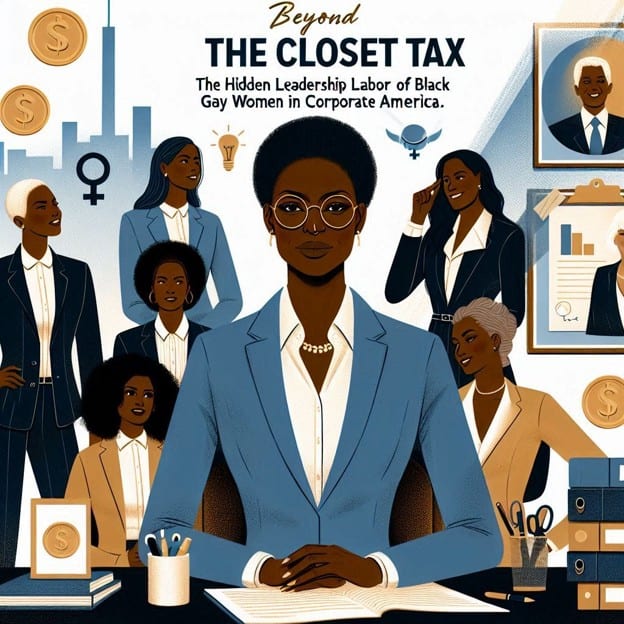
Beyond the Closet Tax: The Hidden Leadership Labor of Black Gay Women in Corporate America

“The master’s tools will never dismantle the master’s house. They may allow us temporarily to beat him at his own game, but they will never enable us to bring about genuine change.” — Audre Lorde

Every Monday morning, millions of professionals across corporate America engage in a seemingly simple ritual: sharing weekend stories with colleagues. For most, this casual workplace bonding requires no strategic calculation. But for Black gay women in leadership roles, each interaction carries invisible labor that few recognize and even fewer understand.

This is what I call the “Closet Tax”—the exhausting mental and emotional energy required to constantly navigate disclosure decisions in professional settings. It’s the cognitive burden of calculating whether mentioning your partner will derail your career trajectory. It’s the isolation of hearing heterosexual colleagues casually reference their families while you carefully edit your own life stories.

During Pride Month, as we celebrate progress in LGBTQ+ rights, it’s crucial to examine this hidden labor that Black gay women carry in corporate spaces. This burden isn’t just personal—it’s organizational inefficiency disguised as professional decorum.

The Double Standard of Authentic Sharing

In my book “High-Value Leadership: Transforming Organizations Through Purposeful Culture,” I discuss how authentic communication drives engagement and innovation. Yet for Black gay women, authenticity comes with unique professional risks that their heterosexual and white colleagues don’t face.

Consider this stark reality: when a white male executive mentions his wife and kids, it’s seen as personable leadership. When a Black gay woman mentions her partner, it becomes a “lifestyle choice” that some question in professional settings.

The Authenticity Penalty includes:

  • Hyper-scrutiny of personal relationships
  • Assumptions about “agenda” when advocating for inclusive policies
  • Isolation from informal networks centered around heterosexual family activities
  • Career consequences for the same authentic sharing praised in others

Dr. Kenji Yoshino’s research on “covering” reveals that 83% of LGBTQ+ individuals modify their behavior to fit heterosexual norms at work. For Black gay women, this covering carries additional layers of complexity as they navigate both racial and sexual orientation bias simultaneously.

The Emotional Labor Calculation

Every professional interaction requires Black gay women to perform what I call “The Disclosure Decision Matrix”—a split-second assessment of:

Environmental Safety: Is this person/situation safe for disclosure? Professional Impact: Will this information affect my career trajectory? Energy Conservation: Do I have the emotional bandwidth to handle potential reactions? Strategic Value: Does disclosure serve my professional goals?

This constant calculation is invisible labor that drains cognitive resources from actual leadership work. Research from the Williams Institute shows that workplace discrimination concerns cause LGBTQ+ employees to spend an average of 18 hours per week managing identity-related workplace stress.

Case Study: The Strategic Authenticity Journey

Consider the experience of Jasmine Rodriguez*, a Black lesbian woman who serves as Vice President of Operations at a Fortune 500 financial services company. When Jasmine joined the executive team three years ago, she carefully maintained what she calls “strategic ambiguity” about her personal life.

Phase 1: The Hiding Years For her first 18 months, Jasmine never mentioned her wife, Maria. She avoided company social events where partners were invited. She felt increasingly isolated as colleagues bonded over family stories she couldn’t share.

The cost was significant:

  • Reduced authentic connections with team members
  • Missed networking opportunities at family-inclusive events
  • Increased stress from maintaining carefully constructed boundaries
  • Decreased job satisfaction despite career advancement

Phase 2: The Awakening Everything changed when Jasmine attended a leadership development program where she learned about the business case for authentic leadership. She realized her carefully constructed boundaries were limiting her effectiveness.

Phase 3: Strategic Authenticity Implementation Working with an executive coach who understood intersectional challenges, Jasmine developed a strategic authenticity plan:

  1. Selective Disclosure: She began mentioning Maria in appropriate contexts, starting with trusted colleagues and employee resource group settings.
  2. Professional Integration: She leveraged her bilingual household (Maria speaks Spanish) to contribute insights about Latino market opportunities.
  3. Inclusive Leadership: She used her experience to create more inclusive team-building activities that didn’t assume heterosexual family structures.
  4. Ally Development: She identified and cultivated relationships with leaders who valued diverse perspectives.

The Results:

  • Team engagement scores increased by 35%
  • Her division captured $15M in new Latino market opportunities
  • She was promoted to Senior VP within 12 months
  • Employee satisfaction with inclusive leadership in her division reached company highs

*Name changed for privacy

The Business Cost of the Closet Tax

The Closet Tax isn’t just a personal burden—it’s organizational inefficiency with measurable costs:

Innovation Loss: When leaders can’t bring their whole selves to work, organizations lose valuable perspectives and market insights.

Engagement Deficit: Research shows that employees who can be authentic at work are 42% more likely to stay with their employer and 33% more productive.

Talent Retention: The stress of managing identity disclosure contributes to higher turnover rates among LGBTQ+ professionals, costing companies an average of $15,000-$50,000 per departure.

Market Blindness: Organizations that don’t leverage diverse leadership perspectives miss opportunities in increasingly diverse consumer markets.

Current Trends: The Shifting Landscape

Several trends are creating both opportunities and challenges for Black gay women in leadership:

Positive Developments:

  • 94% of Fortune 500 companies now have LGBTQ+ inclusive policies
  • Employee Resource Groups for LGBTQ+ professionals have grown 300% in five years
  • Younger workforce expectations increasingly include authentic leadership

Persistent Challenges:

  • Only 3% of senior executives are openly LGBTQ+
  • Black LGBTQ+ women face compounded barriers in advancement
  • Inclusion policies don’t always translate to inclusive cultures

Frameworks for Strategic Authenticity

Drawing from Audre Lorde’s wisdom that “the master’s tools will never dismantle the master’s house,” Black gay women must create new frameworks for authentic leadership. Here’s my strategic approach:

The BRIDGE Framework for Authentic Leadership

B – Build Your Foundation: Establish your leadership credibility before navigating disclosure decisions. Excellence becomes your shield.

R – Read the Environment: Develop sophisticated skills for assessing organizational culture, team dynamics, and individual receptiveness.

I – Identify Allies: Cultivate relationships with leaders who demonstrate inclusive values through actions, not just words.

D – Deploy Strategic Authenticity: Choose deliberate moments for authentic sharing that align with your professional goals and organizational impact.

G – Generate Systemic Change: Use your position to create more inclusive environments for others.

E – Evaluate and Evolve: Regularly assess the impact of your authenticity strategy and adjust as needed.

The Ally Assessment Tool

Not all allies are created equal. Use this framework to identify genuine advocates:

Surface Allies: Express support for LGBTQ+ rights but take no meaningful action Supportive Allies: Demonstrate inclusive behavior but may not actively advocate Strategic Allies: Use their privilege and position to create opportunities for LGBTQ+ advancement Transformational Allies: Work to change systems and challenge bias in organizational structures

Focus your energy on cultivating strategic and transformational allies who can provide both emotional support and professional advocacy.

Building Networks That Support, Not Tokenize

In “Rise & Thrive: A Black Woman’s Blueprint for Leadership Excellence,” I discuss the importance of building authentic professional networks. For Black gay women, this requires particular sophistication to avoid tokenization.

Authentic Network Building Strategies:

1. Intersectional Connections: Build relationships with others who understand multiple forms of marginalization, not just single-identity groups.

2. Cross-Identity Alliances: Cultivate relationships with leaders from different backgrounds who share values of inclusion and authentic leadership.

3. Professional Value Exchange: Ensure relationships are built on mutual professional benefit, not just diversity representation.

4. Strategic Visibility: Choose platforms and forums where your expertise, not your identity, takes center stage.

5. Mentorship Circles: Create and participate in mentoring relationships that address both professional development and identity navigation.

Expert Insights: The Psychology of Hidden Labor

Dr. Ilan Meyer’s groundbreaking research on minority stress theory explains why the Closet Tax creates such significant psychological burden. His studies show that the chronic stress of managing stigmatized identities can:

  • Reduce cognitive capacity for complex problem-solving
  • Decrease workplace satisfaction and engagement
  • Increase turnover intentions
  • Impact physical and mental health

For Black gay women, this stress is compounded by what Dr. Kimberlé Crenshaw calls “intersectional invisibility”—being overlooked because their experiences don’t fit single-identity frameworks.

Practical Strategies for Reducing the Closet Tax

For Individual Leaders:

1. Develop Your Authenticity Roadmap

  • Assess your current level of authenticity at work
  • Identify specific contexts where increased authenticity would serve your goals
  • Create a timeline for strategic disclosure decisions
  • Build support systems for each phase of your journey

2. Master the Art of Strategic Sharing

  • Practice natural ways to reference your partner in professional contexts
  • Develop comfort with boundary-setting when people ask intrusive questions
  • Use your experiences to provide valuable business insights
  • Connect your personal authenticity to professional effectiveness

3. Build Your Ally Network Systematically

  • Identify potential allies through their actions, not just their words
  • Cultivate relationships gradually, based on professional mutual benefit
  • Educate allies about how they can support without tokenizing
  • Create accountability structures within your network

4. Document Your Leadership Impact

  • Track how authenticity affects your leadership effectiveness
  • Gather evidence of business results from inclusive leadership
  • Share your story strategically to create pathways for others
  • Use your success to advocate for systemic changes

For Organizations:

1. Address Systemic Barriers

  • Audit policies for heteronormative assumptions
  • Create inclusive language in communications and benefits
  • Ensure leadership development programs address intersectional experiences
  • Measure and track inclusion beyond just representation numbers

2. Develop Inclusive Leadership Competencies

  • Train leaders to recognize and interrupt bias
  • Create psychological safety for authentic leadership expression
  • Reward inclusive leadership behaviors in performance evaluations
  • Provide coaching for leaders navigating authenticity challenges

Pride Month Action Plan: Moving Beyond Tolerance to Transformation

This Pride Month, commit to actions that reduce the Closet Tax for Black gay women in your organization:

Week 1: Assessment

  • Evaluate your workplace culture for authentic inclusion
  • Identify Black LGBTQ+ women leaders and understand their experiences
  • Assess your own role in creating psychological safety

Week 2: Education

  • Learn about intersectional experiences through education and listening
  • Understand the difference between equality and equity in LGBTQ+ inclusion
  • Research best practices from organizations leading in this area

Week 3: Action

  • Implement at least one policy or practice change that increases inclusion
  • Begin building authentic relationships with LGBTQ+ colleagues
  • Use your influence to challenge bias when you see it

Week 4: Advocacy

  • Become a vocal advocate for systemic changes in your organization
  • Mentor or sponsor Black LGBTQ+ professionals
  • Share your learning and commitment with your network

Creating Cultural Multiplier Effects

As I discuss in “Mastering a High-Value Company Culture,” authentic leaders create ripple effects that transform entire organizational cultures. When Black gay women can lead authentically, they:

  • Model inclusive leadership for others
  • Create psychological safety that benefits all employees
  • Drive innovation through diverse perspectives
  • Build market insights that improve business results
  • Demonstrate that success doesn’t require conformity

Discussion Questions and Strategic Planning

As you consider how to address the Closet Tax in your leadership or organization, reflect on these questions:

  1. Personal Awareness: Where do you see the Closet Tax operating in your workplace? How might it be affecting leadership effectiveness?
  2. Organizational Culture: What systems, policies, or practices in your organization create additional burdens for Black LGBTQ+ women leaders?
  3. Ally Development: How can you move from being a supportive ally to a strategic or transformational ally?
  4. Business Impact: What opportunities might your organization be missing by not fully leveraging the perspectives of Black gay women leaders?
  5. Systemic Change: What specific actions could you take to reduce the hidden labor burden for intersectional leaders in your sphere of influence?

The Innovation Opportunity Hidden in Plain Sight

The Closet Tax represents more than just individual burden—it’s organizational waste of human potential. Black gay women who have navigated multiple forms of marginalization possess extraordinary skills in:

  • Reading complex social dynamics
  • Building bridges across differences
  • Creating inclusive environments
  • Identifying overlooked market opportunities
  • Managing change and uncertainty

When organizations reduce the Closet Tax, they unlock these capabilities for business advantage.

Ready to Transform Your Leadership Culture?

Addressing the Closet Tax requires intentional strategy and systemic change. At Che’ Blackmon Consulting, we specialize in helping leaders and organizations create authentic inclusion that drives measurable results.

Our services include:

  • Intersectional Leadership Development that addresses multiple identity navigation
  • Inclusive Culture Transformation that goes beyond policies to practices
  • Executive Coaching for leaders navigating authenticity challenges
  • Organizational Assessment that identifies hidden barriers to authentic leadership

Whether you’re a leader seeking to navigate intersectional challenges or an organization committed to reducing the Closet Tax for all employees, we can help you create sustainable transformation.

Ready to move beyond tolerance to transformation? Contact us at admin@cheblackmon.com or call 888.369.7243. Let’s create the high-value culture where authentic leadership isn’t just accepted—it’s unleashed.

Remember Audre Lorde’s revolutionary insight: while the master’s tools may not dismantle the master’s house, we can create new tools that build houses where everyone can thrive. Your authentic leadership is one of those tools.

The time has come to move beyond the Closet Tax to authentic leadership advantage. The question isn’t whether you can afford to be authentic—it’s whether your organization can afford for you not to be.


Che’ Blackmon is a Human Resources strategist, author, and organizational culture transformation expert. Her books “Mastering a High-Value Company Culture,” “High-Value Leadership,” and “Rise & Thrive” provide frameworks for authentic leadership and inclusive organizational development. Learn more at cheblackmon.com.

#ClosetTax #IntersectionalLeadership #BlackLGBTQ+ #AuthenticLeadership #PrideMonth #InclusiveLeadership #HiddenLabor #DiversityAndInclusion #CorporateInclusion #LeadershipDevelopment #WorkplaceEquity #OrganizationalTransformation #BlackWomenInLeadership #ExecutivePresence #CulturalTransformation #StrategicAuthenticity #AllyDevelopment #BusinessCase

The Audre Lorde Principle: Why Your ‘Whole Self’ IS Your Competitive Advantage in Leadership

“Caring for myself is not self-indulgence, it is self-preservation, and that is an act of political warfare.” — Audre Lorde

In boardrooms across America, a quiet revolution is taking place. Black women leaders are discovering what poet and activist Audre Lorde knew decades ago: authenticity isn’t just personal liberation—it’s a strategic advantage that transforms organizations and drives unprecedented results.

As someone who has spent over twenty years transforming organizational cultures, I’ve witnessed a fundamental shift. The most innovative companies aren’t just tolerating diverse leadership styles—they’re actively seeking them. The corporate myth that success requires fragmenting yourself is crumbling, replaced by evidence that wholeness creates competitive advantage.

This Pride Month, as we celebrate authenticity and self-expression, it’s time to examine how the Audre Lorde Principle—bringing your complete self to leadership—isn’t just morally right, but strategically brilliant.

Dismantling the Fragmentation Myth

Traditional corporate culture has long demanded that leaders fit into narrow molds. For Black women, particularly those who identify as LGBTQ+, this has meant an exhausting performance of acceptability. We’ve been told to:

  • Soften our voices but not appear weak
  • Show confidence but not aggression
  • Demonstrate femininity but not frivolity
  • Be approachable but maintain authority

In my book “Rise & Thrive: A Black Woman’s Blueprint for Leadership Excellence,” I call this the “Performance Prison”—a self-limiting cycle where we expend enormous energy trying to be palatable rather than powerful.

But here’s what the research reveals: authenticity doesn’t dilute leadership effectiveness—it amplifies it.

A 2023 study by Deloitte found that organizations with authentic leadership cultures show 40% higher employee engagement, 58% greater innovation rates, and 27% better financial performance. When leaders show up as their whole selves, they create psychological safety that unleashes organizational potential.

The Masculine-Presenting Leadership Advantage

Let’s address an uncomfortable truth: masculine-presenting Black women often face the harshest penalties in corporate environments. They’re seen as “too aggressive,” “not feminine enough,” or “intimidating.” These coded criticisms reveal organizational bias against women who don’t perform white feminine standards.

Yet these same leaders possess qualities that drive exceptional results:

Direct Communication: What’s labeled “aggressive” is often clarity and efficiency that cuts through corporate bureaucracy.

Strategic Assertiveness: The ability to make tough decisions without endless consensus-building drives faster innovation cycles.

Authentic Presence: The refusal to perform palatability creates genuine connections based on competence rather than compliance.

Resilience: Having navigated bias develops extraordinary emotional regulation and crisis leadership skills.

Consider the journey of Alex Thompson*, a masculine-presenting Black lesbian who serves as Chief Operations Officer at a major retail company. Early in her career, Alex received feedback to “soften her approach” and “work on her executive presence.”

Instead of conforming, Alex doubled down on authenticity. She:

  • Maintained her direct communication style while adding strategic context
  • Used her partnership with her wife as examples in work-life integration discussions
  • Leveraged her community connections to identify emerging market trends
  • Created mentorship programs specifically for non-conforming professionals

The results speak volumes. Under Alex’s leadership, operational efficiency improved by 35%, employee satisfaction increased by 50%, and the company captured $12M in new market opportunities identified through her community insights.

*Name changed for privacy

Innovation Through Authentic Connection

In “High-Value Leadership: Transforming Organizations Through Purposeful Culture,” I discuss how authentic leaders create what I call “Innovation Ecosystems”—environments where diverse perspectives naturally generate breakthrough solutions.

Black LGBTQ+ women leaders excel at this because their lived experiences have taught them to:

See Multiple Perspectives: Navigating intersecting identities develops sophisticated empathy and systems thinking.

Build Unlikely Alliances: Experience as outsiders creates skill in finding common ground across differences.

Identify Overlooked Opportunities: Understanding marginalized communities reveals unmet market needs.

Create Psychological Safety: Having experienced exclusion, they’re naturally gifted at building inclusive environments.

The Business Case for Wholeness

Recent McKinsey research on diversity and performance reveals compelling evidence:

  • Companies with diverse leadership teams are 70% more likely to capture new markets
  • Organizations with LGBTQ+ inclusive policies see 25% lower turnover rates
  • Authentic leadership cultures report 3x higher customer satisfaction scores

But the data tells only part of the story. The real impact lies in the transformation of organizational culture itself.

Case Study: Revolutionary Leadership in Action

Take the example of Jordan Williams*, Chief Marketing Officer at a technology startup. As a Black lesbian woman, Jordan initially felt pressure to compartmentalize her identity. She rarely mentioned her partner and avoided discussions about her weekend activities.

Everything changed when Jordan attended a Pride Month leadership panel where she heard other LGBTQ+ executives discuss the business value of authenticity. Inspired, she began what she calls her “Wholeness Experiment.”

Phase 1: Personal Integration Jordan started mentioning her partner naturally in appropriate work contexts. When discussing team-building activities, she shared insights from planning her commitment ceremony. When talking about work-life balance, she included her experience as a stepparent.

Phase 2: Professional Leverage She used her connections in LGBTQ+ communities to identify emerging consumer trends. Her understanding of chosen family dynamics helped the company develop products that served non-traditional households.

Phase 3: Cultural Transformation Jordan created employee resource groups that went beyond single-identity support to address intersectional experiences. She instituted “Authentic Leadership” workshops that helped all employees bring more of themselves to work.

The results were extraordinary:

  • Her marketing campaigns achieved 45% higher engagement rates
  • Employee satisfaction in her division increased by 60%
  • The company captured $8M in new revenue from previously overlooked market segments
  • Jordan was promoted to Chief Marketing Officer within 18 months

*Name changed for privacy

Current Trends: The Authenticity Advantage

Several trends are converging to make authentic leadership not just acceptable, but essential:

Gen Z Workforce Expectations: Younger employees increasingly choose employers based on authentic leadership and inclusive culture, not just compensation.

Consumer Demand for Authentic Brands: Companies with authentic leadership are better positioned to build genuine brand connections with diverse consumer bases.

Innovation Imperative: In rapidly changing markets, the diverse perspectives that come with authentic leadership drive necessary innovation.

ESG Investment Focus: Environmental, Social, and Governance investing increasingly values authentic diversity in leadership as a risk mitigation and growth strategy.

The Pride Month Perspective: Self-Preservation as Strategy

Lorde’s assertion that self-care is “political warfare” takes on new meaning in corporate contexts. When Black LGBTQ+ women leaders practice authentic self-expression, they’re not just preserving their individual well-being—they’re dismantling systems that limit organizational potential.

This Pride Month, consider how bringing your whole self to leadership creates ripple effects:

Personal Impact: Reduced stress, increased energy, authentic relationships, career satisfaction

Team Impact: Higher psychological safety, improved innovation, stronger collaboration, increased engagement

Organizational Impact: Enhanced culture, broader market reach, improved reputation, competitive advantage

Societal Impact: Normalized diverse leadership, expanded possibilities for others, systemic change

Practical Strategies for Authentic Leadership

If you’re ready to embrace the Audre Lorde Principle in your leadership journey, consider these strategies:

1. Conduct an Authenticity Audit

Assess where you’re fragmenting yourself:

  • What aspects of your identity do you hide at work?
  • Which relationships do you avoid mentioning?
  • What perspectives do you withhold in meetings?
  • Where do you feel you’re performing rather than being?

2. Develop Strategic Authenticity

Choose deliberate moments for increased authenticity:

  • Share appropriate personal stories that illustrate leadership principles
  • Use your community connections for business insights
  • Leverage your unique perspective in strategic discussions
  • Mentor others navigating similar challenges

3. Build Authenticity Infrastructure

Create systems that support your whole self:

  • Join or create employee resource groups
  • Seek sponsors who value authentic leadership
  • Document the business impact of your authentic contributions
  • Develop allies across identity lines

4. Measure Authentic Impact

Track how authenticity affects your leadership effectiveness:

  • Team engagement scores
  • Innovation metrics
  • Relationship quality
  • Personal satisfaction
  • Business results

5. Create Authenticity Ripples

Use your authentic leadership to transform organizational culture:

  • Model wholeness for other leaders
  • Advocate for inclusive policies and practices
  • Share your story strategically
  • Mentor emerging authentic leaders

Expert Insights: The Science of Authentic Leadership

Dr. Brené Brown’s research on vulnerability and leadership provides crucial context for understanding why authenticity drives results. Her studies show that leaders who demonstrate appropriate vulnerability create 76% higher engagement and 67% better problem-solving in their teams.

For Black LGBTQ+ women leaders, this research is particularly relevant because:

Authentic Vulnerability: Sharing appropriate struggles creates connection without oversharing Strategic Transparency: Being genuine about your perspective without becoming the token voice Inclusive Modeling: Demonstrating that success doesn’t require conformity

The Multiplier Effect of Authentic Leadership

As I discuss in “Mastering a High-Value Company Culture,” authentic leaders create what I call “Cultural Multipliers”—their impact extends far beyond their direct sphere of influence.

When Black LGBTQ+ women lead authentically, they:

  • Give permission for others to be authentic
  • Expand organizational definitions of leadership
  • Create more innovative and inclusive cultures
  • Drive better business results through diverse perspectives

Addressing the Risks: Smart Authenticity

Authentic leadership doesn’t mean oversharing or ignoring organizational realities. Smart authenticity involves:

Context Awareness: Understanding when and how to share different aspects of yourself

Professional Boundaries: Maintaining appropriate work relationships while being genuine

Strategic Timing: Choosing moments when authenticity serves your goals and organizational needs

Support Systems: Having allies and sponsors who advocate for your authentic leadership style

Pride Month Action Steps: Implementing the Audre Lorde Principle

This Pride Month, commit to bringing more of your authentic self to your leadership practice:

Week 1: Complete your authenticity audit and identify one area for increased genuineness

Week 2: Share an appropriate personal story that illustrates a leadership principle

Week 3: Use your unique perspective to contribute a fresh insight in a strategic discussion

Week 4: Mentor someone else who is navigating authenticity in leadership

Discussion Questions and Reflection

As you consider implementing the Audre Lorde Principle in your leadership practice, reflect on these questions:

  1. Personal Assessment: Where have you been fragmenting yourself professionally? What would change if you brought more wholeness to your leadership?
  2. Organizational Culture: Does your workplace reward authenticity or conformity? What evidence do you see?
  3. Business Impact: How might your unique perspective and experiences drive innovation or better business results?
  4. Legacy Thinking: What kind of authentic leadership model do you want to create for others?
  5. Support Systems: Who in your network supports your authentic leadership? What gaps exist in your support system?

The Competitive Advantage of Wholeness

The evidence is clear: in our rapidly changing business environment, the leaders who will thrive are those who can bring their complete selves to the challenge of transformation. Your intersectional identity, your unique perspective, your authentic relationships—these aren’t obstacles to overcome but advantages to leverage.

As Audre Lorde wrote, “It is not our differences that divide us. It is our inability to recognize, accept, and celebrate those differences.” Organizations that learn to recognize, accept, and celebrate the wholeness of Black LGBTQ+ women leaders will find themselves with significant competitive advantages.

Your authentic leadership isn’t just about personal liberation—it’s about organizational transformation that creates value for everyone.

Ready to Unleash Your Authentic Leadership Advantage?

Implementing the Audre Lorde Principle requires strategic support and customized approaches. At Che’ Blackmon Consulting, we specialize in helping leaders develop authentic leadership presence that drives measurable business results.

Our services include:

  • Authentic Leadership Coaching designed for intersectional leaders
  • Cultural Transformation Consulting that values diverse leadership styles
  • Executive Presence Development that honors your authentic self
  • Organizational Inclusion Strategy that leverages authentic leadership for competitive advantage

Whether you’re an individual leader ready to embrace your whole self or an organization seeking to unlock the power of authentic leadership, we can help you implement the strategies that create lasting transformation.

Ready to discover your authentic leadership advantage? Contact us at admin@cheblackmon.com or call 888.369.7243. Let’s create the high-value culture where your wholeness becomes your competitive edge.

Remember Audre Lorde’s revolutionary truth: your whole self isn’t just enough—it’s everything your organization needs to thrive in an increasingly complex world.


Che’ Blackmon is a Human Resources strategist, author, and organizational culture transformation expert. Her books “Mastering a High-Value Company Culture,” “High-Value Leadership,” and “Rise & Thrive” provide frameworks for authentic leadership and inclusive organizational development. Learn more at cheblackmon.com.

#AuthenticLeadership #BlackWomenInLeadership #WholenessAtWork #PrideMonth #LeadershipAdvantage #CompetitiveEdge #InclusiveLeadership #CorporateTransformation #BlackExcellence #LGBTQ+ #ExecutivePresence #OrganizationalCulture #LeadershipDevelopment #DiversityAndInclusion #AudreLordePrinciple #HighValueLeadership #MasculinePresentingLeaders #InnovationThroughInclusion

Sister Outsider in the Boardroom: Navigating the Triple-Bind When You’re the ‘Only One’ Three Times Over

“There is no such thing as a single-issue struggle because we do not live single-issue lives.” — Audre Lorde

When Audre Lorde penned these words in “Sister Outsider,” she captured a truth that reverberates through corporate boardrooms today. For Black lesbian women in leadership, this reality manifests as what I call the “triple-bind”—being simultaneously hypervisible and invisible, carrying the weight of representation while fighting for authentic presence, and navigating the exhausting mathematics where racism + sexism + homophobia doesn’t equal simple addition, but exponential barriers.

As I reflect on over two decades of transforming organizational cultures, I’ve witnessed the unique challenges faced by Black LGBTQ+ women leaders. They embody what Lorde called “sister outsiders”—individuals whose intersecting identities place them at the margins, yet whose perspectives are essential for authentic organizational transformation.

The Exhausting Mathematics of Oppression

In my book “High-Value Leadership: Transforming Organizations Through Purposeful Culture,” I discuss how leaders must navigate complex cultural dynamics. For Black lesbian women, this navigation requires extraordinary skill because they face what researchers call “intersectional invisibility”—being overlooked precisely because their experiences don’t fit neat, single-identity categories.

The mathematics here isn’t simple arithmetic. When a Black lesbian woman enters a leadership role, she doesn’t face racism, then sexism, then homophobia in sequence. These forces compound and amplify each other, creating unique challenges:

The Hypervisibility Paradox: She’s highly visible as “different” yet invisible when strategic contributions need recognition. Her presence in meetings is noted (often as the only Black person, only woman, or only openly LGBTQ+ person), but her ideas may be overlooked or credited to others.

The Authenticity Tax: The emotional labor required to decide which parts of herself to reveal in different professional contexts. Unlike her white lesbian colleagues or straight Black colleagues, she lacks the privilege of partial identity alignment with dominant groups.

The Representation Burden: Being expected to speak for all Black people, all women, and all LGBTQ+ employees—an impossible task that no single person can fulfill.

Strategies for Maintaining Authentic Leadership Presence

As I outline in “Rise & Thrive: A Black Woman’s Blueprint for Leadership Excellence,” authentic leadership requires strategic navigation. For Black lesbian women, this means developing what I call “intentional authenticity”—being deliberately selective about when and how to show up fully while maintaining professional effectiveness.

The PRIDE Framework for Authentic Leadership

Drawing inspiration from Pride Month’s celebration of authentic self-expression, I’ve developed the PRIDE framework specifically for Black LGBTQ+ women leaders:

P – Purpose-Driven Visibility: Choose moments for full authenticity that align with your leadership goals and organizational impact. This isn’t about hiding—it’s about strategic presence.

R – Relationship-Building Across Difference: Cultivate allies across identity lines. In “Mastering a High-Value Company Culture,” I emphasize that high-value cultures celebrate diverse perspectives. Build bridges with white LGBTQ+ colleagues, straight Black colleagues, and others who can amplify your voice.

I – Intersectional Advocacy: Use your unique perspective to advocate for systemic changes that benefit multiple marginalized groups. Your insider-outsider position provides valuable insights into organizational blind spots.

D – Documentation and Storytelling: Keep records of your contributions and tell your story strategically. The intersection of multiple marginalized identities often means your achievements face additional scrutiny or attribution challenges.

E – Empowerment of Others: Create pathways for other multiply-marginalized individuals. As Lorde taught us, liberation is collective, not individual.

Case Study: Transforming Through Authentic Leadership

Consider the journey of Dr. Maya Patel*, a Black lesbian woman who became Chief Technology Officer at a Fortune 500 company. When she started, she was the only Black person, one of two women, and the only openly LGBTQ+ person in the C-suite.

Initially, Maya felt pressure to downplay aspects of her identity. She rarely mentioned her wife in professional settings and code-switched heavily in leadership meetings. However, she realized this approach was limiting her effectiveness and impact.

Working with our consulting team, Maya developed a strategic authenticity plan:

  1. Selective Vulnerability: She began sharing appropriate personal stories that highlighted her family life while connecting to business outcomes. When discussing work-life balance initiatives, she mentioned her wife’s perspective as a working mother.
  2. Intersectional Innovation: Maya leveraged her unique perspective to identify market opportunities others missed. Her understanding of multiple marginalized communities helped the company develop products that served underrepresented customer segments.
  3. Coalition Building: She created informal mentorship networks that crossed identity lines, supporting not just other Black women or LGBTQ+ employees, but anyone navigating outsider status.
  4. Strategic Sponsorship: Maya used her influence to advocate for systemic changes in hiring, promotion, and leadership development that benefited multiple groups.

The results were remarkable. Under Maya’s leadership, her division saw 40% improvement in innovation metrics, 60% increase in employee engagement scores, and 25% growth in market share among diverse customer segments. Most importantly, the company experienced cultural transformation that made it more inclusive for everyone.

*Name changed for privacy

Current Trends and Best Practices

Recent research from McKinsey’s “Women in the Workplace” report shows that Black women face unique challenges in corporate advancement, and these challenges are compounded for Black LGBTQ+ women. However, organizations implementing inclusive leadership practices are seeing significant returns:

Psychological Safety Initiatives: Companies creating explicit psychological safety for LGBTQ+ employees of color report 47% higher innovation rates and 35% better retention of diverse talent.

Intersectional Leadership Development: Programs that address multiple identity intersections (rather than single-identity diversity initiatives) show 3x greater impact on leadership pipeline development.

Authentic Storytelling Platforms: Organizations that create formal and informal platforms for leaders to share their authentic stories see increased employee engagement and better decision-making.

Expert Insights: The Power of Intersectional Leadership

Dr. Kimberlé Crenshaw’s foundational work on intersectionality provides crucial context for understanding why traditional diversity initiatives often miss Black LGBTQ+ women. As she notes, “Intersectionality is a lens through which you can see where power comes and collides, where it interlocks and intersects.”

For organizations serious about inclusive leadership, this means:

  • Moving beyond single-axis diversity initiatives to address intersecting identities
  • Creating sponsorship programs that specifically support multiply-marginalized leaders
  • Implementing bias interruption training that addresses intersectional experiences
  • Measuring inclusion metrics that capture intersectional experiences

The Business Case for Intersectional Inclusion

As I discuss in “High-Value Leadership,” authentic inclusion drives measurable business results. For Black LGBTQ+ women leaders, their unique perspectives offer organizations:

Enhanced Innovation: Research from Boston Consulting Group shows that companies with above-average diversity scores report innovation revenue that is 19% higher than companies with below-average diversity scores.

Improved Decision-Making: Diverse leadership teams make better decisions 87% of the time and deliver 60% better results.

Stronger Cultural Transformation: Leaders who’ve navigated multiple forms of marginalization often possess exceptional emotional intelligence and change management skills.

Market Insight: Their lived experiences provide valuable insight into underserved customer segments and emerging market opportunities.

Practical Takeaways for Sister Outsiders

If you’re a Black LGBTQ+ woman navigating leadership spaces, consider these strategies:

1. Develop Your Personal Board of Directors

Create a diverse advisory network that includes:

  • A sponsor who advocates for your advancement
  • A mentor who understands intersectional challenges
  • Peers who provide mutual support
  • Allies from different identity groups

2. Practice Strategic Authenticity

  • Identify contexts where full authenticity serves your goals
  • Develop comfort with selective disclosure
  • Create authentic connections without over-sharing
  • Use your story strategically to drive business outcomes

3. Build Intersectional Alliances

  • Connect with other multiply-marginalized leaders
  • Create cross-identity coalitions for systemic change
  • Support others while advancing your own goals
  • Leverage collective power for individual and group advancement

4. Document Your Impact

  • Keep detailed records of your contributions
  • Gather testimonials from colleagues and clients
  • Track metrics that demonstrate your value
  • Share your story strategically

5. Create Systemic Change

  • Advocate for policies that address intersectional barriers
  • Mentor others navigating similar challenges
  • Challenge processes that perpetuate exclusion
  • Build inclusive systems that outlast your tenure

Pride Month Reflection: Celebrating Authentic Leadership

This Pride Month, as we celebrate progress in LGBTQ+ rights and visibility, it’s crucial to recognize that not all members of our community experience equality equally. Black lesbian women in corporate leadership face unique challenges that require specific strategies and support systems.

Audre Lorde reminded us that “The master’s tools will never dismantle the master’s house.” For sister outsiders in boardrooms today, this means we must create new tools, new frameworks, and new pathways that honor our full humanity while driving organizational transformation.

Your intersectional identity isn’t a burden to overcome—it’s a superpower to leverage. Your ability to navigate multiple forms of marginalization has developed extraordinary resilience, cultural intelligence, and leadership capabilities that organizations desperately need.

Discussion Questions and Next Steps

As you reflect on this article, consider these questions:

  1. Personal Reflection: How has your intersectional identity shaped your leadership approach? What unique strengths have you developed?
  2. Organizational Assessment: Does your workplace have support systems for multiply-marginalized leaders? What gaps exist?
  3. Strategic Planning: How can you use your unique perspective to drive innovation and inclusion in your organization?
  4. Coalition Building: Who in your network could become allies in your intersectional advocacy efforts?
  5. Legacy Thinking: What systemic changes do you want to create for future sister outsiders in leadership?

Ready to Transform Your Leadership Journey?

Navigating the triple-bind requires strategic support and customized approaches. At Che’ Blackmon Consulting, we specialize in helping leaders develop authentic leadership presence while driving organizational transformation.

Our services include:

  • Individual executive coaching for intersectional leadership development
  • Organizational culture assessments that address intersectional inclusion
  • Leadership development programs designed for multiply-marginalized leaders
  • Strategic planning support for authentic diversity and inclusion initiatives

Whether you’re a sister outsider seeking to maximize your impact or an organization committed to creating truly inclusive leadership environments, we can help you unlock, empower, and transform.

Ready to discuss your unique leadership journey? Contact us at admin@cheblackmon.com or call 888.369.7243. Let’s create the high-value culture where your authentic leadership can thrive.

Remember Audre Lorde’s powerful words: “If I didn’t define myself for myself, I would be crunched into other people’s fantasies for me and eaten alive.” Your time to define yourself—and transform organizations—is now.


Che’ Blackmon is a Human Resources strategist, author, and organizational culture transformation expert. Her books “Mastering a High-Value Company Culture,” “High-Value Leadership,” and “Rise & Thrive” provide frameworks for authentic leadership and inclusive organizational development. Learn more at cheblackmon.com.

#IntersectionalLeadership #BlackWomenInLeadership #LGBTQ+ #PrideMonth #AuthenticLeadership #DiversityAndInclusion #ExecutivePresence #CorporateLeadership #Leadership #WorkplaceCulture #InclusiveLeadership #TransformationalLeadership #BlackExcellence #SisterOutsider #OrganizationalCulture #WomenInBusiness #HighValueLeadership

The Black Woman’s Career Pivot: Recognizing When to Stay and When to Create Your Own Table

“If they don’t give you a seat at the table, bring a folding chair.” — Shirley Chisholm

Every Black woman in corporate America reaches a crossroads. It’s that moment when you realize that despite your qualifications, dedication, and results, the path to advancement remains frustratingly unclear. You’ve navigated the microaggressions, managed up with precision, and delivered exceptional performance. Yet the question persists: Is it time to keep fighting for a seat at their table, or should you build your own?

After two decades of transforming organizational cultures and watching countless talented Black women make this pivotal decision, I’ve learned that the answer isn’t simple. It requires strategic thinking, honest self-assessment, and a clear understanding of what success means to you—not what others have defined it to be.

The career pivot for Black women is unique. We’re not just changing jobs or industries; we’re often choosing between conforming to systems that weren’t designed for us or creating new systems that reflect our values and vision. This decision carries weight that extends beyond individual advancement—it impacts our families, our communities, and the Black women who follow in our footsteps.

The Corporate Reality Check

Before exploring when to pivot, we must acknowledge the environment that creates the need for this decision. Research from McKinsey & Company’s “Women in the Workplace” study reveals that Black women face a “broken rung” at the first step to management—for every 100 men promoted to manager, only 58 Black women receive the same opportunity.

This isn’t about lacking qualifications or ambition. Black women are more likely than white women to report wanting to be promoted and to take concrete steps toward advancement. Yet we consistently face barriers that include:

The Likability Penalty: Research shows that Black women are penalized for displaying the same assertive behaviors that advance white men and women.

The Competency Questioning: Our expertise is routinely challenged in ways that our counterparts don’t experience, requiring us to repeatedly prove our capabilities.

The Isolation Factor: Being “the only one” or one of very few creates additional pressure and limits our ability to build authentic relationships.

The Cultural Taxation: We’re often asked to take on additional responsibilities related to diversity and inclusion without additional compensation or recognition.

These systemic barriers create a unique decision-making framework. Unlike other professionals who might consider a career change for growth or fulfillment, Black women often evaluate whether to stay in environments that may never fully recognize or reward our contributions.

The Stay vs. Go Framework

In “High-Value Leadership: Transforming Organizations Through Purposeful Culture,” I emphasize that every leadership decision should align with your values, vision, and desired impact. When considering whether to stay in corporate environments or create your own path, this alignment becomes critical.

The PIVOT Assessment Framework

I’ve developed the PIVOT framework to help Black women make strategic career decisions that honor both their ambitions and their authenticity:

P – Purpose Alignment Does your current role allow you to fulfill your larger purpose, or are you constantly compromising your values to fit organizational expectations?

I – Impact Potential Can you create the level of impact you desire within existing structures, or are systemic barriers limiting your ability to make meaningful change?

V – Value Recognition Are your contributions appropriately recognized and compensated, or do you consistently feel undervalued despite strong performance?

O – Opportunity Trajectory Do you see clear pathways for advancement that don’t require abandoning your authentic self, or have you hit an invisible ceiling?

T – Transformation Possibility Can you influence positive change within your organization, or have you exhausted your ability to create the culture you want to see?

Let’s examine each element in detail.

Purpose Alignment: Staying True to Your Why

Maya Angelou said, “Success is liking yourself, liking what you do, and liking how you do it.” For Black women in corporate spaces, this alignment often becomes complicated by the need to code-switch, minimize parts of our identity, or pursue goals that don’t reflect our authentic values.

Case Study: The Values Conflict Keisha, a senior marketing executive at a Fortune 500 company, found herself increasingly uncomfortable with her organization’s approach to diversity marketing. Despite her success in driving revenue growth, she felt complicit in campaigns that she believed exploited rather than celebrated Black culture. Her purpose—to create authentic representation in media—was consistently at odds with her organization’s profit-first approach.

After using the PIVOT framework, Keisha recognized that her values were fundamentally misaligned with her organization’s priorities. She transitioned to launching her own marketing consultancy focused on authentic cultural representation, ultimately creating more impact and fulfillment than she had experienced in corporate America.

When Purpose Alignment Suggests Staying:

  • Your organization’s mission genuinely resonates with your personal values
  • You can pursue meaningful work that reflects your authentic interests
  • Your role allows you to influence positive change for communities you care about
  • The culture supports your whole self, not just your professional persona

When Purpose Misalignment Suggests Pivoting:

  • You consistently feel like you’re compromising your integrity
  • Your work conflicts with your personal values or community interests
  • You’re required to represent or promote initiatives that feel inauthentic
  • The organizational culture demands that you suppress important parts of your identity

Impact Potential: Measuring Your Ability to Create Change

In “Mastering a High-Value Company Culture,” I discuss how transformative leaders create environments where positive change can flourish. The question for Black women becomes: Can you create that change within existing systems, or do those systems inherently limit your impact?

The Change Agent Test: Evaluate your ability to create positive change by asking:

  • Do decision-makers genuinely consider and implement your ideas?
  • Can you influence policies and practices that affect other underrepresented employees?
  • Are you able to build diverse teams and inclusive practices within your sphere of influence?
  • Does your organization invest resources in initiatives you champion?

Case Study: The System Transformer Dr. Angela Williams, Chief Diversity Officer at a major healthcare system, initially considered leaving corporate America after facing resistance to her inclusion initiatives. However, she recognized that her position gave her unique leverage to transform hiring practices, leadership development, and patient care approaches. By staying and strategically building alliances, she created systemic changes that improved outcomes for thousands of employees and patients.

Her decision to stay was validated by her ability to create measurable impact: a 40% increase in diverse leadership hires, implementation of bias-free recruiting processes, and development of cultural competency training that became an industry model.

When High Impact Potential Suggests Staying:

  • You can influence meaningful policy and practice changes
  • Your ideas are implemented and supported with resources
  • You’re able to mentor and develop other underrepresented professionals
  • Your role creates ripple effects that benefit broader communities

When Limited Impact Suggests Pivoting:

  • Your ideas are consistently dismissed or minimized
  • You lack the authority or resources to implement meaningful changes
  • Systemic barriers prevent you from creating the impact you envision
  • Your energy is consumed by fighting the system rather than changing it

Value Recognition: Ensuring Fair Compensation and Credit

The wage gap for Black women is well-documented—we earn 63 cents for every dollar earned by white men. But value recognition extends beyond salary to include credit for ideas, inclusion in key decisions, and acknowledgment of contributions.

The Recognition Audit: Assess your current value recognition by examining:

  • Compensation Equity: Is your salary competitive with peers who have similar experience and performance?
  • Credit Attribution: Do you receive appropriate recognition for your ideas and achievements?
  • Decision Inclusion: Are you included in strategic discussions and high-level meetings?
  • Growth Investment: Does your organization invest in your professional development and advancement?

Case Study: The Undervalued Expert Lisa, a cybersecurity expert with 15 years of experience, consistently found her recommendations questioned while less experienced male colleagues were immediately trusted. Despite leading successful security implementations that saved her company millions, she was passed over for promotions twice. When she discovered that newly hired male peers were earning 20% more than her, she realized her value wasn’t being recognized or compensated fairly.

Lisa leveraged her expertise to launch an independent cybersecurity consultancy. Within two years, she was earning triple her corporate salary while working with clients who valued and implemented her recommendations immediately.

When Strong Value Recognition Suggests Staying:

  • Your compensation reflects your contributions and market value
  • You receive appropriate credit for your work and ideas
  • Leadership seeks your input on important decisions
  • Your organization invests in your continued growth and development

When Poor Value Recognition Suggests Pivoting:

  • You’re consistently underpaid compared to peers with similar qualifications
  • Your contributions are minimized or attributed to others
  • You’re excluded from key meetings and strategic decisions
  • Professional development opportunities are limited or nonexistent

Opportunity Trajectory: Mapping Your Path Forward

Traditional career advice suggests looking for clear advancement pathways within organizations. For Black women, these pathways are often obscured by invisible barriers, shifting standards, and limited role models in senior positions.

The Pathway Analysis: Evaluate your advancement opportunities by considering:

  • Visible Role Models: Are there Black women in senior roles who can serve as examples of possible advancement?
  • Sponsor Availability: Do you have access to influential advocates who actively support your advancement?
  • Skill Development: Can you acquire the experiences and skills needed for your next level within your current organization?
  • Timeline Realism: Given current organizational dynamics, is advancement likely within your desired timeframe?

Case Study: The Plateau Breaker Monica, an operations director, had been “being prepared for promotion” for three years. Despite exceeding performance targets and completing an executive MBA program, the promotion never materialized. Each time, she was told she needed “just a bit more experience” while watching less qualified candidates advance.

Monica’s turning point came when she realized that her organization’s definition of “ready” would continue to evolve to exclude her. She transitioned to a smaller company where she immediately became VP of Operations, doubling her salary and gaining equity in a rapidly growing business.

When Clear Trajectory Suggests Staying:

  • You can identify realistic pathways to your desired level
  • Role models exist who have successfully navigated similar paths
  • You have sponsors who actively advocate for your advancement
  • The organization has demonstrated commitment to promoting Black women

When Limited Trajectory Suggests Pivoting:

  • Advancement requirements seem to shift each time you meet them
  • Few or no Black women hold senior positions in your organization
  • Sponsorship is unavailable or ineffective
  • The timeline for advancement doesn’t align with your career goals

Transformation Possibility: Your Ability to Change the Culture

Some Black women find deep fulfillment in transforming organizations from within, becoming the change they want to see. Others discover that their energy is better invested in creating new environments rather than trying to fix existing ones.

The Culture Change Assessment: Evaluate your transformation potential by examining:

  • Leadership Receptivity: Are organizational leaders genuinely open to cultural transformation?
  • Resource Availability: Will the organization invest the time, money, and effort needed for meaningful change?
  • Historical Progress: Has the organization demonstrated ability to evolve its culture?
  • Personal Sustainability: Can you maintain your well-being while driving cultural change?

Case Study: The Culture Creator After years of trying to change her law firm’s exclusionary culture, partner Jasmine Roberts made a different choice. Instead of continuing to fight an uphill battle, she left to co-found a law firm built on principles of inclusion, mentorship, and shared success. Her firm now employs more diverse attorneys than her previous firm’s entire partnership and has become a model for the legal industry.

Jasmine’s decision to create rather than transform allowed her to build the culture she envisioned from the ground up, ultimately having greater impact than her internal change efforts could have achieved.

The Entrepreneurship Alternative: Creating Your Own Table

Black women are the fastest-growing group of entrepreneurs in America, and our business creation isn’t just about following dreams—it’s often about creating the opportunities that corporate America doesn’t provide.

The Entrepreneurship Readiness Assessment: Consider these factors when evaluating the entrepreneurship path:

Market Opportunity: Is there demand for your skills or solutions in the marketplace?

Financial Preparation: Do you have the resources or access to capital needed to launch and sustain a business?

Risk Tolerance: Are you prepared for the uncertainty and challenges of entrepreneurship?

Support Network: Do you have mentors, advisors, and supporters who can guide your journey?

Passion Alignment: Does entrepreneurship align with your values and long-term vision?

In “Rise & Thrive: The Black Woman’s Blueprint for Leadership Excellence,” I discuss how entrepreneurship can be a powerful vehicle for creating the leadership opportunities that traditional employment may not provide. However, it’s not the right path for everyone, and timing matters.

The Hybrid Approach: Portfolio Careers

Many successful Black women have discovered that the binary choice between corporate employment and entrepreneurship doesn’t capture all possibilities. Portfolio careers—combining employment with consulting, board positions, speaking, or business ownership—allow for diversified income, reduced risk, and multiple avenues for impact.

Case Study: The Portfolio Pioneer Carmen maintained her role as a pharmaceutical executive while building a leadership coaching practice on the side. Over three years, her coaching revenue grew to match her corporate salary. This financial security allowed her to negotiate a more flexible arrangement with her employer, eventually transitioning to a consulting relationship that gave her the stability of ongoing corporate income while building her independent practice.

Her portfolio approach provided the best of both worlds: corporate benefits and income stability while building entrepreneurial skills and client relationships.

Making the Decision: A Strategic Process

The decision to stay or pivot shouldn’t be made in moments of frustration or after particularly difficult experiences. It requires strategic thinking and careful planning.

The 90-Day Decision Process

Days 1-30: Assessment and Data Gathering

  • Complete the PIVOT framework assessment
  • Gather salary and advancement data for your role and industry
  • Document recent experiences, both positive and negative
  • Seek feedback from trusted mentors and advisors

Days 31-60: Option Exploration

  • Research alternative opportunities within your current organization
  • Explore potential roles at other companies
  • Investigate entrepreneurship opportunities in your field
  • Consider hybrid approaches that might meet your needs

Days 61-90: Decision and Planning

  • Make your decision based on data and strategic thinking, not emotion
  • Develop a detailed implementation plan
  • Build your support network for the transition
  • Set success metrics for your chosen path

The Transition Strategy: Making Your Move

Whether you decide to stay and transform or pivot to create your own opportunities, the transition requires careful planning and execution.

For Those Who Choose to Stay

Recommit with Conditions: If you decide to stay, do so strategically with clear conditions and timelines for the changes you need to see.

Build Internal Alliances: Strengthen relationships with allies who support your advancement and cultural transformation goals.

Create External Options: Even if you stay, build external networks and opportunities that provide leverage and alternatives.

Document Everything: Keep detailed records of your contributions, the support you receive, and the progress toward your goals.

For Those Who Choose to Pivot

Financial Planning: Ensure you have adequate financial resources for your transition period, whether that’s job searching or launching a business.

Network Activation: Leverage your professional relationships to identify opportunities and gather support for your new direction.

Skill Development: Acquire any additional skills or credentials needed for your new path.

Brand Building: Develop your professional brand and thought leadership in your chosen direction.

Success Stories: Black Women Who Made Strategic Pivots

The Corporate Transformer

After 15 years in banking, Vice President Denise Johnson was recruited to lead diversity and inclusion at a progressive financial services firm. Her decision to stay in corporate America was strategic—she could create greater systemic change from within than she could as an external consultant. Under her leadership, the firm became an industry leader in diverse hiring and inclusive culture.

The Serial Entrepreneur

Marketing executive Tasha Williams left her Fortune 500 role to launch her first business, a digital marketing agency focused on Black-owned businesses. After successfully exiting that business, she launched a second company, then became an angel investor. Her entrepreneurial path created wealth and impact that corporate advancement couldn’t match.

The Portfolio Professional

Former pharmaceutical executive Dr. Kimberly Davis created a portfolio career combining part-time consulting with her former employer, board positions with healthcare startups, speaking engagements, and executive coaching. Her diversified approach provides financial security while allowing her to pursue multiple passions and create broad impact.

The Ripple Effect of Your Decision

Remember that your career pivot isn’t just about you. The path you choose creates ripple effects that impact other Black women, your family, and your community.

When You Stay and Transform:

  • You create pathways for other Black women within your organization
  • You model how to navigate and influence corporate systems
  • You build bridges between corporate success and community impact

When You Create Your Own Table:

  • You demonstrate alternative pathways to success and fulfillment
  • You create opportunities for other Black women through hiring and partnerships
  • You build generational wealth and independence

Both choices are valuable. Both require courage. Both contribute to the larger movement of Black women’s advancement.

The Support System You Need

Regardless of which path you choose, you need a robust support system that includes:

Strategic Advisors: People who can help you think through complex decisions and see blind spots.

Emotional Support: Friends, family, or counselors who can help you process the challenges and celebrate the victories.

Practical Resources: Access to capital, legal advice, career coaching, or other resources needed for your transition.

Professional Network: Connections who can provide opportunities, referrals, and collaboration.

Role Models: Examples of Black women who have successfully navigated similar transitions.

Measuring Success on Your Own Terms

One of the most important aspects of making a strategic career pivot is defining success for yourself rather than accepting others’ definitions.

Traditional metrics of success—salary, title, company size—may not capture what matters most to you. Consider alternative success measures:

Impact Metrics: How many people do you influence positively? What changes do you create?

Fulfillment Measures: How aligned is your work with your values and passions?

Freedom Indicators: How much control do you have over your time, decisions, and priorities?

Growth Tracking: How much are you learning and developing personally and professionally?

Legacy Building: What foundation are you creating for future generations?

The Future of Black Women’s Leadership

As we look toward the future, the traditional model of climbing corporate ladders is evolving. Black women are increasingly creating new models of leadership that combine corporate success with entrepreneurship, social impact with personal fulfillment, and individual advancement with collective progress.

This evolution reflects broader changes in work itself—the rise of remote work, the gig economy, and project-based careers. Black women who master the art of strategic career pivoting will be best positioned to thrive in this changing landscape.

Your Pivot Action Plan

Step 1: Complete Your PIVOT Assessment (Week 1)

Work through each element systematically, gathering data and honest self-reflection.

Step 2: Explore Your Options (Weeks 2-4)

Research specific opportunities in each potential direction—staying, moving to another organization, or creating your own path.

Step 3: Build Your Support Network (Weeks 5-6)

Identify and connect with people who can advise, support, and potentially collaborate with you.

Step 4: Create Your Strategic Plan (Weeks 7-8)

Develop a detailed plan for your chosen direction, including timelines, resources needed, and success metrics.

Step 5: Execute Your Transition (Ongoing)

Implement your plan while remaining flexible enough to adjust as circumstances evolve.

Discussion Questions for Reflection

  • What elements of the PIVOT framework resonate most with your current situation?
  • How do you define success for yourself, independent of external expectations?
  • What fears or concerns do you have about staying versus pivoting?
  • What support do you need to make a strategic career decision?
  • How might your decision impact other Black women in your sphere of influence?
  • What legacy do you want to create through your career choices?

Your Strategic Pivot Partner

Making strategic career decisions requires more than good intentions—it demands clear thinking, honest assessment, and the courage to choose paths that align with your authentic vision of success. You don’t have to navigate this journey alone.

At Che’ Blackmon Consulting, I specialize in empowering Black women and other overlooked talent to make strategic career decisions that honor both their ambitions and their authenticity. My mission is to create sustainable pathways for authentic growth and breakthrough performance, whether that’s within existing organizations or through creating new opportunities.

Whether you’re evaluating your current situation, planning a strategic pivot, or building the support systems needed for your transition, I provide the insights, tools, and guidance needed to make decisions that align with your values and advance your vision.

Ready to evaluate your career path strategically and make decisions that align with your authentic vision of success? Contact me to discuss customized coaching programs, strategic planning sessions, or organizational culture transformation initiatives that create environments where Black women can thrive authentically.

Together, we can ensure that your career pivot—whether staying to transform or creating your own table—positions you for success, fulfillment, and maximum impact.

Your seat at the table isn’t a gift to be granted—it’s a position to be claimed, whether at existing tables or ones you create yourself.


Che’ Blackmon is the author of “Mastering a High-Value Company Culture,” “High-Value Leadership: Transforming Organizations Through Purposeful Culture,” and “Rise & Thrive: The Black Woman’s Blueprint for Leadership Excellence.” With over 20 years of experience transforming organizational cultures, she helps leaders make strategic career decisions that align with their authentic vision while creating pathways for others to thrive.

#CareerPivot #BlackWomenInLeadership #StrategicDecisions #CreateYourOwnTable #RiseAndThrive #PurposefulLeadership #CareerStrategy #AuthenticSuccess #LeadershipExcellence #ProfessionalGrowth #WorkplaceEquity #EntrepreneurialMindset

Strategic Alliances: Building Support Systems When Traditional Sponsorship Falls Short

“If you want to go fast, go alone. If you want to go far, go together.” — African Proverb

Traditional sponsorship advice sounds simple: find a senior leader who believes in you and will advocate for your advancement. But what happens when that formula doesn’t work? What do you do when sponsors are scarce, when advocacy comes with invisible quotas, or when the traditional power brokers don’t see your potential?

For many professionals—particularly Black women and other underrepresented leaders—traditional sponsorship often falls short of its promises. After two decades of transforming organizational cultures, I’ve learned that the most successful leaders don’t just wait for sponsors to emerge. They build strategic alliances that create multiple pathways to success, influence, and advancement.

Strategic alliances differ fundamentally from traditional sponsorship. While sponsorship relies on a single powerful advocate, strategic alliances create a network of mutually beneficial relationships where success is shared, influence is distributed, and support flows in multiple directions.

The Limitations of Traditional Sponsorship

Before exploring alternatives, let’s acknowledge why traditional sponsorship often fails certain groups. Research from the Center for Creative Leadership reveals that while 71% of Fortune 500 companies have formal mentoring programs, only 37% have effective sponsorship programs. Even more telling, these programs disproportionately benefit those who already have access to informal networks and cultural capital.

The traditional sponsorship model operates on several assumptions that don’t hold true for all professionals:

Assumption 1: Senior Leaders Recognize Talent Across All Demographics Reality: Unconscious bias often leads to “like me” sponsorship, where senior leaders gravitate toward people who remind them of themselves.

Assumption 2: Sponsors Will Take Career Risks for Their Protégés Reality: Many potential sponsors are risk-averse when it comes to advocating for underrepresented talent, especially in environments with invisible quotas.

Assumption 3: One Sponsor Is Sufficient Reality: Complex career advancement often requires multiple advocates across different functions, levels, and networks.

Assumption 4: Sponsorship Relationships Develop Naturally Reality: Many high-potential professionals lack access to the informal settings where sponsorship relationships traditionally form.

The Strategic Alliance Alternative

Strategic alliances represent a more democratic and sustainable approach to career advancement. Instead of depending on a single powerful advocate, you create a network of mutually beneficial relationships that collectively provide the support, advocacy, and opportunities that traditional sponsorship promises.

In “High-Value Leadership: Transforming Organizations Through Purposeful Culture,” I emphasize that transformative leadership requires building ecosystems of support rather than relying on individual relationships. This principle applies directly to career advancement.

The ALLIANCE Framework

I’ve developed the ALLIANCE framework to help professionals build strategic support systems that transcend traditional sponsorship limitations:

A – Assess Your Ecosystem Map your current professional relationships and identify gaps in support, influence, and advocacy.

L – Leverage Mutual Benefits Create relationships where your success directly benefits others, making advocacy a natural outcome rather than a favor.

L – Link Across Levels Build connections with peers, junior colleagues, and senior leaders to create multi-directional support.

I – Integrate Diverse Perspectives Include allies from different departments, industries, and backgrounds to expand your influence network.

A – Activate Cross-Functional Partnerships Develop alliances that span organizational boundaries and create value across different areas.

N – Nurture Long-term Relationships Focus on sustainable partnerships that evolve and deepen over time.

C – Create Reciprocal Value Ensure that every alliance provides mutual benefit, making the relationship sustainable and authentic.

E – Expand External Networks Build alliances beyond your immediate organization to create alternative pathways and opportunities.

Types of Strategic Alliances

1. Peer Power Alliances

These relationships with colleagues at your level create mutual support systems for advancement. Peer alliances work because they’re based on reciprocity and shared challenges.

Case Study: The Finance Five A group of mid-level finance professionals at a global consulting firm created what they called “The Finance Five”—a strategic alliance focused on collective advancement. They shared opportunities, provided references for each other, and created a rotation system for high-visibility presentations. Within three years, four of the five had been promoted to senior roles, with each promotion strengthening the network’s influence.

Their success came from understanding that peer relationships could be as powerful as traditional sponsorship when properly leveraged. They created value for each other while building collective influence that individual efforts couldn’t achieve.

2. Cross-Functional Bridge Alliances

These partnerships span different departments and create value by connecting previously separate areas of expertise.

Example: The Innovation Connector Sarah, a marketing director, struggled to find a traditional sponsor in her male-dominated organization. Instead, she built strategic alliances with leaders in technology, operations, and customer service. By positioning herself as the connector who could translate between these functions, she became indispensable to major initiatives. Her cross-functional alliances led to her promotion to VP of Customer Experience—a role that didn’t exist before she created the business case for it.

3. Reverse Mentoring Alliances

These relationships with junior colleagues provide fresh perspectives while creating future advocates. Reverse mentoring alliances acknowledge that influence isn’t always hierarchical.

The Power of Teaching In “Rise & Thrive: The Black Woman’s Blueprint for Leadership Excellence,” I discuss how teaching and mentoring others actually accelerates your own advancement. When you help others succeed, you build a network of advocates who will support your career as they advance in theirs.

4. External Industry Alliances

These connections beyond your organization create alternative pathways and reduce dependence on internal politics.

Case Study: The Speaker’s Circle Maria, a supply chain executive, found limited sponsorship opportunities in her traditional manufacturing company. She joined a professional association and began speaking at industry conferences. Through these external alliances, she built relationships with executives at other companies, eventually receiving multiple job offers that tripled her compensation and influence.

Her external alliances provided the leverage she needed to negotiate better opportunities within her current organization and ultimately transition to a role where her expertise was truly valued.

Building Your Strategic Alliance Network

Phase 1: Assessment and Planning (Month 1)

Relationship Audit Create a comprehensive map of your current professional relationships:

  • Who currently advocates for you?
  • Who benefits from your success?
  • Where are the gaps in your support network?
  • Which relationships could be strengthened?

Value Proposition Development Clearly articulate what you bring to potential alliances:

  • What unique skills or perspectives do you offer?
  • How can your success benefit others?
  • What problems can you solve for potential allies?
  • What resources or connections can you share?

Target Identification Identify potential alliance partners across different categories:

  • High-performing peers who share similar goals
  • Cross-functional colleagues who could benefit from your expertise
  • Junior professionals who could learn from your experience
  • External professionals in your industry or related fields

Phase 2: Relationship Building (Months 2-4)

The Value-First Approach Begin all alliance-building efforts by providing value before asking for anything in return. This might involve:

  • Sharing relevant opportunities or information
  • Making strategic introductions
  • Offering your expertise to solve problems
  • Providing insights or perspectives that others lack

Strategic Engagement Engage with potential allies through:

  • Collaborative projects that showcase mutual strengths
  • Professional development initiatives
  • Industry events and conferences
  • Cross-functional committees or task forces

Documentation and Follow-through Keep track of your alliance-building efforts:

  • Document value provided and received
  • Follow up on commitments consistently
  • Celebrate others’ successes publicly
  • Share credit generously for collaborative achievements

Phase 3: Alliance Activation (Months 5-8)

Creating Mutual Advocacy Transform relationships into active alliances by:

  • Explicitly discussing career goals and how you can support each other
  • Creating formal or informal partnerships for advancement
  • Establishing regular check-ins and communication
  • Developing systems for sharing opportunities and information

Expanding Influence Collectively Use your alliances to:

  • Amplify each other’s voices in important meetings
  • Create visibility for alliance partners’ achievements
  • Collaborate on high-impact initiatives
  • Build collective influence that benefits all members

Phase 4: Network Expansion and Optimization (Months 9-12)

Scaling Your Network Expand your alliance network by:

  • Introducing alliance partners to each other
  • Creating groups or communities around shared interests
  • Hosting events or initiatives that bring people together
  • Building bridges between different networks

Measuring Impact Evaluate the effectiveness of your strategic alliances:

  • Track opportunities that came through alliance relationships
  • Assess the mutual value created for all parties
  • Identify the most productive alliance types for your goals
  • Refine your approach based on results

Overcoming Alliance-Building Challenges

Challenge 1: Time and Energy Constraints

Solution: Quality Over Quantity Focus on building fewer, deeper alliances rather than trying to connect with everyone. In “Mastering a High-Value Company Culture,” I emphasize that sustainable relationships require consistent investment over time.

Challenge 2: Perceived Self-Interest

Solution: Authentic Value Creation Ensure that your alliance-building efforts genuinely benefit others. When relationships are truly reciprocal, they don’t feel transactional or self-serving.

Challenge 3: Organizational Politics

Solution: Navigate Carefully Understand your organization’s cultural dynamics and build alliances that enhance rather than threaten existing relationships. Sometimes this means being strategic about timing and visibility.

Challenge 4: Geographic or Remote Work Barriers

Solution: Digital Alliance Building Use technology to build and maintain alliances across distance. Virtual coffee chats, collaborative online projects, and digital networking events can be as effective as in-person relationship building.

The Compound Effect of Strategic Alliances

Strategic alliances create what I call a “compound effect” that goes beyond individual advancement. When multiple alliance partners succeed simultaneously, the collective influence and opportunity creation benefits everyone in the network.

This compound effect explains why strategic alliances often outperform traditional sponsorship:

Distributed Risk: Multiple advocates mean that your advancement isn’t dependent on a single person’s career trajectory or organizational influence.

Expanded Opportunities: Alliance partners across different functions and organizations create diverse pathways to advancement.

Enhanced Credibility: Recommendations from multiple sources carry more weight than a single sponsor’s advocacy.

Sustainable Support: Reciprocal relationships are more likely to survive organizational changes and career transitions.

Innovation Catalyst: Diverse alliances create opportunities for innovation and problem-solving that wouldn’t exist in traditional sponsorship relationships.

Digital Age Alliance Building

Modern technology has transformed how strategic alliances can be built and maintained. Social media platforms, professional networks, and collaboration tools create new opportunities for alliance building that transcend traditional limitations.

LinkedIn Strategy Use LinkedIn not just for job searching but for alliance building:

  • Share others’ content and achievements
  • Provide thoughtful comments on posts
  • Create content that adds value to your network
  • Participate in industry discussions and groups

Virtual Collaboration Create alliances through digital collaboration:

  • Joint webinars or presentations
  • Co-authored articles or research
  • Online learning groups or book clubs
  • Virtual networking events or mastermind groups

Industry Platforms Engage with alliance partners through:

  • Professional association activities
  • Industry conference participation
  • Online communities and forums
  • Collaborative projects and initiatives

Measuring Alliance Success

Traditional sponsorship success is often measured by individual advancement. Strategic alliance success should be measured by collective outcomes and mutual benefit.

Individual Metrics

  • Career advancement opportunities received through alliances
  • Skill development gained through collaborative relationships
  • Visibility and recognition achieved through alliance activities
  • Compensation and responsibility increases

Collective Metrics

  • Number of alliance partners who achieved their goals
  • Successful collaborations and projects completed
  • Value created for organizations through alliance activities
  • Long-term sustainability of alliance relationships

Organizational Impact

  • Innovation and problem-solving achieved through diverse alliances
  • Improved collaboration across functions and levels
  • Enhanced organizational culture and engagement
  • Reduced silos and increased cross-functional effectiveness

The Future of Professional Advancement

As organizations become more diverse, remote, and project-based, traditional sponsorship models will become increasingly inadequate. Strategic alliances represent the future of professional advancement—more democratic, sustainable, and effective than relying on single advocates.

This shift aligns with broader trends in organizational design that emphasize networks over hierarchies, collaboration over competition, and mutual value creation over zero-sum thinking.

In “High-Value Leadership,” I argue that the most effective leaders will be those who can build and leverage networks of strategic alliances rather than depending on traditional power structures. This skill becomes even more critical as career paths become less linear and organizational boundaries become more fluid.

Building Your Alliance Action Plan

Week 1: Assessment

  • Complete your relationship audit
  • Identify value proposition
  • List potential alliance targets

Week 2-4: Initial Outreach

  • Reach out to three potential alliance partners
  • Offer value before asking for anything
  • Schedule initial conversations

Month 2: Deepening Relationships

  • Collaborate on at least one project with each alliance partner
  • Provide value through introductions, information, or expertise
  • Begin discussing mutual career goals

Month 3: Network Expansion

  • Introduce alliance partners to each other
  • Attend industry events with alliance partners
  • Create or join professional groups

Month 4: Measuring and Optimizing

  • Assess the value created and received in each alliance
  • Identify the most effective alliance types
  • Plan for expanding successful alliance models

Case Study: The Executive Alliance Circle

Consider the transformation achieved by “The Executive Alliance Circle,” a group of six mid-level professionals from different companies in the same industry. Frustrated by limited sponsorship opportunities in their respective organizations, they created a strategic alliance focused on collective advancement.

Their approach included:

Monthly Strategic Sessions: Regular meetings to discuss career goals, share opportunities, and plan mutual support.

Cross-Company Projects: Collaborative initiatives that showcased their expertise while creating value for their respective organizations.

Joint Visibility Initiatives: Co-presenting at conferences, co-authoring articles, and sharing speaking opportunities.

Reciprocal Advocacy: Actively promoting each other’s achievements and recommending alliance partners for opportunities.

External Network Building: Collectively engaging with senior leaders across their industry through strategic alliance activities.

Results after two years:

  • Five of six members received promotions
  • The group collectively generated over $2 million in new business for their organizations
  • Three members received job offers from other alliance partners’ companies
  • The alliance evolved into an industry leadership network with expanded membership

Their success demonstrates that strategic alliances can achieve results that traditional sponsorship rarely delivers while creating sustainable support systems that benefit all participants.

Advanced Alliance Strategies

The Portfolio Approach

Like a financial portfolio, your alliance network should be diversified across:

  • Different organizational levels
  • Various functional areas
  • Multiple industries or sectors
  • Different geographic regions
  • Various career stages and experiences

The Ecosystem Strategy

Create alliances that connect to form larger ecosystems of mutual support. This might involve:

  • Building bridges between different professional networks
  • Creating alliance groups around specific goals or interests
  • Developing formal or informal communities of practice
  • Establishing ongoing collaborative initiatives

The Platform Strategy

Use your alliance network to create platforms that benefit broader communities:

  • Hosting networking events or professional development sessions
  • Creating online communities or resources
  • Developing thought leadership initiatives
  • Building industry groups or associations

Actionable Next Steps

  1. Complete Your Alliance Audit: Map your current relationships and identify gaps in your support network.
  2. Define Your Value Proposition: Clearly articulate what you bring to potential alliance partners.
  3. Identify Five Target Alliances: Choose potential partners across different categories (peer, cross-functional, external, etc.).
  4. Create Your Outreach Strategy: Develop a plan for providing value to potential alliance partners before asking for support.
  5. Set Monthly Alliance Goals: Commit to specific relationship-building activities each month.
  6. Track Alliance ROI: Monitor the value created and received through your strategic alliances.
  7. Expand Strategically: Use successful alliances as models for building additional relationships.

Discussion Questions for Reflection

  • Where has traditional sponsorship fallen short in your career journey?
  • What unique value do you bring to potential alliance partners?
  • Which colleagues or professionals could benefit from your success while supporting your advancement?
  • How could strategic alliances help you overcome current career challenges?
  • What would success look like if you had a network of strategic allies supporting your goals?

Your Strategic Alliance Partner

Building effective strategic alliances requires more than good intentions—it demands strategic thinking, relationship skills, and cultural intelligence. You don’t have to navigate this journey alone.

At Che’ Blackmon Consulting, I specialize in empowering overlooked talent and transforming organizational cultures through strategic leadership development. My mission is to create sustainable pathways for authentic growth and breakthrough performance, particularly for professionals who face limitations in traditional sponsorship systems.

Whether you’re building your first strategic alliance network or optimizing existing relationships for greater impact, I provide the insights, tools, and support needed to create mutually beneficial partnerships that accelerate your career while transforming your professional environment.

Ready to build strategic alliances that transcend traditional sponsorship limitations? Contact me to discuss customized coaching programs, alliance-building workshops, or organizational culture transformation initiatives that create environments where strategic partnerships thrive.

Together, we can build networks of mutual support that don’t just advance individual careers but transform entire professional ecosystems.


Che’ Blackmon is the author of “Mastering a High-Value Company Culture,” “High-Value Leadership: Transforming Organizations Through Purposeful Culture,” and “Rise & Thrive: The Black Woman’s Blueprint for Leadership Excellence.” With over 20 years of experience transforming organizational cultures, she helps leaders and organizations create environments where strategic alliances flourish and overlooked talent thrives through authentic leadership and mutual support.

#StrategicAlliances #NetworkingStrategy #CareerAdvancement #ProfessionalGrowth #LeadershipDevelopment #RiseAndThrive #MutualSupport #CareerStrategy #ExecutivePresence #WorkplaceSuccess #ProfessionalNetworking #LeadershipExcellence

When One Is ‘Too Many’: Navigating Environments Where Your Presence Is Viewed as a Threat

“The master’s tools will never dismantle the master’s house.” — Audre Lorde

There’s an unspoken mathematics in corporate America that every Black woman learns to calculate. It’s not found in any employee handbook or diversity statement, but we feel its weight in every boardroom, every leadership meeting, every promotion cycle. It’s the equation that determines when “one is too many”—when your very presence shifts from being tolerated to being perceived as a threat to the established order.

In my two decades of transforming organizational cultures, I’ve witnessed this phenomenon repeatedly. I’ve lived it personally. And I’ve learned that understanding this invisible quota system isn’t about accepting limitations—it’s about developing strategies to navigate and ultimately transform these environments.

The Invisible Quota System

The “one is too many” phenomenon operates on a simple but devastating principle: there’s always an unwritten limit to how many Black women can occupy positions of influence before the dominant group feels their power is threatened. This isn’t about merit, qualifications, or organizational need. It’s about maintaining the comfort level of those who’ve traditionally held power.

I experienced this firsthand when male leaders in my organization—both white and Black—discovered my salary was comparable to theirs. The reaction was swift and telling. Despite my role as an HR leader focused on strategic initiatives, I was suddenly assigned additional tasks like ordering food and handling clerical duties. Resources were systematically pulled from my department while my strategic responsibilities increased, creating an impossible situation designed to undermine my effectiveness.

This wasn’t about my performance or capabilities. It was about the discomfort created by my presence at their level—a presence that challenged their assumptions about who belongs in positions of influence and authority.

The Mathematics of Tokenism

Research from the Center for Talent Innovation reveals that Black women hold only 1.4% of executive positions and 4% of C-suite roles in Fortune 500 companies. But even these small numbers trigger what I call “quota anxiety”—the fear among dominant groups that any increase in Black women’s representation represents a zero-sum loss of their own opportunities.

This anxiety manifests in several ways:

The “Only One” Dynamic: Organizations often unconsciously operate under the assumption that having one Black woman in leadership is sufficient for diversity. Adding another feels like “too much” representation.

Hypervisibility: When you’re the only one or one of very few, every action is scrutinized as representative of your entire demographic. Success is minimized as “diversity hiring,” while mistakes are amplified as proof that “they” don’t belong.

Performance Penalties: Black women face what researchers call “shifting standards”—we’re held to higher performance standards than our white counterparts while being given fewer resources and support to meet those standards.

The Sponsorship Trap

Traditional career advice emphasizes finding sponsors—senior leaders who actively advocate for your advancement. But for Black women, sponsorship operates under a different set of rules that acknowledge the quota system’s reality.

There’s a saying among Black women in corporate spaces that captures this perfectly: “Even with a white male sponsor, he will never advocate for you enough to be his neighbor.” This reflects a painful truth—support often extends only to a comfortable distance from real power and influence.

The sponsorship trap becomes even more complex when considering Black women who have reached senior positions. These leaders often find themselves in an impossible situation: they want to sponsor other Black women, but doing so can trigger perceptions that there are “too many” of us, calling their own judgment into question and potentially putting their positions at risk.

This creates what I call the “advancement paradox”—the very success that should enable us to lift others can actually limit our ability to do so without facing professional consequences.

The Kamala Harris Effect in Corporate Spaces

The 2024 presidential campaign provided a stark illustration of how accomplished Black women face scrutiny that goes far beyond normal professional evaluation. Vice President Kamala Harris, despite her extensive credentials as a prosecutor, attorney general, and senator, faced attacks that questioned her fundamental competence in ways that would be inconceivable for similarly qualified white candidates.

This “Kamala Harris Effect” plays out daily in corporate environments. Black women must not only excel in their roles but also continually prove their right to occupy space, defend their qualifications against attacks that often cross from professional into personal territory, and navigate criticism designed to undermine their credibility.

Roland Martin’s “The Browning of America” explains this phenomenon as part of white anxiety about demographic shifts and changing power dynamics. In corporate settings, this anxiety translates into resistance to Black women’s advancement that intensifies as we move up the organizational hierarchy.

The Hidden Tax of “Managing Up”

Traditional career advice tells us to “manage up”—build relationships with senior leaders and align our work with their priorities. For Black women, this process carries an additional emotional and psychological burden that constitutes what I call the “navigation tax.”

Every interaction requires careful calibration:

  • Standing up for ourselves without appearing “aggressive”
  • Asserting our expertise without seeming “threatening”
  • Advocating for our ideas without triggering negative stereotypes
  • Correcting misconceptions without appearing “difficult”

This delicate balance creates a constant state of vigilance that our white counterparts rarely experience. The mental energy required for this continuous strategic navigation represents a hidden tax on our leadership capacity—energy that could otherwise be directed toward innovation, strategy, and results.

Strategic Navigation: The SHIELD Framework

In “Rise & Thrive: The Black Woman’s Blueprint for Leadership Excellence,” I developed the SHIELD framework for navigating environments where your presence is viewed as a threat:

S – Strategic Awareness

Understand the invisible dynamics at play in your organization. Map the power structures, identify the comfort zones, and recognize the unwritten rules that govern advancement.

H – Hyper-performance Documentation

Document everything. Keep meticulous records of your contributions, achievements, and impact. When your presence is viewed as threatening, your performance data becomes your shield against attempts to minimize your value.

I – Influence Networks

Build strategic alliances with people who benefit from your success. These relationships provide protection and advocacy that traditional networking cannot deliver.

E – Excellence with Boundaries

Deliver exceptional results while maintaining clear professional boundaries. Don’t absorb additional responsibilities designed to undermine your effectiveness.

L – Legacy Leadership

Focus on creating sustainable change that extends beyond your individual advancement. Transform the systems that created the “one is too many” mentality.

D – Diversified Options

Develop multiple pathways to success. This might mean building consulting skills, creating revenue streams, or developing expertise that makes you indispensable across organizations.

The Entrepreneurship Alternative

The quota system helps explain why Black women are among the fastest-growing populations of entrepreneurs. When corporate environments operate under “one is too many” mathematics, creating our own opportunities becomes not just attractive but necessary.

Black women-owned businesses have grown by 50% since 2019, representing the fastest growth rate among all demographics. This isn’t just about following dreams—it’s about creating spaces where our presence isn’t viewed as a threat but as an asset.

Transforming Organizations from Within

The principles outlined in “High-Value Leadership: Transforming Organizations Through Purposeful Culture” become critical tools for changing the “one is too many” dynamic. High-value leadership focuses on creating environments where diverse talents can thrive—but this requires intentional culture transformation.

Organizations serious about change must:

Examine Their Invisible Quotas: Conduct honest assessments of their leadership demographics and the unwritten rules that maintain current power structures.

Create Accountability for Inclusive Behaviors: Move beyond diversity statements to measuring and rewarding leaders who actively advance underrepresented talent.

Address Cultural Taxation: Recognize and compensate for the additional burdens placed on Black women leaders, from extra representation duties to navigation taxes.

Build Multiple Pathways to Success: Create various routes to leadership that don’t require fitting into existing molds or waiting for permission from gatekeepers.

Case Study: Reshaping the Narrative

Consider the transformation at a Fortune 500 financial services company where I consulted. The organization had one Black woman in senior leadership and seemed satisfied with this “diversity achievement.” However, data revealed that qualified Black women were consistently passed over for advancement despite strong performance reviews.

We implemented a comprehensive culture transformation strategy:

  1. Visibility Analysis: We tracked who was invited to strategic meetings, who presented at leadership forums, and who received high-visibility assignments.
  2. Sponsorship Accountability: We required senior leaders to identify and actively sponsor high-potential Black women, with this responsibility included in their performance evaluations.
  3. Decision-Making Transparency: We created processes that made promotion and advancement decisions more transparent, reducing the impact of unconscious bias.
  4. Cultural Narrative Shift: We reframed diversity from a “nice to have” to a business imperative tied to innovation and market competitiveness.

The result? Within two years, the organization had three Black women in senior leadership roles, and more importantly, had shifted from viewing this as “too many” to recognizing it as “still not enough.”

Beyond Individual Navigation: Systemic Change

While individual navigation strategies are essential for survival and advancement, the ultimate goal must be systemic transformation. This requires collective action and allies who understand that dismantling the “one is too many” mentality benefits everyone.

In “Mastering a High-Value Company Culture,” I emphasize that sustainable change requires shifting organizational DNA—the deep-seated beliefs and assumptions that drive behavior. This means:

Challenging the Scarcity Mindset: Helping organizations understand that leadership effectiveness isn’t diminished by diversity—it’s enhanced by it.

Redefining Excellence: Expanding definitions of leadership to include the unique strengths that Black women bring to organizations.

Creating Abundance Thinking: Shifting from “How many is too many?” to “How can we leverage more diverse talent?”

The Compound Effect of Breakthrough

When we successfully navigate environments where our presence is viewed as a threat, we don’t just advance individually—we create what I call the “compound effect of breakthrough.” Each barrier we shatter weakens the foundation of the “one is too many” system for those who follow.

This is why our advancement carries such weight and why the resistance is so intense. We’re not just taking individual steps up corporate ladders—we’re fundamentally altering the architecture of power and possibility.

Practical Strategies for Daily Navigation

Morning Preparation Ritual

Start each day by reviewing your wins, affirmations, and strategic goals. This mental preparation helps you enter spaces from a position of strength rather than defense.

Meeting Mastery

  • Arrive early to establish presence
  • Prepare thoroughly to counter any competency questions
  • Document your contributions in follow-up emails
  • Bring data to support your points

Relationship Investment

  • Identify three key relationships to nurture each week
  • Create value for others before asking for support
  • Build coalitions across different organizational levels
  • Maintain relationships even when you don’t need immediate help

Communication Excellence

  • Practice articulating your value proposition clearly
  • Develop scripts for common challenging situations
  • Master the art of strategic visibility
  • Learn to advocate for yourself without appearing defensive

Long-term Strategy: Building Your Legacy

Remember that your navigation of these environments isn’t just about personal success—it’s about transformation. Every strategic move you make, every boundary you establish, every excellence standard you set creates new possibilities for those who follow.

Your presence, even when viewed as threatening, is actually expanding the realm of what’s possible. You’re not just navigating the “one is too many” system—you’re systematically dismantling it.

Actionable Next Steps

  1. Conduct a Power Audit: Map the informal power structures in your organization. Who really makes decisions? Where are the comfort zones? What are the unwritten rules?
  2. Document Your Journey: Start keeping detailed records of your contributions, interactions, and the responses you receive. This becomes both evidence and armor.
  3. Build Strategic Alliances: Identify five people whose success is enhanced by your advancement and invest in those relationships intentionally.
  4. Develop Your Options: Create alternative pathways to success through skill development, external visibility, or entrepreneurial ventures.
  5. Find Your Tribe: Connect with other Black women navigating similar challenges. Shared strategies and mutual support are invaluable resources.

Discussion Questions for Reflection

  • Where have you experienced the “one is too many” phenomenon in your career journey?
  • How has the perception of your presence as “threatening” manifested in your workplace?
  • What invisible quotas have you observed in your organization?
  • How can you transform the environments you navigate while protecting your own advancement?
  • What legacy do you want to create for the Black women who follow you?

Your Navigation Partner in Transformation

Navigating environments where your presence is viewed as a threat requires more than individual resilience—it demands strategic intelligence, cultural competence, and transformational leadership skills. You don’t have to navigate this journey alone.

At Che’ Blackmon Consulting, I specialize in empowering overlooked talent and transforming organizational cultures that limit potential. My mission is to create sustainable pathways for authentic growth and breakthrough performance, particularly for leaders who face systemic barriers like the “one is too many” dynamic.

Whether you’re developing personal navigation strategies or working to transform your organization’s culture, I provide the insights, tools, and support needed to not just survive but thrive in challenging environments.

Ready to transform how you navigate and influence your professional environment? Contact me to discuss customized coaching programs, organizational culture transformation, or speaking engagements that address the real challenges facing Black women in leadership.

Together, we can shift the narrative from “one is too many” to “we need more”—transforming not just individual careers, but entire organizational cultures.


Che’ Blackmon is the author of “Mastering a High-Value Company Culture,” “High-Value Leadership: Transforming Organizations Through Purposeful Culture,” and “Rise & Thrive: The Black Woman’s Blueprint for Leadership Excellence.” With over 20 years of experience transforming organizational cultures, she helps leaders and organizations create environments where overlooked talent thrives and authentic leadership transforms workplaces.

#OneIsTooMany #BlackWomenInLeadership #InvisibleQuotas #CorporateReality #RiseAndThrive #NavigationStrategies #LeadershipBarriers #SystemicChange #BlackExcellence #WorkplaceEquity #ExecutivePresence #CareerStrategy