Love Day Special: Celebrating the Teams That Make Work Worth It ❤️

By Che’ Blackmon, DBA Candidate | Founder & CEO, Che’ Blackmon Consulting

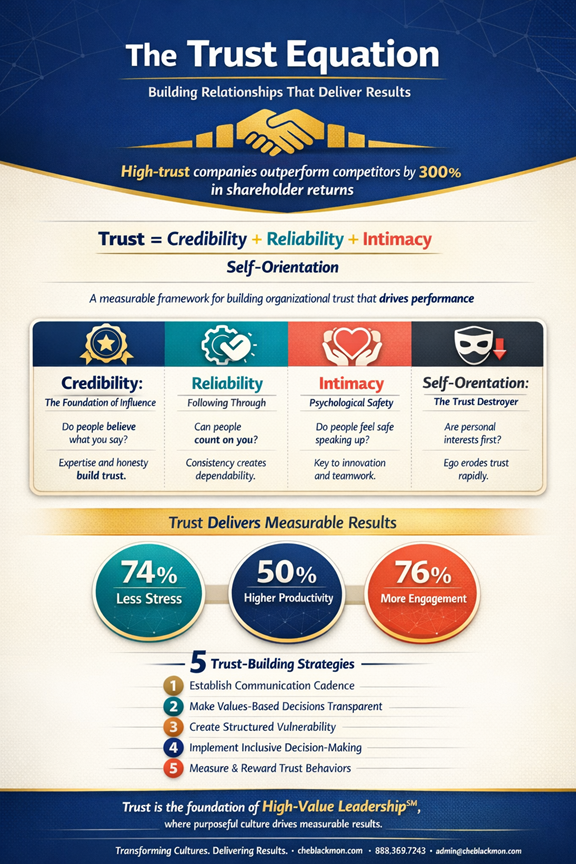
Valentine’s Day often brings to mind romantic relationships, chocolates, and roses. Yet there’s another kind of love that deserves equal celebration: the professional bonds that transform ordinary workplaces into extraordinary teams. When we talk about High-Value Leadership™, we’re talking about creating environments where people genuinely care about each other’s success, where trust runs deep, and where the collective achievement matters more than individual glory. This is workplace love in its truest, most professional form.

For Black women navigating corporate spaces, these team relationships carry particular weight. We often enter environments where we’re the “only” or among very few. The quality of our workplace relationships directly impacts our ability to thrive, advance, and bring our authentic selves to work. When teams operate with genuine care and mutual support rather than superficial tolerance, everything changes. As I explore in “Rise & Thrive: A Black Woman’s Blueprint for Leadership Excellence,” authentic connection in professional settings isn’t a nice-to-have; it’s essential for sustainable success.

This Love Day, let’s celebrate the teams that make work worth it. The colleagues who challenge us to grow, the leaders who clear paths for our advancement, the peers who cover our backs during difficult seasons, and the direct reports who remind us why leadership matters. These relationships form the foundation of high-value cultures where both people and organizations flourish together.

The Love That Drives Performance 💪

When we talk about workplace love, we’re not discussing inappropriate office romances or forced friendships. We’re describing something far more powerful: psychological safety, mutual respect, genuine care for colleagues’ wellbeing, and commitment to collective success. This kind of professional love transforms organizational performance in measurable ways.

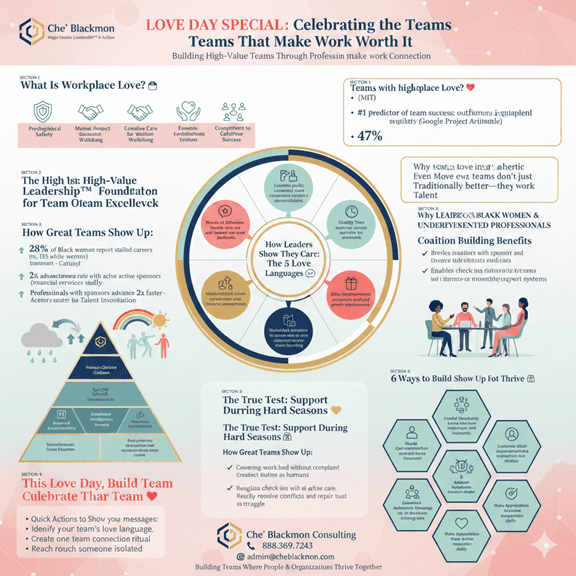
Research from MIT’s Human Dynamics Laboratory found that the single most important predictor of team productivity is how team members interact. Teams with high-quality connections (characterized by mutual trust, positive regard, and emotional carrying capacity) consistently outperform teams with equivalent talent but lower-quality relationships. Google’s famous Project Aristotle reached similar conclusions: psychological safety, the feeling that you can take interpersonal risks without fear of punishment or embarrassment, matters more than individual intelligence or expertise.

There was a technology company struggling with innovation despite hiring brilliant engineers. Their technical capabilities were impressive, but their culture was cutthroat and competitive. Engineers hoarded information, avoided asking for help, and rarely collaborated across specialties. Leadership decided to intentionally build what they called “caring culture” through structured team-building, vulnerability exercises, and reward systems that prioritized collective achievement. Within eighteen months, innovation metrics improved 47%. Employee retention among top performers increased by 33%. The difference wasn’t new talent; it was new relationships characterized by genuine professional care and mutual support.

As I discuss in “High-Value Leadership: Transforming Organizations Through Purposeful Culture,” authentic connection is one of the five pillars of High-Value Leadership™. Leaders who build real relationships at all levels of the organization create cultures where people feel seen, valued, and motivated to contribute their best work. This isn’t soft skill fluff; it’s strategic wisdom backed by decades of organizational research and real-world results.

When Teams Become Family (The Good Kind) 👨‍👩‍👧‍👦

The phrase “we’re like family” can trigger warranted skepticism in workplace contexts. Too often it’s used to justify unreasonable demands or boundary violations. However, there’s a healthy version of workplace family that deserves celebration: teams that show up for each other during difficult times, celebrate each other’s victories, hold space for vulnerability, and commit to each other’s growth and development.

Think about the teams where people genuinely look out for one another. The colleague who notices you’re overwhelmed and quietly redistributes work. The manager who remembers your parent is ill and gives you flexibility without requiring you to ask. The peer who celebrates your promotion even though they wanted it too. The direct report who tells you honestly when your leadership approach isn’t working. These behaviors reflect professional love: choosing the other person’s wellbeing and success even when it’s inconvenient or difficult.

For Black women in corporate spaces, finding this kind of team feels particularly precious. Research from Catalyst shows that Black women face unique challenges including higher rates of being mistaken for administrative staff, having their authority questioned, and receiving less credit for collaborative work. In teams characterized by genuine care and respect, these microaggressions decrease significantly. Colleagues actively interrupt bias, share credit generously, and create space for Black women’s voices and leadership. The difference between working on a team that tolerates you and one that genuinely values you is profound.

There was a healthcare organization that implemented “care pods” where small cross-functional teams met weekly not to discuss work tasks but to check in on each other’s wellbeing, share challenges, and offer support. Initially met with skepticism, these pods became sacred space where staff could be honest about struggles with burnout, family challenges, or professional frustrations. The organization tracked outcomes and found that units with highly engaged care pods had 28% lower turnover, 35% higher patient satisfaction scores, and significantly better staff resilience metrics during the pandemic. The investment in professional care paid measurable dividends.

The Leadership Love Language 💼

Just as Gary Chapman’s “Five Love Languages” describes how people express and receive love in romantic relationships, there are distinct ways leaders demonstrate professional care and teams experience feeling valued. Understanding these leadership love languages helps us both give and receive appreciation more effectively.

Words of Affirmation

Some team members thrive on verbal recognition and specific feedback. They need to hear “that presentation was excellent” or “your analysis changed my thinking.” For Black women, who often receive less recognition than similarly performing peers, words of affirmation carry extra weight. Specific, public acknowledgment of contributions combats invisibility and validates expertise. High-value leaders master the art of meaningful affirmation that goes beyond generic praise to recognize specific contributions and their impact.

Acts of Service

Actions speak louder than words for many professionals. Leaders who demonstrate care through service might clear obstacles blocking their team’s progress, take administrative burdens off someone’s plate, or personally advocate for resources the team needs. There was a director who noticed her team spending hours on manual data compilation. Rather than simply acknowledging their frustration, she worked with IT to automate the process, freeing up twenty hours weekly for more strategic work. Her team felt profoundly valued because she invested her political capital and time in solving their problem.

Quality Time

In our calendars-packed work culture, giving someone your undivided attention is a powerful expression of care. Leaders who practice the quality time love language schedule regular one-on-ones and actually show up present, phones down, listening actively. They create space for career development conversations that aren’t rushed. They remember what team members shared previously and follow up. For professionals from underrepresented backgrounds, having a leader who consistently makes time signals that your development matters and your perspective is valued.

Gifts (Opportunities)

In professional contexts, gifts take the form of opportunities: the chance to lead a high-visibility project, an invitation to present to executives, sponsorship for a development program, or a stretch assignment that builds new capabilities. Leaders who understand this love language actively look for opportunities to give their team members experiences that accelerate growth. They think strategically about who would benefit from which opportunity and make intentional matches. As I emphasize in “Mastering a High-Value Company Culture,” investing in people’s development is how you build sustainable high-value cultures.

Physical Touch (Professional Boundaries)

In workplace contexts, this translates to appropriate expressions of human connection and solidarity: the fist bump after a big win, the supportive hand on a shoulder during a difficult moment, or the team huddle before a major presentation. These gestures must always respect professional boundaries and individual comfort levels, but for some people, appropriate physical expressions of solidarity strengthen team bonds. The key is reading cues, respecting boundaries, and never making physical contact a requirement for belonging.

Understanding your own leadership love language and those of your team members creates more effective appreciation. When recognition doesn’t land, it’s often not lack of effort but mismatch in language. The leader who gives public praise to someone who values quality time might miss the mark. The team member who needs words of affirmation might not fully receive acts of service. High-value leaders learn to express care in the languages their team members understand and value.

Breaking Isolation: Coalition Building as Love in Action 🤝

For professionals from traditionally overlooked backgrounds, particularly Black women, workplace isolation is more than uncomfortable; it’s career limiting. When you’re the only person who looks like you in meetings, when your experiences go unrecognized, when you lack advocates who understand your challenges, professional growth becomes exponentially harder. Coalition building, the intentional formation of supportive professional relationships, is love in action.

Research from the Center for Talent Innovation shows that Black women are more likely than any other group to report feeling stalled in their careers, with 28% saying their career advancement has stalled compared to 13% of white women. This stalling isn’t due to lack of ambition or capability; it’s often due to lack of sponsorship, advocacy, and coalitions. When organizations build cultures where coalition formation is encouraged and supported, everyone benefits but the impact on underrepresented professionals is transformative.

There was a financial services firm that deliberately created “advocacy circles” where senior leaders committed to actively sponsoring emerging talent from underrepresented backgrounds. Unlike traditional mentoring, which is often passive, sponsorship requires active advocacy: recommending people for opportunities, using social capital to open doors, and sharing institutional knowledge that helps navigate organizational politics. The firm tracked outcomes and found that professionals with active sponsors advanced to leadership positions at twice the rate of those without. More importantly, participants reported feeling genuinely supported and valued rather than isolated and invisible.

In “Rise & Thrive,” I discuss the critical importance of building strategic alliances and finding your people in corporate spaces. This isn’t about networking for superficial gain; it’s about finding genuine professional relationships that sustain you through challenges, celebrate your wins, and help you navigate organizational complexities. When Black women support each other rather than competing for limited seats, when allies use their privilege to create opportunities, when leaders actively work to break isolation, that’s workplace love manifesting as tangible career impact.

Tough Love: Feedback as Care 📝

True professional love includes tough conversations. The colleague who tells you when your presentation missed the mark. The leader who gives you critical feedback on a project. The peer who lets you know your approach is creating unintended problems. These honest conversations, delivered with care and respect, are profound expressions of professional love because they prioritize your growth over comfort.

However, research shows significant disparities in how feedback is delivered across demographic groups. Black women are more likely to receive vague feedback, personality-based criticism rather than behavior-specific guidance, and evaluation that questions their capability rather than addressing specific performance issues. When feedback is delivered with genuine care for development rather than as criticism or dismissal, it transforms from potentially harmful to profoundly helpful.

High-Value Leadership™ emphasizes balanced accountability: maintaining high standards within psychologically safe environments. This means giving honest feedback while also creating conditions where people can receive it constructively. The leader who says “I care about your success too much to let this slide” before difficult feedback signals that the conversation comes from care rather than criticism. The peer who follows tough feedback with “How can I support you in addressing this?” demonstrates that honesty and support aren’t contradictory.

There was a manufacturing company that implemented “growth conversations” replacing traditional performance reviews. These quarterly dialogues focused on development rather than evaluation, with structured frameworks ensuring feedback was specific, actionable, and delivered with genuine care for growth. Managers received training on delivering feedback without bias and creating psychological safety. The company tracked results and found that engagement scores improved 31%, internal mobility increased 42%, and employees consistently rated these conversations as more valuable than previous review processes. The shift from evaluative to developmental feedback, grounded in genuine care for people’s growth, transformed how the organization approached talent development.

Celebrating Wins Together: The Joy of Collective Success 🎉

One of the clearest indicators of healthy team relationships is how people respond to each other’s successes. In competitive cultures characterized by scarcity mindset, one person’s win feels like another’s loss. In high-value cultures built on genuine professional care, celebrating others’ victories comes naturally because collective success matters more than individual glory.

When a colleague gets promoted, do people genuinely celebrate or quietly resent? When a team member wins an award, does the team share pride or feel overlooked? When someone lands a major account, does everyone feel the victory or just the individual? These questions reveal the quality of professional relationships and the health of organizational culture. Teams that genuinely love and support each other experience collective joy in individual triumphs.

For Black women whose successes are often minimized or attributed to factors other than capability and hard work, having colleagues who genuinely celebrate achievements matters enormously. When your team makes your promotion their win, when your presentation success feels like a collective triumph, when your award is celebrated as team validation, you experience true belonging. This celebratory culture doesn’t happen automatically; it requires intentional cultivation by leaders committed to abundance thinking and collective success.

There was a consulting firm that created “win walls” in every department where team members posted not just client victories but also personal professional achievements, colleague recognitions, and team milestones. During monthly gatherings, teams celebrated these wins together, with colleagues sharing what others’ successes meant to them. This practice normalized celebration, made recognition collective rather than hierarchical, and built cultures where people genuinely wanted each other to succeed. The firm found that teams with highly engaged win walls had stronger collaboration metrics, better client satisfaction scores, and lower voluntary turnover. The practice of collective celebration strengthened professional bonds and reinforced that everyone’s success matters.

When Teams Carry Each Other: Support During Hard Seasons 🌧️

The truest test of team relationships comes during difficult seasons. When someone faces personal crisis, health challenges, family emergencies, or professional setbacks, how does the team respond? In transactional workplace cultures, people are on their own during hard times. In high-value cultures characterized by genuine professional care, teams show up for each other when it matters most.

This support takes many forms. Colleagues quietly covering responsibilities so someone can attend to family needs. Teams rallying to help a struggling member meet deadlines. Leaders creating flexibility during personal crises without requiring detailed justification. Peers checking in regularly during difficult periods not to gossip but to offer genuine support. These acts of professional solidarity strengthen bonds and create cultures where people feel safe being human.

For Black women who often feel pressure to appear strong and invulnerable at work, having teams that create space for vulnerability and struggle is particularly valuable. Research shows that Black women face “strong Black woman” stereotypes that make showing weakness feel risky. When teams normalize struggle and create genuine support systems, these stereotypes lose their power. People can be honest about challenges without fear of being perceived as weak or less capable.

There was a technology company where an engineer faced a family medical crisis requiring frequent absences over several months. Rather than treating this as a performance problem, the team restructured responsibilities, created backup systems, and maintained full salary and benefits throughout the crisis. Team members sent regular messages of support, covered workload without complaint, and celebrated when the crisis resolved and the engineer returned. Years later, this engineer became one of the company’s most loyal and productive contributors, and the story of how the team showed up became part of organizational lore about what their culture values. The investment in caring for people during hard times paid dividends in loyalty, engagement, and cultural strength.

Building the Kind of Team Culture Worth Celebrating 🏗️

Creating teams characterized by genuine professional care and mutual support doesn’t happen accidentally. It requires intentional cultivation by leaders committed to High-Value Leadership™ principles. Here are practical strategies for building cultures where workplace relationships thrive:

Model Vulnerability and Authenticity

Leaders set the tone for team relationships. When leaders share appropriate struggles, admit mistakes, and show humanity, they give permission for others to do the same. This doesn’t mean oversharing or making yourself the center of attention; it means being genuine about challenges and showing that perfection isn’t required. As I discuss in my work on High-Value Leadership™, authentic connection starts with leaders willing to be real.

Create Structured Opportunities for Connection

Don’t leave relationship building to chance. Create regular opportunities for team members to connect as humans, not just as functional roles. This might include team lunches without work agendas, walking meetings, virtual coffee chats, or structured sharing time in team meetings. The key is making connection an expected part of team culture rather than an afterthought.

Reward Collaborative Behavior

What gets recognized gets repeated. If you only celebrate individual achievement, you’ll get individual competitors. If you recognize and reward people who help others succeed, share knowledge generously, and prioritize team wins, you’ll build collaborative cultures. Make supporting colleagues a valued and visible part of what success looks like in your organization.

Address Relationship Damage Quickly

When team relationships fracture due to conflict, misunderstanding, or breach of trust, address it promptly. Unresolved relationship damage festers and spreads, poisoning team culture. High-value leaders facilitate difficult conversations, help people repair breaches, and sometimes make tough decisions about team members whose behavior damages relationships beyond repair.

Build Inclusive Practices That Combat Isolation

For professionals from underrepresented backgrounds, feeling included and valued requires intentional practice. This means ensuring all voices are heard in meetings, distributing high-visibility opportunities equitably, interrupting bias when it occurs, and creating formal structures like employee resource groups or mentoring programs that combat isolation. In “Rise & Thrive,” I outline specific strategies for creating inclusive environments where Black women and other traditionally overlooked professionals can thrive.

Make Appreciation a Regular Practice

Don’t wait for Valentine’s Day or annual reviews to express appreciation. Build regular practices of recognition and gratitude into team rhythms. This might include starting meetings with appreciations, creating channels for peer recognition, or establishing rituals that normalize expressing thanks and acknowledging contributions. When appreciation becomes routine rather than rare, it strengthens relationship bonds and reinforces positive culture.

Key Takeaways 🔑

As we celebrate Love Day, let’s honor the professional relationships that make work meaningful and productive:

  1. Workplace love, defined as genuine care, mutual respect, and commitment to collective success, drives measurable performance improvements including higher innovation, better retention, and increased productivity.
  2. High-quality team relationships characterized by psychological safety and authentic connection create environments where everyone, particularly traditionally overlooked professionals, can thrive.
  3. Leaders demonstrate care through different “love languages” including words of affirmation, acts of service, quality time, meaningful opportunities, and appropriate professional connection.
  4. Coalition building and active sponsorship combat isolation for Black women and other underrepresented professionals, creating tangible career advancement opportunities.
  5. Honest feedback delivered with genuine care for development, rather than criticism, accelerates growth and strengthens professional relationships.
  6. Teams that celebrate collective success and support each other during difficult seasons build bonds that enhance both individual wellbeing and organizational performance.
  7. Creating cultures worth celebrating requires intentional leadership practices including modeling vulnerability, creating connection opportunities, rewarding collaboration, and addressing relationship damage promptly.

Discussion Questions 💭

Reflect on these questions individually or discuss them with your team:

  • Think about a team or colleague that made work feel meaningful. What specific behaviors or qualities created that experience? How might you cultivate those same qualities in your current professional relationships?
  • Which “leadership love language” (words, actions, time, opportunities, appropriate connection) do you most value receiving? Which do you default to giving? Is there a mismatch that might be affecting your relationships?
  • For leaders: How does your team celebrate individual and collective wins? Are celebrations authentic and inclusive, or do they feel performative or leave people out?
  • For professionals from underrepresented backgrounds: Do you have genuine allies and sponsors who actively advocate for you? If not, what would it take to build those coalitions? If yes, how might you pay that forward?
  • How does your organization handle difficult seasons when team members face personal or professional challenges? Does the culture create space for vulnerability and support, or is there pressure to hide struggle?
  • What’s one concrete practice you could implement in the next month to strengthen professional relationships on your team?

Next Steps: Expressing Professional Appreciation 👣

This Love Day, move beyond reflection to action. Here are specific ways to express professional appreciation and strengthen team relationships:

Write Three Specific Thank You Messages: Identify three colleagues, direct reports, or leaders who have impacted your professional life. Write specific, detailed messages explaining exactly what they did that mattered and how it affected you or the organization. Be concrete rather than generic. Send these messages this week.

Identify Your Team’s Love Language: Pay attention to how your team members respond to different forms of appreciation. Do they light up at public recognition or prefer private feedback? Do they value time investment or tangible opportunities? Adjust your appreciation style to match what each person values.

Create a Team Ritual: Propose one small ritual that builds team connection. This might be starting meetings with appreciations, establishing weekly coffee chats, creating a recognition channel, or implementing “win of the week” sharing. Start small and build consistency.

Reach Out to Someone Isolated: Think about colleagues who might feel isolated or overlooked in your organization, particularly those from underrepresented backgrounds. Reach out with genuine interest in their experience and perspective. Offer specific support if appropriate, or simply listen and validate.

Audit Your Team Culture: If you’re a leader, conduct an honest assessment of your team’s relationship health. Do people support each other or compete? Is vulnerability safe or risky? Are celebrations authentic and inclusive? Identify one area for improvement and create a specific action plan.

Be the Support You Wish You Had: Think about what you wish colleagues had done for you during challenging times. Commit to being that person for others. Look for opportunities to cover workload, offer flexibility, or simply check in with genuine care when someone is struggling.

Final Thoughts 💡

This Love Day, as candy hearts and roses dominate the cultural conversation, let’s also celebrate the professional love that sustains us: the teams that make hard work feel meaningful, the colleagues who see our potential and help us reach it, the leaders who invest in our growth, and the cultures where everyone can bring their authentic selves and thrive.

These relationships aren’t fluffy feel-good extras; they’re the foundation of high-performing organizations. When we invest in building genuine professional care, mutual respect, and collective commitment, we create cultures where innovation flourishes, people stay and grow, and work feels like something more than just a paycheck. We create environments worthy of celebration not just on Valentine’s Day but every day.

For Black women and other professionals from traditionally overlooked backgrounds, these relationships are particularly crucial. They’re the difference between surviving and thriving, between feeling isolated and feeling genuinely valued, between stalled careers and accelerated advancement. When organizations get team relationships right, when they build cultures characterized by authentic care and mutual support, everyone benefits but the impact on those who have historically been marginalized is transformative.

As I’ve learned through twenty-four years of building and transforming organizational cultures, the teams that make work worth it aren’t accidents. They’re the result of intentional leadership, consistent practice, and genuine commitment to each other’s success. They reflect High-Value Leadership™ principles in action: purpose-driven vision, stewardship of culture, emotional intelligence, balanced accountability, and authentic connection.

So this Love Day, take time to appreciate the teams that make your work meaningful. Express gratitude to colleagues who show up for you. Commit to being the kind of team member others are grateful to work with. And if you’re a leader, dedicate yourself to building cultures where genuine professional care thrives and everyone can bring their best selves to work.

The teams worth celebrating are the ones we intentionally create through daily choices to care, support, challenge, and champion each other. That’s the kind of workplace love that deserves recognition every single day.

Ready to Build Teams That Thrive? 🌟

At Che’ Blackmon Consulting, we specialize in transforming organizational cultures and building high-value teams where genuine professional care drives measurable results. Whether you’re looking to:

  • Strengthen team relationships and build psychological safety
  • Create inclusive cultures where diverse talent thrives
  • Develop leadership capabilities that foster authentic connection
  • Transform competitive dynamics into collaborative partnerships
  • Build strategic HR infrastructure that supports relational culture

We bring over two decades of progressive HR leadership experience combined with cutting-edge research in organizational transformation. Our High-Value Leadership™ methodology has helped organizations across industries build cultures where both people and businesses flourish together.

Let’s talk about how to build teams worth celebrating in your organization. We offer complimentary consultation calls to explore your needs and discuss how we can support your culture transformation journey.

Contact Che’ Blackmon Consulting Today:

📧 Email: admin@cheblackmon.com

📞 Phone: 888.369.7243

🌐 Website: cheblackmon.com

About the Author 👩🏾‍💼

Che’ Blackmon is the Founder and CEO of Che’ Blackmon Consulting, a Michigan-based fractional HR and culture transformation consultancy. With 24+ years of progressive HR leadership experience across manufacturing, automotive, healthcare, and professional services sectors, she has consistently delivered measurable results including 9% engagement increases, 60% safety improvements, and successful culture transformations for organizations ranging from startups to Fortune 500 companies.

Currently pursuing a Doctor of Business Administration (DBA) in Organizational Leadership at National University, Che’ is developing Michigan’s first AI-powered culture transformation platform that predicts employee turnover 3-6 months in advance. Her dissertation research focuses on AI-enhanced predictive analytics for culture transformation and employee retention.

Che’ is the published author of three books on leadership and organizational culture: “High-Value Leadership: Transforming Organizations Through Purposeful Culture,” “Mastering a High-Value Company Culture,” and “Rise & Thrive: A Black Woman’s Blueprint for Leadership Excellence.” She hosts the twice-weekly podcast “Unlock, Empower, Transform with Che’ Blackmon” and the “Rise & Thrive” YouTube series.

Her work focuses on creating high-value cultures where both people and organizations thrive, with particular attention to advancing opportunities for Black women and other traditionally overlooked professionals in corporate spaces.

#LoveDay #ValentinesDay #TeamAppreciation #WorkplaceCulture #HighValueLeadership #TeamExcellence #LeadershipDevelopment #PsychologicalSafety #TeamLove #OrganizationalCulture #ProfessionalAppreciation #EmployeeEngagement #TeamSuccess #LeadershipMatters #CelebrateTeams

The Partnership Principle: Why Collaboration Beats Competition 🤝

By Che’ Blackmon, DBA Candidate | Founder & CEO, Che’ Blackmon Consulting

In a world that often glorifies individual achievement and competitive advantage, there’s a powerful truth that many organizations overlook: collaboration, not competition, is the real driver of sustainable success. As I wrote in “High-Value Leadership: Transforming Organizations Through Purposeful Culture,” culture is not built through command and control; it is cultivated through environments where people and organizations thrive together. The partnership principle embodies this philosophy. It recognizes that when we shift from a zero-sum mindset to one of collective growth, everyone wins.

For Black women in corporate spaces, this principle carries particular significance. Too often, we’re pitted against one another in environments where representation is scarce and opportunities feel limited. We’re told there’s only room for one at the table. Yet the partnership principle challenges this scarcity mindset. It invites us to build coalitions, amplify each other’s voices, and create new tables where collaboration becomes our collective strength.

The Competitive Trap: Why It Fails Organizations 🚫

Traditional workplace cultures have long operated on the assumption that competition drives performance. Leaders pit teams against each other. Individuals hoard information to protect their positions. Success is measured by who climbs fastest, not by what the collective achieves. This approach might yield short-term gains, but research consistently shows it creates long-term damage to organizational health and innovation capacity.

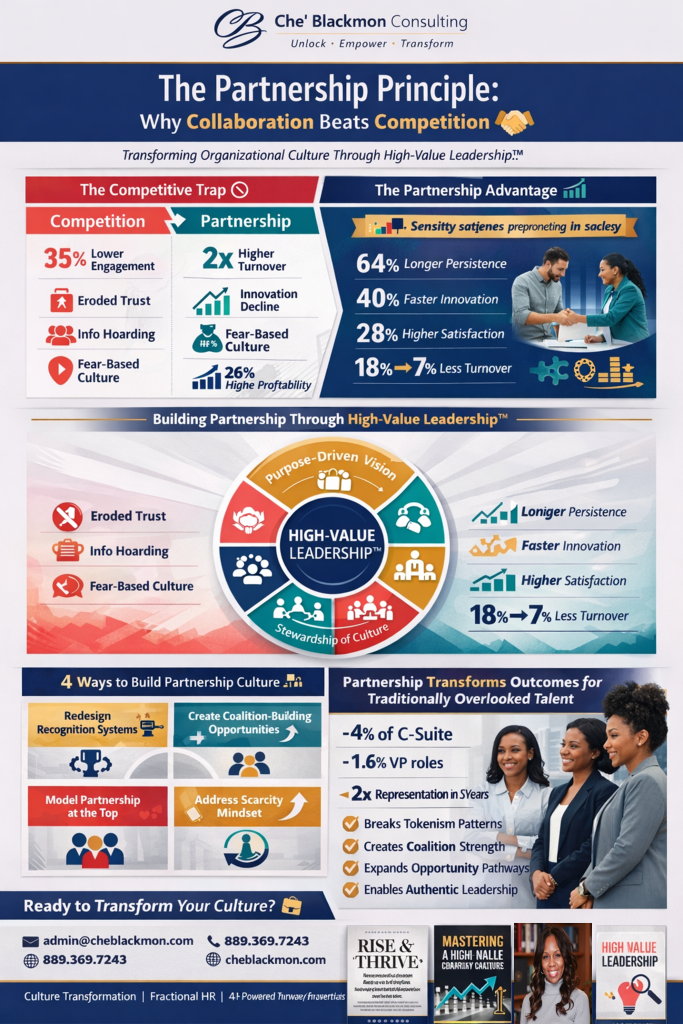
There was a manufacturing company that implemented a forced ranking system, requiring managers to identify the bottom 10% of performers each quarter for potential termination. The intention was to drive excellence through competition. Instead, the policy created a culture of fear and mistrust. Team members stopped sharing best practices. They withheld information that could help colleagues succeed. Innovation plummeted because people were too afraid to take risks that might reflect poorly in rankings. Within two years, the company’s employee engagement scores dropped 35%, and turnover among top performers doubled.

This scenario illustrates what happens when competition becomes the organizing principle. People focus on self-preservation rather than collective progress. As I discuss in “Mastering a High-Value Company Culture,” culture is the lifeblood of any organization. When that lifeblood is poisoned by cutthroat competition, the entire organization suffers. Collaboration withers. Trust erodes. The very innovation that competition was supposed to inspire gets stifled.

For traditionally overlooked groups, particularly Black women, competitive workplace cultures create additional barriers. When representation is already limited, competition for the few available leadership positions can become intense and isolating. Some organizations unconsciously pit Black women against each other, creating what scholars call “competitive victimhood,” where individuals feel they must prove they deserve opportunities more than others who share their identity. This dynamic is both exhausting and counterproductive, preventing the coalition-building that could transform organizational culture.

The Partnership Advantage: What Research Reveals 📊

Extensive research across industries demonstrates that collaborative cultures outperform competitive ones on virtually every meaningful metric. A Stanford study found that when people work collaboratively, they persist 64% longer on challenging tasks and report higher engagement and lower fatigue. Google’s Project Aristotle, which analyzed hundreds of teams to identify what makes them effective, found that psychological safety (the belief that you can take risks without punishment) was the number one predictor of team success. You cannot build psychological safety in a culture where people view each other as threats.

The partnership principle isn’t about eliminating accountability or lowering standards. Rather, it’s about creating what Brené Brown calls “brave spaces” where people can challenge each other, share diverse perspectives, and innovate together. High-value leadership, as I outline in my work, maintains high standards within psychologically safe environments. These aren’t contradictory goals; they’re complementary ones.

Consider the technology company that deliberately shifted from individual to team-based performance metrics. Rather than ranking engineers against each other, they measured success by collective output, knowledge sharing, and cross-functional collaboration. The results were remarkable. Innovation cycles accelerated by 40%. Employee satisfaction scores increased by 28%. Voluntary turnover among high performers dropped from 18% to 7% annually. The partnership principle transformed not just metrics but the lived experience of work.

Research on diverse teams provides additional evidence for the partnership principle. McKinsey’s extensive studies on diversity show that companies in the top quartile for ethnic diversity are 36% more likely to outperform peers on profitability. However, this diversity dividend only materializes when organizations build inclusive cultures where diverse voices are genuinely valued and collaboration is rewarded. Simply having diverse representation without the partnership principle yields minimal benefits. The magic happens when people from different backgrounds work together toward shared goals, bringing their unique perspectives and experiences to solve complex problems collaboratively.

Building Partnership Cultures: Practical Strategies 🏗️

Redesign Recognition and Reward Systems

Most organizations inadvertently reinforce competitive behavior through their recognition programs. When you only celebrate individual achievements, when bonuses are tied to outperforming colleagues, when promotion decisions hinge on being better than others rather than contributing to collective success, you send clear messages about what matters. The partnership principle requires deliberately redesigning these systems to reward collaboration.

Progressive organizations are creating team-based incentives that tie rewards to collective outcomes. They’re recognizing “collaboration champions” who actively help others succeed. They’re measuring leaders not just on their team’s results but on their contributions to cross-functional initiatives. These aren’t small tweaks; they represent fundamental shifts in how success is defined and rewarded.

Create Intentional Coalition-Building Opportunities

Partnership doesn’t happen automatically. It requires intentional structure and support. Organizations committed to the partnership principle create formal mechanisms for collaboration. This might include cross-functional project teams, mentoring circles that connect people across departments, or innovation labs where diverse employees collaborate on strategic challenges.

For Black women and other underrepresented groups, these coalition-building opportunities are particularly crucial. Employee resource groups can serve as powerful platforms for partnership when they’re properly resourced and integrated into business strategy. Rather than positioning these groups as separate or marginal, forward-thinking companies engage them as strategic partners in shaping culture, developing talent, and driving innovation. As I emphasize in “Rise & Thrive: A Black Woman’s Blueprint for Leadership Excellence,” authentic leadership requires bringing your whole self to your role. Organizations that enable this authenticity through supportive partnerships unlock tremendous potential.

Model Partnership at the Top

Culture cascades from leadership. If executives compete visibly, hoard information, or undermine each other, that behavior permeates the organization. The partnership principle must be modeled at the top. This means executives publicly celebrating each other’s successes, collaborating transparently on strategic initiatives, and demonstrating that helping colleagues succeed is valued as highly as individual achievement.

There was a financial services firm where the CEO intentionally restructured executive team meetings to emphasize partnership. Instead of departmental updates designed to showcase individual accomplishments, meetings focused on collaborative problem-solving around organizational challenges. Each executive was assigned a peer accountability partner from a different function. Their performance reviews included 360-degree feedback specifically on collaborative behaviors. These structural changes signaled that partnership wasn’t optional rhetoric; it was expected practice.

Address the Scarcity Mindset Directly

For the partnership principle to take root, organizations must address the scarcity mindset that fuels competition. This mindset assumes limited resources, opportunities, and recognition. It creates zero-sum thinking where one person’s gain becomes another’s loss. Leaders must actively counter this narrative by demonstrating abundance thinking through their decisions and communications.

This is especially important for creating inclusive environments where Black women and other minorities can thrive. When there’s only one Black woman in senior leadership, the message sent to others is clear: there’s only room for one. Organizations committed to the partnership principle intentionally expand representation, create multiple pathways to leadership, and celebrate when diverse talent succeeds together rather than positioning individuals as singular tokens. As I discuss in my doctoral research on AI-enhanced predictive analytics for culture transformation, organizations can use data to identify and address these patterns before they become entrenched.

The Partnership Principle in Action: Real-World Impact 💼

When organizations genuinely embrace the partnership principle, the results are transformative. Consider the healthcare organization that implemented a collaborative care model, requiring physicians, nurses, and support staff to work in integrated teams rather than hierarchical silos. Patient outcomes improved by 22%. Staff satisfaction increased by 31%. Medical errors decreased by 45%. The partnership principle didn’t just make work better; it literally saved lives.

Or examine the professional services firm that created a formal sponsorship program pairing senior leaders with high-potential employees from underrepresented backgrounds. Unlike traditional mentoring, which is often passive, this program required sponsors to actively advocate for their partners, share opportunities, and facilitate meaningful connections. Within three years, representation of Black women in director-level roles doubled. More importantly, employee engagement among participants increased 40%, and the organization reported stronger client relationships because diverse teams brought richer perspectives to client challenges.

These examples illustrate what becomes possible when organizations move beyond competitive frameworks toward partnership models. The shift isn’t just philosophical; it has measurable business impact. Companies with collaborative cultures report higher innovation rates, stronger employee retention, better customer satisfaction, and improved financial performance. The partnership principle isn’t idealistic naiveté; it’s strategic wisdom backed by evidence.

Personal Practice: Living the Partnership Principle 🌟

While organizational culture change requires leadership commitment, individuals can embody the partnership principle regardless of their formal authority. Your personal practice matters. It creates ripples that influence those around you and gradually shifts culture from the ground up.

Start by examining your default mindset. When a colleague succeeds, is your first reaction celebration or comparison? When you have valuable information, do you share it generously or hoard it strategically? When someone asks for help, do you see it as an opportunity or an imposition? Your honest answers reveal whether you’re operating from scarcity or abundance thinking. The partnership principle requires choosing abundance consistently, even when scarcity feels safer.

As Black women navigating corporate spaces, living the partnership principle means actively supporting other Black women rather than viewing them as competition for limited opportunities. It means using whatever platform you have to amplify others’ voices. It means sharing lessons from your journey, making introductions that benefit others, and celebrating collective progress. In “Rise & Thrive,” I emphasize that your leadership journey isn’t about fitting into existing structures but transforming them. Partnership is how we create that transformation together.

Practical actions to embody the partnership principle include regularly offering to help colleagues without expecting immediate reciprocity, publicly crediting others for their contributions to your work, seeking input from diverse perspectives before making decisions, and volunteering to connect people who could benefit from knowing each other. These aren’t grand gestures; they’re daily practices that signal your commitment to collaboration over competition. Over time, these small actions compound into significant culture shifts.

Overcoming Partnership Challenges 🎯

Embracing the partnership principle isn’t without challenges. Some people will view your collaborative approach as weakness or naiveté. In competitive environments, generosity can be exploited. Setting boundaries becomes essential. Partnership doesn’t mean being a doormat or letting others take credit for your work. It means approaching relationships with generosity while maintaining healthy boundaries.

Black women often face particular challenges in this regard. We navigate stereotypes about being either too aggressive or too accommodating, too competitive or too collaborative. The partnership principle helps us transcend these false binaries. We can be both strong and collaborative, both ambitious and supportive. High-value leadership, as I define it in my work, embraces these complexities rather than forcing us into narrow boxes.

Another challenge is organizational inertia. Even when individuals embrace partnership, entrenched systems may reward competitive behavior. In these situations, finding allies becomes crucial. Seek out others who share your values. Build coalition incrementally. Document the positive outcomes of collaborative approaches. Present the business case for partnership to leaders who can influence broader culture change. Transformation rarely happens overnight, but persistence pays off.

Remember too that partnership doesn’t require perfect agreement or constant harmony. Healthy partnerships involve constructive conflict and honest feedback. The goal isn’t eliminating disagreement but ensuring it happens within a foundation of mutual respect and shared purpose. As I discuss in “Mastering a High-Value Company Culture,” strong cultures can hold space for diverse viewpoints precisely because they’re built on trust and partnership rather than competition.

Looking Forward: The Future of Work is Collaborative 🚀

As we move deeper into the 21st century, the partnership principle isn’t just morally right; it’s strategically imperative. The challenges facing organizations today require collaborative solutions. Climate change, technological disruption, global pandemics, and social justice movements all demand that we work together across differences. No individual, team, or even organization can solve these complex problems alone. Partnership becomes not just preferable but necessary for survival.

The rise of remote and hybrid work models makes partnership both more challenging and more essential. Without physical proximity, we must be more intentional about building connections, sharing information, and creating collaborative spaces. Technology enables new forms of partnership, but it requires deliberate effort to prevent digital isolation and competition for visibility in virtual environments.

Younger generations entering the workforce increasingly prioritize collaboration, purpose, and inclusive culture over traditional markers of individual success. They’re less interested in climbing ladders at others’ expense and more focused on collective impact. Organizations that cling to competitive models will struggle to attract and retain talent. Those that embrace the partnership principle position themselves for long-term success in an evolving landscape.

For Black women and other underrepresented groups, the future of work holds both challenges and opportunities. As organizations grapple with diversity, equity, and inclusion, the partnership principle offers a framework for moving beyond tokenism toward genuine belonging. When we build cultures where collaboration is valued more than competition, where multiple people can succeed simultaneously, where difference is leveraged as strength rather than minimized as threat, everyone benefits. The rising tide truly lifts all boats.

Key Takeaways 🔑

The partnership principle transforms organizations by replacing competitive scarcity with collaborative abundance. Here are the essential insights to remember:

  1. Competition creates short-term gains but long-term organizational damage through eroded trust, reduced innovation, and increased turnover.
  2. Research consistently shows collaborative cultures outperform competitive ones on engagement, innovation, retention, and financial metrics.
  3. Partnership requires redesigning systems to reward collaboration, creating intentional coalition-building opportunities, and modeling collaborative behavior at leadership levels.
  4. For Black women and other underrepresented groups, partnership offers paths beyond tokenism toward genuine belonging and shared success.
  5. Individual practice matters; you can embody partnership principles regardless of formal authority through daily actions that prioritize collective success.
  6. Partnership doesn’t eliminate accountability or conflict; it creates foundations of trust and respect that enable productive disagreement and high standards.
  7. The future of work increasingly demands collaborative approaches to solve complex challenges that no individual or organization can address alone.

Discussion Questions 💭

Reflect on these questions individually or discuss them with your team:

  • How does your organization currently balance competition and collaboration? What systems or practices reinforce competitive behavior, and what supports partnership?
  • Think about a recent situation where you defaulted to competitive rather than collaborative thinking. What drove that choice? How might a partnership approach have changed the outcome?
  • For underrepresented professionals: What barriers have you experienced to building partnerships in your workplace? What support would help you engage more fully in collaborative relationships?
  • How might your team redesign one existing process or practice to better reflect the partnership principle? What would success look like?
  • Who in your organization exemplifies the partnership principle? What specific behaviors make them effective collaborative leaders?

Next Steps: Taking Action 👣

Understanding the partnership principle is valuable, but transformation requires action. Here’s how to begin:

Conduct a Personal Audit: Over the next week, notice when you default to competitive versus collaborative thinking. What patterns emerge? What triggers competitive impulses? Use this awareness to make conscious choices aligned with partnership values.

Practice Visible Generosity: Commit to three specific acts of professional generosity this month. Share credit publicly for collaborative work. Make an introduction that benefits someone else. Offer expertise to a colleague without expecting immediate reciprocity. Notice how these actions influence your relationships and your mindset.

Start Team Conversations: If you lead a team, facilitate discussion about the partnership principle using the questions provided above. Invite team members to identify where competitive dynamics undermine collective success. Co-create agreements about how you want to work together differently.

Build Strategic Alliances: Identify two to three colleagues who share your commitment to collaborative culture. Meet regularly to support each other, share resources, and strategize about how to influence broader organizational change. Coalition-building accelerates transformation.

Measure What Matters: If you have influence over performance management, advocate for metrics that capture collaborative contributions. Propose recognition programs that celebrate partnership. Use data to demonstrate the business case for collaboration in your context.

Final Thoughts 💡

The partnership principle represents a fundamental shift in how we think about success, leadership, and organizational culture. It challenges deeply ingrained assumptions about scarcity, competition, and individual achievement. Embracing it requires courage, especially in environments still dominated by competitive dynamics.

Yet the evidence is clear: collaboration beats competition. Organizations built on partnership principles are more innovative, more resilient, and more human. They create space for diverse talent to thrive. They solve complex problems more effectively. They build cultures where people don’t just survive but genuinely flourish.

For Black women and other professionals from traditionally overlooked backgrounds, the partnership principle offers particular promise. It creates pathways beyond tokenism toward genuine belonging and shared leadership. It enables us to build coalitions that transform culture rather than adapting to fit into limiting structures. It allows us to bring our whole selves to our work and to succeed not despite our differences but because of them.

The shift from competition to collaboration won’t happen overnight. It requires sustained effort, intentional practice, and systemic change. But every partnership you build, every generous act you practice, every collaborative success you create moves your organization closer to this vision. Culture transformation begins with individual choices that compound into collective momentum.

As I’ve learned through twenty-four years of transforming organizational cultures, change is always possible when we commit to it together. The partnership principle isn’t just a nice idea; it’s a practical framework for building organizations worthy of the talent and dedication people bring to their work. It’s how we create high-value cultures where both individuals and organizations thrive.

The question isn’t whether the partnership principle works. Research and practice confirm it does. The question is whether you’re ready to embrace it, to model it in your own leadership, and to help build organizations where collaboration truly beats competition. Your answer matters. The impact you create through partnership will ripple far beyond what you can see.

Ready to Transform Your Organization’s Culture? 🌈

At Che’ Blackmon Consulting, we specialize in helping organizations shift from competitive cultures to collaborative ones that drive sustainable success. Whether you’re looking to:

  • Develop high-value leadership capabilities across your organization
  • Build inclusive cultures where diverse talent thrives
  • Transform competitive dynamics into collaborative partnerships
  • Leverage AI-enhanced predictive analytics to prevent turnover and strengthen culture
  • Create strategic HR infrastructure that supports your business goals

We bring over two decades of progressive HR leadership experience combined with cutting-edge research in organizational transformation. Our approach is grounded in proven methodologies, informed by real-world results, and customized to your unique context and challenges.

Let’s talk about how the partnership principle can transform your organization. We offer complimentary consultation calls to explore your needs and discuss how we can support your culture transformation journey.

Contact Che’ Blackmon Consulting Today:

📧 Email: admin@cheblackmon.com

📞 Phone: 888.369.7243

🌐 Website: cheblackmon.com

About the Author 👩🏾‍💼

Che’ Blackmon is the Founder and CEO of Che’ Blackmon Consulting, a Michigan-based fractional HR and culture transformation consultancy. With 24+ years of progressive HR leadership experience across manufacturing, automotive, healthcare, and professional services sectors, she has consistently delivered measurable results including 9% engagement increases, 60% safety improvements, and successful culture transformations for organizations ranging from startups to Fortune 500 companies.

Currently pursuing a Doctor of Business Administration (DBA) in Organizational Leadership at National University, Che’ is developing Michigan’s first AI-powered culture transformation platform that predicts employee turnover 3-6 months in advance. Her dissertation research focuses on AI-enhanced predictive analytics for culture transformation and employee retention.

Che’ is the published author of three books on leadership and organizational culture: “High-Value Leadership: Transforming Organizations Through Purposeful Culture,” “Mastering a High-Value Company Culture,” and “Rise & Thrive: A Black Woman’s Blueprint for Leadership Excellence.” She hosts the twice-weekly podcast “Unlock, Empower, Transform with Che’ Blackmon” and the “Rise & Thrive” YouTube series.

#PartnershipPrinciple #HighValueLeadership #OrganizationalCulture #CollaborationOverCompetition #LeadershipDevelopment #CultureTransformation #HRLeadership #ExecutiveLeadership #BlackWomenInLeadership #InclusiveLeadership #WorkplaceCulture #TeamCollaboration #LeadershipExcellence #PsychologicalSafety #BusinessTransformation

🌍 Cross-Cultural Competence: Leading in a Global Workplace 🌐

By Che’ Blackmon, DBA Candidate | Founder & CEO, Che’ Blackmon Consulting

✨ Introduction: The New Reality of Leadership

The workplace has changed. Today’s leaders navigate teams that span continents, cultures, and communication styles. Whether your organization operates across international borders or serves a diverse local community, cross-cultural competence has become essential for effective leadership. This is not merely about being polite or politically correct. It is about building the kind of purposeful culture that drives results.

As I discuss in High-Value Leadership: Transforming Organizations Through Purposeful Culture, leaders who understand the intersection of culture and performance create environments where every team member can contribute their best work. Cross-cultural competence amplifies this principle by ensuring that cultural differences become sources of strength rather than barriers to success.

🔍 Understanding Cross-Cultural Competence

Cross-cultural competence refers to the ability to understand, communicate with, and effectively interact with people across cultures. It involves awareness of your own cultural worldview, knowledge of different cultural practices and worldviews, and the skills to bridge differences respectfully and productively.

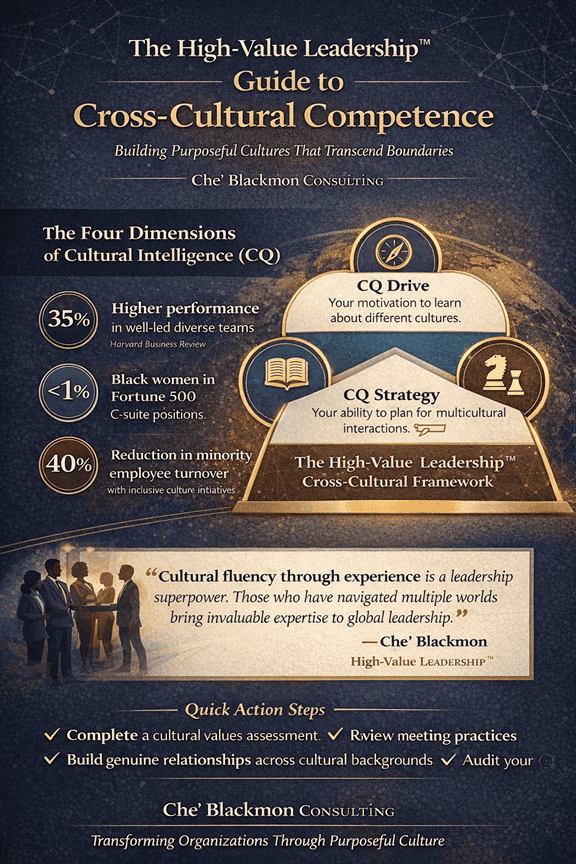
Research from the Harvard Business Review indicates that culturally diverse teams outperform homogeneous ones by up to 35% when led effectively. However, the same research shows that poorly managed diverse teams underperform significantly. The difference lies in leadership competence.

The Four Dimensions of Cultural Intelligence

Dr. Soon Ang and Dr. Linn Van Dyne’s research on Cultural Intelligence (CQ) identifies four key capabilities. First, CQ Drive represents your motivation and interest in learning about different cultures. Second, CQ Knowledge encompasses your understanding of cultural similarities and differences. Third, CQ Strategy involves your ability to plan for multicultural interactions. Fourth, CQ Action reflects your capability to adapt behavior appropriately in different cultural contexts.

👩🏾‍💼 The Overlooked Perspective: Black Women in Global Leadership

Discussions about cross-cultural competence often focus on national cultures while overlooking the unique experiences of those who navigate multiple cultural identities daily. Black women in corporate spaces, for instance, bring invaluable perspectives to global leadership conversations.

In Rise & Thrive: A Black Woman’s Blueprint for Leadership Excellence, I explore how Black women have historically developed sophisticated cultural navigation skills out of necessity. These skills, including code-switching, reading organizational dynamics, and building coalitions across differences, translate directly into cross-cultural leadership capabilities.

McKinsey’s research on diversity in leadership consistently shows that companies with diverse leadership teams, including representation of Black women at senior levels, demonstrate stronger financial performance and innovation. Yet Black women remain severely underrepresented in global leadership roles, holding less than 1% of C-suite positions in Fortune 500 companies.

Leveraging Lived Experience as Leadership Capital

Leaders from traditionally overlooked backgrounds often possess what I call “cultural fluency through experience.” Having navigated predominantly white corporate spaces while maintaining connections to their communities of origin, these leaders develop nuanced abilities to bridge cultural gaps, recognize unspoken dynamics, and create inclusive environments.

Organizations seeking to build cross-cultural competence should recognize and leverage this expertise rather than expecting assimilation. When Black women and other underrepresented leaders are empowered to lead authentically, they model the kind of cultural bridge-building that global organizations require.

📊 Case Studies: Cross-Cultural Leadership in Action

Case Study 1: Manufacturing Meets Global Markets

Consider a mid-sized automotive supplier that expanded operations to include facilities in Mexico and partnerships in Germany. Initially, the company experienced significant friction. American managers interpreted Mexican colleagues’ relationship-building communication style as inefficient. German partners found American directness abrasive.

The turning point came when leadership invested in cross-cultural training and, critically, elevated leaders from each location into strategic decision-making roles. By creating space for different communication styles and decision-making approaches, the company reduced conflict, improved supplier relationships, and increased production efficiency by 22% within 18 months.

Case Study 2: Healthcare System Transformation

A regional healthcare system serving a rapidly diversifying patient population struggled with patient satisfaction scores and staff turnover. Exit interviews revealed that employees from minority backgrounds felt their cultural insights were dismissed, while patients reported feeling misunderstood by care providers.

The organization implemented a comprehensive culture transformation initiative. This included elevating diverse voices into leadership councils, creating cultural liaison positions, and revising hiring practices to value cultural competence alongside clinical skills. Within two years, patient satisfaction scores increased by 15%, and staff turnover among minority employees dropped by 40%.

🛠️ Building Your Cross-Cultural Competence: Practical Strategies

In Mastering a High-Value Company Culture, I outline principles for creating organizational cultures that bring out the best in people. These principles apply directly to cross-cultural leadership.

Strategy 1: Develop Cultural Self-Awareness

Before you can effectively lead across cultures, you must understand your own cultural programming. Examine your assumptions about time, hierarchy, communication, and conflict. Consider how your background shapes what you consider “professional” or “appropriate.” Many workplace norms that seem universal are actually culturally specific.

Action Step: Complete a cultural values assessment such as the Intercultural Development Inventory or CQ Assessment. Reflect on three situations where your cultural assumptions may have influenced your leadership decisions.

Strategy 2: Practice Active Cultural Learning

Cross-cultural competence requires ongoing education. Study the cultural backgrounds of your team members and stakeholders. Learn about communication styles, decision-making preferences, and values that may differ from your own. Approach this learning with humility and genuine curiosity rather than treating it as a checklist exercise.

Action Step: Identify one cultural group you work with regularly but know little about. Commit to learning about their cultural context through reading, conversation, and observation. Seek out content created by members of that community rather than outside observers.

Strategy 3: Create Inclusive Communication Practices

Effective cross-cultural leaders adapt their communication styles while creating space for diverse communication preferences. This means being explicit about expectations rather than assuming shared understanding, allowing multiple channels for input, and recognizing that silence may indicate disagreement or contemplation depending on cultural context.

Action Step: Review your team meeting practices. Do they favor those comfortable with verbal debate? Add written input options, structured reflection time, and alternative ways for team members to contribute ideas.

Strategy 4: Build Diverse Leadership Pipelines

Organizations cannot develop cross-cultural competence through training alone. They must ensure that leadership teams reflect the diversity of their workforce, customer base, and global reach. This requires intentional efforts to identify, develop, and promote leaders from underrepresented backgrounds, including Black women and other traditionally overlooked groups.

Action Step: Audit your organization’s leadership pipeline. Where are the gaps in representation? What barriers exist for advancement? Create specific initiatives to address these gaps with accountability measures and timelines.

📈 Current Trends and Best Practices

The landscape of cross-cultural leadership continues to evolve. Several trends are shaping best practices in this field.

Remote Work and Virtual Teams. The shift to remote and hybrid work has intensified the need for cross-cultural competence. Leaders now manage teams they may never meet in person, across multiple time zones and cultural contexts. Research from GitLab and Buffer indicates that successful remote teams prioritize explicit communication, documentation, and asynchronous work practices that accommodate different working styles and schedules.

Intersectionality in Leadership Development. Progressive organizations recognize that cultural identity is multifaceted. Effective cross-cultural development programs address intersectionality, understanding that a Black woman executive, a first-generation college graduate manager, or an LGBTQ+ team leader from a conservative region each bring unique perspectives and face distinct challenges.

Data-Driven Culture Assessment. Leading organizations use analytics to measure cultural competence and inclusion. This includes tracking promotion rates across demographic groups, analyzing engagement survey results by cultural background, and monitoring retention patterns. Data provides accountability and helps identify systemic barriers that individual good intentions cannot overcome.

Psychological Safety as Foundation. Research by Dr. Amy Edmondson and others demonstrates that psychological safety, the belief that one can speak up without punishment or humiliation, is essential for cross-cultural teams to thrive. Creating environments where team members can bring their authentic cultural selves without fear enables the innovation and collaboration that diverse teams promise.

💡 Actionable Takeaways

To strengthen your cross-cultural leadership competence, focus on these key actions:

1. Commit to Self-Examination. Regularly assess your own cultural biases and assumptions. Seek feedback from colleagues with different backgrounds about how your leadership style lands across cultures.

2. Invest in Relationships. Build genuine connections with team members from different cultural backgrounds. Move beyond surface-level interactions to understand their perspectives, values, and experiences.

3. Amplify Overlooked Voices. Actively create space for Black women, people of color, and other traditionally marginalized groups to contribute and lead. Recognize that their cultural navigation expertise is an organizational asset.

4. Adapt Your Leadership Style. Develop flexibility in how you communicate, make decisions, and provide feedback. What works in one cultural context may not work in another.

5. Make Systemic Changes. Individual competence matters, but sustainable change requires systemic attention to policies, practices, and structures that may inadvertently disadvantage certain cultural groups.

6. Measure and Adjust. Track outcomes related to cultural competence and inclusion. Use data to identify what is working and what needs adjustment.

🎯 Conclusion: Leadership That Transcends Boundaries

Cross-cultural competence is not an optional skill for today’s leaders. It is fundamental to building the high-value organizational cultures that drive sustainable success. When leaders embrace cultural differences as opportunities rather than obstacles, they unlock innovation, engagement, and performance that homogeneous thinking cannot achieve.

For those who have been traditionally overlooked in leadership conversations, particularly Black women navigating corporate spaces, know that your cultural fluency is a superpower. Your experience bridging worlds, adapting to different contexts, and bringing your full self despite resistance positions you uniquely for the global leadership challenges ahead.

The path forward requires both individual growth and organizational transformation. As I emphasize throughout my work, purposeful culture does not happen by accident. It requires intentional leadership, consistent action, and unwavering commitment to bringing out the best in every person, regardless of their cultural background.

❓ Discussion Questions for Reflection

1. What cultural assumptions have you brought into leadership situations that you later recognized were not universal? How did this recognition change your approach?

2. How does your organization currently leverage the cultural expertise of Black women and other traditionally overlooked leaders? What opportunities exist to do this more effectively?

3. Think about a cross-cultural conflict or misunderstanding you have witnessed. What cultural factors may have contributed to the disconnect? How might a culturally competent leader have approached the situation differently?

4. What barriers exist in your organization that may prevent culturally diverse leaders from advancing into senior positions? What specific steps could address these barriers?

5. How can you personally commit to growing your cross-cultural competence over the next six months? What specific learning activities and relationship-building efforts will you pursue?

🚀 Your Next Steps

Building cross-cultural competence is a journey, not a destination. Start where you are, commit to growth, and take consistent action. Whether you are an emerging leader seeking to develop your capabilities or an executive aiming to transform your organizational culture, the time to begin is now.

Consider exploring additional resources such as Mastering a High-Value Company Culture and High-Value Leadership: Transforming Organizations Through Purposeful Culture for deeper insights into building cultures where all people thrive. For Black women and other leaders from traditionally overlooked backgrounds, Rise & Thrive: A Black Woman’s Blueprint for Leadership Excellence offers specific guidance for navigating corporate spaces while leading authentically.

🤝 Partner with Che’ Blackmon Consulting

Ready to transform your organization’s culture and develop cross-cultural leadership capabilities? Che’ Blackmon Consulting offers fractional HR leadership, culture transformation consulting, and executive coaching designed to create workplaces where every person can contribute their best work.

📧 Email: admin@cheblackmon.com

📞 Phone: 888.369.7243

🌐 Website: cheblackmon.com

Let’s build purposeful cultures together. ✨

#HighValueLeadership #CrossCulturalCompetence #GlobalLeadership #DiversityAndInclusion #CultureTransformation #BlackWomenInLeadership #LeadershipDevelopment #WorkplaceCulture #InclusiveLeadership #HRLeadership #OrganizationalCulture #ExecutiveLeadership #CulturalIntelligence #PurposefulCulture #WomenInLeadership

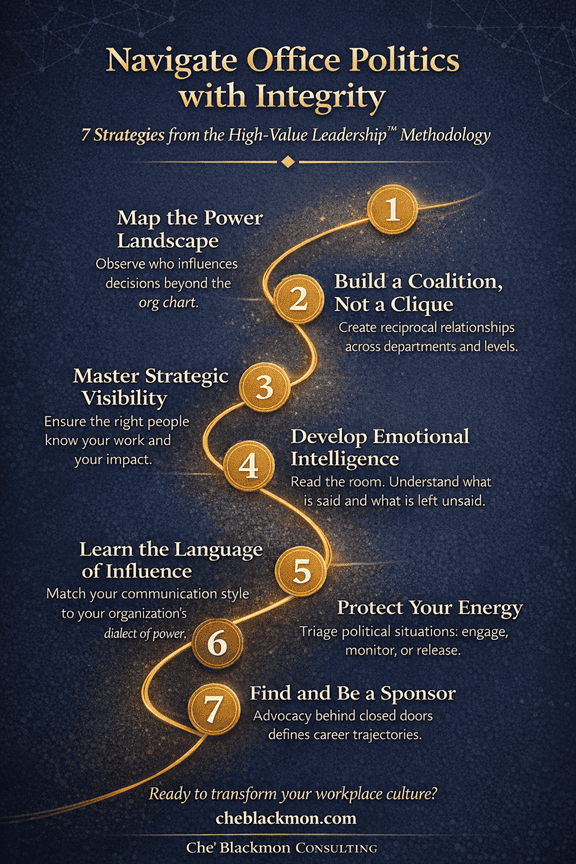
Office Politics for People Who Hate Politics: A Survival Guide 🎯

By Che’ Blackmon, DBA Candidate | Founder & CEO, Che’ Blackmon Consulting

Author of High‐Value Leadership, Mastering a High‐Value Company Culture & Rise & Thrive

💡 Let’s Be Honest: Nobody Taught You This in School

You went to school, earned your degree, sharpened your skills, and showed up to the workplace ready to contribute. Then, somewhere between your first team meeting and your first performance review, you realized something unsettling: the rules of the game were never written down.

Office politics. Just hearing those two words makes most people cringe. It conjures images of backstabbing, favoritism, gossip, and manipulation. And for many professionals, especially Black women and other traditionally overlooked groups, the terrain of office politics can feel less like a game and more like a minefield.

But here is the truth that changed my entire approach to organizational culture: office politics is not optional. It exists in every workplace, in every industry, at every level. The question is not whether politics exists. The question is whether you will learn to navigate it with integrity, or let it navigate you.

This article is your survival guide. Whether you are a new professional finding your footing, a mid career leader seeking the next level, or an executive trying to build a healthier culture, this guide will equip you with the practical strategies to thrive in politically charged environments without compromising who you are.

🔍 Section 1: Understanding Office Politics (It’s Not What You Think)

Redefining the Term

Office politics, at its core, is simply the way power, influence, and relationships operate within an organization. That is it. It is the informal network of decision making that runs alongside the official org chart. It is who gets heard in meetings, whose ideas get funded, who receives mentorship, and whose contributions are celebrated versus overlooked.

In Mastering a High‐Value Company Culture, I write extensively about the invisible systems that shape organizational life. Culture is not just what a company puts on its website. It is what happens when leadership is not watching. And office politics is one of the most powerful forces shaping that reality.

📊 What the Research Says

A 2023 study published by the Harvard Business Review found that 93% of employees believe office politics exist in their workplace, yet fewer than 25% feel equipped to navigate them effectively. The gap between awareness and capability is enormous, and it disproportionately affects people who were never given access to the unwritten playbook.

Research from McKinsey’s Women in the Workplace 2023 report reinforces what many of us already know: Black women are significantly less likely to have sponsors (not just mentors, but sponsors) who advocate for their advancement behind closed doors. When the political landscape requires someone in the room to say your name with conviction, the absence of sponsorship is not a minor inconvenience. It is a career limiting reality.

✨ Politics Is Not the Problem. Toxic Politics Is.

There is an important distinction to draw here. Healthy organizational politics involves building genuine relationships, advocating for your work and your team, and understanding how decisions are made so you can be part of the conversation. Toxic politics, on the other hand, involves manipulation, exclusion, dishonesty, and hoarding of information.

High value leaders, as I describe in High‐Value Leadership: Transforming Organizations Through Purposeful Culture, do not avoid politics altogether. They transform the political environment by leading with transparency, accountability, and genuine care for people. That is the standard we should aspire to.

🎯 Section 2: Why Avoidance Is Not a Strategy

If you are someone who says, “I just put my head down and do good work,” this section is especially for you.

The belief that excellent work speaks for itself is one of the most dangerous myths in professional life. It sounds noble. It feels righteous. And in a perfect world, it would be true. But organizations are run by people, and people are influenced by relationships, visibility, and perception just as much as they are by performance metrics.

🚨 The Cost of Opting Out

Consider this scenario. There was a company where a senior operations manager consistently delivered outstanding results. She exceeded her KPIs every quarter, solved problems before they became crises, and earned the deep respect of her direct reports. Yet year after year, she was passed over for promotion in favor of colleagues whose results were objectively less impressive but whose visibility within the executive suite was far greater.

What happened? She had opted out of the political landscape. She did not attend optional leadership meetings. She did not build relationships with decision makers outside her direct chain of command. She assumed her work was enough. It was not.

This story repeats itself across industries, and it repeats with particular frequency for Black women and other professionals from traditionally overlooked backgrounds. In Rise & Thrive: A Black Woman’s Blueprint for Leadership Excellence, I address this pattern directly. The systems were not designed with us in mind, but that does not mean we are powerless within them. It means we must be strategic, intentional, and unapologetically visible.

📋 The Visibility Gap

A 2024 Lean In study revealed that Black women are 1.5 times more likely than white women to report that their contributions go unrecognized at work. Additionally, they are significantly more likely to experience the “only” phenomenon, where they are the sole person of their race and gender in the room. Being the “only” adds an extra layer of political complexity because every action is scrutinized, every misstep feels amplified, and the emotional labor of navigating these dynamics is constant and exhausting.

Avoidance is not neutrality. In the context of office politics, silence is a position, and it is rarely one that works in your favor.

🛠️ Section 3: The Survival Toolkit – 7 Strategies for Navigating Office Politics with Integrity

1️⃣ Map the Power Landscape

Every organization has a formal structure and an informal one. The formal structure is the org chart. The informal structure is the web of influence, trust, and information flow that actually drives decisions.

Actionable Step: Spend two weeks observing. Who do leaders consult before making decisions? Whose opinions carry weight in meetings even when they are not the most senior person present? Who controls access to information or resources? Write these observations down. This is your political map, and it is one of the most valuable tools you can develop.

2️⃣ Build a Coalition, Not a Clique

Relationships are the currency of influence. But there is a critical difference between building a broad coalition of trusted colleagues and retreating into a small, insular group. Cliques breed suspicion. Coalitions build organizational strength.

Actionable Step: Identify three to five people across different departments, levels, and backgrounds with whom you can build genuine, reciprocal relationships. Offer value before asking for it. Share information, make introductions, and celebrate their wins publicly.

3️⃣ Master the Art of Strategic Visibility

Visibility does not mean self promotion. It means ensuring that the right people know about your work, your expertise, and your aspirations. There is nothing arrogant about wanting your contributions to be seen.

Actionable Step: Start a practice of sending brief, regular updates to your manager and key stakeholders. Keep them factual and concise. Include impact metrics where possible. Frame your work in terms of organizational outcomes, not personal achievement. For example, instead of saying “I completed the project,” say “The new process reduced turnaround time by 30%, supporting our Q3 efficiency goals.”

4️⃣ Develop Your Emotional Intelligence

Political navigation requires reading the room. It requires understanding not just what people say, but what they mean, what they fear, and what they need. Emotional intelligence is the foundation of effective political navigation.

According to Daniel Goleman, whose research has shaped the field of emotional intelligence in leadership, leaders with high EQ outperform their peers by an average of 20% in performance outcomes. The ability to regulate your own emotions while accurately reading others is not a “soft skill.” It is a leadership superpower.

Actionable Step: After every significant meeting or interaction, ask yourself three questions. What emotions were present in the room? What was left unsaid? What does this tell me about the priorities and concerns of the people involved? This practice builds your political awareness exponentially over time.

5️⃣ Learn the Language of Influence

Every organization has its own dialect of power. Some companies value data driven arguments. Others respond to storytelling. Some prioritize consensus building while others reward decisiveness. Understanding the communication style that resonates with your organization’s decision makers is essential.

Actionable Step: Study how successful leaders in your organization communicate. Pay attention to the structure of their presentations, the language they use in emails, and the way they frame proposals. Adapt your communication style to meet decision makers where they are, while remaining authentic to your own voice.

6️⃣ Protect Your Energy and Set Boundaries 🔋

Political navigation is exhausting, especially when you are also managing the additional weight of being underestimated, stereotyped, or overlooked. You cannot pour from an empty cup, and you cannot fight every battle.

Actionable Step: Develop a personal “political triage” system. Categorize situations into three buckets: (1) must engage because it directly impacts your career, your team, or your values, (2) should monitor because it may become relevant, and (3) release because it does not serve you and engaging will only drain your energy. This framework helps you focus your political capital where it matters most.

7️⃣ Find and Be a Sponsor

Mentors advise you. Sponsors advocate for you when you are not in the room. The difference between the two can define the trajectory of a career.

In Rise & Thrive, I emphasize that sponsorship is particularly vital for Black women, who are often excluded from the informal networks where sponsorship relationships naturally develop. But sponsorship is a two way street. As you rise, you have a responsibility to sponsor others, particularly those from backgrounds that are traditionally underrepresented.

Actionable Step: Identify one person in a position of influence who has demonstrated genuine investment in your growth. Build the relationship intentionally over time by delivering excellent work, seeking their counsel, and being transparent about your career goals. Simultaneously, identify one person who is earlier in their career whom you can begin to sponsor.

🏢 Section 4: The Organizational Responsibility

Let us be clear: the burden of navigating office politics should not rest solely on the shoulders of individual employees. Organizations have a profound responsibility to create cultures where political maneuvering is not required for basic fairness, where advancement is transparent, and where every voice is genuinely valued.

📈 Building a High Value Culture

This is the heart of the work I do through Che’ Blackmon Consulting and the foundation of Mastering a High‐Value Company Culture. A truly high value culture is one where:

✅ TransparencyDecision making processes are clear and accessible to all employees, not just those with inside connections.
✅ EquityAdvancement criteria are explicit, consistently applied, and regularly audited for bias.
✅ BelongingEvery employee, regardless of background, feels psychologically safe to speak up, challenge ideas, and be their authentic self.
✅ AccountabilityLeaders at every level are held to the same standards they expect from their teams.
✅ RecognitionContributions are acknowledged based on impact, not proximity to power.

When organizations invest in building these cultural foundations, the need for individuals to navigate toxic politics diminishes significantly. The playing field becomes more level, and the energy that employees would have spent on political survival gets redirected toward innovation, collaboration, and growth.

💪 Section 5: A Special Note for Black Women in Corporate Spaces

If you are a Black woman reading this, I want to speak to you directly for a moment.

You are not imagining it. The political terrain is different for you. Research consistently confirms what you have experienced in conference rooms, performance reviews, and hallway conversations. You face a unique intersection of racial and gender bias that creates what scholars call a “double bind,” where you are simultaneously held to higher standards and given less grace for mistakes.

A 2023 report by the National Partnership for Women and Families found that Black women earn 67 cents for every dollar earned by white, non Hispanic men. That pay gap is not just a compensation issue. It is a reflection of systemic political dynamics within organizations that undervalue the contributions of Black women at every level.

“Your presence in the room is not an accident. It is an achievement. And your ability to thrive in that room is not about changing who you are. It is about understanding the environment and using your power strategically.”

This is precisely why I wrote Rise & Thrive: A Black Woman’s Blueprint for Leadership Excellence. Because general career advice, while helpful, does not always account for the specific challenges that Black women face. You deserve guidance that speaks to your experience, validates your reality, and equips you with strategies that work within the world as it is while you help build the world as it should be.

Five Power Moves for Black Women Navigating Office Politics 👑

🔹 Document Everything. Keep a running record of your accomplishments, your contributions to team projects, and any feedback you receive. This is not paranoia. It is professional self preservation.

🔹 Cultivate Your Inner Circle Wisely. Seek out trusted allies, both within and outside your organization, who understand the unique dynamics you navigate. Community is not a luxury. It is a necessity.

🔹 Negotiate from Data, Not Emotion. When advocating for yourself, lead with impact data and market benchmarks. Prepare thoroughly and practice with trusted advisors so that your confidence is rooted in preparation.

🔹 Reject the Superwoman Complex. You do not have to be twice as good to earn half the recognition. That narrative, while born from real experience, can lead to burnout. Give yourself permission to be excellent without being exhausted.

🔹 Amplify Other Black Women. When you gain influence, use it. Recommend other Black women for opportunities, invite them into rooms they have been excluded from, and publicly champion their expertise. Collective advancement is the most powerful form of political strategy.

📊 Section 6: Current Trends Shaping Office Politics in 2025 and Beyond

🤖 The Rise of AI and Its Political Implications

As artificial intelligence transforms the workplace, new political dynamics are emerging. Decisions about which roles are augmented, which are automated, and who controls AI driven processes are deeply political. Employees who understand AI and can articulate its value are gaining significant organizational influence, while those who resist it risk being marginalized in the conversation.

Organizations that approach AI implementation transparently and inclusively, rather than allowing it to be driven by a small, insular group, will create healthier political environments and better outcomes for all employees.

🏠 Hybrid Work and the New Proximity Bias

The shift to hybrid and remote work has fundamentally reshaped office politics. Proximity bias, where employees who are physically present in the office receive more opportunities and visibility, has become one of the most significant political challenges of this era. Research from Stanford University’s Nick Bloom has shown that remote workers are 50% less likely to receive promotions compared to their in office counterparts, even when performance is equivalent.

For Black women and other traditionally overlooked professionals, this presents a complex calculus. Remote work may offer relief from daily microaggressions and the emotional tax of being the “only,” but it may also reduce the visibility that is essential for advancement. There is no one size fits all answer, but awareness of this dynamic is critical for making informed career decisions.

🌐 The Growing Demand for Authentic Leadership

One of the most encouraging trends in organizational leadership is the growing demand for authenticity. Employees, particularly younger generations, are increasingly unwilling to tolerate leaders who operate through manipulation and opacity. They want leaders who are transparent, values driven, and genuinely invested in the wellbeing of their teams. This is the essence of what I call High‐Value Leadership, and it represents a fundamental shift in the political expectations of the modern workplace.

✅ Section 7: Your Action Plan – Starting Monday

Knowledge without action is just trivia. Here is your week by week plan for putting these strategies into practice.

📅 Week 1: Observe and Map. Spend this week mapping the informal power structure of your organization. Identify the key influencers, the decision making patterns, and the communication channels that matter most. Write it down.

📅 Week 2: Connect and Build. Reach out to one new person outside your immediate team. Have a genuine conversation about their work, their challenges, and their goals. Plant the seed of a coalition.

📅 Week 3: Speak Up and Be Seen. Volunteer for a visible project or initiative. Share an insight in a meeting that demonstrates your expertise. Send an update to your manager that highlights your recent impact.

📅 Week 4: Reflect and Refine. Review what you have learned. What surprised you about the political landscape? Where do you need to invest more energy? What boundaries do you need to strengthen? Adjust your approach accordingly.

💬 Discussion Questions for Teams and Individuals

Whether you are reflecting on your own, journaling, or facilitating a team conversation, these questions are designed to deepen your understanding and inspire action.

1. What is one political dynamic in your current workplace that you have been avoiding? What would it look like to engage with it strategically rather than ignore it?

2. Think about a time when someone’s advocacy (or lack thereof) directly impacted your career. What did that experience teach you about the power of sponsorship?

3. How does your organization’s culture reward visibility? Are those rewards distributed equitably, or do certain groups have more natural access to visibility opportunities?

4. In what ways can you begin to sponsor or advocate for a colleague from a traditionally overlooked background this month?

5. If you could change one thing about the political culture of your workplace, what would it be? What is one step you can take to begin that change?

🚀 Next Steps: Let’s Transform Your Workplace Together

Office politics does not have to be a source of dread. With the right strategies, the right mindset, and the right support, you can navigate any organizational environment with confidence and integrity.

At Che’ Blackmon Consulting, we partner with organizations and leaders to build high value cultures where politics serve the mission, not undermine it. Whether you need fractional HR leadership, culture transformation consulting, or keynote speaking that moves your team to action, we are here to help.

🌟 Ready to Build a High‐Value Culture? Connect with Che’ Blackmon Consulting today. 📧  admin@cheblackmon.com 📞  888.369.7243 🌐  cheblackmon.com

📚 Explore Che’’s Books:

High‐Value Leadership: Transforming Organizations Through Purposeful Culture

Mastering a High‐Value Company Culture

Rise & Thrive: A Black Woman’s Blueprint for Leadership Excellence

Because you deserve a workplace where your talent is recognized, your voice is valued, and your potential is limitless. ✨

#OfficePolitics #WorkplaceCulture #LeadershipDevelopment #HighValueLeadership #BlackWomenInLeadership #CorporateSurvivalGuide #CareerStrategy #WorkplaceEquity #WomenInLeadership #ProfessionalGrowth #CultureTransformation #BlackWomenAtWork #ExecutivePresence #SponsorshipMatters #EmotionalIntelligence #StrategicVisibility #LeadershipTips #CheBlackmonConsulting #RiseAndThrive #PurposefulCulture

The Trust Equation: Building Relationships That Deliver Results

By Che’ Blackmon Founder & CEO, Che’ Blackmon Consulting DBA Candidate in Organizational Leadership

In organizational leadership, trust is not a soft skill relegated to team building exercises and annual retreats. It is the fundamental currency of high performance. Without trust, even the most brilliant strategies collapse under the weight of organizational dysfunction, political maneuvering, and cultural toxicity. Yet trust remains one of the most misunderstood and poorly cultivated elements of corporate success.

Consider this: According to research from the Harvard Business Review, employees at high-trust companies report 74% less stress, 50% higher productivity, and 76% more engagement than those at low-trust organizations. The financial implications are equally compelling. Companies with high-trust cultures outperform their competitors by nearly 300% in total shareholder returns. Trust is not abstract. It translates directly to your bottom line, your retention metrics, and your ability to attract and develop exceptional talent.

This article explores the trust equation as both a leadership framework and a strategic imperative for organizational transformation, drawing from research in organizational behavior, decades of HR leadership experience across manufacturing and automotive sectors, and practical insights from building high-value company cultures that deliver measurable results.

💎 Understanding the Trust Equation

The trust equation, originally developed by David Maister, Charles Green, and Robert Galford, provides a mathematical framework for understanding what builds and erodes trust in professional relationships:

Trust = (Credibility + Reliability + Intimacy) ÷ Self-Orientation

Let’s examine each component and its implications for organizational leadership.

🎯 Credibility: The Foundation of Influence

Credibility answers the question: Do people believe what you say? In organizational contexts, credibility emerges from demonstrated expertise, consistent communication of accurate information, and the willingness to admit when you don’t have all the answers. Leaders with credibility don’t pretend to be infallible. They acknowledge complexity, cite sources, and make decisions based on data rather than ego.

There was a manufacturing company facing chronic quality issues that threatened a major automotive contract. The CEO could have deflected blame or manufactured optimistic projections. Instead, she brought the entire leadership team together, presented unvarnished production data, acknowledged the severity of the situation, and outlined a realistic 90-day improvement plan with weekly transparency reports to all stakeholders. Her credibility soared not because she had easy answers but because she refused to insult their intelligence with corporate spin.

For traditionally overlooked employees, particularly Black women navigating predominantly white corporate spaces, credibility faces additional barriers. Research from the Center for Talent Innovation reveals that Black women must often work harder to establish credibility, facing what scholars call the credibility tax. They are more likely to have their expertise questioned, their accomplishments attributed to external factors like affirmative action, and their leadership capabilities doubted. Building credibility in these environments requires not just competence but strategic visibility, calculated risk-taking, and the cultivation of sponsors who can amplify your expertise.

⚙️ Reliability: Following Through on Commitments

Reliability asks: Can people count on you to do what you said you would do? This seems straightforward until you recognize how frequently leaders make commitments they cannot keep. Every cancelled one-on-one meeting, every delayed decision, every forgotten promise erodes the reliability component of trust. Reliability compounds over time. Leaders who consistently deliver on small commitments build reserves of trust that sustain them through inevitable failures on larger initiatives.

Consider the experience of a technology startup that promised its engineering team flexible work arrangements, then abruptly mandated full-time office attendance when venture capital funding arrived. The policy reversal destroyed reliability overnight. Engineers who had structured their lives around flexibility felt betrayed. Within six months, the company lost 40% of its technical talent, delaying product launches and damaging its reputation in the competitive talent market.

The lesson is clear: leaders must underpromise and overdeliver rather than making grandiose commitments they lack the authority or resources to fulfill. Reliability requires realistic assessment of capacity, transparent communication about constraints, and the courage to say no when you cannot responsibly commit.

For Black women and other marginalized groups, unreliable leadership has particularly devastating effects. When leaders promise diversity initiatives, mentorship programs, or pathways to advancement but fail to follow through, it confirms suspicions that inclusion efforts are performative rather than genuine. This erosion of trust creates what organizational psychologists call minority stress, the additional cognitive and emotional burden of navigating predominantly white institutions while managing constant microaggressions and broken promises.

🤝 Intimacy: Creating Psychological Safety

Intimacy in the trust equation does not refer to personal closeness but to the safety people feel when they share concerns, admit mistakes, or voice dissenting opinions. Organizations with high intimacy are characterized by psychological safety, the belief that you won’t be punished or humiliated for speaking up. Research by Dr. Amy Edmondson at Harvard Business School demonstrates that psychological safety is the strongest predictor of team effectiveness, innovation, and learning velocity.

Leaders create intimacy through vulnerability. When a senior executive admits uncertainty, acknowledges a failed initiative, or asks for help, it signals that imperfection is acceptable. This permission to be human cascades through the organization. Teams become willing to surface problems early rather than hiding them until they metastasize into crises.

There was a healthcare organization whose culture punished dissent so aggressively that nurses stopped reporting medication errors, fearing retaliation. Patient safety incidents increased by 300% over two years before the board intervened, replacing the executive team with leaders trained in high-reliability organizations. The new leadership implemented anonymous reporting systems, held monthly listening sessions, and publicly celebrated employees who identified process failures. Within 18 months, reported incidents increased (a positive indicator of transparency) while actual patient harm decreased by 60%.

For Black women in corporate environments, psychological safety is often absent. Research published in the Journal of Vocational Behavior found that Black women report the lowest levels of psychological safety among all demographic groups, navigating what scholars describe as a concrete ceiling rather than a glass one. They face penalty for displaying too much emotion or too little, for being too assertive or insufficiently confident. This impossible calculus makes authentic participation exhausting. Leaders building trust with diverse teams must recognize that intimacy requires dismantling the informal penalties that punish difference.

🎭 Self-Orientation: The Trust Destroyer

Self-orientation is the denominator in the trust equation, which means it has multiplicative destructive power. High self-orientation appears when leaders prioritize their own interests, ego, or advancement over the needs of their teams and organizations. It manifests in credit-stealing, blame-shifting, political maneuvering, and decisions that optimize personal visibility rather than organizational outcomes.

The mathematics are unforgiving. A leader might score highly on credibility, reliability, and intimacy, but if self-orientation is high, trust collapses. Employees can forgive occasional incompetence. They rarely forgive self-serving behavior masquerading as leadership.

Consider the executive who championed a major operational improvement project, celebrated publicly when it succeeded, but privately blamed the implementation team when components failed. His credibility, initially high due to technical expertise, evaporated as employees recognized his pattern of claiming credit while deflecting accountability. Within a year, his department experienced the highest turnover rate in the company.

Reducing self-orientation requires uncomfortable self-awareness. It means asking: Am I making this decision because it’s right for the organization or because it makes me look good? Am I promoting this person because they’re the best candidate or because they’re loyal to me? Am I pushing this initiative because it solves a real problem or because I want to be associated with innovation? These questions are difficult precisely because self-interest is often unconscious, rationalized through elaborate justifications that disguise ego as strategy.

For traditionally overlooked employees, high self-orientation among leaders translates to tokenism, performative diversity, and the perpetuation of exclusive networks that maintain power for existing elites. When leaders prioritize their own comfort over systemic change, diversity initiatives become box-checking exercises rather than genuine transformation.

🏗️ Building Trust in Organizational Transformation

The trust equation provides a diagnostic framework, but organizational transformation requires systematic application of trust-building principles. In my work developing AI-enhanced predictive analytics for culture transformation, one pattern emerges consistently: companies that successfully transform their cultures prioritize trust metrics as early indicators of systemic health.

Traditional engagement surveys measure satisfaction after the fact. Advanced predictive models identify trust erosion 3 to 6 months before it manifests in turnover, absenteeism, or productivity declines. These systems track communication patterns, response times to employee concerns, consistency between stated values and resource allocation, and the distribution of opportunities across demographic groups.

There was a professional services firm that implemented trust metrics alongside traditional performance indicators. They discovered that teams with the highest billable hours had the lowest trust scores, indicating that short-term revenue optimization was destroying long-term sustainability. The firm restructured incentives to reward trust-building behaviors like mentorship, knowledge sharing, and collaborative problem-solving. Within 18 months, both trust scores and revenue increased, disproving the false dichotomy between relationship investment and financial performance.

🌟 Trust as the Foundation of High-Value Culture

A high-value company culture, as articulated in my books “Mastering a High-Value Company Culture” and “High-Value Leadership: Transforming Organizations Through Purposeful Culture,” is fundamentally built on trust. You cannot have accountability without trust. You cannot have innovation without trust. You cannot have diversity and inclusion without trust. Every positive organizational attribute depends on this foundation.

High-value cultures are characterized by several trust-dependent attributes. First, they exhibit high challenge and high support, creating environments where people are pushed to excellence while knowing they will be supported through inevitable struggles. Second, they demonstrate transparency in decision-making, helping employees understand the logic behind strategic choices even when those choices are difficult. Third, they maintain consistency between espoused values and actual practices, ensuring that mission statements reflect reality rather than aspirational fiction.

The automotive sector provides powerful examples of trust-based transformation. When the Detroit Lions underwent cultural transformation under their current leadership, they didn’t just change personnel. They fundamentally altered the trust dynamics of the organization. Leaders established credibility through transparent communication about the rebuilding process. They demonstrated reliability by following through on development commitments to players. They created intimacy by acknowledging past failures and vulnerability. They reduced self-orientation by making decisions based on long-term team success rather than short-term wins that would boost individual reputations.

The results speak for themselves. From chronic underperformance to championship contention, the Lions transformed not through individual talent alone but through building a trust-based culture that maximized collective capability. This same blueprint applies across industries. Trust is not sector-specific. It is the universal foundation of organizational excellence.

🚀 Practical Strategies for Building Trust

Understanding the trust equation intellectually is necessary but insufficient. Leaders must translate framework into action through deliberate practices that build trust systematically. The following strategies have proven effective across organizations ranging from 20 to 2,000 employees.

1️⃣ Establish Communication Cadence and Consistency

Trust requires predictability. Establish regular communication rhythms and maintain them religiously. Weekly team meetings at the same time. Monthly all-hands presentations. Quarterly strategic updates. The specific frequency matters less than consistency. When leaders cancel repeatedly or reschedule based on their convenience rather than team needs, reliability erodes.

Beyond meetings, establish response time norms. If you commit to responding to employee questions within 24 hours, honor that commitment even when the response is “I’m still working on this and will have an update by Friday.” Silence breeds anxiety and speculation. Predictable communication, even when the message is difficult, builds trust.

2️⃣ Make Values-Based Decisions Transparent

When you make difficult decisions, explain the values-based reasoning behind them. Don’t just announce the decision. Walk people through the trade-offs you considered, the criteria you used, and how your choice aligns with organizational values. This transparency builds credibility and helps employees develop better judgment for their own decisions.

There was a company that needed to reduce headcount during an economic downturn. The CEO could have issued a terse announcement and moved on. Instead, she held a company-wide meeting where she explained the financial realities, the alternatives she had considered (reduced hours, executive pay cuts, delayed expansion), the decision-making framework she used (preserving technical talent critical to future growth), and the severance packages she had negotiated. She took questions for two hours. While the decision was painful, trust actually increased because employees understood the logic and saw that the choice, while difficult, was made with integrity.

3️⃣ Create Structured Vulnerability

Psychological safety requires leaders to model vulnerability first. Create structured opportunities to share challenges, admit mistakes, and ask for help. In leadership team meetings, start with a round where each person shares one area where they’re struggling. In all-hands meetings, acknowledge recent failures and what you learned from them. In one-on-one conversations, ask for feedback on your leadership and demonstrate you value the input by acting on it.

Vulnerability must be genuine rather than performative. Employees recognize the difference between authentic admission of difficulty and calculated humility designed to seem relatable. The test is whether you’re willing to be vulnerable about things that might genuinely affect how people perceive your competence, not just safe admissions that everyone already knows.

4️⃣ Implement Inclusive Decision-Making Processes

Trust erodes when decisions consistently favor the same people or perspectives. Implement processes that ensure diverse voices influence outcomes. This might mean rotating who leads strategic initiatives, deliberately seeking input from junior employees before senior ones speak (to avoid groupthink), or using anonymous feedback mechanisms when hierarchy might suppress honest communication.

For Black women and other traditionally overlooked employees, inclusive processes are not optional nice-to-haves. They are essential to building trust that the organization genuinely values their perspectives rather than tokenizing their presence. As I outline in “Rise & Thrive: A Black Woman’s Blueprint for Leadership Excellence,” Black women must often navigate the additional burden of representing their entire demographic while fighting assumptions about their capabilities. Leaders who build trust create systems that distribute voice and influence based on merit and insight rather than proximity to power.

5️⃣ Measure and Reward Trust-Building Behaviors

Organizations get what they measure and reward. If you measure only individual performance, you incentivize self-orientation. If you measure team outcomes, collaboration, mentorship, and knowledge sharing, you incentivize trust-building behaviors. Incorporate trust metrics into performance evaluations. Recognize and promote leaders who develop others, not just those who deliver short-term results.

Advanced analytics can track these behaviors systematically. Communication pattern analysis can identify leaders who hoard information versus those who share generously. Network analysis can reveal who serves as connectors across organizational silos. Turnover analysis can identify which leaders retain and develop talent versus which ones churn through people in pursuit of results.

⚠️ Trust Barriers for Traditionally Overlooked Populations

While the trust equation applies universally, its application is not neutral. Traditionally overlooked populations, particularly Black women, face systemic barriers that complicate trust-building in corporate environments. Understanding these barriers is essential for leaders committed to genuine inclusion rather than performative diversity.

🚧 The Double Bind of Assertiveness

Black women face what researchers call the double bind: behaviors that build trust when exhibited by white men are interpreted as threatening or inappropriate when exhibited by Black women. Assertiveness becomes aggression. Confidence becomes arrogance. Direct communication becomes unprofessional. This impossible calculus means Black women must expend enormous cognitive energy calculating how to communicate in ways that build rather than erode trust, often requiring them to soften language, add qualifiers, and perform deference that undermines their own credibility.

Leaders who want to build trust with Black women must recognize this dynamic and actively work against it. This means intervening when you observe differential reactions to similar behaviors across demographic groups. It means examining your own reactions when a Black woman communicates directly. It means creating explicit permission for assertiveness rather than forcing women of color to navigate an invisible maze of racial and gender expectations.

🚧 The Sponsorship Gap

Trust-building in organizations happens partly through formal channels but significantly through informal networks and sponsorship relationships. Research from the Center for Talent Innovation shows that Black women are significantly less likely to have sponsors who advocate for them in promotion discussions, connect them to high-visibility projects, and provide air cover when they take risks.

This sponsorship gap compounds over time. Without sponsors, Black women have fewer opportunities to demonstrate competence on high-stakes projects, which means they build less credibility, which means they’re less likely to attract sponsors. The cycle perpetuates itself. Leaders who want to build trust must deliberately sponsor talented Black women, using their own credibility to amplify theirs.

🚧 The Authenticity Penalty

Psychological safety, the intimacy component of trust, requires authenticity. Yet Black women in predominantly white corporate spaces often feel pressure to code-switch, downplay cultural identity, and perform whiteness to fit in. Research published in the Journal of Applied Psychology found that this pressure to suppress authentic identity creates chronic stress, reduces job satisfaction, and increases turnover intentions.

Leaders who want to build trust must create environments where cultural authenticity is not just tolerated but celebrated. This means examining dress codes that penalize natural hair. It means recognizing that effective communication takes many forms beyond the white, middle-class norms that dominate corporate America. It means understanding that inclusivity is not requiring everyone to assimilate but rather expanding organizational norms to accommodate diverse ways of being professional.

🔮 The Future of Trust: AI-Enhanced Culture Transformation

As organizations become more complex and distributed, maintaining trust at scale requires technological augmentation. My doctoral research focuses on AI-enhanced predictive analytics for culture transformation, specifically identifying trust erosion before it manifests in turnover. These systems represent the next frontier in proactive organizational development.

Advanced analytics can track communication patterns that indicate declining trust. When response times to employee questions increase, when meeting attendance drops, when collaboration decreases, when informal social connections weaken, these patterns predict turnover 3 to 6 months in advance. This early warning system allows leaders to intervene before valuable employees disengage completely.

More importantly, predictive analytics can identify disparities in how trust-building behaviors are distributed across demographic groups. If Black women receive fewer mentorship opportunities, less access to high-visibility projects, or slower responses to their ideas, data surfaces these patterns in ways that anecdotal evidence cannot. This creates accountability for inclusive practices.

The goal is not to replace human judgment but to augment it. Leaders need data to identify patterns they might miss, early warning signals that prevent crises, and objective measures of progress toward cultural goals. AI becomes a tool for building more trustworthy organizations, not replacing the fundamentally human work of relationship-building.

💡 Key Takeaways

The trust equation provides a powerful framework for understanding and building the most critical element of organizational success. Trust is not a soft skill. It is the hard infrastructure that enables everything else: innovation, accountability, collaboration, retention, and financial performance.

For leaders committed to transformation, the path forward is clear. Build credibility through competence and honesty. Demonstrate reliability by following through on commitments. Create intimacy through psychological safety and vulnerability. Reduce self-orientation by prioritizing organizational success over personal advancement. These are not abstract principles. They are daily practices that compound into cultural transformation.

For traditionally overlooked populations, particularly Black women navigating corporate spaces, building and experiencing trust requires confronting systemic barriers that complicate every element of the equation. Leaders who want to create genuinely inclusive cultures must recognize these barriers and actively work to dismantle them through policy, practice, and personal intervention.

The future belongs to organizations that make trust a strategic priority, measuring it, rewarding it, and building it systematically. In an era of increasing organizational complexity, distributed work, and demographic diversity, trust is not optional. It is the competitive advantage that separates high-performing cultures from those that merely survive.

💬 Discussion Questions for Your Leadership Team

Use these questions to spark meaningful conversations about trust in your organization:

1. Where does our organization score highest in the trust equation: credibility, reliability, or intimacy? Where do we score lowest? What specific behaviors contribute to each score?

2. How do we know if self-orientation is influencing our leadership decisions? What systems do we have in place to surface when leaders prioritize personal success over organizational outcomes?

3. Do all employees experience the same levels of trust in our organization, or do traditionally overlooked populations face additional barriers? How would we know?

4. What would it look like to measure trust as rigorously as we measure financial performance? What metrics would we track? How would we use that data?

5. If we implemented one trust-building practice consistently for the next 90 days, which would have the greatest impact on our culture? What prevents us from starting today?

6. How does our promotion and reward system incentivize trust-building behaviors versus individual achievement? What would need to change to better align incentives with our cultural values?

7. When was the last time someone on our leadership team admitted a mistake publicly? What does that tell us about psychological safety at the top of our organization?

🎯 Next Steps: From Insight to Action

Reading about trust is useful. Building it requires action. Here are concrete steps you can take this week:

Conduct a trust audit. Survey your team anonymously using the trust equation framework. Ask employees to rate leadership on credibility, reliability, intimacy, and self-orientation. Compare results across demographic groups to identify disparities.

Establish communication norms. Define and commit to specific communication rhythms: response times, meeting cadences, transparency expectations. Share these norms publicly and hold yourself accountable.

Create structured vulnerability. In your next leadership team meeting, start with a round where each person shares one area where they’re currently struggling. Model the behavior you want to see cascade through the organization.

Review recent decisions through a trust lens. Examine the last three significant decisions your leadership team made. For each, evaluate: Did we communicate the values-based reasoning? Did we follow through on related commitments? Did we involve diverse perspectives? Did we prioritize organizational success over individual advancement?

Identify and address barriers for marginalized employees. Conduct listening sessions with Black women and other traditionally overlooked groups in your organization. Ask specifically about trust barriers they face. Commit to addressing at least one systemic barrier within 90 days.

Measure what matters. Add trust metrics to your organizational dashboard. Track them as rigorously as revenue, productivity, and customer satisfaction. Make trust a standing agenda item in leadership meetings.

🤝 Work with Che’ Blackmon Consulting

Building trust at scale requires expertise, systems, and accountability. Che’ Blackmon Consulting helps organizations transform their cultures through:

✨ AI-Enhanced Culture Transformation: Predictive analytics that identify trust erosion 3 to 6 months before it manifests in turnover, giving you time to intervene proactively.

✨ Fractional HR Leadership: Strategic HR guidance for companies with 20 to 200 employees who need senior-level expertise without full-time overhead.

✨ Executive Coaching for Black Women Leaders: Specialized support for navigating the unique challenges of building credibility, trust, and influence in predominantly white corporate spaces.

✨ Culture Transformation Consulting: Systematic approaches to building high-value cultures that deliver measurable results in engagement, retention, and performance.

✨ Leadership Development: Training and workshops based on proven frameworks from “High-Value Leadership,” “Mastering a High-Value Company Culture,” and “Rise & Thrive.”

Ready to build a trust-based culture that drives results?

📧 Email: admin@cheblackmon.com

📞 Phone: 888.369.7243

🌐 Website: cheblackmon.com

Let’s transform your organization together. Because trust is not a luxury. It is the foundation of everything you want to achieve.

About the Author

Che’ Blackmon is the Founder and CEO of Che’ Blackmon Consulting, a Michigan-based culture transformation consultancy. She is a DBA candidate in Organizational Leadership at National University, where her dissertation research focuses on AI-enhanced predictive analytics for culture transformation and employee turnover prevention. With 24+ years of progressive HR leadership experience across manufacturing, automotive, healthcare, and professional services, Che’ has delivered measurable results including 9% increases in employee engagement, 60% improvements in safety metrics, and 96% ratification rates in workplace organization negotiations.

She is the author of three books on leadership and organizational culture: “High-Value Leadership: Transforming Organizations Through Purposeful Culture,” “Mastering a High-Value Company Culture,” and “Rise & Thrive: A Black Woman’s Blueprint for Leadership Excellence.” She hosts the twice-weekly podcast “Unlock, Empower, Transform with Che’ Blackmon” and produces the weekly YouTube series “Rise & Thrive.”

#Leadership #TrustEquation #OrganizationalCulture #HighValueLeadership #CultureTransformation #HR #PeopleAndCulture #ExecutiveLeadership #ChangeManagement #EmployeeEngagement #TrustInLeadership #DiversityAndInclusion #PsychologicalSafety #LeadershipDevelopment #OrganizationalDevelopment #HRLeadership #CorporateCulture #WorkplaceCulture #BusinessLeadership #LeadershipStrategy

💝 Building Beloved Brands: Culture as Your Greatest Marketing Tool 💝

By Che’ Blackmon, DBA Candidate | Founder & CEO, Che’ Blackmon Consulting

Every year, companies spend billions on advertising, influencer partnerships, and marketing campaigns designed to make customers love them. They craft perfect taglines, produce stunning visuals, and purchase premium placements. Yet despite all this investment, many brands remain forgettable. Consumers scroll past their ads, ignore their emails, and feel nothing when they see their logos.

Meanwhile, other organizations spend far less on traditional marketing yet inspire fierce loyalty. Customers become advocates. Employees become ambassadors. Communities form around these brands, defending them during crises and celebrating their wins as personal victories. These are beloved brands.

What separates the beloved from the forgettable? It is not a bigger marketing budget or a cleverer campaign. It is culture. The most beloved brands in the world are built from the inside out, with organizational cultures so strong and authentic that they radiate outward, attracting customers, talent, and partners who share their values.

Culture is not just an HR initiative. It is your greatest marketing tool.

🔍 The Inside Out Revolution

Traditional marketing operates outside in. It identifies what customers want to hear, then crafts messages designed to appeal to those desires. The product or service may or may not match the promise. The internal culture may or may not reflect the external image. The gap between what is advertised and what is experienced creates cynicism, and modern consumers have developed finely tuned detectors for inauthenticity.

Beloved brands flip this model. They build cultures around genuine values, treat employees in ways that reflect those values, create products and services that embody those values, and then let that authenticity speak for itself. The marketing is not separate from the culture. The culture IS the marketing.

As I explore in High-Value Leadership: Transforming Organizations Through Purposeful Culture, organizations with purposeful cultures do not need to convince anyone of their values. They demonstrate them daily through thousands of interactions, decisions, and moments of truth. This consistency creates trust, and trust creates love.

📊 The Data Behind Beloved Brands

The business case for culture-driven branding is overwhelming. Research from Deloitte found that mission-driven companies have 30% higher levels of innovation and 40% higher levels of retention compared to their competitors. Glassdoor studies show that companies with strong cultures outperform the S&P 500 by 122%.

Edelman’s Trust Barometer consistently reveals that consumers make purchasing decisions based on trust in an organization’s values, with 81% saying they must be able to trust the brand to do what is right. This trust cannot be manufactured through advertising. It must be earned through consistent, values-aligned behavior.

Perhaps most compelling, research from Harvard Business School found that customers who are emotionally connected to a brand have a 306% higher lifetime value than satisfied customers. They stay longer, spend more, and actively recruit others to the brand. This emotional connection is not created by clever marketing. It is created by genuine experiences that reflect genuine culture.

🏢 Anatomy of a Beloved Brand

What does a culture-driven beloved brand actually look like in practice? Several elements consistently appear:

Clear, Lived Values 🎯

Beloved brands have values that are more than wall decorations. These values guide real decisions, including difficult ones. When there is tension between values and short-term profit, values win. Employees can articulate the values without checking a poster because they see them in action daily.

Employee Experience Mirrors Customer Experience ✨

Organizations cannot sustainably treat customers better than they treat employees. Eventually, the internal reality leaks into external interactions. Beloved brands ensure that the care, respect, and value they want customers to feel is first experienced by the people who serve those customers.

Stories Over Slogans 📖

Beloved brands are rich in authentic stories: the employee who went above and beyond, the customer whose life was changed, the decision that sacrificed profit for principle. These stories circulate organically because they are true and because they resonate with shared values. No advertising agency can create stories as powerful as genuine cultural moments.

Transparency in Imperfection 💎

Beloved brands do not pretend to be perfect. They acknowledge mistakes, share challenges openly, and invite stakeholders into their journey of improvement. This vulnerability creates deeper connection than any polished facade could achieve. Customers and employees alike prefer authentic imperfection to manufactured perfection.

Community Cultivation 🌱

Beloved brands see themselves as hosts of communities rather than vendors of products. They create spaces, whether physical or virtual, where people with shared values can connect. They facilitate relationships between customers, not just between company and customer. This community becomes self-sustaining, generating word of mouth that no marketing spend could purchase.

💫 Culture, Brand, and the Overlooked Leader

For Black women and other traditionally overlooked leaders in corporate spaces, the relationship between culture and brand carries particular significance.

Authenticity, which is the cornerstone of beloved brands, has often been dangerous territory for Black women at work. The pressure to code switch, to present a version of oneself deemed acceptable to majority culture, creates an internal tension between authentic expression and professional survival. When organizations demand inauthenticity from their people, that inauthenticity inevitably seeps into the brand.

Conversely, organizations that create cultures where all employees can show up authentically unlock tremendous brand potential. The unique perspectives, communication styles, and cultural competencies that diverse leaders bring become sources of differentiation and connection with increasingly diverse customer bases.

In Rise & Thrive: A Black Woman’s Blueprint for Leadership Excellence, I explore how Black women leaders can advocate for cultures that allow authentic contribution while strategically positioning themselves as culture shapers. When Black women are empowered to lead authentically, they often create the very cultures that build beloved brands, bringing community orientation, relational intelligence, and values-driven leadership that resonates with modern consumers.

Research from McKinsey consistently shows that companies with diverse leadership teams are more likely to outperform their peers. Part of this advantage comes from the cultural richness that diverse leaders create, cultures that feel welcoming to diverse customers and that generate innovation through varied perspectives.

📱 Culture in the Age of Radical Transparency

Several trends have made culture-driven branding more important than ever:

Social Media Amplification 📣

Every employee is now a potential brand ambassador or brand critic with a platform. A single viral post about workplace culture, positive or negative, can reach millions. Organizations can no longer hide internal realities behind external marketing. The gap between advertised values and lived values is exposed within hours.

Review Culture 🌟

Platforms like Glassdoor, Indeed, and Google Reviews mean that internal culture is visible to anyone with a smartphone. Job candidates research employer brands before applying. Customers read employee reviews before purchasing. Culture is no longer private. It is part of the public brand whether organizations like it or not.

Values-Driven Consumers 💚

Younger generations in particular make purchasing decisions based on perceived company values around sustainability, diversity, equity, community involvement, and ethical practices. They research before buying and share their findings widely. Companies with genuine values-aligned cultures have stories to tell. Companies with manufactured values have only marketing copy.

The Great Resignation’s Legacy 🚪

The workforce disruptions of recent years laid bare the importance of culture for retention and recruitment. Organizations known for toxic cultures struggled to hire even at premium wages, while those with positive cultures maintained stability. The competition for talent has made culture a visible differentiator that directly affects operational capacity.

🛠️ Building Your Beloved Brand from the Inside Out

1. Audit Your Culture-Brand Gap 🔎

Start by honestly assessing the distance between how your organization presents itself externally and how it operates internally. Survey employees about whether marketing messages reflect their experience. Review customer complaints for patterns that suggest systemic cultural issues. Read your Glassdoor reviews as if you were a prospective customer.

Action Step: Gather your leadership team and compare your external brand promises to internal employee experience data. Identify three specific gaps where the external message does not match internal reality.

2. Define Values That Matter 💎

Generic values like “integrity” and “excellence” mean nothing because they differentiate no one. Beloved brands have specific, sometimes even provocative values that reflect genuine beliefs. These values should help you say no to opportunities that do not align, even profitable ones. In Mastering a High-Value Company Culture, I outline processes for identifying values that are authentic, distinctive, and actionable.

Action Step: Test your values by identifying three decisions in the past year that were made specifically because of values, even when other options might have been more profitable or convenient. If you cannot identify such decisions, your values may not be operational.

3. Align Employee Experience First 👥

Before investing in external brand campaigns, ensure employees experience what you want customers to experience. If you want customers to feel valued, employees must feel valued first. If you want customers to trust you, employees must trust leadership first. The internal experience inevitably becomes the external experience.

There was a hospitality company struggling with customer satisfaction despite heavy marketing investment. Analysis revealed that frontline employees felt unsupported and disrespected. They could not create welcoming experiences for guests because they themselves did not feel welcomed. By redirecting resources from marketing to employee experience improvements, including better scheduling, manager training, and recognition programs, the company saw customer satisfaction rise naturally as employees became genuine ambassadors.

Action Step: For each promise you make to customers, assess whether employees experience that same promise internally. Create a plan to close any gaps.

4. Collect and Amplify Authentic Stories 📚

Every organization has stories that reveal its true culture. The question is whether anyone is capturing and sharing them. Create systems for collecting stories from employees, customers, and community members. Look for moments when values were demonstrated in action. These authentic stories become your most powerful marketing content.

Action Step: Implement a monthly ritual where teams share stories of values in action. Celebrate these stories publicly and save them for future use in recruitment, marketing, and culture reinforcement.

5. Turn Employees into Brand Ambassadors 🌟

Employees who genuinely love where they work become powerful, credible advocates for the brand. This cannot be forced or manufactured. It happens naturally when employees feel valued, aligned with organizational purpose, and proud of how the organization operates. The goal is not to train employees to say nice things but to create conditions where nice things are genuinely true.

Action Step: Survey employees about their willingness to recommend the organization to friends and family, both as an employer and as a provider of products or services. Use the results as a leading indicator of brand health.

6. Build Community, Not Just Customer Base 🤝

Beloved brands create opportunities for customers to connect with each other around shared values and interests. This might be through events, online forums, user groups, or collaborative initiatives. When customers form relationships through your brand, their loyalty becomes about community belonging, not just product satisfaction.

Action Step: Identify one initiative that could bring customers together around shared values rather than just shared product use. Pilot this community-building effort and measure engagement beyond traditional marketing metrics.

📈 Measuring Culture-Driven Brand Success

Traditional marketing metrics do not fully capture the value of culture-driven branding. Consider adding these measurements:

Employee Net Promoter Score (eNPS): How likely are employees to recommend your organization as a place to work? This predicts future brand advocacy.

Culture-Brand Alignment Index: Survey both employees and customers about organizational values. Measure the consistency between internal and external perceptions.

Organic Advocacy Rate: Track unprompted positive mentions on social media, review sites, and in customer feedback. This indicates genuine brand love versus manufactured buzz.

Referral Source Analysis: Monitor how many new customers and employees come through referrals versus paid acquisition. High referral rates suggest culture is creating advocacy.

🏆 The Sustainable Advantage

In a world where products can be copied, prices can be undercut, and advertising can be outspent, culture remains the one sustainable competitive advantage. It cannot be purchased, replicated overnight, or faked for long. A genuine culture that creates a beloved brand is built over years through consistent, values-aligned decisions and authentic human connection.

This is both the challenge and the opportunity. Organizations willing to do the hard, slow work of culture building create advantages that compound over time. Every positive employee experience strengthens the culture. Every authentic customer interaction reinforces the brand. Every values-aligned decision adds to the reservoir of trust.

The organizations that will thrive in the coming decades are those that understand this fundamental truth: the best marketing does not happen in the marketing department. It happens everywhere, every day, in every interaction between your people and your stakeholders. Culture is your greatest marketing tool. Is yours working for you or against you?

💬 Discussion Questions

1. How large is the gap between your organization’s external brand message and internal cultural reality? What evidence supports your assessment?

2. Can you identify three authentic stories from your organization that reveal its true values in action? How are these stories currently being shared or not shared?

3. For traditionally overlooked leaders: How does your organization’s culture support or hinder your ability to contribute authentically? How might greater authenticity strengthen the brand?

4. If every employee at your organization posted honestly about their work experience on social media, how would it affect your brand? What does this tell you about culture-brand alignment?

5. What would need to change in your organization for employees to become genuine, enthusiastic brand ambassadors without being asked?

🚀 Your Next Steps

Building a beloved brand is not a project with a finish line. It is an ongoing commitment to culture that radiates outward. Start where you are with what you have. Choose one strategy from this article and implement it this month. Measure both cultural indicators and brand indicators to track progress.

Engage your team in the conversation. Share this article and discuss which elements resonate with your current reality and aspirations. Culture change happens through many small conversations and decisions, not through mandates from above.

Remember that culture-driven branding requires patience. The results compound over time as trust builds, stories accumulate, and reputation solidifies. The organizations that stay committed to this approach create advantages that become increasingly difficult for competitors to overcome.

✨ Ready to Build a Beloved Brand from the Inside Out?

If you are ready to transform your organizational culture into your most powerful marketing asset, Che’ Blackmon Consulting is here to guide the journey. We specialize in culture transformation, leadership development, and helping organizations discover that their greatest competitive advantage lies in how they treat their people.

📧 Email: admin@cheblackmon.com

📞 Phone: 888.369.7243

🌐 Website: cheblackmon.com

Let’s unlock your potential, empower your leadership, and transform your impact together.

📖 About the Author

Che’ Blackmon is the Founder and CEO of Che’ Blackmon Consulting, a Michigan-based fractional HR and culture transformation consultancy. With over 24 years of progressive HR leadership experience across manufacturing, automotive, healthcare, and other sectors, Che’ brings deep expertise in building organizational cultures that become competitive advantages. She is currently pursuing her Doctor of Business Administration (DBA) in Organizational Leadership with research focused on AI-enhanced organizational transformation. Che’ is the author of High-Value Leadership: Transforming Organizations Through Purposeful Culture, Mastering a High-Value Company Culture, and Rise & Thrive: A Black Woman’s Blueprint for Leadership Excellence. She hosts the “Unlock, Empower, Transform” podcast and the “Rise & Thrive” YouTube series.

#Leadership #BrandBuilding #CompanyCulture #HighValueLeadership #EmployerBranding #WorkplaceCulture #BrandStrategy #CultureTransformation #EmployeeExperience #CustomerExperience #MarketingStrategy #BelovedBrands #OrganizationalCulture #LeadershipDevelopment #BrandLoyalty