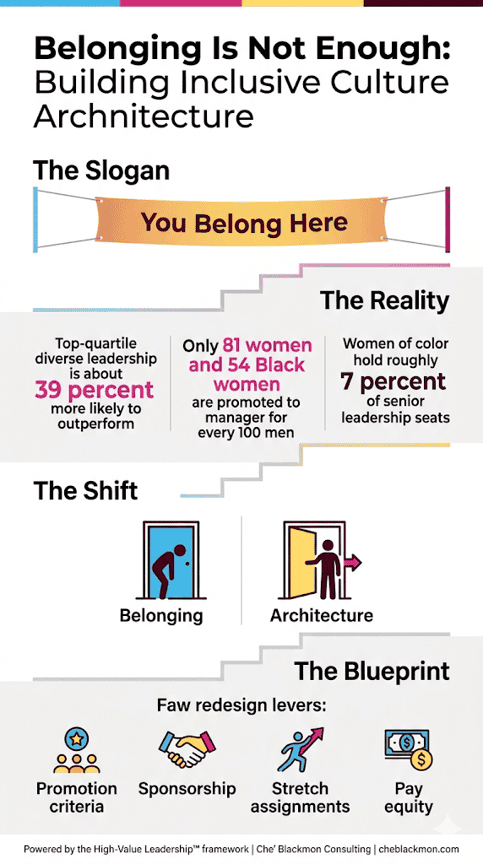
Walk into almost any company today and you will find the word everywhere. It lives on the careers page. It shows up in the values painted on the lobby wall. It gets repeated in onboarding decks and quarterly town halls. You belong here. The phrase is meant to feel warm, and for many people it does. Yet for some of the very people it claims to welcome, belonging has started to feel like a promise the building was never designed to keep.
🏗️ When the Welcome Mat Hides a Locked Door
Belonging became the headline of inclusion work for a good reason. It captures something representation alone cannot. You can hire a more diverse team and still leave people feeling like guests in someone else’s house. So leaders reached for belonging as the next frontier, and that instinct was right. The problem is where many stopped.
Here is the quiet flaw in the way belonging often gets used. It asks the individual to adjust to a culture that was built without them in mind. Fit in. Find your people. Bring your whole self, as long as your whole self matches the unwritten rules already in place. Belonging, framed this way, becomes one more thing the overlooked have to earn. The pressure to assimilate gets rebranded as inclusion.
This matters most for the people who have always been asked to do the adjusting. Across manufacturing, automotive, healthcare, non-profit, quick-service, and professional services settings, Black women in corporate spaces have learned to read a room, soften an idea, and carry the emotional cost of being the only one at the table. A culture can tell them they belong while every system around them quietly says prove it again.
📊 The Business Case Is Stronger Than the Slogans
The financial argument for inclusion is not soft, and it is not new. In its 2023 analysis of more than a thousand companies across two dozen countries, McKinsey & Company found that organizations in the top quartile for gender and for ethnic diversity in leadership were roughly 39 percent more likely to outperform their peers on profitability than companies in the bottom quartile (McKinsey & Company, 2023). That figure has climbed steadily across a decade of study. The relationship is an association rather than a guarantee, yet the pattern is consistent enough that ignoring it has become its own kind of risk.
The cost of getting it wrong shows up just as clearly. A 2023 peer reviewed study of workplace ostracism found that when people are subtly pushed to the margins, their basic need to belong is thwarted, and the fallout is measurable: lower job satisfaction, a stronger intention to quit, weaker loyalty, and even higher reported depression (Brison & Caesens, 2023). Exclusion, in other words, is not only unkind. It is expensive, and the invoice arrives through turnover, disengagement, and lost institutional knowledge.
🪜 The Broken Rung Black Women Keep Hitting
If belonging programs alone solved the problem, the promotion data would show it. It does not. The 2024 Women in the Workplace report, the tenth edition of the study by McKinsey & Company and LeanIn.Org, describes a broken rung at the very first step into management. For every 100 men promoted to manager, only 81 women advance. For Black women, that number falls to 54 (McKinsey & Company & LeanIn.Org, 2024). Women of color hold only about 7 percent of senior leadership seats, a number that has barely moved in years.
The daily experience tells the same story. Women who absorb three or more microaggressions are far more likely to burn out and to seriously consider leaving, with the data pointing to several times the risk of their peers (McKinsey & Company & LeanIn.Org, 2024). Black women in corporate spaces often carry an extra weight that rarely appears in an engagement survey: being mistaken for someone else of the same race, having their competence quietly questioned, or feeling judged for how they speak.
Put the pieces together and the limit of belonging language becomes obvious. You cannot affirm your way out of a structural problem. Telling a Black woman she belongs while the promotion machinery routes opportunity around her is asking her to feel at home in a house whose stairs keep collapsing under her feet. The warmth is real. The architecture is broken.
🧱 From Belonging to Architecture
Belonging is a feeling. Architecture is a structure. That single distinction reframes the entire conversation. Feelings can be nurtured with intention and care, and they should be. Structures, though, have to be designed, inspected, and rebuilt when they fail. Inclusive culture architecture asks a harder and more useful question than do people feel welcome. It asks how is opportunity actually distributed here, and who built the rules.
That means looking at the load bearing walls of an organization. How are promotion criteria written and applied. Who gets the high visibility projects that lead to advancement. Who has a sponsor with real influence, not just a mentor with kind words. How are pay, feedback, and meeting norms designed, and who gets interrupted while someone else gets credit. These are not vibes. They are decisions, and decisions can be redesigned.
This is where the High-Value Leadership™ framework earns its place. Its Stewardship of Culture pillar treats culture as something a leader designs and maintains on purpose, the way a steward tends a property rather than hoping the weather cooperates. Paired with the Authentic Connection pillar, it pushes leaders past the comfortable slogan toward the uncomfortable audit. Belonging asks people to fit the building. Architecture asks the building to fit the people.
🏢 Case Study: The Company That Redesigned the Room
Consider an organization in the professional services space that had spent two years investing heavily in belonging. There were affinity groups, listening sessions, and a values statement that named inclusion in bold letters. Engagement scores looked respectable. Leaders felt proud. Yet a closer look at the exit data told a different story, because women of color were leaving at nearly twice the rate of their colleagues, and the talent pipeline into management had quietly narrowed to almost no one who looked like the clients they served.
Rather than launch another awareness campaign, the leadership team stopped asking people to fit and started auditing the structure itself. They examined who received stretch assignments and found the choices ran on familiarity rather than merit. They rewrote vague promotion criteria into clear and observable standards. They built a sponsorship program that paired emerging Black women leaders with senior leaders who held real budget and real decision power, and they tracked the outcomes the same way they tracked revenue.
The results showed up in the numbers that matter. Within eighteen months, voluntary turnover among women of color fell by roughly a third, internal promotion rates for the group rose, and the management pipeline began to reflect the workforce and the market. The belonging programs had not been wrong. They had simply been asked to carry weight that only architecture could hold. The shift, anchored in deliberate Stewardship of Culture, turned good intentions into a measurable result.
✅ What You Can Do This Week
Audit one process, not your whole culture.Pull the last two years of promotions and ask a hard question. Did opportunity flow evenly, or did it follow familiarity? One honest data pull beats a dozen value statements.
Separate mentors from sponsors.A mentor gives advice. A sponsor spends political capital on your behalf. Identify which Black women on your team have real sponsors, and close the gap on purpose.
Make your promotion criteria observable.Replace words like leadership presence with specific, written, and measurable standards so the rules stop living in people’s heads.
Track stretch assignments like you track budget.Visibility work leads to advancement. Watch who gets it for the next quarter and notice the pattern.
Ask a quieter question in your next survey.Move past do you feel you belong and ask whether people believe the path to advancement is fair. The gap between those two answers is your real work.
💬 Discussion Questions
Where in your organization does belonging language outpace structural change?
If you mapped how your last five promotions actually happened, what would the map reveal?
Who are the Black women on your team, and do they have sponsors with real influence or only mentors with kind words?
What is one load bearing process you could redesign this quarter instead of asking people to adapt to it?
👣 Next Steps for Readers
Start with a single audit rather than a sweeping initiative. Choose promotions, sponsorship, or stretch assignments, and look at the real data for the past two years. Bring the findings to your leadership team and frame the conversation around architecture rather than blame. Then pick one structure to redesign, set a measurable goal, and revisit it in ninety days. Inclusive culture is not built in a town hall. It is built in the quiet decisions you are willing to change.
🤝 Work With Che’ Blackmon Consulting
If you are ready to move from belonging slogans to inclusive culture architecture that produces measurable results, Che’ Blackmon Consulting partners with leaders to design cultures worth staying for. Let us build the structure together.
Brison, N., & Caesens, G. (2023). The relationship between workplace ostracism and organizational dehumanization: The role of need to belong and its outcomes. Psychologica Belgica, 63(1). https://doi.org/10.5334/pb.1215
Every April 22nd, the world pauses to honor the planet. Companies post green gradients. Executives quote Indigenous wisdom on LinkedIn. Internal newsletters showcase volunteer clean-ups. And then, like clockwork, April 23rd arrives and most organizations return to the exact operating rhythms that exhaust their people, deplete their communities, and compromise the very planet they just pledged to protect.
Earth Day is not a marketing moment. It is a leadership mirror.
If sustainability is only something your organization performs on April 22nd, you do not have a sustainability strategy. You have a sustainability season. And the same principle applies to your culture. A workplace cannot be environmentally sustainable on the outside while being humanly extractive on the inside.
🌍 The data is clear. IBM research found that 67 percent of workers are more willing to apply for jobs with environmentally sustainable companies, and roughly one in three accepted a lower salary to work for a socially responsible employer. PwC’s global study across 95 countries found that 19 percent of workers value ESG policies as much as or more than their salary. Gallup’s State of the Global Workplace 2026 report confirms that disengagement is now costing the world economy $10 trillion annually in lost productivity. Sustainable cultures are not a soft priority. They are a business imperative.
🌲 Redefining Sustainability in the Workplace
When most leaders hear the word sustainability, they think solar panels, recycling bins, and carbon offsets. Those matter. But true organizational sustainability is far broader. It is the capacity of an organization to endure, perform, and renew itself without depleting the resources it depends on. Those resources include the planet. They also include the people.
In my book Mastering a High Value Company Culture, I wrote that culture is the lifeblood of any organization. A culture that drains its employees to the point of burnout is no more sustainable than a factory that drains a local watershed. Both practices may produce short term output. Neither practice can continue indefinitely. And in the end, both practices leave the environment they touched weaker than they found it.
Sustainable by design means something specific. It means that your culture, your policies, your leadership practices, and your operational rhythms are built from the ground up to renew the people and the planet they interact with. Not after the fact. Not as an add on. By design.
♻️ The Three Pillars of True Workplace Sustainability
ESG frameworks typically break sustainability into three categories. Environmental, social, and governance. For our purposes, we can translate those same three categories directly into the language of culture.
Environmental Sustainability. Are your operational practices reducing your organization’s ecological footprint? Are you conscious of energy use, waste, and the physical environments your employees work in every day?
Human Sustainability. Are your people being renewed or depleted by their work? Are workloads, schedules, and expectations designed to allow people to thrive across a career, not survive a quarter?
Ethical Sustainability. Are your decisions, governance practices, and leadership behaviors aligned with the values you claim publicly? Or is there a gap between the plaque in the lobby and the conversations that happen behind closed doors?
A truly sustainable organization performs well across all three. Weakness in any one area eventually compromises the other two.
🌿 The Five Pillars of High-Value Leadership™ as a Sustainability Blueprint
In High Value Leadership: Transforming Organizations Through Purposeful Culture, I introduced the five pillars that form the foundation of leadership built to last. Each pillar, when practiced consistently, creates the conditions for a sustainable culture. Consider how they map onto the sustainability conversation.
1️⃣ Purpose-Driven Vision
Organizations with clear environmental and social purpose outperform their peers. Research shows that when employees believe their work has special meaning, they are 56 percent more likely to experience innovation opportunities. A purpose driven vision is not a poster. It is a compass that guides every decision from supply chain sourcing to employee wellbeing.
2️⃣ Stewardship of Culture
Stewardship is the sustainability pillar dressed in a different name. A steward does not exploit. A steward tends, protects, and leaves the land better than she found it. The same is true of culture. Leaders who see themselves as stewards rather than owners make decisions that renew the culture rather than extract from it.
3️⃣ Emotional Intelligence
Burnout is the cultural equivalent of soil erosion. It happens slowly, then suddenly, and leaves the landscape unable to produce. Emotionally intelligent leaders read the signals early, adjust the workload, and restore the conditions for growth before depletion becomes the norm.
4️⃣ Balanced Responsibility
True sustainability requires honest accountability. Are the consequences of your decisions borne equitably across your workforce? Or are certain employees shouldering disproportionate weight? The frontline worker standing all day in a hot manufacturing plant bears a different cost than the executive in the climate controlled office.
5️⃣ Authentic Connection
Sustainable organizations are built on real relationships, not transactional ones. When people feel authentically connected to their leaders, their colleagues, and their work, they invest discretionary effort that no policy can mandate. That discretionary effort is the renewable energy source of any thriving culture.
📈 2026 Trends Every Leader Should Understand
The landscape has shifted dramatically in the last three years. Leaders still operating from a 2015 playbook are losing ground fast. A few realities to internalize.
Global engagement is at its lowest since 2020. Gallup reports that global employee engagement fell to 20 percent in 2025, its lowest point in five years. This is not a minor dip. It is a structural warning sign.
Retention is directly tied to ESG credibility. Companies with strong ESG practices experience 24 percent less turnover in low turnover industries and 59 percent less turnover in high turnover industries. Employees who believe their company makes a positive impact on the world are 11 times more likely to stay long term.
Generation Z and Millennials are voting with their feet. Deloitte data shows 40 percent of Millennial and Gen Z workers choose their employers based on sustainability credentials. This is the talent pipeline every organization is fighting for.
Purpose outperforms performative gestures. The World Economic Forum reports that nearly half of companies surveyed cite lack of employee engagement as their primary obstacle to achieving sustainability goals. Top down mandates without cultural buy in simply do not work.
HR is now an ESG function. Leading organizations now embed sustainability accountability directly into HR leadership roles, recognizing that human sustainability and environmental sustainability are inseparable.
🏭 Practical Examples: What Sustainable Culture Looks Like in Action
Example One: The Manufacturing Plant That Rebuilt Its Shift Model
There was a manufacturing organization facing a quiet crisis. Voluntary turnover on second and third shifts was climbing. Workers were describing their schedules as a health hazard. Leadership had invested heavily in environmental sustainability initiatives, including solar roof panels and waste reduction programs. Those efforts were real. The recognition in industry publications was real. But inside the building, the humans running the operation were being depleted by rotating schedules that ignored the science of circadian rhythm, family structure, and long term health.
The plant leadership made a decision that felt counterintuitive. They slowed down long enough to listen. Cross shift listening sessions revealed that the workforce was not asking for less work. They were asking for schedules that honored their humanity. Within a year of redesigning the shift model with employee input and adding flexibility bands for family needs, turnover dropped by double digits and production stability improved. The organization learned that you cannot market an environmentally sustainable operation while running a humanly extractive one.
Example Two: The Healthcare Organization That Paired Green with Grace
There was a healthcare organization that had invested significantly in reducing medical waste and transitioning to energy efficient equipment across its facilities. Leadership was proud of the environmental metrics. They were less proud of the burnout numbers among their clinical staff, particularly among nurses of color who consistently reported feeling unseen and overworked.
The leadership team realized that their ESG strategy had a blind spot. Environmental sustainability without human sustainability was incomplete. They added two new workforce commitments to their ESG framework. First, a clinical workload cap tied to patient acuity. Second, a formal mentorship program for nurses of color, designed to address the invisible labor they carried. Within eighteen months, both retention and patient outcomes improved measurably. The environmental story became more credible because it was now matched by a human story worth telling.
Example Three: The Professional Services Firm That Stopped Performing Sustainability
There was a professional services firm whose sustainability report was a marketing masterpiece. Glossy photos. Impressive metrics. A dedicated Chief Sustainability Officer. And yet, the firm’s internal engagement scores were in steady decline, and exit interviews repeatedly surfaced the same theme. Employees felt that the firm’s external ESG commitments were louder than its internal culture.
The turning point came when leadership invited a blunt cultural audit. The audit revealed that the firm was using sustainability as a recruiting hook without living it as a daily practice. The leadership team rebuilt the ESG strategy from the inside out, starting with policies on PTO utilization, meeting load, and inclusive advancement. The external metrics did not change overnight. But the internal culture did. And within two years, engagement, retention, and client satisfaction all moved in the same direction at the same time. Upward.
💜 The Sustainability Conversation That Centers the Traditionally Overlooked
Before we continue, there is a dimension of this conversation that deserves explicit attention. When organizations talk about sustainability, they often talk about protecting the planet for future generations. That is noble. But who, exactly, are we centering when we talk about future generations? The lived experience of environmental and organizational harm has never been equally distributed.
“The master’s tools will never dismantle the master’s house.” — Audre Lorde
In Rise and Thrive: A Black Woman’s Blueprint for Leadership Excellence, I wrote about the invisible labor that Black women carry in corporate environments. The code switching. The hypervigilance. The emotional cost of representing an entire demographic while simultaneously being expected to perform excellence. That labor is a form of extraction that rarely shows up on an ESG dashboard. But it is real. It depletes. And it undermines the very sustainability claims organizations make publicly.
McKinsey’s Women in the Workplace 2025 report, published in partnership with LeanIn.org, continues to document what many of us already knew. Only 60 Black women are promoted to their first management role for every 100 men promoted. Women of color, and Black women in particular, are among the most likely to report frequent burnout and exclusion. When a culture extracts disproportionately from any one group, it is not sustainable. It is simply postponing the reckoning.
Environmental justice and workplace justice share a common principle. Those closest to the harm must be closest to the solution. An ESG strategy that claims to honor people and the planet, while continuing to overlook the women of color who hold so many organizations together, is not a sustainability strategy. It is a selective one.
What Leaders Can Do Differently
Audit your ESG strategy through an equity lens. Ask who is included in the planning, who is counted in the metrics, and who bears the cost of the decisions being made.
Measure human sustainability the way you measure environmental sustainability. Track burnout, invisible labor, promotion equity, and retention by demographic with the same rigor you track carbon emissions.
Create real pathways for voice. Employee resource groups, listening sessions, and trusted third party cultural audits can surface the truths your standard surveys miss.
Invest in the leadership pipeline for traditionally overlooked employees. Retention is an ESG metric. So is advancement. Both require deliberate investment, not hopeful intention.
✅ Actionable Takeaways: A Sustainable by Design Playbook
If you are ready to move from Earth Day performance to sustainable by design practice, here is a starting framework.
🧭 Step One: Expand Your Definition of Sustainability
Write down what your organization currently tracks under the heading of sustainability. Then ask whether human sustainability metrics are included. If the answer is no, your definition is incomplete.
🧭 Step Two: Integrate ESG into HR, Not Around It
The most advanced organizations now treat HR leadership and sustainability leadership as interdependent functions. Your workforce is your primary environment. Treat it as one.
🧭 Step Three: Listen Before You Legislate
Cross departmental listening sessions, skip level meetings, and anonymous feedback channels will reveal whether your stated values match your lived culture. The gap between the two is where sustainability initiatives quietly fail.
🧭 Step Four: Build Renewal Into the Operating Rhythm
Review your meeting load, PTO utilization rates, on call expectations, and after hours communication norms. A culture that never allows renewal is not a culture. It is a conveyor belt with people on it.
🧭 Step Five: Measure Culture With the Same Rigor as Carbon
Engagement scores, eNPS, promotion equity, and retention by demographic belong on the same dashboard as energy use and waste reduction metrics. Culture is a business metric. Sustainability is a cultural metric. Treat both accordingly.
💬 Discussion Questions for Your Leadership Team
If you lead a team, an HR function, or an executive suite, bring these questions to your next leadership meeting.
If your organization had to measure human sustainability with the same rigor as environmental sustainability, what would the scorecard look like?
Where in your current operating model is renewal built in, and where is it missing entirely?
Are your ESG metrics evenly representative of all employee demographics, or are certain voices systematically missing from the data?
What invisible labor are your traditionally overlooked employees carrying, and how is that depletion showing up in retention or engagement trends?
If Earth Day came every week instead of once a year, what would your organization need to change about how it operates?
🚀 Next Steps for Readers
Conduct a dual audit. Review your environmental sustainability practices and your cultural sustainability practices side by side. Identify where they reinforce each other and where they contradict.
Interview five tenured employees. Ask what the organization does that helps them renew. Ask what depletes them. Their answers are your cultural sustainability audit.
Disaggregate your retention data. Review turnover by demographic, department, and tenure. Sustainability requires knowing who is staying, who is leaving, and why.
Align your next ESG report with the five pillars. Purpose-Driven Vision. Stewardship of Culture. Emotional Intelligence. Balanced Responsibility. Authentic Connection. Any of these five pillars that are missing from your ESG narrative signal a gap worth closing.
Commit publicly to one human sustainability metric this year. Choose one. Announce it. Measure it. Report on it next Earth Day.
🌟 A Final Word
Earth Day is not about trees alone. It is about legacy. It is about whether the world our workers inherit, including the workplaces they spend the majority of their waking hours inside, will be healthier, fairer, and more regenerative than the ones we received. Environmental stewardship and human stewardship are not two separate conversations. They are one conversation with two expressions.
“We do not inherit the earth from our ancestors. We borrow it from our children.” — Native American Proverb
The same is true of culture. The workplaces we build today are borrowed from the people who will lead them tomorrow. Sustainable by design is not a slogan. It is an obligation. And it starts with leaders who are willing to look at their culture through the same honest lens they would apply to their carbon footprint.
🤝 Ready to Work With Che’ Blackmon Consulting?
If your organization is ready to move beyond Earth Day gestures and build a culture that is sustainable by design, let’s talk. Che’ Blackmon Consulting partners with manufacturing, automotive, healthcare, nonprofit, quick service, and professional services organizations to build cultures where both the people and the planet can thrive.
Services include:
Fractional HR leadership and executive consulting
Culture transformation and Engagement Architecture
High-Value Leadership™ development and coaching
ESG and human sustainability integration strategy
Inclusive leadership and equity driven retention programs
Every Monday morning, somewhere in America, a plant manager stares at a call-out list and sighs. Another round of unplanned absences. Another scramble for coverage. Another day of overtime, stretched coworkers, and missed production targets. The easy response is to blame the people who did not show up. The harder, more honest response is to ask a different question:
What is our culture telling people when they decide whether or not to come to work today?
Absenteeism is rarely the real problem. It is almost always the symptom of something deeper. And for organizations willing to look beneath the surface, the absence data sitting in your HRIS is one of the most honest cultural audits you will ever receive.
📊 The numbers do not lie. The CDC estimates that absenteeism costs U.S. employers $225.8 billion annually in lost productivity, or roughly $1,685 per employee, per year. The national absence rate climbed to 3.2 percent in 2024 and has continued to trend upward in 2025 and 2026. Meanwhile, Gallup research shows that highly engaged teams experience 81 percent lower absenteeism than their disengaged counterparts.
🩺 The Misdiagnosis That Costs Organizations Millions
Most organizations treat absenteeism the way a patient might treat a fever. They reach for the quickest fix. Stricter attendance policies. Points systems. Progressive discipline. Last chance agreements. And while those tools have their place, none of them address the underlying infection.
In over twenty four years of HR leadership across manufacturing, automotive, healthcare, nonprofit, quick service, and professional services environments, one truth has held constant. When people repeatedly choose not to come to work, they are communicating something. The question is whether leadership is listening.
In my book Mastering a High Value Company Culture, I wrote that culture is the lifeblood of any organization. A fever does not exist without a reason. Neither does a chronic absenteeism pattern. When organizations skip the diagnostic step and jump straight to discipline, they end up with a workforce that either learns to manipulate the point system or simply walks out the door altogether. Neither outcome solves the real problem.
🔍 What Absenteeism Is Actually Telling You
Unplanned absence patterns function as an unfiltered data stream on your culture. Think of them as anonymous employee feedback, written in behavior instead of words. Here is what that feedback often says:
“I do not feel psychologically safe here.” Employees experiencing harassment, bullying, or retaliation will often avoid the workplace long before they file a formal complaint.
“My leader does not see me as a person.” Disengagement caused by poor people management is one of the largest drivers of discretionary absence.
“My work has no meaning beyond my paycheck.” When purpose is absent, presence becomes optional.
“I am burned out and cannot sustain this pace.” Chronic understaffing, unrealistic workloads, and unmanaged stress show up as sick days long before they show up on an exit survey.
“My life outside of work is not supported here.” Lack of flexibility for caregivers, single parents, and those managing chronic health conditions forces employees into a choice they should never have to make.
Sedgwick reported in 2024 that more than 3.6 million U.S. absences were attributed to family or personal obligations. That is not a workforce problem. That is a workplace design problem.
🧬 The Five Pillars of High-Value Leadership™ as a Diagnostic Tool
In High Value Leadership: Transforming Organizations Through Purposeful Culture, I introduced the five pillars that form the foundation of leadership that actually moves culture. Those same five pillars can be used in reverse as a diagnostic checklist when absenteeism starts climbing. When attendance trends downward, at least one of these pillars is cracked.
1️⃣ Purpose-Driven Vision
Do employees understand why their role matters? Can they articulate how their work connects to the mission? When the “why” is missing, showing up becomes transactional. A transactional workforce calls out for any reason, or no reason at all.
2️⃣ Stewardship of Culture
Are leaders actively tending to the culture, or merely talking about it? A high school graduate on the production floor can tell within a week whether culture is real or performative. If the plaque in the lobby says one thing and the shift supervisor demonstrates another, absenteeism becomes the workforce’s quiet protest vote.
3️⃣ Emotional Intelligence
Do frontline leaders know how to have a conversation with an employee who is struggling? Or do they default to writing them up? Sedgwick’s research is clear. Managers are the first to notice attendance patterns, but without emotional intelligence training, they respond to symptoms instead of addressing root causes.
4️⃣ Balanced Responsibility
Is accountability applied evenly? Or do certain employees get grace while others get points? Inconsistency in how attendance policies are enforced destroys trust faster than almost any other cultural violation. Employees see who gets a pass, and they respond accordingly.
5️⃣ Authentic Connection
Does anyone actually know your employees as human beings? When a supervisor has a real relationship with a team member, that team member thinks twice before calling out. Not out of fear, but out of respect. Authentic connection converts attendance from a compliance issue into a mutual commitment.
🏭 Practical Examples: What the Data Reveals When We Dig In
Example One: The Monday Morning Mystery
There was a manufacturing plant whose absenteeism rate had climbed to over 9 percent, with the majority of call outs occurring on Mondays and the day after payday. Leadership initially implemented a stricter points policy. Within six months, absenteeism had actually increased, and voluntary turnover on the production floor had climbed by nearly 18 percent.
A deeper cultural diagnostic, including stay interviews with tenured employees and listening sessions with frontline associates, revealed something the points system could never uncover. Mondays were not the problem. Sunday nights were. Weekend shifts had been extended without employee input. Family obligations were being squeezed. A culture of fear around requesting time off meant employees who needed a day simply took one, consequences be damned.
The fix was not a tougher policy. The fix was rebuilding the scheduling process with employee voice, adding a modest flexibility window for family needs, and retraining supervisors on how to have attendance conversations with empathy instead of threat. Within twelve months, absenteeism dropped below 4 percent. Turnover followed.
Example Two: The Healthcare Department That Was “Just Burned Out”
There was a healthcare organization where a particular department had the highest absenteeism rate in the entire facility. Leadership attributed it to the physical demands of healthcare work. That explanation felt true enough to stop the investigation. The actual root cause was buried one layer deeper. A department manager was creating a hostile environment for employees of color, particularly Black women, through a consistent pattern of microaggressions, credit taking, and selective discipline.
The employees were not burned out by the work. They were burned out by the psychological toll of showing up every day to a leader who did not see them. Once the leadership issue was addressed, engagement scores improved by double digits and absenteeism normalized within two quarters.
Example Three: The Quick-Service Turnover Trap
There was a quick service organization where absenteeism had become so normalized that the regional operations team built it into the labor model. They hired 20 percent over headcount, simply assuming people would not show up. What seemed like a clever workaround was actually a confession. Leadership had given up on the culture and decided to manage around it. The cost was staggering. Constant onboarding, eroded team cohesion, and a brand reputation that made attracting high quality talent nearly impossible.
💜 The Absenteeism Conversation No One Wants to Have
Before we continue, there is a subset of this conversation that deserves its own attention. The impact of culture on the traditionally overlooked, and most specifically on Black women in corporate spaces, requires us to look at absenteeism through a different lens.
“It is not our differences that divide us. It is our inability to recognize, accept, and celebrate those differences.” — Audre Lorde
In Rise and Thrive: A Black Woman’s Blueprint for Leadership Excellence, I wrote about the invisible labor that Black women carry in professional settings. The code switching. The vigilance against microaggressions. The emotional cost of being the “only one” in the room. The weight of being expected to perform excellence while being held to standards that are simultaneously higher and more ambiguous than those applied to their peers.
McKinsey’s Women in the Workplace 2025 report, published in partnership with LeanIn.org, confirmed what many Black women already knew. For every 100 men promoted into their first management role, only 60 Black women receive the same opportunity. Six in ten senior level women report frequent burnout. Women of color, and Black women in particular, are among the most likely to report feeling scrutinized, excluded, and under pressure to represent an entire demographic.
When you layer these realities on top of traditional workplace stressors, something important becomes clear. A Black woman calling out of work is rarely just calling out of work. She may be managing the cumulative weight of being talked over in meetings, being mistaken for support staff, having her ideas attributed to someone else, or absorbing the daily microaggressions that her colleagues may not even recognize.
Traditional absenteeism analysis often penalizes the very employees who are already carrying the heaviest cultural load. Points systems do not measure invisible labor. Progressive discipline does not account for racial or gender based exhaustion. And when Black women eventually disengage, the organization labels them as “not a culture fit” rather than acknowledging that the culture was never built to fit them in the first place.
What Leaders Can Do Differently
Disaggregate your absence data. If you only look at aggregate numbers, you will miss the patterns that matter. Break the data down by demographic, by department, and by leader.
Audit your discipline application. Look honestly at who is receiving attendance points and who is receiving grace. Inconsistency is often the loudest signal of bias in the system.
Create real pathways for voice. Skip level meetings, listening sessions, and trusted third party culture audits can surface what your exit interviews are too late to catch.
Invest in leader development, not just employee compliance. Every dollar invested in emotional intelligence, inclusive leadership, and cultural competency pays back in reduced absenteeism and turnover.
📈 Current Trends Every Leader Should Understand in 2026
The absenteeism landscape has shifted significantly. Leaders who are still running the 2015 playbook are losing ground. A few realities worth internalizing:
Mental health is now a dominant driver. Gallup estimates mental health related unplanned absences cost the U.S. economy $47.6 billion annually in lost productivity. Workers with poor mental health miss an average of 12 days per year, compared to 2.5 days for their peers.
Flexibility is no longer a perk. McKinsey’s 2025 data showed that 67 percent of women said flexibility would make the biggest difference in their careers. Pulling back flexible work options disproportionately harms women, and especially women of color.
Chronic disease management is a workplace productivity strategy. The CDC has documented that employees managing multiple chronic conditions miss significantly more days. Employers who invest in preventive care and meaningful accommodations see direct returns.
Disengagement and absenteeism are now inseparable. Gallup found that highly engaged teams experience 81 percent lower absenteeism. You cannot discipline your way out of a disengagement problem. You have to lead your way out of it.
Frontline managers are your early warning system. They see the patterns before HR does. Equipping them with coaching conversations, not just disciplinary scripts, changes the trajectory of your attendance data.
✅ Actionable Takeaways: A Culture-First Attendance Playbook
If you have read this far, you likely already sense that your absenteeism data is telling you something your policies are not equipped to hear. Here is a starting framework.
🧭 Step One: Run a Root-Cause Diagnostic
Before you touch the policy, look at the data. Where are the absences concentrated? Which shifts, which leaders, which departments, which demographics? What patterns emerge over time? Do not assume. Diagnose.
🧭 Step Two: Listen Before You Legislate
Skip level meetings, stay interviews, and anonymous listening sessions will surface truths that surveys alone will not. Employees will tell you what is broken if they trust that telling you is safe.
🧭 Step Three: Train Leaders to Have Human Conversations
Every frontline supervisor should know how to ask, “What is going on with you this month?” before they reach for the write up form. That single conversation often prevents the next call out.
🧭 Step Four: Redesign Work, Not Just Discipline
If your scheduling model, workload distribution, or flexibility options are not fit for the workforce you actually employ, fix the design. Compliance systems cannot compensate for structural failures.
🧭 Step Five: Measure Culture as Rigorously as Production
Engagement scores, eNPS, exit interview themes, and absence patterns should live on the same dashboard as quality metrics and output numbers. Culture is a business metric. Treat it like one.
💬 Discussion Questions for Your Leadership Team
If you lead a team, an HR function, or an executive suite, bring these questions to your next leadership meeting.
When you review your absenteeism data, do you investigate root causes, or do you reach immediately for a policy lever?
Can every leader in your organization name the top three drivers of unplanned absence in their department? If not, why not?
Are your attendance policies being applied consistently across demographics, shifts, and leaders? How do you know?
What invisible labor are your traditionally overlooked employees carrying, and how does that show up in your absence data?
If absenteeism is a cultural symptom, what is your culture currently trying to tell you?
🚀 Next Steps for Readers
Pull your last twelve months of absence data. Disaggregate it by leader, department, shift, and demographic where permissible. Look for the patterns your old analysis missed.
Ask five tenured employees what keeps them coming to work. Their answers are your culture audit.
Ask five former employees why they stopped showing up. Their answers are your turnover prevention plan.
Review your frontline leadership development curriculum. If it does not include emotional intelligence, inclusive leadership, and attendance coaching, it is incomplete.
Revisit your five pillars of High Value Leadership. Rate your organization honestly on Purpose Driven Vision, Stewardship of Culture, Emotional Intelligence, Balanced Responsibility, and Authentic Connection. Wherever you score lowest, that is likely where your absenteeism is highest.
🌟 A Final Word
Absenteeism is not a workforce deficiency to be managed. It is a cultural message to be understood. When organizations develop the discipline to read that message honestly, something powerful happens. Attendance improves, yes. But so does engagement, retention, innovation, and performance. A high value culture does not eliminate absence. It earns presence.
“The role of a leader is not to come up with all the great ideas. The role of a leader is to create an environment in which great ideas can happen.” — Simon Sinek
And, I would add, where great people consistently choose to show up.
🤝 Ready to Work With Che’ Blackmon Consulting?
If your organization is ready to move beyond surface level fixes and build a culture where people choose presence, let’s talk. Che’ Blackmon Consulting partners with manufacturing, automotive, healthcare, nonprofit, quick service, and professional services organizations to diagnose cultural root causes, develop high value leaders, and transform workplaces from the inside out.
Services include:
Fractional HR leadership and executive consulting
Culture transformation and engagement architecture
High-Value Leadership™ development and coaching
Workforce planning, analytics, and root-cause diagnostics
Inclusive leadership and emotional intelligence training
Every organization has at least one meeting where the most important thing goes unsaid. The engineer who knows the timeline is unrealistic but watches the leadership team celebrate it anyway. The nurse who notices a safety gap and decides not to raise it because the last person who did was labeled difficult. The manager who sees a colleague being treated unfairly and stays quiet because she needs the job. The Black woman who has a better idea in the room but swallows it, knowing that if she offers it too directly she will be called aggressive, and if she softens it too much she will be ignored entirely.
That silence is not shyness. It is not a personality issue. It is not a failure of courage. It is the predictable, rational response of people who have learned that speaking up carries a cost they cannot always afford to pay. And until leaders understand this, no amount of engagement surveys, town halls, or open-door policies will create a culture where truth can actually be spoken.
Psychological safety is not about comfort. It is about the conditions under which honesty becomes possible. When those conditions exist, organizations learn faster, innovate more effectively, recover from mistakes with less damage, and retain the very people they spent years trying to hire. When those conditions do not exist, the smartest people in the room keep their best thinking to themselves, and the organization pays for that silence every single day.
Harvard Business School professor Amy Edmondson, whose research has defined the field for more than two decades, describes psychological safety as a shared belief that a team is safe for interpersonal risk-taking. It is not the absence of discomfort. It is the presence of permission. Permission to ask the hard question. Permission to admit the error. Permission to disagree with the senior leader without professional consequence. Permission to bring your whole self to a meeting where your whole self has historically been unwelcome.
This article is a blueprint. It is for leaders who understand that culture is built through conditions, not slogans, and who are ready to examine what their current environment actually rewards and punishes. It is also for the traditionally overlooked, the people who have been asked to perform authenticity in systems that were never designed to receive it, with a specific focus on Black women in corporate spaces whose experience of psychological safety is often measured in small betrayals.
🧱 What Psychological Safety Actually Is and Is Not
Before we build anything, we have to agree on what we are building. Psychological safety is one of the most widely used and most misunderstood concepts in modern leadership. A leader who claims to have built it without examining their own behavior is almost always describing a culture where people have simply stopped telling them the truth.
✅ What Psychological Safety Is
Psychological safety is the shared belief on a team that it is okay to take interpersonal risks. It is the felt sense that you can raise a concern, admit a mistake, offer a half-formed idea, or disagree with a decision without being humiliated, punished, or quietly sidelined. It is the condition that allows candor, curiosity, and learning to coexist with high performance.
Research from Google’s Project Aristotle, which studied what makes teams effective, identified psychological safety as the single most important factor distinguishing high-performing teams from the rest. Not intelligence. Not talent. Not even experience. The ability to work in a space where honesty was welcome.
🚫 What Psychological Safety Is Not
Psychological safety is not a lower performance standard. It is not the absence of accountability. It is not permission to behave badly without consequence. It is not emotional coddling. It is not an invitation to litigate every decision or to require consensus on every direction. Leaders who equate psychological safety with softness have fundamentally misunderstood the research.
In fact, the opposite is true. Psychologically safe environments tend to have higher standards, not lower ones, because the honesty flowing through the organization allows errors to surface early, disagreements to sharpen thinking, and weak ideas to be replaced by stronger ones. A culture where everyone nods and no one challenges is not safe. It is compliant. And compliance is often what organizations mistake for culture until their best people leave to find somewhere they can actually think out loud.
A high-value culture does not happen by accident. It takes intentional design, consistent reinforcement, and continuous evolution.
That principle, anchored in Mastering a High-Value Company Culture, applies nowhere more clearly than to psychological safety. You cannot wish it into existence. You have to design it, reinforce it, and protect it even when doing so is inconvenient.
📊 Why This Matters Now More Than Ever
The conditions of modern work have made psychological safety a strategic necessity rather than a cultural luxury. Four forces are driving this shift.
Complexity has increased: The work is more interdependent, the decisions are more ambiguous, and the margin for silent error is smaller than it used to be. In environments like manufacturing, healthcare, and professional services, a single unspoken concern can cascade into quality issues, safety incidents, or client losses that ripple for months.
Talent has more options: Workers increasingly choose organizations based on whether they can thrive, not just whether they can survive. When someone cannot be honest at work, they start looking for a place where they can.
Hybrid work has thinned trust: Research consistently shows that distributed teams have to build psychological safety more deliberately because the casual moments of connection that once built trust organically now require design.
Equity expectations have matured: Employees, especially those from historically marginalized groups, are no longer willing to spend their careers performing versions of themselves that their workplaces find acceptable. They want to be valued for who they are, not rewarded for who they are pretending to be.
Recent research from Edmondson and her colleagues at Harvard found that psychological safety is an enduring resource amid constraints, meaning it helps employees avoid burnout and increases their intention to stay even when material resources are scarce. In other words, when the budget gets tight, when the team gets leaner, when the workload grows heavier, psychological safety becomes more important, not less. It is the cultural infrastructure that keeps people from quietly quitting or loudly leaving.
💜 The Unique Weight Carried by the Traditionally Overlooked
A general conversation about psychological safety is incomplete without a specific conversation about who bears the greatest cost when it is missing. Safety is never evenly distributed. A team is only as psychologically safe as the least safe person on it, and the least safe person is almost always someone whose identity, history, or role has taught them that speaking freely carries a price.
🏭 The Frontline and the Invisible Majority
Across industries, some of the least psychologically safe employees are the people closest to the work. Frontline operators in manufacturing plants who see quality issues but have learned that flagging them leads to blame. Case managers in non-profit and healthcare settings who know the case load is unsustainable but cannot say so without being told to manage their mindset. Quick-service workers who understand customer behavior better than the executives setting strategy but have no channel to share that understanding. Administrative professionals in professional services who know exactly which partners cause client friction but would never say so out loud. These workers carry institutional knowledge that could transform their organizations. Instead, they carry it home every night.
✊🏾 Black Women and the Interpersonal Risk Tax
For Black women in corporate spaces, the concept of psychological safety intersects with a lifetime of learned vigilance. To understand why, you have to understand the layered calculation that often precedes every professional word.
Research published in Harvard Business Review has long documented that code-switching, the practice of adjusting speech, appearance, and behavior to fit dominant cultural norms, is a routine professional strategy for Black employees that comes at significant psychological cost. A survey commissioned by Indeed found that 34 percent of Black employees have code-switched at work, compared to 12 percent of non-Hispanic white employees, and 44 percent of Black employees viewed code-switching as necessary to succeed professionally.
Layer on top of that the Women in the Workplace research from Lean In and McKinsey, which has consistently documented that Black women face more microaggressions, receive less manager support, and are less likely to report having strong allies at work than nearly any other group. The result is a daily tax on speaking. Every question becomes a calculation. Is this the moment? Will this cost me? Am I being too direct? Am I being too passive? Will my tone be read as aggressive because of who is saying it? Will my silence be read as disengagement because I am not performing enthusiasm?
This is why psychological safety cannot be declared. It has to be engineered. When a leader says the team is a safe space to speak up, that statement does not neutralize years of pattern recognition. The Black woman at the table is not assessing the leader’s words. She is assessing whose ideas get credited, whose pushback gets respected, whose mistakes get forgiven, and whose get remembered. The blueprint has to change what she observes, not what she is told.
When Black women speak up, they are often doing so across a gap that their white peers simply do not have to cross. Safety is the bridge that closes the gap.
🏛️ The High-Value Psychological Safety Blueprint
Building psychological safety is not a program. It is an operating system. The blueprint below draws from the five pillars of the High-Value Leadership framework, developed through more than two decades of human resources leadership across manufacturing, automotive, non-profit, healthcare, quick-service, and professional services environments.
🧭 Pillar 1: Purpose-Driven Vision
People speak up when they understand why their voice matters. Anchor every difficult conversation to the mission. Remind the team that the goal is not to avoid friction but to produce work that reflects who the organization says it wants to be. When purpose is clear, candor stops feeling like risk and starts feeling like responsibility.
🏺 Pillar 2: Stewardship of Culture
Culture is stewarded in moments. Every time a leader interrupts a junior employee, that moment trains the room. Every time a senior leader thanks someone for raising a concern, that moment trains the room. Every time someone is labeled difficult for naming a problem, that moment trains the room. Stewardship means understanding that you are always on stage, and that the most important messages you send are the ones you did not plan to send.
💗 Pillar 3: Emotional Intelligence
Emotionally intelligent leaders recognize that safety is experienced differently by different people. What feels like candid feedback to one employee can feel like a professional threat to another, depending on their identity, their role, and their history. This does not mean avoiding hard conversations. It means calibrating them. It means understanding that feedback delivered publicly lands differently than feedback delivered privately. It means asking people how they best receive difficult information and honoring the answer.
⚖️ Pillar 4: Balanced Responsibility
Psychological safety cannot be the sole responsibility of the senior leader. The research is clear that it is built at the team level, through thousands of small interactions among peers. This means every member of the team has to own their part. Leaders set the tone. Managers reinforce the norms. Peers choose how they respond when someone takes a risk. When that responsibility is balanced across the system, the culture survives transitions. When it rests on one brave manager, it collapses the day that manager moves on.
🤝 Pillar 5: Authentic Connection
Connection is the soil in which safety grows. People take interpersonal risks with people who have demonstrated that they see them as whole human beings, not as role occupants. This does not require oversharing or forced vulnerability. It requires consistent, genuine attention. Remembering what matters to someone. Asking meaningful questions. Being willing to name your own fallibility first, so that others can do the same.
📖 What the Blueprint Looks Like in Practice
Here are three composite scenarios that illustrate what psychological safety looks like when it is designed, and what happens when it is assumed rather than built. These reflect patterns I have observed across industries, not any single organization.
🏭 Scenario One: The Manufacturing Plant That Rebuilt Reporting
There was a manufacturing facility where safety incidents were trending upward despite an intensive safety program. The leadership team could not understand it. Training was current, policies were posted, audits were clean. When a new HR leader arrived and began exit interviews, a different picture emerged. Operators had been seeing near-miss incidents for months and deliberately not reporting them, because the last three people who had submitted reports were placed on performance improvement plans shortly after.
The fix was not another training. It was a redesign of the system itself. Reports began being reviewed by a separate quality team rather than the shift supervisor. Every reported near-miss triggered a recognition conversation, not a discipline conversation. The plant manager began each operations meeting by personally thanking the operators who had surfaced issues that week. Twelve months later, reported incidents went up, which was exactly the point. Actual injuries went down significantly. The silence had been hiding the danger.
🏥 Scenario Two: The Healthcare Team That Lost Its Best Black Clinician
There was a healthcare organization where a high-performing Black woman, a clinician with nearly a decade at the organization, resigned unexpectedly. Leadership was surprised. Her exit interview revealed something they were not prepared to hear. She had raised the same concern in leadership meetings for three years. Every time, her concern was dismissed. Every time, a white male colleague would raise a similar concern months later and it would be celebrated as insight. She did not leave because of one incident. She left because of a pattern.
The response could have been defensive. Instead, the organization conducted a listening audit with other Black women in clinical roles and discovered the pattern was systemic. They redesigned their meeting protocols to require attribution, meaning any idea raised had to be credited to the person who originally surfaced it, even if someone else amplified it later. They introduced structured turn-taking in clinical huddles so that seniority and volume did not dominate the conversation. They were honest with their staff that the changes had been prompted by the departure of a colleague whose voice they had failed to protect. The honesty itself was a cultural turning point.
🏢 Scenario Three: The Professional Services Firm That Invited Dissent
There was a professional services firm where every major strategic decision seemed to move forward unanimously, and yet the execution kept stalling. Partners wondered why alignment in the room did not translate into alignment in the work. An organizational audit revealed that associates and mid-level professionals systematically disagreed with the strategy but had learned not to say so in partner meetings because the partners who had raised objections in prior years had been quietly passed over for promotion.
The firm introduced a practice borrowed from Edmondson’s research called the dissent check. Before any major strategic decision was finalized, the senior leader in the room would explicitly ask, “What are we missing, and what would you say if you knew there would be no consequence for saying it?” The first few meetings were quiet. By the fourth meeting, associates began surfacing genuine concerns. By the end of the year, the firm had revised three major initiatives based on input that would otherwise have stayed silent, and their execution velocity meaningfully improved.
🛠️ Actionable Takeaways: Building the Blueprint
If you are ready to move psychological safety from aspiration to architecture, here is where to begin. These steps are not optional extras. They are the connective tissue of a culture that can actually hold truth.
Audit Your Own Response Patterns. Before you measure the team, measure yourself. When was the last time someone disagreed with you in a meeting? How did you respond? If you cannot remember the last time, that is the signal, not the absence of dissent.
Model Fallibility First. You cannot ask your team to admit mistakes if they have never heard you admit one. Say the words. Name a recent decision you would revisit, a call you got wrong, or a piece of feedback you initially resisted and later accepted.
Redesign Your Meeting Mechanics. Psychological safety is often built or destroyed in the first ten seconds of a meeting. Consider structured turn-taking, round robins, and explicit invitations for the quieter voices. Who speaks first sets who speaks at all.
Attribute Ideas Publicly. Make it a norm that any idea amplified in a meeting is attributed to the person who originally raised it. This one practice disproportionately benefits the employees whose contributions are most often absorbed by others.
Introduce the Dissent Check. Before finalizing significant decisions, explicitly ask what the team would say if consequences were off the table. Accept silence the first few times. Keep asking. The trust is earned over iterations.
Separate Reporting From Judging. When employees surface problems, the first response should be gratitude, not investigation. Build systems where concerns flow to learning teams rather than disciplinary channels.
Examine Equity Gaps in Voice. Ask yourself whose ideas get traction in your organization and whose get overlooked. If the answers cluster around a single demographic profile, the safety of your environment is not evenly distributed, and the blueprint needs attention.
Measure What Matters. Include psychological safety items in your engagement survey and track them by demographic. Safety at the aggregate level can mask significant gaps by race, gender, role, tenure, and working model.
📈 Current Trends Shaping Psychological Safety
A few important shifts are reshaping how organizations think about this work.
Psychological safety is becoming a measurable discipline: Tools like Edmondson’s Fearless Organization Scan and the Enterprise Psychological Safety Index are giving organizations benchmarks where only intuition used to live.
Hybrid work requires intentional design: The informal hallway conversations that once built trust organically have to be replaced with deliberate practices, from structured check-ins to clear norms about camera use and asynchronous communication.
Safety is being linked to diversity outcomes: Research increasingly shows that diversity only delivers performance when it is paired with psychological safety. Without it, the diverse perspectives you hired for remain unspoken.
AI adoption is raising new safety questions: As AI reshapes workflows, employees need to feel safe admitting what they do not yet know, experimenting openly, and voicing concerns about how the technology is being deployed.
Regulators and investors are paying attention: Psychological safety is increasingly appearing in ESG conversations, workforce risk disclosures, and compliance frameworks, reflecting its connection to preventable harm and workforce sustainability.
💭 Discussion Questions for Your Team
Use these questions in your next leadership meeting, offsite, or team check-in. Do not rush the answers. The quality of the conversation is itself the diagnostic.
When was the last time someone on this team took an interpersonal risk, and how did we respond?
If a new employee joined us tomorrow and observed one week of meetings, what would they learn is safe to say here and what would they learn to keep to themselves?
Whose voice is consistently centered in our decision-making, and whose voice do we routinely absorb without attribution?
If we examined our engagement data by race, gender, and level, would psychological safety look the same across those cuts, or would it reveal gaps we have not yet addressed?
How do we respond when someone surfaces a mistake, a concern, or a dissenting view? Are we modeling gratitude, or are we modeling defense?
What would it look like if the least safe person on our team felt as empowered to speak as the most senior person?
🚀 Next Steps for Readers
If this article has surfaced patterns you recognize in your organization, let it become motion, not just reflection. Choose one practice from the blueprint this week. Name a mistake in your next meeting. Attribute an idea publicly. Ask a dissent check question. Build the habit before you build the program.
And if you are ready to partner with someone who can help you engineer this shift at scale, that is precisely the work Che’ Blackmon Consulting exists to do. Whether you are leading a private-equity-backed portfolio company, a Michigan manufacturer navigating workforce transformation, or a mission-driven organization seeking to align its stated values with its actual practice, we bring the High-Value Leadership framework to the table with honesty, rigor, and measurable results.
✨ A Final Word
The most expensive thing your organization owns is the truth that goes unspoken. The best idea nobody dared to share. The risk nobody named until it became a crisis. The talented person who quietly decided this was not the place. The Black woman who stopped raising her hand and started polishing her resume. Every one of those silences is a line item on a balance sheet you do not yet see.
Psychological safety is how you recover that cost. It is how you transform silence into signal, and signal into progress. It is the cultural infrastructure that lets your people become who you hired them to be.
Your organization deserves the truth. Your people deserve the permission to speak it. Build the blueprint that makes both possible.
Unlock. Empower. Transform.
🤝 Ready to Work With Che’ Blackmon Consulting?
Let’s engineer a culture where truth can be spoken, heard, and acted on.
Che’ Blackmon is a DBA Candidate in Organizational Leadership at National University and the Founder and CEO of Che’ Blackmon Consulting, a fractional HR and culture transformation practice. With more than twenty-four years of progressive human resources leadership experience across manufacturing, automotive, non-profit, healthcare, quick-service, and professional services industries, she is the author of three books: High-Value Leadership: Transforming Organizations Through Purposeful Culture, Mastering a High-Value Company Culture, and the e-book Rise & Thrive: A Black Woman’s Blueprint for Leadership Excellence. Her proprietary High-Value Leadership framework helps organizations build purposeful, people-first cultures that drive measurable business results.
Walk into almost any organization today and you will hear the same thing. Leaders will tell you they value their people. They will point to an employee of the month wall, a Slack channel full of celebratory emojis, and maybe an annual banquet where someone gets a plaque. These gestures are not wrong. They are simply not enough.
There is a quiet crisis unfolding in workplaces across every industry. Recognition has become a performance rather than a practice. It has become something leaders remember to do in moments rather than something woven into how the business actually operates. And while the shoutouts feel good in the moment, they rarely change the trajectory of a person’s career, a team’s cohesion, or an organization’s bottom line.
The data tells the story plainly. According to Gallup’s 2026 State of the Global Workplace report, global employee engagement fell to just 20 percent in 2025, costing the world economy an estimated $10 trillion in lost productivity. Meanwhile, research shows that only 22 percent of employees feel they receive the right amount of recognition for their work, a number that has remained stubbornly flat since 2022. When employees do feel meaningfully recognized, they are up to four times more likely to be engaged and 45 percent less likely to leave within two years.
So here is the uncomfortable truth. If your organization is still treating recognition like confetti, sprinkled on top of business as usual, you are leaving engagement, retention, and performance on the table. Worse, you are very likely overlooking the very people whose contributions carry your culture quietly every single day.
This article is about fixing that. It is about moving from recognition as a social ritual to recognition as a system. It is about building appreciation into the bones of your organization so that the right people are seen, the right behaviors are rewarded, and no one has to perform extraordinary labor just to be noticed for ordinary excellence.
🔍 Why Shoutouts Alone Keep Failing Your People
Shoutouts are not the enemy. The problem is that most organizations have stopped there. A shoutout is a moment. A system is a structure. And moments cannot do the work that structures are designed to do.
🎭 Recognition Becomes Personality-Driven
When recognition depends on a manager remembering to say thank you, it becomes a lottery. Some employees have gregarious, verbally expressive managers who celebrate loudly and often. Others report to more reserved leaders who assume a paycheck is thanks enough. The quality of appreciation an employee receives should not be determined by the personality of the person they happen to report to. Yet in most organizations, that is exactly what happens.
⚖️ The Visibility Gap Widens
Shoutouts tend to reward visibility, not value. The employee who speaks up in meetings, who works in functions close to the executive team, or who shares a demographic profile with leadership is far more likely to be named, nominated, and celebrated. Meanwhile, the team members doing the heavy lifting of culture, mentorship, cross-functional coordination, and quiet problem-solving often go unnamed. Their work holds everything together, and yet the spotlight rarely finds them.
🕰️ Appreciation Without Infrastructure Does Not Scale
When your recognition strategy lives inside someone’s head rather than inside your systems, it does not survive turnover. A new leader comes in, a beloved manager moves to another business unit, and the culture of appreciation evaporates overnight. Sustainable recognition is not about who is in the room today. It is about what has been built into the process so that tomorrow’s leaders inherit the right habits.
A high-value culture is one that routinely creates value for employees, customers, shareholders, and the community at large. It does not happen by accident. It takes intentional design, consistent reinforcement, and continuous evolution.
That principle, drawn from Mastering a High-Value Company Culture, sits at the heart of what systemic appreciation requires. Intention. Design. Reinforcement. Not applause.
💜 The People Your Current System Is Missing
Every recognition system has a shadow. It rewards some behaviors, some roles, and some people while rendering others invisible. Before you redesign your approach, you have to be honest about who is falling through the cracks.
🧵 The Workforce That Holds the Culture Together
Across industries, there are categories of contributors who do enormous work and receive disproportionately little recognition. Frontline operators in manufacturing plants who keep the line running safely. Administrative professionals who quietly route the information that lets executives make decisions. Second-shift and third-shift workers in quick-service environments whose labor is invisible simply because leadership is not present to witness it. Case managers in non-profit and healthcare settings whose emotional labor carries entire communities. Client-facing professionals in professional services who absorb difficult conversations so the partnership looks seamless. These workers are often described with language like dependable, reliable, and consistent. Translation: their contributions are taken for granted.
✊🏾 Black Women and the Double Tax on Excellence
The recognition gap is especially stark for Black women in corporate spaces. Research from Lean In and McKinsey’s Women in the Workplace study has documented year after year that Black women experience more microaggressions, receive less manager support, and are promoted at significantly lower rates than their peers. In fact, Women in the Workplace data has shown that 40 percent of Black women have had their judgment questioned in their area of expertise, a rate far higher than their white male counterparts. More recent Women in the Workplace findings continue to show that Black women face the steepest drop-offs in advancement as seniority increases and are among the least likely to report having strong allies at work.
Translated into everyday experience, this means Black women often do excellent work and then have to advocate for that work to be seen, re-explain that work to be validated, and perform emotional composure while doing both. It is what many call the double tax. Produce at an elite level, then produce the case that you produced at an elite level. Shoutout culture cannot fix that. Shoutout culture, in fact, often worsens it, because it rewards those who already have audiences while the quieter producers get to watch.
A truly systemic approach to appreciation has to look at who is consistently being seen and who is consistently being skipped. It has to ask the uncomfortable questions. Who gets nominated for stretch assignments? Who gets invited into informal mentorship conversations? Who gets named when executives are asked which rising leaders they are watching? When the answers cluster around one profile, the system is not neutral. The system is working as designed, and the design needs to change.
🏛️ The High-Value Recognition Framework
Recognition that actually works is recognition that is structural. It does not rely on any single manager’s memory or personality. It is embedded across five dimensions, drawn from the High-Value Leadership framework that I developed through more than two decades in manufacturing, automotive, non-profit, healthcare, quick-service, and professional services environments.
🧭 1. Purpose-Driven Vision
Recognition should reinforce the mission, not just reward personality. When leaders celebrate behaviors that advance the organization’s purpose, employees internalize what matters. When recognition drifts into celebrating only the loudest voices or the most charismatic personalities, the message gets muddled. Ask yourself: does what we celebrate actually tell our people what this organization is here to do?
🏺 2. Stewardship of Culture
Culture is not inherited. It is stewarded. Recognition is one of the most powerful levers any leader has for shaping culture because what gets rewarded gets repeated. If you want collaborative teams, recognize collaboration, not just individual heroics. If you want psychological safety, recognize the people who ask hard questions, not just the people who answer them.
💗 3. Emotional Intelligence
Not every employee wants to be praised the same way. Some people light up when named in front of a group. Others quietly dread it. Some value a handwritten note. Others want a real growth opportunity. Emotionally intelligent recognition asks people how they want to be seen, and then honors that answer.
⚖️ 4. Balanced Responsibility
Recognition cannot be the sole job of the senior leader. It also cannot be outsourced entirely to HR. The most effective systems spread the responsibility. Managers are trained and held accountable. Peers are equipped with the language and tools to appreciate one another. Executives model it publicly. HR infrastructures the whole thing with data, audits, and feedback loops. When the responsibility is balanced, the culture becomes resilient.
🤝 5. Authentic Connection
Generic recognition feels worse than no recognition at all. A boilerplate thank-you note with someone’s name swapped in communicates that the leader did not actually pay attention. Authentic recognition is specific. It names the behavior, connects it to impact, and often connects it to the person’s growth journey. That is what makes someone feel truly seen.
📖 What This Looks Like in Practice
Let me share three composite scenarios that illustrate what systemic appreciation looks like when it is built rather than improvised. These reflect patterns I have observed across industries, not any one specific organization.
🏭 Scenario One: The Manufacturing Plant That Rebuilt Trust
There was a manufacturing plant where leadership was frustrated by high turnover on the production floor. Their engagement survey results showed that operators did not feel valued. The leadership team’s instinct was to launch an employee of the month program. Instead, they paused and audited their existing recognition patterns. The data was sobering. Over 90 percent of recognition was flowing to salaried professionals. Hourly operators, who represented the majority of the workforce and produced the actual product, were almost never named.
The fix was not a new poster. The fix was systemic. They built recognition criteria into supervisor accountability. They trained frontline supervisors in the specific language of appreciation. They created peer nomination channels that did not require a laptop. They restructured their monthly operations meetings so that every function had to publicly name an operator whose work had made their numbers possible. Twelve months later, turnover dropped significantly, and exit interviews showed a marked shift in how operators described their experience of being valued.
🏥 Scenario Two: The Healthcare Organization That Looked Under the Hood
There was a healthcare organization that had received an employee engagement alert about a decline in perceived fairness. When they broke the data down by demographic, they found that Black women in clinical and administrative roles reported the steepest decline in feeling recognized. The temptation was to launch a diversity celebration. Instead, leadership examined their talent review process and discovered that recognition nominations were clustering in specific departments led by a narrow slice of managers. Employees led by those managers were benefiting from visibility. Everyone else was invisible regardless of performance.
They redesigned their calibration process so that recognition data was reviewed alongside performance data, and gaps had to be explained. They also introduced sponsor conversations so that high-performing Black women were intentionally connected to senior leaders who could vouch for them in rooms they were not in. The organization did not claim to have solved systemic bias. But it did create a structure that no longer allowed it to hide.
🏢 Scenario Three: The Professional Services Firm That Rethought the Star System
There was a professional services firm that had built its recognition model around its rainmakers. The partners who brought in the biggest book of business were celebrated at every turn. The associates and operations teams that made that rainmaking possible were rarely named. When a high-performing associate, who happened to be a Black woman, resigned, the exit interview revealed she had not felt seen in three years despite consistently elite performance. The firm realized its recognition architecture was celebrating the finish line while ignoring the marathon.
They introduced multi-tiered recognition categories that named contribution across the entire value chain, and they made the criteria public. Partners now had to name specific associates whose work enabled a client win, with detail about what that enablement looked like. What was once a star system became a constellation.
🛠️ Actionable Takeaways: Building Your Recognition System
If you are a leader, an HR partner, or a founder trying to move your organization beyond shoutouts, here is where to begin. This is not a checklist to complete in a weekend. It is a set of practices to integrate deliberately.
Audit Your Current Recognition Patterns. Pull the last twelve months of who has been formally recognized. Break it down by department, level, tenure, gender, and race to the extent your data allows. Look for who is consistently named and who is consistently skipped. The pattern will tell you where your system is leaking.
Build Recognition Into Manager Accountability. Train every people leader on what high-quality recognition looks like. Then measure it. If a manager goes a full quarter without specifically appreciating members of their team, that is a data point worth surfacing in their own development conversation.
Ask Your People How They Want to Be Seen. Create a simple mechanism, whether in onboarding or in regular check-ins, for employees to share how they prefer to be recognized. Public or private. Words or growth opportunities. Time off or financial reward. Then honor it.
Tie Recognition to Behaviors That Advance the Mission. Name the specific behaviors you want to see. Collaboration. Candor. Stewardship. Then recognize those behaviors explicitly when you see them, rather than simply congratulating outcomes.
Create Recognition Equity Guardrails. Review recognition data alongside performance and promotion data. If the three do not track, you have a bias problem disguised as a recognition problem. Fix the bias, not the reporting.
Invest in Peer-to-Peer Channels. Research from Vantage Circle indicates that peer recognition is roughly 35.7 percent more likely to drive financial growth than manager-only praise. Equip your people to appreciate one another, and make those moments visible.
Celebrate the Overlooked Intentionally. Ask your senior leaders to name three people in their organization who are not yet receiving the visibility they deserve. Then act on that list. Stretch assignments. Exposure. Sponsorship. This is how equity shows up in practice.
📈 Current Trends: Where Recognition Is Heading
The best organizations are already moving in this direction. A few trends are shaping the next chapter of workplace recognition.
Personalization at scale: Recognition platforms are becoming more sophisticated in helping managers tailor appreciation to individual employee preferences rather than issuing boilerplate thank-yous.
Real-time recognition: Organizations are moving away from annual awards ceremonies and toward daily or weekly recognition habits that research shows are dramatically more effective for engagement.
Manager enablement: With Gallup reporting that roughly 70 percent of team engagement variance is tied to the manager, companies are investing heavily in equipping managers with recognition skills rather than hoping they already have them.
Equity audits: Forward-thinking HR teams are applying the same rigor to recognition data that they already apply to compensation and promotion data, surfacing bias before it calcifies into turnover.
Well-being integration: Recognition is increasingly being linked to employee well-being strategies, reflecting the reality that feeling valued is itself a component of mental and professional health.
Each of these trends points toward the same underlying shift. Recognition is graduating from a soft skill to a strategic discipline. The organizations that treat it as a discipline will pull ahead. The ones that keep it at the level of ceremony will continue to lose their best people without understanding why.
💭 Discussion Questions for Your Team
If you are reading this and wondering how to bring these ideas into your own organization, start with a conversation. Here are questions worth bringing to your next leadership meeting, HR strategy session, or team offsite.
Who in our organization is consistently recognized, and who is consistently overlooked? What patterns do we see?
Are our recognition practices driven by systems and standards, or by individual manager personalities?
When we audit our recognition data against our promotion and retention data, what story emerges?
How are we equipping managers to recognize effectively, and how are we holding them accountable when they do not?
Where are the traditionally overlooked members of our workforce, and what would it take to see them clearly?
If a new employee joined our team tomorrow, what would they learn that this organization values based only on who we celebrate?
🚀 Next Steps for Readers
If this article has surfaced patterns you recognize in your own organization, do not let the insight sit on the page. Take one step this week. Just one. Pull your recognition data. Ask one employee how they want to be seen. Audit one process. Momentum builds from movement, not from planning.
And if you find yourself wanting a partner in this work, someone to help you move from a culture of shoutouts to a culture of systemic appreciation, that is exactly the work Che’ Blackmon Consulting is built for. Whether you are a private-equity-backed portfolio company, a Michigan manufacturer navigating workforce transformation, or a mission-driven organization ready to align your culture with your purpose, we bring the High-Value Leadership framework to the table with practical, measurable, and honest strategy.
✨ A Final Word
Recognition is not a decoration on top of your culture. It is one of the most revealing mirrors your organization has. It shows you who you see, who you value, and who you forget. The organizations that build their appreciation into the bones of their systems are the ones whose people stay, grow, and pour themselves into the mission. The organizations that settle for shoutouts will keep wondering why their engagement scores do not move.
Your people deserve better than applause. They deserve to be built into the architecture.
Unlock. Empower. Transform.
🤝 Ready to Work With Che’ Blackmon Consulting?
Let’s build a culture where recognition is systemic, strategic, and sustainable.
Che’ Blackmon is a DBA Candidate in Organizational Leadership at National University and the Founder and CEO of Che’ Blackmon Consulting, a fractional HR and culture transformation practice. With more than twenty-four years of progressive human resources leadership experience across manufacturing, automotive, non-profit, healthcare, quick-service, and professional services industries, she is the author of three books: High-Value Leadership: Transforming Organizations Through Purposeful Culture, Mastering a High-Value Company Culture, and the e-book Rise & Thrive: A Black Woman’s Blueprint for Leadership Excellence. Her proprietary High-Value Leadership framework helps organizations build purposeful, people-first cultures that drive measurable business results.
🔍 Introduction: A Blueprint That Doesn’t Sit on the Shelf
When I wrote “Rise & Thrive: A Black Woman’s Blueprint for Leadership Excellence,” I made a deliberate choice with the word “blueprint.” A blueprint is not a wish list. It is not a vision board. It is a set of precise, actionable plans designed to build something real. And the women who have taken this book from page to practice are doing exactly that: building careers, cultures, and legacies that transform the organizations around them.
This article is for them. And it is for you, whether you have read “Rise & Thrive” or are encountering its frameworks for the first time.
The five lessons in this article are not theoretical. They are drawn directly from the strategies, frameworks, and principles that “Rise & Thrive” lays out for Black women navigating corporate spaces where they are often the only one in the room, the most scrutinized person at the table, and the least likely to receive the sponsorship and structural support that their contributions deserve. These lessons also connect to the broader leadership philosophy I introduced in “High–Value Leadership: Transforming Organizations Through Purposeful Culture” and the culture building principles in “Mastering a High–Value Company Culture,” because individual leadership excellence and organizational culture transformation are not separate journeys. They are the same journey, seen from different seats.
With over 24 years of progressive HR leadership experience across manufacturing, automotive, healthcare, nonprofit, quick service, and professional services industries, I have witnessed what happens when talented leaders have a blueprint and what happens when they do not. The difference is not talent. It is never talent. The difference is strategy. And strategy is what “Rise & Thrive” delivers.
Let me show you how five of its core lessons show up in real boardrooms, real careers, and real transformations every day.
👑 Lesson 1: Know Your Value Before the Room Tries to Define It for You
Chapter 1 of “Rise & Thrive” opens with a foundational truth: the journey to leadership excellence begins with clearly identifying and owning what makes you exceptional. This is not self help affirmation. It is strategic positioning.
Black women in corporate spaces operate in environments where their value is frequently underestimated, misattributed, or simply invisible. Research consistently shows that Black women are more likely to have their ideas credited to someone else, their qualifications questioned, and their leadership style scrutinized through a lens of bias rather than competence. In this context, knowing your value is not optional. It is the foundation on which every other strategy rests.
“Rise & Thrive” introduces a Personal Leadership Audit that goes beyond generic competency assessments. It evaluates five dimensions that research shows are particularly impactful for Black women leaders: Authentic Presence, Strategic Influence, Cultural Intelligence, Boundary Management, and Resilience Practices. Each dimension captures a strength that traditional performance reviews often miss but that Black women deploy every single day.
📋 In Practice: The Director Who Rewrote Her Own Story
There was a nonprofit organization where a Black woman in a director role had spent years receiving feedback that praised her “reliability” and “team spirit” but never positioned her as a strategic leader. She was the person everyone depended on but nobody sponsored. When she completed the Personal Leadership Audit from “Rise & Thrive,” she recognized that her cultural intelligence and crisis management skills, both forged through years of navigating complex organizational dynamics, were strategic assets that had never been named.
She created a personal value statement that reframed her contributions in strategic language. She stopped describing herself as “supportive” and started describing herself as “a leader who builds organizational resilience through culturally intelligent team development.” The words changed. The perception changed. And within a year, she was promoted to vice president.
The room did not define her value. She defined it first. And then she made sure the room could see it.
🎯 Your Takeaway
Complete the Personal Leadership Audit from “Rise & Thrive” Chapter 1. Rate yourself across all five dimensions and identify the strengths that your organization has not yet recognized.
Write a personal value statement that translates your unique experiences, including those forged through navigating bias, into strategic leadership language.
Share your value statement with a trusted mentor or sponsor and ask: “Does this accurately capture what I bring? What am I underselling?”
🛡️ Lesson 2: Protect Your Energy Like the Strategic Asset It Is
Chapter 7 of “Rise & Thrive” makes a case that too many leadership books skip: for Black women in leadership, self care is not a luxury. It is a strategic necessity. The unique pressures of navigating microaggressions, carrying the weight of representation, and managing the emotional tax create a heightened risk of burnout that no amount of ambition can outrun.
This is where the SHIELD Resilience Strategy comes in. SHIELD stands for Self Awareness, Healthy Coping, Internal Resources, External Support, Learning Orientation, and Daily Practices. It is not a weekend retreat formula. It is a daily operating system designed for leaders who are navigating environments that extract more energy from them than from their peers.
Catalyst’s research confirms that more than half of Black women report feeling “on guard” in the workplace to protect against bias. That state of constant vigilance is a chronic energy drain that accumulates over weeks, months, and years. SHIELD gives leaders a framework for identifying where their energy is going, protecting what remains, and building reserves that sustain long term impact rather than short term survival.
📋 In Practice: The Leader Who Stopped Running on Empty
There was a healthcare organization where a Black woman in a senior leadership role was consistently the highest performer on her team, the first to arrive, the last to leave, and the person everyone turned to when a crisis emerged. She described herself as “fine” until one morning she sat in her car in the parking lot for twenty minutes, unable to make herself walk inside. She was not sick. She was depleted.
When she read “Rise & Thrive” and encountered the SHIELD framework, she recognized that she had been running without a resilience strategy for years. She began implementing daily practices: a morning mindfulness routine before checking email, a boundary around lunchtime that she protected as non negotiable, and a weekly check in with a peer ally who understood her experience. She also began conducting what “Rise & Thrive” calls an Energy Audit, mapping where her energy was going and making deliberate decisions about what to invest in and what to release.
Within three months, her performance did not decline. It improved. She described the shift as “finally leading from fullness instead of fumes.”
🎯 Your Takeaway
Deploy the SHIELD Resilience Strategy from “Rise & Thrive” Chapter 7 as a daily discipline, not a crisis response. Consistent investment in resilience is not selfish. It is the foundation of sustained leadership impact.
Conduct an Energy Audit. For one week, track where your energy goes and what depletes you fastest. Use the data to make strategic decisions about boundaries, delegation, and renewal.
Identify your single most important daily resilience practice and protect it with the same rigor you apply to your most important meeting.
🗣️ Lesson 3: Master Your Voice Without Losing It
Chapter 5 of “Rise & Thrive” tackles one of the most nuanced challenges Black women leaders face: mastering executive communication without surrendering the authentic voice that makes their leadership distinctive. The book frames this as expanding your influence while honoring your authenticity, rejecting the false choice between “fitting in” and “speaking up.”
Too many corporate environments treat communication style as a proxy for competence. Black women who speak with passion are labeled “too aggressive.” Black women who use storytelling, a culturally rich communication tradition, are told to “get to the point.” Black women who are measured and strategic are described as “hard to read.” The behavioral corridor is impossibly narrow, and “Rise & Thrive” refuses to accept its legitimacy.
Instead, the book introduces a strategic communication framework that treats code switching not as a survival mechanism but as strategic versatility: a skill that deserves recognition rather than the exhaustion it currently generates. It also provides practical scripts for high stakes moments, including navigating microaggressions, negotiating for advancement, and advocating for resources.
📋 In Practice: The Executive Who Found Her Frequency
There was a professional services firm where a Black woman on the leadership track received consistent feedback that her communication style was “too direct” for client interactions. The feedback confused her because she watched male colleagues with similar styles receive praise for their “decisiveness.” She began to doubt her instincts and her voice, adjusting her delivery until it felt unrecognizable.
After reading “Rise & Thrive,” she stopped trying to find the “right” style and started building a strategic communication portfolio: a repertoire of approaches she could deploy based on context, audience, and objective. She developed what the book calls her “story portfolio,” a curated set of narratives that demonstrated her expertise while connecting with diverse audiences. She learned to adapt with wisdom rather than shrink with compliance.
The result was not a softer version of herself. It was a more strategic one. She retained her directness in contexts where it served her goals and expanded her range in contexts that called for different approaches. Her partners noticed the shift, and her client portfolio grew. She did not lose her voice. She found more ways to use it.
🎯 Your Takeaway
Build your communication portfolio using the framework in “Rise & Thrive” Chapter 5. Map your natural style, identify two or three additional approaches you can develop, and practice deploying them in low stakes settings before high stakes moments.
Create your story portfolio: three to five narratives from your professional experience that demonstrate your expertise, values, and impact. Rehearse them until they feel natural.
The next time you receive contradictory communication feedback, ask yourself: “Is this feedback about my effectiveness, or is it about someone else’s comfort with my identity?” The answer determines your response.
🤝 Lesson 4: Build Your Board, Don’t Wait to Be Discovered
Chapter 3 of “Rise & Thrive” addresses one of the most consequential gaps in Black women’s career strategy: the difference between being mentored and being sponsored. The book is direct: Black women are consistently over mentored and under sponsored. They receive plenty of advice but limited advocacy. And the gap between advice and advocacy is the gap between stagnation and advancement.
The solution “Rise & Thrive” offers is the Personal Board of Directors: a strategic group of seven advocates designed to provide not just wisdom but action. The seven seats are The Sponsor, The Mentor, The Coach, The Connector, The Truth Teller, The Peer Ally, and The External Advisor. Each seat serves a specific function, and leaving critical seats empty, particularly The Sponsor, creates a structural vulnerability that hard work alone cannot overcome.
Lean In and McKinsey’s Women in the Workplace 2025 report found that for every 100 men promoted to manager, only 60 Black women received the same advancement. Less than a quarter of Black women feel they have the sponsorship they need to advance. These numbers do not reflect a talent problem. They reflect a system problem. And “Rise & Thrive” gives Black women a strategy for navigating that system with agency rather than waiting for it to notice them.
📋 In Practice: The Manager Who Stopped Waiting
There was a manufacturing company where a Black woman at the plant manager level had received five consecutive years of “exceeds expectations” performance reviews. She had completed every development program the company offered. She had mentors in three different functions. And she had not been promoted.
When she mapped her relationships against the seven seat framework from “Rise & Thrive,” the gap was immediately visible. She had Mentors, a Coach, and Peer Allies. She had no Sponsor, no Connector, and no External Advisor. Nobody with decision making authority was saying her name in succession planning conversations. Nobody outside her immediate function knew what she was capable of.
She created a 90 day board building plan. She identified a senior vice president who led a cross functional initiative she admired and volunteered for a workstream within his portfolio. She joined an external industry association and began presenting at regional conferences, building her External Advisor and Connector seats simultaneously. Within six months, the SVP became her first true sponsor. Within a year, she was promoted to a regional operations role. The promotion did not happen because she finally “deserved” it. She had always deserved it. It happened because she built the advocacy infrastructure that made her excellence visible to the people with the power to act on it.
🎯 Your Takeaway
Map your current relationships against the seven seat framework from “Rise & Thrive” Chapter 3. Identify which seats are filled, which are empty, and which are filled by people who do not have the power to act on your behalf.
Create a 90 day Board Building Plan targeting the most critical empty seats. Be strategic about demonstrating your value in contexts where potential sponsors and connectors can observe it directly.
Remember: sponsorship is not a gift. It is a strategic relationship built on mutual value. Ask yourself: “What am I providing that would motivate someone to invest their credibility in my success?”
✨ Lesson 5: Lead for Legacy, Not Just for the Next Promotion
The conclusion of “Rise & Thrive” introduces the POWER Integration Framework: Purpose Driven Direction, Orchestrated Relationships, Wisdom in Navigation, Excellence with Boundaries, and Resilient Transformation. This framework is the synthesis of everything the book teaches, and its final element, Resilient Transformation, carries a message that elevates the entire blueprint beyond personal advancement: your success is not complete until it creates pathways for others.
“Rise & Thrive” was never just about getting to the boardroom. It is about what you do once you are there. It is about using your position to challenge systems that excluded you, mentoring the next generation with the sponsorship you wish you had received, building inclusive cultures that do not require the next Black woman to carry the same invisible tax you carried, and creating the kind of organizational transformation that “Mastering a High–Value Company Culture” and “High–Value Leadership” describe.
Legacy leadership means understanding that your personal board of advocates is not just for you. It is a model for what every traditionally overlooked leader deserves. Your SHIELD resilience practice is not just self preservation. It is a demonstration that sustainable leadership is possible. Your authentic voice is not just your career asset. It is permission for the next Black woman in the room to speak without shrinking.
The High–Value Leadership™ framework’s five pillars, Purpose Driven Vision, Stewardship of Culture, Emotional Intelligence, Balanced Responsibility, and Authentic Connection, are the organizational expression of what “Rise & Thrive” teaches individually. When a leader who has internalized the “Rise & Thrive” blueprint steps into a role with organizational authority, those five pillars become the tools through which she transforms not just her career but the culture around her.
📋 In Practice: The VP Who Changed the System, Not Just Her Title
There was an automotive company where a Black woman who had risen to vice president of human resources used her position to implement three structural changes inspired by the principles in “Rise & Thrive” and the High–Value Leadership™ framework. First, she created a formal sponsorship program that paired high potential women of color with C suite sponsors, ensuring that advocacy was embedded in the system rather than left to chance. Second, she redesigned the company’s performance evaluation criteria to recognize the cultural labor, such as DEI committee work, mentoring, and community engagement, that had historically been performed by women of color without acknowledgment. Third, she established a leadership development track that explicitly addressed the hypervisibility and invisibility paradox, the emotional tax, and the code switching dynamic, giving the next generation tools she had been forced to discover on her own.
Within two years, the organization’s pipeline of women of color advancing to director level roles increased by 35%. Engagement scores among Black women employees rose significantly. And the VP described the work as the most important thing she had ever done, not because of the metrics, but because she knew that the system she had inherited would not be the system she left behind.
That is legacy leadership. That is what “Rise & Thrive” builds toward.
🎯 Your Takeaway
Ask yourself: “When I leave this organization, what will be different because I was here?” If your answer is limited to your personal achievements, expand it to include the systems, programs, and cultural shifts you want to create.
Identify one structural change you can advocate for in your current role that would reduce the barriers faced by the next generation of traditionally overlooked leaders. Use the High–Value Leadership™ pillars as your framework for designing that change.
Read the POWER Integration Framework in the conclusion of “Rise & Thrive” and create your own 90 day legacy plan: specific actions you will take to transform not just your career trajectory but the landscape for those who follow you.
📈 Current Trends and Best Practices
The themes in “Rise & Thrive” are more relevant in 2025 and 2026 than they were when the book was written, as several converging trends reshape the landscape for Black women in leadership.
First, the sponsorship gap is widening even as awareness grows. The Women in the Workplace 2025 report found that nearly one in six companies have scaled back formal sponsorship programs. At the same time, two in ten companies are placing low or no priority on women’s career advancement, and this rises to three in ten for women of color. This means the individual board building strategy in “Rise & Thrive” is not just helpful. It is essential.
Second, the conversation around resilience is evolving from individual coping to organizational accountability. Leading organizations are recognizing that resilience training for individuals is insufficient when the systems creating the stress remain unchanged. The SHIELD framework in “Rise & Thrive” addresses both dimensions: personal resilience practices that sustain the individual while she advocates for the systemic changes that will reduce the need for extraordinary resilience in the first place.
Third, authentic leadership is increasingly recognized as a competitive advantage rather than a risk. Research from Harvard Business School confirms that Black women executives who thrive cultivate environments where emotional intelligence, authenticity, and agility are valued at every level. The communication strategies in “Rise & Thrive” equip leaders to bring these qualities forward without the exhaustion that code switching and performative conformity generate.
Finally, legacy leadership is becoming a defining characteristic of the most impactful leaders of this era. The leaders who are being studied, celebrated, and followed are not those who simply advanced their own careers. They are those who transformed the environments they entered, creating conditions where the next generation does not have to carry the same weight. “Rise & Thrive” was written with exactly this vision in mind.
❓ Discussion Questions for Reflection and Team Dialogue
Which of the five lessons resonates most with where you are in your career right now? What would it look like to apply that lesson intentionally over the next 30 days?
Have you completed a Personal Leadership Audit? If so, which dimensions revealed strengths you had not previously named? If not, what is stopping you from starting?
How are you currently protecting your energy? Does your resilience practice feel proactive and strategic, or reactive and crisis driven?
Map your current relationships against the seven seat Personal Board of Directors framework. Which seats are filled, and which are empty? What is your plan for addressing the most critical gap?
What legacy are you building right now? If you left your current organization tomorrow, what would be different because you were there?
How does the intersection of your personal leadership journey connect to the organizational culture around you? Where do the individual strategies from “Rise & Thrive” and the organizational frameworks from “High–Value Leadership” converge in your experience?
Who in your professional life needs to read “Rise & Thrive”? What would change for them if they had this blueprint?
🚀 Next Steps: Your Blueprint Starts Now
“Rise & Thrive” is not a book you read once and shelve. It is a working document, a strategy manual, a blueprint that you return to at every inflection point of your career. The five lessons in this article are the beginning, not the destination.
Get your copy of “Rise & Thrive: A Black Woman’s Blueprint for Leadership Excellence” and begin with the Personal Leadership Audit in Chapter 1. All titles, including “High–Value Leadership: Transforming Organizations Through Purposeful Culture” and “Mastering a High–Value Company Culture,” are available at https://books.by/blackmons–bookshelf.
Share this article with a colleague, a friend, or a leader who needs a blueprint. The strategies in “Rise & Thrive” gain power when they are shared, discussed, and implemented in community.
Connect with Che’ Blackmon Consulting for leadership development, culture transformation, or strategic coaching that brings the “Rise & Thrive” principles to life in your organization and your career. Whether you need fractional HR leadership, a keynote speaker, or one on one strategic advisory, we meet you where you are.
✨ Ready to Rise & Thrive? ✨ “Rise & Thrive: A Black Woman’s Blueprint for Leadership Excellence” is the strategic companion every Black woman leader deserves. Pair it with “High–Value Leadership” for the organizational transformation framework. 📚 Get All Three Books: books.by/blackmons–bookshelf📧 admin@cheblackmon.com📞 888.369.7243 🌐 cheblackmon.com 📥 Download the Free SHIELD Resilience Strategy Guide: Get It Here
📖 About the Author
Che’ Blackmon is a DBA Candidate in Organizational Leadership and the Founder and CEO of Che’ Blackmon Consulting, a fractional HR and culture transformation consultancy. With over 24 years of progressive HR leadership experience across manufacturing, automotive, healthcare, nonprofit, quick service, and professional services industries, Che’ is the author of three books: “Mastering a High–Value Company Culture,” “High–Value Leadership: Transforming Organizations Through Purposeful Culture,” and “Rise & Thrive: A Black Woman’s Blueprint for Leadership Excellence.” She is the creator of the High–Value Leadership™ framework and host of the “Unlock, Empower, Transform” podcast and “Rise & Thrive” YouTube series. Her work centers on building purposeful cultures where traditionally overlooked talent can lead, grow, and thrive.