Cheers to the Woman You Were—Now Let’s Architect the Woman You’re Becoming

By Che’ Blackmon, Founder & CEO, Che’ Blackmon Consulting | DBA Candidate in Organizational Leadership


đŸ„‚ She Deserves Her Roses

Before we talk about 2026, let’s talk about her—the woman who got you through 2025.

She showed up when she was tired. She problem-solved when the solutions weren’t obvious. She navigated office politics that would have sidelined someone with less resilience. She mentored people who never thanked her, solved problems that were never acknowledged, and carried emotional labor that never appeared on anyone’s balance sheet.

She code-switched until her authentic voice felt like a second language. She managed microaggressions with a smile because showing frustration would confirm stereotypes. She worked twice as hard for half the recognition and still found the energy to lift others up behind her.

She survived budget cuts, reorganizations, toxic leadership, and systemic barriers that were never designed for her to succeed. She delivered excellence anyway. She built relationships. She stayed professional when people around her did not. She protected her team even when leadership didn’t protect her.

That woman—the one who got you through 2025—deserves celebration.

But celebration isn’t the same thing as replication.

You can honor who she was without committing to becoming her again in 2026. You can acknowledge her resilience without romanticizing the circumstances that required it. You can appreciate her strength without demanding she carry the same weight into another year.

Because here’s the sophisticated truth that doesn’t get said enough: The woman who survived 2025 and the woman who will thrive in 2026 might require different architecture.

Not a different person. A more strategic version of exactly who you are.


đŸ—ïž The Architecture Question

Most leadership development programs ask you to “set goals” or “create a vision” for the new year. That’s not wrong, but it’s incomplete.

Goals are destinations. Architecture is infrastructure.

The architecture question isn’t “What do you want to accomplish in 2026?” It’s “What kind of woman needs to exist to accomplish that—and how do you intentionally build her?”

This isn’t about personality makeovers or becoming someone you’re not. It’s about strategic design. It’s about looking at the demands of 2026 and asking:

  • What mindset does she need that I don’t currently have?
  • What energy allocation does she require that I’m not currently practicing?
  • What boundaries does she enforce that I’m currently violating?
  • What visibility does she command that I’m currently avoiding?
  • What influence infrastructure does she build that I haven’t prioritized?

For Black women leaders specifically, this question carries additional weight. We’ve spent decades adapting to environments that weren’t designed for us, code-switching to survive, and building resilience to compensate for systemic barriers. The woman we’ve had to be was shaped by necessity as much as choice.

The woman you’re architecting for 2026 gets to be shaped by strategy.


📊 What the Research Says About Intentional Leadership Design

Dr. Herminia Ibarra’s research on leadership transitions at INSEAD reveals a critical insight: Leaders who successfully navigate career advancement don’t just set new goals—they intentionally redesign how they operate.

Her work shows that effective leadership transitions require three shifts:

  1. Redefining your professional identity (how you see yourself and your role)
  2. Developing new networks and relationships (who has access to you and whose tables you’re at)
  3. Making sense of your experiences differently (the narratives you tell about challenges, setbacks, and successes)

Notice what’s missing from this list? Working harder.

The woman you’re becoming in 2026 doesn’t succeed by doing more of what the woman of 2025 did. She succeeds by operating differently—more strategically, more intentionally, more architecturally.

Research from the Center for Creative Leadership adds nuance for Black women specifically. Their study on executive women of color found that the leaders who break through to senior roles share a common practice: They actively redesign themselves at each career stage rather than assuming the competencies that got them to their current level will carry them to the next.

Translation: Upgrading yourself while running is not optional. It’s how you compete.


🎯 The GenX Reality: We Don’t Get to Step Back

Here’s what makes this conversation different for GenX women—and particularly for Black GenX women in corporate spaces:

We don’t have the luxury of taking a sabbatical to “find ourselves.” We don’t get gap years for self-discovery. We have to upgrade our leadership operating systems while simultaneously running them.

We’re in our peak earning years managing aging parents and supporting adult children still finding their footing. We’re carrying institutional knowledge in organizations experiencing massive generational turnover. We’re leading teams through AI transformation, economic uncertainty, and cultural shifts while figuring out our own relationship to these changes.

We can’t step back. We have to architect forward.

This isn’t a complaint—it’s context. GenX women became masters of “figure it out while doing it.” That skill is an asset. But it also means we’re prone to defaulting to survival patterns (figure it out, muscle through, make it work) when strategic redesign is what’s actually required.

The woman you’re architecting for 2026 isn’t just figuring it out. She’s designing it intentionally.


đŸ›ïž Three Pillars of Intentional Leadership Architecture

Pillar 1: Leadership Presence—From Competence to Commanding

The Woman of 2025: She proved her competence repeatedly. She over-prepared for every meeting. She documented every decision. She made herself indispensable through technical expertise and reliability. She worked hard to earn respect.

The Woman You’re Architecting for 2026: She operates from an assumption of competence rather than constantly proving it. Her leadership presence communicates strategic value before she speaks. She’s moved from being respected for execution to being sought out for vision.

What This Requires:

Mindset Shift:

  • From: “I need to prove I belong here”
  • To: “My expertise is the reason I’m here—how do I leverage it strategically?”

Behavioral Change:

  • Speak earlier in meetings (not after you’ve processed every angle)
  • Offer strategic perspective, not just tactical solutions
  • Stop over-explaining your recommendations
  • Take up space without apologizing for it

For Black Women Specifically:

There was a financial services company where a Black woman VP consistently downplayed her expertise when presenting to senior leadership. She’d preface recommendations with “I might be wrong, but…” or “This is just my perspective…” Her ideas were excellent, but her delivery undermined her authority.

When she shifted to leading with conviction—”Based on my analysis, here’s what we need to do”—her influence quadrupled. Same expertise. Different presence.

The architecture work: Dismantling the protective pattern of minimizing yourself to make others comfortable, and building a presence that reflects your actual expertise level.

2026 Design Question: What would your leadership presence look like if you operated from the assumption that your competence is established, not questioned?


Pillar 2: Energy Architecture—From Reactive to Regenerative

The Woman of 2025: She said yes to everything because she feared the consequences of saying no. She absorbed everyone’s emotional labor. She managed crises as they emerged. Her calendar owned her. She collapsed into weekends trying to recover from weeks that depleted her.

The Woman You’re Architecting for 2026: She has an energy budget and protects it fiercely. She distinguishes between her responsibility and everyone else’s comfort. She prevents crises through strategic systems rather than managing them through heroic effort. Her calendar reflects her priorities, not everyone else’s emergencies.

What This Requires:

Energy Audit: Track your energy across one week. Not just time—energy.

  • What activities energize you? (Even if they’re hard work)
  • What depletes you disproportionately to the value created?
  • Where are you spending energy managing what should be other people’s responsibilities?
  • What boundaries would give you 20% more capacity?

Strategic Elimination:

According to research from the Energy Project, high-performing leaders don’t just manage time—they manage energy across four dimensions: physical, emotional, mental, and spiritual. The leaders who sustain performance without burnout practice strategic elimination, not just time management.

The Woman You’re Architecting:

  • Eliminates one energy-draining commitment per quarter
  • Builds 30-minute buffers between high-stakes meetings
  • Protects morning hours for strategic thinking (no back-to-back meetings before 10am)
  • Delegates emotional labor that isn’t hers to carry
  • Says “I’ll get back to you” instead of immediately solving everyone’s problems

For Black Women Specifically:

We carry a particular kind of energy drain: the tax of navigating predominantly white spaces, managing others’ discomfort with our presence, and absorbing workplace dynamics that weren’t designed for our success.

Research from Dr. Ella F. Washington shows that Black women spend up to 15 hours per week on identity-related “emotional labor”—managing microaggressions, educating colleagues about diversity, proving competence repeatedly, and moderating authentic expression to fit workplace norms.

That’s nearly 40% of a standard work week spent on labor that doesn’t appear in your job description and doesn’t contribute to advancement.

The architecture work: Building boundaries around what energy you’ll spend on organizational dysfunction versus strategic priorities that actually advance your career.

2026 Design Question: If you had 15 more hours per week because you stopped absorbing what isn’t yours to carry, what would you build with that capacity?


Pillar 3: Influence Infrastructure—From Invisible to Indispensable

The Woman of 2025: She did excellent work and hoped someone noticed. She waited to be invited to important conversations. She built relationships when convenient. Her influence was limited to her direct team and immediate function.

The Woman You’re Architecting for 2026: She builds influence infrastructure intentionally. She cultivates relationships strategically across functions and levels. She positions her expertise where decision-makers can see it. Her influence extends beyond her role because she’s architected it that way.

What This Requires:

Relationship Mapping:

Create a visual map of your current influence infrastructure:

Inner Circle (High Trust, High Access):

  • Who can you call at 5pm on Friday with a complex problem?
  • Who advocates for you in rooms you’re not in?
  • Who shares opportunities before they’re publicly posted?

Strategic Network (Moderate Trust, Targeted Engagement):

  • Who do you engage with for mutual benefit but not deep relationship?
  • Who has influence in areas you’re trying to grow into?
  • Who knows your work but doesn’t know you personally?

Outer Ring (Low Trust, Minimal Engagement):

  • Who should be in your network but currently isn’t?
  • Who has power in spaces you’re trying to access?
  • Who are the connectors who could bridge you to new opportunities?

The Architecture Question: Are you spending 80% of your relationship energy on your inner circle (maintenance) while spending only 20% on strategic network building (growth)?

The Woman You’re Architecting:

  • Inverts that ratio: 30% maintenance, 70% strategic expansion
  • Schedules “influence meetings” quarterly with 3-5 strategic relationships outside her immediate function
  • Asks for introductions from existing connections
  • Shares her expertise in forums where decision-makers participate
  • Builds reciprocal value (solves problems for people she wants relationships with)

For Black Women Specifically:

Sylvia Ann Hewlett’s research on sponsorship shows that Black women are the least likely demographic to have sponsors (leaders who use their political capital to advocate for your advancement). We have mentors—people who give advice. We rarely have sponsors—people who fight for us in promotion conversations.

Why? Because sponsorship requires access to power networks that have historically excluded us. It requires relationships with decision-makers who often don’t look like us and don’t naturally gravitate toward us socially.

The architecture work: Intentionally building influence infrastructure that compensates for the networks you weren’t born into.

There was a healthcare organization where a Black woman Director realized she had strong relationships with other Black women leaders and mid-level managers—but zero relationships with the C-suite white men who made promotion decisions. Her competence was undeniable. Her influence infrastructure was non-existent where it mattered most for advancement.

She spent six months strategically building just three relationships with C-suite decision-makers. Not through manipulation—through solving problems they cared about. Within eighteen months, she was promoted to VP. Same competence. Different infrastructure.

2026 Design Question: Who needs to know about your expertise and value for your 2026 goals to be achievable—and do they currently know?
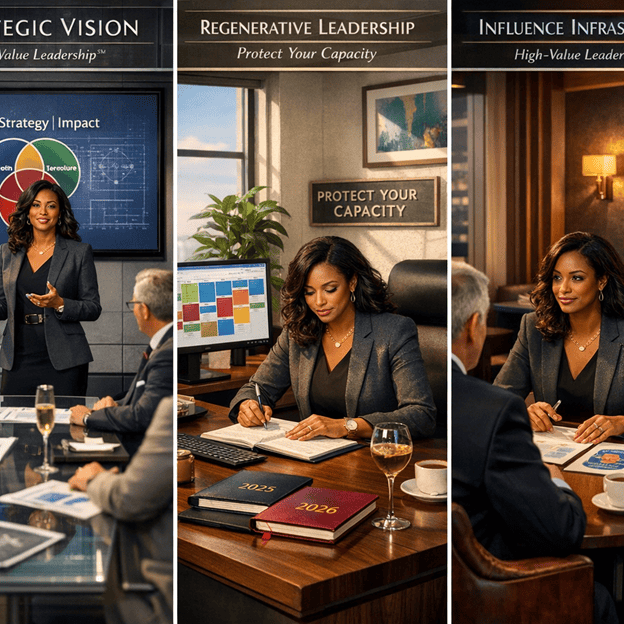

🔧 The Practical Architecture Process

Theory is useless without application. Here’s how to actually architect the woman you’re becoming in 2026:

Step 1: Honor the Woman of 2025 (December 30-31)

Complete this exercise in writing:

She got me through 2025 by:

  • [List 5-7 specific strengths, patterns, or practices]

But in 2026, I need to:

  • [List 3-5 different operational patterns required]

Example:

She got me through 2025 by:

  • Saying yes to every opportunity to prove my value
  • Working nights and weekends to deliver flawless results
  • Managing everyone’s emotional comfort in meetings
  • Building deep expertise in my functional area

But in 2026, I need to:

  • Say yes strategically to opportunities aligned with VP-level priorities
  • Protect weekend capacity for strategic thinking and personal renewal
  • Stop managing others’ discomfort and focus on driving business outcomes
  • Build cross-functional strategic visibility, not just functional expertise

The point: Name what worked and what needs to change. Honor both.


Step 2: Define Your 2026 Architecture Across Three Pillars (January 1-7)

For each pillar, answer:

Leadership Presence:

  • What do I want to be known for in 2026? (Not what I do—who I am as a leader)
  • What’s one behavior I need to stop? (Over-explaining, apologizing, deferring)
  • What’s one behavior I need to start? (Speaking first, challenging assumptions, taking strategic risks)

Energy Architecture:

  • What’s consuming energy without creating value?
  • What boundary would give me 20% more capacity?
  • What would regenerative energy management look like for me?

Influence Infrastructure:

  • Who needs to know about my expertise for my 2026 goals to be possible?
  • What three strategic relationships will I intentionally build?
  • How will I create visibility in spaces where decisions about my future are made?

Step 3: Build Your First 90 Days (January-March 2026)

Don’t try to architect everything at once. Pick ONE shift per pillar for Q1:

Leadership Presence (One Behavioral Shift):

  • Example: “I will speak in the first third of every senior leadership meeting, offering strategic perspective rather than waiting to respond to others.”

Energy Architecture (One Boundary):

  • Example: “I will eliminate Sunday email checking and protect 9-11am Monday/Wednesday for strategic thinking with no meetings.”

Influence Infrastructure (One Relationship Investment):

  • Example: “I will schedule monthly ‘learning conversations’ with the CFO, solving one problem she cares about each quarter.”

Track these for 90 days. Assess. Adjust. Expand.


Step 4: Create Accountability Architecture (Ongoing)

Architecture requires maintenance. Who will hold you accountable to becoming who you’re designing?

Options:

  • Schedule monthly self-audits (calendar reminder: “Am I building the woman I designed?”)
  • Partner with a peer for reciprocal accountability
  • Hire a coach who specializes in leadership architecture
  • Join a cohort-based program focused on strategic leadership design

The woman you’re architecting doesn’t just set intentions. She builds systems that ensure those intentions become reality.


💎 High-Value Leadership℠: Architecture as Strategic Competence

In High-Value Leadership: Transforming Organizations Through Purposeful Culture, I define high-value leadership as leadership that creates sustainable impact through intentional design, not reactive management.

The same principle applies to designing yourself as a leader.

Low-value leadership patterns:

  • React to whatever emerges
  • Default to last year’s operating system
  • Hope circumstances change rather than intentionally changing how you engage circumstances
  • Measure success by survival rather than strategic progress

High-Value Leadership℠ patterns:

  • Anticipate what’s required and build infrastructure proactively
  • Upgrade operating systems before they become obsolete
  • Architect circumstances rather than just navigate them
  • Measure success by intentional design, not accidental outcomes

The woman you’re becoming in 2026 isn’t an accidental outcome of circumstances. She’s a strategic design project.

In Mastering a High-Value Company Culture, I explore how transformational cultures are built through “conscious construction”—the intentional building of systems, norms, and practices that produce desired outcomes. You can’t build a high-value culture accidentally. It requires architecture.

The same is true for building the leader you’re becoming.

And for my Black women leaders specifically: Rise & Thrive: A Black Woman’s Blueprint for Leadership Excellence addresses the unique navigation required when you’re architecting yourself in spaces that weren’t designed for your success.

Rising is about visibility and positioning. Thriving is about sustainability and strategic design.

You can’t thrive by replicating the survival patterns that got you here. You have to architect a more strategic version of yourself—one that honors your resilience while refusing to romanticize the circumstances that required it.


🌟 She Got You Here. Now Design Who Takes You Forward.

December 31st is the perfect day for this work.

Not because there’s anything magical about the calendar flipping. Because you have permission—from yourself—to acknowledge that the woman who survived 2025 and the woman who will thrive in 2026 might operate differently.

She doesn’t need to be someone else. She needs to be a more strategic version of exactly who you are.

More boundaried. More visible. More intentional about energy. More deliberate about influence. More convicted in her presence. More protective of her capacity. More strategic about her relationships.

Same values. Different architecture.

So yes—cheers to the woman you were in 2025. She deserves every bit of celebration.

And now?

Let’s architect the woman you’re becoming.

Not through vague intentions or aspirational thinking. Through strategic design across three pillars: Leadership Presence, Energy Architecture, and Influence Infrastructure.

Because the woman who thrives in 2026 isn’t hoping circumstances change. She’s architecting herself to transform them.


💭 Reflection Questions

Work through these alone or with your leadership circle:

1. What did the woman of 2025 do brilliantly that you want to honor—and what did she do out of survival that you want to release?

2. If you operated from an assumption of established competence in 2026 instead of constantly proving yourself, how would your leadership presence shift?

3. For Black women specifically: What protective mechanism or survival pattern served you in hostile environments but is now limiting your effectiveness in your current context?

4. What’s consuming 20% or more of your energy without creating proportional value—and what boundary would protect that capacity?

5. Who needs to know about your expertise and leadership capability for your 2026 goals to be achievable—and do they currently know?

6. What’s one behavior you need to stop, one you need to start, and one boundary you need to enforce to become the woman you’re architecting for 2026?


🚀 Next Steps: From Reflection to Architecture

STEP 1: Complete the Honor & Release Exercise

Block 60 minutes on December 30th or 31st. Honor who got you through 2025. Name what needs to change for 2026.

STEP 2: Define Your Three-Pillar Architecture

Use the framework in this article to design:

  • Your Leadership Presence shift
  • Your Energy Architecture boundary
  • Your Influence Infrastructure investment

STEP 3: Build Your Q1 Accountability System

Don’t just design the woman you’re becoming—create the systems that ensure you actually build her.

STEP 4: Get Strategic Support

Architecture is hard to do alone, especially when you’re upgrading while running.


đŸ€ Work with Che’ Blackmon Consulting

If you’ve realized that architecting the woman you’re becoming requires more than personal reflection—that you need strategic coaching, proven frameworks, and accountability from someone who understands both the business strategy AND the unique navigation Black women leaders face—we should talk.

Our services for individual leaders:

✅ Executive Coaching for Strategic Leadership Architecture
One-on-one coaching designed specifically for Black women leaders navigating the shift from competence to commanding presence, from reactive to regenerative energy management, and from invisible to indispensable influence.

✅ High-Value Leadership Intensive (Waitlist Now Open)
A cohort-based program that combines strategic leadership development with the architecture work of building sustainable, influential leadership presence. Specifically designed for GenX women leaders ready to upgrade their operating systems.

For organizations:

✅ Leadership Development Programs
Building high-value leadership cultures where architecture is taught as a strategic competence, not just goal-setting.

✅ Executive Coaching for Leadership Transitions
Supporting leaders through critical transitions with intentional redesign rather than hoping competence alone carries them forward.

✅ Culture Transformation for Equity
Creating organizational environments where Black women and other traditionally overlooked leaders don’t have to architect around systemic barriers—they can architect for strategic impact.

Ready to architect the woman you’re becoming with strategic support?

📧 admin@cheblackmon.com
📞 888.369.7243
🌐 cheblackmon.com


Additional Resources:

📚 Read: High-Value Leadership: Transforming Organizations Through Purposeful Culture
The strategic framework that applies to organizational transformation and personal leadership architecture
Get the book: https://books.by/blackmons-bookshelf

🎓 Join the Waitlist: High-Value Leadership Intensive
A transformative cohort-based program for leaders ready to architect their next-level leadership presence
Join: https://adept-solutions-llc-2.kit.com/147712ac25

📖 Read: Rise & Thrive: A Black Woman’s Blueprint for Leadership Excellence
The specific navigation guide for Black women architecting leadership excellence in corporate spaces

🎧 Listen: Unlock, Empower, Transform with Che’ Blackmon
Twice-weekly conversations on leadership architecture and strategic career design

đŸ“ș Watch: Rise & Thrive YouTube Series
Practical leadership architecture content for Black women in corporate leadership


Che’ Blackmon is the Founder & CEO of Che’ Blackmon Consulting, a Michigan-based fractional HR and culture transformation consultancy. As a DBA candidate in Organizational Leadership at National University with 24+ years of progressive HR leadership experience, she specializes in AI-enhanced culture transformation and executive coaching for high-value leadership development. She is the author of “High-Value Leadership: Transforming Organizations Through Purposeful Culture,” “Mastering a High-Value Company Culture,” and “Rise & Thrive: A Black Woman’s Blueprint for Leadership Excellence.”


She got you here. Now let’s architect who takes you forward. ✹

Not a different woman. A more strategic version of exactly who you are.

#Leadership #LeadershipDevelopment #WomenInLeadership #BlackWomenInBusiness #ExecutiveCoaching #CareerDevelopment #ProfessionalGrowth #HighValueLeadership #IntentionalLeadership #LeadershipPresence #EnergyManagement #ExecutivePresence #StrategicLeadership #NewYearNewYou #LeadershipTransformation

The Competence Paradox: Why Your 2025 Wins Don’t Guarantee Your 2026 Relevance

By Che’ Blackmon, Founder & CEO, Che’ Blackmon Consulting | DBA Candidate in Organizational Leadership


🎯 The Lie We’ve Been Sold

You crushed 2025.

You delivered that critical project three weeks ahead of schedule. You resolved the interdepartmental conflict that had been festering for eighteen months. You mentored six emerging leaders, negotiated a complex vendor agreement that saved the company $400K, and your team’s engagement scores increased by 14 points. Your performance review was glowing. Your contributions were undeniable.

And yet.

When the VP role opened in January 2026, they hired someone from outside the organization. Someone with half your tenure and a third of your institutional knowledge. Someone who “brings fresh perspective” and “fits the leadership vision going forward.”

Here’s the uncomfortable truth that nobody talks about in those sanitized leadership development workshops: Competence got you in the room, but competence alone won’t elevate you to the leadership table.

For Black women professionals—especially those of us in GenX who came up being told that excellence was the only credential we needed—this is a particularly painful realization. We were raised on the promise that if we worked twice as hard, prepared three times as thoroughly, and delivered flawless results, we’d be recognized. We’d advance. We’d be valued.

We did all of that. And we’re still the most competent people in rooms where we’re also the most invisible.

Welcome to the Competence Paradox.


💡 What Is the Competence Paradox?

The Competence Paradox is the gap between proving you’re capable and being positioned for advancement. It’s the space where excellent work goes unrecognized, where critical contributions get attributed to “the team,” and where your November wins are completely forgotten by February.

It’s the phenomenon where you can be objectively high-value—delivering measurable impact, solving complex problems, driving organizational results—and still not be positioned as high-value in the eyes of decision-makers.

Research from the Center for Talent Innovation reveals that 65% of Black professionals report their ideas are not acknowledged or adopted at the same rate as their white colleagues’ ideas, even when the ideas are identical. McKinsey’s 2024 Women in the Workplace study shows that Black women are significantly underrepresented in senior leadership despite often being the most educated and credentialed employees in their organizations.

The data is clear: Competence is necessary but insufficient.


🔍 The Three Dimensions of the Paradox

Dimension 1: The Invisibility of Excellence

There was a financial services company where a Black woman Director of Risk Management had successfully predicted and prevented three major compliance violations over eighteen months. Her analysis was thorough, her recommendations were implemented, and the company avoided millions in potential penalties. Her work was excellent.

But when the C-suite discussed “strategic thinkers” for succession planning, her name never came up. Why? Because preventing disasters is invisible work. Nobody sees what didn’t happen. Her competence was undeniable, but it wasn’t visible in ways that translated to leadership perception.

Meanwhile, a peer who led a flashy digital transformation initiative (that ultimately came in over budget and under-delivered) was being groomed for VP. His work was visible. His “innovation” was discussed. His positioning was strategic.

The lesson: Excellence that’s invisible doesn’t translate to influence.

Dimension 2: The Attribution Gap

Catalyst research shows that when women—particularly Black women—deliver strong results, those results are more likely to be attributed to external factors (team effort, market conditions, luck) rather than individual competence and leadership. When men deliver comparable results, they’re attributed to skill, vision, and leadership capability.

You delivered a complex project successfully? “The team really came through.”
He delivered a comparable project? “His leadership was instrumental.”

Same outcome. Different narrative. Different career trajectory.

The lesson: If you’re not controlling the narrative around your wins, someone else is—or worse, no one is.

Dimension 3: The Positioning Premium

According to research from Stanford’s VMware Women’s Leadership Lab, leaders who advance share a common trait that has nothing to do with competence: strategic self-positioning. They actively manage how their work is perceived, discussed, and remembered. They cultivate sponsors who amplify their contributions. They connect their wins to organizational priorities in ways that make them indispensable.

Meanwhile, many high-performing Black women operate under the belief that “good work speaks for itself.” It doesn’t. Not in environments where unconscious bias shapes whose contributions get amplified and whose get overlooked.

The lesson: Being competent and being positioned as leadership material are two different skill sets.


📊 The Data: What Actually Separates Promoted Leaders from Equally Capable Peers?

A comprehensive study by the Executive Leadership Council and the Center for Creative Leadership examined what differentiates executives who advance to the C-suite from equally qualified peers who plateau. The findings are illuminating—and frustrating:

Factors That DON’T Significantly Predict Advancement:

  • ❌ Years of experience (competence baseline)
  • ❌ Educational credentials (competence baseline)
  • ❌ Performance ratings (competence validation)
  • ❌ Technical expertise (competence demonstration)

Factors That DO Significantly Predict Advancement:

  • ✅ Executive sponsorship (someone with power advocating for you)
  • ✅ Strategic visibility (your work being known beyond your immediate function)
  • ✅ Narrative control (how your contributions are framed and remembered)
  • ✅ Perceived leadership potential (not just performance, but future capability)
  • ✅ Cultural capital (being seen as “fitting” the leadership culture)

Notice anything? None of these advancement factors are about doing better work. They’re about positioning, perception, and power dynamics.

For Black women, the implications are sobering. We often excel at the competence factors while being systematically excluded from the positioning factors. We’re told to focus on performance while watching less qualified peers leverage relationships, visibility, and strategic positioning to leapfrog us.


🚧 Why GenX Women Fall Into This Trap More Than Others

GenX women—particularly Black GenX women—were socialized into a specific professional mythology:

The Mythology:

  • “Keep your head down and do excellent work.”
  • “Let your results speak for themselves.”
  • “Don’t be too visible or you’ll be seen as self-promotional.”
  • “Prove yourself through performance, not politics.”
  • “If you’re good enough, they’ll notice.”

The Reality:

  • Invisible excellence doesn’t translate to advancement
  • Results need advocates to speak for them
  • Strategic visibility is leadership competence, not vanity
  • Organizations ARE political—pretending they’re not is career sabotage
  • “Good enough” gets overlooked while “strategically positioned” gets promoted

We entered the workforce in the 80s and 90s when this mythology was gospel—especially for Black women who were told that any visibility that wasn’t tied to flawless performance would confirm stereotypes. We learned to be exceptional AND invisible. Competent AND non-threatening. Valuable AND uncomplaining.

Now we’re in mid-to-senior career stages watching younger colleagues—who didn’t internalize these limiting beliefs—advocate for themselves, leverage sponsors, and advance past us. Not because they’re more competent. Because they understand the positioning game we were told not to play.


💰 The Real Cost of the Competence Paradox

Let’s quantify what this costs:

Financial Impact

Research from PayScale and the American Association of University Women shows:

  • Black women earn 38% less than white men for comparable work
  • The wage gap for Black women widens with seniority (competence increases but positioning gaps compound)
  • Black women with advanced degrees earn less than white men with bachelor’s degrees

Translation: Your 2025 competence didn’t close the gap. Your 2026 positioning strategy might.

Career Velocity Impact

A study by LeanIn.Org and McKinsey found:

  • For every 100 men promoted to manager, only 60 Black women are promoted
  • Black women are less likely than any other group to be promoted from manager to senior manager
  • This gap isn’t explained by performance differences—it’s explained by sponsorship and visibility gaps

Translation: Competence gets you to manager. Positioning gets you to senior leader.

Influence & Impact Ceiling

When you’re highly competent but poorly positioned:

  • Your ideas get implemented without credit
  • Your expertise is utilized without compensation
  • Your leadership capability is questioned despite proven results
  • Your contributions are valued but not rewarded with advancement

This isn’t just unfair—it’s a strategic waste of your capacity and a limitation on your impact.


🎯 The Four Pillars of Strategic Positioning

If competence alone isn’t enough (and the data shows it isn’t), what does strategic positioning actually look like?

Pillar 1: Visibility Architecture

What it is: Intentionally designing how, when, and where your expertise becomes known.

What it’s NOT: Self-promotion for ego or attention.

What it IS: Strategic communication that connects your work to organizational priorities in ways decision-makers can see, understand, and value.

Practical Application:

There was a healthcare organization where a Black woman VP of Operations consistently delivered on complex regulatory compliance projects. Excellent work. Zero visibility outside her immediate division. When asked why she didn’t present her wins at leadership meetings, she said, “That feels like bragging.”

Meanwhile, a peer was presenting quarterly “innovation updates” that were 30% substance and 70% positioning. Guess who got tapped for the COO role?

The VP’s competence was never in question. Her positioning was non-existent.

How to Build Visibility Architecture:

  • Connect your wins to C-suite priorities in writing (memos, reports, updates)
  • Request presentation time at leadership forums (frame it as “sharing learnings” not self-promotion)
  • Publish thought leadership externally (LinkedIn articles, industry publications)
  • Speak at conferences and internal events
  • Build a “brag file” and share quarterly highlights with your leader AND their leader

Pillar 2: Sponsorship Cultivation

What it is: Identifying and cultivating relationships with leaders who have power and will advocate for you in rooms you’re not in.

The difference between mentorship and sponsorship:

  • Mentors give advice and support
  • Sponsors use their capital to advocate for your advancement

Research by Sylvia Ann Hewlett shows that 85% of promotions happen because of sponsorship, not performance alone. Yet Black women are significantly less likely to have sponsors than any other demographic group.

How to Cultivate Sponsors:

  • Identify leaders whose priorities align with your expertise
  • Make their lives easier by solving problems they care about
  • Ask explicitly for sponsorship (not just mentorship)
  • Give them “ammunition”—regular updates on your wins that they can use to advocate for you
  • Understand that sponsorship is reciprocal: what value do you bring to their objectives?

Pillar 3: Narrative Control

What it is: Actively shaping the story that gets told about your work, your contributions, and your leadership capability.

If you’re not controlling your narrative, one of three things happens:

  1. Your contributions get attributed to “the team” or external factors
  2. Your work gets remembered incorrectly or incompletely
  3. No story gets told at all—your wins simply disappear from organizational memory

Your November wins won’t be remembered in February unless you’ve strategically positioned them in the organizational narrative.

How to Control Your Narrative:

  • Frame your wins strategically: Don’t just report what you did—connect it to strategic outcomes
    • ❌ “Completed the vendor negotiation project”
    • ✅ “Restructured vendor agreements resulting in $400K annual savings and 15% efficiency improvement, directly supporting the CFO’s cost optimization initiative”
  • Document in real-time: Don’t wait for annual reviews to capture your impact
  • Use the “FYI” strategy: Send brief, strategic updates to key stakeholders positioning your work in the context of organizational priorities
  • Teach others to advocate for you: Give your manager, sponsors, and allies the language to describe your impact accurately

Pillar 4: Future-Readiness Signaling

What it is: Demonstrating not just current competence but future capability.

Decision-makers promote based on perceived potential, not just proven performance. They’re asking: “Can I see this person at the next level?”

For Black women, this is where bias does the most damage. Research shows that evaluators are more likely to question Black women’s “leadership presence,” “executive gravitas,” and “strategic thinking” even when objective performance is identical to peers.

How to Signal Future-Readiness:

  • Speak the language of strategy, not just execution: Connect your work to enterprise goals, market dynamics, competitive positioning
  • Demonstrate cross-functional thinking: Show you understand the business beyond your functional silo
  • Participate visibly in strategic initiatives: Volunteer for transformation projects, strategic planning, high-visibility task forces
  • Build external credibility: Industry recognition, speaking engagements, board seats signal you’re leadership-ready
  • Articulate a leadership POV: Have a clear perspective on industry trends, organizational challenges, future opportunities

đŸ”„ Real Talk: What Black Women Specifically Need to Navigate This Paradox

Let’s address what the “mainstream” leadership advice won’t say directly:

1. The “Twice as Good” Trap Is Real—And It’s Not Enough

We were told if we worked twice as hard and delivered twice the results, we’d get the same opportunities. That was always a lie. The standard isn’t “twice as good”—it’s “twice as good AND strategically positioned.”

You can’t out-competence systemic bias. You have to out-strategize it.

2. Visibility Isn’t “Bragging”—It’s Strategic Communication

Black women are socialized to avoid visibility that isn’t tied to flawless performance. We’re told:

  • Don’t be too confident (aggressive)
  • Don’t talk about your wins (self-promotional)
  • Don’t make yourself too visible (threatening)

Meanwhile, mediocre white men are building personal brands and leveraging every minor win into maximum visibility.

Reframe: Strategic visibility is a professional competence, not a character flaw. If you can’t advocate for yourself, you can’t advocate for your team, your priorities, or the people you’re trying to lift up.

3. You Need Sponsors Who Actually Have Power

Well-meaning mentorship from other Black women or junior leaders won’t compensate for lack of sponsorship from C-suite decision-makers. This isn’t about abandoning your community—it’s about being strategic about who has the actual power to advance your career.

4. “Fitting In” Isn’t the Goal—Strategic Differentiation Is

We’re often told to “fit” the leadership culture. But for Black women, “fitting” often means shrinking, code-switching, or performing a version of leadership that isn’t authentic.

Reframe: High-value leadership isn’t about conformity—it’s about strategic differentiation. Position your unique perspective, experience, and approach as a competitive advantage, not something to minimize.

5. Protecting Your Capacity Is Strategic Positioning

Black women carry disproportionate emotional labor, invisible work, and “diversity responsibilities” that consume capacity but don’t translate to advancement. Every hour you spend on unpaid DEI work or managing others’ discomfort is an hour you’re not spending on strategic positioning.

It’s not selfish to protect your capacity for work that actually advances your career. It’s strategic.


📋 The 5-Minute Visibility Audit

Before you can position yourself strategically, you need to understand your current visibility baseline. Answer these questions honestly:

Strategic Visibility Check

1. Who knows about your most significant 2025 accomplishments?

  • ☐ Just me
  • ☐ My immediate manager
  • ☐ My skip-level leader
  • ☐ C-suite decision-makers
  • ☐ People outside my function/division

2. When was the last time you presented your work to senior leadership?

  • ☐ Never
  • ☐ Over a year ago
  • ☐ Within the past year
  • ☐ Within the past quarter
  • ☐ Regularly (monthly/quarterly)

3. How many senior leaders outside your direct reporting line could articulate your value proposition?

  • ☐ Zero
  • ☐ 1-2
  • ☐ 3-5
  • ☐ 5+

4. Do you have documentation of your wins connected to business outcomes?

  • ☐ No formal tracking
  • ☐ Performance review notes only
  • ☐ Personal “brag file” I maintain
  • ☐ Regular updates shared with leadership
  • ☐ Published thought leadership demonstrating expertise

5. When your name comes up in succession planning conversations, what are you known for?

  • ☐ I honestly don’t know
  • ☐ Executing tasks well
  • ☐ Being reliable/a team player
  • ☐ Subject matter expertise in my function
  • ☐ Strategic thinking and leadership potential

Sponsorship & Advocacy Check

6. Do you have a sponsor (not mentor) actively advocating for you?

  • ☐ No
  • ☐ I have mentors but not sponsors
  • ☐ I think so, but I’m not sure
  • ☐ Yes, and I actively maintain that relationship

7. How often do you give your manager/sponsor “ammunition” to advocate for you?

  • ☐ Never/rarely
  • ☐ During performance reviews only
  • ☐ When specifically asked
  • ☐ Proactively on a regular basis

8. Who in your organization would fight for you to get promoted if you weren’t in the room?

  • ☐ No one I can identify
  • ☐ Maybe my direct manager
  • ☐ My manager and 1-2 others
  • ☐ Multiple leaders with decision-making power

Future-Readiness Signaling Check

9. When you communicate about your work, do you focus on:

  • ☐ Tasks completed (execution)
  • ☐ Projects delivered (management)
  • ☐ Problems solved (expertise)
  • ☐ Strategic outcomes achieved (leadership)
  • ☐ Future capability and vision (executive presence)

10. In the past 6 months, have you:

  • ☐ Participated in cross-functional strategic initiatives
  • ☐ Presented on industry trends or organizational strategy
  • ☐ Published thought leadership externally
  • ☐ Built relationships with decision-makers outside your division
  • ☐ Articulated a clear POV on where the organization should be headed

Scoring Your Visibility

0-3 checks: Your competence is invisible. Urgent positioning work needed.

4-6 checks: You have baseline visibility but significant positioning gaps.

7-9 checks: You’re positioning strategically in some areas but missing opportunities.

10+ checks: You understand that positioning is as important as performance.


đŸ› ïž Your 2026 Positioning Strategy: Four Quarters, Four Pillars

Stop trying to boil the ocean. Here’s a practical quarterly plan to build strategic positioning throughout 2026:

Q1 2026: Build Your Visibility Architecture

Goal: Make your expertise visible to decision-makers

Actions:

  • Document your 2025 wins connected to business outcomes
  • Request 15 minutes at a leadership meeting to share key learnings from a major project
  • Start a quarterly “FYI” update to your skip-level leader
  • Publish one thought leadership piece (LinkedIn article, internal blog, industry publication)
  • Create a tracking system for capturing wins in real-time

Milestone: By March 31, at least 3 senior leaders outside your direct chain can articulate your value.

Q2 2026: Cultivate Strategic Sponsorship

Goal: Identify and activate sponsors who will advocate for you

Actions:

  • Identify 2-3 potential sponsors (leaders with power whose priorities align with your expertise)
  • Set up informal “learning conversations” with each
  • Solve a problem they care about (make their lives easier)
  • Explicitly ask one to be your sponsor
  • Give your sponsor quarterly updates with specific “asks” for advocacy

Milestone: By June 30, you have at least one active sponsor who’s advocated for you in a meaningful way.

Q3 2026: Control Your Narrative

Goal: Shape how your work and leadership are discussed

Actions:

  • Audit how your contributions are currently being described/attributed
  • Create templated language for how you want your wins framed
  • Teach your manager/allies how to advocate for you using this language
  • Connect every win to strategic priorities in writing
  • Address any misattribution directly and immediately

Milestone: By September 30, you’ve successfully reframed at least 3 contributions that were being under-valued or misattributed.

Q4 2026: Signal Future-Readiness

Goal: Position yourself as leadership-ready for 2027 opportunities

Actions:

  • Volunteer for a high-visibility strategic initiative
  • Present on industry trends or organizational strategy
  • Build relationships with 3-5 decision-makers outside your division
  • Articulate your leadership POV in a visible forum
  • Request stretch assignments that demonstrate next-level capability

Milestone: By December 31, when your name comes up in succession planning, you’re discussed as a strategic leader, not just a strong executor.


💎 High-Value Leadership℠: Where Competence Meets Strategic Positioning

In High-Value Leadership: Transforming Organizations Through Purposeful Culture, I define high-value leadership as the intersection of authentic excellence and strategic impact. Notice both components are essential.

Authentic excellence = Your competence, your expertise, your track record
Strategic impact = Your visibility, your positioning, your narrative control

Most Black women have mastered the first. We’ve spent careers proving our competence. What we often haven’t done—because we were told it was “political” or “self-promotional”—is master the second.

But here’s the truth: You can’t transform organizational culture from a position of invisibility.

You can’t build high-value cultures if you’re not positioned as a high-value leader. You can’t advocate for equity if you’re not in rooms where decisions are made. You can’t lift others up if you’re stuck in the competence trap yourself.

Strategic positioning isn’t about ego. It’s about maximizing your capacity to create impact.

In Mastering a High-Value Company Culture, one of the core principles is “conscious construction”—the intentional building of environments where excellence is recognized and rewarded equitably. But until we have those environments, you have to navigate the environments that exist. That means building positioning competence alongside performance competence.

And for my Black women leaders: Rise & Thrive: A Black Woman’s Blueprint for Leadership Excellence speaks directly to this navigation. Rising means being seen. Thriving means being strategically positioned. Excellence means refusing to accept that competence alone should be enough—while simultaneously mastering the positioning game we didn’t create but must learn to play.


🚀 Your 2025 Wins Are Assets—But Only If You Position Them

December 30th is the perfect day for this audit. Your 2025 wins are fresh. Your capacity for 2026 positioning is available. The gap between your competence and your visibility is quantifiable.

Here’s what you need to accept:

Your November wins WILL be forgotten by February—unless you position them strategically.

That project you delivered flawlessly? Already fading from organizational memory.
That crisis you resolved? Someone else is probably taking credit.
That innovation you implemented? Being discussed as “team success” rather than your leadership.

This isn’t because your work wasn’t excellent. It’s because excellence without positioning is invisible.

So the question isn’t whether you’re competent enough for 2026 opportunities. You are. You’ve proven that repeatedly.

The question is: Are you positioned for decision-makers to see your competence, value your contributions, and advocate for your advancement?

If the answer is no, your 2025 wins won’t guarantee your 2026 relevance. They’ll just be more proof of the Competence Paradox—excellent work that didn’t translate to advancement because positioning was missing.


💭 Discussion Questions

Work through these with your leadership team, peer group, or in personal reflection:

  1. When you think about your most significant 2025 accomplishments, who beyond your immediate manager could articulate their business impact? If the answer is “very few people,” what does that tell you about your visibility architecture?
  2. For Black women specifically: How much energy are you spending proving your competence versus positioning your expertise strategically? What would shift if you allocated even 20% of that “proving” energy to strategic visibility?
  3. Do you have a sponsor (someone with power who advocates for you) or just mentors (people who give advice)? If you don’t have sponsors, what’s preventing you from actively cultivating them?
  4. How are your contributions currently being described and attributed? Are you controlling that narrative or is someone else—or worse, is no narrative being created at all?
  5. If you were in a succession planning conversation about yourself, what would you want decision-makers to say about your leadership potential? Are you giving them the evidence and language to say those things?

🎯 Next Steps: From Competence to Strategic Positioning

STEP 1: Take the 5-Minute Visibility Audit

Complete the assessment in this article. Be brutally honest. Your career trajectory depends on accurate self-assessment, not aspirational thinking.

STEP 2: Identify Your Biggest Positioning Gap

Based on your audit, where’s the most critical gap?

  • ☐ Visibility (no one knows about my wins)
  • ☐ Sponsorship (no one’s advocating for me)
  • ☐ Narrative Control (my work is being misattributed)
  • ☐ Future-Readiness Signaling (I’m seen as tactical, not strategic)

STEP 3: Implement ONE Positioning Strategy This Week

Don’t try to fix everything at once. Pick ONE action:

  • Send an “FYI” update to your skip-level leader highlighting a recent win
  • Schedule a conversation with a potential sponsor
  • Reframe how you’re describing a major accomplishment
  • Volunteer for a high-visibility strategic initiative
  • Publish one piece of thought leadership

STEP 4: Build Your 2026 Positioning Plan

Use the quarterly framework in this article to create a practical, actionable plan for building strategic positioning throughout 2026.


đŸ€ Work with Che’ Blackmon Consulting

If you’ve realized that the Competence Paradox isn’t just a personal challenge but a systemic issue limiting your entire organization’s ability to recognize and advance top talent—especially Black women and other traditionally overlooked leaders—we should talk.

Che’ Blackmon Consulting specializes in AI-enhanced culture transformation that doesn’t just identify talent gaps—it predicts them 3-6 months in advance and helps you build cultures where competence is actually recognized and rewarded equitably.

Our services include:

  • Executive Coaching for Strategic Positioning: One-on-one coaching specifically designed for Black women leaders navigating the Competence Paradox
  • High-Value Leadership Development: Building both performance competence AND positioning competence in your leadership pipeline
  • Culture Transformation Roadmaps: Creating organizational environments where talent is recognized based on impact, not just visibility
  • Sponsorship Program Design: Building formal sponsorship structures that close advancement gaps for traditionally overlooked talent
  • Predictive Turnover Analytics: Identifying high-performers who are likely to leave because competence isn’t translating to advancement

Ready to transform competence into strategic positioning—for yourself or your organization?

📧 admin@cheblackmon.com
📞 888.369.7243
🌐 cheblackmon.com


Additional Resources:

📚 Read: High-Value Leadership: Transforming Organizations Through Purposeful Culture
Get the book: https://books.by/blackmons-bookshelf

🎓 Join the Waitlist: High-Value Leadership Intensive
An immersive program for leaders ready to master both excellence and strategic positioning
Join: https://adept-solutions-llc-2.kit.com/147712ac25

🎧 Listen: Unlock, Empower, Transform with Che’ Blackmon
Twice-weekly podcast on leadership, culture transformation, and strategic career navigation

đŸ“ș Watch: Rise & Thrive YouTube Series
Leadership content specifically for Black women in corporate spaces


Che’ Blackmon is the Founder & CEO of Che’ Blackmon Consulting, a Michigan-based fractional HR and culture transformation consultancy. As a DBA candidate in Organizational Leadership at National University with 24+ years of progressive HR leadership experience, she specializes in AI-enhanced culture transformation for organizations ready to move from reactive management to predictive excellence. She is the author of “High-Value Leadership: Transforming Organizations Through Purposeful Culture,” “Mastering a High-Value Company Culture,” and “Rise & Thrive: A Black Woman’s Blueprint for Leadership Excellence.”


Your 2025 wins were impressive. Your 2026 positioning strategy will be transformative. ✹

Don’t let the Competence Paradox keep you invisible. Build the visibility architecture your excellence deserves.

#Leadership #ExecutiveLeadership #CareerDevelopment #BlackWomenInBusiness #WomenInLeadership #ExecutivePresence #CareerAdvancement #StrategicPositioning #HighValueLeadership #LeadershipDevelopment #ProfessionalGrowth #ExecutiveCoaching #WorkplaceEquity #Sponsorship #SuccessionPlanning

The Unfinished Business Audit: What GenX Leaders Must Release Before 2026

By Che’ Blackmon, Founder & CEO, Che’ Blackmon Consulting | DBA Candidate in Organizational Leadership


📊 We Don’t Do Nostalgia—We Do Inventory

December 29th hits different for GenX leaders.

We’re not the generation waxing poetic about “the good old days” or romanticizing our college years on social media. We’re the latchkey kids who learned resourcefulness as a survival skill, the middle children of American generations who watched our parents downsize and our younger colleagues job-hop their way to the top. We inventory. We assess. We make strategic decisions about what stays and what goes.

But here’s the paradox that’s costing you more than you realize: The same resourcefulness that made you invaluable as a leader is now keeping you tethered to professional baggage you should have released years ago.

That networking contact who exhausts you? Still on your calendar.
That career setback from 2019? Still playing in your head during important presentations.
That leadership approach that worked brilliantly in 2015 but alienates your younger team members? Still your default setting.

The problem isn’t that you’re holding onto things. GenX leaders hold onto everything because we were raised to make something out of nothing, to fix what’s broken, and to never waste a resource. The problem is we haven’t audited what’s actually worth the real estate it’s occupying in our leadership capacity.


💰 The Economics of Unfinished Business

Let’s talk numbers, because that’s the language we speak.

Research from the NeuroLeadership Institute shows that unresolved professional conflicts and unprocessed career experiences consume approximately 23% of a leader’s cognitive bandwidth. That’s nearly a quarter of your strategic thinking capacity spent rehashing old situations, managing relationships that should have ended, and defending leadership approaches that no longer serve you.

For Black women leaders specifically, this tax is even higher. Dr. Ella F. Washington’s research on “emotional tax” in the workplace reveals that 58% of Black women report being on guard to protect against racial and gender bias, a vigilance that compounds when layered with unresolved professional experiences. We’re not just carrying our own unfinished business—we’re navigating workplaces that often created that unfinished business in the first place.

Consider this scenario: There was a company where a VP of Operations—a Black woman who’d been with the organization for 14 years—couldn’t bring herself to deprioritize a struggling mentee relationship. The mentee had become increasingly demanding, missing scheduled meetings but expecting imme