By Che’ Blackmon, DBA Candidate | Founder & CEO, Che’ Blackmon Consulting
🌼 Introduction: The Promise That Follows the Pain
There is a reason Easter does not arrive in the middle of summer. It arrives at the turning point between winter’s grip and spring’s promise. It arrives precisely when the world is ready to remember that endings are not final, that dormant things are not dead things, and that the most powerful transformations begin in seasons that feel the most uncertain.
For leaders, this is more than a metaphor. It is a mirror.
Every leader who has guided an organization through a restructuring, a market downturn, a cultural crisis, or even the slow erosion of trust understands what it means to lead through winter. What separates transformational leaders from transactional ones is not their ability to avoid winter. It is their ability to recognize the renewal that is waiting on the other side and to lead their people toward it with clarity, compassion, and conviction.
Throughout more than twenty four years of progressive HR leadership across the automotive, manufacturing, healthcare, nonprofit, quick‑service, and professional services industries, I have seen organizations at every stage of this cycle. The ones that emerge strongest are never the ones with the most resources. They are the ones with the most purposeful leadership. That conviction is the foundation of the High‑Value Leadership™ framework that I introduced in High‑Value Leadership: Transforming Organizations Through Purposeful Culture and it is the lens through which this entire article is written.
This Easter weekend, wherever you are in your leadership season, I want you to know: the renewal is not a wish. It is a principle. And it is available to every leader willing to do the work.
🌿 Understanding the Renewal Principle: Transformation Is Seasonal, Not Sudden
We live in a business culture that worships the overnight success story. The startup that became a unicorn. The turnaround that happened in a single quarter. The leader who walked in and changed everything by sheer force of will. These stories are exciting. They are also, almost universally, myths.
Real transformation is seasonal. It moves through identifiable stages, each one serving a purpose that cannot be skipped. Just as a seed must split open underground before it can push through the soil, organizational transformation requires a breaking open of old assumptions before new growth can take root.
In Mastering a High‑Value Company Culture, I wrote that culture is the lifeblood of any organization. That metaphor is more literal than most leaders realize. Lifeblood circulates. It is constantly being renewed, replenished, and redirected to where the body needs it most. When circulation stops, the body does not simply slow down. It fails. Organizations work the same way. A culture that is not being intentionally renewed is a culture that is quietly deteriorating, even when the surface metrics look stable.
The Renewal Principle asserts that healthy organizations do not treat transformation as a one‑time project. They treat it as a continuous discipline, a rhythm of assessment, release, reinvestment, and growth that mirrors the natural cycles we see in every living system.
📊 The Evidence Behind the Principle
This is not just philosophy. The data is striking. A 2025 report from the Josh Bersin Company found that organizations practicing what they call “continuous organizational redesign” outperform their peers by 4.2 times in revenue growth and 3.7 times in employee satisfaction. These organizations do not wait for crises to force change. They embed renewal into their operating model.
Similarly, Harvard Business Review published research in late 2024 showing that companies with formalized cultural assessment cycles of every eighteen to twenty four months experience 41% less unplanned executive turnover than companies that assess culture only during moments of crisis. The message is consistent: renewal by design is exponentially more effective than renewal by emergency.
🏢 When Organizations Refuse to Renew: The Cost of Staying in Winter
If the Renewal Principle teaches us that transformation is natural and necessary, then it follows that resistance to renewal carries a measurable cost. And it does.
⚠️ The Warning Signs of Cultural Stagnation
There was a quick‑service restaurant franchise with over forty locations that prided itself on a culture of “consistency.” For years, their operational model had worked. Turnover was manageable. Revenue was stable. But beneath the surface, something was shifting. Their workforce demographics were changing. The expectations of a new generation of employees were different from those of the generation before them. And the franchise’s leadership team, composed entirely of leaders who had been promoted from within over a fifteen year period, could not see what they could not see.
When turnover spiked by 38% over eighteen months, the leadership team attributed it to “the labor market.” When customer satisfaction scores declined, they attributed it to “unreliable staffing.” What they did not recognize was that their culture had not been renewed in over a decade. The values that once drove performance had calcified into rigidity. The communication style that once felt clear and direct now felt dismissive and hierarchical to a workforce that expected collaboration and transparency.
By the time the franchise ownership brought in external HR support to conduct a culture assessment, three of their top performing general managers had already left for competitors. The cost of replacing those leaders alone exceeded $450,000. The cost of the cultural damage they left behind was incalculable.
This is what happens when organizations stay in winter too long. Stagnation does not announce itself with a crisis. It creeps in quietly through attrition, disengagement, and a slow erosion of the trust that holds an organization together.
🔍 A Nonprofit That Found Renewal Through Honest Assessment
Contrast that with a mid‑size nonprofit serving urban communities that recognized its own stagnation before it became a crisis. The executive director noticed that program outcomes were plateauing despite consistent funding. Staff morale had flattened. And the organization’s leadership pipeline, once a source of pride, had dried up because high‑potential employees were leaving for roles that offered more autonomy and professional development.
Rather than rationalizing the trends, the leadership team chose to enter what I would call a voluntary winter. They paused new program launches, commissioned an independent culture audit, and held listening sessions with staff at every level. What they heard was uncomfortable but invaluable: employees felt micromanaged, overlooked for advancement, and disconnected from the organization’s mission despite believing deeply in the work itself.
The organization restructured its leadership development approach, flattened unnecessary layers of approval, and created clear promotion pathways tied to competency rather than tenure. Within two years, staff retention improved by 26%, program outcomes increased by 18%, and the organization attracted three major new funding partnerships specifically because funders cited the “healthy organizational culture” as a deciding factor.
That is the Renewal Principle in action. The discomfort of honest assessment became the doorway to growth.
✊🏾 Renewal and the Black Woman Leader: Transforming Systems That Were Never Built for You
Every conversation about organizational renewal must reckon with a difficult truth: the systems that most organizations are trying to renew were not built with everyone in mind. And for Black women in leadership, that reality adds layers of complexity that are too often ignored in mainstream leadership literature.
In Rise & Thrive: A Black Woman’s Blueprint for Leadership Excellence, I explored the concept of strategic navigation, the art of making intentional choices about when to conform and when to challenge, when to advocate and when to build coalitions, when to speak and when to let your results do the speaking. For Black women, leadership renewal is not just about transforming the organization. It is about transforming the organization while simultaneously navigating systems that may actively resist your authority, question your competence, or diminish your contributions.
The data tells a story that demands attention. According to LeanIn.Org’s 2024 analysis, Black women experience microaggressions at work at nearly 1.8 times the rate of white women. They are less likely to have their ideas credited to them. They are more likely to be tasked with “office housework” such as note taking, event planning, and administrative tasks that fall outside their job descriptions. And they are significantly less likely to have a sponsor, not just a mentor, but a sponsor with real organizational power who actively advocates for their advancement.
Yet despite these barriers, Black women continue to show up, lead, and transform the organizations they serve. A 2024 study from the Center for Talent Innovation found that Black women are 25% more likely than their white female peers to aspire to positions of significant leadership influence. The ambition is there. The talent is there. What is often missing is the organizational will to create equitable systems of renewal that include everyone.
💡 What Renewal Looks Like When Equity Is at the Center
Renewal that centers equity looks different from renewal that merely includes a diversity statement. It means examining who holds power in your organization and whether that power is distributed equitably. It means auditing your succession planning process to determine whether high‑potential Black women are being identified, developed, and sponsored at the same rate as their peers. It means measuring belonging, not just engagement, and holding leaders accountable for creating environments where traditionally overlooked employees do not have to perform twice as hard to receive half the recognition.
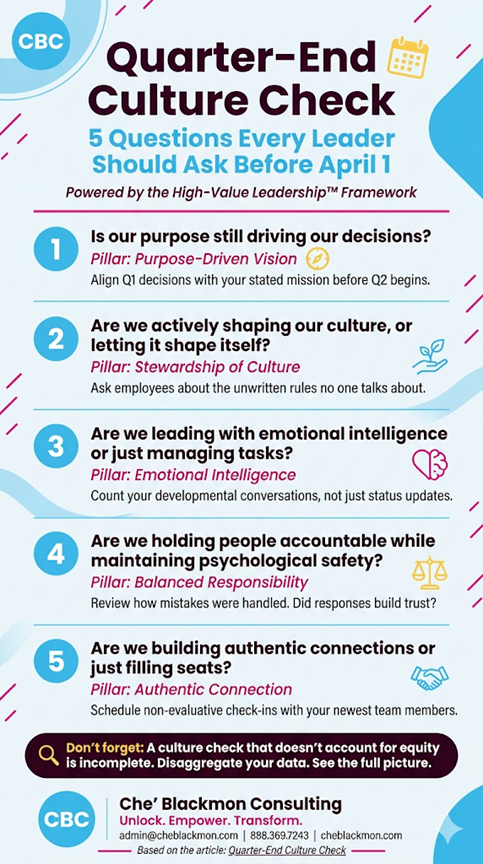
The fourth pillar of the High‑Value Leadership™ framework is Balanced Responsibility. In High‑Value Leadership, I defined this as the ability to maintain high standards while simultaneously creating psychological safety. For Black women in corporate spaces, this pillar is not abstract. It is the difference between an organization that says “we value diversity” and an organization that demonstrates that value through equitable promotion rates, fair compensation, access to high‑visibility projects, and protection from the disproportionate burden of invisible labor.
This Easter, if you are a leader committed to renewal, ask yourself this: When my organization renews, will it renew for everyone? Or will it renew the same systems of advantage and oversight that existed before, simply dressed in new language?
🔑 The Five Doors of Renewal: A Framework for Transformation
Drawing from the High‑Value Leadership™ methodology and more than two decades of cross‑industry experience, I have identified five sequential “doors” that organizations must walk through to achieve meaningful, lasting renewal. Each door corresponds to a pillar of the framework and represents both a challenge and an opportunity.
🚪 Door 1: Clarity of Purpose (Purpose‑Driven Vision)
Renewal without purpose is just activity. Before any transformation effort can succeed, the organization must reconnect with its foundational “why.” This is not a rebranding exercise. It is a deep, honest examination of whether the organization’s stated purpose still reflects its lived reality. There was a professional services firm that spent six months and significant consulting fees redesigning its mission statement and values only to discover in a subsequent employee survey that 74% of the staff could not recite even one of the new values. The renewal had been cosmetic. Purpose must be embedded in daily operations, leadership behaviors, and performance expectations to drive real change.
🚪 Door 2: Cultural Honesty (Stewardship of Culture)
The second door requires leaders to look at their culture without filters. This means moving beyond the curated version of culture that appears on career websites and social media and confronting the actual, lived culture that employees experience every day. Predictive analytics and AI powered sentiment tools are making this kind of honest assessment more accessible than ever. Organizations can now identify burnout clusters, disengagement patterns, and leadership blind spots in real time rather than waiting for annual surveys that arrive too late to prevent damage.
🚪 Door 3: Emotional Courage (Emotional Intelligence)
Renewal demands uncomfortable conversations. It demands that leaders acknowledge their own contributions to the problems they are trying to solve. It demands vulnerability. According to Brené Brown’s research, leaders who demonstrate vulnerability during periods of organizational change are perceived as more trustworthy by their teams and are 67% more effective at building the coalition support needed to sustain transformation efforts. Emotional courage is not weakness. It is the engine of credibility.
🚪 Door 4: Accountable Action (Balanced Responsibility)
The fourth door is where many renewal efforts stall. Leaders articulate the vision. They assess the culture. They have the courageous conversations. And then they fail to translate all of that insight into measurable, accountable action. Renewal without accountability is a retreat, not a transformation. There was a manufacturing company that completed an exhaustive culture audit, identified twelve specific areas for improvement, created a beautifully designed action plan, and then allowed every single initiative to die within six months because no individual leader was held personally accountable for any of the outcomes. The data was right. The analysis was right. The follow through was absent.
🚪 Door 5: Relational Investment (Authentic Connection)
The final door is the one that determines whether renewal becomes sustainable or temporary. Authentic Connection, the fifth pillar of High‑Value Leadership™, requires leaders to invest in genuine, ongoing relationships with the people they lead. Not once a year during performance review season. Not only during crises. But consistently, intentionally, and across all levels of the organization, especially with those who have been historically overlooked. When employees feel genuinely known and valued by their leaders, they become partners in renewal rather than bystanders watching it happen.
📈 2026 Trends Shaping the Renewal Conversation
The broader leadership landscape in 2026 reflects a fundamental shift in how organizations think about transformation. Several converging trends are making the Renewal Principle more relevant than ever.
🤖 AI as a Renewal Accelerator
Artificial intelligence is no longer a future consideration for people strategy. It is a present reality. Organizations are deploying AI powered tools that can predict voluntary turnover three to six months in advance, identify the specific leadership behaviors driving disengagement, and surface promotion bias patterns that human analysis consistently misses. For organizations committed to equitable renewal, these tools represent an unprecedented opportunity to make data visible where intuition has historically been blind. When AI reveals that high‑potential Black women are being passed over for stretch assignments at twice the rate of their peers, that is not just a data point. That is a renewal mandate.
🤝 The Rise of Fractional Leadership
The fractional executive model is reshaping how organizations access strategic leadership during critical seasons of transformation. Rather than committing to a full‑time CHRO hire that may not align with the organization’s stage or budget, companies across manufacturing, healthcare, and professional services are engaging fractional HR leaders who bring enterprise level experience, objective perspective, and cross‑industry insight. This model is particularly powerful during renewal cycles because it provides the strategic depth of a seasoned executive without the long‑term structural cost, allowing organizations to invest their resources in the transformation itself rather than in overhead.
🌍 Purpose as a Talent Magnet
The 2025 Edelman Trust Barometer found that 68% of employees globally say they would leave their current employer for an organization with a stronger sense of purpose, even at the same or lower compensation. For organizations in renewal, this finding is both a warning and an invitation. The organizations that can authentically articulate and live their purpose, not just market it, are attracting and retaining the caliber of talent that makes renewal sustainable. Purpose is no longer a cultural luxury. It is a competitive necessity.
✅ Actionable Takeaways for Leaders This Easter Weekend
First, name your season honestly. Are you in a season of growth, a season of assessment, or a season of stagnation that you have been calling stability? Renewal begins with the courage to name where you actually are, not where you wish you were.
Second, schedule a culture pulse check before your next quarter begins. Do not wait for the annual survey. Use a focused, targeted assessment to understand how your people are experiencing your culture right now. If you do not have the internal capacity to do this objectively, engage external support.
Third, identify three employees in your organization who are traditionally overlooked for development and create a specific, time‑bound plan to sponsor their growth this quarter. Sponsorship is not mentoring. Sponsorship means using your positional power to advocate for someone’s advancement in rooms where decisions are being made.
Fourth, evaluate your leadership pipeline for equity gaps. Are Black women, frontline supervisors, and other underrepresented groups being developed and promoted at rates proportional to their representation and performance? If you do not know the answer, that is itself the answer.
Fifth, adopt predictive tools for your people strategy. Whether it is AI powered analytics, real‑time engagement dashboards, or structured stay interviews, move from reactive management to proactive stewardship of your culture. The organizations that see the storm before it arrives are the ones that weather it best.
Sixth, make renewal a rhythm, not a reaction. Block time on your leadership calendar for quarterly culture reflection. Make it as non‑negotiable as your financial review. Because the culture that carries your strategy is at least as important as the budget that funds it.
💬 Discussion Questions for Leaders and Teams
1. Which of the Five Doors of Renewal feels most urgent for your organization right now? What is preventing you from walking through it?
2. If you conducted an honest culture assessment today, what do you think your employees would say about the gap between your stated values and the daily lived experience of your culture?
3. How does your organization currently invest in the development of Black women and other traditionally overlooked groups? Is that investment producing measurable outcomes in promotion rates, retention, and leadership representation?
4. What is one legacy practice, policy, or cultural norm in your organization that has outlived its usefulness? What would it take to release it intentionally this quarter?
5. How would your leadership approach change if you treated renewal as a continuous discipline rather than a response to crisis? What would you start doing differently this month?
🚀 Next Steps: Write Your Renewal Story
Easter reminds us that the most powerful stories in human history are stories of renewal. They are stories of leaders and communities that refused to accept that the difficult season was the final chapter.
Your organization has a renewal story waiting to be written. It begins with honest assessment. It moves through the courage to release what is no longer serving your people. It takes root through intentional investment in leadership development and equitable systems. And it bears fruit through the sustained, daily discipline of leading with purpose.
If this article resonated with you, do not let the insight stay theoretical. Share it with your leadership team. Bring the discussion questions to your next meeting. Choose one actionable takeaway and commit to implementing it within the next thirty days. The Renewal Principle is not passive. It requires a leader willing to act. That leader is you.
That is the heart of High‑Value Leadership™. That is the mission of Che’ Blackmon Consulting. And that is the transformation your organization and your people are waiting for.
🌟 Ready to Start Your Organization’s Renewal Season?
Che’ Blackmon Consulting partners with organizations to assess culture, develop high‑value leaders, and build workplaces where renewal is intentional, inclusive, and measurable. Whether you need fractional HR leadership, a culture transformation strategy, or executive coaching to guide your team through a critical season of change, we bring more than twenty four years of cross‑industry experience to help you move from where you are to where your purpose demands you go.
📧 admin@cheblackmon.com
📞 888.369.7243
📚 Explore More from Che’ Blackmon Consulting
📖 Mastering a High‑Value Company Culture – The foundational guide to building cultures that drive measurable business results.
📖 High‑Value Leadership: Transforming Organizations Through Purposeful Culture – A deep dive into the five pillars of leadership that create lasting organizational change.
📖 Rise & Thrive: A Black Woman’s Blueprint for Leadership Excellence – A strategic roadmap for Black women navigating the unique challenges of corporate leadership.
🎥 Rise & Thrive YouTube Series – Weekly episodes exploring each chapter of the e‑book with practical leadership insights.
🎙️ Unlock, Empower, Transform Podcast – Twice‑weekly conversations on culture, leadership, and building workplaces that work for everyone.
“The seed never sees the flower. But the flower is never possible without the season the seed spent in the dark. Lead through the darkness with purpose, and trust that the bloom is already on its way.”
– Che’ Blackmon
#EasterWeekend #RenewalPrinciple #LeadershipMatters #PurposeDrivenLeadership #HighValueLeadership #CultureTransformation #OrganizationalRenewal #BlackWomenInLeadership #BlackWomenLead #WomenInLeadership #InclusiveLeadership #FractionalHR #HRLeadership #OrganizationalCulture #WorkplaceEquity #LeadWithPurpose #TransformationalLeadership #LeadershipDevelopment #TalentRetention #DiversityEquityInclusion #CheBlackmonConsulting #UnlockEmpowerTransform