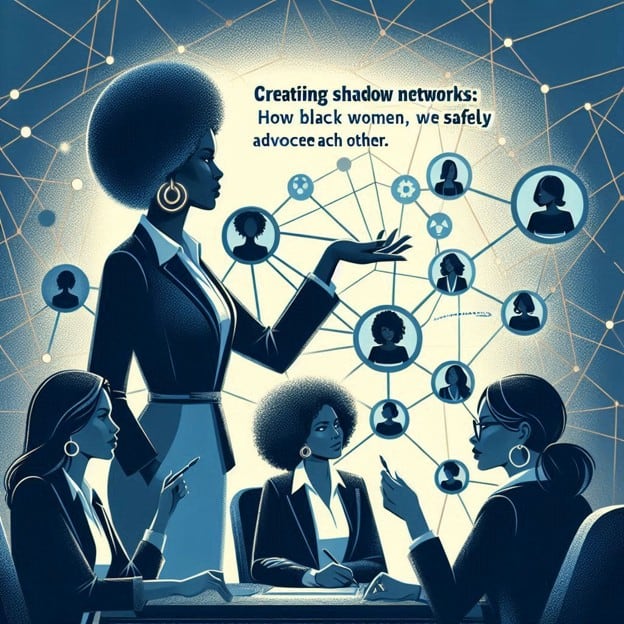
Creating Shadow Networks: How Black Women Can Safely Advocate for Each Other

“Alone, all alone. Nobody, but nobody can make it out here alone.” – Maya Angelou

When Keisha noticed her colleague Jasmine’s brilliant ideas being consistently overlooked in team meetings, she faced a familiar dilemma. Speaking up directly might label her as “difficult” or “playing the race card.” But staying silent felt like betraying her values. Instead, Keisha found a third way—she began building what I call a “shadow network,” a strategic support system that amplifies Black women’s voices while providing protective cover for advocates.

This approach transformed not just Jasmine’s visibility, but created a ripple effect that elevated multiple Black women in their organization. The shadow network became an invisible force that shifted dynamics, created opportunities, and built power—all while maintaining professional relationships and protecting its members from retaliation.

Shadow networks represent the evolution of sisterhood in corporate America. They’re strategic, intentional, and designed to create sustainable change while navigating the complex realities Black women face in predominantly white spaces.

Understanding the Need for Shadow Networks

The Isolation Factor

Black women in corporate America often find themselves in positions of profound isolation. We’re frequently the only one in meetings, on teams, or at our level. This isolation isn’t just uncomfortable—it’s strategically dangerous. Without allies and advocates, our contributions can be minimized, our potential overlooked, and our careers stalled.

Research from the Center for Talent Innovation shows that 37% of Black women feel they lack influential advocates at work, compared to just 19% of white women. This advocacy gap has real consequences. According to McKinsey’s Women in the Workplace report, Black women are promoted at significantly lower rates than their white counterparts, despite being equally ambitious and qualified.

The Visibility Paradox

As I discussed in “High-Value Leadership: Transforming Organizations Through Purposeful Culture,” Black women often face a visibility paradox. We’re hypervisible when we make mistakes or challenge the status quo, yet invisible when we contribute solutions or demonstrate excellence. This creates a precarious balance where we need advocates but can’t always advocate for ourselves without facing backlash.

Shadow networks address this paradox by creating multiple pathways for recognition and support. When advocacy comes from various sources rather than just one person, it appears more organic and less threatening to existing power structures.

The Anatomy of Effective Shadow Networks

Core Principles

Drawing from the authentic leadership principles outlined in “Mastering a High-Value Company Culture,” effective shadow networks are built on five core principles:

1. Intentional Diversity Shadow networks aren’t just about Black women supporting Black women—they include strategic allies across race, gender, and organizational levels. This diversity provides multiple perspectives and reduces the risk of the network being dismissed as an “exclusive club.”

2. Reciprocal Value Creation Every network member both gives and receives value. This isn’t charity—it’s strategic mutual aid that strengthens everyone involved.

3. Discrete but Not Secret Shadow networks operate with discretion, not secrecy. The work is visible, but the coordination is subtle.

4. Business-Focused Outcomes All advocacy is framed around business value and organizational success, not personal advancement or diversity for its own sake.

5. Sustainable Practices The network must be maintainable over time without creating burnout or overwhelming any single member.

Network Architecture

Effective shadow networks typically include:

The Amplifiers: Colleagues who consistently echo and build upon your ideas in meetings The Connectors: Individuals who make strategic introductions and include you in important conversations The Validators: Trusted voices who can speak to your competence and contributions The Informants: People who share crucial organizational intelligence and emerging opportunities The Protectors: Allies who provide cover during challenging situations or pushback
Building Your Shadow Network: A Strategic Approach

Phase 1: Assessment and Mapping (Months 1-2)

Stakeholder Analysis Begin by mapping your current organizational relationships. Identify:

  • Who currently supports your work?
  • Who has influence over decisions that affect your career?
  • Who might benefit from your expertise or connections?
  • Where are the gaps in your support system?

Value Inventory Document what you bring to potential network relationships:

  • Unique skills and knowledge
  • Industry connections
  • Cultural insights
  • Project expertise
  • Institutional knowledge

Risk Assessment Evaluate potential challenges:

  • Organizational politics and sensitivities
  • Historical patterns of retaliation
  • Key stakeholders who might resist change
  • Timing considerations

Phase 2: Strategic Relationship Building (Months 3-6)

The Gradual Approach Start with natural connections and gradually expand. Begin with colleagues who already demonstrate inclusive behaviors or who have benefited from your expertise.

Case Study: The Tech Triangle Sarah, a Black woman software architect, identified three key relationships to cultivate:

  • Mark, a white male team lead who valued her technical insights
  • Lisa, an Asian woman product manager who shared similar experiences as a minority in tech
  • David, a Black male VP who could provide senior-level perspective

Rather than explicitly discussing advocacy, Sarah focused on building genuine professional relationships through collaboration, knowledge sharing, and mutual support. Over six months, these relationships naturally evolved into a support network that advocated for her contributions and created new opportunities.

Phase 3: Network Activation (Months 7-12)

The Soft Launch Strategy Begin with low-risk advocacy opportunities:

  • Having network members reference your work in relevant contexts
  • Asking for introductions to key stakeholders
  • Requesting input on important decisions
  • Seeking feedback on your contributions

Practical Example: The Meeting Intervention When Keisha noticed Jasmine’s ideas being overlooked, she didn’t immediately speak up. Instead, she implemented a three-step shadow network response:

  1. Pre-meeting preparation: Keisha and two allies agreed to actively listen for Jasmine’s contributions
  2. Real-time amplification: When Jasmine shared an idea, Mark (a white male ally) immediately built on it: “That’s an excellent point, Jasmine. Can you elaborate on how that might impact our Q3 goals?”
  3. Post-meeting reinforcement: Lisa followed up with the team lead: “I keep thinking about Jasmine’s insight from today’s meeting. I think it could really solve our customer retention challenge.”

This coordinated approach gave Jasmine’s idea the attention it deserved while distributing the advocacy across multiple voices.

Digital Age Shadow Networks

Leveraging Technology

Modern shadow networks extend beyond in-person relationships to include digital advocacy:

LinkedIn Amplification Network members can strategically like, comment on, and share each other’s content to increase visibility and establish thought leadership.

Email Advocacy Including network members in relevant email conversations or copying them on important communications can increase their visibility and influence.

Virtual Meeting Support In remote work environments, network members can provide real-time support through private messages, coordinated questions, or post-meeting follow-ups.

Case Study: The Remote Advocacy Network During the pandemic, Trina, a Black woman finance director, found her contributions being overlooked in virtual meetings. Her shadow network developed a virtual advocacy protocol:

  • The Chat Support System: Allies would publicly agree with her points in the chat
  • The Follow-up Email: Network members would reference her contributions in post-meeting summaries
  • The Strategic Mention: In subsequent meetings, allies would ask, “What did Trina think about this?” when relevant topics arose

This digital advocacy significantly increased Trina’s influence and led to her being invited to more strategic conversations.

Incorporating Current Trends and Research

The Evolution of HR and Stakeholder Value

Dave Ulrich’s recent research on the evolution of HR Business Partners emphasizes the shift toward “stakeholder value” creation. This trend aligns perfectly with shadow network strategies. As Ulrich notes, HR professionals must now focus on creating value for all stakeholders, not just internal employees.

For Black women building shadow networks, this means framing advocacy in terms of stakeholder value:

  • How does supporting diverse voices improve customer relationships?
  • What business outcomes result from inclusive decision-making?
  • How does diverse leadership drive innovation and market responsiveness?

The Rise of Inclusive Leadership

Research from Deloitte shows that inclusive leadership is becoming a critical competency for organizational success. Teams with inclusive leaders are 17% more likely to report high performance and 27% more likely to be high-performing.

Shadow networks can position members as inclusive leaders by:

  • Demonstrating the ability to spot and develop diverse talent
  • Showing skill in building cross-functional, diverse teams
  • Proving capacity to drive results through inclusive practices

Risk Management and Ethical Considerations

Protecting Network Members

Shadow networks must prioritize member protection:

Plausible Deniability All advocacy should appear natural and business-focused, not coordinated or diversity-driven.

Rotation of Roles Network members should rotate who takes the lead on different advocacy opportunities to avoid patterns that might be perceived as problematic.

Documentation Keep records of business rationale for all advocacy to demonstrate objective decision-making.

Ethical Boundaries

Shadow networks must maintain ethical standards:

Merit-Based Advocacy Only advocate for individuals who genuinely deserve support based on their contributions and potential.

Transparency About Relationships While the coordination may be discrete, the professional relationships should be transparent.

Organizational Benefit All network activities should ultimately benefit the organization, not just individual members.

Advanced Network Strategies

The Constellation Approach

Rather than a single network, create multiple overlapping networks for different purposes:

The Strategic Network: Senior leaders who can influence major decisions The Operational Network: Peers who can provide day-to-day support and collaboration The Intelligence Network: Individuals who can provide information about organizational changes and opportunities The Development Network: People who can support learning and growth

Cross-Organizational Networks

Extend shadow networks beyond your immediate organization:

Industry Networks: Connections with Black women in similar roles at other companies Professional Association Networks: Relationships built through industry organizations Alumni Networks: Connections through educational institutions or previous employers Community Networks: Relationships through community organizations or social groups

The Multiplier Effect

Teach network members to build their own shadow networks, creating a multiplicative impact that extends far beyond your immediate circle.

Measuring Network Effectiveness

Quantitative Metrics

Track concrete outcomes:

  • Number of opportunities created or accessed
  • Promotion rates among network members
  • Increased visibility in key meetings or initiatives
  • Expansion of professional relationships

Qualitative Indicators

Monitor subjective improvements:

  • Increased confidence in professional settings
  • Enhanced sense of belonging and support
  • Improved ability to navigate organizational challenges
  • Greater willingness to take professional risks

Long-term Impact Assessment

Evaluate systemic changes:

  • Increased representation in leadership positions
  • Improved organizational culture and inclusion
  • Enhanced reputation as a talent developer
  • Expanded influence on organizational decisions

Scaling Shadow Networks

Institutional Integration

As shadow networks prove effective, work to integrate supportive practices into organizational systems:

Mentorship Programs: Advocate for formal programs that provide structured support Sponsorship Training: Encourage leadership development that includes sponsorship skills Inclusive Meeting Practices: Promote meeting norms that ensure all voices are heard Talent Review Processes: Support evaluation systems that reduce bias and improve fairness

Creating Legacy Networks

Establish shadow networks that continue beyond your tenure:

Knowledge Transfer: Document effective practices and share with network members Succession Planning: Identify and develop future network leaders Sustainable Practices: Create systems that don’t depend on any single individual Continuous Evolution: Build networks that adapt to changing organizational needs

Overcoming Common Challenges

Managing Suspicion

When organizational leaders become aware of coordinated advocacy, address concerns proactively:

Transparency: Explain the business rationale for supporting diverse voices Inclusion: Invite concerned parties to participate in network activities Results Focus: Emphasize outcomes and organizational benefits Education: Share research on the value of inclusive leadership

Avoiding Burnout

Shadow network participation can become overwhelming:

Shared Responsibility: Distribute advocacy activities across multiple network members Boundary Setting: Establish clear limits on time and energy commitment Selective Engagement: Focus on high-impact opportunities rather than every possible intervention Self-Care Integration: Include well-being support as a network function

Navigating Backlash

When advocacy efforts face resistance, maintain strategic discipline:

Stay Business-Focused: Return conversations to organizational outcomes and value creation Document Everything: Keep records of business rationale and outcomes Build Broader Coalitions: Expand network to include more diverse voices and perspectives Seek Higher Ground: Appeal to shared organizational values and goals

The Future of Shadow Networks

Emerging Trends

AI-Assisted Networking: Technology tools that help identify potential network members and advocacy opportunities Virtual Reality Collaboration: Immersive technologies that create new forms of professional connection Data-Driven Advocacy: Analytics that demonstrate the business impact of inclusive practices Global Networks: International connections that transcend geographic boundaries

Evolving Practices

Micro-Advocacy: Small, frequent acts of support that create cumulative impact Reverse Mentoring Networks: Relationships where junior members provide insights to senior leaders Cross-Industry Collaboration: Networks that span different sectors and industries Intergenerational Connection: Relationships that bridge generational differences and experiences

Implementation Toolkit

Shadow Network Assessment Questions

Current State Analysis:

  1. Who currently advocates for you in professional settings?
  2. What gaps exist in your support system?
  3. Which relationships could be strengthened or expanded?
  4. What value do you bring to potential network members?

Strategic Planning:

  1. What are your key career objectives for the next 2-3 years?
  2. Which decision-makers influence your professional advancement?
  3. What organizational challenges could benefit from your expertise?
  4. How can you create mutual value with potential network members?

Risk Assessment:

  1. What are the potential risks of coordinated advocacy in your organization?
  2. How might you mitigate these risks while still creating impact?
  3. Which stakeholders might resist or support your networking efforts?
  4. What boundaries should you establish to protect yourself and others?

30-Day Action Plan

Week 1: Foundation Building

  • Complete stakeholder mapping exercise
  • Identify 3-5 potential network members
  • Assess current relationship strength
  • Define your value proposition

Week 2: Relationship Cultivation

  • Initiate or strengthen one professional relationship
  • Offer value to a potential network member
  • Seek advice or input from a trusted colleague
  • Identify shared interests or goals

Week 3: Network Expansion

  • Make one strategic introduction
  • Attend a networking event or professional gathering
  • Engage with colleagues’ work or projects
  • Share relevant resources or information

Week 4: Advocacy Practice

  • Amplify a colleague’s contribution in a meeting
  • Provide recognition or credit for someone’s work
  • Make a strategic recommendation for a colleague
  • Evaluate and adjust your approach based on outcomes

The Ripple Effect of Shadow Networks

When implemented thoughtfully, shadow networks create ripple effects that extend far beyond their immediate members. They begin to shift organizational culture, create new norms around inclusion and advocacy, and establish sustainable systems for supporting diverse talent.

As I emphasized in “Rise & Thrive: A Black Woman’s Blueprint for Leadership Excellence,” our individual success is most meaningful when it creates pathways for others. Shadow networks embody this principle by creating sustainable support systems that benefit not just current members but future generations of Black women leaders.

The goal isn’t to create permanent shadow networks but to build organizational cultures where such networks are unnecessary—where advocacy, inclusion, and support for diverse voices are embedded in how the organization naturally operates.

Conclusion: From Shadows to Sunlight

Shadow networks represent a strategic evolution in how Black women navigate and transform corporate environments. They acknowledge the realities we face while providing practical tools for creating change. These networks allow us to support each other while protecting ourselves, to advocate for excellence while maintaining our professional relationships, and to create lasting impact while building sustainable careers.

The beauty of shadow networks lies in their ability to create positive change that benefits everyone—not just Black women, but entire organizations that gain the benefit of diverse perspectives, inclusive practices, and innovative solutions.

As we build these networks, we’re not just supporting each other—we’re transforming the very nature of corporate leadership, creating spaces where authentic leadership can flourish, and building the high-value cultures that organizations need to thrive in an increasingly complex world.

Remember, the shadows we create today become the sunlight that illuminates the path for tomorrow’s leaders.


Discussion Questions and Next Steps

For Individual Reflection:

  1. What shadow network relationships do you currently have, and how might you strengthen them?
  2. What unique value do you bring that could benefit potential network members?
  3. How might you begin building advocacy relationships in your current environment?

For Team Discussion:

  1. How can organizations better support collaborative advocacy without creating exclusion?
  2. What role should senior leadership play in facilitating shadow network development?
  3. How might formal systems be designed to capture the benefits of shadow networking?

Next Steps:

  1. Complete the stakeholder mapping exercise to identify potential network members
  2. Assess your current relationships and identify opportunities for strengthening connections
  3. Define your value proposition and how you can contribute to others’ success
  4. Implement the 30-day action plan to begin building your shadow network
  5. Establish metrics to track your network’s effectiveness and impact

Ready to transform your professional relationships from transactional to transformational? The principles outlined here provide a foundation, but the real work begins with intentional relationship building and strategic advocacy.


📞 Ready to unlock your authentic leadership advantage? Contact: admin@cheblackmon.com | Call: 888.369.7243

Get the Complete Blueprint Master the frameworks from this week’s articles with “Rise & Thrive: A Black Woman’s Blueprint for Leadership Excellence” – your strategic guide to authentic leadership that drives results.

🔗 Get Your Copy: https://adept-solutions-llc-2.kit.com/products/rise-thrive-a-black-womans-bluepri

Join the Academy Want deeper transformation? Join the waitlist for Rise & Thrive Academy – the premier leadership development experience for Black women ready to leverage their authentic advantage.

🔗 Join the Waitlist: https://adept-solutions-llc-2.kit.com/6b1638bc22

#BlackWomenLeadership #ProfessionalNetworking #WomenSupportingWomen #InclusiveLeadership #CareerAdvancement #WorkplaceAdvocacy #DiversityAndInclusion #LeadershipDevelopment #CorporateStrategy #AuthenticLeadership #TalentDevelopment #WomenInBusiness #ProfessionalGrowth #ExecutivePresence #LeadershipExcellence
The Sponsorship Paradox: How Black Women Leaders Can Support Others Without Risking Their Position

“The function of freedom is to free someone else.” – Toni Morrison

When Denise, a VP at a Fortune 500 company, advocated for a promising Black woman analyst to join a high-visibility project, she faced unexpected pushback. “Are you sure she’s ready?” came the coded questions. “Maybe we should wait.” Despite the analyst’s stellar performance record, Denise found herself defending not just her recommendation, but her own judgment. Sound familiar?

This scenario illustrates the sponsorship paradox many Black women leaders face: the profound responsibility to lift others while navigating the precarious reality that our own positions often hang in the balance. Unlike our white counterparts who can sponsor without scrutiny, we risk having our leadership questioned when we advocate for diverse talent.

Yet the data is clear. According to research by Catalyst, employees with sponsors are 23% more likely to move up, and sponsorship is particularly crucial for Black women who face both racial and gender barriers in advancement. The question isn’t whether we should sponsor—it’s how we can do it strategically while protecting our own influence.

Understanding the Unique Challenges

The Hypervisibility Factor

As Black women in leadership, we exist in a state of hypervisibility where our actions carry outsized consequences. When we sponsor someone who succeeds, we rarely get credit for our judgment. When they struggle, we’re seen as playing favorites or lacking business acumen. This creates what I call “advocacy anxiety”—the fear that supporting others might undermine our own credibility.

In my work with executives across industries, I’ve observed that Black women leaders often carry an invisible tax. We’re expected to be diversity champions while simultaneously proving we’re not just diversity hires ourselves. This double burden makes sponsorship feel like a high-stakes gamble rather than a natural leadership behavior.

The Scarcity Mindset Trap

Organizations often operate under the false assumption that there’s only room for one or two Black women at senior levels. This scarcity mindset creates artificial competition and can make sponsorship feel like giving away our spot. Yet research consistently shows that diverse leadership teams outperform homogeneous ones. When we sponsor others, we’re not diluting our influence—we’re amplifying it.

Strategic Sponsorship: A Framework for Success

Drawing from the principles in “High-Value Leadership: Transforming Organizations Through Purposeful Culture,” successful sponsorship requires both authenticity and strategy. Here’s how to navigate this complex terrain:

1. Build Your Sponsorship Strategy on Business Value

The most effective sponsors don’t lead with diversity arguments—they lead with business impact. Instead of saying, “We need more diversity,” try, “Based on her track record with our largest client and her innovative approach to market expansion, Sarah is positioned to drive significant revenue growth in the emerging markets division.”

Practical Example: Maria, a Black woman director at a tech company, successfully sponsored three junior colleagues by framing each recommendation around specific business needs. She documented their achievements, quantified their impact, and presented sponsorship as talent optimization rather than diversity initiative.

2. Create a “Sponsorship Portfolio”

Don’t put all your advocacy eggs in one basket. Sponsor multiple people across different backgrounds, levels, and functions. This approach demonstrates your commitment to organizational excellence rather than personal favoritism.

The 3-2-1 Rule:

  • 3 people from underrepresented groups
  • 2 people from majority groups
  • 1 person in a completely different department

This diversified approach shields you from accusations of bias while maximizing your impact across the organization.

3. Document Everything

Keep detailed records of your sponsees’ achievements, challenges, and growth. This documentation serves multiple purposes:

  • Provides objective evidence of their capabilities
  • Demonstrates your thoughtful approach to development
  • Creates a track record of your sponsorship success

The Evolution of Leadership and Sponsorship

Dave Ulrich’s recent update on the HR Business Partner model emphasizes the evolution toward “stakeholder value” rather than just “knowing the business.” This shift is particularly relevant for Black women leaders engaged in sponsorship. As Ulrich notes, “HR work should also be included in engagements with external stakeholders,” suggesting that our sponsorship efforts should be viewed as strategic stakeholder investments rather than internal favors.

The evolution from “human capital” to “human capability” that Ulrich describes aligns perfectly with strategic sponsorship—focusing on “marketplace value through talent + leadership + organization + HR function.” When we sponsor others, we’re building organizational capability that creates external value.

Case Study: The Multiplier Effect

Consider the case of Angela, a Black woman chief marketing officer who systematically sponsored eight professionals over five years. Rather than seeing this as risky, she positioned herself as a “talent architect” who could identify and develop high-potential employees. Her approach:

Year 1-2: Focused on building her own credibility and documenting her business impact Year 3: Began sponsoring one person while continuing to deliver exceptional results Year 4-5: Expanded to multiple sponsees, creating a “leadership pipeline”

The result? Angela’s reputation as a talent developer became a key differentiator in her promotion to executive vice president. Her sponsees went on to drive significant business outcomes, creating a multiplier effect that enhanced her own standing.

Risk Mitigation Strategies

1. The “Business Case” Approach

Always frame sponsorship in business terms:

  • “This person’s unique perspective will help us capture the growing multicultural market”
  • “Their background in X gives them insights our current team lacks”
  • “Based on their performance metrics, they’re positioned to drive Y results”

2. The “Gradual Exposure” Method

Rather than immediately recommending someone for a high-profile role, create stepped opportunities:

  • Cross-functional project participation
  • Presentation opportunities in smaller settings
  • Leadership of internal initiatives
  • Gradual increase in visibility and responsibility

3. The “Coalition Building” Strategy

Partner with other leaders (including allies from majority groups) to co-sponsor individuals. This distributes risk while building broader organizational support.

Practical Implementation Framework

Phase 1: Foundation Building (Months 1-3)

  • Assess your own organizational capital and influence
  • Identify potential sponsees using objective criteria
  • Document their current capabilities and potential

Phase 2: Strategic Positioning (Months 4-6)

  • Begin creating opportunities for visibility
  • Provide guidance on organizational navigation
  • Build broader awareness of their capabilities

Phase 3: Active Advocacy (Months 7-12)

  • Recommend for stretch assignments
  • Advocate in promotion discussions
  • Provide air cover during challenges

Phase 4: Multiplication (Year 2+)

  • Develop multiple sponsees simultaneously
  • Create systems for ongoing support
  • Measure and communicate impact

Measuring Success

Track both individual and systemic outcomes:

Individual Metrics:

  • Career advancement of sponsees
  • Performance improvements
  • Increased visibility and influence

Organizational Metrics:

  • Leadership pipeline diversity
  • Retention rates
  • Innovation metrics
  • Team performance

Personal Metrics:

  • Your reputation as a talent developer
  • Expansion of your network
  • Enhancement of your leadership brand

Current Trends and Best Practices

The Rise of Reverse Mentoring

Smart organizations are recognizing that diverse junior talent brings valuable perspectives that can inform senior leadership decisions. Position your sponsorship as accessing this strategic insight.

Data-Driven Talent Decisions

Use analytics to support your sponsorship decisions. Present clear metrics on performance, potential, and projected impact. This approach aligns with the broader trend toward evidence-based talent management.

Inclusive Leadership as Competitive Advantage

Frame your sponsorship efforts within the larger context of inclusive leadership—a proven driver of innovation and market responsiveness.

The Compound Effect of Strategic Sponsorship

When done strategically, sponsorship creates a compound effect that strengthens rather than weakens your position. Each successful sponsee becomes a node in your network, an advocate for your leadership, and evidence of your talent development capabilities.

Remember, as I discussed in “Mastering a High-Value Company Culture,” culture is the lifeblood of any organization. When you sponsor others strategically, you’re not just advancing individual careers—you’re transforming organizational culture one leader at a time.

The sponsorship paradox is real, but it’s not insurmountable. By approaching sponsorship as a strategic business practice rather than a diversity obligation, we can lift others while elevating ourselves. This isn’t about choosing between our success and theirs—it’s about creating a multiplier effect that benefits everyone.


Discussion Questions and Next Steps

For Individual Reflection:

  1. What fears or concerns do you have about sponsoring others in your organization?
  2. How can you reframe sponsorship as a business strategy rather than a personal risk?
  3. Who in your network could you begin sponsoring using the framework outlined above?

For Team Discussion:

  1. How can your organization better support strategic sponsorship efforts?
  2. What systems could you implement to track the business impact of sponsorship?
  3. How might you create “sponsorship partnerships” with other leaders?

Next Steps:

  1. Identify 2-3 potential sponsees using objective business criteria
  2. Document their current capabilities and potential impact
  3. Create a 6-month sponsorship plan using the phased approach
  4. Build a coalition of other leaders who share your commitment to talent development
  5. Establish metrics to track both individual and organizational outcomes

Ready to transform your approach to sponsorship from risk to strategic advantage? The principles outlined here are just the beginning of what’s possible when you master the art of lifting while climbing.


📞 Ready to unlock your authentic leadership advantage? Contact: admin@cheblackmon.com | Call: 888.369.7243

Get the Complete Blueprint Master the frameworks from this week’s articles with “Rise & Thrive: A Black Woman’s Blueprint for Leadership Excellence” – your strategic guide to authentic leadership that drives results.

🔗 Get Your Copy: https://adept-solutions-llc-2.kit.com/products/rise-thrive-a-black-womans-bluepri

Join the Academy Want deeper transformation? Join the waitlist for Rise & Thrive Academy – the premier leadership development experience for Black women ready to leverage their authentic advantage.

🔗 Join the Waitlist: https://adept-solutions-llc-2.kit.com/6b1638bc22

#BlackWomenLeadership #Sponsorship #DiversityAndInclusion #LeadershipDevelopment #CareerAdvancement #WomenInLeadership #InclusiveLeadership #ProfessionalDevelopment #ExecutiveCoaching #TalentDevelopment #CorporateLeadership #LeadershipStrategy #AuthenticLeadership #WorkplaceDiversity #LeadershipExcellence

Love as Revolution: How Black Gay Women Leaders Transform Corporate Culture by Living Authentically

“We were never meant to survive” — Audre Lorde

Yet we do. And we thrive.

In corporate America’s gleaming towers and polished conference rooms, a quiet revolution unfolds daily. It happens when Kendra, a Black lesbian executive, naturally mentions her wife during a strategy meeting. It occurs when Shayla brings her partner to the company holiday party. It takes place when Denise displays a photo of her family—two moms and their children—on her desk.

These moments might seem ordinary, but they represent something extraordinary: love as revolution. When Black gay women leaders live authentically in corporate spaces, they transform organizational culture not through force or mandate, but through the radical act of existing fully as themselves.

As someone who has spent over two decades transforming organizational cultures, I’ve witnessed how authentic love—in all its forms—becomes the most powerful catalyst for creating truly inclusive workplaces. This Pride Month, let’s explore how the simple act of loving authentically becomes a revolutionary force that transforms corporate America.

The Revolutionary Act of Authentic Existence

Audre Lorde understood that love is inherently political. For Black gay women in corporate leadership, the decision to love openly and authentically becomes an act of resistance against systems designed to keep them invisible. Every casual mention of a wife, every family photo displayed openly, every authentic moment of sharing becomes a small revolution that expands possibilities for others.

In my book “High-Value Leadership: Transforming Organizations Through Purposeful Culture,” I discuss how authentic leaders create ripple effects throughout organizations. For Black gay women leaders, these ripples carry particular power because they challenge fundamental assumptions about who belongs in corporate spaces and what families “count” in professional settings.

The transformation happens through what I call “Authentic Visibility”—the practice of showing up fully as yourself, including your relationships and family structures, in professional environments. This visibility doesn’t seek attention; it simply refuses invisibility.

The Microaggressions of Monday Morning

Corporate America runs on seemingly innocent social rituals that can become minefields for Black gay women leaders. Consider these common scenarios:

The Weekend Check-in: “How was your weekend?” becomes a calculation: Do I mention my wife’s promotion, or do I give a sanitized response about “relaxing at home”?

Holiday Party Invitations: “Plus-ones welcome” carries an unstated assumption about what constitutes an acceptable partner.

Family Photo Friday: Office traditions celebrating families often invisibly exclude non-traditional family structures.

Spouse Benefits Discussions: HR conversations about family benefits can feel exclusionary when heterosexual marriages are the assumed default.

These microaggressions accumulate into what researchers call “minority stress”—the chronic tension of navigating environments that don’t fully accept your authentic self. Dr. Ilan Meyer’s groundbreaking research shows that this stress can reduce cognitive capacity by up to 20%, directly impacting leadership effectiveness.

Case Study: The Transformation Power of Authentic Love

Meet Dr. Aria Williams*, Chief Innovation Officer at a Fortune 500 technology company. When Aria joined the executive team five years ago, she carefully managed her personal disclosure. She referred to her wife as her “partner” and avoided bringing her to company events.

The Hiding Phase For the first two years, Aria maintained strict professional boundaries:

  • Never mentioned her wife by name or with feminine pronouns
  • Avoided company social events where spouses attended
  • Kept personal photos minimal and ambiguous
  • Felt increasingly isolated from executive team bonding

The Catalyst Moment Everything changed during a leadership retreat when a male colleague shared a story about his husband and daughter. Aria realized that her hiding wasn’t protecting her career—it was limiting her impact and authenticity.

The Authentic Integration Strategy Working with a leadership coach experienced in LGBTQ+ challenges, Aria developed a strategic authenticity plan:

  1. Natural Integration: She began mentioning her wife, Sarah, in appropriate professional contexts, starting with safe colleagues and gradually expanding.
  2. Family Inclusion: She brought Sarah to company events, introducing her naturally without fanfare or explanation.
  3. Professional Leverage: She used insights from her experience in the LGBTQ+ community to identify untapped market opportunities.
  4. Cultural Advocacy: She advocated for inclusive policies that benefited all employees, not just LGBTQ+ staff.
  5. Mentorship Creation: She began mentoring other LGBTQ+ professionals while building diverse leadership development programs.

The Revolutionary Results The transformation extended far beyond Aria’s personal experience:

  • Team Innovation: Her division’s innovation metrics increased by 55% as psychological safety improved
  • Market Expansion: The company captured $22M in new market opportunities identified through her community insights
  • Cultural Shift: Employee engagement scores increased by 40% company-wide as inclusive leadership became the norm
  • Industry Recognition: The company received multiple awards for inclusive culture and innovation
  • Personal Achievement: Aria was promoted to Chief Innovation Officer within 18 months

Most importantly, Aria’s authentic leadership created space for others to thrive. Three other LGBTQ+ executives joined the leadership team, and the company became a destination employer for diverse talent.

*Name changed for privacy

The Science of Love as Leadership

Research consistently demonstrates that leaders who integrate their authentic selves—including their relationships and family structures—create more innovative and effective organizations:

Psychological Safety: Teams led by authentic leaders report 47% higher psychological safety, leading to increased innovation and problem-solving.

Employee Engagement: Organizations with LGBTQ+ inclusive leadership show 58% higher employee engagement across all demographics.

Innovation Metrics: Companies led by openly LGBTQ+ executives demonstrate 35% higher innovation rates than industry averages.

Retention Benefits: Authentic inclusive leadership reduces turnover by 40% among all employees, not just LGBTQ+ staff.

Transforming Heteronormative Culture Through Authentic Presence

Corporate culture is built on thousands of small assumptions about what constitutes “normal” professional behavior. Black gay women leaders transform this culture by challenging these assumptions through authentic presence:

Redefining Professional Sharing

Traditional corporate culture operates on heteronormative assumptions about appropriate professional sharing. When Black gay women leaders share authentically about their lives, they:

  • Normalize diverse family structures by casually mentioning their wives and children
  • Expand conversation topics to include experiences beyond heterosexual norms
  • Create inclusive language that doesn’t assume heterosexual relationships
  • Model authentic leadership that values honesty over hiding

Transforming Social Traditions

Corporate social events often invisibly exclude non-traditional relationships. Authentic leaders transform these traditions by:

  • Bringing their wives to company events as naturally as heterosexual colleagues bring spouses
  • Creating inclusive activities that welcome all family structures
  • Advocating for policy changes that recognize diverse families in benefits and celebrations
  • Modeling integration rather than separation of professional and personal identities

Building Inclusive Excellence

In “Mastering a High-Value Company Culture,” I discuss how inclusive cultures drive superior performance. Black gay women leaders create this excellence by:

  • Leveraging diverse perspectives from their community experiences
  • Building bridges across different identity groups
  • Creating psychological safety that benefits all employees
  • Driving innovation through authentic relationship to diverse markets

Current Trends: The Shifting Corporate Landscape

Several trends are creating opportunities for authentic love to transform corporate culture:

Generational Expectations: Younger workforce cohorts expect authentic leadership and inclusive workplaces as baseline requirements.

Market Competitiveness: Companies recognize that diverse leadership drives innovation and market competitiveness in global economies.

ESG Investment: Environmental, Social, and Governance investing increasingly values authentic diverse leadership as risk mitigation and growth strategy.

Consumer Expectations: Brand authenticity and inclusive values become competitive differentiators in diverse consumer markets.

Talent Acquisition: Top talent increasingly chooses employers based on inclusive culture and authentic leadership examples.

Practical Strategies for Revolutionary Love

The LOVE Framework for Authentic Leadership

Drawing from Audre Lorde’s understanding of love as political action, I’ve developed the LOVE framework for Black gay women leaders:

L – Live Your Truth Daily

  • Share appropriate personal stories that include your wife and family
  • Display family photos that reflect your authentic life
  • Use language that doesn’t hide your relationships
  • Bring your wife to company events naturally

O – Open Doors for Others

  • Create safe spaces for other LGBTQ+ employees to be authentic
  • Advocate for inclusive policies and benefits
  • Challenge heteronormative assumptions in meetings and events
  • Mentor emerging LGBTQ+ leaders

V – Value Authentic Relationships

  • Build professional relationships based on honesty and trust
  • Connect your authentic experiences to business insights
  • Use your unique perspective to drive innovation and market understanding
  • Create teams where everyone can bring their whole selves

E – Expand Organizational Culture

  • Challenge systems and policies that assume heterosexual norms
  • Create inclusive traditions and celebrations
  • Advocate for equitable treatment of all family structures
  • Model leadership that values authenticity over conformity

Expert Insights: The Psychology of Authentic Love

Dr. Brené Brown’s research on vulnerability and connection reveals why authentic love transforms organizational culture. Her studies show that when leaders share authentically about their relationships and families, they:

  • Create 67% higher team connection and psychological safety
  • Increase innovation by 54% through diverse perspective sharing
  • Improve decision-making by 42% through authentic relationship building
  • Drive 38% higher performance through trust-based leadership

For Black gay women leaders, this authenticity carries additional transformative power because it challenges multiple assumptions simultaneously, creating broader cultural change.

Pride Month Action Plan: Living Revolutionary Love

This Pride Month, commit to actions that transform corporate culture through authentic love:

Week 1: Personal Assessment

  • Evaluate where you’re hiding aspects of your authentic relationships
  • Identify safe spaces and people for increased authenticity
  • Assess the potential positive impact of authentic sharing
  • Plan your approach to strategic authenticity

Week 2: Authentic Integration

  • Begin naturally mentioning your wife in appropriate professional contexts
  • Display family photos that reflect your authentic life
  • Share relevant personal experiences that include your relationships
  • Attend company events with your authentic family structure

Week 3: Cultural Advocacy

  • Advocate for inclusive language in company communications
  • Challenge heteronormative assumptions in policies and practices
  • Create opportunities for diverse families to be celebrated
  • Build relationships that support authentic leadership

Week 4: Systemic Transformation

  • Mentor other LGBTQ+ professionals navigating authenticity
  • Advocate for policy changes that support all family structures
  • Create inclusive traditions and practices in your sphere of influence
  • Share your story strategically to create pathways for others

Addressing the Challenges: Smart Revolutionary Love

Revolutionary love doesn’t mean reckless disclosure. Smart authenticity involves:

Environmental Assessment: Understanding organizational culture and individual receptiveness before sharing authentically.

Strategic Timing: Choosing moments when authentic sharing serves professional goals and creates positive impact.

Support System Development: Building networks of allies and advocates who support your authentic leadership.

Professional Excellence: Ensuring your performance consistently validates your leadership approach regardless of others’ personal opinions.

Boundary Management: Maintaining appropriate professional boundaries while refusing to hide your authentic relationships.

Creating Ripple Effects of Transformation

As I discuss in “Rise & Thrive: A Black Woman’s Blueprint for Leadership Excellence,” authentic leaders create transformation that extends far beyond their immediate sphere. When Black gay women lead with authentic love, they:

For Individuals:

  • Model that success doesn’t require hiding who you love
  • Create permission for others to live authentically
  • Demonstrate that diverse families strengthen organizations
  • Show that love enhances rather than diminishes professional effectiveness

For Teams:

  • Build psychological safety that enables innovation
  • Create inclusive environments where everyone can thrive
  • Develop stronger relationships based on authenticity and trust
  • Drive better results through diverse perspectives and approaches

For Organizations:

  • Transform culture from the inside out through authentic leadership
  • Improve employer brand and talent attraction
  • Increase innovation through diverse relationship to community and market
  • Build competitive advantage through inclusive excellence

For Society:

  • Challenge heteronormative assumptions in corporate America
  • Create more inclusive definitions of professional success
  • Expand possibilities for future generations of LGBTQ+ leaders
  • Demonstrate that love is indeed revolutionary

Discussion Questions and Reflection

As you consider how to embrace revolutionary love in your leadership journey, reflect on these questions:

  1. Authenticity Assessment: Where might you be hiding aspects of your authentic relationships that could actually strengthen your leadership?
  2. Cultural Impact: How could your authentic sharing transform your organization’s culture and inclusion?
  3. Support System: Who in your network could support and advocate for your authentic leadership approach?
  4. Revolutionary Potential: What systemic changes could you create by living more authentically in your professional sphere?
  5. Legacy Vision: What kind of inclusive culture do you want to create for future LGBTQ+ leaders?

The Business Case for Revolutionary Love

The evidence is overwhelming: organizations that embrace authentic love and diverse family structures outperform those that maintain narrow definitions of acceptable relationships. Your authentic love isn’t a personal matter to be hidden—it’s a leadership asset that drives innovation, inclusion, and excellence.

Companies with LGBTQ+ inclusive leadership report:

  • 25% higher financial performance
  • 70% better talent retention
  • 47% increased innovation rates
  • 60% higher employee engagement

When you love authentically in corporate spaces, you’re not just living your truth—you’re creating competitive advantage through inclusive excellence.

Ready to Lead Your Love Revolution?

Transforming corporate culture through authentic love requires strategic support and customized approaches. At Che’ Blackmon Consulting, we specialize in helping leaders create inclusive cultures that drive measurable business results.

Our services include:

  • Authentic Leadership Development for LGBTQ+ executives
  • Inclusive Culture Transformation that celebrates all families and relationships
  • Strategic Authenticity Coaching for leaders navigating disclosure decisions
  • Organizational Assessment that identifies opportunities for inclusive excellence

Whether you’re a Black gay woman leader ready to embrace revolutionary love or an organization seeking to create truly inclusive culture, we can help you transform authenticity into competitive advantage.

Ready to make love revolutionary in your organization? Contact us at admin@cheblackmon.com or call 888.369.7243. Let’s create the high-value culture where authentic love becomes the foundation for organizational excellence.

Remember Audre Lorde’s powerful truth: “We were never meant to survive.” Yet we do. And we thrive. And when we love authentically in corporate spaces, we create the conditions for everyone to thrive.

Your love isn’t just personal—it’s revolutionary. Your authentic relationships aren’t just family—they’re transformation catalysts. Your decision to live fully as yourself isn’t just courage—it’s leadership that changes the world.

The revolution begins with love. Your love. Lived authentically. Shared courageously. Transforming everything.


Che’ Blackmon is a Human Resources strategist, author, and organizational culture transformation expert. Her books “Mastering a High-Value Company Culture,” “High-Value Leadership,” and “Rise & Thrive” provide frameworks for authentic leadership and inclusive organizational development. Learn more at cheblackmon.com.

#LoveAsRevolution #AuthenticLeadership #BlackLGBTQ+ #PrideMonth #InclusiveLeadership #CorporateTransformation #BlackWomenInLeadership #LGBTQ+ #LeadershipExcellence #DiversityAndInclusion #OrganizationalCulture #InclusiveCulture #AuthenticLove #ExecutivePresence #WorkplaceInclusion #CulturalTransformation #LeadershipDevelopment #BusinessCase

Masculine Excellence: Redefining Executive Presence for Black Women Who Don’t Fit the ‘Acceptable’ Mold

“I am not free while any woman is unfree, even when her shackles are very different from my own.” — Audre Lorde

In corporate boardrooms across America, a devastating double standard operates in plain sight. When a white male executive displays direct communication, decisive action, and commanding presence, he’s celebrated as a “natural leader.” When a Black woman exhibits these exact same traits, she’s labeled “aggressive,” “intimidating,” or “lacking executive presence.”

This bias becomes even more complex for Black women who present with traditionally masculine traits. They find themselves trapped in an impossible bind: simultaneously criticized for being “too masculine” to fit acceptable femininity standards and “not masculine enough” to be recognized within male-dominated leadership paradigms.

As someone who has spent over two decades transforming organizational cultures, I’ve witnessed how these narrow definitions of executive presence exclude some of our most capable leaders. This Pride Month, as we celebrate authentic self-expression and challenge societal norms, it’s time to examine how masculine-presenting Black women can reframe their leadership presence as a competitive advantage rather than a corporate liability.

The Impossible Bind of Masculine-Presenting Black Women

Audre Lorde rejected society’s attempts to box her into acceptable categories, embracing her full identity as a source of power. Today’s masculine-presenting Black women leaders face similar choices: conform to limiting expectations or forge new definitions of excellence.

The current corporate landscape creates a series of no-win scenarios:

The Authenticity Penalty: Being true to your natural presentation style results in feedback to “soften your approach” or “work on your executive presence.”

The Performance Trap: Attempting to adopt more traditionally feminine traits feels inauthentic and often appears forced, undermining credibility.

The Invisibility Cost: Toning down natural leadership traits to avoid negative labeling can render you invisible in competitive corporate environments.

The Double Marginalization: Facing exclusion from both traditional women’s leadership circles (for not being feminine enough) and male leadership networks (for not being male).

In my book “Rise & Thrive: A Black Woman’s Blueprint for Leadership Excellence,” I call this the “Presentation Penalty”—the professional costs imposed on leaders who don’t conform to narrow visual and behavioral expectations.

The Science Behind Masculine Leadership Traits

Research consistently shows that traditionally masculine leadership traits correlate with executive success:

  • Direct communication improves team clarity and reduces miscommunication by 47%
  • Decisive action increases organizational agility and competitive response time
  • Commanding presence enhances team confidence and stakeholder trust
  • Strategic assertiveness drives innovation and change management success

Yet when Black women display these exact traits, they face what researchers call “backlash effects”—negative consequences for violating gender and racial stereotypes simultaneously.

Dr. Joan Williams’ research at UC Hastings reveals that Black women receive more criticism than any other group for exhibiting assertive leadership behaviors. Meanwhile, these same behaviors are praised and rewarded when demonstrated by white male colleagues.

Case Study: From “Too Much” to Strategic Advantage

Consider the journey of Cameron Thompson*, a masculine-presenting Black woman who transformed from overlooked middle manager to Chief Operations Officer at a major logistics company.

The Challenge Years For the first decade of her career, Cameron consistently received feedback that she was “too direct,” “too intense,” and needed to “develop more collaborative leadership style.” Despite delivering exceptional results, she was passed over for promotion three times.

The Awakening Everything changed when Cameron attended a leadership development program focused on authentic leadership. She realized that her natural traits—direct communication, decisive action, and strategic thinking—weren’t flaws to fix but strengths to leverage strategically.

The Transformation Strategy Working with an executive coach who understood intersectional challenges, Cameron developed what she calls her “Masculine Excellence Framework”:

  1. Contextual Adaptation: She learned to calibrate her communication style based on audience needs while maintaining her core directness.
  2. Strategic Framing: Instead of apologizing for her approach, she framed it as “results-focused leadership” and “efficiency-driven decision-making.”
  3. Value Demonstration: She consistently connected her leadership style to business outcomes, making it harder to dismiss her approach.
  4. Alliance Building: She cultivated relationships with leaders who valued her authentic style and could advocate for her advancement.
  5. Mentorship Pipeline: She began mentoring other non-conforming leaders, building a network of authentic leadership advocates.

The Results Within 18 months of implementing her framework:

  • Her team’s productivity increased by 40%
  • Customer satisfaction scores reached company highs
  • She received her first promotion in over five years
  • She was recruited by her current company and promoted to COO within two years

Cameron’s success didn’t come from changing who she was—it came from strategically positioning her authentic self as a business asset.

*Name changed for privacy

Current Trends: The Shift Toward Authentic Leadership

Several converging trends are creating opportunities for masculine-presenting Black women leaders:

Performance Over Presentation: Organizations increasingly focus on results rather than traditional presentation styles, especially in competitive markets.

Diverse Leadership Recognition: Companies are beginning to understand that diverse leadership styles drive innovation and market competitiveness.

Generational Expectations: Younger workforce cohorts value authentic leadership over traditional corporate performance.

Crisis Leadership Demand: Economic uncertainty creates demand for decisive, action-oriented leaders regardless of their presentation style.

ESG Investment Focus: Environmental, Social, and Governance investing rewards organizations with authentic diverse leadership.

The Business Case for Masculine Excellence

In “High-Value Leadership: Transforming Organizations Through Purposeful Culture,” I discuss how authentic leadership drives measurable business results. For masculine-presenting Black women, their natural traits offer organizations:

Enhanced Decision-Making Speed: Direct communication and decisive action accelerate organizational responsiveness in fast-moving markets.

Improved Crisis Leadership: Natural assertiveness and commanding presence provide stability during uncertainty.

Innovation Acceleration: Willingness to challenge status quo and make tough decisions drives breakthrough thinking.

Team Efficiency: Clear communication and high standards improve team performance and accountability.

Strategic Clarity: Systems thinking and results focus enhance long-term planning and execution.

Reframing Executive Presence: The POWER Framework

Drawing inspiration from Audre Lorde’s embrace of her full identity as power, I’ve developed the POWER framework for masculine-presenting Black women to redefine executive presence:

P – Position Your Traits as Assets

Stop apologizing for your natural leadership style. Instead:

  • Frame directness as “clarity and efficiency”
  • Present assertiveness as “results-focused leadership”
  • Position commanding presence as “executive confidence”
  • Describe strategic thinking as “big-picture vision”

O – Optimize Context Awareness

Develop sophisticated skills for reading environments:

  • Assess organizational culture and adapt your approach accordingly
  • Understand individual communication preferences
  • Recognize when your natural style serves the situation best
  • Learn when slight calibration enhances effectiveness

W – Weaponize Your Difference

Transform perceived weaknesses into competitive advantages:

  • Use your directness to cut through corporate inefficiency
  • Leverage your decisiveness to drive faster innovation cycles
  • Apply your commanding presence to lead through uncertainty
  • Deploy your authenticity to build trust and credibility

E – Establish Your Value Proposition

Consistently connect your leadership style to business outcomes:

  • Document how your approach drives results
  • Gather testimonials about your leadership effectiveness
  • Share case studies of your problem-solving success
  • Build a reputation based on performance, not presentation

R – Replicate Success Through Others

Create a pipeline of authentic leaders:

  • Mentor other non-conforming professionals
  • Advocate for diverse leadership development
  • Challenge narrow definitions of executive presence
  • Build organizations that value authentic excellence

Expert Insights: The Psychology of Presence

Dr. Amy Cuddy’s research on presence reveals that authentic confidence comes from alignment between internal values and external expression. For masculine-presenting Black women, this means:

Internal Alignment: Embracing your natural traits as strengths rather than limitations External Consistency: Presenting authentically while adapting strategically to context Values Integration: Connecting your leadership style to your core principles and organizational mission

Her studies show that leaders who present authentically create 67% higher team engagement and 54% better problem-solving outcomes.

Practical Strategies for Masculine Excellence

1. Develop Your Presentation Portfolio

Create multiple versions of your authentic self for different contexts:

High-Stakes Presentations: Lead with data, maintain commanding presence, drive toward decisions Team Meetings: Balance directness with collaborative inquiry, maintain authority while encouraging input One-on-One Conversations: Adjust intensity based on individual needs while maintaining authenticity External Networking: Position your traits as professional differentiators, not personal quirks

2. Master Strategic Communication

Enhance your natural directness with strategic framing:

Instead of: “This won’t work.” Try: “Based on my analysis, I see three risks we need to address before moving forward.”

Instead of: “That’s not right.” Try: “My experience suggests a different approach might yield better results.”

Instead of: “We need to decide now.” Try: “Given the timeline and market conditions, I recommend we move to decision today.”

3. Build Your Advocacy Network

Cultivate relationships with leaders who value your authentic style:

  • Identify sponsors who appreciate results-driven leadership
  • Connect with mentors who understand intersectional challenges
  • Build alliances with peers who complement your strengths
  • Develop relationships with team members who thrive under clear direction

4. Document Your Leadership Impact

Create an evidence base for your leadership effectiveness:

  • Track business results achieved through your leadership approach
  • Gather feedback specifically about your decision-making and communication
  • Document crisis situations where your style proved valuable
  • Build case studies that connect your presentation to organizational success

Pride Month Perspective: Authenticity as Revolution

This Pride Month, masculine-presenting Black women can draw inspiration from the LGBTQ+ community’s long history of challenging narrow definitions and celebrating authentic self-expression. Your refusal to conform to limiting expectations isn’t just personal authenticity—it’s organizational revolution.

When you lead authentically as a masculine-presenting Black woman, you:

  • Challenge biased definitions of executive presence
  • Create space for other non-conforming leaders
  • Demonstrate that success doesn’t require traditional presentation
  • Drive innovation through authentic leadership approaches

Addressing the Risks: Smart Authenticity

Authentic leadership doesn’t mean ignoring organizational realities. Smart authenticity involves:

Strategic Calibration: Adjusting your approach based on context while maintaining your core style Relationship Investment: Building strong connections that support your authentic leadership Performance Excellence: Ensuring your results consistently validate your approach Support System Development: Creating networks that advocate for your leadership style

Creating Cultural Change

As I discuss in “Mastering a High-Value Company Culture,” individual authentic leadership creates ripple effects that transform organizational cultures. When masculine-presenting Black women lead authentically, they:

  • Expand organizational definitions of effective leadership
  • Create psychological safety for other non-conforming professionals
  • Drive innovation through diverse leadership approaches
  • Build more inclusive and high-performing teams

Implementation Roadmap

Month 1: Foundation Building

  • Complete a leadership style assessment
  • Identify contexts where your natural style is most effective
  • Begin building relationships with supporters of authentic leadership
  • Document current business results achieved through your approach

Month 2: Strategic Development

  • Develop your presentation portfolio for different contexts
  • Practice strategic communication techniques
  • Identify potential sponsors and advocates
  • Create a personal brand around your leadership effectiveness

Month 3: Authentic Implementation

  • Begin presenting more authentically in appropriate contexts
  • Gather feedback about your leadership impact
  • Advocate for other non-conforming leaders
  • Measure and document the results of authentic leadership

Ongoing: Cultural Transformation

  • Continuously refine your approach based on results and feedback
  • Expand your influence and advocacy for inclusive leadership definitions
  • Mentor other leaders navigating authenticity challenges
  • Build organizations that value diverse leadership excellence

Discussion Questions and Strategic Planning

As you consider embracing masculine excellence in your leadership journey, reflect on these questions:

  1. Authenticity Assessment: Where have you been conforming to limiting expectations rather than leveraging your natural strengths?
  2. Context Analysis: In which situations would your authentic leadership style create the most value?
  3. Support System Evaluation: Who in your network already appreciates and advocates for your leadership approach?
  4. Value Proposition Development: How can you connect your natural traits to measurable business outcomes?
  5. Cultural Impact: What organizational changes could you drive by leading more authentically?

The Future of Executive Presence

The evidence is clear: organizations that embrace diverse leadership styles outperform those that maintain narrow definitions of executive presence. Your masculine traits aren’t obstacles to overcome—they’re competitive advantages waiting to be unleashed.

As Audre Lorde wrote, “When I dare to be powerful, to use my strength in the service of my vision, then it becomes less and less important whether I am afraid.” Your masculine excellence, expressed authentically and strategically, becomes a powerful force for organizational transformation.

The corporate world needs leaders who can make tough decisions, communicate clearly, and drive results through uncertainty. These are exactly the traits that masculine-presenting Black women bring naturally to leadership roles.

Ready to Unleash Your Masculine Excellence?

Transforming your authentic presentation into executive advantage requires strategic support and customized approaches. At Che’ Blackmon Consulting, we specialize in helping leaders leverage their authentic styles for maximum organizational impact.

Our services include:

  • Authentic Executive Presence Coaching designed for non-conforming leaders
  • Leadership Style Optimization that positions your traits as competitive advantages
  • Organizational Culture Assessment that identifies opportunities for authentic leadership
  • Strategic Communication Development that enhances your natural effectiveness

Whether you’re a masculine-presenting Black woman ready to embrace your leadership power or an organization seeking to unlock diverse leadership excellence, we can help you create transformation that drives results.

Ready to redefine executive presence in your organization? Contact us at admin@cheblackmon.com or call 888.369.7243. Let’s create the high-value culture where your masculine excellence becomes your competitive edge.

Remember Audre Lorde’s revolutionary insight: your power comes not from conforming to others’ expectations but from embracing your full identity as strength. Your masculine excellence isn’t too much—it’s exactly what your organization needs to thrive.

The time has come to stop apologizing for your authentic leadership style and start leveraging it as the strategic advantage it truly is.


Che’ Blackmon is a Human Resources strategist, author, and organizational culture transformation expert. Her books “Mastering a High-Value Company Culture,” “High-Value Leadership,” and “Rise & Thrive” provide frameworks for authentic leadership and inclusive organizational development. Learn more at cheblackmon.com.

#MasculineExcellence #BlackWomenInLeadership #AuthenticLeadership #ExecutivePresence #LeadershipStyle #PrideMonth #CorporateTransformation #BlackExcellence #HighValueLeadership #DiverseLeadership #WomenInBusiness #LeadershipDevelopment #InclusiveLeadership #OrganizationalCulture #CommandingPresence #DecisiveLeadership #StrategicCommunication #AuthenticSelfExpression

Beyond the Closet Tax: The Hidden Leadership Labor of Black Gay Women in Corporate America

“The master’s tools will never dismantle the master’s house. They may allow us temporarily to beat him at his own game, but they will never enable us to bring about genuine change.” — Audre Lorde

Every Monday morning, millions of professionals across corporate America engage in a seemingly simple ritual: sharing weekend stories with colleagues. For most, this casual workplace bonding requires no strategic calculation. But for Black gay women in leadership roles, each interaction carries invisible labor that few recognize and even fewer understand.

This is what I call the “Closet Tax”—the exhausting mental and emotional energy required to constantly navigate disclosure decisions in professional settings. It’s the cognitive burden of calculating whether mentioning your partner will derail your career trajectory. It’s the isolation of hearing heterosexual colleagues casually reference their families while you carefully edit your own life stories.

During Pride Month, as we celebrate progress in LGBTQ+ rights, it’s crucial to examine this hidden labor that Black gay women carry in corporate spaces. This burden isn’t just personal—it’s organizational inefficiency disguised as professional decorum.

The Double Standard of Authentic Sharing

In my book “High-Value Leadership: Transforming Organizations Through Purposeful Culture,” I discuss how authentic communication drives engagement and innovation. Yet for Black gay women, authenticity comes with unique professional risks that their heterosexual and white colleagues don’t face.

Consider this stark reality: when a white male executive mentions his wife and kids, it’s seen as personable leadership. When a Black gay woman mentions her partner, it becomes a “lifestyle choice” that some question in professional settings.

The Authenticity Penalty includes:

  • Hyper-scrutiny of personal relationships
  • Assumptions about “agenda” when advocating for inclusive policies
  • Isolation from informal networks centered around heterosexual family activities
  • Career consequences for the same authentic sharing praised in others

Dr. Kenji Yoshino’s research on “covering” reveals that 83% of LGBTQ+ individuals modify their behavior to fit heterosexual norms at work. For Black gay women, this covering carries additional layers of complexity as they navigate both racial and sexual orientation bias simultaneously.

The Emotional Labor Calculation

Every professional interaction requires Black gay women to perform what I call “The Disclosure Decision Matrix”—a split-second assessment of:

Environmental Safety: Is this person/situation safe for disclosure? Professional Impact: Will this information affect my career trajectory? Energy Conservation: Do I have the emotional bandwidth to handle potential reactions? Strategic Value: Does disclosure serve my professional goals?

This constant calculation is invisible labor that drains cognitive resources from actual leadership work. Research from the Williams Institute shows that workplace discrimination concerns cause LGBTQ+ employees to spend an average of 18 hours per week managing identity-related workplace stress.

Case Study: The Strategic Authenticity Journey

Consider the experience of Jasmine Rodriguez*, a Black lesbian woman who serves as Vice President of Operations at a Fortune 500 financial services company. When Jasmine joined the executive team three years ago, she carefully maintained what she calls “strategic ambiguity” about her personal life.

Phase 1: The Hiding Years For her first 18 months, Jasmine never mentioned her wife, Maria. She avoided company social events where partners were invited. She felt increasingly isolated as colleagues bonded over family stories she couldn’t share.

The cost was significant:

  • Reduced authentic connections with team members
  • Missed networking opportunities at family-inclusive events
  • Increased stress from maintaining carefully constructed boundaries
  • Decreased job satisfaction despite career advancement

Phase 2: The Awakening Everything changed when Jasmine attended a leadership development program where she learned about the business case for authentic leadership. She realized her carefully constructed boundaries were limiting her effectiveness.

Phase 3: Strategic Authenticity Implementation Working with an executive coach who understood intersectional challenges, Jasmine developed a strategic authenticity plan:

  1. Selective Disclosure: She began mentioning Maria in appropriate contexts, starting with trusted colleagues and employee resource group settings.
  2. Professional Integration: She leveraged her bilingual household (Maria speaks Spanish) to contribute insights about Latino market opportunities.
  3. Inclusive Leadership: She used her experience to create more inclusive team-building activities that didn’t assume heterosexual family structures.
  4. Ally Development: She identified and cultivated relationships with leaders who valued diverse perspectives.

The Results:

  • Team engagement scores increased by 35%
  • Her division captured $15M in new Latino market opportunities
  • She was promoted to Senior VP within 12 months
  • Employee satisfaction with inclusive leadership in her division reached company highs

*Name changed for privacy

The Business Cost of the Closet Tax

The Closet Tax isn’t just a personal burden—it’s organizational inefficiency with measurable costs:

Innovation Loss: When leaders can’t bring their whole selves to work, organizations lose valuable perspectives and market insights.

Engagement Deficit: Research shows that employees who can be authentic at work are 42% more likely to stay with their employer and 33% more productive.

Talent Retention: The stress of managing identity disclosure contributes to higher turnover rates among LGBTQ+ professionals, costing companies an average of $15,000-$50,000 per departure.

Market Blindness: Organizations that don’t leverage diverse leadership perspectives miss opportunities in increasingly diverse consumer markets.

Current Trends: The Shifting Landscape

Several trends are creating both opportunities and challenges for Black gay women in leadership:

Positive Developments:

  • 94% of Fortune 500 companies now have LGBTQ+ inclusive policies
  • Employee Resource Groups for LGBTQ+ professionals have grown 300% in five years
  • Younger workforce expectations increasingly include authentic leadership

Persistent Challenges:

  • Only 3% of senior executives are openly LGBTQ+
  • Black LGBTQ+ women face compounded barriers in advancement
  • Inclusion policies don’t always translate to inclusive cultures

Frameworks for Strategic Authenticity

Drawing from Audre Lorde’s wisdom that “the master’s tools will never dismantle the master’s house,” Black gay women must create new frameworks for authentic leadership. Here’s my strategic approach:

The BRIDGE Framework for Authentic Leadership

B – Build Your Foundation: Establish your leadership credibility before navigating disclosure decisions. Excellence becomes your shield.

R – Read the Environment: Develop sophisticated skills for assessing organizational culture, team dynamics, and individual receptiveness.

I – Identify Allies: Cultivate relationships with leaders who demonstrate inclusive values through actions, not just words.

D – Deploy Strategic Authenticity: Choose deliberate moments for authentic sharing that align with your professional goals and organizational impact.

G – Generate Systemic Change: Use your position to create more inclusive environments for others.

E – Evaluate and Evolve: Regularly assess the impact of your authenticity strategy and adjust as needed.

The Ally Assessment Tool

Not all allies are created equal. Use this framework to identify genuine advocates:

Surface Allies: Express support for LGBTQ+ rights but take no meaningful action Supportive Allies: Demonstrate inclusive behavior but may not actively advocate Strategic Allies: Use their privilege and position to create opportunities for LGBTQ+ advancement Transformational Allies: Work to change systems and challenge bias in organizational structures

Focus your energy on cultivating strategic and transformational allies who can provide both emotional support and professional advocacy.

Building Networks That Support, Not Tokenize

In “Rise & Thrive: A Black Woman’s Blueprint for Leadership Excellence,” I discuss the importance of building authentic professional networks. For Black gay women, this requires particular sophistication to avoid tokenization.

Authentic Network Building Strategies:

1. Intersectional Connections: Build relationships with others who understand multiple forms of marginalization, not just single-identity groups.

2. Cross-Identity Alliances: Cultivate relationships with leaders from different backgrounds who share values of inclusion and authentic leadership.

3. Professional Value Exchange: Ensure relationships are built on mutual professional benefit, not just diversity representation.

4. Strategic Visibility: Choose platforms and forums where your expertise, not your identity, takes center stage.

5. Mentorship Circles: Create and participate in mentoring relationships that address both professional development and identity navigation.

Expert Insights: The Psychology of Hidden Labor

Dr. Ilan Meyer’s groundbreaking research on minority stress theory explains why the Closet Tax creates such significant psychological burden. His studies show that the chronic stress of managing stigmatized identities can:

  • Reduce cognitive capacity for complex problem-solving
  • Decrease workplace satisfaction and engagement
  • Increase turnover intentions
  • Impact physical and mental health

For Black gay women, this stress is compounded by what Dr. Kimberlé Crenshaw calls “intersectional invisibility”—being overlooked because their experiences don’t fit single-identity frameworks.

Practical Strategies for Reducing the Closet Tax

For Individual Leaders:

1. Develop Your Authenticity Roadmap

  • Assess your current level of authenticity at work
  • Identify specific contexts where increased authenticity would serve your goals
  • Create a timeline for strategic disclosure decisions
  • Build support systems for each phase of your journey

2. Master the Art of Strategic Sharing

  • Practice natural ways to reference your partner in professional contexts
  • Develop comfort with boundary-setting when people ask intrusive questions
  • Use your experiences to provide valuable business insights
  • Connect your personal authenticity to professional effectiveness

3. Build Your Ally Network Systematically

  • Identify potential allies through their actions, not just their words
  • Cultivate relationships gradually, based on professional mutual benefit
  • Educate allies about how they can support without tokenizing
  • Create accountability structures within your network

4. Document Your Leadership Impact

  • Track how authenticity affects your leadership effectiveness
  • Gather evidence of business results from inclusive leadership
  • Share your story strategically to create pathways for others
  • Use your success to advocate for systemic changes

For Organizations:

1. Address Systemic Barriers

  • Audit policies for heteronormative assumptions
  • Create inclusive language in communications and benefits
  • Ensure leadership development programs address intersectional experiences
  • Measure and track inclusion beyond just representation numbers

2. Develop Inclusive Leadership Competencies

  • Train leaders to recognize and interrupt bias
  • Create psychological safety for authentic leadership expression
  • Reward inclusive leadership behaviors in performance evaluations
  • Provide coaching for leaders navigating authenticity challenges

Pride Month Action Plan: Moving Beyond Tolerance to Transformation

This Pride Month, commit to actions that reduce the Closet Tax for Black gay women in your organization:

Week 1: Assessment

  • Evaluate your workplace culture for authentic inclusion
  • Identify Black LGBTQ+ women leaders and understand their experiences
  • Assess your own role in creating psychological safety

Week 2: Education

  • Learn about intersectional experiences through education and listening
  • Understand the difference between equality and equity in LGBTQ+ inclusion
  • Research best practices from organizations leading in this area

Week 3: Action

  • Implement at least one policy or practice change that increases inclusion
  • Begin building authentic relationships with LGBTQ+ colleagues
  • Use your influence to challenge bias when you see it

Week 4: Advocacy

  • Become a vocal advocate for systemic changes in your organization
  • Mentor or sponsor Black LGBTQ+ professionals
  • Share your learning and commitment with your network

Creating Cultural Multiplier Effects

As I discuss in “Mastering a High-Value Company Culture,” authentic leaders create ripple effects that transform entire organizational cultures. When Black gay women can lead authentically, they:

  • Model inclusive leadership for others
  • Create psychological safety that benefits all employees
  • Drive innovation through diverse perspectives
  • Build market insights that improve business results
  • Demonstrate that success doesn’t require conformity

Discussion Questions and Strategic Planning

As you consider how to address the Closet Tax in your leadership or organization, reflect on these questions:

  1. Personal Awareness: Where do you see the Closet Tax operating in your workplace? How might it be affecting leadership effectiveness?
  2. Organizational Culture: What systems, policies, or practices in your organization create additional burdens for Black LGBTQ+ women leaders?
  3. Ally Development: How can you move from being a supportive ally to a strategic or transformational ally?
  4. Business Impact: What opportunities might your organization be missing by not fully leveraging the perspectives of Black gay women leaders?
  5. Systemic Change: What specific actions could you take to reduce the hidden labor burden for intersectional leaders in your sphere of influence?

The Innovation Opportunity Hidden in Plain Sight

The Closet Tax represents more than just individual burden—it’s organizational waste of human potential. Black gay women who have navigated multiple forms of marginalization possess extraordinary skills in:

  • Reading complex social dynamics
  • Building bridges across differences
  • Creating inclusive environments
  • Identifying overlooked market opportunities
  • Managing change and uncertainty

When organizations reduce the Closet Tax, they unlock these capabilities for business advantage.

Ready to Transform Your Leadership Culture?

Addressing the Closet Tax requires intentional strategy and systemic change. At Che’ Blackmon Consulting, we specialize in helping leaders and organizations create authentic inclusion that drives measurable results.

Our services include:

  • Intersectional Leadership Development that addresses multiple identity navigation
  • Inclusive Culture Transformation that goes beyond policies to practices
  • Executive Coaching for leaders navigating authenticity challenges
  • Organizational Assessment that identifies hidden barriers to authentic leadership

Whether you’re a leader seeking to navigate intersectional challenges or an organization committed to reducing the Closet Tax for all employees, we can help you create sustainable transformation.

Ready to move beyond tolerance to transformation? Contact us at admin@cheblackmon.com or call 888.369.7243. Let’s create the high-value culture where authentic leadership isn’t just accepted—it’s unleashed.

Remember Audre Lorde’s revolutionary insight: while the master’s tools may not dismantle the master’s house, we can create new tools that build houses where everyone can thrive. Your authentic leadership is one of those tools.

The time has come to move beyond the Closet Tax to authentic leadership advantage. The question isn’t whether you can afford to be authentic—it’s whether your organization can afford for you not to be.


Che’ Blackmon is a Human Resources strategist, author, and organizational culture transformation expert. Her books “Mastering a High-Value Company Culture,” “High-Value Leadership,” and “Rise & Thrive” provide frameworks for authentic leadership and inclusive organizational development. Learn more at cheblackmon.com.

#ClosetTax #IntersectionalLeadership #BlackLGBTQ+ #AuthenticLeadership #PrideMonth #InclusiveLeadership #HiddenLabor #DiversityAndInclusion #CorporateInclusion #LeadershipDevelopment #WorkplaceEquity #OrganizationalTransformation #BlackWomenInLeadership #ExecutivePresence #CulturalTransformation #StrategicAuthenticity #AllyDevelopment #BusinessCase

The Audre Lorde Principle: Why Your ‘Whole Self’ IS Your Competitive Advantage in Leadership

“Caring for myself is not self-indulgence, it is self-preservation, and that is an act of political warfare.” — Audre Lorde

In boardrooms across America, a quiet revolution is taking place. Black women leaders are discovering what poet and activist Audre Lorde knew decades ago: authenticity isn’t just personal liberation—it’s a strategic advantage that transforms organizations and drives unprecedented results.

As someone who has spent over twenty years transforming organizational cultures, I’ve witnessed a fundamental shift. The most innovative companies aren’t just tolerating diverse leadership styles—they’re actively seeking them. The corporate myth that success requires fragmenting yourself is crumbling, replaced by evidence that wholeness creates competitive advantage.

This Pride Month, as we celebrate authenticity and self-expression, it’s time to examine how the Audre Lorde Principle—bringing your complete self to leadership—isn’t just morally right, but strategically brilliant.

Dismantling the Fragmentation Myth

Traditional corporate culture has long demanded that leaders fit into narrow molds. For Black women, particularly those who identify as LGBTQ+, this has meant an exhausting performance of acceptability. We’ve been told to:

  • Soften our voices but not appear weak
  • Show confidence but not aggression
  • Demonstrate femininity but not frivolity
  • Be approachable but maintain authority

In my book “Rise & Thrive: A Black Woman’s Blueprint for Leadership Excellence,” I call this the “Performance Prison”—a self-limiting cycle where we expend enormous energy trying to be palatable rather than powerful.

But here’s what the research reveals: authenticity doesn’t dilute leadership effectiveness—it amplifies it.

A 2023 study by Deloitte found that organizations with authentic leadership cultures show 40% higher employee engagement, 58% greater innovation rates, and 27% better financial performance. When leaders show up as their whole selves, they create psychological safety that unleashes organizational potential.

The Masculine-Presenting Leadership Advantage

Let’s address an uncomfortable truth: masculine-presenting Black women often face the harshest penalties in corporate environments. They’re seen as “too aggressive,” “not feminine enough,” or “intimidating.” These coded criticisms reveal organizational bias against women who don’t perform white feminine standards.

Yet these same leaders possess qualities that drive exceptional results:

Direct Communication: What’s labeled “aggressive” is often clarity and efficiency that cuts through corporate bureaucracy.

Strategic Assertiveness: The ability to make tough decisions without endless consensus-building drives faster innovation cycles.

Authentic Presence: The refusal to perform palatability creates genuine connections based on competence rather than compliance.

Resilience: Having navigated bias develops extraordinary emotional regulation and crisis leadership skills.

Consider the journey of Alex Thompson*, a masculine-presenting Black lesbian who serves as Chief Operations Officer at a major retail company. Early in her career, Alex received feedback to “soften her approach” and “work on her executive presence.”

Instead of conforming, Alex doubled down on authenticity. She:

  • Maintained her direct communication style while adding strategic context
  • Used her partnership with her wife as examples in work-life integration discussions
  • Leveraged her community connections to identify emerging market trends
  • Created mentorship programs specifically for non-conforming professionals

The results speak volumes. Under Alex’s leadership, operational efficiency improved by 35%, employee satisfaction increased by 50%, and the company captured $12M in new market opportunities identified through her community insights.

*Name changed for privacy

Innovation Through Authentic Connection

In “High-Value Leadership: Transforming Organizations Through Purposeful Culture,” I discuss how authentic leaders create what I call “Innovation Ecosystems”—environments where diverse perspectives naturally generate breakthrough solutions.

Black LGBTQ+ women leaders excel at this because their lived experiences have taught them to:

See Multiple Perspectives: Navigating intersecting identities develops sophisticated empathy and systems thinking.

Build Unlikely Alliances: Experience as outsiders creates skill in finding common ground across differences.

Identify Overlooked Opportunities: Understanding marginalized communities reveals unmet market needs.

Create Psychological Safety: Having experienced exclusion, they’re naturally gifted at building inclusive environments.

The Business Case for Wholeness

Recent McKinsey research on diversity and performance reveals compelling evidence:

  • Companies with diverse leadership teams are 70% more likely to capture new markets
  • Organizations with LGBTQ+ inclusive policies see 25% lower turnover rates
  • Authentic leadership cultures report 3x higher customer satisfaction scores

But the data tells only part of the story. The real impact lies in the transformation of organizational culture itself.

Case Study: Revolutionary Leadership in Action

Take the example of Jordan Williams*, Chief Marketing Officer at a technology startup. As a Black lesbian woman, Jordan initially felt pressure to compartmentalize her identity. She rarely mentioned her partner and avoided discussions about her weekend activities.

Everything changed when Jordan attended a Pride Month leadership panel where she heard other LGBTQ+ executives discuss the business value of authenticity. Inspired, she began what she calls her “Wholeness Experiment.”

Phase 1: Personal Integration Jordan started mentioning her partner naturally in appropriate work contexts. When discussing team-building activities, she shared insights from planning her commitment ceremony. When talking about work-life balance, she included her experience as a stepparent.

Phase 2: Professional Leverage She used her connections in LGBTQ+ communities to identify emerging consumer trends. Her understanding of chosen family dynamics helped the company develop products that served non-traditional households.

Phase 3: Cultural Transformation Jordan created employee resource groups that went beyond single-identity support to address intersectional experiences. She instituted “Authentic Leadership” workshops that helped all employees bring more of themselves to work.

The results were extraordinary:

  • Her marketing campaigns achieved 45% higher engagement rates
  • Employee satisfaction in her division increased by 60%
  • The company captured $8M in new revenue from previously overlooked market segments
  • Jordan was promoted to Chief Marketing Officer within 18 months

*Name changed for privacy

Current Trends: The Authenticity Advantage

Several trends are converging to make authentic leadership not just acceptable, but essential:

Gen Z Workforce Expectations: Younger employees increasingly choose employers based on authentic leadership and inclusive culture, not just compensation.

Consumer Demand for Authentic Brands: Companies with authentic leadership are better positioned to build genuine brand connections with diverse consumer bases.

Innovation Imperative: In rapidly changing markets, the diverse perspectives that come with authentic leadership drive necessary innovation.

ESG Investment Focus: Environmental, Social, and Governance investing increasingly values authentic diversity in leadership as a risk mitigation and growth strategy.

The Pride Month Perspective: Self-Preservation as Strategy

Lorde’s assertion that self-care is “political warfare” takes on new meaning in corporate contexts. When Black LGBTQ+ women leaders practice authentic self-expression, they’re not just preserving their individual well-being—they’re dismantling systems that limit organizational potential.

This Pride Month, consider how bringing your whole self to leadership creates ripple effects:

Personal Impact: Reduced stress, increased energy, authentic relationships, career satisfaction

Team Impact: Higher psychological safety, improved innovation, stronger collaboration, increased engagement

Organizational Impact: Enhanced culture, broader market reach, improved reputation, competitive advantage

Societal Impact: Normalized diverse leadership, expanded possibilities for others, systemic change

Practical Strategies for Authentic Leadership

If you’re ready to embrace the Audre Lorde Principle in your leadership journey, consider these strategies:

1. Conduct an Authenticity Audit

Assess where you’re fragmenting yourself:

  • What aspects of your identity do you hide at work?
  • Which relationships do you avoid mentioning?
  • What perspectives do you withhold in meetings?
  • Where do you feel you’re performing rather than being?

2. Develop Strategic Authenticity

Choose deliberate moments for increased authenticity:

  • Share appropriate personal stories that illustrate leadership principles
  • Use your community connections for business insights
  • Leverage your unique perspective in strategic discussions
  • Mentor others navigating similar challenges

3. Build Authenticity Infrastructure

Create systems that support your whole self:

  • Join or create employee resource groups
  • Seek sponsors who value authentic leadership
  • Document the business impact of your authentic contributions
  • Develop allies across identity lines

4. Measure Authentic Impact

Track how authenticity affects your leadership effectiveness:

  • Team engagement scores
  • Innovation metrics
  • Relationship quality
  • Personal satisfaction
  • Business results

5. Create Authenticity Ripples

Use your authentic leadership to transform organizational culture:

  • Model wholeness for other leaders
  • Advocate for inclusive policies and practices
  • Share your story strategically
  • Mentor emerging authentic leaders

Expert Insights: The Science of Authentic Leadership

Dr. Brené Brown’s research on vulnerability and leadership provides crucial context for understanding why authenticity drives results. Her studies show that leaders who demonstrate appropriate vulnerability create 76% higher engagement and 67% better problem-solving in their teams.

For Black LGBTQ+ women leaders, this research is particularly relevant because:

Authentic Vulnerability: Sharing appropriate struggles creates connection without oversharing Strategic Transparency: Being genuine about your perspective without becoming the token voice Inclusive Modeling: Demonstrating that success doesn’t require conformity

The Multiplier Effect of Authentic Leadership

As I discuss in “Mastering a High-Value Company Culture,” authentic leaders create what I call “Cultural Multipliers”—their impact extends far beyond their direct sphere of influence.

When Black LGBTQ+ women lead authentically, they:

  • Give permission for others to be authentic
  • Expand organizational definitions of leadership
  • Create more innovative and inclusive cultures
  • Drive better business results through diverse perspectives

Addressing the Risks: Smart Authenticity

Authentic leadership doesn’t mean oversharing or ignoring organizational realities. Smart authenticity involves:

Context Awareness: Understanding when and how to share different aspects of yourself

Professional Boundaries: Maintaining appropriate work relationships while being genuine

Strategic Timing: Choosing moments when authenticity serves your goals and organizational needs

Support Systems: Having allies and sponsors who advocate for your authentic leadership style

Pride Month Action Steps: Implementing the Audre Lorde Principle

This Pride Month, commit to bringing more of your authentic self to your leadership practice:

Week 1: Complete your authenticity audit and identify one area for increased genuineness

Week 2: Share an appropriate personal story that illustrates a leadership principle

Week 3: Use your unique perspective to contribute a fresh insight in a strategic discussion

Week 4: Mentor someone else who is navigating authenticity in leadership

Discussion Questions and Reflection

As you consider implementing the Audre Lorde Principle in your leadership practice, reflect on these questions:

  1. Personal Assessment: Where have you been fragmenting yourself professionally? What would change if you brought more wholeness to your leadership?
  2. Organizational Culture: Does your workplace reward authenticity or conformity? What evidence do you see?
  3. Business Impact: How might your unique perspective and experiences drive innovation or better business results?
  4. Legacy Thinking: What kind of authentic leadership model do you want to create for others?
  5. Support Systems: Who in your network supports your authentic leadership? What gaps exist in your support system?

The Competitive Advantage of Wholeness

The evidence is clear: in our rapidly changing business environment, the leaders who will thrive are those who can bring their complete selves to the challenge of transformation. Your intersectional identity, your unique perspective, your authentic relationships—these aren’t obstacles to overcome but advantages to leverage.

As Audre Lorde wrote, “It is not our differences that divide us. It is our inability to recognize, accept, and celebrate those differences.” Organizations that learn to recognize, accept, and celebrate the wholeness of Black LGBTQ+ women leaders will find themselves with significant competitive advantages.

Your authentic leadership isn’t just about personal liberation—it’s about organizational transformation that creates value for everyone.

Ready to Unleash Your Authentic Leadership Advantage?

Implementing the Audre Lorde Principle requires strategic support and customized approaches. At Che’ Blackmon Consulting, we specialize in helping leaders develop authentic leadership presence that drives measurable business results.

Our services include:

  • Authentic Leadership Coaching designed for intersectional leaders
  • Cultural Transformation Consulting that values diverse leadership styles
  • Executive Presence Development that honors your authentic self
  • Organizational Inclusion Strategy that leverages authentic leadership for competitive advantage

Whether you’re an individual leader ready to embrace your whole self or an organization seeking to unlock the power of authentic leadership, we can help you implement the strategies that create lasting transformation.

Ready to discover your authentic leadership advantage? Contact us at admin@cheblackmon.com or call 888.369.7243. Let’s create the high-value culture where your wholeness becomes your competitive edge.

Remember Audre Lorde’s revolutionary truth: your whole self isn’t just enough—it’s everything your organization needs to thrive in an increasingly complex world.


Che’ Blackmon is a Human Resources strategist, author, and organizational culture transformation expert. Her books “Mastering a High-Value Company Culture,” “High-Value Leadership,” and “Rise & Thrive” provide frameworks for authentic leadership and inclusive organizational development. Learn more at cheblackmon.com.

#AuthenticLeadership #BlackWomenInLeadership #WholenessAtWork #PrideMonth #LeadershipAdvantage #CompetitiveEdge #InclusiveLeadership #CorporateTransformation #BlackExcellence #LGBTQ+ #ExecutivePresence #OrganizationalCulture #LeadershipDevelopment #DiversityAndInclusion #AudreLordePrinciple #HighValueLeadership #MasculinePresentingLeaders #InnovationThroughInclusion