📚 AI‑Powered Stay Interviews: The Modern Tool for Understanding Why People Stay

By Che’ Blackmon, DBA Candidate | Founder & CEO, Che’ Blackmon Consulting

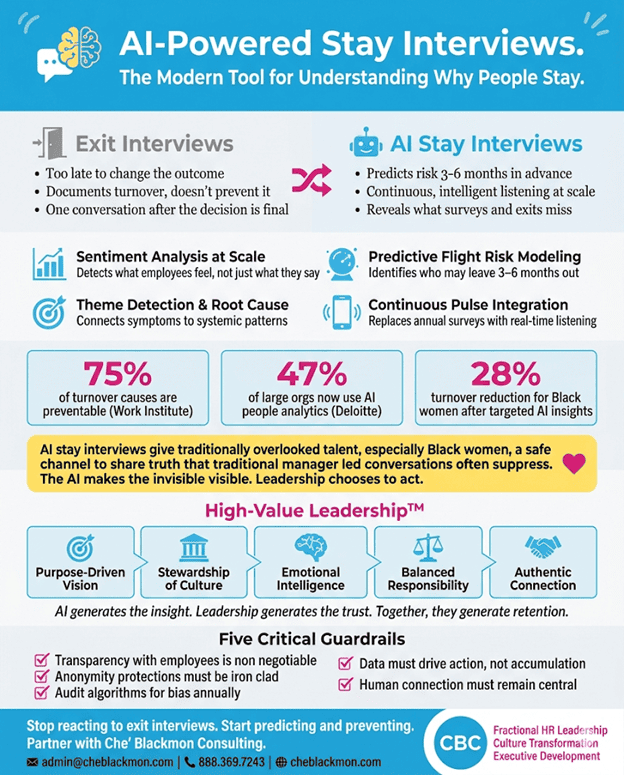
Most organizations spend the majority of their retention energy on the wrong conversation. They invest in exit interviews, asking people who have already decided to leave why they are going. By the time that conversation happens, the decision is final, the institutional knowledge is walking out the door, and the feedback arrives too late to change anything for the person giving it. Exit interviews do not prevent turnover. They document it.

Stay interviews flip the equation entirely. Instead of asking departing employees why they left, stay interviews ask current employees why they stay, what might cause them to leave, and what the organization could do differently to keep them engaged and committed. It is a simple concept with extraordinary power. And now, with the integration of artificial intelligence, the stay interview is evolving from an occasional HR initiative into a continuous, data driven retention strategy that can identify flight risk, surface hidden frustrations, and reveal engagement patterns that traditional surveys miss entirely.

In Mastering a High‑Value Company Culture, I wrote that culture is the lifeblood of any organization. But understanding the health of that lifeblood requires more than annual check ups. It requires ongoing, intelligent listening. AI powered stay interviews represent the next evolution of that listening, and organizations that embrace this tool will retain the talent their competitors are still trying to figure out how to attract.

🔄 From Exit to Stay: Why the Conversation Must Shift

The exit interview has been a staple of HR practice for decades. And for decades, it has produced the same frustrating outcome: a folder full of honest feedback from people who are no longer around to benefit from the changes that feedback might inspire. According to the Work Institute’s 2023 Retention Report, more than 75% of the root causes of voluntary turnover are preventable. The problem is not that organizations lack the information to prevent departures. The problem is that they gather that information at the wrong time.

Stay interviews address this timing gap directly. Popularized by workplace strategist Beverly Kaye and first introduced in her work on employee engagement, the stay interview is a structured, proactive conversation between a manager and a current employee designed to understand what keeps the employee engaged and what could push them toward the door. The questions are straightforward: What do you look forward to when you come to work? What are you learning here? What would make your job better? If you could change something about your role or the team, what would it be? What might tempt you to leave?

These are not complicated questions. But they are rarely asked. And when they are asked, the answers are often captured in a notebook, shared informally, and never analyzed at scale. This is where artificial intelligence changes everything.

🤖 What AI Brings to the Stay Interview

Artificial intelligence does not replace the human connection at the heart of a stay interview. What it does is amplify the organization’s ability to listen at scale, identify patterns that no individual manager could detect, and transform qualitative conversations into quantitative, actionable intelligence.

📊 Sentiment Analysis at Scale

AI powered natural language processing (NLP) tools can analyze the text and tone of stay interview responses across hundreds or thousands of employees simultaneously. These tools detect emotional sentiment, recurring themes, shifts in language over time, and even the difference between what employees say and how they say it. For example, an employee who responds “everything is fine” with language patterns that suggest resignation rather than satisfaction will be flagged differently than one who says the same words with genuine enthusiasm. This level of analysis is impossible for a human reviewer to perform consistently at scale.

🔮 Predictive Flight Risk Modeling

When stay interview data is combined with other organizational data points such as tenure, promotion history, manager tenure, performance ratings, PTO usage patterns, and engagement survey scores, AI can build predictive models that identify which employees are at elevated risk of leaving within the next three to six months. This moves retention from a reactive practice (waiting for the resignation letter) to a predictive strategy (intervening before the decision is made). In my brand voice document for Che’ Blackmon Consulting, I describe this as “predictive analytics for people, not just products.” It is the principle that the same data science rigor organizations apply to forecasting supply chain disruptions and customer churn can and should be applied to understanding and preventing talent loss.

🎯 Theme Detection and Root Cause Analysis

Traditional stay interviews produce valuable but often siloed insights. Manager A learns that their employee wants more development opportunities. Manager B learns that their employee is frustrated by scheduling practices. Manager C learns that their employee feels overlooked for recognition. In isolation, these feel like individual concerns. AI powered analysis aggregates these inputs and identifies systemic themes: perhaps development, scheduling, and recognition are not three separate problems but three symptoms of a single root cause, such as supervisor capacity or an inequitable resource allocation model. This kind of pattern recognition transforms stay interview data from anecdotal feedback into strategic intelligence.

📱 Continuous Pulse Integration

AI enables organizations to move stay interviews from an annual or quarterly event to a continuous listening rhythm. Chatbot based micro stay interviews can be deployed through existing communication platforms, asking employees two to three targeted questions at regular intervals. The AI compiles and analyzes responses over time, building a longitudinal picture of each employee’s engagement trajectory. This approach reduces survey fatigue (because each interaction is brief) while dramatically increasing the richness and timeliness of the data.

❤️ The Equity Imperative: Why AI Stay Interviews Matter Most for Overlooked Talent

Traditional stay interviews, when conducted exclusively by direct managers, carry an inherent limitation: they rely on the employee feeling psychologically safe enough to be honest with the person who holds the most direct power over their daily experience. For many employees, especially those from traditionally overlooked backgrounds, that safety does not exist.

In Rise & Thrive: A Black Woman’s Blueprint for Leadership Excellence, I address the reality that Black women in corporate spaces face a compounding set of barriers that make honest upward communication especially risky. They navigate what scholars call “double jeopardy,” facing bias related to both race and gender. They are more likely to receive coded feedback, to be overlooked for stretch assignments, and to feel that raising concerns will be career limiting. In a traditional stay interview setting, a Black woman may tell her manager “everything is fine” not because it is, but because her lived experience has taught her that honesty with authority figures can be weaponized.

AI powered stay interviews offer a critical alternative pathway. When employees can respond to stay interview questions through an anonymous or semi anonymous digital interface, the psychological barriers to honesty are significantly reduced. The employee is not looking into the eyes of the person who controls their performance review. They are sharing their truth with a system that aggregates it alongside hundreds of other voices, protecting individual identity while surfacing collective patterns.

Furthermore, AI analysis can be designed to disaggregate data by demographic group, revealing whether the stay interview themes for Black women differ from those of their peers. If Black women are consistently reporting concerns about advancement equity, feedback quality, or belonging at higher rates than the general population, the AI flags that disparity as a systemic issue requiring targeted intervention rather than burying it inside an aggregated average that makes everything look acceptable.

💡 Case in Point

There was a company in the manufacturing sector that implemented an AI powered stay interview platform across its three largest plants. The overall results were positive: 71% of employees reported feeling engaged, and the most common “stay factor” was team relationships. But when the AI disaggregated the data by race and gender, a starkly different picture emerged for Black women in mid level roles. Their top reported concern was not compensation or workload. It was “I do not feel my manager advocates for me.” This insight had never surfaced in the company’s traditional engagement survey because it was averaged into the broader population’s more positive responses.

Armed with this insight, the company implemented a targeted sponsorship program for Black women in mid level positions and added advocacy training to its supervisor coaching curriculum. Within 12 months, voluntary turnover among Black women in the organization dropped by 28%, and their engagement scores improved by 15 points. The AI did not solve the problem. It made the problem visible. Leadership solved it by choosing to act.

📈 Current Trends: The AI Stay Interview Landscape in 2025 and 2026

  • Conversational AI Platforms Are Maturing. Tools like Culture Amp, Qualtrics, Peakon (now part of Workday), and Lattice have integrated AI driven sentiment analysis into their employee listening suites. Newer entrants are building purpose built stay interview chatbots that feel conversational rather than transactional, reducing the friction that makes traditional surveys feel like homework.
  • Predictive People Analytics Is No Longer Experimental. Organizations that once viewed predictive turnover modeling as futuristic are now deploying it operationally. A 2024 report from Deloitte found that 47% of large organizations are actively using or piloting AI powered people analytics tools, up from 29% in 2022. The tools are becoming more accessible, more affordable, and more accurate.
  • Ethical AI and Algorithmic Fairness Are Front and Center. As AI tools become more prevalent in HR, concerns about algorithmic bias, data privacy, and the ethical use of employee data are intensifying. Responsible organizations are establishing AI governance frameworks that ensure their tools do not replicate or amplify existing biases. This is especially critical when analyzing data for traditionally overlooked populations, where biased algorithms could produce recommendations that worsen rather than improve equity outcomes.
  • Manager Enablement Is the Missing Piece. The most sophisticated AI platform in the world is useless if the managers who receive its insights do not know what to do with them. Progressive organizations are pairing AI stay interview tools with manager coaching programs that teach supervisors how to interpret the data, have follow up conversations, and implement changes based on what the AI reveals. The technology generates the insight. The manager generates the trust.
  • Integration with Employee Experience Ecosystems. AI stay interview data is increasingly being integrated with broader employee experience platforms that connect onboarding, learning, performance, and career mobility into a single ecosystem. This integration allows organizations to respond to a stay interview insight (“I want more development”) with a concrete action (“Here are three learning pathways aligned with your stated career goal”) in near real time.

✨ The High‑Value Leadership™ Framework and AI Stay Interviews

Technology alone does not transform culture. Technology amplifies the culture that already exists. If the culture is one of genuine listening and responsive leadership, AI stay interviews will accelerate that culture’s impact. If the culture is one of lip service and performative engagement, AI will simply produce more data that leadership ignores. The difference is the quality of the leadership operating the tool.

The High‑Value Leadership™ framework I developed through High‑Value Leadership: Transforming Organizations Through Purposeful Culture provides the leadership foundation that makes AI stay interviews effective. Each of the five pillars directly supports the conditions required for AI powered listening to produce real results.

  1. Purpose‑Driven Vision ensures that stay interview data is used in service of a compelling organizational mission, not as a surveillance tool. When employees understand that the organization’s purpose includes their growth and wellbeing, they are more willing to share honest feedback through any channel.
  2. Stewardship of Culture means that leaders actively use the insights generated by AI stay interviews to nurture the culture rather than filing them away. Stewardship requires closing the loop: telling employees what was heard, what is being done, and what cannot change (and why).
  3. Emotional Intelligence equips managers to respond to AI generated insights with empathy and skill. The data might reveal that an employee is at risk. The emotionally intelligent manager translates that data point into a human conversation that makes the employee feel seen, not surveilled.
  4. Balanced Responsibility ensures that the accountability for acting on stay interview insights does not fall solely on HR. Retention is a leadership responsibility, and AI stay interview data should be integrated into every people leader’s performance expectations.
  5. Authentic Connection reminds us that no amount of data replaces the power of a leader who knows their people. AI stay interviews provide the map. Authentic connection provides the relationship that makes the map worth following.

🌟 From My Experience: 24+ Years of Listening on the Front Lines

Long before AI tools existed, the stay interview was one of the most powerful practices in my retention toolkit. Across manufacturing, automotive, healthcare, nonprofit, quick service, and professional services industries, I consistently found that the most valuable retention intelligence came not from surveys or exit interviews but from the simple act of asking people who were still present: “What keeps you here? And what could push you away?”

There was a company in the automotive sector that was losing experienced skilled trades workers at an unsustainable rate. The exit interview data pointed to compensation as the primary driver. The company raised wages. The turnover continued. When the HR team implemented stay interviews with the remaining skilled trades employees, a completely different picture emerged. The employees who were staying were not staying for the pay. They were staying for the relationships on their teams and the respect they received from their immediate supervisors. The employees who were leaving were not leaving because of pay. They were leaving because they felt invisible to leadership, passed over for input on decisions that affected their work, and disrespected by a scheduling process that prioritized production flexibility over personal commitments.

The exit interviews had pointed to a symptom. The stay interviews revealed the disease. If that company had access to AI powered tools that could aggregate, analyze, and disaggregate those stay interview insights across every plant, every shift, and every demographic group, the intervention would have been faster, more precise, and more impactful. That is the promise of AI in this space. Not to replace the listening. To sharpen it.

⚠️ Critical Guardrails: Using AI Responsibly in Employee Listening

The power of AI stay interviews comes with real responsibilities that organizations must take seriously.

  • Transparency Is Non Negotiable. Employees must know that AI tools are being used, what data is being collected, how it will be analyzed, and who will have access to the results. Trust cannot be built through hidden surveillance. Organizations that deploy AI listening tools without transparency will deepen the engagement gap rather than closing it.
  • Anonymity Protections Must Be Real. If the AI platform promises anonymity, that promise must be iron clad. Employees who discover that their “anonymous” feedback was traceable back to them will never trust the system again, and they will warn their colleagues not to either.
  • Algorithmic Bias Must Be Audited. AI tools trained on historical data can inherit and amplify the biases embedded in that data. Organizations must audit their AI stay interview tools for bias, particularly in how they interpret sentiment across different cultural communication styles. A response pattern that an algorithm flags as “disengaged” might actually reflect a culturally specific communication norm that differs from the majority population’s style.
  • Data Must Drive Action, Not Accumulation. The fastest way to undermine an AI stay interview program is to collect insights and do nothing with them. Every cycle of data collection must be followed by visible, communicated action. When employees see that their input led to a change, they invest more trust in the process. When they see that their input disappeared into a dashboard, they stop participating.
  • Human Connection Must Remain Central. AI is the amplifier. The manager is the instrument. No algorithm can replace the moment when a leader looks an employee in the eye and says, “I heard you. Here is what we are doing about it.” That moment is where trust is built, and trust is the only foundation on which retention can stand.

✅ Actionable Takeaways: 7 Steps to Implement AI Powered Stay Interviews

  1. Start with the Human Foundation. Before deploying any AI tool, ensure your managers are trained in the fundamentals of stay interviews: how to ask the right questions, how to listen without defensiveness, and how to follow through on what they hear. Technology amplifies leadership quality. It does not create it.
  2. Select Tools That Disaggregate Data by Demographics. Any AI stay interview platform you adopt should have the capability to segment results by race, gender, tenure, role level, and location. If the tool cannot show you how the experience of Black women differs from the experience of the general population, it is not sophisticated enough for equitable culture work.
  3. Pilot Before Scaling. Implement AI powered stay interviews in one department or facility first. Learn what works, what employees respond to, and where the technology’s recommendations need human context before rolling the program across the enterprise.
  4. Communicate Transparently with Employees. Before launch, explain the purpose of the AI stay interview program, how the data will be used, what protections are in place for anonymity, and most importantly, the organization’s commitment to acting on what it learns. Transparency at the outset builds trust that sustains the program over time.
  5. Build Closed Loop Action Cycles. For every round of AI stay interview data collected, establish a clear timeline for analysis, leadership review, action planning, and communication back to employees. The cycle should be: listen, analyze, act, communicate. Repeat.
  6. Audit for Algorithmic Bias Annually. Engage an external partner or internal data science team to audit your AI tools for bias at least once per year. Pay special attention to how sentiment analysis algorithms interpret responses from employees of different racial, cultural, and linguistic backgrounds.
  7. Integrate Stay Interview Insights with Manager Coaching. The AI generates the data. The manager generates the relationship. Ensure your supervisor coaching program includes training on how to interpret AI stay interview insights and translate them into meaningful, personalized conversations with team members.

💬 Discussion Questions for Your Leadership Team

Use these questions to explore how AI powered stay interviews could transform your organization’s approach to retention:

  1. Are we currently conducting stay interviews in any form? If so, how are we analyzing and acting on the data? If not, what has prevented us from starting?
  2. How confident are we that our employees, especially Black women and other traditionally overlooked talent, feel safe enough to give honest feedback through existing channels? What evidence do we have?
  3. If we disaggregated our retention and engagement data by race and gender tomorrow, what would we expect to find? What would we be afraid to find?
  4. Are our managers equipped to act on the insights an AI stay interview platform would generate? Or would we need to invest in coaching and development before deploying the technology?
  5. What ethical guardrails do we have in place for using AI in our people practices? How would we ensure transparency, anonymity, and algorithmic fairness?
  6. Which of the five High‑Value Leadership™ pillars (Purpose‑Driven Vision, Stewardship of Culture, Emotional Intelligence, Balanced Responsibility, Authentic Connection) represents our organization’s greatest strength in listening to employees? Which represents our biggest gap?
  7. If we could predict which employees are at risk of leaving six months from now, what would we do differently today? Are we prepared to act on that knowledge?

🚀 Next Steps: Stop Reacting. Start Predicting.

The organizations that will win the talent war in the next decade will not be the ones that offer the highest salaries or the best perks. They will be the ones that understand their people so well that they can predict and prevent the conditions that cause good people to leave. AI powered stay interviews are not a futuristic fantasy. They are available today, and they are already transforming retention outcomes for organizations that have the leadership courage to listen, disaggregate, and act.

If you are ready to evolve your retention strategy from exit interviews and annual surveys to continuous, intelligent, equitable listening, Che’ Blackmon Consulting can help. Through fractional HR leadership, culture transformation consulting, and AI powered retention strategy development rooted in the High‑Value Leadership™ framework, we partner with organizations to build cultures that do not just attract talent but understand it, invest in it, and keep it.

Because the best retention strategy is not reacting to exit interviews. It is creating an environment where your best people never want to leave. And the first step is asking them why they stay.

🌟 Ready to Transform Your Organization’s Culture?

Work with Che’ Blackmon Consulting

📧  admin@cheblackmon.com

📞  888.369.7243

🌐  cheblackmon.com

📚 Explore More from Che’ Blackmon

Mastering a High‑Value Company Culture – Available on Amazon

High‑Value Leadership: Transforming Organizations Through Purposeful Culture – Available on Amazon

Rise & Thrive: A Black Woman’s Blueprint for Leadership Excellence – E‑Book Available at cheblackmon.com

🎥 Rise & Thrive YouTube Series | 🎙️ Unlock, Empower, Transform Podcast

© 2026 Che’ Blackmon Consulting. All rights reserved.

High‑Value Leadership™ is a proprietary framework of Che’ Blackmon Consulting.

#AIinHR #StayInterviews #PredictiveAnalytics #HighValueLeadership #EmployeeRetention #PeopleAnalytics #WorkplaceCulture #CultureTransformation #BlackWomenInLeadership #TalentRetention #HRTechnology #CheBlackmonConsulting #FractionalHR #RetentionStrategy #EmployeeListening #PsychologicalSafety #FutureOfWork #HRInnovation #LeadershipDevelopment #RiseAndThrive

📚 The Engagement Gap: What Your Employees Are Thinking But Not Saying

📖 Book Tie‑In: Mastering a High‑Value Company Culture — Engagement and Psychological Safety

By Che’ Blackmon, DBA Candidate | Founder & CEO, Che’ Blackmon Consulting

Your employees are talking. They are talking to their partners over dinner. They are talking to their friends on the weekend. They are talking to recruiters in their LinkedIn inboxes. The one place they are not talking? To you.

This is the engagement gap, and it is one of the most expensive, pervasive, and misunderstood problems in modern organizations. It is the distance between what employees actually think about their work, their leaders, and their future at the company, and what they are willing to say out loud. That gap is not empty. It is filled with frustration, unspoken ideas, eroding trust, and quiet plans to leave.

In Mastering a High‑Value Company Culture, I wrote that culture is the lifeblood of any organization. But culture does not reveal itself through what people say in town hall meetings when the CEO is watching. It reveals itself in what people say when they feel safe enough to be honest, and more importantly, in what they choose not to say when they do not feel safe at all. The engagement gap is the space where culture is actually lived. And for most organizations, that space is a warning they have not yet learned to read.

📊 The State of Silence: What the Data Reveals

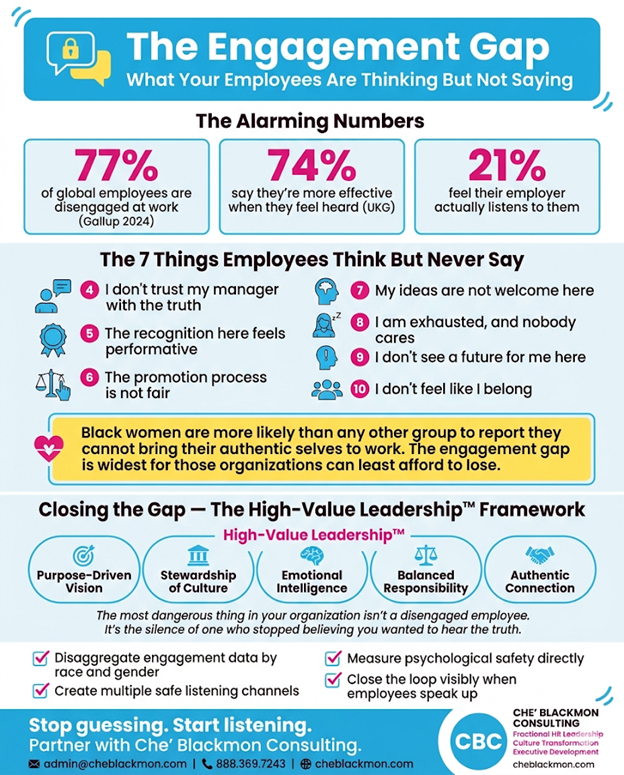
The numbers on employee engagement have been alarming for years, and they are not improving fast enough. Gallup’s 2024 State of the Global Workplace report found that only 23% of employees worldwide are engaged at work. That means 77% of the global workforce is either not engaged or actively disengaged. In the United States, the number is slightly better at 33%, but that still means two out of every three American workers are showing up without being fully invested in the work they do or the organizations they serve.

But here is the part that rarely makes the headlines. Disengagement does not always look like poor performance. Some of the most disengaged employees in your organization are hitting their numbers, meeting their deadlines, and attending every meeting. They are doing just enough to stay employed while investing their creativity, passion, and discretionary effort somewhere else. Gallup calls this “quiet quitting,” but that term obscures the real issue. These employees have not quit their work ethic. They have quit their belief that the organization deserves their best.

The engagement gap lives in the silence between what leaders ask and what employees reveal. A 2023 study by the Workforce Institute at UKG found that 74% of employees believe they are more effective when they feel heard, yet only 21% feel strongly that their employer genuinely listens to them. That 53 percentage point chasm is not a communication issue. It is a trust issue. And trust is the foundation upon which every other element of engagement is built.

🧠 The Psychology of Silence: Why Employees Stop Talking

Understanding why employees go silent requires understanding the concept of psychological safety, a term popularized by Harvard Business School professor Amy Edmondson. Psychological safety is the shared belief that a team is safe for interpersonal risk taking. It means employees feel they can speak up, ask questions, admit mistakes, and challenge ideas without fear of humiliation, punishment, or career consequences.

Google’s landmark Project Aristotle research confirmed that psychological safety is the single most important factor in high performing teams. Teams with high psychological safety outperformed their peers on every meaningful metric, not because they had smarter people, but because their people felt safe enough to contribute fully.

When psychological safety is absent, employees perform a constant internal calculation before every interaction. “If I raise this concern, will my manager retaliate?” “If I admit I do not understand, will I be seen as incompetent?” “If I challenge this decision, will I be labeled as difficult?” “If I share this idea, will someone else take credit for it?” These calculations happen in seconds, and they happen dozens of times a day. Over time, the cost of speaking up begins to consistently outweigh the perceived benefit, and silence becomes the rational choice.

In Mastering a High‑Value Company Culture, I describe the contrast between two operations managers I observed over the course of my career. One leader, whom I called Mark, created an environment where people felt safe to communicate openly and take ownership of their work. The other, Larry, fostered a climate of passive aggressive retaliation where employees learned quickly that honesty was punished. Both managers worked in the same company, under the same mission statement, governed by the same values poster on the wall. The difference in the cultures they created was entirely a function of whether their people felt psychologically safe enough to engage authentically.

🔇 The Seven Things Employees Think But Never Say

Based on more than 24 years of HR leadership across manufacturing, automotive, healthcare, nonprofit, quick service, and professional services industries, and informed by countless exit interviews, engagement surveys, skip level conversations, and confidential coaching sessions, the following represent the most common unspoken truths employees carry with them every day.

1. “I do not trust my manager with the truth.” 🤐

This is the foundational silence. When employees do not trust that their direct supervisor will handle honest feedback with maturity and without retaliation, they learn to tell leadership what it wants to hear. They smile in one on one meetings. They check “satisfied” on the survey. And they apply for other jobs in the parking lot.

2. “The recognition here feels performative.” 🏆

Employees can tell the difference between genuine recognition and scripted appreciation. When leaders praise publicly but criticize privately, when recognition goes to the same people regardless of contribution, or when “Employee of the Month” is chosen by rotation rather than merit, people disengage from the entire system. They stop seeking recognition and start seeking employers who notice real contributions.

3. “The promotion process is not fair.” 🚧

Few things erode engagement faster than watching someone less qualified advance while you are told to “be patient” or “keep doing great work.” When employees perceive that advancement is based on relationships rather than results, or that certain demographics consistently advance while others are passed over, the message is clear even if it is never spoken aloud: your ceiling is predetermined.

4. “My ideas are not welcome here.” 💡

Innovation does not die because employees lack creativity. It dies because employees stop offering their ideas after being dismissed, ignored, or worse, watching their ideas get implemented after someone else presents them. The engagement gap widens every time an employee sits in a meeting with a solution they will never share because the last time they spoke up, nothing happened.

5. “I am exhausted, and nobody cares.” 😩

Burnout has become normalized in many workplaces. Employees describe working through illness, skipping vacations, and taking on additional responsibilities after colleagues leave without any adjustment to workload or compensation. When they raise concerns, they are met with some version of “we all have to do more with less.” That response does not build resilience. It builds resentment.

6. “I do not see a future for me here.” 🔮

This may be the most dangerous unspoken truth because it represents the moment an employee transitions from disengaged to departing. When people cannot envision their next role, their next opportunity for growth, or their next milestone within the organization, they begin envisioning it somewhere else. The engagement gap becomes a retention crisis the moment an employee stops seeing themselves in the company’s future.

7. “I do not feel like I belong.” 💔

Belonging is not the same as inclusion, and it runs deeper than diversity metrics. An employee can be included in every meeting and still feel like they do not belong. Belonging means feeling that your authentic self is valued, that your perspective matters, and that your presence is not merely tolerated but genuinely wanted. When belonging is absent, engagement is impossible.

❤️ The Amplified Gap: How Silence Disproportionately Impacts Black Women

Every one of the seven unspoken truths listed above is experienced more acutely by traditionally overlooked employees, and most specifically by Black women in corporate spaces.

In Rise & Thrive: A Black Woman’s Blueprint for Leadership Excellence, I address what scholars call “double jeopardy,” the compounding reality of navigating bias related to both race and gender simultaneously. Black women face contradictory expectations in the workplace: be assertive but not aggressive, be visible but not too visible, be confident but not intimidating. The cognitive and emotional labor required to navigate these contradictions every day is exhausting and largely invisible to leadership.

McKinsey’s 2023 “Women in the Workplace” report, conducted with LeanIn.Org, found that Black women are more likely than any other demographic group to report that they cannot bring their authentic selves to work. They are more likely to experience microaggressions, to have their judgment questioned, to be mistaken for someone in a more junior role, and to feel that they need to outperform their peers just to be perceived as equally competent.

For Black women, the engagement gap is not simply about whether the organization listens. It is about whether the organization has created conditions where it is safe for them to speak at all. When a Black woman raises a concern and is labeled “angry,” she learns to stay silent. When she shares an idea and watches a peer present the same idea two weeks later to applause, she learns to keep her insights to herself. When she asks about her career trajectory and receives vague non answers while watching others with less experience advance, she learns that this organization’s version of meritocracy does not include her.

These are not isolated incidents. They are systemic patterns, and they create an engagement gap that is significantly wider and deeper for Black women than for their counterparts.

💡 Case in Point

There was a company in the healthcare industry that prided itself on strong engagement scores. The overall score hovered around 78%, well above the industry average. But when the HR team disaggregated the data by race and gender for the first time, a different picture emerged. Engagement among Black women in the organization was 52%, a full 26 points below the company average. The gap had been invisible for years because no one had thought to look at it.

When focus groups were convened, the themes were consistent. Black women described feeling invisible in team meetings, receiving feedback that felt racially coded, watching peers with less tenure receive developmental opportunities they had requested and been denied, and sensing that raising concerns would be career limiting. The organization’s culture was not universally broken. It was selectively broken, and the employees experiencing the worst of it were the least likely to report it through traditional engagement channels.

The company responded by implementing confidential listening sessions, disaggregated engagement tracking, bias awareness training for all people leaders, and an equitable sponsorship program. Within 12 months, engagement among Black women rose to 71%, closing the gap by 19 points. The company also saw improvements in overall engagement, innovation metrics, and retention across every demographic because the systemic issues affecting Black women had been dragging the broader culture down as well.

📈 Current Trends: The Evolving Engagement Landscape in 2025 and 2026

Several converging trends are reshaping how organizations must think about engagement and the silence that surrounds it.

  • Survey Fatigue and Declining Participation. Employees are increasingly skeptical of engagement surveys, particularly when previous surveys produced no visible changes. Response rates have declined across industries, and organizations that rely solely on annual surveys are getting an increasingly incomplete and unreliable picture of their culture.
  • The Rise of Passive Listening. Progressive organizations are supplementing surveys with passive listening tools that analyze communication patterns, meeting participation, collaboration networks, and sentiment from internal platforms to identify engagement signals without relying on employees to self report. These tools raise important ethical questions about privacy, but they represent a fundamental shift in how organizations measure the gap between what employees say and what they actually experience.
  • The Trust Recession. Edelman’s 2024 Trust Barometer found that trust in employers has declined for the second consecutive year. Employees increasingly question whether leadership decisions are made in their interest, particularly around return to office mandates, layoff strategies, and the deployment of AI technologies that may affect their roles. This broader trust recession makes the engagement gap harder to close because employees are starting from a lower baseline of belief in organizational sincerity.
  • Gen Z’s Vocal Disillusionment. Unlike previous generations who tended to disengage silently, Gen Z employees are more likely to voice their dissatisfaction publicly, on social media, in Glassdoor reviews, and in team Slack channels. While this transparency can be uncomfortable for leadership, it also provides organizations with more visible signals of the engagement gap than they have ever had before. The question is whether leaders are listening or dismissing these signals as generational entitlement.
  • Belonging as the New Engagement Frontier. Research from BetterUp has shown that workplace belonging is correlated with a 56% increase in job performance, a 50% reduction in turnover risk, and a 75% decrease in sick days. Organizations that focus exclusively on engagement metrics without measuring belonging are addressing the symptom while ignoring the cause.

✨ Closing the Gap: The High‑Value Leadership™ Approach

Closing the engagement gap requires more than better surveys and bigger budgets for pizza parties. It requires a fundamental shift in how leaders think about the relationship between culture, trust, and the daily experience of every employee. The High‑Value Leadership™ framework I developed through High‑Value Leadership: Transforming Organizations Through Purposeful Culture provides a structured approach to this shift, grounded in five interconnected pillars.

🎯 Purpose‑Driven Vision: Answering the “Why” Before the “What”

Employees disengage when they cannot connect their daily work to a meaningful purpose. Leaders who articulate a compelling “why” and consistently connect individual contributions to that larger mission create environments where people feel their work matters. When work matters, silence gives way to investment.

🏛️ Stewardship of Culture: Listening Before Directing

Culture does not maintain itself. It requires active stewardship, which begins with genuine listening. Stewardship means creating multiple, safe channels for employees to share their truth: not just annual surveys, but regular pulse checks, skip level meetings, stay interviews, anonymous feedback mechanisms, and walking the floor conversations that happen outside of formal settings. Stewardship also means acting visibly on what you hear, because listening without action is worse than not asking at all.

🧠 Emotional Intelligence: Reading What Is Not Said

Emotionally intelligent leaders do not wait for employees to raise their hands. They read body language, notice changes in participation, pay attention to who has stopped contributing in meetings, and follow up when something feels off. Daniel Goleman’s research has consistently demonstrated that emotional intelligence is the strongest predictor of leadership effectiveness. In the context of the engagement gap, it is the skill that allows leaders to hear what employees are thinking even when they are not saying it.

⚖️ Balanced Responsibility: Accountability with Humanity

High performing cultures balance accountability with genuine care for the people being held accountable. When accountability is imposed without empathy, it creates fear. When empathy is extended without accountability, it creates complacency. The balance between these forces is where psychological safety lives, and psychological safety is the single most important condition for closing the engagement gap.

🤝 Authentic Connection: Making It Safe to Be Honest

Authentic connection means building relationships where honesty is not just permitted but rewarded. It means leaders who share their own challenges, who admit when they do not have answers, who demonstrate vulnerability as a strength rather than a liability. When leaders model authenticity, they give employees permission to do the same. And when employees feel that permission, the engagement gap begins to close.

🌟 From My Experience: Lessons from 24+ Years on the Front Lines of Engagement

Across every industry I have served, the engagement gap has been a constant companion. I have seen it manifest differently depending on the environment. In manufacturing and automotive settings, it shows up as high absenteeism, safety incidents, and grievance filings. In healthcare, it appears as compassion fatigue, short staffing spirals, and patient care errors. In professional services, it looks like presenteeism, performative busyness, and the quiet exodus of top talent to competitors who promised what the current employer could not deliver.

There was an automotive manufacturing company that was experiencing a steady decline in its employee engagement survey scores over three consecutive years. Leadership attributed the decline to “post pandemic fatigue” and assumed it would resolve on its own. It did not. The HR team conducted confidential listening sessions with employees at every level and discovered a pattern: frontline workers felt that leadership made decisions that affected their daily lives without ever consulting them. Shift schedules were changed without input. Safety protocols were adjusted without explanation. Overtime was mandated without acknowledgment of the personal cost.

The employees had not stopped caring about their work. They had stopped believing that their input mattered. When the company implemented a structured feedback loop that included shift level advisory councils, transparent communication about scheduling decisions, and a recognition program designed with employee input, engagement scores reversed course within two quarters. The gap had not been about engagement programs. It had been about voice.

✅ Actionable Takeaways: 8 Steps to Close the Engagement Gap

  1. Disaggregate Your Engagement Data. Stop looking at your engagement scores as a single number. Break them down by department, team, tenure, and most critically, by race and gender. The gaps you discover will tell you where your culture is actually broken.
  2. Create Multiple Listening Channels. Annual surveys are not enough. Implement pulse surveys, skip level meetings, confidential listening sessions, stay interviews, and leader rounding. Different employees feel safe in different formats. Give them options.
  3. Close the Loop Visibly. When employees share feedback, they need to see evidence that it was received and considered. Communicate what you heard, what you are doing about it, and what you cannot change (and why). The fastest way to widen the engagement gap is to ask for feedback and then do nothing with it.
  4. Measure Psychological Safety Directly. Add specific questions to your engagement surveys that measure whether employees feel safe speaking up, challenging ideas, admitting mistakes, and being honest with their managers. Track these scores over time and by team.
  5. Train Leaders in Emotional Intelligence. Equip your managers with the ability to read nonverbal cues, ask open ended questions, create space for honest dialogue, and respond to vulnerability with support rather than judgment. These skills are trainable and their impact on engagement is measurable.
  6. Audit Your Belonging Practices. Go beyond inclusion metrics. Ask whether employees, especially Black women and other traditionally overlooked talent, feel they genuinely belong. Do they see themselves reflected in leadership? Are their cultural identities respected? Do they feel their perspectives are sought and valued?
  7. Redesign Recognition to Be Equitable and Specific. Examine who gets recognized, for what, and by whom. Ensure recognition is distributed equitably across demographics and that it is specific enough to feel meaningful. “Great job” is forgettable. “Your analysis in the Q3 review changed how we approach that entire product line” is transformational.
  8. Make Engagement a Leadership Accountability, Not an HR Program. Engagement should be a standing item on every leadership team agenda, reviewed with the same rigor as financial performance, quality metrics, and customer satisfaction. When engagement is treated as HR’s problem, it remains HR’s problem. When it becomes a leadership accountability, it becomes a business advantage.

💬 Discussion Questions for Your Leadership Team

Use these questions to open an honest conversation about the engagement gap in your organization:

  1. When was the last time an employee told us something we did not want to hear? How did we respond? And what does that response signal to everyone watching?
  2. If we disaggregated our engagement data by race and gender today, what would we find? Do we have the courage to look?
  3. Do our employees trust their direct supervisors enough to be honest? How do we know, and what evidence do we have beyond our own assumptions?
  4. Which of the seven unspoken truths in this article resonates most with what we suspect our employees are experiencing? What would we do differently if we treated that suspicion as fact?
  5. Are Black women and other traditionally overlooked employees in our organization experiencing a different culture than what our overall engagement scores suggest? What would it take to find out?
  6. Which of the five High‑Value Leadership™ pillars (Purpose‑Driven Vision, Stewardship of Culture, Emotional Intelligence, Balanced Responsibility, Authentic Connection) represents our organization’s biggest opportunity to close the engagement gap?
  7. If our employees could say one thing to leadership with complete safety and no consequences, what do we think they would say? And what are we doing to create the conditions where they actually can?

🚀 Next Steps: Start Hearing What Has Always Been There

The engagement gap is not new. It has always existed. What is new is our understanding of how much it costs, who it impacts most, and what it takes to close it. The employees in your organization are not withholding their truth to be difficult. They are withholding it because the environment has taught them that honesty is risky. Changing that equation is not a program. It is a leadership commitment.

If you are ready to move beyond surface level engagement scores and begin understanding the culture your employees actually experience, Che’ Blackmon Consulting can help. Through fractional HR leadership, culture assessments, engagement strategy development, and leadership coaching rooted in the High‑Value Leadership™ framework, we partner with organizations to create environments where employees do not just show up. They speak up, lean in, and stay.

Because the most dangerous thing in your organization is not a disengaged employee. It is the silence of an employee who stopped believing you wanted to hear the truth.

🌟 Ready to Transform Your Organization’s Culture?

Work with Che’ Blackmon Consulting

📧  admin@cheblackmon.com

📞  888.369.7243

🌐  cheblackmon.com

📚 Explore More from Che’ Blackmon

Mastering a High‑Value Company Culture – Available on Amazon

High‑Value Leadership: Transforming Organizations Through Purposeful Culture – Available on Amazon

Rise & Thrive: A Black Woman’s Blueprint for Leadership Excellence – E‑Book Available at cheblackmon.com

🎥 Rise & Thrive YouTube Series | 🎙️ Unlock, Empower, Transform Podcast

© 2026 Che’ Blackmon Consulting. All rights reserved.

High‑Value Leadership™ is a proprietary framework of Che’ Blackmon Consulting.

#EngagementGap #EmployeeEngagement #HighValueLeadership #PsychologicalSafety #WorkplaceCulture #CultureTransformation #BlackWomenInLeadership #EmployeeVoice #RetentionStrategy #HRLeadership #LeadershipDevelopment #TalentRetention #CheBlackmonConsulting #FractionalHR #InclusiveLeadership #BelongingAtWork #PeopleFirst #QuietQuitting #EmployeeExperience #RiseAndThrive

📚 Supervisor Coaching as Retention Strategy: Why Your Managers Are Your Biggest Flight Risk Factor

By Che’ Blackmon, DBA Candidate | Founder & CEO, Che’ Blackmon Consulting

There is an old saying in human resources that people do not leave companies; they leave managers. It has been repeated so often that it almost sounds like a cliché. But the reason it endures is because the data behind it is overwhelming, and most organizations still have not done anything meaningful about it.

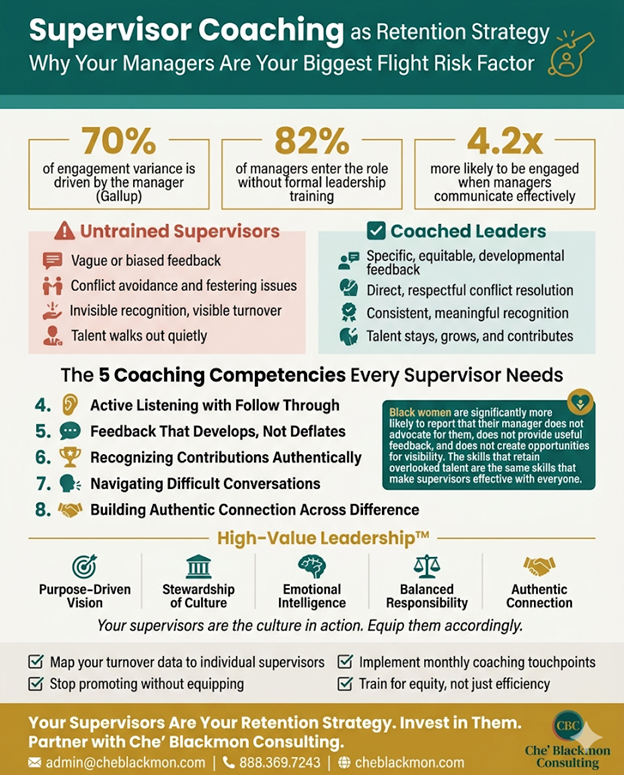
Gallup’s research has confirmed this reality for over two decades. Managers account for at least 70% of the variance in employee engagement scores. That is not a typo. Seventy percent. Which means your supervisors, your shift leads, your department heads, and your frontline managers are not just influencing retention. They are your retention strategy, whether they know it or not. And whether they are equipped for that role or not.

In Mastering a High‑Value Company Culture, I wrote that culture is the lifeblood of any organization. But culture does not flow from mission statements framed in the lobby. It flows from the daily interactions between employees and the leaders closest to them. Your frontline supervisor who dismisses a concern without listening. Your department manager who plays favorites and calls it performance management. Your team lead who takes credit for someone else’s work without blinking. These are the moments where culture is built or destroyed, one conversation at a time. And these are the moments that determine whether your best people stay or go.

🚨 The Manager Gap: Promoted for Performance, Failing at People

One of the most consistent patterns across every industry I have worked in over more than 24 years of HR leadership, from automotive and manufacturing to healthcare, nonprofit, quick service, and professional services, is this: organizations routinely promote their best individual contributors into management roles and then provide little to no development for the leadership skills that role actually requires.

The best welder becomes the welding supervisor. The top performing nurse becomes the charge nurse. The highest billing associate becomes the team lead. The assumption is that because someone excels at doing the work, they will naturally excel at leading the people who do the work. That assumption is expensive and wrong.

A 2024 survey conducted by the Chartered Management Institute found that 82% of managers in the United Kingdom entered management roles without any formal training in leadership. While the study focused on the UK workforce, similar patterns have been well documented in the United States. The result is what researchers have termed “accidental managers,” individuals who hold authority over others without ever being taught how to lead, communicate, coach, or resolve conflict effectively.

In High‑Value Leadership: Transforming Organizations Through Purposeful Culture, I outline the concept of Balanced Responsibility as one of the five pillars of the High‑Value Leadership™ framework. Balanced Responsibility means holding people accountable while simultaneously investing in their development. When organizations promote people into supervisory roles without equipping them to lead, they violate this principle in both directions. They hold the new manager accountable for outcomes without providing the support to achieve them. And they hold the team accountable for engagement while placing them under someone who was never taught how to engage.

📉 What the Research Tells Us: Managers Are the Multiplier

The connection between manager quality and employee retention is not speculation. It is one of the most well documented relationships in organizational science.

Gallup’s 2024 State of the Global Workplace report found that employees who strongly agree their manager communicates effectively are 4.2 times more likely to be engaged at work. Meanwhile, employees who rate their immediate supervisor poorly are four times more likely to be actively looking for a new job. The report further noted that improving manager effectiveness is the single most impactful action an organization can take to improve overall workplace engagement and retention.

A separate study by the Work Institute’s 2023 Retention Report found that the top three reasons employees voluntarily leave organizations are career development opportunities, work life balance, and manager behavior. Of those three, manager behavior is the factor most within the organization’s immediate control because it can be improved through targeted coaching, development, and accountability.

Dr. John Gottman, the renowned relationship researcher, has identified that it takes a ratio of five positive interactions to one negative interaction to maintain a healthy relationship. While his work focuses on personal relationships, organizational psychologists have applied this principle to the workplace with striking results. Managers who maintain high ratios of positive to corrective interactions retain more people, receive higher trust scores, and produce stronger team outcomes. Managers who default to criticism, micromanagement, or indifference create environments where people emotionally disengage long before they formally resign.

🎯 The Five Coaching Competencies Every Supervisor Needs

Supervisor coaching is not about turning every manager into a therapist or a motivational speaker. It is about building a consistent, practical set of leadership competencies that directly influence whether employees feel valued, heard, and motivated to stay. Based on the High‑Value Leadership™ framework and more than two decades of applied experience, the following five competencies are the ones that matter most for retention.

🔑 1. Active Listening with Follow Through

Most employees do not expect their manager to solve every problem. What they expect is to be heard and to see evidence that their input was taken seriously. Active listening is not nodding during a conversation and then doing nothing. It is reflecting what was said, asking clarifying questions, and then following up with visible action or a transparent explanation of why action was not taken. When managers master this competency, trust builds quickly. When they fail at it, resentment builds faster.

🔑 2. Delivering Feedback That Develops, Not Deflates

Feedback is a tool. In the hands of a skilled leader, it sharpens performance. In the hands of an untrained supervisor, it creates fear, defensiveness, and disengagement. Effective supervisor coaching teaches managers how to deliver feedback that is specific, timely, behavior focused, and forward looking. It teaches them to replace statements like “you need to do better” with observations like “in yesterday’s team meeting, I noticed you had some strong ideas that you did not share until the end. I would love to see you bring those contributions in earlier next time because the team benefits from your perspective.” That shift in approach changes the entire dynamic.

🔑 3. Recognizing Contributions Authentically

Recognition is one of the most powerful and most underutilized retention tools available to any manager. And it costs nothing. A 2023 Workhuman and Gallup joint study found that employees who receive meaningful recognition are five times more likely to feel connected to their company’s culture and four times more likely to be engaged. Yet the same study found that only 23% of employees strongly agree they receive the right amount of recognition for the work they do. Supervisor coaching should include structured guidance on how to recognize contributions in ways that are specific, personal, and consistent. Generic praise like “good job” is forgettable. Recognition that names the specific contribution, explains its impact, and connects it to the team’s purpose is transformational.

🔑 4. Navigating Difficult Conversations Without Avoidance

Many supervisors avoid conflict because they were never taught how to handle it. They let performance issues fester until they become crises. They avoid addressing interpersonal tensions until the team fractures. They dodge conversations about compensation, career progression, or workload because they do not know what to say. This avoidance does not protect anyone. It signals to employees that their concerns are not important enough to address, which accelerates disengagement and turnover. Coaching supervisors in conflict navigation, using frameworks grounded in Emotional Intelligence (the third pillar of High‑Value Leadership™), equips them to have direct, respectful conversations that resolve issues rather than burying them.

🔑 5. Building Authentic Connection Across Difference

The fifth pillar of the High‑Value Leadership™ framework is Authentic Connection, and it is perhaps the most important competency for supervisors leading increasingly diverse teams. Authentic connection means knowing your people beyond their job titles. It means understanding what motivates them, what frustrates them, what their career aspirations are, and what makes them feel valued. It also means developing the cultural competence to connect effectively across differences of race, gender, generation, and background. Supervisors who build authentic connections with their teams create bonds that are far more durable than any compensation package or benefits plan.

❤️ The Overlooked Impact: When Manager Gaps Hit Black Women Hardest

The consequences of poorly equipped supervisors are not distributed equally across the workforce. Traditionally overlooked employees, and most specifically Black women in corporate spaces, experience the effects of unskilled management at a disproportionate rate.

In Rise & Thrive: A Black Woman’s Blueprint for Leadership Excellence, I address the reality that Black women face what scholars call “double jeopardy” in the workplace, navigating bias related to both race and gender simultaneously. This reality becomes especially acute when the person with the most direct power over your daily work experience, your immediate supervisor, lacks the emotional intelligence, cultural competence, or coaching skill to lead you equitably.

McKinsey’s 2023 “Women in the Workplace” research, conducted in partnership with LeanIn.Org, found that Black women are significantly more likely than white women to report that their manager does not advocate for them, does not provide useful feedback, and does not create opportunities for visibility. They are also more likely to report receiving feedback that is coded with racial and gender bias, such as being told they are “too assertive,” “intimidating,” or that they “need to soften their approach.”

These dynamics are not just uncomfortable. They are retention killers. When a Black woman’s manager does not have the competence to provide equitable coaching, fair recognition, and unbiased feedback, she experiences the workplace as a place that does not value her contributions. She begins to disengage. She stops volunteering for stretch assignments because the risk feels too high and the reward too unlikely. She updates her resume quietly. And when she leaves, the organization often has no idea that the root cause was not compensation, not location, not the role itself, but the person in the chair directly above hers.

💡 Case in Point

There was a company in the professional services sector that conducted an analysis of its voluntary turnover data over a three year period. When the data was segmented by demographic, the results were stark: Black women were leaving at nearly twice the rate of their white counterparts. Exit interviews pointed to a common theme. The departing employees did not feel supported by their direct supervisors. They described managers who overlooked them for project leadership, gave them vague feedback while providing detailed developmental guidance to peers, and excluded them from informal networking opportunities where real career decisions were made.

The company’s response was to implement a mandatory supervisor coaching program that included training on bias awareness, equitable feedback practices, and inclusive sponsorship. Within 18 months, voluntary turnover among Black women in the organization decreased by 34%. The program did not just improve diversity metrics. It improved overall team performance and engagement scores across every demographic, because the skills that make a supervisor effective with overlooked talent are the same skills that make them effective with everyone.

📈 Current Trends: The Coaching Revolution in 2025 and 2026

Several converging trends are pushing supervisor coaching from a “nice to have” to a strategic imperative for forward thinking organizations.

  • The Manager Burnout Epidemic. Managers themselves are burning out at record rates. A 2024 report from Microsoft’s Work Trend Index found that 53% of managers say they feel burned out at work, making them less effective leaders and more likely to leave themselves. Coaching is not just about making managers better for their teams. It is about sustaining the managers who hold the organization together.
  • The Shift from Performance Reviews to Ongoing Coaching. Leading organizations are abandoning the annual performance review in favor of continuous coaching conversations. Companies like Adobe, Microsoft, and Deloitte have restructured their performance management systems around regular one on one coaching interactions. This shift demands that supervisors develop real coaching skills, not just the ability to fill out a rating form once a year.
  • Gen Z’s Non Negotiable Demand for Feedback. The newest generation in the workforce is vocal about wanting frequent, constructive, and personalized feedback from their managers. Research from Deloitte’s Gen Z and Millennial Survey consistently shows that young employees prioritize manager quality and development support above nearly every other factor when evaluating whether to stay with an employer.
  • AI as a Coach Amplifier, Not a Replacement. Organizations are beginning to deploy AI tools that support managers with real time coaching prompts, sentiment analysis from team surveys, and personalized development recommendations. These tools are promising, but they amplify the effectiveness of already skilled coaches. They cannot compensate for a manager who fundamentally lacks the ability to connect with, listen to, and develop people.
  • Psychological Safety as a Business Metric. Google’s Project Aristotle research established that psychological safety is the most important factor in high performing teams. That research has now been widely adopted, and progressive organizations are measuring psychological safety as a leading indicator of both engagement and retention. Since supervisors are the primary architects of psychological safety within their teams, coaching them in this area has become a direct investment in business performance.

🛠️ Building a Supervisor Coaching Program That Actually Works

Many organizations have attempted manager training programs that produced no lasting change. The workshops were attended, the evaluations were completed, and within 30 days the old behaviors returned. The difference between training that fades and coaching that transforms is structural. Effective supervisor coaching programs share several critical design elements.

✨ Element 1: Anchor Coaching in Organizational Purpose

The first pillar of the High‑Value Leadership™ framework is Purpose‑Driven Vision. Supervisor coaching should not be positioned as remedial or punitive. It should be framed as a strategic investment in the organization’s mission. When managers understand that their coaching development is connected to the company’s larger purpose and that the organization views them as essential to its success, buy in increases dramatically.

✨ Element 2: Replace One Time Workshops with Sustained Practice

A two hour workshop on “effective feedback” will not change behavior. What changes behavior is repeated practice with real time observation and feedback. Effective programs incorporate monthly coaching circles where supervisors practice skills with peers, shadow coaching sessions where a coach observes the supervisor in their natural work environment, and structured reflection exercises that connect daily interactions to leadership competency development.

✨ Element 3: Measure Impact Through Retention Data, Not Just Satisfaction Scores

Most training programs measure success by participant satisfaction (“Did you enjoy the workshop?”). Effective coaching programs measure success by business outcomes. Track voluntary turnover rates by team before and after coaching implementation. Monitor engagement survey scores at the supervisor level. Analyze regrettable turnover data to determine whether coaching is reducing the loss of high performers. These metrics create accountability and demonstrate ROI to senior leadership.

✨ Element 4: Include Equity and Inclusion as Core Competencies

Supervisor coaching programs that do not address bias, cultural competence, and equitable treatment are incomplete. As discussed in the equity section above, the skills that retain overlooked talent are not optional add ons. They are foundational. Every coaching curriculum should include modules on recognizing and interrupting bias in feedback, ensuring equitable access to development opportunities, and building trust across cultural differences.

✨ Element 5: Support the Coaches

Supervisors cannot pour from an empty cup. Effective coaching programs also include support for the supervisors themselves: access to their own coaching relationships, clear boundaries around their span of control, workload assessments to prevent burnout, and recognition for the invisible labor of people leadership. This aligns directly with the Stewardship of Culture pillar, which teaches that culture must be nurtured at every level, including at the level of those entrusted with stewarding it.

🌟 From My Experience: What 24+ Years in the Trenches Has Taught Me

Across every industry I have served in my career, from the plant floor to the executive suite, the pattern is unmistakable. When supervisors are coached, engagement rises, grievances decline, safety improves, quality improves, and turnover slows. When supervisors are neglected, every metric that matters to the business suffers.

There was a company in the automotive manufacturing sector that was struggling with chronic first year turnover on its production floor. The HR team analyzed the data and discovered that 60% of new hires who left within their first year were assigned to the same three supervisors. These were not bad people. They were technically proficient, experienced operators who had been promoted based on their production knowledge. But they had never been taught how to onboard new team members, deliver constructive feedback, or create an environment where people felt welcome and supported during their most vulnerable first weeks on the job.

The company implemented a targeted coaching program for those three supervisors and eventually expanded it to the entire supervisory team. The coaching focused on the fundamentals: listening, welcoming, setting clear expectations, checking in during the first 90 days, and recognizing small wins. Within two quarters, first year turnover in those teams dropped by more than 40%. The supervisors themselves reported feeling more confident and less stressed. One of them told the HR team, “Nobody ever taught me how to do the people part of my job. I was just figuring it out and getting it wrong.”

That single quote captures the entire problem. And the entire opportunity.

✅ Actionable Takeaways: 7 Steps to Turn Your Supervisors into Retention Anchors

  1. Map Turnover to Managers. Analyze your voluntary turnover data by supervisor. Identify patterns. If certain teams consistently lose people at higher rates, the common denominator is likely the leader, not the work itself.
  2. Stop Promoting Without Equipping. Every new supervisor should receive a structured onboarding experience that includes leadership fundamentals, not just operational procedures. If you would not hand someone a machine without training them to operate it safely, do not hand them a team without training them to lead it effectively.
  3. Implement Monthly Coaching Touchpoints. Move beyond annual training events. Create monthly coaching circles, peer learning pods, or one on one check ins with an internal or external coach that keep development ongoing and skill application consistent.
  4. Train for Equity, Not Just Efficiency. Ensure every coaching curriculum includes bias awareness, equitable feedback practices, and inclusive leadership behaviors. These are not separate from good management. They are the standard of good management.
  5. Measure What Matters. Track engagement scores, retention rates, and regrettable turnover at the individual manager level. Make this data visible to leadership and tie it to manager performance evaluations.
  6. Create Feedback Loops from Employees to Leadership. Implement upward feedback mechanisms (such as skip level meetings, anonymous pulse surveys, or 360 degree assessments) that give senior leadership visibility into how supervisors are actually experienced by their teams, not just how they report their own effectiveness.
  7. Invest in Your Supervisors’ Wellbeing. Managers who are burned out, overwhelmed, or unsupported cannot coach others effectively. Ensure your coaching program includes resources for supervisor resilience, workload balance, and access to their own professional development and support.

💬 Discussion Questions for Your Leadership Team

Use these questions to open a candid dialogue about the role your supervisors play in retention:

  1. If we segmented our voluntary turnover data by supervisor, what patterns would emerge? Do we have the courage to look at that data honestly?
  2. How many of our current supervisors received formal leadership development before or immediately after being promoted? What did that development include?
  3. Do Black women and other traditionally overlooked employees in our organization rate their supervisory relationships as positively as their peers? If we do not know the answer, what does that tell us?
  4. Are our supervisors equipped to deliver equitable feedback, inclusive recognition, and culturally competent coaching? Or are we assuming these skills will develop on their own?
  5. When was the last time we asked our supervisors what they need to be more effective? Are we supporting them the way we expect them to support their teams?
  6. Which of the five High‑Value Leadership™ pillars (Purpose‑Driven Vision, Stewardship of Culture, Emotional Intelligence, Balanced Responsibility, Authentic Connection) is most underdeveloped in our supervisory population? What would it look like to address that gap intentionally?
  7. If we invested in a structured supervisor coaching program today, what measurable outcomes would we expect to see in 6 months? In 12 months?

🚀 Next Steps: Your Supervisors Are Waiting

Your organization’s retention strategy is only as strong as the people who implement it every day, and those people are your supervisors. They are the ones who conduct the morning huddles, approve the time off requests, deliver the feedback, respond to the complaints, and set the tone for how it feels to work on their team. They are the culture in action. And right now, most of them are doing their best with very little support.

That is a gap you can close. And the return on closing it, measured in retention, engagement, performance, and equity, is extraordinary.

If you are ready to transform your supervisors from your biggest flight risk factor into your most powerful retention asset, Che’ Blackmon Consulting can help. Through fractional HR leadership, culture transformation consulting, and supervisor coaching programs rooted in the High‑Value Leadership™ framework, we equip your managers with the skills, competencies, and support they need to lead people well, retain top talent, and build cultures where everyone thrives.

Because the most expensive leadership decision you can make is not investing in a bad hire. It is failing to develop the supervisor who drives that hire out the door.

🌟 Ready to Transform Your Organization’s Culture?

Work with Che’ Blackmon Consulting

📧  admin@cheblackmon.com

📞  888.369.7243

🌐  cheblackmon.com

📚 Explore More from Che’ Blackmon

Mastering a High‑Value Company Culture – Available on Amazon

High‑Value Leadership: Transforming Organizations Through Purposeful Culture – Available on Amazon

Rise & Thrive: A Black Woman’s Blueprint for Leadership Excellence – E‑Book Available at cheblackmon.com

🎥 Rise & Thrive YouTube Series | 🎙️ Unlock, Empower, Transform Podcast

© 2026 Che’ Blackmon Consulting. All rights reserved.

High‑Value Leadership™ is a proprietary framework of Che’ Blackmon Consulting.

#SupervisorCoaching #RetentionStrategy #HighValueLeadership #ManagerDevelopment #EmployeeRetention #LeadershipCoaching #WorkplaceCulture #CultureTransformation #BlackWomenInLeadership #FrontlineLeaders #PeopleFirst #CheBlackmonConsulting #EmployeeEngagement #CoachingCulture #TalentRetention #DEI #HRLeadership #FractionalHR #LeadershipMatters #RiseAndThrive

📚 The Real Cost of One Bad Exit: Calculating What Turnover Actually Costs Your Business

By Che’ Blackmon, DBA Candidate | Founder & CEO, Che’ Blackmon Consulting

When someone resigns, most leaders see a vacancy. They see a job posting that needs to go live, a team that needs to absorb extra work, and a calendar that suddenly feels tighter. What they rarely see is the full financial earthquake that one departure sets off beneath the surface of their organization. The real cost of turnover is not a single line item. It is a compounding crisis that touches recruiting, onboarding, productivity, morale, institutional knowledge, and customer relationships all at once.

And here is what makes it worse: the employees organizations can least afford to lose are often the ones who leave first.

In Mastering a High‑Value Company Culture, I wrote that culture is the lifeblood of any organization. When that lifeblood is healthy, people stay, grow, and contribute at levels that transform businesses. When it is toxic or neglected, talented people quietly update their resumes and walk out the door, taking years of knowledge, relationships, and momentum with them. Every exit is a cultural referendum. The question is whether leadership is paying attention to the verdict.

💰 The True Price Tag: What One Departure Really Costs

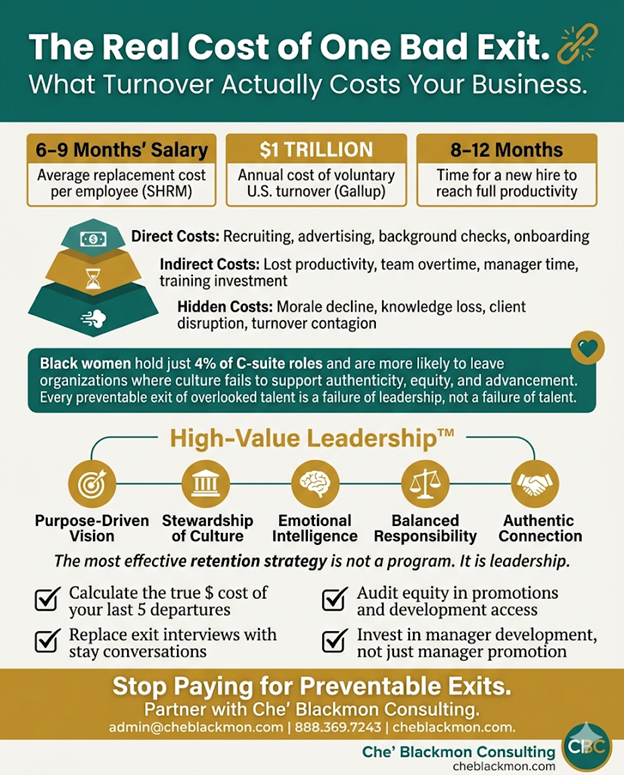
Most business leaders dramatically underestimate what it costs to replace an employee. According to the Society for Human Resource Management (SHRM), the average cost to replace a salaried employee ranges from six to nine months of that person’s salary. For senior or highly specialized roles, that figure can climb to 200% of annual compensation or more. Gallup’s research puts the annual cost of voluntary turnover in U.S. businesses at roughly one trillion dollars.

Let that number land for a moment. One trillion dollars. And that figure only accounts for the costs we can measure directly.

📋 Breaking Down the Cost Categories

Direct Costs include job advertising, recruiter fees, background checks, drug screenings, relocation packages, and signing bonuses. For a mid level manager earning $75,000 annually, these direct costs alone can exceed $15,000 before the new hire even completes orientation.

Indirect Costs are where the real damage hides. These include lost productivity during the vacancy period, the reduced output of the new hire during their learning curve (which research from the Brandon Hall Group suggests can last 8 to 12 months), overtime costs for team members absorbing extra responsibilities, and the time managers and HR professionals invest in interviewing, onboarding, and training.

Hidden Costs are the most dangerous because they compound silently. When a respected team member leaves, remaining employees begin questioning their own commitment. Institutional knowledge walks out the door. Client relationships fracture. Innovation slows because the team is focused on survival rather than growth. These ripple effects can persist for months or even years after a single departure.

🔍 The Turnover Domino Effect: When One Exit Becomes Five

Turnover is rarely an isolated event. Research published in the Academy of Management Journal has shown that when one employee leaves, the probability of additional departures in the same unit increases significantly. This phenomenon, sometimes called turnover contagion, occurs because departures signal to remaining employees that something may be fundamentally wrong with the team, the leadership, or the organization’s trajectory.

There was a company in the manufacturing sector that lost its most experienced shift supervisor. Within 60 days, three additional team leads submitted their resignations, citing the same concerns the supervisor had raised for over a year: inconsistent scheduling, a lack of recognition, and leadership that prioritized output numbers over people. The cost of replacing that one supervisor was estimated at $45,000. The total cost of the four departures combined, factoring in lost production, quality defects, and emergency overtime, exceeded $300,000.

In High‑Value Leadership: Transforming Organizations Through Purposeful Culture, I define Stewardship of Culture as one of the five pillars of the High‑Value Leadership™ framework. Leaders who steward culture do not wait for exit interviews to discover what is broken. They build systems of listening, accountability, and responsiveness that address concerns before they become resignations. When stewardship is absent, every exit becomes an invitation for the next one.

❤️ The Human Side: Impact on Traditionally Overlooked Talent

Not all turnover is created equal in terms of who bears the greatest burden. Traditionally overlooked employees, and most specifically Black women in corporate spaces, experience the costs of toxic culture and preventable turnover at a disproportionate rate.

According to a 2023 McKinsey and LeanIn.Org “Women in the Workplace” report, Black women are more likely than any other demographic group to report that they feel they cannot bring their authentic selves to work. They are more likely to experience microaggressions, to have their competence questioned, and to be passed over for promotion despite strong performance reviews. When organizations fail to address these dynamics, they lose talented professionals who could have been transformational leaders.

In Rise & Thrive: A Black Woman’s Blueprint for Leadership Excellence, I address what scholars call “double jeopardy,” the reality of facing bias and barriers related to both race and gender simultaneously. Black women hold just 4% of C‑suite positions and 1.4% of executive level roles in Fortune 500 companies, not because of a lack of ambition or qualification, but because of systemic barriers including hiring bias, limited access to influential networks, and workplace cultures that were not designed with their success in mind.

💡 The Retention Equity Gap

When a Black woman leaves an organization, the loss extends beyond her individual contribution. She often served as an informal mentor, a bridge builder across departments, and a voice for perspectives that would otherwise go unheard. Her departure frequently signals to other employees from underrepresented groups that the organization is not a safe place to invest their careers.

There was an organization in the healthcare industry that lost three of its five Black women in mid level leadership over an 18 month period. Each cited a variation of the same experience: being overlooked for stretch assignments, receiving feedback that felt coded (“too direct,” “needs to soften her approach”), and watching less qualified peers advance. The organization eventually spent over $500,000 on recruiting, onboarding, and lost productivity. The irony was that investing a fraction of that amount in equitable development programs, mentoring, and inclusive leadership training could have retained all three.

This is not just a diversity, equity, and inclusion conversation. It is a bottom line conversation. Organizations that fail to create environments where all talent can thrive are literally paying for that failure every single quarter.

📈 Current Trends: Why Turnover Is Accelerating in 2025 and 2026

The workforce landscape continues to shift in ways that make retention more complex than ever. Several converging trends are driving voluntary turnover to new heights.

  • The Expectation Economy. Employees, particularly those in Gen Z and younger millennial demographics, expect more than a paycheck. They expect purpose, flexibility, growth pathways, and leaders who demonstrate emotional intelligence. Organizations that have not adapted to this shift are hemorrhaging talent.
  • AI Anxiety and Change Fatigue. Rapid adoption of artificial intelligence and automation technologies has created uncertainty across industries. Employees who do not feel supported through technological transitions are more likely to disengage and seek stability elsewhere.
  • The Manager Crisis. Gallup’s 2024 State of the Global Workplace report found that managers account for 70% of the variance in employee engagement. Yet many organizations continue to promote individuals into management roles based on technical competence rather than leadership capability, creating a pipeline of well meaning but ill equipped leaders who inadvertently drive turnover.
  • Return to Office Tensions. Organizations that have mandated rigid return to office policies without addressing the underlying trust deficit are seeing spikes in voluntary departures, particularly among high performers who have demonstrated their ability to deliver results remotely.

🛠️ A Practical Framework: Calculating Your Organization’s True Turnover Cost

Understanding the problem is the first step. Quantifying it is what creates urgency for action. Below is a simplified framework for calculating the true cost of a single departure. Use this as a starting point and adjust based on your industry and role complexity.

🧮 The Turnover Cost Calculator

  1. Separation Costs: Exit interview time, administrative processing, severance (if applicable), unemployment insurance increases, and legal review. Estimated range: $1,000 to $5,000.
  2. Vacancy Costs: Lost productivity per day multiplied by the average number of days the position remains open. For a $75,000 role, daily productivity value is approximately $375. The average time to fill in 2025 is 44 days (SHRM benchmark), resulting in an estimated $16,500 in vacancy costs alone.
  3. Replacement Costs: Job advertising, recruiter fees, interviewing time (multiply hours spent by hourly rate of each interviewer), background and reference checks, onboarding materials, and technology setup. Estimated range: $5,000 to $25,000 depending on role level.
  4. Ramp Up Costs: New hires typically operate at 25% productivity in month one, 50% in month two, and 75% in month three. Full productivity may not be reached for 8 to 12 months. Calculate the difference between full productivity value and actual output during this period.
  5. Cultural and Morale Costs: While harder to quantify, estimate this by tracking engagement survey score changes, additional voluntary departures within 90 days, and customer satisfaction shifts following a key departure.

For a mid level manager earning $75,000, the conservative total cost of a single departure often falls between $50,000 and $100,000. For senior leaders and specialized roles, that number can easily exceed $200,000.

✨ High‑Value Leadership™ as a Retention Strategy

The most effective retention strategy is not a program. It is not a perk. It is leadership. Specifically, it is the kind of leadership that intentionally builds cultures where people feel seen, heard, valued, and positioned to grow.

The High‑Value Leadership™ framework I developed through High‑Value Leadership: Transforming Organizations Through Purposeful Culture rests on five pillars, each of which directly addresses the root causes of preventable turnover.

  • Purpose‑Driven Vision. Employees who understand the “why” behind their work are significantly more engaged. When leaders articulate a compelling purpose and connect daily tasks to that larger mission, people stop viewing their role as a job and start viewing it as a contribution.
  • Stewardship of Culture. Culture does not maintain itself. It requires active, ongoing stewardship. Leaders must listen before they direct, measure what matters, and respond to cultural warning signs before they become cultural crises.
  • Emotional Intelligence. Daniel Goleman’s research has consistently shown that emotional intelligence is the single strongest predictor of leadership effectiveness. Leaders who can manage their own emotions and respond empathetically to others create psychologically safe environments where people are willing to stay, even during difficult seasons.
  • Balanced Responsibility. High performing cultures hold people accountable while also investing in their development. When accountability exists without support, it breeds fear. When support exists without accountability, it breeds complacency. The balance between these two forces is where retention thrives.
  • Authentic Connection. People do not leave companies. They leave leaders who fail to connect with them. Authentic connection means knowing your people beyond their performance metrics, understanding their aspirations, and creating space for them to bring their whole selves to work.

✅ Actionable Takeaways: 7 Steps to Reduce Costly Turnover

  1. Conduct a Turnover Cost Audit. Use the framework above to calculate the true cost of your last five departures. Present these numbers to senior leadership. Nothing creates urgency faster than a dollar sign.
  2. Invest in Manager Development, Not Just Manager Promotion. Equip every people leader with emotional intelligence training, coaching skills, and cultural stewardship tools. The return on this investment far exceeds the cost of the turnover it prevents.
  3. Build Stay Interview Practices. Stop relying solely on exit interviews to learn what is wrong. Implement quarterly stay conversations that ask high performers what keeps them engaged and what might cause them to leave.
  4. Audit Your Equity Practices. Examine promotion rates, pay equity, and access to stretch assignments across demographic groups. If Black women and other traditionally overlooked employees are advancing at lower rates than their peers, your retention strategy has a critical gap that no amount of perks will fill.
  5. Create Psychological Safety Metrics. Add questions to your engagement surveys that specifically measure whether employees feel safe speaking up, challenging ideas, and making mistakes without punishment. Track these scores over time and tie them to manager performance evaluations.
  6. Establish a 90 Day Early Warning System. The first 90 days after a departure are the highest risk period for additional turnover. During this window, increase check in frequency with remaining team members, address workload redistribution transparently, and accelerate backfill timelines.
  7. Align Retention with Business Strategy. Retention should not live exclusively in HR’s portfolio. It should be a standing agenda item in every leadership team meeting, with the same rigor and visibility as revenue, quality, and customer satisfaction metrics.

🗣️ Expert Insight: What the Research Tells Us

Dr. John Sullivan, a widely recognized HR thought leader, has argued that most organizations measure turnover rate but fail to measure turnover quality, meaning they do not distinguish between the departure of an average performer and the departure of someone who was a top contributor. He recommends that organizations calculate “regrettable turnover” separately and treat each instance as a critical incident requiring root cause analysis.

Dave Ulrich, whose work I reference extensively in Mastering a High‑Value Company Culture, has emphasized that talent is the primary driver of value in knowledge economies. Organizations that treat people as interchangeable parts will consistently underperform those that invest in creating environments where talent can be developed, engaged, and retained.

Brené Brown’s research on vulnerability and trust, which I draw upon in High‑Value Leadership, reinforces that employees are more likely to stay in environments where they feel they can be honest about challenges without fear of retaliation. When leaders model vulnerability and create space for authentic dialogue, they build the kind of trust that no compensation package can replicate.

🎯 From My Experience: Over Two Decades on the Front Lines of Retention

With more than 24 years of progressive HR leadership across manufacturing, automotive, healthcare, nonprofit, quick service, and professional services industries, I have watched the turnover conversation evolve significantly. Early in my career, turnover was treated as an unavoidable cost of doing business. Leaders would shrug and say, “People leave. That’s just how it works.”

That mindset is outdated and expensive. What I have witnessed consistently is that the organizations willing to invest intentionally in culture, in leadership development, and in creating equitable pathways for all employees (not just those who look like, sound like, or think like the existing leadership team) are the ones that retain their best people and outperform their competitors.

There was a company in the automotive sector that was experiencing 40% annual turnover on its production floor. After conducting a thorough culture assessment, the root causes became clear: frontline supervisors had received no leadership training, recognition was nonexistent, and scheduling practices were eroding trust. Within 12 months of implementing targeted leadership development, structured recognition programs, and transparent scheduling communication, turnover dropped to 18%. The estimated annual savings exceeded $1.2 million.

That is not magic. That is what happens when organizations stop treating people as replaceable and start treating culture as a strategic priority.

💬 Discussion Questions for Your Leadership Team

Use these questions to spark a meaningful conversation with your leadership team about turnover’s true impact on your organization:

  1. Do we currently calculate the full cost of turnover, or are we only tracking the turnover rate? What would change if we attached a dollar amount to every departure?
  2. When was the last time we lost a high performer? Did we conduct a root cause analysis, or did we simply post the job and move on?
  3. Are Black women and other traditionally overlooked employees advancing at the same rate as their peers in our organization? If not, what systemic barriers might be contributing to that gap?
  4. How would our frontline supervisors and mid level managers rate their own preparedness to lead people effectively? Have we invested in their development?
  5. Do our stay interview practices give us actionable insight, or are we waiting for exit interviews to learn what went wrong?
  6. Which of the five High‑Value Leadership™ pillars (Purpose‑Driven Vision, Stewardship of Culture, Emotional Intelligence, Balanced Responsibility, Authentic Connection) represents our organization’s greatest strength? Which represents our greatest opportunity for growth?
  7. If we could retain just five additional employees this year who would otherwise have left, what would that save us financially? What would it preserve culturally?

🚀 Next Steps: Stop Paying for Preventable Exits

Every organization has the power to reduce turnover, but it requires a shift in mindset. It requires leaders who are willing to examine their culture honestly, invest in people strategically, and hold themselves accountable for the environments they create. The cost of doing nothing is measurable, and it is growing every quarter.

If you are ready to move from reactive recruiting to proactive retention, Che’ Blackmon Consulting can help. Through fractional HR leadership, culture transformation consulting, and leadership development rooted in the High‑Value Leadership™ framework, we partner with organizations to build cultures that attract, develop, and retain the talent they cannot afford to lose.

Because the real question is not whether you can afford to invest in your culture. The real question is whether you can afford not to.

🌟 Ready to Transform Your Organization’s Culture?

Work with Che’ Blackmon Consulting

📧  admin@cheblackmon.com

📞  888.369.7243

🌐  cheblackmon.com

📚 Explore More from Che’ Blackmon

Mastering a High‑Value Company Culture – Available on Amazon

High‑Value Leadership: Transforming Organizations Through Purposeful Culture – Available on Amazon

Rise & Thrive: A Black Woman’s Blueprint for Leadership Excellence – E‑Book Available at cheblackmon.com

🎥 Rise & Thrive YouTube Series | 🎙️ Unlock, Empower, Transform Podcast

© 2026 Che’ Blackmon Consulting. All rights reserved.

High‑Value Leadership™ is a proprietary framework of Che’ Blackmon Consulting.

#HighValueLeadership #TurnoverCost #EmployeeRetention #HRLeadership #CultureTransformation #WorkplaceCulture #BlackWomenInLeadership #LeadershipDevelopment #TalentRetention #FractionalHR #PeopleFirst #CheBlackmonConsulting #RetentionStrategy #EmployeeEngagement #DEI #OrganizationalCulture #LeadershipMatters #HRStrategy #HighValueCulture #RiseAndThrive

The Diversity Dividend: How Inclusive Leadership Drives Measurable Business Performance

By Che’ Blackmon, DBA Candidate | Founder & CEO, Che’ Blackmon Consulting

For years, the business case for diversity, equity, and inclusion was framed as a moral argument. Organizations were told it was the right thing to do. They were asked to look at representation gaps, acknowledge historical inequities, and commit to change because fairness demanded it. That case remains true. But it is also incomplete. Because the data has now accumulated to the point where the business case for inclusive leadership is not just ethical. It is empirical, financial, and strategic.

The diversity dividend is real. It shows up in revenue performance, in innovation rates, in decision quality, in talent retention, and in the resilience of organizations that can draw on the full range of human perspective rather than the narrow band of experience that homogeneous leadership teams represent. Companies in the top quartile for gender diversity are 15 to 25 percent more likely to achieve above-average financial returns, according to McKinsey and Company. Companies in the top quartile for ethnic and cultural diversity are 35 percent more likely to outperform their peers. These are not soft metrics. They are business results.

This article makes the case that inclusive leadership is not a program to be launched or a goal to be checked off. It is a strategic discipline that requires the same rigor, accountability, and investment that organizations apply to any other driver of performance. It is also deeply connected to the culture and leadership infrastructure that determines whether the diversity dividend can be collected at all, or whether it evaporates because the organization built representation without building the conditions for that representation to thrive.

📈 Defining the Diversity Dividend: What the Research Actually Shows

The phrase diversity dividend is not rhetorical. It describes a measurable premium in organizational performance that results from the strategic inclusion of diverse perspectives, backgrounds, and experiences at every level of decision-making. It is different from diversity as representation, which measures who is in the room. The dividend is produced when those people are genuinely included in the conversation, when their perspectives actually shape the decisions, and when the culture has been built to make that kind of authentic contribution possible.

The research base for this claim is extensive and spans more than two decades of organizational study. McKinsey and Company’s Diversity Wins report found that organizations with more than 30 percent women in executive roles were significantly more likely to outperform those with fewer women in leadership. The Boston Consulting Group found that companies with above-average diversity on their management teams reported innovation revenue 19 percentage points higher than companies with below-average diversity. Harvard Business Review research found that diverse teams make better decisions 87 percent of the time compared to individual decision-makers, and that cognitively diverse teams solve complex problems faster than homogeneous ones.

Deloitte’s research on inclusive leadership found that when employees feel included in their organization, team performance improves by 17 percent, team collaboration improves by 20 percent, and decision-making quality improves by 20 percent. These gains are not abstract. They translate directly into the metrics that determine organizational success: speed to market, product quality, client retention, and financial performance.

💡 Diversity without inclusion is representation without return. The dividend is paid only when people can fully bring their expertise, perspective, and voice to the work.

The mechanism behind these outcomes is well-established in organizational behavior research. Diverse teams bring a broader range of information, challenge assumptions that homogeneous teams accept uncritically, generate more options before converging on solutions, and are less susceptible to the groupthink dynamics that produce catastrophic organizational failures. When those diverse perspectives are genuinely included, the quality of organizational reasoning improves at every level.

🔍 The Gap Between Diversity and Inclusion: Why the Dividend Gets Left on the Table

Most organizations that have invested in diversity initiatives have discovered a frustrating reality: representation does not automatically produce inclusion, and inclusion does not automatically produce the performance outcomes the research promises. The gap between having diverse people and deriving value from their diversity is where most inclusion strategies fail, and understanding that gap is essential to closing it.

🚨 The Presence Trap

There was a manufacturing organization that invested significantly in recruiting a diverse workforce and achieved meaningful representation improvements at the individual contributor and mid-management levels. Its survey data, however, told a different story. Black employees and employees from other underrepresented groups consistently reported feeling that their ideas were less likely to be taken seriously, that they were excluded from informal decision-making conversations, and that advancement criteria were applied inconsistently across demographic lines. The organization had hired for diversity and then failed to build the conditions that allow diversity to contribute. The dividend was available. The infrastructure to collect it was absent.

This pattern is extraordinarily common. Organizations mistake the presence of diverse talent for the inclusion of diverse talent. They celebrate demographic milestones while ignoring the experience data that would tell them whether those milestones are translating into genuine participation, authentic contribution, and equitable advancement. Representation is a necessary condition for the diversity dividend. It is not a sufficient one.

📋 The Inclusion Infrastructure Deficit

Genuine inclusion requires structural conditions that most organizations have not built. It requires psychological safety, the belief that speaking up, disagreeing, and contributing authentically will not result in professional consequences. It requires consistent accountability, the assurance that the same standards apply to everyone regardless of who they know or what they look like. It requires transparent processes for advancement and recognition, so that the informal favoritism and proximity bias that have historically shaped organizational outcomes are replaced by visible, equitable criteria.

In High-Value Leadership: Transforming Organizations Through Purposeful Culture, the argument is made that authentic connection and stewardship of culture are leadership responsibilities that directly produce or undermine the psychological safety required for inclusion to function. Leaders who model intellectual humility, who actively solicit dissenting views, who credit contributions equitably, and who make their decision-making criteria transparent are the human infrastructure through which the diversity dividend becomes collectible.

There was a professional services organization that had a stated commitment to inclusion but whose actual culture rewarded conformity. Employees who challenged dominant perspectives in strategy meetings were labeled as difficult rather than engaged. Managers who had built informal networks of similar-background colleagues routinely bypassed formal nomination processes for high-visibility assignments. The organization’s diversity metrics looked adequate. Its inclusion experience data told the truth. When leadership invested in a culture realignment that addressed psychological safety, equitable processes, and manager accountability, engagement scores for underrepresented employees improved significantly within 18 months.

✨ The Compounded Reality: Black Women and the Uncollected Dividend

No group in the American corporate workforce carries the weight of the inclusion gap more acutely than Black women. They enter organizations with credentials, competence, and the strategic resilience that comes from navigating systems not designed for their advancement. They contribute, lead, and deliver results at rates that consistently exceed the recognition and advancement they receive. And the organizations that fail to include them fully are not just making an equity error. They are making a business error, leaving a measurable dividend uncollected.

🚨 The Advancement Cliff

McKinsey and Company’s Women in the Workplace research has documented for consecutive years that Black women face the steepest advancement cliff of any demographic group in corporate America. They are the least likely to receive sponsorship from senior leaders who can advocate for their advancement in rooms they are not in. They are the most likely to have their ideas credited to others. They are the most likely to be assessed as strong performers but not leadership material, a distinction that reflects the gap between performance evaluation systems that measure output and advancement criteria that measure cultural fit with leadership teams that do not reflect their identity.

The organizational cost of this pattern is not abstract. Every Black woman whose career progression is artificially stalled represents a loss of strategic leadership capacity at a career stage when her institutional knowledge, relationship equity, and functional expertise are at their most valuable. Every departure that results from that stalled trajectory represents a recruitment and development investment that produces no return. Every organization that perpetuates this pattern is systematically excluding some of its most experienced contributors from the rooms where its most consequential decisions are made.

💡 The Invisible Tax

Beyond the structural barriers, Black women in corporate environments pay what researchers have described as an invisible tax: the additional cognitive and emotional labor required to navigate workplaces that were not designed for their presence. This includes code-switching, the perpetual management of how one is perceived across racial and gender lines simultaneously. It includes the hypervisibility that makes Black women simultaneously more scrutinized and less sponsored. It includes the experience of having their competence questioned at levels their peers do not encounter, requiring a constant standard of proof that depletes the professional energy that should be directed toward contribution and development.

This invisible tax has measurable outcomes. Research from the Center for Talent Innovation found that Black women are significantly more likely than their peers to report exhaustion from managing their identity at work, and significantly more likely to consider leaving their current employer as a result. The organizations that address this tax structurally, through psychological safety investments, equitable recognition systems, and active sponsorship programs, are the organizations that retain the Black women whose full contribution is available to produce the diversity dividend.

📚  Rise & Thrive Connection: In Rise & Thrive: A Black Woman’s Blueprint for Leadership Excellence, the strategies for navigating these structural realities are addressed with both candor and practical depth. The SHIELD Resilience Framework offers Black women a personal and professional toolkit for thriving in environments that require resilience alongside excellence. If you are navigating this reality, that work was written for this season of your career.

🏗️ How High-Value Leadership™ Collects the Dividend

The High-Value Leadership™ framework, built on Purpose-Driven Vision, Stewardship of Culture, Emotional Intelligence, Balanced Responsibility, and Authentic Connection, is the leadership architecture through which the diversity dividend moves from research finding to organizational reality. Each pillar creates specific conditions that either enable or inhibit the full contribution of diverse talent.

Purpose-Driven Vision and the Inclusive Why 🎯

Organizations whose purpose is genuinely inclusive, whose stated mission reflects a commitment to the full human experience rather than a narrow demographic slice of it, attract and retain a broader range of talent. More importantly, they create a shared framework of meaning that makes diversity coherent rather than cosmetic. Purpose-Driven Vision in a High-Value Leadership™ context is not a tagline that happens to include inclusive language. It is a North Star that actually guides decision-making, resource allocation, and leadership behavior across the entire organization.

Stewardship of Culture and the Inclusion Infrastructure 🌱

Culture stewardship is where the diversity dividend is either built or lost. The leader who actively monitors the health of their team’s inclusion experience, who intervenes when exclusion patterns emerge, who redesigns processes when they produce inequitable outcomes, and who holds themselves and others accountable to inclusion standards is the leader who creates the conditions that allow diverse talent to contribute fully. Mastering a High-Value Company Culture makes the case that culture is not built by programs. It is built by the daily decisions of leaders who understand that every choice they make is a cultural signal.

Emotional Intelligence and the Empathy Infrastructure 🧠

Daniel Goleman’s research established that emotional intelligence accounts for the majority of leadership effectiveness. In the context of inclusive leadership, EI is the capacity to understand and navigate the emotional landscape of a diverse team, to recognize when a team member is experiencing the invisible tax described above, to respond to that experience with empathy rather than dismissal, and to create interactions that feel safe for authentic expression across difference. Leaders with high EI are the leaders whose diverse team members stay, grow, and contribute at their full capacity.

Balanced Responsibility and the Equity Standard ⚖️

The diversity dividend is only collectible when the standards of excellence and accountability apply equally to everyone, and when the rewards for meeting those standards, recognition, advancement, and opportunity, are distributed equitably. Balanced Responsibility in the High-Value Leadership™ framework means holding high performance standards in a psychologically safe environment where everyone has an equal opportunity to meet them. It means that underperformance is addressed regardless of who is underperforming, and that excellence is recognized regardless of who is excelling.

Authentic Connection and the Trust Foundation 🤝

Trust is the currency through which every other inclusion investment operates. Diverse team members who do not trust that their organization is genuinely committed to their equitable advancement will not provide the full contribution that the diversity dividend requires. They will perform at a level sufficient to protect their employment while reserving their highest value for environments that actually deserve it. Authentic connection, the fifth pillar of High-Value Leadership™, is built through consistent, transparent, and genuinely reciprocal leadership relationships. It is the foundation on which everything else rests.

🌈 The diversity dividend is not a bonus paid for doing inclusion right. It is the natural return on an organizational investment in building a culture where every person can bring their full contribution to the work.

📉 What Inclusive Organizations Are Actually Doing Differently

The organizations that consistently collect the diversity dividend are not the ones with the most sophisticated DEI programs. They are the ones where inclusion is embedded in how decisions are made, how people are developed, and how leadership accountability is measured. Here is what that looks like in practice.

There was a healthcare organization that redesigned its promotion process after recognizing that its informal nomination system consistently produced a finalist pool that did not reflect the diversity of its workforce. It replaced subjective manager nominations with structured competency assessments, added sponsorship requirements for all high-potential program participants, and implemented demographic reporting for every stage of the promotion pipeline. Within two years, representation in senior clinical leadership improved significantly and engagement scores for underrepresented employees rose toward parity with the broader workforce.

There was a nonprofit organization that integrated inclusion metrics into its leadership performance evaluation system for the first time, making manager accountability for team inclusion experience a factor in annual performance reviews. Leaders who had previously treated DEI as a compliance obligation began treating it as a leadership competency, because it was now measured and consequential. Team engagement scores for Black employees and other employees of color improved in those managers’ units, and voluntary turnover in those groups declined.

There was an automotive organization that implemented a structured reverse mentoring program pairing senior leaders with junior professionals from underrepresented groups, not as a nicety but as a development requirement. Senior leaders reported that the perspective shift produced by those relationships changed how they made decisions about team composition, project assignments, and advancement nominations. The organization’s internal diversity advancement metrics improved noticeably over the program’s first two years.

The common thread across all three is structural change to the systems that determine who advances, who contributes, and who is held accountable for inclusion outcomes. Programs create awareness. Systems create change.

🛠️ Actionable Takeaways: Collecting Your Organization’s Diversity Dividend

✅ For Organizational Leaders and HR Professionals

1. Measure Inclusion Experience Separately From Representation

Representation metrics tell you who is in the organization. Inclusion experience metrics tell you whether they can contribute fully. Disaggregate your engagement survey data by race, gender, and career level. Ask specific questions about psychological safety, recognition equity, and advancement fairness. The gaps you find are where the dividend is being left uncollected.

2. Redesign Advancement Processes for Equity

Audit every stage of your promotion and advancement process for informal bias. Who nominates candidates? What criteria are applied? How are nominations reviewed? Where are the demographic disparities in each stage? Redesigning for equity does not mean lowering standards. It means ensuring the same standards apply to everyone and that advancement pathways are visible to everyone.

3. Build Active Sponsorship Into Your Culture

Mentorship advises. Sponsorship advocates. Ensure that your highest-potential professionals from underrepresented groups have sponsors who actively advocate for their advancement in rooms they are not in. Make sponsorship a leadership expectation, not an optional gesture.

4. Hold Leaders Accountable for Inclusion Outcomes

What gets measured gets managed. Add inclusion metrics to your leadership performance evaluation system. Hold managers accountable for the engagement and advancement of underrepresented team members, not just for the output metrics that capture only part of their leadership impact.

5. Invest in Psychological Safety as an Organizational Capability

Psychological safety does not emerge from good intentions. It is built through consistent leadership behavior over time. Train your managers in the specific practices that build safety: soliciting dissent, crediting contributions accurately, responding to disagreement without defensiveness, and modeling intellectual humility. Measure it. Improve it.

✨ For Individual Professionals Navigating Inclusive Leadership Environments

Document Your Contributions and Quantify Your Impact

The diversity dividend depends on organizations being able to see and value your contribution. Do not assume visibility will come automatically, particularly in environments where Black women and other underrepresented professionals are systematically underseen. Build your evidence base, document your outcomes, and make your impact visible and specific.

Seek Sponsors, Not Just Mentors

The research is clear that sponsorship drives advancement in ways that mentorship alone cannot. Identify leaders in your organization who have both the authority and the willingness to advocate for your advancement. Invest in those relationships with the same intentionality you bring to every other strategic priority.

💬 Discussion Questions for Leaders and Teams

Use these questions to generate meaningful conversations within your organization, leadership team, or professional development community.

  • When you look at your organization’s representation data alongside your inclusion experience data for the same demographic groups, what gaps do you see? What do those gaps tell you about where the diversity dividend is being left uncollected?
  • Is your organization’s advancement process designed primarily for equity or primarily for efficiency? What would it look like to redesign it so that both criteria were equally weighted?
  • What specific actions are your senior leaders taking to sponsor rather than simply mentor high-potential professionals from underrepresented groups? How is that sponsorship measured and recognized?
  • For Black women and other professionals navigating the invisible tax of identity management at work: what one structural change in your organization would most meaningfully reduce that tax? And who has the authority to make it?
  • If your organization’s diversity dividend is currently uncollected, what is the estimated annual cost of that uncollected return in turnover, disengagement, missed innovation, and foregone talent?

🚦 Next Steps: From Diversity Initiative to Inclusive Performance Strategy

The diversity dividend is available to every organization willing to build the conditions required to collect it. Here is a practical path forward.

  1. Conduct a disaggregated analysis of your engagement, advancement, and retention data by race, gender, and career level simultaneously. Find the gap between your representation metrics and your inclusion experience metrics.
  2. Audit your advancement and promotion processes for informal bias. Identify the stages where disparities emerge and commit to structural redesign of those stages.
  3. Build active sponsorship into your leadership expectations and measure it. Track how many high-potential professionals from underrepresented groups have sponsors who are actively advocating for their advancement.
  4. Add inclusion outcomes to your leadership performance evaluation framework. Make manager accountability for inclusion experience a measured and consequential leadership competency.
  5. Invest in psychological safety as an organizational capability. Train your managers, measure safety by team and manager, and hold leaders accountable for the culture their behavior produces.
  6. If you are a Black woman or member of another underrepresented group navigating these dynamics: Rise and Thrive: A Black Woman’s Blueprint for Leadership Excellence was written for exactly this professional journey. The SHIELD Resilience Framework within that work provides both the personal tools and the strategic clarity to navigate these environments with purpose and power.

🚀 Ready to Collect Your Organization’s Diversity Dividend?

Che’ Blackmon Consulting partners with organizations and leaders who are ready to move from diversity as representation to inclusion as a performance strategy. Whether you are diagnosing the gap between your representation data and your inclusion experience, redesigning your advancement processes for equity, or developing the High-Value Leadership™ competencies that make the diversity dividend collectible, we bring the frameworks, experience, and tools to help your organization perform at its full potential.

📧 admin@cheblackmon.com     📞 888.369.7243     🌐 cheblackmon.com

About the Author

Che’ Blackmon is a doctoral candidate in Organizational Leadership (DBA), the Founder and CEO of Che’ Blackmon Consulting, and a recognized expert in culture transformation, fractional HR leadership, and high-value leadership development. With more than 24 years of progressive HR leadership experience spanning manufacturing, automotive, healthcare, nonprofit, quick-service, and professional services industries, she has built a body of work dedicated to engineering cultures where every person, at every career stage and across every identity, can contribute fully and advance equitably. She is the author of Mastering a High-Value Company Culture, High-Value Leadership: Transforming Organizations Through Purposeful Culture, and the e-book Rise and Thrive: A Black Woman’s Blueprint for Leadership Excellence. Che’ is the creator of the proprietary High-Value Leadership™ framework and the host of the Unlock, Empower, Transform podcast.

© 2025 Che’ Blackmon Consulting. All rights reserved. | High-Value Leadership™ is a trademark of Che’ Blackmon Consulting.

#DiversityDividend #InclusiveLeadership #DEI #HighValueLeadership #CompanyCulture #BlackWomenLead #WorkplaceBias #OrganizationalPerformance #HRLeadership #CultureTransformation #EmployeeEngagement #WorkplaceInclusion #LeadershipDevelopment #FractionalHR #CheBlackmonConsulting

Predictive Workforce Analytics: Turning Data Into Your Strategic Pot of Gold

By Che’ Blackmon, DBA Candidate | Founder & CEO, Che’ Blackmon Consulting

There is a running conversation in boardrooms and HR offices across every major industry that goes something like this: we did not see it coming. A top performer resigned without warning. An entire department’s engagement quietly collapsed before anyone noticed. A pattern of turnover that seemed random was, in retrospect, entirely predictable. The information was there. The signals were there. The data existed in performance management systems, engagement surveys, compensation records, and attendance logs. What was missing was not the data. What was missing was the willingness and the infrastructure to use it before the damage was done.

Predictive workforce analytics is the practice of using historical and real-time data to forecast future workforce outcomes, including turnover, engagement decline, skills gaps, and succession readiness, before those outcomes materialize as crises. It is one of the most powerful tools available to modern HR leaders and organizational executives, and it remains one of the most underutilized. The gap between organizations that use analytics reactively and those that use them predictively is measured in millions of dollars, in leadership pipeline depth, and in the competitive advantage that comes from never being surprised by your own people.

This article is about closing that gap. It is about what predictive workforce analytics actually is, what it makes possible, how it connects to the culture and leadership infrastructure that makes data meaningful, and why the organizations that get this right are positioned to outperform everyone who is still waiting for the exit interview to learn what they should have known six months earlier.

📈 From Rearview Mirror to Windshield: What Predictive Analytics Actually Does

Most workforce data is used descriptively. It tells you what happened. Turnover rate last quarter. Average time to fill open roles. Engagement scores from the last survey. Absenteeism trends by department. This is valuable information, but it is historical. By the time you are reading it, the story it tells has already been written and many of the decisions that would have changed the outcome are no longer available to you.

Predictive analytics shifts the orientation from the rearview mirror to the windshield. Instead of asking what happened, it asks what is likely to happen next and what we can do about it now. Machine learning models, statistical analysis, and integrated data systems are used to identify patterns across multiple data points simultaneously, patterns that no human manager can reliably detect by reviewing reports in isolation. When those patterns are identified early enough, leaders have a window of time in which intervention is both possible and effective.

According to a 2023 IBM Institute for Business Value report, organizations that use predictive people analytics are 2.2 times more likely to outperform their peers in revenue growth and 1.5 times more likely to successfully retain high performers. These outcomes are not produced by the analytics alone. They are produced by the combination of good data and leaders who are committed to acting on what the data reveals. Analytics without cultural readiness to respond is just expensive reporting.

💡 Predictive analytics does not replace human judgment. It informs it with precision and timing that human intuition alone cannot match.

🔬 The Four Highest-Value Predictive Analytics Applications in Workforce Strategy

📌 1. Turnover Prediction

Voluntary turnover is the single most expensive and most preventable people problem in most organizations. The Society for Human Resource Management estimates the cost of replacing an employee ranges from one-half to two times their annual salary when recruitment, onboarding, and productivity loss are fully calculated. For organizations with chronic turnover, the cumulative annual cost is often in the millions, and the organizational energy required to perpetually backfill roles that should never have been vacated is a strategic tax on everything else the organization is trying to accomplish.

Predictive turnover models analyze dozens of variables simultaneously, including tenure, compensation relative to market, promotion recency, manager effectiveness scores, engagement survey responses, project assignment patterns, and even communication frequency in collaborative platforms. These variables, individually, are insufficient signals. In combination and over time, they produce a turnover risk score that can identify employees who are likely to leave 90 to 180 days before they submit a resignation letter. That window is everything. It is the difference between losing someone and retaining them.

There was a healthcare organization that implemented a turnover prediction model after experiencing a costly string of departures in a critical clinical department. The model identified a cluster of mid-level professionals who scored high on several simultaneous risk indicators, including stalled compensation growth, declining engagement scores, and a pattern of declining project participation. The organization intervened with targeted retention conversations, compensation adjustments, and development opportunities. The retention rate for that identified cohort exceeded 85 percent over the following year, and the cost avoidance from retained institutional knowledge was substantial.

📌 2. Engagement Forecasting

Engagement surveys measure the current state of employee sentiment at a single point in time. They are useful, but they are inherently delayed indicators. By the time disengagement shows up in an annual survey, it has typically been building for months, and the employees most affected may have already mentally resigned even if their physical departure has not yet followed. Predictive engagement modeling uses continuous data streams, including recognition frequency, performance review scores, absenteeism patterns, and internal mobility activity, to forecast engagement trajectories rather than simply measuring current states.

The practical application is transformative. Instead of discovering that a department’s engagement has dropped 12 points in the annual survey and then spending a quarter diagnosing the root cause, predictive engagement forecasting allows leaders to see the trajectory six months earlier, before it becomes a survey result, and intervene in ways that are proportionate to the early-stage signal rather than reactive to a full-blown engagement crisis.

Deloitte’s Global Human Capital Trends research has found that organizations using continuous listening strategies combined with predictive modeling report significantly higher confidence in their ability to prevent engagement decline before it becomes a retention event. The infrastructure required is not primarily technological. It is cultural. Organizations must build environments where employees are willing to provide authentic signal data, and that willingness is built through trust, not through surveillance.

📌 3. Succession Readiness and Leadership Pipeline Analytics

Succession planning in most organizations is an annual exercise. A list of names is generated for each critical role, assessed through a combination of performance reviews and manager nominations, and then filed until the next annual review cycle. This approach has two significant failures. First, it is static in a workforce that is dynamic. People develop, plateau, and sometimes exit between annual reviews in ways the succession plan does not capture. Second, it is deeply susceptible to the informal biases that determine whose name a manager thinks to put on a list.

Predictive succession analytics changes both of these dynamics. It creates a continuous, data-driven picture of pipeline depth by analyzing skill trajectories, learning and development engagement, performance trends over time, cross-functional experience, and leadership assessment data. It identifies not just who is ready for advancement but who is on a readiness trajectory, which is arguably more valuable because it gives the organization time to develop talent rather than simply select from a pool that already exists.

In High-Value Leadership: Transforming Organizations Through Purposeful Culture, the stewardship of culture is identified as a foundational leadership responsibility. Stewardship of a leadership pipeline requires the same intentional investment, and predictive analytics makes that stewardship precise in ways that informal succession conversations cannot. There was a manufacturing organization that used pipeline analytics to identify a significant gap in its next-generation leadership bench three years before the projected wave of senior retirements. That three-year runway allowed the organization to invest in accelerated development programs and internal mobility initiatives that would have been impossible to execute in a reactive timeframe.

📌 4. Skills Gap and Workforce Planning Analytics

The pace of technological change, industry disruption, and evolving market demands means that the skills your organization needs in three years are meaningfully different from the skills your workforce currently holds. Most organizations have no systematic visibility into this gap. They hire for current needs, develop for current capabilities, and then discover the skills deficit when it has already translated into a competitive disadvantage or a failed technology implementation.

Predictive skills gap analytics maps current workforce capabilities against projected future requirements and identifies the delta. It surfaces which roles are at highest risk of being underskilled for near-future needs, which employees are on development trajectories that position them well for emerging requirements, and where recruiting investment should be targeted to address gaps that internal development cannot close in time. This is workforce planning operating at strategic velocity rather than administrative pace.

✨ The Equity Imperative: Predictive Analytics and the Traditionally Overlooked

Predictive workforce analytics carries an enormous promise for equity and inclusion, and an equally significant risk of amplifying existing inequities if it is not designed and deployed with intentionality. This distinction matters profoundly, and it matters most for the professionals who have historically been most disadvantaged by the informal, relationship-driven, and often biased processes that analytics is designed to replace.

🚨 When Algorithms Inherit Bias

Data does not lie. But data can encode the decisions of systems that did. If an organization’s historical promotion data reflects years of bias against Black women and other underrepresented professionals, a predictive model trained on that data will encode those biases as predictive signals. The model will learn that the profile most likely to be promoted is the profile that has historically been promoted, regardless of whether that outcome reflects actual performance potential or simply pattern recognition of who was already advantaged.

This is not a theoretical risk. Amazon’s well-documented 2018 abandonment of an AI-based recruiting tool that systematically down-ranked resumes from women was a high-profile demonstration of exactly this dynamic. The model was trained on a decade of hiring decisions, and those decisions reflected the company’s historical pattern of male-dominated technical hiring. The algorithm learned to replicate that pattern as a success criterion.

The lesson is not that predictive analytics cannot serve equity. The lesson is that it will serve whatever the data encodes unless explicit corrective design choices are made. Bias audits of training data, diversity-adjusted weighting in model design, ongoing disparity monitoring in model outputs, and regular human review of algorithmic recommendations are all required elements of an equitable analytics infrastructure.

💡 The Case for Equity-Centered Analytics for Black Women

For Black women in corporate environments, the historic experience has been one of performing at a high level while advancement pathways remain narrow and informal sponsorship networks remain inaccessible. McKinsey and Company’s Women in the Workplace research has documented consistently that Black women face the most pronounced advancement gap of any demographic group, are the least likely to receive sponsorship, and are the most likely to have their contributions credited to others.

An analytics infrastructure designed with equity as a design principle changes this dynamic structurally. When advancement criteria are explicit and measurable rather than implicit and relational, the informal favoritism that has historically shaped who gets considered loses its power. When turnover risk models flag high-performing Black women as retention risks based on data rather than leaving the identification to managers who may have limited visibility into the drivers of their experience, organizations gain the ability to intervene before losing people they should have been actively developing.

In Rise and Thrive: A Black Woman’s Blueprint for Leadership Excellence, the argument is clear that structural change requires structural tools. Predictive analytics, when designed and deployed with equity as a non-negotiable design criterion, is one of the most powerful structural tools available for dismantling the informal systems that have kept Black women and other overlooked professionals from advancing at the rate their performance warrants.

📚  Rise & Thrive Connection: The data visibility that predictive analytics provides for organizations mirrors the strategic self-awareness that Rise and Thrive builds for individual professionals. Both are about seeing clearly, acting early, and refusing to be surprised by outcomes that were always preventable with the right information and the right systems.

There was a professional services organization that implemented an equity analytics layer on top of its existing workforce reporting. This layer disaggregated every key metric, including promotion rates, development program participation, stretch assignment allocation, and turnover risk scores, by race, gender, and career level simultaneously. The findings were not comfortable. Black women at the mid-manager level were significantly underrepresented in high-visibility project assignments, significantly underrepresented in the sponsorship program nominations, and significantly overrepresented in the high turnover risk cohort. None of these patterns had been visible in aggregate reporting. All of them were visible the moment the data was disaggregated. The organization redesigned its sponsorship nomination process, revised its project assignment criteria, and implemented structured check-in protocols for the identified high-risk cohort. Representation in senior leadership for Black women improved meaningfully over the following two years.

🏗️ Building the Infrastructure: What Predictive Analytics Requires

Predictive workforce analytics is not a software purchase. It is an organizational capability that requires infrastructure at three levels: data quality, analytical capacity, and cultural readiness to act on what the data reveals. All three are necessary. None is sufficient alone.

💻 Data Quality and Integration

Predictive models are only as good as the data they are trained on. Organizations with fragmented HRIS systems, inconsistent performance management practices, or gaps in data collection cannot produce reliable predictive outputs from poor inputs. Before investing in advanced analytics capability, organizations must honestly assess whether their data is clean, consistent, integrated, and comprehensive enough to support predictive modeling. This is often a multi-year infrastructure investment, but it is also the foundation on which every other analytics capability rests.

The specific data domains most critical for workforce prediction include performance management records over time, compensation history and market positioning, engagement survey data with longitudinal tracking, learning and development completion and application, organizational network analysis data, and manager effectiveness metrics. Organizations that have consistent, high-quality data in these domains have the raw material for powerful predictive capability. Those that do not need to build the foundation before expecting the insight.

🧠 Analytical Capacity: People and Technology

The technology landscape for predictive workforce analytics has matured significantly. Platforms including Visier, Workday People Analytics, SAP SuccessFactors Analytics, and IBM Watson Talent provide increasingly accessible predictive capability built on top of existing HR data infrastructure. Many of these platforms offer pre-built turnover prediction and engagement forecasting models that can be configured to an organization’s specific data environment without requiring a dedicated data science team.

The human capacity requirement is equally important. HR leaders who can translate analytical outputs into strategic conversations with business partners, who can communicate risk and opportunity in the language of revenue and competitive advantage rather than HR metrics, and who can advocate for data-driven interventions in organizations where intuition and relationships have historically driven people decisions are the irreplaceable human layer in any analytics capability. Technology surfaces the insight. HR leadership converts it into action.

🌱 Cultural Readiness: The Most Underestimated Requirement

The most sophisticated analytics infrastructure produces no value in an organization whose culture is not ready to act on what the data reveals. Cultural readiness for predictive analytics means leaders who are willing to be told that their department has a turnover risk cluster, who treat that information as an asset rather than an accusation, and who take proportionate action before the risk materializes rather than managing the aftermath of a departure that was predictable.

It also means an organizational commitment to using data as a tool for equity rather than efficiency alone. Mastering a High-Value Company Culture argues that cultures that endure are cultures built on transparency, accountability, and the genuine investment of leaders in the people they lead. Predictive analytics is a transparency tool. It makes visible what informal observation misses, and it creates accountability for acting on what is now impossible to claim was unseen.

💡 Data does not change culture. Leaders do. Predictive analytics gives leaders information early enough and precisely enough to lead differently. What they do with it is still a leadership choice.

📉 The High-Value Leadership™ Connection: Analytics in Service of Culture

The High-Value Leadership™ framework, anchored in Purpose-Driven Vision, Stewardship of Culture, Emotional Intelligence, Balanced Responsibility, and Authentic Connection, does not exist in tension with data-driven leadership. It is its philosophical foundation. Each pillar of the framework is both a cultural aspiration and a measurable domain that analytics can inform.

Purpose-Driven Vision requires that leaders understand whether employees experience a meaningful connection between their work and the organizational mission. Engagement analytics can measure that connection continuously and flag when it is eroding before it becomes disengagement. Stewardship of Culture requires that leaders actively monitor and respond to the health of the organizational culture. Turnover prediction and equity analytics are the instruments through which that stewardship becomes precise rather than impressionistic. Emotional Intelligence in leadership produces measurable outcomes in team safety, feedback quality, and collaborative effectiveness that analytics can surface. Balanced Responsibility is sustained when accountability systems are consistent and transparent, conditions that data visibility supports directly. Authentic Connection produces the trust that makes employees willing to provide the honest signal data that makes analytics useful in the first place.

The synergy is this: analytics without High-Value Leadership produces data that no one acts on. High-Value Leadership without analytics produces well-intentioned leadership that is still making decisions with incomplete information. Together, they produce the kind of organizational intelligence that allows leaders to steward their culture, protect their people, and build competitive advantage with a precision that neither achieves independently.

🛠️ Actionable Takeaways: Getting Started With Predictive Analytics

The following takeaways are designed for HR leaders, executives, and organizational stakeholders who are ready to move from descriptive to predictive workforce intelligence.

✅ For Organizational Leaders and HR Professionals

1. Assess Your Data Foundation First

Before investing in predictive analytics technology, audit the quality, consistency, and integration of your existing workforce data. Identify which critical data domains are well-captured and which have significant gaps. Build a data readiness roadmap as the first step in your analytics strategy rather than assuming technology can compensate for data quality deficits.

2. Start With Turnover Prediction

Turnover prediction is the highest immediate ROI application of predictive analytics for most organizations because the cost of preventable departure is large, the data required is widely available, and the intervention options are well-established. Implement a turnover risk model, integrate it into your manager toolkit, and establish a clear protocol for what action is taken at what risk threshold.

3. Disaggregate Every Output by Demographics

From the moment you begin producing predictive analytics outputs, establish the practice of disaggregating those outputs by race, gender, career level, and tenure simultaneously. What looks like a uniform pattern in aggregate data is often a significant disparity when examined by demographic segment. That disparity is both an equity signal and a strategic risk signal. Invisible inequity is expensive equityy and it is also just expensive.

4. Build Equity Audits Into Your Analytics Governance

Establish a regular review cycle in which your predictive models are audited for disparate impact. Examine whether model outputs, such as who is flagged as high turnover risk or high promotion potential, are distributed equitably across demographic groups. Where disparities are found, diagnose whether they reflect genuine differences in circumstance or whether they encode historical bias, and redesign accordingly.

5. Develop HR’s Analytical Fluency

The technology is increasingly accessible. The human capability to use it strategically is the limiting factor in most organizations. Invest in developing your HR team’s ability to work with data, translate analytics outputs into business language, and advocate for data-driven interventions at the executive level. This is a capability investment with compounding returns.

✨ For Individual Professionals Navigating Data-Driven Organizations

Understand How Decisions Are Being Made About You

In organizations with active analytics capabilities, workforce decisions are increasingly informed by algorithmic assessments. Understand what metrics are being tracked, what they are used for, and whether the organization has equity governance in place. Professionals who understand the data systems that influence their advancement are better positioned to advocate for themselves within those systems.

Build Your Own Evidence Base

Whether or not your organization has sophisticated analytics, you can build your own evidence base of documented contributions, quantified outcomes, and recorded feedback. This serves as your personal data infrastructure for advancement conversations and as a counterweight to any informal bias in how your performance is perceived relative to how it is documented.

💬 Discussion Questions for Leaders and Teams

Use these questions to drive strategic conversations within your organization, HR function, or leadership development cohort.

  • If your organization implemented a turnover prediction model today and it identified your ten highest-risk employees, how confident are you that your leaders would act on that information? What cultural readiness barriers exist?
  • When you look at your current succession pipeline analytics, how confident are you that the names on your succession plan reflect actual performance trajectories rather than informal relationship capital and proximity to decision-makers?
  • Has your organization ever disaggregated its workforce data by race and gender simultaneously at the career-level? What do you think you would find? What would you do with it?
  • If you are a Black woman or member of another underrepresented group: how transparent is the data that informs advancement decisions in your organization? And how are you building your own evidence infrastructure to ensure your contributions are visible and documented?
  • What is one specific workforce outcome your organization experienced in the last two years that predictive analytics could have prevented? What would the organizational value of that prevention have been?

🚦 Next Steps: Building Your Predictive Analytics Capability

Turning workforce data into strategic gold requires commitment, infrastructure, and the cultural leadership to act on what the data reveals. Here is where to begin.

  1. Conduct a data readiness audit. Assess the quality, consistency, and integration of your current workforce data across the domains critical for predictive modeling.
  2. Identify your highest-priority predictive use case. For most organizations, turnover prediction offers the clearest immediate ROI and the most established model design.
  3. Establish demographic disaggregation as a standard practice in all workforce reporting, not as an add-on equity initiative but as core analytical hygiene.
  4. Invest in HR analytical fluency. Identify the capability gaps on your team and build a development plan that includes data literacy, analytics interpretation, and business case communication.
  5. Build equity governance into your analytics infrastructure from the beginning. Design bias audits, disparity monitoring, and human review protocols before you deploy models, not after disparities are discovered.
  6. Revisit the High-Value Leadership™ framework and its five pillars as the cultural foundation on which your analytics capability will either flourish or stall. Data in the hands of High-Value Leaders is a transformative organizational asset.

🚀 Ready to Turn Your Workforce Data Into Strategic Gold?

Che’ Blackmon Consulting partners with organizations and leaders who are serious about building the analytics infrastructure and the cultural leadership capacity to use workforce data as a genuine strategic asset. Whether you are building your first predictive capability, auditing existing analytics for equity, or developing the High-Value Leadership™ competencies that make data actionable, we bring the frameworks, experience, and tools to move your organization forward.

📧 admin@cheblackmon.com     📞 888.369.7243     🌐 cheblackmon.com

About the Author

Che’ Blackmon is a doctoral candidate in Organizational Leadership (DBA), the Founder and CEO of Che’ Blackmon Consulting, and a recognized expert in culture transformation, fractional HR leadership, and high-value leadership development. With more than 24 years of progressive HR leadership experience spanning manufacturing, automotive, healthcare, nonprofit, quick-service, and professional services industries, she brings a practitioner’s perspective to the intersection of workforce strategy, people analytics, and culture transformation. She is the author of Mastering a High-Value Company Culture, High-Value Leadership: Transforming Organizations Through Purposeful Culture, and the e-book Rise and Thrive: A Black Woman’s Blueprint for Leadership Excellence. Che’ is the creator of the proprietary High-Value Leadership™ framework and the host of the Unlock, Empower, Transform podcast.

© 2025 Che’ Blackmon Consulting. All rights reserved. | High-Value Leadership™ is a trademark of Che’ Blackmon Consulting.

#WorkforceAnalytics #PredictiveAnalytics #HRStrategy #PeopleAnalytics #HighValueLeadership #CompanyCulture #EmployeeRetention #HRLeadership #BlackWomenLead #WorkplaceBias #DataDrivenHR #OrganizationalCulture #CultureTransformation #FractionalHR #CheBlackmonConsulting