📚The High-Value Leader’s Q2 Playbook: Turning Spring Momentum Into Lasting Results

By Che’ Blackmon, DBA Candidate | Founder & CEO, Che’ Blackmon Consulting

Author of Mastering a High-Value Company Culture, High-Value Leadership, and Rise & Thrive

“The role of a leader is not to come up with all the great ideas. The role of a leader is to create an environment in which great ideas can happen.” — Simon Sinek

🌱 Introduction: The Q2 Inflection Point

Spring does something to organizations. The new year energy has settled. Q1 data is in. The initial rush of planning has given way to the sobering reality of execution. For many leaders, Q2 is when the gap between ambition and action becomes impossible to ignore. Strategies that looked brilliant on a whiteboard in January are now either gaining traction or quietly stalling. This is the inflection point, and how leaders respond to it determines whether the rest of the year builds momentum or bleeds potential.

In my book Mastering a High-Value Company Culture, I emphasize that culture is the lifeblood of any organization. But culture does not run on autopilot. It requires continuous, intentional stewardship, especially during transitional moments like the shift from Q1 to Q2. This is the season when high-value leaders separate themselves from the rest. They do not coast on early wins or panic over early setbacks. They recalibrate, recommit, and reposition their teams for sustainable performance.

Over more than two decades of progressive HR leadership across manufacturing, automotive, healthcare, nonprofit, quick service, and professional services industries, I have watched the Q2 transition make or break organizational years. The leaders who treat this quarter as a strategic pivot point, rather than just the next set of weeks on the calendar, consistently deliver results that compound through the second half of the year. This playbook is designed to help you become that kind of leader.

🔥 Why Q2 Is the Most Strategic Quarter of the Year

Most organizations pour enormous energy into Q1 planning. Annual goals are set. Budgets are finalized. Kickoff meetings generate enthusiasm and alignment. But Q1 is a sprint of intention. Q2 is where intention meets the discipline of execution. It is the quarter where leaders must transition from setting direction to sustaining it, and that transition is far more difficult than most leadership frameworks acknowledge.

The data supports this. SHRM’s 2026 State of the Workplace report found that effective leadership and management is the primary workplace need identified by employers, even above technology adoption and cost management. Additionally, 72 percent of HR professionals report that workers have higher expectations of employers today than in previous years. These rising expectations do not wait until the annual performance review cycle to surface. They show up in Q2, when the promises made in January either materialize or evaporate.

The 2026 landscape adds another layer of complexity. According to Deloitte’s 2025 Global Human Capital Trends survey, 73 percent of organizations recognize the need to reinvigorate the role of the manager, but only 7 percent are making significant progress. That gap between recognition and action is exactly where Q2 discipline becomes critical. Leaders who use this quarter to close that gap will build organizational capacity that compounds throughout the year. Those who let it drift will find themselves playing catch-up by Q3.

🏆 The Five Plays: A High-Value Leader’s Q2 Playbook

Each of the following plays aligns with the pillars of High-Value Leadership™, the proprietary framework I introduce in High-Value Leadership: Transforming Organizations Through Purposeful Culture. The five pillars are Purpose-Driven Vision, Stewardship of Culture, Emotional Intelligence, Balanced Responsibility, and Authentic Connection. Together, they provide the foundation for leadership that creates lasting organizational value.

🎯 Play 1: Conduct a Ruthless Q1 Reality Check

High-Value Leadership™ Pillar: Purpose-Driven Vision

Before you can build Q2 momentum, you must tell yourself the truth about Q1. Not the version that looks good in a board presentation. The version that reflects what actually happened on the ground, in the culture, among the people doing the work. Purpose-driven leaders do not sugarcoat performance data. They use it as a compass.

There was a company in the automotive manufacturing sector that entered Q2 celebrating what appeared to be a strong first quarter. Revenue targets were met. Production quotas were hit. But when leadership dug deeper into the data, they discovered that those results were achieved at a significant human cost. Overtime hours had surged by 35 percent. Three high-performing supervisors had submitted resignation letters. Employee grievances in one production area had doubled. The Q1 numbers looked healthy, but the culture underneath was fracturing. Had leadership not conducted a rigorous reality check before charging into Q2, they would have accelerated into a retention crisis that the financials would not have revealed until Q3.

A meaningful Q1 reality check examines performance through three lenses: results (what was achieved), process (how it was achieved), and people (at what cost to the workforce). When any one of these lenses reveals a disconnect, Q2 strategy must account for it. High-value leaders understand that results achieved at the expense of people are not sustainable results. They are borrowed time.

Action Step: Convene your leadership team for a structured Q1 debrief that examines results, process, and people outcomes with equal rigor. Ask specifically: What did we achieve? How did we achieve it? Who was affected, and how? Use the answers to recalibrate Q2 priorities with sustainability in mind.

🤝 Play 2: Reinvest in Your Middle Managers

High-Value Leadership™ Pillar: Emotional Intelligence

If there is one group that determines whether Q2 strategy translates into Q2 results, it is middle management. These are the leaders who translate executive vision into daily operations. They are the ones conducting the one-on-ones, managing the conflicts, interpreting policy changes, and setting the emotional temperature of their teams. And in 2026, they are under extraordinary pressure.

Harvard Business Review’s 2025 global survey of 600 mid-level and senior leaders found that 87 percent report experiencing burnout at least weekly. Yet only 50 percent say their organization supports their mental well-being. Middle managers are caught between executive leadership directives and frontline workforce realities, carrying the highest emotional and operational load in the organization. When they burn out, culture fractures at the exact point where strategy meets execution.

There was a healthcare organization that entered Q2 with ambitious patient satisfaction goals. Senior leadership had invested heavily in new technology and workflow redesigns. But they had overlooked the people responsible for implementing those changes: the department managers and shift supervisors who would have to teach, coach, troubleshoot, and motivate their teams through the transition. By mid-Q2, implementation was behind schedule, morale was declining, and two experienced managers had taken extended medical leave due to stress. The strategy was sound. The failure was in not equipping the people who had to carry it.

In High-Value Leadership, I discuss emotional intelligence as a core pillar of leadership effectiveness. This pillar is especially critical for middle managers, who must sustain awareness and effective management of both their own emotions and the emotions of those they lead. Q2 is the quarter to invest in them deliberately: through coaching, through realistic workload assessments, through genuine check-ins that go beyond project updates.

Action Step: Schedule individual development conversations with each of your middle managers during the first two weeks of Q2. Ask them three questions: What is working well for you right now? What is weighing on you? What do you need from me to lead effectively this quarter? Then act on what you hear.

💠 Play 3: Close the Equity Gaps Before They Widen

High-Value Leadership™ Pillar: Authentic Connection

Q2 is when equity gaps that were seeded in Q1 begin to compound. The stretch assignments that were distributed in January. The succession planning conversations that happened in February. The high-potential designations that were finalized in March. By the time Q2 arrives, the patterns of who gets invested in and who gets overlooked are already calcifying. And the data tells us clearly who is most likely to be left out.

McKinsey’s Women in the Workplace 2025 report found that for every 100 men promoted to their first management role, only 74 women of color receive the same promotion. For Black women, that number drops to approximately 60. This is not a pipeline problem at the top. It is a fracture at the very first rung, and it shapes every level of leadership representation that follows. Black women hold only 4.3 percent of managerial positions compared to 32.6 percent held by white women, despite research consistently showing that Black women are more likely to aspire to leadership and take proactive steps toward advancement.

In Rise & Thrive: A Black Woman’s Blueprint for Leadership Excellence, I address how Black women navigate what scholars call “double jeopardy,” facing bias and barriers related to both race and gender simultaneously. They encounter contradictory expectations, invisible emotional labor, and the persistent challenge of being evaluated by standards that were never designed with them in mind. A high-value leader’s Q2 playbook must include a deliberate audit of who is being developed, who is being sponsored, and who is being positioned for advancement, with honest examination of whether equity gaps exist.

There was a professional services firm that reviewed its Q1 talent development data at the start of Q2 and discovered a troubling pattern. Of the 24 employees selected for the company’s leadership acceleration program, only one was a Black woman, despite Black women representing 18 percent of the eligible candidate pool. When leadership examined the selection criteria, they found that “executive presence” and “cultural fit” were weighted heavily in the evaluation, two subjective measures that research has shown to disproportionately disadvantage professionals from underrepresented backgrounds. The firm restructured its criteria for Q2 nominations, replacing subjective assessments with measurable performance indicators and documented leadership contributions.

Action Step: Pull your Q1 talent development data and disaggregate it by race, gender, and role level. Identify who received stretch assignments, leadership development opportunities, mentorship, and sponsorship. If certain groups are underrepresented, examine the selection criteria and decision-making processes that produced those outcomes. Adjust Q2 talent investments to close identified gaps.

📣 Play 4: Realign Communication for the Long Game

High-Value Leadership™ Pillar: Stewardship of Culture

Q1 communication tends to be aspirational. It is the language of vision casting, goal setting, and fresh starts. Q2 communication must be different. It must be the language of honest progress, transparent adjustment, and sustained connection. The organizations that maintain momentum through Q2 are the ones where leaders communicate with clarity, frequency, and candor about where things stand.

SHRM’s 2026 research found that 91 percent of workers who believe their organization effectively addresses workplace needs report job satisfaction, compared to just 44 percent among those who view their organization as ineffective. Communication is the mechanism through which employees assess whether their organization is responsive to their needs. When leaders go quiet after Q1, employees fill the silence with assumptions, and those assumptions are rarely generous.

In Mastering a High-Value Company Culture, I discuss the transformative power of strategic communication in driving engagement. One of the most significant outcomes from my career in HR leadership was a 9 percent increase in employee engagement that was directly attributable to improved communication practices. Nine percent may sound modest, but in an organization with thousands of employees, that shift translates to measurable reductions in turnover, absenteeism, and conflict.

There was a manufacturing company that struggled every year with what leadership called the “Q2 slump”: a predictable drop in engagement and productivity between April and June. When they investigated the root cause, they discovered it was a communication gap. Q1 was filled with town halls, leadership messages, and strategic updates. By Q2, leadership attention shifted to operations, and communication with the frontline workforce dropped to near zero. Employees felt forgotten. When leadership implemented a structured Q2 communication cadence that included biweekly frontline updates, monthly “ask me anything” sessions with plant leadership, and real-time progress reporting on Q1 commitments, the Q2 slump disappeared within one cycle.

Action Step: Design a Q2 communication plan that includes a regular cadence of updates on strategic priorities, honest reporting on Q1 follow-through commitments, and structured opportunities for two-way dialogue at every level of the organization. Ensure communication reaches every employee, regardless of role, shift, or location.

🚀 Play 5: Build the Leadership Bench, Not Just the Business Plan

High-Value Leadership™ Pillar: Balanced Responsibility

Q2 is the ideal quarter to invest in developing the next generation of leaders. The urgency of Q1 has passed. The demands of the second half have not yet arrived. This window of relative stability is exactly when high-value leaders should be identifying, coaching, and stretching the people who will carry the organization forward.

The 2026 workforce landscape demands a fundamentally different approach to leadership development. McKinsey’s research on the Growth Leaders Mindset found that adaptability, courage, and empowerment are strongly linked to outperforming peers in innovation and long-term value creation. Deloitte’s findings add that organizations prioritizing human capabilities such as collaboration and emotional intelligence are nearly twice as likely to have employees who feel their work is meaningful and twice as likely to report better outcomes. Leadership development in 2026 is not about sending people to a seminar. It is about creating conditions where leadership capacity is built through real work, real challenges, and real accountability.

There was a nonprofit organization that committed during Q2 to launching an internal leadership cohort specifically designed for employees from traditionally overlooked backgrounds. The program was small, just eight participants, but it was intentional. Each participant was paired with a senior leader as a sponsor (not just a mentor), given a strategic project to lead, and provided with monthly coaching sessions. By year end, five of the eight participants had been promoted. More importantly, the program sent a signal throughout the organization that leadership development was not reserved for those who already looked and sounded like existing leadership. It was available to anyone with the talent and the drive to grow.

As I write in Rise & Thrive, Black women and other professionals from underrepresented backgrounds are not lacking in ambition, qualification, or readiness for leadership. What they often lack is access: access to sponsorship, to stretch assignments, to the informal networks where career-defining opportunities are distributed. A high-value leader’s Q2 playbook must include deliberate action to expand that access.

Action Step: Identify three to five emerging leaders from across your organization who have demonstrated potential but have not yet been formally invested in. Pair each with a senior sponsor, assign them a meaningful Q2 project, and create a structured development plan with clear milestones. Ensure that your selection process actively includes professionals from traditionally overlooked backgrounds.

🔮 Leading in 2026: Trends Shaping the Q2 Landscape

The High-Value Leader’s Q2 Playbook does not exist in a vacuum. Several macro trends are reshaping the leadership landscape in ways that directly affect how Q2 should be approached.

The Middle Management Crisis Is Accelerating. Globally, the number of managers has dropped by over 6 percent in the past three years as organizations flatten their structures. Those who remain are absorbing more responsibility with fewer resources. Q2 leaders must recognize that middle managers are the most critical and most vulnerable link in the execution chain and invest accordingly.

AI Is Reshaping Work Faster Than Communication Can Keep Up. DHR Global’s 2026 Workforce Trends Report found that while 69 percent of C-suite leaders say their organization has communicated clearly about AI’s impact, only 12 percent of entry-level employees agree. This communication gap creates anxiety, disengagement, and resistance. Q2 is the time to close that gap through transparent, accessible communication about what AI means for every role.

Purpose Is Becoming a Performance Driver. Deloitte’s research consistently shows that purpose-driven organizations outperform competitors in employee retention, customer loyalty, and long-term financial results. In 2026, purpose is not a branding message. It is a strategic advantage. Q2 leaders who reconnect their teams to organizational purpose will see measurable returns in engagement and discretionary effort.

Culture Is Moving from an HR Topic to an Operational One. Culture is no longer treated as a communication exercise. It is becoming embedded into operations, decision-making, and accountability structures. Organizations that treat culture as a leadership discipline, rather than an annual survey initiative, are outperforming those that do not. This shift aligns directly with the Stewardship of Culture pillar in the High-Value Leadership™ framework.

Skills-Based Workforce Planning Is Gaining Traction. Traditional role-based planning is giving way to skills-based approaches that connect talent development with internal mobility and long-term organizational resilience. Q2 is the ideal time to begin identifying and mapping the skills your organization will need in Q3 and Q4 and ensuring development investments align accordingly.

📋 Actionable Takeaways: Your Q2 Action Plan

  1. Conduct a Three-Lens Q1 Review. Examine results, process, and people outcomes before finalizing Q2 priorities. Surface the truths that dashboards alone cannot reveal.
  2. Invest in Your Middle Managers Immediately. They carry the heaviest load and receive the least support. Schedule development conversations, assess workloads realistically, and provide the coaching they need to sustain performance without burning out.
  3. Audit Your Talent Pipeline for Equity. Disaggregate Q1 development data by race, gender, and role level. Identify who is being invested in and who is being overlooked. Adjust Q2 talent strategies to close identified gaps.
  4. Build a Q2 Communication Plan with Cadence and Candor. Do not let communication drop off after the Q1 surge. Maintain regular, two-way dialogue with every level of the organization. Report honestly on progress and setbacks alike.
  5. Launch or Accelerate Leadership Development for Emerging Talent. Use the Q2 window to invest in the next generation of leaders. Prioritize sponsorship over mentorship. Ensure access is equitable and intentional.
  6. Reconnect Your Team to Purpose. Revisit and reinforce the “why” behind your organization’s work. Purpose-driven teams outperform in engagement, retention, and innovation. Do not assume that Q1’s vision-casting still resonates. Refresh it for Q2.
  7. Treat Culture as a Leadership Discipline, Not an HR Initiative. Culture does not sustain itself. It requires daily stewardship, visible accountability, and consistent modeling from leaders at every level. Make culture a standing agenda item for Q2 leadership meetings.

💬 Discussion Questions for Leadership Teams

  • What did our Q1 results cost our people? Were our achievements sustainable, or did we borrow from our team’s capacity in ways that will create problems in Q2?
  • How are our middle managers doing, honestly? Do we know what they need, and are we providing it?
  • If we examined our Q1 talent development decisions through an equity lens, what patterns would we find? Who was invested in and who was overlooked?
  • Has our communication cadence maintained the energy and transparency of Q1, or has it dropped off? What are employees hearing from us right now, and what are they not hearing?
  • What are we doing today to develop the leaders we will need 18 months from now? Are those development opportunities reaching the right people?

🌟 Closing Thought

Q2 is not a continuation of Q1. It is a declaration of intent. The leaders who treat this quarter as a strategic inflection point will build the kind of organizational momentum that carries through the rest of the year and beyond. Those who coast, react, or defer will find themselves scrambling by Q3.

As I write in High-Value Leadership: Transforming Organizations Through Purposeful Culture, high-value leadership is a breakaway from traditional leadership constructs. It signifies creating environments in which both humans and companies can thrive together. Q2 is your chance to demonstrate what that looks like in practice. Not through grand gestures, but through disciplined, purposeful, people-centered action.

The spring momentum is here. The question is whether you will let it dissipate or channel it into something lasting. Choose the latter.

📖 Explore More from Che’ Blackmon Consulting

For further reading and tools to support your leadership and culture transformation journey, explore these resources from Che’ Blackmon, DBA Candidate:

  • Mastering a High-Value Company Culture (Book)
  • High-Value Leadership: Transforming Organizations Through Purposeful Culture (Book)
  • Rise & Thrive: A Black Woman’s Blueprint for Leadership Excellence (E-Book)
  • Unlock, Empower, Transform Podcast (Available on all major platforms)
  • Rise & Thrive YouTube Series

✨ Ready to Build Your Q2 Playbook? Let’s Talk. ✨

Che’ Blackmon Consulting offers fractional HR leadership, culture audits, leadership development, and organizational transformation services designed to help leaders build workplaces where everyone can thrive.

📧  admin@cheblackmon.com

📞  888.369.7243

🌐  cheblackmon.com

High-Value Leadership™ is a proprietary framework of Che’ Blackmon Consulting.

© 2026 Che’ Blackmon Consulting. All rights reserved.

#Q2Playbook #HighValueLeadership #LeadershipDevelopment #OrganizationalCulture #WorkplaceCulture #CEOStrategy #MiddleManagement #TalentPipeline #BlackWomenInLeadership #DiversityEquityInclusion #EmployeeEngagement #CultureTransformation #FractionalHR #PurposeDrivenLeadership #WorkplaceEquity #HRStrategy #LeadershipBurnout #CheBlackmonConsulting #RiseAndThrive #HighValueCulture
📚 Q1 Culture Audit: The 7-Point Checklist Every CEO Should Run Before Q2

By Che’ Blackmon, DBA Candidate | Founder & CEO, Che’ Blackmon Consulting

Author of Mastering a High-Value Company Culture, High-Value Leadership, and Rise & Thrive

“Culture is not solely an inside-out feature, but one of great external relevance too.” — Dave Ulrich

🎯 Introduction: Why Q1 Is the Moment of Truth

The first quarter of the fiscal year is more than a financial checkpoint. It is the moment when organizations reveal whether their stated values actually show up in daily operations. Culture does not pause for quarterly reviews; it operates in every meeting, every hiring decision, every interaction between managers and frontline employees. Yet far too many CEOs wait until annual engagement surveys or exit interview trends to assess the health of their organizational culture. By then, the damage is often already done.

In my book Mastering a High-Value Company Culture, I emphasize that culture is the lifeblood of any organization. It summarizes the values, beliefs, attitudes, and behaviors that define the environment where people work. A Q1 culture audit is the strategic equivalent of a wellness exam: it catches potential issues early, validates what is working, and positions leadership to make intentional adjustments before Q2 priorities consume organizational bandwidth.

Over more than two decades of progressive HR leadership across manufacturing, automotive, healthcare, nonprofit, quick service, and professional services industries, I have seen one truth play out consistently. The organizations that audit their culture proactively outperform those that react to problems after they escalate. The question is not whether you can afford to conduct a culture audit before Q2. The question is whether you can afford not to.

🔥 Why a Q1 Culture Audit Matters Now More Than Ever

The workplace landscape of 2026 has shifted in ways that demand urgent cultural attention. According to McKinsey’s Women in the Workplace 2025 report, women remain underrepresented at every level of the corporate pipeline, making up just 29 percent of C-suite roles. For women of color, the numbers are even more striking: only 7 percent hold C-suite positions, and for every 100 men promoted to manager, only 74 women of color receive the same advancement. These figures are not abstract statistics. They represent the lived experiences of talented professionals whose contributions are being undervalued and whose career trajectories are being stunted by systemic barriers.

The reality for Black women in corporate America is particularly urgent. Research published in Scientific Reports confirms that Black women occupy only 4.3 percent of managerial positions compared to 32.6 percent held by white women. Furthermore, Black women experience what researchers call “intersectional invisibility,” facing compounded challenges at the intersection of race and gender that generic diversity initiatives often fail to address. When organizations fail to audit their culture with an equity lens, they risk losing exceptional talent and perpetuating environments where only certain people can thrive.

In Rise & Thrive: A Black Woman’s Blueprint for Leadership Excellence, I address the “double jeopardy” that Black women navigate: bias and barriers related to both race and gender simultaneously. A meaningful culture audit must account for these intersectional experiences. Culture is never experienced uniformly across an organization. What feels inclusive from the C-suite may feel suffocating on the frontline, and what works for the majority may be silently failing your most overlooked and undervalued contributors.

✅ The 7-Point Culture Audit Checklist

The following checklist is designed to help CEOs and senior leaders conduct a meaningful, actionable culture audit before Q2. Each checkpoint aligns with the principles of High-Value Leadership™, the proprietary framework I introduce in High-Value Leadership: Transforming Organizations Through Purposeful Culture. The five pillars of this framework are Purpose-Driven Vision, Stewardship of Culture, Emotional Intelligence, Balanced Responsibility, and Authentic Connection. Every item on this checklist connects back to at least one of these pillars.

❶ Checkpoint 1: Values Alignment Audit 🧭

High-Value Leadership™ Pillar: Purpose-Driven Vision

Start by asking a deceptively simple question: Do the values displayed on your lobby wall match the values displayed in your daily operations? Values alignment is the foundation of a high-value culture. When there is a gap between stated values and lived experience, employees notice. They may not say anything immediately, but over time that gap erodes trust, engagement, and retention.

There was a company in the automotive manufacturing sector that proudly listed “Respect for All People” as a core value. However, frontline workers in the plant consistently reported that their ideas were dismissed in production meetings, and their concerns about safety were routinely deprioritized in favor of output targets. The value existed in print but not in practice. When leadership finally conducted a values alignment audit, they discovered a 42 percent gap between how executives perceived culture and how hourly employees experienced it. That gap was costing them in turnover, grievances, and declining product quality.

Action Step: Distribute a brief, anonymous values alignment survey to employees at every level. Ask them to rate how consistently they see each stated value reflected in day-to-day decisions. Compare results across departments, shifts, and demographic groups to identify where alignment is strong and where it is breaking down.

❷ Checkpoint 2: Inclusion and Belonging Assessment 🤝

High-Value Leadership™ Pillar: Authentic Connection

Inclusion is not a program. It is a practice. And belonging is the emotional experience of knowing that your full identity is welcome in a space, not just tolerated. As I write in Rise & Thrive, Black women in corporate environments often face contradictory expectations: to be assertive but not “aggressive,” to be confident but not “intimidating,” to be visible but not “too visible.” The cognitive and emotional labor required to navigate these contradictions creates an additional workload that remains largely invisible to others.

A culture audit should go beyond surface level diversity metrics and examine the qualitative experience of belonging. There was an organization in the healthcare industry that had strong representation numbers on paper but discovered through focus groups that Black women and other underrepresented employees felt they had to “code-switch” extensively just to be perceived as professional. They reported feeling exhausted by the performance of assimilation, and several high performers left within 18 months citing “cultural fit” as the reason, a term that often masks exclusion dressed up in polite language.

Action Step: Conduct confidential focus groups or listening sessions segmented by demographic groups, tenure, and role level. Ask specific questions about whether employees feel they can bring their full selves to work, whether they have access to influential mentors and sponsors, and whether they have ever been overlooked for opportunities despite strong performance.

❸ Checkpoint 3: Leadership Behavior Review 💡

High-Value Leadership™ Pillar: Emotional Intelligence

Culture does not trickle down from a mission statement. It cascades from leadership behavior. In High-Value Leadership, I discuss how high-value leaders are characterized by emotional intelligence, which includes sustained awareness and effective management of one’s own emotions and the emotions of others. A Q1 culture audit must include an honest assessment of whether leaders at every level are modeling the behaviors the organization claims to value.

There was a company in the professional services sector where senior leaders talked extensively about “psychological safety” in town halls. However, managers in the middle layer routinely penalized team members for raising concerns, dismissed dissenting opinions in meetings, and operated through fear rather than trust. The disconnect between senior leadership messaging and middle management behavior created a culture of cynicism. Employees learned that speaking up was welcomed in theory but punished in practice.

Action Step: Implement a 360-degree feedback process that specifically evaluates leadership behaviors aligned with your stated cultural values. Include questions about whether leaders actively listen, demonstrate empathy, acknowledge mistakes, advocate for their teams, and create space for honest dialogue. Pay close attention to the gap between how leaders rate themselves and how their direct reports rate them.

❹ Checkpoint 4: Communication Flow Analysis 📣

High-Value Leadership™ Pillar: Stewardship of Culture

How information moves through an organization reveals more about its culture than any values statement ever could. In Mastering a High-Value Company Culture, I discuss the critical role of strategic communications in driving employee engagement. One of the most significant findings from my career in HR leadership was that a 9 percent increase in employee engagement was directly attributable to improved communication practices. That is not a marginal gain. In organizations with thousands of employees, that kind of shift translates to measurable improvements in productivity, retention, and morale.

There was a manufacturing organization that conducted an internal communications audit during Q1 and discovered that critical policy changes were being communicated to salaried employees via email but were posted on break room bulletin boards for hourly workers, sometimes days later. The disparity in communication channels signaled an unspoken hierarchy of importance. Hourly employees, many of whom were people of color, felt like afterthoughts. Once leadership equalized communication methods and timing across all employee groups, grievances dropped by 23 percent within one quarter.

Action Step: Map your organization’s communication flow from top to bottom and bottom to top. Identify how key messages reach every segment of the workforce. Evaluate whether communication is timely, transparent, two-directional, and accessible to employees across all shifts, locations, and languages. Audit not just what is communicated but how and to whom.

❺ Checkpoint 5: Talent Pipeline Equity Review 📈

High-Value Leadership™ Pillar: Balanced Responsibility

The “broken rung” is one of the most critical and least discussed barriers in corporate talent pipelines. McKinsey’s research shows that for every 100 men promoted to their first management role, only 93 women receive the same promotion. For women of color, that number drops to 74, and for Black women specifically, it falls to approximately 60. This early fracture in the pipeline shapes everything that follows and explains why representation gaps persist at every subsequent level of leadership.

A culture audit must include a rigorous review of promotion data, disaggregated by race, gender, tenure, and department. There was a company in the quick service industry that believed its promotion process was equitable because it used a standardized evaluation rubric. However, when they analyzed promotion rates by demographic group, they discovered that Black women were consistently rated “meets expectations” while performing at levels that earned white male peers “exceeds expectations” ratings. The rubric was not the problem. The subjectivity in how the rubric was applied was the problem.

Action Step: Pull your Q1 promotion, succession planning, and high potential identification data. Disaggregate it by race, gender, age, and role level. Look for patterns of inequity in who gets promoted, who gets placed on succession plans, who gets stretch assignments, and who gets sponsored for leadership development. If certain groups are consistently underrepresented in the talent pipeline, investigate whether the criteria, the process, or the evaluators are contributing to the disparity.

❻ Checkpoint 6: Employee Wellbeing and Psychological Safety Check ❤️

High-Value Leadership™ Pillar: Emotional Intelligence

Wellbeing is not a perk. It is a cultural indicator. When employees feel psychologically safe, they take risks, share ideas, report concerns, and bring creativity to their work. When they do not, they protect themselves through silence, disengagement, and eventually departure. In Rise & Thrive, I discuss how the additional emotional labor borne by Black women in navigating workplace bias creates compounded stress that many organizations neither recognize nor address. This invisible burden is not captured by standard engagement surveys.

There was a nonprofit organization that received strong overall scores on its annual engagement survey. However, when leaders dug deeper into the data, they discovered that Black women employees rated psychological safety significantly lower than every other demographic group. They reported feeling that mistakes were judged more harshly, that their ideas had to be twice as good to receive the same recognition, and that they were held to higher standards of professionalism while watching peers receive more grace and flexibility. The organization’s overall score masked a deeply inequitable experience.

Action Step: Add psychological safety and wellbeing questions to your Q1 audit that are disaggregated by demographic group. Ask employees whether they feel comfortable taking interpersonal risks at work, whether they believe mistakes are held against them, whether they feel their manager cares about their wellbeing, and whether they feel they can challenge the status quo without fear of retaliation. Analyze the data for disparities across groups and take targeted action where gaps exist.

❼ Checkpoint 7: Accountability and Follow-Through Audit 📋

High-Value Leadership™ Pillar: Stewardship of Culture

The fastest way to destroy cultural credibility is to ask employees for feedback and then do nothing with it. Every survey, focus group, and listening session creates an implicit promise: “We are listening, and we will act.” When organizations fail to follow through, employees learn that participation is performative. They stop sharing honestly, and the real culture goes underground.

In High-Value Leadership, I reference the principle of “Extreme Ownership” articulated by Jocko Willink and Leif Babin, which holds that leaders must be responsible for everything in their domain, including the culture they create. Accountability is not about punishment. It is about leaders owning outcomes, communicating transparently about progress, and demonstrating through action that employee input drives real change.

There was a company in the automotive sector that conducted an extensive engagement survey, shared the results with employees, and promised an action plan within 60 days. Six months later, no action plan had been communicated. When the next survey came around, participation dropped from 82 percent to 47 percent. Employees had learned that the survey was a ritual, not a catalyst. It took a complete leadership reset and a public commitment to accountability before trust began to rebuild.

Action Step: Review every commitment made to employees in the past 12 months, from survey action plans to town hall promises to policy change announcements. Assess which commitments were fulfilled, which are in progress, and which were quietly abandoned. Create a visible accountability tracker that employees can access, and assign executive ownership to each outstanding commitment with a clear timeline for completion.

💠 The Overlooked Factor: Why Culture Audits Must Center the Traditionally Overlooked

A culture audit that only measures the majority experience is not a culture audit. It is a confirmation exercise. The true measure of organizational culture is how it serves those who have the least structural power: hourly workers, employees of color, women, individuals with disabilities, and those at the intersection of multiple marginalized identities.

As I note in Rise & Thrive, Black women face a unique combination of workplace challenges that generic assessments consistently miss. These include being less likely to receive sponsorship from senior leaders, being penalized for the same leadership traits that are celebrated in their peers, and experiencing the “glass cliff” phenomenon of being promoted during organizational crises when the risk of failure is highest. A culture audit that does not specifically examine these experiences will inevitably produce incomplete data and ineffective solutions.

Recent data underscores the urgency. In the first half of 2025, more than 300,000 Black women left the U.S. workforce, one of the fastest and steepest declines since the onset of COVID in 2020. This exodus was not driven by a lack of ambition. Research consistently shows that Black women are more likely than their peers to aspire to leadership roles and to take proactive steps toward promotion. The departure was driven by environments that failed to recognize, develop, and retain exceptional talent. When culture pushes people out, the culture audit must ask why.

🔮 Current Trends and Best Practices for 2026

Leading organizations are evolving their approach to culture assessment in several important ways.

Continuous Listening Over Annual Surveys: The days of relying on a single annual engagement survey are ending. Best-in-class organizations are implementing quarterly pulse checks, real-time feedback mechanisms, and structured listening sessions that capture the employee experience as it evolves rather than as a static snapshot.

Intersectional Data Analysis: Progressive companies are disaggregating survey and performance data not just by single categories like race or gender, but by intersectional identities. This approach reveals disparities that aggregate data conceals, particularly for employees who sit at the intersection of multiple underrepresented groups.

Leadership Accountability Scorecards: Organizations that tie culture metrics to leadership performance evaluations and compensation decisions see faster improvement in culture outcomes. When leaders are held accountable for the culture they create, culture becomes a business priority rather than an HR afterthought.

Psychological Safety as a Measurable KPI: Pioneering organizations are treating psychological safety as a quantifiable business metric, measuring it alongside traditional performance indicators and tracking improvement over time.

Centering the Frontline Perspective: The most effective culture audits prioritize the perspectives of employees closest to the customer, the product, and the operation. These are the people who experience culture most directly and whose insights are most actionable.

🚀 Actionable Takeaways: Your Next Steps

  1. Schedule Your Q1 Culture Audit Before Q2 Begins. Block time on the executive calendar. Assign ownership. Set a deadline for completing all seven checkpoints. Culture audits that are not scheduled do not happen.
  2. Disaggregate Everything. Overall averages hide disparities. Break your data down by race, gender, role level, shift, department, and tenure. Look specifically at the experience of your most underrepresented employees.
  3. Listen to the People Closest to the Work. Frontline employees, hourly workers, and those in traditionally overlooked roles often have the clearest view of culture gaps. Their insights should drive your action plan.
  4. Close the Say-Do Gap. Audit not just what your organization says it values but what it actually does. The distance between stated values and lived experience is where trust is either built or broken.
  5. Commit to Visible Follow-Through. Share findings with employees. Publish your action plan. Create an accountability tracker. Nothing destroys engagement faster than asking for input and then going silent.
  6. Invest in the Leaders Who Shape Culture Daily. Culture is not set in the boardroom. It is set in the one-on-ones, the team meetings, and the daily interactions led by frontline managers. Equip them with the emotional intelligence, cultural awareness, and accountability to lead with intention.
  7. Seek External Expertise When Internal Perspective Is Limited. Organizations that are deeply embedded in their own culture often struggle to see it clearly. A trusted external partner can provide the objectivity, industry benchmarking, and strategic guidance needed to turn audit findings into lasting transformation.

💬 Discussion Questions for Leadership Teams

  • If we surveyed every employee today, would they describe our culture the same way our executive team does? Where do we expect the biggest gaps to appear?
  • What does our promotion and succession planning data reveal about who gets developed and who gets overlooked? Are there patterns we have been unwilling to confront?
  • How do our most underrepresented employees, particularly Black women and other employees of color, describe their daily experience in this organization? Have we ever asked them directly?
  • What commitments did we make to our workforce in the last 12 months that we have not yet fulfilled? What message does that send?
  • Are our leaders equipped with the emotional intelligence and cultural competency to steward the culture we aspire to build? Where are the gaps in leadership capability?

🌟 Closing Thought

Culture is never neutral. It is either intentionally designed to bring out the best in people or it is passively allowed to reproduce the patterns of the past. The organizations that thrive in 2026 and beyond will be those that treat culture not as an HR initiative but as a leadership discipline, one that requires the same rigor, accountability, and strategic investment as any other business function.

As I write in Mastering a High-Value Company Culture, your employees are not resources; they form the lifeblood of your organization. When you invest in their development, create open lines of communication, and foster an atmosphere where they can grow, you are laying more than a foundation for a better workplace. You are laying a foundation for business success that can be sustained.

The Q1 culture audit is your opportunity to lead with intention before Q2 demands your attention. Do not let it pass.

📖 Explore More from Che’ Blackmon Consulting

For further reading and tools to support your culture transformation journey, explore these resources from Che’ Blackmon, DBA Candidate:

  • Mastering a High-Value Company Culture (Book)
  • High-Value Leadership: Transforming Organizations Through Purposeful Culture (Book)
  • Rise & Thrive: A Black Woman’s Blueprint for Leadership Excellence (E-Book)
  • Unlock, Empower, Transform Podcast (Available on all major platforms)
  • Rise & Thrive YouTube Series

✨ Ready to Transform Your Culture? Let’s Talk. ✨

Che’ Blackmon Consulting offers fractional HR leadership, culture audits, and organizational transformation services designed to help leaders build workplaces where everyone can thrive.

📧  admin@cheblackmon.com

📞  888.369.7243

🌐  cheblackmon.com

High-Value Leadership™ is a proprietary framework of Che’ Blackmon Consulting.

© 2026 Che’ Blackmon Consulting. All rights reserved.

#CultureAudit #HighValueLeadership #OrganizationalCulture #CEOChecklist #WorkplaceCulture #LeadershipDevelopment #HRStrategy #EmployeeEngagement #DiversityEquityInclusion #BlackWomenInLeadership #TalentPipeline #PsychologicalSafety #CultureTransformation #FractionalHR #HighValueCulture #CheBlackmonConsulting #RiseAndThrive #Q1Audit #PurposeDrivenLeadership #WorkplaceEquity

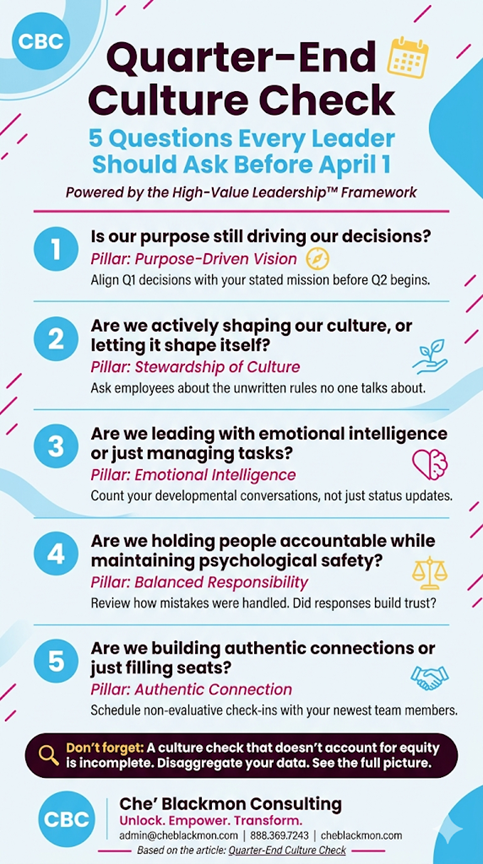
📊 Quarter‑End Culture Check: 5 Questions Every Leader Should Ask Before April 1 📋

📚 By Che’ Blackmon, DBA Candidate | Founder & CEO, Che’ Blackmon Consulting

🎯 Introduction: The Quarter Is Ending. Is Your Culture on Track?

As we approach the end of the first quarter, leaders everywhere are reviewing financial targets, sales pipelines, and operational dashboards. But how many are pausing to evaluate something equally critical: the health of their organizational culture? Culture is not a static initiative that launches once and runs on autopilot. It is a living, breathing ecosystem that requires consistent attention, honest assessment, and intentional recalibration.

In Mastering a High‑Value Company Culture, I explored the foundational truth that culture is the lifeblood of any organization. It summarizes the values, beliefs, attitudes, and behaviors that define the environment where people work. When leaders invest in culture strategically, organizations see measurable returns: higher engagement, stronger retention, accelerated innovation, and improved customer satisfaction. When they neglect it, even the most talented teams begin to fracture.

The transition from Q1 to Q2 presents a natural inflection point. Goals have been tested against reality. Team dynamics have been stress tested. And the patterns that will define your culture for the rest of the year are already forming. This is the ideal moment to conduct a deliberate culture check, not to assign blame or generate anxiety, but to ensure your organization is building on a foundation of purpose, trust, and shared accountability.

The five questions outlined below are drawn from the High‑Value Leadership™ framework, which I introduced in High‑Value Leadership: Transforming Organizations Through Purposeful Culture. Each question aligns with one of the five pillars of that framework: Purpose‑Driven Vision, Stewardship of Culture, Emotional Intelligence, Balanced Responsibility, and Authentic Connection. Together, they offer a practical and thorough lens for evaluating where your culture stands today and where it needs to go tomorrow.

❓ Question 1: Is Our Purpose Still Driving Our Decisions?

Pillar: Purpose‑Driven Vision

Every organization begins the year with a stated mission, a set of strategic objectives, and a vision for where it wants to be. But by March, something subtle often happens. The day to day operational pressure begins to overshadow the “why” behind the work. Decisions that should be guided by mission and values start to be driven by urgency, convenience, or simply “the way things have always been done.”

In High‑Value Leadership, I describe Purpose‑Driven Vision as the leader’s ability to birth and deliver a strong “why” that inspires action. Simon Sinek’s enduring insight that organizations must “start with why” remains one of the most relevant leadership principles of our time. When that “why” fades from daily decision making, culture begins to drift.

There was a mid‑size manufacturing company that opened the year with an ambitious employee engagement strategy. Their stated purpose was to create a workplace where every associate felt valued and empowered to contribute ideas. By mid‑March, leadership meetings had become consumed by production metrics and cost reduction targets, with no time reserved for engagement updates or employee feedback review. Purpose had been replaced by pressure.

💡 Actionable Takeaway:

Before Q2 begins, schedule a 30 minute leadership alignment session focused solely on this question: “Does our most recent major decision reflect our stated purpose?” If the answer is unclear or uncomfortable, it is a signal to recalibrate. Review your mission statement alongside your Q1 decisions and look for alignment gaps.

❓ Question 2: Are We Actively Shaping Our Culture, or Letting It Shape Itself?

Pillar: Stewardship of Culture

One of the most consequential truths in organizational development is this: culture will form whether you design it intentionally or not. In the absence of deliberate shaping, culture defaults to the behaviors that are tolerated, the narratives that go unchallenged, and the values that are modeled (or contradicted) by those in power.

In Mastering a High‑Value Company Culture, I wrote extensively about the contrast between leaders who actively steward their culture and those who allow it to evolve unchecked. I shared the story of two operations managers at the same plant: one who embodied high‑value leadership through consistency, respect, and clear communication; and another whose passive aggressive behaviors and misaligned incentives eroded trust across the organization. Both were technically competent. But only one built a culture worth working in.

A recent Gallup study confirms that manager behavior is the single most significant factor in employee engagement, accounting for up to 70% of the variance in team engagement scores. This means that culture is not shaped by posters on the wall or values listed on a website. It is shaped by what leaders do every day.

For traditionally overlooked populations, particularly Black women in corporate spaces, the absence of intentional culture stewardship has outsized consequences. In Rise & Thrive: A Black Woman’s Blueprint for Leadership Excellence, I highlighted the reality that Black women hold just 4% of C‑suite positions and 1.4% of executive and senior level roles in Fortune 500 companies. When culture is left unmanaged, the biases, microaggressions, and inequities that already exist tend to deepen rather than diminish. Intentional stewardship is not optional; it is the difference between inclusion as a value and inclusion as a practice.

💡 Actionable Takeaway:

Conduct a brief “culture audit” by asking three to five employees at different levels this question: “What is one unwritten rule in our organization that everyone knows but no one talks about?” The answers will reveal the gap between your intended culture and your actual culture. Address the most common themes in a transparent leadership communication before Q2 kicks off.

❓ Question 3: Are We Leading with Emotional Intelligence or Just Managing Tasks?

Pillar: Emotional Intelligence

The pace of Q1 often rewards task completion over human connection. Leaders who began the year with intentions of checking in with their teams, offering mentorship, and creating space for honest dialogue may find that those commitments quietly slipped away as deadlines intensified. When this happens, leaders are not leading; they are simply managing.

Daniel Goleman’s foundational research on emotional intelligence demonstrates that self‑awareness, empathy, and relational management are not “soft” skills; they are critical leadership competencies that directly impact team performance and organizational outcomes. In High‑Value Leadership, I positioned Emotional Intelligence as a core pillar because I have seen, across more than two decades in manufacturing, automotive, healthcare, nonprofit, and professional services environments, that the leaders who create lasting cultural impact are those who understand people as deeply as they understand processes.

There was a healthcare organization that struggled with high turnover among frontline staff. When leadership finally conducted exit interviews with genuine curiosity rather than defensiveness, a pattern emerged: employees did not feel “heard.” They had raised concerns about scheduling fairness, workload distribution, and recognition, but leadership had treated these as operational issues rather than emotional ones. When the incoming director began holding monthly listening sessions with no agenda other than understanding, turnover dropped by nearly 20% within two quarters.

This matters acutely for professionals who are already navigating invisible workloads. In Rise & Thrive, I discussed the concept of “double jeopardy” that Black women face in professional settings: the cognitive and emotional labor required to manage both racial and gender bias while simultaneously performing at the highest level. Leaders who lack emotional intelligence often fail to see this additional burden, which means they also fail to create the conditions under which all employees, not just the most visible ones, can thrive.

💡 Actionable Takeaway:

Before April 1, send your leadership team a one‑question self assessment: “In the past 90 days, how many one on one conversations have I had with my direct reports that focused on their development, concerns, or career aspirations rather than status updates?” If the number is low, prioritize building human connection into your Q2 leadership rhythm. Consider adopting a structured monthly check in template that includes at least one question about well being and professional growth.

❓ Question 4: Are We Holding People Accountable While Maintaining Psychological Safety?

Pillar: Balanced Responsibility

Accountability without safety creates fear. Safety without accountability creates complacency. High‑value leaders understand that both must coexist for a culture to be truly effective.

Amy Edmondson’s research on psychological safety, which has become one of the most cited frameworks in organizational science, shows that the highest performing teams are those where members feel safe to take risks, admit mistakes, and raise concerns without fear of punishment. At the same time, Patty McCord’s work in Powerful reminds us that maintaining high standards is not the enemy of a healthy culture; it is a prerequisite for one.

In High‑Value Leadership, I described Balanced Responsibility as the ability to maintain high standards while cultivating an environment that feels psychologically safe. This is one of the most difficult leadership balances to strike, particularly in high‑pressure industries like manufacturing and automotive where results are measured in real time and margins for error are slim.

There was a quick‑service organization that had built a reputation for operational excellence, but employee satisfaction scores were consistently low. The root cause was not the standards themselves; it was how they were enforced. Mistakes were met with public correction rather than private coaching. Employees learned to hide problems rather than surface them. When the leadership team shifted to a model of accountable coaching, where expectations remained high but feedback was delivered with respect and developmental intent, both performance metrics and engagement scores improved simultaneously.

For Black women and other traditionally overlooked professionals, the absence of psychological safety is not merely uncomfortable; it is career limiting. When the cost of speaking up is perceived to be higher than the cost of staying silent, organizations lose access to perspectives that could drive innovation, prevent errors, and strengthen decision making.

💡 Actionable Takeaway:

Ask your leadership team to evaluate the last three instances where an employee made a mistake or raised a concern. How was each situation handled? Were responses consistent across levels and demographics? Use this review to identify whether your accountability practices are building trust or eroding it. If patterns of inequity emerge, address them directly in Q2 leadership development programming.

❓ Question 5: Are We Building Authentic Connections or Just Filling Seats?

Pillar: Authentic Connection

The final question in this quarter‑end culture check may be the most telling. Are the relationships within your organization real, or are they transactional? Do leaders know their people, or do they simply know their people’s output?

John Maxwell’s principle that “people don’t care how much you know until they know how much you care” is not a motivational platitude. It is supported by decades of research linking relational trust to organizational performance. In High‑Value Leadership, I identified Authentic Connection as the fifth pillar because it is the element that gives the other four pillars their staying power. Purpose without connection is just a slogan. Accountability without connection feels punitive. Emotional intelligence without connection becomes performative.

There was an automotive supplier that invested heavily in diversity hiring, successfully increasing representation at the mid management level. However, within 18 months, a significant portion of newly hired diverse leaders had left the organization. Exit data revealed a consistent theme: they did not feel a sense of belonging. They had been recruited but not integrated. Their managers had not invested in building genuine relationships with them, and mentorship or sponsorship opportunities were largely extended through informal networks that favored those who already “fit in.”

In Rise & Thrive, I addressed this challenge directly, noting that Black women who attain leadership positions often face what researchers call the “glass cliff” phenomenon, being promoted into high‑risk roles during times of organizational crisis while simultaneously lacking the relational support systems that their peers take for granted. Authentic connection is the antidote to this isolation. It is what transforms diversity from a metric into a lived experience.

💡 Actionable Takeaway:

Before Q2 begins, identify three employees who have been with your organization for less than one year, particularly those from historically underrepresented backgrounds. Schedule a casual, non evaluative conversation with each of them. Ask about their onboarding experience, whether they feel connected to their team, and what would make them want to stay long term. Use these insights to inform your retention and engagement strategies for the remainder of the year.

🔍 The Overlooked Factor: Why Culture Checks Must Center Equity

A quarter‑end culture check that does not account for equity is incomplete. Organizations often measure culture through aggregate engagement scores and satisfaction surveys, but these tools can mask significant disparities in experience across demographics.

McKinsey’s 2024 “Women in the Workplace” report continues to document that women of color, and Black women in particular, report markedly different workplace experiences than their white counterparts. They are more likely to have their competence questioned, to feel isolated from social networks, and to experience being the “only one” in meetings and decision making spaces. These experiences do not show up in company wide averages, but they are defining the culture for a significant portion of your workforce.

In my consulting practice with Che’ Blackmon Consulting, I work with organizations to disaggregate their culture data by demographic groups so they can see the full picture. The results are often eye opening. An organization that believes its culture is strong may discover that the experience is vastly different depending on who you ask. This kind of insight is not a reason for discouragement; it is a roadmap for targeted, meaningful improvement.

As I wrote in Rise & Thrive, “It is not our differences that divide us. It is our inability to recognize, accept, and celebrate those differences.” A truly high‑value culture does not simply tolerate diversity; it actively creates the conditions under which every person, regardless of background, can contribute fully and be recognized for that contribution.

📈 Current Trends Reinforcing the Need for Culture Accountability

Several trends in the current business environment make this quarter‑end culture check more urgent than ever.

The Return to Office Debate: As more organizations mandate or encourage in‑person work, leaders must be especially attentive to how these transitions impact different groups. Employees with caregiving responsibilities, those with disabilities, and professionals who found that remote work reduced their exposure to microaggressions all experience these transitions differently. A culture check should include questions about whether return to office policies are being implemented equitably.

AI and Workforce Transformation: The rapid adoption of artificial intelligence is reshaping job roles, creating anxiety about displacement, and demanding new skills. Leaders who are not proactively communicating about AI’s impact on their workforce are allowing fear and misinformation to fill the vacuum. Culture checks should assess whether employees feel informed and supported as technology reshapes their work.

The Evolving DEI Landscape: Regardless of where your organization stands on the broader societal conversation about diversity, equity, and inclusion, the internal expectation from employees, particularly those from marginalized communities, has not diminished. A 2025 Pew Research Center study found that the majority of workers still believe their employers should be doing more to promote fairness and inclusion in the workplace. Leaders who treat equity as a trend rather than a value risk losing the trust and talent of their most underrepresented team members.

Mental Health and Well Being: The World Health Organization’s recognition of burnout as an occupational phenomenon has prompted organizations to rethink how they support employee well being. A quarter‑end culture check should include an honest assessment of whether leadership is modeling sustainable work habits and whether mental health resources are accessible, not just available.

📋 Quick Reference: Your Q1 Culture Check Summary

Question 1 (Purpose‑Driven Vision): Is our purpose still driving our decisions?

Question 2 (Stewardship of Culture): Are we actively shaping our culture, or letting it shape itself?

Question 3 (Emotional Intelligence): Are we leading with emotional intelligence or just managing tasks?

Question 4 (Balanced Responsibility): Are we holding people accountable while maintaining psychological safety?