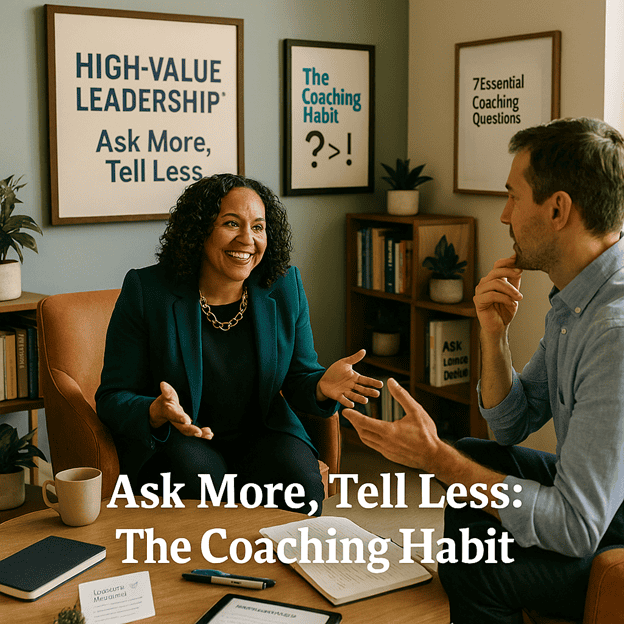
Why the best leaders ask more than they answer—and how questions transform organizations
The senior director had all the answers. Twenty years of industry experience had taught him exactly how problems should be solved, decisions should be made, and work should be executed. When his team brought challenges, he dispensed solutions efficiently. When they proposed ideas, he quickly identified flaws and provided corrections. He was knowledgeable, decisive, and always available to tell people what to do.
His team was also disengaged, dependent, and stagnant. Nobody developed problem-solving capabilities because he solved all the problems. Nobody took ownership because he owned all the decisions. Nobody grew because he did all the thinking.
When his best performer resigned, the exit interview revealed a painful truth: “I didn’t leave for more money. I left because I stopped learning. Every conversation with him was him telling me what to do. I became a pair of hands executing his ideas rather than a professional developing my own capabilities.”
This leader had mistaken directing for developing. He’d confused having answers with building leaders. And he’d paid for it with turnover, disengagement, and a team that couldn’t function without his constant intervention.
The shift he needed—and that most leaders need—is simple but profound: from telling to asking. From providing answers to asking powerful questions that develop thinking, build ownership, and create leaders rather than followers.
The Case for Coaching-Style Leadership 🎯
Traditional leadership operated on an expertise model: the leader knew most, decided most, and directed execution. This model worked reasonably well in stable environments with routine work and predictable challenges. It fails spectacularly in complex, rapidly changing environments requiring innovation, adaptation, and distributed decision-making.
As I discuss in High-Value Leadership: Transforming Organizations Through Purposeful Culture, high-value leaders understand that their job isn’t to be the smartest person in the room—it’s to make everyone in the room smarter. This requires a fundamental shift from directive leadership to developmental leadership, from command-and-control to coach-and-cultivate.
Research by the International Coach Federation demonstrates that organizations with strong coaching cultures report:
- 62% higher employee engagement
- 51% higher revenue growth
- 60% improvement in team performance
- 48% improvement in organizational culture
These aren’t marginal improvements—they’re transformational differences driven by a simple practice: leaders who ask powerful questions instead of providing all the answers.
Why coaching-style leadership matters more in 2025 and beyond:
Pace of change exceeds leader knowledge: Leaders can no longer know everything their teams need to know. Technology, market conditions, customer preferences, and competitive dynamics change faster than any single person can track. Leaders who insist on having all answers become bottlenecks.
Talent expectations have shifted: Younger professionals expect development, not just direction. They want to learn, grow, and build capabilities—not just execute tasks. Leaders who only tell rather than develop lose talent to competitors who coach.
Complex problems require diverse thinking: The challenges organizations face exceed any individual’s cognitive capacity. Solutions emerge from collective intelligence, not individual genius. Coaching-style leadership leverages diverse perspectives rather than imposing single viewpoints.
Remote work demands autonomy: Distributed teams can’t wait for leader approval on every decision. Coaching develops judgment and ownership that enables effective autonomous action when leaders aren’t immediately available.
Inclusion requires voice: Traditionally marginalized groups—particularly Black women—have been talked at and directed rather than asked and developed. Coaching-style leadership creates space for voices that have been historically silenced.
Understanding Powerful Questions ❓
Not all questions are created equal. Many so-called questions are actually disguised directives, judgments, or rhetorical devices designed to prove points rather than provoke thinking.
Pseudo-questions that don’t actually coach:
“Don’t you think you should…?” (This is telling disguised as asking) “Why did you do it that way?” (This often implies criticism rather than curiosity) “Have you considered [my solution]?” (This is directing with a question mark) “Wouldn’t it be better if…?” (This is judgment framed as inquiry)
These questions don’t develop thinking—they impose the leader’s thinking while creating the appearance of involvement.
Powerful questions share key characteristics:
They’re genuinely curious: The leader doesn’t know the answer and actually wants to understand the other person’s thinking. Genuine curiosity creates psychological safety and invites authentic responses.
They’re open-ended: Powerful questions can’t be answered with yes/no. They require thinking, reflection, and articulation of perspectives. “What concerns you about this approach?” generates more development than “Are you concerned?”
They expand thinking: Great coaching questions help people see possibilities, connections, or implications they hadn’t considered. “What else could be true?” or “Who else might be affected?” broaden perspective beyond initial framing.
They build ownership: Questions like “What do you think we should do?” or “What would you propose?” shift responsibility from the leader to the person being coached. This develops both capability and accountability.
They surface assumptions: “What are you assuming about this situation?” or “What would need to be true for that to work?” help people examine their mental models rather than operating on autopilot.
They connect to purpose: “How does this connect to what matters most?” or “What impact do you want to have?” ground problem-solving in values and objectives rather than just tactics.
The Seven Essential Coaching Questions 7️⃣
While coaching conversations can include infinite questions, research by Michael Bungay Stanier and others identifies several questions with outsized impact. These questions, asked consistently, transform how leaders develop their teams.
1. “What’s on your mind?” 🤔
Purpose: Opens conversation without imposing agenda. Lets the other person surface what matters most to them rather than what you assume matters.
Why it’s powerful: This question immediately signals that this conversation is about their thinking, not your telling. It creates space for issues the leader might not have considered or even known about.
When to use it: Opening one-on-ones, check-ins, or whenever someone seems to need to talk but hasn’t articulated what about.
Example in practice:
A team member seems distracted during meetings but hasn’t raised concerns. Rather than assuming the problem or offering unsolicited advice, the leader opens their one-on-one with: “What’s on your mind?”
The team member shares that they’re struggling with work-life balance since their elderly parent moved in with them. This isn’t a problem the leader could have solved by providing technical guidance—it required space to articulate what was actually affecting performance.
The leader’s role shifts from problem-solver to thought partner, exploring: “What support would help you manage this?” and “What adjustments might make this season more sustainable?”
2. “And what else?” (AWE) 🔄
Purpose: Deepens exploration beyond the first, often surface-level response. Humans tend to offer the most available or least risky answer first. “And what else?” surfaces additional factors, concerns, or ideas.
Why it’s powerful: This simple question generates exponentially more insight than stopping at the first response. It also demonstrates genuine interest rather than performative inquiry.
When to use it: After almost any response to deepen understanding. Research shows asking “and what else?” 3-5 times in a conversation dramatically improves the quality of thinking.
Example in practice:
Leader: “What challenges are you facing with this project?” Team member: “We’re behind schedule.” Leader: “And what else?” Team member: “The vendor hasn’t delivered what they promised.” Leader: “And what else?” Team member: “Honestly, I’m not sure everyone on the team understands what we’re trying to accomplish.”
That third factor—lack of shared understanding—is often the root cause that wouldn’t have surfaced without deeper exploration. The leader now knows that solving the schedule and vendor issues without addressing alignment will still leave the project struggling.
3. “What’s the real challenge here for you?” 🎯
Purpose: Focuses on the core issue rather than symptoms or surface problems. Helps people distinguish between what looks like the problem and what actually is the problem.
Why it’s powerful: People often present presenting problems rather than real problems. This question cuts through to what actually matters and makes the challenge specific to the person, not abstract.
When to use it: When conversations spiral across multiple issues, when someone seems stuck, or when the stated problem doesn’t explain the level of frustration or difficulty.
Example in practice:
A manager brings multiple complaints about a project: the timeline is unrealistic, resources are insufficient, stakeholders keep changing requirements, and the team seems demotivated.
Rather than trying to solve all these issues, the leader asks: “What’s the real challenge here for you?”
After reflection: “I’ve never led a project this high-visibility before. I’m afraid if it fails, it will define my reputation. So I’m trying to control everything instead of trusting my team and managing stakeholder expectations.”
The real challenge isn’t timeline, resources, or scope—it’s the manager’s fear and resulting micromanagement. Solving the stated problems wouldn’t have addressed the underlying issue driving dysfunction.
4. “What do you want?” 🎁
Purpose: Clarifies objectives and desired outcomes. Many people know what they don’t want but haven’t articulated what they actually want instead.
Why it’s powerful: This question shifts from complaint to aspiration, from problem to possibility. It also surfaces whether someone wants advice, validation, decision-making authority, or just to be heard.
When to use it: When conversations feel stuck in problem description without moving toward solutions, or when you’re unclear what the person actually needs from you.
Example in practice:
A team member brings repeated concerns about team dynamics but doesn’t propose solutions. The leader asks: “What do you want?”
Initial response: “I want people to stop interrupting me in meetings.”
Leader: “And what else do you want?”
Deeper response: “I want my ideas to be taken seriously. I want to feel like my perspective matters to the team.”
Now the conversation shifts from managing meeting behavior (which the leader could mandate) to building influence and voice (which requires developmental coaching about communication, relationship-building, and confidence).
5. “How can I help?” 🤝
Purpose: Clarifies what support is actually needed versus what the leader assumes is needed. Prevents over-functioning or providing help that doesn’t help.
Why it’s powerful: This question makes the other person specify what would be useful rather than the leader imposing their preferred form of help. It also positions the leader as supportive resource rather than controlling authority.
When to use it: After someone has articulated a challenge or goal. Before jumping in to solve or advise.
Example in practice:
A team member shares they’re struggling with a difficult stakeholder who dismisses their recommendations.
Instead of immediately offering advice (“Have you tried…”), the leader asks: “How can I help?”
Possible responses reveal very different needs:
- “Could you attend the next meeting and observe the dynamic?” (Wants witness/validation)
- “Would you help me role-play the conversation?” (Wants practice/skill development)
- “Could you talk to them directly?” (Wants intervention)
- “Just listen to me vent for a minute.” (Wants empathy, not solving)
Each requires different help. Asking prevents providing the wrong type of support.
6. “If you’re saying yes to this, what are you saying no to?” ⚖️
Purpose: Surfaces trade-offs and opportunity costs. Helps people think strategically about priorities rather than just adding to their plate.
Why it’s powerful: People habitually say yes without considering what they’ll sacrifice to accommodate new commitments. This question forces explicit trade-off thinking that prevents overcommitment and burnout.
When to use it: When someone is considering new commitments, struggling with workload, or saying yes to everything while complaining about overwhelm.
Example in practice:
A high-performer volunteers for another task force while already stretched thin. Rather than either approving or denying the request, the leader asks: “If you’re saying yes to this task force, what are you saying no to?”
The team member considers: “I guess I’d have to deprioritize the process improvement project I’ve been leading. Or stop mentoring the two junior team members who’ve been asking for my time. Or reduce time on my core responsibilities.”
This reflection reveals that the task force—while potentially valuable—comes at costs the team member hadn’t fully considered. They may still choose it, but now it’s a conscious strategic choice rather than reflexive yes.
7. “What was most useful about this conversation?” 📝
Purpose: Consolidates learning and signals that development happens through their thinking, not your telling. Also provides you feedback about what’s actually helpful.
Why it’s powerful: This question requires reflection about what mattered, which reinforces integration. It also trains people to extract value from conversations rather than passively receiving advice.
When to use it: Closing coaching conversations, one-on-ones, or developmental discussions.
Example in practice:
After a thirty-minute coaching conversation about navigating organizational politics, the leader closes with: “What was most useful about this conversation?”
Response: “Realizing that I’ve been waiting for permission to build relationships with senior leaders when I actually just need to reach out. And that my discomfort isn’t a sign I shouldn’t do it—it’s just unfamiliarity.”
This reflection crystallizes the insight from the conversation and identifies what will actually drive behavior change versus everything else discussed that might have been interesting but won’t translate to action.
The Traditionally Overlooked: Coaching Black Women Leaders 🌟
Coaching-style leadership takes on particular significance for Black women and other marginalized leaders who’ve historically been directed, dismissed, and developed least.
As I explore in Rise & Thrive: A Black Woman’s Blueprint for Leadership Excellence, Black women in corporate spaces often navigate environments where their thinking isn’t solicited, their perspectives aren’t valued, and their development isn’t prioritized. They receive direction without development, criticism without coaching, and feedback about how they should be different rather than questions that help them grow from where they are.
Common patterns affecting Black women that coaching can address:
Under-developed and over-directed: Black women frequently receive explicit instructions about tasks while their white peers receive developmental coaching about leadership. This perpetuates skill gaps that then get cited as reasons for non-promotion.
There was a technology company where performance reviews revealed striking patterns: Black women’s reviews contained 42% more directive language (“you should,” “you need to,” “make sure you”) while white men’s reviews contained 67% more developmental language (“consider,” “what if you,” “how might you”).
The directive approach treated Black women as executors rather than thinkers, denying them the coaching that builds strategic capability.
Questions as interrogation rather than development: Black women report that when leaders ask them questions, it often feels like skeptical interrogation (“Why did you do it that way?” with implicit criticism) rather than curious development (“What was your thinking?” with genuine interest).
This distinction—between questions that question judgment versus questions that develop judgment—profoundly affects whether coaching actually develops capability or just reinforces insecurity.
Feedback without psychological safety: Effective coaching requires psychological safety to think out loud, make mistakes, and explore ideas without fear. Black women often lack this safety, making coaching conversations feel risky rather than developmental.
Style feedback masquerading as coaching: Black women disproportionately receive “coaching” focused on changing how they communicate, dress, or show up rather than questions that develop their strategic thinking, leadership capability, or technical expertise.
“Have you considered being less direct?” isn’t developmental coaching—it’s assimilation pressure disguised as development.
Lack of access to coaching: Executive coaching, leadership development, and other coaching resources disproportionately flow to people who “look like leaders”—which often means white men. Black women get excluded from coaching opportunities then face criticism for lacking capabilities coaching would have developed.
Effective coaching for Black women requires:
Genuine curiosity about their thinking: Questions that actually want to understand their perspective rather than leading them to pre-determined “correct” answers.
Recognition of context: Understanding that Black women navigate additional complexities that white colleagues don’t face. “What challenges are you facing?” followed by “And what else?” might surface dynamics of exclusion, bias, or isolation that require different coaching approaches.
Development of full capability spectrum: Coaching that builds strategic thinking, leadership presence, technical depth, political navigation—not just style modification to fit dominant culture norms.
Psychological safety for authentic development: Creating conditions where Black women can think out loud, explore ideas, admit uncertainty, and develop without fear that vulnerability will be weaponized against them.
Sponsorship alongside coaching: Coaching develops capability, but Black women also need sponsors who create opportunities to apply those capabilities. Coaching without opportunity access is development without advancement.
Building a Coaching Culture: Beyond Individual Conversations 🏢
While individual coaching conversations matter, sustainable impact requires building coaching into organizational culture—making it how work gets done rather than something special that happens occasionally.
As I outline in Mastering a High-Value Company Culture, high-value cultures integrate coaching into regular rhythms: team meetings, project debriefs, performance conversations, problem-solving sessions, and decision-making processes.
Elements of strong coaching cultures:
Regular Coaching Rhythms 📅
Weekly one-on-ones structured around coaching questions: Instead of status update meetings, leaders use structured time to develop team members through powerful questions about challenges they’re facing, opportunities they’re seeing, and capabilities they’re building.
Team coaching sessions: Regular team time devoted to collective learning through questions like: “What did we learn from this project?” “What’s working well that we should do more of?” “What’s not working that we need to change?”
Peer coaching: Structured opportunities for colleagues to coach each other, not just receive coaching from leaders. This democratizes development and builds coaching capabilities across the organization.
Leader Accountability for Development 📊
Coaching as performance metric: Leaders evaluated not just on their team’s outputs but on their team’s development. Metrics like: team members’ skill growth, promotion rates, engagement scores, and self-reported development.
Development plans for every team member: Not just for underperformers or high-potentials, but systematic development conversations and plans for everyone. Coaching questions drive these conversations rather than leader-prescribed development paths.
Time allocation expectations: Leaders explicitly expected to spend significant time (20-30%) on developing people, not just managing tasks. This time is protected and valued rather than treated as optional when “real work” allows.
Training and Support for Coaches 🎓
Coaching skills development: Teaching leaders how to ask powerful questions, create psychological safety, listen deeply, and resist the advice-giving reflex. These are learned skills, not innate talents.
Practice and feedback: Leaders practice coaching with observation and feedback, not just attend training then return to old patterns. Skill development requires deliberate practice with refinement.
Peer learning communities: Leaders learn coaching together through peer observation, case consultation, and shared problem-solving about developmental challenges.
Systems That Support Coaching 🔧
Performance management redesigned: Shifting from annual reviews to ongoing coaching conversations. Replacing rating systems that create defensiveness with developmental dialogue that builds capability.
Meeting structures that enable coaching: Agendas with time for questions rather than only presentations. Norms that value inquiry over advocacy. Practices that ensure psychological safety for learning.
Recognition for development: Celebrating not just results but how people developed capabilities, helped others learn, and built organizational capability for the future.
Case Study: Manufacturing Company’s Coaching Transformation 🏭
A Michigan automotive supplier faced concerning patterns: engagement was low (43%), turnover was high (31%), and leadership bench strength was weak. When senior leaders retired or left, they struggled to fill positions internally.
Exit interviews revealed a common theme: “My manager told me what to do but never developed me. I stopped learning, so I left.”
The CEO recognized they had directive leaders who managed tasks but didn’t develop people. She commissioned a coaching culture initiative.
Initial assessment revealed:
- Managers spent 78% of time directing work, 22% developing people
- One-on-ones focused almost entirely on status updates
- Questions managers asked were mostly interrogative (“Why is this late?”) rather than developmental
- No systematic approach to employee development beyond required training
- High-performers left because they plateaued—capable managers didn’t know how to develop them further
Intervention design:
Phase 1: Leader Development (Months 1-3)
- All managers trained in coaching skills: asking powerful questions, active listening, resisting advice reflex
- Introduction of the seven essential coaching questions
- Practice sessions with feedback and refinement
- Peer coaching partnerships established
Phase 2: Structure and Rhythm Changes (Months 4-6)
- One-on-ones restructured: first 20 minutes for coaching questions, last 10 for status updates (reversed previous ratio)
- Monthly team learning sessions where leaders coached teams through challenges
- Development plans required for all employees, driven by coaching questions rather than manager prescriptions
- Manager performance metrics expanded to include team development outcomes
Phase 3: Culture Embedding (Months 7-12)
- Coaching competency added to leadership requirements
- Recognition program highlighting developmental leadership examples
- Peer coaching expanded beyond managers to include all employees
- Project debriefs redesigned around coaching questions: “What worked? What didn’t? What would we do differently? What did we learn?”
Results after 18 months:
Engagement increased from 43% to 68%: Employees reported feeling more valued, developed, and empowered.
Turnover decreased from 31% to 17%: Exit interviews showed people staying because “I’m still learning” rather than leaving because “I stopped growing.”
Internal promotion rate increased by 47%: More people ready for advancement because they’d been developed systematically.
Problem-solving improved: Teams solved problems more independently because coaching had developed their thinking capabilities rather than dependence on manager solutions.
Innovation increased: Coaching questions surfaced ideas from people who previously hadn’t been asked for their thinking.
Manager effectiveness improved: Managers reported less stress from feeling responsible for having all answers, more satisfaction from developing people.
The most significant shift wasn’t in metrics—it was in how work felt. One manager reflected: “I used to go home exhausted from solving everyone’s problems. Now I go home energized by helping people solve their own problems. And they’re becoming better problem-solvers than I ever was because they’re developing their own thinking instead of just executing mine.”
Overcoming the Advice-Giving Addiction 🚫
The biggest barrier to coaching-style leadership is most leaders’ addiction to giving advice. Telling feels efficient, demonstrates expertise, and provides immediate gratification. Asking feels slow, uncertain, and risks exposing that you don’t know everything.
Why leaders default to telling:
Efficiency illusion: Telling seems faster than asking. “Just do X” takes thirty seconds. Coaching someone to develop their own solution takes twenty minutes. But the long-term efficiency reverses—coached people solve future problems independently while directed people keep returning for solutions.
Expertise identity: Many leaders derive self-worth from being the smartest person who has the answers. Asking questions threatens this identity: “If I’m asking instead of knowing, what’s my value?”
Organizational culture: Many organizations reward quick decisive action over developmental patience. Leaders who coach face pressure to “just tell people what to do and move on.”
Lack of skill: Leaders often don’t know how to coach effectively, so they default to comfortable directive approaches even when they intellectually believe coaching matters.
Breaking the advice addiction requires:
Awareness of the reflex: Notice how quickly you jump to advice. When someone brings a challenge, count to five before responding. The pause interrupts automatic telling.
Start with one question: Before offering any advice, ask just one coaching question: “What have you already tried?” or “What ideas do you have?” This small step builds the coaching muscle.
Make advice opt-in, not default: Instead of offering unsolicited solutions, ask: “Would you like my thoughts on this, or would it be more helpful to think through it together?” This makes advice something they can request rather than something you impose.
Celebrate developed thinking, not just delivered solutions: Recognize when team members solve problems independently, even if their solutions differ from what you would have done. This reinforces development over dependence.
Get coaching yourself: Leaders who receive coaching understand its value viscerally rather than abstractly. Executive coaching for leaders models the developmental approach you want them to practice.
Coaching Questions for Common Leadership Situations 💼
When team members bring problems seeking solutions:
Instead of: “Here’s what you should do…”
Ask:
- “What options have you considered?”
- “What would you do if I weren’t available to ask?”
- “What’s your recommendation and what’s your reasoning?”
- “What would need to be true for your approach to work?”
- “How could you test your solution on small scale before full implementation?”
When someone proposes an idea you think is flawed:
Instead of: “That won’t work because…”
Ask:
- “Walk me through your thinking—what led you to this approach?”
- “What potential challenges do you see with this approach?”
- “What would success look like? How would you measure it?”
- “Who else might be affected? What’s their perspective?”
- “What’s Plan B if this doesn’t work as hoped?”
When you notice performance issues:
Instead of: “You need to improve X…”
Ask:
- “How do you think things are going?”
- “What’s getting in the way of your best work?”
- “What support would help you perform at your highest level?”
- “What patterns are you noticing in your work?”
- “What would you like to be different?”
When someone seems stuck or frustrated:
Instead of: Offering solutions or motivation
Ask:
- “What’s the hardest part of this for you?”
- “What’s one small step you could take today?”
- “What would make this feel more manageable?”
- “Who could help you with this?”
- “What’s worked when you’ve faced similar challenges before?”
When coaching emerging leaders:
Instead of: Telling them how to lead
Ask:
- “What kind of leader do you want to be?”
- “What impact do you want to have on your team?”
- “What’s your learning edge right now—where are you most growing?”
- “What leadership behaviors have you observed that you want to emulate? Which do you want to avoid?”
- “How will you know you’re developing as a leader?”
Research-Backed Coaching Best Practices 📚
Organizations that coach effectively share common practices supported by research:
They ask more than they tell: Research by Julia Milner and Trenton Milner published in Harvard Business Review found that managers who ask questions rather than provide solutions develop higher-performing teams. The optimal ratio: 60-70% questions, 30-40% advice.
They resist premature advice: Studies show that leaders who wait until after asking at least three questions before offering advice generate better outcomes than those who jump immediately to solutions. The discipline of inquiry before advocacy improves both the quality of advice (when given) and team member development.
They listen more than they speak: Research on coaching effectiveness shows that in developmental conversations, the person being coached should speak 60-70% of the time. When leaders dominate conversation, development doesn’t happen.
They tolerate productive struggle: Carol Dweck’s research on growth mindset shows that struggle is essential to learning. Leaders who rescue people from difficulty prevent development. Coaching-style leaders ask: “What could you try?” rather than eliminating struggle with solutions.
They coach the person, not just the problem: Effective coaches focus on building capabilities that transfer across situations rather than just solving the immediate issue. Questions like “What’s the pattern here?” or “Where else does this show up?” connect specific situations to broader development.
They make coaching everyone’s job: Organizations with strongest coaching cultures democratize coaching rather than treating it as something only senior leaders do. Peer coaching, team coaching, and upward coaching (junior people coaching senior leaders) all contribute to development.
Common Coaching Mistakes That Undermine Development ⚠️
Mistake 1: Asking leading questions that aren’t actually questions
“Don’t you think you should…” is telling with a question mark. Powerful questions are genuinely open without predetermined answers.
Mistake 2: Asking questions but not listening to answers
Leaders who ask questions but interrupt, argue with responses, or ignore input teach people that their thinking doesn’t actually matter. Asking questions requires genuine curiosity about answers.
Mistake 3: Using questions to avoid difficult conversations
Coaching questions work for development, not for addressing performance problems requiring direct feedback. “What could you do differently?” isn’t appropriate when clear corrective feedback is needed: “This behavior is unacceptable and must stop.”
Mistake 4: Coaching when directing is appropriate
Coaching develops judgment for ambiguous situations. Some situations require clear direction: safety issues, compliance requirements, organizational mandates. Know when each approach fits.
Mistake 5: Coaching without psychological safety
Questions asked in threatening environments generate defensive responses, not developmental thinking. Coaching requires foundation of safety, trust, and genuine development intent.
Mistake 6: Assuming everyone wants or needs the same coaching
Different people need different developmental support. Some need confidence-building, others need challenge. Some need technical skill development, others need strategic thinking development. Effective coaches diagnose individual needs rather than applying one-size-fits-all approaches.
Mistake 7: Measuring coaching by time spent rather than impact achieved
Having coaching conversations doesn’t equal effective development. Impact shows up in capability growth, independent problem-solving, ownership increases, and engagement improvements—not just hours of coaching delivered.
Building Your Personal Coaching Practice 🌱
Developing coaching-style leadership is a practice, not a switch you flip. Start small, build gradually, and refine based on what works.
Week 1: Awareness and Baseline
- Notice how often you give advice versus ask questions
- Count: How many coaching questions do you ask per day?
- Observe: When do you jump to advice? What triggers the telling reflex?
- Record: What questions do you currently ask? Are they genuine or leading?
Week 2-3: One Question Practice
- Commit to asking one coaching question before any advice
- Start with: “What’s your thinking on this?”
- Practice the three-second pause before responding
- Notice what happens when you ask first
Week 4-5: Expand Question Repertoire
- Add “And what else?” to deepen exploration
- Introduce “What’s the real challenge here for you?”
- Practice “How can I help?” before offering solutions
- Experiment with different questions in different contexts
Week 6-8: Build Coaching Rhythms
- Restructure one-on-ones to start with coaching questions
- Add one team coaching session per month
- Establish peer coaching partnership with colleague
- Track what questions generate best thinking
Month 3 and beyond: Refine and Expand
- Seek feedback: “What’s most useful about our conversations?”
- Observe patterns: Which questions work for which situations?
- Learn from mistakes: When did questions not work? Why?
- Deepen practice: Executive coaching for yourself to experience coaching from inside
Month 6: Assess Impact
- How has team engagement changed?
- Are people solving more problems independently?
- What capabilities have team members developed?
- How has your experience of leadership shifted?
Discussion Questions for Your Leadership Team 💭
- When we review our typical leadership conversations, are we asking or telling more often? What’s the ratio, and what’s ideal for our context?
- How would our team members describe the questions we ask? Genuine developmental inquiry? Skeptical interrogation? Leading questions disguised as participation?
- What prevents us from coaching more effectively? Time pressure? Advice addiction? Lack of skill? Organizational culture that rewards quick solutions?
- When we look at who receives developmental coaching in our organization, what patterns emerge by race, gender, and other demographics? Who gets coached and who gets directed?
- What would shift if we measured leaders not just on their team’s outputs but on their team’s development? What behaviors would this change?
- Black women and other marginalized leaders: Do you receive genuine developmental coaching or primarily directive feedback and style policing? What would change if you received the former?
- If we committed to asking three coaching questions before offering any advice, what would become possible in our organization?
Next Steps: Your Coaching Development Action Plan 📝
Immediate Actions (This Week):
- Choose one coaching question to practice consistently this week
- Notice your advice-giving reflex and pause before responding
- Schedule one conversation specifically for coaching practice
- Ask someone for feedback: “Do my questions feel developmental or interrogative?”
- Identify one leader whose coaching style you admire and observe how they ask questions
Short-Term Actions (Next 30 Days):
- Implement coaching questions in one-on-ones with direct reports
- Establish one peer coaching partnership for mutual development
- Read or listen to resources on coaching-style leadership
- Practice all seven essential coaching questions in various contexts
- Track what questions generate best thinking and development
Long-Term Culture Shift (Next 6 Months):
- Build coaching competency into leadership evaluation criteria
- Train all managers in coaching skills with practice and feedback
- Restructure meetings and one-on-ones to include coaching time
- Create peer coaching programs across the organization
- Measure and celebrate team member development alongside task completion
- Establish coaching culture indicators and track progress quarterly
Partner with Che’ Blackmon Consulting: Building Coaching Capability at Scale ✨
Transforming from directive to developmental leadership requires more than individual commitment—it requires organizational systems, skilled development, and sustained support.
Che’ Blackmon Consulting helps organizations build coaching cultures through:
Leadership Coaching Skills Development: Training programs that build leaders’ capacity to ask powerful questions, create psychological safety, and develop people through inquiry rather than direction.
Executive Coaching: One-on-one coaching for leaders to develop their own coaching capabilities while experiencing coaching from the inside, making the value visceral rather than abstract.
Coaching Culture Assessment: Evaluation of current state (how much coaching happens, how effective it is, who receives it equitably) and roadmap for building stronger developmental culture.
Manager Development Programs: Cohort-based learning where managers develop coaching skills together through practice, feedback, and peer learning.
Organizational System Redesign: Transformation of performance management, meeting structures, and leadership rhythms to integrate coaching rather than treating it as separate from “real work.”
Equity-Focused Coaching Practices: Specific development of coaching approaches that effectively develop Black women and other traditionally marginalized leaders who’ve been over-directed and under-coached.
As a doctoral candidate in Organizational Leadership and founder of Che’ Blackmon Consulting, I bring both research-backed frameworks and practical implementation experience to help you shift from telling cultures to asking cultures, from directive leadership to developmental leadership, from creating followers to building leaders.
The leaders your organization needs tomorrow won’t develop by being told what to do today. They’ll develop by being asked powerful questions that build their thinking, judgment, ownership, and capability.
Your choice: Build leaders who depend on you for answers, or build leaders who develop their own? One requires telling. The other requires asking.
📧 admin@cheblackmon.com
📞 888.369.7243
🌐 cheblackmon.com
Let’s build the coaching capabilities your leaders need to develop the organization your mission requires.
Che’ Blackmon is a doctoral candidate in Organizational Leadership, founder and CEO of Che’ Blackmon Consulting, and author of “High-Value Leadership: Transforming Organizations Through Purposeful Culture,” “Mastering a High-Value Company Culture,” and “Rise & Thrive: A Black Woman’s Blueprint for Leadership Excellence.” She brings 24+ years of progressive HR leadership experience helping organizations build coaching cultures that develop capability at scale and create environments where all leaders—including those traditionally overlooked—receive the developmental support required for excellence.
#CoachingLeadership #LeadershipDevelopment #HighValueLeadership #ExecutiveCoaching #LeadershipSkills #DevelopmentalLeadership #PowerfulQuestions #TalentDevelopment #LeadershipCoaching #OrganizationalDevelopment #EmployeeEngagement #BlackWomenInLeadership #InclusiveLeadership #GrowthMindset #LeadershipCulture #PeopleFirst #CoachingCulture #LeadershipTransformation #ExecutiveDevelopment #TeamDevelopment