New Year. Same Damn Problems. Here’s Why That’s Actually Good News. 💡

By Che’ Blackmon, Founder & CEO, Che’ Blackmon Consulting | DBA Candidate in Organizational Leadership


Let me tell you something nobody wants to hear on January 1st: that champagne you drank at midnight didn’t wash away your 2025 problems.

Your toxic team member is still toxic. Your turnover crisis is still a crisis. That executive who undermines you in meetings? Still undermining you. The systems that failed you in October are going to fail you in February unless something fundamentally changes.

And here’s the part that might surprise you: this is actually the best news you’ll hear all year.

The New Year’s Lie We Keep Telling Ourselves 🎭

We’ve been conditioned to believe that January 1st is magic. A clean slate. A fresh start. A chance to be better, do better, achieve more. We make resolutions. We buy planners. We tell ourselves “this year will be different.”

But here’s what actually happens: We take the same leadership habits, the same broken organizational systems, the same unresolved conflicts, and we drag them across an arbitrary date on the calendar. Then we wonder why March feels exactly like November.

There was a company that spent $50,000 on a New Year’s leadership retreat. Vision boards. Team building exercises. Motivational speakers. By April, their turnover rate was higher than it had been the previous year. Why? Because they treated culture transformation like a resolution instead of a structural renovation.

The calendar changed. The company culture didn’t.

The Truth About January 1st (And Why It Still Matters) 📅

Now, before you think I’m about to tell you that New Year’s is meaningless, let me be clear: I’m not.

January 1st absolutely has power. But not because the universe resets. Not because your problems dissolve at midnight. The power of January 1st is purely psychological, and that psychology is incredibly valuable if you know how to use it strategically.

Research in behavioral psychology shows that temporal landmarks create what scientists call “the fresh start effect.” People are more likely to pursue goals after meaningful calendar dates. Our brains love milestones. We’re wired to see beginnings as opportunities for change.

But here’s the critical distinction: Psychology creates the opening. Strategy determines whether anything actually changes.

For Black women in leadership, this distinction isn’t academic. It’s survival. We don’t have the luxury of hoping things will magically improve. We’ve spent our entire careers navigating spaces that weren’t designed for us, excelling despite systems built to exclude us, and carrying the weight of being “the only” or “the first.”

We know that willpower doesn’t dismantle structural barriers. We know that positive thinking doesn’t change toxic workplace cultures. We know that working twice as hard to get half as far isn’t a sustainable strategy.

What we need isn’t motivation. We need methodology.

Why Your 2025 Problems Are Coming With You Into 2026 🎒

Let’s get specific about what actually follows you into the new year:

Unresolved conflict doesn’t expire. That tension between your marketing and sales teams? Still there. The communication breakdown between leadership and frontline employees? Still broken. The resentment from that poorly handled reorganization? Still festering.

Structural dysfunction doesn’t self-correct. If your hiring process was biased in 2025, it’s still biased now. If your promotion criteria were unclear and subjective, they still are. If your retention strategy was “hope people don’t leave,” congratulations on your continued hope-based approach.

Toxic culture doesn’t heal itself. Organizations don’t wake up on January 2nd suddenly valuing psychological safety. They don’t spontaneously start recognizing contributions from traditionally overlooked employees. They don’t magically begin addressing microaggressions or creating equitable opportunities.

There was a healthcare organization that celebrated making it through 2024 with “only” 23% turnover. They threw a party. They gave bonuses. They congratulated themselves on improvement. What they didn’t do was ask why nearly a quarter of their workforce left, what patterns existed in who was leaving, or what systemic issues were driving the exodus. Twelve months later, they were at 31% turnover and completely blindsided.

The new year didn’t fix their turnover problem. It amplified it.

The Part Where This Becomes Good News 🌟

So if January 1st doesn’t magically solve anything, and your problems are definitely coming with you, why is this good news?

Because clarity is power.

When you stop waiting for magical transformations and start acknowledging what’s actually broken, you can finally do something about it. When you recognize that the calendar change is just a psychological trigger rather than an actual solution, you can use that trigger strategically instead of being disappointed by it repeatedly.

Here’s what I mean: Everyone else in your organization is in reset mode right now. They’re setting goals. They’re making plans. They’re talking about fresh starts. This is your window.

While they’re focused on individual resolutions and departmental objectives, you can be the leader who says, “Before we talk about what we want to achieve this year, let’s talk about what prevented us from achieving it last year.”

While they’re creating vision statements, you can create accountability structures. While they’re doing icebreakers, you can be identifying the actual ice that needs breaking. While they’re hoping for change, you can be engineering it.

The GenX Reframe: Using the Reset Without Believing the Hype 🎯

If you’re a Black Gen X woman leader, you already know that waiting for conditions to be perfect is a losing strategy. We came up in corporate America during a time when diversity was a checkbox, mentorship was scarce, and “leaning in” meant leaning into spaces that actively pushed back.

We learned not to wait for permission. We learned not to trust that fairness would find us. We learned to create our own opportunities, build our own tables, and be strategic about every single move we made.

That same strategic mindset applies here.

The New Year reset is happening whether you participate or not. Your employees are thinking about it. Your leadership team is planning around it. Your competitors are leveraging it. The question isn’t whether to engage with the cultural moment of January. The question is whether you’re going to let that moment use you, or whether you’re going to use it.

In my work developing the High-Value Leadership methodology, I’ve identified a critical pattern: Organizations that treat January as a planning month succeed at about the same rate as organizations that don’t plan at all. But organizations that treat January as a diagnostic month followed by strategic intervention? They transform.

What Actually Needs to Change (Not What You Wish Would Change) 🔧

Let’s get tactical. If you had these problems in 2025, you’ll have them in 2026 unless you address the root causes:

High turnover among high performers. This isn’t a compensation issue most of the time. It’s a culture issue. Your best people are leaving because they’re tired of carrying underperformers, navigating unclear expectations, or watching less qualified colleagues get promoted. You can wish they’d stay. Or you can fix the systems that make staying intolerable.

Consistently overlooked contributions from certain demographics. If the same groups of people keep getting passed over for advancement, keep having their ideas attributed to others, or keep being excluded from high-visibility projects, you have a pattern. Patterns don’t break themselves. They require intentional intervention.

Leadership team dysfunction masquerading as “healthy debate.” There’s a difference between productive conflict and toxic competition. If your executive team spends more time protecting turf than serving the mission, no amount of trust falls will fix it. You need structural changes to accountability, decision-making processes, and consequence management.

Reactive crisis management instead of proactive problem-solving. If you spent 2025 putting out fires, you’ll spend 2026 the same way unless you create systems for identifying sparks before they become flames. This requires investment in predictive analytics, employee feedback mechanisms, and leadership courage to address small problems before they metastasize.

Diversity initiatives without inclusion infrastructure. Hiring diverse talent is the easy part. Creating an environment where that talent can thrive, advance, and lead? That requires transforming how decisions get made, how success gets defined, and how power gets distributed. If you celebrated diversity numbers while maintaining exclusionary cultures, 2026 is when that comes due.

The Strategic Reset: 7 Things Leaders Need to Fix (Not Wish For) ✅

Here’s your 2026 Strategic Reset Checklist. Not resolutions. Not wishes. Structural interventions.

1. Conduct an honest turnover autopsy. Don’t just track who left. Track who left, when they left, what roles they held, what demographics they represented, and what their exit interviews revealed. Look for patterns. Patterns tell you where your system is broken.

2. Audit your promotion and recognition processes for bias. Who got promoted in 2025? Who got high-visibility assignments? Who got mentored by senior leaders? If the answers consistently favor the same demographic groups, you don’t have a meritocracy. You have a bias delivery system.

3. Create psychological safety metrics and track them. If you’re not measuring whether people feel safe speaking up, challenging ideas, or raising concerns, you have no idea whether your culture is healthy. What gets measured gets managed. What gets managed can be transformed.

4. Establish consequence accountability for toxic behavior. That high performer who treats people terribly? The executive who creates hostile environments? The manager who drives away talent? They need to face actual consequences or your culture will continue to rot from the inside out.

5. Build predictive systems for culture challenges. Don’t wait until exit interviews to learn about problems. Implement regular pulse surveys, create safe feedback channels, and develop early warning indicators for engagement decline. Problems you can predict, you can prevent.

6. Invest in middle management development specifically focused on equity. Your frontline managers make or break your culture every single day. If they don’t have skills, tools, and accountability for creating equitable team environments, your executive-level commitments are meaningless.

7. Stop treating culture work as an HR responsibility and start treating it as a leadership imperative. Culture transformation doesn’t happen in HR. It happens in every interaction, every decision, every meeting, every evaluation. If your executives aren’t actively engaged in culture work, you’re not actually doing culture work.

For Black Women Leaders: The Strategic Advantage of Starting Clear 💪

Let me speak directly to my sisters navigating corporate leadership: We already know that organizational New Year’s resolutions rarely benefit us.

We know that diversity commitments often evaporate by February. We know that inclusion initiatives frequently exclude us from design and implementation. We know that culture transformation work gets delegated to us without resources, authority, or genuine support.

But here’s what we also know: We’re exceptionally skilled at creating change in hostile environments.

We’ve been doing it our entire careers. We’ve been translating between cultures, navigating coded language, building coalitions across difference, and finding ways to succeed despite structural barriers designed to prevent exactly that.

The New Year reset moment gives us permission to be bold about naming problems that we’re usually expected to quietly tolerate. It gives us cover to propose structural changes that might otherwise be dismissed as “too much” or “not the right time.” It gives us the psychological opening to push for the transformations we’ve been strategizing about all year.

In “Rise & Thrive: A Black Woman’s Blueprint for Leadership Excellence,” I talk about the concept of strategic visibility. Sometimes the most powerful leadership move is being visible about what’s not working. January is the perfect time for that visibility.

The Data Behind Why This Matters Now 📊

Organizations that conduct strategic diagnostics in Q1 and implement changes by Q2 see measurably different outcomes than organizations that skip straight to goal-setting.

Research shows that companies with strong feedback cultures have 14.9% lower turnover rates than companies without them. Organizations that address bias in promotion processes see 30% increases in retention among diverse talent. Companies that establish clear psychological safety metrics report 27% higher innovation rates.

But here’s the part that matters most: None of these improvements happen accidentally. They happen because leaders made conscious decisions to prioritize structural change over cosmetic motivation.

There was a manufacturing company facing catastrophic turnover in their engineering department. Every January, they did the same thing: new vision statement, updated values poster, team building retreat. Every April, they had the same result: another exodus of talent. Year five, they tried something different. They spent January interviewing every engineer about systemic barriers to success. They spent February designing solutions to those barriers. They spent March implementing changes to workload distribution, recognition systems, and advancement criteria. By December, they had their lowest turnover rate in eight years.

The calendar didn’t change their outcome. Strategy did.

Making the Psychology Work for You Instead of Against You 🧠

Here’s how to leverage the fresh start effect without falling for the fresh start fantasy:

Use January as your diagnostic month. While everyone else is making resolutions, you’re gathering data. While they’re setting goals, you’re identifying obstacles. While they’re hoping for change, you’re mapping the intervention points where change actually happens.

Create visible accountability structures. Don’t just commit to transformation. Build the systems that make transformation inevitable. Public dashboards. Regular progress reports. Clear metrics. Defined timelines. Named ownership.

Engage your people in the diagnosis. The folks closest to the problems have the clearest view of solutions. But they rarely get asked. January is your opportunity to authentically involve employees in identifying what needs to change and designing how to change it.

Communicate ruthlessly honestly. Don’t sugarcoat the challenges. Don’t oversell the timeline. Don’t promise what you can’t deliver. Be transparent about what’s broken, what you’re committing to fix, what resources you’re allocating, and what success will look like.

Celebrate diagnostic clarity, not just outcomes. Getting clear about what’s actually wrong is an achievement. Naming toxic patterns is brave leadership. Acknowledging systemic failures is the first step toward systemic solutions. Honor that work.

The Traditionally Overlooked: Why This Matters Differently for Some 🎓

Every organizational problem impacts different people differently. That’s not opinion. That’s pattern recognition backed by decades of data.

When turnover is high, women of color often leave first. Not because they’re less committed. Because they face additional barriers, receive less support, and carry extra burdens that their counterparts don’t experience.

When toxic behavior goes unaddressed, it disproportionately harms people with less organizational power. That’s not coincidence. That’s how power protects itself.

When promotion processes lack transparency, bias fills the gaps. And bias consistently favors people who already have privilege.

If you’re creating your 2026 strategy without explicitly considering differential impact, you’re not actually fixing your problems. You’re just rearranging who suffers from them.

There was a technology company that celebrated reducing overall turnover from 18% to 12%. Significant achievement, right? Except when you disaggregated the data, turnover among Black women actually increased from 22% to 29%. The company’s interventions helped some people. They actively harmed others. Without disaggregated analysis, they never would have known.

What you don’t measure by demographic, you can’t fix equitably.

From Diagnosis to Action: What Happens After January 🚀

Clarity without action is just well-informed stagnation. Here’s how to move from diagnostic to transformation:

Month 1 (January): Honest Assessment. Interview departing employees. Survey current employees. Analyze demographic patterns in advancement, recognition, and retention. Identify the top three systemic issues preventing your culture from being what you claim it is.

Month 2 (February): Strategic Design. Based on your assessment, design specific interventions. Not vague commitments. Actual changes to actual systems. Who will do what by when with what resources and what measures of success.

Month 3 (March): Implementation. Launch your interventions. Communicate clearly about what’s changing and why. Create feedback loops so you know whether changes are working. Adjust based on real-time data.

Month 4-12: Iteration and Refinement. Culture transformation isn’t a one-time event. It’s continuous improvement based on continuous learning. What’s working? What’s not? What needs to change? What needs to stay?

What Makes This Different From Every Other January Article You’ll Read 💯

I’m not selling you hope. I’m offering you methodology.

I’m not telling you that 2026 will be better because you want it to be. I’m telling you that 2026 can be different if you’re willing to do structurally different things.

I’m not pretending that positive thinking transforms toxic cultures. I’m giving you the tools to actually transform them.

And I’m not asking you to wait for organizational commitment before you start leading differently. I’m inviting you to use this psychological moment to create the structural changes that everyone agrees are needed but nobody wants to prioritize.

That’s what High-Value Leadership is fundamentally about. It’s not about hoping for high-value cultures. It’s about building the systems, structures, and strategies that make high-value cultures inevitable.

Your Next Steps: Making 2026 Structurally Different 🎯

Here’s what I want you to do right now:

Step 1: Write down the three biggest culture challenges your organization faced in 2025. Not symptoms. Root causes.

Step 2: For each challenge, identify one structural change that would address the root cause. Not a training. Not a poster. An actual system modification.

Step 3: Determine what resources, authority, and support you need to implement those changes. Be specific.

Step 4: Decide who needs to be involved in both diagnosis and solution design. Hint: It’s probably not just leadership.

Step 5: Create a timeline. When will you complete assessment? When will you design interventions? When will you launch? When will you evaluate?

Discussion Questions for Your Leadership Team 💬

Use these to facilitate honest conversation about what actually needs to change:

  1. What problems did we hope would resolve themselves in 2025 that are still with us today?
  2. Where do we see the biggest gaps between our stated values and our actual practices?
  3. Who in our organization carries disproportionate burdens, and what systems create those disparities?
  4. What would need to change structurally for our best people to want to stay for the next five years?
  5. If we’re truly honest, what are we hoping will magically improve without us having to do uncomfortable work to change it?
  6. How do we currently respond when people raise concerns about bias, inequity, or toxic behavior? What does that response pattern tell us about our culture?
  7. What metrics would tell us whether our culture is actually improving versus just maintaining the status quo?

The Bottom Line ⚡

New Year. Same damn problems.

But now you have clarity about what they actually are, why they persist, and what needs to change structurally to address them.

That clarity is your competitive advantage. That honesty is your strategic foundation. That willingness to name what’s broken instead of pretending it will fix itself? That’s leadership.

2026 won’t be different because the calendar changed. It will be different because you’re willing to make structurally different choices about how you lead, what you prioritize, and what you refuse to tolerate.

The question isn’t whether your problems are coming with you into the new year. They absolutely are.

The question is what you’re going to do about them.


Ready to Turn Clarity Into Transformation? 🌟

If you’re done with hope-based strategies and ready for structural change, let’s talk. Che’ Blackmon Consulting specializes in AI-enhanced culture transformation that doesn’t just identify problems but predicts them 3-6 months in advance, giving you the strategic advantage to intervene before crises happen.

Whether you need a comprehensive culture diagnostic, strategic intervention design, or ongoing transformation support, we’re here to partner with you in creating the high-value culture your organization claims to want and your people deserve to experience.

Let’s make 2026 structurally different together.

📧 admin@cheblackmon.com
📞 888.369.7243
🌐 cheblackmon.com

Che’ Blackmon is a DBA candidate in Organizational Leadership, published author of three leadership books, and Founder & CEO of Che’ Blackmon Consulting. She brings 24+ years of progressive HR leadership experience and a commitment to transforming organizational cultures through honest assessment, strategic intervention, and relentless accountability.

#HighValueLeadership #CultureTransformation #OrganizationalCulture #LeadershipDevelopment #BlackWomenInLeadership #TurnoverPrevention #EmployeeRetention #ToxicWorkplace #PsychologicalSafety #StrategicLeadership #DEI #InclusiveLeadership #GenXLeadership #HRStrategy #WorkplaceCulture #ChangeManagement #ExecutiveLeadership #BlackWomenLeaders #CorporateCulture #LeadershipStrategy
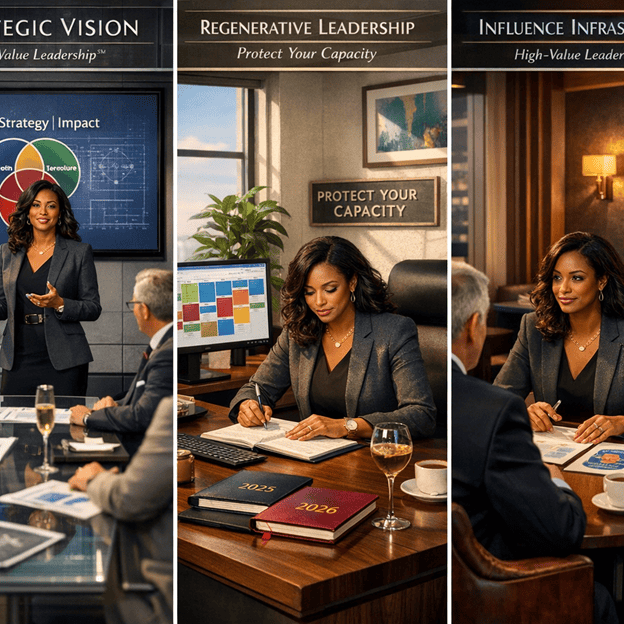
Cheers to the Woman You Were—Now Let’s Architect the Woman You’re Becoming

By Che’ Blackmon, Founder & CEO, Che’ Blackmon Consulting | DBA Candidate in Organizational Leadership


🥂 She Deserves Her Roses

Before we talk about 2026, let’s talk about her—the woman who got you through 2025.

She showed up when she was tired. She problem-solved when the solutions weren’t obvious. She navigated office politics that would have sidelined someone with less resilience. She mentored people who never thanked her, solved problems that were never acknowledged, and carried emotional labor that never appeared on anyone’s balance sheet.

She code-switched until her authentic voice felt like a second language. She managed microaggressions with a smile because showing frustration would confirm stereotypes. She worked twice as hard for half the recognition and still found the energy to lift others up behind her.

She survived budget cuts, reorganizations, toxic leadership, and systemic barriers that were never designed for her to succeed. She delivered excellence anyway. She built relationships. She stayed professional when people around her did not. She protected her team even when leadership didn’t protect her.

That woman—the one who got you through 2025—deserves celebration.

But celebration isn’t the same thing as replication.

You can honor who she was without committing to becoming her again in 2026. You can acknowledge her resilience without romanticizing the circumstances that required it. You can appreciate her strength without demanding she carry the same weight into another year.

Because here’s the sophisticated truth that doesn’t get said enough: The woman who survived 2025 and the woman who will thrive in 2026 might require different architecture.

Not a different person. A more strategic version of exactly who you are.


🏗️ The Architecture Question

Most leadership development programs ask you to “set goals” or “create a vision” for the new year. That’s not wrong, but it’s incomplete.

Goals are destinations. Architecture is infrastructure.

The architecture question isn’t “What do you want to accomplish in 2026?” It’s “What kind of woman needs to exist to accomplish that—and how do you intentionally build her?”

This isn’t about personality makeovers or becoming someone you’re not. It’s about strategic design. It’s about looking at the demands of 2026 and asking:

  • What mindset does she need that I don’t currently have?
  • What energy allocation does she require that I’m not currently practicing?
  • What boundaries does she enforce that I’m currently violating?
  • What visibility does she command that I’m currently avoiding?
  • What influence infrastructure does she build that I haven’t prioritized?

For Black women leaders specifically, this question carries additional weight. We’ve spent decades adapting to environments that weren’t designed for us, code-switching to survive, and building resilience to compensate for systemic barriers. The woman we’ve had to be was shaped by necessity as much as choice.

The woman you’re architecting for 2026 gets to be shaped by strategy.


📊 What the Research Says About Intentional Leadership Design

Dr. Herminia Ibarra’s research on leadership transitions at INSEAD reveals a critical insight: Leaders who successfully navigate career advancement don’t just set new goals—they intentionally redesign how they operate.

Her work shows that effective leadership transitions require three shifts:

  1. Redefining your professional identity (how you see yourself and your role)
  2. Developing new networks and relationships (who has access to you and whose tables you’re at)
  3. Making sense of your experiences differently (the narratives you tell about challenges, setbacks, and successes)

Notice what’s missing from this list? Working harder.

The woman you’re becoming in 2026 doesn’t succeed by doing more of what the woman of 2025 did. She succeeds by operating differently—more strategically, more intentionally, more architecturally.

Research from the Center for Creative Leadership adds nuance for Black women specifically. Their study on executive women of color found that the leaders who break through to senior roles share a common practice: They actively redesign themselves at each career stage rather than assuming the competencies that got them to their current level will carry them to the next.

Translation: Upgrading yourself while running is not optional. It’s how you compete.


🎯 The GenX Reality: We Don’t Get to Step Back

Here’s what makes this conversation different for GenX women—and particularly for Black GenX women in corporate spaces:

We don’t have the luxury of taking a sabbatical to “find ourselves.” We don’t get gap years for self-discovery. We have to upgrade our leadership operating systems while simultaneously running them.

We’re in our peak earning years managing aging parents and supporting adult children still finding their footing. We’re carrying institutional knowledge in organizations experiencing massive generational turnover. We’re leading teams through AI transformation, economic uncertainty, and cultural shifts while figuring out our own relationship to these changes.

We can’t step back. We have to architect forward.

This isn’t a complaint—it’s context. GenX women became masters of “figure it out while doing it.” That skill is an asset. But it also means we’re prone to defaulting to survival patterns (figure it out, muscle through, make it work) when strategic redesign is what’s actually required.

The woman you’re architecting for 2026 isn’t just figuring it out. She’s designing it intentionally.


🏛️ Three Pillars of Intentional Leadership Architecture

Pillar 1: Leadership Presence—From Competence to Commanding

The Woman of 2025: She proved her competence repeatedly. She over-prepared for every meeting. She documented every decision. She made herself indispensable through technical expertise and reliability. She worked hard to earn respect.

The Woman You’re Architecting for 2026: She operates from an assumption of competence rather than constantly proving it. Her leadership presence communicates strategic value before she speaks. She’s moved from being respected for execution to being sought out for vision.

What This Requires:

Mindset Shift:

  • From: “I need to prove I belong here”
  • To: “My expertise is the reason I’m here—how do I leverage it strategically?”

Behavioral Change:

  • Speak earlier in meetings (not after you’ve processed every angle)
  • Offer strategic perspective, not just tactical solutions
  • Stop over-explaining your recommendations
  • Take up space without apologizing for it

For Black Women Specifically:

There was a financial services company where a Black woman VP consistently downplayed her expertise when presenting to senior leadership. She’d preface recommendations with “I might be wrong, but…” or “This is just my perspective…” Her ideas were excellent, but her delivery undermined her authority.

When she shifted to leading with conviction—”Based on my analysis, here’s what we need to do”—her influence quadrupled. Same expertise. Different presence.

The architecture work: Dismantling the protective pattern of minimizing yourself to make others comfortable, and building a presence that reflects your actual expertise level.

2026 Design Question: What would your leadership presence look like if you operated from the assumption that your competence is established, not questioned?


Pillar 2: Energy Architecture—From Reactive to Regenerative

The Woman of 2025: She said yes to everything because she feared the consequences of saying no. She absorbed everyone’s emotional labor. She managed crises as they emerged. Her calendar owned her. She collapsed into weekends trying to recover from weeks that depleted her.

The Woman You’re Architecting for 2026: She has an energy budget and protects it fiercely. She distinguishes between her responsibility and everyone else’s comfort. She prevents crises through strategic systems rather than managing them through heroic effort. Her calendar reflects her priorities, not everyone else’s emergencies.

What This Requires:

Energy Audit: Track your energy across one week. Not just time—energy.

  • What activities energize you? (Even if they’re hard work)
  • What depletes you disproportionately to the value created?
  • Where are you spending energy managing what should be other people’s responsibilities?
  • What boundaries would give you 20% more capacity?

Strategic Elimination:

According to research from the Energy Project, high-performing leaders don’t just manage time—they manage energy across four dimensions: physical, emotional, mental, and spiritual. The leaders who sustain performance without burnout practice strategic elimination, not just time management.

The Woman You’re Architecting:

  • Eliminates one energy-draining commitment per quarter
  • Builds 30-minute buffers between high-stakes meetings
  • Protects morning hours for strategic thinking (no back-to-back meetings before 10am)
  • Delegates emotional labor that isn’t hers to carry
  • Says “I’ll get back to you” instead of immediately solving everyone’s problems

For Black Women Specifically:

We carry a particular kind of energy drain: the tax of navigating predominantly white spaces, managing others’ discomfort with our presence, and absorbing workplace dynamics that weren’t designed for our success.

Research from Dr. Ella F. Washington shows that Black women spend up to 15 hours per week on identity-related “emotional labor”—managing microaggressions, educating colleagues about diversity, proving competence repeatedly, and moderating authentic expression to fit workplace norms.

That’s nearly 40% of a standard work week spent on labor that doesn’t appear in your job description and doesn’t contribute to advancement.

The architecture work: Building boundaries around what energy you’ll spend on organizational dysfunction versus strategic priorities that actually advance your career.

2026 Design Question: If you had 15 more hours per week because you stopped absorbing what isn’t yours to carry, what would you build with that capacity?


Pillar 3: Influence Infrastructure—From Invisible to Indispensable

The Woman of 2025: She did excellent work and hoped someone noticed. She waited to be invited to important conversations. She built relationships when convenient. Her influence was limited to her direct team and immediate function.

The Woman You’re Architecting for 2026: She builds influence infrastructure intentionally. She cultivates relationships strategically across functions and levels. She positions her expertise where decision-makers can see it. Her influence extends beyond her role because she’s architected it that way.

What This Requires:

Relationship Mapping:

Create a visual map of your current influence infrastructure:

Inner Circle (High Trust, High Access):

  • Who can you call at 5pm on Friday with a complex problem?
  • Who advocates for you in rooms you’re not in?
  • Who shares opportunities before they’re publicly posted?

Strategic Network (Moderate Trust, Targeted Engagement):

  • Who do you engage with for mutual benefit but not deep relationship?
  • Who has influence in areas you’re trying to grow into?
  • Who knows your work but doesn’t know you personally?

Outer Ring (Low Trust, Minimal Engagement):

  • Who should be in your network but currently isn’t?
  • Who has power in spaces you’re trying to access?
  • Who are the connectors who could bridge you to new opportunities?

The Architecture Question: Are you spending 80% of your relationship energy on your inner circle (maintenance) while spending only 20% on strategic network building (growth)?

The Woman You’re Architecting:

  • Inverts that ratio: 30% maintenance, 70% strategic expansion
  • Schedules “influence meetings” quarterly with 3-5 strategic relationships outside her immediate function
  • Asks for introductions from existing connections
  • Shares her expertise in forums where decision-makers participate
  • Builds reciprocal value (solves problems for people she wants relationships with)

For Black Women Specifically:

Sylvia Ann Hewlett’s research on sponsorship shows that Black women are the least likely demographic to have sponsors (leaders who use their political capital to advocate for your advancement). We have mentors—people who give advice. We rarely have sponsors—people who fight for us in promotion conversations.

Why? Because sponsorship requires access to power networks that have historically excluded us. It requires relationships with decision-makers who often don’t look like us and don’t naturally gravitate toward us socially.

The architecture work: Intentionally building influence infrastructure that compensates for the networks you weren’t born into.

There was a healthcare organization where a Black woman Director realized she had strong relationships with other Black women leaders and mid-level managers—but zero relationships with the C-suite white men who made promotion decisions. Her competence was undeniable. Her influence infrastructure was non-existent where it mattered most for advancement.

She spent six months strategically building just three relationships with C-suite decision-makers. Not through manipulation—through solving problems they cared about. Within eighteen months, she was promoted to VP. Same competence. Different infrastructure.

2026 Design Question: Who needs to know about your expertise and value for your 2026 goals to be achievable—and do they currently know?


🔧 The Practical Architecture Process

Theory is useless without application. Here’s how to actually architect the woman you’re becoming in 2026:

Step 1: Honor the Woman of 2025 (December 30-31)

Complete this exercise in writing:

She got me through 2025 by:

  • [List 5-7 specific strengths, patterns, or practices]

But in 2026, I need to:

  • [List 3-5 different operational patterns required]

Example:

She got me through 2025 by:

  • Saying yes to every opportunity to prove my value
  • Working nights and weekends to deliver flawless results
  • Managing everyone’s emotional comfort in meetings
  • Building deep expertise in my functional area

But in 2026, I need to:

  • Say yes strategically to opportunities aligned with VP-level priorities
  • Protect weekend capacity for strategic thinking and personal renewal
  • Stop managing others’ discomfort and focus on driving business outcomes
  • Build cross-functional strategic visibility, not just functional expertise

The point: Name what worked and what needs to change. Honor both.


Step 2: Define Your 2026 Architecture Across Three Pillars (January 1-7)

For each pillar, answer:

Leadership Presence:

  • What do I want to be known for in 2026? (Not what I do—who I am as a leader)
  • What’s one behavior I need to stop? (Over-explaining, apologizing, deferring)
  • What’s one behavior I need to start? (Speaking first, challenging assumptions, taking strategic risks)

Energy Architecture:

  • What’s consuming energy without creating value?
  • What boundary would give me 20% more capacity?
  • What would regenerative energy management look like for me?

Influence Infrastructure:

  • Who needs to know about my expertise for my 2026 goals to be possible?
  • What three strategic relationships will I intentionally build?
  • How will I create visibility in spaces where decisions about my future are made?

Step 3: Build Your First 90 Days (January-March 2026)

Don’t try to architect everything at once. Pick ONE shift per pillar for Q1:

Leadership Presence (One Behavioral Shift):

  • Example: “I will speak in the first third of every senior leadership meeting, offering strategic perspective rather than waiting to respond to others.”

Energy Architecture (One Boundary):

  • Example: “I will eliminate Sunday email checking and protect 9-11am Monday/Wednesday for strategic thinking with no meetings.”

Influence Infrastructure (One Relationship Investment):

  • Example: “I will schedule monthly ‘learning conversations’ with the CFO, solving one problem she cares about each quarter.”

Track these for 90 days. Assess. Adjust. Expand.


Step 4: Create Accountability Architecture (Ongoing)

Architecture requires maintenance. Who will hold you accountable to becoming who you’re designing?

Options:

  • Schedule monthly self-audits (calendar reminder: “Am I building the woman I designed?”)
  • Partner with a peer for reciprocal accountability
  • Hire a coach who specializes in leadership architecture
  • Join a cohort-based program focused on strategic leadership design

The woman you’re architecting doesn’t just set intentions. She builds systems that ensure those intentions become reality.


💎 High-Value Leadership℠: Architecture as Strategic Competence

In High-Value Leadership: Transforming Organizations Through Purposeful Culture, I define high-value leadership as leadership that creates sustainable impact through intentional design, not reactive management.

The same principle applies to designing yourself as a leader.

Low-value leadership patterns:

  • React to whatever emerges
  • Default to last year’s operating system
  • Hope circumstances change rather than intentionally changing how you engage circumstances
  • Measure success by survival rather than strategic progress

High-Value Leadership℠ patterns:

  • Anticipate what’s required and build infrastructure proactively
  • Upgrade operating systems before they become obsolete
  • Architect circumstances rather than just navigate them
  • Measure success by intentional design, not accidental outcomes

The woman you’re becoming in 2026 isn’t an accidental outcome of circumstances. She’s a strategic design project.

In Mastering a High-Value Company Culture, I explore how transformational cultures are built through “conscious construction”—the intentional building of systems, norms, and practices that produce desired outcomes. You can’t build a high-value culture accidentally. It requires architecture.

The same is true for building the leader you’re becoming.

And for my Black women leaders specifically: Rise & Thrive: A Black Woman’s Blueprint for Leadership Excellence addresses the unique navigation required when you’re architecting yourself in spaces that weren’t designed for your success.

Rising is about visibility and positioning. Thriving is about sustainability and strategic design.

You can’t thrive by replicating the survival patterns that got you here. You have to architect a more strategic version of yourself—one that honors your resilience while refusing to romanticize the circumstances that required it.


🌟 She Got You Here. Now Design Who Takes You Forward.

December 31st is the perfect day for this work.

Not because there’s anything magical about the calendar flipping. Because you have permission—from yourself—to acknowledge that the woman who survived 2025 and the woman who will thrive in 2026 might operate differently.

She doesn’t need to be someone else. She needs to be a more strategic version of exactly who you are.

More boundaried. More visible. More intentional about energy. More deliberate about influence. More convicted in her presence. More protective of her capacity. More strategic about her relationships.

Same values. Different architecture.

So yes—cheers to the woman you were in 2025. She deserves every bit of celebration.

And now?

Let’s architect the woman you’re becoming.

Not through vague intentions or aspirational thinking. Through strategic design across three pillars: Leadership Presence, Energy Architecture, and Influence Infrastructure.

Because the woman who thrives in 2026 isn’t hoping circumstances change. She’s architecting herself to transform them.


💭 Reflection Questions

Work through these alone or with your leadership circle:

1. What did the woman of 2025 do brilliantly that you want to honor—and what did she do out of survival that you want to release?

2. If you operated from an assumption of established competence in 2026 instead of constantly proving yourself, how would your leadership presence shift?

3. For Black women specifically: What protective mechanism or survival pattern served you in hostile environments but is now limiting your effectiveness in your current context?

4. What’s consuming 20% or more of your energy without creating proportional value—and what boundary would protect that capacity?

5. Who needs to know about your expertise and leadership capability for your 2026 goals to be achievable—and do they currently know?

6. What’s one behavior you need to stop, one you need to start, and one boundary you need to enforce to become the woman you’re architecting for 2026?


🚀 Next Steps: From Reflection to Architecture

STEP 1: Complete the Honor & Release Exercise

Block 60 minutes on December 30th or 31st. Honor who got you through 2025. Name what needs to change for 2026.

STEP 2: Define Your Three-Pillar Architecture

Use the framework in this article to design:

  • Your Leadership Presence shift
  • Your Energy Architecture boundary
  • Your Influence Infrastructure investment

STEP 3: Build Your Q1 Accountability System

Don’t just design the woman you’re becoming—create the systems that ensure you actually build her.

STEP 4: Get Strategic Support

Architecture is hard to do alone, especially when you’re upgrading while running.


🤝 Work with Che’ Blackmon Consulting

If you’ve realized that architecting the woman you’re becoming requires more than personal reflection—that you need strategic coaching, proven frameworks, and accountability from someone who understands both the business strategy AND the unique navigation Black women leaders face—we should talk.

Our services for individual leaders:

✅ Executive Coaching for Strategic Leadership Architecture
One-on-one coaching designed specifically for Black women leaders navigating the shift from competence to commanding presence, from reactive to regenerative energy management, and from invisible to indispensable influence.

✅ High-Value Leadership Intensive (Waitlist Now Open)
A cohort-based program that combines strategic leadership development with the architecture work of building sustainable, influential leadership presence. Specifically designed for GenX women leaders ready to upgrade their operating systems.

For organizations:

✅ Leadership Development Programs
Building high-value leadership cultures where architecture is taught as a strategic competence, not just goal-setting.

✅ Executive Coaching for Leadership Transitions
Supporting leaders through critical transitions with intentional redesign rather than hoping competence alone carries them forward.

✅ Culture Transformation for Equity
Creating organizational environments where Black women and other traditionally overlooked leaders don’t have to architect around systemic barriers—they can architect for strategic impact.

Ready to architect the woman you’re becoming with strategic support?

📧 admin@cheblackmon.com
📞 888.369.7243
🌐 cheblackmon.com


Additional Resources:

📚 Read: High-Value Leadership: Transforming Organizations Through Purposeful Culture
The strategic framework that applies to organizational transformation and personal leadership architecture
Get the book: https://books.by/blackmons-bookshelf

🎓 Join the Waitlist: High-Value Leadership Intensive
A transformative cohort-based program for leaders ready to architect their next-level leadership presence
Join: https://adept-solutions-llc-2.kit.com/147712ac25

📖 Read: Rise & Thrive: A Black Woman’s Blueprint for Leadership Excellence
The specific navigation guide for Black women architecting leadership excellence in corporate spaces

🎧 Listen: Unlock, Empower, Transform with Che’ Blackmon
Twice-weekly conversations on leadership architecture and strategic career design

📺 Watch: Rise & Thrive YouTube Series
Practical leadership architecture content for Black women in corporate leadership


Che’ Blackmon is the Founder & CEO of Che’ Blackmon Consulting, a Michigan-based fractional HR and culture transformation consultancy. As a DBA candidate in Organizational Leadership at National University with 24+ years of progressive HR leadership experience, she specializes in AI-enhanced culture transformation and executive coaching for high-value leadership development. She is the author of “High-Value Leadership: Transforming Organizations Through Purposeful Culture,” “Mastering a High-Value Company Culture,” and “Rise & Thrive: A Black Woman’s Blueprint for Leadership Excellence.”


She got you here. Now let’s architect who takes you forward. ✨

Not a different woman. A more strategic version of exactly who you are.

#Leadership #LeadershipDevelopment #WomenInLeadership #BlackWomenInBusiness #ExecutiveCoaching #CareerDevelopment #ProfessionalGrowth #HighValueLeadership #IntentionalLeadership #LeadershipPresence #EnergyManagement #ExecutivePresence #StrategicLeadership #NewYearNewYou #LeadershipTransformation

The Competence Paradox: Why Your 2025 Wins Don’t Guarantee Your 2026 Relevance

By Che’ Blackmon, Founder & CEO, Che’ Blackmon Consulting | DBA Candidate in Organizational Leadership


🎯 The Lie We’ve Been Sold

You crushed 2025.

You delivered that critical project three weeks ahead of schedule. You resolved the interdepartmental conflict that had been festering for eighteen months. You mentored six emerging leaders, negotiated a complex vendor agreement that saved the company $400K, and your team’s engagement scores increased by 14 points. Your performance review was glowing. Your contributions were undeniable.

And yet.

When the VP role opened in January 2026, they hired someone from outside the organization. Someone with half your tenure and a third of your institutional knowledge. Someone who “brings fresh perspective” and “fits the leadership vision going forward.”

Here’s the uncomfortable truth that nobody talks about in those sanitized leadership development workshops: Competence got you in the room, but competence alone won’t elevate you to the leadership table.

For Black women professionals—especially those of us in GenX who came up being told that excellence was the only credential we needed—this is a particularly painful realization. We were raised on the promise that if we worked twice as hard, prepared three times as thoroughly, and delivered flawless results, we’d be recognized. We’d advance. We’d be valued.

We did all of that. And we’re still the most competent people in rooms where we’re also the most invisible.

Welcome to the Competence Paradox.


💡 What Is the Competence Paradox?

The Competence Paradox is the gap between proving you’re capable and being positioned for advancement. It’s the space where excellent work goes unrecognized, where critical contributions get attributed to “the team,” and where your November wins are completely forgotten by February.

It’s the phenomenon where you can be objectively high-value—delivering measurable impact, solving complex problems, driving organizational results—and still not be positioned as high-value in the eyes of decision-makers.

Research from the Center for Talent Innovation reveals that 65% of Black professionals report their ideas are not acknowledged or adopted at the same rate as their white colleagues’ ideas, even when the ideas are identical. McKinsey’s 2024 Women in the Workplace study shows that Black women are significantly underrepresented in senior leadership despite often being the most educated and credentialed employees in their organizations.

The data is clear: Competence is necessary but insufficient.


🔍 The Three Dimensions of the Paradox

Dimension 1: The Invisibility of Excellence

There was a financial services company where a Black woman Director of Risk Management had successfully predicted and prevented three major compliance violations over eighteen months. Her analysis was thorough, her recommendations were implemented, and the company avoided millions in potential penalties. Her work was excellent.

But when the C-suite discussed “strategic thinkers” for succession planning, her name never came up. Why? Because preventing disasters is invisible work. Nobody sees what didn’t happen. Her competence was undeniable, but it wasn’t visible in ways that translated to leadership perception.

Meanwhile, a peer who led a flashy digital transformation initiative (that ultimately came in over budget and under-delivered) was being groomed for VP. His work was visible. His “innovation” was discussed. His positioning was strategic.

The lesson: Excellence that’s invisible doesn’t translate to influence.

Dimension 2: The Attribution Gap

Catalyst research shows that when women—particularly Black women—deliver strong results, those results are more likely to be attributed to external factors (team effort, market conditions, luck) rather than individual competence and leadership. When men deliver comparable results, they’re attributed to skill, vision, and leadership capability.

You delivered a complex project successfully? “The team really came through.”
He delivered a comparable project? “His leadership was instrumental.”

Same outcome. Different narrative. Different career trajectory.

The lesson: If you’re not controlling the narrative around your wins, someone else is—or worse, no one is.

Dimension 3: The Positioning Premium

According to research from Stanford’s VMware Women’s Leadership Lab, leaders who advance share a common trait that has nothing to do with competence: strategic self-positioning. They actively manage how their work is perceived, discussed, and remembered. They cultivate sponsors who amplify their contributions. They connect their wins to organizational priorities in ways that make them indispensable.

Meanwhile, many high-performing Black women operate under the belief that “good work speaks for itself.” It doesn’t. Not in environments where unconscious bias shapes whose contributions get amplified and whose get overlooked.

The lesson: Being competent and being positioned as leadership material are two different skill sets.


📊 The Data: What Actually Separates Promoted Leaders from Equally Capable Peers?

A comprehensive study by the Executive Leadership Council and the Center for Creative Leadership examined what differentiates executives who advance to the C-suite from equally qualified peers who plateau. The findings are illuminating—and frustrating:

Factors That DON’T Significantly Predict Advancement:

  • ❌ Years of experience (competence baseline)
  • ❌ Educational credentials (competence baseline)
  • ❌ Performance ratings (competence validation)
  • ❌ Technical expertise (competence demonstration)

Factors That DO Significantly Predict Advancement:

  • ✅ Executive sponsorship (someone with power advocating for you)
  • ✅ Strategic visibility (your work being known beyond your immediate function)
  • ✅ Narrative control (how your contributions are framed and remembered)
  • ✅ Perceived leadership potential (not just performance, but future capability)
  • ✅ Cultural capital (being seen as “fitting” the leadership culture)

Notice anything? None of these advancement factors are about doing better work. They’re about positioning, perception, and power dynamics.

For Black women, the implications are sobering. We often excel at the competence factors while being systematically excluded from the positioning factors. We’re told to focus on performance while watching less qualified peers leverage relationships, visibility, and strategic positioning to leapfrog us.


🚧 Why GenX Women Fall Into This Trap More Than Others

GenX women—particularly Black GenX women—were socialized into a specific professional mythology:

The Mythology:

  • “Keep your head down and do excellent work.”
  • “Let your results speak for themselves.”
  • “Don’t be too visible or you’ll be seen as self-promotional.”
  • “Prove yourself through performance, not politics.”
  • “If you’re good enough, they’ll notice.”

The Reality:

  • Invisible excellence doesn’t translate to advancement
  • Results need advocates to speak for them
  • Strategic visibility is leadership competence, not vanity
  • Organizations ARE political—pretending they’re not is career sabotage
  • “Good enough” gets overlooked while “strategically positioned” gets promoted

We entered the workforce in the 80s and 90s when this mythology was gospel—especially for Black women who were told that any visibility that wasn’t tied to flawless performance would confirm stereotypes. We learned to be exceptional AND invisible. Competent AND non-threatening. Valuable AND uncomplaining.

Now we’re in mid-to-senior career stages watching younger colleagues—who didn’t internalize these limiting beliefs—advocate for themselves, leverage sponsors, and advance past us. Not because they’re more competent. Because they understand the positioning game we were told not to play.


💰 The Real Cost of the Competence Paradox

Let’s quantify what this costs:

Financial Impact

Research from PayScale and the American Association of University Women shows:

  • Black women earn 38% less than white men for comparable work
  • The wage gap for Black women widens with seniority (competence increases but positioning gaps compound)
  • Black women with advanced degrees earn less than white men with bachelor’s degrees

Translation: Your 2025 competence didn’t close the gap. Your 2026 positioning strategy might.

Career Velocity Impact

A study by LeanIn.Org and McKinsey found:

  • For every 100 men promoted to manager, only 60 Black women are promoted
  • Black women are less likely than any other group to be promoted from manager to senior manager
  • This gap isn’t explained by performance differences—it’s explained by sponsorship and visibility gaps

Translation: Competence gets you to manager. Positioning gets you to senior leader.

Influence & Impact Ceiling

When you’re highly competent but poorly positioned:

  • Your ideas get implemented without credit
  • Your expertise is utilized without compensation
  • Your leadership capability is questioned despite proven results
  • Your contributions are valued but not rewarded with advancement

This isn’t just unfair—it’s a strategic waste of your capacity and a limitation on your impact.


🎯 The Four Pillars of Strategic Positioning

If competence alone isn’t enough (and the data shows it isn’t), what does strategic positioning actually look like?

Pillar 1: Visibility Architecture

What it is: Intentionally designing how, when, and where your expertise becomes known.

What it’s NOT: Self-promotion for ego or attention.

What it IS: Strategic communication that connects your work to organizational priorities in ways decision-makers can see, understand, and value.

Practical Application:

There was a healthcare organization where a Black woman VP of Operations consistently delivered on complex regulatory compliance projects. Excellent work. Zero visibility outside her immediate division. When asked why she didn’t present her wins at leadership meetings, she said, “That feels like bragging.”

Meanwhile, a peer was presenting quarterly “innovation updates” that were 30% substance and 70% positioning. Guess who got tapped for the COO role?

The VP’s competence was never in question. Her positioning was non-existent.

How to Build Visibility Architecture:

  • Connect your wins to C-suite priorities in writing (memos, reports, updates)
  • Request presentation time at leadership forums (frame it as “sharing learnings” not self-promotion)
  • Publish thought leadership externally (LinkedIn articles, industry publications)
  • Speak at conferences and internal events
  • Build a “brag file” and share quarterly highlights with your leader AND their leader

Pillar 2: Sponsorship Cultivation

What it is: Identifying and cultivating relationships with leaders who have power and will advocate for you in rooms you’re not in.

The difference between mentorship and sponsorship:

  • Mentors give advice and support
  • Sponsors use their capital to advocate for your advancement

Research by Sylvia Ann Hewlett shows that 85% of promotions happen because of sponsorship, not performance alone. Yet Black women are significantly less likely to have sponsors than any other demographic group.

How to Cultivate Sponsors:

  • Identify leaders whose priorities align with your expertise
  • Make their lives easier by solving problems they care about
  • Ask explicitly for sponsorship (not just mentorship)
  • Give them “ammunition”—regular updates on your wins that they can use to advocate for you
  • Understand that sponsorship is reciprocal: what value do you bring to their objectives?

Pillar 3: Narrative Control

What it is: Actively shaping the story that gets told about your work, your contributions, and your leadership capability.

If you’re not controlling your narrative, one of three things happens:

  1. Your contributions get attributed to “the team” or external factors
  2. Your work gets remembered incorrectly or incompletely
  3. No story gets told at all—your wins simply disappear from organizational memory

Your November wins won’t be remembered in February unless you’ve strategically positioned them in the organizational narrative.

How to Control Your Narrative:

  • Frame your wins strategically: Don’t just report what you did—connect it to strategic outcomes
    • ❌ “Completed the vendor negotiation project”
    • ✅ “Restructured vendor agreements resulting in $400K annual savings and 15% efficiency improvement, directly supporting the CFO’s cost optimization initiative”
  • Document in real-time: Don’t wait for annual reviews to capture your impact
  • Use the “FYI” strategy: Send brief, strategic updates to key stakeholders positioning your work in the context of organizational priorities
  • Teach others to advocate for you: Give your manager, sponsors, and allies the language to describe your impact accurately

Pillar 4: Future-Readiness Signaling

What it is: Demonstrating not just current competence but future capability.

Decision-makers promote based on perceived potential, not just proven performance. They’re asking: “Can I see this person at the next level?”

For Black women, this is where bias doe