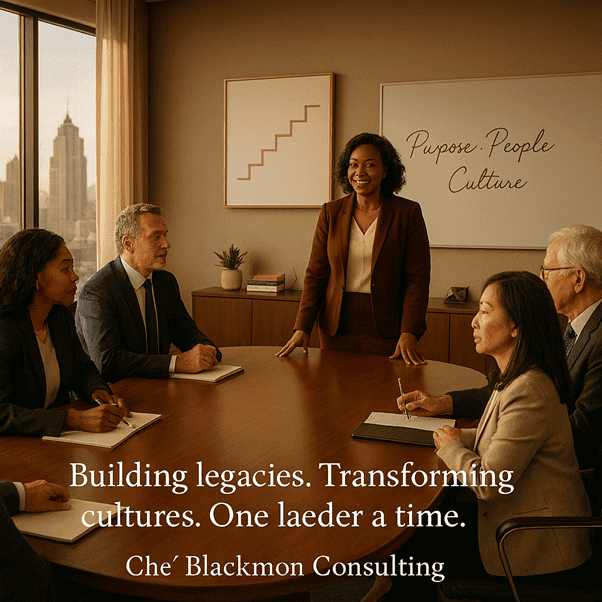
Building Your Leadership Legacy: It’s Never Too Early (or Late) 🌟

By Che’ Blackmon | Founder & CEO, Che’ Blackmon Consulting | DBA Candidate, Organizational Leadership

What will people say about your leadership when you’re no longer in the room? Better yet—what impact will your leadership have ten years from now, even if you’ve moved on to your next chapter?

These questions aren’t reserved for corner-office executives or those approaching retirement. Legacy isn’t something you build at the end of your career. It’s something you construct—brick by brick, decision by decision—from the very moment you choose to lead.

Understanding Leadership Legacy in Today’s Workplace 📊

The concept of leadership legacy has evolved dramatically. According to research by Dame Leadership, cultivating a lasting leadership legacy requires intentionality, reflection, and a commitment to nurturing those around you. It’s no longer about accumulating titles or achieving short-term metrics. True leadership extends beyond immediate results—it’s about leaving a mark that inspires, empowers, and shapes future generations.

Harvard Business Publishing’s 2024 Global Leadership Development Study reinforces this shift: 70% of respondents indicate it’s important for leaders to master a wider range of effective leadership behaviors to meet current and future business needs. The old playbook of commanding from the top simply doesn’t work anymore. Today’s leaders must be adaptive, emotionally intelligent, and deeply invested in developing others.

“Legacy lives in people. Investing in others multiplies your reach.” — Leadership Foundry

This is what I call High-Value Leadership—the kind of leadership that transforms organizations through purposeful culture. It’s leadership that recognizes every interaction as an opportunity to build something lasting.

The Unique Legacy Challenge for Black Women in Leadership 💪🏾

Let’s address something that many leadership discussions overlook entirely: the distinct experience of Black women building legacies in corporate spaces.

The data tells a sobering story. McKinsey’s Women in the Workplace 2025 report reveals that women of color are promoted at significantly lower rates—only 74 women of color are promoted to manager for every 100 men. Black women hold just 4.3% of managerial positions compared to 32.6% of white women. And according to Lean In’s research, less than a quarter of Black women feel they have the sponsorship they need to advance their careers.

But here’s what the statistics don’t capture: Black women are just as ambitious as their peers—and among employees who want to be top executives, Black women are most likely to be motivated by a desire to positively influence company culture or to be role models for others like them. This is legacy-building in its purest form.

The “broken rung” phenomenon—where women are promoted at lower rates to that critical first managerial position—hits Black women especially hard. After notable improvements in 2021 and 2022, Black women’s promotion rates in 2024 actually regressed to 2020 levels. Meanwhile, the “glass cliff” phenomenon means that when Black women do break through, they’re often placed in leadership positions during periods of organizational crisis—set up to navigate the impossible without adequate support.

Yet despite these barriers, something remarkable is happening. A recent report from the Women of Color Retail Alliance shows that Black women-owned businesses climbed 7.1 percent year over year, with more than 2 million Black women-owned enterprises now generating over $118 billion annually. Black women aren’t just surviving corporate spaces—they’re building their own.

This is the spirit behind my book “Rise & Thrive: A Black Woman’s Blueprint for Leadership Excellence.” Building a legacy when the system wasn’t designed for your success requires a different playbook—one rooted in resilience, strategic self-advocacy, and the understanding that your success creates pathways for others.

The Case Study: Detroit Lions Culture Transformation 🦁

Sometimes the most powerful lessons in leadership legacy come from unexpected places. As a Detroit native and lifelong Lions fan, I’ve watched one of the most remarkable culture transformations in sports unfold in my own backyard.

When Dan Campbell became head coach in January 2021, he inherited a franchise that hadn’t won a playoff game in over three decades. The Lions were synonymous with losing. But Campbell didn’t just focus on winning games—he focused on building culture.

His approach embodies what authentic legacy-building looks like:

  • Vulnerability as Strength: Campbell cried publicly after tough losses—not for himself, but for his players and the effort they’d invested. This wasn’t weakness; it was authentic leadership that connected on a human level.
  • Taking Ownership First: When things go wrong, Campbell starts with what he could have done differently. This approach has now become embedded in the team culture—players don’t blame each other but talk about what more they can do to support team success.
  • Investing in Everyone: In the locker room, Campbell doesn’t just acknowledge the star players. He recognizes those who achieve milestones, shares specific statistics about their success, and ensures everyone feels valued.
  • Grit and Resilience as Core Values: Campbell instilled a philosophy that the team would “go a little bit longer, push a little harder, and think a little deeper.” This wasn’t just talk—it became the team’s identity.

The results speak for themselves. By 2023, the Lions reached the NFC Championship game—their first in decades. In his fourth year, the team is now expected to compete at the highest level. But more importantly, Campbell built something that outlasts any single season: a culture where people believe in each other and want to give their best.

This is the heart of what I teach about High-Value Company Culture. Titles and wins will fade. Culture endures.

The Five Pillars of Legacy-Focused Leadership 🏛️

Based on my 24+ years in HR leadership across manufacturing, automotive, healthcare, and professional services—combined with current research and organizational behavior studies—I’ve identified five essential pillars for building a meaningful leadership legacy:

1. Define Your Leadership Purpose

Every lasting legacy begins with clarity of purpose. What values do you want to embody? What lasting impact do you want to have on your organization and the people you serve? How do you want to be remembered by those you lead?

This isn’t about crafting a perfect mission statement. It’s about honest self-reflection. Your clarity of purpose becomes the foundation for your legacy, offering a roadmap for others to follow.

2. Invest in People Development

Leaders don’t build legacies alone; they cultivate them by empowering others. Make it a priority to mentor and develop your team. Invest time in understanding their strengths, aspirations, and areas for growth.

This is particularly critical for Black women and other underrepresented groups who often lack access to senior leaders and sponsorship. According to Lean In’s research, Black women are much less likely than their non-Black colleagues to interact with senior leaders at work. If you’re in a position of influence, intentionally create access for those who don’t have it.

3. Lead with Authenticity

Actions speak louder than words, and the way you conduct yourself as a leader will leave a lasting impression. Authenticity isn’t about being perfect—it’s about being real. The most trusted leaders are those who show up as themselves, acknowledge their limitations, and demonstrate genuine care for others.

As one analyst said about Dan Campbell: “He doesn’t feel like management. He doesn’t feel like he’s above you. He feels like one of your teammates.” That’s authentic leadership.

4. Build Systems That Outlast You

True legacy isn’t about being indispensable—it’s about building systems, processes, and cultures that continue to thrive after you’re gone. There’s a company that experienced this firsthand: after their visionary leader departed, the organization struggled because everything had been built around one person rather than embedded in sustainable systems.

Document your knowledge. Create succession plans. Develop multiple leaders who can carry the vision forward. As I discuss in “Mastering a High-Value Company Culture,” sustainable culture transformation requires infrastructure, not just inspiration.

5. Measure Impact, Not Just Results

Numbers matter, but not all metrics count long-term. Track influence—team morale, ideas implemented, people developed—not just revenue or efficiency gains. Ask for feedback on your impact. Celebrate milestones that build momentum, not just finish lines.

Research from Deloitte’s 2024 Leadership Impact Report shows that 68% of executives now prioritize long-term influence over short-term wins. Leaders who think long-term boost engagement by 25% and innovation by 30%.

Starting Your Legacy Journey Today 🚀

Whether you’re an emerging leader taking your first management role or a seasoned executive contemplating retirement, the time to build your legacy is now. Here’s how to begin:

For Early-Career Leaders:

Don’t wait until you have a certain title to start building legacy. Document your values now. Find one person you can mentor—even informally. Take ownership of mistakes before pointing fingers. Your habits today become your leadership identity tomorrow.

For Mid-Career Leaders:

This is your prime legacy-building season. You have enough experience to have wisdom and enough time to implement it. Focus on developing other leaders. Create systems that work without you. Be the sponsor that others need—especially for those who don’t look like the traditional power structure.

For Senior Leaders:

Your legacy is likely already taking shape. The question is whether it’s the legacy you intended. Take stock of what you’ve built. Where are the gaps? What knowledge will leave with you if you don’t transfer it now? Who needs your voice advocating for them?

For Black Women Leaders Specifically:

Your legacy building happens in a context where you may be the first—or only—person who looks like you in the room. This means your success creates possibility for others. Be visible. Bring others along. And remember: You don’t have to shrink yourself to fit spaces that weren’t designed for you. Your authentic leadership is your greatest legacy asset.

The Bottom Line

Leadership legacy isn’t built in a single moment of glory. It’s built in the daily decisions to show up authentically, invest in others, and create value that outlasts your tenure. As the research consistently shows, the leaders who make the greatest long-term impact are those who prioritize people over positions, culture over quick wins, and purpose over popularity.

What legacy are you building today?

Discussion Questions for Reflection 💭

  1. If you left your current role tomorrow, what would people say about your leadership impact?
  2. Who are you actively developing or sponsoring right now? If no one comes to mind, what’s stopping you?
  3. What knowledge or expertise do you possess that would benefit others—and how can you begin transferring it?
  4. How does your leadership create access and opportunity for those who are traditionally overlooked?
  5. What’s one thing you can do this week to begin building a more intentional legacy?

Your Next Steps 📌

  1. Conduct a Legacy Audit: Reflect on the five pillars above and honestly assess where you’re strong and where you need growth.
  2. Identify One Person to Develop: Commit to mentoring or sponsoring someone in the next 30 days—especially someone who could benefit from your access and influence.
  3. Document Your Values: Write down the leadership principles you want to be known for. Share them with your team.
  4. Seek Feedback: Ask trusted colleagues: “What impact has my leadership had on you?” Be prepared to listen.

Ready to Build Your Leadership Legacy? 🤝

Building a lasting leadership legacy doesn’t happen by accident—it requires intention, strategy, and often, a guide who’s walked the path before you.

At Che’ Blackmon Consulting, we specialize in AI-enhanced culture transformation and High-Value Leadership development. Whether you’re looking to transform your organization’s culture, develop your leadership pipeline, or create your own blueprint for leadership excellence, we’re here to help.

Let’s connect:

📧 Email: admin@cheblackmon.com

📞 Phone: 888.369.7243

🌐 Website: cheblackmon.com

Your legacy is waiting to be built. Let’s build it together.

—

Che’ Blackmon is the Founder & CEO of Che’ Blackmon Consulting, a fractional HR and culture transformation consultancy. She is the author of “High-Value Leadership: Transforming Organizations Through Purposeful Culture,” “Mastering a High-Value Company Culture,” and “Rise & Thrive: A Black Woman’s Blueprint for Leadership Excellence.” She is currently pursuing her Doctor of Business Administration in Organizational Leadership at National University.

#LeadershipLegacy #HighValueLeadership #WomenInLeadership #BlackWomenLead #CultureTransformation #LeadershipDevelopment #ExecutiveLeadership #OrganizationalCulture #LeadershipTips #DiversityInLeadership #AuthenticLeadership #LegacyBuilding #LeadershipMindset #WomenLeaders #PurposeDrivenLeadership


The 2026 Leadership Forecast: 7 Trends You Can’t Ignore 🔮

The leadership landscape is shifting faster than most organizations can adapt. As we move deeper into 2026, the executives and teams who stay competitive won’t just be keeping up with change—they’ll be architecting it. This isn’t about following trends for the sake of it. It’s about understanding the deeper cultural undercurrents that will define organizational success for the next several years.

In my work as a fractional HR consultant and DBA candidate in Organizational Leadership, I’ve spent nearly two and a half decades watching how organizations either thrive or struggle during periods of transformation. What I’ve discovered is this: the companies winning in 2026 aren’t the ones with the flashiest strategies. They’re the ones who’ve built purposeful cultures that attract, retain, and elevate their people—especially those who’ve been historically overlooked in corporate spaces.

The seven trends I’m about to walk you through aren’t predictions plucked from thin air. They’re grounded in organizational research, labor market realities, and the lived experiences of thousands of professionals trying to navigate a workplace that’s finally being asked to evolve.


1. The Rise of Predictive Culture Analytics 📊

Organizations are no longer waiting until people quit to realize they had a retention problem. Predictive analytics in HR—the ability to forecast employee engagement, burnout, and turnover 3 to 6 months in advance—is moving from “nice to have” to competitive necessity.

What does this mean? Companies are investing in tools and methodologies that analyze patterns in organizational data: engagement scores, promotion timelines, pay equity metrics, and communication patterns. When a company notices that employees in certain departments are 40% more likely to leave within six months, they can actually do something about it.

The overlooked angle: Black women and other historically marginalized professionals often experience different patterns of burnout and disengagement than their majority-culture counterparts. They’re more likely to experience microaggressions, exclusion from informal networks, and unequal access to development opportunities. Yet many organizations’ analytics still treat all employee populations as monolithic. In 2026, the leaders who matter will be disaggregating their data. They’ll be asking not just, “Who’s leaving?” but “Who’s leaving in what groups, and why?” This level of insight allows organizations to proactively address systemic issues rather than just managing the symptoms.

Actionable takeaway: Audit your current people analytics. Are you looking at retention rates by demographic group? Are you measuring engagement differently across your organization? Start there.


2. Purpose-Driven Culture as a Competitive Edge 💡

We’ve talked about purpose in organizations for years. But in 2026, purpose isn’t just a marketing tagline or an HR initiative. It’s the connective tissue between strategy, daily work, and employee identity. Organizations that can clearly articulate their “why” and connect it to the actual work their teams do will attract and retain talent at rates that outpace their competitors by significant margins.

This matters because people want to work for something. They want their effort to matter beyond the paycheck. But—and this is crucial—purpose has to be authentic. It can’t be performative.

There was a mid-sized manufacturing company that realized their stated values (innovation, integrity, community) didn’t match how they actually operated. Their decision-making processes were opaque. Their community involvement was minimal. Their “innovation” talk clashed with a culture that punished failure. They didn’t just revise their values on a poster. They reworked their entire decision-making framework, tied executive compensation to community impact, and created psychological safety around experimentation. The result? A 27% increase in internal promotion rates within two years and measurably higher engagement across all demographic groups—including a 34% improvement in Black women’s sense of belonging.

This kind of transformation is what “purpose-driven culture” actually looks like.

The overlooked angle: Black women have historically been expected to prove their commitment to organizations that haven’t committed to them. A purposeful culture that’s genuinely inclusive signals something powerful: “You belong here, and your contributions matter.” When that message is authentic, it changes everything about how people show up to work.

Actionable takeaway: Take your stated values and audit them. Do your hiring practices reflect them? Your promotion processes? Your daily decision-making? If there’s a gap, you’ve got work to do. Start with one area and make a visible shift.


3. The Demand for Radical Transparency in Pay and Advancement 💰

Pay transparency laws are spreading. More companies are publishing salary ranges. Remote work has made it harder to hide regional pay disparities. And employees—especially younger workers and those who’ve experienced discrimination—are talking openly about compensation.

In 2026, organizations that resist this shift will find themselves struggling to attract talent. Those that lean into transparency will build trust at a foundational level.

But here’s what real transparency looks like beyond publishing a salary range: It’s clear communication about how people advance, what skills lead to higher compensation, and what the actual experience is for different groups moving through your organization. It’s addressing pay gaps not by raising the bottom (though that too) but by examining whether certain groups are concentrated in lower-paying roles and whether there are systemic barriers preventing progression.

Research from organizations studying workplace equity consistently shows that Black women are overrepresented in roles with lower pay and underrepresented in higher-paying leadership positions. This isn’t because of lack of capability. It’s systemic. Transparent advancement pathways that identify and address these patterns don’t just improve equity—they improve overall organizational talent development because everyone can see what success looks like.

Actionable takeaway: Conduct a pay equity audit disaggregated by demographic groups. If you don’t know whether you have a pay equity problem, start there. Then publish a clear advancement pathway. Make it visible. Communicate it. And hold yourself accountable to it.


4. Psychological Safety as a Prerequisite for Performance ✨

This one’s been building for a few years, but 2026 is when it becomes non-negotiable. Organizations are learning what research by Amy Edmondson and others has proven: Psychological safety—the belief that you won’t be punished or humiliated for speaking up with ideas, questions, concerns, or mistakes—directly correlates with innovation, quality, and performance.

But creating psychological safety isn’t about being nice. It’s about intentional leadership practices. It’s about a manager who explicitly acknowledges their own mistakes. It’s about teams that hold blameless post-mortems instead of witch hunts. It’s about a culture where someone can say, “I don’t understand” without it being held against them.

In Mastering a High-Value Company Culture, I emphasize that culture is not what you say your values are—it’s what you do when no one’s watching, and especially what you do when someone breaks a rule or makes a mistake. Psychological safety is the infrastructure that allows people to take intellectual risks, innovate, and bring their full selves to work.

The overlooked angle: For Black women and other historically marginalized professionals, psychological safety often doesn’t exist in the same way it does for majority-culture employees. There’s research showing that women, and particularly Black women, are less likely to speak up in meetings, less likely to take credit for their work, and more likely to self-monitor their behavior. Why? Because the consequences of being seen as “aggressive,” “difficult,” or “too much” feel real. They often are real. Creating genuine psychological safety means examining where those power dynamics show up and intentionally shifting them.

Actionable takeaway: Ask your team (anonymously, if it helps): Do you feel safe asking questions? Speaking up if you disagree? Admitting when you don’t know something? Take the results seriously. Then identify one concrete leadership behavior that would shift the needle on psychological safety—and commit to it.


5. Skills-Based Hiring and Development Over Credential Gatekeeping 🎓

The great credential recount is happening. Organizations are realizing that a four-year degree doesn’t always predict job performance, and that requiring one eliminates talented people from consideration. In 2026, forward-thinking companies are shifting to skills-based hiring: defining the actual skills needed for a role and evaluating candidates—and promoting from within—based on demonstrated capability rather than credentials or tenure.

This is particularly consequential for closing opportunity gaps. Historically, educational and credential requirements have been used (intentionally or not) as barriers that disproportionately exclude Black professionals, women, and other marginalized groups. A skills-based approach to hiring and advancement creates multiple on-ramps into roles and organizations.

But here’s the reality: If you shift to skills-based hiring without also creating internal development pathways, you’re just pushing the problem around. You need to combine this with robust, accessible skill-building opportunities. That means mentorship programs that aren’t just informal networks (which tend to be homogenous). It means training and development that’s actually accessible to people at all levels. It means promoting people based on what they can do, not based on who they know.

Actionable takeaway: Identify one role you’re currently hiring for. What skills do you actually need? What would you remove from the job description if you removed the credential requirement? Now pilot a skills-based hiring approach for that role. Track your outcomes. Does it expand your talent pool? Does it change the diversity of your applicants?


6. The “Great Reshuffle” Continues: Retention Through Meaningful Work 🔄

People aren’t just changing jobs anymore. They’re changing careers, industries, and expectations around what work should look like. The pandemic gave people permission to ask themselves, “Is this what I actually want to be doing?” and many decided the answer was no.

In 2026, the competition for talent remains intense. But the organizations that will win aren’t necessarily the ones offering the highest salaries. They’re the ones offering: clarity about what success looks like, autonomy in how work gets done, opportunities to grow and develop, and—critically—work that feels meaningful.

There was an organization in the healthcare sector that realized they were losing strong performers to burnout, not because of compensation but because people felt disconnected from the impact of their work. The work itself was meaningful, but the organizational systems made it hard to see. They restructured how they communicated outcomes, created more direct connections between frontline teams and the people they served, and gave teams more say in how they organized their work. Retention improved. So did quality metrics.

The overlooked angle: Research on workplace experience shows that Black women often report lower perceptions of meaningful work and advancement opportunity, even when doing comparable work to others. This isn’t because the work isn’t meaningful—it’s because they’re more likely to experience doubt about whether they’re truly valued by the organization, less likely to have advocates pushing for their advancement, and more likely to see advancement opportunities going to others. Creating truly meaningful work experiences for everyone means actively countering these patterns.

Actionable takeaway: Ask your team: Do you understand how your work matters? Can you see the impact you’re creating? If the answer is no, that’s actionable feedback. Create more visibility into outcomes. Make the connection between work and impact explicit.


7. Leadership Development as a Strategic Imperative (Not an HR Checkbox) 🚀

Organizations are finally treating leadership development with the seriousness it deserves. Not as a one-off training program or an annual workshop. As a strategic priority. Because the truth is: the quality of leadership in your organization directly determines organizational culture, retention, performance, and your ability to navigate change.

In High-Value Leadership: Transforming Organizations Through Purposeful Culture, the fundamental thesis is this: high-value leadership isn’t about charisma or the ability to inspire from a stage. It’s about the intentional, daily choices leaders make—in how they communicate, how they make decisions, how they handle conflict, how they develop others. These practices compound. Over time, they shape organizational culture.

In 2026, the leaders who matter are those who see development of their people as a core part of their job—not an add-on. They’re also leaders who are themselves developing continuously. They’re examining their own biases, expanding their perspectives, and building skills that allow them to lead effectively in increasingly diverse, complex environments.

The overlooked angle: There’s been a significant trend toward investing heavily in developing high-potential employees for advancement. The challenge? High-potential identification has often been biased, reflecting conscious and unconscious preferences for people who “look like” current leaders. In 2026, intentional organizations are disaggregating their leadership pipeline data. They’re asking: Which groups are identified as high-potential? Are there demographic disparities? If so, is it because of actual differences in performance, or is it because of how we identify potential? This kind of examination creates space for more Black women and other historically overlooked professionals to move into leadership roles.

Actionable takeaway: Examine your leadership development programs. Who has access to them? Who gets identified for advancement opportunities? Are there demographic patterns? If yes, dig into why. Then commit to intentional changes that create equitable access to development.


The Common Thread: Culture as Strategy 🧵

These seven trends aren’t disconnected observations. They’re different expressions of a single underlying reality: Culture is no longer a soft skill. It’s a business strategy. Organizations with intentional, inclusive, purposeful cultures will attract better talent, retain them longer, innovate more effectively, and adapt to change more quickly. It’s not an assumption. It’s measurable.

This shift matters especially for Black women in corporate spaces. For decades, the message—implicit or explicit—has been: “Fit in. Don’t ask questions. Prove yourself. Maybe then you’ll be valued.” In 2026, the leading organizations are flipping this. They’re building cultures where diverse perspectives are sought. Where questions are encouraged. Where advancement is based on demonstrated capability, not on fitting a predetermined mold. Where belonging is proactive, not something you have to earn.

This benefits everyone. Psychological safety benefits everyone. Pay transparency benefits everyone. Skills-based advancement benefits everyone. Purpose-driven work benefits everyone. The organizations that understand this—that recognize that equitable, inclusive cultures are also high-performing cultures—will be the ones that lead in 2026 and beyond.


Discussion Questions for Your Team 💭

Take these questions to your leadership team, your managers, or your broader organization. Use them to spark conversation about where you are on these trends and where you need to focus.

On Predictive Culture Analytics: Are you currently tracking turnover patterns by demographic group? If not, what would it take to start? What might you discover?

On Purpose-Driven Culture: Can your team members clearly articulate your organization’s purpose and how their work connects to it? If not, what’s the gap?

On Pay and Advancement Transparency: Does everyone in your organization understand what it takes to advance? Are there demographic disparities in advancement rates? If so, what systemic factors might be contributing?

On Psychological Safety: Do people feel safe speaking up, asking questions, and admitting mistakes? How do you know? What’s one leadership behavior that would shift this?

On Skills-Based Development: Are you still gatekeeping opportunities based on credentials and tenure, or are you evaluating people based on demonstrated capability?

On Meaningful Work: Can your people see the impact of their work? Do they understand how it matters?

On Leadership Development: Is leadership development a strategic priority in your organization, or a checkbox? How do you know?


Your Next Steps 🎯

Understanding these trends is one thing. Implementing them in your organization is another. Here’s what I recommend:

First, assess where you are. Pick one or two of these trends that feel most relevant to your current challenges. Be honest about where your organization stands. Not where you want to be, but where you actually are right now.

Second, identify the gap. Between where you are and where you need to be, what’s the gap? What’s preventing you from moving forward? Is it lack of clarity? Resources? Leadership alignment? Resistance?

Third, create a plan. Don’t try to tackle all seven trends at once. Start with one. Build momentum. Create visible progress. Then move to the next.

Finally, measure it. How will you know if things are improving? What metrics matter? And critically—are you measuring across demographic groups? The trends that matter are the ones that create equitable improvement across your entire organization.


Let’s Transform Your Organization Together 🤝

These trends represent both a challenge and an opportunity. Organizations that move intentionally on these fronts will build cultures where diverse talent wants to work, where people bring their best selves, and where performance naturally follows.

If you’re ready to make this shift—to build a purposeful, high-value culture that attracts, develops, and retains your best people—let’s talk.

Che’ Blackmon Consulting specializes in exactly this kind of culture transformation work. As a DBA candidate in Organizational Leadership with nearly 25 years of progressive HR leadership experience, I’ve guided organizations through the kind of systemic change these trends require. My approach integrates organizational research, practical strategy, and a deep commitment to building equitable, inclusive cultures that actually perform.

Whether you’re beginning to think about culture strategy or you’re ready to implement significant change, we can help.

📧 admin@cheblackmon.com
📞 888.369.7243
🌐 cheblackmon.com

Or if you’d like to explore how these trends show up in your specific organization, let’s set up a conversation. I work with organizations to diagnose culture challenges, identify what’s possible, and create roadmaps for transformation.

The future of work is being written right now. The question is: Will your organization be writing it, or reading about what others have accomplished?


Recommended Resources 📚

For deeper exploration of these concepts, consider:

  • Edmondson, A. C. (2018). The Fearless Organization: Creating Psychological Safety in the Workplace for Learning, Innovation, and Growth.
  • Hewlett, S. A., Marshall, M., & Sherbin, L. (2013). “How Diversity Can Drive Innovation.” Harvard Business Review.
  • Research on pay equity and advancement patterns from organizations like the Society for Human Resource Management and the Center for Talent Innovation
  • Che’ Blackmon’s books: High-Value Leadership: Transforming Organizations Through Purposeful Culture, Mastering a High-Value Company Culture, and Rise & Thrive: A Black Woman’s Blueprint for Leadership Excellence

About the Author

Che’ Blackmon is the Founder & CEO of Che’ Blackmon Consulting, a fractional HR and culture transformation consultancy based in Michigan. With nearly 25 years of progressive HR leadership experience across manufacturing, automotive, healthcare, and other sectors, Che’ specializes in AI-enhanced culture transformation services and predictive analytics. She is a published author of three books on leadership and organizational culture and is currently pursuing a Doctor of Business Administration in Organizational Leadership. Her work is grounded in the belief that equitable, purposeful cultures are also the highest-performing cultures—and that organizations have both the opportunity and responsibility to make that shift.

Follow along for more insights on leadership and culture transformation:
🎙️ Podcast: Unlock, Empower, Transform with Che’ Blackmon (twice weekly)
📺 YouTube: Rise & Thrive series
🌐 Visit: cheblackmon.com

#Leadership #OrganizationalCulture #HRStrategy #2026Trends #CultureTransformation #DiversityAndInclusion #EmployeeRetention #WorkplaceCulture #LeadershipDevelopment #PsychologicalSafety #PayEquity #TalentManagement #HighValueLeadership #BlackWomenInLeadership #DEIB

The Entrepreneur’s Exit: Transitioning from Corporate to Consulting 🚀

By Che’ Blackmon, Founder & CEO, Che’ Blackmon Consulting


There’s a moment that comes to many accomplished corporate professionals—a quiet realization that the path you’ve been climbing no longer leads where you want to go. Maybe it’s the third time you’ve been passed over for a promotion despite exceptional performance. Maybe it’s the exhaustion of navigating toxic culture while delivering extraordinary results. Maybe it’s the dream you’ve been deferring for “someday” that suddenly feels urgent.

For me, that moment came after 24+ years of progressive HR leadership across manufacturing, automotive, and healthcare. I’d built HR departments from scratch, led culture transformations, achieved measurable business results, and earned every credential the profession offers. On paper, I was successful. In reality, I was ready for something different—something I could build on my own terms.

In April 2024, I made the leap from corporate executive to entrepreneur, launching Che’ Blackmon Consulting. Now, as I’m building Michigan’s first AI-powered culture transformation platform while pursuing my doctorate, I’m living proof that the transition from corporate to consulting—while challenging—can be the most fulfilling professional decision you make.

This article isn’t theoretical. It’s the roadmap I wish I’d had—the practical, honest guide to making the entrepreneur’s exit successfully.

Why Accomplished Professionals Are Choosing the Exit Ramp 💡

The corporate-to-consulting transition isn’t new, but it’s accelerating. Here’s why:

1. The Glass Ceiling That Never Breaks

Despite decades of “diversity and inclusion” initiatives, the statistics remain stark: only 4% of C-suite positions are held by Black professionals, and Black women hold less than 1.5% of executive roles. For many accomplished Black women, the realization hits: no matter how hard you work, how many degrees you earn, or how exceptional your results, there’s a ceiling you’re not allowed to break.

As I discuss in Rise & Thrive: A Black Woman’s Blueprint for Leadership Excellence, sometimes the most strategic move is creating your own table rather than fighting for a seat at one that was never designed to include you.

2. The Toll of Code-Switching and Cultural Navigation

The exhaustion is real. Modulating your tone so you’re not “too aggressive.” Managing your hair so it’s “professional.” Explaining your lived experiences to colleagues who’ve never had to think about race. Absorbing microaggressions with grace while delivering exceptional work. Watching less-qualified colleagues advance while you’re told to “be patient.”

One study found that Black professionals spend an average of 2.3 hours daily managing bias and navigating workplace racism—time their white colleagues invest in relationship-building, skill development, and career advancement. Over a career, that’s years of your life spent on survival rather than thriving.

Consulting offers an alternative: you set the culture, define the standards, and work with clients who value your expertise without requiring constant self-editing.

3. The Compensation Reality

Black women earn 67 cents for every dollar white men earn in traditional corporate roles. In consulting, you set your rates based on value delivered, not organizational pay bands that systematically undervalue your contributions.

There was a Black woman who left a corporate director role making $125,000 to launch her own consulting practice. Year one, she earned $98,000 working fewer hours. Year two: $165,000. Year three: $240,000. She’ll never close that gap as someone’s employee.

4. The Autonomy and Impact You’ve Always Wanted

In corporate roles, you implement strategies others design. You navigate bureaucracy and politics. You wait for approvals and committee decisions. In consulting, you identify problems, design solutions, implement strategies, and see direct impact—often in weeks rather than years.

The autonomy is intoxicating. So is the impact.

5. The Legacy and Wealth-Building Opportunity

Corporate jobs build your resume. Consulting builds your business—an asset you own, can scale, can sell, and can pass to the next generation. For Black women with an average net worth of $200 (compared to $41,000 for white women), entrepreneurship represents one of the few viable wealth-building pathways.

In High-Value Leadership: Transforming Organizations Through Purposeful Culture, I discuss how transformational leaders create sustainable impact. Sometimes that impact comes from building something entirely your own.

The Honest Reality: What Corporate Doesn’t Prepare You For ⚠️

Before we romanticize the transition, let’s be brutally honest about what corporate life doesn’t prepare you for:

You’re Now Responsible for Everything

In corporate roles, someone handles IT issues, accounting, legal contracts, marketing, business development, invoicing, collections, insurance, taxes, and administrative tasks. In consulting? That’s all you—at least initially.

The skillset that made you an exceptional HR executive or operations leader doesn’t automatically translate to running a business. You’ll need to learn (or outsource) functions you’ve never touched.

Income Volatility is Real

Corporate paychecks arrive predictably every two weeks. Consulting income fluctuates wildly, especially early on. You might bill $30,000 one month and $3,000 the next. This volatility requires financial discipline, substantial savings, and psychological adjustment.

One consultant shared: “The first time I had a $0 income month after 20 years of six-figure salaries, I had a full-blown panic attack. I had to completely reframe my relationship with money and income predictability.”

You Are the Brand (And the Product)

In corporate roles, you represent the organization’s brand. In consulting, you ARE the brand. Every interaction, every social media post, every client engagement reflects on you personally. This visibility is both opportunity and pressure.

For Black women especially, this means navigating stereotypes not just about your professional capabilities but about Black women entrepreneurs—assumptions about expertise, credibility, and seriousness that you must actively counter through every client interaction.

Loneliness and Isolation Are Underestimated

Corporate life includes built-in community—colleagues, team meetings, water cooler conversations, organizational culture (even if dysfunctional). Consulting, especially initially, is isolating. You work alone, make decisions alone, and celebrate wins alone.

One former executive admitted: “I didn’t realize how much I’d miss the casual interactions with colleagues. Some days, the only adult conversation I had was with the barista at Starbucks.”

Healthcare, Benefits, and Retirement Planning Become Your Responsibility

Corporate employees often take benefits for granted—employer-subsidized health insurance, 401(k) matching, paid time off, disability insurance. As a consultant, you pay full freight for everything, and costs add up quickly.

Healthcare alone can cost $800-1,500 monthly for individual coverage with high deductibles. Retirement contributions come entirely from your pocket. There’s no paid vacation—if you’re not working, you’re not earning.

The Strategic Transition: A Phased Approach 🗺️

The most successful transitions aren’t impulsive leaps—they’re strategic, phased approaches that reduce risk while building momentum. Here’s the framework:

Phase 1: Foundation Building (6-12 Months Before Exit)

Financial Preparation:

  • Build 9-12 months of living expenses in savings (not 3-6 months—that’s insufficient)
  • Pay down high-interest debt aggressively
  • Reduce monthly expenses to create financial runway
  • Research health insurance options and costs
  • Understand tax implications of self-employment

Market Research and Validation:

  • Identify your specific consulting niche and ideal clients
  • Research market rates for your services
  • Conduct informal interviews with potential clients about their needs
  • Join consulting associations and entrepreneur networks
  • Follow and study successful consultants in your field

Skill Development:

  • Take courses in business development, marketing, and financial management
  • Learn consulting methodologies and frameworks
  • Develop your thought leadership voice through writing or speaking
  • Build comfort with selling (this is often the hardest skill for former employees)

Legal and Administrative Setup:

  • Consult with attorney about business structure (LLC, S-Corp, etc.)
  • Work with accountant on tax strategy and bookkeeping systems
  • Research business insurance requirements
  • Set up basic business infrastructure (website, email, contracts)

Network Cultivation:

  • Reconnect with former colleagues and industry contacts
  • Join professional associations relevant to your consulting focus
  • Attend conferences and networking events
  • Begin building your LinkedIn presence and personal brand

There was a corporate VP who spent 18 months preparing for her consulting transition. She saved $75,000 in runway capital, took business courses at the local community college, built relationships with 30 potential clients, and had her first three consulting contracts lined up before giving notice. Her transition was seamless because she’d done the foundational work.

Phase 2: The Bridge Strategy (3-6 Months)

Many successful transitions include a bridge period—time when you’re testing consulting while maintaining some income stability:

Option A: Part-Time or Fractional Role

  • Negotiate a transition to part-time status with your current employer
  • Take a fractional executive role that provides steady income while allowing consulting time
  • Accept contract work that offers flexibility

Option B: Sabbatical or Leave

  • Some organizations offer sabbatical programs after tenure milestones
  • Unpaid leave provides time to test consulting without fully severing ties
  • This approach offers a safety net if consulting doesn’t work out

Option C: Side Hustle Testing

  • Begin consulting evenings and weekends while employed (check your employment agreement carefully for non-compete and conflict of interest provisions)
  • Test your services, refine your offerings, and validate demand
  • Build confidence and client base before full transition

I chose a hybrid approach: I left my corporate role but immediately secured a fractional HR consulting engagement that provided base income while I built my broader consulting practice and launched the AI-powered culture transformation platform I’m developing for CBC Consulting.

Phase 3: The Launch (Months 1-6)

The first six months of full-time consulting are critical:

Business Development Focus:

  • Dedicate 50-60% of time to business development initially (networking, proposals, relationship building)
  • Say yes to opportunities that build experience and portfolio
  • Price competitively while you establish credibility (but not desperately—that signals lack of confidence)
  • Track everything: leads, proposals, conversion rates, revenue

Service Refinement:

  • Start with services you can deliver immediately based on your expertise
  • Gather feedback obsessively and refine offerings
  • Document your processes and methodologies
  • Create case studies and testimonials

Systems and Infrastructure:

  • Implement CRM system for tracking prospects and clients
  • Set up bookkeeping and invoicing systems
  • Create contract templates and project management tools
  • Establish your client delivery process

Marketing and Visibility:

  • Publish content regularly (blog posts, LinkedIn articles, videos)
  • Speak at industry events and conferences
  • Join podcasts or create your own (I launched “Unlock, Empower, Transform with Che’ Blackmon”)
  • Build your email list and nurture relationships

One consultant shared: “My first six months, I submitted 47 proposals and landed 6 clients. That 13% conversion rate felt terrible at the time, but looking back, it was exactly what I needed to learn my market, refine my pitch, and build confidence.”

Phase 4: Stabilization and Growth (Months 6-18)

After the initial survival period, focus shifts to sustainability and growth:

Diversify Revenue Streams:

  • Consulting services (one-on-one client work)
  • Group programs (workshops, cohort-based learning)
  • Digital products (online courses, templates, frameworks)
  • Speaking engagements
  • Writing (books, paid articles)

Systematize and Scale:

  • Document delivery methodologies so you’re not reinventing constantly
  • Consider subcontractors or associates to expand capacity
  • Develop signature frameworks and intellectual property
  • Create leveraged offerings (one-to-many rather than one-to-one)

Strategic Positioning:

  • Raise rates as demand and expertise grow
  • Say no to projects that don’t align with strategy or values
  • Focus on ideal clients and premium services
  • Build authority in your specific niche

Financial Maturity:

  • Implement percentage-based financial system (30% taxes, 20% profit/savings, 50% operations)
  • Invest in retirement consistently
  • Build emergency fund beyond initial runway
  • Consider disability and life insurance

I’m currently in this phase with CBC Consulting—diversifying beyond traditional consulting into the AI-powered culture transformation platform, continuing my doctoral research, maintaining my podcast and YouTube series, and publishing books. Multiple revenue streams create both stability and scalability.

Phase 5: Sustainability and Legacy (18+ Months)

Long-term success requires thinking beyond immediate client work:

Build Assets:

  • Intellectual property (books, courses, frameworks, assessments)
  • Recurring revenue (retainers, subscriptions, memberships)
  • Scalable programs that aren’t dependent on your time
  • Systems and team that can operate without you

Strategic Partnerships:

  • Collaborate with complementary consultants
  • Create referral networks and alliances
  • Consider strategic acquisitions or mergers
  • Build affiliate and licensing arrangements

Legacy and Impact:

  • Mentor emerging consultants, especially from underrepresented backgrounds
  • Contribute thought leadership that shapes your industry
  • Create pathways for others who’ll follow your journey
  • Build something that outlasts your active involvement

In Mastering a High-Value Company Culture, I discuss how high-value organizations create sustainable impact. The same principle applies to consulting businesses—you’re building something with lasting value beyond immediate transactions.

Special Considerations for Black Women Making the Transition 💪

The corporate-to-consulting transition has unique dimensions for Black women that warrant explicit discussion:

1. Addressing the Credibility Gap

Research shows that Black women consultants face more scrutiny about their expertise than white consultants with identical credentials. Clients question your background more aggressively, request more references, and negotiate more aggressively on price.

Strategies:

  • Over-credential initially (display degrees, certifications, awards prominently)
  • Lead with quantifiable results from corporate career
  • Secure early testimonials and case studies from recognizable clients
  • Consider partnering with established consultants for larger early projects
  • Build a strong digital presence (website, LinkedIn, published content) that establishes authority

2. Navigating Pricing Dynamics

Black women often underprice services due to:

  • Internalized messaging about their worth
  • Reasonable fear that higher pricing will trigger bias
  • Lack of access to information about market rates
  • Pressure to prove themselves through “affordability”

Strategies:

  • Research market rates obsessively and price at market (minimum)
  • Join consultant networks where pricing is discussed transparently
  • Practice pricing conversations until they feel natural
  • Remember that underpricing signals lack of confidence, not value
  • Increase rates regularly (10-15% annually minimum)

There was a Black woman consultant who started pricing her strategic consulting at $150/hour—substantially below the $300-500/hour market rate—because she feared pricing herself out of opportunities. After six months of being constantly busy but barely profitable, a mentor convinced her to raise rates to $400/hour. She lost two price-sensitive clients and gained four high-value clients who respected her expertise. Her revenue doubled while her hours decreased by 30%.

3. Building Networks Without Existing Social Capital

Many successful consultants leverage existing professional networks from their corporate careers. For Black women who were often isolated in corporate spaces or excluded from influential networks, this advantage is limited.

Strategies:

  • Intentionally join professional associations and attend conferences
  • Create your own community through content creation and thought leadership
  • Leverage online networks and communities (LinkedIn, industry-specific groups)
  • Partner with other consultants to access their networks
  • Focus on delivering exceptional value so clients become enthusiastic referral sources

4. Managing the Emotional Tax

The stress of navigating bias doesn’t end when you leave corporate. Black women consultants still encounter clients who underestimate their expertise, question their credentials, or treat them as less authoritative than white consultants.

Strategies:

  • Develop screening questions to assess client fit and readiness
  • Walk away from clients who don’t demonstrate respect
  • Build a support network of other Black women consultants who understand
  • Invest in therapy or coaching to process the emotional labor
  • Remember that every problematic client you fire creates space for a great one

5. Accessing Capital and Resources

Black women receive less than 1% of venture capital funding and face systematic barriers accessing business loans and credit. Building a consulting business often requires bootstrap financing.

Strategies:

  • Build substantial personal savings before transition
  • Start lean and grow organically from revenue
  • Explore grants and programs specifically for Black women entrepreneurs
  • Consider business incubators and accelerators
  • Leverage free or low-cost tools and resources initially

Common Mistakes and How to Avoid Them 🚫

Having made this transition myself and supported others through it, here are the mistakes I see repeatedly:

Mistake #1: Leaving Without Adequate Runway

The biggest mistake is underestimating how long it takes to build sustainable income. Three months of savings isn’t enough. Six months is barely adequate. Nine to twelve months is realistic.

Solution: Stay in corporate longer than you want to while you build financial reserves. The security is worth the temporary frustration.

Mistake #2: Being a Generalist

“I can help any organization with anything” is not a compelling value proposition. Generalists compete on price. Specialists compete on expertise.

Solution: Choose a specific niche and ideal client. You can always expand later, but initial traction requires focus.

Mistake #3: Underinvesting in Marketing and Visibility

Many accomplished professionals assume their expertise will speak for itself. It won’t. Nobody knows you exist unless you tell them—repeatedly and strategically.

Solution: Dedicate 50% of time to business development and visibility in year one, 30-40% in year two, 20-30% ongoing. This is not optional.

Mistake #4: Pricing Too Low

Underpricing doesn’t just hurt your income—it attracts the wrong clients, signals lack of confidence, and makes it harder to raise rates later.

Solution: Research market rates thoroughly and price at or slightly above market. You can always negotiate down, but starting low boxes you in.

Mistake #5: Not Saying No

Early desperation leads many consultants to accept every opportunity, even those that don’t align with their expertise, values, or business strategy.

Solution: Develop clear criteria for ideal clients and projects. Politely decline opportunities that don’t fit. Every bad-fit client steals time from finding good-fit clients.

Mistake #6: Neglecting Financial Management

Many consultants are brilliant at their craft but terrible at business finances. They don’t track expenses, miss tax payments, underbill clients, or spend money they haven’t earned yet.

Solution: Work with a bookkeeper and accountant from day one. Implement simple financial systems immediately. Review finances weekly, not quarterly.

Mistake #7: Isolation and Lack of Community

Solo consulting is lonely. Without intentional effort to build community, isolation leads to burnout, depression, and business failure.

Solution: Join mastermind groups, consultant networks, and coworking spaces. Invest in coaching or peer support. Schedule regular connection with other entrepreneurs.

Your Consulting Business Model: Options to Consider 💼

Not all consulting looks the same. Here are models to consider:

1. Traditional Project-Based Consulting

You’re hired for specific projects with defined scopes, deliverables, and timelines. Common in strategy, operations, HR, and technology consulting.

Pros: Clear boundaries, defined deliverables, ability to command premium rates for expertise Cons: Constant business development, income volatility, project end dates mean you’re always selling

2. Retainer-Based Consulting

Clients pay monthly retainers for ongoing access to your expertise and defined services. Common in fractional executive roles, advisor relationships, and ongoing support.

Pros: Predictable recurring revenue, deeper client relationships, less constant selling Cons: Requires demonstrating ongoing value, can feel like employment without benefits, client dependency risk

3. Hybrid Model (My Approach)

Combination of project work, retainers, speaking, writing, courses, and other revenue streams that create both stability and scalability.

Pros: Diversified income, multiple pathways to impact, reduced dependency on any single revenue source Cons: Complexity in managing multiple business lines, potential for distraction and loss of focus

4. Productized Consulting

You package your expertise into standardized offerings (assessments, workshops, implementation programs) with fixed pricing and defined deliverables.

Pros: Easier to sell and deliver, more scalable than custom consulting, clear client expectations Cons: Less flexibility for unique client needs, potential commoditization, requires significant upfront development

5. Platform/Technology-Enabled Consulting

You build technology platforms or tools that enhance or replace traditional consulting services. This is the model I’m pursuing with the AI-powered culture transformation platform for CBC Consulting.

Pros: Massive scalability, potential for significant valuation and exit, competitive moat through technology Cons: Requires substantial capital and technical expertise, longer development timeline, higher risk

Building Your Consulting Brand and Visibility 📢

In consulting, obscurity is expensive. The most talented consultant nobody knows about earns nothing. Here’s how to build visibility:

Content Marketing:
  • Write articles (LinkedIn, Medium, industry publications)
  • Create videos (YouTube, social media)
  • Launch a podcast
  • Publish books (I’ve published three, and each has created client opportunities)
  • Share insights and frameworks generously
Speaking:
  • Conference presentations
  • Industry association events
  • Podcast guest appearances
  • Webinars and virtual events
  • Corporate speaking engagements
Networking:
  • Join relevant professional associations
  • Attend industry conferences and events
  • Participate in online communities
  • Host or facilitate connections for others
  • Build genuine relationships, not transactional connections
Social Media:
  • LinkedIn (essential for B2B consulting)
  • Twitter/X (good for thought leadership)
  • Instagram (more B2C but growing B2B presence)
  • YouTube (high-value content, good SEO)
  • Choose 1-2 platforms and excel rather than being mediocre on all
Partnerships and Collaborations:
  • Joint ventures with complementary consultants
  • Subcontracting with larger firms
  • Affiliate relationships
  • Guest contributions to others’ platforms
  • Strategic alliances

The goal is to become the obvious choice when your ideal clients need the expertise you offer. This requires consistent, strategic visibility over time.

The First Year: What to Actually Expect 📅

Let me be radically honest about what the first year looks like:

Months 1-3: The Honeymoon and Panic
  • Initial excitement and freedom
  • First few clients from existing network
  • Realization of how much you don’t know about running a business
  • Oscillation between confidence and terror
  • Steep learning curve on everything from invoicing to contracts to marketing
Months 4-6: The Grind
  • Rejection becomes normal (most proposals don’t convert)
  • Income volatility creates stress
  • Questioning whether you made the right decision
  • Slowly building systems and processes
  • Starting to find your rhythm
Months 7-9: The Breakthrough
  • Referrals start coming from early clients
  • Your positioning and messaging get clearer
  • Confidence improves from successful client outcomes
  • Financial picture becomes less terrifying
  • You remember why you made this choice
Months 10-12: The Foundation
  • Sustainable pipeline of opportunities
  • Proven delivery methods and client results
  • Financial systems functioning reliably
  • Clear sense of what’s working and what’s not
  • Excitement about year two possibilities

My first year followed this pattern almost exactly. Months 4-6 were brutally hard—I questioned my decision constantly and wondered if I’d made a catastrophic mistake. But by month 10, I couldn’t imagine going back to corporate. The freedom, impact, and alignment with my values made every challenge worth it.

When Consulting Might Not Be Right 💭

Honesty requires acknowledging that consulting isn’t for everyone. Consider whether you have:

High Risk Tolerance: Can you handle income volatility and uncertainty?

Self-Discipline: Can you structure your days without external accountability?

Sales Comfort: Are you willing to constantly sell yourself and your services?

Financial Cushion: Do you have adequate savings to weather the transition?

Support System: Do you have family/partner support for this journey?

Business Acumen: Are you willing to learn business operations?

Resilience: Can you handle rejection and setbacks without giving up?

If you answered no to most of these, consulting may not be your best path—at least not yet. Consider building these capabilities while remaining employed.

Moving Forward: Your Decision Framework ✅

Ready to evaluate whether the entrepreneurial exit is right for you? Use this framework:

This Week: Honest Assessment

Financial Reality Check:

  • Current savings: __________
  • Monthly expenses: __________
  • Runway months at current savings: __________
  • Target runway (9-12 months): __________
  • Gap to close: __________

Market Viability Check:

  • What specific problem do I solve for which specific clients?
  • What are clients currently paying for these solutions?
  • Who are 10 potential clients I could approach?
  • What would differentiate my consulting from alte