Creating Shadow Networks: How Black Women Can Safely Advocate for Each Other

“Alone, all alone. Nobody, but nobody can make it out here alone.” – Maya Angelou

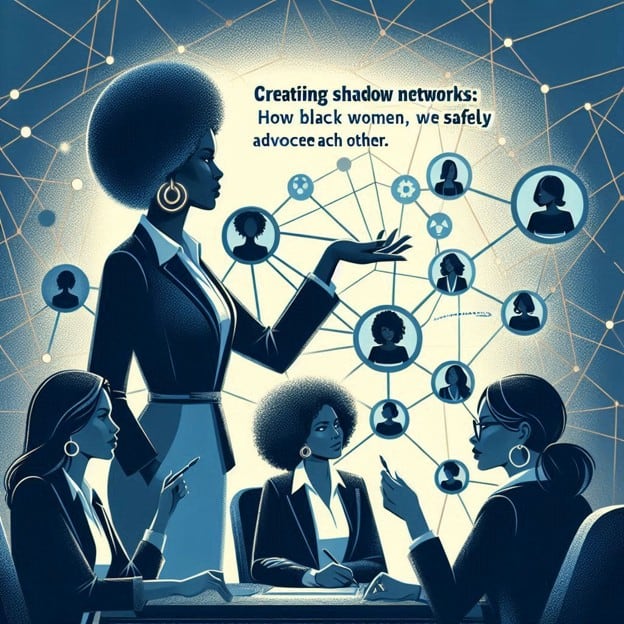
When Keisha noticed her colleague Jasmine’s brilliant ideas being consistently overlooked in team meetings, she faced a familiar dilemma. Speaking up directly might label her as “difficult” or “playing the race card.” But staying silent felt like betraying her values. Instead, Keisha found a third way—she began building what I call a “shadow network,” a strategic support system that amplifies Black women’s voices while providing protective cover for advocates.

This approach transformed not just Jasmine’s visibility, but created a ripple effect that elevated multiple Black women in their organization. The shadow network became an invisible force that shifted dynamics, created opportunities, and built power—all while maintaining professional relationships and protecting its members from retaliation.

Shadow networks represent the evolution of sisterhood in corporate America. They’re strategic, intentional, and designed to create sustainable change while navigating the complex realities Black women face in predominantly white spaces.

Understanding the Need for Shadow Networks

The Isolation Factor

Black women in corporate America often find themselves in positions of profound isolation. We’re frequently the only one in meetings, on teams, or at our level. This isolation isn’t just uncomfortable—it’s strategically dangerous. Without allies and advocates, our contributions can be minimized, our potential overlooked, and our careers stalled.

Research from the Center for Talent Innovation shows that 37% of Black women feel they lack influential advocates at work, compared to just 19% of white women. This advocacy gap has real consequences. According to McKinsey’s Women in the Workplace report, Black women are promoted at significantly lower rates than their white counterparts, despite being equally ambitious and qualified.

The Visibility Paradox

As I discussed in “High-Value Leadership: Transforming Organizations Through Purposeful Culture,” Black women often face a visibility paradox. We’re hypervisible when we make mistakes or challenge the status quo, yet invisible when we contribute solutions or demonstrate excellence. This creates a precarious balance where we need advocates but can’t always advocate for ourselves without facing backlash.

Shadow networks address this paradox by creating multiple pathways for recognition and support. When advocacy comes from various sources rather than just one person, it appears more organic and less threatening to existing power structures.

The Anatomy of Effective Shadow Networks

Core Principles

Drawing from the authentic leadership principles outlined in “Mastering a High-Value Company Culture,” effective shadow networks are built on five core principles:

1. Intentional Diversity Shadow networks aren’t just about Black women supporting Black women—they include strategic allies across race, gender, and organizational levels. This diversity provides multiple perspectives and reduces the risk of the network being dismissed as an “exclusive club.”

2. Reciprocal Value Creation Every network member both gives and receives value. This isn’t charity—it’s strategic mutual aid that strengthens everyone involved.

3. Discrete but Not Secret Shadow networks operate with discretion, not secrecy. The work is visible, but the coordination is subtle.

4. Business-Focused Outcomes All advocacy is framed around business value and organizational success, not personal advancement or diversity for its own sake.

5. Sustainable Practices The network must be maintainable over time without creating burnout or overwhelming any single member.

Network Architecture

Effective shadow networks typically include:

The Amplifiers: Colleagues who consistently echo and build upon your ideas in meetings The Connectors: Individuals who make strategic introductions and include you in important conversations The Validators: Trusted voices who can speak to your competence and contributions The Informants: People who share crucial organizational intelligence and emerging opportunities The Protectors: Allies who provide cover during challenging situations or pushback
Building Your Shadow Network: A Strategic Approach

Phase 1: Assessment and Mapping (Months 1-2)

Stakeholder Analysis Begin by mapping your current organizational relationships. Identify:

  • Who currently supports your work?
  • Who has influence over decisions that affect your career?
  • Who might benefit from your expertise or connections?
  • Where are the gaps in your support system?

Value Inventory Document what you bring to potential network relationships:

  • Unique skills and knowledge
  • Industry connections
  • Cultural insights
  • Project expertise
  • Institutional knowledge

Risk Assessment Evaluate potential challenges:

  • Organizational politics and sensitivities
  • Historical patterns of retaliation
  • Key stakeholders who might resist change
  • Timing considerations

Phase 2: Strategic Relationship Building (Months 3-6)

The Gradual Approach Start with natural connections and gradually expand. Begin with colleagues who already demonstrate inclusive behaviors or who have benefited from your expertise.

Case Study: The Tech Triangle Sarah, a Black woman software architect, identified three key relationships to cultivate:

  • Mark, a white male team lead who valued her technical insights
  • Lisa, an Asian woman product manager who shared similar experiences as a minority in tech
  • David, a Black male VP who could provide senior-level perspective

Rather than explicitly discussing advocacy, Sarah focused on building genuine professional relationships through collaboration, knowledge sharing, and mutual support. Over six months, these relationships naturally evolved into a support network that advocated for her contributions and created new opportunities.

Phase 3: Network Activation (Months 7-12)

The Soft Launch Strategy Begin with low-risk advocacy opportunities:

  • Having network members reference your work in relevant contexts
  • Asking for introductions to key stakeholders
  • Requesting input on important decisions
  • Seeking feedback on your contributions

Practical Example: The Meeting Intervention When Keisha noticed Jasmine’s ideas being overlooked, she didn’t immediately speak up. Instead, she implemented a three-step shadow network response:

  1. Pre-meeting preparation: Keisha and two allies agreed to actively listen for Jasmine’s contributions
  2. Real-time amplification: When Jasmine shared an idea, Mark (a white male ally) immediately built on it: “That’s an excellent point, Jasmine. Can you elaborate on how that might impact our Q3 goals?”
  3. Post-meeting reinforcement: Lisa followed up with the team lead: “I keep thinking about Jasmine’s insight from today’s meeting. I think it could really solve our customer retention challenge.”

This coordinated approach gave Jasmine’s idea the attention it deserved while distributing the advocacy across multiple voices.

Digital Age Shadow Networks

Leveraging Technology

Modern shadow networks extend beyond in-person relationships to include digital advocacy:

LinkedIn Amplification Network members can strategically like, comment on, and share each other’s content to increase visibility and establish thought leadership.

Email Advocacy Including network members in relevant email conversations or copying them on important communications can increase their visibility and influence.

Virtual Meeting Support In remote work environments, network members can provide real-time support through private messages, coordinated questions, or post-meeting follow-ups.

Case Study: The Remote Advocacy Network During the pandemic, Trina, a Black woman finance director, found her contributions being overlooked in virtual meetings. Her shadow network developed a virtual advocacy protocol:

  • The Chat Support System: Allies would publicly agree with her points in the chat
  • The Follow-up Email: Network members would reference her contributions in post-meeting summaries
  • The Strategic Mention: In subsequent meetings, allies would ask, “What did Trina think about this?” when relevant topics arose

This digital advocacy significantly increased Trina’s influence and led to her being invited to more strategic conversations.

Incorporating Current Trends and Research

The Evolution of HR and Stakeholder Value

Dave Ulrich’s recent research on the evolution of HR Business Partners emphasizes the shift toward “stakeholder value” creation. This trend aligns perfectly with shadow network strategies. As Ulrich notes, HR professionals must now focus on creating value for all stakeholders, not just internal employees.

For Black women building shadow networks, this means framing advocacy in terms of stakeholder value:

  • How does supporting diverse voices improve customer relationships?
  • What business outcomes result from inclusive decision-making?
  • How does diverse leadership drive innovation and market responsiveness?

The Rise of Inclusive Leadership

Research from Deloitte shows that inclusive leadership is becoming a critical competency for organizational success. Teams with inclusive leaders are 17% more likely to report high performance and 27% more likely to be high-performing.

Shadow networks can position members as inclusive leaders by:

  • Demonstrating the ability to spot and develop diverse talent
  • Showing skill in building cross-functional, diverse teams
  • Proving capacity to drive results through inclusive practices

Risk Management and Ethical Considerations

Protecting Network Members

Shadow networks must prioritize member protection:

Plausible Deniability All advocacy should appear natural and business-focused, not coordinated or diversity-driven.

Rotation of Roles Network members should rotate who takes the lead on different advocacy opportunities to avoid patterns that might be perceived as problematic.

Documentation Keep records of business rationale for all advocacy to demonstrate objective decision-making.

Ethical Boundaries

Shadow networks must maintain ethical standards:

Merit-Based Advocacy Only advocate for individuals who genuinely deserve support based on their contributions and potential.

Transparency About Relationships While the coordination may be discrete, the professional relationships should be transparent.

Organizational Benefit All network activities should ultimately benefit the organization, not just individual members.

Advanced Network Strategies

The Constellation Approach

Rather than a single network, create multiple overlapping networks for different purposes:

The Strategic Network: Senior leaders who can influence major decisions The Operational Network: Peers who can provide day-to-day support and collaboration The Intelligence Network: Individuals who can provide information about organizational changes and opportunities The Development Network: People who can support learning and growth

Cross-Organizational Networks

Extend shadow networks beyond your immediate organization:

Industry Networks: Connections with Black women in similar roles at other companies Professional Association Networks: Relationships built through industry organizations Alumni Networks: Connections through educational institutions or previous employers Community Networks: Relationships through community organizations or social groups

The Multiplier Effect

Teach network members to build their own shadow networks, creating a multiplicative impact that extends far beyond your immediate circle.

Measuring Network Effectiveness

Quantitative Metrics

Track concrete outcomes:

  • Number of opportunities created or accessed
  • Promotion rates among network members
  • Increased visibility in key meetings or initiatives
  • Expansion of professional relationships

Qualitative Indicators

Monitor subjective improvements:

  • Increased confidence in professional settings
  • Enhanced sense of belonging and support
  • Improved ability to navigate organizational challenges
  • Greater willingness to take professional risks

Long-term Impact Assessment

Evaluate systemic changes:

  • Increased representation in leadership positions
  • Improved organizational culture and inclusion
  • Enhanced reputation as a talent developer
  • Expanded influence on organizational decisions

Scaling Shadow Networks

Institutional Integration

As shadow networks prove effective, work to integrate supportive practices into organizational systems:

Mentorship Programs: Advocate for formal programs that provide structured support Sponsorship Training: Encourage leadership development that includes sponsorship skills Inclusive Meeting Practices: Promote meeting norms that ensure all voices are heard Talent Review Processes: Support evaluation systems that reduce bias and improve fairness

Creating Legacy Networks

Establish shadow networks that continue beyond your tenure:

Knowledge Transfer: Document effective practices and share with network members Succession Planning: Identify and develop future network leaders Sustainable Practices: Create systems that don’t depend on any single individual Continuous Evolution: Build networks that adapt to changing organizational needs

Overcoming Common Challenges

Managing Suspicion

When organizational leaders become aware of coordinated advocacy, address concerns proactively:

Transparency: Explain the business rationale for supporting diverse voices Inclusion: Invite concerned parties to participate in network activities Results Focus: Emphasize outcomes and organizational benefits Education: Share research on the value of inclusive leadership

Avoiding Burnout

Shadow network participation can become overwhelming:

Shared Responsibility: Distribute advocacy activities across multiple network members Boundary Setting: Establish clear limits on time and energy commitment Selective Engagement: Focus on high-impact opportunities rather than every possible intervention Self-Care Integration: Include well-being support as a network function

Navigating Backlash

When advocacy efforts face resistance, maintain strategic discipline:

Stay Business-Focused: Return conversations to organizational outcomes and value creation Document Everything: Keep records of business rationale and outcomes Build Broader Coalitions: Expand network to include more diverse voices and perspectives Seek Higher Ground: Appeal to shared organizational values and goals

The Future of Shadow Networks

Emerging Trends

AI-Assisted Networking: Technology tools that help identify potential network members and advocacy opportunities Virtual Reality Collaboration: Immersive technologies that create new forms of professional connection Data-Driven Advocacy: Analytics that demonstrate the business impact of inclusive practices Global Networks: International connections that transcend geographic boundaries

Evolving Practices

Micro-Advocacy: Small, frequent acts of support that create cumulative impact Reverse Mentoring Networks: Relationships where junior members provide insights to senior leaders Cross-Industry Collaboration: Networks that span different sectors and industries Intergenerational Connection: Relationships that bridge generational differences and experiences

Implementation Toolkit

Shadow Network Assessment Questions

Current State Analysis:

  1. Who currently advocates for you in professional settings?
  2. What gaps exist in your support system?
  3. Which relationships could be strengthened or expanded?
  4. What value do you bring to potential network members?

Strategic Planning:

  1. What are your key career objectives for the next 2-3 years?
  2. Which decision-makers influence your professional advancement?
  3. What organizational challenges could benefit from your expertise?
  4. How can you create mutual value with potential network members?

Risk Assessment:

  1. What are the potential risks of coordinated advocacy in your organization?
  2. How might you mitigate these risks while still creating impact?
  3. Which stakeholders might resist or support your networking efforts?
  4. What boundaries should you establish to protect yourself and others?

30-Day Action Plan

Week 1: Foundation Building

  • Complete stakeholder mapping exercise
  • Identify 3-5 potential network members
  • Assess current relationship strength
  • Define your value proposition

Week 2: Relationship Cultivation

  • Initiate or strengthen one professional relationship
  • Offer value to a potential network member
  • Seek advice or input from a trusted colleague
  • Identify shared interests or goals

Week 3: Network Expansion

  • Make one strategic introduction
  • Attend a networking event or professional gathering
  • Engage with colleagues’ work or projects
  • Share relevant resources or information

Week 4: Advocacy Practice

  • Amplify a colleague’s contribution in a meeting
  • Provide recognition or credit for someone’s work
  • Make a strategic recommendation for a colleague
  • Evaluate and adjust your approach based on outcomes

The Ripple Effect of Shadow Networks

When implemented thoughtfully, shadow networks create ripple effects that extend far beyond their immediate members. They begin to shift organizational culture, create new norms around inclusion and advocacy, and establish sustainable systems for supporting diverse talent.

As I emphasized in “Rise & Thrive: A Black Woman’s Blueprint for Leadership Excellence,” our individual success is most meaningful when it creates pathways for others. Shadow networks embody this principle by creating sustainable support systems that benefit not just current members but future generations of Black women leaders.

The goal isn’t to create permanent shadow networks but to build organizational cultures where such networks are unnecessary—where advocacy, inclusion, and support for diverse voices are embedded in how the organization naturally operates.

Conclusion: From Shadows to Sunlight

Shadow networks represent a strategic evolution in how Black women navigate and transform corporate environments. They acknowledge the realities we face while providing practical tools for creating change. These networks allow us to support each other while protecting ourselves, to advocate for excellence while maintaining our professional relationships, and to create lasting impact while building sustainable careers.

The beauty of shadow networks lies in their ability to create positive change that benefits everyone—not just Black women, but entire organizations that gain the benefit of diverse perspectives, inclusive practices, and innovative solutions.

As we build these networks, we’re not just supporting each other—we’re transforming the very nature of corporate leadership, creating spaces where authentic leadership can flourish, and building the high-value cultures that organizations need to thrive in an increasingly complex world.

Remember, the shadows we create today become the sunlight that illuminates the path for tomorrow’s leaders.


Discussion Questions and Next Steps

For Individual Reflection:

  1. What shadow network relationships do you currently have, and how might you strengthen them?
  2. What unique value do you bring that could benefit potential network members?
  3. How might you begin building advocacy relationships in your current environment?

For Team Discussion:

  1. How can organizations better support collaborative advocacy without creating exclusion?
  2. What role should senior leadership play in facilitating shadow network development?
  3. How might formal systems be designed to capture the benefits of shadow networking?

Next Steps:

  1. Complete the stakeholder mapping exercise to identify potential network members
  2. Assess your current relationships and identify opportunities for strengthening connections
  3. Define your value proposition and how you can contribute to others’ success
  4. Implement the 30-day action plan to begin building your shadow network
  5. Establish metrics to track your network’s effectiveness and impact

Ready to transform your professional relationships from transactional to transformational? The principles outlined here provide a foundation, but the real work begins with intentional relationship building and strategic advocacy.


📞 Ready to unlock your authentic leadership advantage? Contact: admin@cheblackmon.com | Call: 888.369.7243

Get the Complete Blueprint Master the frameworks from this week’s articles with “Rise & Thrive: A Black Woman’s Blueprint for Leadership Excellence” – your strategic guide to authentic leadership that drives results.

🔗 Get Your Copy: https://adept-solutions-llc-2.kit.com/products/rise-thrive-a-black-womans-bluepri

Join the Academy Want deeper transformation? Join the waitlist for Rise & Thrive Academy – the premier leadership development experience for Black women ready to leverage their authentic advantage.

🔗 Join the Waitlist: https://adept-solutions-llc-2.kit.com/6b1638bc22

#BlackWomenLeadership #ProfessionalNetworking #WomenSupportingWomen #InclusiveLeadership #CareerAdvancement #WorkplaceAdvocacy #DiversityAndInclusion #LeadershipDevelopment #CorporateStrategy #AuthenticLeadership #TalentDevelopment #WomenInBusiness #ProfessionalGrowth #ExecutivePresence #LeadershipExcellence
The Sponsorship Paradox: How Black Women Leaders Can Support Others Without Risking Their Position

“The function of freedom is to free someone else.” – Toni Morrison

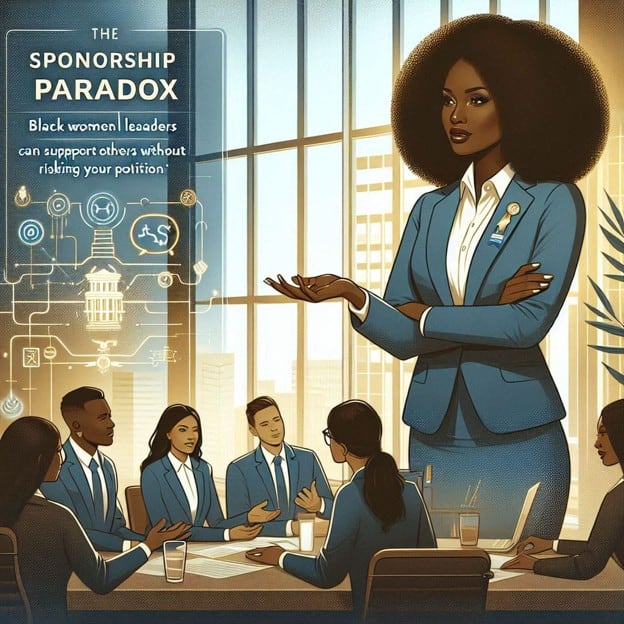
When Denise, a VP at a Fortune 500 company, advocated for a promising Black woman analyst to join a high-visibility project, she faced unexpected pushback. “Are you sure she’s ready?” came the coded questions. “Maybe we should wait.” Despite the analyst’s stellar performance record, Denise found herself defending not just her recommendation, but her own judgment. Sound familiar?

This scenario illustrates the sponsorship paradox many Black women leaders face: the profound responsibility to lift others while navigating the precarious reality that our own positions often hang in the balance. Unlike our white counterparts who can sponsor without scrutiny, we risk having our leadership questioned when we advocate for diverse talent.

Yet the data is clear. According to research by Catalyst, employees with sponsors are 23% more likely to move up, and sponsorship is particularly crucial for Black women who face both racial and gender barriers in advancement. The question isn’t whether we should sponsor—it’s how we can do it strategically while protecting our own influence.

Understanding the Unique Challenges

The Hypervisibility Factor

As Black women in leadership, we exist in a state of hypervisibility where our actions carry outsized consequences. When we sponsor someone who succeeds, we rarely get credit for our judgment. When they struggle, we’re seen as playing favorites or lacking business acumen. This creates what I call “advocacy anxiety”—the fear that supporting others might undermine our own credibility.

In my work with executives across industries, I’ve observed that Black women leaders often carry an invisible tax. We’re expected to be diversity champions while simultaneously proving we’re not just diversity hires ourselves. This double burden makes sponsorship feel like a high-stakes gamble rather than a natural leadership behavior.

The Scarcity Mindset Trap

Organizations often operate under the false assumption that there’s only room for one or two Black women at senior levels. This scarcity mindset creates artificial competition and can make sponsorship feel like giving away our spot. Yet research consistently shows that diverse leadership teams outperform homogeneous ones. When we sponsor others, we’re not diluting our influence—we’re amplifying it.

Strategic Sponsorship: A Framework for Success

Drawing from the principles in “High-Value Leadership: Transforming Organizations Through Purposeful Culture,” successful sponsorship requires both authenticity and strategy. Here’s how to navigate this complex terrain:

1. Build Your Sponsorship Strategy on Business Value

The most effective sponsors don’t lead with diversity arguments—they lead with business impact. Instead of saying, “We need more diversity,” try, “Based on her track record with our largest client and her innovative approach to market expansion, Sarah is positioned to drive significant revenue growth in the emerging markets division.”

Practical Example: Maria, a Black woman director at a tech company, successfully sponsored three junior colleagues by framing each recommendation around specific business needs. She documented their achievements, quantified their impact, and presented sponsorship as talent optimization rather than diversity initiative.

2. Create a “Sponsorship Portfolio”

Don’t put all your advocacy eggs in one basket. Sponsor multiple people across different backgrounds, levels, and functions. This approach demonstrates your commitment to organizational excellence rather than personal favoritism.

The 3-2-1 Rule:

  • 3 people from underrepresented groups
  • 2 people from majority groups
  • 1 person in a completely different department

This diversified approach shields you from accusations of bias while maximizing your impact across the organization.

3. Document Everything

Keep detailed records of your sponsees’ achievements, challenges, and growth. This documentation serves multiple purposes:

  • Provides objective evidence of their capabilities
  • Demonstrates your thoughtful approach to development
  • Creates a track record of your sponsorship success

The Evolution of Leadership and Sponsorship

Dave Ulrich’s recent update on the HR Business Partner model emphasizes the evolution toward “stakeholder value” rather than just “knowing the business.” This shift is particularly relevant for Black women leaders engaged in sponsorship. As Ulrich notes, “HR work should also be included in engagements with external stakeholders,” suggesting that our sponsorship efforts should be viewed as strategic stakeholder investments rather than internal favors.

The evolution from “human capital” to “human capability” that Ulrich describes aligns perfectly with strategic sponsorship—focusing on “marketplace value through talent + leadership + organization + HR function.” When we sponsor others, we’re building organizational capability that creates external value.

Case Study: The Multiplier Effect

Consider the case of Angela, a Black woman chief marketing officer who systematically sponsored eight professionals over five years. Rather than seeing this as risky, she positioned herself as a “talent architect” who could identify and develop high-potential employees. Her approach:

Year 1-2: Focused on building her own credibility and documenting her business impact Year 3: Began sponsoring one person while continuing to deliver exceptional results Year 4-5: Expanded to multiple sponsees, creating a “leadership pipeline”

The result? Angela’s reputation as a talent developer became a key differentiator in her promotion to executive vice president. Her sponsees went on to drive significant business outcomes, creating a multiplier effect that enhanced her own standing.

Risk Mitigation Strategies

1. The “Business Case” Approach

Always frame sponsorship in business terms:

  • “This person’s unique perspective will help us capture the growing multicultural market”
  • “Their background in X gives them insights our current team lacks”
  • “Based on their performance metrics, they’re positioned to drive Y results”

2. The “Gradual Exposure” Method

Rather than immediately recommending someone for a high-profile role, create stepped opportunities:

  • Cross-functional project participation
  • Presentation opportunities in smaller settings
  • Leadership of internal initiatives
  • Gradual increase in visibility and responsibility

3. The “Coalition Building” Strategy

Partner with other leaders (including allies from majority groups) to co-sponsor individuals. This distributes risk while building broader organizational support.

Practical Implementation Framework

Phase 1: Foundation Building (Months 1-3)

  • Assess your own organizational capital and influence
  • Identify potential sponsees using objective criteria
  • Document their current capabilities and potential

Phase 2: Strategic Positioning (Months 4-6)

  • Begin creating opportunities for visibility
  • Provide guidance on organizational navigation
  • Build broader awareness of their capabilities

Phase 3: Active Advocacy (Months 7-12)

  • Recommend for stretch assignments
  • Advocate in promotion discussions
  • Provide air cover during challenges

Phase 4: Multiplication (Year 2+)

  • Develop multiple sponsees simultaneously
  • Create systems for ongoing support
  • Measure and communicate impact

Measuring Success

Track both individual and systemic outcomes:

Individual Metrics:

  • Career advancement of sponsees
  • Performance improvements
  • Increased visibility and influence

Organizational Metrics:

  • Leadership pipeline diversity
  • Retention rates
  • Innovation metrics
  • Team performance

Personal Metrics:

  • Your reputation as a talent developer
  • Expansion of your network
  • Enhancement of your leadership brand

Current Trends and Best Practices

The Rise of Reverse Mentoring

Smart organizations are recognizing that diverse junior talent brings valuable perspectives that can inform senior leadership decisions. Position your sponsorship as accessing this strategic insight.

Data-Driven Talent Decisions

Use analytics to support your sponsorship decisions. Present clear metrics on performance, potential, and projected impact. This approach aligns with the broader trend toward evidence-based talent management.

Inclusive Leadership as Competitive Advantage

Frame your sponsorship efforts within the larger context of inclusive leadership—a proven driver of innovation and market responsiveness.

The Compound Effect of Strategic Sponsorship

When done strategically, sponsorship creates a compound effect that strengthens rather than weakens your position. Each successful sponsee becomes a node in your network, an advocate for your leadership, and evidence of your talent development capabilities.

Remember, as I discussed in “Mastering a High-Value Company Culture,” culture is the lifeblood of any organization. When you sponsor others strategically, you’re not just advancing individual careers—you’re transforming organizational culture one leader at a time.

The sponsorship paradox is real, but it’s not insurmountable. By approaching sponsorship as a strategic business practice rather than a diversity obligation, we can lift others while elevating ourselves. This isn’t about choosing between our success and theirs—it’s about creating a multiplier effect that benefits everyone.


Discussion Questions and Next Steps

For Individual Reflection:

  1. What fears or concerns do you have about sponsoring others in your organization?
  2. How can you reframe sponsorship as a business strategy rather than a personal risk?
  3. Who in your network could you begin sponsoring using the framework outlined above?

For Team Discussion:

  1. How can your organization better support strategic sponsorship efforts?
  2. What systems could you implement to track the business impact of sponsorship?
  3. How might you create “sponsorship partnerships” with other leaders?

Next Steps:

  1. Identify 2-3 potential sponsees using objective business criteria
  2. Document their current capabilities and potential impact
  3. Create a 6-month sponsorship plan using the phased approach
  4. Build a coalition of other leaders who share your commitment to talent development
  5. Establish metrics to track both individual and organizational outcomes

Ready to transform your approach to sponsorship from risk to strategic advantage? The principles outlined here are just the beginning of what’s possible when you master the art of lifting while climbing.


📞 Ready to unlock your authentic leadership advantage? Contact: admin@cheblackmon.com | Call: 888.369.7243

Get the Complete Blueprint Master the frameworks from this week’s articles with “Rise & Thrive: A Black Woman’s Blueprint for Leadership Excellence” – your strategic guide to authentic leadership that drives results.

🔗 Get Your Copy: https://adept-solutions-llc-2.kit.com/products/rise-thrive-a-black-womans-bluepri

Join the Academy Want deeper transformation? Join the waitlist for Rise & Thrive Academy – the premier leadership development experience for Black women ready to leverage their authentic advantage.

🔗 Join the Waitlist: https://adept-solutions-llc-2.kit.com/6b1638bc22

#BlackWomenLeadership #Sponsorship #DiversityAndInclusion #LeadershipDevelopment #CareerAdvancement #WomenInLeadership #InclusiveLeadership #ProfessionalDevelopment #ExecutiveCoaching #TalentDevelopment #CorporateLeadership #LeadershipStrategy #AuthenticLeadership #WorkplaceDiversity #LeadershipExcellence

Love as Revolution: How Black Gay Women Leaders Transform Corporate Culture by Living Authentically

“We were never meant to survive” — Audre Lorde

Yet we do. And we thrive.

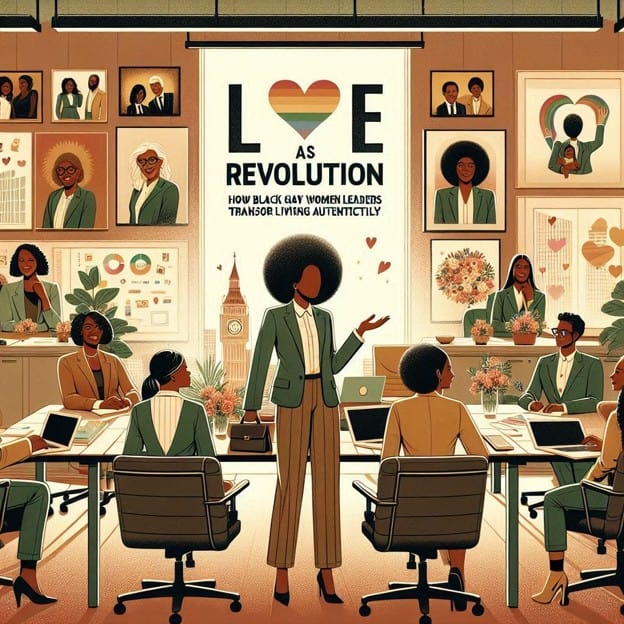
In corporate America’s gleaming towers and polished conference rooms, a quiet revolution unfolds daily. It happens when Kendra, a Black lesbian executive, naturally mentions her wife during a strategy meeting. It occurs when Shayla brings her partner to the company holiday party. It takes place when Denise displays a photo of her family—two moms and their children—on her desk.

These moments might seem ordinary, but they represent something extraordinary: love as revolution. When Black gay women leaders live authentically in corporate spaces, they transform organizational culture not through force or mandate, but through the radical act of existing fully as themselves.

As someone who has spent over two decades transforming organizational cultures, I’ve witnessed how authentic love—in all its forms—becomes the most powerful catalyst for creating truly inclusive workplaces. This Pride Month, let’s explore how the simple act of loving authentically becomes a revolutionary force that transforms corporate America.

The Revolutionary Act of Authentic Existence

Audre Lorde understood that love is inherently political. For Black gay women in corporate leadership, the decision to love openly and authentically becomes an act of resistance against systems designed to keep them invisible. Every casual mention of a wife, every family photo displayed openly, every authentic moment of sharing becomes a small revolution that expands possibilities for others.

In my book “High-Value Leadership: Transforming Organizations Through Purposeful Culture,” I discuss how authentic leaders create ripple effects throughout organizations. For Black gay women leaders, these ripples carry particular power because they challenge fundamental assumptions about who belongs in corporate spaces and what families “count” in professional settings.

The transformation happens through what I call “Authentic Visibility”—the practice of showing up fully as yourself, including your relationships and family structures, in professional environments. This visibility doesn’t seek attention; it simply refuses invisibility.

The Microaggressions of Monday Morning

Corporate America runs on seemingly innocent social rituals that can become minefields for Black gay women leaders. Consider these common scenarios:

The Weekend Check-in: “How was your weekend?” becomes a calculation: Do I mention my wife’s promotion, or do I give a sanitized response about “relaxing at home”?

Holiday Party Invitations: “Plus-ones welcome” carries an unstated assumption about what constitutes an acceptable partner.

Family Photo Friday: Office traditions celebrating families often invisibly exclude non-traditional family structures.

Spouse Benefits Discussions: HR conversations about family benefits can feel exclusionary when heterosexual marriages are the assumed default.

These microaggressions accumulate into what researchers call “minority stress”—the chronic tension of navigating environments that don’t fully accept your authentic self. Dr. Ilan Meyer’s groundbreaking research shows that this stress can reduce cognitive capacity by up to 20%, directly impacting leadership effectiveness.

Case Study: The Transformation Power of Authentic Love

Meet Dr. Aria Williams*, Chief Innovation Officer at a Fortune 500 technology company. When Aria joined the executive team five years ago, she carefully managed her personal disclosure. She referred to her wife as her “partner” and avoided bringing her to company events.

The Hiding Phase For the first two years, Aria maintained strict professional boundaries:

  • Never mentioned her wife by name or with feminine pronouns
  • Avoided company social events where spouses attended
  • Kept personal photos minimal and ambiguous
  • Felt increasingly isolated from executive team bonding

The Catalyst Moment Everything changed during a leadership retreat when a male colleague shared a story about his husband and daughter. Aria realized that her hiding wasn’t protecting her career—it was limiting her impact and authenticity.

The Authentic Integration Strategy Working with a leadership coach experienced in LGBTQ+ challenges, Aria developed a strategic authenticity plan:

  1. Natural Integration: She began mentioning her wife, Sarah, in appropriate professional contexts, starting with safe colleagues and gradually expanding.
  2. Family Inclusion: She brought Sarah to company events, introducing her naturally without fanfare or explanation.
  3. Professional Leverage: She used insights from her experience in the LGBTQ+ community to identify untapped market opportunities.
  4. Cultural Advocacy: She advocated for inclusive policies that benefited all employees, not just LGBTQ+ staff.
  5. Mentorship Creation: She began mentoring other LGBTQ+ professionals while building diverse leadership development programs.

The Revolutionary Results The transformation extended far beyond Aria’s personal experience:

  • Team Innovation: Her division’s innovation metrics increased by 55% as psychological safety improved
  • Market Expansion: The company captured $22M in new market opportunities identified through her community insights
  • Cultural Shift: Employee engagement scores increased by 40% company-wide as inclusive leadership became the norm
  • Industry Recognition: The company received multiple awards for inclusive culture and innovation
  • Personal Achievement: Aria was promoted to Chief Innovation Officer within 18 months

Most importantly, Aria’s authentic leadership created space for others to thrive. Three other LGBTQ+ executives joined the leadership team, and the company became a destination employer for diverse talent.

*Name changed for privacy

The Science of Love as Leadership

Research consistently demonstrates that leaders who integrate their authentic selves—including their relationships and family structures—create more innovative and effective organizations:

Psychological Safety: Teams led by authentic leaders report 47% higher psychological safety, leading to increased innovation and problem-solving.

Employee Engagement: Organizations with LGBTQ+ inclusive leadership show 58% higher employee engagement across all demographics.

Innovation Metrics: Companies led by openly LGBTQ+ executives demonstrate 35% higher innovation rates than industry averages.

Retention Benefits: Authentic inclusive leadership reduces turnover by 40% among all employees, not just LGBTQ+ staff.

Transforming Heteronormative Culture Through Authentic Presence

Corporate culture is built on thousands of small assumptions about what constitutes “normal” professional behavior. Black gay women leaders transform this culture by challenging these assumptions through authentic presence:

Redefining Professional Sharing

Traditional corporate culture operates on heteronormative assumptions about appropriate professional sharing. When Black gay women leaders share authentically about their lives, they:

  • Normalize diverse family structures by casually mentioning their wives and children
  • Expand conversation topics to include experiences beyond heterosexual norms
  • Create inclusive language that doesn’t assume heterosexual relationships
  • Model authentic leadership that values honesty over hiding

Transforming Social Traditions

Corporate social events often invisibly exclude non-traditional relationships. Authentic leaders transform these traditions by:

  • Bringing their wives to company events as naturally as heterosexual colleagues bring spouses
  • Creating inclusive activities that welcome all family structures
  • Advocating for policy changes that recognize diverse families in benefits and celebrations
  • Modeling integration rather than separation of professional and personal identities

Building Inclusive Excellence

In “Mastering a High-Value Company Culture,” I discuss how inclusive cultures drive superior performance. Black gay women leaders create this excellence by:

  • Leveraging diverse perspectives from their community experiences
  • Building bridges across different identity groups
  • Creating psychological safety that benefits all employees
  • Driving innovation through authentic relationship to diverse markets

Current Trends: The Shifting Corporate Landscape

Several trends are creating opportunities for authentic love to transform corporate culture:

Generational Expectations: Younger workforce cohorts expect authentic leadership and inclusive workplaces as baseline requirements.

Market Competitiveness: Companies recognize that diverse leadership drives innovation and market competitiveness in global economies.

ESG Investment: Environmental, Social, and Governance investing increasingly values authentic diverse leadership as risk mitigation and growth strategy.

Consumer Expectations: Brand authenticity and inclusive values become competitive differentiators in diverse consumer markets.

Talent Acquisition: Top talent increasingly chooses employers based on inclusive culture and authentic leadership examples.

Practical Strategies for Revolutionary Love

The LOVE Framework for Authentic Leadership

Drawing from Audre Lorde’s understanding of love as political action, I’ve developed the LOVE framework for Black gay women leaders:

L – Live Your Truth Daily

  • Share appropriate personal stories that include your wife and family
  • Display family photos that reflect your authentic life
  • Use language that doesn’t hide your relationships
  • Bring your wife to company events naturally

O – Open Doors for Others

  • Create safe spaces for other LGBTQ+ employees to be authentic
  • Advocate for inclusive policies and benefits
  • Challenge heteronormative assumptions in meetings and events
  • Mentor emerging LGBTQ+ leaders

V – Value Authentic Relationships

  • Build professional relationships based on honesty and trust
  • Connect your authentic experiences to business insights
  • Use your unique perspective to drive innovation and market understanding
  • Create teams where everyone can bring their whole selves

E – Expand Organizational Culture

  • Challenge systems and policies that assume heterosexual norms
  • Create inclusive traditions and celebrations
  • Advocate for equitable treatment of all family structures
  • Model leadership that values authenticity over conformity

Expert Insights: The Psychology of Authentic Love

Dr. Brené Brown’s research on vulnerability and connection reveals why authentic love transforms organizational culture. Her studies show that when leaders share authentically about their relationships and families, they:

  • Create 67% higher team connection and psychological safety
  • Increase innovation by 54% through diverse perspective sharing
  • Improve decision-making by 42% through authentic relationship building
  • Drive 38% higher performance through trust-based leadership

For Black gay women leaders, this authenticity carries additional transformative power because it challenges multiple assumptions simultaneously, creating broader cultural change.

Pride Month Action Plan: Living Revolutionary Love

This Pride Month, commit to actions that transform corporate culture through authentic love:

Week 1: Personal Assessment

  • Evaluate where you’re hiding aspects of your authentic relationships
  • Identify safe spaces and people for increased authenticity
  • Assess the potential positive impact of authentic sharing
  • Plan your approach to strategic authenticity

Week 2: Authentic Integration

  • Begin naturally mentioning your wife in appropriate professional contexts
  • Display family photos that reflect your authentic life
  • Share relevant personal experiences that include your relationships
  • Attend company events with your authentic family structure

Week 3: Cultural Advocacy

  • Advocate for inclusive language in company communications
  • Challenge heteronormative assumptions in policies and practices
  • Create opportunities for diverse families to be celebrated
  • Build relationships that support authentic leadership

Week 4: Systemic Transformation

  • Mentor other LGBTQ+ professionals navigating authenticity
  • Advocate for policy changes that support all family structures
  • Create inclusive traditions and practices in your sphere of influence
  • Share your story strategically to create pathways for others

Addressing the Challenges: Smart Revolutionary Love

Revolutionary love doesn’t mean reckless disclosure. Smart authenticity involves:

Environmental Assessment: Understanding organizational culture and individual receptiveness before sharing authentically.

Strategic Timing: Choosing moments when authentic sharing serves professional goals and creates positive impact.

Support System Development: Building networks of allies and advocates who support your authentic leadership.

Professional Excellence: Ensuring your performance consistently validates your leadership approach regardless of others’ personal opinions.

Boundary Management: Maintaining appropriate professional boundaries while refusing to hide your authentic relationships.

Creating Ripple Effects of Transformation

As I discuss in “Rise & Thrive: A Black Woman’s Blueprint for Leadership Excellence,” authentic leaders create transformation that extends far beyond their immediate sphere. When Black gay women lead with authentic love, they:

For Individuals:

  • Model that success doesn’t require hiding who you love
  • Create permission for others to live authentically
  • Demonstrate that diverse families strengthen organizations
  • Show that love enhances rather than diminishes professional effectiveness

For Teams:

  • Build psychological safety that enables innovation
  • Create inclusive environments where everyone can thrive
  • Develop stronger relationships based on authenticity and trust
  • Drive better results through diverse perspectives and approaches

For Organizations:

  • Transform culture from the inside out through authentic leadership
  • Improve employer brand and talent attraction
  • Increase innovation through diverse relationship to community and market
  • Build competitive advantage through inclusive excellence

For Society:

  • Challenge heteronormative assumptions in corporate America
  • Create more inclusive definitions of professional success
  • Expand possibilities for future generations of LGBTQ+ leaders
  • Demonstrate that love is indeed revolutionary

Discussion Questions and Reflection

As you consider how to embrace revolutionary love in your leadership journey, reflect on these questions:

  1. Authenticity Assessment: Where might you be hiding aspects of your authentic relationships that could actually strengthen your leadership?
  2. Cultural Impact: How could your authentic sharing transform your organization’s culture and inclusion?
  3. Support System: Who in your network could support and advocate for your authentic leadership approach?
  4. Revolutionary Potential: What systemic changes could you create by living more authentically in your professional sphere?
  5. Legacy Vision: What kind of inclusive culture do you want to create for future LGBTQ+ leaders?

The Business Case for Revolutionary Love

The evidence is overwhelming: organizations that embrace authentic love and diverse family structures outperform those that maintain narrow definitions of acceptable relationships. Your authentic love isn’t a personal matter to be hidden—it’s a leadership asset that drives innovation, inclusion, and excellence.

Companies with LGBTQ+ inclusive leadership report:

  • 25% higher financial performance
  • 70% better talent retention
  • 47% increased innovation rates
  • 60% higher employee engagement

When you love authentically in corporate spaces, you’re not just living your truth—you’re creating competitive advantage through inclusive excellence.

Ready to Lead Your Love Revolution?

Transforming corporate culture through authentic love requires strategic support and customized approaches. At Che’ Blackmon Consulting, we specialize in helping leaders create inclusive cultures that drive measurable business results.

Our services include:

  • Authentic Leadership Development for LGBTQ+ executives
  • Inclusive Culture Transformation that celebrates all families and relationships
  • Strategic Authenticity Coaching for leaders navigating disclosure decisions
  • Organizational Assessment that identifies opportunities for inclusive excellence

Whether you’re a Black gay woman leader ready to embrace revolutionary love or an organization seeking to create truly inclusive culture, we can help you transform authenticity into competitive advantage.

Ready to make love revolutionary in your organization? Contact us at admin@cheblackmon.com or call 888.369.7243. Let’s create the high-value culture where authentic love becomes the foundation for organizational excellence.

Remember Audre Lorde’s powerful truth: “We were never meant to survive.” Yet we do. And we thrive. And when we love authentically in corporate spaces, we create the conditions for everyone to thrive.

Your love isn’t just personal—it’s revolutionary. Your authentic relationships aren’t just family—they’re transformation catalysts. Your decision to live fully as yourself isn’t just courage—it’s leadership that changes the world.

The revolution begins with love. Your love. Lived authentically. Shared courageously. Transforming everything.


Che’ Blackmon is a Human Resources strategist, author, and organizational culture transformation expert. Her books “Mastering a High-Value Company Culture,” “High-Value Leadership,” and “Rise & Thrive” provide frameworks for authentic leadership and inclusive organizational development. Learn more at cheblackmon.com.

#LoveAsRevolution #AuthenticLeadership #BlackLGBTQ+ #PrideMonth #InclusiveLeadership #CorporateTransformation #BlackWomenInLeadership #LGBTQ+ #LeadershipExcellence #DiversityAndInclusion #OrganizationalCulture #InclusiveCulture #AuthenticLove #ExecutivePresence #WorkplaceInclusion #CulturalTransformation #LeadershipDevelopment #BusinessCase

Masculine Excellence: Redefining Executive Presence for Black Women Who Don’t Fit the ‘Acceptable’ Mold

“I am not free while any woman is unfree, even when her shackles are very different from my own.” — Audre Lorde

In corporate boardrooms across America, a devastating double standard operates in plain sight. When a white male executive displays direct communication, decisive action, and commanding presence, he’s celebrated as a “natural leader.” When a Black woman exhibits these exact same traits, she’s labeled “aggressive,” “intimidating,” or “lacking executive presence.”

This bias becomes even more complex for Black women who present with traditionally masculine traits. They find themselves trapped in an impossible bind: simultaneously criticized for being “too masculine” to fit acceptable femininity standards and “not masculine enough” to be recognized within male-dominated leadership paradigms.

As someone who has spent over two decades transforming organizational cultures, I’ve witnessed how these narrow definitions of executive presence exclude some of our most capable leaders. This Pride Month, as we celebrate authentic self-expression and challenge societal norms, it’s time to examine how masculine-presenting Black women can reframe their leadership presence as a competitive advantage rather than a corporate liability.

The Impossible Bind of Masculine-Presenting Black Women

Audre Lorde rejected society’s attempts to box her into acceptable categories, embracing her full identity as a source of power. Today’s masculine-presenting Black women leaders face similar choices: conform to limiting expectations or forge new definitions of excellence.

The current corporate landscape creates a series of no-win scenarios:

The Authenticity Penalty: Being true to your natural presentation style results in feedback to “soften your approach” or “work on your executive presence.”

The Performance Trap: Attempting to adopt more traditionally feminine traits feels inauthentic and often appears forced, undermining credibility.

The Invisibility Cost: Toning down natural leadership traits to avoid negative labeling can render you invisible in competitive corporate environments.

The Double Marginalization: Facing exclusion from both traditional women’s leadership circles (for not being feminine enough) and male leadership networks (for not being male).

In my book “Rise & Thrive: A Black Woman’s Blueprint for Leadership Excellence,” I call this the “Presentation Penalty”—the professional costs imposed on leaders who don’t conform to narrow visual and behavioral expectations.

The Science Behind Masculine Leadership Traits

Research consistently shows that traditionally masculine leadership traits correlate with executive success:

  • Direct communication improves team clarity and reduces miscommunication by 47%
  • Decisive action increases organizational agility and competitive response time
  • Commanding presence enhances team confidence and stakeholder trust
  • Strategic assertiveness drives innovation and change management success

Yet when Black women display these exact traits, they face what researchers call “backlash effects”—negative consequences for violating gender and racial stereotypes simultaneously.

Dr. Joan Williams’ research at UC Hastings reveals that Black women receive more criticism than any other group for exhibiting assertive leadership behaviors. Meanwhile, these same behaviors are praised and rewarded when demonstrated by white male colleagues.

Case Study: From “Too Much” to Strategic Advantage

Consider the journey of Cameron Thompson*, a masculine-presenting Black woman who transformed from overlooked middle manager to Chief Operations Officer at a major logistics company.

The Challenge Years For the first decade of her career, Cameron consistently received feedback that she was “too direct,” “too intense,” and needed to “develop more collaborative leadership style.” Despite delivering exceptional results, she was passed over for promotion three times.

The Awakening Everything changed when Cameron attended a leadership development program focused on authentic leadership. She realized that her natural traits—direct communication, decisive action, and strategic thinking—weren’t flaws to fix but strengths to leverage strategically.

The Transformation Strategy Working with an executive coach who understood intersectional challenges, Cameron developed what she calls her “Masculine Excellence Framework”:

  1. Contextual Adaptation: She learned to calibrate her communication style based on audience needs while maintaining her core directness.
  2. Strategic Framing: Instead of apologizing for her approach, she framed it as “results-focused leadership” and “efficiency-driven decision-making.”
  3. Value Demonstration: She consistently connected her leadership style to business outcomes, making it harder to dismiss her approach.
  4. Alliance Building: She cultivated relationships with leaders who valued her authentic style and could advocate for her advancement.
  5. Mentorship Pipeline: She began mentoring other non-conforming leaders, building a network of authentic leadership advocates.

The Results Within 18 months of implementing her framework:

  • Her team’s productivity increased by 40%
  • Customer satisfaction scores reached company highs
  • She received her first promotion in over five years
  • She was recruited by her current company and promoted to COO within two years

Cameron’s success didn’t come from changing who she was—it came from strategically positioning her authentic self as a business asset.

*Name changed for privacy

Current Trends: The Shift Toward Authentic Leadership

Several converging trends are creating opportunities for masculine-presenting Black women leaders:

Performance Over Presentation: Organizations increasingly focus on results rather than traditional presentation styles, especially in competitive markets.

Diverse Leadership Recognition: Companies are beginning to understand that diverse leadership styles drive innovation and market competitiveness.

Generational Expectations: Younger workforce cohorts value authentic leadership over traditional corporate performance.

Crisis Leadership Demand: Economic uncertainty creates demand for decisive, action-oriented leaders regardless of their presentation style.

ESG Investment Focus: Environmental, Social, and Governance investing rewards organizations with authentic diverse leadership.

The Business Case for Masculine Excellence

In “High-Value Leadership: Transforming Organizations Through Purposeful Culture,” I discuss how authentic leadership drives measurable business results. For masculine-presenting Black women, their natural traits offer organizations:

Enhanced Decision-Making Speed: Direct communication and decisive action accelerate organizational responsiveness in fast-moving markets.

Improved Crisis Leadership: Natural assertiveness and commanding presence provide stability during uncertainty.

Innovation Acceleration: Willingness to challenge status quo and make tough decisions drives breakthrough thinking.

Team Efficiency: Clear communication and high standards improve team performance and accountability.

Strategic Clarity: Systems thinking and results focus enhance long-term planning and execution.

Reframing Executive Presence: The POWER Framework

Drawing inspiration from Audre Lorde’s embrace of her full identity as power, I’ve developed the POWER framework for masc