THE LEADERSHIP LENS
By Che’ Blackmon, DBA Candidate | Founder & CEO, Che’ Blackmon Consulting
Today, millions of people will set an alarm, skip sleep, and stand in line for the best deal of the year.
Most leaders will pass on the only deal that costs them nothing.
It is the Friday after Thanksgiving. The inbox is quieter. The meetings have mostly vanished. For one rare day, the noise of the year drops low enough for you to hear yourself think. And yet so many of us spend it the same way: clearing email from the couch, rereading year end reports, and quietly dreading the four weeks ahead.
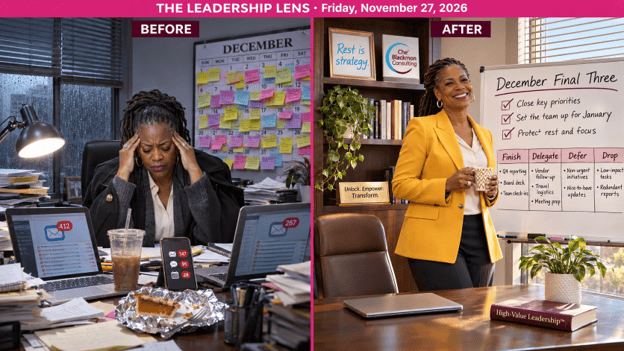
Here is the truth I want you to sit with this morning. Rest is not the opposite of performance. Strategic rest is how high performers get ready for the stretch that matters most. December is a sprint: budgets close, goals get judged, teams get tired, and holidays stack on top of deadlines. The leaders who finish strong are rarely the ones who never stopped. They are the ones who stopped on purpose.
🛍️ The Deal Most Leaders Pass Up
Black Friday is built on one idea: something valuable is available right now, for a limited time, at a price you will not see again.
That is exactly what this day offers a leader. The value is clarity. The window is short. And the price is simply a decision to step back long enough to see the whole field before the final quarter of the game.
Most leaders skip it for three reasons:
- Rest feels like falling behind. When the to do list is long, stopping feels irresponsible, even when stopping is what would make the list manageable.
- Busy has become a badge. Many cultures still quietly reward the person who answers at 10 p.m. and works through the holiday weekend.
- Nobody taught us how to rest with intention. We know how to collapse. Few of us know how to recover in a way that sets up the next season.
Strategic rest is different from simply taking a day off. It has a purpose, a structure, and a payoff. It is rest that leaves you clearer, not just less tired.
📱 The Workday That Never Clocks Out
If you feel like work follows you everywhere, the data says you are not imagining it.
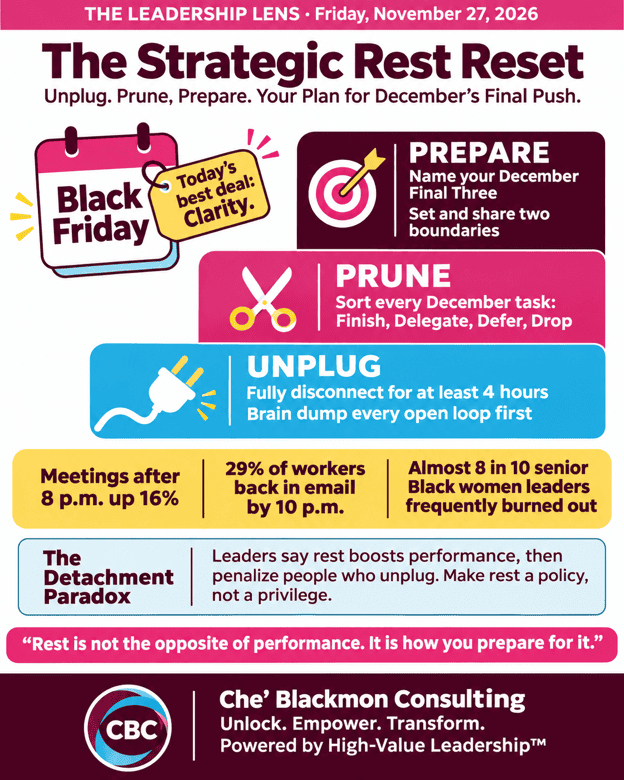
Microsoft’s 2025 Work Trend Index special report analyzed anonymized activity across Microsoft 365 and surveyed 31,000 knowledge workers in 31 markets. It describes an “infinite workday.” Of the people online at 6 a.m., 40 percent are already reviewing email to plan their day. Meetings after 8 p.m. are up 16 percent from the year before. By 10 p.m., 29 percent of active workers are back in their inboxes. The typical worker is interrupted by a meeting, an email, or a message roughly every two minutes during core hours, and nearly half of employees (48 percent) and more than half of leaders (52 percent) say work feels chaotic and fragmented (Microsoft, 2025).
Read those numbers as a leader, not just as a worker. Every late meeting you schedule, every 10 p.m. message you send, and every weekend email you answer sets the standard for your team. Your calendar is a culture document. People read it more closely than your values statement.
And December makes it worse. Year end pushes the workday wider just as personal obligations multiply. Without a reset, you enter the final push already running on reserve.
⚖️ The Detachment Paradox: We Say Rest Matters, Then We Punish It
Here is the contrarian part. Most organizations do not have a rest problem because leaders think rest is useless. They have a rest problem because leaders believe in rest and then quietly penalize the people who take it.
A 2025 article in Organizational Behavior and Human Decision Processes reported 16 studies on how managers view psychological detachment, meaning the ability to mentally switch off from work during personal time. Managers recognized that detachment improves well being and even boosts performance during working hours. Yet when evaluating who was promotable, they penalized employees they saw as detaching. The penalty shrank when detachment was framed as a way to come back stronger for the work, and early evidence suggested that formal policies, such as no email over weekends, may reduce the penalty (Buechel & Solinas, 2025).
That finding should stop every executive in their tracks. If your people believe that unplugging will cost them a promotion, no wellness webinar will change their behavior. The message they hear is the one your evaluations send.
This is where High-Value Leadership™ asks more of us. Purposeful culture is not what we say we value. It is what we reward, what we model, and what we protect. If rest is strategic for you, it has to be safe for your team.
💜 Who Pays the Highest Price
Exhaustion is not distributed evenly.
The Women in the Workplace 2025 report from McKinsey & Company and LeanIn.Org, based on 124 organizations and survey responses from roughly 9,500 employees, found that senior level women are experiencing higher burnout than ever. The finding for Black women is the one I cannot stop thinking about: almost 8 in 10 senior level Black women reported being frequently burned out in the past year, and even more were worried about their job security (Krivkovich et al., 2025).
Put that next to the detachment paradox. Black women leaders are often expected to outperform, overprepare, and be endlessly available, partly because the margin for error has never felt as wide for us. When rest is quietly penalized, the people with the least margin feel the penalty first and feel it hardest.
So if you lead Black women, or if you are one, hear this clearly: your rest is not a reward for finishing. It is part of how you finish. And if you are an executive, making strategic rest safe is not a perk. It is a retention strategy for some of the most talented, most stretched leaders in your organization.
🧭 The Strategic Rest Reset: Unplug, Prune, Prepare
Strategic rest has three moves. You can do all three between today and Monday morning. None of them require a retreat, a spa, or a week off. They require intention.
🔌 Move 1: Unplug (Today)
The first move is a real unplug, not a half break with your phone face up on the table.
Choose a window today, even if it is only four hours, and fully disconnect. Turn off notifications. Put an out of office message on your email, even for one day. Psychological detachment works because it gives your mind a break from the constant loop of open tasks.
Before you disconnect, take ten minutes for a brain dump. Write down every open loop that is rattling around in your head: the unanswered email, the difficult conversation, the budget question. Getting it on paper tells your brain it is safe to stop holding it.
Try this: Set an out of office message that reads, “I am offline today to rest and prepare for a strong December. I will respond on Monday.”
✂️ Move 2: Prune (This Weekend)
December rarely fails because leaders do too little. It fails because they try to do everything.
Sometime this weekend, after you have rested, look at your brain dump and your December calendar together. Sort every commitment into one of four groups: finish, delegate, defer to January, or drop. Be honest. Some of what is on your list made sense in September and no longer matters now.
Pruning is a leadership act. When you cut low value work, you give your team permission to cut it too. That is how you protect energy for the work that actually moves the year forward.
Try this: For every item you keep, ask one question: “If this does not happen by December 31, what is the real consequence?” If the answer is “not much,” move it.
🎯 Move 3: Prepare (Sunday Evening or Monday Morning)
Now set up the final push on purpose. Choose your December Final Three: the three outcomes that would make you proud of how this year ended. Write them down. Share them with your team on Monday.
Then protect them. Block focus time on your calendar for each one. Decide your own boundaries for December, such as no meetings after 5 p.m. and no email on Sundays, and say them out loud so your team knows the standard. When the leader names the boundary, the team gets permission to keep it.
Try this: Open Monday’s team meeting with, “Here are my Final Three for December, here is what I moved off the list, and here is one thing I am asking each of you to stop doing.”
🏢 Make Rest a Policy, Not a Privilege
Individual rest is powerful. Organizational rest is transformational.
Remember the research: formal policies appear to reduce the penalty people feel for unplugging (Buechel & Solinas, 2025). That means leaders have a real lever. You do not have to rely on people being brave enough to rest. You can make it normal.
- Name protected time. Make the Friday after Thanksgiving, or another December day, a true no meeting, no expectation day for your team.
- Set December norms in writing. For example: no meetings after a set hour, delayed send for after hours email, and no expectation of weekend replies.
- Separate rest from evaluation. Tell managers directly that using time off and respecting boundaries will never count against anyone’s promotability, and then check that it does not.
- Model it visibly. Take your own time off and talk about it. Your team will follow your calendar, not your memo.
📊 Case in Point: The Plant That Stopped Sprinting Into December
The following is a composite scenario drawn from patterns common across manufacturing, healthcare, and professional services environments. The figures are illustrative.
🏭 The Challenge
Consider a multi site manufacturing company whose leadership team dreaded December every year. Production targets, year end audits, budget planning, and holiday staffing all landed in the same four weeks. Leaders worked through the Thanksgiving weekend as a matter of habit, and supervisors followed their example.
The cost showed up every January. The prior year, the team had committed to five year end priorities and finished one. Quality defects rose in December. A pulse survey found that only 41 percent of supervisors agreed with the statement, “I can disconnect from work during my time off without worrying about how it will look.” Two experienced supervisors resigned in the first week of January, both citing exhaustion.
The person who named the pattern was the company’s HR director, a Black woman who realized she was one of the people sending messages at 10 p.m. She saw that her own example was part of the problem, and she brought a proposal to the executive team.
🔧 The Intervention
The team rebuilt its year end approach around the Strategic Rest Reset and the High-Value Leadership™ principle that culture is shaped by what leaders model and reward.
- A protected reset day. The Friday after Thanksgiving became a company wide no meeting, no email day for salaried leaders, with coverage plans for the plants. Executives went offline first and said so.
- A pruning session. On the Monday after Thanksgiving, each leader brought a list of December commitments and sorted them into finish, delegate, defer, or drop.
- The December Final Three. Each department named three year end outcomes, posted them where the team could see them, and blocked focus time to protect them.
- Written December norms. No meetings after 5 p.m., delayed send for after hours email, and a clear statement from the executive team that respecting boundaries would never count against promotability.
📈 The Results
The leadership team cut 11 of its 26 planned December initiatives, either deferring them to January or dropping them altogether. After hours messages among leaders fell by about 38 percent from the prior December. Every department delivered all three of its Final Three priorities, compared with one of five company priorities the year before. December quality defects dropped by roughly 20 percent.
By the next pulse survey in January, the share of supervisors who said they could disconnect without worry rose from 41 percent to 68 percent. Supervisor resignations in the first quarter fell from six the year before to two.
The lesson is simple. The team did not work less because they cared less. They worked on less because they finally chose what mattered. That is High-Value Leadership™ in practice: purpose first, energy protected, and a culture where rest makes people stronger rather than less promotable.
🧠 Current Trends and Best Practices
- Right to disconnect conversations are growing. More organizations and some governments are setting expectations about after hours contact. Leaders who act early shape the culture instead of reacting to it.
- Recovery is becoming a performance metric. Forward thinking companies track not only output but sustainability, including after hours activity, time off usage, and burnout signals in pulse surveys.
- AI is a chance to reclaim time, if leaders let it. Automating routine work only helps if the time saved goes to focus and recovery, not to more meetings.
- Quiet periods are a strategic asset. Holiday lulls are ideal moments for reflection, planning, and pruning. Treat them as an investment, not a gap.
- Equity lens on rest. The leaders most likely to be burned out are often the least likely to feel safe resting. Inclusive cultures make rest visible, normal, and safe for everyone.
✅ Actionable Takeaways You Can Use This Week
- Unplug for real today. Choose a window of at least four hours and fully disconnect, notifications off and out of office on.
- Do a ten minute brain dump. Write every open loop on paper before you rest so your mind can let go of it.
- Prune your December. Sort every commitment into finish, delegate, defer, or drop.
- Name your Final Three. Choose the three outcomes that would make you proud of how this year ends.
- Set and share your December boundaries. Pick two, such as no meetings after 5 p.m. and no Sunday email, and announce them on Monday.
- Check your evaluation habits. Before year end reviews, ask yourself whether you have ever quietly counted someone’s boundaries against them.
💬 Discussion Questions
- What does your calendar from the last month teach your team about rest and availability?
- Where in your organization might people believe that unplugging will cost them a promotion, and how do you know?
- Which December commitments are you holding onto out of habit rather than real value?
- How could your team make strategic rest safe for the leaders who carry the most and have the least margin, including Black women leaders?
🚀 Next Steps for Readers
- Share this article with a leader who is already dreading December and needs permission to reset.
- Read High-Value Leadership: Transforming Organizations Through Purposeful Culture to build a culture where what you model, reward, and protect lines up with what you say you value.
- Join the High-Value Leadership Intensive waitlist to lead into 2027 with clarity, purpose, and energy alongside other purpose driven leaders.
- Subscribe to The Blackmon Brief on Substack for culture and leadership insights every Monday, Wednesday, and Friday.
📚 References
Buechel, E. C., & Solinas, E. (2025). The detachment paradox: Employers recognize the benefits of detachment for employee well-being and performance, yet penalize it in employee evaluations. Organizational Behavior and Human Decision Processes, 188, Article 104403. https://doi.org/10.1016/j.obhdp.2025.104403
Krivkovich, A., Goldstein, D., & McConnell, M. (2025, December 9). Women in the workplace 2025. McKinsey & Company; LeanIn.Org. https://www.mckinsey.com/featured-insights/diversity-and-inclusion/women-in-the-workplace
Microsoft. (2025, June 17). Breaking down the infinite workday [Work Trend Index special report]. https://www.microsoft.com/en-us/worklab/work-trend-index/breaking-down-infinite-workday
🤝 Finish the Year Strong, Without Running on Empty
December does not have to be a test of endurance. Whether you are an executive leading through year end pressure, an HR leader trying to protect a tired team, or a leader who has carried everyone else all year, Che’ Blackmon Consulting helps you build a culture where performance and well being strengthen each other. Let’s make your final push your strongest one.
📧 admin@cheblackmon.com | 📞 888.369.7243 | 🌐 cheblackmon.com
Unlock. Empower. Transform.
🔍 The Leadership Lens Challenge
Before you open your inbox again, ask yourself one question: If my team copied exactly how I rested this weekend, would they be ready for December, or just more tired?
#BlackFridayLeadership #StrategicRest #LeadershipDevelopment #BurnoutPrevention #HighValueLeadership #WorkplaceCulture #YearEndPlanning #ExecutiveLeadership #BlackWomenInLeadership #WomenInLeadership #RightToDisconnect #CheBlackmonConsulting