🌍 Cross-Cultural Competence: Leading in a Global Workplace 🌐

By Che’ Blackmon, DBA Candidate | Founder & CEO, Che’ Blackmon Consulting

✨ Introduction: The New Reality of Leadership

The workplace has changed. Today’s leaders navigate teams that span continents, cultures, and communication styles. Whether your organization operates across international borders or serves a diverse local community, cross-cultural competence has become essential for effective leadership. This is not merely about being polite or politically correct. It is about building the kind of purposeful culture that drives results.

As I discuss in High-Value Leadership: Transforming Organizations Through Purposeful Culture, leaders who understand the intersection of culture and performance create environments where every team member can contribute their best work. Cross-cultural competence amplifies this principle by ensuring that cultural differences become sources of strength rather than barriers to success.
🔍 Understanding Cross-Cultural Competence

Cross-cultural competence refers to the ability to understand, communicate with, and effectively interact with people across cultures. It involves awareness of your own cultural worldview, knowledge of different cultural practices and worldviews, and the skills to bridge differences respectfully and productively.

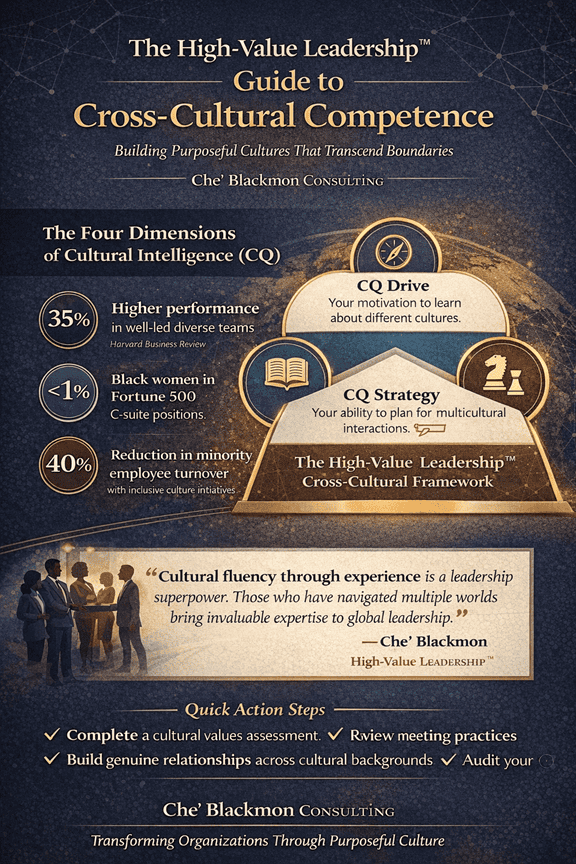
Research from the Harvard Business Review indicates that culturally diverse teams outperform homogeneous ones by up to 35% when led effectively. However, the same research shows that poorly managed diverse teams underperform significantly. The difference lies in leadership competence.

The Four Dimensions of Cultural Intelligence

Dr. Soon Ang and Dr. Linn Van Dyne’s research on Cultural Intelligence (CQ) identifies four key capabilities. First, CQ Drive represents your motivation and interest in learning about different cultures. Second, CQ Knowledge encompasses your understanding of cultural similarities and differences. Third, CQ Strategy involves your ability to plan for multicultural interactions. Fourth, CQ Action reflects your capability to adapt behavior appropriately in different cultural contexts.

👩🏾‍💼 The Overlooked Perspective: Black Women in Global Leadership

Discussions about cross-cultural competence often focus on national cultures while overlooking the unique experiences of those who navigate multiple cultural identities daily. Black women in corporate spaces, for instance, bring invaluable perspectives to global leadership conversations.

In Rise & Thrive: A Black Woman’s Blueprint for Leadership Excellence, I explore how Black women have historically developed sophisticated cultural navigation skills out of necessity. These skills, including code-switching, reading organizational dynamics, and building coalitions across differences, translate directly into cross-cultural leadership capabilities.

McKinsey’s research on diversity in leadership consistently shows that companies with diverse leadership teams, including representation of Black women at senior levels, demonstrate stronger financial performance and innovation. Yet Black women remain severely underrepresented in global leadership roles, holding less than 1% of C-suite positions in Fortune 500 companies.

Leveraging Lived Experience as Leadership Capital

Leaders from traditionally overlooked backgrounds often possess what I call “cultural fluency through experience.” Having navigated predominantly white corporate spaces while maintaining connections to their communities of origin, these leaders develop nuanced abilities to bridge cultural gaps, recognize unspoken dynamics, and create inclusive environments.

Organizations seeking to build cross-cultural competence should recognize and leverage this expertise rather than expecting assimilation. When Black women and other underrepresented leaders are empowered to lead authentically, they model the kind of cultural bridge-building that global organizations require.

📊 Case Studies: Cross-Cultural Leadership in Action

Case Study 1: Manufacturing Meets Global Markets

Consider a mid-sized automotive supplier that expanded operations to include facilities in Mexico and partnerships in Germany. Initially, the company experienced significant friction. American managers interpreted Mexican colleagues’ relationship-building communication style as inefficient. German partners found American directness abrasive.

The turning point came when leadership invested in cross-cultural training and, critically, elevated leaders from each location into strategic decision-making roles. By creating space for different communication styles and decision-making approaches, the company reduced conflict, improved supplier relationships, and increased production efficiency by 22% within 18 months.

Case Study 2: Healthcare System Transformation

A regional healthcare system serving a rapidly diversifying patient population struggled with patient satisfaction scores and staff turnover. Exit interviews revealed that employees from minority backgrounds felt their cultural insights were dismissed, while patients reported feeling misunderstood by care providers.

The organization implemented a comprehensive culture transformation initiative. This included elevating diverse voices into leadership councils, creating cultural liaison positions, and revising hiring practices to value cultural competence alongside clinical skills. Within two years, patient satisfaction scores increased by 15%, and staff turnover among minority employees dropped by 40%.

🛠️ Building Your Cross-Cultural Competence: Practical Strategies

In Mastering a High-Value Company Culture, I outline principles for creating organizational cultures that bring out the best in people. These principles apply directly to cross-cultural leadership.

Strategy 1: Develop Cultural Self-Awareness

Before you can effectively lead across cultures, you must understand your own cultural programming. Examine your assumptions about time, hierarchy, communication, and conflict. Consider how your background shapes what you consider “professional” or “appropriate.” Many workplace norms that seem universal are actually culturally specific.

Action Step: Complete a cultural values assessment such as the Intercultural Development Inventory or CQ Assessment. Reflect on three situations where your cultural assumptions may have influenced your leadership decisions.

Strategy 2: Practice Active Cultural Learning

Cross-cultural competence requires ongoing education. Study the cultural backgrounds of your team members and stakeholders. Learn about communication styles, decision-making preferences, and values that may differ from your own. Approach this learning with humility and genuine curiosity rather than treating it as a checklist exercise.

Action Step: Identify one cultural group you work with regularly but know little about. Commit to learning about their cultural context through reading, conversation, and observation. Seek out content created by members of that community rather than outside observers.

Strategy 3: Create Inclusive Communication Practices

Effective cross-cultural leaders adapt their communication styles while creating space for diverse communication preferences. This means being explicit about expectations rather than assuming shared understanding, allowing multiple channels for input, and recognizing that silence may indicate disagreement or contemplation depending on cultural context.

Action Step: Review your team meeting practices. Do they favor those comfortable with verbal debate? Add written input options, structured reflection time, and alternative ways for team members to contribute ideas.

Strategy 4: Build Diverse Leadership Pipelines

Organizations cannot develop cross-cultural competence through training alone. They must ensure that leadership teams reflect the diversity of their workforce, customer base, and global reach. This requires intentional efforts to identify, develop, and promote leaders from underrepresented backgrounds, including Black women and other traditionally overlooked groups.

Action Step: Audit your organization’s leadership pipeline. Where are the gaps in representation? What barriers exist for advancement? Create specific initiatives to address these gaps with accountability measures and timelines.

📈 Current Trends and Best Practices

The landscape of cross-cultural leadership continues to evolve. Several trends are shaping best practices in this field.

Remote Work and Virtual Teams. The shift to remote and hybrid work has intensified the need for cross-cultural competence. Leaders now manage teams they may never meet in person, across multiple time zones and cultural contexts. Research from GitLab and Buffer indicates that successful remote teams prioritize explicit communication, documentation, and asynchronous work practices that accommodate different working styles and schedules.

Intersectionality in Leadership Development. Progressive organizations recognize that cultural identity is multifaceted. Effective cross-cultural development programs address intersectionality, understanding that a Black woman executive, a first-generation college graduate manager, or an LGBTQ+ team leader from a conservative region each bring unique perspectives and face distinct challenges.

Data-Driven Culture Assessment. Leading organizations use analytics to measure cultural competence and inclusion. This includes tracking promotion rates across demographic groups, analyzing engagement survey results by cultural background, and monitoring retention patterns. Data provides accountability and helps identify systemic barriers that individual good intentions cannot overcome.

Psychological Safety as Foundation. Research by Dr. Amy Edmondson and others demonstrates that psychological safety, the belief that one can speak up without punishment or humiliation, is essential for cross-cultural teams to thrive. Creating environments where team members can bring their authentic cultural selves without fear enables the innovation and collaboration that diverse teams promise.

💡 Actionable Takeaways

To strengthen your cross-cultural leadership competence, focus on these key actions:

1. Commit to Self-Examination. Regularly assess your own cultural biases and assumptions. Seek feedback from colleagues with different backgrounds about how your leadership style lands across cultures.

2. Invest in Relationships. Build genuine connections with team members from different cultural backgrounds. Move beyond surface-level interactions to understand their perspectives, values, and experiences.

3. Amplify Overlooked Voices. Actively create space for Black women, people of color, and other traditionally marginalized groups to contribute and lead. Recognize that their cultural navigation expertise is an organizational asset.

4. Adapt Your Leadership Style. Develop flexibility in how you communicate, make decisions, and provide feedback. What works in one cultural context may not work in another.

5. Make Systemic Changes. Individual competence matters, but sustainable change requires systemic attention to policies, practices, and structures that may inadvertently disadvantage certain cultural groups.

6. Measure and Adjust. Track outcomes related to cultural competence and inclusion. Use data to identify what is working and what needs adjustment.

🎯 Conclusion: Leadership That Transcends Boundaries

Cross-cultural competence is not an optional skill for today’s leaders. It is fundamental to building the high-value organizational cultures that drive sustainable success. When leaders embrace cultural differences as opportunities rather than obstacles, they unlock innovation, engagement, and performance that homogeneous thinking cannot achieve.

For those who have been traditionally overlooked in leadership conversations, particularly Black women navigating corporate spaces, know that your cultural fluency is a superpower. Your experience bridging worlds, adapting to different contexts, and bringing your full self despite resistance positions you uniquely for the global leadership challenges ahead.

The path forward requires both individual growth and organizational transformation. As I emphasize throughout my work, purposeful culture does not happen by accident. It requires intentional leadership, consistent action, and unwavering commitment to bringing out the best in every person, regardless of their cultural background.

❓ Discussion Questions for Reflection

1. What cultural assumptions have you brought into leadership situations that you later recognized were not universal? How did this recognition change your approach?

2. How does your organization currently leverage the cultural expertise of Black women and other traditionally overlooked leaders? What opportunities exist to do this more effectively?

3. Think about a cross-cultural conflict or misunderstanding you have witnessed. What cultural factors may have contributed to the disconnect? How might a culturally competent leader have approached the situation differently?

4. What barriers exist in your organization that may prevent culturally diverse leaders from advancing into senior positions? What specific steps could address these barriers?

5. How can you personally commit to growing your cross-cultural competence over the next six months? What specific learning activities and relationship-building efforts will you pursue?

🚀 Your Next Steps

Building cross-cultural competence is a journey, not a destination. Start where you are, commit to growth, and take consistent action. Whether you are an emerging leader seeking to develop your capabilities or an executive aiming to transform your organizational culture, the time to begin is now.

Consider exploring additional resources such as Mastering a High-Value Company Culture and High-Value Leadership: Transforming Organizations Through Purposeful Culture for deeper insights into building cultures where all people thrive. For Black women and other leaders from traditionally overlooked backgrounds, Rise & Thrive: A Black Woman’s Blueprint for Leadership Excellence offers specific guidance for navigating corporate spaces while leading authentically.

🤝 Partner with Che’ Blackmon Consulting

Ready to transform your organization’s culture and develop cross-cultural leadership capabilities? Che’ Blackmon Consulting offers fractional HR leadership, culture transformation consulting, and executive coaching designed to create workplaces where every person can contribute their best work.

📧 Email: admin@cheblackmon.com

📞 Phone: 888.369.7243

🌐 Website: cheblackmon.com

Let’s build purposeful cultures together. ✨

#HighValueLeadership #CrossCulturalCompetence #GlobalLeadership #DiversityAndInclusion #CultureTransformation #BlackWomenInLeadership #LeadershipDevelopment #WorkplaceCulture #InclusiveLeadership #HRLeadership #OrganizationalCulture #ExecutiveLeadership #CulturalIntelligence #PurposefulCulture #WomenInLeadership


💝 Building Beloved Brands: Culture as Your Greatest Marketing Tool 💝

By Che’ Blackmon, DBA Candidate | Founder & CEO, Che’ Blackmon Consulting

Every year, companies spend billions on advertising, influencer partnerships, and marketing campaigns designed to make customers love them. They craft perfect taglines, produce stunning visuals, and purchase premium placements. Yet despite all this investment, many brands remain forgettable. Consumers scroll past their ads, ignore their emails, and feel nothing when they see their logos.

Meanwhile, other organizations spend far less on traditional marketing yet inspire fierce loyalty. Customers become advocates. Employees become ambassadors. Communities form around these brands, defending them during crises and celebrating their wins as personal victories. These are beloved brands.

What separates the beloved from the forgettable? It is not a bigger marketing budget or a cleverer campaign. It is culture. The most beloved brands in the world are built from the inside out, with organizational cultures so strong and authentic that they radiate outward, attracting customers, talent, and partners who share their values.

Culture is not just an HR initiative. It is your greatest marketing tool.

🔍 The Inside Out Revolution

Traditional marketing operates outside in. It identifies what customers want to hear, then crafts messages designed to appeal to those desires. The product or service may or may not match the promise. The internal culture may or may not reflect the external image. The gap between what is advertised and what is experienced creates cynicism, and modern consumers have developed finely tuned detectors for inauthenticity.

Beloved brands flip this model. They build cultures around genuine values, treat employees in ways that reflect those values, create products and services that embody those values, and then let that authenticity speak for itself. The marketing is not separate from the culture. The culture IS the marketing.

As I explore in High-Value Leadership: Transforming Organizations Through Purposeful Culture, organizations with purposeful cultures do not need to convince anyone of their values. They demonstrate them daily through thousands of interactions, decisions, and moments of truth. This consistency creates trust, and trust creates love.

📊 The Data Behind Beloved Brands

The business case for culture-driven branding is overwhelming. Research from Deloitte found that mission-driven companies have 30% higher levels of innovation and 40% higher levels of retention compared to their competitors. Glassdoor studies show that companies with strong cultures outperform the S&P 500 by 122%.

Edelman’s Trust Barometer consistently reveals that consumers make purchasing decisions based on trust in an organization’s values, with 81% saying they must be able to trust the brand to do what is right. This trust cannot be manufactured through advertising. It must be earned through consistent, values-aligned behavior.

Perhaps most compelling, research from Harvard Business School found that customers who are emotionally connected to a brand have a 306% higher lifetime value than satisfied customers. They stay longer, spend more, and actively recruit others to the brand. This emotional connection is not created by clever marketing. It is created by genuine experiences that reflect genuine culture.

🏢 Anatomy of a Beloved Brand

What does a culture-driven beloved brand actually look like in practice? Several elements consistently appear:

Clear, Lived Values 🎯

Beloved brands have values that are more than wall decorations. These values guide real decisions, including difficult ones. When there is tension between values and short-term profit, values win. Employees can articulate the values without checking a poster because they see them in action daily.

Employee Experience Mirrors Customer Experience ✨

Organizations cannot sustainably treat customers better than they treat employees. Eventually, the internal reality leaks into external interactions. Beloved brands ensure that the care, respect, and value they want customers to feel is first experienced by the people who serve those customers.

Stories Over Slogans 📖

Beloved brands are rich in authentic stories: the employee who went above and beyond, the customer whose life was changed, the decision that sacrificed profit for principle. These stories circulate organically because they are true and because they resonate with shared values. No advertising agency can create stories as powerful as genuine cultural moments.

Transparency in Imperfection 💎

Beloved brands do not pretend to be perfect. They acknowledge mistakes, share challenges openly, and invite stakeholders into their journey of improvement. This vulnerability creates deeper connection than any polished facade could achieve. Customers and employees alike prefer authentic imperfection to manufactured perfection.

Community Cultivation 🌱

Beloved brands see themselves as hosts of communities rather than vendors of products. They create spaces, whether physical or virtual, where people with shared values can connect. They facilitate relationships between customers, not just between company and customer. This community becomes self-sustaining, generating word of mouth that no marketing spend could purchase.

💫 Culture, Brand, and the Overlooked Leader

For Black women and other traditionally overlooked leaders in corporate spaces, the relationship between culture and brand carries particular significance.

Authenticity, which is the cornerstone of beloved brands, has often been dangerous territory for Black women at work. The pressure to code switch, to present a version of oneself deemed acceptable to majority culture, creates an internal tension between authentic expression and professional survival. When organizations demand inauthenticity from their people, that inauthenticity inevitably seeps into the brand.

Conversely, organizations that create cultures where all employees can show up authentically unlock tremendous brand potential. The unique perspectives, communication styles, and cultural competencies that diverse leaders bring become sources of differentiation and connection with increasingly diverse customer bases.

In Rise & Thrive: A Black Woman’s Blueprint for Leadership Excellence, I explore how Black women leaders can advocate for cultures that allow authentic contribution while strategically positioning themselves as culture shapers. When Black women are empowered to lead authentically, they often create the very cultures that build beloved brands, bringing community orientation, relational intelligence, and values-driven leadership that resonates with modern consumers.

Research from McKinsey consistently shows that companies with diverse leadership teams are more likely to outperform their peers. Part of this advantage comes from the cultural richness that diverse leaders create, cultures that feel welcoming to diverse customers and that generate innovation through varied perspectives.

📱 Culture in the Age of Radical Transparency

Several trends have made culture-driven branding more important than ever:

Social Media Amplification 📣

Every employee is now a potential brand ambassador or brand critic with a platform. A single viral post about workplace culture, positive or negative, can reach millions. Organizations can no longer hide internal realities behind external marketing. The gap between advertised values and lived values is exposed within hours.

Review Culture 🌟

Platforms like Glassdoor, Indeed, and Google Reviews mean that internal culture is visible to anyone with a smartphone. Job candidates research employer brands before applying. Customers read employee reviews before purchasing. Culture is no longer private. It is part of the public brand whether organizations like it or not.

Values-Driven Consumers 💚

Younger generations in particular make purchasing decisions based on perceived company values around sustainability, diversity, equity, community involvement, and ethical practices. They research before buying and share their findings widely. Companies with genuine values-aligned cultures have stories to tell. Companies with manufactured values have only marketing copy.

The Great Resignation’s Legacy 🚪

The workforce disruptions of recent years laid bare the importance of culture for retention and recruitment. Organizations known for toxic cultures struggled to hire even at premium wages, while those with positive cultures maintained stability. The competition for talent has made culture a visible differentiator that directly affects operational capacity.

🛠️ Building Your Beloved Brand from the Inside Out

1. Audit Your Culture-Brand Gap 🔎

Start by honestly assessing the distance between how your organization presents itself externally and how it operates internally. Survey employees about whether marketing messages reflect their experience. Review customer complaints for patterns that suggest systemic cultural issues. Read your Glassdoor reviews as if you were a prospective customer.

Action Step: Gather your leadership team and compare your external brand promises to internal employee experience data. Identify three specific gaps where the external message does not match internal reality.

2. Define Values That Matter 💎

Generic values like “integrity” and “excellence” mean nothing because they differentiate no one. Beloved brands have specific, sometimes even provocative values that reflect genuine beliefs. These values should help you say no to opportunities that do not align, even profitable ones. In Mastering a High-Value Company Culture, I outline processes for identifying values that are authentic, distinctive, and actionable.

Action Step: Test your values by identifying three decisions in the past year that were made specifically because of values, even when other options might have been more profitable or convenient. If you cannot identify such decisions, your values may not be operational.

3. Align Employee Experience First 👥

Before investing in external brand campaigns, ensure employees experience what you want customers to experience. If you want customers to feel valued, employees must feel valued first. If you want customers to trust you, employees must trust leadership first. The internal experience inevitably becomes the external experience.

There was a hospitality company struggling with customer satisfaction despite heavy marketing investment. Analysis revealed that frontline employees felt unsupported and disrespected. They could not create welcoming experiences for guests because they themselves did not feel welcomed. By redirecting resources from marketing to employee experience improvements, including better scheduling, manager training, and recognition programs, the company saw customer satisfaction rise naturally as employees became genuine ambassadors.

Action Step: For each promise you make to customers, assess whether employees experience that same promise internally. Create a plan to close any gaps.

4. Collect and Amplify Authentic Stories 📚

Every organization has stories that reveal its true culture. The question is whether anyone is capturing and sharing them. Create systems for collecting stories from employees, customers, and community members. Look for moments when values were demonstrated in action. These authentic stories become your most powerful marketing content.

Action Step: Implement a monthly ritual where teams share stories of values in action. Celebrate these stories publicly and save them for future use in recruitment, marketing, and culture reinforcement.

5. Turn Employees into Brand Ambassadors 🌟

Employees who genuinely love where they work become powerful, credible advocates for the brand. This cannot be forced or manufactured. It happens naturally when employees feel valued, aligned with organizational purpose, and proud of how the organization operates. The goal is not to train employees to say nice things but to create conditions where nice things are genuinely true.

Action Step: Survey employees about their willingness to recommend the organization to friends and family, both as an employer and as a provider of products or services. Use the results as a leading indicator of brand health.

6. Build Community, Not Just Customer Base 🤝

Beloved brands create opportunities for customers to connect with each other around shared values and interests. This might be through events, online forums, user groups, or collaborative initiatives. When customers form relationships through your brand, their loyalty becomes about community belonging, not just product satisfaction.

Action Step: Identify one initiative that could bring customers together around shared values rather than just shared product use. Pilot this community-building effort and measure engagement beyond traditional marketing metrics.

📈 Measuring Culture-Driven Brand Success

Traditional marketing metrics do not fully capture the value of culture-driven branding. Consider adding these measurements:

Employee Net Promoter Score (eNPS): How likely are employees to recommend your organization as a place to work? This predicts future brand advocacy.

Culture-Brand Alignment Index: Survey both employees and customers about organizational values. Measure the consistency between internal and external perceptions.

Organic Advocacy Rate: Track unprompted positive mentions on social media, review sites, and in customer feedback. This indicates genuine brand love versus manufactured buzz.

Referral Source Analysis: Monitor how many new customers and employees come through referrals versus paid acquisition. High referral rates suggest culture is creating advocacy.

🏆 The Sustainable Advantage

In a world where products can be copied, prices can be undercut, and advertising can be outspent, culture remains the one sustainable competitive advantage. It cannot be purchased, replicated overnight, or faked for long. A genuine culture that creates a beloved brand is built over years through consistent, values-aligned decisions and authentic human connection.

This is both the challenge and the opportunity. Organizations willing to do the hard, slow work of culture building create advantages that compound over time. Every positive employee experience strengthens the culture. Every authentic customer interaction reinforces the brand. Every values-aligned decision adds to the reservoir of trust.

The organizations that will thrive in the coming decades are those that understand this fundamental truth: the best marketing does not happen in the marketing department. It happens everywhere, every day, in every interaction between your people and your stakeholders. Culture is your greatest marketing tool. Is yours working for you or against you?

💬 Discussion Questions

1. How large is the gap between your organization’s external brand message and internal cultural reality? What evidence supports your assessment?

2. Can you identify three authentic stories from your organization that reveal its true values in action? How are these stories currently being shared or not shared?

3. For traditionally overlooked leaders: How does your organization’s culture support or hinder your ability to contribute authentically? How might greater authenticity strengthen the brand?

4. If every employee at your organization posted honestly about their work experience on social media, how would it affect your brand? What does this tell you about culture-brand alignment?

5. What would need to change in your organization for employees to become genuine, enthusiastic brand ambassadors without being asked?

🚀 Your Next Steps

Building a beloved brand is not a project with a finish line. It is an ongoing commitment to culture that radiates outward. Start where you are with what you have. Choose one strategy from this article and implement it this month. Measure both cultural indicators and brand indicators to track progress.

Engage your team in the conversation. Share this article and discuss which elements resonate with your current reality and aspirations. Culture change happens through many small conversations and decisions, not through mandates from above.

Remember that culture-driven branding requires patience. The results compound over time as trust builds, stories accumulate, and reputation solidifies. The organizations that stay committed to this approach create advantages that become increasingly difficult for competitors to overcome.

✨ Ready to Build a Beloved Brand from the Inside Out?

If you are ready to transform your organizational culture into your most powerful marketing asset, Che’ Blackmon Consulting is here to guide the journey. We specialize in culture transformation, leadership development, and helping organizations discover that their greatest competitive advantage lies in how they treat their people.

📧 Email: admin@cheblackmon.com

📞 Phone: 888.369.7243

🌐 Website: cheblackmon.com

Let’s unlock your potential, empower your leadership, and transform your impact together.

📖 About the Author

Che’ Blackmon is the Founder and CEO of Che’ Blackmon Consulting, a Michigan-based fractional HR and culture transformation consultancy. With over 24 years of progressive HR leadership experience across manufacturing, automotive, healthcare, and other sectors, Che’ brings deep expertise in building organizational cultures that become competitive advantages. She is currently pursuing her Doctor of Business Administration (DBA) in Organizational Leadership with research focused on AI-enhanced organizational transformation. Che’ is the author of High-Value Leadership: Transforming Organizations Through Purposeful Culture, Mastering a High-Value Company Culture, and Rise & Thrive: A Black Woman’s Blueprint for Leadership Excellence. She hosts the “Unlock, Empower, Transform” podcast and the “Rise & Thrive” YouTube series.

#Leadership #BrandBuilding #CompanyCulture #HighValueLeadership #EmployerBranding #WorkplaceCulture #BrandStrategy #CultureTransformation #EmployeeExperience #CustomerExperience #MarketingStrategy #BelovedBrands #OrganizationalCulture #LeadershipDevelopment #BrandLoyalty

🤝 The Connection Economy: Why Relationships Drive Results 🤝

By Che’ Blackmon, DBA Candidate | Founder & CEO, Che’ Blackmon Consulting

We have entered a new era of business. The old economy rewarded those who hoarded information, guarded resources, and climbed over others to reach the top. But that economy is fading. In its place, something far more powerful has emerged: the connection economy.

In this new landscape, relationships are currency. Trust is capital. And the leaders who invest in genuine human connection are the ones generating extraordinary results.

This is not soft leadership. This is smart leadership. Research consistently shows that organizations with strong relational cultures outperform their competitors in every measurable way. They attract better talent. They retain employees longer. They innovate faster. They weather crises more effectively. The data is clear: connection drives results.

🌐 What Is the Connection Economy?

The term “connection economy” describes a fundamental shift in how value is created and exchanged in the modern workplace. Unlike the industrial economy that valued efficiency above all else, or the knowledge economy that prioritized information, the connection economy recognizes that sustainable success flows through relationships.

Seth Godin, who popularized this concept, argues that in an age of automation and artificial intelligence, human connection has become the most valuable and irreplaceable commodity. Machines can process data. Algorithms can optimize operations. But only humans can build the trust, empathy, and collaborative spirit that transforms good organizations into great ones.

As I explore in High-Value Leadership: Transforming Organizations Through Purposeful Culture, the most effective leaders understand that their primary job is not managing tasks but cultivating relationships. They create environments where people feel seen, valued, and connected to something larger than themselves.

📊 The Business Case for Connection

If you need to convince skeptics that relationships matter, the numbers tell a compelling story.

According to Gallup’s State of the Global Workplace report, employees who have a best friend at work are seven times more likely to be engaged in their jobs. They produce higher quality work, have better safety records, and are significantly less likely to leave. Yet only three in ten employees strongly agree that they have a best friend at work, representing a massive untapped opportunity for organizations willing to prioritize connection.

Research from MIT’s Human Dynamics Laboratory found that patterns of communication are the most important predictor of a team’s success. Not the content of discussions. Not individual intelligence. But the frequency, energy, and inclusiveness of interactions. Teams that communicate in certain patterns, with members engaging equally and face to face, consistently outperform teams that do not.

A landmark study published in Harvard Business Review found that companies with highly connected cultures experienced 2.5 times higher revenue growth over a three year period compared to companies with disconnected cultures. The researchers concluded that connection was not just a “nice to have” but a significant competitive advantage.

💫 Connection and the Overlooked Leader

For traditionally overlooked talent in corporate spaces, particularly Black women in leadership, the connection economy presents both unique challenges and powerful opportunities.

The challenges are real. Research from LeanIn.Org and McKinsey’s Women in the Workplace study consistently shows that Black women are less likely to have access to senior leaders, less likely to receive sponsorship, and more likely to have their judgment questioned. They often find themselves excluded from the informal networks where crucial information flows and career advancing relationships form.

In Rise & Thrive: A Black Woman’s Blueprint for Leadership Excellence, I address this reality head on. The connection economy does not automatically level the playing field. Systemic barriers persist. But understanding how connection works provides a strategic framework for navigating and ultimately transforming these systems.

Here is the opportunity: Black women have been building connection economies within their communities for generations. The mutual aid networks, the sisterhood circles, the “each one teach one” mentality that has sustained Black communities through centuries of exclusion represents sophisticated relational intelligence that is now recognized as essential for organizational success.

The skills that have helped Black women survive and thrive despite systemic barriers, including the ability to read rooms, build coalitions across difference, and create belonging from scratch, are precisely the skills the connection economy rewards. The task now is ensuring these contributions are recognized, valued, and compensated appropriately.

🔑 Five Pillars of Connection Driven Leadership

1. Intentional Presence 👁️

Connection begins with presence. Not physical proximity, but genuine attentiveness. In an age of constant distraction, the simple act of giving someone your full attention has become revolutionary.

There was a technology company struggling with cross functional collaboration. Teams worked in silos, communication broke down regularly, and projects consistently missed deadlines. The solution was not a new project management system but a cultural intervention focused on presence. Leaders committed to device free meetings, active listening protocols, and what they called “connection before content” practices where every meeting began with genuine check ins. Within six months, project completion rates improved by 34%.

Action Step: For one week, practice being fully present in every conversation. Put away devices. Make eye contact. Listen to understand rather than to respond. Notice what shifts in your relationships.

2. Psychological Safety 🛡️

Google’s extensive research on team effectiveness, known as Project Aristotle, found that psychological safety was the single most important factor in high performing teams. Psychological safety means team members feel safe to take risks, voice opinions, and be themselves without fear of punishment or humiliation.

This is particularly significant for overlooked leaders. When people must constantly monitor how they are perceived, code switch to fit in, or guard against microaggressions, the cognitive load leaves less capacity for innovation and contribution. Creating psychological safety is not just ethical. It is strategic.

In Mastering a High-Value Company Culture, I outline specific practices for building psychological safety, including normalizing vulnerability from leadership, responding productively to mistakes, and actively seeking dissenting opinions.

Action Step: In your next team meeting, ask a question that invites disagreement, such as “What am I missing?” or “What concerns have we not addressed?” Thank people genuinely when they offer critical perspectives.

3. Strategic Vulnerability 💝

Brené Brown’s research on vulnerability has transformed how we understand leadership. Contrary to traditional models that equated leadership with invulnerability, Brown’s work shows that the willingness to be seen, including strengths and struggles, is what creates genuine connection.

Strategic vulnerability does not mean oversharing or inappropriate emotional displays. It means authentically acknowledging challenges, admitting mistakes, and showing up as a whole human rather than a polished facade. When leaders model this behavior, it gives permission for others to do the same.

There was a financial services firm where the CEO began sharing brief monthly reflections with the entire organization. These were not triumphant announcements but honest assessments that included mistakes made, lessons learned, and areas of uncertainty. Employee surveys showed a 28% increase in trust scores within one year. More importantly, teams throughout the organization began having more honest conversations about challenges, leading to faster problem identification and resolution.

Action Step: Identify one area where you have been projecting certainty despite feeling uncertain. Find an appropriate opportunity to acknowledge that uncertainty with your team. Notice how they respond.

4. Inclusive Networks 🌍

Connection driven leaders do not just build networks. They build inclusive networks that span hierarchies, departments, and demographic groups. They intentionally connect with people who are different from themselves and create opportunities for others to do the same.

Research from organizational network analysis shows that the most innovative ideas and solutions typically emerge at the intersections of different groups rather than within homogeneous clusters. Leaders who bridge diverse networks become conduits for these innovations.

For Black women and other overlooked leaders, building inclusive networks often requires extra intentionality. This might mean joining professional associations, seeking reverse mentoring relationships, or creating affinity groups within organizations. It also means using whatever positional power you have to pull others into networks from which they have been excluded.

Action Step: Map your current professional network. Identify gaps in diversity, whether by role, department, demographic, or perspective. Commit to making three new connections in the next month that begin to fill those gaps.

5. Generative Reciprocity 🔄

The connection economy runs on reciprocity, but not the transactional kind that keeps score. Generative reciprocity means contributing to relationships and communities without immediate expectation of return, trusting that value flows in unexpected ways over time.

Adam Grant’s research on giving and taking in organizations shows that “givers,” those who contribute to others without keeping score, tend to be both the lowest and highest performers. The difference is that successful givers are strategic about how and to whom they give, protecting their energy while maximizing their impact.

There was a healthcare system that implemented what they called “pay it forward” leadership development. Senior leaders were expected to sponsor at least two emerging leaders annually, with particular focus on talent from underrepresented groups. Within three years, the organization’s leadership pipeline diversified significantly, and sponsored leaders showed promotion rates 2.3 times higher than unsponsored peers.

Action Step: Identify someone early in their career who could benefit from your knowledge or connections. Reach out this week with an offer of support, expecting nothing in return.

📈 Connection in the Age of AI and Remote Work

Two major trends are reshaping how we think about connection at work: the rise of artificial intelligence and the normalization of remote and hybrid work arrangements.

Some feared that these trends would diminish human connection. Instead, they have highlighted its irreplaceable value. As AI takes over routine cognitive tasks, the uniquely human abilities to empathize, collaborate, and build trust become even more essential. Organizations are realizing that their competitive advantage lies not in having the best algorithms but in having the strongest relationships.

Remote work has forced organizations to be more intentional about connection. The casual hallway conversations and lunch meetings that once happened organically now require deliberate design. This intentionality, while initially challenging, has led many organizations to develop more inclusive connection practices that work for introverts, caregivers, and employees who were previously excluded from the after hours networking events where relationships traditionally formed.

Current best practices for virtual connection include regular one on one check ins focused on relationships rather than just tasks, virtual coffee conversations paired across departments or levels, asynchronous video messages that convey tone and personality, and hybrid meeting protocols that ensure remote participants are fully included.

🏗️ Building a Connection Culture

Individual leaders can model connection driven behavior, but sustainable transformation requires embedding connection into organizational culture. This means examining systems, structures, and practices through a relational lens.

Questions to consider include: Do our hiring practices assess relational skills alongside technical competencies? Do our performance management systems reward collaboration as much as individual achievement? Do our meeting structures allow for genuine connection or just information transfer? Do our physical and virtual spaces facilitate relationship building? Do our development programs include training on emotional intelligence, active listening, and inclusive leadership?

In Mastering a High-Value Company Culture, I provide frameworks for conducting this kind of cultural audit and implementing changes that strengthen relational infrastructure. The goal is not to add connection initiatives on top of existing practices but to weave connection into the fabric of how work gets done.

🌱 The Ripple Effect of Connected Leadership

When leaders prioritize connection, the effects ripple outward in ways that are difficult to measure but impossible to miss. Teams become more cohesive. Collaboration becomes more fluid. Information flows more freely. Problems get surfaced earlier. Innovation accelerates. People stay longer and contribute more fully.

But perhaps the most profound impact is on the leaders themselves. Leading through connection is more sustainable than leading through control. It distributes the burden of leadership across relationships rather than concentrating it in one person. It creates feedback loops that help leaders learn and grow. It generates the kind of meaning and fulfillment that protects against burnout.

For Black women leaders who have often been expected to carry organizations while receiving the least support, connection driven leadership offers a more reciprocal model. When you invest in relationships, those relationships invest back in you. When you build bridges, those bridges hold you up.

🎯 The Connection Imperative

The connection economy is not a trend that will pass. It is a fundamental shift in how value is created and success is achieved. Organizations and leaders who fail to adapt will find themselves increasingly marginalized, unable to attract talent, unable to innovate, unable to retain the relationships that drive results.

But those who embrace this shift, who invest in relationships as deliberately as they invest in technology or processes, will discover that connection is not just good for business. It is good for the soul. It transforms work from a place where we merely exchange labor for wages into a community where we grow, contribute, and belong.

The question is not whether you can afford to prioritize connection. The question is whether you can afford not to.

💬 Discussion Questions

1. How would you describe the relational health of your current team or organization? What evidence supports your assessment?

2. Which of the five pillars of connection driven leadership represents your greatest strength? Which represents your biggest growth opportunity?

3. How have you experienced or observed the challenges faced by overlooked leaders in building professional networks? What strategies have been effective in overcoming these barriers?

4. In what ways has remote or hybrid work affected relationship building in your organization? What practices have helped maintain or strengthen connection?

5. If you were to audit your organization’s culture through a relational lens, what would you examine first? What changes might you recommend?

🚀 Your Next Steps

Becoming a connection driven leader does not require a complete overhaul of how you work. It begins with small, consistent shifts in attention and intention. This week, choose one of the action steps from this article and commit to implementing it. Pay attention to what changes in your relationships and your results.

Remember that building a connection economy is not a solo endeavor. Share these ideas with colleagues. Start conversations about relational health in your organization. Create opportunities for others to connect. The more people who embrace this approach, the more powerful its effects become.

In the connection economy, your greatest asset is not what you know or even what you can do. It is who you are in relationship with others. Invest accordingly.

✨ Ready to Build Your Connection Economy?

If you are ready to transform your organization’s culture through the power of connection, Che’ Blackmon Consulting is here to guide the journey. We specialize in culture transformation, leadership development, and building organizations where relationships drive results.

📧 Email: admin@cheblackmon.com

📞 Phone: 888.369.7243

🌐 Website: cheblackmon.com

Let’s unlock your potential, empower your leadership, and transform your impact together.

📖 About the Author

Che’ Blackmon is the Founder and CEO of Che’ Blackmon Consulting, a Michigan-based fractional HR and culture transformation consultancy. With over 24 years of progressive HR leadership experience across manufacturing, automotive, healthcare, and other sectors, Che’ brings deep expertise in building organizations where people and performance thrive together. She is currently pursuing her Doctor of Business Administration (DBA) in Organizational Leadership with research focused on AI-enhanced organizational transformation. Che’ is the author of High-Value Leadership: Transforming Organizations Through Purposeful Culture, Mastering a High-Value Company Culture, and Rise & Thrive: A Black Woman’s Blueprint for Leadership Excellence. She hosts the “Unlock, Empower, Transform” podcast and the “Rise & Thrive” YouTube series.

#Leadership #ConnectionEconomy #WorkplaceCulture #HighValueLeadership #RelationshipBuilding #LeadershipDevelopment #EmployeeEngagement #OrganizationalCulture #TrustInLeadership #TeamBuilding #HRLeadership #ProfessionalNetworking #CultureTransformation #BlackWomenInLeadership #LeadWithPurpose

❤️ Love Your Work Again: Rediscovering Passion in Leadership ❤️

By Che’ Blackmon, DBA Candidate | Founder & CEO, Che’ Blackmon Consulting

There was a time when you loved what you did. You remember that feeling of excitement when you landed your leadership role, the sense of purpose that drove you to give your best every single day. But somewhere along the way, something shifted. The spark dimmed. The passion faded. And now you find yourself going through the motions, wondering if this is all there is.

If this resonates with you, know that you are not alone. Research from Gallup consistently shows that nearly 70% of employees feel disengaged at work, and leaders are not immune to this epidemic. In fact, those in leadership positions often carry the heaviest burden, shouldering organizational pressures while trying to inspire teams they struggle to connect with themselves.

But here is the good news: passion can be rekindled. Purpose can be rediscovered. And you can absolutely love your work again.

🔍 Understanding the Disconnect

Before we can reignite the flame, we must first understand what extinguished it. The disconnect between leaders and their passion typically stems from several sources: misalignment between personal values and organizational culture, chronic overwhelm that leaves no space for strategic thinking, feeling invisible or undervalued despite contributions, and losing sight of the “why” behind the work.

As I discuss in High-Value Leadership: Transforming Organizations Through Purposeful Culture, purposeful leadership begins with alignment. When our daily actions align with our core values and the organization’s mission, work transforms from obligation to opportunity.

💫 The Overlooked Leader: A Special Note

For traditionally overlooked talent in corporate spaces, particularly Black women in leadership, the disconnect can run even deeper. Navigating environments where you must constantly prove your worth, code switch to fit in, or fight for a seat at tables you helped build creates a unique form of exhaustion that standard leadership advice rarely addresses.

In Rise & Thrive: A Black Woman’s Blueprint for Leadership Excellence, I explore how Black women can reclaim their power and passion without sacrificing authenticity. The key lies not in working harder or conforming more, but in strategic positioning and intentional self-advocacy.

A 2023 study by McKinsey & Company found that Black women leaders are significantly more likely than their peers to feel they need to work twice as hard to be seen as competent. This invisible labor drains passion faster than any deadline ever could.

🔥 Reigniting Your Leadership Flame

1. Reconnect with Your Purpose 🎯

There was a manufacturing company in the Midwest struggling with leadership turnover. Their senior managers were technically competent but emotionally checked out. Through a culture transformation initiative, the organization discovered that leaders had lost connection to the company’s founding mission of providing stable, family-sustaining careers in their community.

When leaders were reconnected to this purpose through storytelling, community engagement, and visible impact metrics, engagement scores increased by nearly 20% within six months. The work had not changed. The perspective had.

Action Step: Write down why you originally chose leadership. What impact did you hope to make? How does your current role connect to that vision?

2. Create Psychological Safety for Yourself 🛡️

Leaders often focus so intently on creating safe environments for their teams that they neglect their own psychological safety. This is particularly true for those navigating spaces where their presence itself is a form of activism.

Psychological safety means having spaces where you can think out loud without judgment, make mistakes without catastrophic consequences, and be authentically yourself. For many leaders, especially those from underrepresented backgrounds, this may require building intentional support systems outside of the organization.

Action Step: Identify three people who can serve as your professional “board of advisors,” individuals who understand your unique challenges and can provide candid feedback and encouragement.

3. Embrace High-Value Culture Practices 🌟

In Mastering a High-Value Company Culture, I outline how organizational culture directly impacts individual fulfillment. But culture is not something that happens to us. We are active participants in its creation.

Even in imperfect organizational cultures, leaders can cultivate “micro-cultures” within their teams that reflect their values. There was a healthcare organization where one department leader transformed her unit’s culture despite operating within a larger system resistant to change. By consistently modeling transparency, celebrating small wins, and protecting her team’s time for meaningful work, she created an oasis of engagement that eventually influenced broader organizational practices.

Action Step: Identify one cultural practice you can implement within your sphere of influence this week, whether that is a new meeting format, a recognition ritual, or a protected time for strategic thinking.

4. Leverage Technology as an Equalizer ⚡

Current trends in AI and predictive analytics are creating unprecedented opportunities for leaders to work smarter, not harder. These technologies can automate routine tasks, provide data-driven insights for decision-making, and create more equitable systems for talent development and retention.

For overlooked leaders, technology can be particularly powerful. AI-enhanced tools can help identify bias in organizational systems, predict turnover risks before they become crises, and democratize access to leadership development resources that were previously available only to those with the right connections.

Action Step: Explore one technology tool or platform that could reduce your administrative burden and free up time for the leadership activities that energize you.

5. Practice Strategic Rest 😴

Rest is not the opposite of productivity. It is its foundation. Research from the Harvard Business Review consistently demonstrates that leaders who prioritize recovery outperform those who push through exhaustion.

For Black women and other traditionally overlooked leaders, rest can feel particularly elusive. The pressure to be twice as good, the awareness of representing more than yourself, and the genuine desire to open doors for those coming behind can make stepping back feel impossible. But sustainable leadership requires sustainable energy.

Action Step: Block one non-negotiable rest period in your calendar this week. This could be an hour, a half-day, or simply 20 minutes of protected silence. Guard it fiercely.

📊 The Data Behind Passion-Driven Leadership

The business case for passionate leadership is compelling. Organizations with engaged leadership teams see 21% higher profitability according to Gallup research. They experience 41% lower absenteeism and 59% lower turnover. These are not soft metrics. They translate directly to bottom-line results.

But beyond the numbers, passionate leaders create ripple effects that transform entire organizational ecosystems. When a leader genuinely loves their work, that energy is contagious. Teams become more innovative. Customer experiences improve. And the cycle of positive engagement perpetuates itself.

🌱 A New Season of Leadership

Rediscovering passion in leadership is not about returning to who you were when you started. You have grown. You have learned. You have been shaped by experiences both triumphant and challenging. The goal is not to recapture the past but to create a new relationship with your work that honors who you are becoming.

This may mean advocating for a role that better aligns with your strengths. It could involve setting boundaries that protect your energy. Perhaps it requires having honest conversations about what you need to thrive. Or maybe it starts with simply acknowledging that you deserve to love your work again.

Whatever path forward looks like for you, know that passion is not a finite resource that runs out. It is a renewable energy that can be cultivated, protected, and expanded. You have permission to pursue it.

💬 Discussion Questions

1. When did you last feel genuinely excited about your leadership role? What conditions were present during that time?

2. What specific aspects of your current role drain your energy most significantly? How might you minimize or transform these elements?

3. How does your organization’s culture support or hinder your ability to lead authentically? What micro-culture changes could you implement within your team?

4. For those navigating spaces as traditionally overlooked talent: What unique strengths has your experience given you? How can you leverage these as assets rather than viewing them as obstacles?

5. What would it look like for you to prioritize rest and recovery without guilt? What support would you need to make this sustainable?

🚀 Your Next Steps

Transformation begins with a single intentional action. Choose one strategy from this article and commit to implementing it this week. Track how it impacts your energy, engagement, and sense of purpose. Small shifts create momentum, and momentum creates lasting change.

Remember: loving your work again is not a luxury. It is a leadership imperative. Your passion fuels your impact. And the world needs the best version of you leading the way.

✨ Ready to Transform Your Leadership Journey?

If you are ready to reignite your passion and build a leadership approach that aligns with your values, Che’ Blackmon Consulting is here to partner with you. We specialize in fractional HR leadership, culture transformation, and equipping leaders with the tools they need to thrive authentically.

📧 Email: admin@cheblackmon.com

📞 Phone: 888.369.7243

🌐 Website: cheblackmon.com

Let’s unlock your potential, empower your leadership, and transform your impact together.

📖 About the Author

Che’ Blackmon is the Founder and CEO of Che’ Blackmon Consulting, a Michigan-based fractional HR and culture transformation consultancy. With over 24 years of progressive HR leadership experience across manufacturing, automotive, healthcare, and other sectors, Che’ brings deep expertise in organizational transformation. She is currently pursuing her Doctor of Business Administration (DBA) in Organizational Leadership with research focused on AI-enhanced organizational transformation. Che’ is the author of High-Value Leadership: Transforming Organizations Through Purposeful Culture, Mastering a High-Value Company Culture, and Rise & Thrive: A Black Woman’s Blueprint for Leadership Excellence. She hosts the “Unlock, Empower, Transform” podcast and the “Rise & Thrive” YouTube series.

#Leadership #LeadershipDevelopment #WorkplaceCulture #HighValueLeadership #ExecutiveCoaching #BlackWomenInLeadership #CareerGrowth #PurposeDrivenLeadership #OrganizationalCulture #LeadershipCoach #HRLeadership #EmployeeEngagement #WomenInLeadership #CultureTransformation #LeadWithPurpose