⚡ The Energy Audit: Where Leaders Lose (and Find) Their Spark ⚡

A High-Value Leadership Perspective on Sustainable Performance

Leadership is exhausting.

There, I said it. Not the motivational poster version you see plastered across LinkedIn feeds. The real, bone tired, Sunday evening dread kind of exhausting that creeps in when you’ve been running on empty for so long that you can’t remember what full feels like. If you’re reading this and nodding along, you’re not alone. Energy depletion among leaders has reached epidemic proportions, and it’s affecting not just performance metrics, but the very fabric of organizational culture and the personal wellbeing of those who lead.

The question isn’t whether leaders are losing energy. The question is: where is it going, and how do we get it back? 💡

🔍 The Hidden Energy Drains: What the Research Reveals

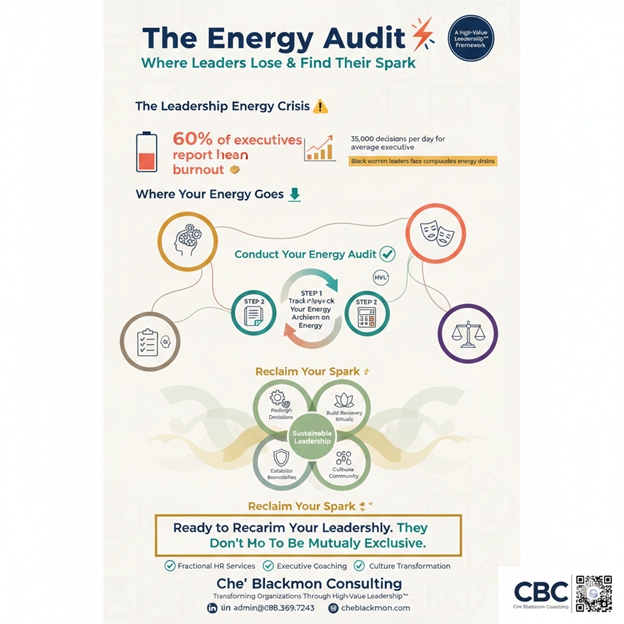
Recent studies from the Harvard Business Review paint a sobering picture. Over 60% of executives report feeling burned out, and the numbers are even more staggering for leaders who navigate the additional weight of being traditionally overlooked in corporate spaces. For Black women in leadership, the energy tax is compounded by what researchers call “emotional labor,” the invisible work of managing perceptions, code switching, and proving competence in environments that weren’t built with them in mind.

Energy depletion doesn’t happen in a vacuum. It accumulates through a series of micro moments that, individually, seem manageable. Collectively, they create a deficit that no amount of weekend rest can repair. Consider these common energy drains that leaders face daily:

Decision Fatigue and Cognitive Overload

The average executive makes over 35,000 decisions per day. Each decision, no matter how small, depletes a finite cognitive resource. When you’re already operating in spaces where every move is scrutinized more heavily, that number multiplies. You’re not just deciding on strategy or budget allocations; you’re constantly calculating the perception of each choice.

Misaligned Values and Cultural Dissonance

There’s an energy leak that happens when your personal values clash with organizational culture. When you have to suppress your authentic self to fit into corporate norms, when you’re the only voice advocating for equity in rooms full of people who view it as a checkbox rather than a commitment, you’re burning fuel that should be powering innovation and growth. This is particularly acute for Black women leaders who often find themselves as the “only” or one of few, navigating cultures that were not designed with their leadership styles, communication preferences, or lived experiences in mind.

Invisible Labor and Unrecognized Contributions

The work that doesn’t show up in job descriptions but somehow always lands on your desk. Mentoring junior colleagues. Smoothing over team conflicts. Being voluntold for diversity initiatives while your peers focus solely on revenue generating work. This invisible labor drains energy while rarely adding to your advancement or recognition.

Constant Performance Pressure and Imposter Syndrome

When you’re operating in spaces where people like you have historically been excluded, there’s an unspoken pressure to be exceptional at all times. Mistakes that would be learning opportunities for others become proof that you don’t belong. This hypervigilance is exhausting. It creates a perpetual state of stress that depletes energy reserves faster than any strategic initiative or operational challenge.

💸 The Cost of Running on Empty

Energy depletion isn’t just a personal problem. It’s an organizational crisis that manifests in tangible, measurable ways. When leaders run on empty, the ripple effects touch every corner of the enterprise.

There was a company in the manufacturing sector that lost a brilliant VP of Operations within 18 months of her appointment. On paper, she had everything: impressive credentials, strategic vision, and the operational expertise to transform their supply chain. What the exit interview revealed was more nuanced. She was exhausted. Not from the work itself, but from the constant need to prove her worth in ways her male counterparts never had to. She left not because she couldn’t do the job, but because the energy required to do it while managing bias, microaggressions, and isolation was unsustainable.

The company didn’t just lose a talented executive. They lost institutional knowledge, strategic relationships, and a pipeline of diverse talent who saw in her departure a signal about their own futures. The cost of replacing her ran into seven figures when you factor in recruitment, onboarding, lost productivity, and the projects that stalled in her absence. More significantly, they lost credibility in their diversity and inclusion commitments.

The organizational costs of leadership energy depletion include decreased decision quality, reduced innovation and creative problem solving, higher turnover among high performers, cultural erosion and disengagement, missed strategic opportunities, and damaged employer brand and recruitment challenges. These aren’t abstract concepts. They show up in quarterly earnings, employee engagement scores, and talent retention metrics.

📊 Conducting Your Energy Audit: A Framework for Leaders

An energy audit for leaders mirrors the process organizations use to identify inefficiencies in their operations. Instead of examining electrical systems and HVAC units, you’re examining how you allocate your most precious resource: your energy. This isn’t about working harder or finding more hours in the day. It’s about working smarter and being intentional about where your energy goes.

Step One: Track Your Energy Expenditures

For one week, keep a simple energy journal. Not a detailed log of every minute, but a general accounting of what gives you energy and what depletes it. At the end of each day, ask yourself three questions. What activities today left me energized? What activities left me drained? What surprised me about my energy patterns?

Pay particular attention to the activities that drain you but that you feel obligated to continue. These are your prime candidates for elimination, delegation, or redesign. For Black women leaders, this often includes activities related to being the diversity representative, informal mentorship that isn’t valued or compensated, and managing others’ comfort with your presence in leadership spaces.

Step Two: Identify Your Energy Architecture

Everyone has a unique energy architecture, the patterns and rhythms that govern when you’re at your best. Some leaders are morning people who tackle complex decisions before noon. Others hit their stride in the afternoon. Understanding your architecture allows you to structure your day for maximum effectiveness.

Examine your calendar through an energy lens. Are you scheduling high stakes meetings during your lowest energy periods? Are you filling your peak hours with administrative tasks that could be batched or delegated? Are you building in recovery time between energy intensive activities, or are you scheduling back to back meetings that leave no room for processing or renewal?

Step Three: Calculate Your Return on Energy

Just as organizations calculate ROI for financial investments, leaders need to calculate return on energy for their activities. Not everything that feels productive is actually moving you or your organization forward. Some activities are energy vampires disguised as important work.

Create three categories for your activities: high energy investment, high return activities; necessary but energy draining activities; and low return energy drains. The goal isn’t to eliminate all energy draining activities. Some are unavoidable parts of leadership. The goal is to be conscious about which drains are necessary and which are habits or obligations that no longer serve you or your organization.

⚙️ Strategic Energy Management: From Audit to Action

Understanding where your energy goes is only half the battle. The real transformation happens when you redesign how you work, lead, and show up in ways that honor your energy architecture while meeting organizational demands.

Redesign Your Decision Making Process

Decision fatigue is real and cumulative. Combat it by creating decision frameworks that reduce the cognitive load of routine choices. Establish clear criteria for common decisions so you’re not reinventing the wheel each time. Delegate decisions that don’t require your specific expertise or authority. Batch similar decisions together rather than switching contexts throughout the day.

A technology executive shared her strategy of implementing “decision free Fridays” where she avoids making any major decisions, using the day instead for strategic thinking and planning. This single change improved not only her decision quality on other days, but also her overall wellbeing.

Build Energy Recovery Into Your Rhythm

You can’t sprint a marathon. Leadership is a long game that requires intentional recovery. This isn’t about bubble baths and self care platitudes. It’s about building recovery mechanisms into your regular rhythm that allow you to sustain high performance over time.

Recovery looks different for different people, but research points to several effective strategies. Physical movement breaks between meetings. Dedicated think time that isn’t interrupted by pings and notifications. Clear boundaries between work and personal time, even when working remotely. Micro breaks throughout the day, not just at lunch. Regular check ins with trusted advisors or coaches who can provide perspective. Time in community with people who share your lived experience and understand the unique challenges you face.

Create Boundaries That Honor Your Energy

For leaders who are used to being accessible, available, and always on, boundary setting can feel uncomfortable. For Black women leaders, it can feel particularly risky given the stereotypes about being difficult or not being team players. Yet boundaries aren’t walls that keep people out. They’re guidelines that protect your ability to show up fully and effectively.

Start by identifying your non negotiables. These are the boundaries that protect your core energy reserves. They might include no meetings before 9am or after 5pm, no work emails on weekends, dedicated time for strategic thinking that can’t be interrupted, or limits on travel commitments. Communicate these boundaries clearly and consistently. Model them for your team to create a culture where sustainable performance is valued over performative busyness.
🌟 The Unique Energy Dynamics for Black Women in Leadership

Let’s address what often goes unsaid in mainstream leadership development. The energy equation looks different when you’re navigating leadership while Black and female. The tax on your energy isn’t just about the work itself but about the context in which you’re doing it.

Research from the Center for Talent Innovation found that Black professionals are more likely than their white counterparts to report feeling stalled in their careers, being on guard to protect against bias, and needing to work harder than their peers to achieve the same level of recognition. Each of these experiences represents a significant energy drain that compounds over time.

The Code Switching Tax

Code switching, the practice of adjusting your language, behavior, and appearance to fit into predominantly white professional spaces, is exhausting. It requires constant vigilance and self monitoring. You’re not just thinking about what to say; you’re calculating how it will be received, whether it reinforces or contradicts stereotypes, and what the political ramifications might be.

A senior director at a Fortune 500 company described it as “wearing a mask that you can never quite take off, even when you get home.” The energy required to maintain that mask, day after day, year after year, is staggering. And unlike other forms of professional stress, there’s no relief valve because the triggers aren’t isolated incidents but the ambient conditions of the environment itself.

The Credibility Gap

Studies consistently show that Black women in leadership positions face a credibility gap that their white male counterparts don’t encounter. Your expertise is questioned more frequently. Your decisions are second guessed more openly. Your authority is challenged more readily. Each incident might seem small, but the cumulative effect is significant energy depletion.

This credibility gap means you often need to work twice as hard to get half the credit. You come over prepared to meetings. You document everything meticulously. You build coalitions more carefully. You navigate politics more strategically. All of this is energy intensive work that should be going into innovation, strategy, and growth.

The Isolation Factor

Being the only one or one of few creates a unique form of isolation that drains energy in ways that are hard to articulate to people who haven’t experienced it. You don’t have the natural allies and informal networks that form organically among majority group members. You can’t assume anyone understands the nuances of your experience without extensive explanation. You bear the burden of representation, knowing that your actions will be generalized to your entire demographic.

This isolation affects everything from strategic decision making to simple workplace interactions. When you don’t have trusted peers who share your perspective, you’re processing challenges in isolation. When you don’t see yourself reflected in senior leadership, you’re charting a path with no map. This solo navigation is exhausting in ways that compound over time.

🛠️ Building a Sustainable Leadership Practice

Sustainable leadership isn’t about finding a magic formula that eliminates stress or makes challenges disappear. It’s about developing practices and support systems that allow you to navigate the demands of leadership without depleting yourself in the process.

Cultivate Your Kitchen Cabinet

Every leader needs a kitchen cabinet, a small group of trusted advisors who can provide honest feedback, strategic perspective, and emotional support. This isn’t your official board of directors or your executive team. This is your personal advisory group, the people who have your back and your best interests at heart.

For Black women leaders, this cabinet ideally includes other Black women who understand the unique dynamics you face. People who can validate your experiences, share strategies that worked for them, and remind you that you’re not alone or crazy when you encounter situations that others might dismiss. These relationships are not just nice to have; they’re essential for sustainable performance.

Develop Your Energy Rituals

High performing athletes have pre game rituals that prepare them mentally and physically for competition. Leaders need similar rituals that signal to their bodies and minds when it’s time to perform and when it’s time to recover. These rituals create structure and predictability in otherwise chaotic schedules.

Your energy rituals might include a morning routine that sets your intention for the day, transition rituals between work and home that create psychological separation, weekly planning sessions that align your calendar with your energy architecture, monthly reviews where you assess what’s working and what needs adjustment, or quarterly retreats for deep reflection and strategic thinking.

Invest in Professional Development That Energizes

Not all professional development is created equal when it comes to energy. Generic leadership programs that don’t acknowledge or address the unique challenges faced by Black women leaders can actually be depleting. You spend energy translating their content to your context, managing the microaggressions that inevitably arise, and explaining your perspective to people who may not be ready to hear it.

Seek out development opportunities that energize rather than drain you. Programs designed for and by people who share your lived experience. Executive coaching with someone who understands the intersection of race and gender in leadership. Communities and networks where you can show up authentically without having to code switch or self censor.

🏢 The Organizational Imperative: Creating Cultures That Sustain Leaders

While individual energy management is crucial, we can’t ignore the organizational conditions that either support or undermine leader sustainability. Organizations that want to retain their best leaders, particularly those from traditionally underrepresented groups, must create cultures that recognize and address the unique energy drains these leaders face.

This isn’t about special treatment. It’s about equitable treatment that accounts for the different challenges different leaders face. When organizations fail to do this, they lose talented leaders not because those leaders can’t handle the work, but because the energy required to navigate bias, isolation, and constant credibility questioning is unsustainable.

Audit Your Culture for Energy Equity

Organizations need to conduct their own energy audits, examining where systemic issues create unnecessary drains on leaders from underrepresented groups. This includes examining meeting cultures that require everyone to be on all the time, recognition systems that overlook invisible labor, advancement criteria that privilege certain styles and backgrounds, informal networks that exclude diverse leaders, and workload distribution that disproportionately assigns diversity and inclusion work to people of color.

Provide Real Support, Not Performative Programs

Many organizations have diversity and inclusion initiatives that look good on paper but provide little real support for leaders navigating challenging environments. Real support includes executive sponsorship from senior leaders who use their political capital to advocate for diverse leaders, affinity groups with budget and influence, not just permission to meet, flexible work arrangements that account for different needs and circumstances, professional development that addresses the specific challenges diverse leaders face, and clear pathways for advancement that don’t require assimilation.

Measure What Matters

If leader sustainability and energy aren’t measured, they won’t be managed. Organizations should track retention rates disaggregated by race and gender, time to promotion for diverse leaders compared to their peers, participation in high visibility projects and opportunities, engagement scores among different demographic groups, and exit interview themes related to culture and belonging.

These metrics reveal whether your organization is creating conditions that support all leaders or whether some leaders are having to work significantly harder than others to achieve the same outcomes.

🚀 Moving Forward: From Depletion to Renewal

Finding your spark again isn’t about a single intervention or magic solution. It’s about making intentional, strategic choices about how you lead, where you invest your energy, and what you’re willing to stop doing. It’s about recognizing that sustainable leadership isn’t weakness; it’s wisdom.

For Black women leaders especially, reclaiming your energy is an act of resistance against systems that expect you to work twice as hard for half the recognition. It’s a commitment to showing up powerfully without burning out completely. It’s honoring your brilliance by protecting the energy that fuels it.

The energy audit is your starting point. It’s the moment you stop accepting exhaustion as the price of leadership and start designing a leadership practice that honors both your ambition and your humanity. You deserve to lead powerfully and live fully. The two don’t have to be mutually exclusive.

✅ Actionable Takeaways

Conduct a week long energy audit tracking what energizes and depletes you daily. Identify your peak performance times and restructure your calendar accordingly. Calculate return on energy for your current commitments and eliminate low value drains. Establish three non negotiable boundaries that protect your core energy reserves. Build a kitchen cabinet of trusted advisors who understand your unique challenges. Create daily transition rituals between high energy work and recovery time. Invest in professional development designed for leaders who share your lived experience. Audit your organization’s culture for energy equity and advocate for systemic changes.

💭 Discussion Questions

What activities in your current role give you energy versus drain your energy? How might your energy equation differ from colleagues who don’t share your identity or background? What boundaries would you need to establish to protect your peak performance capacity? In what ways does your organization’s culture support or undermine sustainable leadership? What would change if you prioritized energy sustainability as much as productivity? How can you build community with other leaders who understand your unique challenges? What invisible labor are you carrying that should be recognized, compensated, or redistributed? What would it look like to lead powerfully while also protecting your wellbeing?

🎯 Next Steps: Partner with Che’ Blackmon Consulting

If you’re ready to reclaim your leadership energy and build a sustainable high value practice, Che’ Blackmon Consulting can help. As a Doctoral Candidate in Organizational Leadership with over two decades of progressive HR leadership experience, Che’ Blackmon specializes in culture transformation and leadership development that honors the unique experiences of traditionally overlooked leaders.

Through fractional HR services, executive coaching, and organizational culture audits, CBC helps leaders and organizations create the conditions for sustainable high performance. Our approach combines strategic HR expertise with deep understanding of the intersectional challenges that Black women and other underrepresented leaders face in corporate spaces.

Whether you need individual coaching to conduct your energy audit and redesign your leadership practice, team development to build more inclusive and energizing cultures, or organizational consulting to address systemic energy drains, we’re here to support your journey from depletion to renewal.

Let’s Talk About Your Leadership Energy 💫

📧 admin@cheblackmon.com

📞 888.369.7243

🌐 cheblackmon.com

Your energy is your leadership currency. Invest it wisely. Protect it fiercely. Renew it regularly.

#Leadership #ExecutiveLeadership #LeadershipDevelopment #BlackWomenLeaders #WomenInLeadership #ExecutiveBurnout #LeadershipEnergy #SustainableLeadership #HighValueLeadership #CultureTransformation #DiversityAndInclusion #ExecutiveCoaching #WorkplaceCulture #LeadershipCoaching #BlackExcellence #ProfessionalDevelopment #HRLeadership #OrganizationalCulture #LeadershipStrategy #ExecutivePresence

The Wellness ROI: Why Healthy Leaders Build Healthy Companies 💪🌱

By Che’ Blackmon, DBA Candidate | Founder & CEO, Che’ Blackmon Consulting

What if the best investment you could make in your organization’s success was investing in your own wellness? Not the wellness programs with free fruit baskets or yoga mats gathering dust in the break room. I’m talking about the real, transformative kind of wellness that starts at the top. The kind that ripples through every level of your company and shows up in your bottom line.

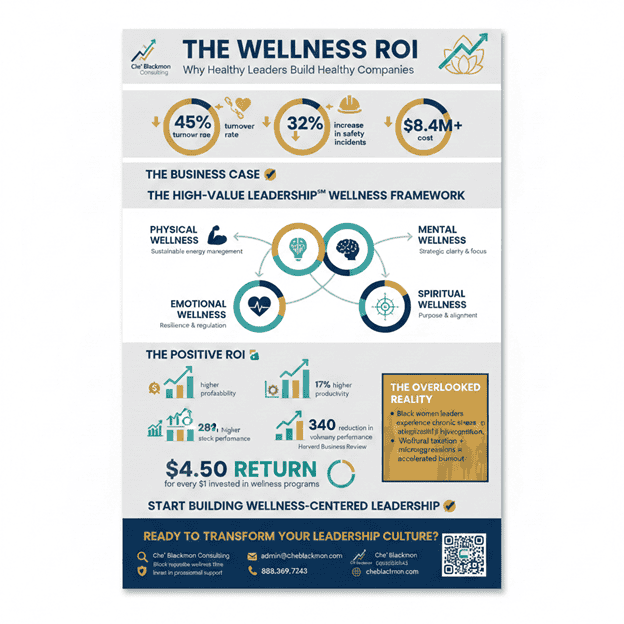
Here’s a truth many executives resist: your personal wellness directly impacts organizational performance. When leaders are depleted, disengaged, or running on fumes, their teams feel it. When leaders thrive, organizations flourish. The data is clear. Companies with healthy, engaged leaders see 21% higher profitability and 17% higher productivity than those led by burned out, chronically stressed executives.

Yet leadership wellness remains one of the most overlooked drivers of organizational success. This oversight is even more pronounced for traditionally overlooked leaders, particularly Black women executives who navigate unique stressors including cultural taxation, microaggressions, and the exhausting labor of being “the only one” in the room. The cost of ignoring leadership wellness? Billions in lost productivity, failed culture transformation initiatives, and talented leaders walking out the door.

The Hidden Cost of Unhealthy Leadership 📉💸

Leadership wellness isn’t a luxury. It’s a business imperative. When executives neglect their physical, mental, and emotional health, the consequences cascade throughout the organization in measurable ways.

Consider the manufacturing company where the executive team prided themselves on being “available 24/7” and working through weekends. On the surface, this looked like dedication. In reality, they were modeling unsustainable behaviors that employees replicated throughout the organization. Within eighteen months, the company faced turnover rates exceeding 45%, safety incidents increased by 32%, and employee engagement scores plummeted to the bottom quartile. The direct costs? Over $8.4 million in recruitment, training, workers’ compensation claims, and lost productivity.

The research backs this up. Studies show that stressed leaders make poorer decisions, struggle with emotional regulation, and create environments where psychological safety diminishes. Their teams experience higher rates of burnout, increased conflict, and decreased innovation. The irony? Leaders often believe they’re demonstrating commitment through self-sacrifice when they’re actually undermining the very outcomes they’re trying to achieve.

The Unique Burden for Traditionally Overlooked Leaders 🎯

For Black women in leadership, the wellness equation includes additional variables that many organizations fail to acknowledge. Research from the American Psychological Association reveals that Black women executives experience chronic stress at rates significantly higher than their white counterparts, driven by persistent workplace discrimination, lack of mentorship and sponsorship, and the pressure to represent an entire demographic while navigating predominantly white, male corporate spaces.

These leaders face what researchers call “John Henryism,” a pattern of high effort coping with chronic stressors that leads to accelerated wear and tear on the body and mind. They work twice as hard to receive half the recognition. They carry the invisible weight of being scrutinized more intensely, having their competence questioned more frequently, and managing the emotional labor of making others comfortable with their presence in leadership.

The cost is staggering. Not just to these talented leaders who deserve better, but to organizations losing brilliant minds, innovative thinking, and leadership capacity they desperately need. When companies ignore these realities, they lose not only individual leaders but entire communities of potential talent who see the burnout patterns and opt out before even entering the pipeline.

Understanding True Leadership Wellness 🧠❤️

Leadership wellness goes far beyond the absence of illness or the presence of a gym membership. It encompasses the complete integration of physical vitality, mental clarity, emotional resilience, and spiritual grounding that enables leaders to show up as their best selves consistently.

In my work developing High-Value Leadership frameworks, I’ve identified four critical dimensions that healthy leaders actively cultivate:

  • Physical Wellness: Not just exercise, but sustainable energy management, quality sleep, proper nutrition, and the ability to recognize and respond to your body’s signals before they become crises.
  • Mental Wellness: Cognitive capacity for strategic thinking, decision-making under pressure, creative problem-solving, and the mental spaciousness to see beyond immediate firefighting.
  • Emotional Wellness: Self-awareness, emotional regulation, empathy, the ability to navigate difficult conversations, and resilience in the face of setbacks without bypassing genuine processing of challenges.
  • Spiritual Wellness: Connection to purpose, alignment with values, meaning-making in work, and the capacity to maintain perspective during turbulent times.

These dimensions don’t exist in isolation. They interact and reinforce each other. A leader who consistently sleeps four hours a night will struggle with emotional regulation. An executive disconnected from their deeper purpose will find it difficult to inspire others authentically. Leaders who ignore their mental health needs will eventually hit walls that impact every aspect of their leadership effectiveness.

The Measurable ROI of Leader Wellness 📊✨

Let’s talk numbers because that’s the language that gets attention in boardrooms. Organizations that prioritize leadership wellness see returns that go straight to the bottom line.

Research from the Harvard Business Review demonstrates that companies with wellness-focused leadership development programs experience 28% higher stock performance over time compared to industry peers. Deloitte’s research shows organizations with strong wellness cultures report 11% higher revenue growth and are 2.5 times more likely to be high-performing organizations.

But the returns extend beyond financial metrics. There was a healthcare organization struggling with physician burnout rates exceeding 60%, threatening both patient care quality and accreditation status. When they implemented a comprehensive leadership wellness initiative starting with their C-suite and cascading through medical directors, the transformation was remarkable. Within two years, physician burnout dropped to 28%, patient satisfaction scores increased by 17 points, and medical error rates decreased by 41%. The financial impact? A positive ROI of $4.50 for every dollar invested in the wellness program.

The Ripple Effect on Organizational Culture 🌊

Healthy leaders create healthy cultures. When executives model sustainable work practices, prioritize recovery and renewal, and demonstrate vulnerability around their own wellness journeys, they give permission for everyone else to do the same.

Consider the technology company where the CEO openly shared their commitment to therapy, regular exercise, and unplugging on weekends. This transparency shifted the entire organizational narrative around wellness from weakness to wisdom. Middle managers felt empowered to set boundaries. Individual contributors stopped glorifying overwork. The company saw voluntary turnover drop by 34%, engagement scores rise to the 87th percentile, and innovation metrics improve significantly as people had the mental and emotional capacity to think creatively rather than simply react to constant urgency.

The data is unequivocal. Organizations with healthy leaders experience lower healthcare costs, reduced absenteeism, higher retention rates, stronger employer brands, and more resilient teams capable of navigating uncertainty without fracturing. These outcomes don’t happen by accident. They result from intentional choices that leaders make about how they steward their own wellness and model those practices throughout the organization.

Practical Strategies for Leadership Wellness 🔧💡

Understanding the importance of leadership wellness matters little without practical application. Here are evidence-based strategies that high-performing leaders use to maintain their wellness while driving organizational results.

Build Non-Negotiable Wellness Routines ⏰

Healthy leaders treat wellness activities with the same commitment they give to board meetings or strategic planning sessions. These aren’t items that get bumped when calendars fill up. They’re foundational practices that enable everything else.

Start with sleep. Research consistently shows that leaders who prioritize seven to eight hours of quality sleep demonstrate better judgment, improved emotional regulation, and enhanced creative problem-solving. Block your sleep schedule like you block meeting time. Protect it fiercely.

Movement matters. This doesn’t require marathon training or extreme fitness regimens. It means regular physical activity that gets your heart rate up, reduces stress hormones, and clears mental fog. Whether it’s walking, swimming, dancing, or strength training, find what you enjoy and do it consistently. Schedule it. Show up for it. Model it for your team.

Mindfulness and meditation practices offer another powerful tool. Even ten minutes daily of focused breathing, meditation, or mindful reflection can significantly reduce stress, improve focus, and enhance decision-making capacity. Leaders who maintain these practices report greater clarity, better emotional regulation, and improved ability to stay present during challenging conversations.

Create Boundaries That Serve You and Your Organization 🛡️

Boundaries aren’t barriers to productivity. They’re enablers of sustainable high performance. Leaders who establish and maintain clear boundaries around their time, energy, and availability create space for recovery, reflection, and renewal.

This means learning to say no strategically. Not every meeting requires your presence. Not every decision needs your input. Not every crisis demands your personal intervention. Trust your team. Delegate meaningfully. Create space in your calendar for deep work, strategic thinking, and restoration.

Technology boundaries matter too. The expectation of constant availability destroys wellness and models unsustainable practices for your entire organization. Establish clear communication protocols. Define true emergencies versus things that can wait. Turn off notifications during focused work time and personal time. Your team will adapt, and they’ll appreciate the permission to do the same.

Invest in Professional Support 🤝

High-performing athletes have coaches, trainers, nutritionists, and sports psychologists supporting their performance. Why should high-performing leaders be any different? Professional support isn’t admission of weakness. It’s strategic investment in your most important asset: yourself.

Therapy and counseling provide invaluable support for processing stress, developing emotional intelligence, and maintaining mental health. Executive coaching offers outside perspective, accountability, and strategic guidance for both professional development and personal wellness. Peer support groups connect you with other leaders navigating similar challenges, reducing isolation and providing community.

For Black women leaders especially, finding culturally competent support makes a significant difference. Therapists, coaches, and mentors who understand the unique challenges of navigating corporate spaces as a Black woman can provide validation, strategies, and support that generic programs miss entirely. Don’t settle for support that doesn’t truly see and understand your experience.

Cultivate Authentic Connection and Community 👥💖

Leadership can be lonely, particularly at senior levels. Isolation erodes wellness, increases stress, and limits perspective. Intentionally building and maintaining authentic connections becomes essential for sustained leadership effectiveness.

This includes personal relationships outside of work that remind you of your identity beyond your title. Friendships that have nothing to do with business deals or networking. Family time that’s truly present and engaged. Community involvement that connects you to purpose larger than quarterly earnings.

It also means fostering genuine connection within your professional sphere. Building relationships with peers based on mutual support rather than competition. Creating space for vulnerable conversations about the real challenges of leadership. Finding or creating communities where you can be fully yourself without performance or pretense.

Building Organizational Systems That Support Leader Wellness 🏢🌟

Individual leader wellness practices matter, but they’re not enough. Organizations must create systems and structures that support rather than undermine leadership wellness.

Redesign How Leadership Work Gets Done 🔄

Many organizations structure leadership roles in ways that guarantee burnout. Unrealistic spans of control, constant context switching, back-to-back meetings with no processing time, expectation of immediate responses to all communications. These aren’t signs of importance. They’re design flaws.

Organizations serious about leader wellness audit how leadership work actually happens. They examine meeting cultures and eliminate wasteful gatherings. They create focused time blocks for strategic thinking. They establish communication protocols that respect recovery time. They distribute decision-making authority so everything doesn’t bottleneck at the top.

One professional services firm reduced executive meetings by 40% through rigorous evaluation of whether gatherings actually required executive presence or could be handled differently. They implemented “focus Fridays” where no meetings were scheduled, giving leaders uninterrupted time for deep work. Within six months, leader satisfaction scores increased by 31%, and strategic initiative completion rates improved by 27%.

Make Wellness Part of Leadership Development 📚

Leadership development programs typically focus on strategy, finance, operations, and people management. Rarely do they address the personal sustainability required to lead effectively over time. This gap sets leaders up for failure.

Progressive organizations integrate wellness into leadership development from the start. They teach new leaders about energy management, stress physiology, and the neuroscience of decision-making. They provide training on emotional intelligence, self-awareness, and resilience building. They normalize conversations about mental health, work-life integration, and sustainable performance.

This proves particularly critical for developing diverse leadership pipelines. When organizations equip Black women and other traditionally overlooked leaders with not just technical skills but also tools for managing the unique stressors they face, retention and advancement improve dramatically. Development programs that acknowledge and address these realities, rather than pretending everyone faces identical challenges, create pathways for diverse talent to not just survive but thrive in leadership roles.

Measure and Reward Sustainable Leadership 📈

What gets measured gets managed. What gets rewarded gets repeated. If organizations want healthy leadership, they must measure wellness indicators and build them into performance evaluation and compensation systems.

This includes tracking leader burnout indicators, team engagement scores, voluntary turnover rates in leader’s organizations, and sustainability metrics like vacation usage and reasonable working hours. It means evaluating leaders not just on what results they achieve but how they achieve them. Leaders who drive results through unsustainable practices that burn out their teams should not be rewarded the same as leaders who deliver outcomes while building healthy, engaged, resilient teams.

Recognition and advancement criteria should explicitly include modeling healthy leadership practices. Taking vacation time should be celebrated, not stigmatized. Setting boundaries should be seen as mature leadership, not lack of commitment. Leaders who invest in their wellness and create cultures where others can do the same deserve promotion over those who achieve short-term gains through long-term destructive practices.

The Future of Leadership Wellness 🚀🔮

The pandemic fundamentally shifted conversations about work, wellness, and sustainability. Leaders who emerged from that crucible understand that the old playbook of sacrificing health for results no longer works, if it ever truly did. The future belongs to organizations that integrate wellness into their leadership DNA.

We’re seeing emergence of predictive analytics that identify burnout risk before it becomes crisis. AI-powered tools that help leaders optimize their schedules for energy and effectiveness rather than simply cramming in maximum commitments. Virtual reality applications for stress management and mindfulness practice. Wearable technology that provides real-time biofeedback on stress physiology.

But technology alone won’t solve this. The real shift requires cultural transformation that values human sustainability as much as quarterly performance. It demands courage from leaders to model different ways of working. It necessitates organizations making hard choices to support leader wellness even when it conflicts with short-term convenience or traditional expectations.

For organizations committed to diversity, equity, and inclusion, leader wellness must be a central component of those efforts. You cannot build truly inclusive cultures while ignoring the disproportionate wellness burdens placed on Black women and other marginalized leaders. Real DEI work addresses not just representation but also the conditions that enable diverse leaders to sustain their careers and thrive long-term.

The Investment That Pays Dividends 💰🌈

Leadership wellness isn’t self-indulgence. It’s strategic imperative. The leaders who will navigate the complexity and uncertainty ahead are those who have cultivated the physical vitality, mental clarity, emotional resilience, and spiritual grounding to sustain themselves and their teams through whatever comes.

Organizations that invest in leadership wellness see measurable returns in every metric that matters: financial performance, employee engagement, innovation capacity, retention rates, and competitive positioning. They build cultures where people want to work, not just because of what they do but because of how they do it.

The question isn’t whether your organization can afford to prioritize leadership wellness. The question is whether you can afford not to. Because the leaders you’re burning out today are the ones you’ll desperately need tomorrow. The culture you’re creating through unsustainable leadership practices today will determine whether you can attract and retain the talent you need to compete in the future.

Healthy leaders build healthy companies. It’s time we started acting like we believe it.

Reflection Questions for Your Leadership Team 💭🗣️

  • What leadership wellness practices are we currently modeling, and what message do those practices send to our organization?
  • How do our organizational systems and structures support or undermine leadership sustainability?
  • What wellness burdens do our traditionally overlooked leaders carry that we haven’t acknowledged or addressed?
  • If we measured the ROI of our current leadership wellness investments, what would the numbers reveal?
  • What would need to change in our culture for sustainable leadership practices to become the norm rather than the exception?
  • How are we integrating wellness into our leadership development programs and succession planning?
  • What specific commitments are we willing to make as a leadership team to prioritize our own wellness and model healthy practices?

Next Steps: Building Your Wellness-Centered Leadership Culture 🎯

For Individual Leaders:

  • Conduct a personal wellness audit across all four dimensions: physical, mental, emotional, and spiritual. Identify your biggest gaps and commit to one actionable change in each area.
  • Schedule non-negotiable wellness activities in your calendar for the next month and protect them as fiercely as you protect board meetings.
  • Identify one boundary you need to establish or reinforce to protect your wellness and communicate it clearly to your team this week.
  • Research and reach out to at least three professional support resources (therapist, coach, peer group) that could support your wellness journey.

For Organizations:

  • Assess your current leadership wellness initiatives. Are they cosmetic (fruit baskets) or substantive (systemic support)? Identify gaps and develop a comprehensive strategy.
  • Audit how leadership work actually gets done in your organization. Where are the design flaws that guarantee burnout? Create an action plan to address the top three.
  • Review your leadership development programs and performance evaluation criteria. Are you teaching and rewarding sustainable leadership or inadvertently promoting destructive practices?
  • Establish baseline wellness metrics for your leadership team and set targets for improvement. Include these in your organizational scorecard alongside traditional performance measures.
  • Specifically examine the wellness burdens placed on your traditionally overlooked leaders. Develop targeted support systems that address their unique challenges rather than pretending one size fits all.

Partner with Che’ Blackmon Consulting 🤝✨

Building a wellness-centered leadership culture requires more than good intentions. It demands strategic expertise, proven frameworks, and ongoing support. At Che’ Blackmon Consulting, we specialize in helping organizations transform their leadership cultures through our proprietary High-Value Leadership methodology.

Our fractional HR and culture transformation services include:

  • Leadership wellness assessments and strategic planning
  • Culture transformation initiatives that prioritize sustainable leadership
  • AI-powered predictive analytics for identifying wellness risks before they become crises
  • Executive coaching for sustainable high performance
  • Leadership development programs that integrate wellness from the ground up
  • Specialized support for organizations committed to creating environments where traditionally overlooked leaders thrive

Whether you’re a small business looking to build a healthy leadership culture from the start or an established organization ready to transform unsustainable practices, we have solutions tailored to your needs.

Ready to Build Healthier Leadership? 🌟

Let’s talk about creating a leadership wellness strategy that drives real results.

📧 admin@cheblackmon.com

📞 888.369.7243

🌐 cheblackmon.com

Che’ Blackmon, DBA Candidate, is the Founder & CEO of Che’ Blackmon Consulting, a fractional HR and culture transformation consultancy serving organizations across Michigan and beyond. With over 24 years of progressive HR leadership experience, she specializes in helping companies build High-Value Cultures where leaders and teams thrive sustainably. She is the author of “High-Value Leadership: Transforming Organizations Through Purposeful Culture,” “Mastering a High-Value Company Culture,” and “Rise & Thrive: A Black Woman’s Blueprint for Leadership Excellence.”

#LeadershipWellness #ExecutiveHealth #HighValueLeadership #OrganizationalCulture #LeadershipDevelopment #WellnessROI #SustainableLeadership #BlackWomenLeaders #DiversityAndInclusion #CultureTransformation #ExecutiveCoaching #LeadershipExcellence #WorkplaceWellbeing #HealthyLeadership #CorporateWellness #InclusiveLeadership #LeadershipMindset #OrganizationalWellness #ProfessionalDevelopment #LeadershipMatters

🌍 Cross-Cultural Competence: Leading in a Global Workplace 🌐

By Che’ Blackmon, DBA Candidate | Founder & CEO, Che’ Blackmon Consulting

✨ Introduction: The New Reality of Leadership

The workplace has changed. Today’s leaders navigate teams that span continents, cultures, and communication styles. Whether your organization operates across international borders or serves a diverse local community, cross-cultural competence has become essential for effective leadership. This is not merely about being polite or politically correct. It is about building the kind of purposeful culture that drives results.

As I discuss in High-Value Leadership: Transforming Organizations Through Purposeful Culture, leaders who understand the intersection of culture and performance create environments where every team member can contribute their best work. Cross-cultural competence amplifies this principle by ensuring that cultural differences become sources of strength rather than barriers to success.

🔍 Understanding Cross-Cultural Competence

Cross-cultural competence refers to the ability to understand, communicate with, and effectively interact with people across cultures. It involves awareness of your own cultural worldview, knowledge of different cultural practices and worldviews, and the skills to bridge differences respectfully and productively.

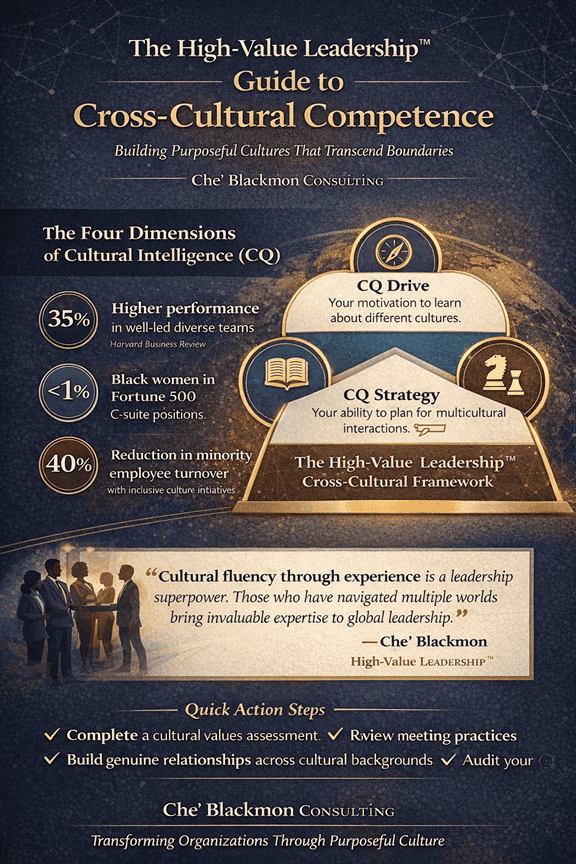
Research from the Harvard Business Review indicates that culturally diverse teams outperform homogeneous ones by up to 35% when led effectively. However, the same research shows that poorly managed diverse teams underperform significantly. The difference lies in leadership competence.

The Four Dimensions of Cultural Intelligence

Dr. Soon Ang and Dr. Linn Van Dyne’s research on Cultural Intelligence (CQ) identifies four key capabilities. First, CQ Drive represents your motivation and interest in learning about different cultures. Second, CQ Knowledge encompasses your understanding of cultural similarities and differences. Third, CQ Strategy involves your ability to plan for multicultural interactions. Fourth, CQ Action reflects your capability to adapt behavior appropriately in different cultural contexts.

👩🏾‍💼 The Overlooked Perspective: Black Women in Global Leadership

Discussions about cross-cultural competence often focus on national cultures while overlooking the unique experiences of those who navigate multiple cultural identities daily. Black women in corporate spaces, for instance, bring invaluable perspectives to global leadership conversations.

In Rise & Thrive: A Black Woman’s Blueprint for Leadership Excellence, I explore how Black women have historically developed sophisticated cultural navigation skills out of necessity. These skills, including code-switching, reading organizational dynamics, and building coalitions across differences, translate directly into cross-cultural leadership capabilities.

McKinsey’s research on diversity in leadership consistently shows that companies with diverse leadership teams, including representation of Black women at senior levels, demonstrate stronger financial performance and innovation. Yet Black women remain severely underrepresented in global leadership roles, holding less than 1% of C-suite positions in Fortune 500 companies.

Leveraging Lived Experience as Leadership Capital

Leaders from traditionally overlooked backgrounds often possess what I call “cultural fluency through experience.” Having navigated predominantly white corporate spaces while maintaining connections to their communities of origin, these leaders develop nuanced abilities to bridge cultural gaps, recognize unspoken dynamics, and create inclusive environments.

Organizations seeking to build cross-cultural competence should recognize and leverage this expertise rather than expecting assimilation. When Black women and other underrepresented leaders are empowered to lead authentically, they model the kind of cultural bridge-building that global organizations require.

📊 Case Studies: Cross-Cultural Leadership in Action

Case Study 1: Manufacturing Meets Global Markets

Consider a mid-sized automotive supplier that expanded operations to include facilities in Mexico and partnerships in Germany. Initially, the company experienced significant friction. American managers interpreted Mexican colleagues’ relationship-building communication style as inefficient. German partners found American directness abrasive.

The turning point came when leadership invested in cross-cultural training and, critically, elevated leaders from each location into strategic decision-making roles. By creating space for different communication styles and decision-making approaches, the company reduced conflict, improved supplier relationships, and increased production efficiency by 22% within 18 months.

Case Study 2: Healthcare System Transformation

A regional healthcare system serving a rapidly diversifying patient population struggled with patient satisfaction scores and staff turnover. Exit interviews revealed that employees from minority backgrounds felt their cultural insights were dismissed, while patients reported feeling misunderstood by care providers.

The organization implemented a comprehensive culture transformation initiative. This included elevating diverse voices into leadership councils, creating cultural liaison positions, and revising hiring practices to value cultural competence alongside clinical skills. Within two years, patient satisfaction scores increased by 15%, and staff turnover among minority employees dropped by 40%.

🛠️ Building Your Cross-Cultural Competence: Practical Strategies

In Mastering a High-Value Company Culture, I outline principles for creating organizational cultures that bring out the best in people. These principles apply directly to cross-cultural leadership.

Strategy 1: Develop Cultural Self-Awareness

Before you can effectively lead across cultures, you must understand your own cultural programming. Examine your assumptions about time, hierarchy, communication, and conflict. Consider how your background shapes what you consider “professional” or “appropriate.” Many workplace norms that seem universal are actually culturally specific.

Action Step: Complete a cultural values assessment such as the Intercultural Development Inventory or CQ Assessment. Reflect on three situations where your cultural assumptions may have influenced your leadership decisions.

Strategy 2: Practice Active Cultural Learning

Cross-cultural competence requires ongoing education. Study the cultural backgrounds of your team members and stakeholders. Learn about communication styles, decision-making preferences, and values that may differ from your own. Approach this learning with humility and genuine curiosity rather than treating it as a checklist exercise.

Action Step: Identify one cultural group you work with regularly but know little about. Commit to learning about their cultural context through reading, conversation, and observation. Seek out content created by members of that community rather than outside observers.

Strategy 3: Create Inclusive Communication Practices

Effective cross-cultural leaders adapt their communication styles while creating space for diverse communication preferences. This means being explicit about expectations rather than assuming shared understanding, allowing multiple channels for input, and recognizing that silence may indicate disagreement or contemplation depending on cultural context.

Action Step: Review your team meeting practices. Do they favor those comfortable with verbal debate? Add written input options, structured reflection time, and alternative ways for team members to contribute ideas.

Strategy 4: Build Diverse Leadership Pipelines

Organizations cannot develop cross-cultural competence through training alone. They must ensure that leadership teams reflect the diversity of their workforce, customer base, and global reach. This requires intentional efforts to identify, develop, and promote leaders from underrepresented backgrounds, including Black women and other traditionally overlooked groups.

Action Step: Audit your organization’s leadership pipeline. Where are the gaps in representation? What barriers exist for advancement? Create specific initiatives to address these gaps with accountability measures and timelines.

📈 Current Trends and Best Practices

The landscape of cross-cultural leadership continues to evolve. Several trends are shaping best practices in this field.

Remote Work and Virtual Teams. The shift to remote and hybrid work has intensified the need for cross-cultural competence. Leaders now manage teams they may never meet in person, across multiple time zones and cultural contexts. Research from GitLab and Buffer indicates that successful remote teams prioritize explicit communication, documentation, and asynchronous work practices that accommodate different working styles and schedules.

Intersectionality in Leadership Development. Progressive organizations recognize that cultural identity is multifaceted. Effective cross-cultural development programs address intersectionality, understanding that a Black woman executive, a first-generation college graduate manager, or an LGBTQ+ team leader from a conservative region each bring unique perspectives and face distinct challenges.

Data-Driven Culture Assessment. Leading organizations use analytics to measure cultural competence and inclusion. This includes tracking promotion rates across demographic groups, analyzing engagement survey results by cultural background, and monitoring retention patterns. Data provides accountability and helps identify systemic barriers that individual good intentions cannot overcome.

Psychological Safety as Foundation. Research by Dr. Amy Edmondson and others demonstrates that psychological safety, the belief that one can speak up without punishment or humiliation, is essential for cross-cultural teams to thrive. Creating environments where team members can bring their authentic cultural selves without fear enables the innovation and collaboration that diverse teams promise.

💡 Actionable Takeaways

To strengthen your cross-cultural leadership competence, focus on these key actions:

1. Commit to Self-Examination. Regularly assess your own cultural biases and assumptions. Seek feedback from colleagues with different backgrounds about how your leadership style lands across cultures.

2. Invest in Relationships. Build genuine connections with team members from different cultural backgrounds. Move beyond surface-level interactions to understand their perspectives, values, and experiences.

3. Amplify Overlooked Voices. Actively create space for Black women, people of color, and other traditionally marginalized groups to contribute and lead. Recognize that their cultural navigation expertise is an organizational asset.

4. Adapt Your Leadership Style. Develop flexibility in how you communicate, make decisions, and provide feedback. What works in one cultural context may not work in another.

5. Make Systemic Changes. Individual competence matters, but sustainable change requires systemic attention to policies, practices, and structures that may inadvertently disadvantage certain cultural groups.

6. Measure and Adjust. Track outcomes related to cultural competence and inclusion. Use data to identify what is working and what needs adjustment.

🎯 Conclusion: Leadership That Transcends Boundaries

Cross-cultural competence is not an optional skill for today’s leaders. It is fundamental to building the high-value organizational cultures that drive sustainable success. When leaders embrace cultural differences as opportunities rather than obstacles, they unlock innovation, engagement, and performance that homogeneous thinking cannot achieve.

For those who have been traditionally overlooked in leadership conversations, particularly Black women navigating corporate spaces, know that your cultural fluency is a superpower. Your experience bridging worlds, adapting to different contexts, and bringing your full self despite resistance positions you uniquely for the global leadership challenges ahead.

The path forward requires both individual growth and organizational transformation. As I emphasize throughout my work, purposeful culture does not happen by accident. It requires intentional leadership, consistent action, and unwavering commitment to bringing out the best in every person, regardless of their cultural background.

❓ Discussion Questions for Reflection

1. What cultural assumptions have you brought into leadership situations that you later recognized were not universal? How did this recognition change your approach?

2. How does your organization currently leverage the cultural expertise of Black women and other traditionally overlooked leaders? What opportunities exist to do this more effectively?

3. Think about a cross-cultural conflict or misunderstanding you have witnessed. What cultural factors may have contributed to the disconnect? How might a culturally competent leader have approached the situation differently?

4. What barriers exist in your organization that may prevent culturally diverse leaders from advancing into senior positions? What specific steps could address these barriers?

5. How can you personally commit to growing your cross-cultural competence over the next six months? What specific learning activities and relationship-building efforts will you pursue?

🚀 Your Next Steps

Building cross-cultural competence is a journey, not a destination. Start where you are, commit to growth, and take consistent action. Whether you are an emerging leader seeking to develop your capabilities or an executive aiming to transform your organizational culture, the time to begin is now.

Consider exploring additional resources such as Mastering a High-Value Company Culture and High-Value Leadership: Transforming Organizations Through Purposeful Culture for deeper insights into building cultures where all people thrive. For Black women and other leaders from traditionally overlooked backgrounds, Rise & Thrive: A Black Woman’s Blueprint for Leadership Excellence offers specific guidance for navigating corporate spaces while leading authentically.

🤝 Partner with Che’ Blackmon Consulting

Ready to transform your organization’s culture and develop cross-cultural leadership capabilities? Che’ Blackmon Consulting offers fractional HR leadership, culture transformation consulting, and executive coaching designed to create workplaces where every person can contribute their best work.

📧 Email: admin@cheblackmon.com

📞 Phone: 888.369.7243

🌐 Website: cheblackmon.com

Let’s build purposeful cultures together. ✨

#HighValueLeadership #CrossCulturalCompetence #GlobalLeadership #DiversityAndInclusion #CultureTransformation #BlackWomenInLeadership #LeadershipDevelopment #WorkplaceCulture #InclusiveLeadership #HRLeadership #OrganizationalCulture #ExecutiveLeadership #CulturalIntelligence #PurposefulCulture #WomenInLeadership

💝 Building Beloved Brands: Culture as Your Greatest Marketing Tool 💝

By Che’ Blackmon, DBA Candidate | Founder & CEO, Che’ Blackmon Consulting

Every year, companies spend billions on advertising, influencer partnerships, and marketing campaigns designed to make customers love them. They craft perfect taglines, produce stunning visuals, and purchase premium placements. Yet despite all this investment, many brands remain forgettable. Consumers scroll past their ads, ignore their emails, and feel nothing when they see their logos.

Meanwhile, other organizations spend far less on traditional marketing yet inspire fierce loyalty. Customers become advocates. Employees become ambassadors. Communities form around these brands, defending them during crises and celebrating their wins as personal victories. These are beloved brands.

What separates the beloved from the forgettable? It is not a bigger marketing budget or a cleverer campaign. It is culture. The most beloved brands in the world are built from the inside out, with organizational cultures so strong and authentic that they radiate outward, attracting customers, talent, and partners who share their values.

Culture is not just an HR initiative. It is your greatest marketing tool.

🔍 The Inside Out Revolution

Traditional marketing operates outside in. It identifies what customers want to hear, then crafts messages designed to appeal to those desires. The product or service may or may not match the promise. The internal culture may or may not reflect the external image. The gap between what is advertised and what is experienced creates cynicism, and modern consumers have developed finely tuned detectors for inauthenticity.

Beloved brands flip this model. They build cultures around genuine values, treat employees in ways that reflect those values, create products and services that embody those values, and then let that authenticity speak for itself. The marketing is not separate from the culture. The culture IS the marketing.

As I explore in High-Value Leadership: Transforming Organizations Through Purposeful Culture, organizations with purposeful cultures do not need to convince anyone of their values. They demonstrate them daily through thousands of interactions, decisions, and moments of truth. This consistency creates trust, and trust creates love.

📊 The Data Behind Beloved Brands

The business case for culture-driven branding is overwhelming. Research from Deloitte found that mission-driven companies have 30% higher levels of innovation and 40% higher levels of retention compared to their competitors. Glassdoor studies show that companies with strong cultures outperform the S&P 500 by 122%.

Edelman’s Trust Barometer consistently reveals that consumers make purchasing decisions based on trust in an organization’s values, with 81% saying they must be able to trust the brand to do what is right. This trust cannot be manufactured through advertising. It must be earned through consistent, values-aligned behavior.

Perhaps most compelling, research from Harvard Business School found that customers who are emotionally connected to a brand have a 306% higher lifetime value than satisfied customers. They stay longer, spend more, and actively recruit others to the brand. This emotional connection is not created by clever marketing. It is created by genuine experiences that reflect genuine culture.

🏢 Anatomy of a Beloved Brand

What does a culture-driven beloved brand actually look like in practice? Several elements consistently appear:

Clear, Lived Values 🎯

Beloved brands have values that are more than wall decorations. These values guide real decisions, including difficult ones. When there is tension between values and short-term profit, values win. Employees can articulate the values without checking a poster because they see them in action daily.

Employee Experience Mirrors Customer Experience ✨

Organizations cannot sustainably treat customers better than they treat employees. Eventually, the internal reality leaks into external interactions. Beloved brands ensure that the care, respect, and value they want customers to feel is first experienced by the people who serve those customers.

Stories Over Slogans 📖

Beloved brands are rich in authentic stories: the employee who went above and beyond, the customer whose life was changed, the decision that sacrificed profit for principle. These stories circulate organically because they are true and because they resonate with shared values. No advertising agency can create stories as powerful as genuine cultural moments.

Transparency in Imperfection 💎

Beloved brands do not pretend to be perfect. They acknowledge mistakes, share challenges openly, and invite stakeholders into their journey of improvement. This vulnerability creates deeper connection than any polished facade could achieve. Customers and employees alike prefer authentic imperfection to manufactured perfection.

Community Cultivation 🌱

Beloved brands see themselves as hosts of communities rather than vendors of products. They create spaces, whether physical or virtual, where people with shared values can connect. They facilitate relationships between customers, not just between company and customer. This community becomes self-sustaining, generating word of mouth that no marketing spend could purchase.

💫 Culture, Brand, and the Overlooked Leader

For Black women and other traditionally overlooked leaders in corporate spaces, the relationship between culture and brand carries particular significance.

Authenticity, which is the cornerstone of beloved brands, has often been dangerous territory for Black women at work. The pressure to code switch, to present a version of oneself deemed acceptable to majority culture, creates an internal tension between authentic expression and professional survival. When organizations demand inauthenticity from their people, that inauthenticity inevitably seeps into the brand.

Conversely, organizations that create cultures where all employees can show up authentically unlock tremendous brand potential. The unique perspectives, communication styles, and cultural competencies that diverse leaders bring become sources of differentiation and connection with increasingly diverse customer bases.

In Rise & Thrive: A Black Woman’s Blueprint for Leadership Excellence, I explore how Black women leaders can advocate for cultures that allow authentic contribution while strategically positioning themselves as culture shapers. When Black women are empowered to lead authentically, they often create the very cultures that build beloved brands, bringing community orientation, relational intelligence, and values-driven leadership that resonates with modern consumers.

Research from McKinsey consistently shows that companies with diverse leadership teams are more likely to outperform their peers. Part of this advantage comes from the cultural richness that diverse leaders create, cultures that feel welcoming to diverse customers and that generate innovation through varied perspectives.

📱 Culture in the Age of Radical Transparency

Several trends have made culture-driven branding more important than ever:

Social Media Amplification 📣

Every employee is now a potential brand ambassador or brand critic with a platform. A single viral post about workplace culture, positive or negative, can reach millions. Organizations can no longer hide internal realities behind external marketing. The gap between advertised values and lived values is exposed within hours.

Review Culture 🌟

Platforms like Glassdoor, Indeed, and Google Reviews mean that internal culture is visible to anyone with a smartphone. Job candidates research employer brands before applying. Customers read employee reviews before purchasing. Culture is no longer private. It is part of the public brand whether organizations like it or not.

Values-Driven Consumers 💚

Younger generations in particular make purchasing decisions based on perceived company values around sustainability, diversity, equity, community involvement, and ethical practices. They research before buying and share their findings widely. Companies with genuine values-aligned cultures have stories to tell. Companies with manufactured values have only marketing copy.

The Great Resignation’s Legacy 🚪

The workforce disruptions of recent years laid bare the importance of culture for retention and recruitment. Organizations known for toxic cultures struggled to hire even at premium wages, while those with positive cultures maintained stability. The competition for talent has made culture a visible differentiator that directly affects operational capacity.

🛠️ Building Your Beloved Brand from the Inside Out

1. Audit Your Culture-Brand Gap 🔎

Start by honestly assessing the distance between how your organization presents itself externally and how it operates internally. Survey employees about whether marketing messages reflect their experience. Review customer complaints for patterns that suggest systemic cultural issues. Read your Glassdoor reviews as if you were a prospective customer.

Action Step: Gather your leadership team and compare your external brand promises to internal employee experience data. Identify three specific gaps where the external message does not match internal reality.

2. Define Values That Matter 💎

Generic values like “integrity” and “excellence” mean nothing because they differentiate no one. Beloved brands have specific, sometimes even provocative values that reflect genuine beliefs. These values should help you say no to opportunities that do not align, even profitable ones. In Mastering a High-Value Company Culture, I outline processes for identifying values that are authentic, distinctive, and actionable.

Action Step: Test your values by identifying three decisions in the past year that were made specifically because of values, even when other options might have been more profitable or convenient. If you cannot identify such decisions, your values may not be operational.

3. Align Employee Experience First 👥

Before investing in external brand campaigns, ensure employees experience what you want customers to experience. If you want customers to feel valued, employees must feel valued first. If you want customers to trust you, employees must trust leadership first. The internal experience inevitably becomes the external experience.

There was a hospitality company struggling with customer satisfaction despite heavy marketing investment. Analysis revealed that frontline employees felt unsupported and disrespected. They could not create welcoming experiences for guests because they themselves did not feel welcomed. By redirecting resources from marketing to employee experience improvements, including better scheduling, manager training, and recognition programs, the company saw customer satisfaction rise naturally as employees became genuine ambassadors.

Action Step: For each promise you make to customers, assess whether employees experience that same promise internally. Create a plan to close any gaps.

4. Collect and Amplify Authentic Stories 📚

Every organization has stories that reveal its true culture. The question is whether anyone is capturing and sharing them. Create systems for collecting stories from employees, customers, and community members. Look for moments when values were demonstrated in action. These authentic stories become your most powerful marketing content.

Action Step: Implement a monthly ritual where teams share stories of values in action. Celebrate these stories publicly and save them for future use in recruitment, marketing, and culture reinforcement.

5. Turn Employees into Brand Ambassadors 🌟

Employees who genuinely love where they work become powerful, credible advocates for the brand. This cannot be forced or manufactured. It happens naturally when employees feel valued, aligned with organizational purpose, and proud of how the organization operates. The goal is not to train employees to say nice things but to create conditions where nice things are genuinely true.

Action Step: Survey employees about their willingness to recommend the organization to friends and family, both as an employer and as a provider of products or services. Use the results as a leading indicator of brand health.

6. Build Community, Not Just Customer Base 🤝

Beloved brands create opportunities for customers to connect with each other around shared values and interests. This might be through events, online forums, user groups, or collaborative initiatives. When customers form relationships through your brand, their loyalty becomes about community belonging, not just product satisfaction.

Action Step: Identify one initiative that could bring customers together around shared values rather than just shared product use. Pilot this community-building effort and measure engagement beyond traditional marketing metrics.

📈 Measuring Culture-Driven Brand Success

Traditional marketing metrics do not fully capture the value of culture-driven branding. Consider adding these measurements:

Employee Net Promoter Score (eNPS): How likely are employees to recommend your organization as a place to work? This predicts future brand advocacy.

Culture-Brand Alignment Index: Survey both employees and customers about organizational values. Measure the consistency between internal and external perceptions.

Organic Advocacy Rate: Track unprompted positive mentions on social media, review sites, and in customer feedback. This indicates genuine brand love versus manufactured buzz.

Referral Source Analysis: Monitor how many new customers and employees come through referrals versus paid acquisition. High referral rates suggest culture is creating advocacy.

🏆 The Sustainable Advantage

In a world where products can be copied, prices can be undercut, and advertising can be outspent, culture remains the one sustainable competitive advantage. It cannot be purchased, replicated overnight, or faked for long. A genuine culture that creates a beloved brand is built over years through consistent, values-aligned decisions and authentic human connection.

This is both the challenge and the opportunity. Organizations willing to do the hard, slow work of culture building create advantages that compound over time. Every positive employee experience strengthens the culture. Every authentic customer interaction reinforces the brand. Every values-aligned decision adds to the reservoir of trust.

The organizations that will thrive in the coming decades are those that understand this fundamental truth: the best marketing does not happen in the marketing department. It happens everywhere, every day, in every interaction between your people and your stakeholders. Culture is your greatest marketing tool. Is yours working for you or against you?

💬 Discussion Questions

1. How large is the gap between your organization’s external brand message and internal cultural reality? What evidence supports your assessment?

2. Can you identify three authentic stories from your organization that reveal its true values in action? How are these stories currently being shared or not shared?

3. For traditionally overlooked leaders: How does your organization’s culture support or hinder your ability to contribute authentically? How might greater authenticity strengthen the brand?

4. If every employee at your organization posted honestly about their work experience on social media, how would it affect your brand? What does this tell you about culture-brand alignment?

5. What would need to change in your organization for employees to become genuine, enthusiastic brand ambassadors without being asked?

🚀 Your Next Steps

Building a beloved brand is not a project with a finish line. It is an ongoing commitment to culture that radiates outward. Start where you are with what you have. Choose one strategy from this article and implement it this month. Measure both cultural indicators and brand indicators to track progress.

Engage your team in the conversation. Share this article and discuss which elements resonate with your current reality and aspirations. Culture change happens through many small conversations and decisions, not through mandates from above.

Remember that culture-driven branding requires patience. The results compound over time as trust builds, stories accumulate, and reputation solidifies. The organizations that stay committed to this approach create advantages that become increasingly difficult for competitors to overcome.

✨ Ready to Build a Beloved Brand from the Inside Out?

If you are ready to transform your organizational culture into your most powerful marketing asset, Che’ Blackmon Consulting is here to guide the journey. We specialize in culture transformation, leadership development, and helping organizations discover that their greatest competitive advantage lies in how they treat their people.

📧 Email: admin@cheblackmon.com

📞 Phone: 888.369.7243

🌐 Website: cheblackmon.com

Let’s unlock your potential, empower your leadership, and transform your impact together.

📖 About the Author

Che’ Blackmon is the Founder and CEO of Che’ Blackmon Consulting, a Michigan-based fractional HR and culture transformation consultancy. With over 24 years of progressive HR leadership experience across manufacturing, automotive, healthcare, and other sectors, Che’ brings deep expertise in building organizational cultures that become competitive advantages. She is currently pursuing her Doctor of Business Administration (DBA) in Organizational Leadership with research focused on AI-enhanced organizational transformation. Che’ is the author of High-Value Leadership: Transforming Organizations Through Purposeful Culture, Mastering a High-Value Company Culture, and Rise & Thrive: A Black Woman’s Blueprint for Leadership Excellence. She hosts the “Unlock, Empower, Transform” podcast and the “Rise & Thrive” YouTube series.

#Leadership #BrandBuilding #CompanyCulture #HighValueLeadership #EmployerBranding #WorkplaceCulture #BrandStrategy #CultureTransformation #EmployeeExperience #CustomerExperience #MarketingStrategy #BelovedBrands #OrganizationalCulture #LeadershipDevelopment #BrandLoyalty

🤝 The Connection Economy: Why Relationships Drive Results 🤝

By Che’ Blackmon, DBA Candidate | Founder & CEO, Che’ Blackmon Consulting

We have entered a new era of business. The old economy rewarded those who hoarded information, guarded resources, and climbed over others to reach the top. But that economy is fading. In its place, something far more powerful has emerged: the connection economy.

In this new landscape, relationships are currency. Trust is capital. And the leaders who invest in genuine human connection are the ones generating extraordinary results.

This is not soft leadership. This is smart leadership. Research consistently shows that organizations with strong relational cultures outperform their competitors in every measurable way. They attract better talent. They retain employees longer. They innovate faster. They weather crises more effectively. The data is clear: connection drives results.

🌐 What Is the Connection Economy?

The term “connection economy” describes a fundamental shift in how value is created and exchanged in the modern workplace. Unlike the industrial economy that valued efficiency above all else, or the knowledge economy that prioritized information, the connection economy recognizes that sustainable success flows through relationships.

Seth Godin, who popularized this concept, argues that in an age of automation and artificial intelligence, human connection has become the most valuable and irreplaceable commodity. Machines can process data. Algorithms can optimize operations. But only humans can build the trust, empathy, and collaborative spirit that transforms good organizations into great ones.

As I explore in High-Value Leadership: Transforming Organizations Through Purposeful Culture, the most effective leaders understand that their primary job is not managing tasks but cultivating relationships. They create environments where people feel seen, valued, and connected to something larger than themselves.

📊 The Business Case for Connection

If you need to convince skeptics that relationships matter, the numbers tell a compelling story.

According to Gallup’s State of the Global Workplace report, employees who have a best friend at work are seven times more likely to be engaged in their jobs. They produce higher quality work, have better safety records, and are significantly less likely to leave. Yet only three in ten employees strongly agree that they have a best friend at work, representing a massive untapped opportunity for organizations willing to prioritize connection.

Research from MIT’s Human Dynamics Laboratory found that patterns of communication are the most important predictor of a team’s success. Not the content of discussions. Not individual intelligence. But the frequency, energy, and inclusiveness of interactions. Teams that communicate in certain patterns, with members engaging equally and face to face, consistently outperform teams that do not.

A landmark study published in Harvard Business Review found that companies with highly connected cultures experienced 2.5 times higher revenue growth over a three year period compared to companies with disconnected cultures. The researchers concluded that connection was not just a “nice to have” but a significant competitive advantage.

💫 Connection and the Overlooked Leader

For traditionally overlooked talent in corporate spaces, particularly Black women in leadership, the connection economy presents both unique challenges and powerful opportunities.

The challenges are real. Research from LeanIn.Org and McKinsey’s Women in the Workplace study consistently shows that Black women are less likely to have access to senior leaders, less likely to receive sponsorship, and more likely to have their judgment questioned. They often find themselves excluded from the informal networks where crucial information flows and career advancing relationships form.

In Rise & Thrive: A Black Woman’s Blueprint for Leadership Excellence, I address this reality head on. The connection economy does not automatically level the playing field. Systemic barriers persist. But understanding how connection works provides a strategic framework for navigating and ultimately transforming these systems.

Here is the opportunity: Black women have been building connection economies within their communities for generations. The mutual aid networks, the sisterhood circles, the “each one teach one” mentality that has sustained Black communities through centuries of exclusion represents sophisticated relational intelligence that is now recognized as essential for organizational success.

The skills that have helped Black women survive and thrive despite systemic barriers, including the ability to read rooms, build coalitions across difference, and create belonging from scratch, are precisely the skills the connection economy rewards. The task now is ensuring these contributions are recognized, valued, and compensated appropriately.

🔑 Five Pillars of Connection Driven Leadership

1. Intentional Presence 👁️

Connection begins with presence. Not physical proximity, but genuine attentiveness. In an age of constant distraction, the simple act of giving someone your full attention has become revolutionary.

There was a technology company struggling with cross functional collaboration. Teams worked in silos, communication broke down regularly, and projects consistently missed deadlines. The solution was not a new project management system but a cultural intervention focused on presence. Leaders committed to device free meetings, active listening protocols, and what they called “connection before content” practices where every meeting began with genuine check ins. Within six months, project completion rates improved by 34%.

Action Step: For one week, practice being fully present in every conversation. Put away devices. Make eye contact. Listen to understand rather than to respond. Notice what shifts in your relationships.

2. Psychological Safety 🛡️

Google’s extensive research on team effectiveness, known as Project Aristotle, found that psychological safety was the single most important factor in high performing teams. Psychological safety means team members feel safe to take risks, voice opinions, and be themselves without fear of punishment or humiliation.

This is particularly significant for overlooked leaders. When people must constantly monitor how they are perceived, code switch to fit in, or guard against microaggressions, the cognitive load leaves less capacity for innovation and contribution. Creating psychological safety is not just ethical. It is strategic.

In Mastering a High-Value Company Culture, I outline specific practices for building psychological safety, including normalizing vulnerability from leadership, responding productively to mistakes, and actively seeking dissenting opinions.

Action Step: In your next team meeting, ask a question that invites disagreement, such as “What am I missing?” or “What concerns have we not addressed?” Thank people genuinely when they offer critical perspectives.

3. Strategic Vulnerability 💝

Brené Brown’s research on vulnerability has transformed how we understand leadership. Contrary to traditional models that equated leadership with invulnerability, Brown’s work shows that the willingness to be seen, including strengths and struggles, is what creates genuine connection.

Strategic vulnerability does not mean oversharing or inappropriate emotional displays. It means authentically acknowledging challenges, admitting mistakes, and showing up as a whole human rather than a polished facade. When leaders model this behavior, it gives permission for others to do the same.

There was a financial services firm where the CEO began sharing brief monthly reflections with the entire organization. These were not triumphant announcements but honest assessments that included mistakes made, lessons learned, and areas of uncertainty. Employee surveys showed a 28% increase in trust scores within one year. More importantly, teams throughout the organization began having more honest conversations about challenges, leading to faster problem identification and resolution.

Action Step: Identify one area where you have been projecting certainty despite feeling uncertain. Find an appropriate opportunity to acknowledge that uncertainty with your team. Notice how they respond.

4. Inclusive Networks 🌍

Connection driven leaders do not just build networks. They build inclusive networks that span hierarchies, departments, and demographic groups. They intentionally connect with people who are different from themselves and create opportunities for others to do the same.

Research from organizational network analysis shows that the most innovative ideas and solutions typically emerge at the intersections of different groups rather than within homogeneous clusters. Leaders who bridge diverse networks become conduits for these innovations.

For Black women and other overlooked leaders, building inclusive networks often requires extra intentionality. This might mean joining professional associations, seeking reverse mentoring relationships, or creating affinity groups within organizations. It also means using whatever positional power you have to pull others into networks from which they have been excluded.

Action Step: Map your current professional network. Identify gaps in diversity, whether by role, department, demographic, or perspective. Commit to making three new connections in the next month that begin to fill those gaps.

5. Generative Reciprocity 🔄

The connection economy runs on reciprocity, but not the transactional kind that keeps score. Generative reciprocity means contributing to relationships and communities without immediate expectation of return, trusting that value flows in unexpected ways over time.

Adam Grant’s research on giving and taking in organizations shows that “givers,” those who contribute to others without keeping score, tend to be both the lowest and highest performers. The difference is that successful givers are strategic about how and to whom they give, protecting their energy while maximizing their impact.

There was a healthcare system that implemented what they called “pay it forward” leadership development. Senior leaders were expected to sponsor at least two emerging leaders annually, with particular focus on talent from underrepresented groups. Within three years, the organization’s leadership pipeline diversified significantly, and sponsored leaders showed promotion rates 2.3 times higher than unsponsored peers.

Action Step: Identify someone early in their career who could benefit from your knowledge or connections. Reach out this week with an offer of support, expecting nothing in return.

📈 Connection in the Age of AI and Remote Work

Two major trends are reshaping how we think about connection at work: the rise of artificial intelligence and the normalization of remote and hybrid work arrangements.

Some feared that these trends would diminish human connection. Instead, they have highlighted its irreplaceable value. As AI takes over routine cognitive tasks, the uniquely human abilities to empathize, collaborate, and build trust become even more essential. Organizations are realizing that their competitive advantage lies not in having the best algorithms but in having the strongest relationships.

Remote work has forced organizations to be more intentional about connection. The casual hallway conversations and lunch meetings that once happened organically now require deliberate design. This intentionality, while initially challenging, has led many organizations to develop more inclusive connection practices that work for introverts, caregivers, and employees who were previously excluded from the after hours networking events where relationships traditionally formed.

Current best practices for virtual connection include regular one on one check ins focused on relationships rather than just tasks, virtual coffee conversations paired across departments or levels, asynchronous video messages that convey tone and personality, and hybrid meeting protocols that ensure remote participants are fully included.

🏗️ Building a Connection Culture

Individual leaders can model connection driven behavior, but sustainable transformation requires embedding connection into organizational culture. This means examining systems, structures, and practices through a relational lens.

Questions to consider include: Do our hiring practices assess relational skills alongside technical competencies? Do our performance management systems reward collaboration as much as individual achievement? Do our meeting structures allow for genuine connection or just information transfer? Do our physical and virtual spaces facilitate relationship building? Do our development programs include training on emotional intelligence, active listening, and inclusive leadership?

In Mastering a High-Value Company Culture, I provide frameworks for conducting this kind of cultural audit and implementing changes that strengthen relational infrastructure. The goal is not to add connection initiatives on top of existing practices but to weave connection into the fabric of how work gets done.

🌱 The Ripple Effect of Connected Leadership

When leaders prioritize connection, the effects ripple outward in ways that are difficult to measure but impossible to miss. Teams become more cohesive. Collaboration becomes more fluid. Information flows more freely. Problems get surfaced earlier. Innovation accelerates. People stay longer and contribute more fully.

But perhaps the most profound impact is on the leaders themselves. Leading through connection is more sustainable than leading through control. It distributes the burden of leadership across relationships rather than concentrating it in one person. It creates feedback loops that help leaders learn and grow. It generates the kind of meaning and fulfillment that protects against burnout.

For Black women leaders who have often been expected to carry organizations while receiving the least support, connection driven leadership offers a more reciprocal model. When you invest in relationships, those relationships invest back in you. When you build bridges, those bridges hold you up.

🎯 The Connection Imperative

The connection economy is not a trend that will pass. It is a fundamental shift in how value is created and success is achieved. Organizations and leaders who fail to adapt will find themselves increasingly marginalized, unable to attract talent, unable to innovate, unable to retain the relationships that drive results.

But those who embrace this shift, who invest in relationships as deliberately as they invest in technology or processes, will discover that connection is not just good for business. It is good for the soul. It transforms work from a place where we merely exchange labor for wages into a community where we grow, contribute, and belong.

The question is not whether you can afford to prioritize connection. The question is whether you can afford not to.

💬 Discussion Questions

1. How would you describe the relational health of your current team or organization? What evidence supports your assessment?

2. Which of the five pillars of connection driven leadership represents your greatest strength? Which represents your biggest growth opportunity?

3. How have you experienced or observed the challenges faced by overlooked leaders in building professional networks? What strategies have been effective in overcoming these barriers?

4. In what ways has remote or hybrid work affected relationship building in your organization? What practices have helped maintain or strengthen connection?

5. If you were to audit your organization’s culture through a relational lens, what would you examine first? What changes might you recommend?

🚀 Your Next Steps

Becoming a connection driven leader does not require a complete overhaul of how you work. It begins with small, consistent shifts in attention and intention. This week, choose one of the action steps from this article and commit to implementing it. Pay attention to what changes in your relationships and your results.

Remember that building a connection economy is not a solo endeavor. Share these ideas with colleagues. Start conversations about relational health in your organization. Create opportunities for others to connect. The more people who embrace this approach, the more powerful its effects become.

In the connection economy, your greatest asset is not what you know or even what you can do. It is who you are in relationship with others. Invest accordingly.

✨ Ready to Build Your Connection Economy?

If you are ready to transform your organization’s culture through the power of connection, Che’ Blackmon Consulting is here to guide the journey. We specialize in culture transformation, leadership development, and building organizations where relationships drive results.

📧 Email: admin@cheblackmon.com

📞 Phone: 888.369.7243

🌐 Website: cheblackmon.com

Let’s unlock your potential, empower your leadership, and transform your impact together.

📖 About the Author

Che’ Blackmon is the Founder and CEO of Che’ Blackmon Consulting, a Michigan-based fractional HR and culture transformation consultancy. With over 24 years of progressive HR leadership experience across manufacturing, automotive, healthcare, and other sectors, Che’ brings deep expertise in building organizations where people and performance thrive together. She is currently pursuing her Doctor of Business Administration (DBA) in Organizational Leadership with research focused on AI-enhanced organizational transformation. Che’ is the author of High-Value Leadership: Transforming Organizations Through Purposeful Culture, Mastering a High-Value Company Culture, and Rise & Thrive: A Black Woman’s Blueprint for Leadership Excellence. She hosts the “Unlock, Empower, Transform” podcast and the “Rise & Thrive” YouTube series.

#Leadership #ConnectionEconomy #WorkplaceCulture #HighValueLeadership #RelationshipBuilding #LeadershipDevelopment #EmployeeEngagement #OrganizationalCulture #TrustInLeadership #TeamBuilding #HRLeadership #ProfessionalNetworking #CultureTransformation #BlackWomenInLeadership #LeadWithPurpose

The Money Conversation: Talking Compensation Without Awkwardness 💰

By Che’ Blackmon, Founder & CEO, Che’ Blackmon Consulting


Let’s be honest: most of us would rather discuss almost anything else—our weekend plans, the weather, even politics—before we willingly talk about money at work. Yet compensation conversations are the cornerstone of professional growth, organizational fairness, and personal financial security. The awkwardness surrounding these discussions isn’t just uncomfortable; it’s costly, particularly for those already navigating systemic barriers in corporate spaces.

Why the Silence Costs Us All

The reluctance to discuss compensation stems from deeply rooted cultural taboos, power dynamics, and fear of professional consequences. We’ve been socialized to believe that talking about money is impolite, greedy, or unprofessional. This silence, however, perpetuates pay inequities and keeps talented professionals from achieving their full earning potential.

Consider this: women earn approximately 84 cents for every dollar earned by men, and Black women earn just 67 cents for every dollar earned by white, non-Hispanic men. These gaps don’t narrow by accident. They persist because of the very awkwardness we’re addressing—the discomfort that prevents honest dialogue about what we’re worth and what we’re paid.

In High-Value Leadership: Transforming Organizations Through Purposeful Culture, I discuss how transformational leaders create environments where difficult conversations become catalysts for positive change. Compensation transparency is one of those conversations. When organizations cultivate cultures that normalize these discussions, everyone benefits—from entry-level employees to the C-suite.

The Cultural Conditioning That Keeps Us Quiet 🤫

From childhood, many of us receive mixed messages about money. “Don’t ask people what they make.” “Be grateful for what you have.” “Asking for more seems greedy.” These well-intentioned lessons create professional adults who struggle to advocate for their worth.

For Black women and other traditionally overlooked professionals, these challenges compound. Research shows that Black women face unique stereotyping when negotiating—they’re often perceived as “aggressive” or “difficult” for demonstrating the same assertiveness that earns white male colleagues respect. This double standard creates a minefield: speak up and risk being labeled; stay silent and accept less than you deserve.

A major technology company discovered this firsthand when conducting an internal pay equity audit. They found that their highest-performing Black female engineers were consistently paid 12-18% less than their male counterparts with identical experience and performance ratings. The disparity wasn’t intentional; it resulted from years of those women avoiding compensation conversations out of fear, while their male colleagues negotiated freely and frequently.

Breaking the Awkwardness: A Framework for Success ✨

1. Prepare With Data, Not Emotion

The most effective compensation conversations are grounded in market research, performance metrics, and tangible contributions. Before initiating the discussion, gather:

  • Industry salary benchmarks for your role, experience level, and geographic location
  • Documentation of your achievements: quantifiable results, completed projects, exceeded targets
  • Expansion of responsibilities you’ve taken on since your last compensation review
  • Market movement: how your industry and role have evolved

This preparation transforms the conversation from personal (“I need more money”) to professional (“Based on market data and my contributions, here’s the compensation alignment I’m seeking”).

2. Choose Timing Strategically

There’s an art to when you raise compensation discussions. Optimal times include:

  • Annual review cycles (but don’t wait for your manager to initiate)
  • After completing a significant project or achievement
  • When taking on expanded responsibilities
  • During market shifts that affect your role’s value

One mid-sized manufacturing organization implemented quarterly “career conversations” separate from performance reviews. This normalized ongoing dialogue about growth, development, and compensation, removing much of the tension from annual review discussions.

3. Frame the Conversation Properly

Language matters enormously. Compare these approaches:

Less Effective: “I really need a raise. My rent went up and things are expensive.”

More Effective: “I’d like to discuss compensation alignment. Based on my research, professionals in similar roles with comparable experience are earning 15-20% more. Given my contributions to the recent product launch and the expanded team leadership I’ve assumed, I believe a salary adjustment to [specific number] reflects market value and my impact.”

The second approach is professional, data-driven, and positions you as someone who understands their value and the broader market context.

4. Practice the Uncomfortable Silence

After stating your case, stop talking. The silence will feel unbearable, but resist the urge to fill it with justifications, apologies, or backtracking. This is where many professionals—especially women—undermine their own negotiations by talking themselves down from their initial request.

There was a company whose HR director noticed a pattern: male candidates averaged 23 seconds of silence after stating their salary expectations, while female candidates averaged 7 seconds before adding qualifiers like “but I’m flexible” or “that might be too high.” Those extra 16 seconds of confidence translated to an average difference of $8,400 in starting salaries.

Special Considerations for Black Women and Traditionally Overlooked Professionals 🎯

In Rise & Thrive: A Black Woman’s Blueprint for Leadership Excellence, I address the unique navigation required when you’re breaking barriers while building your career. Compensation conversations require additional strategic thinking when you’re already managing stereotypes and biases.

The Preparation Tax

Black women often need to be twice as prepared to be considered equally credible. While this reality is frustrating, acknowledging it allows you to plan accordingly:

  • Anticipate potential objections and prepare responses
  • Bring documentation that white colleagues might not need
  • Have external validation ready (market studies, competitive offers, industry benchmarks)
  • Consider having allies or mentors review your approach beforehand

The Collaboration Strategy

Building coalitions with other professionals navigating similar challenges creates strength in numbers. When multiple team members approach leadership about compensation equity concerns—backed by data—it’s harder to dismiss as individual complaints.

A healthcare organization faced this when six Black women in their nursing leadership team simultaneously requested compensation reviews. Rather than approaching individually (where concerns might be deflected), they presented collective data showing systematic pay disparities. The organization conducted a comprehensive audit and implemented corrective adjustments within 90 days.

The Documentation Discipline

Keep meticulous records of your accomplishments, contributions, and any verbal commitments about compensation. Documentation protects you and provides irrefutable evidence when memories become selective.

Creating a Culture That Welcomes These Conversations 🏢

As a doctoral candidate researching organizational transformation and someone who has spent over two decades in progressive HR leadership, I’ve seen how the right culture changes everything. Organizations serious about equity must actively cultivate environments where compensation conversations are normalized, not penalized.

In Mastering a High-Value Company Culture, I outline how purposeful culture transformation requires intentional systems and practices. Here’s how organizations can reduce awkwardness around compensation:

Implement Transparent Salary Bands

When employees understand the compensation range for their role and what it takes to progress, mystery and guesswork disappear. Buffer, Whole Foods, and others have pioneered radical transparency, publishing salaries internally or even publicly.

Train Managers in Compensation Conversations

Most managers receive little training in discussing money. They’re as uncomfortable as employees, which creates defensive, awkward exchanges. Investing in manager development around compensation discussions improves outcomes for everyone.

Conduct Regular Pay Equity Audits

Proactive organizations don’t wait for problems to surface. They regularly analyze compensation data by gender, race, and other demographics, addressing disparities before they become legal or reputational issues.

Establish Clear Compensation Philosophies

When organizations articulate how they determine pay—market positioning, internal equity, performance impact—employees have a framework for understanding their compensation and requesting adjustments.

A regional financial services company implemented these practices after discovering their employee engagement scores around “fair compensation” were 30 points below industry benchmarks. Within 18 months of creating transparency, conducting audits, and training managers, those scores increased by 28 points, and voluntary turnover decreased by 34%.

The Script: What to Actually Say 📝

Let’s get practical. Here are frameworks for different compensation scenarios:

Requesting a Raise During Your Review:

“Thank you for the positive feedback on my performance this year. I’d like to discuss compensation. Based on my contributions—specifically [achievement 1], [achievement 2], and [achievement 3]—along with market research showing similar roles in our industry range from $X to $Y, I’m requesting a salary adjustment to $[specific amount]. This aligns with both my performance and market value. What are your thoughts?”

Addressing a Pay Disparity You’ve Discovered:

“I’ve become aware of compensation differences between my role and similar positions. I’d like to understand our compensation philosophy and discuss alignment. My research indicates [provide specific data]. Can we schedule time to review my compensation in relation to internal equity and market rates?”

Negotiating a New Job Offer:

“I’m excited about this opportunity. Based on my experience, the responsibilities we’ve discussed, and market rates for this role, I was expecting compensation in the range of $X to $Y. Is there flexibility in the current offer?”

Following Up After a “No”:

“I appreciate you considering my request. Can you help me understand what specific criteria or accomplishments would support a compensation increase? I’d like to establish clear goals we can revisit in [timeframe].”

When the Answer is No: Strategic Next Steps 🚀

Not every compensation request results in immediate salary increases. How you handle “no” determines your long-term success:

  1. Request Specificity: “What exactly would need to change for this conversation to have a different outcome?”
  2. Establish Timeline: “When can we revisit this discussion? What milestones should I focus on?”
  3. Explore Alternatives: If base salary isn’t negotiable, consider bonuses, additional PTO, professional development funds, flexible work arrangements, or expanded responsibilities that position you for future increases.
  4. Assess Honestly: Is this a temporary “not now” or a permanent ceiling? If you’re consistently undervalued despite strong performance and market data, it might be time to explore opportunities elsewhere.

One professional services firm found that employees who engaged in these strategic follow-up conversations after initial denials had a 73% success rate in securing increases within six months, compared to 31% who simply accepted the initial “no” without further discussion.

The Ripple Effect: How Your Conversation Helps Others 🌊

When you successfully navigate compensation conversations, you create pathways for others. This is especially significant for traditionally overlooked professionals who benefit when predecessors normalize these discussions and demonstrate effective strategies.

Every time you negotiate successfully, you:

  • Challenge bias about who “should” ask for more money
  • Create precedent for fair compensation in your role
  • Model confidence for junior colleagues watching your example
  • Contribute data that helps organizations identify and correct systemic issues

Your willingness to have uncomfortable conversations today makes them less uncomfortable for everyone tomorrow.

The Organizational Imperative 💼

For leaders and organizations reading this: compensation awkwardness isn’t just an employee problem. It’s an organizational dysfunction that costs you talent, engagement, and competitive advantage.

High-value organizations, as I define them in my work on purposeful culture transformation, recognize that compensation transparency and fairness aren’t nice-to-haves—they’re fundamental to building trust, attracting top talent, and achieving sustainable success.

When employees believe they’re paid fairly and have clear paths to increased compensation, they:

  • Invest more deeply in their work
  • Stay with organizations longer
  • Refer high-quality candidates
  • Contribute more innovative thinking
  • Build stronger client relationships

Conversely, compensation secrecy and inequity create toxic cultures where talent exits, performance suffers, and employer brand deteriorates.

Moving Forward: Your Action Plan ✅

The awkwardness around money conversations doesn’t disappear overnight, but it diminishes with practice and preparation. Here’s your roadmap:

This Week:

  • Research market rates for your role using Glassdoor, Payscale, salary.com, and industry reports
  • Document your accomplishments and quantifiable contributions from the past year
  • Identify the appropriate person and timing for your compensation conversation

This Month:

  • Practice your compensation conversation script with a trusted mentor or friend
  • Gather any additional documentation needed to support your request
  • Schedule the conversation with your manager

This Quarter:

  • Have the compensation conversation
  • Follow up strategically based on the outcome
  • If employed in a leadership role, audit your team’s compensation for equity
  • Share learnings with your professional network to help others navigate similar conversations

Discussion Questions & Reflection 💭

  1. What specific fears or concerns have prevented you from initiating compensation conversations in your career? Where do those fears originate?
  2. How might your organization’s culture currently support or hinder open discussions about compensation? What’s one change that would make the biggest difference?
  3. For leaders: When was the last time you proactively addressed compensation equity within your team? What prompted that review, and what did you discover?
  4. What role does mentorship play in helping traditionally overlooked professionals navigate compensation conversations more effectively? How can senior leaders better support this?
  5. How do you balance gratitude for your current opportunity with advocacy for fair compensation? Are these truly in conflict?

Your Next Steps With Che’ Blackmon Consulting 🌟

If you’re ready to transform how your organization approaches compensation, culture, and equity—or if you’re a professional who wants personalized support navigating these crucial conversations—let’s talk.

Che’ Blackmon Consulting specializes in:

  • Culture transformation strategies that address systemic inequities
  • Leadership development for executives committed to purposeful change
  • Compensation equity audits and remediation strategies
  • Executive coaching for professionals navigating career advancement
  • AI-powered predictive analytics for organizational transformation

Whether you’re building Michigan’s next high-value culture or positioning yourself for leadership excellence, we’re here to help you unlock potential, empower change, and transform outcomes.


Ready to have better conversations about compensation and culture?

📧 Email: admin@cheblackmon.com
📞 Phone: 888.369.7243
🌐 Web: cheblackmon.com

Let’s unlock the uncomfortable conversations that lead to transformational outcomes—for individuals, organizations, and entire industries.


Che’ Blackmon is the founder and CEO of Che’ Blackmon Consulting, a DBA candidate at National University, and the author of multiple books on leadership and organizational culture including “High-Value Leadership: Transforming Organizations Through Purposeful Culture” and “Rise & Thrive: A Black Woman’s Blueprint for Leadership Excellence.” With over 24 years of progressive HR leadership experience, she specializes in culture transformation and empowering traditionally overlooked talent to rise and thrive in corporate spaces.

#CompensationEquity #PayTransparency #SalaryNegotiation #BlackWomenInBusiness #WageGap #HighValueLeadership #HRLeadership #OrganizationalCulture #PayEquity #WomenInLeadership #DiversityAndInclusion #CompensationStrategy #LeadershipDevelopment #CultureTransformation #ProfessionalDevelopment #CareerAdvancement #ExecutiveCoaching #HRConsulting #WorkplaceEquity #CorporateCulture #BlackWomenLeaders #SalaryTransparency #FairPay #DEI #EmployeeEngagement #TalentRetention #LeadershipExcellence #HRTransformation #RiseAndThrive #CheBlackmon