🌱 Spring Training for Leaders: Preparing for Your Best Quarter Yet

By Che’ Blackmon, DBA Candidate | Founder & CEO, Che’ Blackmon Consulting

Every spring, professional athletes gather for one purpose: to sharpen skills, realign with team goals, rebuild chemistry, and eliminate the habits that held them back the season before. Spring training is not glamorous. It is deliberate, repetitive, and often uncomfortable. Yet it is the foundation of every championship run.

Leaders need spring training too.

As we move into a new quarter, organizations everywhere are assessing where they stand. Q2 presents a pivotal window. The early optimism of January has worn off. The energy of a new year has either taken root or faded. And for many companies, the gap between where they intended to be and where they actually are is becoming uncomfortably clear.

This is your moment to step into the training room.

In my work as a culture transformation consultant and through the frameworks I have developed in High-Value Leadership: Transforming Organizations Through Purposeful Culture, Mastering a High-Value Company Culture, and Rise & Thrive: A Black Woman’s Blueprint for Leadership Excellence, one truth has emerged with consistent clarity: organizations do not transform on their own. Leaders do. And the best leaders treat every quarter as an opportunity to re-examine, retool, and recommit.

This article is your playbook for doing exactly that.

⚾ Why Q2 Is Your Most Strategic Quarter

Most strategic plans are written in the fourth quarter and launched with fanfare in January. By Q2, the adrenaline has settled. Budgets have been tested. Teams have shown their real dynamics. And the data does not lie.

According to research from McKinsey & Company, fewer than one-third of organizational transformations succeed. The most common culprits are not poor strategy but poor execution, misaligned teams, and leaders who fail to sustain momentum. Q2 is the quarter where that momentum is either lost or locked in.

Think of it this way: in baseball, spring training is not the season but it absolutely determines the season. The teams that use preseason to drill fundamentals, repair weak spots, and build genuine cohesion are the ones raising trophies in October. Leaders who treat Q2 as a sprint rather than preparation for the championship run will almost always fall short.

This quarter matters. Prepare accordingly.

📊 The State of the Workforce: What the Data Is Telling Us

Before leaders can train effectively, they need an honest assessment of the playing field. The current workforce landscape demands attention to several converging trends.

🔍 Trend 1: Employee Engagement Remains a Critical Challenge

Gallup’s State of the Global Workplace report consistently shows that only about 23% of employees worldwide are engaged at work. This means that the overwhelming majority of people in any given organization are either quietly disengaged or actively working against organizational goals. That is not a human resources problem. It is a leadership problem.

High-value leaders, as I outline in High-Value Leadership: Transforming Organizations Through Purposeful Culture, do not simply manage tasks. They build cultures where people feel seen, valued, and connected to purpose. Engagement is not a benefit or a perk. It is the direct outcome of how leaders show up every single day.

🤖 Trend 2: AI Integration Is Accelerating, and People Are Scared

Artificial intelligence is no longer a future concern. It is reshaping workflows, eliminating redundancies, and creating entirely new roles in real time. The Society for Human Resource Management reports that more than 40% of workers are worried about AI affecting their jobs. Leaders who ignore that fear are creating a culture of anxiety rather than innovation.

Your spring training must include conversations about AI. Not to pacify employees but to involve them in the transition. The organizations that are thriving in this environment are the ones where leaders have demystified the technology and positioned their teams as partners in the process, not casualties of it.

💬 Trend 3: Psychological Safety Is the New Competitive Advantage

Harvard Business School professor Amy Edmondson has spent decades researching what separates high-performing teams from average ones. Her conclusion is consistent: psychological safety, the belief that one will not be punished for speaking up, is the single most important factor in team performance.

And yet most organizations have a long way to go. A 2023 survey by the Center for Creative Leadership found that nearly half of employees do not feel comfortable raising concerns to their managers. If your team cannot tell you the truth, you are leading with a blindfold on.

Spring training for leaders means creating the conditions where honest dialogue becomes the norm, not the exception.

🎯 The High-Value Leadership Framework: Your Training Playbook

Spring training without a framework is just exercise. Purposeful preparation requires a structure. The High-Value Leadership™ methodology I have developed centers on five core pillars. Each one is a station in your leadership training camp.

Pillar 1 🏆 Purpose-Driven Vision

Great leaders do not just communicate what needs to get done. They articulate why it matters. Simon Sinek’s foundational research shows that teams who understand the purpose behind their work consistently outperform those who do not. In Mastering a High-Value Company Culture, I describe culture as the lifeblood of any organization. Purpose is the heartbeat that keeps it alive.

There was a manufacturing company that was facing high turnover and low morale despite competitive pay. After working through a leadership assessment, it became clear that frontline employees had almost no visibility into how their work connected to the company’s mission. Once leadership made purpose visible through regular town halls, transparent communication, and meaningful recognition, the culture began to shift. Turnover dropped. Productivity climbed. And it started not with a new HR policy but with a leader willing to tell the real story of why the work mattered.

“Culture is the lifeblood of any organization. Purpose is the heartbeat that keeps it alive.” — Che’ Blackmon

Pillar 2 🧐 Emotional Intelligence in Action

Daniel Goleman’s research established that emotional intelligence accounts for nearly 90% of what distinguishes top performers from their peers with similar technical skills. Self-awareness, self-regulation, empathy, motivation, and social skill are not soft skills. They are power skills, and they are the difference between leaders who build loyalty and those who burn through talent.

Q2 is the perfect time to take your EQ temperature. Are you regulating your stress well? Are you genuinely listening before responding? Are you curious about your team’s experience or just reporting out results? These are not comfortable questions. They are necessary ones.

Pillar 3 🤝 Authentic Connection at Every Level

John Maxwell has long taught that leadership is influence, nothing more and nothing less. And influence is built on relationships. High-value leaders do not manage from a distance. They are present, intentional, and genuinely interested in the humans they lead.

This does not require hours of one-on-one time with every direct report. It requires consistency. A brief, genuine check-in. Remembering details. Following through on commitments. Being present in a meeting rather than half-present behind a screen. Small, repeated actions compound over time into trust.

Pillar 4 ⚖️ Balanced Accountability

High standards and psychological safety are not opposites. They coexist in high-performing cultures. The best leaders hold their teams to rigorous expectations while simultaneously creating an environment where mistakes are learning opportunities rather than career-ending events.

Netflix’s Patty McCord described this dynamic in her book Powerful: organizations that treat employees as capable adults and hold them accountable accordingly attract and retain top talent. The key is that accountability must be paired with clarity. People cannot meet a standard they do not fully understand.

Pillar 5 🌍 Culture as a Strategic Asset

Culture is not the result of a few perks and a nicely worded mission statement. It is built through thousands of daily decisions: who gets promoted, whose ideas get heard, how conflict is handled, what behaviors are rewarded, and what behaviors are quietly tolerated. In Mastering a High-Value Company Culture, I make the case that intentional culture is not a nice-to-have. It is a strategic imperative.

Your spring training must include a culture audit. Not a survey that gets filed away but a real reckoning with what your culture is producing right now and whether it is aligned with where you want to go.

💎 Centering the Traditionally Overlooked: The Business Case for Inclusion

No conversation about leadership development is complete without addressing who has historically been excluded from it. For too long, the image of a leader has been narrow, and the pipeline of leadership training, sponsorship, and opportunity has reflected that narrowness.

The data on Black women in corporate America is sobering. According to LeanIn.Org, Black women are significantly underrepresented at every level of corporate leadership, from manager to the C-suite. They are more likely to have their ideas dismissed, less likely to have sponsors who advocate for them, and more likely to face the compounded burden of both racial and gender bias in performance evaluations.

In Rise & Thrive: A Black Woman’s Blueprint for Leadership Excellence, I speak directly to the experience of navigating a workplace that was not designed with you in mind. What researchers describe as “double jeopardy” refers to the unique intersection of race and gender bias that Black women experience simultaneously. It is not theoretical. It is the daily reality of being the only one in the room, of having your competence questioned before it is demonstrated, and of carrying an invisible tax on your time and energy that your peers do not pay.

📊 The Numbers Do Not Lie Black women hold approximately 4% of C-suite positions, 1.6% of VP roles, and 1.4% of executive-level positions in Fortune 500 companies — despite making up 7.4% of the U.S. population. This is a leadership development gap, not a talent gap. Source: McKinsey & Company, LeanIn.Org

Spring training for leaders must be explicitly designed to close these gaps. Here is what that looks like in practice.

1. Examine Your Promotion Process with an Equity Lens 🔍

There was an organization where HR data revealed that women of color were advancing at a significantly slower rate than white peers with comparable performance ratings. The issue was not in the formal criteria. It was in the informal conversations that happened before promotion committees convened. The leaders who spoke up for candidates were speaking up for people they knew well, and they knew well the people who looked like them, socialized with them, and reminded them of themselves.

Audit your talent pipeline. Look at who is being developed, who is being sponsored, and who is being overlooked. Then ask why.

2. Create Sponsorship, Not Just Mentorship 🏆

Mentorship tells someone what to do. Sponsorship opens the door and says your name when you are not in the room. Research from the Center for Talent Innovation shows that Black women are twice as likely to have a mentor and half as likely to have a sponsor compared to white male peers. That gap is consequential. Sponsors accelerate careers in ways that mentors cannot.

If you are in a position of influence, use it. Use it deliberately and consistently for the people who have historically been passed over.

3. Normalize Feedback for Everyone 🗣️

One of the most insidious forms of workplace inequity is the withholding of honest feedback from employees of color. Research from Lean In and McKinsey shows that Black women are less likely to receive the kind of direct, actionable feedback that leads to growth. Often, well-intentioned managers soften feedback out of discomfort, leaving Black women without the information they need to advance.

Feedback is not punitive. It is a form of investment. Every employee deserves the honest, developmental feedback that leads to real growth.
📋 Spring Training Drills: Actionable Takeaways for Leaders

The following are your core training drills for Q2. These are not aspirational ideals. They are concrete, executable actions that you can begin this week.

Drill 1: Conduct a Mid-Cycle Culture Audit 🤔

Do not wait for your annual engagement survey. Conduct a quick, focused listening session with your team. Ask three simple questions:

  1. What is working well right now that we should protect?
  2. What is holding us back that we should address?
  3. What do you need from me as your leader that you are not currently getting?

Then listen. Do not defend. Do not explain. Just listen. What you hear will be more valuable than any survey data.

Drill 2: Realign on Goals Together 🎯

Pull out your Q1 commitments and review them openly with your team. Celebrate what was accomplished. Acknowledge what missed the mark without assigning blame. Then collaboratively adjust the Q2 plan based on what the data and the team’s experience are telling you.

Shared ownership of the plan produces shared accountability for the outcome. Leaders who hand down targets from above without consultation are operating a command-and-control model that today’s workforce will not sustain.

Drill 3: Invest in One Person’s Development This Quarter 🌱

Identify one emerging leader on your team, particularly someone who is often overlooked, and make a deliberate investment in their development. Connect them to a stretch assignment. Introduce them to your network. Advocate for them in a meeting where they are not present.

One intentional act of sponsorship per quarter adds up over time. It builds loyalty. It builds bench strength. And it builds the kind of inclusive culture that attracts top talent.

Drill 4: Block Time for Your Own Growth 📚

Leaders who are not growing are slowly falling behind. This quarter, commit to a learning goal. Read one book that challenges your current thinking. Attend a leadership workshop. Engage a coach or consultant who will tell you the truth about your blind spots.

Continuous growth is not optional for high-value leaders. It is foundational.

Drill 5: Build in Reflection Time 🧘

The best athletes do not train without reviewing game film. The best leaders do not lead without reflection. Carve out fifteen to thirty minutes weekly, not monthly, to assess your leadership. What went well? What would you do differently? Where did you operate from your values and where did you compromise them?

Reflection without action is daydreaming. Action without reflection is chaos. The combination is mastery.

💡 Expert Insights: What the Research Is Telling Leaders Right Now

The convergence of research from organizational psychology, leadership science, and workforce analytics is pointing in a clear direction. Leaders who will thrive in the next decade share a common set of characteristics that look very different from the command-and-control models of the past.

Brené Brown’s research on vulnerability in leadership reveals that the most trusted leaders are not the ones who project infallibility. They are the ones who are willing to say, “I do not have all the answers, and I need your help.” That kind of courage is not weakness. It is the foundation of genuine team trust.

Research from Google’s Project Aristotle, which studied hundreds of internal teams over several years, found that psychological safety was the number one predictor of team effectiveness. Not individual brilliance. Not technical expertise. Psychological safety. The willingness to take interpersonal risks, to ask questions, to admit mistakes, and to offer new ideas without fear of ridicule or punishment.

And Gallup’s decades of research on the manager-employee relationship confirm what any honest employee will tell you: people do not leave companies. They leave managers. The investment organizations make in manager development is the highest-return investment they can make.

“People don’t leave companies. They leave managers. Investing in leader development is the highest-return investment an organization can make.”

🏆 A Case Study in Culture Transformation

There was a regional healthcare organization grappling with high nurse turnover, declining patient satisfaction scores, and a middle management team that was burned out and disengaged. The executive team had tried every structural fix: new scheduling software, updated benefits packages, revised onboarding protocols. Nothing moved the needle.

What was missing was not a better system. It was better leadership.

When the organization committed to a comprehensive leadership development initiative rooted in the High-Value Leadership™ framework, the results were notable. Middle managers were trained in emotional intelligence and feedback delivery. Town halls became two-way conversations rather than executive monologues. A formal sponsorship program was created to develop underrepresented employees, including Black women who had been in the organization for years without a clear path forward.

Within twelve months, voluntary turnover in the nursing staff declined meaningfully. Employee engagement scores improved. And several of the employees in the sponsorship program had been promoted into roles that expanded their scope of influence.

The culture did not change because the environment changed. It changed because the leaders changed.

📝 The Rise and Thrive Principle: Leading While Fully Yourself

For Black women in leadership, spring training carries an additional dimension. It includes the intentional work of deciding, again and again, to show up fully as yourself in spaces that have not always welcomed your wholeness.

In Rise & Thrive: A Black Woman’s Blueprint for Leadership Excellence, I write about the tax that code-switching, over-explaining, and shrinking to fit an uninclusive culture places on Black women professionals. That tax is real. It drains energy, creativity, and resilience. And it costs organizations the full benefit of the talent they claim to have hired.

Spring training for Black women leaders means something specific. It means reassessing which rooms deserve your energy and which do not. It means building a personal board of advisors who reflect where you want to go, not just where you have been. It means protecting your peace as a professional strategy, not a luxury.

And for organizations, it means creating the conditions that make it possible for Black women to lead without the constant overhead of proving their right to be there. That starts at the top. It starts with leaders who are willing to examine their own biases and do the work of creating genuinely inclusive cultures, not just diverse headcounts.

🤔 Discussion Questions for Leaders

Use these questions individually or with your leadership team as part of your Q2 spring training conversations:

  • When did you last have a genuinely honest conversation with your team about what is and is not working? What made that conversation possible, or what has made it difficult?
  • Who on your team is thriving, and who is struggling? What do you actually know about why, and what have you done in response?
  • If you audited your organization’s promotion and development decisions over the last two years, would the outcomes reflect your stated commitment to equity? What would the data show?
  • What is one leadership habit you know is holding your team back? What would it take for you to change it this quarter?
  • Who are you actively sponsoring right now? If the answer is no one, who could you start sponsoring this week?
  • What does your team’s culture actually reward, meaning what behaviors get recognized, celebrated, or repeated? Is that aligned with your stated values?

📋 Next Steps for Your Q2 Preparation

Spring training does not happen on its own. Here is a structured thirty-day plan to launch your best quarter yet.

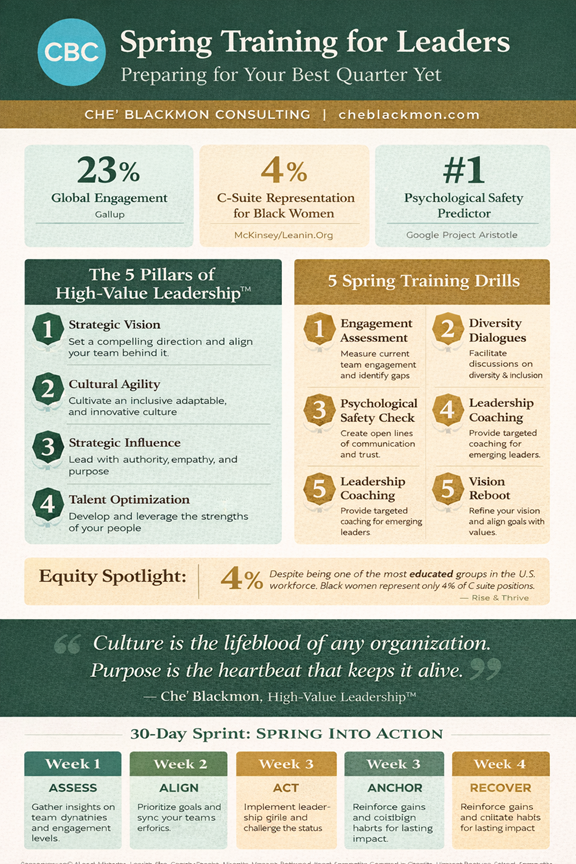
  1. Week 1 – Assess: Conduct a listening session with your team. Review Q1 results honestly. Identify one cultural gap and one leadership habit you want to address.
  2. Week 2 – Align: Reconnect the team around purpose. Revisit goals and co-create the Q2 plan. Identify the emerging leader you will sponsor this quarter.
  3. Week 3 – Act: Launch your development investment. Begin your weekly reflection practice. Have one feedback conversation you have been putting off.
  4. Week 4 – Anchor: Build the structures that will sustain the momentum. Schedule regular check-ins. Create accountability mechanisms that the team owns, not just you.

Then do it again next quarter. High-value leadership is not a one-time effort. It is a sustained practice.

🌱 Ready to Build Your High-Value Culture?

Che’ Blackmon Consulting partners with organizations ready to move from intentions to transformation. Whether you are a mid-market company navigating growth, a leadership team in need of a culture reset, or a Black woman leader ready to rise without shrinking, we have a solution designed for you.

Our signature High-Value Leadership™ consulting services and the High-Value Leadership Intensive course are built from over 24 years of real-world experience transforming culture across manufacturing, healthcare, automotive, and professional services sectors.

Your best quarter starts with one conversation.

📧 admin@cheblackmon.com     📞 888.369.7243     🌐 cheblackmon.com

About the Author

Che’ Blackmon is the Founder and CEO of Che’ Blackmon Consulting (CBC), a Michigan-based culture transformation consultancy. She is a DBA candidate in Organizational Leadership at National University, where her dissertation research focuses on AI-enhanced predictive analytics for culture transformation and employee turnover prevention. With more than 24 years of progressive HR leadership experience across manufacturing, automotive, healthcare, and professional services, Che’ is the author of three published works: High-Value Leadership: Transforming Organizations Through Purposeful Culture, Mastering a High-Value Company Culture, and Rise & Thrive: A Black Woman’s Blueprint for Leadership Excellence. She hosts the podcast Unlock, Empower, Transform with Che’ Blackmon and the Rise & Thrive YouTube series. Learn more at cheblackmon.com.

#LeadershipDevelopment, #HighValueLeadership, #CultureTransformation, #SpringTraining, #Q2Goals, #EmployeeEngagement, #BlackWomenLead, #InclusiveLeadership, #HRLeadership, #WorkplaceCulture, #PurposeDrivenLeadership, #OrganizationalDevelopment, #FractionalHR, #CheBlackmon, #UnlockEmpowerTransform

Love Day Special: Celebrating the Teams That Make Work Worth It ❤️

By Che’ Blackmon, DBA Candidate | Founder & CEO, Che’ Blackmon Consulting

Valentine’s Day often brings to mind romantic relationships, chocolates, and roses. Yet there’s another kind of love that deserves equal celebration: the professional bonds that transform ordinary workplaces into extraordinary teams. When we talk about High-Value Leadership™, we’re talking about creating environments where people genuinely care about each other’s success, where trust runs deep, and where the collective achievement matters more than individual glory. This is workplace love in its truest, most professional form.

For Black women navigating corporate spaces, these team relationships carry particular weight. We often enter environments where we’re the “only” or among very few. The quality of our workplace relationships directly impacts our ability to thrive, advance, and bring our authentic selves to work. When teams operate with genuine care and mutual support rather than superficial tolerance, everything changes. As I explore in “Rise & Thrive: A Black Woman’s Blueprint for Leadership Excellence,” authentic connection in professional settings isn’t a nice-to-have; it’s essential for sustainable success.

This Love Day, let’s celebrate the teams that make work worth it. The colleagues who challenge us to grow, the leaders who clear paths for our advancement, the peers who cover our backs during difficult seasons, and the direct reports who remind us why leadership matters. These relationships form the foundation of high-value cultures where both people and organizations flourish together.

The Love That Drives Performance 💪

When we talk about workplace love, we’re not discussing inappropriate office romances or forced friendships. We’re describing something far more powerful: psychological safety, mutual respect, genuine care for colleagues’ wellbeing, and commitment to collective success. This kind of professional love transforms organizational performance in measurable ways.

Research from MIT’s Human Dynamics Laboratory found that the single most important predictor of team productivity is how team members interact. Teams with high-quality connections (characterized by mutual trust, positive regard, and emotional carrying capacity) consistently outperform teams with equivalent talent but lower-quality relationships. Google’s famous Project Aristotle reached similar conclusions: psychological safety, the feeling that you can take interpersonal risks without fear of punishment or embarrassment, matters more than individual intelligence or expertise.

There was a technology company struggling with innovation despite hiring brilliant engineers. Their technical capabilities were impressive, but their culture was cutthroat and competitive. Engineers hoarded information, avoided asking for help, and rarely collaborated across specialties. Leadership decided to intentionally build what they called “caring culture” through structured team-building, vulnerability exercises, and reward systems that prioritized collective achievement. Within eighteen months, innovation metrics improved 47%. Employee retention among top performers increased by 33%. The difference wasn’t new talent; it was new relationships characterized by genuine professional care and mutual support.

As I discuss in “High-Value Leadership: Transforming Organizations Through Purposeful Culture,” authentic connection is one of the five pillars of High-Value Leadership™. Leaders who build real relationships at all levels of the organization create cultures where people feel seen, valued, and motivated to contribute their best work. This isn’t soft skill fluff; it’s strategic wisdom backed by decades of organizational research and real-world results.

When Teams Become Family (The Good Kind) 👨‍👩‍👧‍👦

The phrase “we’re like family” can trigger warranted skepticism in workplace contexts. Too often it’s used to justify unreasonable demands or boundary violations. However, there’s a healthy version of workplace family that deserves celebration: teams that show up for each other during difficult times, celebrate each other’s victories, hold space for vulnerability, and commit to each other’s growth and development.

Think about the teams where people genuinely look out for one another. The colleague who notices you’re overwhelmed and quietly redistributes work. The manager who remembers your parent is ill and gives you flexibility without requiring you to ask. The peer who celebrates your promotion even though they wanted it too. The direct report who tells you honestly when your leadership approach isn’t working. These behaviors reflect professional love: choosing the other person’s wellbeing and success even when it’s inconvenient or difficult.

For Black women in corporate spaces, finding this kind of team feels particularly precious. Research from Catalyst shows that Black women face unique challenges including higher rates of being mistaken for administrative staff, having their authority questioned, and receiving less credit for collaborative work. In teams characterized by genuine care and respect, these microaggressions decrease significantly. Colleagues actively interrupt bias, share credit generously, and create space for Black women’s voices and leadership. The difference between working on a team that tolerates you and one that genuinely values you is profound.

There was a healthcare organization that implemented “care pods” where small cross-functional teams met weekly not to discuss work tasks but to check in on each other’s wellbeing, share challenges, and offer support. Initially met with skepticism, these pods became sacred space where staff could be honest about struggles with burnout, family challenges, or professional frustrations. The organization tracked outcomes and found that units with highly engaged care pods had 28% lower turnover, 35% higher patient satisfaction scores, and significantly better staff resilience metrics during the pandemic. The investment in professional care paid measurable dividends.

The Leadership Love Language 💼

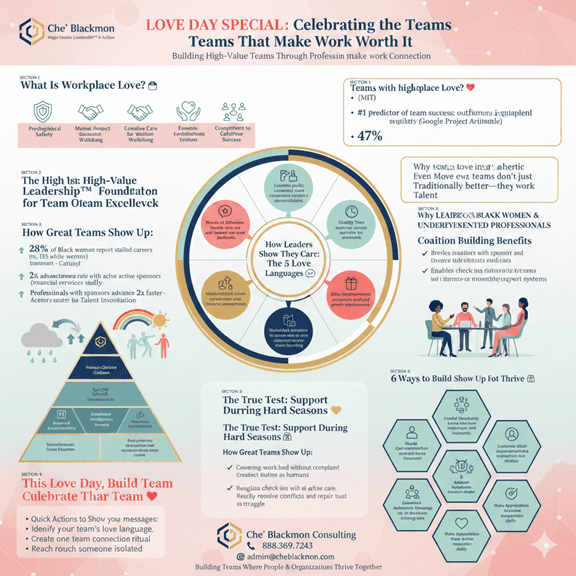
Just as Gary Chapman’s “Five Love Languages” describes how people express and receive love in romantic relationships, there are distinct ways leaders demonstrate professional care and teams experience feeling valued. Understanding these leadership love languages helps us both give and receive appreciation more effectively.

Words of Affirmation

Some team members thrive on verbal recognition and specific feedback. They need to hear “that presentation was excellent” or “your analysis changed my thinking.” For Black women, who often receive less recognition than similarly performing peers, words of affirmation carry extra weight. Specific, public acknowledgment of contributions combats invisibility and validates expertise. High-value leaders master the art of meaningful affirmation that goes beyond generic praise to recognize specific contributions and their impact.

Acts of Service

Actions speak louder than words for many professionals. Leaders who demonstrate care through service might clear obstacles blocking their team’s progress, take administrative burdens off someone’s plate, or personally advocate for resources the team needs. There was a director who noticed her team spending hours on manual data compilation. Rather than simply acknowledging their frustration, she worked with IT to automate the process, freeing up twenty hours weekly for more strategic work. Her team felt profoundly valued because she invested her political capital and time in solving their problem.

Quality Time

In our calendars-packed work culture, giving someone your undivided attention is a powerful expression of care. Leaders who practice the quality time love language schedule regular one-on-ones and actually show up present, phones down, listening actively. They create space for career development conversations that aren’t rushed. They remember what team members shared previously and follow up. For professionals from underrepresented backgrounds, having a leader who consistently makes time signals that your development matters and your perspective is valued.

Gifts (Opportunities)

In professional contexts, gifts take the form of opportunities: the chance to lead a high-visibility project, an invitation to present to executives, sponsorship for a development program, or a stretch assignment that builds new capabilities. Leaders who understand this love language actively look for opportunities to give their team members experiences that accelerate growth. They think strategically about who would benefit from which opportunity and make intentional matches. As I emphasize in “Mastering a High-Value Company Culture,” investing in people’s development is how you build sustainable high-value cultures.

Physical Touch (Professional Boundaries)

In workplace contexts, this translates to appropriate expressions of human connection and solidarity: the fist bump after a big win, the supportive hand on a shoulder during a difficult moment, or the team huddle before a major presentation. These gestures must always respect professional boundaries and individual comfort levels, but for some people, appropriate physical expressions of solidarity strengthen team bonds. The key is reading cues, respecting boundaries, and never making physical contact a requirement for belonging.

Understanding your own leadership love language and those of your team members creates more effective appreciation. When recognition doesn’t land, it’s often not lack of effort but mismatch in language. The leader who gives public praise to someone who values quality time might miss the mark. The team member who needs words of affirmation might not fully receive acts of service. High-value leaders learn to express care in the languages their team members understand and value.

Breaking Isolation: Coalition Building as Love in Action 🤝

For professionals from traditionally overlooked backgrounds, particularly Black women, workplace isolation is more than uncomfortable; it’s career limiting. When you’re the only person who looks like you in meetings, when your experiences go unrecognized, when you lack advocates who understand your challenges, professional growth becomes exponentially harder. Coalition building, the intentional formation of supportive professional relationships, is love in action.

Research from the Center for Talent Innovation shows that Black women are more likely than any other group to report feeling stalled in their careers, with 28% saying their career advancement has stalled compared to 13% of white women. This stalling isn’t due to lack of ambition or capability; it’s often due to lack of sponsorship, advocacy, and coalitions. When organizations build cultures where coalition formation is encouraged and supported, everyone benefits but the impact on underrepresented professionals is transformative.

There was a financial services firm that deliberately created “advocacy circles” where senior leaders committed to actively sponsoring emerging talent from underrepresented backgrounds. Unlike traditional mentoring, which is often passive, sponsorship requires active advocacy: recommending people for opportunities, using social capital to open doors, and sharing institutional knowledge that helps navigate organizational politics. The firm tracked outcomes and found that professionals with active sponsors advanced to leadership positions at twice the rate of those without. More importantly, participants reported feeling genuinely supported and valued rather than isolated and invisible.

In “Rise & Thrive,” I discuss the critical importance of building strategic alliances and finding your people in corporate spaces. This isn’t about networking for superficial gain; it’s about finding genuine professional relationships that sustain you through challenges, celebrate your wins, and help you navigate organizational complexities. When Black women support each other rather than competing for limited seats, when allies use their privilege to create opportunities, when leaders actively work to break isolation, that’s workplace love manifesting as tangible career impact.

Tough Love: Feedback as Care 📝

True professional love includes tough conversations. The colleague who tells you when your presentation missed the mark. The leader who gives you critical feedback on a project. The peer who lets you know your approach is creating unintended problems. These honest conversations, delivered with care and respect, are profound expressions of professional love because they prioritize your growth over comfort.

However, research shows significant disparities in how feedback is delivered across demographic groups. Black women are more likely to receive vague feedback, personality-based criticism rather than behavior-specific guidance, and evaluation that questions their capability rather than addressing specific performance issues. When feedback is delivered with genuine care for development rather than as criticism or dismissal, it transforms from potentially harmful to profoundly helpful.

High-Value Leadership™ emphasizes balanced accountability: maintaining high standards within psychologically safe environments. This means giving honest feedback while also creating conditions where people can receive it constructively. The leader who says “I care about your success too much to let this slide” before difficult feedback signals that the conversation comes from care rather than criticism. The peer who follows tough feedback with “How can I support you in addressing this?” demonstrates that honesty and support aren’t contradictory.

There was a manufacturing company that implemented “growth conversations” replacing traditional performance reviews. These quarterly dialogues focused on development rather than evaluation, with structured frameworks ensuring feedback was specific, actionable, and delivered with genuine care for growth. Managers received training on delivering feedback without bias and creating psychological safety. The company tracked results and found that engagement scores improved 31%, internal mobility increased 42%, and employees consistently rated these conversations as more valuable than previous review processes. The shift from evaluative to developmental feedback, grounded in genuine care for people’s growth, transformed how the organization approached talent development.

Celebrating Wins Together: The Joy of Collective Success 🎉

One of the clearest indicators of healthy team relationships is how people respond to each other’s successes. In competitive cultures characterized by scarcity mindset, one person’s win feels like another’s loss. In high-value cultures built on genuine professional care, celebrating others’ victories comes naturally because collective success matters more than individual glory.

When a colleague gets promoted, do people genuinely celebrate or quietly resent? When a team member wins an award, does the team share pride or feel overlooked? When someone lands a major account, does everyone feel the victory or just the individual? These questions reveal the quality of professional relationships and the health of organizational culture. Teams that genuinely love and support each other experience collective joy in individual triumphs.

For Black women whose successes are often minimized or attributed to factors other than capability and hard work, having colleagues who genuinely celebrate achievements matters enormously. When your team makes your promotion their win, when your presentation success feels like a collective triumph, when your award is celebrated as team validation, you experience true belonging. This celebratory culture doesn’t happen automatically; it requires intentional cultivation by leaders committed to abundance thinking and collective success.

There was a consulting firm that created “win walls” in every department where team members posted not just client victories but also personal professional achievements, colleague recognitions, and team milestones. During monthly gatherings, teams celebrated these wins together, with colleagues sharing what others’ successes meant to them. This practice normalized celebration, made recognition collective rather than hierarchical, and built cultures where people genuinely wanted each other to succeed. The firm found that teams with highly engaged win walls had stronger collaboration metrics, better client satisfaction scores, and lower voluntary turnover. The practice of collective celebration strengthened professional bonds and reinforced that everyone’s success matters.

When Teams Carry Each Other: Support During Hard Seasons 🌧️

The truest test of team relationships comes during difficult seasons. When someone faces personal crisis, health challenges, family emergencies, or professional setbacks, how does the team respond? In transactional workplace cultures, people are on their own during hard times. In high-value cultures characterized by genuine professional care, teams show up for each other when it matters most.

This support takes many forms. Colleagues quietly covering responsibilities so someone can attend to family needs. Teams rallying to help a struggling member meet deadlines. Leaders creating flexibility during personal crises without requiring detailed justification. Peers checking in regularly during difficult periods not to gossip but to offer genuine support. These acts of professional solidarity strengthen bonds and create cultures where people feel safe being human.

For Black women who often feel pressure to appear strong and invulnerable at work, having teams that create space for vulnerability and struggle is particularly valuable. Research shows that Black women face “strong Black woman” stereotypes that make showing weakness feel risky. When teams normalize struggle and create genuine support systems, these stereotypes lose their power. People can be honest about challenges without fear of being perceived as weak or less capable.

There was a technology company where an engineer faced a family medical crisis requiring frequent absences over several months. Rather than treating this as a performance problem, the team restructured responsibilities, created backup systems, and maintained full salary and benefits throughout the crisis. Team members sent regular messages of support, covered workload without complaint, and celebrated when the crisis resolved and the engineer returned. Years later, this engineer became one of the company’s most loyal and productive contributors, and the story of how the team showed up became part of organizational lore about what their culture values. The investment in caring for people during hard times paid dividends in loyalty, engagement, and cultural strength.

Building the Kind of Team Culture Worth Celebrating 🏗️

Creating teams characterized by genuine professional care and mutual support doesn’t happen accidentally. It requires intentional cultivation by leaders committed to High-Value Leadership™ principles. Here are practical strategies for building cultures where workplace relationships thrive:

Model Vulnerability and Authenticity

Leaders set the tone for team relationships. When leaders share appropriate struggles, admit mistakes, and show humanity, they give permission for others to do the same. This doesn’t mean oversharing or making yourself the center of attention; it means being genuine about challenges and showing that perfection isn’t required. As I discuss in my work on High-Value Leadership™, authentic connection starts with leaders willing to be real.

Create Structured Opportunities for Connection

Don’t leave relationship building to chance. Create regular opportunities for team members to connect as humans, not just as functional roles. This might include team lunches without work agendas, walking meetings, virtual coffee chats, or structured sharing time in team meetings. The key is making connection an expected part of team culture rather than an afterthought.

Reward Collaborative Behavior

What gets recognized gets repeated. If you only celebrate individual achievement, you’ll get individual competitors. If you recognize and reward people who help others succeed, share knowledge generously, and prioritize team wins, you’ll build collaborative cultures. Make supporting colleagues a valued and visible part of what success looks like in your organization.

Address Relationship Damage Quickly

When team relationships fracture due to conflict, misunderstanding, or breach of trust, address it promptly. Unresolved relationship damage festers and spreads, poisoning team culture. High-value leaders facilitate difficult conversations, help people repair breaches, and sometimes make tough decisions about team members whose behavior damages relationships beyond repair.

Build Inclusive Practices That Combat Isolation

For professionals from underrepresented backgrounds, feeling included and valued requires intentional practice. This means ensuring all voices are heard in meetings, distributing high-visibility opportunities equitably, interrupting bias when it occurs, and creating formal structures like employee resource groups or mentoring programs that combat isolation. In “Rise & Thrive,” I outline specific strategies for creating inclusive environments where Black women and other traditionally overlooked professionals can thrive.

Make Appreciation a Regular Practice

Don’t wait for Valentine’s Day or annual reviews to express appreciation. Build regular practices of recognition and gratitude into team rhythms. This might include starting meetings with appreciations, creating channels for peer recognition, or establishing rituals that normalize expressing thanks and acknowledging contributions. When appreciation becomes routine rather than rare, it strengthens relationship bonds and reinforces positive culture.

Key Takeaways 🔑

As we celebrate Love Day, let’s honor the professional relationships that make work meaningful and productive:

  1. Workplace love, defined as genuine care, mutual respect, and commitment to collective success, drives measurable performance improvements including higher innovation, better retention, and increased productivity.
  2. High-quality team relationships characterized by psychological safety and authentic connection create environments where everyone, particularly traditionally overlooked professionals, can thrive.
  3. Leaders demonstrate care through different “love languages” including words of affirmation, acts of service, quality time, meaningful opportunities, and appropriate professional connection.
  4. Coalition building and active sponsorship combat isolation for Black women and other underrepresented professionals, creating tangible career advancement opportunities.
  5. Honest feedback delivered with genuine care for development, rather than criticism, accelerates growth and strengthens professional relationships.
  6. Teams that celebrate collective success and support each other during difficult seasons build bonds that enhance both individual wellbeing and organizational performance.
  7. Creating cultures worth celebrating requires intentional leadership practices including modeling vulnerability, creating connection opportunities, rewarding collaboration, and addressing relationship damage promptly.

Discussion Questions 💭

Reflect on these questions individually or discuss them with your team:

  • Think about a team or colleague that made work feel meaningful. What specific behaviors or qualities created that experience? How might you cultivate those same qualities in your current professional relationships?
  • Which “leadership love language” (words, actions, time, opportunities, appropriate connection) do you most value receiving? Which do you default to giving? Is there a mismatch that might be affecting your relationships?
  • For leaders: How does your team celebrate individual and collective wins? Are celebrations authentic and inclusive, or do they feel performative or leave people out?
  • For professionals from underrepresented backgrounds: Do you have genuine allies and sponsors who actively advocate for you? If not, what would it take to build those coalitions? If yes, how might you pay that forward?
  • How does your organization handle difficult seasons when team members face personal or professional challenges? Does the culture create space for vulnerability and support, or is there pressure to hide struggle?
  • What’s one concrete practice you could implement in the next month to strengthen professional relationships on your team?

Next Steps: Expressing Professional Appreciation 👣

This Love Day, move beyond reflection to action. Here are specific ways to express professional appreciation and strengthen team relationships:

Write Three Specific Thank You Messages: Identify three colleagues, direct reports, or leaders who have impacted your professional life. Write specific, detailed messages explaining exactly what they did that mattered and how it affected you or the organization. Be concrete rather than generic. Send these messages this week.

Identify Your Team’s Love Language: Pay attention to how your team members respond to different forms of appreciation. Do they light up at public recognition or prefer private feedback? Do they value time investment or tangible opportunities? Adjust your appreciation style to match what each person values.

Create a Team Ritual: Propose one small ritual that builds team connection. This might be starting meetings with appreciations, establishing weekly coffee chats, creating a recognition channel, or implementing “win of the week” sharing. Start small and build consistency.

Reach Out to Someone Isolated: Think about colleagues who might feel isolated or overlooked in your organization, particularly those from underrepresented backgrounds. Reach out with genuine interest in their experience and perspective. Offer specific support if appropriate, or simply listen and validate.

Audit Your Team Culture: If you’re a leader, conduct an honest assessment of your team’s relationship health. Do people support each other or compete? Is vulnerability safe or risky? Are celebrations authentic and inclusive? Identify one area for improvement and create a specific action plan.

Be the Support You Wish You Had: Think about what you wish colleagues had done for you during challenging times. Commit to being that person for others. Look for opportunities to cover workload, offer flexibility, or simply check in with genuine care when someone is struggling.

Final Thoughts 💡

This Love Day, as candy hearts and roses dominate the cultural conversation, let’s also celebrate the professional love that sustains us: the teams that make hard work feel meaningful, the colleagues who see our potential and help us reach it, the leaders who invest in our growth, and the cultures where everyone can bring their authentic selves and thrive.

These relationships aren’t fluffy feel-good extras; they’re the foundation of high-performing organizations. When we invest in building genuine professional care, mutual respect, and collective commitment, we create cultures where innovation flourishes, people stay and grow, and work feels like something more than just a paycheck. We create environments worthy of celebration not just on Valentine’s Day but every day.

For Black women and other professionals from traditionally overlooked backgrounds, these relationships are particularly crucial. They’re the difference between surviving and thriving, between feeling isolated and feeling genuinely valued, between stalled careers and accelerated advancement. When organizations get team relationships right, when they build cultures characterized by authentic care and mutual support, everyone benefits but the impact on those who have historically been marginalized is transformative.

As I’ve learned through twenty-four years of building and transforming organizational cultures, the teams that make work worth it aren’t accidents. They’re the result of intentional leadership, consistent practice, and genuine commitment to each other’s success. They reflect High-Value Leadership™ principles in action: purpose-driven vision, stewardship of culture, emotional intelligence, balanced accountability, and authentic connection.

So this Love Day, take time to appreciate the teams that make your work meaningful. Express gratitude to colleagues who show up for you. Commit to being the kind of team member others are grateful to work with. And if you’re a leader, dedicate yourself to building cultures where genuine professional care thrives and everyone can bring their best selves to work.

The teams worth celebrating are the ones we intentionally create through daily choices to care, support, challenge, and champion each other. That’s the kind of workplace love that deserves recognition every single day.

Ready to Build Teams That Thrive? 🌟

At Che’ Blackmon Consulting, we specialize in transforming organizational cultures and building high-value teams where genuine professional care drives measurable results. Whether you’re looking to:

  • Strengthen team relationships and build psychological safety
  • Create inclusive cultures where diverse talent thrives
  • Develop leadership capabilities that foster authentic connection
  • Transform competitive dynamics into collaborative partnerships
  • Build strategic HR infrastructure that supports relational culture

We bring over two decades of progressive HR leadership experience combined with cutting-edge research in organizational transformation. Our High-Value Leadership™ methodology has helped organizations across industries build cultures where both people and businesses flourish together.

Let’s talk about how to build teams worth celebrating in your organization. We offer complimentary consultation calls to explore your needs and discuss how we can support your culture transformation journey.

Contact Che’ Blackmon Consulting Today:

📧 Email: admin@cheblackmon.com

📞 Phone: 888.369.7243

🌐 Website: cheblackmon.com

About the Author 👩🏾‍💼

Che’ Blackmon is the Founder and CEO of Che’ Blackmon Consulting, a Michigan-based fractional HR and culture transformation consultancy. With 24+ years of progressive HR leadership experience across manufacturing, automotive, healthcare, and professional services sectors, she has consistently delivered measurable results including 9% engagement increases, 60% safety improvements, and successful culture transformations for organizations ranging from startups to Fortune 500 companies.

Currently pursuing a Doctor of Business Administration (DBA) in Organizational Leadership at National University, Che’ is developing Michigan’s first AI-powered culture transformation platform that predicts employee turnover 3-6 months in advance. Her dissertation research focuses on AI-enhanced predictive analytics for culture transformation and employee retention.

Che’ is the published author of three books on leadership and organizational culture: “High-Value Leadership: Transforming Organizations Through Purposeful Culture,” “Mastering a High-Value Company Culture,” and “Rise & Thrive: A Black Woman’s Blueprint for Leadership Excellence.” She hosts the twice-weekly podcast “Unlock, Empower, Transform with Che’ Blackmon” and the “Rise & Thrive” YouTube series.

Her work focuses on creating high-value cultures where both people and organizations thrive, with particular attention to advancing opportunities for Black women and other traditionally overlooked professionals in corporate spaces.

#LoveDay #ValentinesDay #TeamAppreciation #WorkplaceCulture #HighValueLeadership #TeamExcellence #LeadershipDevelopment #PsychologicalSafety #TeamLove #OrganizationalCulture #ProfessionalAppreciation #EmployeeEngagement #TeamSuccess #LeadershipMatters #CelebrateTeams

Office Politics for People Who Hate Politics: A Survival Guide 🎯

By Che’ Blackmon, DBA Candidate | Founder & CEO, Che’ Blackmon Consulting

Author of High‐Value Leadership, Mastering a High‐Value Company Culture & Rise & Thrive

💡 Let’s Be Honest: Nobody Taught You This in School

You went to school, earned your degree, sharpened your skills, and showed up to the workplace ready to contribute. Then, somewhere between your first team meeting and your first performance review, you realized something unsettling: the rules of the game were never written down.

Office politics. Just hearing those two words makes most people cringe. It conjures images of backstabbing, favoritism, gossip, and manipulation. And for many professionals, especially Black women and other traditionally overlooked groups, the terrain of office politics can feel less like a game and more like a minefield.

But here is the truth that changed my entire approach to organizational culture: office politics is not optional. It exists in every workplace, in every industry, at every level. The question is not whether politics exists. The question is whether you will learn to navigate it with integrity, or let it navigate you.

This article is your survival guide. Whether you are a new professional finding your footing, a mid career leader seeking the next level, or an executive trying to build a healthier culture, this guide will equip you with the practical strategies to thrive in politically charged environments without compromising who you are.

🔍 Section 1: Understanding Office Politics (It’s Not What You Think)

Redefining the Term

Office politics, at its core, is simply the way power, influence, and relationships operate within an organization. That is it. It is the informal network of decision making that runs alongside the official org chart. It is who gets heard in meetings, whose ideas get funded, who receives mentorship, and whose contributions are celebrated versus overlooked.

In Mastering a High‐Value Company Culture, I write extensively about the invisible systems that shape organizational life. Culture is not just what a company puts on its website. It is what happens when leadership is not watching. And office politics is one of the most powerful forces shaping that reality.

📊 What the Research Says

A 2023 study published by the Harvard Business Review found that 93% of employees believe office politics exist in their workplace, yet fewer than 25% feel equipped to navigate them effectively. The gap between awareness and capability is enormous, and it disproportionately affects people who were never given access to the unwritten playbook.

Research from McKinsey’s Women in the Workplace 2023 report reinforces what many of us already know: Black women are significantly less likely to have sponsors (not just mentors, but sponsors) who advocate for their advancement behind closed doors. When the political landscape requires someone in the room to say your name with conviction, the absence of sponsorship is not a minor inconvenience. It is a career limiting reality.

✨ Politics Is Not the Problem. Toxic Politics Is.

There is an important distinction to draw here. Healthy organizational politics involves building genuine relationships, advocating for your work and your team, and understanding how decisions are made so you can be part of the conversation. Toxic politics, on the other hand, involves manipulation, exclusion, dishonesty, and hoarding of information.

High value leaders, as I describe in High‐Value Leadership: Transforming Organizations Through Purposeful Culture, do not avoid politics altogether. They transform the political environment by leading with transparency, accountability, and genuine care for people. That is the standard we should aspire to.

🎯 Section 2: Why Avoidance Is Not a Strategy

If you are someone who says, “I just put my head down and do good work,” this section is especially for you.

The belief that excellent work speaks for itself is one of the most dangerous myths in professional life. It sounds noble. It feels righteous. And in a perfect world, it would be true. But organizations are run by people, and people are influenced by relationships, visibility, and perception just as much as they are by performance metrics.

🚨 The Cost of Opting Out

Consider this scenario. There was a company where a senior operations manager consistently delivered outstanding results. She exceeded her KPIs every quarter, solved problems before they became crises, and earned the deep respect of her direct reports. Yet year after year, she was passed over for promotion in favor of colleagues whose results were objectively less impressive but whose visibility within the executive suite was far greater.

What happened? She had opted out of the political landscape. She did not attend optional leadership meetings. She did not build relationships with decision makers outside her direct chain of command. She assumed her work was enough. It was not.

This story repeats itself across industries, and it repeats with particular frequency for Black women and other professionals from traditionally overlooked backgrounds. In Rise & Thrive: A Black Woman’s Blueprint for Leadership Excellence, I address this pattern directly. The systems were not designed with us in mind, but that does not mean we are powerless within them. It means we must be strategic, intentional, and unapologetically visible.

📋 The Visibility Gap

A 2024 Lean In study revealed that Black women are 1.5 times more likely than white women to report that their contributions go unrecognized at work. Additionally, they are significantly more likely to experience the “only” phenomenon, where they are the sole person of their race and gender in the room. Being the “only” adds an extra layer of political complexity because every action is scrutinized, every misstep feels amplified, and the emotional labor of navigating these dynamics is constant and exhausting.

Avoidance is not neutrality. In the context of office politics, silence is a position, and it is rarely one that works in your favor.

🛠️ Section 3: The Survival Toolkit – 7 Strategies for Navigating Office Politics with Integrity

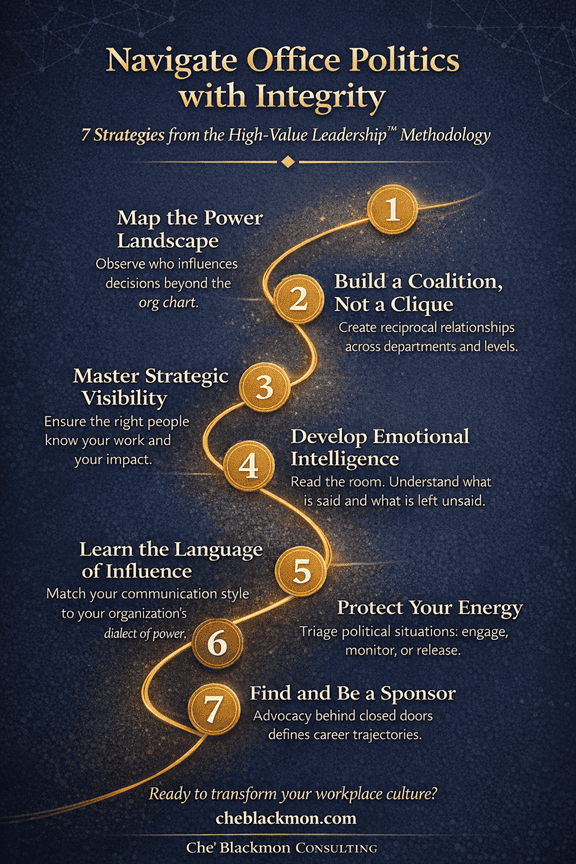
1️⃣ Map the Power Landscape

Every organization has a formal structure and an informal one. The formal structure is the org chart. The informal structure is the web of influence, trust, and information flow that actually drives decisions.

Actionable Step: Spend two weeks observing. Who do leaders consult before making decisions? Whose opinions carry weight in meetings even when they are not the most senior person present? Who controls access to information or resources? Write these observations down. This is your political map, and it is one of the most valuable tools you can develop.

2️⃣ Build a Coalition, Not a Clique

Relationships are the currency of influence. But there is a critical difference between building a broad coalition of trusted colleagues and retreating into a small, insular group. Cliques breed suspicion. Coalitions build organizational strength.

Actionable Step: Identify three to five people across different departments, levels, and backgrounds with whom you can build genuine, reciprocal relationships. Offer value before asking for it. Share information, make introductions, and celebrate their wins publicly.

3️⃣ Master the Art of Strategic Visibility

Visibility does not mean self promotion. It means ensuring that the right people know about your work, your expertise, and your aspirations. There is nothing arrogant about wanting your contributions to be seen.

Actionable Step: Start a practice of sending brief, regular updates to your manager and key stakeholders. Keep them factual and concise. Include impact metrics where possible. Frame your work in terms of organizational outcomes, not personal achievement. For example, instead of saying “I completed the project,” say “The new process reduced turnaround time by 30%, supporting our Q3 efficiency goals.”

4️⃣ Develop Your Emotional Intelligence

Political navigation requires reading the room. It requires understanding not just what people say, but what they mean, what they fear, and what they need. Emotional intelligence is the foundation of effective political navigation.

According to Daniel Goleman, whose research has shaped the field of emotional intelligence in leadership, leaders with high EQ outperform their peers by an average of 20% in performance outcomes. The ability to regulate your own emotions while accurately reading others is not a “soft skill.” It is a leadership superpower.

Actionable Step: After every significant meeting or interaction, ask yourself three questions. What emotions were present in the room? What was left unsaid? What does this tell me about the priorities and concerns of the people involved? This practice builds your political awareness exponentially over time.

5️⃣ Learn the Language of Influence

Every organization has its own dialect of power. Some companies value data driven arguments. Others respond to storytelling. Some prioritize consensus building while others reward decisiveness. Understanding the communication style that resonates with your organization’s decision makers is essential.

Actionable Step: Study how successful leaders in your organization communicate. Pay attention to the structure of their presentations, the language they use in emails, and the way they frame proposals. Adapt your communication style to meet decision makers where they are, while remaining authentic to your own voice.

6️⃣ Protect Your Energy and Set Boundaries 🔋

Political navigation is exhausting, especially when you are also managing the additional weight of being underestimated, stereotyped, or overlooked. You cannot pour from an empty cup, and you cannot fight every battle.

Actionable Step: Develop a personal “political triage” system. Categorize situations into three buckets: (1) must engage because it directly impacts your career, your team, or your values, (2) should monitor because it may become relevant, and (3) release because it does not serve you and engaging will only drain your energy. This framework helps you focus your political capital where it matters most.

7️⃣ Find and Be a Sponsor

Mentors advise you. Sponsors advocate for you when you are not in the room. The difference between the two can define the trajectory of a career.

In Rise & Thrive, I emphasize that sponsorship is particularly vital for Black women, who are often excluded from the informal networks where sponsorship relationships naturally develop. But sponsorship is a two way street. As you rise, you have a responsibility to sponsor others, particularly those from backgrounds that are traditionally underrepresented.

Actionable Step: Identify one person in a position of influence who has demonstrated genuine investment in your growth. Build the relationship intentionally over time by delivering excellent work, seeking their counsel, and being transparent about your career goals. Simultaneously, identify one person who is earlier in their career whom you can begin to sponsor.

🏢 Section 4: The Organizational Responsibility

Let us be clear: the burden of navigating office politics should not rest solely on the shoulders of individual employees. Organizations have a profound responsibility to create cultures where political maneuvering is not required for basic fairness, where advancement is transparent, and where every voice is genuinely valued.

📈 Building a High Value Culture

This is the heart of the work I do through Che’ Blackmon Consulting and the foundation of Mastering a High‐Value Company Culture. A truly high value culture is one where:

✅ TransparencyDecision making processes are clear and accessible to all employees, not just those with inside connections.
✅ EquityAdvancement criteria are explicit, consistently applied, and regularly audited for bias.
✅ BelongingEvery employee, regardless of background, feels psychologically safe to speak up, challenge ideas, and be their authentic self.
✅ AccountabilityLeaders at every level are held to the same standards they expect from their teams.
✅ RecognitionContributions are acknowledged based on impact, not proximity to power.

When organizations invest in building these cultural foundations, the need for individuals to navigate toxic politics diminishes significantly. The playing field becomes more level, and the energy that employees would have spent on political survival gets redirected toward innovation, collaboration, and growth.

💪 Section 5: A Special Note for Black Women in Corporate Spaces

If you are a Black woman reading this, I want to speak to you directly for a moment.

You are not imagining it. The political terrain is different for you. Research consistently confirms what you have experienced in conference rooms, performance reviews, and hallway conversations. You face a unique intersection of racial and gender bias that creates what scholars call a “double bind,” where you are simultaneously held to higher standards and given less grace for mistakes.

A 2023 report by the National Partnership for Women and Families found that Black women earn 67 cents for every dollar earned by white, non Hispanic men. That pay gap is not just a compensation issue. It is a reflection of systemic political dynamics within organizations that undervalue the contributions of Black women at every level.

“Your presence in the room is not an accident. It is an achievement. And your ability to thrive in that room is not about changing who you are. It is about understanding the environment and using your power strategically.”

This is precisely why I wrote Rise & Thrive: A Black Woman’s Blueprint for Leadership Excellence. Because general career advice, while helpful, does not always account for the specific challenges that Black women face. You deserve guidance that speaks to your experience, validates your reality, and equips you with strategies that work within the world as it is while you help build the world as it should be.

Five Power Moves for Black Women Navigating Office Politics 👑

🔹 Document Everything. Keep a running record of your accomplishments, your contributions to team projects, and any feedback you receive. This is not paranoia. It is professional self preservation.

🔹 Cultivate Your Inner Circle Wisely. Seek out trusted allies, both within and outside your organization, who understand the unique dynamics you navigate. Community is not a luxury. It is a necessity.

🔹 Negotiate from Data, Not Emotion. When advocating for yourself, lead with impact data and market benchmarks. Prepare thoroughly and practice with trusted advisors so that your confidence is rooted in preparation.

🔹 Reject the Superwoman Complex. You do not have to be twice as good to earn half the recognition. That narrative, while born from real experience, can lead to burnout. Give yourself permission to be excellent without being exhausted.

🔹 Amplify Other Black Women. When you gain influence, use it. Recommend other Black women for opportunities, invite them into rooms they have been excluded from, and publicly champion their expertise. Collective advancement is the most powerful form of political strategy.

📊 Section 6: Current Trends Shaping Office Politics in 2025 and Beyond

🤖 The Rise of AI and Its Political Implications

As artificial intelligence transforms the workplace, new political dynamics are emerging. Decisions about which roles are augmented, which are automated, and who controls AI driven processes are deeply political. Employees who understand AI and can articulate its value are gaining significant organizational influence, while those who resist it risk being marginalized in the conversation.

Organizations that approach AI implementation transparently and inclusively, rather than allowing it to be driven by a small, insular group, will create healthier political environments and better outcomes for all employees.

🏠 Hybrid Work and the New Proximity Bias

The shift to hybrid and remote work has fundamentally reshaped office politics. Proximity bias, where employees who are physically present in the office receive more opportunities and visibility, has become one of the most significant political challenges of this era. Research from Stanford University’s Nick Bloom has shown that remote workers are 50% less likely to receive promotions compared to their in office counterparts, even when performance is equivalent.

For Black women and other traditionally overlooked professionals, this presents a complex calculus. Remote work may offer relief from daily microaggressions and the emotional tax of being the “only,” but it may also reduce the visibility that is essential for advancement. There is no one size fits all answer, but awareness of this dynamic is critical for making informed career decisions.

🌐 The Growing Demand for Authentic Leadership

One of the most encouraging trends in organizational leadership is the growing demand for authenticity. Employees, particularly younger generations, are increasingly unwilling to tolerate leaders who operate through manipulation and opacity. They want leaders who are transparent, values driven, and genuinely invested in the wellbeing of their teams. This is the essence of what I call High‐Value Leadership, and it represents a fundamental shift in the political expectations of the modern workplace.

✅ Section 7: Your Action Plan – Starting Monday

Knowledge without action is just trivia. Here is your week by week plan for putting these strategies into practice.

📅 Week 1: Observe and Map. Spend this week mapping the informal power structure of your organization. Identify the key influencers, the decision making patterns, and the communication channels that matter most. Write it down.

📅 Week 2: Connect and Build. Reach out to one new person outside your immediate team. Have a genuine conversation about their work, their challenges, and their goals. Plant the seed of a coalition.

📅 Week 3: Speak Up and Be Seen. Volunteer for a visible project or initiative. Share an insight in a meeting that demonstrates your expertise. Send an update to your manager that highlights your recent impact.

📅 Week 4: Reflect and Refine. Review what you have learned. What surprised you about the political landscape? Where do you need to invest more energy? What boundaries do you need to strengthen? Adjust your approach accordingly.

💬 Discussion Questions for Teams and Individuals

Whether you are reflecting on your own, journaling, or facilitating a team conversation, these questions are designed to deepen your understanding and inspire action.

1. What is one political dynamic in your current workplace that you have been avoiding? What would it look like to engage with it strategically rather than ignore it?

2. Think about a time when someone’s advocacy (or lack thereof) directly impacted your career. What did that experience teach you about the power of sponsorship?

3. How does your organization’s culture reward visibility? Are those rewards distributed equitably, or do certain groups have more natural access to visibility opportunities?

4. In what ways can you begin to sponsor or advocate for a colleague from a traditionally overlooked background this month?

5. If you could change one thing about the political culture of your workplace, what would it be? What is one step you can take to begin that change?

🚀 Next Steps: Let’s Transform Your Workplace Together

Office politics does not have to be a source of dread. With the right strategies, the right mindset, and the right support, you can navigate any organizational environment with confidence and integrity.

At Che’ Blackmon Consulting, we partner with organizations and leaders to build high value cultures where politics serve the mission, not undermine it. Whether you need fractional HR leadership, culture transformation consulting, or keynote speaking that moves your team to action, we are here to help.

🌟 Ready to Build a High‐Value Culture? Connect with Che’ Blackmon Consulting today. 📧  admin@cheblackmon.com 📞  888.369.7243 🌐  cheblackmon.com

📚 Explore Che’’s Books:

High‐Value Leadership: Transforming Organizations Through Purposeful Culture

Mastering a High‐Value Company Culture

Rise & Thrive: A Black Woman’s Blueprint for Leadership Excellence

Because you deserve a workplace where your talent is recognized, your voice is valued, and your potential is limitless. ✨

#OfficePolitics #WorkplaceCulture #LeadershipDevelopment #HighValueLeadership #BlackWomenInLeadership #CorporateSurvivalGuide #CareerStrategy #WorkplaceEquity #WomenInLeadership #ProfessionalGrowth #CultureTransformation #BlackWomenAtWork #ExecutivePresence #SponsorshipMatters #EmotionalIntelligence #StrategicVisibility #LeadershipTips #CheBlackmonConsulting #RiseAndThrive #PurposefulCulture

🤝 The Connection Economy: Why Relationships Drive Results 🤝

By Che’ Blackmon, DBA Candidate | Founder & CEO, Che’ Blackmon Consulting

We have entered a new era of business. The old economy rewarded those who hoarded information, guarded resources, and climbed over others to reach the top. But that economy is fading. In its place, something far more powerful has emerged: the connection economy.

In this new landscape, relationships are currency. Trust is capital. And the leaders who invest in genuine human connection are the ones generating extraordinary results.

This is not soft leadership. This is smart leadership. Research consistently shows that organizations with strong relational cultures outperform their competitors in every measurable way. They attract better talent. They retain employees longer. They innovate faster. They weather crises more effectively. The data is clear: connection drives results.

🌐 What Is the Connection Economy?

The term “connection economy” describes a fundamental shift in how value is created and exchanged in the modern workplace. Unlike the industrial economy that valued efficiency above all else, or the knowledge economy that prioritized information, the connection economy recognizes that sustainable success flows through relationships.

Seth Godin, who popularized this concept, argues that in an age of automation and artificial intelligence, human connection has become the most valuable and irreplaceable commodity. Machines can process data. Algorithms can optimize operations. But only humans can build the trust, empathy, and collaborative spirit that transforms good organizations into great ones.

As I explore in High-Value Leadership: Transforming Organizations Through Purposeful Culture, the most effective leaders understand that their primary job is not managing tasks but cultivating relationships. They create environments where people feel seen, valued, and connected to something larger than themselves.

📊 The Business Case for Connection

If you need to convince skeptics that relationships matter, the numbers tell a compelling story.

According to Gallup’s State of the Global Workplace report, employees who have a best friend at work are seven times more likely to be engaged in their jobs. They produce higher quality work, have better safety records, and are significantly less likely to leave. Yet only three in ten employees strongly agree that they have a best friend at work, representing a massive untapped opportunity for organizations willing to prioritize connection.

Research from MIT’s Human Dynamics Laboratory found that patterns of communication are the most important predictor of a team’s success. Not the content of discussions. Not individual intelligence. But the frequency, energy, and inclusiveness of interactions. Teams that communicate in certain patterns, with members engaging equally and face to face, consistently outperform teams that do not.

A landmark study published in Harvard Business Review found that companies with highly connected cultures experienced 2.5 times higher revenue growth over a three year period compared to companies with disconnected cultures. The researchers concluded that connection was not just a “nice to have” but a significant competitive advantage.

💫 Connection and the Overlooked Leader

For traditionally overlooked talent in corporate spaces, particularly Black women in leadership, the connection economy presents both unique challenges and powerful opportunities.

The challenges are real. Research from LeanIn.Org and McKinsey’s Women in the Workplace study consistently shows that Black women are less likely to have access to senior leaders, less likely to receive sponsorship, and more likely to have their judgment questioned. They often find themselves excluded from the informal networks where crucial information flows and career advancing relationships form.

In Rise & Thrive: A Black Woman’s Blueprint for Leadership Excellence, I address this reality head on. The connection economy does not automatically level the playing field. Systemic barriers persist. But understanding how connection works provides a strategic framework for navigating and ultimately transforming these systems.

Here is the opportunity: Black women have been building connection economies within their communities for generations. The mutual aid networks, the sisterhood circles, the “each one teach one” mentality that has sustained Black communities through centuries of exclusion represents sophisticated relational intelligence that is now recognized as essential for organizational success.

The skills that have helped Black women survive and thrive despite systemic barriers, including the ability to read rooms, build coalitions across difference, and create belonging from scratch, are precisely the skills the connection economy rewards. The task now is ensuring these contributions are recognized, valued, and compensated appropriately.

🔑 Five Pillars of Connection Driven Leadership

1. Intentional Presence 👁️

Connection begins with presence. Not physical proximity, but genuine attentiveness. In an age of constant distraction, the simple act of giving someone your full attention has become revolutionary.

There was a technology company struggling with cross functional collaboration. Teams worked in silos, communication broke down regularly, and projects consistently missed deadlines. The solution was not a new project management system but a cultural intervention focused on presence. Leaders committed to device free meetings, active listening protocols, and what they called “connection before content” practices where every meeting began with genuine check ins. Within six months, project completion rates improved by 34%.

Action Step: For one week, practice being fully present in every conversation. Put away devices. Make eye contact. Listen to understand rather than to respond. Notice what shifts in your relationships.

2. Psychological Safety 🛡️

Google’s extensive research on team effectiveness, known as Project Aristotle, found that psychological safety was the single most important factor in high performing teams. Psychological safety means team members feel safe to take risks, voice opinions, and be themselves without fear of punishment or humiliation.

This is particularly significant for overlooked leaders. When people must constantly monitor how they are perceived, code switch to fit in, or guard against microaggressions, the cognitive load leaves less capacity for innovation and contribution. Creating psychological safety is not just ethical. It is strategic.

In Mastering a High-Value Company Culture, I outline specific practices for building psychological safety, including normalizing vulnerability from leadership, responding productively to mistakes, and actively seeking dissenting opinions.

Action Step: In your next team meeting, ask a question that invites disagreement, such as “What am I missing?” or “What concerns have we not addressed?” Thank people genuinely when they offer critical perspectives.

3. Strategic Vulnerability 💝

Brené Brown’s research on vulnerability has transformed how we understand leadership. Contrary to traditional models that equated leadership with invulnerability, Brown’s work shows that the willingness to be seen, including strengths and struggles, is what creates genuine connection.

Strategic vulnerability does not mean oversharing or inappropriate emotional displays. It means authentically acknowledging challenges, admitting mistakes, and showing up as a whole human rather than a polished facade. When leaders model this behavior, it gives permission for others to do the same.

There was a financial services firm where the CEO began sharing brief monthly reflections with the entire organization. These were not triumphant announcements but honest assessments that included mistakes made, lessons learned, and areas of uncertainty. Employee surveys showed a 28% increase in trust scores within one year. More importantly, teams throughout the organization began having more honest conversations about challenges, leading to faster problem identification and resolution.

Action Step: Identify one area where you have been projecting certainty despite feeling uncertain. Find an appropriate opportunity to acknowledge that uncertainty with your team. Notice how they respond.

4. Inclusive Networks 🌍

Connection driven leaders do not just build networks. They build inclusive networks that span hierarchies, departments, and demographic groups. They intentionally connect with people who are different from themselves and create opportunities for others to do the same.

Research from organizational network analysis shows that the most innovative ideas and solutions typically emerge at the intersections of different groups rather than within homogeneous clusters. Leaders who bridge diverse networks become conduits for these innovations.

For Black women and other overlooked leaders, building inclusive networks often requires extra intentionality. This might mean joining professional associations, seeking reverse mentoring relationships, or creating affinity groups within organizations. It also means using whatever positional power you have to pull others into networks from which they have been excluded.

Action Step: Map your current professional network. Identify gaps in diversity, whether by role, department, demographic, or perspective. Commit to making three new connections in the next month that begin to fill those gaps.

5. Generative Reciprocity 🔄

The connection economy runs on reciprocity, but not the transactional kind that keeps score. Generative reciprocity means contributing to relationships and communities without immediate expectation of return, trusting that value flows in unexpected ways over time.

Adam Grant’s research on giving and taking in organizations shows that “givers,” those who contribute to others without keeping score, tend to be both the lowest and highest performers. The difference is that successful givers are strategic about how and to whom they give, protecting their energy while maximizing their impact.

There was a healthcare system that implemented what they called “pay it forward” leadership development. Senior leaders were expected to sponsor at least two emerging leaders annually, with particular focus on talent from underrepresented groups. Within three years, the organization’s leadership pipeline diversified significantly, and sponsored leaders showed promotion rates 2.3 times higher than unsponsored peers.

Action Step: Identify someone early in their career who could benefit from your knowledge or connections. Reach out this week with an offer of support, expecting nothing in return.

📈 Connection in the Age of AI and Remote Work

Two major trends are reshaping how we think about connection at work: the rise of artificial intelligence and the normalization of remote and hybrid work arrangements.

Some feared that these trends would diminish human connection. Instead, they have highlighted its irreplaceable value. As AI takes over routine cognitive tasks, the uniquely human abilities to empathize, collaborate, and build trust become even more essential. Organizations are realizing that their competitive advantage lies not in having the best algorithms but in having the strongest relationships.

Remote work has forced organizations to be more intentional about connection. The casual hallway conversations and lunch meetings that once happened organically now require deliberate design. This intentionality, while initially challenging, has led many organizations to develop more inclusive connection practices that work for introverts, caregivers, and employees who were previously excluded from the after hours networking events where relationships traditionally formed.

Current best practices for virtual connection include regular one on one check ins focused on relationships rather than just tasks, virtual coffee conversations paired across departments or levels, asynchronous video messages that convey tone and personality, and hybrid meeting protocols that ensure remote participants are fully included.

🏗️ Building a Connection Culture

Individual leaders can model connection driven behavior, but sustainable transformation requires embedding connection into organizational culture. This means examining systems, structures, and practices through a relational lens.

Questions to consider include: Do our hiring practices assess relational skills alongside technical competencies? Do our performance management systems reward collaboration as much as individual achievement? Do our meeting structures allow for genuine connection or just information transfer? Do our physical and virtual spaces facilitate relationship building? Do our development programs include training on emotional intelligence, active listening, and inclusive leadership?

In Mastering a High-Value Company Culture, I provide frameworks for conducting this kind of cultural audit and implementing changes that strengthen relational infrastructure. The goal is not to add connection initiatives on top of existing practices but to weave connection into the fabric of how work gets done.

🌱 The Ripple Effect of Connected Leadership

When leaders prioritize connection, the effects ripple outward in ways that are difficult to measure but impossible to miss. Teams become more cohesive. Collaboration becomes more fluid. Information flows more freely. Problems get surfaced earlier. Innovation accelerates. People stay longer and contribute more fully.

But perhaps the most profound impact is on the leaders themselves. Leading through connection is more sustainable than leading through control. It distributes the burden of leadership across relationships rather than concentrating it in one person. It creates feedback loops that help leaders learn and grow. It generates the kind of meaning and fulfillment that protects against burnout.

For Black women leaders who have often been expected to carry organizations while receiving the least support, connection driven leadership offers a more reciprocal model. When you invest in relationships, those relationships invest back in you. When you build bridges, those bridges hold you up.

🎯 The Connection Imperative

The connection economy is not a trend that will pass. It is a fundamental shift in how value is created and success is achieved. Organizations and leaders who fail to adapt will find themselves increasingly marginalized, unable to attract talent, unable to innovate, unable to retain the relationships that drive results.

But those who embrace this shift, who invest in relationships as deliberately as they invest in technology or processes, will discover that connection is not just good for business. It is good for the soul. It transforms work from a place where we merely exchange labor for wages into a community where we grow, contribute, and belong.

The question is not whether you can afford to prioritize connection. The question is whether you can afford not to.

💬 Discussion Questions

1. How would you describe the relational health of your current team or organization? What evidence supports your assessment?

2. Which of the five pillars of connection driven leadership represents your greatest strength? Which represents your biggest growth opportunity?

3. How have you experienced or observed the challenges faced by overlooked leaders in building professional networks? What strategies have been effective in overcoming these barriers?

4. In what ways has remote or hybrid work affected relationship building in your organization? What practices have helped maintain or strengthen connection?

5. If you were to audit your organization’s culture through a relational lens, what would you examine first? What changes might you recommend?

🚀 Your Next Steps

Becoming a connection driven leader does not require a complete overhaul of how you work. It begins with small, consistent shifts in attention and intention. This week, choose one of the action steps from this article and commit to implementing it. Pay attention to what changes in your relationships and your results.

Remember that building a connection economy is not a solo endeavor. Share these ideas with colleagues. Start conversations about relational health in your organization. Create opportunities for others to connect. The more people who embrace this approach, the more powerful its effects become.

In the connection economy, your greatest asset is not what you know or even what you can do. It is who you are in relationship with others. Invest accordingly.

✨ Ready to Build Your Connection Economy?

If you are ready to transform your organization’s culture through the power of connection, Che’ Blackmon Consulting is here to guide the journey. We specialize in culture transformation, leadership development, and building organizations where relationships drive results.

📧 Email: admin@cheblackmon.com

📞 Phone: 888.369.7243

🌐 Website: cheblackmon.com

Let’s unlock your potential, empower your leadership, and transform your impact together.

📖 About the Author

Che’ Blackmon is the Founder and CEO of Che’ Blackmon Consulting, a Michigan-based fractional HR and culture transformation consultancy. With over 24 years of progressive HR leadership experience across manufacturing, automotive, healthcare, and other sectors, Che’ brings deep expertise in building organizations where people and performance thrive together. She is currently pursuing her Doctor of Business Administration (DBA) in Organizational Leadership with research focused on AI-enhanced organizational transformation. Che’ is the author of High-Value Leadership: Transforming Organizations Through Purposeful Culture, Mastering a High-Value Company Culture, and Rise & Thrive: A Black Woman’s Blueprint for Leadership Excellence. She hosts the “Unlock, Empower, Transform” podcast and the “Rise & Thrive” YouTube series.

#Leadership #ConnectionEconomy #WorkplaceCulture #HighValueLeadership #RelationshipBuilding #LeadershipDevelopment #EmployeeEngagement #OrganizationalCulture #TrustInLeadership #TeamBuilding #HRLeadership #ProfessionalNetworking #CultureTransformation #BlackWomenInLeadership #LeadWithPurpose

The Culture Catalyst: How One Leader Can Spark Organization-Wide Change 🔥

By Che’ Blackmon, DBA Candidate & Founder, Che’ Blackmon Consulting

Have you ever wondered why some leaders seem to effortlessly create positive waves throughout their entire organization while others struggle to effect even the smallest changes? The answer lies not in authority or budget, but in understanding how individual leadership choices cascade through organizational systems. This is the power of the culture catalyst—a leader who, by shifting their mindset and approach, inspires organization-wide transformation.

In my work with executives and organizations across manufacturing, healthcare, and professional services, I have witnessed firsthand how one leader’s commitment to authentic, purposeful culture can fundamentally reshape how people work. The question is not whether you have the power to create change. The question is whether you are ready to become the culture catalyst your organization needs.

What Is a Culture Catalyst? 🧪

A culture catalyst is a leader who understands that organizational culture is not something that happens to an organization—it is something that is intentionally created through consistent, aligned actions and decisions. Unlike a charismatic figure who inspires through personality alone, a culture catalyst creates systemic change by modeling high-value behaviors and establishing clear expectations that ripple through every level of the organization.

The culture catalyst operates from a foundation of purpose. In my book Mastering a High-Value Company Culture, I emphasize that high-value cultures are built on clarity about who we are, what we stand for, and why our work matters. A culture catalyst is deeply committed to bringing that vision to life daily.

Culture catalysts share several key characteristics. They communicate with authenticity and transparency. They hold themselves and others accountable to shared values. They listen deeply and create psychological safety where people feel comfortable taking intelligent risks. Most importantly, they understand that their role is not to have all the answers, but to ask the right questions and create the conditions where teams can solve problems together.

The Multiplier Effect of Leadership Integrity 💫

One of the most powerful truths about leadership is that your integrity—the alignment between your words and actions—is not a personal virtue. It is a catalyst for organizational transformation. When your team observes that you genuinely live the values you speak about, something shifts. Trust increases. Engagement improves. People become willing to bring their full selves to their work.

Consider a manufacturing facility where a newly promoted operations director arrived to find an organization struggling with safety compliance and engagement. Rather than implementing a top-down mandate, this leader began by walking the production floor every single day, listening to frontline employees, and most importantly, following the exact same safety protocols she expected from others. There were no shortcuts for leadership. No exceptions. Within six months, safety incidents had declined significantly, and employees began taking ownership of safety initiatives themselves. Why? Because the leader had made safety a lived value, not a policy.

This is the multiplier effect. Your individual commitment to integrity does not simply improve your own leadership—it gives permission for integrity to flourish at every level of the organization. People take cues from leadership. When they see you holding yourself to the same standard you hold them to, they internalize that standard. When they see you admitting mistakes and learning from them, they become more willing to take intelligent risks. When they see you staying committed to organizational values even when it is financially difficult, they understand what you truly value.

This is especially important in conversations about diversity, equity, and inclusion. Black women in particular often navigate corporate spaces where the dominant culture has never genuinely prioritized them. A culture catalyst who is committed to building truly inclusive organizations does not just say the right things. She or he actively creates space for historically overlooked voices to be heard. She or he examines systems and processes to ensure they do not inadvertently exclude. Most importantly, she or he holds this commitment even when there is no external pressure to do so. That consistency is what changes culture.

The Hidden Barriers Facing Overlooked Leaders 🚧

If culture catalysts are so powerful, why are some leaders unable to create meaningful change? Often, the answer lies in how organizational systems can inadvertently suppress the very contributions we need most. This is particularly true for Black women and other traditionally overlooked talent in corporate spaces.

Consider the subtle but significant barriers. A Black woman leader might offer an innovative approach to solving a process problem, only to have her idea overlooked until a colleague—typically someone who looks like the existing power structure—proposes a similar idea and receives credit and advancement. Over time, that leader might internalize the message that her contributions are not valued. Her engagement decreases. Her willingness to speak up diminishes. The organization loses a potential culture catalyst because the system did not create space for her brilliance to be recognized.

In my research and work with organizations, I have observed that the most critical barrier is not a lack of talent or capability among overlooked populations. The barrier is a lack of intentional systems to recognize and amplify that talent. I address this extensively in my e-book Rise and Thrive: A Black Woman’s Blueprint for Leadership Excellence, which explores how women of color can navigate these systems while staying true to their authentic selves.

A true culture catalyst recognizes this. She or he actively works to dismantle the hidden systems that prevent talented people from being seen, heard, and valued. This might mean implementing blind resume review processes, creating mentorship programs specifically designed to develop overlooked talent, or conducting regular check-ins to ensure that great ideas are being attributed and recognized regardless of who proposes them. These actions signal that the organization is serious about building a culture where all talent can thrive.

Real-World Examples of Culture Catalysts at Work 📊

To make this tangible, let me share some general examples of how culture catalysts have created real transformation in their organizations.

Example One: From Compliance to Commitment

A healthcare organization was struggling with low engagement scores, particularly among clinical staff. Employees felt like they were simply complying with policies rather than being part of a meaningful mission. A new HR leader began shifting the conversation. In every meeting, she started by reminding people why the organization exists and how their individual work connects to that mission. She invited frontline staff to meetings that had previously been leadership-only. She implemented a system where frontline employees could propose changes directly, knowing those proposals would receive genuine consideration.

The result? Engagement scores increased by twelve percent over two years. More importantly, employees began taking initiative to solve problems without being asked. Clinical staff started mentoring newer team members. Retention improved. The culture shifted from compliance to ownership because one leader decided to treat people as partners in the mission rather than workers executing a job.

Example Two: Creating Space for Overlooked Talent

A manufacturing organization had a diverse workforce, but leadership positions were predominantly filled by one demographic group. A new operations manager made a conscious decision to change this pattern, not through quotas, but through visibility and opportunity. She began rotating people from non-traditional leadership backgrounds into temporary leadership roles. She provided explicit mentorship. She made sure that when these emerging leaders made mistakes, they were coached rather than punished, while also ensuring they received the same high expectations as any other leader.

Over three years, three of these talented individuals were promoted into permanent leadership roles. The organization’s leadership team became more diverse. Innovation increased because teams now had varied perspectives solving problems. The culture shifted because one leader believed that leadership talent exists throughout the organization and created the systems to surface it.

Example Three: Turning Around a Team Facing Burnout

A department head inherited a team that had experienced significant turnover and whose remaining members were exhausted. Her predecessor had managed through fear and high pressure. She made a conscious choice to enter the role differently. She conducted listening sessions with every team member to understand what had driven people away and what would help people stay. She implemented clearer decision-making processes so people understood not just what decisions were made, but why. She protected her team from unnecessary organizational chaos, filtering what needed their attention from what did not.

Within eighteen months, turnover had stabilized. The team’s productivity metrics improved. People began volunteering to take on stretch assignments. The shift in culture happened because one leader decided that the way she led would be fundamentally different from what came before.

The Four Pillars of a Culture Catalyst 🏛️

Based on my research and experience, culture catalysts operate from four foundational pillars. Understanding these pillars is essential if you want to become a catalyst in your own organization.

Pillar One: Clarity of Purpose

Culture catalysts are crystal clear about why the organization exists and what it stands for. This clarity is not something that lives only in mission statements on the wall. It lives in daily decisions. A leader with clarity of purpose asks questions like: Does this decision align with who we say we are? Is this action consistent with our values? Am I making this choice because it is easy or because it is right? When clarity of purpose guides decisions, employees see that the organization’s values are not merely aspirational—they are operational.

Pillar Two: Authentic Communication

Culture catalysts communicate with transparency and vulnerability. They do not pretend to have all the answers. They share what they know and what they do not know. They explain their thinking process when making decisions. They acknowledge mistakes and talk about what they learned. This kind of communication creates psychological safety. It sends the message that it is acceptable to be human at work. In my book High-Value Leadership: Transforming Organizations Through Purposeful Culture, I emphasize that authentic communication is not a soft skill. It is a fundamental driver of business outcomes because it enables trust, and trust enables everything else.

Pillar Three: Intentional Accountability

Culture catalysts hold themselves and others accountable to shared standards, but they do so in a way that grows people rather than diminishing them. Accountability means clear expectations. It means honest feedback delivered with the intent to help someone improve. It means consequences for choices, delivered with respect. It also means that leaders hold themselves to the same standard they hold their teams to. This kind of accountability builds trust. It signals that standards matter because people matter.

Pillar Four: Inclusive Excellence

Culture catalysts understand that their organizations are stronger when the full spectrum of talent is visible, valued, and developed. Inclusive excellence is not about lowering standards or practicing preferential treatment. It is about recognizing that talent looks different and comes from different backgrounds. It is about removing barriers that have historically prevented certain populations from being seen and heard. It is about creating mentorship and advancement pathways that work for people with different starting points. When a leader commits to inclusive excellence, she or he signals that the organization values innovation, different perspectives, and the full humanity of every person.

Current Trends in Culture Transformation 🌐

As we move deeper into 2026 and beyond, several trends are reshaping how culture catalysts operate.

AI and Human-Centered Leadership

Artificial intelligence is transforming how organizations operate, from automating routine tasks to providing predictive insights about employee engagement and retention. Culture catalysts are leveraging these tools not to replace human connection, but to free up time and energy for more meaningful leadership work. Data can now surface which employees are at risk of leaving, but a culture catalyst uses that data to have deeper conversations and create more supportive environments. Technology becomes a tool for human-centered leadership, not a replacement for it.

The Rise of Purpose-Driven Organizations

Employees, particularly younger workers, want to work for organizations that stand for something beyond profit. Culture catalysts are responding by ensuring that organizational purpose is clear, authentic, and embedded in daily operations. This is not performative corporate social responsibility. This is genuine commitment to making a positive impact. Organizations led by culture catalysts are finding that when people understand how their work contributes to meaningful outcomes, engagement and retention improve dramatically.

Building Cultures of Psychological Safety

In complex, rapidly changing business environments, organizations need people who are willing to speak up, take intelligent risks, and challenge ideas. Culture catalysts understand that this kind of innovation only happens when psychological safety is present. People need to feel confident that they can make a mistake, propose an unconventional idea, or say no to an unreasonable request without facing career consequences. Leaders are increasingly creating explicit structures to build this safety, from psychological safety assessments to training in how to respond to bad news without blaming.

Actionable Steps to Become a Culture Catalyst 🎯

If you are ready to become a culture catalyst in your organization, here are specific actions you can take immediately.

One: Define Your Core Values and Practice Them

Before you can model values for others, you need to be crystal clear about what your core values are. What do you believe about people? What do you believe about work? What do you believe about integrity? Once you have clarity, practice living those values daily. This is not theoretical work. This is real. In every decision you make, every interaction you have, every meeting you run, ask yourself: Is this aligned with my values? Am I modeling what I expect from others? When your team observes this consistency over time, they will begin to internalize those values themselves.

Two: Listen More Than You Talk

One of the most underrated leadership skills is listening. Culture catalysts listen with genuine curiosity. They ask questions and then resist the urge to fill silence with their own opinions. They listen to understand, not to prepare their rebuttal. Make a commitment to spend time listening to frontline employees, to people in underrepresented groups, to people whose voices have been overlooked. Ask them what barriers they experience. Ask them what would help them do their best work. Then actually act on what you hear. When people feel genuinely heard, they become more engaged, more committed, and more willing to go above and beyond.

Three: Examine Your Systems for Hidden Bias

Culture catalysts understand that even well-intentioned systems can perpetuate bias and exclude overlooked talent. Take time to examine your hiring process. Who typically advances? Does it follow a predictable pattern based on background, school, demographic characteristics? Examine your feedback systems. Do certain groups receive harsher feedback or less specific developmental guidance? Examine your promotion timelines. Is there a pattern in who gets promoted quickly and who gets stuck? Once you identify these patterns, work systematically to change them. This might mean blind resume review. This might mean structured interviews. This might mean diverse hiring panels. This might mean explicit mentorship programs. The key is that you are being intentional about removing barriers that prevent talent from being seen.

Four: Create Psychological Safety Explicitly

Do not assume that psychological safety will happen naturally. Create it intentionally. This means establishing group norms about how mistakes are treated. It means responding to bad news with curiosity rather than blame. It means protecting people who speak up with unconventional ideas. It means acknowledging when you do not know something. It means asking for help from people at all levels. Small actions send powerful signals about whether it is safe to take risks in your organization.

Five: Invest in Your Own Development

Culture catalysts understand that leadership development is not a one-time event. It is an ongoing journey. Invest in your own learning. Read. Take courses. Work with a mentor or coach. Join peer learning groups. Stay curious about organizational psychology, human behavior, and culture transformation. The more you understand yourself and how systems work, the more effective you become at catalyzing change. Importantly, make your own learning visible. Let your team see you wrestling with difficult concepts. Let them see you trying new approaches and adjusting when something does not work. This signals that learning is valued and that growth is always possible.

The Ripple Effect of One Leader’s Commitment 🌊

One of the most beautiful aspects of culture catalysts is the ripple effect of their commitment. You do not need buy-in from the entire organization to start shifting culture. You do not need permission from the C-suite. You simply need to commit to leading differently in your own sphere of influence.

When you, as a leader, commit to treating people with respect and transparency, something shifts in your team. People become more trusting. They become more willing to contribute ideas. They become more engaged. That shift spreads. Your team members begin treating each other differently. They begin holding each other accountable to higher standards of respect and collaboration. That energy spreads to other departments. Other leaders notice. The organization begins to shift.

This is especially true when culture catalysts intentionally work to create space for overlooked talent. When a leader commits to identifying and developing talented people from underrepresented backgrounds, that sends a powerful signal throughout the organization. It creates new possibilities. It changes who people see as capable of leadership. Over time, the organization becomes genuinely more diverse and more innovative because people who were previously invisible are now visible and contributing their full talents.

Do not underestimate the power of your individual commitment. Your leadership matters. Your willingness to model different behaviors, ask different questions, and make different decisions ripples far beyond what you can see in any given moment.

Key Takeaways 📌

A culture catalyst is a leader who creates organization-wide transformation through integrity, clarity of purpose, and authentic communication.

Your individual commitment to high standards of integrity does not just improve your own leadership. It gives permission for integrity to flourish at every level of your organization.

Culture catalysts intentionally work to identify and develop talent from traditionally overlooked populations, recognizing that competitive advantage comes from accessing the full spectrum of human talent.

The four pillars of culture catalysts are clarity of purpose, authentic communication, intentional accountability, and inclusive excellence.

You do not need buy-in from the entire organization to start shifting culture. You simply need to commit to leading differently in your own sphere of influence.

The ripple effect of one leader’s commitment is profound and far-reaching.

Discussion Questions for Your Leadership Team 💭

What core values do you want to model as a leader, and are you currently practicing them consistently across all your decisions and interactions?

Who in your organization has talent that remains underutilized or invisible, and what specific actions could you take to help that talent become visible?

What hidden barriers exist in your hiring, feedback, and promotion systems, and how might those barriers prevent talented people from advancing?

How do your team members currently experience psychological safety in your organization, and what specific actions could you take to strengthen it?

What would change in your organization if you committed to leading with the same authenticity and vulnerability you expect from others?

How are you currently investing in your own development as a leader, and what would it mean to make that development a visible, ongoing commitment?

Next Steps: Ready to Catalyze Change? 🚀

Culture transformation is not something that happens overnight, and it is not something you need to figure out alone. If you are ready to become a culture catalyst in your organization, Che’ Blackmon Consulting can help.

Che’ Blackmon Consulting specializes in working with leaders and organizations to build high-value cultures that attract, develop, and retain exceptional talent. With over twenty-four years of progressive HR leadership experience across manufacturing, healthcare, and professional services, Che’ brings deep expertise in culture transformation, inclusive talent development, and predictive analytics for employee retention.

Our services include fractional HR consulting, executive coaching focused on culture leadership, organizational assessments to identify hidden barriers, talent development programs, and customized training designed specifically for your organization’s needs. We work with organizations ranging from twenty to two hundred employees, combining our High-Value Leadership methodology with data-driven insights to create sustainable culture change.

Whether you are ready for a full organizational transformation or you want to start by working with your leadership team, we can design an approach that fits your needs and your timeline. Our goal is simple: to help you become the culture catalyst your organization needs.

Connect with Che’ Blackmon Consulting

📧 Email: admin@cheblackmon.com

📞 Phone: 888.369.7243

🌐 Website: cheblackmon.com

Your organization needs what you have to offer. The question is not whether you have the power to create change. The question is whether you are ready to step into your role as a culture catalyst. We are here to support you on that journey.

Here’s to building organizations where everyone can thrive. 💚

#CultureTransformation #LeadershipDevelopment #OrganizationalCulture #InclusiveLeadership #DiverseLeadership #WomenInLeadership #BlackWomenLeaders #HighValueLeadership #AuthenticLeadership #TalentDevelopment #EmployeeEngagement #CultureChange #LeadershipExcellence #CorporateCulture #TeamLeadership

The Money Conversation: Talking Compensation Without Awkwardness 💰

By Che’ Blackmon, Founder & CEO, Che’ Blackmon Consulting


Let’s be honest: most of us would rather discuss almost anything else—our weekend plans, the weather, even politics—before we willingly talk about money at work. Yet compensation conversations are the cornerstone of professional growth, organizational fairness, and personal financial security. The awkwardness surrounding these discussions isn’t just uncomfortable; it’s costly, particularly for those already navigating systemic barriers in corporate spaces.

Why the Silence Costs Us All

The reluctance to discuss compensation stems from deeply rooted cultural taboos, power dynamics, and fear of professional consequences. We’ve been socialized to believe that talking about money is impolite, greedy, or unprofessional. This silence, however, perpetuates pay inequities and keeps talented professionals from achieving their full earning potential.

Consider this: women earn approximately 84 cents for every dollar earned by men, and Black women earn just 67 cents for every dollar earned by white, non-Hispanic men. These gaps don’t narrow by accident. They persist because of the very awkwardness we’re addressing—the discomfort that prevents honest dialogue about what we’re worth and what we’re paid.

In High-Value Leadership: Transforming Organizations Through Purposeful Culture, I discuss how transformational leaders create environments where difficult conversations become catalysts for positive change. Compensation transparency is one of those conversations. When organizations cultivate cultures that normalize these discussions, everyone benefits—from entry-level employees to the C-suite.

The Cultural Conditioning That Keeps Us Quiet 🤫

From childhood, many of us receive mixed messages about money. “Don’t ask people what they make.” “Be grateful for what you have.” “Asking for more seems greedy.” These well-intentioned lessons create professional adults who struggle to advocate for their worth.

For Black women and other traditionally overlooked professionals, these challenges compound. Research shows that Black women face unique stereotyping when negotiating—they’re often perceived as “aggressive” or “difficult” for demonstrating the same assertiveness that earns white male colleagues respect. This double standard creates a minefield: speak up and risk being labeled; stay silent and accept less than you deserve.

A major technology company discovered this firsthand when conducting an internal pay equity audit. They found that their highest-performing Black female engineers were consistently paid 12-18% less than their male counterparts with identical experience and performance ratings. The disparity wasn’t intentional; it resulted from years of those women avoiding compensation conversations out of fear, while their male colleagues negotiated freely and frequently.

Breaking the Awkwardness: A Framework for Success ✨

1. Prepare With Data, Not Emotion

The most effective compensation conversations are grounded in market research, performance metrics, and tangible contributions. Before initiating the discussion, gather:

  • Industry salary benchmarks for your role, experience level, and geographic location
  • Documentation of your achievements: quantifiable results, completed projects, exceeded targets
  • Expansion of responsibilities you’ve taken on since your last compensation review
  • Market movement: how your industry and role have evolved

This preparation transforms the conversation from personal (“I need more money”) to professional (“Based on market data and my contributions, here’s the compensation alignment I’m seeking”).

2. Choose Timing Strategically

There’s an art to when you raise compensation discussions. Optimal times include:

  • Annual review cycles (but don’t wait for your manager to initiate)
  • After completing a significant project or achievement
  • When taking on expanded responsibilities
  • During market shifts that affect your role’s value

One mid-sized manufacturing organization implemented quarterly “career conversations” separate from performance reviews. This normalized ongoing dialogue about growth, development, and compensation, removing much of the tension from annual review discussions.

3. Frame the Conversation Properly

Language matters enormously. Compare these approaches:

Less Effective: “I really need a raise. My rent went up and things are expensive.”

More Effective: “I’d like to discuss compensation alignment. Based on my research, professionals in similar roles with comparable experience are earning 15-20% more. Given my contributions to the recent product launch and the expanded team leadership I’ve assumed, I believe a salary adjustment to [specific number] reflects market value and my impact.”

The second approach is professional, data-driven, and positions you as someone who understands their value and the broader market context.

4. Practice the Uncomfortable Silence

After stating your case, stop talking. The silence will feel unbearable, but resist the urge to fill it with justifications, apologies, or backtracking. This is where many professionals—especially women—undermine their own negotiations by talking themselves down from their initial request.

There was a company whose HR director noticed a pattern: male candidates averaged 23 seconds of silence after stating their salary expectations, while female candidates averaged 7 seconds before adding qualifiers like “but I’m flexible” or “that might be too high.” Those extra 16 seconds of confidence translated to an average difference of $8,400 in starting salaries.

Special Considerations for Black Women and Traditionally Overlooked Professionals 🎯

In Rise & Thrive: A Black Woman’s Blueprint for Leadership Excellence, I address the unique navigation required when you’re breaking barriers while building your career. Compensation conversations require additional strategic thinking when you’re already managing stereotypes and biases.

The Preparation Tax

Black women often need to be twice as prepared to be considered equally credible. While this reality is frustrating, acknowledging it allows you to plan accordingly:

  • Anticipate potential objections and prepare responses
  • Bring documentation that white colleagues might not need
  • Have external validation ready (market studies, competitive offers, industry benchmarks)
  • Consider having allies or mentors review your approach beforehand

The Collaboration Strategy

Building coalitions with other professionals navigating similar challenges creates strength in numbers. When multiple team members approach leadership about compensation equity concerns—backed by data—it’s harder to dismiss as individual complaints.

A healthcare organization faced this when six Black women in their nursing leadership team simultaneously requested compensation reviews. Rather than approaching individually (where concerns might be deflected), they presented collective data showing systematic pay disparities. The organization conducted a comprehensive audit and implemented corrective adjustments within 90 days.

The Documentation Discipline

Keep meticulous records of your accomplishments, contributions, and any verbal commitments about compensation. Documentation protects you and provides irrefutable evidence when memories become selective.

Creating a Culture That Welcomes These Conversations 🏢

As a doctoral candidate researching organizational transformation and someone who has spent over two decades in progressive HR leadership, I’ve seen how the right culture changes everything. Organizations serious about equity must actively cultivate environments where compensation conversations are normalized, not penalized.

In Mastering a High-Value Company Culture, I outline how purposeful culture transformation requires intentional systems and practices. Here’s how organizations can reduce awkwardness around compensation:

Implement Transparent Salary Bands

When employees understand the compensation range for their role and what it takes to progress, mystery and guesswork disappear. Buffer, Whole Foods, and others have pioneered radical transparency, publishing salaries internally or even publicly.

Train Managers in Compensation Conversations

Most managers receive little training in discussing money. They’re as uncomfortable as employees, which creates defensive, awkward exchanges. Investing in manager development around compensation discussions improves outcomes for everyone.

Conduct Regular Pay Equity Audits

Proactive organizations don’t wait for problems to surface. They regularly analyze compensation data by gender, race, and other demographics, addressing disparities before they become legal or reputational issues.

Establish Clear Compensation Philosophies

When organizations articulate how they determine pay—market positioning, internal equity, performance impact—employees have a framework for understanding their compensation and requesting adjustments.

A regional financial services company implemented these practices after discovering their employee engagement scores around “fair compensation” were 30 points below industry benchmarks. Within 18 months of creating transparency, conducting audits, and training managers, those scores increased by 28 points, and voluntary turnover decreased by 34%.

The Script: What to Actually Say 📝

Let’s get practical. Here are frameworks for different compensation scenarios:

Requesting a Raise During Your Review:

“Thank you for the positive feedback on my performance this year. I’d like to discuss compensation. Based on my contributions—specifically [achievement 1], [achievement 2], and [achievement 3]—along with market research showing similar roles in our industry range from $X to $Y, I’m requesting a salary adjustment to $[specific amount]. This aligns with both my performance and market value. What are your thoughts?”

Addressing a Pay Disparity You’ve Discovered:

“I’ve become aware of compensation differences between my role and similar positions. I’d like to understand our compensation philosophy and discuss alignment. My research indicates [provide specific data]. Can we schedule time to review my compensation in relation to internal equity and market rates?”

Negotiating a New Job Offer:

“I’m excited about this opportunity. Based on my experience, the responsibilities we’ve discussed, and market rates for this role, I was expecting compensation in the range of $X to $Y. Is there flexibility in the current offer?”

Following Up After a “No”:

“I appreciate you considering my request. Can you help me understand what specific criteria or accomplishments would support a compensation increase? I’d like to establish clear goals we can revisit in [timeframe].”

When the Answer is No: Strategic Next Steps 🚀

Not every compensation request results in immediate salary increases. How you handle “no” determines your long-term success:

  1. Request Specificity: “What exactly would need to change for this conversation to have a different outcome?”
  2. Establish Timeline: “When can we revisit this discussion? What milestones should I focus on?”
  3. Explore Alternatives: If base salary isn’t negotiable, consider bonuses, additional PTO, professional development funds, flexible work arrangements, or expanded responsibilities that position you for future increases.
  4. Assess Honestly: Is this a temporary “not now” or a permanent ceiling? If you’re consistently undervalued despite strong performance and market data, it might be time to explore opportunities elsewhere.

One professional services firm found that employees who engaged in these strategic follow-up conversations after initial denials had a 73% success rate in securing increases within six months, compared to 31% who simply accepted the initial “no” without further discussion.

The Ripple Effect: How Your Conversation Helps Others 🌊

When you successfully navigate compensation conversations, you create pathways for others. This is especially significant for traditionally overlooked professionals who benefit when predecessors normalize these discussions and demonstrate effective strategies.

Every time you negotiate successfully, you:

  • Challenge bias about who “should” ask for more money
  • Create precedent for fair compensation in your role
  • Model confidence for junior colleagues watching your example
  • Contribute data that helps organizations identify and correct systemic issues

Your willingness to have uncomfortable conversations today makes them less uncomfortable for everyone tomorrow.

The Organizational Imperative 💼

For leaders and organizations reading this: compensation awkwardness isn’t just an employee problem. It’s an organizational dysfunction that costs you talent, engagement, and competitive advantage.

High-value organizations, as I define them in my work on purposeful culture transformation, recognize that compensation transparency and fairness aren’t nice-to-haves—they’re fundamental to building trust, attracting top talent, and achieving sustainable success.

When employees believe they’re paid fairly and have clear paths to increased compensation, they:

  • Invest more deeply in their work
  • Stay with organizations longer
  • Refer high-quality candidates
  • Contribute more innovative thinking
  • Build stronger client relationships

Conversely, compensation secrecy and inequity create toxic cultures where talent exits, performance suffers, and employer brand deteriorates.

Moving Forward: Your Action Plan ✅

The awkwardness around money conversations doesn’t disappear overnight, but it diminishes with practice and preparation. Here’s your roadmap:

This Week:

  • Research market rates for your role using Glassdoor, Payscale, salary.com, and industry reports
  • Document your accomplishments and quantifiable contributions from the past year
  • Identify the appropriate person and timing for your compensation conversation

This Month:

  • Practice your compensation conversation script with a trusted mentor or friend
  • Gather any additional documentation needed to support your request
  • Schedule the conversation with your manager

This Quarter:

  • Have the compensation conversation
  • Follow up strategically based on the outcome
  • If employed in a leadership role, audit your team’s compensation for equity
  • Share learnings with your professional network to help others navigate similar conversations

Discussion Questions & Reflection 💭

  1. What specific fears or concerns have prevented you from initiating compensation conversations in your career? Where do those fears originate?
  2. How might your organization’s culture currently support or hinder open discussions about compensation? What’s one change that would make the biggest difference?
  3. For leaders: When was the last time you proactively addressed compensation equity within your team? What prompted that review, and what did you discover?
  4. What role does mentorship play in helping traditionally overlooked professionals navigate compensation conversations more effectively? How can senior leaders better support this?
  5. How do you balance gratitude for your current opportunity with advocacy for fair compensation? Are these truly in conflict?

Your Next Steps With Che’ Blackmon Consulting 🌟

If you’re ready to transform how your organization approaches compensation, culture, and equity—or if you’re a professional who wants personalized support navigating these crucial conversations—let’s talk.

Che’ Blackmon Consulting specializes in:

  • Culture transformation strategies that address systemic inequities
  • Leadership development for executives committed to purposeful change
  • Compensation equity audits and remediation strategies
  • Executive coaching for professionals navigating career advancement
  • AI-powered predictive analytics for organizational transformation

Whether you’re building Michigan’s next high-value culture or positioning yourself for leadership excellence, we’re here to help you unlock potential, empower change, and transform outcomes.


Ready to have better conversations about compensation and culture?

📧 Email: admin@cheblackmon.com
📞 Phone: 888.369.7243
🌐 Web: cheblackmon.com

Let’s unlock the uncomfortable conversations that lead to transformational outcomes—for individuals, organizations, and entire industries.


Che’ Blackmon is the founder and CEO of Che’ Blackmon Consulting, a DBA candidate at National University, and the author of multiple books on leadership and organizational culture including “High-Value Leadership: Transforming Organizations Through Purposeful Culture” and “Rise & Thrive: A Black Woman’s Blueprint for Leadership Excellence.” With over 24 years of progressive HR leadership experience, she specializes in culture transformation and empowering traditionally overlooked talent to rise and thrive in corporate spaces.

#CompensationEquity #PayTransparency #SalaryNegotiation #BlackWomenInBusiness #WageGap #HighValueLeadership #HRLeadership #OrganizationalCulture #PayEquity #WomenInLeadership #DiversityAndInclusion #CompensationStrategy #LeadershipDevelopment #CultureTransformation #ProfessionalDevelopment #CareerAdvancement #ExecutiveCoaching #HRConsulting #WorkplaceEquity #CorporateCulture #BlackWomenLeaders #SalaryTransparency #FairPay #DEI #EmployeeEngagement #TalentRetention #LeadershipExcellence #HRTransformation #RiseAndThrive #CheBlackmon